
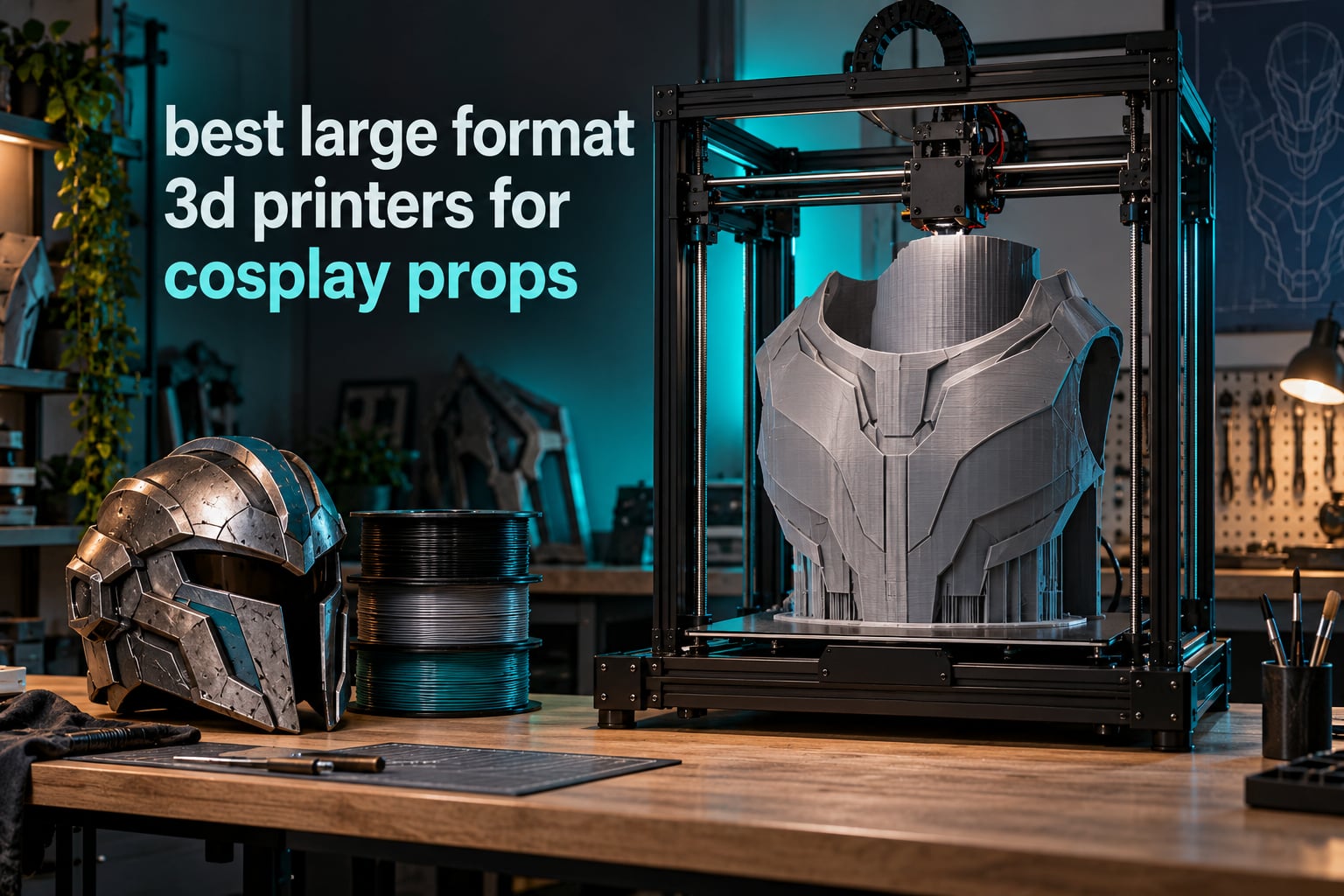
A chest plate that prints as one piece instead of four tiles glued together changes the whole build. So does a greatsword blade that comes off the bed in a single job rather than three spliced sections. That is the entire argument for a large format 3D printer, and it is why cosplayers keep asking which machine to buy first.
Most of the advice out there is a brand list. We took a different approach: we mapped real cosplay part dimensions to build volume, then compared twelve machines against the questions that actually decide a purchase. Can it print a full helmet? Does it survive ABS and ASA in a warm room? Will a beginner get it running in one evening, or spend a weekend troubleshooting?
Before the picks, here is the frame. Large format means a build volume above roughly 300 mm on at least one axis, so whole prop pieces fit in one job. Budget buyers mostly need pieces under 400 mm and can get by paneling. Multi-material builders want a second filament path. ABS and ASA users need a real enclosure. Everything below covers the best large format 3D printers for cosplay props available in 2026, and we have written it for people who will actually wear the result at a convention.
Table of Contents
Top 3 Best Large Format 3D Printers for Cosplay Props in 2026

Flashforge Creator 5 Pro
- 4 independent toolheads
- Zero-purge color changes
- 65C heated chamber
All 12 Large Format Printers Side by Side in 2026
Every machine below is listed with its real build volume so you can match it against the part you want to print. Use the button on any row to check the current listing details.
| Product | Specifications | Action |
|---|---|---|
| Sovol SV08 MAX |
|
Check Latest Price |
 Creality K2 Pro Combo Creality K2 Pro Combo |
|
Check Latest Price |
| Flashforge Creator 5 Pro |
|
Check Latest Price |
 Snapmaker Artisan Snapmaker Artisan |
|
Check Latest Price |
 Anycubic Kobra 3 Max Combo Anycubic Kobra 3 Max Combo |
|
Check Latest Price |
 Creality Ender 5 Max Creality Ender 5 Max |
|
Check Latest Price |
 Longer LK5 Pro Longer LK5 Pro |
|
Check Latest Price |
 Anycubic Photon Mono M7 MAX Anycubic Photon Mono M7 MAX |
|
Check Latest Price |
 Elegoo Jupiter 2 Elegoo Jupiter 2 |
|
Check Latest Price |
 QIDI Max4 Combo QIDI Max4 Combo |
|
Check Latest Price |
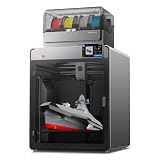 Anycubic Kobra S1 Max Combo Anycubic Kobra S1 Max Combo |
|
Check Latest Price |
 Phrozen Sonic Mega 8K S Phrozen Sonic Mega 8K S |
|
Check Latest Price |
If you are still narrowing the field, our general guides to the best 3D printers for cosplay and the best wide format printers are useful side reading for models outside this lineup.
1. Sovol SV08 MAX – The Largest Cube in the Lineup
Sovol SV08 MAX CoreXY 3D Printer, Voron 2.4 700mm/s High Speed 3D Printers
Build: 500x500x500mm
Speed: 700mm/s
CoreXY
Hotend: 300C
Pros
- 500mm cube prints oversized props in a single job
- Eddy current leveling removes manual bed work
- 300C hotend runs ABS ASA and PA
- Built-in HD camera for remote monitoring
Cons
- Heated chamber module sold separately
- 86.8 lb frame needs two people to move
- Early leveling and electronics faults reported
This is the machine we keep coming back to for a reason: a genuine 500 mm cube means a full chest plate, a pair of pauldrons, or a staff section all fit in one pass. Cosplayers printing oversized pieces run it exactly as intended, and the review pattern is consistent: big parts go down in a single job instead of being tiled and spliced.
CoreXY kinematics move only the toolhead, which is why it holds 700 mm/s and 40000 mm/s² acceleration without shaking tall prints out of alignment. That matters for armor, because a staff or a shin guard printed at full speed with a wandering gantry shows its ripples immediately under a satin primer.
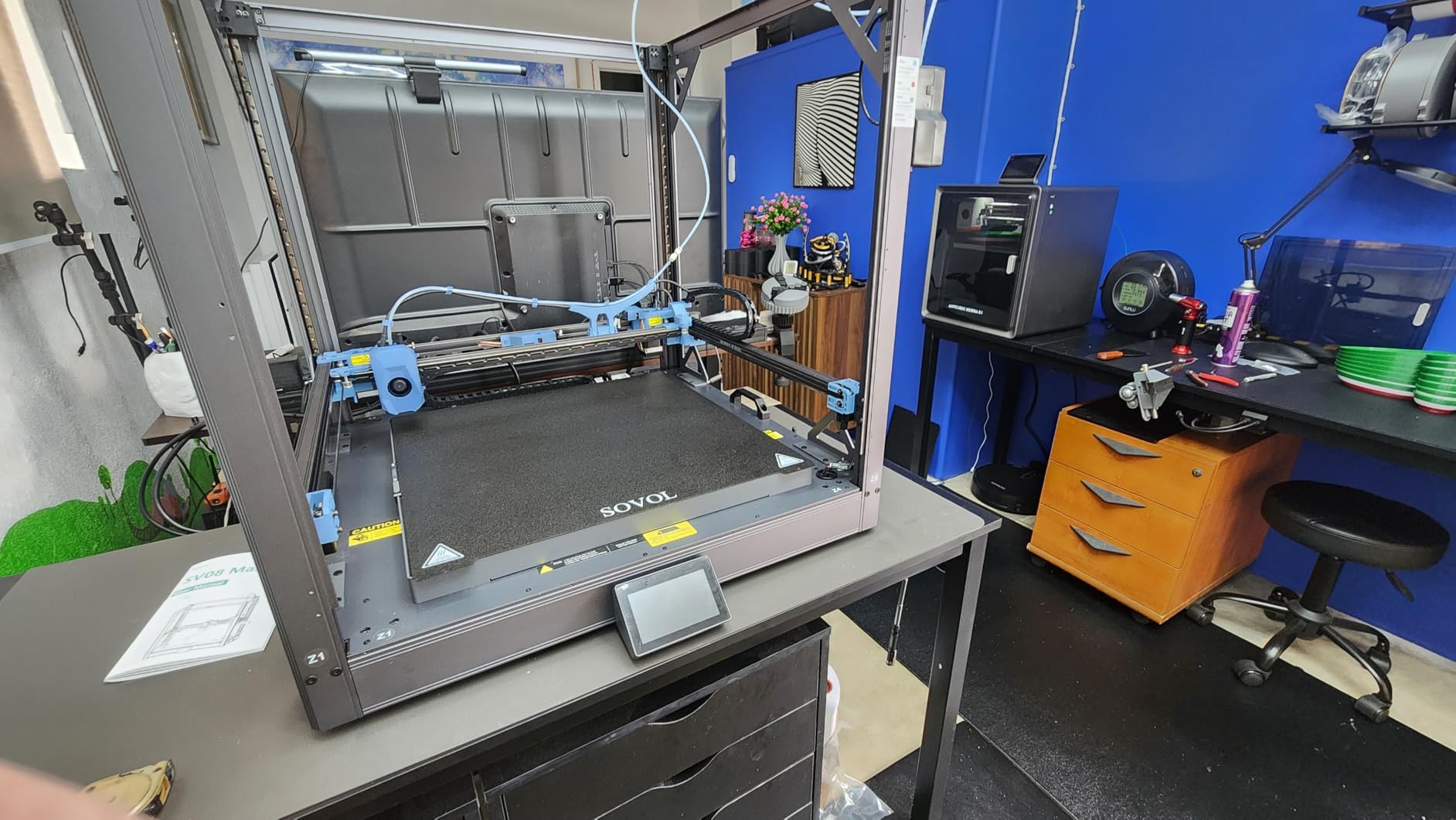
Bed setup is the part that usually spoils a first large print, and the eddy current scanning sensor handles it without manual work. Owners report a reliable first layer with no manual leveling, and the 1280×720 camera with time-lapse is genuinely useful for long overnight prop jobs you do not want to walk over every twenty minutes.
Filament support is the other strength. With a 300C hotend and a 50mm³/s flow nozzle, the machine handles PLA, PETG, TPU, ABS, ASA, PA, PC and carbon-fiber reinforced blends. If your design calls for a stiff PLA-CF armor panel, this is the machine that will not fight you.
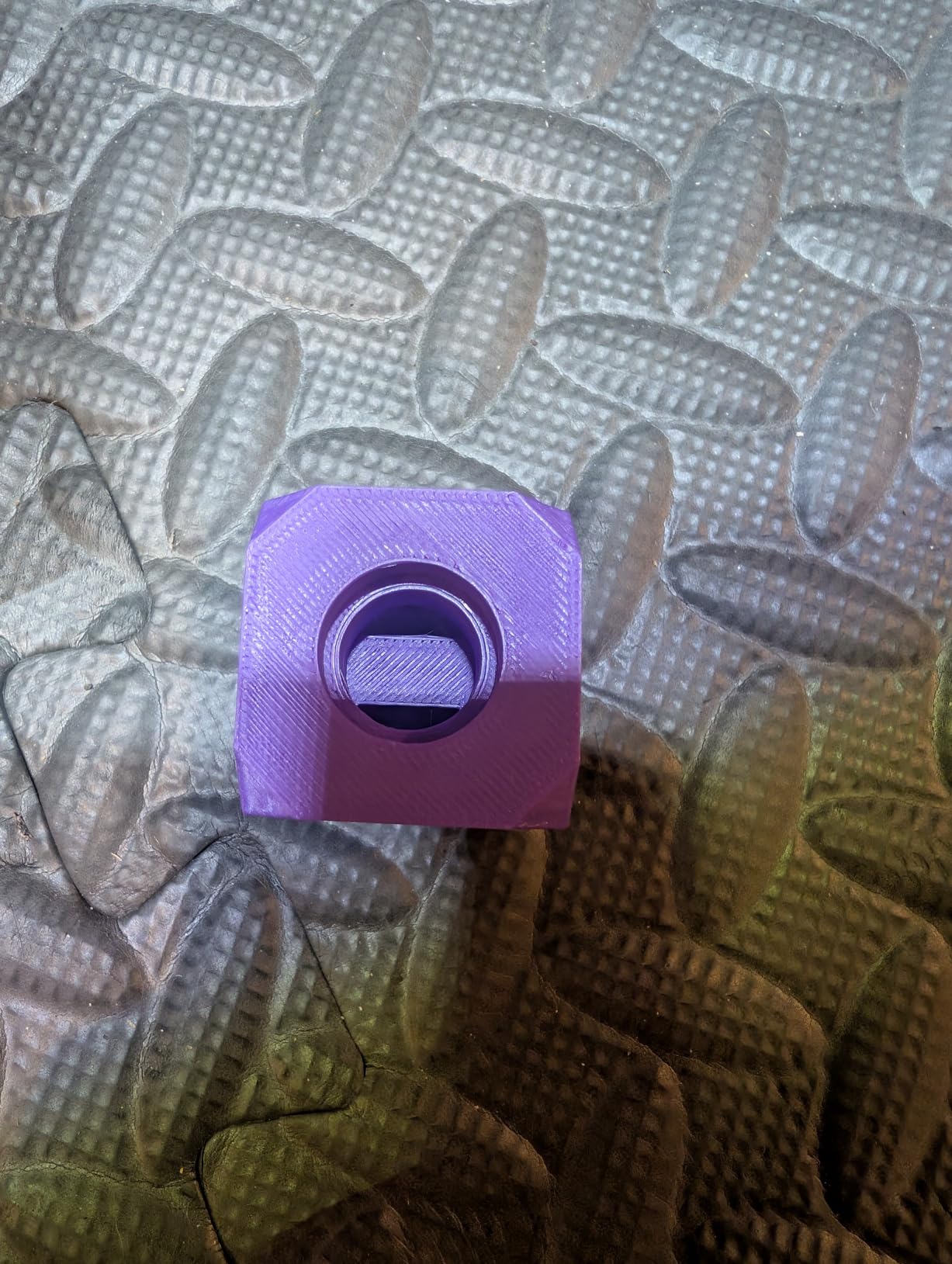
Who the SV08 MAX suits
It suits cosplayers whose parts simply do not fit anywhere else. A full helmet, a mech torso shell, or a greatsword blade at 800 mm can be printed flat in one piece rather than assembled from segments, which removes the weakest line on the finished prop.
It also suits anyone running ABS or ASA for outdoor heat tolerance, provided you budget for the heated chamber module separately. Owners comparing this against Creality and Sovol rivals repeatedly single out fast reliable motion and a bed that levels itself.
Where it falls short
It weighs 86.8 lb and the frame measures 28 x 27.6 x 29.5 inches, so you need a serious work surface and a second pair of hands to get it into position. Plan the placement before it arrives.
The heated chamber interface is reserved but the module is a separate purchase, and the Voron 2.4-based platform is complex for a first machine. Some owners also report early bed leveling, frame and electronic faults on earlier builds, so read the current reviews rather than the launch announcement.
2. Creality K2 Pro Combo – Best Value Enclosed Multi-Color
Creality K2 Pro Combo 3D Printer with CFS, 600mm/s, 300mm Build
Build: 350x350x350mm
Speed: 600mm/s
CFS included
Enclosed
Pros
- 350mm cube fits helmet and armor shells
- 16-color CFS expansion for paint schemes
- 0.05mm precision at 600mm/s
- Automatic bed leveling and Z-offset
Cons
- No third-party slicer support out of the box
- Firmware error cascades reported by some
- Strong off-gassing odor needs ventilation
The K2 Pro Combo has the largest review base of any machine here at more than 2100 ratings, and the sentiment is consistently positive on print quality and bed adhesion. For a cosplayer, the headline is the included CFS: multi-color props come out in one job instead of being painted section by section.
A 350 mm cube is not the biggest volume on this list, but it clears the dimension that matters most for costume work. Helmets, masks and armor shells print in one piece, and the aerospace-grade aluminum exoskeleton keeps the gantry rigid at 600 mm/s with 0.05mm precision.
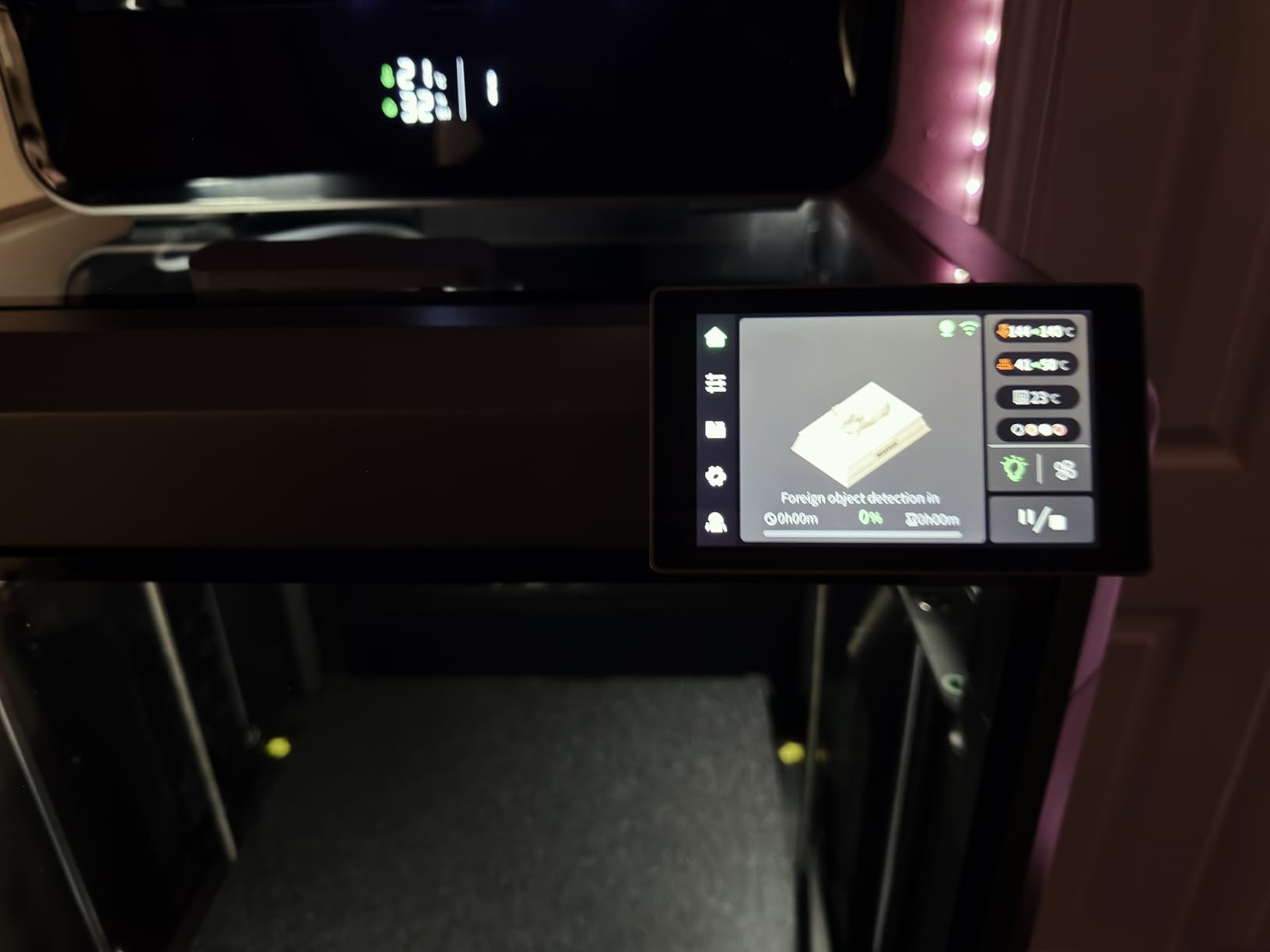
Bed adhesion is the underrated strength here. The textured side grips without glue, which matters when you are printing a wide flat chest plate that wants to lift at the corners. Dual AI cameras watch the toolhead and chamber, catching spaghetti failures before they waste a night.
The fully enclosed chamber with fan climate control is what lets you work in a room with air conditioning on a mild day, and step-servo motors with 32768 microsteps per revolution give unusually clean corners on curved shell surfaces.
Who the K2 Pro Combo suits
It suits cosplayers building multi-color props on a budget of conscience. The CFS is included and expands to four boxes for 16 colors, so a painted-style pauldron or a two-tone weapon can be printed as a finished color block before you prime.
It also suits people upgrading from an entry machine. Owners describe it as a large step up from Ender-series hardware in both quality and reliability, which matches what you see in our full 3D printer roundup.
Where it falls short
It launches with Creality’s own slicer and no third-party slicer support, which is a real limitation if you want to slice in a shared toolchain. That is a larger issue for resin-detail work than for standard FDM props.
Some owners hit a cascade of firmware errors covering nozzle, Z-homing, cutter and extrusion faults, and the machine gives off noticeable volatile odors during initial off-gassing. At 37.4 lb it also needs two people to move, and the CFS side-mount wants a 485 mm cable that is not in the box.
3. Flashforge Creator 5 Pro – Four Toolheads, Zero Waste Color Changes
FLASHFORGE Creator 5 Pro Multi-Color 3D Printer,4-Toolheads,Fully Enclosed
Build: 4 toolheads
Color change: 7s
Chamber: 65C
600mm/s
Pros
- Four toolheads print multi-color in one pass
- Zero-purge design wastes no filament on swaps
- 65C chamber handles ABS ASA PC and Nylon
- HEPA 13 plus carbon filtration
Cons
- Four-toolhead architecture has more failure points
- Bulkier footprint than single-extruder machines
- Newer platform with a smaller troubleshooting base
The Creator 5 Pro is the most interesting machine here for anyone tired of single-color armor. Four independent toolheads mean a prop with a painted pattern, or a two-material piece, prints in one pass with no manual swap pauses in the middle of an eight-hour job.
The zero-purge design is the detail that matters financially. Conventional multi-extruder machines flush filament on every color change, and on a large prop that waste adds up fast. Owners highlight the absence of purge waste as a direct cut to material cost per build.
The 65C actively heated chamber and 120C bed cover ABS, ASA, PC and Nylon properly, not nominally. That is the difference between a prop that stays rigid in a summer convention hall and one that softens and sags in the queue line.
Noise is another quiet win. At 55 dB or under, it is one of the few machines here you can run overnight in a room you sleep in, which matters for anyone with a deadline and a day job.
Who the Creator 5 Pro suits
It suits cosplayers with a specific design brief: a prop that genuinely needs multiple materials or a real color pattern in one print rather than a paint job. For a costume with a hard color split, this saves more finishing time than any other machine on the list.
It also suits anyone printing engineering-grade thermoplastics at home, because the heated chamber is built in rather than sold as an add-on.
Where it falls short
Four toolheads are mechanically more complex than a single extruder, and complexity means more failure points over thousands of print hours. At 20.35 x 21.06 x 19.5 inches and 39.6 lb, it is also bulkier than single-toolhead enclosed machines in the same class.
It is a newer platform, so the community troubleshooting base is smaller. Automatic toolhead offset calibration and flow compensation handle most of it, but a brand-new failure mode will have fewer forum answers than a mature machine.
4. Snapmaker Artisan – Modular Workshop With a 400mm Cube
Snapmaker Artisan 3D Printer,Dual Extrusion 3D Printing,400x400x400mm Large Printing Size,Industrial-Grade Linear Rails Auto Bed Leveling,Quick Swap Modular Design,with 7″ Touchscreen
Build: 400x400x400mm
Dual extrusion
7 inch screen
Linear rails
Pros
- 400mm cube in a desktop-class footprint
- Dual extrusion prints two materials at once
- Steel linear rails improve rigidity and precision
- 7 inch touchscreen for profile-heavy work
Cons
- 79.8 lb weight with a very large footprint
- Older design generation compared with newer enclosed rivals
- Dual laser and CNC modules sold separately
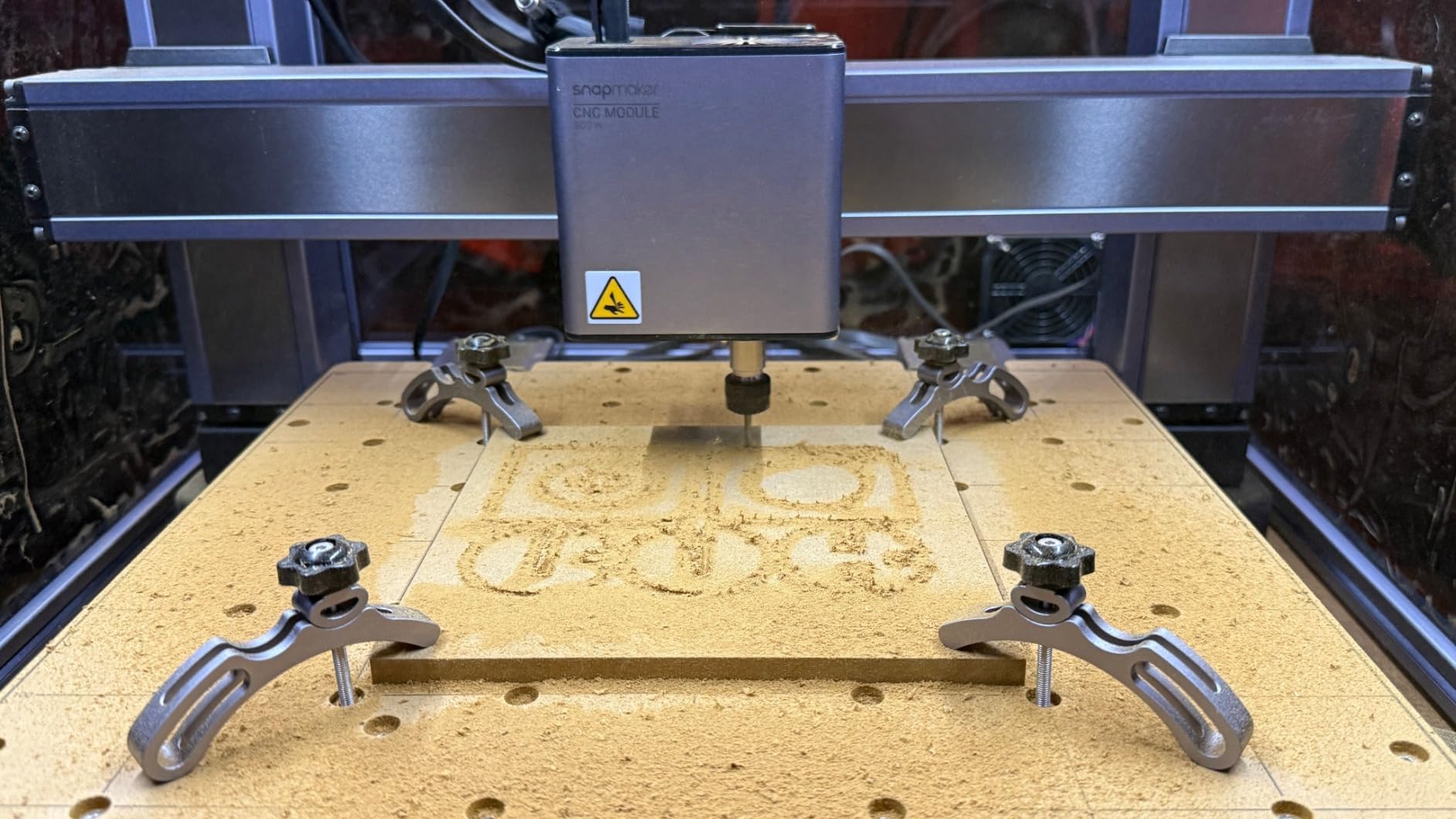
The Artisan is the odd one out here, and that is the point. It is a 3D printer, laser engraver and CNC machine in one chassis, with quick-swap toolheads and platforms. If your cosplay build ends in etched trim, engraved plates or cut acrylic, the same box handles it.
The 400 mm cube is genuinely useful, and reviewers consistently praise it for large multi-part jobs. Dual extrusion with 7:5:1 planetary gearing prints two materials or colors in a single pass, which is how you get a two-tone helmet without splitting the file.
CNC-ground steel linear rails are the spec that changes print quality at this size. Bed slingers and plastic-wheel gantries flex under load, and on a 400 mm print that flex shows up as a wavy surface you have to sand out before primer will sit flat.
The 7-inch touchscreen is larger and more readable than most competitors, and free 3-in-1 software covers printing, laser engraving and CNC machining in one interface.
Who the Artisan suits
It suits the cosplayer whose build has moved past printing into finishing. Detailing stencils, engraved insignia, cut base plates and leather tooling all fall inside one machine, which removes the need to book shop time.
It also suits anyone who wants a 400 mm cube and cares about surface precision more than color capability. Dual extrusion covers the simple two-material case without four toolheads of complexity.
Where it falls short
With 25 ratings, the feedback pool is thin, and the 3.8 average reflects that the price and the older design generation pull it below the lineup average. Judge it on the volume and the tooling, not on the review count.
At 79.8 lb and 24.41 x 22.83 x 24.96 inches it needs real floor space, and the laser and CNC modules are separate purchases that raise the total considerably. Its design generation is being compared against newer enclosed machines.
5. Anycubic Kobra 3 Max Combo – Best for Beginners With a Tall Chamber
Bundle Anycubic Kobra 3 Max Combo 3D Printer, Support Multi Color Printing 600mm/s High-Speed Printing, Large Build Volume 420x420x500mm, Auto Leveling & Smart Vibration Compensation PEI Plate
Build: 420x420x500mm
Speed: 600mm/s
Hotend: 300C
PEI plate
Pros
- 420x420x500mm handles tall helmet props in one piece
- 600mm/s with G-sensor compensation
- PEI spring steel plate grips and releases easily
- Runout auto-pause and power loss resume
Cons
- Small review base means limited long-term field data
- Slicer lock-in with limited third-party support
- Feeder jamming reported on complex multi-color jobs
The Kobra 3 Max Combo is the value answer in this lineup, and the number that sells it is height. A 500 mm Z axis means a tall helmet, a full greave set or a staff section prints upright in one job, which is where many costume prints fail first.
The G-sensor vibration compensation and 20000 mm/s² acceleration keep layer shifts off complex large models at 600 mm/s. The dual-sided PEI spring steel plate gives strong adhesion for big flat panels and easy release once the bed cools.
For filament it covers the common cosplay range with an all-metal 300C hotend: PLA, PETG and TPU all run without difficulty, and the swappable 0.4mm nozzle means you can move to a larger one when a wall-heavy armor print calls for it.
Offline printing mode plus power loss resume are practical rather than flashy. A long chest plate print can run unattended overnight and pick back up after an interruption instead of restarting from zero.
Who the Kobra 3 Max Combo suits
It suits first-time large-format builders who want the most volume they can get in one machine and still need simple multi-color. The combo bundle includes a multi-color unit, so a two-tone prop does not need a second purchase.
It suits cosplayers who work primarily in PLA and PETG. Both are the default materials for costume armor, and neither needs an enclosure on a machine this size.
Where it falls short
With 38 ratings there is far less long-term field data than the mature models here, so you are buying on specification rather than accumulated owner history. Read recent reviews before committing.
Anycubic slicer lock-in is the recurring complaint, along with filament sensor false positives and feeder jamming on long color-heavy jobs. Some machines also arrive with mechanical issues that stop printing circles entirely. Budget for a support ticket in week one.
6. Creality Ender 5 Max – 400mm Cube Built for Print Farms
Creality Ender 5 Max 3D Printer 400×400×400mm Large Build Volume, 700mm/s Fast Printing Speed, 64-Point Auto Leveling, All-Metal Frame & Dual Gear Extruder, Multi-Printer Control Over WLAN
Build: 400x400x400mm
Speed: 700mm/s
CoreXY
64-point leveling
Pros
- 400mm cube handles helmet and armor shells
- 700mm/s CoreXY on large single-color prints
- 64-point auto leveling and auto Z-offset
- Die-cast frame with X-axis linear rail
Cons
- No enclosure so ABS and ASA need an add-on
- Warped beds and early unit failures reported
- Vibrates noticeably in use
The Ender 5 Max is a 400 mm cube with print-farm intentions. WLAN grouped management lets you queue jobs across several machines from one interface, and the dual gear extruder is engineered for continuous operation rather than occasional weekend hobby use.
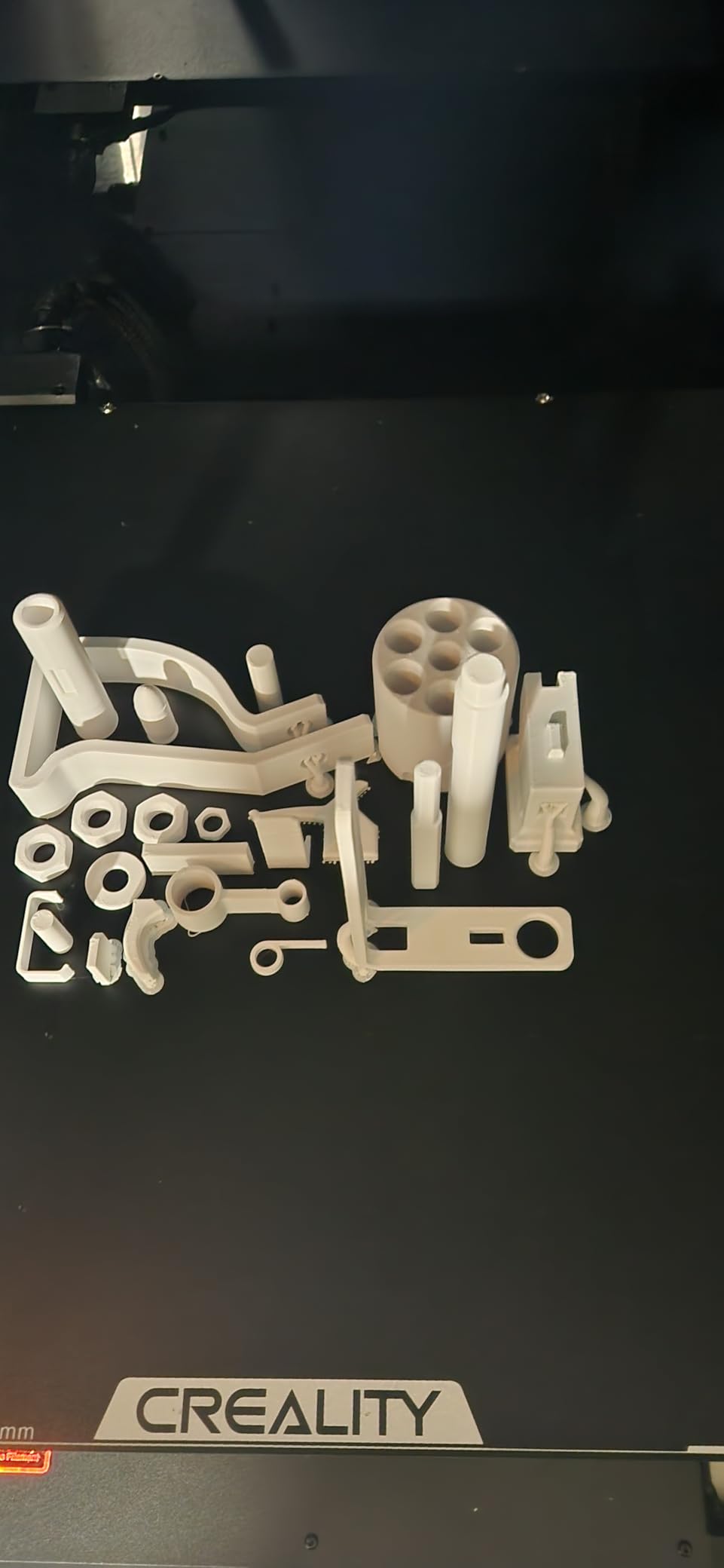
Reviewers split sharply on this one, and the split is worth understanding. Owners who paired it with an enclosure call it a dependable workhorse that prints helmets and multi-color props well, while a second group reports warped beds, non-adhesion and machines breaking during early prints.
On the positive side, the rigid die-cast aluminum frame with a precision X-axis linear rail holds up for tall or heavy models, and 64-point auto leveling with automatic Z-offset removes manual bed work from every job.
The 1000W rapid-heating bed gets to temperature quickly, which cuts the dead time at the start of a long print. Materials run across PLA, PETG, ABS, ASA and PA once dialed in, including PETG-CF for stiffer panels.
Who the Ender 5 Max suits
It suits cosplayers who have already printed small and now want helmet-and-armor volume at a mid-range outlay, and who are comfortable adding an enclosure later. The 400 mm cube is the practical sweet spot most people land on.
It suits people running more than one machine, because grouped WLAN control and a dual gear extruder are built for throughput rather than a single hero print.
Where it falls short
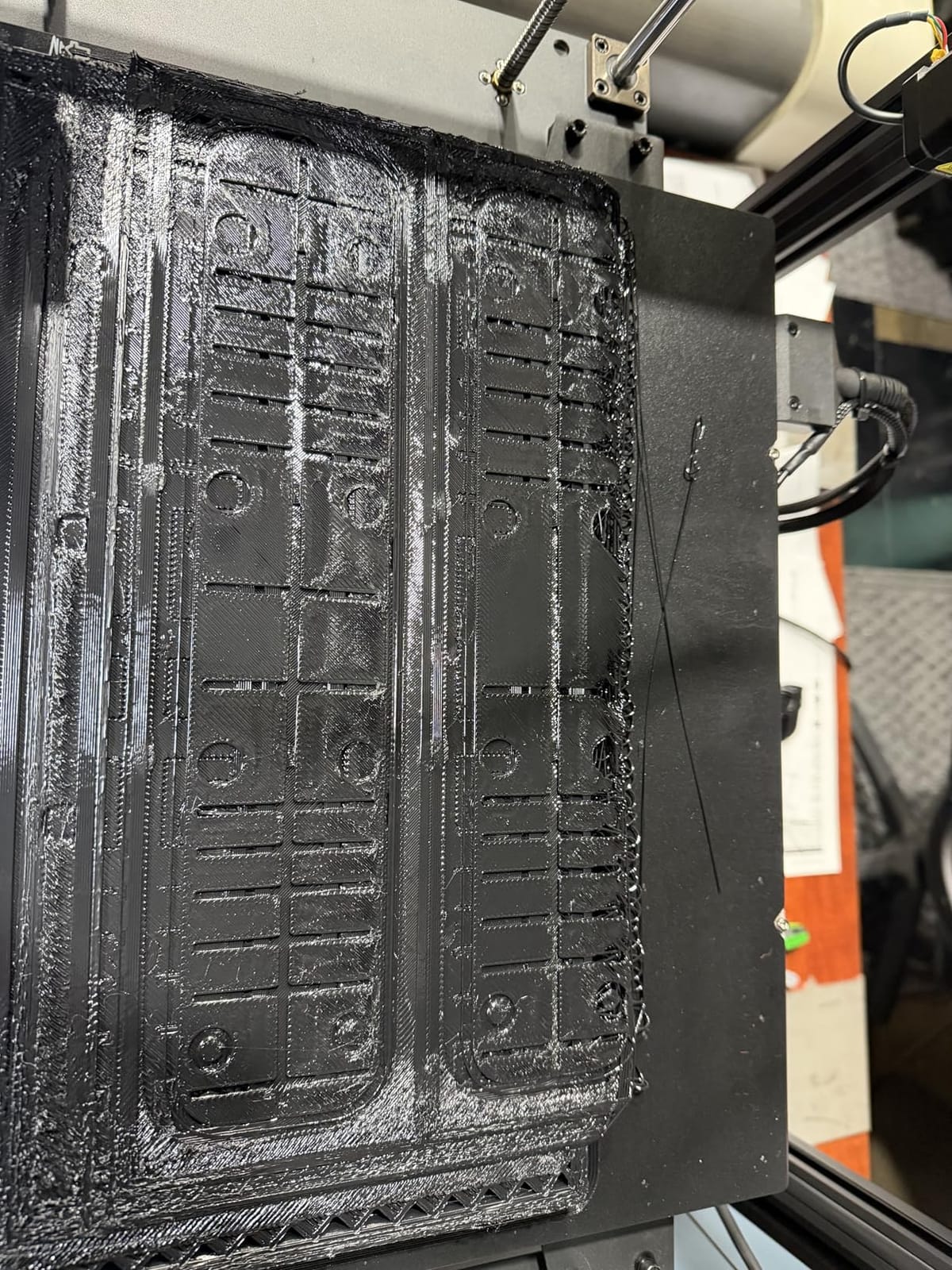
It arrives with no enclosure, so ABS and ASA need an add-on before you can print them properly. Several owners report warped beds, failing build plates and broken machines within weeks, which is what pulls the rating down.
It also vibrates noticeably and the front panel button area is reported to wobble. Creality’s slicing presets are criticized by multiple reviewers, and replacement parts are slow to source.
7. Longer LK5 Pro – The Easiest Way Into Large Format
LONGER LK5 Pro 3 3D Printer, 11.8×11.8×15.7in Large Printing Size with Resume Printing FDM 3D Printer Fully Open Source Motherboard Upgrade TMC 2209 3D Printers 95% Pre-Assembled Ideal for Beginners
Build: 300x300x400mm
90% assembled
TMC silent drivers
Lattice glass plate
Pros
- 300x300x400mm suits real cosplay armor parts
- 90 percent pre-assembled and printing quickly
- Open-source motherboard with a strong mod community
- Silent TMC drivers for bedroom use
Cons
- Open frame makes ABS difficult
- Slow bed warm-up and filament loading
- Filament runout sensor is fragile
The LK5 Pro is the answer to the most common beginner question on the forums: what do I buy if I have never owned a large printer and I am slightly afraid of assembly. It arrives 90% built, and owners report printing within roughly half an hour of opening the box.
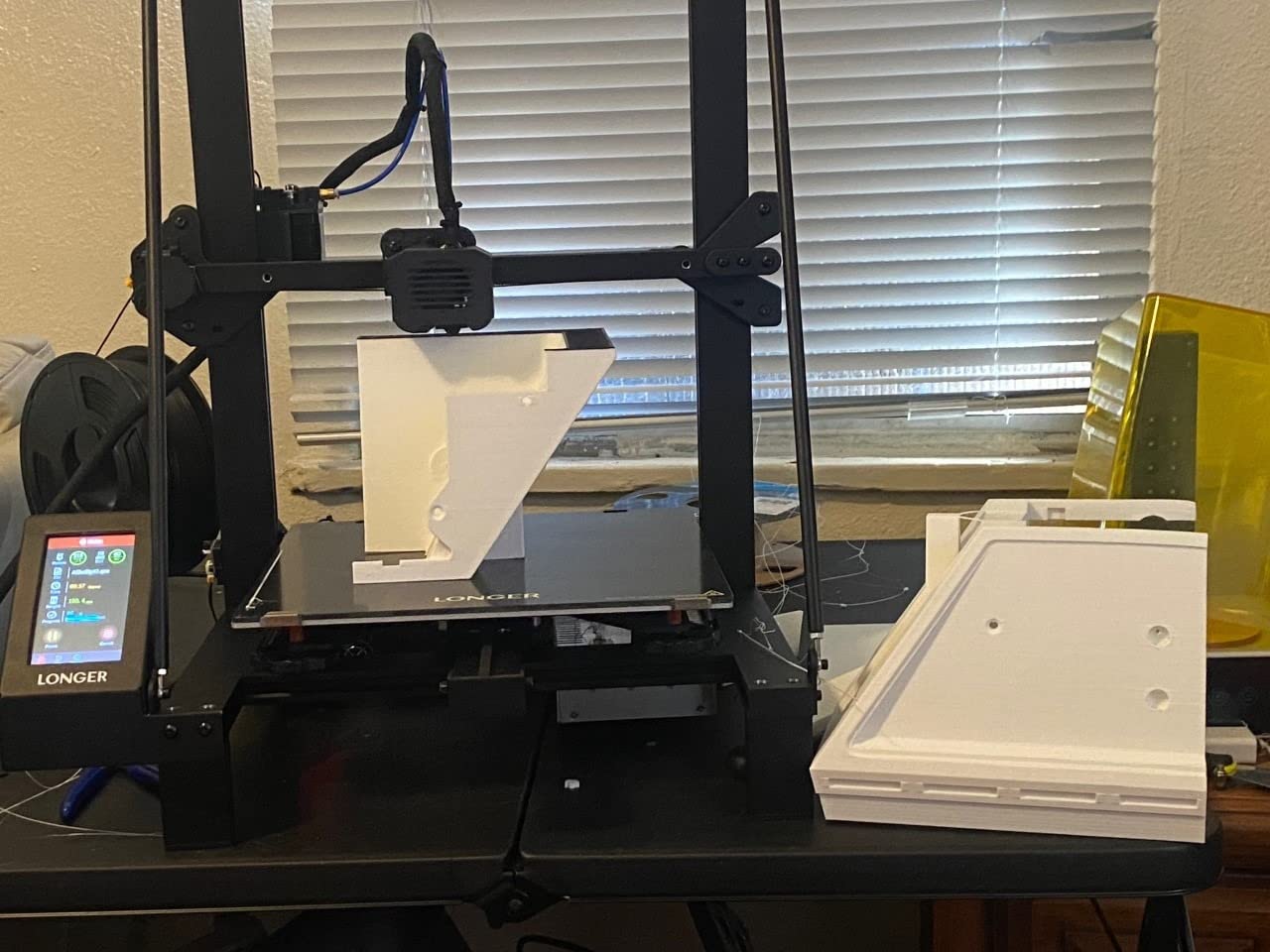
A 300 x 300 x 400 mm volume is more useful for cosplay than the spec sheet suggests. That is enough for a single armor panel, a pauldron, a forearm guard or a mask at real scale, which covers a lot of a build before you ever need to panel anything.
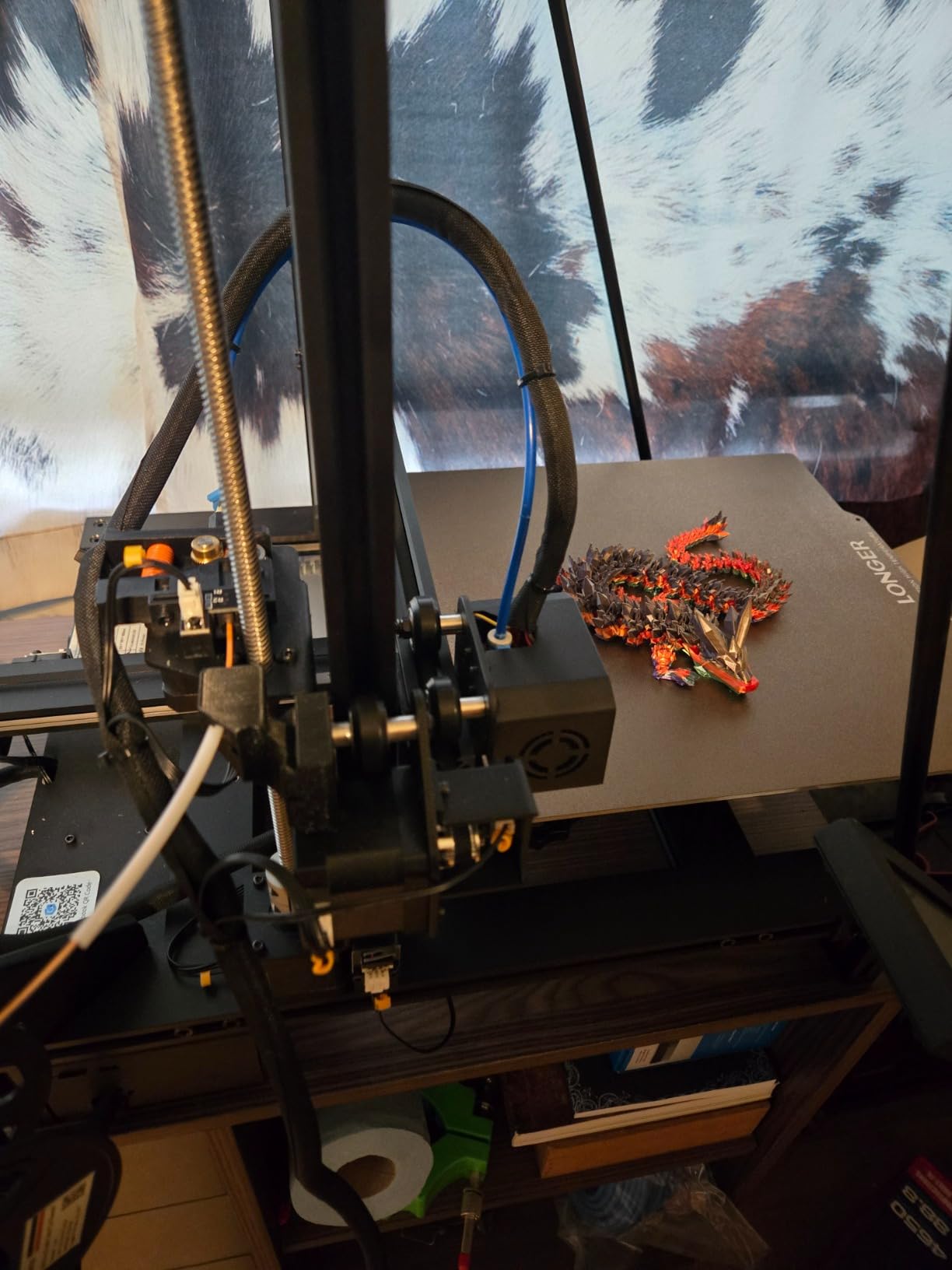
The reinforced diagonal rods form a triangular structure that resists frame twist better than a plain cube, and the 4.3-inch full-color touchscreen plus large leveling knobs make manual setup straightforward if the sensor does not nail it on the first try.
It is also a machine you can grow with. The open-source motherboard with TMC2208 and TMC2209 drivers has a strong community mod scene, and BLTouch mounting points are provided even though the sensor is not included.
Who the LK5 Pro suits
It suits first-time builders and anyone printing mostly PLA and PETG costume pieces. The open frame is a non-issue for those materials, and the open-source firmware means you are not locked into a vendor slicer.
It also suits anyone who wants quiet operation in a shared space. Silent step drivers reduce noise during printing, and at 29.2 lb it is the most manageable machine in this roundup to move between rooms.
Where it falls short
The open frame is the real limitation. ABS and warp-prone materials are difficult on it, so if your design depends on heat tolerance you should add an enclosure or look at a closed machine instead.
Bed warm-up and filament load times are notoriously long, which quietly adds hours across a full armor set. The runout sensor is fragile and needed replacing on some units, printing occasionally stops with no message until a reboot, and replacement parts take time to arrive.
8. Anycubic Photon Mono M7 MAX – Top Rated for Fine Prop Detail
ANYCUBIC Resin 3D Printer, Photon Mono M7 MAX 13.6-inch 7K Mono LCD
Build: 298x164x300mm
7K mono LCD
46 micron pixels
60mm/h
Pros
- 7K mono LCD at 46 micron pixel size
- 298x164x300mm prints large models in one piece
- Heated 1300ml resin vat improves success rate
- Flip-top lid makes big models easy to remove
Cons
- MSLA workflow needs washing and curing
- Noticeable resin odor
- Undersized bundled wash and cure station
Everything in this roundup is filament except this one, and that is the point. Resin is not a substitute for large format, but it is the answer when the detail is in the surface: scale texture, chainmail, engraved trim and character line work on a mask.
It carries the highest owner satisfaction of any machine here, and the reason is the combination of a 13.6-inch 7K mono LCD at 46 micron XY pixel size with a 298 x 164 x 300 mm build volume. That is a large plate for a printer of this class, and owners say it handles big models without splitting and splicing.
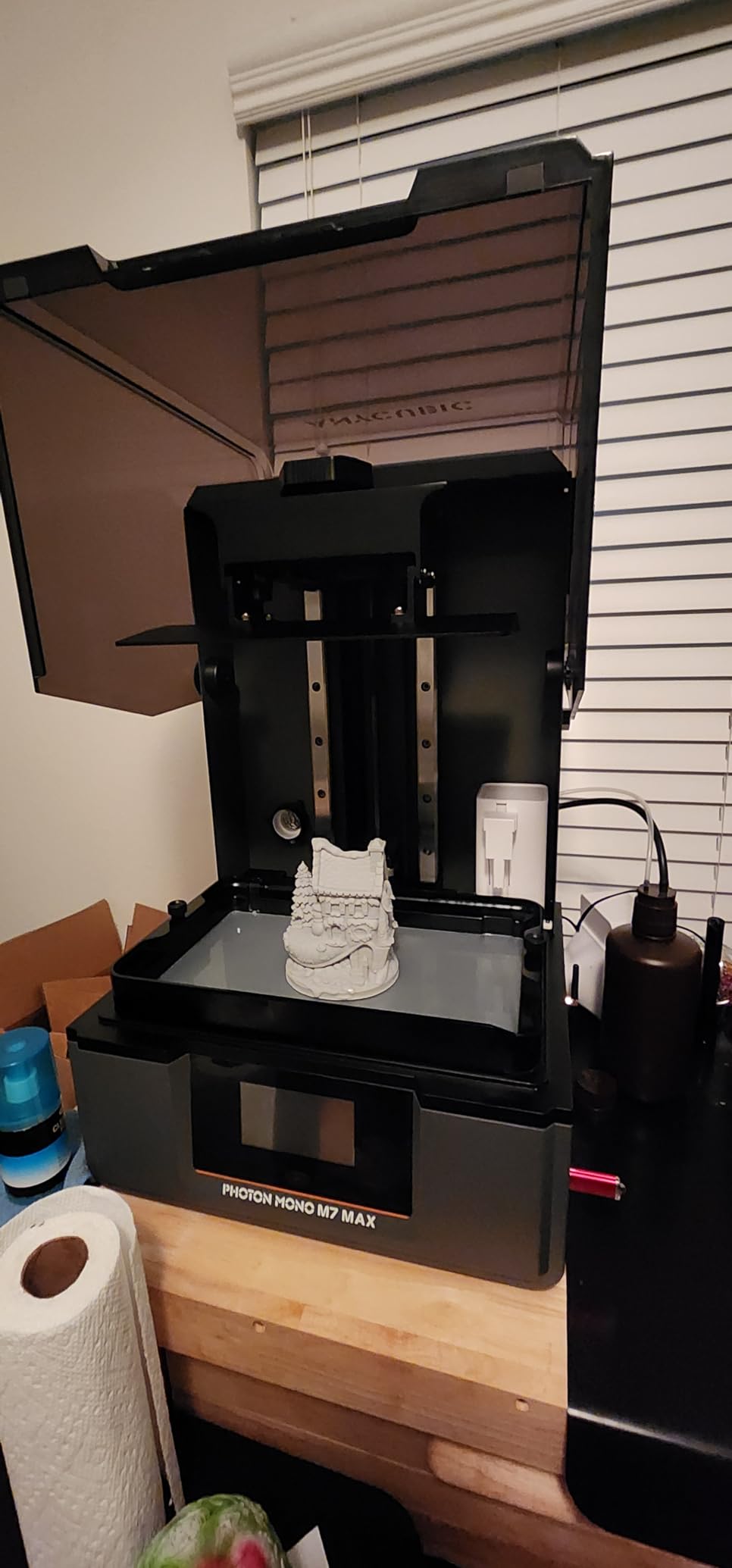
The temperature-controlled 1300ml vat and five intelligent self-check systems, including residual resin and failed print detection, cut the failure rate on long jobs. The flip-top lid is a small thing that matters enormously when you are removing a large mask without flexing it.
Print speed runs up to 60 mm/h, which owners describe as quick for a machine this size, and reported reliability is high once the machine is dialed in.
Who the Photon Mono M7 MAX suits
It suits cosplayers who have hit the ceiling of FDM surface detail and want a printable prop finish that takes primer and paint beautifully. Fine armor texture is exactly what a 46 micron pixel captures and a 0.4mm nozzle cannot.
It also suits anyone who prints helmets or masks, because the depth of field and edge definition make a resin shell look noticeably more like a screen-used prop.
Where it falls short
The MSLA workflow adds work. Every print needs washing and curing, and some resins stay tacky afterward, so the post-processing time is part of the cost of the process. Resin odor is noticeable, and the pump-based self-cleaning and resin loading are slow.
The bundled wash and cure station may be too small for the large build plate, the build plate is heavy and hard to scrape prints from, and the slicer is proprietary. Our resin printer guide covers the safety gear and ventilation setup in more depth.
9. Elegoo Jupiter 2 – 16K Detail at the Cost of Reliability
ELEGOO Jupiter 2 Large 16K Resin 3D Printer
Build: 302.4x161.98x300mm
16K LCD
20x26 micron
Vat heating
Pros
- 16K resolution at 20x26 micron for fine detailing
- Multi-point auto leveling with real-time feedback
- Heated vat and auto resin feeding cut failures
- Quick-swap PFA release film is economical
Cons
- Lowest average rating here at 3.6
- Repeated LCD and board failure reports
- Auto leveling can report success while adhesion fails
The Jupiter 2 is the sharpest resolution in this roundup at 16K and 20×26 micron XY, and it prints at 302.4 x 161.98 x 300 mm. For a cosplay prop that lives or dies on fine surface texture, that resolution is the argument for the machine.
Buyers who dial it in report superb print quality and huge usable volume. The fully enclosed light source eliminates light leaks, the vat holds 30C, and automated resin feeding reduces failed long prints. Wi-Fi cluster management suits running several machines.
The PFA release film is worth noting. Competing films are expensive to replace, and a tool-free quick-swap film change means you are not paying for a fresh membrane every time something goes wrong mid-build.
The HDR camera with real-time monitoring and time-lapse is useful for long resin jobs where you want to know an hour in whether the run is viable, and the smart mechanical sensor alarms on resin shortage, residue and leveling failure.
Who the Jupiter 2 suits
It suits detail-focused cosplayers who print display pieces rather than wearable armor. A 16K plate is the right tool for a small highly detailed prop where filament layer lines would show under gloss paint.
It also suits people running resin in volume, since automated resin feeding and cluster management are aimed at repeat production rather than one-offs.
Where it falls short
This is the most polarized machine here, with the lowest average rating at 3.6 and 27% one-star reviews. Reports of LCD screen failures, chip and fit problems, an auto resin pump that runs when it should not, and auto leveling that reports success while adhesion still fails on one side of the plate.
Instructions and slicer software are criticized as underdeveloped. At nearly 3 feet tall with the top removed to access the build plate, it is also awkward to handle in a home space.
10. QIDI Max4 Combo – Engineering Filaments in a Cosplay Chassis
QIDI Max4 Combo 3D Printer, 390×390×340mm Build Volume, 65℃ Heated Chamber
Build: 390x390x340mm
Speed: 800mm/s
Chamber: 65C
40mm3/s hotend
Pros
- 390x390x340mm handles full-size helmets and armor
- 800mm/s is the highest quoted speed here
- 65C chamber with a high-temp hotend for PC and nylon
- Works out of the box with no manual calibration
Cons
- Heaviest machine here at 120 lb
- Some arrivals had a jammed toolhead assembly
- Polar Cooler and QIDI BOX sold separately
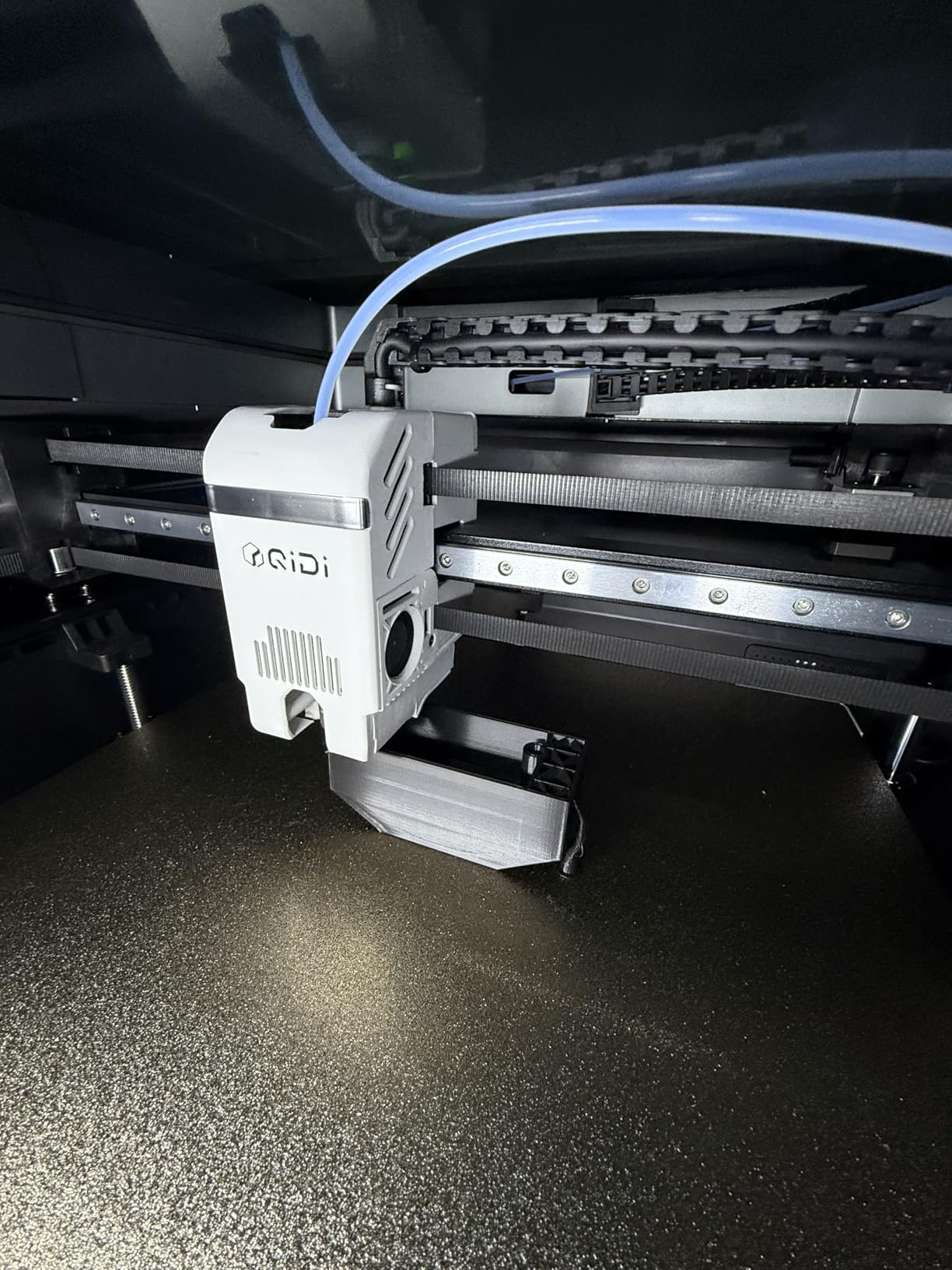
The Max4 is the enthusiast pick, and owners are unusually enthusiastic about it. Several reviewers compare it favorably against Sovol and Creality machines on reliability, out-of-box setup and how fast support responds, including next-day parts.
The numbers back that up. A 390 x 390 x 340 mm volume handles full-size helmets and armor in one piece, 800 mm/s is the highest quoted print speed in this roundup, and the 65C actively heated chamber with a 40mm³/s high-flow hardened hotend prints ABS, PC, CF nylon and PPS-CF.
Closed-loop motors on the X and Y axes plus a 2mm lead screw with an anti-backlash Z nut are what produce the surface quality. On a large prop those are the specs that decide whether the part needs light filling before primer or goes straight to sanding.
It also works without manual leveling or calibration fiddling, uses a full-surface silicone heated bed, and has a built-in AI camera with anomaly detection and auto-pause for long unattended prop builds.
Who the Max4 Combo suits
It suits cosplayers who want the strongest machine here for heat-tolerant materials. A convention hall in July is the test, and a 65C chamber plus a high-temperature hotend is the answer for ASA, PC and reinforced filaments.
It also suits anyone who values surface quality over features. Closed-loop motion and the anti-backlash Z are the difference between a print that sands flat in an hour and one that takes a weekend.
Where it falls short
At 120 lb it is the heaviest machine in this roundup and needs a purpose-built heavy table. The frame measures 28 x 28 x 30 inches, so this is a workshop purchase, not a bedroom one.
Some units arrived with a jammed toolhead assembly that could not extrude at all, the QIDI BOX multi-spool unit is noisy and does not auto-switch on runout, and the Polar Cooler must be bought separately for the Max4 series. Instructions are sparse for a machine this complex.
11. Anycubic Kobra S1 Max Combo – Enclosed Four-Color Starter
Anycubic Kobra S1 Max Combo 3D Printer, Large Build Size 350x350x350 mm³
Build: 350x350x350mm
Chamber: 65C
Hotend: 350C
4 colors
Pros
- 350mm cube prints one-piece helmets
- ACE 2 Pro gives 4 colors with built-in drying
- 65C chamber and 350C hotend for ABS ASA and TPU
- LeviQ 3.0 49-point auto leveling
Cons
- Locked to the Anycubic slicer
- Lightweight plastic build for the size
- Errors on long prints with many color changes
The Kobra S1 Max is the middle path between a single-extruder enclosed machine and a four-toolhead machine. The 350 mm cube with an all-metal CoreXY frame gives you one-piece helmets instead of split files, and the ACE 2 Pro handles four colors out of the box with built-in filament drying.
That drying matters more than it sounds. ABS and ASA printed with wet filament bubble and pop, and a printer that dries its own filament removes one of the most common causes of failed costume prints.
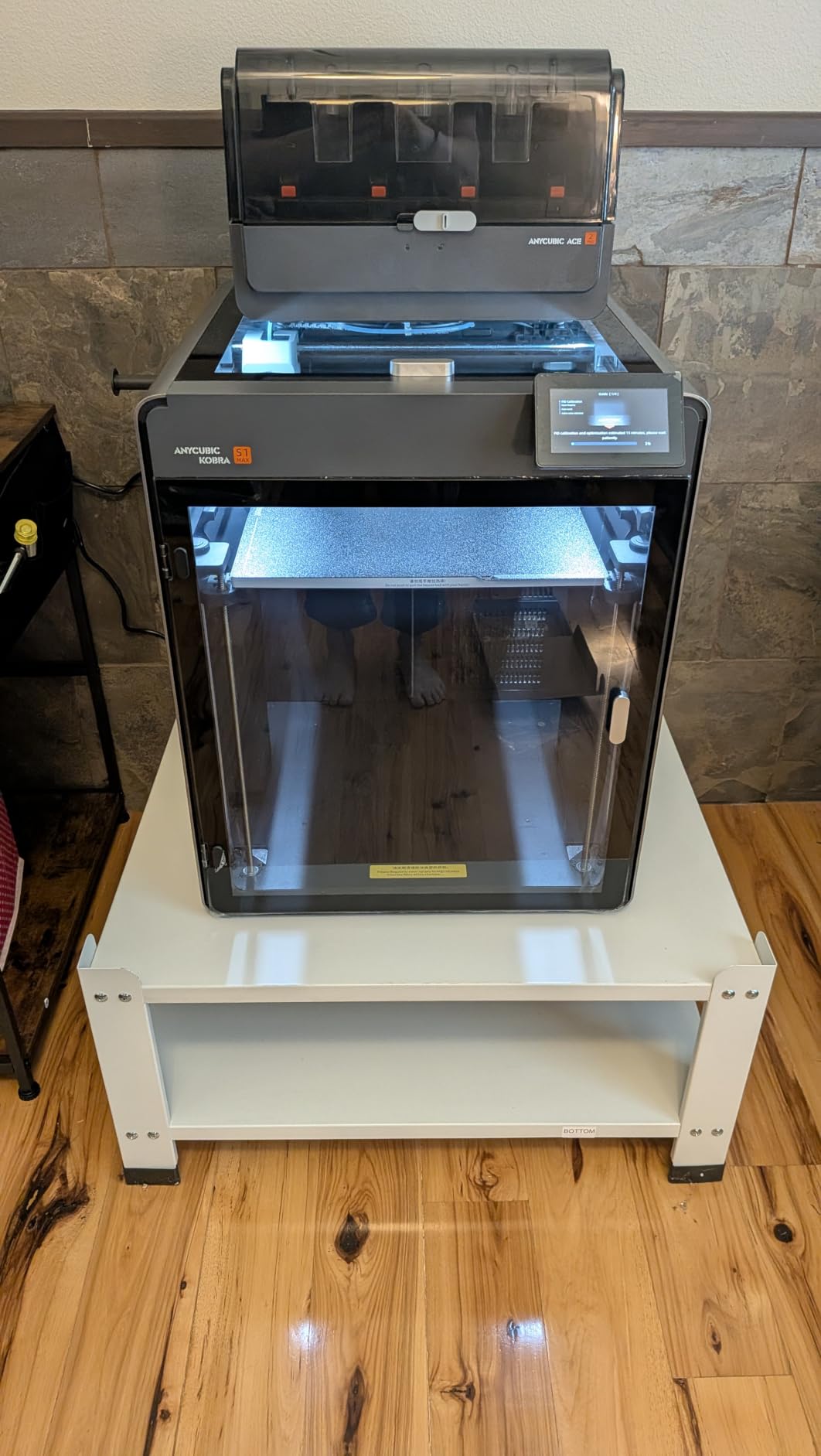
The 65C chamber and 350C hotend cover ABS, ASA, PVA, TPU, PLA and PETG, and CoreXY motion eliminates shaking on tall models, which matters when a staff or a greave prints at full height.
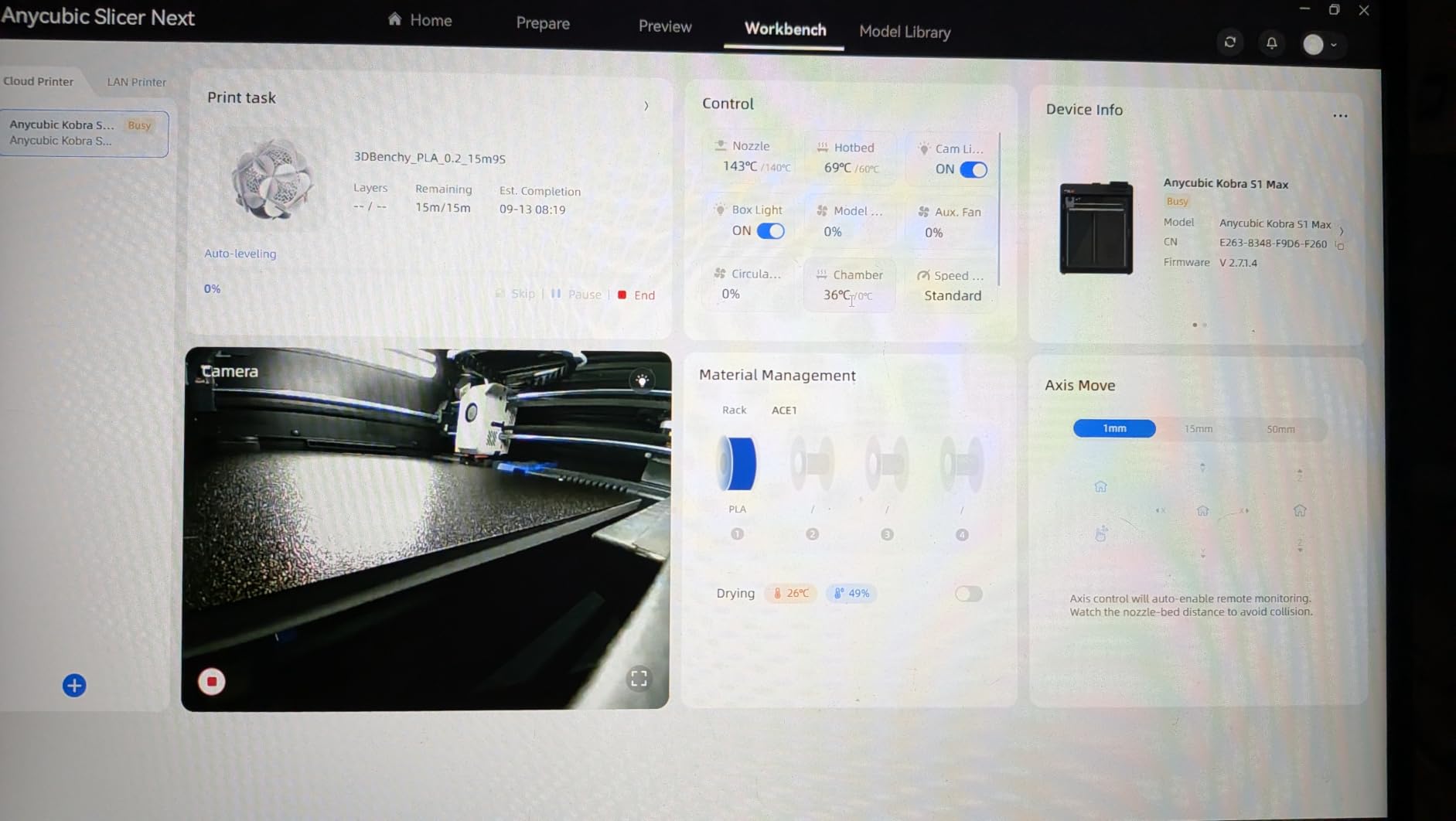
LeviQ 3.0 49-point auto leveling with flow dynamics calibration handles first-layer reliability, and experienced Anycubic owners report setup in under 10 minutes with clean layers and no splitting between PLA, PETG and ABS.
Who the Kobra S1 Max Combo suits
It suits cosplayers who want multi-color and ABS in one machine without the footprint or complexity of a four-toolhead system. Four colors covers most prop paint schemes, and the system expands to 16 if you outgrow it.
It also suits anyone who runs a print farm of these; several owners run multiple Kobra S1 Max units together. If you are new to Anycubic, our beginner’s buying guide covers how to plan a first large print.
Where it falls short
It is locked to the Anycubic slicer with no third-party support, and that is a real constraint for people with an existing slice workflow. Some buyers also dislike the lightweight plastic construction at this size.
Multi-hour prints with many color changes can trigger repeated errors and waste filament, and the AI failure detection frequently misfires and misidentifies filament runs. A feeder tube kink and filament sensor false positives are also reported, along with a larger-than-expected footprint for a home shop.
12. Phrozen Sonic Mega 8K S – Resin Batch Production
phrozen Sonic Mega 8K S LCD/MSLA Resin 3D Printer, 43 µm High Resolution, 15 inch Mono LCD Screen, Fast Production Accurate Details, Large Printing Size L12.99xW7.28xH11.81 Printing Volume
Build: 330x185x300mm
15 inch 8K LCD
43 micron
80 prints in 90 min
Pros
- 330x185x300mm plate handles genuinely large parts
- 15-inch 8K mono LCD at 43 micron
- ACF film improves high-speed success rates
- Integrated drip hanger cleans resin handling
Cons
- No Wi-Fi camera or auto leveling
- No vat heater or built-in air filtration
- Electronics failure reports and a short warranty
The Sonic Mega 8K S is a specialist tool rather than a generalist. Experienced resin makers rate it highly on raw size and batch production, calling it a machine for big, bold prints rather than fine miniatures, and the 330 x 185 x 300 mm plate is the largest footprint in this resin group.
Throughput is the headline: up to 80 x 1/32 scale miniatures in 90 minutes. Repurpose that plate for a batch of identical armor details, badges or repeated costume trim and the economics of resin printing start to work for a cosplay build.
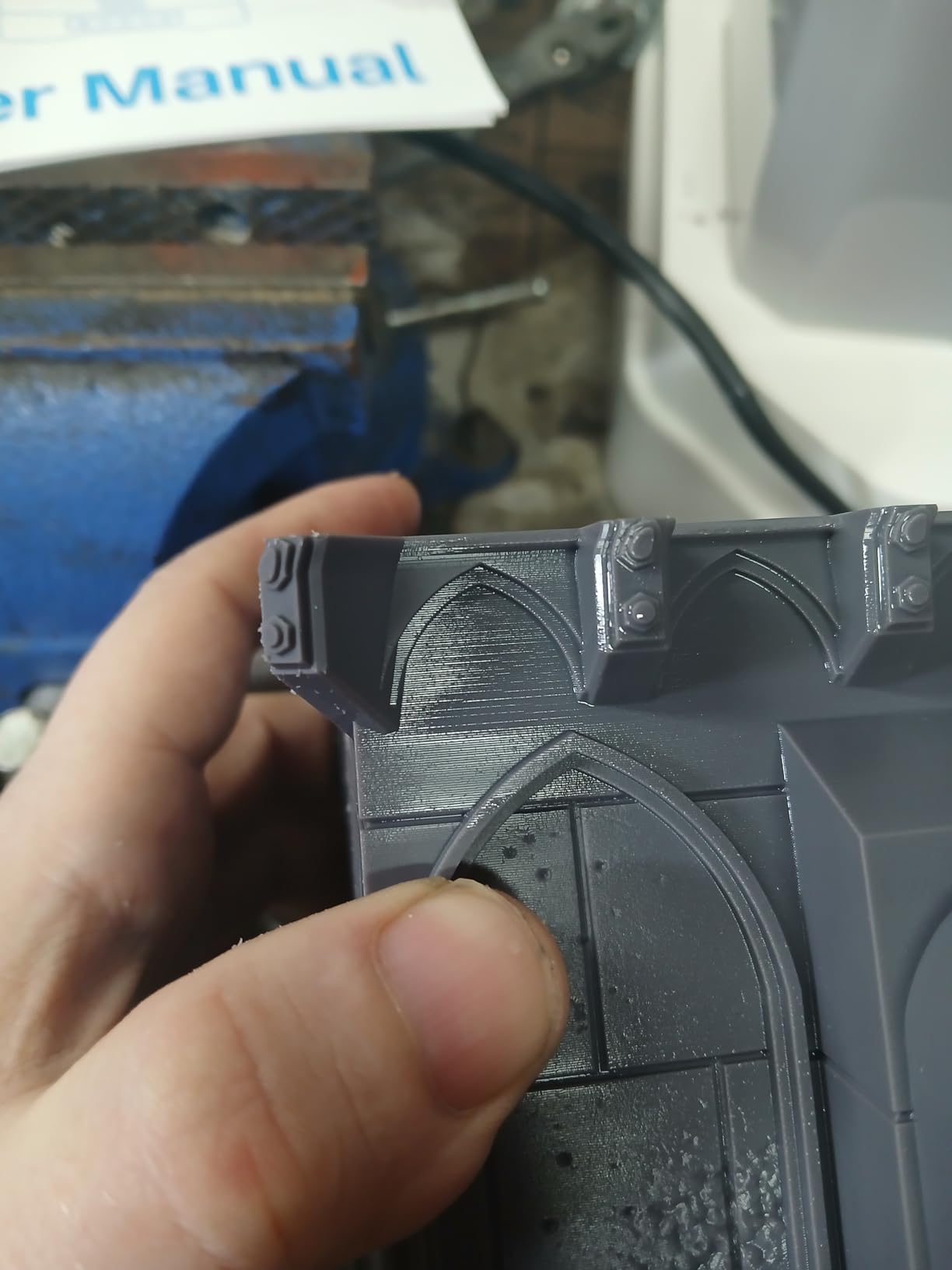
The 15-inch 8K mono LCD at 43 micron handles larger surfaces and props well, and the ACF release film reduces suction force for better success rates at higher speeds. The integrated lift-up lid suits confined workspaces and shelving, which matters more in a home than in a studio.
A built-in metal drip hanger drains resin back to the vat, and once dialed in owners report it runs reliably for long production runs.
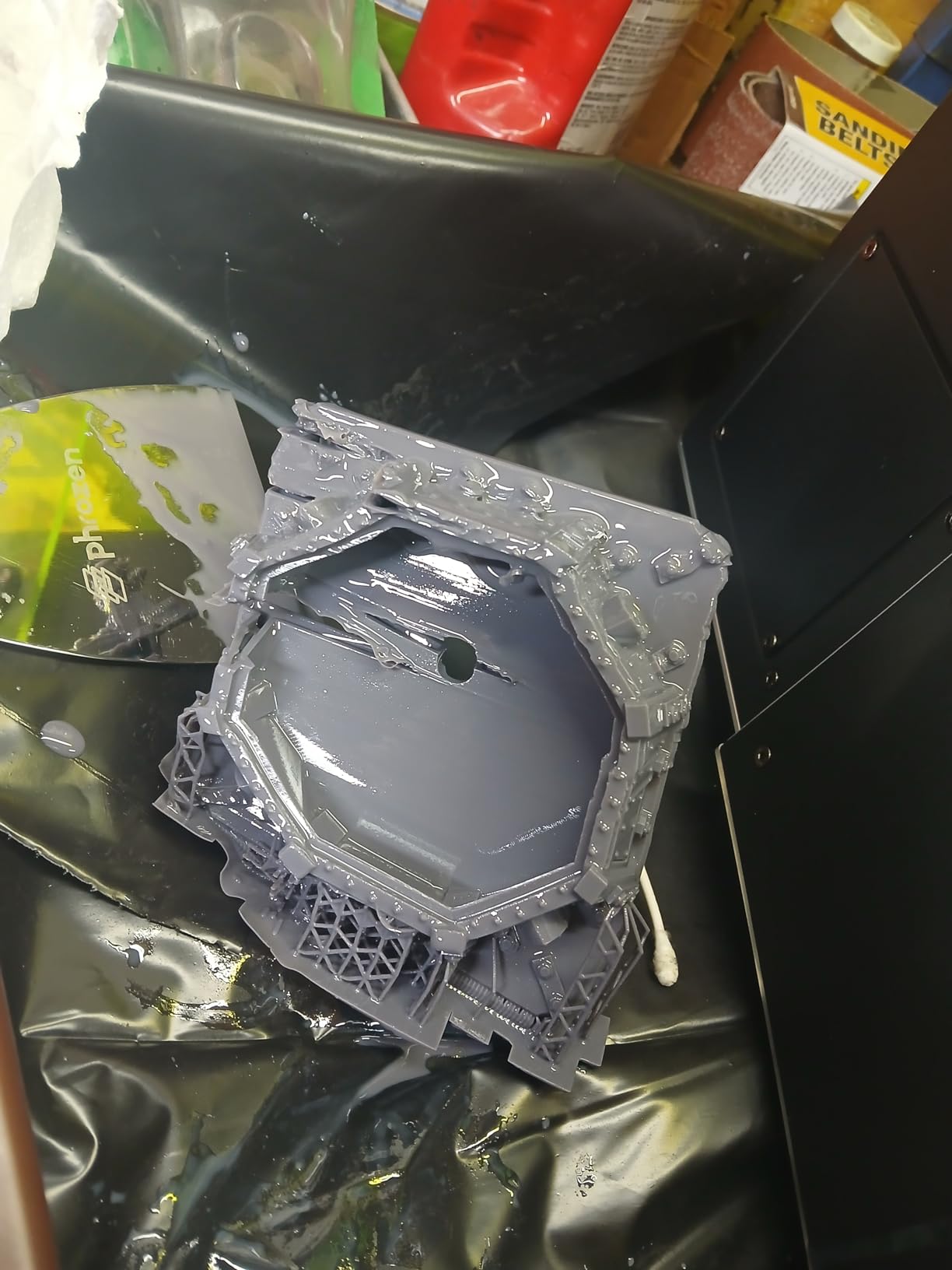
Who the Sonic Mega 8K S suits
It suits cosplayers producing many repeated pieces rather than one hero prop. If a costume needs twenty identical trim elements or a matching set of identical pauldrons, batch resin output is where the time saving becomes real.
It also suits anyone with a small workspace, since the lift-up lid design keeps the machine shelfable and the drip hanger keeps resin handling contained.
Where it falls short
The feature set is dated against newer rivals: no Wi-Fi, no camera and no auto-leveling, and no resin vat heater or built-in air filtration. Several owners report LCD controller, main board and power supply failures, along with damage to the plastic cover and screen on arrival.
The warranty is short and some parts are quoted at high replacement cost, which makes reliability a gamble. The perforated build plate also means you cannot use a flex plate to peel prints off.
What Actually Fits: Cosplay Part Sizes vs Build Volume
Here is the mapping no competitor page gives you, and the reason most cosplay builds go wrong. A part has to fit inside the smallest axis of the build volume after rotation, and typical costume parts are larger than people assume.
A full-size helmet is roughly 250 mm tall and 220 mm wide. A pauldron or shoulder guard lands around 200 to 300 mm across. A chest plate or breastplate runs 400 to 450 mm wide once scaled to a real torso, which is why this is the dimension that forces paneling on most machines.
Forearm guards, gauntlets and boots usually fit anything above 300 mm. A greatsword blade or a staff section pushes 800 mm and beyond, and that is where a 400 mm machine stops entirely and tiling or sectioning becomes mandatory.
So the practical tiers work out like this. Below 300 mm you cover gauntlets, boots, bracers and small props on a desktop machine. At 300 to 350 mm you print helmets, masks, pauldrons and single torso panels. At 400 mm you finally get full chest and back plates in one piece. At 500 mm and above you stop paneling armor and start considering entire weapon props.
The part that surprises people is height. Width is the visible constraint, but Z is what kills long prints, because a 500 mm tall print on a 400 mm machine has to be rotated and printed diagonally or split. The Anycubic Kobra 3 Max Combo and Longer LK5 Pro both trade width for depth, which is a genuinely different set of prop options rather than a bigger number.
The other half of the decision is whether paneling is actually a problem. A chest plate printed as four panels with seams hidden under trim can look better than a warped one-piece print, and experienced cosplayers on forums routinely recommend printing armor panels flat and heat-forming them around the body. Paneling is a technique, not a compromise.
Filament Choices for Cosplay Armor and Props
Material decides more about the finished prop than the printer does. PLA is the default for a reason: it is easy to sand, it takes filler and primer beautifully, and mistakes are cheap. It warps in a warm room, so it is a poor choice for a summer convention build that has to survive a car journey in July.
PETG is the durability answer. Stronger than PLA, less prone to warping and more heat tolerant, which is the standard recommendation for armor panels that get worn, transported and repaired. The trade is a rougher surface that needs more sanding before primer.
PLA-CF and other carbon-fiber reinforced blends add real stiffness for pauldrons, bracers and weapon props, and the carbon fiber suppresses the flex that makes PETG parts look soft. Printed flat on a bed oriented so the reinforcement runs across the load, a 3mm wall goes further than you expect.
ABS and ASA are the materials that genuinely need an enclosed, actively heated chamber. ASA in particular is the standard for anything that will sit in direct sun or a hot vehicle, and it is why the QIDI Max4, Flashforge Creator 5 Pro and Anycubic Kobra S1 Max matter for outdoor events. The Sovol SV08 MAX needs the chamber module added separately to run them properly.
TPU is the specialist option, used for flexible trim, straps, seals and glove details rather than structural armor. Several machines here reach it, including the Kobra 3 Max Combo and the Kobra S1 Max.
For wearable pieces, print flat on the bed with four or more perimeters. That wall count is the single biggest contributor to whether a panel survives being carried through a convention hall, and thin shells are the number one reason printed armor cracks on the way there.
How to Choose a Large Format Printer Without Overspending
Start with the largest single part in your costume, not the biggest number on a spec sheet. Measure it, including the base and any fin or crest, and buy the tier that fits it. Everything else on the list is secondary to that one constraint.
Then decide whether you need an enclosure. If you print PLA and PETG only, an open frame like the Longer LK5 Pro is fine and the savings go into filament and a dryer. If you plan to use ABS or ASA, an enclosed chamber with active heating is not optional, and add-on enclosures cost time in setup and heat loss.
Next, check the footprint and the weight. The QIDI Max4 at 120 lb and the Sovol SV08 MAX at 86.8 lb need serious tables and two people to move. The Creality K2 Pro Combo is 37.4 lb and the LK5 Pro is 29.2 lb, and that difference decides whether the machine lives in a garage or under a bed.
Noise is the constraint people forget. The Flashforge Creator 5 Pro runs at 55 dB or under, which makes overnight printing realistic in a shared space, while a 700 mm/s CoreXY machine with a large bed is a lot of fan noise regardless of what the spec sheet claims.
Multi-material capability should be your last purchase decision, not your first. A CFS unit covers two to four colors for most costume schemes, four toolheads cover genuinely complex patterns at the cost of complexity, and single-extruder machines are entirely viable if you are happy painting. A color change pause on a large print is not a big deal, but a mid-print failure on a color-heavy job is.
Finally, look at the slicer situation honestly. Machines locked to a vendor slicer, like the K2 Pro Combo and the Kobra S1 Max, are fine for a beginner and frustrating for someone with an existing workflow. Open-source motherboards, like the LK5 Pro’s, cost you polish and give you freedom. Our wide format printer guide covers this angle in more depth.
Printing Wearable Armor: Walls, Panels and Finishing
Print time is the least important number in a cosplay build. A large helmet often takes less time to print than it takes to sand, fill, prime and paint, and experienced builders plan backwards from the finishing schedule.
Print armor panels flat rather than in their final curved shape. Flat panels adhere better, do not need support, and can be heat-formed around the body afterward. This is the most consistently recommended technique in the cosplay printing communities, and it works with a printer far smaller than the finished piece.
For seam placement, put joins where trim, a belt, a strap or a pauldron overlap will cover them. Wall loops of four or more, plus a sparse or gyroid infill at around 15 percent, give a panel enough structure to be worn without turning it into a solid block of plastic.
Finishing runs filler, sanding, primer, paint. On large parts the filler stage is the one people underestimate, because a curved surface printed flat has a bow that has to be corrected before primer will sit evenly. Budget a full weekend per major piece.
For joins on multi-piece armor, a two-part epoxy or a joint compound reinforced with fabric gives a stronger repair than glue alone and sands flush afterwards. This matters more than printer choice once you are at assembly, and it is what keeps a printed suit intact through transport and a full convention day.
Frequently Asked Questions
What is the best 3D printer for printing large items?
For cosplay-scale parts, the Sovol SV08 MAX is the strongest all-rounder because its 500 x 500 x 500 mm cube prints oversized props and armor shells in a single job at high speed. If your parts are more like helmets and pauldrons, a 350 to 400 mm machine such as the Creality K2 Pro Combo or Creality Ender 5 Max is plenty and costs considerably less.
What are the best 3D printers for large prints?
The pick depends on three things: volume, material and enclosure. The Sovol SV08 MAX leads on volume at 500 mm cube. The QIDI Max4 Combo and Flashforge Creator 5 Pro lead on ABS and ASA thanks to actively heated 65C chambers. The Creality K2 Pro Combo and Anycubic Kobra S1 Max Combo lead on multi-color output for prop paint schemes.
What is the largest size a 3D printer can print?
Among consumer machines, a 500 x 500 x 500 mm cube such as the Sovol SV08 MAX is at the top of the practical large format range for home and small workshop use. Industrial machines go much further, but for cosplay builds anything past 500 mm is rarely the limiting factor, because most costume parts top out around 450 mm wide.
Who makes the best large format printers?
Creality, Sovol, Anycubic, QIDI and Flashforge cover most of the large format market with machines suited to different budgets and needs. Creality covers the mid-range, Sovol the high-volume end, Anycubic the value enclosed segment, QIDI the engineering filament end and Flashforge the multi-toolhead multi-color end.
Should I use PLA or PETG for cosplay?
PLA is cheaper, easier to sand and takes filler and primer well, which makes it the default for helmet and prop work. PETG is stronger, more heat tolerant and less prone to warping, which makes it the better choice for wearable armor panels that get transported and worn for a full day in a warm convention hall.
Do I need an enclosed 3D printer for cosplay props?
Only if you print ABS or ASA. For PLA and PETG, an open frame such as the Longer LK5 Pro works fine and saves both money and floor space. For ABS and ASA you need an enclosed chamber, and ideally one that actively heats, so parts do not warp or delaminate as they cool. An add-on enclosure works but costs setup time and loses heat.
The Verdict for Cosplay Props in 2026
The best large format 3D printers for cosplay props in 2026 split cleanly by use case. The Sovol SV08 MAX is our overall pick, because a 500 mm cube removes paneling from the biggest parts of a build and the CoreXY motion holds up on the tall prints armor demands. Buy the heated chamber module with it if you plan to use ABS or ASA.
For most cosplayers, the Creality K2 Pro Combo is the smarter entry point, since a 350 mm cube covers helmets and armor shells and the included CFS handles multi-color props without a second machine. The Anycubic Kobra 3 Max Combo is the value route if you want a 500 mm tall chamber and can live with a vendor slicer. For ABS and ASA in a hot convention hall, the QIDI Max4 Combo and Flashforge Creator 5 Pro are the only machines here with a 65C actively heated chamber built in.
Pick by your largest single part, buy the filament you will actually use, and remember that finishing takes longer than printing. The printer gets you the part, the rest of the weekend is sanding.