
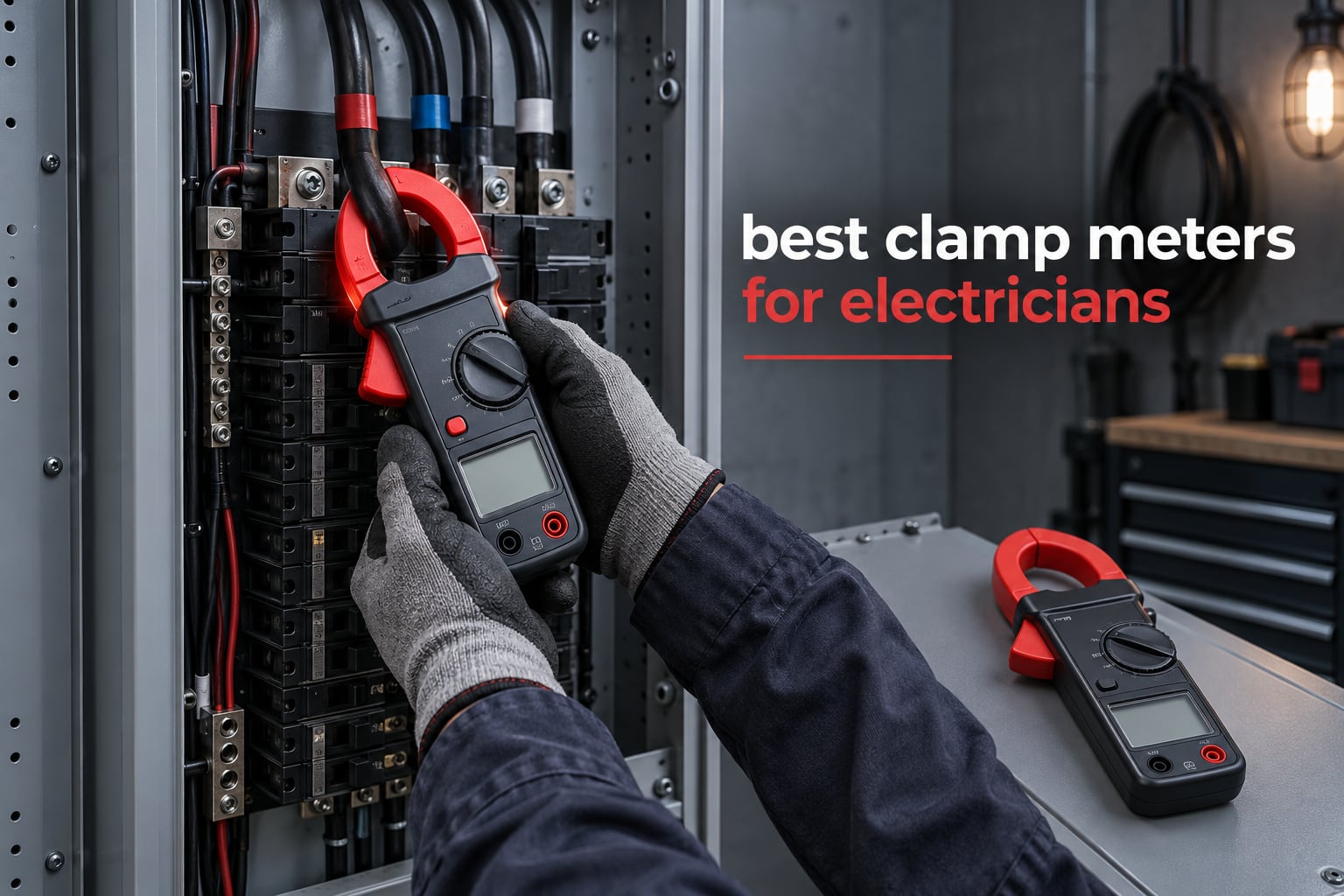
A clamp meter lets you measure live current around a single conductor without cutting power, and that single capability is why the best clamp meters for electricians outsell every other field instrument. In our roundup of 12 meters, the clear all-round winner is the KAIWEETS HT206D: it is the most reviewed meter in this group, it measures true RMS AC and DC current with a hall effect sensor, and it adds low impedance mode, a low pass filter for VFD signals and a K-type thermocouple. The Fluke 323 takes the premium slot for pure AC work, and the Fieldpiece SC260 earns top rated from HVACR technicians who live in dark mechanical rooms.
Twelve meters went into this comparison, from pocket-sized automotive clamps to Fluke models that have been in service for decades. We looked hard at the four things that decide whether a clamp meter is useful on a real job: whether it reads DC current, what CAT rating it carries, how it behaves on non-linear loads, and whether the display is readable in a dark panel with gloves on. Every measurement spec on this page comes from the manufacturer data and the customer review record for that model, not from a spec sheet roundup someone else wrote.
If you are still building a first tool bag, our earlier clamp meter guide covers the fundamentals of how the jaws actually work. This one goes deeper on the professional end of the market.
Table of Contents
Top 3 Best Clamp Meters for Electricians (October 2026)
The three meters below are the ones we would hand to an apprentice, a commercial electrician and an HVACR technician respectively. Each earns its place for a different reason, so read the description before picking.

KAIWEETS HT206D
- True RMS AC/DC current
- LoZ and low pass filter
- CAT III 600V
- K-type thermocouple
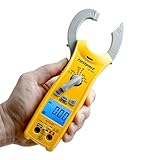
Fieldpiece SC260
- Purpose-built true RMS
- AC current with NCV
- Temperature and capacitance
- Swivel magnet
One thing worth flagging before the individual reviews: no meter on this list is universally best. A residential service electrician who never touches a DC circuit will be better served by a slim AC-only meter with a backlight than by a feature-heavy hall effect clamp. The guide further down maps each meter to the work it actually suits.
12 Best Clamp Meters for Electricians Side by Side in 2026
Here is the full lineup with the specifications that separate these meters. Scan the Key Features column first, then read the individual reviews for the models that match your work.
| Product | Specifications | Action |
|---|---|---|
| KAIWEETS HT206D |
|
Check Latest Price |
 AstroAI 2000-Count Clamp AstroAI 2000-Count Clamp |
|
Check Latest Price |
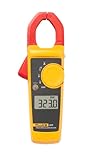 Fluke 323 Fluke 323 |
|
Check Latest Price |
 Fluke 302+ Fluke 302+ |
|
Check Latest Price |
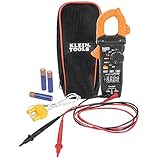 Klein Tools CL390 Klein Tools CL390 |
|
Check Latest Price |
 Klein Tools CL220 Klein Tools CL220 |
|
Check Latest Price |
 Fluke 325 Fluke 325 |
|
Check Latest Price |
 FNIRSI DMC-100 FNIRSI DMC-100 |
|
Check Latest Price |
 Klein Tools CL120 Klein Tools CL120 |
|
Check Latest Price |
 IDEAL 61-747 TightSight IDEAL 61-747 TightSight |
|
Check Latest Price |
 UNI-T UT210e UNI-T UT210e |
|
Check Latest Price |
| Fieldpiece SC260 |
|
Check Latest Price |
1. KAIWEETS HT206D – The Most Complete All-Round Clamp
KAIWEETS HT206D Digital Clamp Meter T-RMS 6000 Counts, Multimeter Voltage Tester Auto-ranging, Measures Current Voltage Temperature Capacitance Resistance Diodes Continuity Duty-Cycle (AC/DC Current)
6000 counts
True RMS AC/DC current
CAT III 600V
LoZ and low pass filter
Thermocouple
Pros
- Reads AC and DC current plus voltage resistance and capacitance
- Compact 7.5 inch body for tight panels
- Low impedance mode kills ghost voltage
- Low pass filter for VFD signals
- Two-color backlit display with LED flashlight
Cons
- Supplied test leads have poor conductivity
- DC current readings below 0.1 A are unreliable
- Housing feels light for heavy site abuse
The HT206D is the meter we keep reaching for when the job description is unknown. It is a 6000-count true RMS clamp with a hall effect sensor, so it measures both AC and DC current through the jaw, and the manufacturer rates it CAT III 600 V under IEC 61010-1. At 7.5 inches long and 7.68 ounces it is one of the smaller bodies here, which matters when you are working one-handed inside a crowded panel.
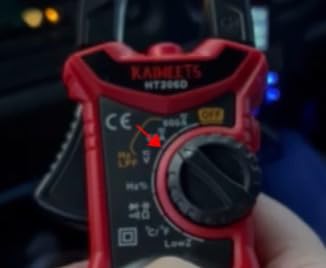
What separates it from other budget clamps is the pair of modes most manufacturers leave out. Low impedance mode puts a deliberate load on the circuit so a floating conductor that is picking up induced voltage from a neighbouring wire reads zero instead of a phantom 40 volts. The low pass filter is the opposite tool: it filters out the high-frequency switching noise that variable frequency drives put on the waveform so you can read the underlying current.
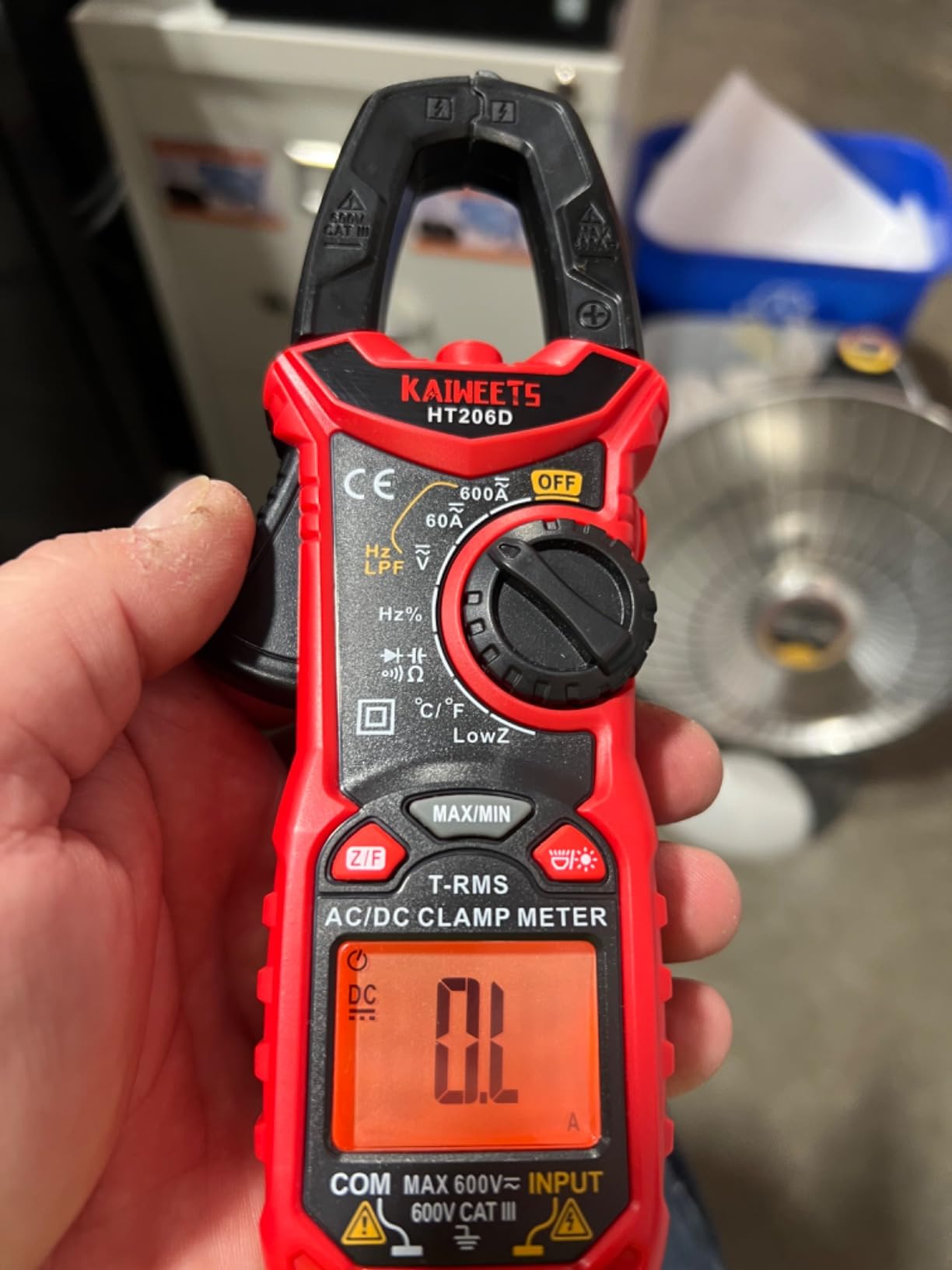
Reviewers consistently describe the readings as landing within a small margin of far more expensive professional meters, and at 12110 reviews this is by a wide margin the most examined meter in our group. The two-colour backlit LCD is a genuinely useful detail: the display turns red above 80 V and 3 A, which is a crude but effective warning that you are measuring something that deserves respect. The included K-type thermocouple covers to 1000 °C, so it doubles as a temperature tool for HVAC diagnostics.
Where it falls short is at the very bottom of the range. Reviewers report that DC current readings in the 100 mA region are inconsistent even after zeroing the meter, and there is no direct mA measurement through the probes. The supplied fine-point test leads are also widely criticised for conductivity and for jumping resistance values, so plan on buying a proper lead set.
Is the HT206D accurate enough for professional work?
For load checks, panel troubleshooting and HVAC service work, yes. The true RMS AC and DC current channels agree closely with professional meters in side-by-side use, and CAT III 600 V covers residential and most commercial panel work. If your work includes sizing conductors to a code-required accuracy or verifying very small DC draws, look at a higher-count meter instead.
The honest limitation is resolution at the low end, not the top end. Readings below roughly 0.1 A of DC current should be treated as indicative only, and reviewers confirm they double-check anything in that range with a second instrument.
Should you buy it if you already own a Fluke?
If your existing Fluke handles AC only and you regularly measure DC circuits, DC circuits in a mixed shop mean the HT206D fills a real gap rather than duplicating what you have. If your work is purely AC residential service, the Fluke 323 below is the better long-term buy because of its build quality and warranty.
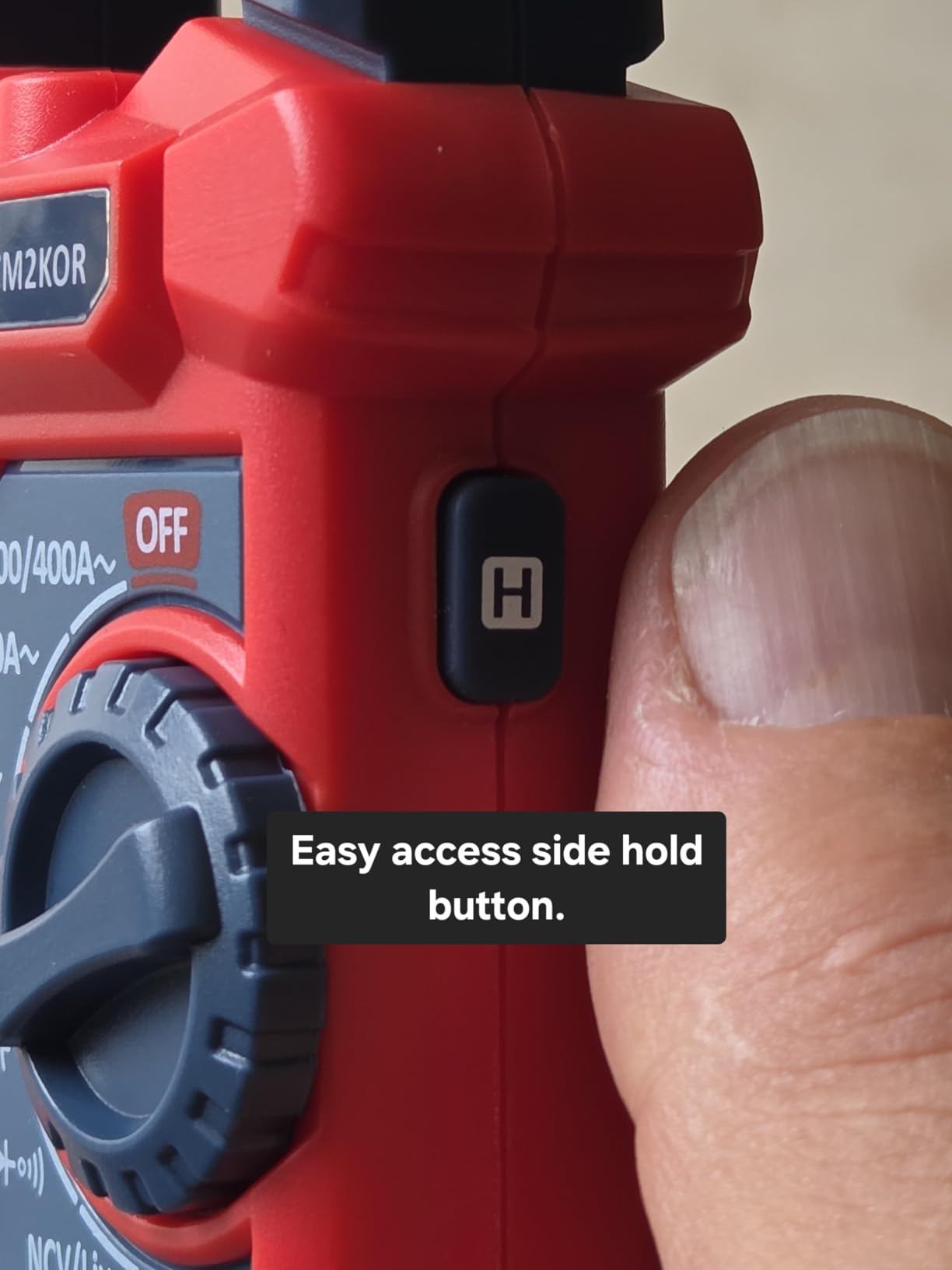
The case against it is physical. Reviewers describe the plastic housing as light and not built for heavy jobsite abuse, so if your meters take a beating on every call, spend up for a meter with a metal or heavily reinforced case. There is also a small annoyance: the meter will not power back on without cycling the function dial through OFF.
2. AstroAI 2000-Count Clamp Meter – The Cheapest Useful Clamp
AstroAI Digital Clamp Meter Multimeter 2000 Counts Amp Voltage Tester Auto-ranging with AC/DC Voltage, AC Current, Resistance, Capacitance, Continuity, Live Wire Test, NCV, Black
2000 counts
AC current only
AC/DC voltage
CAT III 600V
NCV and backlight
Pros
- Broad function set for an entry-level meter
- Non-contact voltage alarm with buzzer and light
- Backlit display plus built-in flashlight
- Data hold and Max/Min capture intermittent faults
- Leads
- bag and batteries included
Cons
- Cannot measure DC current through the clamp
- 2000-count resolution limits precision
- Basic construction next to professional brands
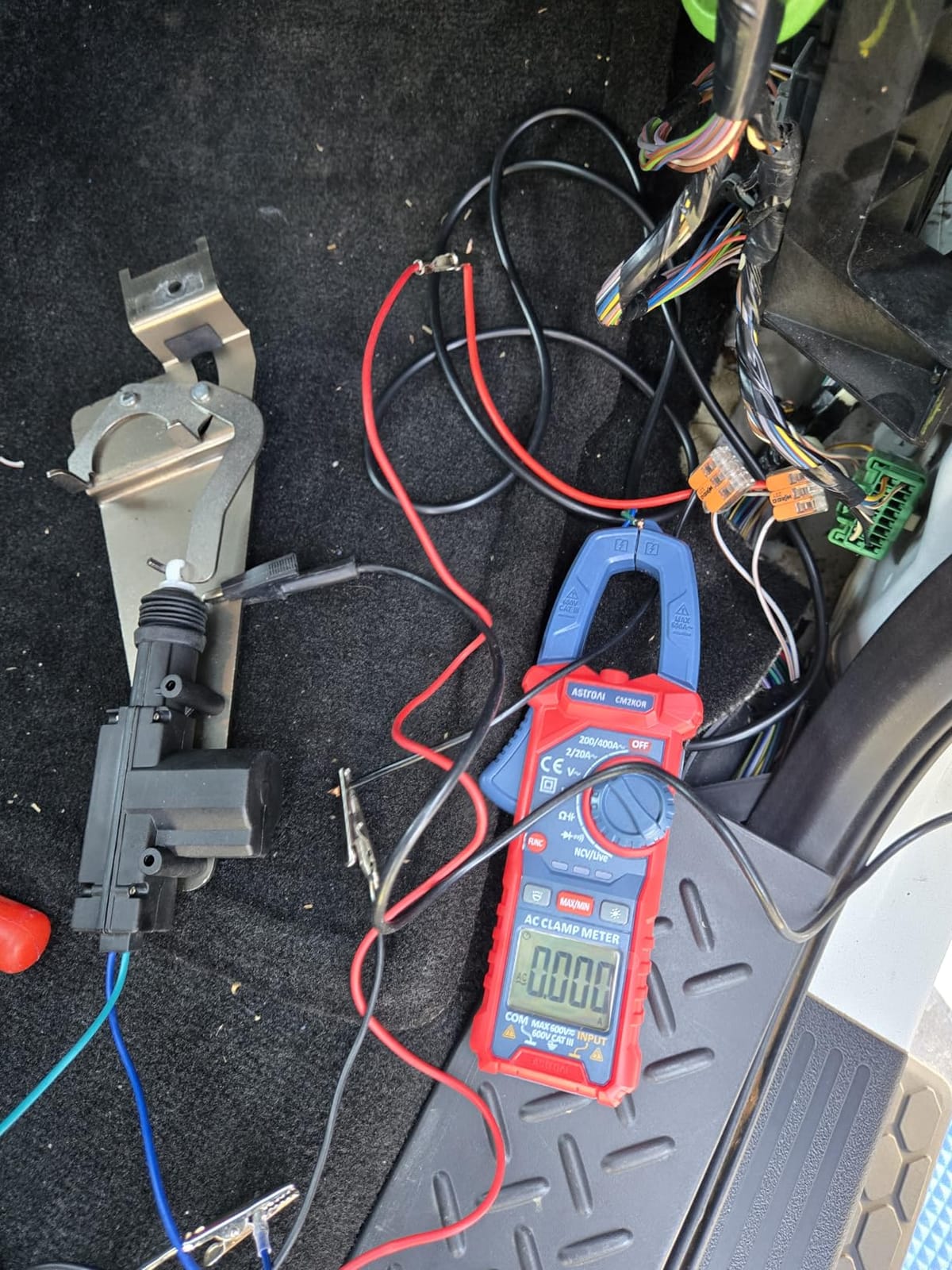
This is the meter to hand an apprentice in year one, or to keep in a van for the quick checks that do not justify unclipping a good instrument. It measures AC current through the jaw, AC and DC voltage, resistance, capacitance, diodes and continuity, and it carries a CAT III 600 V rating with IP 40 ingress protection. Roughly 79 percent of reviewers give it five stars.
The practical value is in the supporting functions. Non-contact voltage detection gives both an audible and a visual alarm, there is a separate live wire test, and data hold with Max/Min lets you catch an intermittent draw without holding the meter in place. Two AAA batteries ship in the box alongside the test leads and a storage bag.
Two limitations decide whether this is your meter. First, it is AC only in the clamp, which the manufacturer states plainly on the spec sheet as well as in the review record. On 24 V DC control circuits, solar strings, EV charger auxiliaries or anything with a rectifier, it simply cannot answer the question. Second, 2000 counts means the least significant digit is coarse, so a reading of 3.42 amps displays as 3.4.
That is fine for confirming a 15 amp circuit is not loaded, and wrong for balancing a three-phase panel where a tenth of an amp matters. Know which problem you have before you buy.
Is an entry-level clamp meter safe to use on a live panel?
The CAT III 600 V rating places it in the correct category for residential and most commercial panel work, so the measurement category is appropriate. The construction is the part to inspect: reviewers describe the build as basic, and this is not a meter to drop off a ladder.
Treat it as a secondary instrument. If you are verifying a service entrance or anything feeding a subpanel, use a meter with a CAT IV rating instead, such as the IDEAL 61-747 covered later in this roundup.
When does the missing DC current capability actually hurt?
It hurts on any circuit with a rectifier, which includes most modern LED drivers, solar inverters, EV charging equipment, battery systems and variable speed HVAC compressors. It does not hurt on standard residential branch circuits, where the load is AC and the AstroAI is genuinely adequate.
Because it is a full auto-ranging meter with a backlight, it also works fine as a secondary meter on jobs where the primary is a true RMS unit. Two meters on a job means you can verify a suspicious reading rather than trusting a single instrument.
3. Fluke 323 – The Most Versatile for Pure AC Work
Fluke 323 Clamp Meter for Commercial/Residential Electricians, Measures AC Current to 400 A & AC/DC Voltage to 600 V, Resistance and Continuity, Includes 2 Year Warranty and Soft Carrying Case
True RMS AC to 400A
AC/DC voltage to 600V
30 mm jaw
CAT IV 300V
Pros
- True RMS accurate on linear and non-linear loads
- Compact body fits into crowded panels
- Build quality owners report holding up for decades
- Audible continuity sensor
- Soft carrying case and two-year warranty
Cons
- Does not measure DC current
- Display is not backlit
- Supplied test leads are frequently replaced
The 323 is the meter most electricians mean when they say a Fluke. It is a true RMS AC current clamp to 400 A with AC and DC voltage to 600 V, a 30 mm jaw opening, resistance to 4 kOhm and an audible continuity sensor, rated CAT IV 300 V and CAT III 600 V. Electricians describe it as a dependable, no-nonsense instrument with readings that hold up over decades of ownership.
For commercial and residential service work this is close to ideal. The 30 mm jaw clears a full-size conductor, the body is small enough to reach behind a panel cover, and the true RMS sensing handles the harmonic-laden waveforms that LED and computer loads produce. At 300 g it is light enough to hold one-handed for a whole service call.
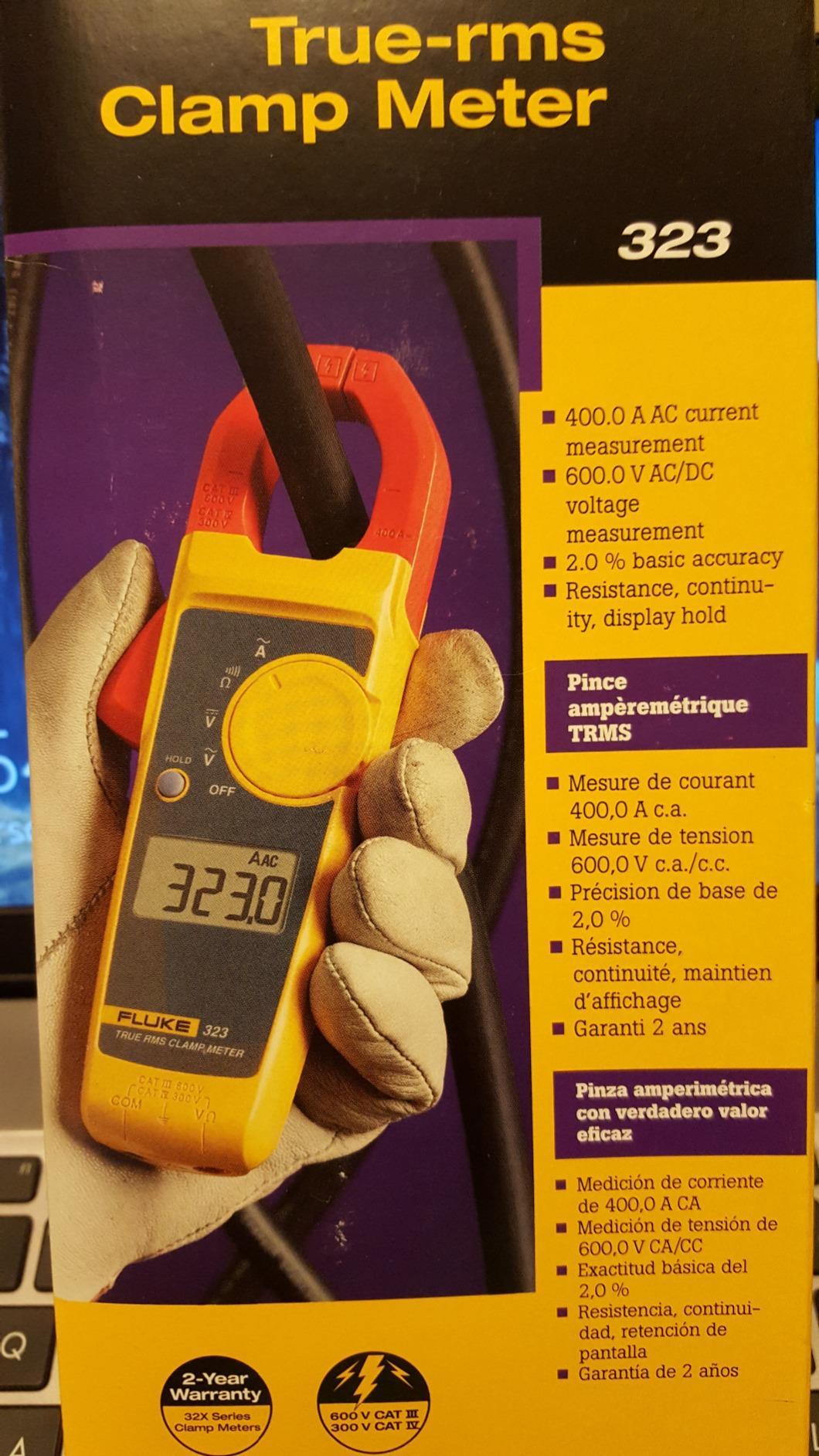
It is important to be blunt about what this meter cannot do. The 323 does not measure DC current through the clamp. It also has no backlight, no capacitance, no frequency and no temperature. If you service solar, EV charging or battery systems, this is the wrong Fluke and the 325 further down is the right one.
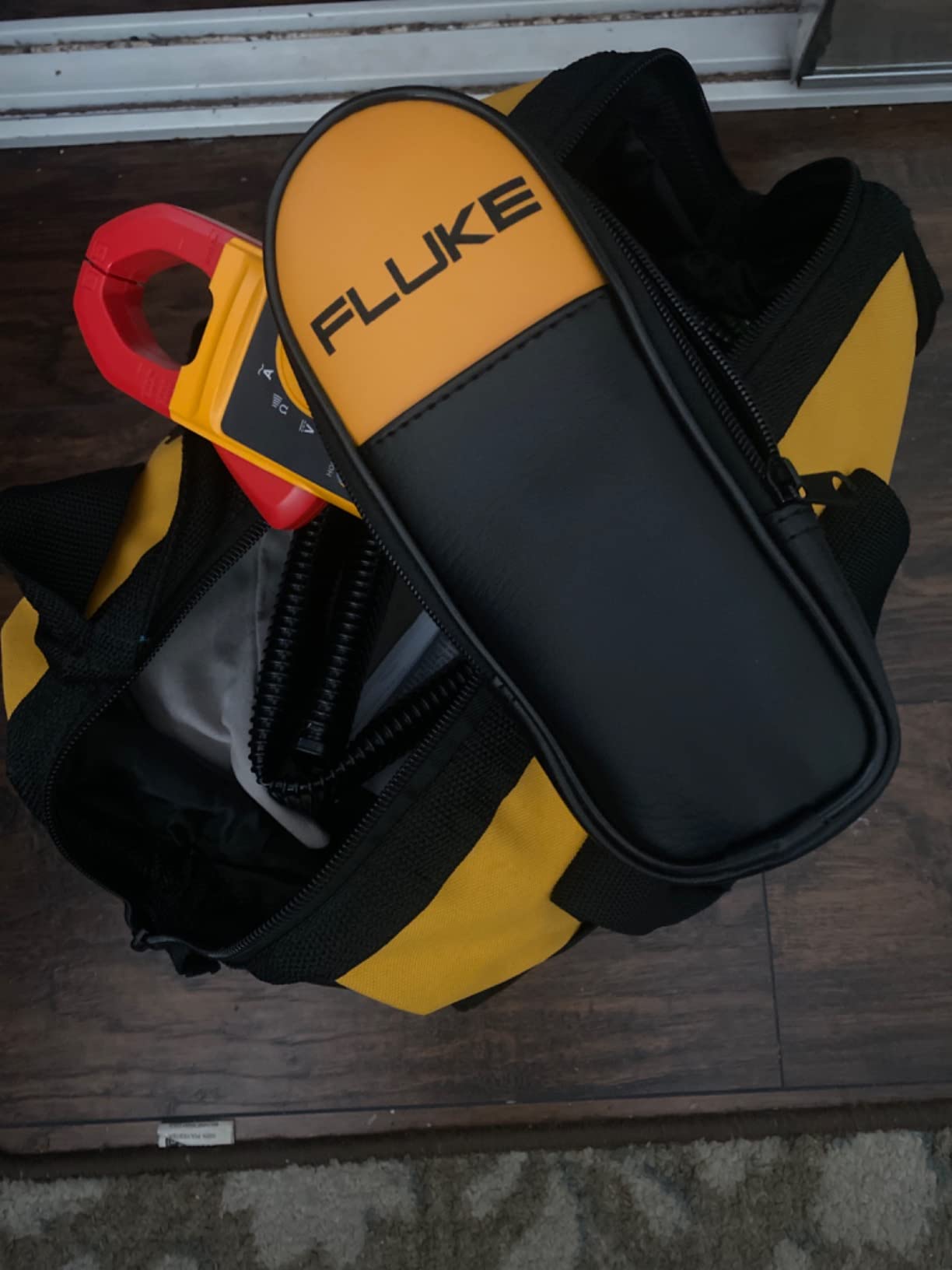
Reviewers also flag that the stock test leads are among the weak points of an otherwise well-regarded tool, and that current accuracy of plus or minus 2 percent plus or minus 5 counts is marginal at low current levels. The soft case is another recurring complaint because the leads have to be unplugged before the meter will fit inside it.
Does the 323 hold calibration over years of service?
The ownership record is the strongest part of this meter’s case. Owners describe units still performing correctly after many years, and calibration stability matters more than out-of-box accuracy once a meter has been dropped, battery-leaked on or left in a hot van. That long-term stability is the main reason to pay for a Fluke rather than a cheaper alternative.
Keep the two-year manufacturer warranty current, and if you are verifying very low current draws, pair it with a meter that has finer low-end resolution rather than pushing the 323 below its comfortable range.
Is the Fluke 323 worth more than a Klein or KAIWEETS?
Yes, if AC accuracy and physical durability are your priorities, because no entry-level clamp matches the Fluke chassis. For a residential service electrician measuring branch loads all day, the build quality alone justifies the difference.
No, if you need DC current, a backlight, temperature or capacitance, because you will be paying premium money for a meter that cannot do the job. In that case the Fluke 325 gives you the same brand name with a hall effect sensor and the extra functions.
4. Fluke 302+ – The Smallest Fluke for Tight Work
Fluke 302+ Digital Clamp Meter, 30mm Jaw, Measures AC Current to 400A, Measures AC/DC Voltage to 600V, Includes 2 Year Warranty
30 mm jaw
AC current to 400A
AC/DC voltage to 600V
1.8% accuracy
Pros
- Compact body with a large 30 mm jaw
- 1.8% accuracy for troubleshooting work
- Simple function set that is quick to learn
- Includes TL75 leads and batteries
- Two-year manufacturer warranty
Cons
- AC current only
- Very limited measurement set for the price
- Display is not backlit
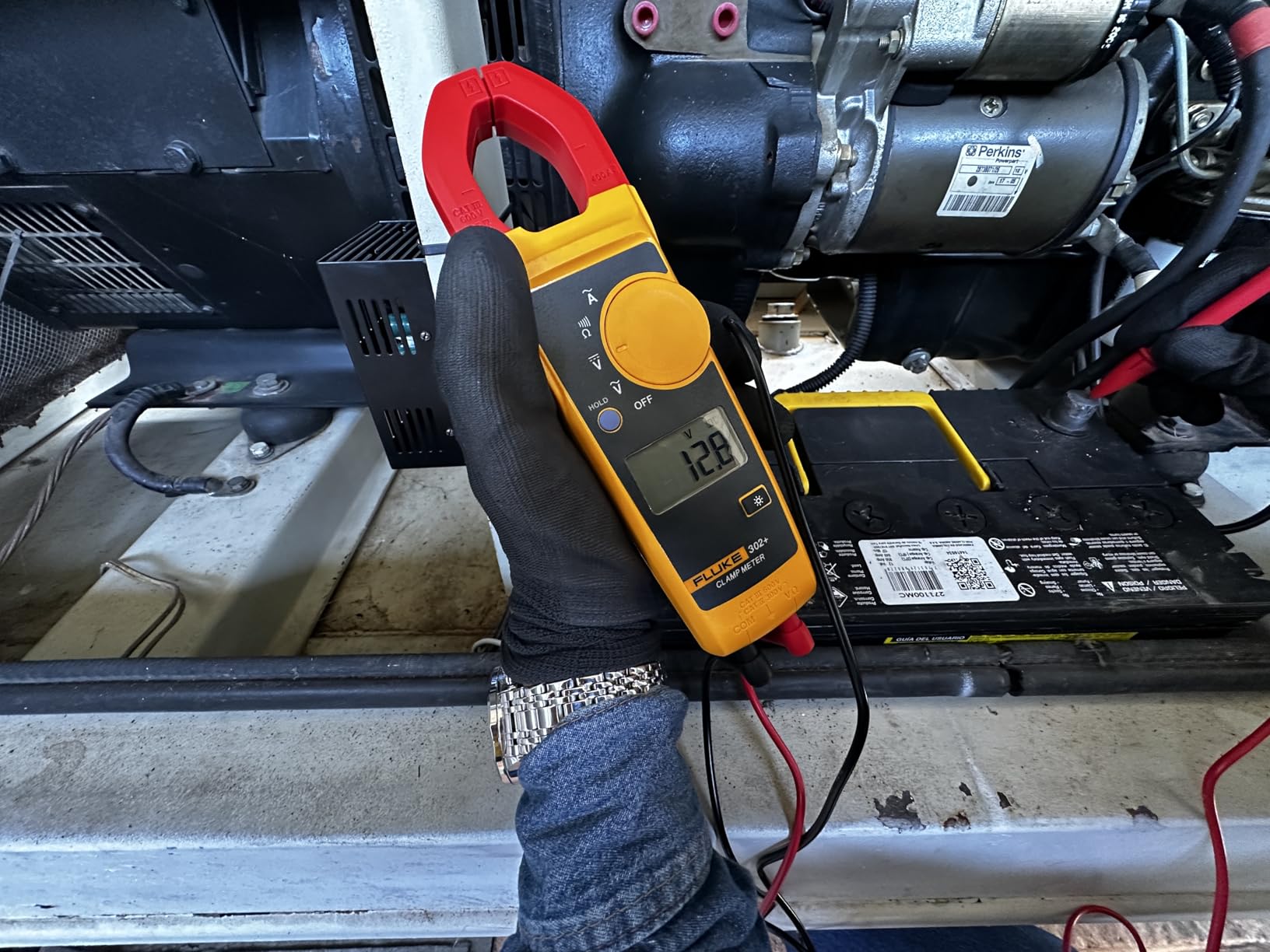
The 302+ is a deliberately stripped-down Fluke. It measures AC current to 400 A and AC and DC voltage to 600 V through the leads, with a stated accuracy of 1.8 percent, a 30 mm jaw, and a CAT IV 300 V / CAT III 600 V rating. At 8.15 inches it is one of the smaller bodies in the Fluke line.
That simplicity is the point. Reviewers describe it as a reliable Fluke that a new technician can pick up and use immediately, which makes it a good companion to a full-featured meter rather than a replacement for one. It is also the version to choose when the previous owner kept losing the case and the leads, because there is less to lose.
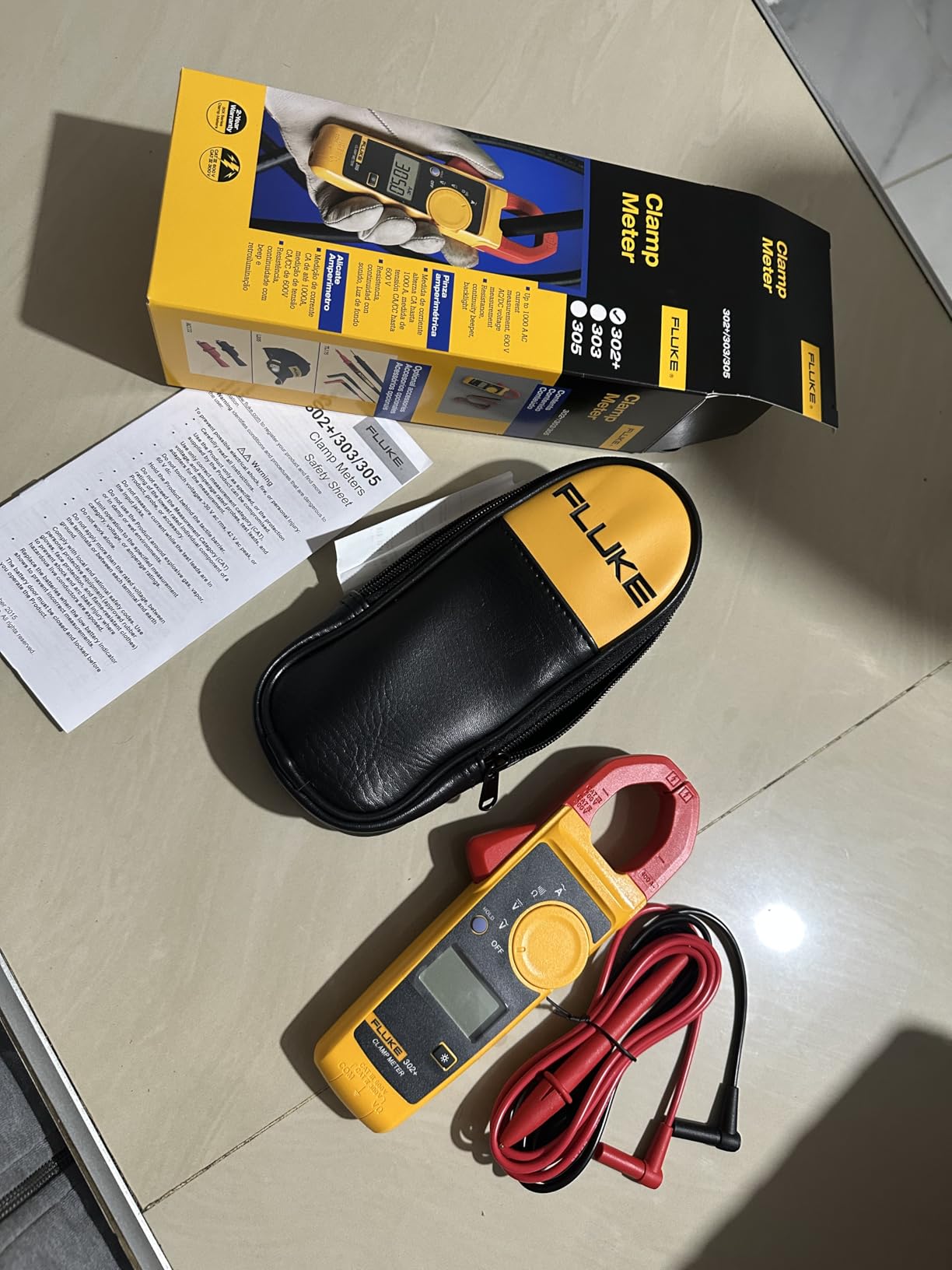
The omissions are the issue. No DC current, no capacitance, no frequency, no temperature and no backlight. In a crawlspace or behind an appliance in a dark mechanical room, a non-backlit display is a real ergonomic disadvantage, and that is the single most common complaint in the review record alongside the limited measurement set.
It ships with the Fluke TL75 hard point lead set and two AA batteries, which is better than the generic leads that come with many competing clamps. The two-year warranty is the same as the rest of the line.
Is a stripped-down Fluke better than a feature-rich budget clamp?
It depends on what you are measuring. For AC current and voltage on a live panel, the 302+ gives you Fluke accuracy in a smaller package, and the accuracy specification is the reason to prefer it. For DC current, temperature, capacitance or work in the dark, the feature-rich options below do more per unit of effort.
Reviewers frame it as a specialised basic clamp rather than an all-in-one, and that framing is accurate. Buy it as the accurate AC meter in a two-meter kit, not as the only meter in a van.
Can a beginner use this meter without training?
Yes. The dial has fewer positions than most competing models, and there is no mode menu to navigate. New technicians in the review record describe learning the controls in the field with no manual, which is the strongest argument for it as a first professional clamp.
The one habit worth drilling early is verifying the meter on a known live source before you trust a reading, since that habit is what keeps you safe regardless of which model you carry.
5. Klein Tools CL390 – Best All-Round Klein With DC and Temperature
Klein Tools CL390 AC/DC Digital Clamp Meter, Auto-Ranging, 400 Amp
AC/DC current to 400A
Temperature probe
Reverse-contrast LCD
DC microamps
Pros
- Full DMM functions plus AC and DC clamp current
- Auto-ranging true RMS on complex signals
- NCV built into the clamp jaw
- Reverse-contrast LCD readable in sun and low light
- Complete kit with thermocouple leads and case
Cons
- Minimum clamp current is 0.3 A
- No 10 A in-circuit range through the leads
- Case wears out before the meter does
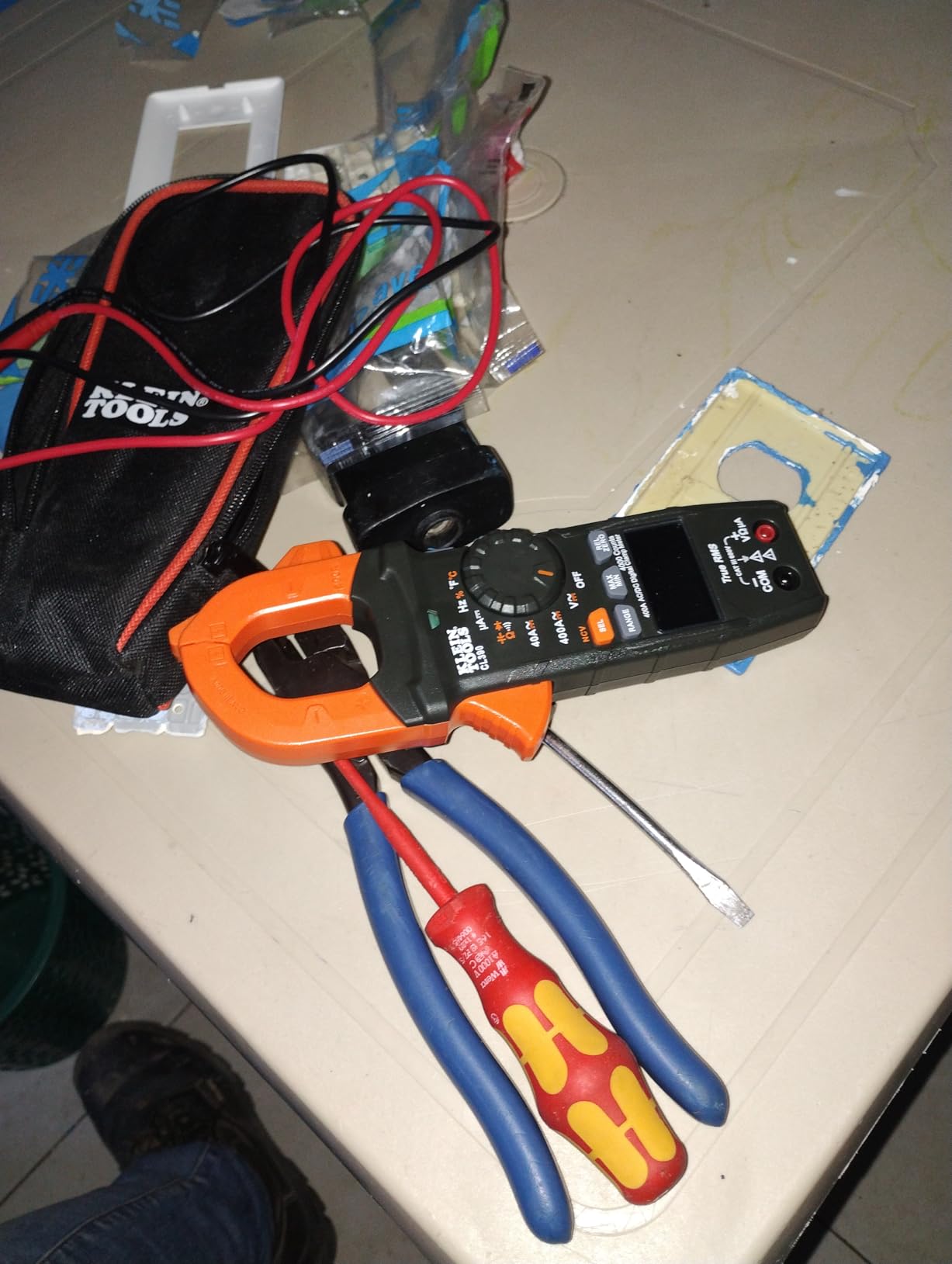
The CL390 is the most capable Klein in this group and the one most electricians describe as covering routine work without a second instrument. It measures AC and DC current to 400 A through the jaw using auto-ranging true RMS, plus AC and DC voltage, resistance, continuity, frequency, duty cycle, DC microamps, diode and capacitance through the leads, and temperature through the included thermocouple. The rating is CAT III 600 V / CAT IV 600 V.
Two details earn their place on a real job. The non-contact voltage detector sits inside the clamp jaw, so you can check a conductor without finding a bare terminal. The reverse-contrast LCD is not a backlight in the usual sense; it stays readable in direct sun and in the dark, which solves the readability problem that the Flukes on this list do not.
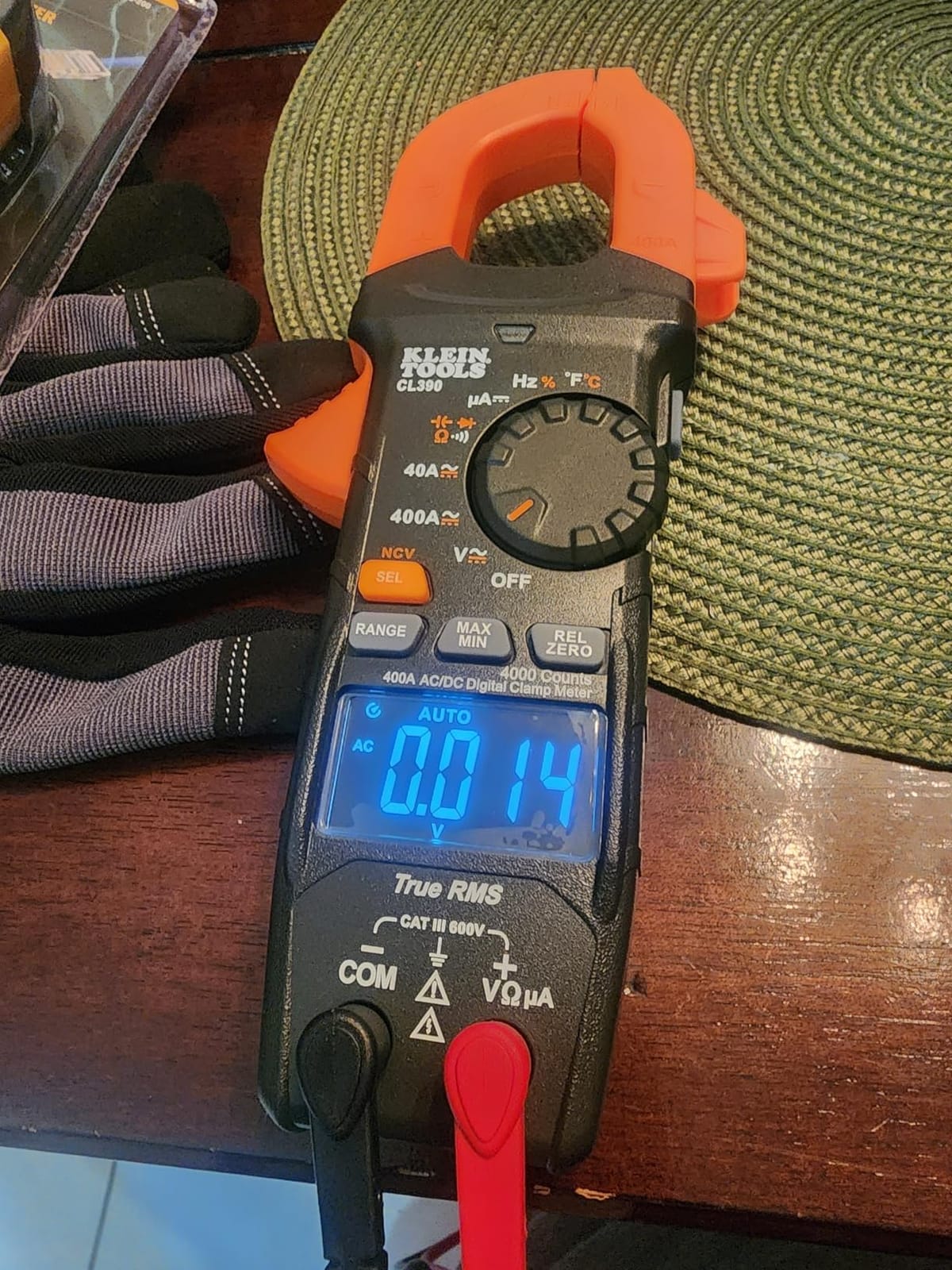
The 0.3 A minimum clamp current is the specification to read twice. Anything drawing less than three tenths of an amp will not register, which takes small control circuits, lighting ballasts and pilot loads off the table for clamp measurement. There is also no 10 A in-circuit range through the leads, so low-current work has to be done with the leads on a de-energised circuit.
On accuracy, reviewers are consistent that it works but does not reach Fluke-level precision, and the included soft carrying case is reported to wear out well before the meter does. The side-mounted test lead holder is a nice touch, and the magnetic hanger that fits it is sold separately.
Can the CL390 replace a separate multimeter?
For most field work, yes, because the lead-based function set includes voltage, resistance, continuity, microamps, diode, capacitance, frequency and duty cycle in one body. That is the same coverage as a typical digital multimeter, plus clamp current and temperature, which is why reviewers call it a dependable all-in-one.
It is not a full substitute for a dedicated DMM when you need bench-level accuracy or a wide resistance range. And the 0.3 A clamp floor means it will not catch a small draw that is faulting a circuit, so keep a current-shunt style measurement in your workflow for those.
Is the CL390 tough enough for daily site use?
Reviewers say it rugs well and handles repeated drops without failure, and the record does not carry the kind of early failure complaints that show up on cheaper meters. The temperature thermocouple adds genuine HVAC value at a fraction of the cost of a dedicated refrigeration meter.
The recurring gripes are functional rather than structural: the 0.3 A floor, the missing 10 A lead range, the shortfall against Fluke precision, and the fragile case. If you drop meters, buy the case as a separate item.
6. Klein Tools CL220 – The Residential Service Call Meter
Klein Tools CL220 Digital Clamp Meter, Auto-Ranging 400 Amp AC, and Temp
Auto-ranging true RMS AC to 400A
Temperature probe
Backlit LCD
NCV in the jaw
Pros
- Klein build quality that holds up over years
- Auto-ranging removes manual range selection
- 400 A AC covers household circuits and larger equipment
- NCV with audible and visual alert
- Backlit display with responsive buttons
Cons
- AC current only
- Temperature readings swing roughly 2 percent across 0 to 100 C
- NCVT triggers on non-live circuits
- Isolated reports of LCD segment failure
The CL220 is the meter for the technician who spends their week in people’s homes rather than on rooftops or in plant rooms. It delivers auto-ranging true RMS AC current to 400 A through the jaw, AC and DC voltage, resistance and continuity through the leads, temperature via the included thermocouple, and non-contact voltage detection in the jaw. The backlit display and auto-ranging both matter more on a residential call than any specification you will read on a datasheet.
Reviewers rate it as a well-made, accurate meter that punches above its price point and suits professional electricians and serious DIYers alike, particularly for HVAC work where the temperature probe earns its keep.
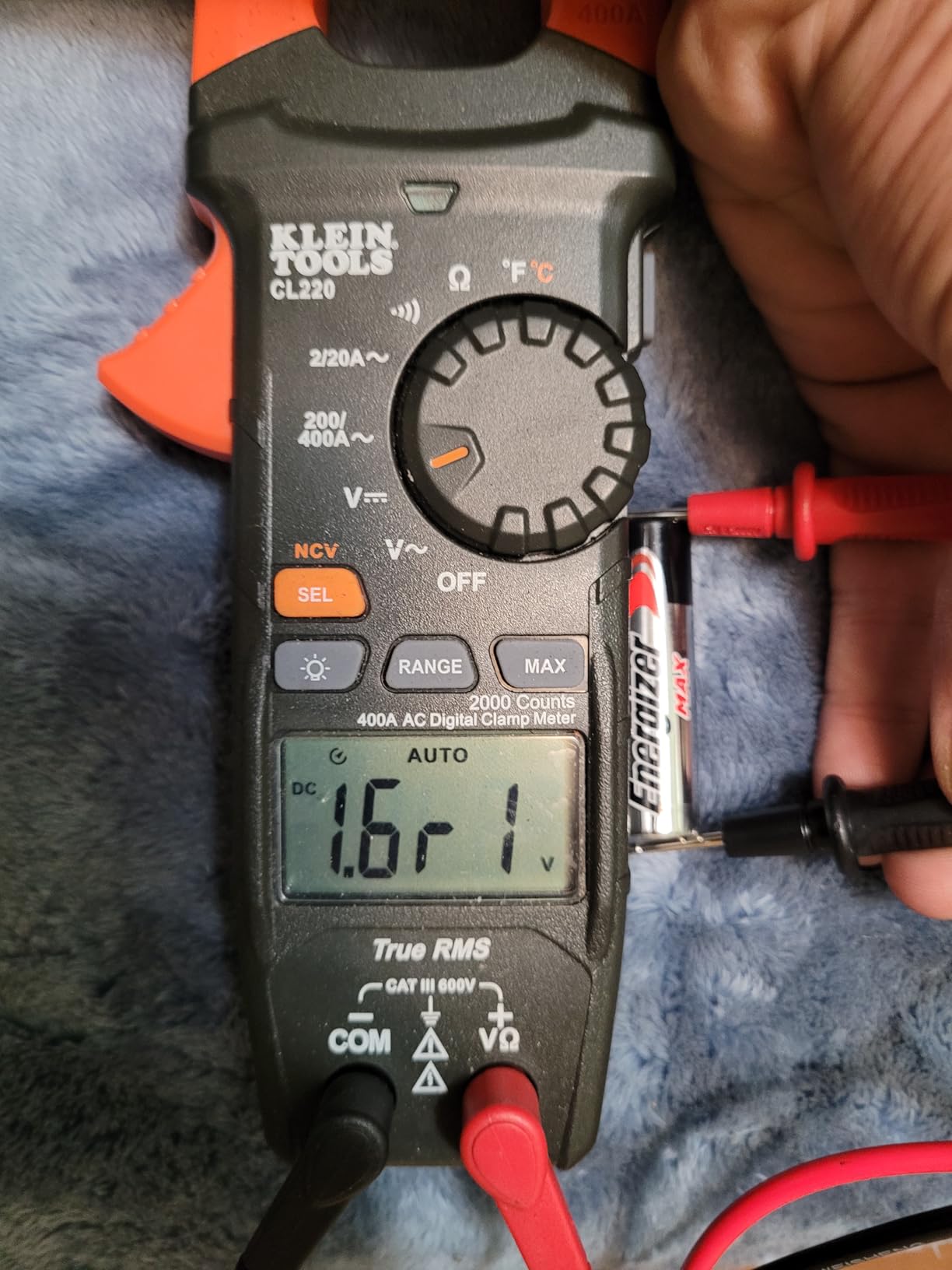
There are four real limitations. The clamp is AC only, so DC circuits are out of scope. The temperature channel is approximate, with roughly a 2 percent swing across the 0 to 100 °C range, which is fine for comparing a supply and return air temperature and wrong for a combustion analysis. The non-contact detector is over-sensitive and can trigger on non-live circuits, so confirm with the leads. And a small number of lightly used units have reported LCD segment failures inside a year or two.
Those last two are the reason we would not put this meter in a role where a false non-contact reading could matter, such as confirming a conductor is dead before working on it.
Is the CL220 accurate enough to trust on a service call?
Yes for AC current and voltage, which is what the majority of residential work involves. The auto-ranging removes the classic error of leaving the meter on the wrong range, and the 400 A ceiling covers every household service conductor you are likely to clamp.
Use the temperature channel comparatively rather than absolutely. It is built for confirming that a system is delivering air, not for certifying a temperature.
Should you choose the CL220 or the CL390?
Choose the CL220 if your current work is AC residential or light HVAC service and you want a backlit, tough meter with a temperature probe. Choose the CL390 if you need DC current, microamps, capacitance, frequency or a lower clamp current threshold.
The CL390 is the more capable instrument and the only one of the two that measures DC current through the jaw, so it is the better all-round buy. The CL220 wins on lightness, simplicity and price.
7. Fluke 325 – The Fluke to Buy If You Need DC Current or Temperature
Fluke 325 True-RMS Clamp Meter with Frequency, Temperature & Capacitance Measurements
True RMS AC and DC to 400A
Capacitance and frequency
Temperature
30 mm jaw
Pros
- True RMS accuracy verified against higher-end Flukes
- Rugged build that survives repeated drops
- DC current frequency capacitance and temperature in one clamp
- Data hold and min/max for large conductors
- Light at 283 g with a backlit display
Cons
- Resistance range stops at 40 kOhm
- No millivolt range and no inrush capture
- No non-contact voltage detection
- Carrying case too small for leads attached
The 325 is the meter to buy when a single instrument has to cover AC and DC. It measures true RMS AC and DC current to 400 A, AC and DC voltage to 600 V, resistance to 40 kOhm, frequency, capacitance and temperature, through a 30 mm jaw, with an audible continuity sensor and a CAT IV 300 V / CAT III 600 V rating. That combination makes it the Fluke of this group for automotive, diesel, motor and mixed residential-commercial shops.
Long-term owners, some with more than a decade of service, describe it as rugged, accurate and dependable, with readings that match pricier instruments. Data hold and min/max are useful when you are clamping a large conductor and cannot watch the display.
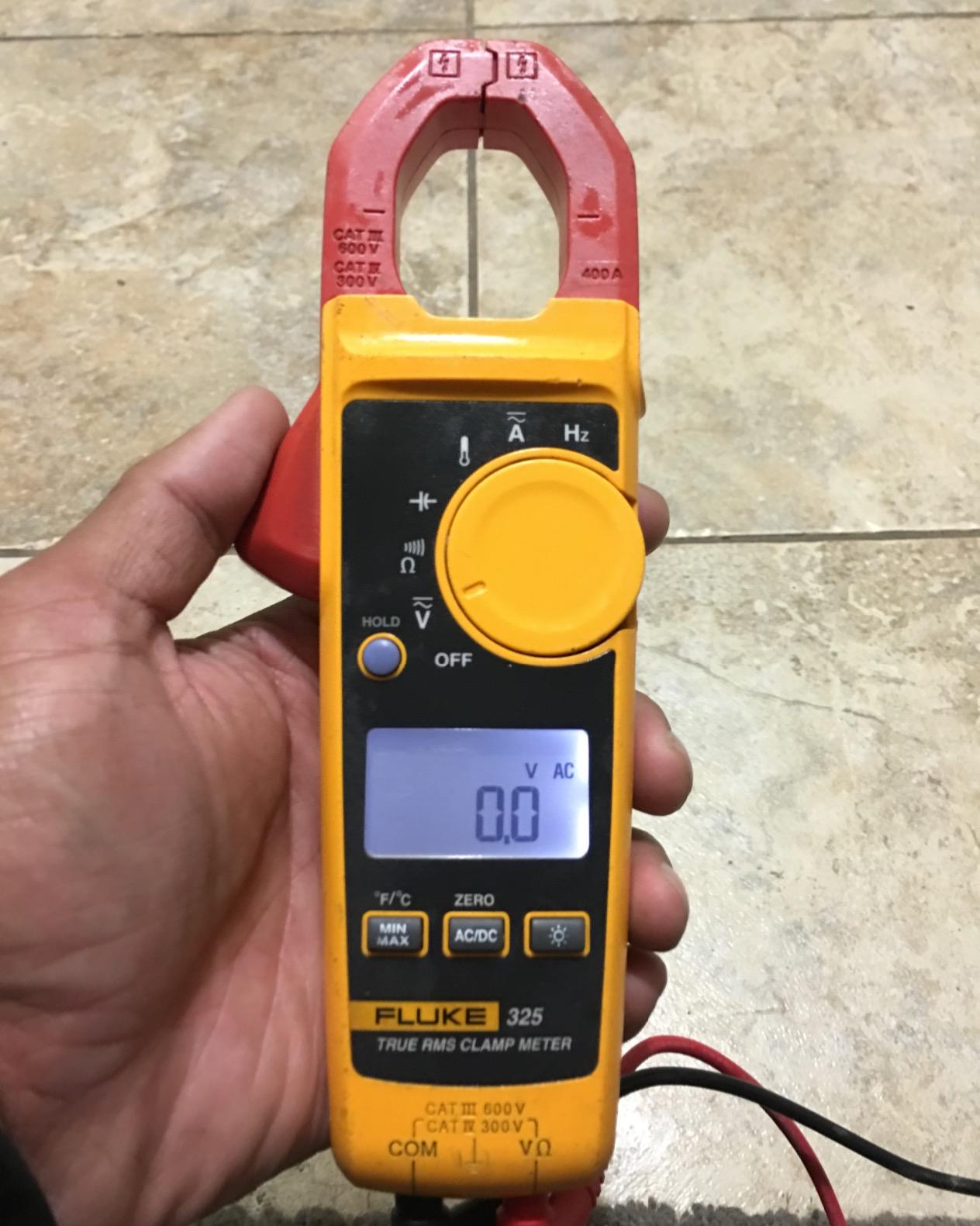
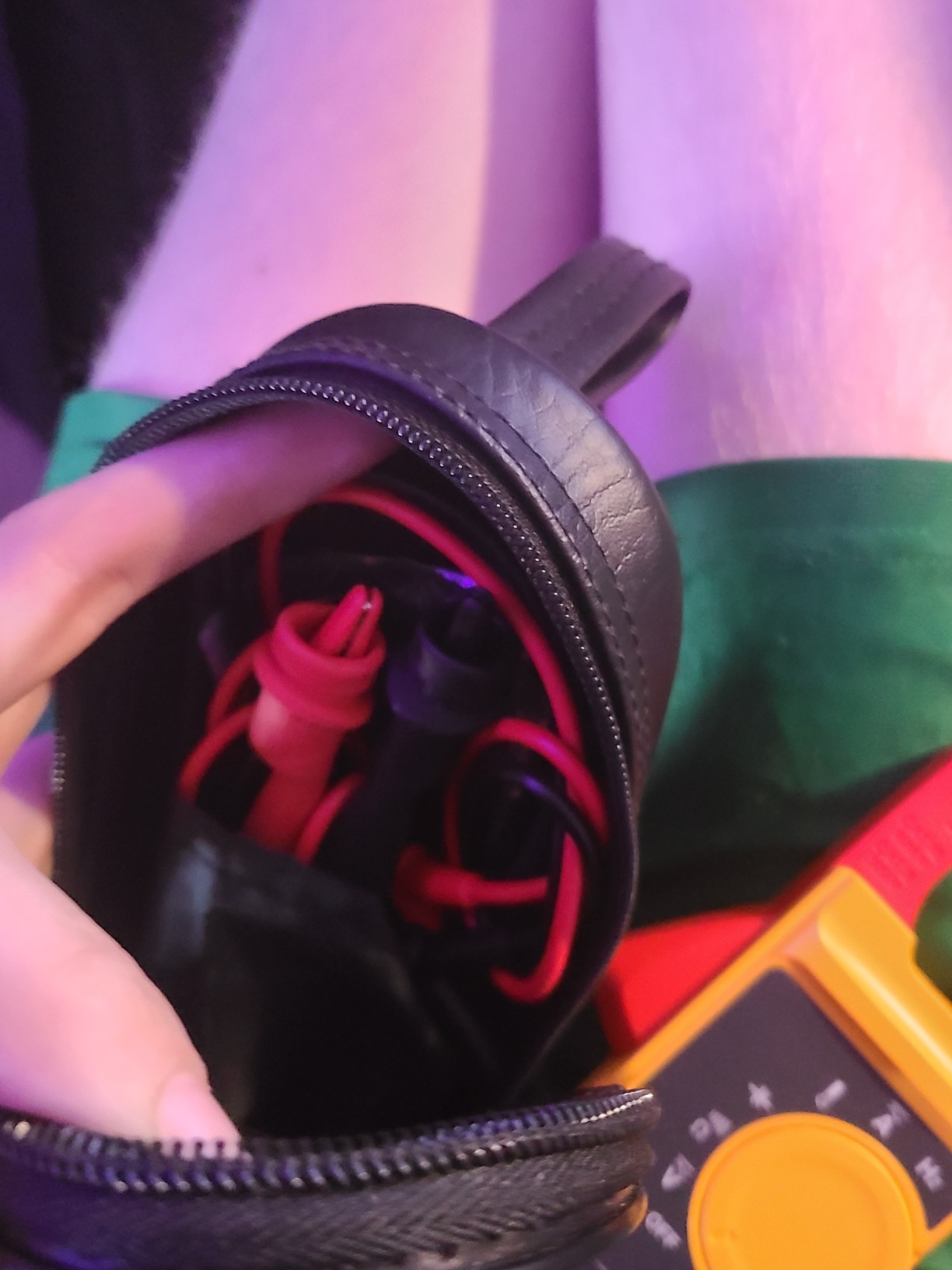
The criticisms are about limits rather than failures. The 40 kOhm resistance ceiling is too low for some thermistor work. There is no millivolt range, so ripple and low-level signal work is impractical. There is no inrush capture mode, no automatic AC and DC selection and no non-contact voltage detection. The combined ohms and continuity mode is described as ambiguous and sometimes beeps unexpectedly, and the supplied soft case is too small to hold the meter with the leads attached.
At 283 g with a backlit display, it is also the Fluke on this list that works in a dark panel, which is a meaningful advantage over the 323 and 302+.
Why does DC current capability matter on a Fluke clamp?
Because a current transformer only responds to AC. A hall effect sensor responds to both, so a hall effect clamp is the only kind that will read a DC circuit at all. The practical list of DC loads in an electrician’s work has grown fast: solar, battery storage, EV charging, LED drivers, modern controls and DC bus work.
If your work touches any of those, an AC-only clamp is not a cheaper option, it is the wrong tool. If it does not, the DC channel simply sits unused, which is why the 323 remains a legitimate purchase for AC-only work.
Is the Fluke 325 worth the step up from the 323?
If you need DC current, capacitance, frequency, temperature or a backlit display, the 325 replaces three tools with one and is worth the step up. If you do not need any of those, the 323 does the same AC job for less and the extra spend buys nothing on your specific work.
One habit to build with this meter: because the ohms and continuity positions are combined, confirm which function is active before you trust a beep or a resistance figure on a live job.
8. FNIRSI DMC-100 – The Clamp With a Graph Screen
FNIRSI DMC-100 Clamp Meter 9999 Counts TRMS, 600A AC/DC Amp Meter
10000 counts
AC/DC current to 600A
2-inch color TFT
Curve recording
Pros
- Readings match far costlier meters in side-by-side tests
- Colour TFT with dark and light themes
- Curve recording captures inrush and intermittent faults
- Rechargeable battery removes dead-meter downtime
- Capacitance and AC/DC clamp performance
Cons
- Temperature function is inaccurate
- Graph view captures about 25 seconds without value labels
- Build is lighter than professional brands
- Internal lithium cell is hard to replace
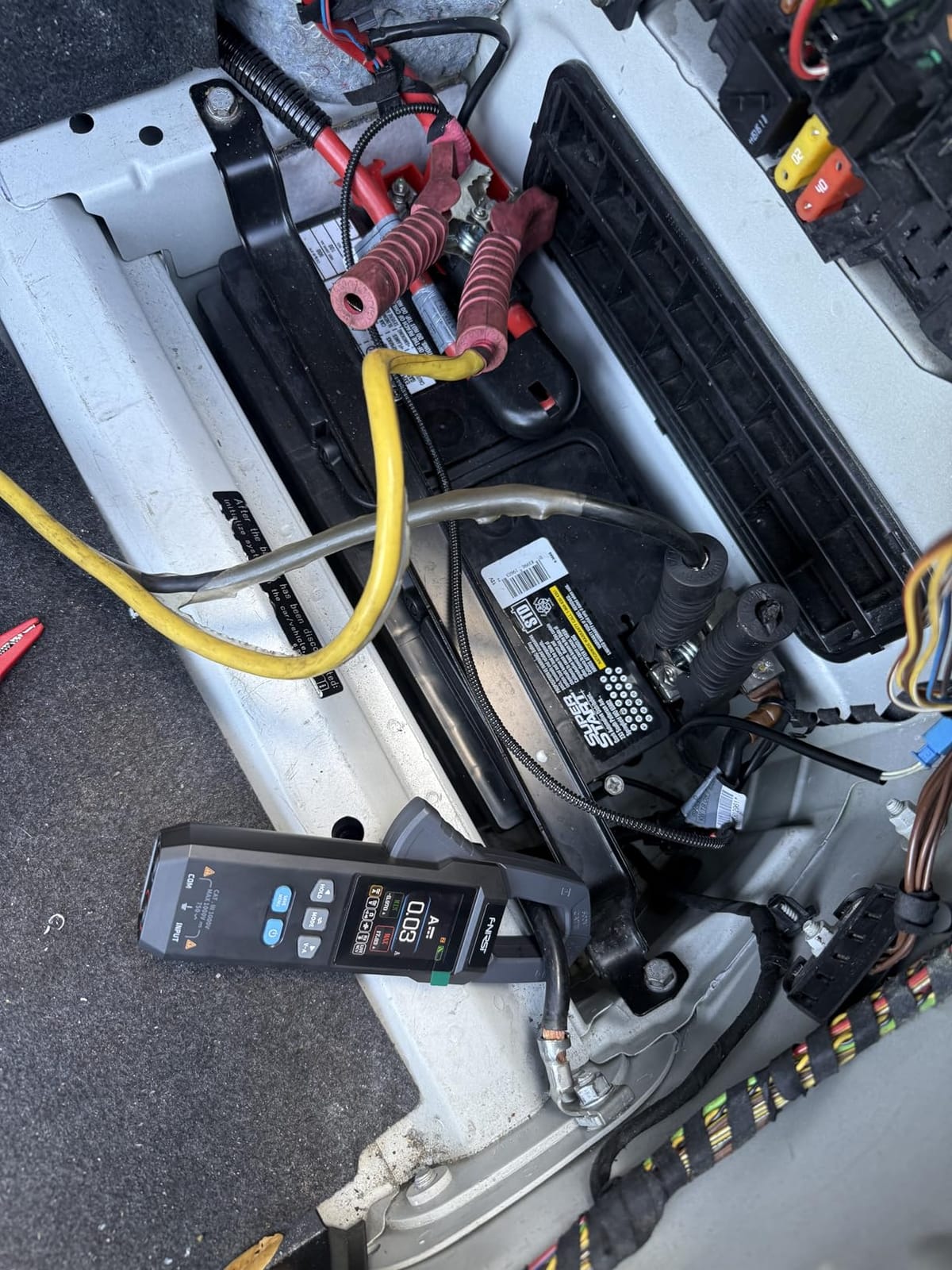
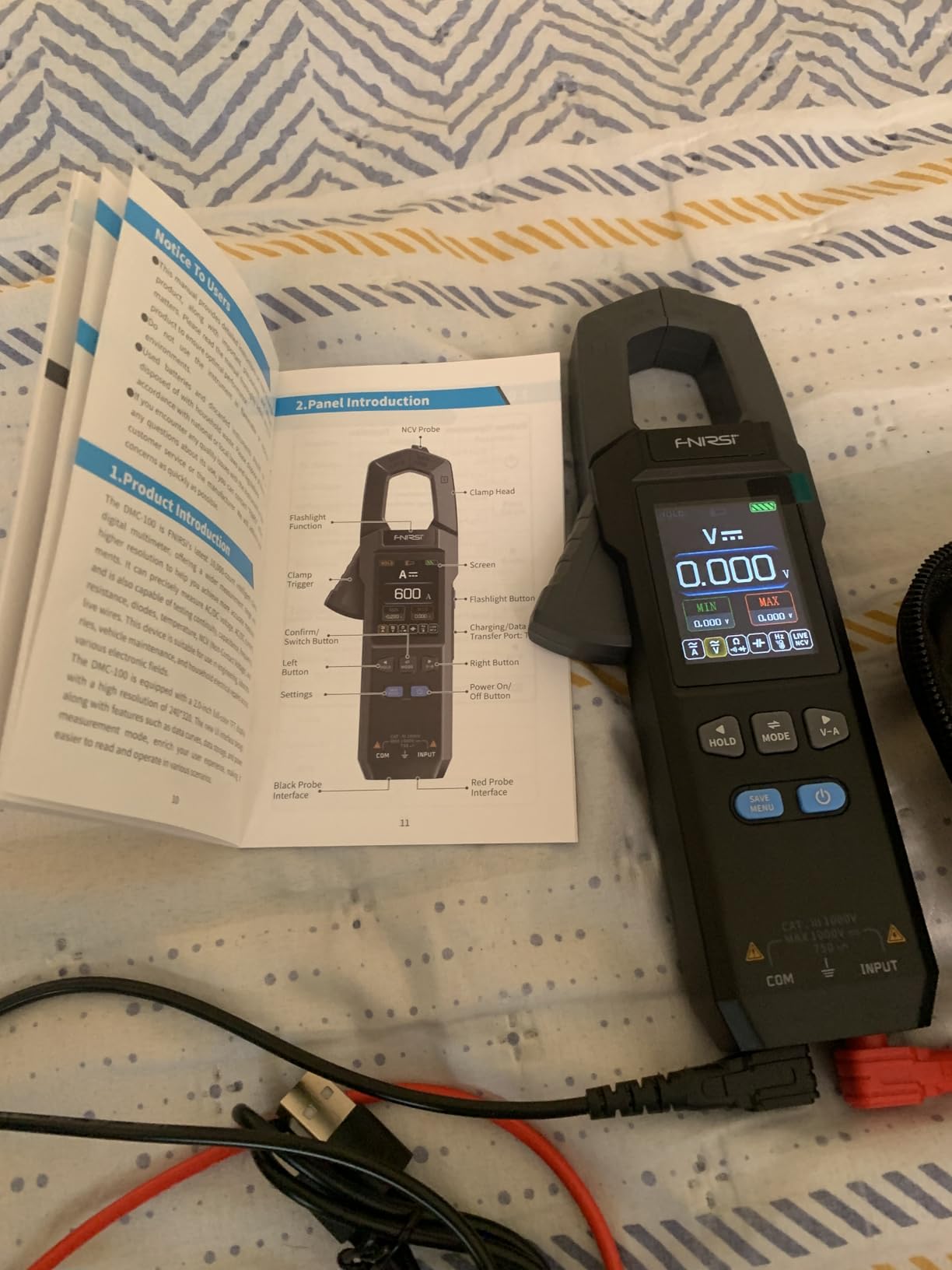
The DMC-100 is the only meter in this roundup with a colour screen and a graphing function, and that is the entire reason to consider it. It is a 10000-count true RMS clamp measuring AC and DC current to 600 A, plus voltage, resistance, capacitance, frequency and temperature. The 2-inch TFT has ten brightness levels, dark and light themes, and can show voltage and current simultaneously.
Curve recording is the standout. It holds eight live data sets and thirty historical records, which means you can watch a motor or a compressor start up and see the shape of the inrush rather than trying to catch a peak on a numeric display. Reviewers single this out for automotive and solar work, and the rechargeable 1500 mAh battery with Type-C charging removes the dead-meter problem entirely.
Set expectations on three points. The temperature function is reported as inaccurate, so ignore that channel. The graph view captures roughly 25 seconds and does not label values, so it is a shape tool rather than a record-keeping tool. And the advertised high count figure overstates real-world accuracy, which is a common feature of this class of meter and worth remembering before you rely on the last digit.
The build is lighter than professional brand meters, and the internal lithium cell is not user-replaceable, which is the failure mode to plan for. Voltage is measured through the test leads rather than from a second pair of jaws, so voltage and current readings come from two different points on the circuit.
Is a graphing clamp meter useful for inrush measurement?
It is the most direct tool in this group for it. Watching the current trace as a motor energises shows the inrush peak, the settle time and any repeated re-strike, all of which are invisible on a numeric display that refreshes slowly. That makes it useful for diagnosing a motor that trips on start or a compressor that struggles to pull down.
The 25-second capture window and the missing value labels mean it is a diagnostic instrument, not a logging one. If you need records you can export and read next week, this is not that tool.
Can the DMC-100 stand in for a professional Fluke?
For routine readings, reviewers say yes, matching Fluke and Fieldpiece units closely in side-by-side testing. For work where the reading has contractual or safety consequences, we would still verify with a second instrument, and that is the honest position for any meter in this class.
The rechargeable battery is a genuine field advantage over every AA and AAA powered meter on this list. Plan around a single non-replaceable cell, and keep a second meter in the van if downtime is not an option.
9. Klein Tools CL120 – The Best Value Basic Klein
Klein Tools CL120 Digital Clamp Meter, Auto-Ranging 400 Amp AC
Auto-ranging AC to 400A
NCV in the clamp jaw
Backlit LCD
Max and data hold
Pros
- Highest average rating in this roundup at 4.8 stars
- One meter covers current voltage resistance continuity and NCV
- Auto-ranging keeps testing fast
- Durable construction that holds up over years
- On-board probe holder on the side
Cons
- AC current only
- No temperature measurement
- Continuity tone is sometimes slow to trigger
- Carrying case is small for longer leads
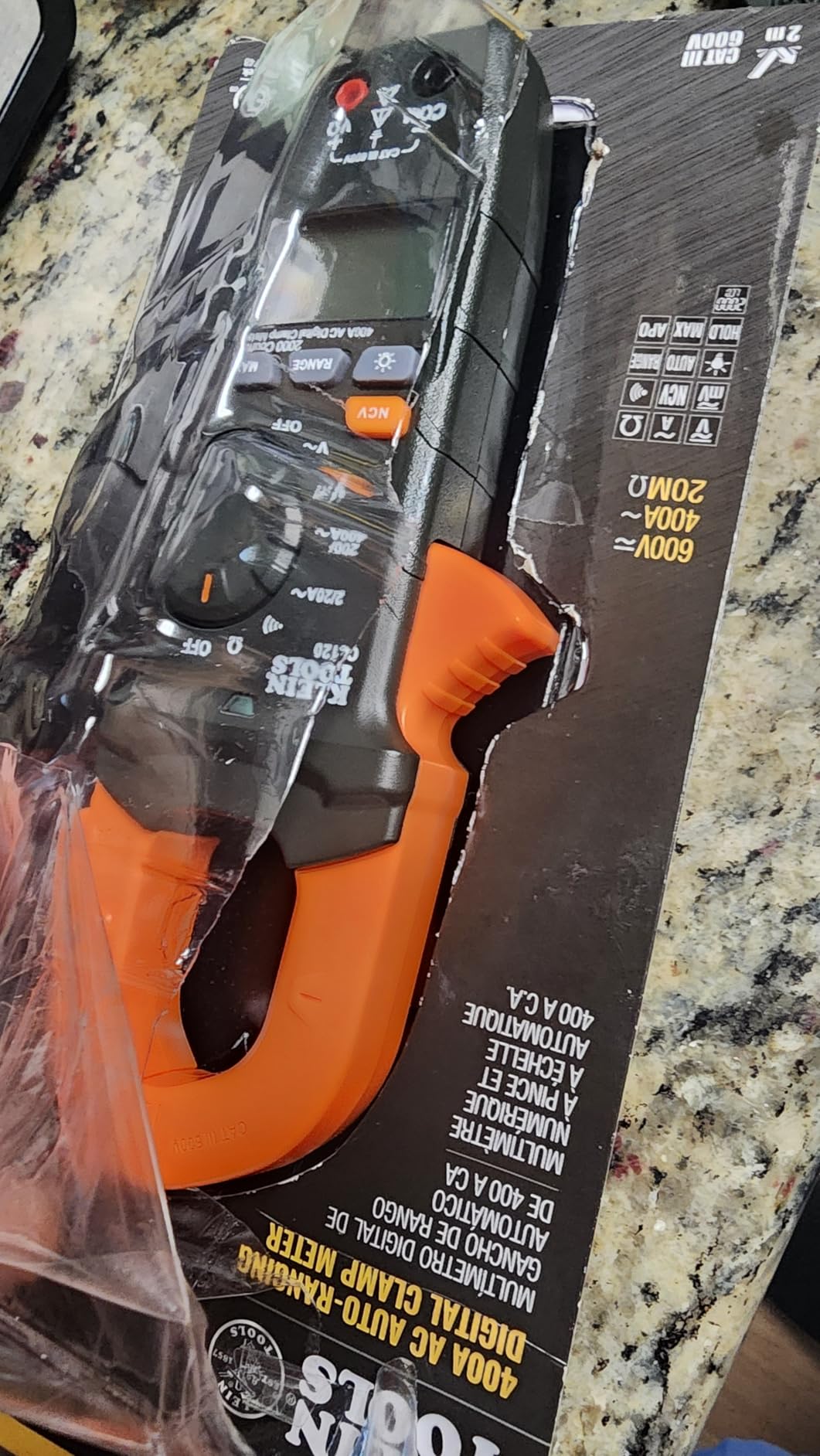
The CL120 carries the highest average rating of any meter in this roundup, and for a straightforward reason: it does the basic professional job cleanly. Auto-ranging AC current to 400 A through the jaw, AC and DC voltage, resistance and continuity through the leads, non-contact voltage testing in the clamp jaw, and a backlit LCD. Max and data hold capture the intermittent faults that a service call is usually about.
Owners call it the best of the basic Klein clamp meters, describing it as simple, durable and capable of covering essentially all routine household and professional checks. It auto-powers off after ten minutes, and the box includes a carrying case, CAT III and CAT IV capped test leads and three AAA batteries.
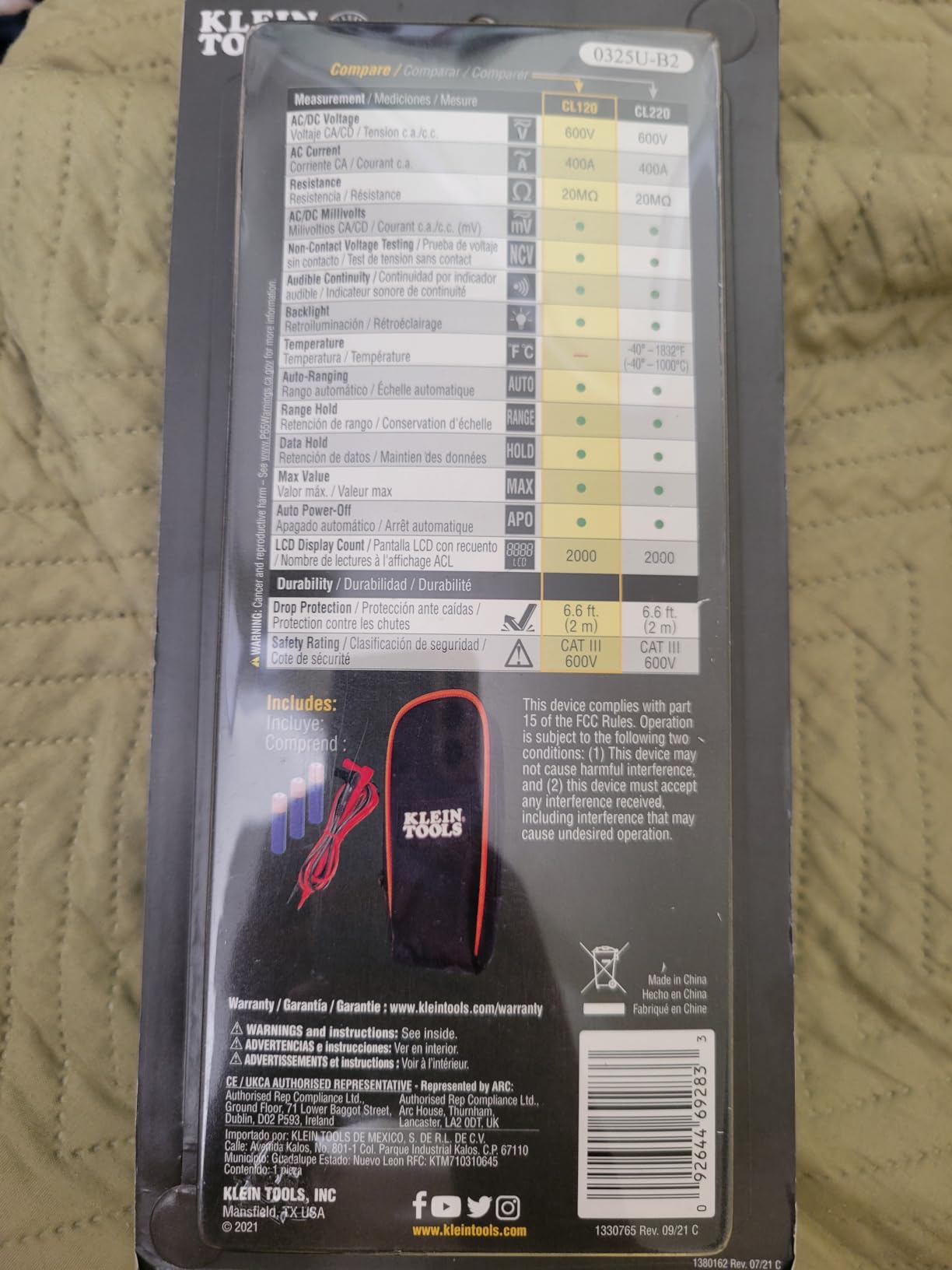
The limits are functional. It is AC only in the clamp, so no DC measurement. It has no temperature function, which is the one thing its sibling the CL220 adds and a genuine loss for HVAC work. The continuity tone is reported as sometimes slow or failing to trigger, so do not use the buzzer as your only confirmation on a de-energisation check. The supplied case is a little small for longer leads.
The capped test leads are worth a mention: they are the correct rating for the work the meter is certified for, which is not always true of the leads that ship with budget clamps.
Is a 4.8-star rating on an AC-only meter worth it?
For residential service, panel work and general maintenance, yes, because rating reflects the whole experience including build and readability, and the backlit display with auto-ranging is what keeps it usable on a dark panel. The 4.8 comes from owners who bought it to do AC work and found it did that job without surprises.
It tells you nothing about DC capability, because there is none. Judge any meter on the functions your work actually needs rather than on its star rating.
Should an apprentice buy this first or save for a hall effect meter?
Buy this first if your current work is AC. You will learn clamp technique, auto-ranging, hold functions and safe measurement practice on a meter that is simple enough to grow into, and you will not be tempted to skip the safety habits because the instrument is confusing.
Save for a hall effect meter as soon as DC enters your work. The jump from an AC-only clamp to a hall effect clamp is the single most useful upgrade an electrician can make, and the CL390 is the version of that upgrade inside the same brand family.
10. IDEAL 61-747 TightSight – The Best CAT IV Rating Here
Ideal Electrical 61-747 TightSight Clamp Meter, 400A AC/DC, 600V TRMS
AC/DC current to 400A
CAT IV 1000V
Dual backlit displays
Temperature and capacitance
Pros
- TightSight display stays readable in bright work areas
- AC and DC clamp current plus NCV in one tool
- Dual backlit displays for low light
- Temperature frequency resistance continuity and capacitance
- Rugged build with a two-year limited warranty
Cons
- Bulky body and 1.5 lb weight
- Far fewer customer reviews than the Fluke and Klein clamps
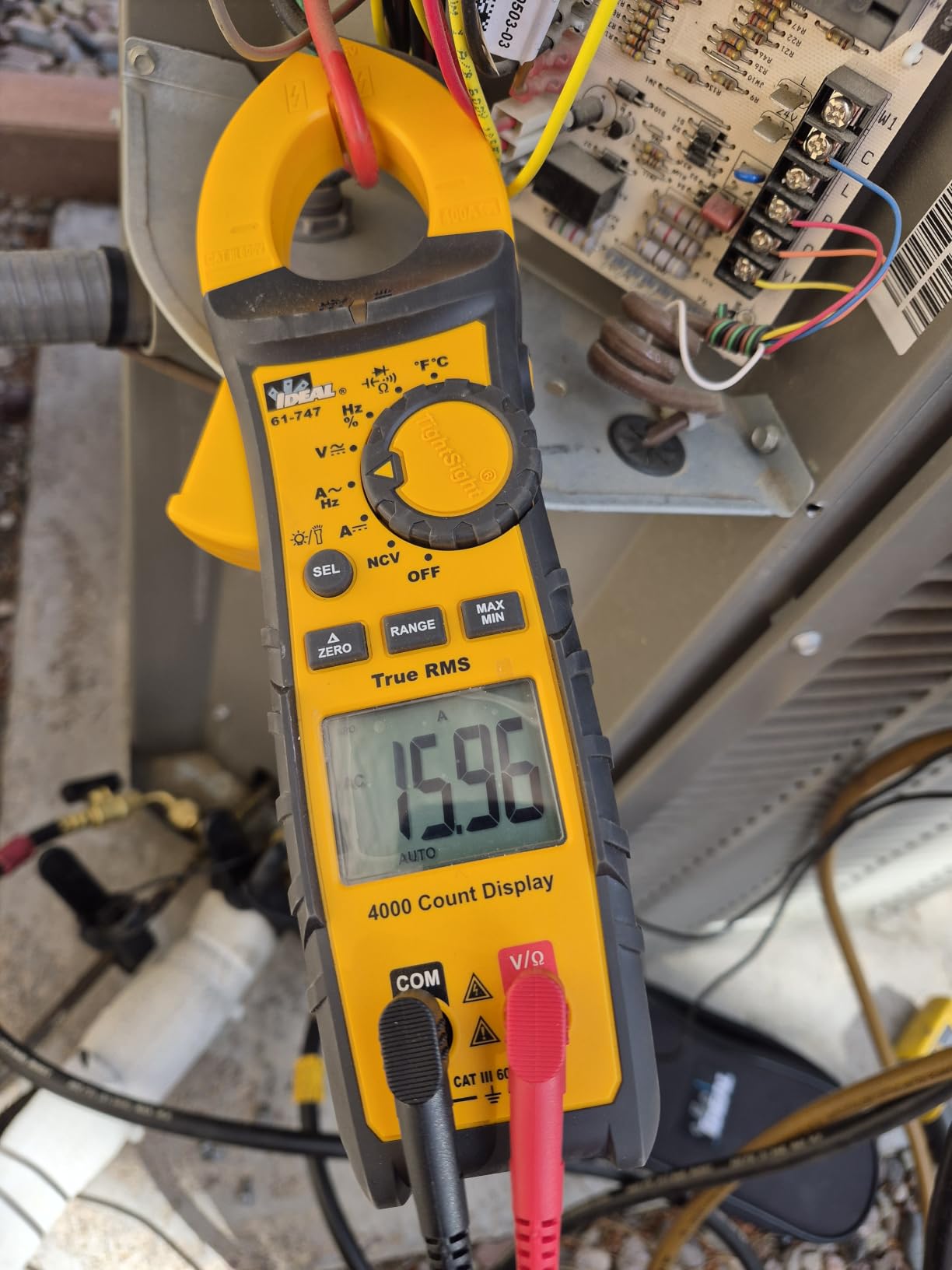
The 61-747 has the highest safety category rating in this roundup: CAT IV 1000 V alongside CAT III 600 V. That is the rating you want when you are clamping a service entrance conductor, a feeder or anything on the line side of a main disconnect, where the available fault current is high enough that a CAT III meter is not the correct instrument.
It also measures AC and DC clamp current to 400 A at 600 V true RMS, with non-contact voltage detection from 40 to 600 V, temperature, frequency, resistance, continuity and capacitance. The TightSight display design and the dual backlights are its most-cited strengths, and 88 percent of reviewers give it five stars.
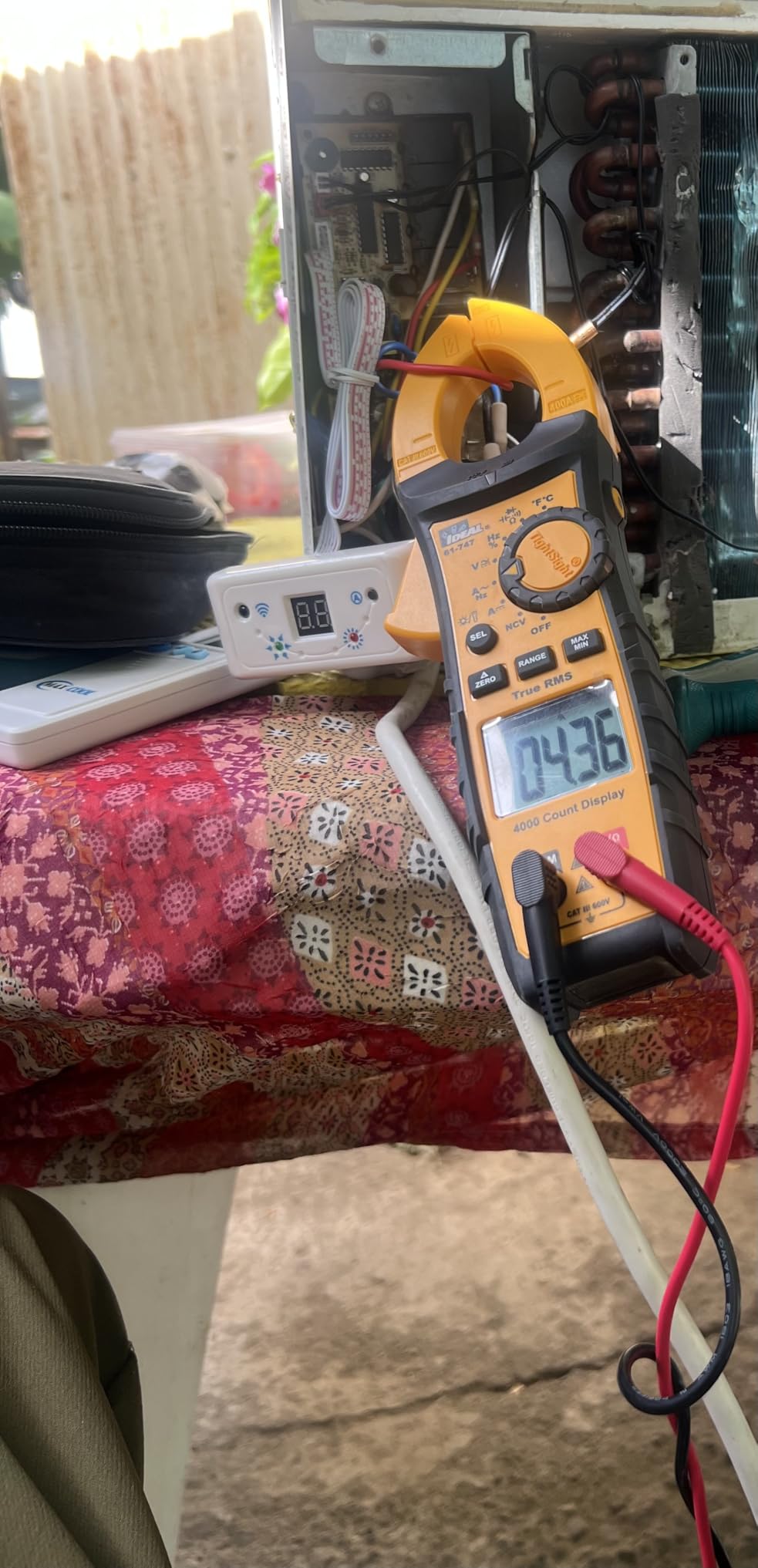
Two honest caveats. The body is bulky at 1.5 pounds, which makes it the least pocketable meter here and noticeably heavier on a long service day. And with 246 reviews against thousands for the Fluke and Klein models, there is very little long-term durability evidence to draw on. That is not a criticism of the meter so much as a statement about how little we can honestly claim about how it ages.
On balance, the CAT IV 1000 V rating is the reason to buy this meter despite its size. For service entrance and feeder work, the rating is not a feature, it is a permission.
What CAT rating do I actually need?
Map the number to the work. CAT II covers loads and plug-connected equipment with a relatively low fault current. CAT III covers distribution boards, panelboards and the branch circuit wiring inside them, which is where most service work happens. CAT IV covers the service entrance, the meter socket and the conductors between the utility supply and the main disconnect, where available fault current is highest.
The mistake worth avoiding is using a CAT III meter on a CAT IV task. The categories exist because a fault in a panel can dump far more energy into your instrument than a fault in a receptacle, and the instrument has to survive it.
Is the weight worth it for a residential electrician?
For pure residential work, no. A slim AC meter with a backlight is easier to carry all day and covers the circuits you will actually be clamping. The 61-747 earns its weight when the work includes service entrances, feeders, commercial distribution or any job where you need to point at a rating and justify it.
If you already own a CAT IV meter, the 61-747 is a better second instrument than another CAT III, because it covers the one measurement your current kit cannot make safely.
11. UNI-T UT210e – The Best Low DC Current Readings in a Small Body
UNI-T UT210e Digital Clamp Meter Multimeter
2000 counts
AC and DC current with 1 mA floor
VFC mode
Compact body
Pros
- AC and DC current in a genuinely pocket-sized body
- Low range resolves to 1 mA
- VFC mode handles variable frequency drives
- Capacitance and continuity for HVAC-R work
- Non-slip rubber grip and overload protection
Cons
- 2000-count resolution is low against 6000-count rivals
- CAT II 600 V and CAT III 300 V rating
- Only one customer image and a small review base
The UT210e is the smallest meter here at just under 2 inches square, and unusually for a meter that size it measures both AC and DC current. The low current range resolves to 1 mA on a 2.000 A range, which makes it the meter in this roundup to reach for when you need to see a small DC control current, a sensor draw or an automotive circuit that other clamps would miss entirely.
It is a 2000-count true RMS meter with AC and DC voltage from 200 mV up to 600 V, a VFC variable frequency mode for drive outputs, continuity, capacitance and resistance, all with a non-slip rubber grip and overload protection.
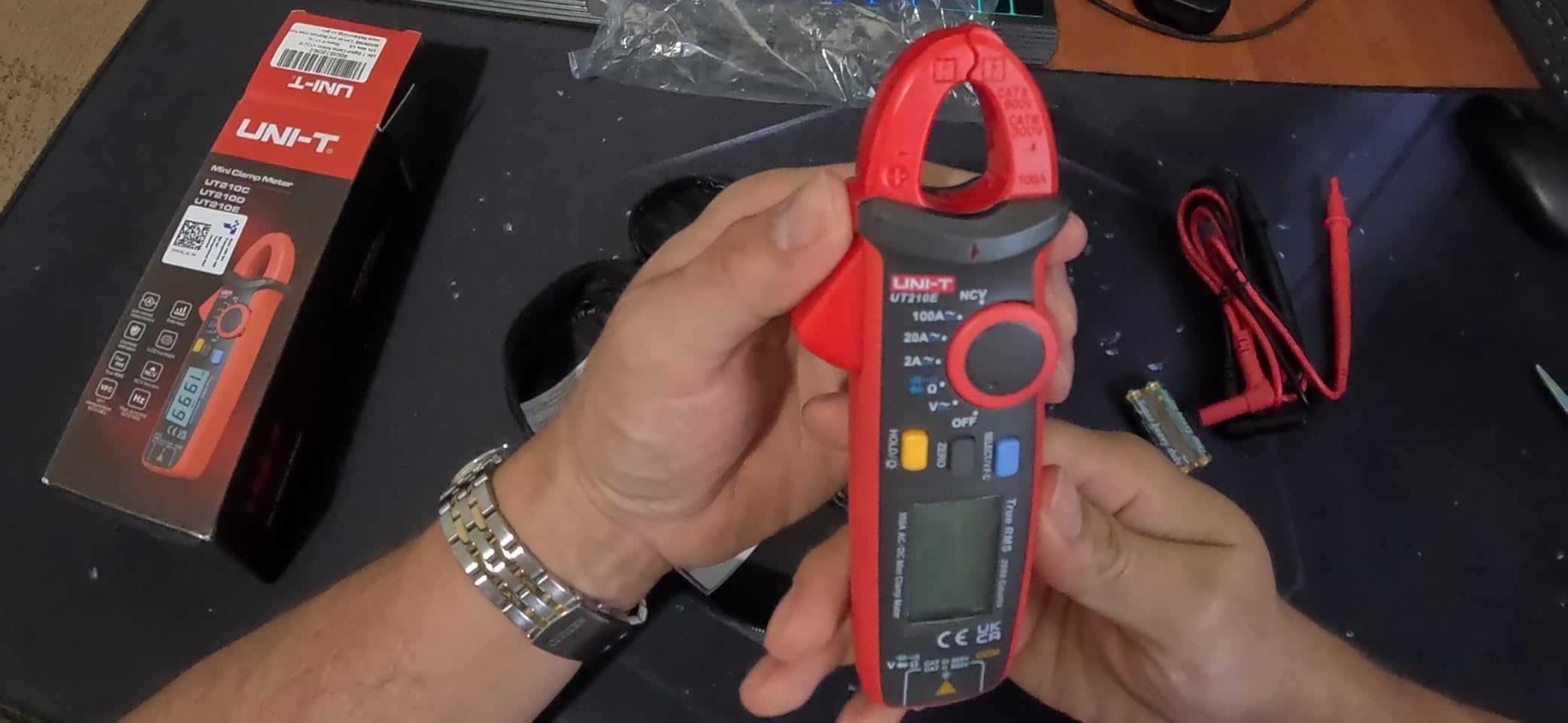
Two things pull against it. The 2000-count display gives a coarse least significant digit, so a reading of 0.487 amps shows as 0.49. And the CAT II 600 V / CAT III 300 V rating is lower than most meters here, which limits it to receptacle and appliance-level work rather than panel and feeder troubleshooting.
The review base is also small at 238 reviews, so the long-term durability picture is thin. Reviewers nevertheless describe it as a genuinely portable all-in-one that fits in a pocket and still handles AC and DC current, true RMS voltage and capacitance work for automotive, HVAC-R and household jobs.
When does a 1 mA floor actually matter?
On low-voltage DC control circuits, 24 V automation loops, sensor and relay currents, small electronic loads, PC power supplies and automotive circuits. Most hall effect clamps in this roundup have a 0.3 A or 0.1 A floor at best, so a small draw simply does not register on them.
That is also why the true RMS rating and the VFC mode are worth noting here. Being able to read a small current accurately on a modern switched load is a capability the larger meters on this list do not have.
Is the lower CAT rating a deal breaker?
It depends entirely on where you work. If you need panel, feeder or service entrance measurements, yes, the UT210e is not the right instrument and you should be carrying a CAT III and CAT IV meter. If you work on appliances, HVAC equipment, control panels and low-voltage systems, the rating matches the work and the low current resolution is a genuine advantage.
Treat it as a specialised second meter rather than a primary. The size makes it the one you keep in a pocket for controls work, and it does not replace a panel-rated clamp.
12. Fieldpiece SC260 – The HVACR Specialist
Fieldpiece Compact HVACR Clamp Multimeter SC260 – True RMS Clamp Meter with Temperature, Capacitance & Backlight
True RMS AC current
NCV and amperage
Temperature and capacitance
Swivel magnet
Pros
- Highest rated option in the group at 4.8 stars
- Compact body built for tight HVACR cabinets
- True RMS accuracy on voltage and current
- Temperature and capacitance are core functions
- Swivel magnet gives hands-free readings
Cons
- AC current only with no DC clamp range
- Costs more than general purpose clamp meters
- Small screen limits visible information
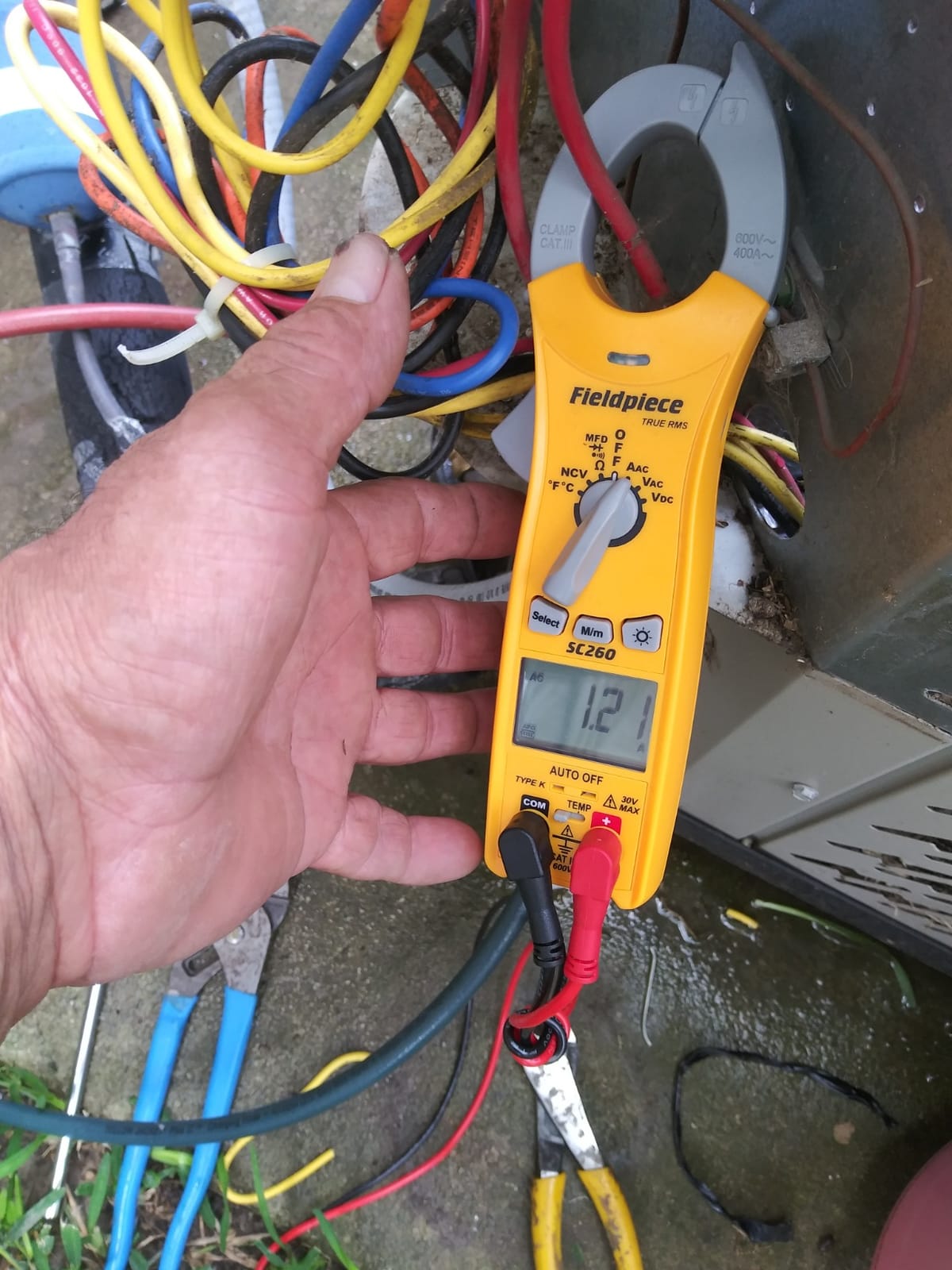
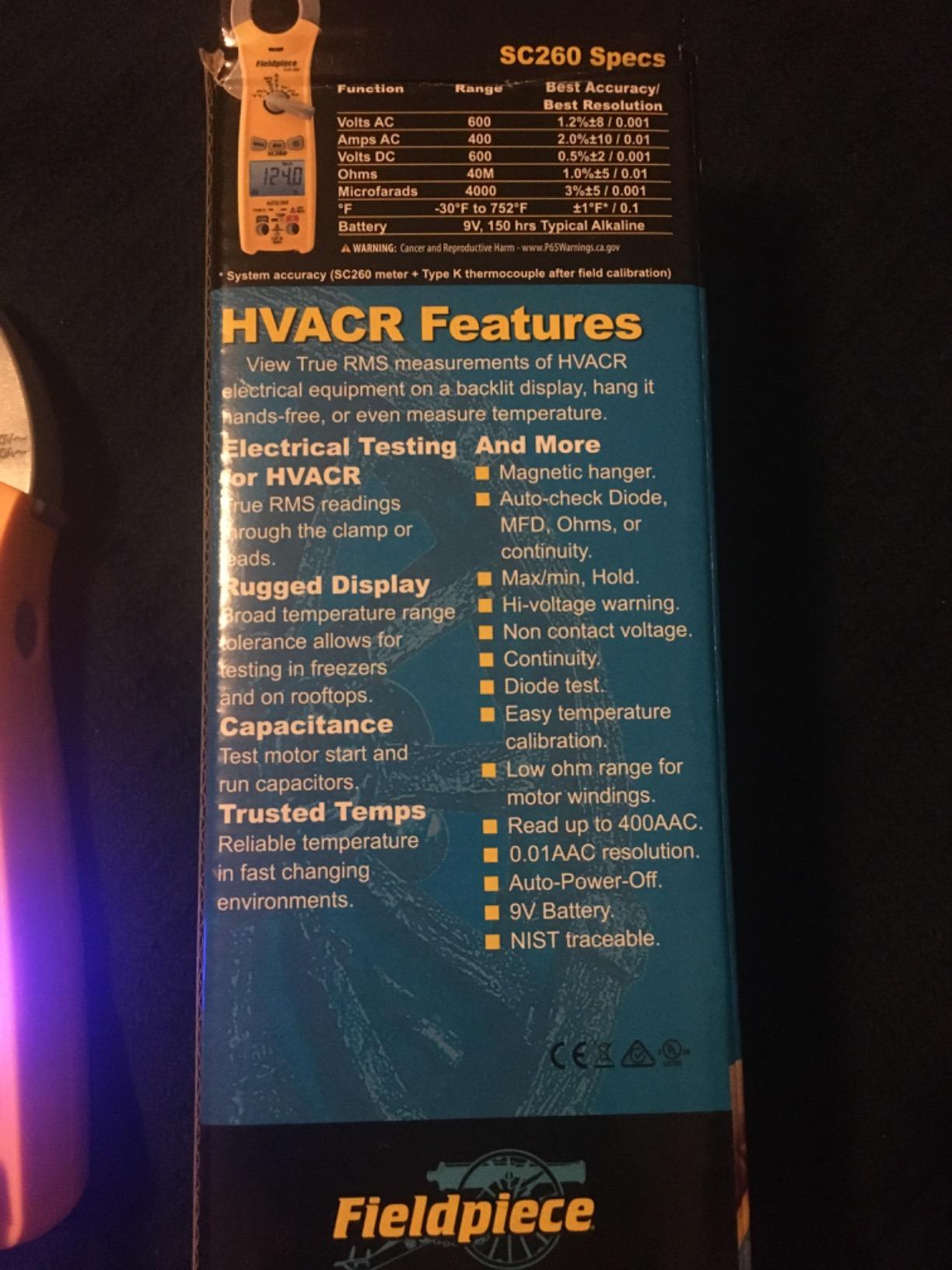
The SC260 was designed for one job: refrigeration and air conditioning service. It is a compact true RMS clamp with higher accuracy on AC voltage and AC current than general purpose meters in its class, temperature and capacitance measurement, a backlit display, non-contact voltage detection, amperage readings, a continuity warning, diode test and an Auto Select mode that picks between capacitance and resistance for you.
What makes it work in an HVAC cabinet is physical. The swivel magnet holds the meter to the equipment so you can read a running compressor without holding anything, and the compact body fits the tight working space around a rooftop unit or a mini-split. Refrigeration technicians consistently single it out as durable, accurate and purpose-built.
Its trade-off is a narrow feature envelope. It measures AC current only, with no DC clamp range, so it will not help with the DC side of a modern inverter-driven system, and it costs more than general purpose clamp meters that cover more measurement categories. The screen is small, which limits how much you can see at once.
At 9.1 inches long it is one of the larger bodies here despite being called compact, and the listed operating upper temperature rating is a modest 122 °F, so leave it in the van on a summer roof rather than leaving it in a hot cabinet.
Is the SC260 worth it if you are not an HVACR technician?
Probably not as a first clamp. The temperature and capacitance functions and the swivel magnet are designed for refrigeration diagnostics, and a general electrician measuring branch current will get less from them than a technician chasing a charge fault or a superheat problem would.
If refrigeration is a meaningful part of your work, it is the meter on this list built for it. The 4.8 rating across 1700 reviews is not an accident, and the accuracy on AC voltage and current is the reason reviewers compare it favourably with general purpose clamps.
Does the AC-only limitation matter in modern HVAC systems?
It matters more than it used to. Inverter-driven compressors and variable speed pumps draw DC on the link side, and a technician chasing a modern system may need DC capability that this meter does not have. Check what the equipment actually is before you commit.
For conventional split systems and light commercial refrigeration on AC circuits, the limitation rarely comes up, and the hands-free magnetic mounting more than compensates for it in a cramped cabinet.
How to Choose a Clamp Meter That Lasts
Buying a clamp meter is mostly a decision about measurement category, current type and the work you actually do. The rest is ergonomics, and the differences between a good meter and a great one are mostly about what happens on a bad day.
Match the CAT rating to the work, not to the price
CAT II is for loads and plug-connected equipment. CAT III is for panelboards and the branch circuit wiring inside them, and it covers the majority of service work. CAT IV is for the service entrance, meter socket and feeder conductors upstream of the main disconnect, where available fault current is highest.
Most electricians need CAT III as a baseline and CAT IV when they work on services and feeders. Of the meters in this roundup, the IDEAL 61-747 carries CAT IV 1000 V, the Klein CL390 and CL120 ship with CAT IV rated capped leads, and the Fluke 323, 302+ and 325 all carry CAT IV 300 V with CAT III 600 V.
Decide between a current transformer and a hall effect sensor
A current transformer only responds to changing current, so it reads AC and nothing else. A hall effect sensor detects the magnetic field itself, which is why every meter in this roundup that measures DC current uses one. That single technology choice decides whether the meter is useful on your work at all.
Forum discussion on r/electricians and ElectricianTalk keeps returning to the tradeoff: several users note that older split transformer AC-only meters seem more reliably accurate on pure AC work than newer hall effect units. The practical answer is that hall effect meters are no longer less accurate on AC, they are just newer, so check the accuracy specification rather than the sensor type.
True RMS matters once the load is not a sine wave
True RMS measures the effective value of the whole waveform rather than estimating it from a rectified average. On a resistive load like a water heater, an average responding meter is close enough. On LED lighting, computer loads, variable frequency drives and inverter-driven motors, the gap widens quickly and an average responding meter reads low.
If your work touches modern lighting or motor drives, do not compromise on this. Every hall effect meter in this roundup is true RMS. Among AC-only meters, check the specification, because some cheap models are not.
Use low impedance mode to avoid ghost voltage
A ghost voltage is a reading on a conductor that is not actually energised, caused by capacitive coupling from a neighbouring wire. A high impedance multimeter sees it easily and will happily tell you a dead circuit is at 40 volts. Low impedance mode adds a deliberate load so the conductor discharges itself and reads zero.
Of the meters here, the KAIWEETS HT206D has an explicit LoZ mode and a low pass filter for VFD signals. The concept applies to every meter, though: prove a circuit dead with the leads and a known-good load, never with a high impedance reading alone.
Look at the display and the controls, not just the specs
Dark panels and gloved hands are the normal condition of electrical work. A backlit display solves the first problem. A reverse-contrast display, as on the Klein CL390, solves both bright sun and low light. The Fluke 323 and 302+ have no backlight at all, which is a real ergonomic cost in a crawlspace.
Input port position matters more than most buyers expect, and it is a complaint that shows up repeatedly in owner reviews. On the Klein models the test lead holder sits on the side of the clamp, so leads hang in the orientation you plug them in. A port on the bottom means you are rotating the meter to insert a probe.
Jaw opening and counts are the two specs that limit you
Most meters in this roundup use a 30 mm jaw, which clears a standard full-size conductor. A bundled or multi-conductor cable may not fit, and that is when a flexible probe is the answer, although none of these twelve include one.
Counts describe display resolution. A 2000-count meter shows 3.4 amps where a 6000-count meter shows 3.42. The AstroAI and UNI-T sit at 2000 counts, the Klein and Fluke models at 6000, and the FNIRSI DMC-100 claims 10000 on a colour screen, although reviewers caution that the claimed precision overstates real-world accuracy.
Clamp Meter or Digital Multimeter: Which One Do You Need?
You need both, and the honest answer is that a clamp meter does not replace a multimeter. It replaces a multimeter for one specific job, and it is a better tool at it.
A digital multimeter measures anything you can touch with two probes: voltage, resistance, continuity, diodes, capacitance, frequency and temperature, on de-energised or low-energy circuits. It cannot measure current on a live circuit at all without breaking the circuit, which on an occupied panel means shutting down something that should not be shut down.
A clamp meter measures current around an insulated conductor with the circuit intact. That is the task it does better than anything else, and for panel troubleshooting, load balancing, motor diagnosis and nuisance-tripping breakers it is the only safe way to get a number.
One classic mistake deserves repeating. If you close the jaw around a cable containing both the hot and the neutral conductor, the two currents are equal and opposite, the fields cancel, and the meter reads zero. Clamp one conductor only. If you want total load rather than per-circuit load, clamp the feeder itself.
What most electricians actually carry is both: a meter with full probe-based functions in the same body as the clamp. The Klein CL390, the Fluke 325 and the KAIWEETS HT206D all do voltage, resistance, continuity, capacitance and temperature through the leads as well as current through the jaw, which is why they are the picks in this roundup. For a wider resistance range, a millivolt range or a bench-accurate reference, a dedicated multimeter still has a place in the bag. If your measuring extends past electrical work, our best dwell meters guide covers heating control timing, and our best pH meters guide covers the fluid measurement side of the trade.
What Electricians Say About Fluke and Klein Meters
Forum threads on r/electricians and ElectricianTalk split predictably into two camps. Fluke owners argue the build quality and accuracy justify the premium. Klein owners reply that a Klein will do you just fine for your needs. Both sides have a point, and the disagreement is really about which jobs you take.
Three threads come up repeatedly. The Hioki CM4371 is named several times in r/electricians discussions as a standout quality option. The Fluke 325 is described as the go-to for general commercial electrical work, while the 376 FC is favoured where loads are heavily non-linear. And the Fluke T5 and T6 electrical testers are praised separately as the kind of tool you can beat on without consequence, which is a different category from a clamp meter entirely.
The complaint that comes up most often against Klein is DC hall effect drift, where readings glitch or wander and force users to double-check against a second tool. That complaint is not attached to one model in particular, so treat it as a workflow habit rather than a model verdict: verify any suspicious DC reading before you act on it. The same instinct is right for entry-level meters generally, where reviewers report weak low current detection.
Two more failure modes are worth planning around. Readings drifting after a year or two on the job is a common ownership report, so make calibration part of your annual maintenance rather than waiting for a bad reading. And battery leakage is a recurring long-term complaint, which is a strong argument for removing batteries from any meter that will sit in a van for weeks.
One piece of context that surprises buyers: Fluke and Amprobe are divisions of the same parent company. Several forum users mention it as a fact worth knowing before assuming you are comparing two independent manufacturers.
Frequently Asked Questions
Which clamp meter is the most accurate?
Among the meters in this roundup, the Fluke 323 and Fluke 325 hold the highest accuracy claims, with the Fieldpiece SC260 rated highest overall by owner rating at 4.8 stars. The budget meters are also more accurate than their price suggests: reviewers report the KAIWEETS HT206D matching far costlier instruments in side-by-side testing. Accuracy claims matter less than the measurement category, so match the CAT rating to the job before comparing digits.
Can a clamp meter replace a multimeter?
No, and you should not try. A clamp meter measures current around an insulated conductor without disconnecting the circuit, which a multimeter cannot do safely on a live panel. For voltage, resistance, continuity, diode and capacitance work, a probe-based meter is still the right tool, and a wider resistance range or a millivolt range will not be on any clamp in this roundup. Most electricians carry both, or a meter that does both in one body.
Is True RMS necessary?
True RMS matters once the load stops being a simple resistive sine wave. On LED lighting, computer loads, variable frequency drives and inverter-driven motors, an average responding meter reads low because it estimates the waveform rather than measuring the whole thing. On a resistive load such as a water heater, the difference is small. If your work touches modern lighting or motor drives, do not compromise on this feature.
What CAT rating do I need as an electrician?
CAT III covers panelboards and branch circuit wiring, which is the majority of service work, and every professional meter in this roundup is rated at least that far. CAT IV is for the service entrance, meter socket and feeder conductors upstream of the main disconnect, where available fault current is highest. If you work on services or feeders, you need CAT IV, and of the meters here the IDEAL 61-747 carries CAT IV 1000 V.
Is a Klein Tools clamp meter good?
Yes for the work most electricians do. The CL390 is the most capable model in this roundup, measuring AC and DC current to 400 A with true RMS, non-contact voltage in the jaw, temperature via thermocouple and a reverse-contrast display that stays readable in sun and low light. The limitation to know about is the 0.3 A minimum clamp current, which puts small draws out of range. Forum discussion also raises occasional DC hall effect drift, so verify suspicious readings with a second tool.
The Best Clamp Meters for Electricians in 2026
The best clamp meters for electricians in 2026 come down to three decisions: whether you need DC current, what CAT rating your work requires, and how much you are measuring in the dark. Buy the hall effect model if DC circuits are part of your work, buy the CAT IV model if you work on services and feeders, and do not compromise on true RMS.
Our pick as the best all-round option is the KAIWEETS HT206D, because it measures true RMS AC and DC current, carries a CAT III 600 V rating, adds low impedance mode and a low pass filter, and has the deepest review record of any meter here. For pure AC commercial and residential service, the Fluke 323 is the durable long-term buy. For refrigeration work, the Fieldpiece SC260 is the specialist instrument technicians keep recommending.
Whichever one you choose, verify it on a known live source before you trust it on a job, clamp one conductor at a time, and treat any low current reading as worth confirming a second time.