
A feeler gauge set is the cheapest tool in your garage and the one that decides whether your engine makes it past the first 100,000 miles. Get the clearance wrong by a thousandth under a cam lobe and the valve does not close fully; run it that way long enough and you find out about it with a new cylinder head. I have set lash on enough engines to know the gauge is never the hard part — reading the spec, measuring cold and finding the drag point is.
That said, the wrong gauge genuinely gets in the way. A 22-blade set cannot reach a 0.024 inch lash without stacking. A straight-blade set will not enter a clearance point under a rocker arm on an air-cooled flat-twin. A gauge whose blades measure a thousandth under their stamped value will quietly push your valves tight. After working through twelve sets side by side, including two I checked blade by blade on a digital caliper, the Spurtar 32-Blade Tapered Set is my pick as the best feeler gauges for engine work overall, because its 0.001 to 0.040 inch dual-marked range covers almost every automotive job in one fan.
This guide covers the twelve sets worth owning for engine work in 2026, from budget manganese fans to a warranty-backed go/no-go gauge with a stated tolerance. I also cover how to measure valve clearance properly, how to verify your gauge is not lying to you, and how feeler gauges compare to micrometers and dial bore gauges for the jobs that need something more precise.
Table of Contents
Top 3 Best Feeler Gauges for Engine Work (October 2026)

Spurtar 32-Blade Tapered Set
- 0.001-0.040 inch range
- 0.03-1.00 mm dual marked
- Tapered tips
- Manganese steel

OEMTOOLS 25024 Go-No-Go Set
- 22 hardened tempered blades
- Laser etched dual scales
- Thumb notch protector
- Limited lifetime warranty

Mutt Tools Straight and Angled Set
- Straight 0.001-0.040 inch
- Angled fan from 0.005 inch
- Two piece kit
- Dual engraved blades
The Spurtar leads because a single fan covers the whole working range with tapered tips that reach into bucket tappets, and 7516 ratings at 4.6 stars give the strongest evidence base in the group. The OEMTOOLS is the pick if you want a brand warranty behind the blades and do not need the widest range. The Mutt Tools kit is the one I reach for when a straight blade simply will not enter the gap.
All 12 Feeler Gauge Sets Compared in 2026
| Product | Specifications | Action |
|---|---|---|
| Spurtar 32-Blade Tapered Set |
|
Check Latest Price |
| OEMTOOLS 25024 Go-No-Go Set |
|
Check Latest Price |
| Mutt Tools Straight and Angled Set |
|
Check Latest Price |
 Handook Stainless Steel 32-Blade Set Handook Stainless Steel 32-Blade Set |
|
Check Latest Price |
 GEARWRENCH 32-Blade Deluxe 161D GEARWRENCH 32-Blade Deluxe 161D |
|
Check Latest Price |
 CHERALKEST 32-Blade Manganese Set CHERALKEST 32-Blade Manganese Set |
|
Check Latest Price |
 Hoiny 32 and 16-Blade Two-Piece Set Hoiny 32 and 16-Blade Two-Piece Set |
|
Check Latest Price |
 TUSK 32-Blade Tapered Set TUSK 32-Blade Tapered Set |
|
Check Latest Price |
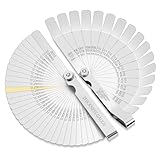 Tokyzexi Straight and Angled Kit Tokyzexi Straight and Angled Kit |
|
Check Latest Price |
 Lisle 68050 Angled Valve Gauge Lisle 68050 Angled Valve Gauge |
|
Check Latest Price |
 Lisle 68150 Go-No-Go Gauge Lisle 68150 Go-No-Go Gauge |
|
Check Latest Price |
 Yourour A308 Offset Tappet Set Yourour A308 Offset Tappet Set |
|
Check Latest Price |
1. Spurtar 32-Blade Tapered Set – Best Overall for Valve Work
Spurtar Feeler Gauges 0.001-0.04″ (0.03-1.00mm) 32 Blades Tapered
0.001-0.040 inch / 0.03-1.00 mm
32 tapered manganese steel blades
Dual SAE and metric
Pros
- Wide range covers most valve clearance and plug gap specs
- Dual SAE and metric markings on every blade
- Polished edges are comfortable to handle
- Folding plated steel case with a thumbscrew
- Oiled coating slows rusting
Cons
- Blade flex can read as clearance on very tight geometry
- Etched numbers are faint in low light
This is the set I keep in my own case. The 32 blades run from 0.001 to 0.040 inch and 0.03 to 1.00 mm, which means the same fan handles a 0.008 inch intake lash on a small four, a 0.045 inch exhaust lash on a worn V8 and a 0.028 inch spark plug gap, without me converting units or swapping tools mid-job.
The tapered tips are the part that earns the badge. On a shim-under-bucket head the clearance point sits at the back of the bucket where the walls taper in, and a full-width blade either fouls the bore or bows. The taper slides past the wall and the blade sits flat where the lobe actually touches the bucket.
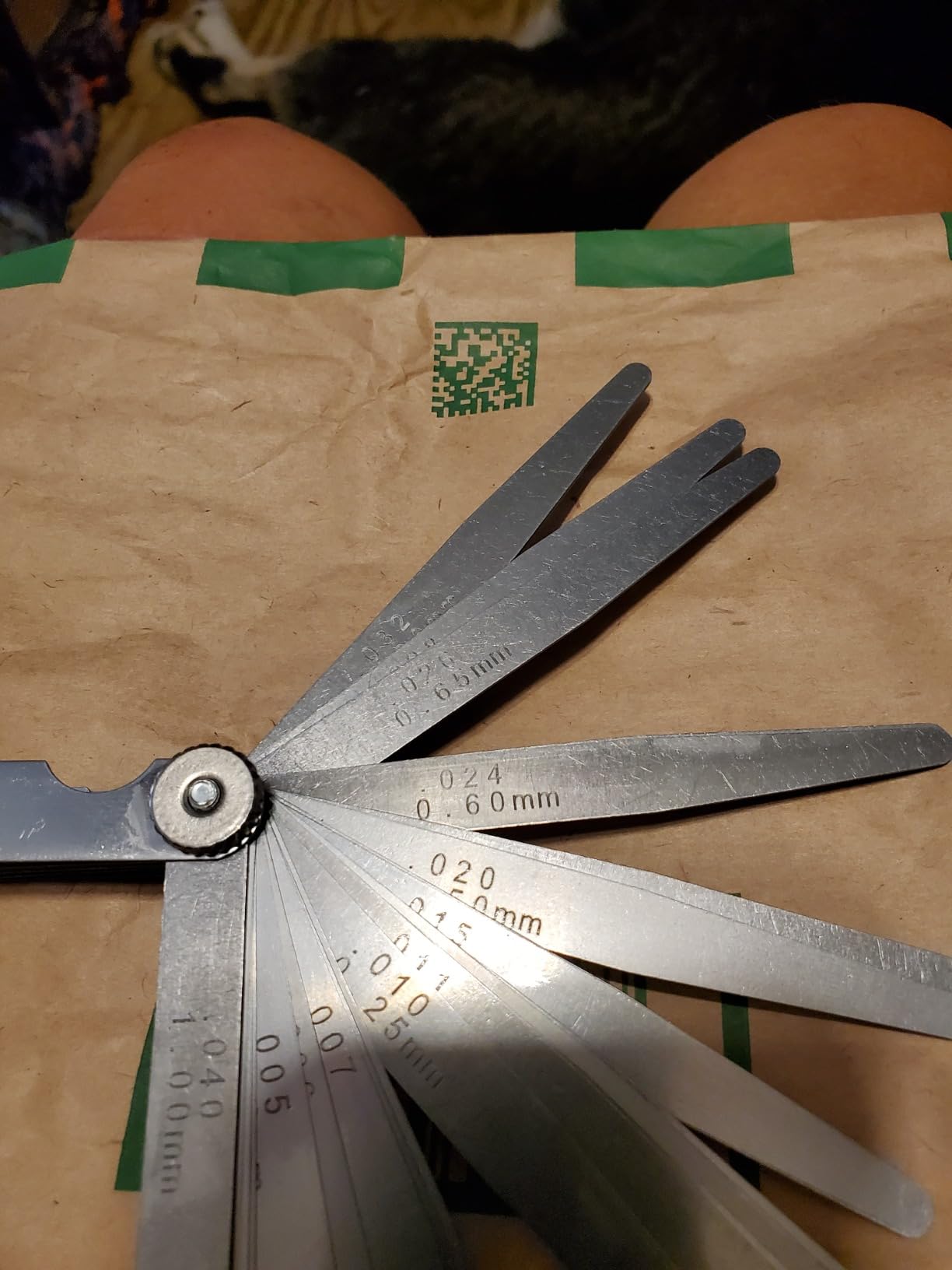
Blades are flexible manganese steel, oiled at the factory to resist rusting. Flexibility is a double-edged quality here: it helps the tapered tip find the gap, and it hurts on deep, narrow geometry where a soft blade bows and you read flex instead of clearance. For a normal four-cylinder or small block V8 with a reachable adjustment point, it is not an issue.
Size numbers are etched into each blade rather than printed on it, which is the right call for longevity. Etching outlasts printing under oil and shop handling, but the contrast is lower, so I wipe the blade and angle it toward a light before trusting a number in a dark engine bay.
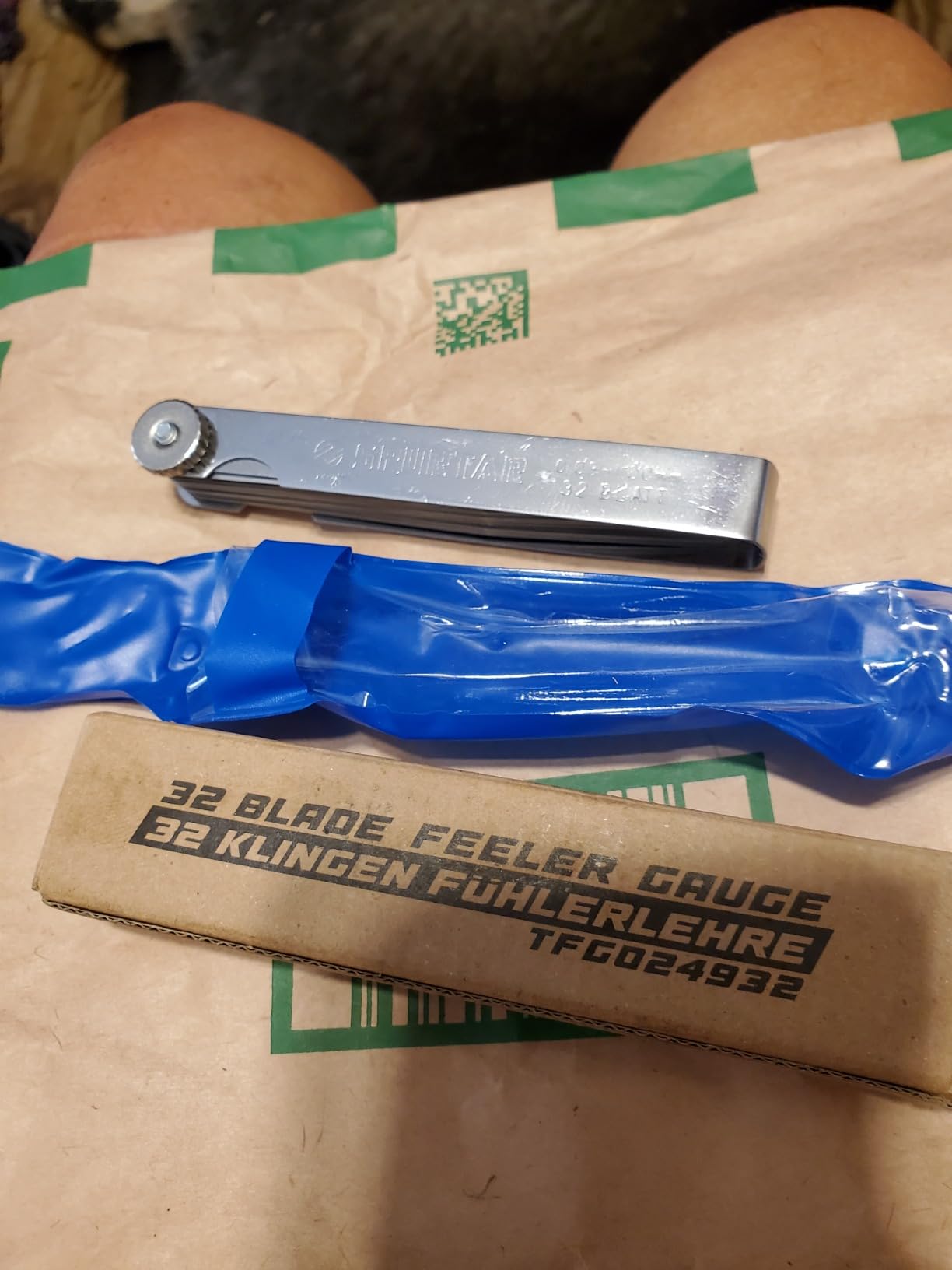
Where the Spurtar set works best
It is the right pick for valve clearance on a cold overhead cam or overhead valve engine, spark plug gapping, piston ring end gap checks and general shim and bearing clearance work. If your engine book quotes a spec in millimetres, the dual marking means you read it off the blade directly instead of doing arithmetic in the middle of a valve adjustment.
Reviewers consistently single out the range and the folding case with thumbscrew, which keeps the fan organised in a toolbox. At 7516 ratings averaging 4.6 stars, this is also the largest sample of real owners in the group, which matters for a precision tool where one bad production run tells you nothing.
Where it falls short
There is no offset or angled blade, so confined access under a deep valve cover or behind a plug on a boxer engine is still a fight. Reviewers also report the flexibility of the blades as a complaint on heavy shop use, which is fair if you are measuring against hard steel points all day.
If your work is centred on shim-under-bucket heads where the access is genuinely awkward, step up to the Mutt Tools kit further down and keep this one for everything else.
2. OEMTOOLS 25024 Go-No-Go Set – Best Value With a Lifetime Warranty
OEMTOOLS 25024 22 Blade Go-No-Go Feeler Gauge, Precision Measurement for Mechanics, Ideal for Engine Tappets, Machine and Guitar Setup, Includes Metric and SAE Blades
22 hardened tempered steel blades
Laser etched inch and mm markings
Thumb notch protector
Lifetime warranty
Pros
- Hardened tempered blades hold accuracy over repeated jobs
- Thumb notch protector speeds blade changes
- Laser etched dual markings on every blade
- Limited lifetime warranty from a known tool brand
- Compact footprint fits a small toolbox
Cons
- 22 blade range is narrower than 32 blade sets
- No offset or angled blade geometry
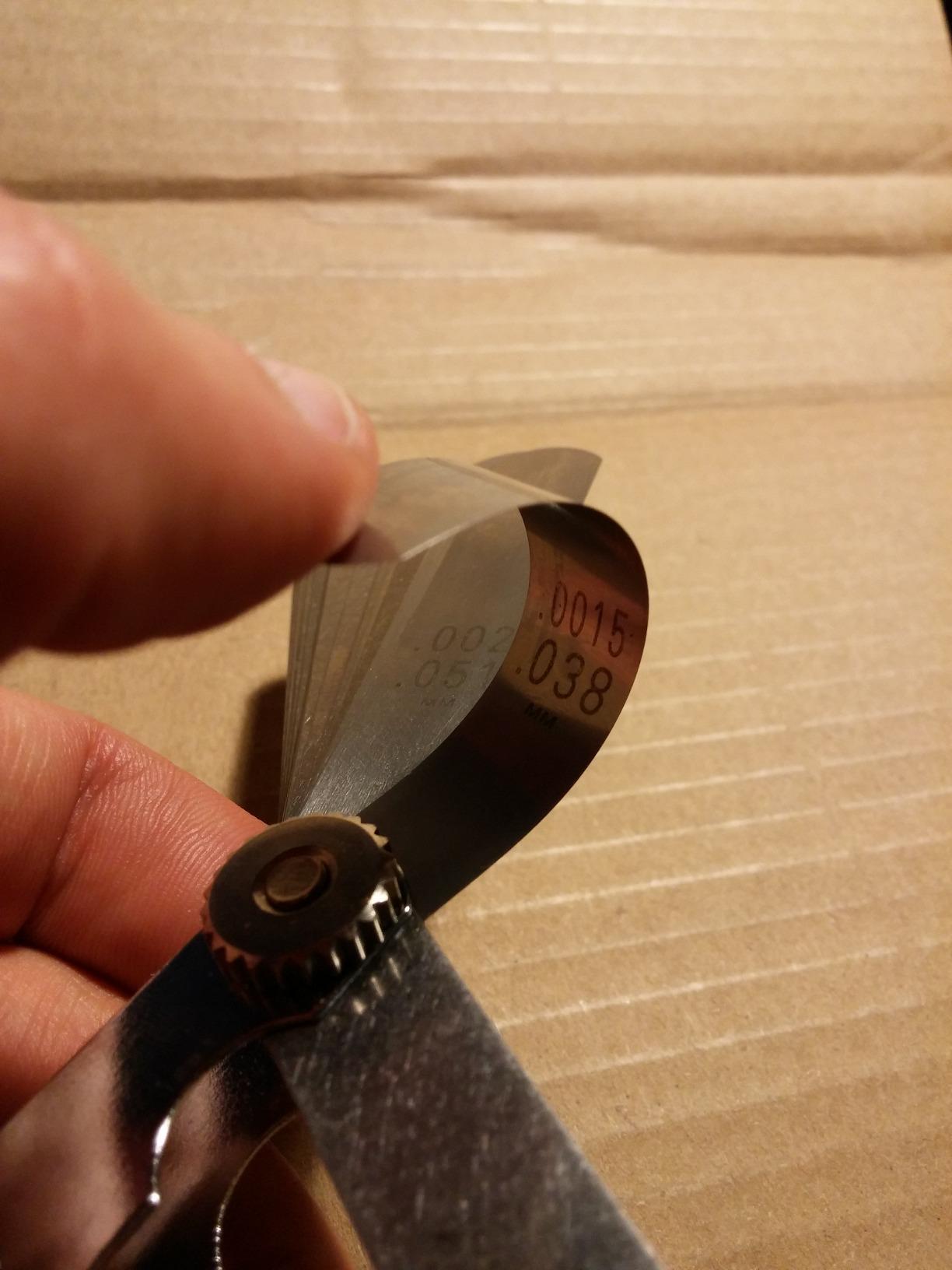
This is the set I recommend to anyone who wants a warranty behind the blades rather than a bargain basement price. The 22 blades are hardened and tempered steel, laser etched in both inch and millimetre, and the whole thing carries an OEMTOOLS limited lifetime warranty.
The go/no-go layout is the quiet strength. Because the blades run in a defined order with no gaps you have to guess about, you slide the spec blade in, and if it drags you know you are at or under the target. That habit is what stops you tightening a valve a quarter turn too far because the blade before it happened to fit.
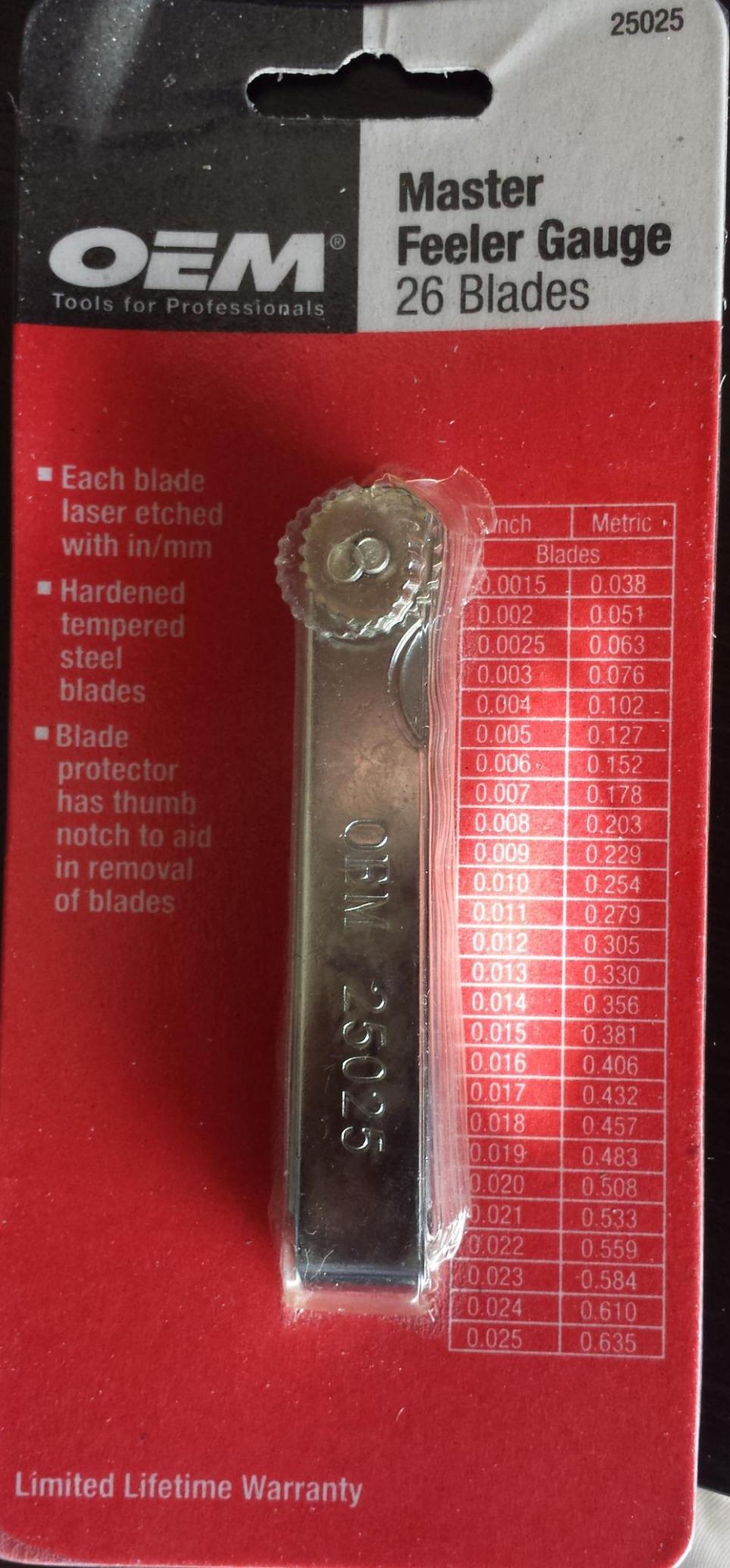
The blade protector with a thumb notch is a small design decision that saves real time. You hook a thumbnail under the notch, fan the blades to the size you want, and they stay put. On a set where you cycle through six or eight sizes per valve it is the difference between a smooth adjustment and a fumbled one.
Blades measure about 6.4 by 2.9 inches in the holder, which keeps the fan compact without cramping the blades. Reviewers running 5280 ratings at 4.6 stars point to precision, blade durability and the quick-change holder as the recurring strengths.
Where the OEMTOOLS set works best
It suits routine valve tappet adjustment, spark plug gapping and light machine setup, and it is a sensible first professional-grade purchase if a warranty matters to your work. The hardened tempered steel is the reason it holds its stamped value over repeated jobs rather than drifting with use.
If you are doing a full engine refresh where every valve gets checked and verified twice, this is the set I would want on the bench. The warranty also makes it an easy recommendation for a shop that replaces tools rather than repairing them.
Where it falls short
Twenty-two blades is a narrower range than the 32-blade sets here, and the steps are wider, so you bracket the true clearance less tightly. There is also no angled blade, which rules it out for recessed access where a straight blade cannot enter the gap.
Owners also note the steel holder can mark a bench surface if you drop it. Minor, but worth knowing if your workbench is a surface you care about.
3. Mutt Tools Straight and Angled Set – Best for Tight Geometry
Mutt Tools Feeler Gauge Set Metric and Inch for Valves, Spark Plug Gap Tool
Straight 0.001-0.040 inch plus angled fan
Angled set from 0.005 inch
Two piece kit
Pros
- Straight and angled gauges in one kit
- Angled fan reaches confined clearance points
- Laser etched markings stay readable
- Blades arrive lubricated from the factory
- Reviewers report accurate results in professional work
Cons
- Angled set minimum of 0.005 inch blocks very fine gaps
- Some buyers find blades less stiff than premium sets
- A few reviewers reported spotting rust on arrival
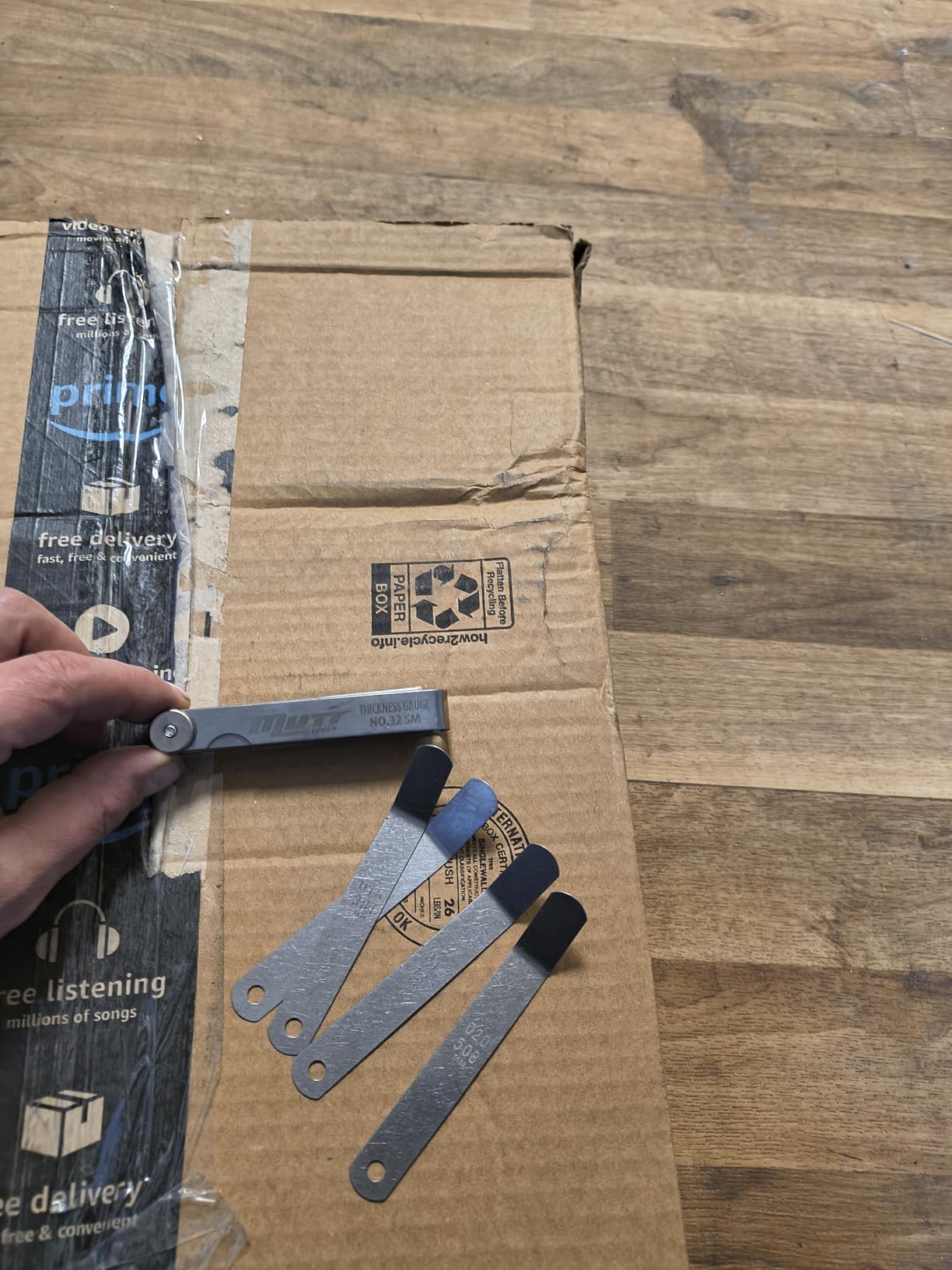
This is the kit I reach for when a straight blade will not go into the gap. It ships as two fans: a straight set running 0.001 to 0.040 inch, and an angled set starting at 0.005 inch with a 2 mm blade on the end. The angled fan is what gets you into a clearance point tucked behind a plug tube or under a deep valve cover.
Every blade carries both metric and imperial markings, which matters more on a two-piece kit than a single fan because you are twice as likely to grab the wrong one and try to read it in the wrong system.
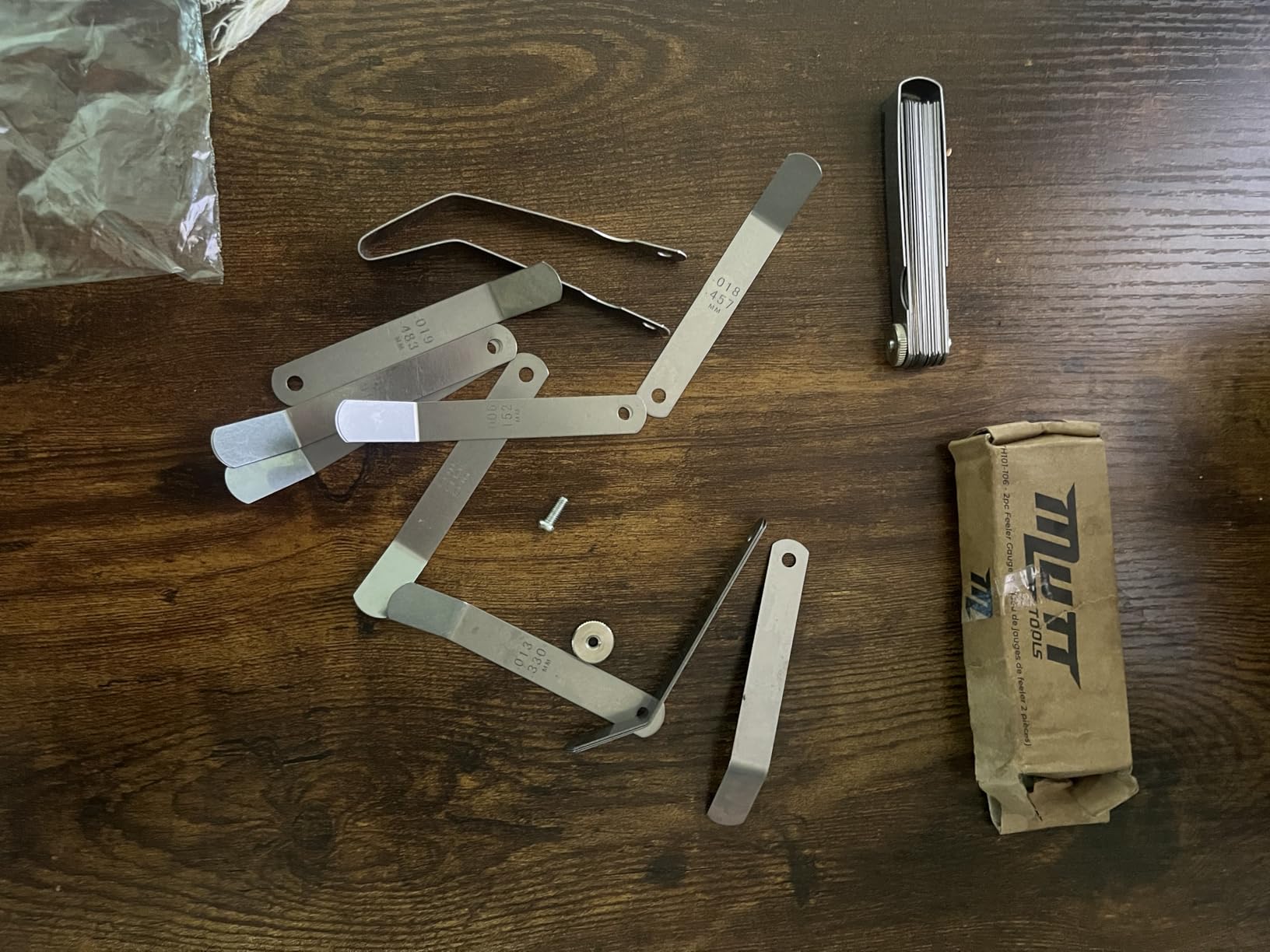
At 4.7 stars across 1713 ratings, this has the second strongest rating in the group behind the GEARWRENCH, and reviewers describe build quality in terms that remind people of vintage shop sets. Blades arrive lubricated, which reviewers read as evidence of careful assembly, and the readings hold up in professional use.
I like the offset configuration because it does not need a bending jig to become useful. Forum users regularly ask whether they can bend a straight blade to 45 degrees themselves, and the honest answer is that you can, but you are then working with a blade that is no longer at its stamped thickness where it matters. A purpose-made angled blade is the same idea done properly.
Where the Mutt Tools kit works best
It is the right pick for air-cooled and boxer engines, motorcycles with tucked-in rockers, and any valve cover where the adjustment point sits at the bottom of a deep well. It also covers clutch pack clearance in automatics, which is a non-engine job this kit does well.
For mixed work where some measurements are wide open and some are buried, two fans beat one. Owning both geometries is worth it the first time you would otherwise have pulled a cylinder head to reach a clearance point.
Where it falls short
The angled fan starts at 0.005 inch, so it cannot help with very fine gaps. Some buyers find the blades less stiff than premium sets, and a few reviewers reported spotting rust on arrival, so wipe the blades before first use and re-oil them after any job in a wet engine bay.
If your work is only on open, easy-to-reach clearance points, you are carrying a second fan you may never open.
4. Handook Stainless Steel 32-Blade Set – Best for Corrosion Resistance
Stainless Steel Feeler Gauge Universal Standard SAE and Metric Offset Valve Thickness Gauge 32-Piece Blade Tool for Measuring Gap Width/Thickness
0.0008-0.040 inch / 0.02-1.00 mm
32 stainless steel blades
Knurled knob
Pros
- Reviewers who calipered them report tight accuracy
- 32 sizes let you stack to an exact gap
- Knurled knob makes blade changes easy
- Stainless steel resists corrosion
- Heavily oiled for long term storage
Cons
- Printed markings are light and hard to read
- Several common inch sizes in the 0.014-0.035 range are absent
- Heavy oil coating needs wiping before delicate work
This is the set for a damp garage, a marine engine bay or a motorcycle that lives outside. The blades are hardened tempered stainless steel across 32 sizes, from 0.0008 inch and 0.02 mm up to 0.040 inch and 1.00 mm, and the whole fan is coated in oil against pitting and corrosion.
The 0.0008 inch floor is unusually fine for a set at this level. That matters for shim and lash work where a 0.001 inch blade is the coarse end of the range and you need something below it to bracket the real clearance.
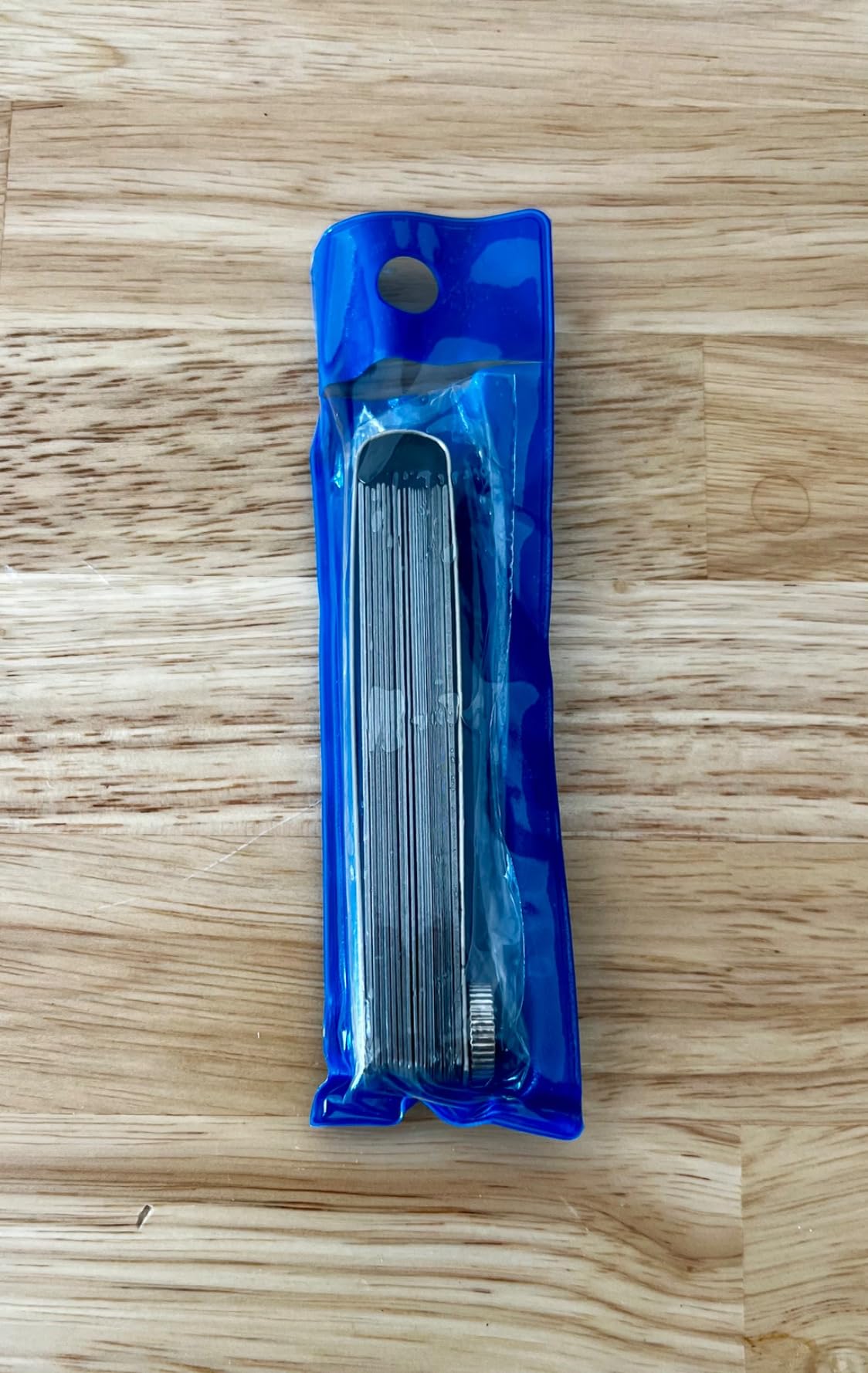
What convinced me was the review evidence from owners who put these blades on a digital caliper and reported tighter tolerance than several competing sets. That is the check that actually matters in this category, and it is the check most owners skip.
The knurled tightening knob on the holding bracket is a genuinely useful upgrade over a friction pivot. You loosen the knob, spread the fan to the size you want, and tighten it again. On a pivot that relies on spring tension alone, blades drift loose in the case and two sizes sit at the same spot, which is exactly how you misread a clearance.
Where the Handook set works best
It suits anyone working in a wet or coastal environment, on a boat engine, or on a machine that sits uncovered through winter. It is also a good choice if you check clearances often enough that corrosion on the blades is a real risk rather than a theoretical one.
The 32 sizes let you stack blades to hit an exact gap, which is useful on ring end gap work where the target falls between two sizes and stacking gets you closer than either blade alone.
Where it falls short
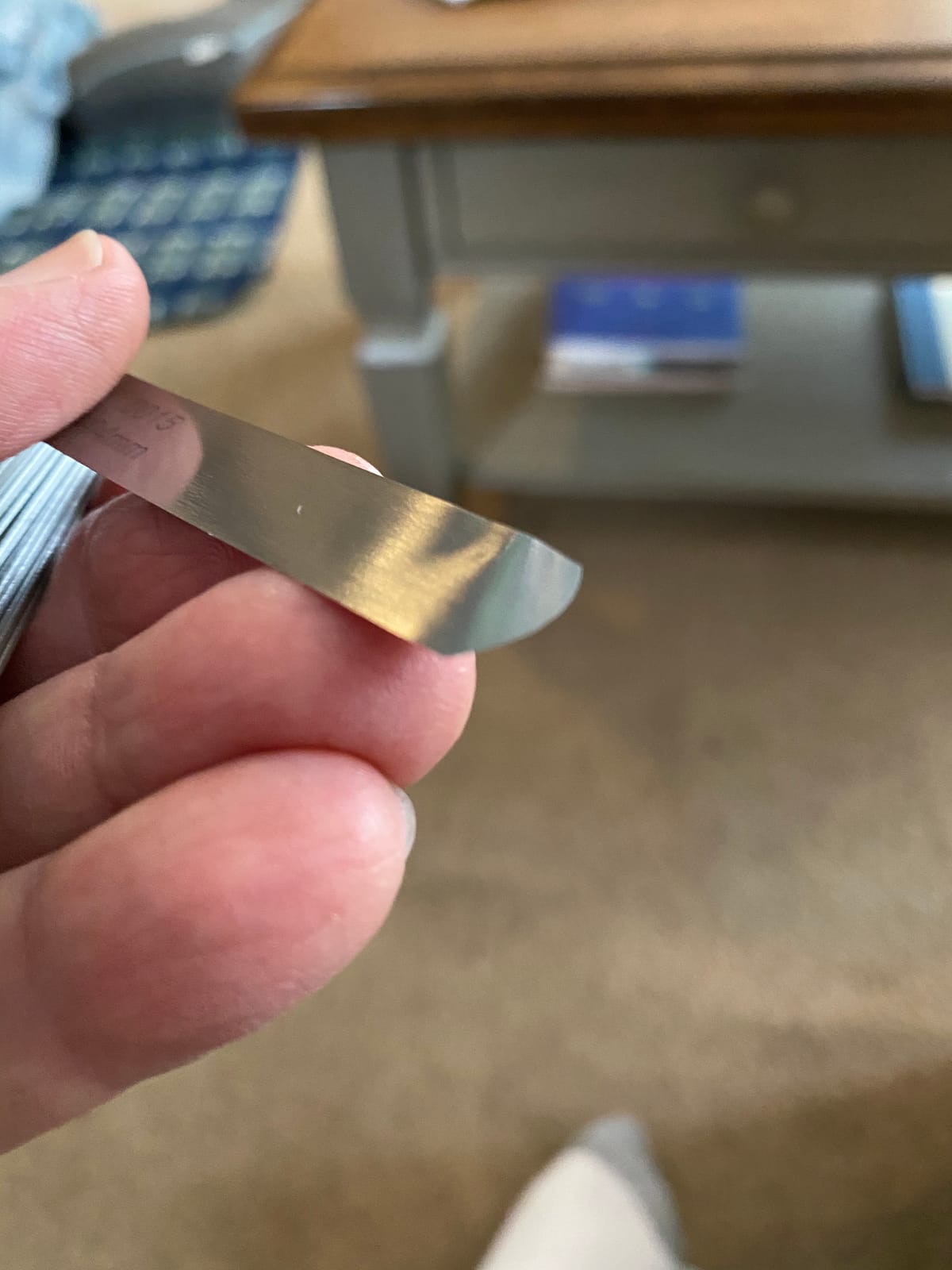
The printed size markings are light and hard to read, and several commonly requested inch sizes in the 0.014 to 0.035 inch range are absent from the fan. Check the full size list against the clearances your engines actually use before buying.
The heavy oil coating is a feature for storage and a nuisance for precision work. Wipe each blade before you measure, because an oily surface changes how the blade feels as it passes.
5. GEARWRENCH 32-Blade Deluxe 161D – Top Rated With a Brass Blade
GEARWRENCH 32 Blade Deluxe SAE/Metric Feeler Gauge | 161D
0.0015-0.035 inch / 0.038-0.889 mm
32 blades plus a 0.010 brass blade
Lifetime warranty
Pros
- Highest average rating here at 4.8 stars
- Standardised 32 blade range
- Bonus 0.010 brass blade is non magnetic
- Limited lifetime warranty
- Every blade carries SAE and metric values
Cons
- Blade only design gives no offset access
- Stops at 0.0015 inch so the finest gaps are out of reach
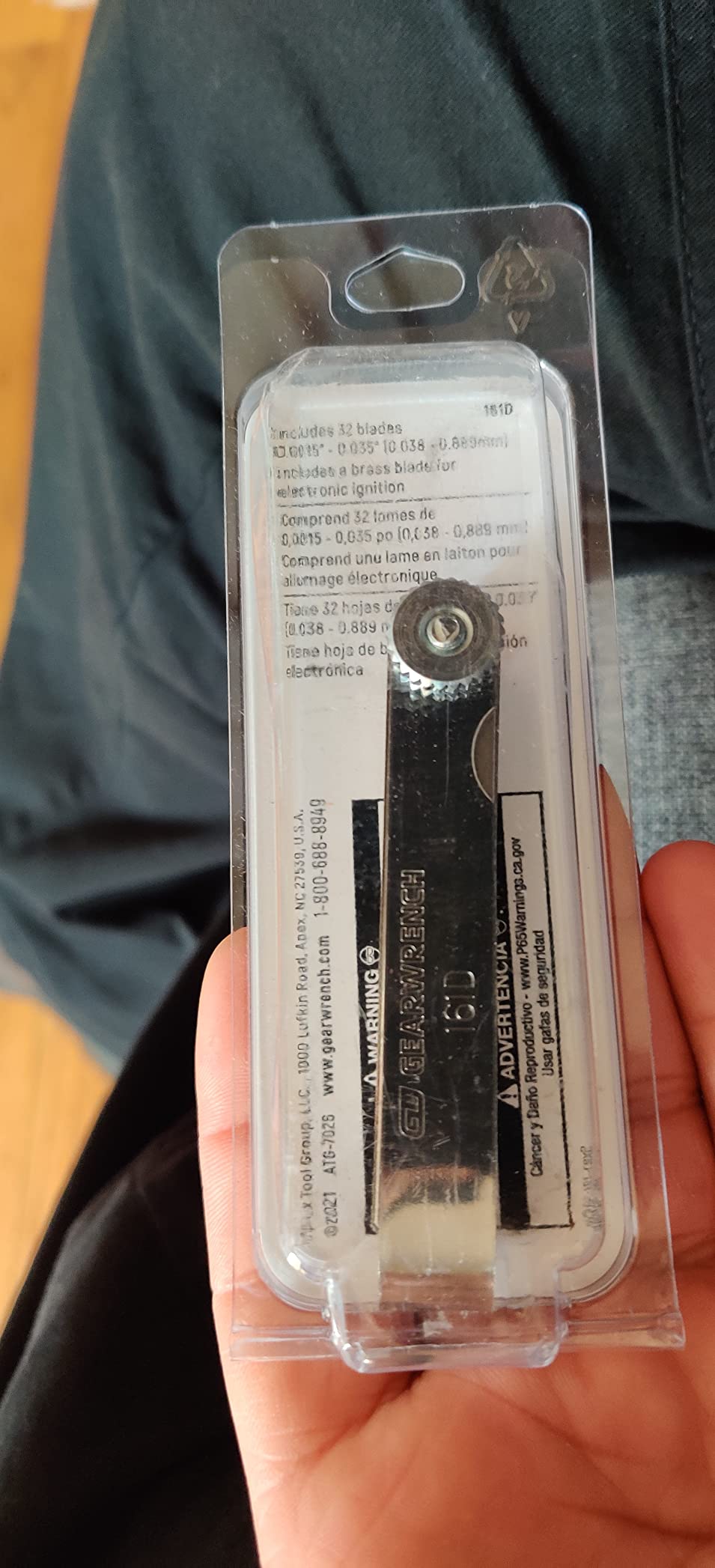
At 4.8 stars across 1082 ratings with 87 percent five-star, this is the highest-rated set in the group. The range is standardised from 0.0015 to 0.035 inch, or 0.038 to 0.889 mm, across 32 blades, and the layout is the classic professional pattern rather than something novel.
The detail I like is the extra 0.010 inch brass blade. Brass is non magnetic, so it will not stick to a hall-effect pickup or a magnetic trigger wheel. That matters if you set a gap near a distributor pickup, a crank sensor or any electronic ignition component, and it is the reason this set edges ahead of similar-layout rivals.
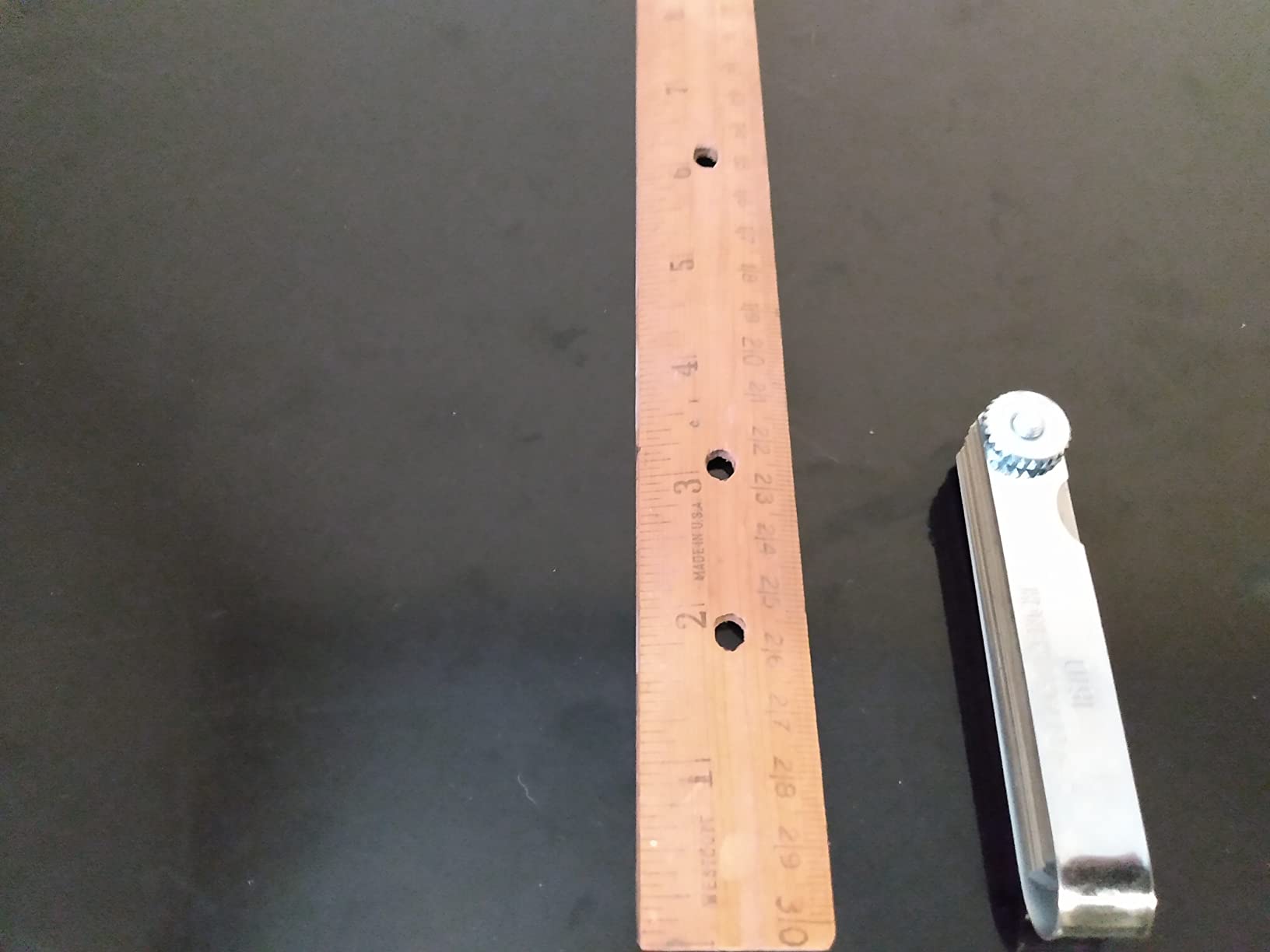
Blade length is 3-5/16 inches at half an inch wide, which is long enough to reach into a rocker area without bending and narrow enough to slot past a plug. The warranty is a standard limited lifetime one, which is a meaningful signal on a precision tool because it implies the brand stands behind heat treatment consistency across a production run.
Owners value the familiar pro-brand layout and the dual markings, and the review spread is the cleanest here with very little one-star feedback. For a shop that already handles GEARWRENCH tools, the whole case matches the rest of the drawer.
Where the GEARWRENCH set works best
It is a strong default for everyday valve clearance work, spark plug gapping and distributor point gaps, and it is the set I would hand a technician who already trusts the brand. The brass blade makes it the safer choice near electronic ignition hardware.
It also suits a workshop that wants one gauge that looks professional and reads clearly without anyone having to explain it. There is no learning curve and no unusual geometry to get wrong.
Where it falls short
It is a blade-only design with no offset or angled access, so tight or recessed clearance points are out of reach. The range also starts at 0.0015 inch, which means the very fine shim and lash sizes sit outside it.
If you work on a boxer engine or a motorcycle with tucked-in rockers, add a second angled fan rather than trying to make this one reach.
6. CHERALKEST 32-Blade Manganese Set – Budget Pick for First-Time Owners
CHERALKEST Feeler Gauge Set Stainless Steel Thickness Gauge 32 Blades
0.0015-0.035 inch / 0.04-0.88 mm
32 number 65 manganese steel blades
Foldable design
Pros
- Includes sizes most sets skip such as 0.017 and 0.019 inch
- Full 32 blade set at the entry level
- Manganese steel blades with dual etched markings
- Compact foldable format for a small toolbox
Cons
- Etched numbers go faint in low light
- Straight blades only with no angled option
- Lightweight case feels flimsy in the hand
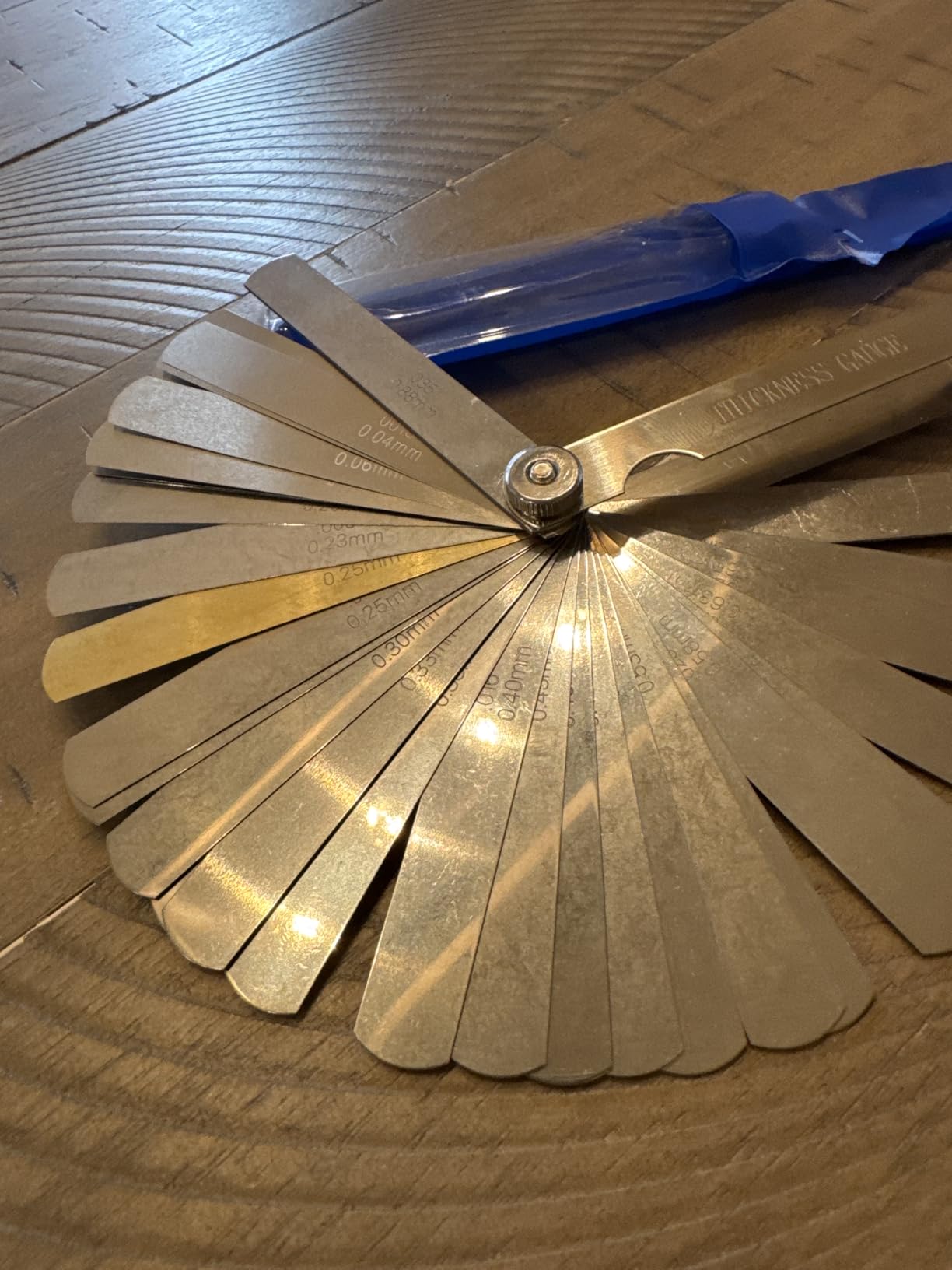
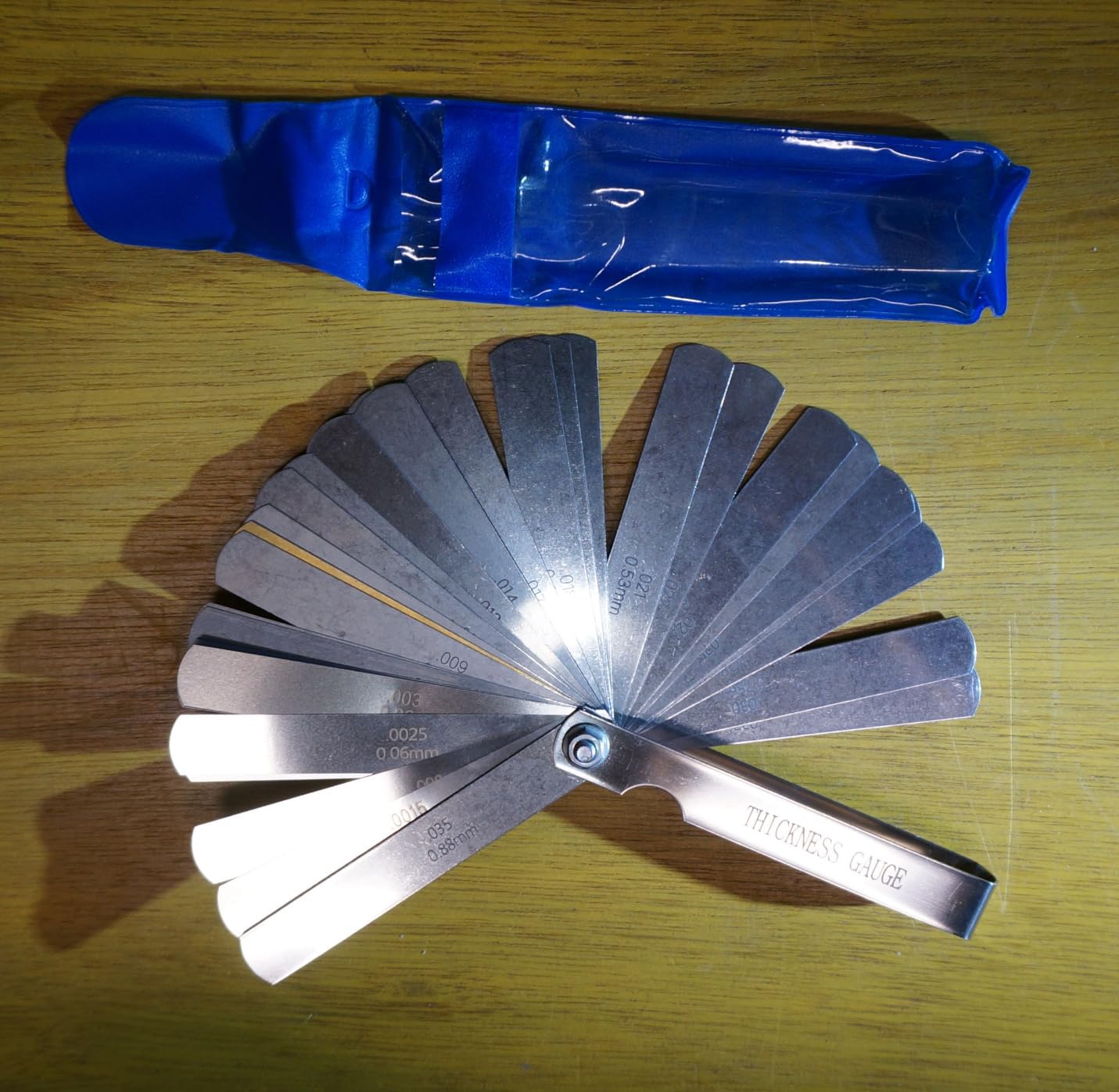
This is the set I tell first-time owners to buy. Thirty-two number 65 manganese steel blades from 0.0015 to 0.035 inch, dual marked in metric and imperial, in a foldable case small enough for a motorcycle tool roll.
Its real argument is size coverage. The inch fan includes 0.014, 0.017, 0.019, 0.021, 0.022, 0.023, 0.028 and 0.032 inch, and those odd sizes are exactly the ones cheaper sets tend to omit. If your engine spec calls for 0.019 inch and your gauge jumps from 0.018 to 0.020, you cannot set it accurately.
Number 65 manganese steel is a sensible choice for blade material. It takes a spring temper, resists snapping at the pivot and stays straight through ordinary shop abuse, which is why it shows up in so many mid-tier gauge sets.
Buyers generally find it accurate and complete, and the mid-range inch increments are the main reason people keep it. At 4.7 stars across 773 ratings it holds up well against sets costing several times more.
Where the CHERALKEST set works best
It suits a first valve adjustment, a motorcycle or scooter service, and general clearance work where you want a full range without spending much. It is also a sensible backup gauge to keep in the van, since it will not be the set you are upset about losing.
For anyone who keeps meeting specs quoted in odd inch increments, the size list is the reason to pick this over a cheaper 25-blade fan with rounder numbers.
Where it falls short
The etched numbers can be faint in low light, which is a real problem when you are reading a size with your head inside a valve cover. It is straight blades only, with no angled option for confined access.
The case is light and does not feel as solid as a plated steel holder. Treat it as the portable set rather than the shop set.
7. Hoiny 32 and 16-Blade Two-Piece Set – Best for Caliper-Checked Accuracy
Hoiny 2pcs Feeler Gauges Set Stainless Steel, Spark Plug Gap Tool
Straight 0.0008-0.040 inch plus offset fan
Offset 0.005-0.020 inch
48 blades across two fans
Pros
- One buyer calipered them and found them spot on
- 48 blades across straight and angled fans
- Bent blades work well in narrow gaps
- Knurled knob makes reorganisation easy
- Broad size coverage for the money
Cons
- Material is magnetic so the stainless claim is doubtful
- Angled fan starts at 0.005 inch
- Storage pouches are cheap and wrinkled
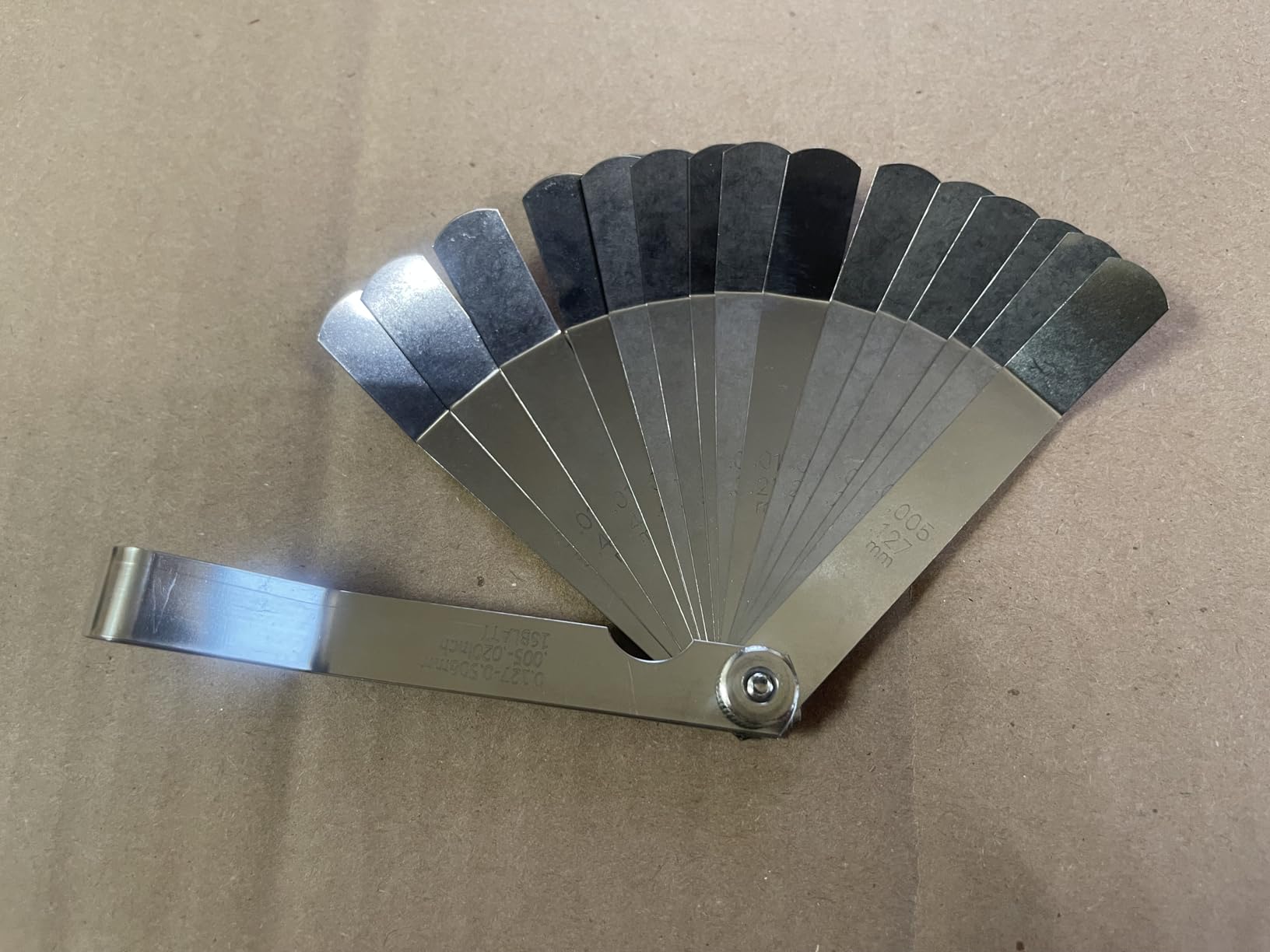
This two-piece set gives you 48 blades: a 32-blade straight fan from 0.0008 to 0.040 inch and 0.02 to 1.00 mm, and a 16-blade offset fan from 0.005 to 0.020 inch and 0.127 to 0.508 mm. That is more coverage than most single sets give you, and it is the widest combination of straight and angled here.
The 0.0008 inch floor on the straight fan is the fine end of what you can buy in this class, which makes it useful for the tight lash figures that shim-under-bucket heads run.
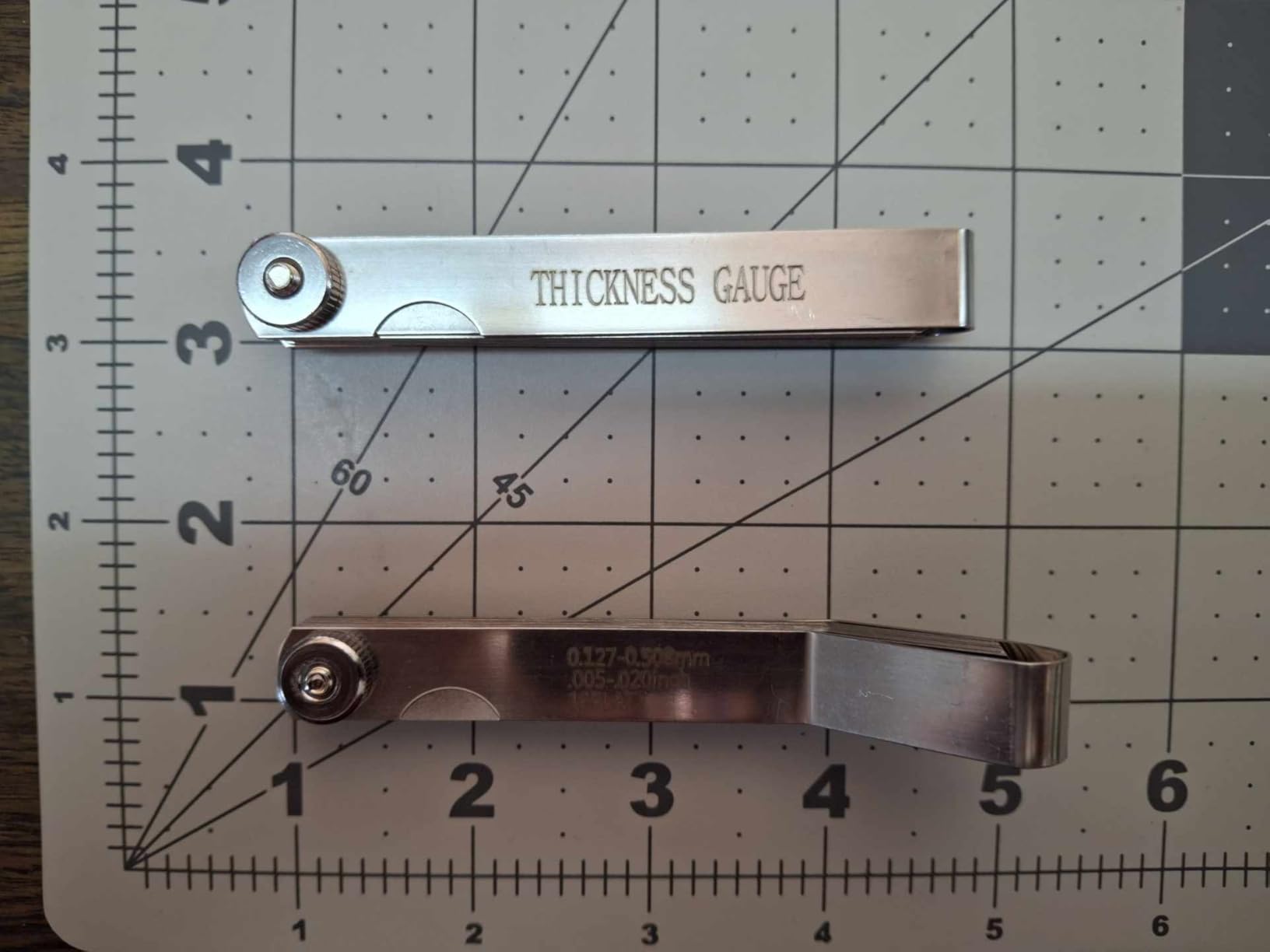
One buyer in the review data put these blades on a digital caliper and found them spot on across sizes, which is the single most persuasive piece of evidence in this category. Guitar and luthiery owners dominate the reviews, and they check accuracy the same way anyone else would.
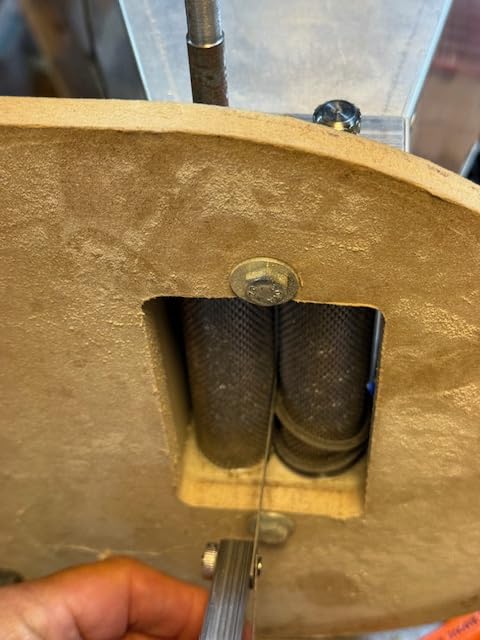
The knurled knob makes rearranging blades easy, so you can pull the sizes you need to the front and fan them out. The bent blades work well in narrow gaps, which is why this set turns up so often in non-engine work where the access is just as awkward.
Where the Hoiny set works best
It suits mixed work where you need both a wide fine straight range and an angled option for buried clearance points. If your engines span a car and a motorcycle, or if you also do instrument and fretted instrument work, the two fans cover both without a third purchase.
The size density is a genuine advantage. With 48 blades you can bracket a clearance much more tightly than a 22-blade set, which is what you want on a head you have just rebuilt.
Where it falls short
Reviewers have questioned the stainless claim after a magnet stuck to the blades, and if true it means the set can rust. Wipe and oil it after use, particularly in a damp garage.
The angled fan starts at 0.005 inch, and the storage pouches are cheap enough to be worth replacing with something sturdier. Neither is a reason to skip it, both are reasons not to leave it in a wet van.
8. TUSK 32-Blade Tapered Set – Best for Motorcycles and UTVs
TUSK Tapered Feeler Gauge Set – 32-Blade Dual-Marked (Inch & Metric) Precision Valve Clearance Tool 0.001″-0.040″ / 0.03 mm-1.0 mm
0.001-0.040 inch / 0.03-1.0 mm
32 tapered blades
About 95 mm long
Pros
- Tapered tips reach tight valve tappets and buckets
- Compact 95 mm blades fit restricted engine bays
- Dual inch and metric scales on every blade
- Built for motorcycle and UTV work
Cons
- Lowest average rating here at 4.5 stars
- Catalog package dimensions look wrong
- No offset option for confined areas
This is the powersports pick. Thirty-two tapered blades from 0.001 to 0.040 inch and 0.03 to 1.0 mm, at roughly 95 mm long, which is the compact length that suits a motorcycle frame or a UTV engine bay where a full-size fan will not fit.
Motorcycle lash specs cluster in the middle of this range. A 0.004 inch intake and 0.005 inch exhaust is a common pairing, and the tapered tip reaches the adjuster gap between a bucket and the seat without fouling the surrounding castings.
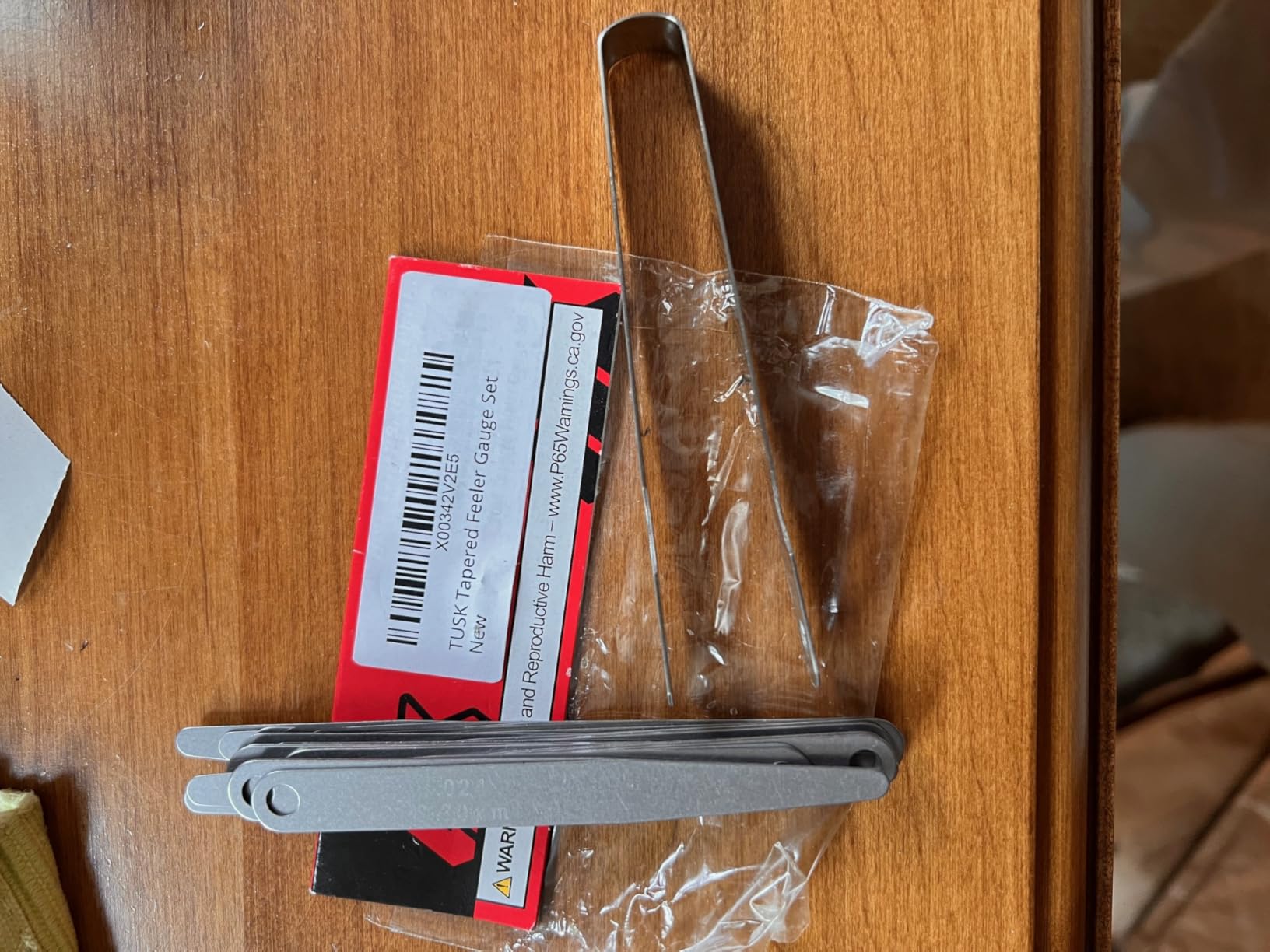
Owners like the tapered access and the compact length for powersports work. One recurring service figure in the forum data is a 0.002 to 0.025 inch working range for typical valve jobs, and this fan covers it end to end in a single gauge.
The tradeoff is that this is the lowest-rated set in the group at 4.5 stars across 645 ratings, with 74 percent five-star and 4 percent one-star. A smaller share of owners also report durability and marking legibility complaints, so inspect the etched numbers when it arrives.
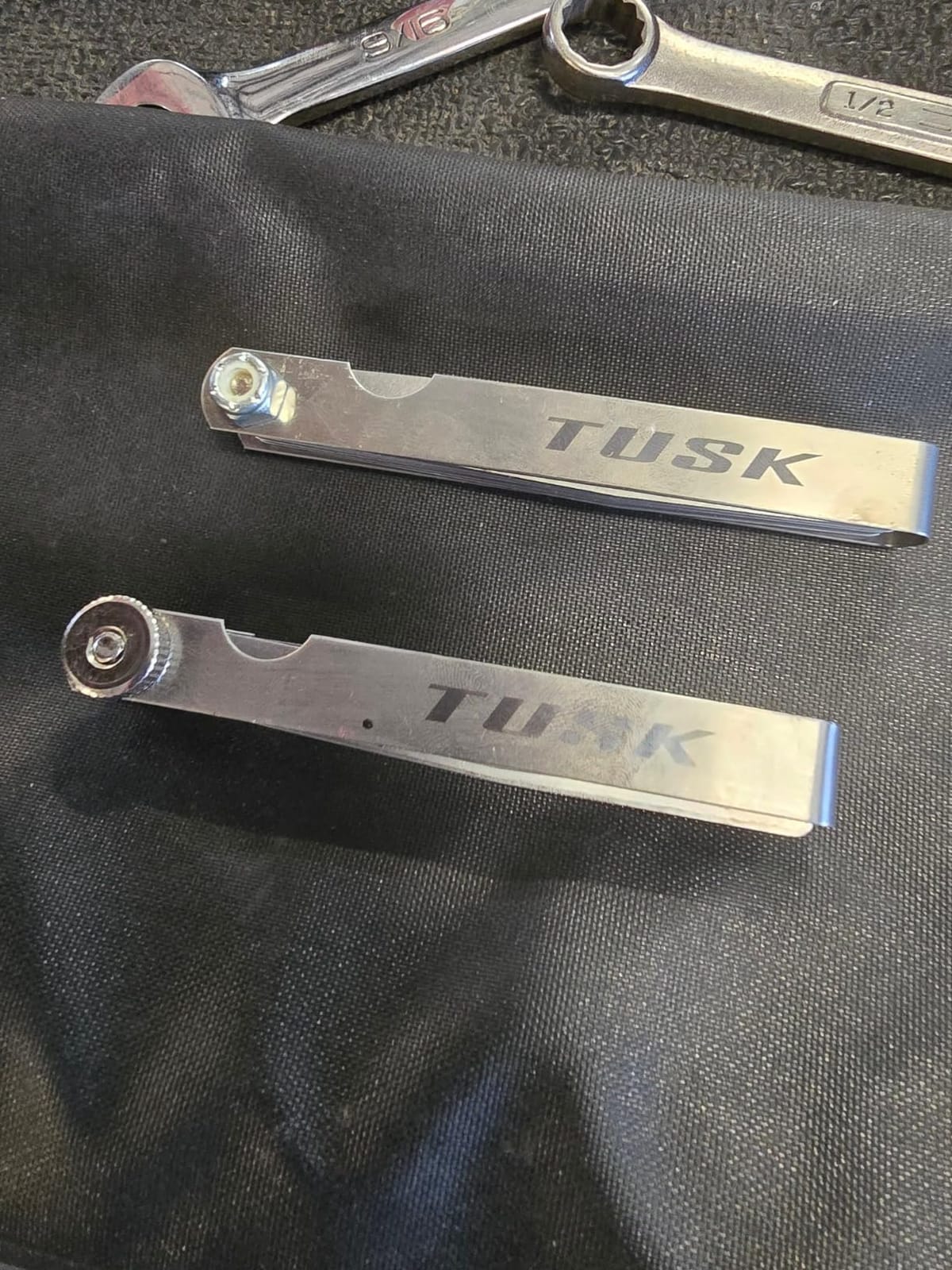
Where the TUSK set works best
It suits motorcycle, ATV and UTV valve clearance work where access is restricted and the blades need to be short. The tapered tips help on the tight bucket geometry common in single and twin cylinder heads.
It is also a good choice for anyone who wants one gauge that fits a small toolbox without becoming a bundle of steel in the bottom of it.
Where it falls short
There is no offset or angled option for genuinely confined areas, and the 4.5 star average is the weakest here. The catalog package dimensions also look wrong in the listing data, which is a small sign of how carefully the product page was put together.
If you do serious motorcycle work in a wet environment, a genuinely stainless set is a better bet than this one.
9. Tokyzexi Straight and Angled Kit – Best for Stacking to Wide Gaps
Tokyzexi 2Pcs Feeler Gauge Set,Premium Straight & Angled Feeler Gauges Kit
32 straight plus 16 offset blades
Straight 0.0015-0.035 inch
Offset 0.005-0.020 inch
Pros
- Straight and angled pair in one kit
- Knurled knob releases clamping pressure for blade changes
- Laser etched dual scales read quickly
- Blades work individually or stacked together
Cons
- Only 352 reviews so less long term feedback
- Straight set starts at 0.0015 inch
- Angled set stops at 0.020 inch
This kit pairs a 32-blade straight gauge covering 0.0015 to 0.035 inch with a 16-blade offset gauge covering 0.005 to 0.020 inch. Hardened stainless steel, laser etched in both systems, with a knurled knob on the pivot shaft.
Its distinguishing feature is that blades can be used individually or stacked together. Stacking is how you reach clearances beyond the largest blade, which is common on worn engines with heavy lash and on ring end gap work where the target falls between sizes.
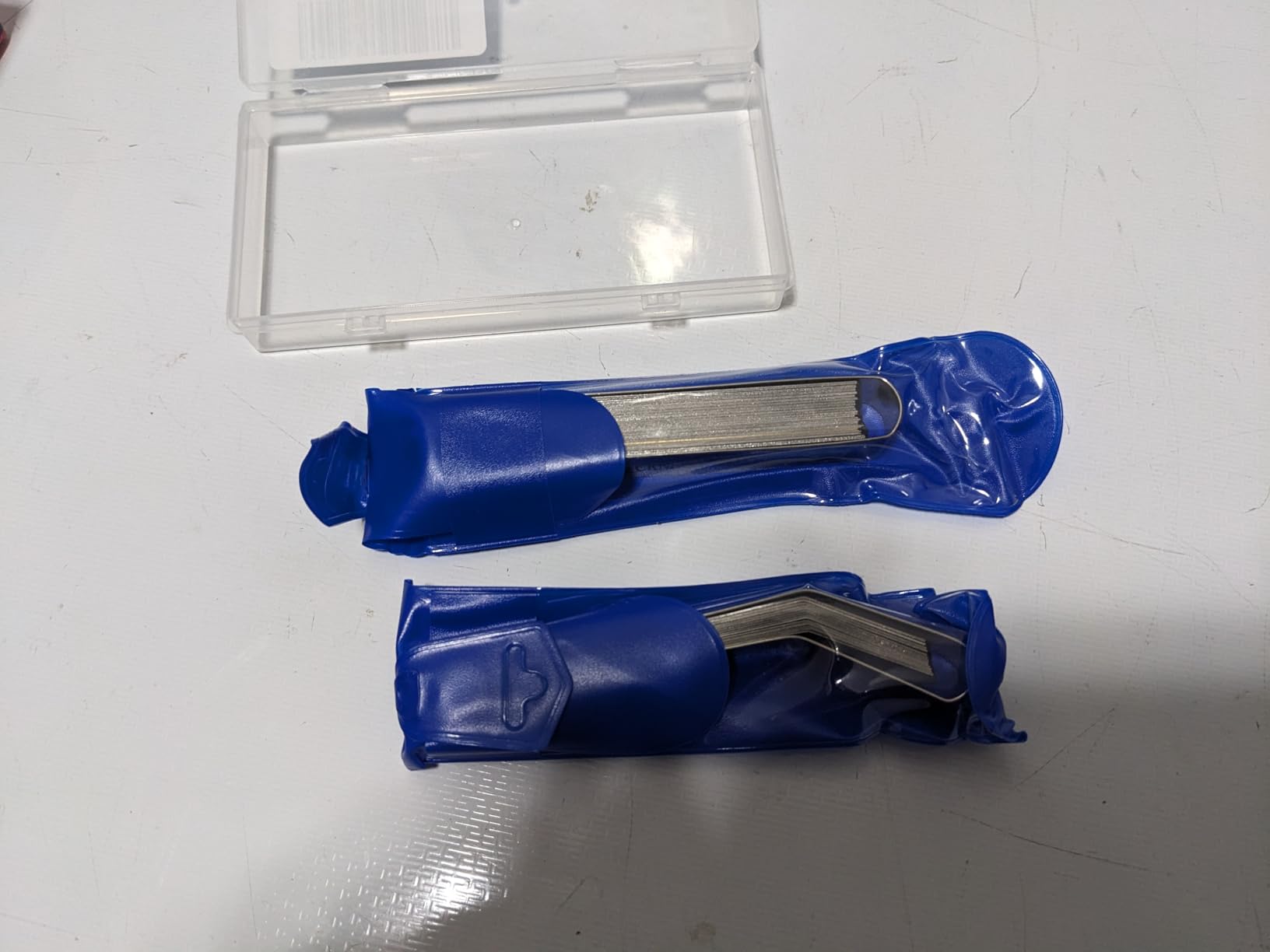
The knurled knob releases clamping pressure so you can change blades without fighting a friction pivot. That sounds minor until you have changed thirty blades in an afternoon and your thumbs are tired.
Feedback centres on value, readable etched markings and the adjustable pivot, with 4.7 stars across 352 ratings. What that review count does not give you is long term accuracy data, and that is worth knowing if this is going to be your only gauge.
Where the Tokyzexi kit works best
It suits a garage that wants both geometries without buying two separate sets, and it is well suited to worn engines with lash beyond 0.020 inch, where the offset fan alone cannot reach.
The stacking ability also makes it useful for ring end gap work, where a small overshoot is acceptable. Ring gap tolerance is far looser than valve clearance, so a stacked reading is often good enough.
Where it falls short
With 352 ratings there is far less long term owner feedback than the established brands here, which means less evidence about how the blades wear. The straight fan starts at 0.0015 inch and the angled fan tops out at 0.020 inch, so the coverage has gaps at both ends of the useful range.
For a shop tool that gets used daily and relied on for a head rebuild, I would rather buy a set with a warranty and a large review base.
10. Lisle 68050 Angled Valve Gauge – Best Warranty-Backed Coarse Range
Lisle 68050 Valve Feeler Gauge
11 blades from 0.008 to 0.040 inch
Angled blade ends
Markings resist fading
Pros
- Angled ends make valve work easier in tight spots
- Users mic'd the blades and found them accurate
- Etched numbers resist fading over years
- Limited lifetime warranty
- Useful beyond valves such as clutch pack clearance
Cons
- Thinnest blade at 0.008 inch is coarse for small engines
- No 0.017 inch blade which is a common lash size
- Some reports of rust straight out of the package
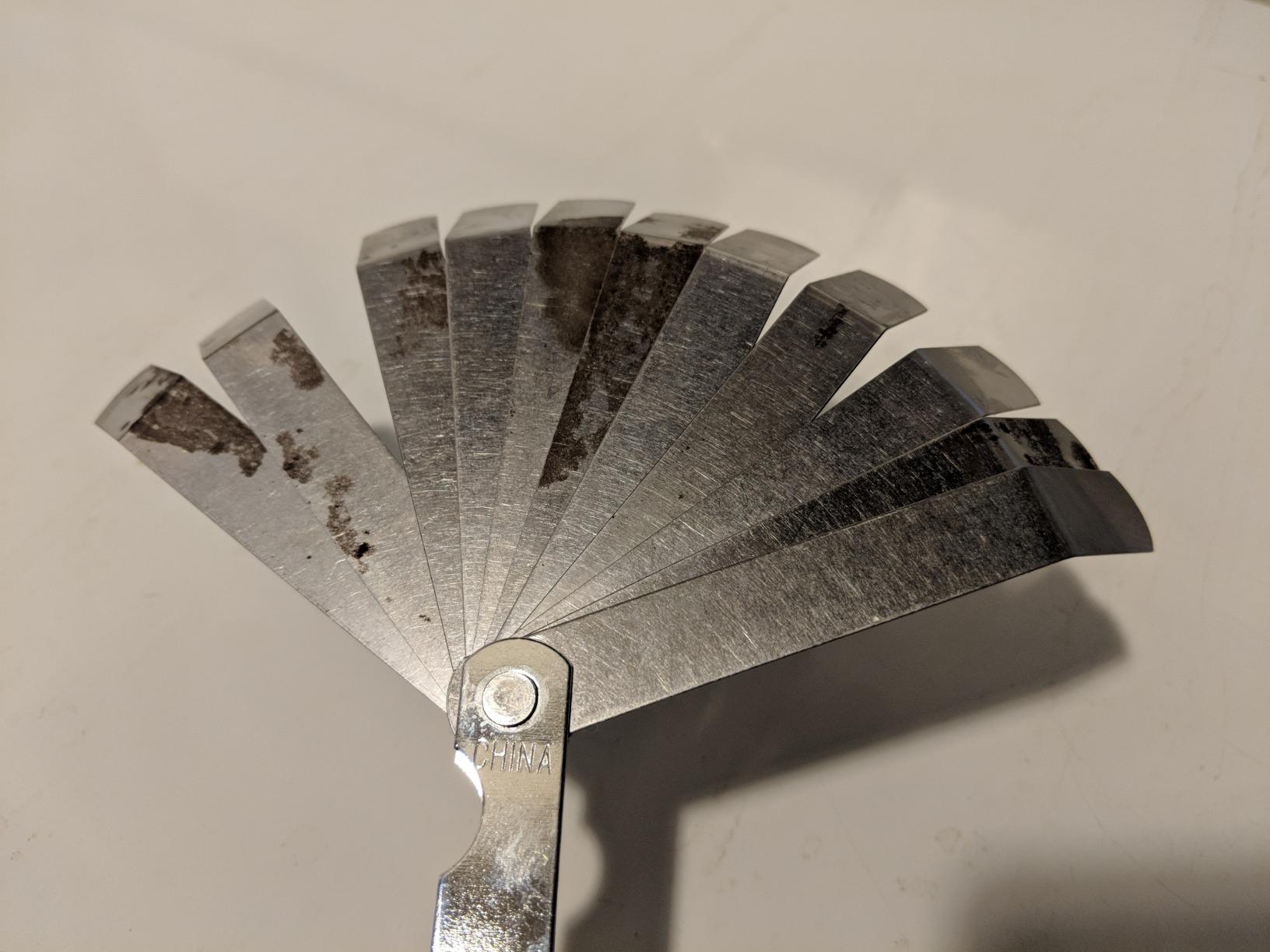
This is a specialist tool rather than a general-purpose fan. Eleven blades running from about 0.008 to 0.040 inch, with angled blade ends and a limited lifetime manufacturer warranty behind them.
Eleven blades sounds sparse, and it is. But every one of them is angled, which means it is eleven tools aimed at the one problem a straight fan cannot solve. On a valve cover where the rocker face sits 40 degrees from your line of sight, this is the gauge that gets used.
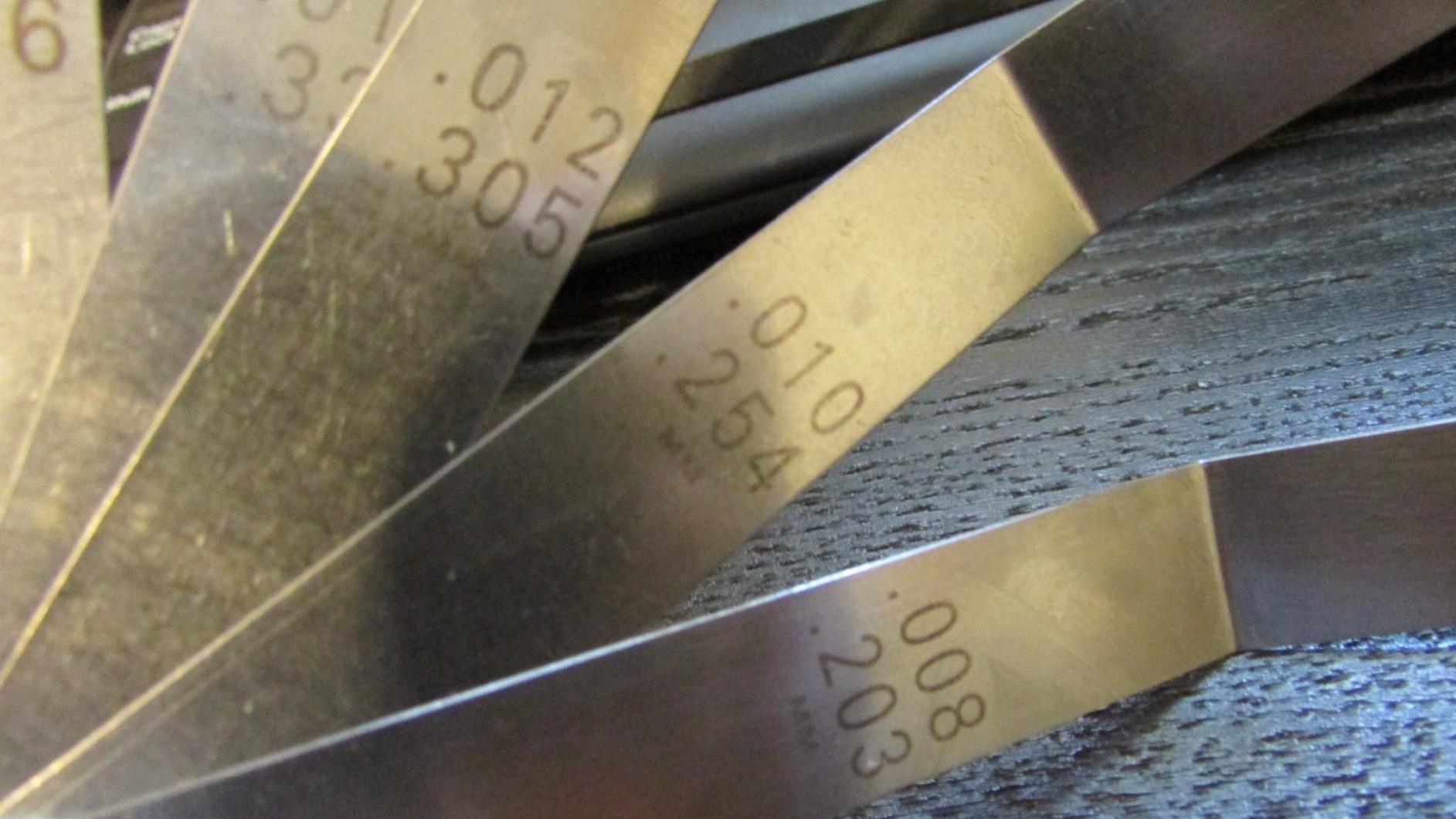
Long-term owners in the review data report that they mic’d the blades and found them accurate, and that the etched numbers resist fading over years. Marking durability is a bigger deal than it sounds: faded sizing is treated by most mechanics as a reason to replace the set on the spot.
Stacking multiple blades also reaches clearances beyond 0.040 inch, which is useful on a worn engine where lash has grown past the largest single blade.
Where the Lisle 68050 works best
It suits valve adjustment on engines with recessed or angled clearance points, and it doubles as a clutch pack clearance gauge on automatic transmissions. The angled ends and the fading-resistant numbers make it a keeper for long-term ownership.
If you own a motorcycle with a cramped valve cover, this is a compact specialist answer rather than a whole second fan.
Where it falls short
The thinnest blade at 0.008 inch is too coarse for many small engines and for any work that needs a fine bracket. There is no 0.017 inch blade, which is a fairly common lash figure, so you cannot set that spec accurately with this set alone.
A few owners also report rust straight out of the package. Check the blades before first use and oil them after.
11. Lisle 68150 Go-No-Go Gauge – Best for Stated Accuracy
Lisle 68150 Go-No-Go Feeler Gauge
22 blades 0.004-0.027 inch
Stated accuracy plus or minus 0.0001 inch
Lifetime warranty
Pros
- Stated accuracy of plus or minus 0.0001 inches
- Compact short blades fit small pockets
- Go and no go layout suits quick clearance checks
- Lifetime warranty backing
Cons
- Smallest review base here at 219 ratings
- No offset or angled blades
- Range stops at 0.027 inch so larger gaps need stacking
This is the only set in the group that publishes a tolerance. Lisle states measurement accuracy of plus or minus 0.0001 inches, across 22 steel blades from 0.004 to 0.027 inch, or 0.102 to 0.686 mm.
That number matters more than it looks. A stated tolerance is a quality signal, not a guarantee, but it tells you the blades are meant to hold their stamped value rather than drifting with use. For an engine job where a thousandth decides whether a valve seats, that is the specification you actually want to see.
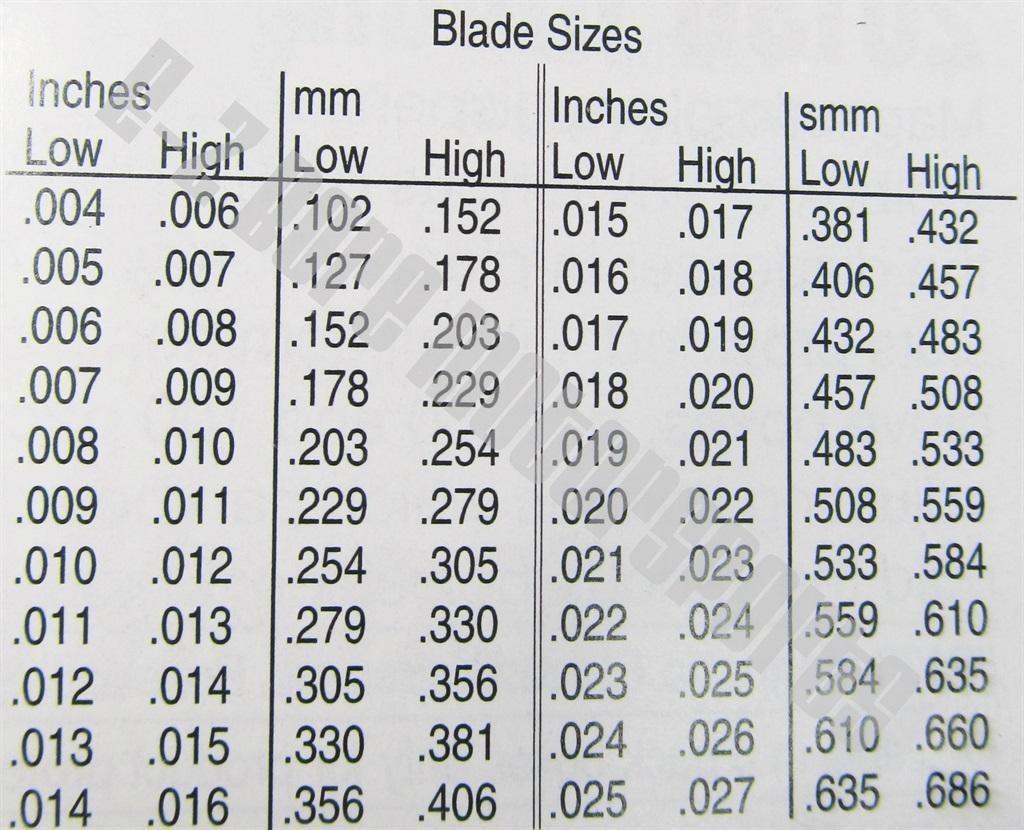
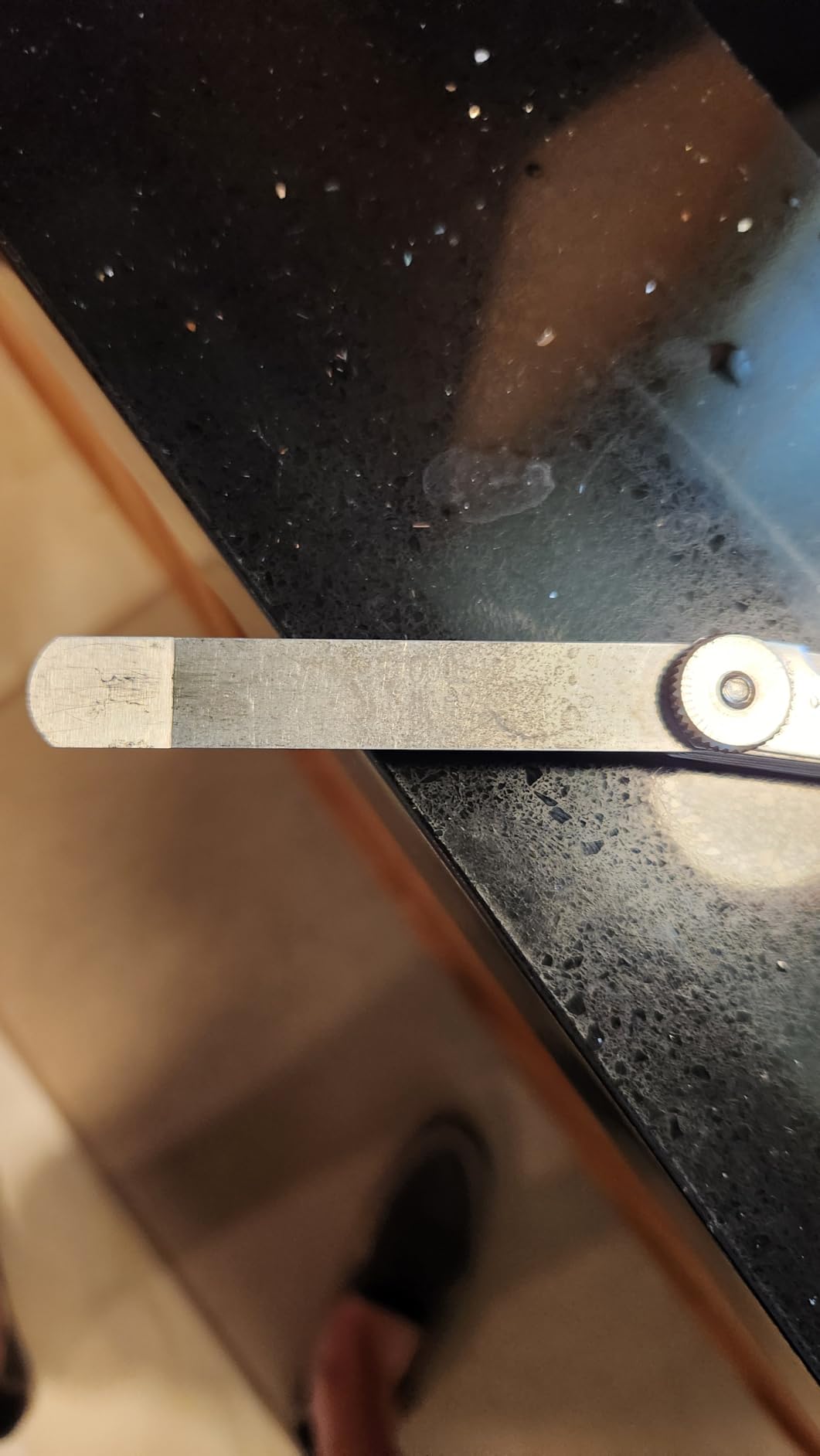
The blades are about half an inch wide and 3.25 inches long, which is the shortest reach here. Short blades suit small pockets where a longer fan fouls a casting, and they are stiff enough that they do not bow in a narrow gap.
Owners find it a dependable, accurate go/no-go gauge for routine clearance work. At 219 ratings there is simply less long term commentary than the larger sets, which is the main limitation here.
Where the Lisle 68150 works best
It suits routine clearance checks and quick verification passes where you want a published tolerance behind the number. The go/no-go habit of sliding the spec blade and then the next size up is the fastest way to catch a valve you adjusted by feel.
The short blades also make it useful in confined spaces where a full-size fan will not physically go, and the lifetime warranty means one bent blade does not end your ownership of it.
Where it falls short
The range stops at 0.027 inch, so anything wider needs stacking, and there are no offset or angled blades at all. With 219 ratings it has the smallest review base in the group, so you get less evidence about how it holds up over years.
If your lash figures regularly exceed 0.025 inch, you need a wider fan alongside this one.
12. Yourour A308 Offset Tappet Set – Best for Dedicated Lash Work
yourour A308 Offset Valve Tappet Gauge Set 11-Blades with Two Handles
11 offset blades 0.004-0.014 inch
Two handles with rubber grips
Dual engraved markings
Pros
- Offset geometry made for valve lash setting
- Two handles give leverage and a soft grip
- Covers the 0.004 to 0.014 inch range
- Backed by a one year warranty and 30 day return window
Cons
- Narrow 11 blade range against 22 and 32 blade sets
- Smallest review base here at 162 ratings
- Tops out at 0.014 inch so wider gaps need stacking
This is a purpose-built valve tappet gauge rather than a general feeler fan. Eleven offset blades from 0.004 to 0.014 inch, or 0.102 to 0.356 mm, on a two-handle configuration with steel and rubber grips.
The offset geometry is the whole point. Every blade enters the clearance point at an angle, which is exactly what a pushrod or rocker arrangement with a low adjustment screw needs. Size numbers are engraved in both metric and imperial.
The two-handle setup is unusual and genuinely useful on a stubborn adjustment. One hand holds the blade position steady while the other turns the adjuster, which stops the blade from shifting mid-turn and giving you a false reading.
Where the A308 works best
It suits valve lash setting on engines where the clearance point is angled and the spec sits in the 0.004 to 0.014 inch band. For a dedicated lash job with a known range, a small specialist gauge is quicker than fighting through a 32-blade fan.
It is also a reasonable second gauge to keep alongside a general set, because it covers a job the general set handles badly.
Where it falls short
Eleven blades is a narrow range next to the 22 and 32 blade sets here, and it tops out at 0.014 inch, so anything wider means stacking. With 162 ratings it has the smallest review base of the twelve, which tells you very little about long term blade accuracy.
The warranty is one year rather than the limited lifetime cover the larger brands offer, so I would not build a whole workflow around it.
How to Choose a Feeler Gauge Set for Engine Work
Pick by the work you actually do, not by the brand on the case. Eight criteria decide whether a set earns a permanent place in your toolbox.
Range. For most automotive valve work a fan covering 0.001 to 0.040 inch handles everything, and 0.002 to 0.025 inch is the range most jobs actually live in. Motorcycle and small engine work sits lower, so check whether the fan reaches below 0.001 inch if you tune those.
Blade count and step spacing. More blades means smaller gaps between sizes. Twenty-two blades give you a coarse bracket; 32 blades let you narrow the clearance to a range you would be happy to sign off.
Dual marking. Every blade stamped in both inch and millimetre. The same clearance is quoted as 0.008 inch in one manual and 0.20 mm in another, and mixing them up mid-adjustment is one of the most common self-inflicted errors.
Blade geometry. Straight blades for open clearance points, tapered tips for narrow buckets, offset or bent blades for recessed and deep-bay access. A straight blade forced into an angled gap bows, and you read the bow instead of the clearance.
Blade length. Around 95 mm suits restricted bays and toolboxes. Longer blades reach deeper into a V8 valley or a truck engine bay but will not fit a motorcycle frame. Match the length to your smallest working space, not your largest.
Material. Manganese and high-carbon steel take a spring temper and resist snapping. Stainless steel resists corrosion in damp or marine environments, though some sets labelled stainless are magnetic enough to question it. A brass blade is worth having for work near electronic ignition components.
Marking durability. Etched numbers outlast printed numbers, but etching has lower contrast. Faded or missing sizing is a reason to replace a set, because a misread clearance is worse than no gauge at all.
Retention. A knurled knob or a thumb notch on the blade protector holds the fan in position. A friction pivot that lets blades drift makes selection ambiguous, and a blade that pops out beside a hot exhaust is a safety problem, not a convenience one.
Then decide whether you need one gauge or two. If every clearance point on your engines is reachable with a straight blade, a single 32-blade fan covers everything and you are done. The moment you own an air-cooled flat, a motorcycle with tucked-in rockers or a deep-lobe camshaft, a second angled fan pays for itself the first time you avoid pulling a head to reach a valve.
If you work in both systems, choose dual-marked blades throughout. A set that mixes inch-only and metric-only fans guarantees you will eventually read a millimetre blade as an inch value.
Wipe the protective oil off before first use. It is there to stop rust, not to sit between the blade and the gap, and an oily blade feels different as it passes through the clearance. More on our approach to marking and layout tools if you want the same scepticism applied elsewhere in the garage.
SAE and Millimetre Equivalents for Common Valve Clearances
This is the conversion table I keep by the bench, because the same clearance gets quoted in both systems depending on which manual you have open. Multiply inches by 25.4 for millimetres.
0.002 inch = 0.05 mm
0.004 inch = 0.10 mm
0.005 inch = 0.13 mm
0.008 inch = 0.20 mm
0.010 inch = 0.25 mm
0.012 inch = 0.30 mm
0.015 inch = 0.38 mm
0.017 inch = 0.43 mm
0.020 inch = 0.51 mm
0.025 inch = 0.64 mm
0.030 inch = 0.76 mm
0.035 inch = 0.89 mm
When a shim-under-bucket head is quoted in metric shim sizes around 2.9 to 3.05 mm, you are looking at lash clearances near 0.008 inch. That is the conversion people most often get wrong, because 0.20 mm and 0.008 inch sit in the middle of the fan and both blades are present.
How to Measure Valve Clearance Correctly
Six steps, and skipping any one of them produces a number you will not be able to reproduce. This is the routine I use on every head.
Measure cold. Let the engine sit overnight or at least until the head is at ambient. Thermal expansion moves the cam, the buckets and the shims, and a hot reading will not match the book spec no matter how good your gauge is.
Rotate the engine to base circle by hand. Turn the crankshaft slowly until the lobe you are measuring is at its lowest point against the follower. Never use the starter or impact wrench, because they can leave a valve a fraction off base circle without you noticing.
Place the blade where the parts actually touch. On a bucket tappet, put the blade between the cam lobe and the top of the bucket. On a rocker arm, place it between the rocker face and the valve stem tip. On a shim under bucket, it goes under the bucket on the cam lobe. Forum users get this wrong more than any other part of the job, and the answer is always the same: lobe to follower, rotated to base circle.
Find the drag point going in and out. The correct blade drags slightly on the way in and scrapes lightly on the way out. If it slides in loose with no resistance, it is too thin. If it will not go in without force, it is too thick.
Read the clearance as a range, not a single number. If the 0.004 inch blade drags and the 0.005 inch blade will not pass, your clearance is between those two. Record the range and compare it to the spec. Users on the sovietsteeds forum describe exactly this convention, and it is the honest way to record a measurement made with discrete blades.
Confirm with a go and no-go pass. Slide the exact spec blade in and out to confirm it does drag, then slide the next size up to confirm it does not pass. That second pass removes any dependency on how you judged the drag, and it is the fastest way to catch an adjuster you turned too far by feel.
Work intake and exhaust separately and record every valve. An intake and exhaust spec are rarely the same figure, and mixing them up is how a set that felt fine turns into an engine that eats an exhaust valve.
How to Check Your Feeler Gauge Is Actually Accurate
Nobody trusts a cheap gauge until someone puts it on a caliper. That instinct is correct, and the check takes five minutes. Accuracy claims in this category are usually stated as a tolerance rather than demonstrated: the Lisle 68150 publishes plus or minus 0.0001 inches, while budget sets generally make no claim at all.
Real drift beyond the printed value comes from one place, and it is not the factory. It is a bent blade. Forcing a blade into a gap it does not fit bows it, and a bowed blade reads falsely forever after. The forum complaint pattern in this category matches exactly, with one report of a 0.001 inch blade actually measuring 0.0007.
Wipe the blades and check them visually. Look for bowing, kinks near the pivot and burrs along the edge. Any blade with a visible kink is finished as a measuring tool.
Spot check on a digital caliper. Clamp a few blades between the jaws and read the thickness. Ten thousandths of an inch resolution is enough to catch a blade that is measuring low. Check more than one size, because a set can be accurate at one thickness and off at another.
Run a go and no-go pass. Confirm the blade you intend to trust slides with drag and that the next size does not pass. This does not prove accuracy, but it proves the fan is in order and the sizes are in the right sequence.
Test the same sizes on two sets. If two sets disagree by more than a thousandth, one of them is wrong and you do not yet know which.
Wipe and re-oil after use. Protective oil is a corrosion feature, not a defect. But it must come off before a measurement, and a clean dry blade is the only way to judge drag consistently.
Treat faded or missing size markings, loose blades in the fan, blades that measure off their stamped value, and magnetic steel where non-magnetic is needed as reject conditions. If you want a comparison approach for other measuring tools, our pin gauge guide covers the same verification logic for a different job.
Feeler Gauges vs Dial Indicators, Micrometers and Dial Bore Gauges
A feeler gauge measures an unserved gap between two assembled parts by comparison. A micrometer measures a dimension directly between anvils and resolves to a thousandth. A dial indicator reads small movement of a plunger. A dial bore gauge measures the internal diameter of a bore and centres itself inside it.
Each one owns a different engine job, and using the wrong tool is the most common reason a measurement disagrees with the manual:
Feeler gauge: valve clearance, spark plug gap, ring end gap, clutch pack clearance. Unserved gap, comparison method, typically good to a thousandth on a good set.
Micrometer: Piston diameter, crankshaft main and rod journals, valve stem diameter, deck height. Direct dimension, resolution of a thousandth or finer.
Dial indicator: crankshaft endplay, valve lift, runout, and deflection readings on an assembled machine. It needs a reference surface and a clamp or magnetic base, and it measures movement rather than a gap you can reach with a blade.
Dial bore gauge: cylinder bore diameter, piston-to-wall clearance in the finished bore. It self-centres in the bore, which is why it beats a micrometer for anything tapered or out of round.
Head clearance and piston-to-valve clearance are not feeler gauge jobs. They need dedicated clearance gauges and a specific procedure, and a feeler blade pressed between the wrong surfaces will give you a confident wrong number. If you are planning a full rebuild, our engine tuner roundup covers the setup side of the same job.
Frequently Asked Questions
What is a good set of feeler gauges?
A good set is a dual-marked fan of hardened steel or stainless blades covering about 0.001 to 0.040 inch and 0.03 to 1.00 mm, with at least 25 blades, etched sizes on both scales, and blade geometry that reaches your clearance points. For most engine work, a 32-blade tapered or straight set handles valve lash, spark plug gaps and ring end gaps.
How accurate are feeler gauges?
Good sets hold their stamped value, and the Lisle 68150 states plus or minus 0.0001 inches. Budget sets usually publish no tolerance at all. In practice most real error comes from a bent blade rather than the factory, which is why you should spot check blades on a digital caliper and reject any that are visibly bowed or reading low.
How snug should a feeler gauge be?
The correct blade drags slightly on the way in and scrapes lightly on the way out. If it slides in loose it is too thin; if it will not go in without force it is too thick, and forcing it bends the blade. Your clearance is the range between the blade that drags and the next one that will not pass, so record both numbers.
Should I use metric or SAE feeler gauges?
Use dual-marked blades and read the spec in whatever system your manual quotes, without converting mid-adjustment. The same clearance appears as 0.008 inch and 0.20 mm, and mixing them up is one of the most common errors in valve work. Some riders prefer metric sets purely because their service manual is metric first.
Can I use a feeler gauge for spark plug gaps and ring end gaps?
Yes. Spark plug gaps sit in the same 0.020 to 0.040 inch band that the upper blades cover, and ring end gap uses the smaller sizes. Ring gap tolerance is far looser than valve clearance, so going slightly over the recommended figure is usually acceptable. Bearing endplay and head clearance are different measurements and need their own gauges.
Why is my feeler gauge reading wrong?
The usual causes are a bent blade from forcing it, oil left on the blade changing how it drags, reading a metric value as an inch figure, measuring a hot engine instead of cold, or a blade that is loose in the fan so two sizes sit at the same place. Check each of those before assuming the gauge is faulty, and confirm with a second set.
Final Verdict
The Spurtar 32-Blade Tapered Set is the best feeler gauges for engine work pick for most people, because a single 0.001 to 0.040 inch dual-marked fan with tapered tips covers valve lash, plug gaps and ring gaps without a second purchase. Pick the OEMTOOLS 25024 if you want a lifetime warranty behind the blades, the Mutt Tools kit when access is tight enough that a straight blade will not go in, and the Lisle 68150 when you want a published tolerance on the spec sheet.
Spend where the money changes the job: geometry and blade range matter, brand does not. Everything else — wiping the oil, measuring cold, rotating to base circle and confirming with a go and no-go pass — costs nothing and decides whether your reading is right. If you are still choosing between instrument families, our gauge roundups cover the other side of the bench.