
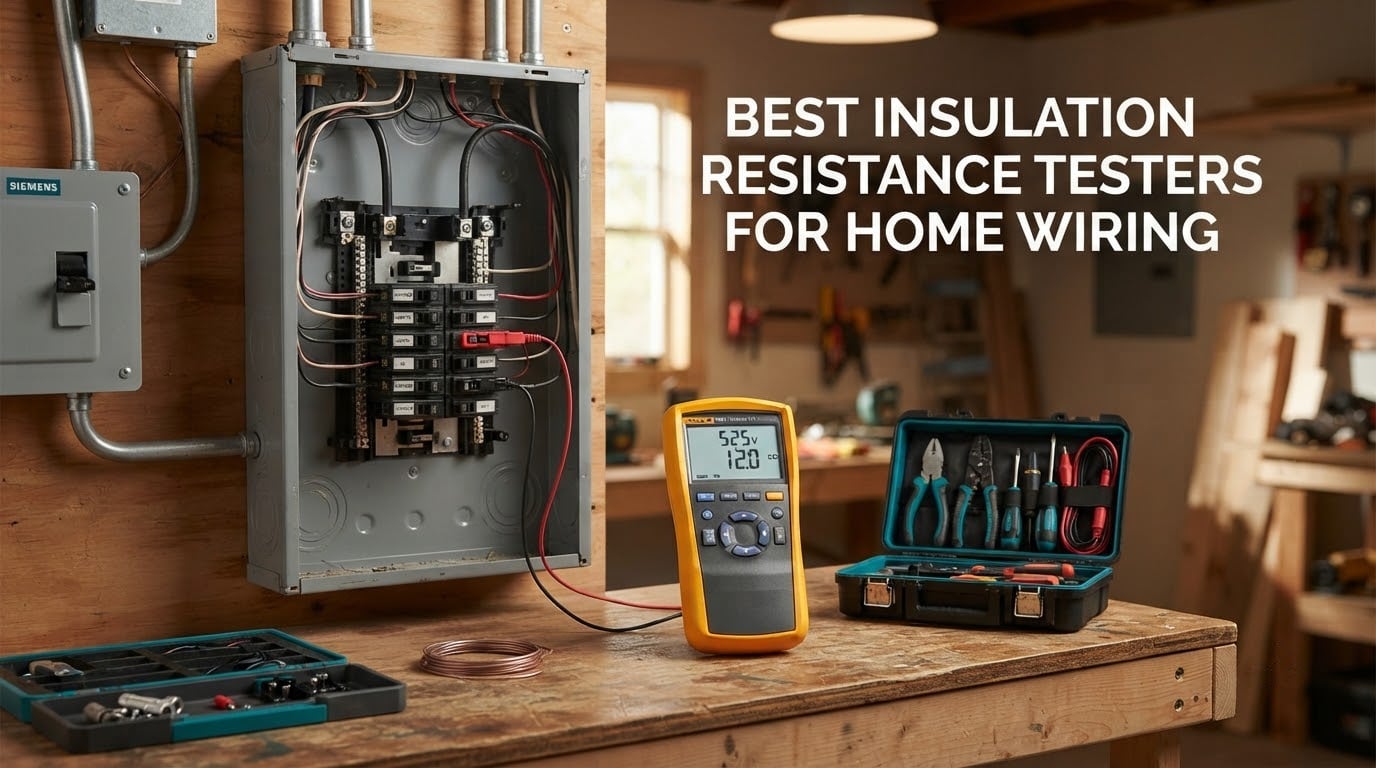
Most people searching for the best insulation resistance testers for home wiring want the same answer to two questions: which meter should I buy, and will it damage my electronics. The short version is that an insulation resistance tester pushes a known DC test voltage between a de-energized conductor and earth, then measures the tiny leakage current coming back through the insulation and reports it in megohms. Healthy insulation passes almost no current and reads very high.
My top pick is the Klein Tools ET600, because it does the job a homeowner actually needs at a mid-range price, combines a full True RMS multimeter in the same body, and covers 125V through 1000V. The Supco M500 is the value choice at a fixed 500V output, and the Fluke 1587 FC is the one to buy if you want logged, trendable results for a whole property. Everything else in the list below earns its place for a specific reason, and I have flagged the honest drawbacks for each one.
A note on terminology before we go further, because this trips up almost everyone. An insulation resistance tester and a megohmmeter are the same thing. A megger is the trade nickname that became generic, and Megger with a capital M is a manufacturer. If a listing says megger, it means megohmmeter. Our earlier guide to insulation testers in general covers the wider category.
Table of Contents
Top 3 Best Insulation Resistance Testers (October 2026)

Klein Tools ET600
- Insulation testing to 4000 MΩ
- 125V/250V/500V/1000V test volts
- True RMS multimeter in the same body

Supco M500
- Fixed 500V test voltage
- Up to 1000 megohms
- Magnetic clip leads
- Auto-discharge after every test

Fluke 1587 FC
- PI and DAR diagnostics
- Fluke Connect wireless logging
- 50V to 1000V test volts
- True RMS
Best Insulation Resistance Testers at a Glance in 2026
| Product | Specifications | Action |
|---|---|---|
| Klein Tools ET600 |
|
Check Latest Price |
| Supco M500 |
|
Check Latest Price |
 Fluke 1507 Fluke 1507 |
|
Check Latest Price |
| Fluke 1587 FC |
|
Check Latest Price |
 Hioki IR4056 Hioki IR4056 |
|
Check Latest Price |
 AEMC 2126.53 AEMC 2126.53 |
|
Check Latest Price |
 Ayitam PM1508 Ayitam PM1508 |
|
Check Latest Price |
 UNI-T UT501A UNI-T UT501A |
|
Check Latest Price |
 KAIWEETS KE2500 KAIWEETS KE2500 |
|
Check Latest Price |
 KKnoon Insulation Tester KKnoon Insulation Tester |
|
Check Latest Price |
1. Klein Tools ET600 – The Best All-Round Tester for Home Wiring
Klein Tools ET600 Multimeter, Megohmmeter Insulation Tester, 4000 Ohms Resistance, 125V/250V/500V/1000V, Auto-Ranging TRMS Multimeter
4000 MΩ insulation range
125V 250V 500V and 1000V test volts
True RMS multimeter built in
CAT III and CAT IV leads
Pros
- Combines a full True RMS multimeter with a built-in insulation tester so one tool covers circuits motors and routine measurements
- Includes both CAT III and CAT IV rated leads plus heavy-duty alligator clips
- Voltage detection warning alarm and high-voltage icon
- Easy to learn interface that new staff pick up quickly
- Reportedly accurate when cross-checked against a Fluke megohmmeter
Cons
- Chunky heavy body is awkward in tight spaces without the clip leads
- 4000-count display resolution is coarser than lab-grade meters
- No PI or DAR diagnostics
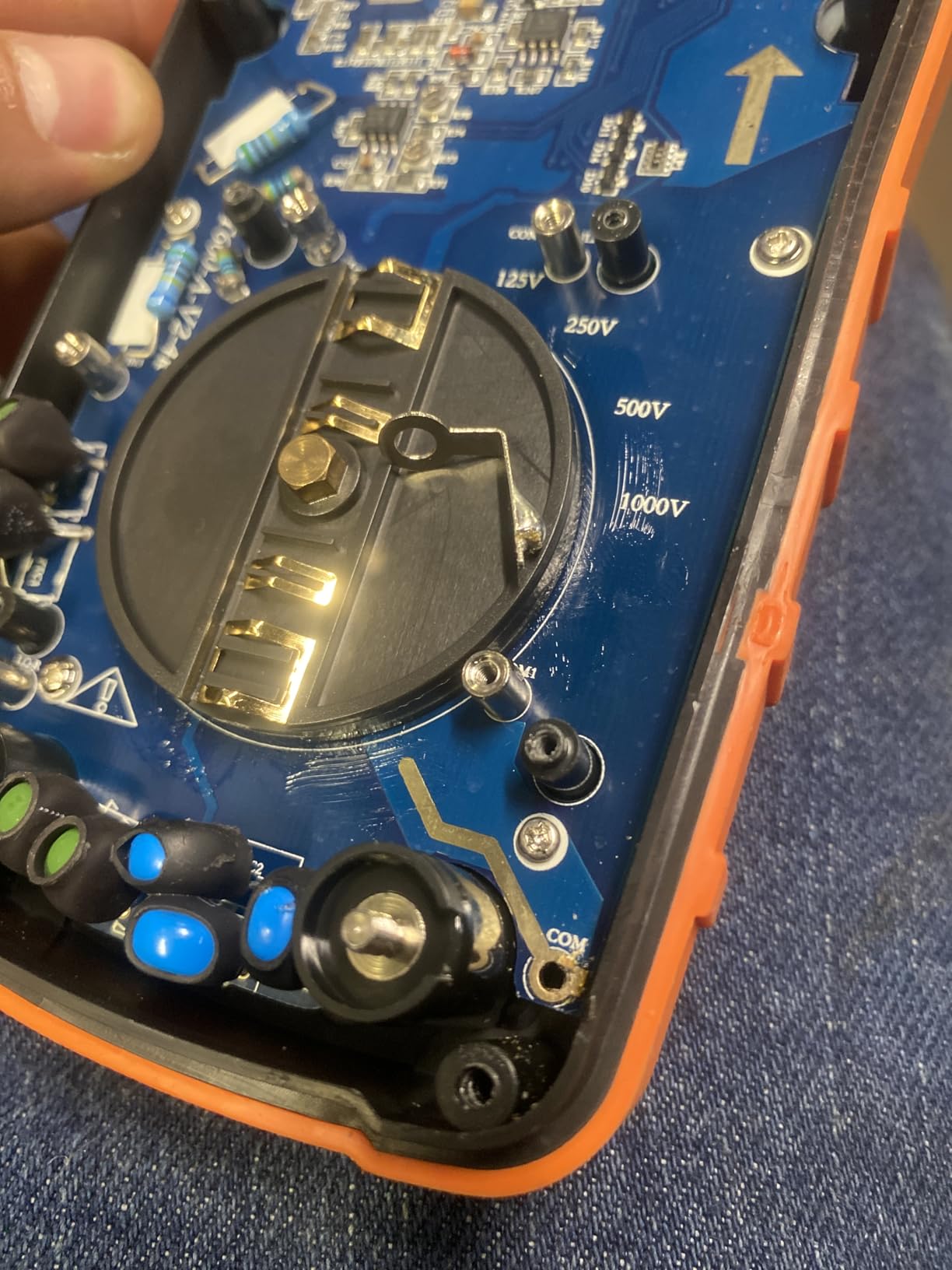
This is the meter I reach for first on a house. It weighs about 1.4 pounds, measures insulation up to 4000 megohms, and steps through 125V, 250V, 500V and 1000V so you can match the test to whatever circuit you are standing in front of. The test and lock buttons mean you can start a reading and take your hands off the leads, which matters when you are working overhead in a panel or basement.
The bigger story is that it is also a genuine True RMS multimeter measuring up to 1000V AC and DC, plus resistance and continuity. For a homeowner doing pre-purchase due diligence, that combination means one instrument covers the whole walkthrough instead of two. Owners report cross-checking readings against a Fluke and getting matching results, and the bar graph, hold and max/min functions make it easy to record a number without fumbling.
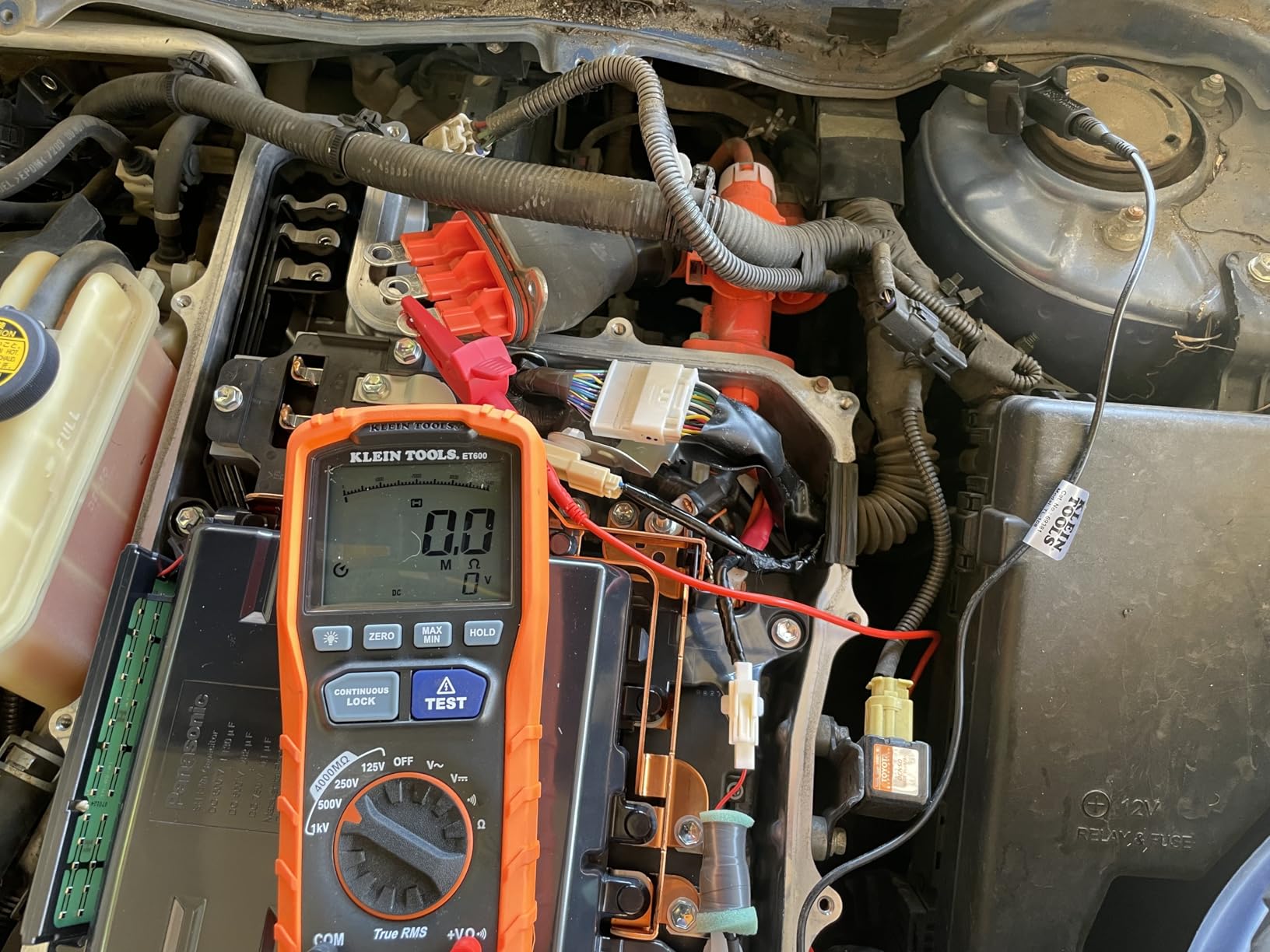
The physical bulk is the honest drawback. It is a large, dense body, and probing a tight junction box means using the clip leads rather than holding the meter in one hand and a probe in the other. Display resolution is 4000 counts, so you will not get the fine resolution a lab-grade instrument offers. Neither issue matters for deciding whether a 1970s circuit is healthy or not.
When the ET600 is the right pick
It is the right call if you are testing a mixed-age house, because you can step down to 125V for a modern electronics-heavy circuit and up to 500V or 1000V for old knob-and-tube-adjacent runs. It is also right if you want one meter in the bag for a full inspection rather than a dedicated insulation tester plus a separate multimeter.
It is the wrong call if you need polarization index and dielectric absorption ratio numbers for trend reporting, or if you want test results pushed to an app automatically. Those diagnostics simply are not on this meter.
What to watch for before buying
Confirm the test lock behavior before you rely on it in a confined space, because a locked test keeps the leads energized until you stop it. Also plan on alkaline batteries rather than a rechargeable pack, and check the 1-year manufacturer warranty terms if the meter is for paid work.
2. Supco M500 – Best Value Fixed-Voltage Insulation Tester
Supco M500 Electronic Megohmmeter, 0 to 1000 Megohms
Fixed 500V test voltage
Up to 1000 megohms
Magnetic clip leads
Auto-discharge after each test
Pros
- Magnetic ends on the terminal leads let you clip straight onto screw terminals
- Very compact at 9.3 by 6 by 1.8 inches and easy to carry
- Fast and easy to read so you can show a homeowner what a failed compressor looks like
- Consistent readings across motors compressors and wiring
- Auto-discharge after every test
- Long-established instrument brand
Cons
- Fixed 500V output with no user-selectable test voltage
- Analog zone scale rather than a precise digital readout
- Runs on C size batteries which are less common than AA
This is the meter with the deepest review base in the group, and for a simple reason: it does one thing and does it every time. It outputs a fixed 500V and reads up to 1000 megohms, which is precisely the residential default voltage. You do not have to think about a selector, you do not have to set a threshold, you clip on and read.
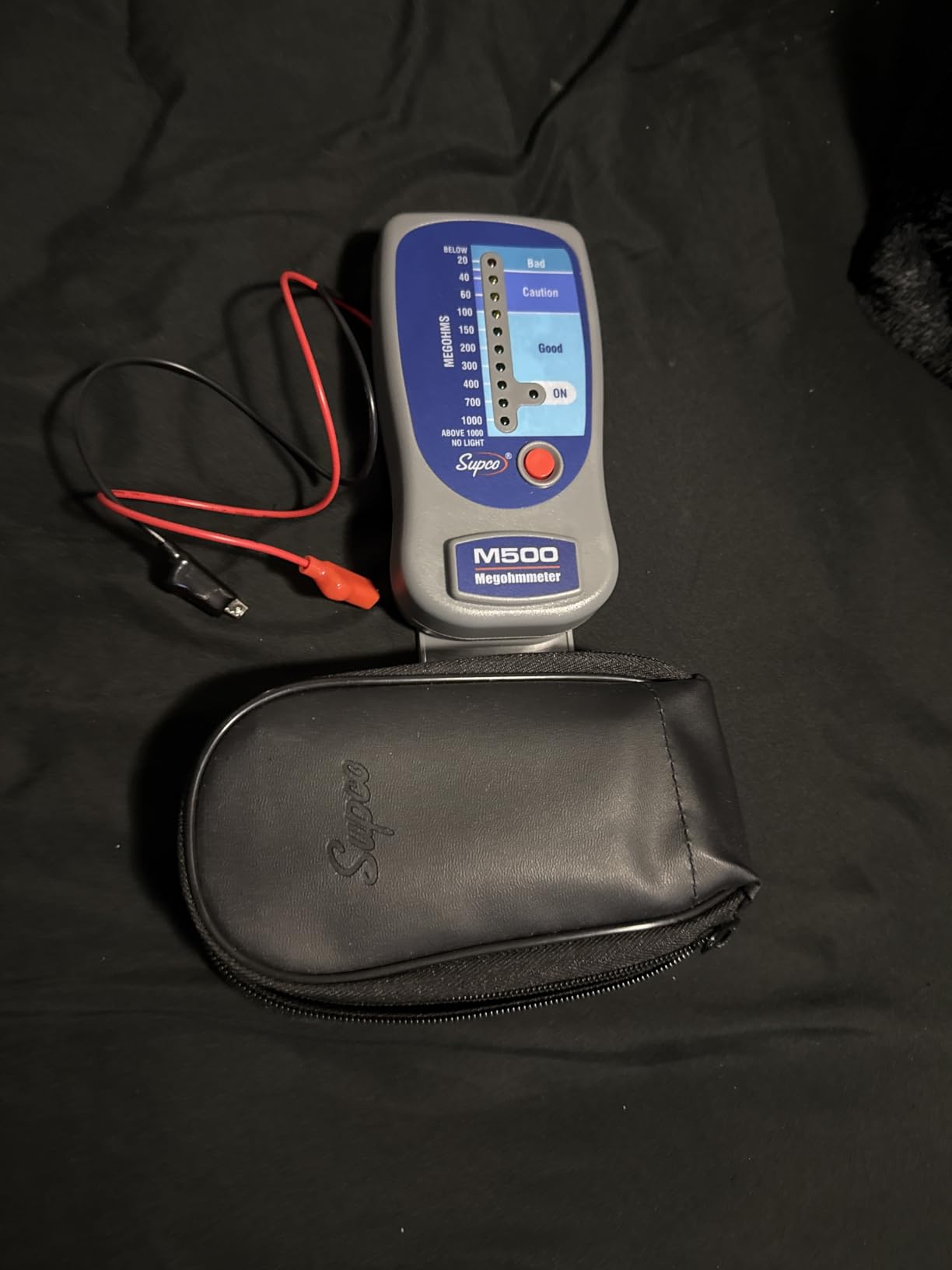
The magnetic ends on the terminal leads are the feature I would not give up. They let you attach the leads to a compressor or a screw terminal and step back, which is safer and far easier than balancing a probe. It also auto-discharges after each test, so the conductors are not left sitting at 500V while you move to the next circuit.
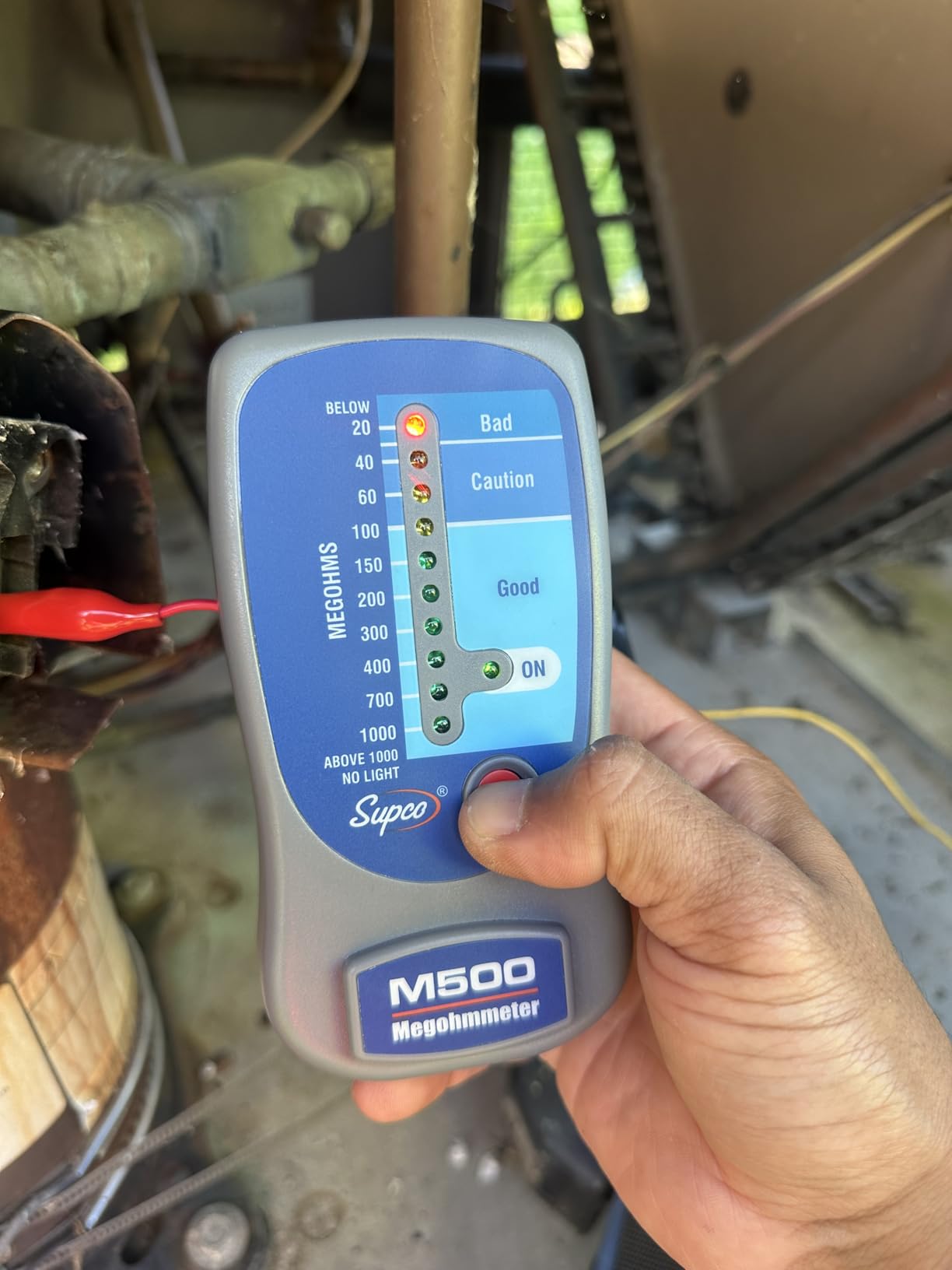
The limitations are structural, not quality issues. Because 500V is fixed, you cannot test low-voltage electronics at a gentle 50V or 100V, and you cannot push to 1000V on a long run to stress-test suspected insulation. The reading shows on a zone scale rather than as a precise number, and it takes C size batteries, which means a second battery type in your bag.
When the M500 is the right pick
Choose it for HVAC compressor checks, pump and motor windings, and older house circuits where a single 500V pass is exactly the right test. It is also the meter to buy if you are a technician who runs the same test dozens of times a day and wants something that cannot be knocked out of a correct setup.
Skip it if you plan to test circuits with connected electronics at low voltage, or if you intend to record specific resistance values for a report or a buyer.
What to watch for before buying
Confirm the zone scale is readable in the light you actually work in, since a bright LED helps but a coarse scale still needs a steady look. Plan on C batteries rather than AA, and note that the leads are short and fold into the back of the housing, which is convenient but limits reach in a deep panel.
3. Fluke 1507 – The Trade Reference Meter With a Calibration Certificate
Fluke 1507 Digital Megohmmeter Resistance Tester for Advanced Industrial and Electrical Testing, Test Voltages: 50V, 100V, 250V, 500V, 1000V
50V to 1000V test voltages
NIST-traceable certificate
Live circuit detection above 30V
Remote test probe
Pros
- Factory calibrated with a NIST-traceable certificate included in the box
- Live circuit detection blocks insulation testing above 30V
- Remote probe makes repetitive and confined-space testing far easier
- Test voltages from 50V up to 1000V
- Large backlit display that is easy to read in the field
Cons
- No hard carrying case included
- Alkaline batteries run down quickly under repeated insulation testing
- Intimidating for users new to megohmmeters
This is the meter most electricians picture when someone says megger. It covers 50V, 100V, 250V, 500V and 1000V, and it ships with a NIST-traceable calibration certificate, which means the readings can be traced back to a national standard. That certificate alone is often the deciding factor when an inspection report has to be defensible.
Two safety features set it apart for home work. Live circuit detection refuses to run an insulation test above 30V, so a missed de-energize turns into a refusal rather than a shock. And the remote test probe lets you start a timed measurement without standing in a wet crawlspace holding the leads.
I would pair it with a proper case, because none is included. Alkaline cells are the other recurring complaint: they drain noticeably faster during repeated insulation tests than during normal multimeter work, and the battery compartment is a routine thing to check before a full house.
When the 1507 is the right pick
It is the right pick when the result has to be documented for a sale, a claim, or an inspection, and when you need the 50V and 100V settings to test modern low-voltage and electronics-heavy circuits gently. It is also the natural choice for a contractor who already owns Fluke meters and wants one ecosystem.
It is overkill if you are doing a single afternoon of checks on an older home, and it is not the right tool if you want PI and DAR trend data, since this model does not compute them.
What to watch for before buying
Budget for a padded case, and decide whether to run it on alkaline cells or accept shorter intervals. Read the live circuit detection threshold carefully so you know what happens if the circuit is not fully dead. Be prepared for a learning curve if you have never used a megohmmeter, because the function layout is denser than a simple multimeter.
4. Fluke 1587 FC – Best for Logged, Trendable Whole-Property Results
Fluke – FLUKE-1587 FC FLUKE 1587 FC 2-in-1 Insulation Multimeter
50V to 1000V test volts
PI and DAR with Trend It graphs
Fluke Connect wireless logging
True RMS, 3-year warranty
Pros
- Complete multimeter and insulation tester in one unit
- PI and DAR readings give real diagnostic depth instead of a pass or fail number
- Wireless logging removes manual note-taking and allows historical tracking
- Sturdy rotary switch and leads that seat securely
- Three-year warranty and a long service reputation
Cons
- Heaviest instrument here at 1645 g
- Does not accept a wire amp clamp accessory
- Runs warm during extended insulation testing
This is the one to buy if you are testing a whole property and need results you can compare year over year. The 1587 FC computes polarization index and dielectric absorption ratio and draws Trend It graphs, so you can see not just that a reading is low but whether the insulation is degrading at a measurable rate. The Fluke Connect app logs results wirelessly and adds temperature compensation, which is what makes those comparisons meaningful in a real house with temperature swings.
It also measures True RMS voltage, resistance, continuity and current, and it spans 50V to 1000V. Users consistently report that readings stabilise quickly and match expectation, and that the build survives dusty, hot job sites. Owners with Fluke 1587 models in service report long working lives, and the three-year warranty backs that up.
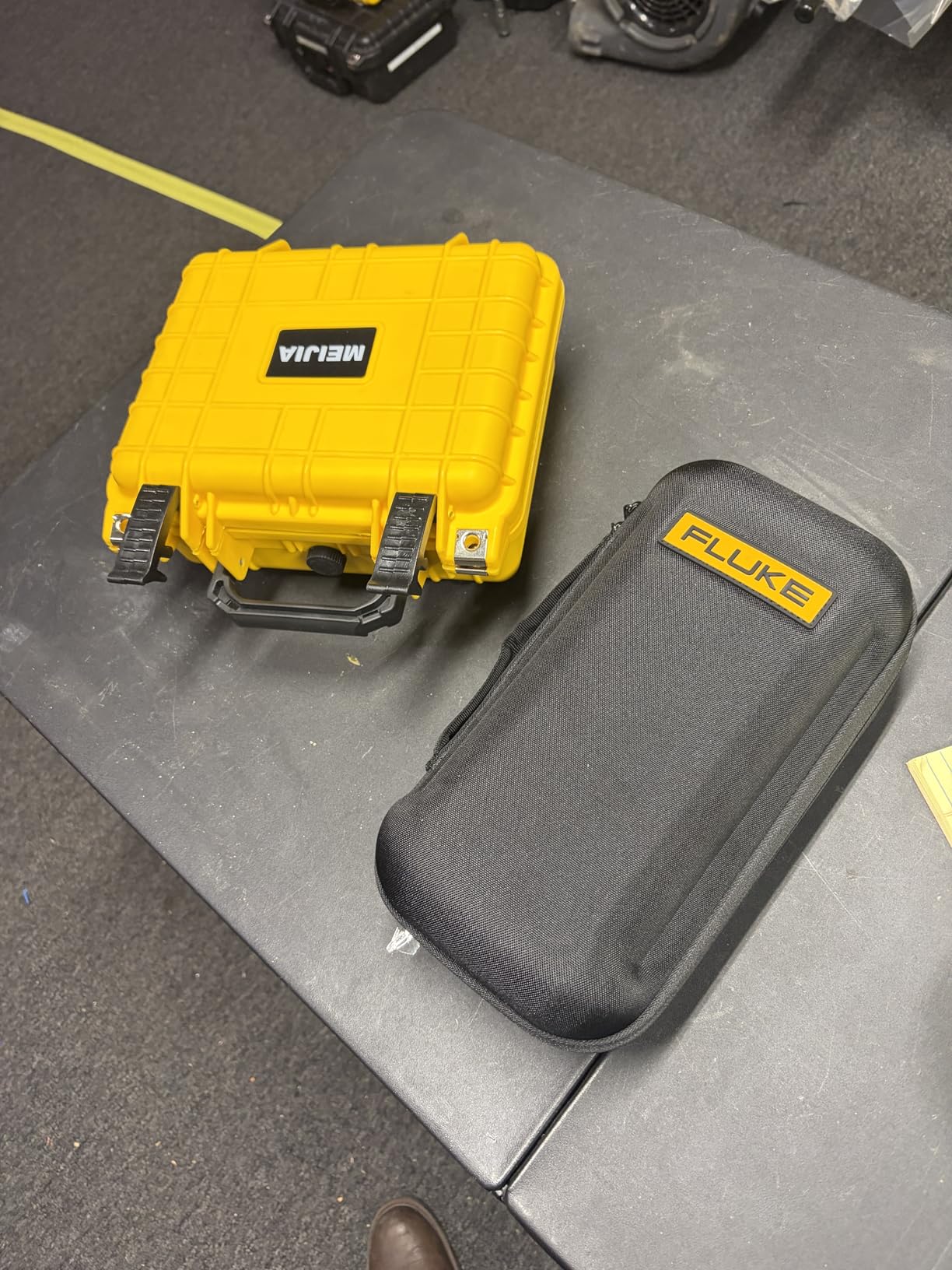
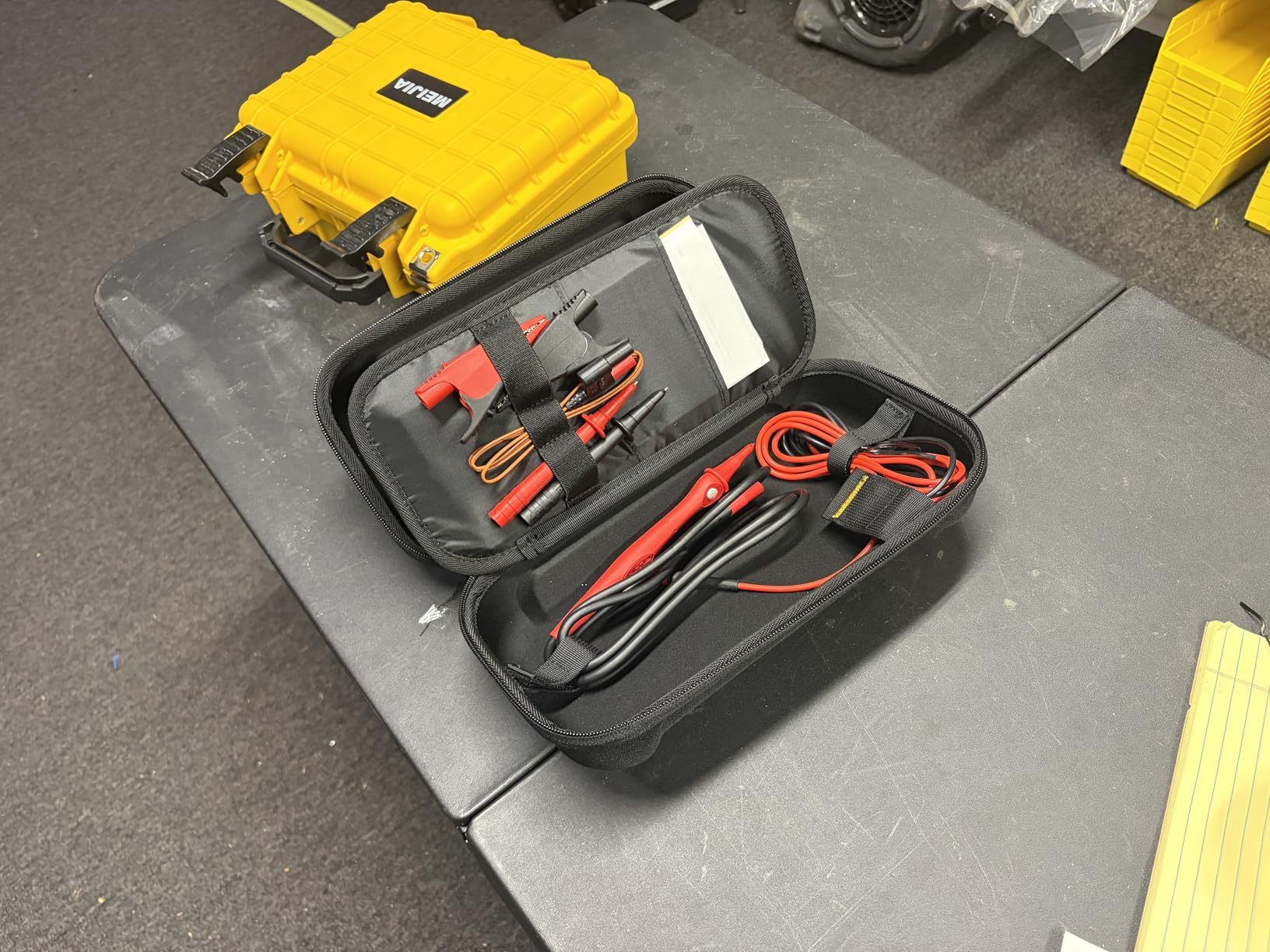
The weight is the thing you feel first. At 1645 g it is the heaviest instrument in this roundup, which is a real consideration on a ladder or in a crawlspace. It has no input for a wire amp clamp, it runs warm through long insulation sessions, and it costs more than everything else here combined by a wide margin.
When the 1587 FC is the right pick
It is right for property managers, agents doing due diligence, and electricians who bill for documented condition reports. It is also right for anyone commissioning new work who wants a baseline recorded to the app so a future owner can compare against it.
It is not right for a single afternoon of DIY checks. The app dependency is a real drawback for anyone who would rather not manage another piece of software, and you pay a genuine premium for diagnostics you may never use.
What to watch for before buying
Test the Fluke Connect app with your own phone before committing, since that is the most common source of frustration with this model. Consider a neck strap or a harness given the weight. And check whether you actually need the current measurement, because the missing clamp input limits you to a different current probe.
5. Hioki IR4056 – Fastest Verdict for First-Time Users
HIOKI Insulation Tester IR4056
50V to 1000V test voltages
100 MΩ to 4000 MΩ range
PASS FAIL decision in 0.8 seconds
Built-in AC and DC voltmeter
Pros
- Very fast stable readings with a PASS FAIL comparator verdict in under a second
- Exceptionally easy to learn for someone new to insulation testing
- Built-in AC and DC voltmeter so one instrument covers live circuit checks
- Compact at 600 g with a neck strap for field use
- Made in Japan by a respected instrument brand
Cons
- Ships with Japanese-language documentation and the English manual must be downloaded
- No remote test probe for hard-to-reach points
- Smaller review base than the mainstream brands
For a homeowner who has never held a megohmmeter, the decision speed is the selling point. The IR4056 gives you a PASS or FAIL comparator result in roughly 0.8 seconds, across five test voltages from 50V to 1000V and a 100 MΩ to 4000 MΩ insulation range. You set a threshold once and the meter does the interpreting for you.
It also has an integrated AC and DC voltage meter, which removes the need to verify a dead circuit with a second instrument. It is drop-proof from one meter, weighs 600 g, and the backlit LED display stays readable in a dark panel. Owners working on electric vehicles report it outruns pricier dedicated EV insulation testers they have tried.
The documentation is the real catch. It arrives in Japanese, and you download the English manual yourself, so budget an extra ten minutes before you start. There is no remote probe for awkward corners, and with 70 ratings the long-term user base is smaller than the brands above, which means less field history to lean on.
When the IR4056 is the right pick
It suits first-time users, EV and hybrid charging circuits, and anyone who wants a clear pass or fail instead of a number to interpret. The built-in voltmeter makes it a good companion for a routine maintenance kit where carrying two meters is impractical.
It is a weaker fit if you need documented numeric values, if you work in confined spaces where a remote probe matters, or if you want readings logged over time.
What to watch for before buying
Download and read the English manual before your first test, since the PASS FAIL threshold is a setting you need to understand. Confirm the 200 mA continuity and live-circuit indicator behaviour fits your workflow. And accept that the meter gives a verdict, not a full diagnostic profile.
6. AEMC 2126.53 – The Pro-Grade Bargain for Floor Heating and Cable Work
AEMC 2126.53 Digital Megohmmeter, 1000V, Black
250V 500V and 1000V selection
EST LOCK up to 15 minutes
Automatic discharge
AC and DC voltmeter to 600V
Pros
- Build quality and readings reported on a par with instruments costing several times more
- EST LOCK allows a controlled timed measurement up to 15 minutes
- Automatic discharge for safety after each test
- Included clamps and leads mean you can start testing immediately
- Widely used for floor heating cable testing
Cons
- Spring tension on the alligator clips could be stronger
- Only three selectable insulation test voltages
The AEMC is the answer for anyone who wants a genuine professional megohmmeter without the professional invoice. Owners report readings consistent with Fluke and Megger instruments costing several times more, which is the whole argument. It offers 250V, 500V and 1000V insulation selections, an AC and DC voltmeter to 600V AC and 1000V DC, and automatic discharge after every test.
The EST LOCK feature is what I would point a renovation buyer at. It holds a controlled timed measurement for up to 15 minutes, which is how you get a stable, comparable number instead of a reading that is still settling. It is also the tester of choice in the floor heating world, including the one used to verify underfloor cable installations before the floor is closed up.
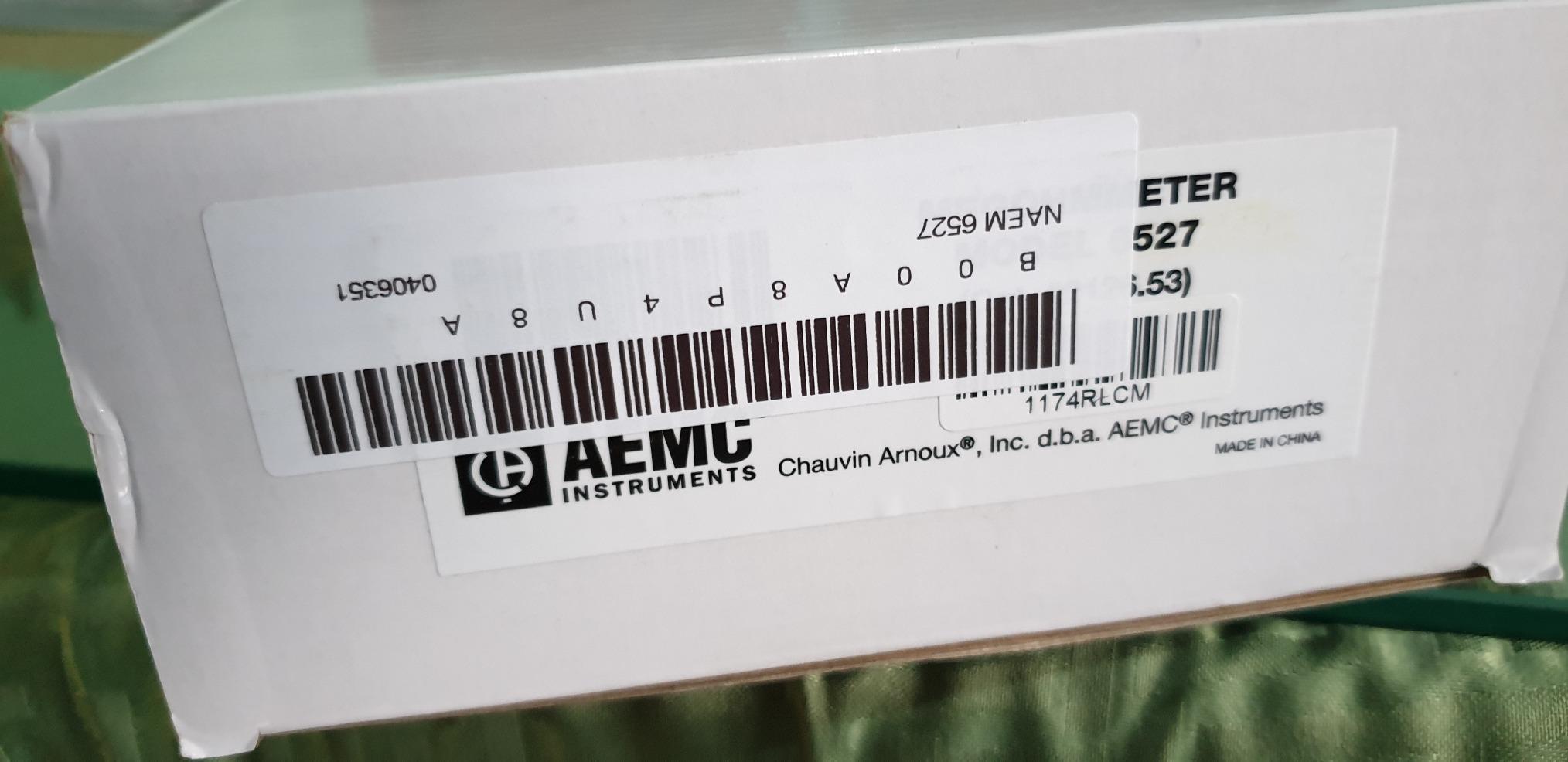
Two honest limits. There are only three selectable test voltages, so you cannot dial down to 50V or 100V for delicate electronics, and the spring tension on the supplied alligator clips is weak enough that owners mention it. At 2 pounds it is also chunky for a hand-held meter, though not in the same league as the 1587 FC.
When the AEMC 2126.53 is the right pick
It is right for floor heating and in-wall heating cable verification, for underfloor cable runs, and for a serious whole-house check where you want a stable timed reading. It is also a strong pick for a technician who wants Fluke-class consistency on a tighter budget.
It is not the right pick if you need low test voltages for sensitive electronics, or if you want PI and DAR diagnostics. Neither feature is on this meter.
What to watch for before buying
Expect to buy sturdier clips than the ones supplied if you are working in a panel with stiff conductors. Confirm the 15-minute timed test fits your procedure, since it locks the leads energized for that duration and you must keep clear. Check that three voltage selections cover the circuits you actually have.
7. Ayitam PM1508 – Most Feature-Rich Budget Diagnostic Unit
Megohmmeter, Insulation Resistance Tester, 50V-1000V Up to 100GΩ
Up to 100 GΩ range
50V to 1000V test voltages
PI and DAR functions
EN61010-1 CAT III 600V
Pros
- Reviewers call it precise across all ranges for the money
- PI and DAR functions usually found on pricier instruments
- Readable display and test leads that feel solid
- Combines a megohmmeter and multimeter with frequency measurement
- Runs on standard AA batteries and includes a detailed manual
Cons
- No carrying case listed
- PI and DAR accuracy unverified against a reference standard by reviewers
- Less established brand with a small international review base
This is the unit I would point at when someone wants insulation diagnostics on a limited budget. It measures up to 100 GΩ, steps through 50V, 100V, 250V, 500V and 1000V, and computes PI and DAR on the device. That diagnostic capability normally appears on instruments several times the price, and the auto-discharge plus compare function make it usable on a real circuit rather than a bench.
It is rated to EN61010-1 with a CAT III 600V category, which is the certification to look for on a residential panel test. It combines the megohmmeter with a multimeter and frequency measurement, runs on four AA batteries, and ships with test leads, an alligator clip and a detailed manual. European and Latin American buyers report precise readings against known resistor values.
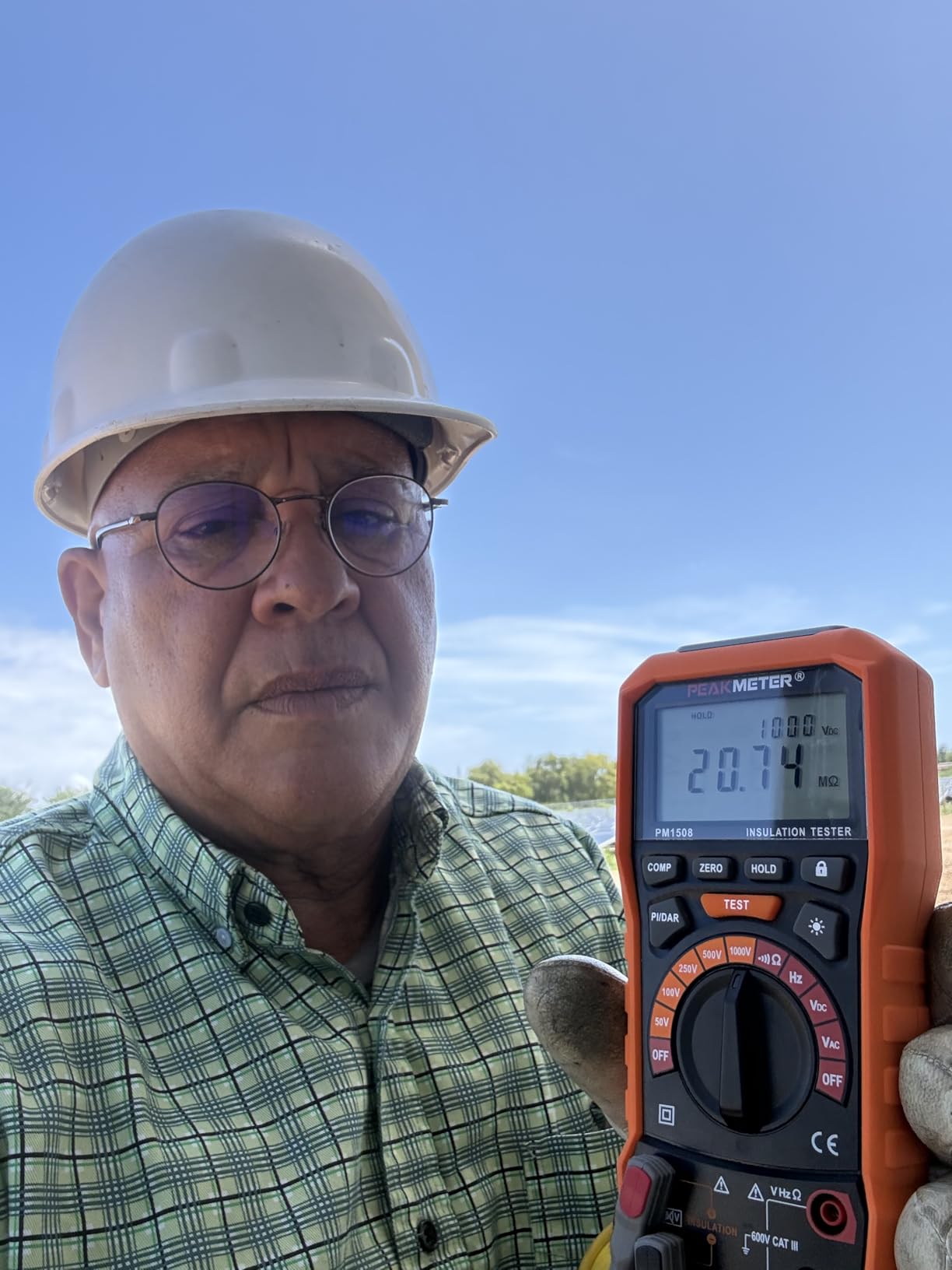
The caveat is verification. Reviewers have not checked its PI and DAR figures against a reference standard, so treat those two numbers as directional rather than reportable. The brand is less established than the names above and its review base is small and international, so there is less long-term field history. No carrying case is listed either, and at 818 g it is not a pocket tool.
When the PM1508 is the right pick
It suits small installation and service work, installation commissioning checks, and anyone who wants PI and DAR output without buying a logging multimeter. It is also a sensible second meter for a homeowner who already owns a basic insulation tester but needs low voltage options.
It is a poor choice for a formal report where a third party will challenge the numbers, and for anyone who needs documentation that survives an insurance or dispute process.
What to watch for before buying
Calibrate your expectations on the PI and DAR functions and confirm them against a known-good reference before relying on them. Buy a case, since none is listed and the meter is not sealed. Also check the CAT III 600V rating is appropriate for your panel work rather than assuming a higher category is always better.
8. UNI-T UT501A – Smallest and Lightest Tester in the Group
UNI-T 1000V Megohmmeter Insulation Tester, Ground Resistance Meter
0 to 5.5 GΩ insulation range
100V 250V and 500V test volts
Automatic measurement mode
CAT III 1000V CAT IV 600V
Pros
- Small and light at 500 g with a pocketable footprint
- Automatic measurement mode with backlit display and audible alarm
- CAT III 1000V and CAT IV 600V ratings for the class
- Suited to transformers cables switches and appliances
- Backed by 30-day returns and a 6-month warranty
Cons
- Insulation range tops out at 5.5 GΩ
- Lowest share of top ratings in the group
- No PI or DAR insulation diagnostics
- Basic accessory bundle
The UT501A is the one to take when you need a light check in a confined space. At 500 g and under six inches tall it fits in a pocket or a belt pouch, and the automatic measurement mode means you connect the leads and it runs without further input. The backlit LCD, low-battery indication, alarm light and buzzer cover the basics you want in a dark panel.
It carries CAT III 1000V and CAT IV 600V compliance, which is real certification for the class rather than a marketing line, and it handles transformers, electric machines, cables, switches and appliances. Buyers treat it as a maintenance and inspection tool where value matters more than laboratory precision.
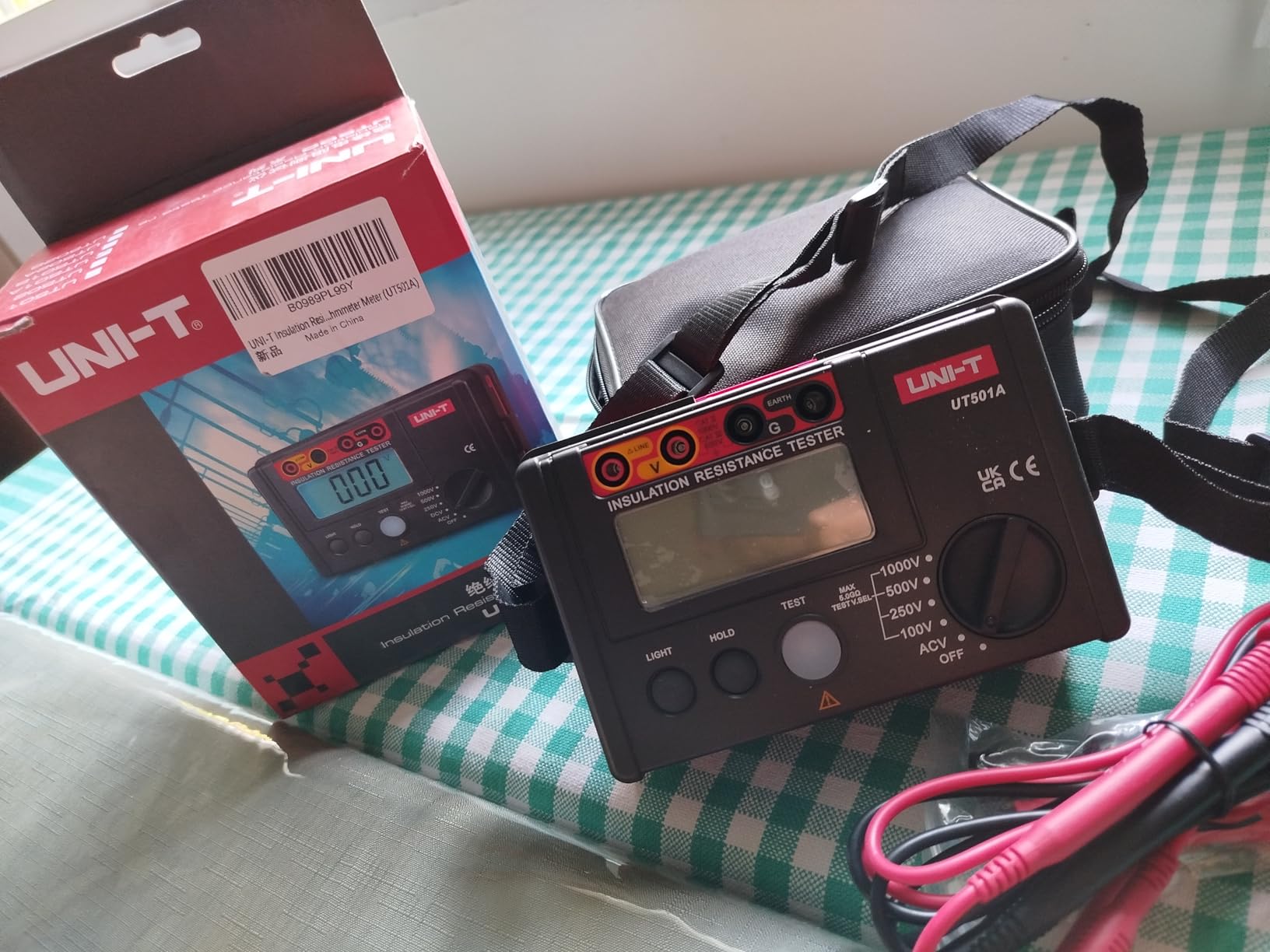
Two things limit it. The insulation range stops at 5.5 GΩ, far below the 100 to 200 GΩ offered by several rivals, so a very healthy circuit reads as over-range rather than as a specific number. There are no PI or DAR diagnostics, and the review distribution is the flattest in this group, with a meaningful share of three-star ratings, so expect occasional quality variation. The accessory bundle is basic, and the warranty is 6 months.
When the UT501A is the right pick
It is right for quick maintenance sweeps, for checking appliance and equipment circuits, and for anyone working in a crawlspace or attic where a 1.4 pound meter is genuinely annoying to hold. It is also a sensible secondary meter to keep in a van.
It is the wrong pick for a pre-purchase inspection where you want a precise number recorded, and for long cable runs where you need a higher ceiling to see headroom above a good reading.
What to watch for before buying
Understand that an over-range display usually means excellent insulation rather than a fault. Confirm 100V, 250V and 500V cover the circuits you plan to test, since there is no 1000V selection on the voltage selector. And keep the 6-month warranty in mind if this is a working tool.
9. KAIWEETS KE2500 – Widest Test Voltage Range, Most Polarized Reviews
KAIWEETS Megohmmeter Insulation Tester 0.1MΩ-200GΩ 2500V DAR/PI Ohm Meter
0.1 MΩ to 200 GΩ range
100V up to 2500V test volts
On-device DAR and PI
Carrying case included
Pros
- Only tester here reaching 2500V
- useful for industrial motors and long cable runs
- Wide 0.1 MΩ to 200 GΩ range with automatic DAR and PI calculation
- Large backlit display with a positive-feeling rotary selector
- Accuracy cross-checked against a Fluke on a known input resistance
- Carrying case and leads included
Cons
- Lowest average rating in the group at 4.2 stars
- Supplied leads and alligator clips feel less secure than the meter
- Uses a stack of disposable AA batteries
- One owner reported a unit failing after a few uses
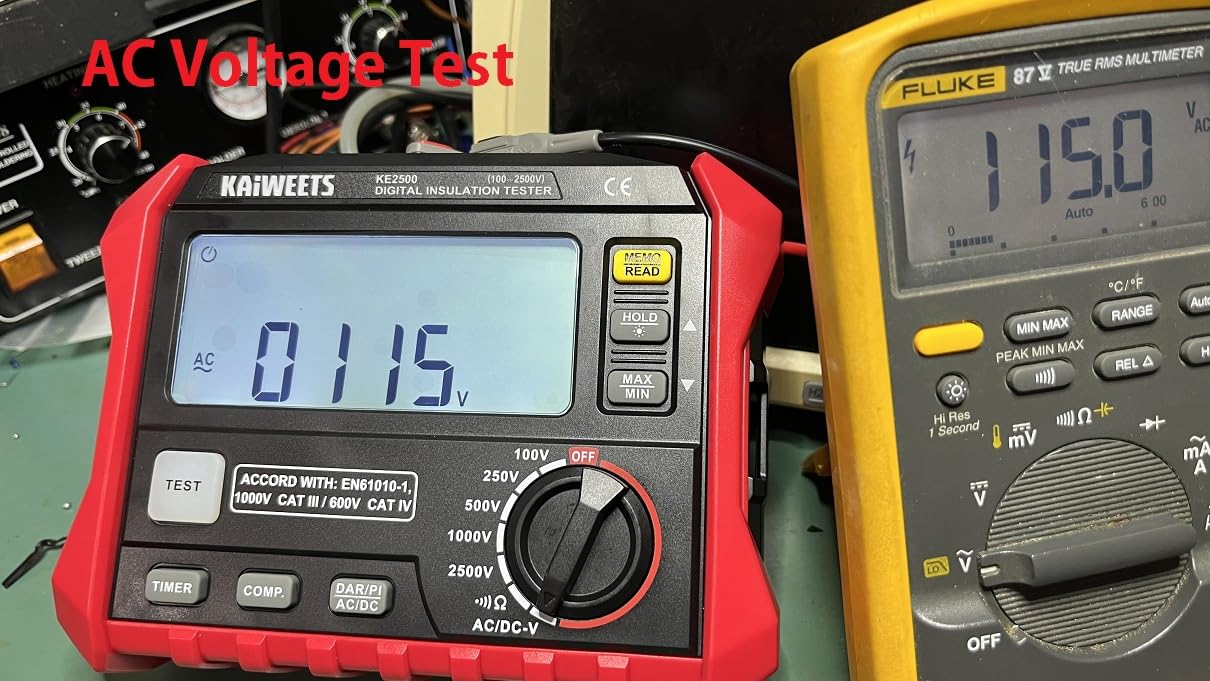
The KE2500 covers more ground than anything else here on paper: 0.1 MΩ to 200 GΩ, five selectable test voltages from 100V up to 2500V, automatic DAR and PI calculation on the device, and a customisable pass or fail threshold. The 2500V setting is unique in this group and genuinely useful for industrial motors and long cable runs, and it measures AC to 750V and DC to 1000V. It is certified to IEC and EN 61010-1 at CAT III 1000V and CAT IV 600V, and it comes with a carrying case.
Most owners rate the feature set and build well above the price class, and at least one cross-checked accuracy against a Fluke on a known input resistance and got a match. The 36-month after-sales service is unusually long for this tier.
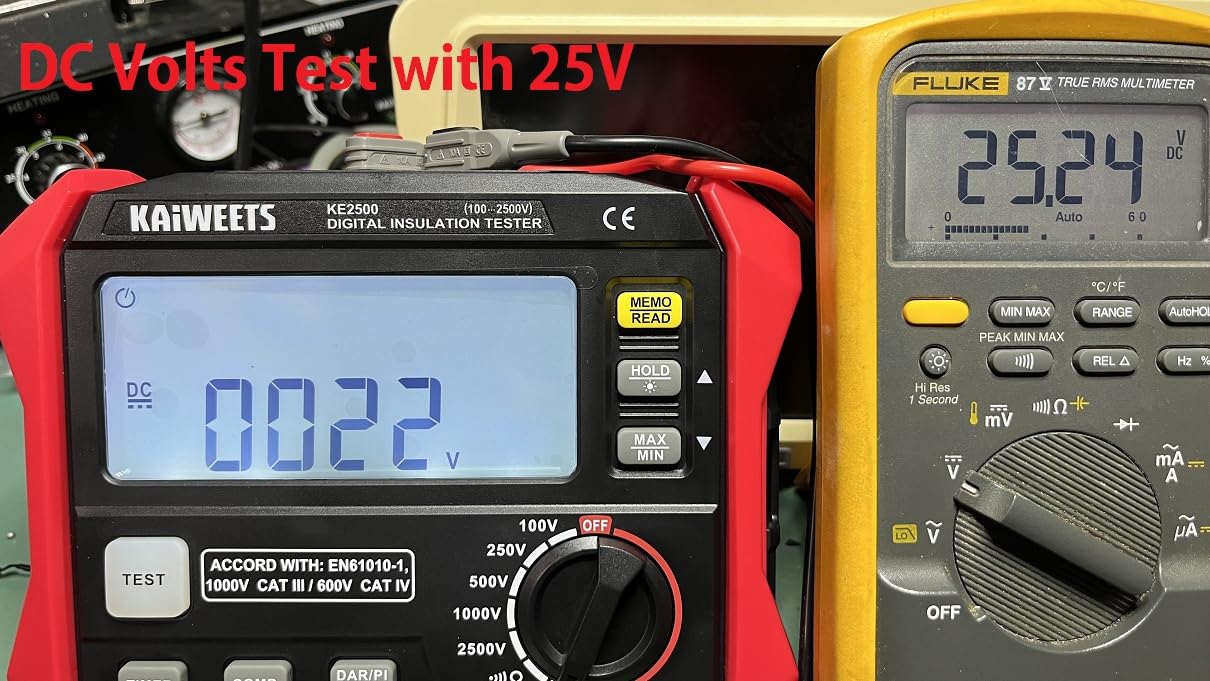
It is also the most polarized product we tested, with the lowest average rating here and a visible share of one-star reviews. Some of those report outright unit failures after a few uses and readings that ran low against a reference Fluke. The common thread across the negative feedback is that the meter is good and the supplied leads are the weak point, and it runs on a stack of eight AA batteries rather than a rechargeable pack. At 1600 g it is also the second-heaviest here.
When the KE2500 is the right pick
It is right for mixed work that includes industrial motors, long cable runs, or service on equipment rated above 1000V, and for anyone who wants a full 200 GΩ ceiling with on-device diagnostics. The carrying case makes it a complete kit out of the box.
It is a poor fit for a homeowner who will test residential circuits and nothing else, because a 2500V capability is not something home wiring benefits from, and the reliability spread is a real risk on a tool you depend on.
What to watch for before buying
Buy better test leads than the ones supplied, since that is the most consistent complaint. Check the unit against a known reference before you rely on it, particularly if you plan to write down the numbers. And plan your battery budget, because eight AA cells is a lot to carry for a meter you may use once a year.
10. KKnoon Insulation Tester – Most Stored Readings at a Low Price
Multimeter, Megohmmeter Insulation Tester, Megohmmeter
1 MΩ to 200 GΩ range
250V up to 2500V test output
100 stored reading sets
Silicone protective case
Pros
- Broad 1 MΩ to 200 GΩ range with selectable voltages up to 2500V
- Stores up to 100 insulation readings for comparison over time
- Automatic voltage release plus high-voltage and low-battery warnings
- Silicone protective case helps it survive drops and scratches
- Dustproof and moisture-proof build with a zipper storage bag
Cons
- Thin review base and a listed upper temperature rating of only 35 °C
- 2000-count display resolution is low by modern standards
- No PI or DAR insulation diagnostics
- Generic model number and unbranded presentation
The distinguishing feature here is memory. This tester stores up to 100 reading sets that you can browse and delete, which is genuinely useful if you are baselining a whole house room by room and want to prove nothing changed since last year. On top of that it covers 1 MΩ to 200 GΩ and offers 250V, 500V, 1000V, 2000V and 2500V output, plus AC and DC voltage measurement from 10V to 600V.
The physical design is sensible for field work. It comes in a silicone protective case that takes drops and scratches, and the construction is described as dustproof and moisture-proof, which suits basement and garage testing. Automatic voltage release plus high-voltage and low-battery indications give reasonable safety cues, and the backlit LCD is readable in a dark panel.
Read the specifications carefully, though. The listed upper temperature rating is only 35 °C, which is low enough to matter in an unheated attic on a summer afternoon. The 2000-count display resolution is coarse by modern standards, there are no PI or DAR diagnostics despite the high-voltage claim, and the model number is generic, which makes support harder to trace. The review base is thin at 60 ratings.
When the KKnoon tester is the right pick
It suits a technician or a determined homeowner building a multi-year record of a house, and for anyone working outdoors or in damp locations who wants a case included. The 2500V and 2000V options cover equipment work that the entry-level testers cannot reach.
It is a poor choice for a formal report, for hot attic work given the temperature rating, or for anyone who needs fine display resolution to distinguish two nearby readings.
What to watch for before buying
Confirm your working environment stays under the 35 °C rating, or choose a different meter for hot spaces. Verify the stored data can be exported or at least read reliably before you build a testing routine around it. And accept that a generic model number means parts and support are harder to source than a branded meter.
How to Test Home Wiring Insulation, Step by Step
This sequence applies to any de-energized circuit and assumes you have already identified which breaker feeds it. If you are unsure, call a licensed electrician rather than guessing.
Identify the circuit and switch off the breaker feeding it. Then switch off the main breaker as well if you are working in the panel itself.
Verify absence of voltage with a multimeter set to volts, on every conductor you intend to test. Confirm between each hot and neutral, each hot and ground, and neutral to ground. A non-contact pen alone is not sufficient verification.
Disconnect the loads listed in the next section. Do this at the panel or at each device, whichever removes the electronics from the circuit.
Choose the test voltage. Use 500V for standard 120V and 240V residential branch circuits, which is the residential default.
Connect the test leads. Clip the L (line) lead to the hot conductor and the E (earth) lead to the ground conductor or the equipment frame.
Start the test. Press and hold the test button for a timed reading, or use the test lock on models that have one. Keep both hands off the leads and off the conductors for the whole test.
Watch the reading settle. It will typically fall during the first several seconds as the insulation capacitance charges. Record the stabilized value, not the first number on screen.
Write the reading down with the date, the circuit name, the test voltage used, and the temperature. Without those four details the number is not much use later.
Disconnect and discharge. Remove the leads and let the meter discharge the circuit through its internal resistor, or confirm the voltage has decayed to zero before touching any conductor. Only then re-energize the breaker.
What to Disconnect Before Insulation Testing
This is the step that prevents damage, and it is the one most often skipped. Applying 500V or 1000V DC across a connected device pushes far more voltage into it than it was ever designed to tolerate, even if the device is switched off. Go through this list before every test.
All GFCI and AFCI receptacles and breakers on the circuit
Smoke and carbon monoxide detectors, which contain sensing electronics
HVAC control boards, thermostats with electronics, and condenser or fan relay modules
Smart switches, smart dimmers, timers, and occupancy sensors
Televisions, audio equipment, AV receivers, game consoles and network gear
Computers, printers, routers and USB charging adapters
LED fixtures with integrated drivers, and any dimmable lighting
Motor loads such as fans, pumps and compressors, unless you are specifically testing their windings
Surge protectors, uninterruptible power supplies and power strips
If a circuit serves only lights and receptacles with nothing electronic attached, you can usually test it as-is. Our circuit tester guide covers the low-voltage tools for the pre-check before you start.
What Insulation Resistance Reading Is Good for Home Wiring?
For house wiring, 1 MΩ is the commonly accepted minimum, and practitioners working on eng-tips use exactly that as a baseline. Most healthy modern residential circuits read far above that, often into the hundreds of megohms or gigohms. Here is how to read the number you get.
Over 1000 MΩ (1 GΩ) — excellent, no action needed, and common on modern circuits with modern insulation.
100 MΩ to 1000 MΩ — good, normal and healthy for residential branch circuits.
10 MΩ to 100 MΩ — acceptable but worth monitoring. Investigate if the trend is downward.
1 MΩ to 10 MΩ — marginal. Look for moisture, contamination or aged insulation and retest.
Below 1 MΩ — fail. Do not energize. Have a licensed electrician trace the fault.
Steadily falling throughout the test — possible moisture intrusion or a developing leak path, since insulation only leaks more as it ages.
Sudden sharp drop — often capacitance charging rather than a fault, but confirm with a second test.
Readings scale with conductor length, which is the single most useful fact for a homeowner and the one most often missed. The standard rule of thumb is a minimum of 1 MΩ per 1000 feet of conductor, so a 150-foot circuit needs roughly 1 MΩ while a 500-foot run to a detached building needs much more. Longer runs give lower readings for the same healthy insulation, because there is simply more insulation surface in the measurement path.
Two environmental factors skew the result. Temperature does: a cold morning reading will be higher than a warm afternoon reading on the same circuit. Humidity does: a circuit in a damp crawlspace will read lower than the same circuit indoors. If you compare readings over time, record the temperature and the weather alongside the number.
If a reading is low, do not immediately assume the wire is ruined. Disconnect everything, let the circuit dry out, clean any contaminated terminals, and retest. Moisture that has crept into a junction box often clears. A reading that stays low after drying points to aged or damaged insulation and needs a professional.
Which Test Voltage for Home Wiring?
500V is the correct default test voltage for standard 120V and 240V residential branch circuits. This is the level most electricians use on a house, and it is high enough to expose developing insulation weaknesses without stressing modern electronics. Here is the full mapping.
50V and 100V — low-voltage circuits, control wiring, electronics and telecommunications cabling. Use these when anything electronic remains connected or cannot be removed.
250V — light circuits, control circuits, very short runs, and older low-voltage systems. A conservative choice for circuits feeding modern lighting and devices.
500V — standard 120V and 240V branch circuits in a home. The residential default, and the voltage to use for almost all house wiring.
1000V — long cable runs, feeder wiring, service conductors, and suspected insulation stress. Can stress sensitive electronics, so only use it when everything is disconnected.
2500V — industrial motors and long cable runs. Beyond what home wiring needs; relevant to service equipment rather than branch circuits.
On the question of whether a 1000V tester damages electronics: it can, and that is exactly why 500V is the residential default. The harm happens when 1000V is applied across a circuit that still has a TV, a smart switch, or an HVAC board hanging off it. Once everything is properly disconnected, 1000V is safe on the wiring itself and is useful for stress-testing older insulation on long runs.
One more case worth naming: photovoltaic arrays and EV charging equipment are rated well above household voltage, and their circuits genuinely need higher test voltages. If your home has solar or a Level 2 charger, the circuit for that equipment is a separate job and worth having a qualified electrician handle it.
How to Choose an Insulation Resistance Tester
Start with the voltage range, because it is the one specification that limits what you can ever do with the meter. Look for at least 250V, 500V and 1000V if you want to work on a whole house. If you only ever test sensitive electronics, 50V and 100V matter more. Next, check the resistance ceiling. A meter topping out at 5.5 GΩ will read over-range on healthy wiring, which is harmless but unhelpful if you want a specific number, so anything above 1000 MΩ is more useful.
Test voltage range and resistance range
These two specifications are the foundation. For residential work, 250V, 500V and 1000V covers you completely, and adding 50V and 100V gives you the option of testing electronics-bearing circuits gently. On resistance, 4000 MΩ is the practical minimum for a house. Above 100 GΩ you are buying resolution you will not use, and above 4000 MΩ you are buying headroom that lets you see a good circuit reading rather than a pegged needle.
PI and DAR diagnostics
Polarization index and dielectric absorption ratio measure how the insulation behaves over time, not just what it reads at 60 seconds. A healthy insulation keeps climbing slightly as the test runs; contaminated or damp insulation levels off or falls. These diagnostics are what turn a snapshot into a condition assessment, and they are the main reason to step up to a Fluke 1587 FC. If you are only checking a house once, you do not need them.
CAT safety rating, explained plainly
CAT ratings describe how much energy the meter can survive if it is misused. CAT II is for plugged-in loads and appliances. CAT III is for distribution boards, fixed installation equipment, and the panel work you will be doing in a house. CAT IV is for the service entrance and the utility side of the meter, which most homeowners never touch. For testing inside a residential panel, look for CAT III 600V or CAT III 1000V. A higher category is not automatically better, but CAT III at minimum is not optional.
Automatic discharge and test lock
Automatic discharge bleeds the stored charge out of the circuit through an internal resistor after a test finishes, which means the conductors are not sitting at 500V while you move to the next one. Treat it as mandatory rather than a nice feature. The test lock button holds the test running hands-free, which is invaluable in a panel where holding a probe in place is awkward, and it is also the reason to read up on the lockout and tagout procedure before using one.
Data logging and Bluetooth
Wireless logging matters when you are testing a whole property and want a history you can compare later. The Fluke 1587 FC with Fluke Connect and its temperature compensation is the clear example. If you are testing one home once, note-taking is sufficient and the app is an added dependency rather than a benefit. Our ground resistance tester guide covers the companion test for grounding systems.
Digital versus analog needle testers
Analog needle insulation testers still exist and remain useful for a simple pass or fail on motors and compressors, and they are cheaper. For a homeowner, a digital meter is the better choice: the numeric readout is unambiguous, most digital models include a built-in voltmeter for verifying a dead circuit, and a precision digital reading is what you need to compare results over time. Buy analog only if you specifically want a rugged field tool for motor winding checks.
Fluke versus Megger, and the price question
Both are established names, and both are respected in the trade. The honest answer to which is better is that Fluke tends to lead on the all-in-one approach, combining the insulation tester with a full True RMS multimeter in one body, while Megger has a long history as a dedicated megohmmeter specialist. Forum consensus is consistent on the broader point: any established name will fit your bill, and the deciding factor is the brand you already own meters from, not a marginal difference in measurement quality.
On price, the meaningful tiers are entry, mid-range and professional. Entry level gets you a 500V or 1000V tester with a basic range and no diagnostics, which is enough to answer whether a circuit is grossly faulty. Mid-range adds a full voltage selection, a higher resistance ceiling, CAT III certification and better leads, which is where most homeowners should land. Professional adds PI and DAR, trend analysis, wireless logging, NIST-traceable calibration and remote probes, which matter when the result has to be defended in a report. Paying professional money for entry-level use is the common mistake; paying entry-level money and then needing a defensible reading is the other one.
A quick decision path
You are testing one older house once, and want the least risk of a wrong reading: mid-range meter with 250V, 500V and 1000V, CAT III rated, automatic discharge. That is the Klein Tools ET600 or the Fluke 1507.
You are checking HVAC, pumps and compressor windings where 500V is the right fixed voltage: the Supco M500.
You want a clear pass or fail without learning diagnostics: the Hioki IR4056.
You are verifying floor heating or underfloor cable before closing a floor: the AEMC 2126.53 with its EST LOCK timed test.
You are documenting a property for a sale, a claim, or recurring condition reports: the Fluke 1587 FC with wireless logging.
You are doing industrial motor or long cable work above 1000V, and accept a wider reliability spread: the KAIWEETS KE2500 or the KKnoon tester.
Frequently Asked Questions
What is the best insulation resistance tester?
For most homeowners the Klein Tools ET600 is the best fit, because it covers 125V to 1000V, measures up to 4000 megohms, and doubles as a True RMS multimeter. The Supco M500 is the value pick for fixed 500V testing, and the Fluke 1587 FC is the choice when you need PI and DAR diagnostics with wireless logging. Choose on voltage range, resistance ceiling, and CAT III certification rather than on brand alone.
What is a good Megger reading for house wiring?
One megohm is the commonly accepted minimum for residential wiring, but most healthy modern circuits read in the hundreds of megohms or gigohms. Scale your expectation with conductor length: the rule of thumb is a minimum of 1 MΩ per 1000 feet of conductor. Below 1 MΩ is a fail, and a reading that falls steadily during the test points to moisture or a developing leak path.
Which test voltage should I use on home wiring?
Use 500V for standard 120V and 240V residential branch circuits. That is the residential default and it exposes developing insulation weaknesses without stressing modern electronics. Use 250V for light and control circuits, and 1000V only for long runs, feeders, or suspected insulation stress after every electronic load has been disconnected. Never apply 500V or 1000V to a circuit with electronics still attached.
What must I disconnect before megger testing a house?
Disconnect GFCI and AFCI devices, smoke and carbon monoxide detectors, HVAC control boards and thermostats, smart switches and dimmers, TVs, audio and network equipment, surge protectors, LED fixtures with integrated drivers, and motor loads. These contain electronics that a 500V or 1000V DC test can damage even when the device is switched off. Verify the circuit is dead with a multimeter before reconnecting anything.
Do I need a megohmmeter to test my house wiring?
A standard multimeter cannot see the slow leakage paths created by damp, aged, or contaminated insulation, so an insulation resistance tester gives you information nothing else can. If you are buying a house with older wiring, planning a renovation, or tracing a circuit that trips or feels warm, it is worth running. For a modern house with no symptoms, testing every few years as part of routine maintenance is reasonable rather than urgent.
Are an insulation tester and a megger the same thing?
Yes. An insulation resistance tester and a megohmmeter are the same instrument under two names. Megger with a capital M is a manufacturer, and megger in lowercase is the trade nickname that became generic. When a listing uses the word megger, it means megohmmeter. The instrument applies a known DC test voltage and measures leakage current through insulation, reporting the result in megohms.
Which Insulation Resistance Tester Should You Buy?
The best insulation resistance testers for home wiring all share three things: a 500V test setting, a resistance ceiling above 1000 megohms, and automatic discharge. Buy the Klein Tools ET600 if you want one meter that also works as a multimeter, the Supco M500 if your testing is focused on motors and compressors, and the Fluke 1587 FC if you need documented, logged results across a whole property.
Whichever you pick, test at 500V on standard 120V and 240V circuits, disconnect every electronic load first, verify the circuit is dead with a multimeter before you touch the leads, and let the meter discharge before you handle conductors again. Get the current through the button, follow the step-by-step sequence above, and call a licensed electrician for anything that reads below 1 MΩ or keeps falling.