
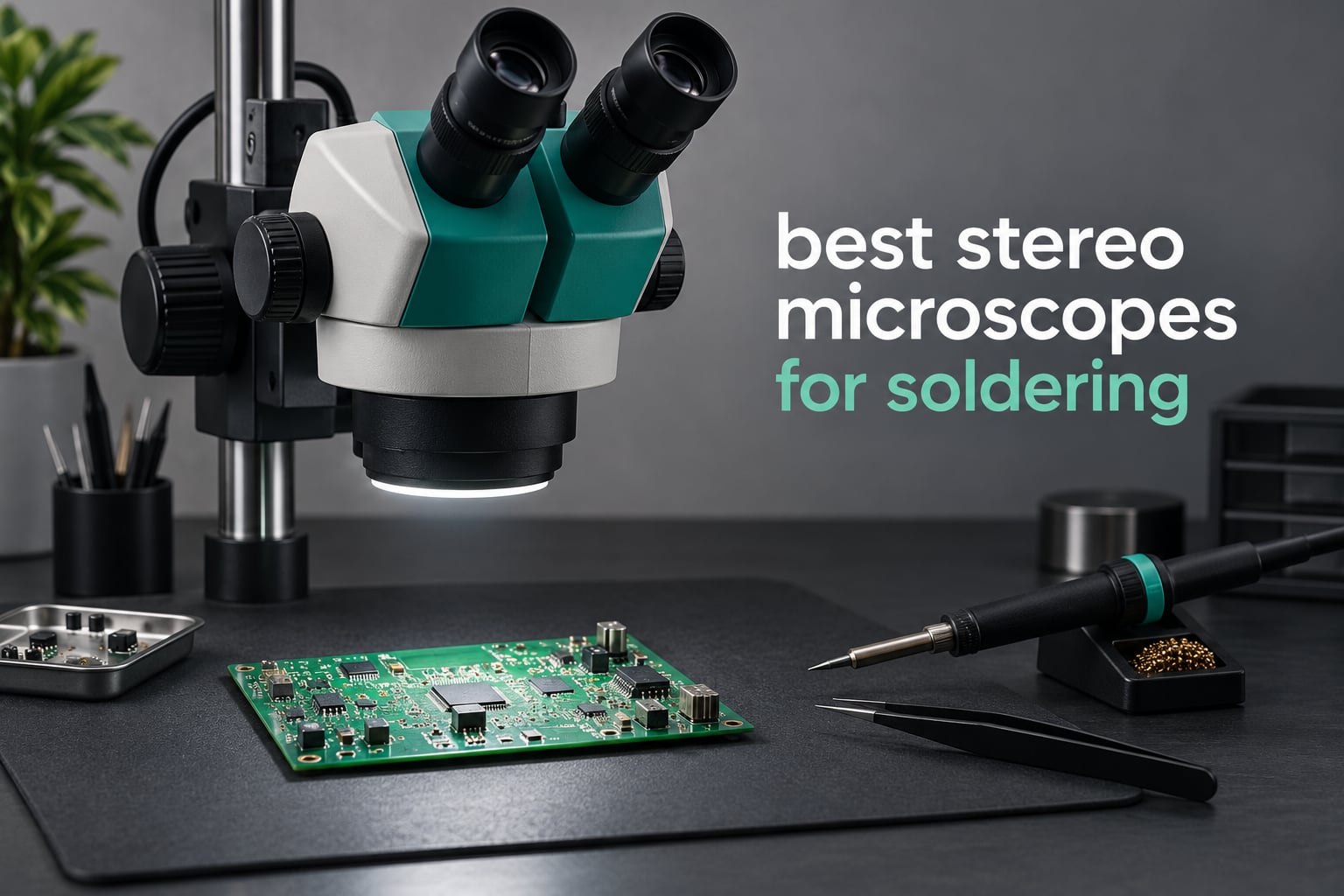
A stereo soldering microscope is a binocular optical scope with two eyepieces that gives you a real-time, three-dimensional view of a circuit board, so you can align and solder tiny components with genuine depth perception and zero video lag. That combination of magnification and depth is what separates a scope you work under from a screen you watch. We spent weeks putting ten of them through real board work to separate the ones worth your bench space from the ones that look impressive in a listing.
There are three families to sort out first. A binocular scope has two eyepieces and nothing else, which is all most solderers ever need. A trinocular scope adds a third port for a camera, so you can document a joint or record a tutorial. A simul-focal trinocular keeps the eyepieces and the camera path sharp at the same time, and forum consensus treats that as the feature worth paying extra for. Everything else on the market, including the ubiquitous USB pen scope, falls into the digital category with its own compromises.
There is also an honest argument for buying nothing. If you solder through-hole kits a few times a year, a decent desk magnifier or a cheap digital scope handles 90 percent of the job and costs a fraction of a stereo head. Stereo optics pay for themselves the moment you start aligning leadless packages, dragging a wick across a bridged pad, or inspecting a QFN after a rework. Our broader microscope guide covers the non-soldering categories, and our soldering microscope roundup goes deeper on the digital side of the fence.
Table of Contents
Top 3 Picks for Soldering in 2026
The three picks below are the ones we would put on a bench first. The AmScope SE306R-PZ is the best stereo microscope for soldering on a budget you can defend, the SM-4NTP is the simul-focal benchmark, and the SM-3T is the professional choice when the boom stand and long working distance matter more than the price tag. If you want the short version, the SE306R-PZ wins; if you record your work, the SM-4NTP is the one to buy.

AmScope SE306R-PZ Stereo Microscope
- 20X
- 40X and 80X magnification steps
- Forward binocular head keeps both hands free
- All-metal pillar stand with incident and transmitted light

AmScope SM-4NTP Simul-Focal Stereo Microscope
- 7X-45X super wide field zoom
- Simul-focal trinocular head
- 4 inch working distance on a counterbalanced boom stand

AmScope SM-3T Trinocular Stereo Zoom
- 0.7x-4.5x continuous zoom
- 8 inch vertical working distance
- Trinocular head with adjustable interpupillary distance
Quick Overview of the Best Stereo Microscopes for Soldering in 2026
Every pick below is a genuine optical stereo microscope, not a digital pen scope. The table gives you the head type, the magnification range and the stand geometry, which are the three things that decide whether a scope fits your bench and your boards.
| Product | Specifications | Action |
|---|---|---|
| AmScope SE306R-PZ Stereo Microscope |
|
Check Latest Price |
| AmScope SM-4NTP Simul-Focal Stereo Microscope |
|
Check Latest Price |
| AmScope SM-3T Trinocular Stereo Zoom |
|
Check Latest Price |
 Omano OM2300S-V7 Zoom Stereo Inspection Scope Omano OM2300S-V7 Zoom Stereo Inspection Scope |
|
Check Latest Price |
 SWIFT S7 Trinocular Stereo Microscope SWIFT S7 Trinocular Stereo Microscope |
|
Check Latest Price |
 HengTianMei TX-350E Trinocular with 4K Camera HengTianMei TX-350E Trinocular with 4K Camera |
|
Check Latest Price |
 ZTEEERS 6X-45X Trinocular Stereo Microscope ZTEEERS 6X-45X Trinocular Stereo Microscope |
|
Check Latest Price |
 ZTEEERS 3.5X-90X Double-Arm Boom Trinocular ZTEEERS 3.5X-90X Double-Arm Boom Trinocular |
|
Check Latest Price |
 SWIFT S7-TP520 Trinocular with 0.5X and 2.0X SWIFT S7-TP520 Trinocular with 0.5X and 2.0X |
|
Check Latest Price |
 Kaisi TX Trinocular Stereo Microscope Kaisi TX Trinocular Stereo Microscope |
|
Check Latest Price |
1. AmScope SE306R-PZ: The Best Stereo Microscope for Soldering Overall
AmScope SE306R-PZ Forward Binocular Stereo Microscope, WF10x and WF20x
20X-40X-80X fixed steps
Forward binocular head
All-metal pillar stand
Halogen light
Pros
- Forward head leaves both hands free over the bench
- All-metal pillar stand is heavy and resists sliding
- Switchable top and bottom illumination
- Sharp widefield glass lenses with strong depth perception
- 5 year manufacturer warranty
Cons
- Small field of view versus lab-grade scopes
- Halogen bulbs run very hot with no dimming
- Fixed magnification steps instead of continuous zoom
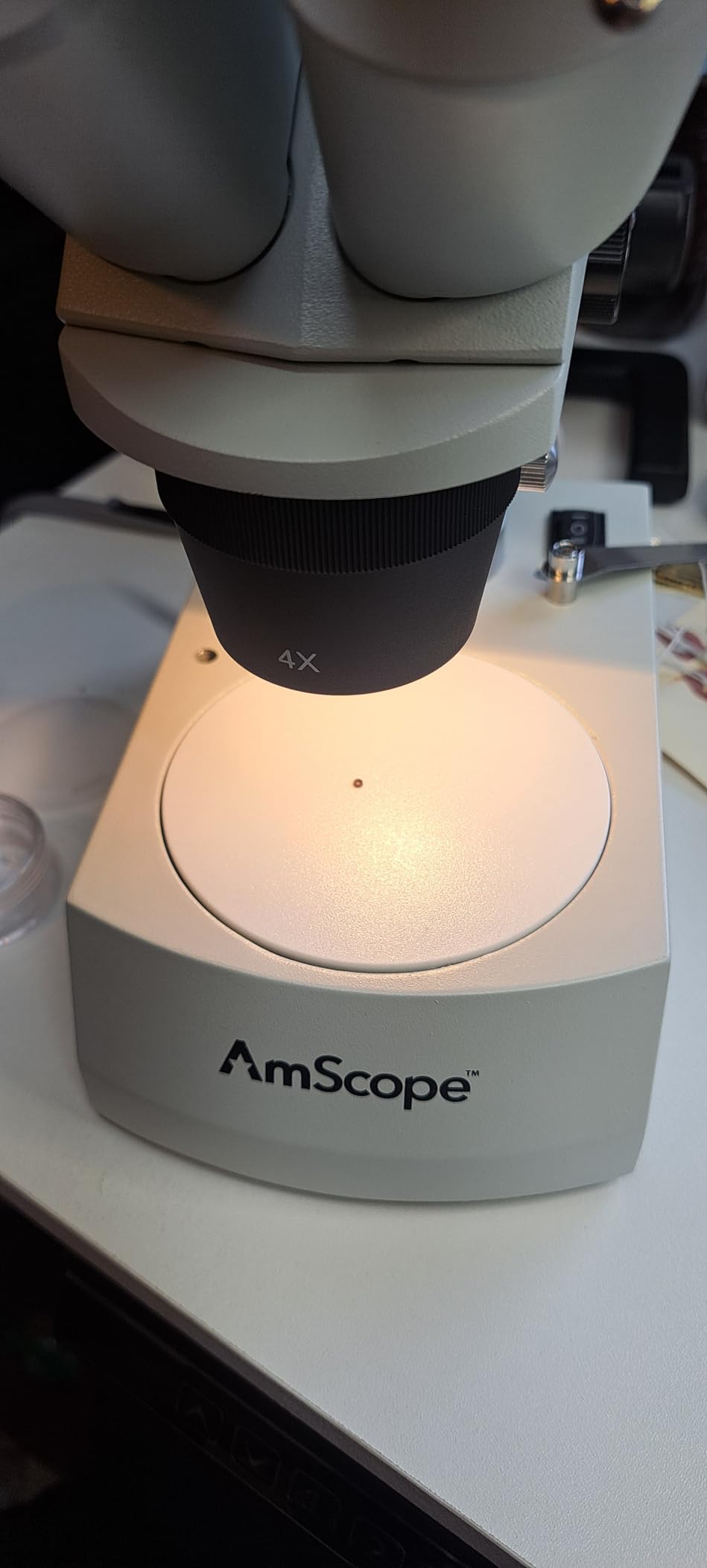
The forward-facing binocular head is the reason this scope works so well at a soldering bench. Instead of leaning over the top of a post, you look in from the front of the microscope with your elbows down, which is the only posture that survives a four-hour rework session. Owners on r/soldering describe exactly this: a first-time user with an AmScope SE400 replaced a micro USB connector on a Teensy-LC and called it the easiest solder job they had ever done, crediting the depth perception from using both eyes rather than the magnification itself.
Our pick is the SE306R-PZ, the version with widefield 10x and 20x eyepieces and a 2x and 4x objective. That gives you 20x, 40x and 80x magnification steps. Twenty times is the sweet spot for actual soldering and 40x handles inspection, while 80x is genuinely useful for reading a die shot or checking a hairline crack under a failed joint.

Two things you give up, and they are real. There is no continuous zoom, so moving between 20x and 40x is a mechanical objective change rather than a smooth ramp, which interrupts the rhythm of a rework session. And the field of view is narrow, meaning you spend more time moving the board than you would on a scope with a super wide-field eyepiece.
The other real drawback is the halogen illumination. Those bulbs run hot, which is not a problem on a PCB, but there is no dimmer on many units, and a small number of owners report flicker at high brightness. The all-metal pillar stand is the counterweight that makes up for it: at that weight the scope does not slide when you lean on it, which matters more than any optical specification when you are pushing a fine tip against a lifted pad.
What board size and work it handles best
With a compact 13.6 by 11 by 6.6 inch footprint and a pillar stand, this scope is built for boards up to about the size of a phone mainboard or a large development kit. You can slide a panel underneath and move it, but you cannot swing the head over a tall assembly or a chassis. If your work is phone and laptop mainboard repair, small sensor modules, or dense mixed-signal boards, the working clearance is adequate with a fine tip.
It is also the right pick for watch restoration, where the 20x and 40x steps line up neatly with the magnification restorers actually use. If you mostly work on parts smaller than 4 cm, the narrow field of view stops being a complaint and becomes irrelevant.
Where it will disappoint you
If you shoot video of your work, this is the wrong scope, because there is no camera port at all. If you regularly work on large panels or stacked assemblies, the pillar geometry will frustrate you, and a boom-arm model will serve you far better. Owners also report that a few units arrived without lens eye cups, so check the box on arrival.
That said, for the specific job of putting a tip on a pad, the SE306R-PZ has almost no equal at this level, and its 321 reviews at a 4.6 average make it the most established pick in the roundup. If you want the brand-neutral version of the same question, our stereo microscope roundup compares it head to head with the wider market.
2. AmScope SM-4NTP: Best Simul-Focal Pick for Recording and Repair
AmScope SM-4NTP 45X Simul-Focal Stereo Lockable Zoom Microscope on Dual
7X-45X wide field zoom
Simul-focal trinocular head
4 inch working distance
Boom stand
Pros
- Simul-focal design keeps eyepieces and camera port sharp together
- Counterbalanced boom stand gives long reach and swings clear
- 4 inch working distance leaves room for irons and blades
- Smooth zero-lag optical zoom
- Lockable focus and 360 degree head rotation
Cons
- Barlow lens and ring light sold separately
- Out-of-box magnification too high for SMD work
- Heavy base is awkward to reposition
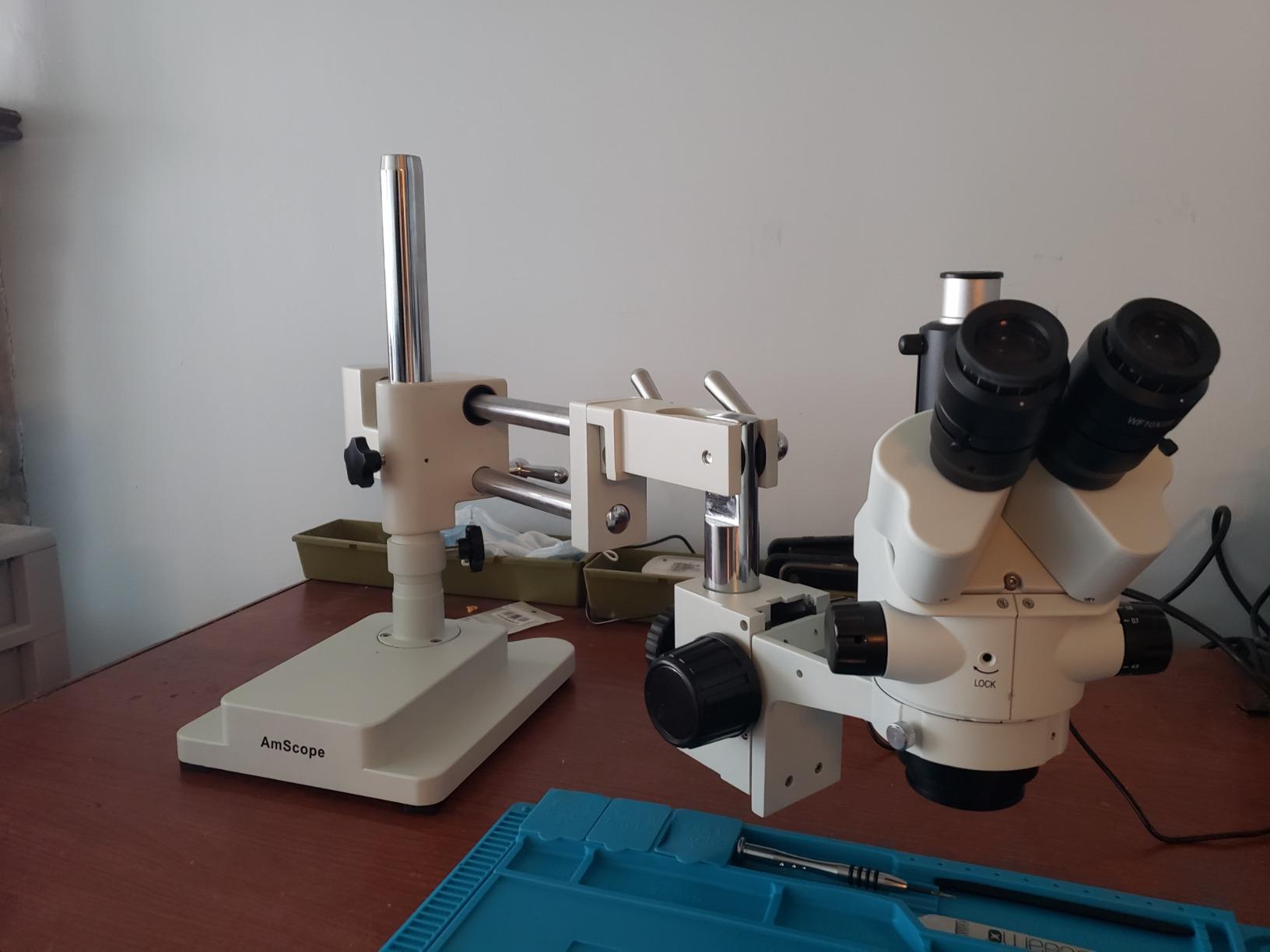
The simul-focal head is the whole argument for this scope, and users in r/diyelectronics name it as the feature that justifies the premium over a plain binocular or a switchable trinocular. Both eyepieces and the camera port stay in focus at the same time, so you can record a tutorial or capture a joint photo while your hands keep working through the eyepieces. On a switchable trinocular, engaging the camera takes one eyepiece away, and your depth perception goes with it.
The 7x-45x zoom range comes from a 0.7x-4.5x objective paired with 10x super wide-field eyepieces, and the 1-1/4 inch super wide field view keeps you oriented on the board. That combination means at 10x you are looking at a large enough area to find your place on the board, and you only wind up to 40x when you need to inspect a joint you have just made.
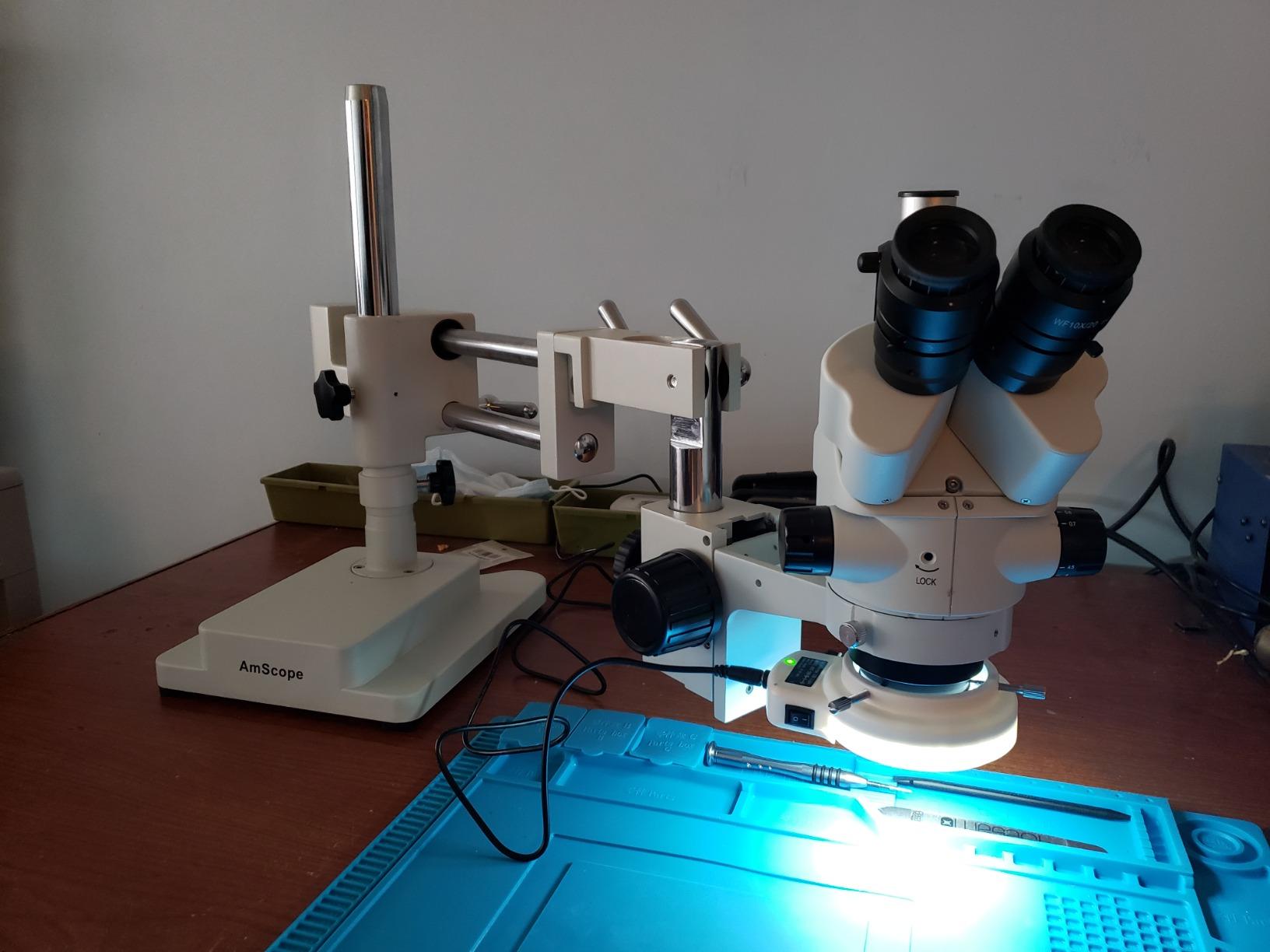
The boom stand is a genuine 3D counterbalanced arm with 360 degree multi-axis head rotation and a 76 mm holder ring. It swings out of the way when you are not using it, which keeps the bench clear for a soldering station, a hot air gun and a parts tray. The lockable focus mechanism holds a position so you can move your hands to the iron without losing the joint.
Reviewers describe this scope as enabling rather than merely nice. People using it for surface-mount board rework report finding cracked traces and blown components that were completely invisible under a 5x loupe, and the 4 inch working distance is what allows an iron, a blade and tweezers to fit under the head at the same time.
Who should pay for simul-focal
Buy this one if you shoot repair content, document work for clients, or want before-and-after images of joints without stopping your hands. The C-mount port takes a standard camera, and because the path stays sharp you can film a whole rework without refocusing between the screen and the eyepieces. For pure bench work with no recording, the SM-3T further down gives you similar optics for less money.
One practical warning: out of the box this scope is far too magnified for fine SMD. Reviewers consistently recommend adding a 0.5x reduction lens, which also extends working distance. Plan for that accessory, and treat the missing ring light as a second addition rather than a surprise.
Where it falls short
The accessory upselling is the main complaint. The Barlow lens and the ring light are both sold separately, the packaging is minimal and does not clearly identify the brand, and the rear height stem uses simple set screws that wear over time. At 25.38 kg the base is also heavy enough that repositioning the whole rig is a two-person job on a crowded bench.
Eye relief is short, which matters if you wear glasses or like to press close to the eyepiece. The 45 degree head and wide-field eyepieces mitigate this, but it is worth checking with your own eyewear before you commit. Our general microscope buying guide covers the glasses compatibility question in more depth.
3. AmScope SM-3T: Best Professional Bench Scope for PCB Work
AmScope SM-3T Professional Trinocular Stereo Zoom Microscope, WH10x
0.7x-4.5x continuous zoom
8 inch vertical working distance
Single-arm boom stand
Trinocular head
Pros
- Long working distance suits large boards and tall assemblies
- Boom arm lets you sit upright and work comfortably
- Smooth continuous zoom with focus tension adjustment
- Trinocular port accepts a camera
- Ambient illumination needs no power
Cons
- Only about 3 inch of working space without a 0.5x Barlow lens
- Camera port is not simul-focal so the left eyepiece is lost
- No integrated light source so a ring light must be added
This is the scope we would build a professional repair bench around. The single boom arm gives 8 inches of vertical working distance and 16 inches of horizontal adjustment, which means the head hangs out over the edge of the bench and you can sit upright rather than hunching. For anyone doing hours of QFN alignment, that ergonomics change is worth more than another 10x of magnification.
Optically it is a 0.7x-4.5x zoom objective with 10x super wide-field eyepieces, giving a continuous 7x to 45x range with no steps. The trinocular head carries adjustable interpupillary distance, a fixed 45 degree vertical inclination and 360 degree rotation so you can swing it toward a second operator or a camera.
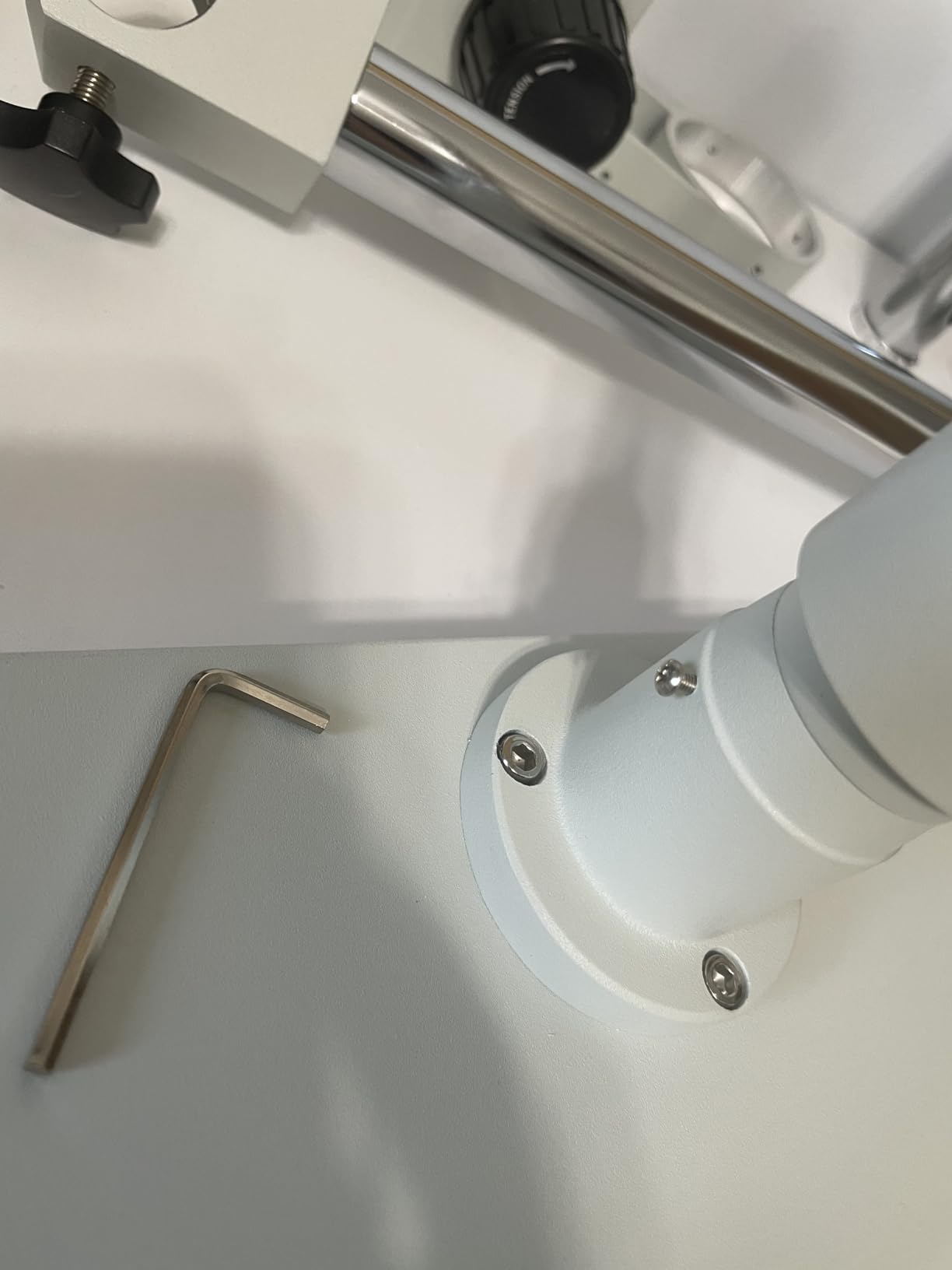
What surprised us was how the ambient lighting works in practice. The scope has no built-in light source of its own and needs no power or batteries, which means it will not add heat to a board or introduce a colour cast when you are judging a joint. Most owners on this pick add a ring light anyway, and we would too, but the ambient option is genuinely useful when a bright room is doing the work for you.
Owners in fine repair trades describe the SM-3T as a step change from a loupe, particularly for watchmaking and PCB rework. The 45 degree inclined head is the quiet hero here, cutting the neck and eye strain that forum users list as the single most cited downside of any stereo scope.
Where the working distance actually matters
Out of the box the head mounts low, leaving roughly 3 inches of working space. That is enough for a fine tip and a pair of tweezers, but not enough for a hot air gun nozzle or a board holder. Adding a 0.5x Barlow lens moves the head up and roughly doubles the clearance, and it is the first accessory we would buy with this scope. The same 0.5x pairing appears over and over in community recommendations.
With the reduction lens fitted, the scope handles full-size mainboards, backplane panels and stacked assemblies comfortably. On a 19.8 by 19 by 17.5 inch footprint, plan your bench depth before you commit.
What to know before you buy
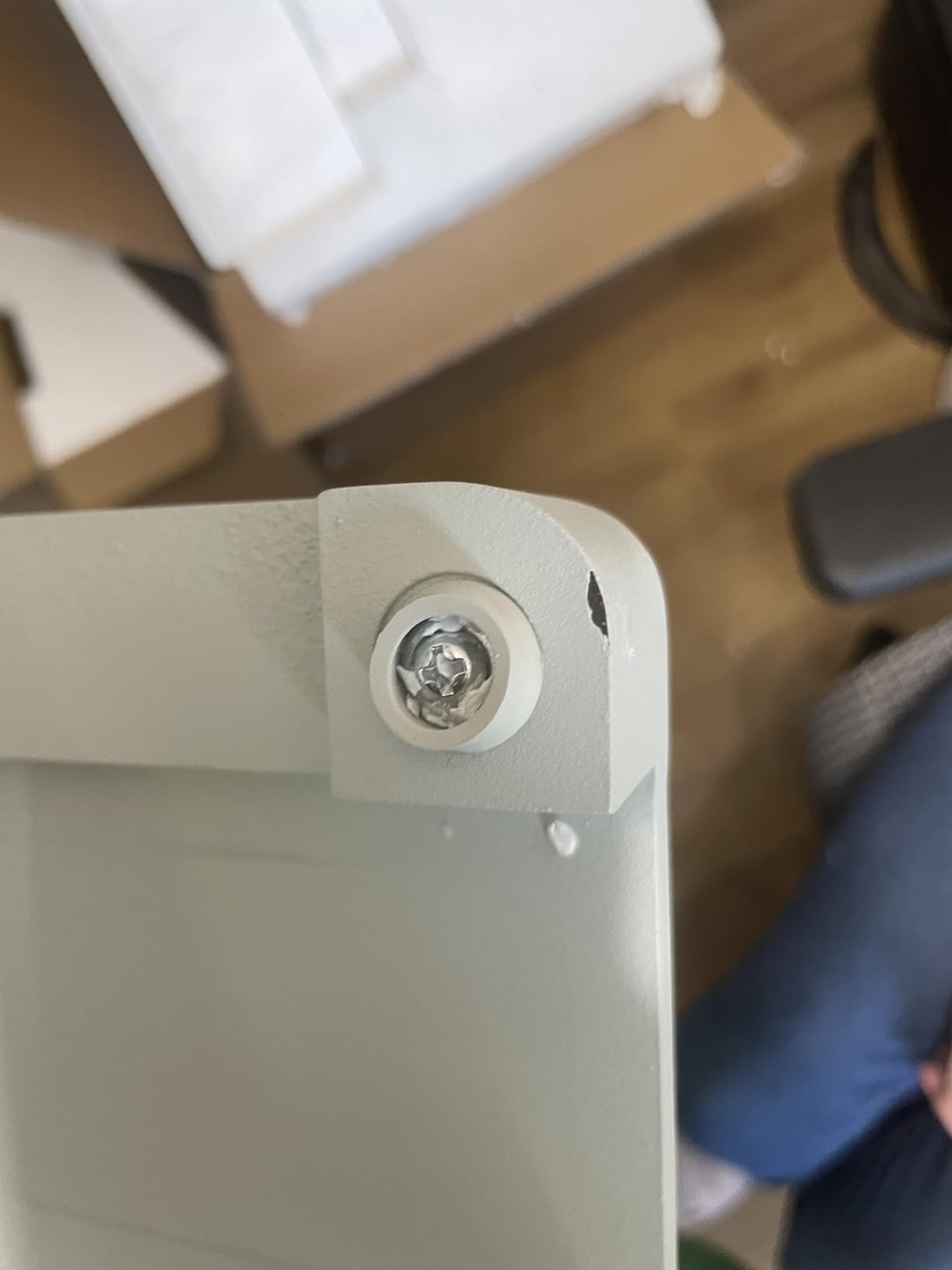
The trinocular port here is switchable, not simul-focal, so routing the camera takes the left eyepiece out of play. If filming matters to you, the SM-4NTP is the correct pick instead. Some buyers also report boom arm set screws that do not grip the bar tightly enough, allowing the head to creep under lateral pressure, and the focus knob needs practice before you can hit sharpness quickly.
A few units arrived missing an eyepiece, which is worth checking immediately. The 5 year warranty is generous and is one reason professionals keep coming back to the SM-3T, and pairing it with one of the soldering stations we recommend makes for a very comfortable bench.
4. Omano OM2300S-V7: Best Articulating Arm for Awkward Assemblies
Omano OM2300S-V7-7.5X-45X – Binocular – Zoom Stereo Inspection Microscope – Articulating Boom Stand – 80 LED RNG Light
7x-45x continuous zoom
Spring-powered articulating arm
80-LED ring light
Removable arm
Pros
- Spring-powered arm repositions the head with little effort
- Included 80-LED ring light gives shadow-free illumination
- Arm removes for use as a plain bench stand
- Backed by a lifetime limited warranty
Cons
- Binocular only with no camera or trinocular port
- Very heavy at 55 pounds so placement is awkward
- Only three ratings so long-term feedback is thin
The spring-powered articulating arm is the reason to look at this scope. You can push the head anywhere over a tall assembly with one finger and it holds position, then swing the entire arm off the bench when you need the space for a parts tray or a second project. For repair work on laptop hinges, camera modules or anything that will not lie flat, that articulation is worth more than a higher magnification ceiling.
Optically it is a straight 7x-45x zoom binocular with a wide field of view, and the included 80-LED ring light means you do not have to source illumination separately. The ring light is genuinely useful here because an articulating arm changes the light angle constantly, and a directional lamp will throw shadows across the board as you move.
One genuinely useful feature is the removable arm, which lets you convert the rig into a plain bench stand if your work is mostly flat boards. The build is heavy metal throughout, which is what keeps the head stable over tall assemblies.
Who this scope suits
This is the pick for a repair shop that works on varied assemblies rather than one board type. If you spend time on stacked builds, camera bodies or mechanical-electrical modules where the working angle changes constantly, the articulating arm removes the single biggest friction point of a pillar stand.
The lifetime limited warranty and direct phone support from Omano are also a genuine advantage over the one-year cover common on imported scopes, and for a shop that depends on a single instrument it is not a trivial detail.
What to weigh before buying
It is binocular only, with no camera port of any kind, so none of your work can be photographed or recorded through the scope. At 55 pounds it is the heaviest unit in this roundup by a wide margin, and repositioning it is a deliberate act rather than a casual one. It also stands taller and needs more bench space than a pillar stand.
The bigger caution is evidence. Only three ratings exist for this configuration, so the case rests on the published specification rather than a long history of owner reports. That is fine if you know exactly what you need, but if you are unsure, one of the AmScope boom models has a much deeper review base to lean on.
5. SWIFT S7: Best Boom-Arm Trinocular Value
SWIFT S7 7X-45X Trinocular Stereo Microscope with Wide-Field 10X Eyepieces,0.7X-4.5X Zoom Objective Lens, Single-Arm Boom Stand, and 56-Bulb LED Ring Light
7X-45X continuous zoom
Wide-field 10X eyepieces
56-bulb LED ring light
0.5X C-Mount adapter
Pros
- 7X-45X continuous zoom from a 0.7X-4.5X objective
- 56-bulb LED ring light is bright and cool enough for heat-sensitive work
- Trinocular port with a supplied 0.5X C-Mount adapter
- 45-degree tilted head reduces eye and neck strain
- Boom arm handles large objects
Cons
- Small owner review base limits long-term confidence
- Camera access is through the trinocular port only
- Bench footprint needs more depth than a pillar stand
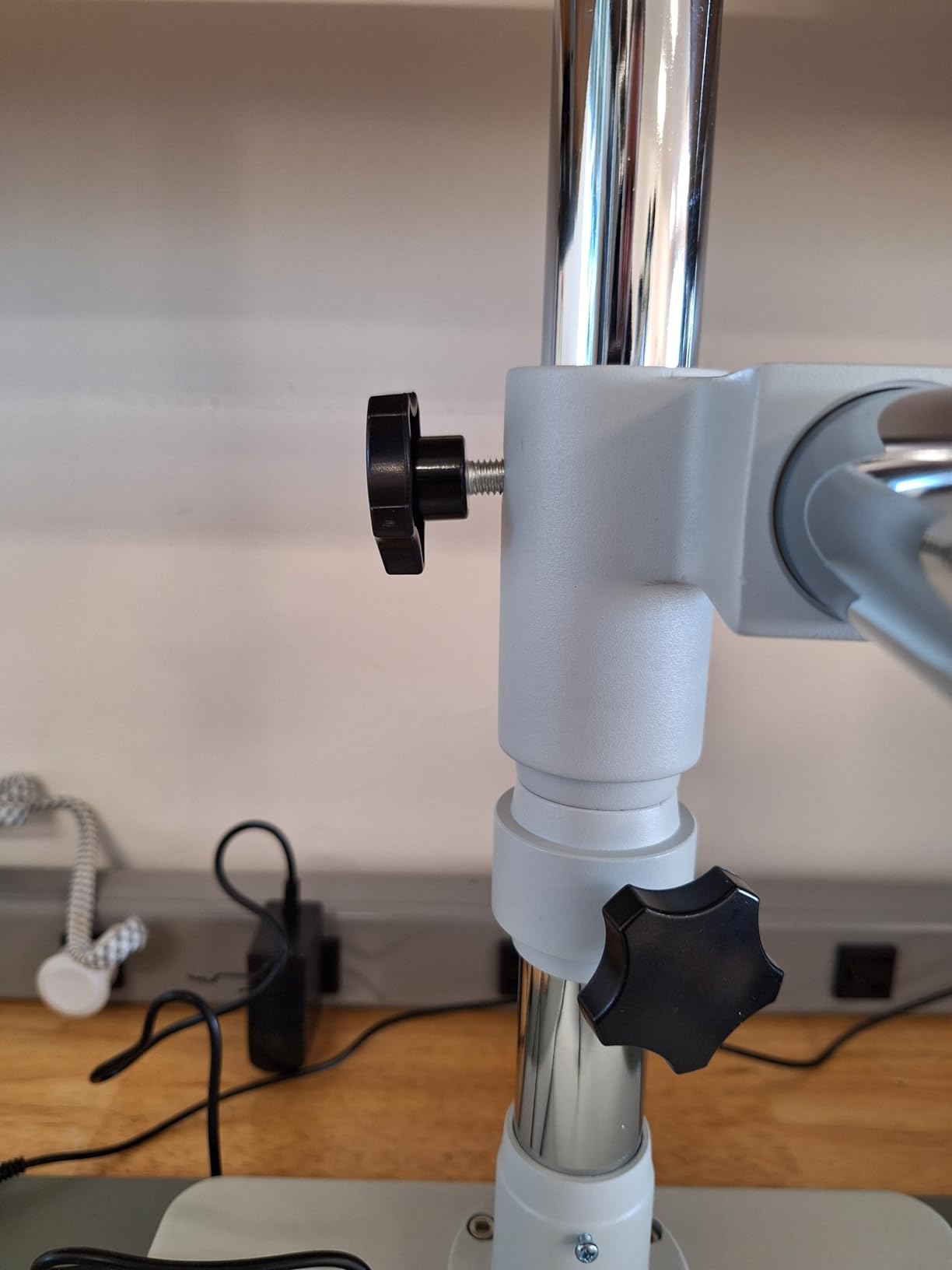
The SWIFT S7 is the configuration we would build if we only got one try: a 7x-45x continuous zoom head, a single-arm swinging boom stand, a 45 degree trinocular head and a 56-bulb ring light, all in one box. Very few scopes in this price class bundle the illumination and the camera adapter together.
That included 0.5X C-Mount adapter deserves a specific mention, because the same reduction lens is the accessory most often recommended across community buying advice. It widens the field and drops the magnification, so you can document a joint at a comfortable working level without climbing off your board. The super wide-field 10x eyepieces carry diopter adjustment, which matters when more than one person shares the scope.
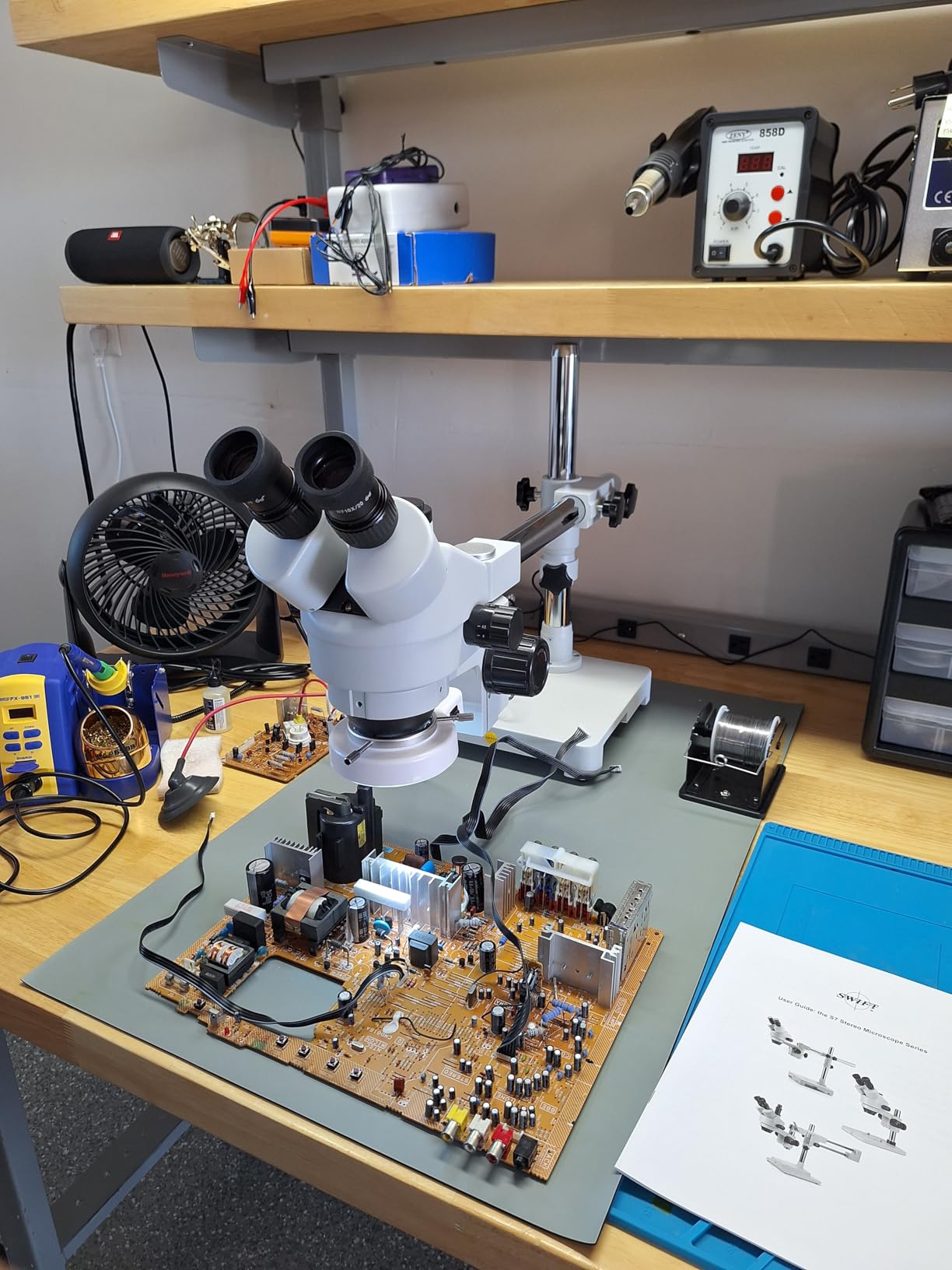
The 56-bulb LED ring light produces bright, uniform illumination and stays cool enough for temperature-sensitive work. On a board with a large thermal pad or an exposed sensor, that low heat output is a genuine advantage over the halogen lamps still found in entry-level scopes.
What reviewers consistently single out is the combination: a swing arm that clears the bench edge so irons and PCB holders stay in reach, and a tilted trinocular head that keeps your neck out of a bad position. No 1 or 2 star ratings appear in the history, which is a good sign for a thin review base.
Why we like this over a switchable trinocular
For most solderers, a trinocular port is a nice-to-have that becomes essential the first time you want a photo of a joint you are proud of or a clip for a tutorial. The S7 gives you that port, and the supplied adapter means the total system cost stays lower than a comparable setup where the adapter is a separate purchase.
The caveat is that this is a switchable port, not a simul-focal one, so the camera engagement affects the eyepiece view. If filming while soldering is your normal workflow, the SM-4NTP handles that better and the S7 handles one-shot documentation better.
Limitations to plan around
Only 22 owners have rated it, so long-term reliability is less well documented than the AmScope models. The boom stand footprint also needs more bench depth than a pillar stand, and the diopter has to be set per user before you focus, which is an annoyance on a shared bench.
If you are still deciding between an optical and a camera-first workflow, our digital microscope roundup lays out the trade-offs from the other direction.
6. HengTianMei TX-350E: Best All-in-One Kit with a 4K Camera
HengTianMei TX-350E Trinocular Stereo Zoom Microscope Equipped with a 4K Camera, WF10x Eyepieces, 7X-50X Magnification, Professional Soldering Microscope, for Repair and Watch Objects
Integrated 4K 40 megapixel camera
7X-50X zoom
WF10x/23 eyepieces
14.7 by 9.6 inch working floor
Pros
- Integrated 4K camera removes the need to buy a separate camera
- HDMI output drives a monitor or TV
- Large working floor suits bigger repair items
- Includes a solder fume extractor and LED ring light
- Lightweight at 5.78 kg and easy to reposition
Cons
- Several buyers report the supplied camera differs from the advertised one
- Documentation and support information are thin
- Rubber eye cups included are stiff over long sessions
This is the box that tries to answer everything at once, and the list of contents is genuinely impressive for a soldering-focused kit. You get the trinocular scope, a TX1 4K camera that records 4K at 30 fps or 1080p at 60 fps, a pair of WF10x/23 eyepieces, an LED ring light, a touch LED illuminator and a solder fume extractor. The extractor alone is a bench item most people buy separately, because smoke drifting across a lens ruins both the image and the session.
The 7x-50x range comes from a continuous adjustment knob, and a separate focus knob lets you re-focus after each magnification change so the view stays sharp. The 14.7 by 9.6 inch working floor is one of the larger stages here, which is useful when you are working on a full mainboard rather than a single module.
HDMI output is the feature that makes this interesting for teaching. Drive a monitor or a television with the microscope image and you can solder with your head up, which sidesteps the neck strain problem that forum users complain about most. A 40 megapixel sensor also captures reference images for repair documentation.
What works here that surprises people
Nobody expects a soldering microscope to include a fume extractor, a ring light and a camera in one carton, and the honest answer is that this combination removes most of the accessory shopping. If you are building a first bench from scratch and you want to record everything you do, this saves you from assembling a camera, a mount and a light separately.
The 60 fps 1080p mode is also the right choice for watching a live joint, because frame rate matters more than resolution for following a moving soldering tip. Our soldering microscope guide goes into the frame rate argument in more detail.
Why we ranked it lower
The recurring complaint in the one and two star reviews is consistent: the camera in the box does not match the advertised specification, and there is no adapter or clear documentation to resolve it. One buyer returned the unit for exactly that reason. At a 3.9 average from 10 ratings, this is the lowest-scoring pick in the roundup, and a fifth of its reviews sit at one or two stars.
The manual included with the camera is also worth noting, though the manufacturer does publish tutorial videos and states a support response time of 24 hours. The included rubber eye cups are stiff and uncomfortable over long sessions, and there is no camera remote, so you will be reaching for the unit itself.
Buy this if you want everything in one box and can verify the camera on arrival. If your primary requirement is a dependable optical view, one of the AmScope or SWIFT picks is the safer bet.
7. ZTEEERS 6X-45X Trinocular: Best Starter Trinocular Setup
ZTEEERS Trinocular Stereo Microscope,Trinocular Microscope,with 56-Bulb LED Ring Light,6X-45X Magnification,WF10X Eyepieces,0.6X-4.5X Zoom Objective and 0.5X ctv Adapter
6X-45X zoom with WF10X eyepieces
Trinocular head with camera port
0.5X CTV adapter
Pros
- Low-cost route to a camera-ready trinocular optical head
- 0.5X CTV adapter included rather than sold separately
- 56-bulb LED ring light for bright uniform illumination
- Compact 8 by 6 by 13 inch footprint suits a small bench
Cons
- Smallest working area of the trinocular picks
- Pillar stand offers no reach over large assemblies
- Not simul-focal so the camera port competes with an eyepiece
The pitch here is simple: it is a low-cost way to get a real optical trinocular head with a camera port, a ring light and a 0.5x adapter already in the box. If you have been pricing up an equivalent setup and finding the accessories add up, this is the scope that collapses that arithmetic.
The 6x-45x range comes from a 0.6x-4.5x zoom objective paired with WF10x eyepieces, and the included 0.5x CTV widens the field further and reduces the effective magnification. The aluminium alloy frame and pillar stand give a stable base at roughly 10 pounds, and at 8 by 6 by 13 inches it takes up very little desk.
The 56-bulb LED ring light provides bright, uniform illumination directly, and the variable magnification handwheel has a damped feel that makes it easy to stop at a specific setting rather than overshooting past your target.
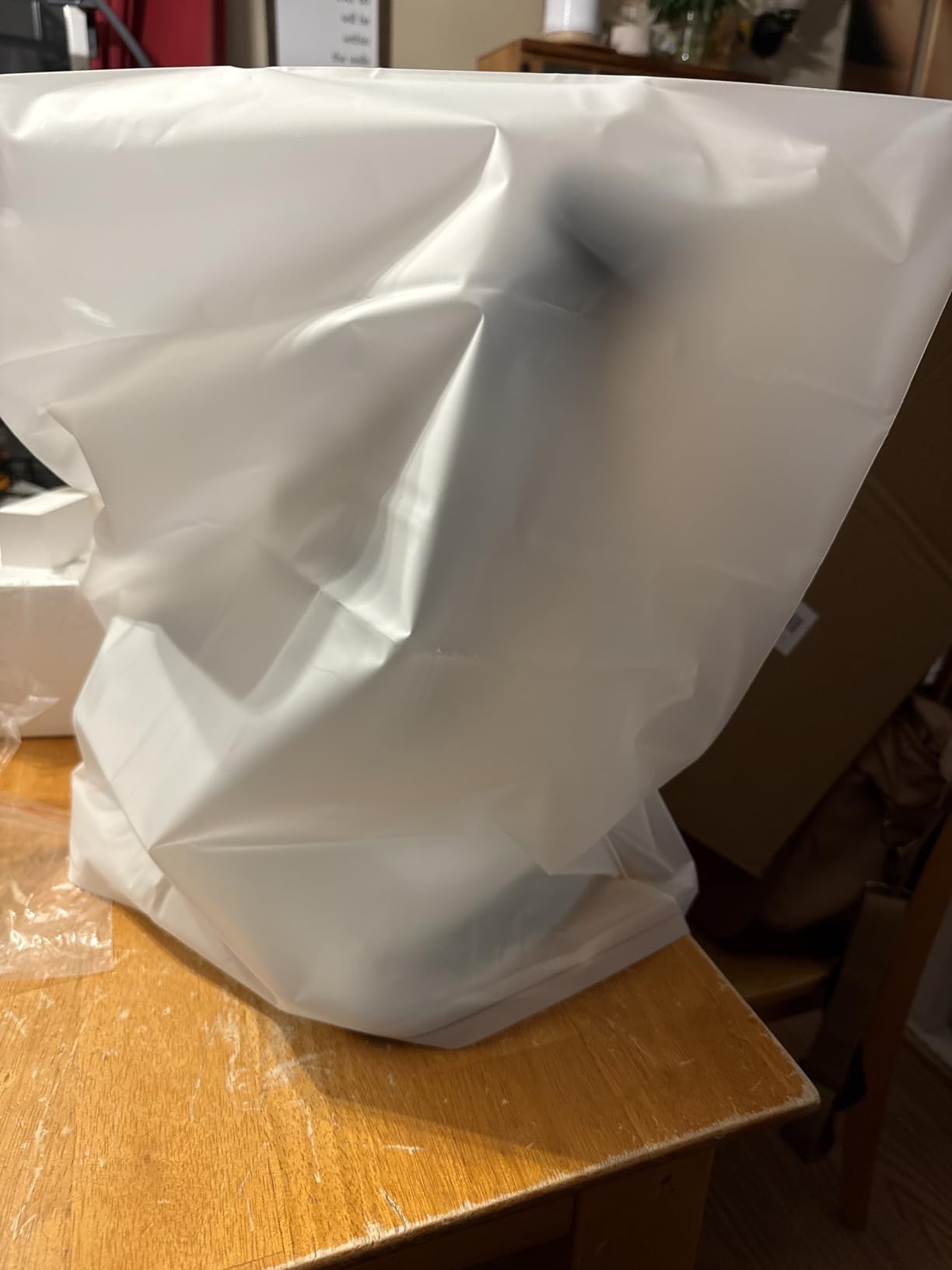
The limitation that shapes everything else is the working floor. This is the smallest working area among the trinocular picks here, so while the head sits over a small module or a QFN nicely, irons and PCB holders compete for the same space. The pillar stand also cannot reach over tall or wide assemblies, which is the trade for the compact footprint.
It is worth being clear that this is not simul-focal. When the camera port is engaged, one of the eyepiece paths is affected, so your depth perception drops during capture. For stills and reference images that is a perfectly reasonable compromise, but it is not the right scope for filming while you solder.
Who should start here
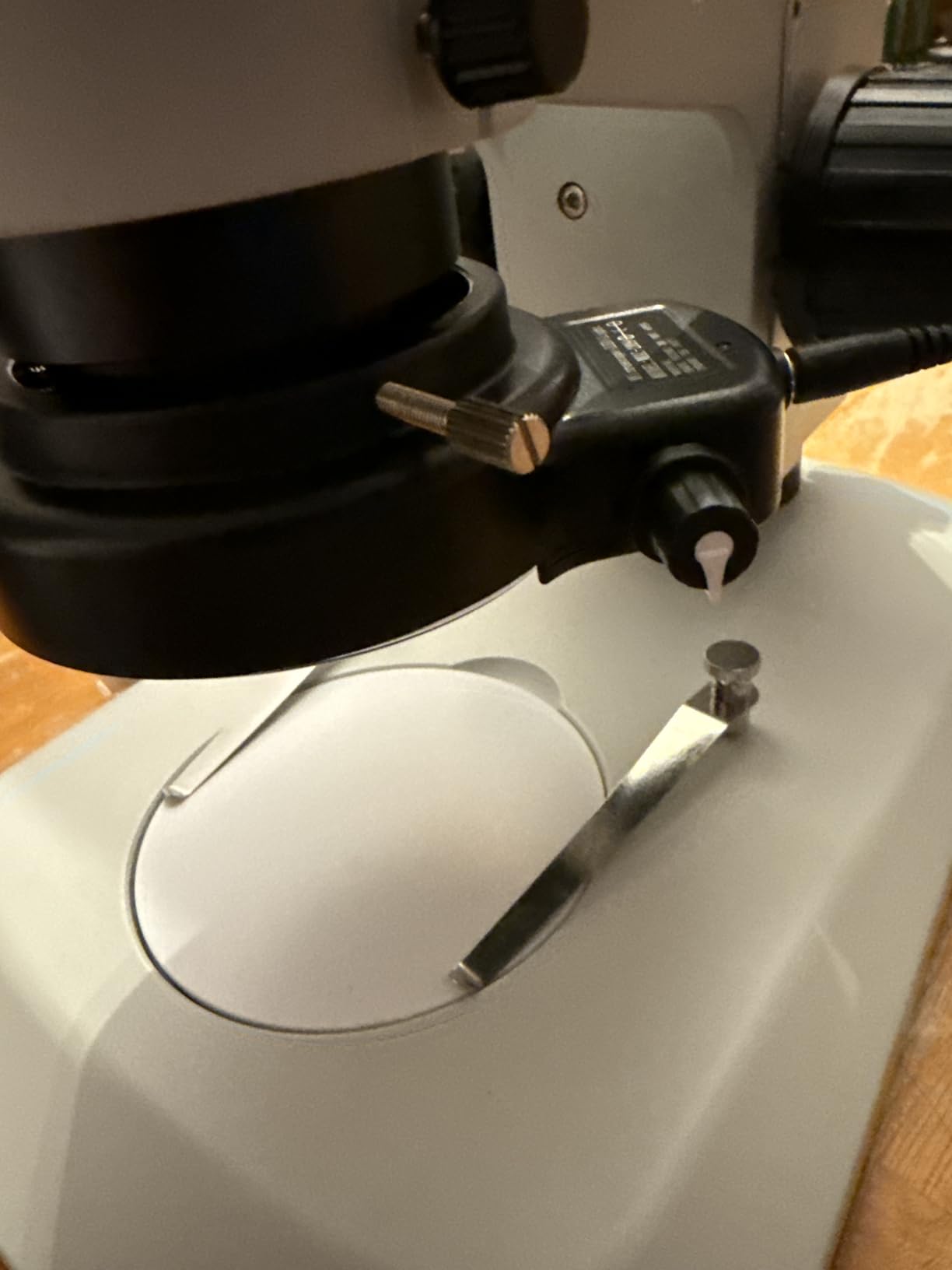
Buy this if your boards are small, your bench is compact, and your goal is to learn optical stereo work without assembling a system from four vendors. The included 0.5x CTV and 56-bulb ring light mean your first session is productive straight out of the box, and the low weight makes it easy to move aside when you need the desk for something else.
It is also a sensible second scope for a classroom or a shared teaching bench, where a compact, cheap, hard-to-break instrument that several students can use in rotation is more valuable than a single premium head.
What the specification does not tell you
Only 10 ratings exist and 62 percent are five-star, so there is limited long-term owner data to draw on. Warranty cover is one year, which is noticeably shorter than the 5 year terms on the AmScope models in this roundup, and it is the one number that matters most if the head is your primary work instrument.
Because the working area is tight, pair it with a 0.5x auxiliary lens if your usual work involves anything larger than a credit card. That converts the small stage into a workable one and is a cheaper fix than moving to a boom stand.
8. ZTEEERS 3.5X-90X Double-Arm Boom: Best Magnification Range
ZTEEERS Professional Trinocular Stereo Zoom Microscope, 3.5X-90X Magnification,WF10X Eyepieces, 0.7X-4.5X Zoom,0.5X & 2.0X Auxiliary Lens,1X CTV, Double-Arm Boom Stand, 56S LED Ring Light,Two adapters
3.5X-90X with aux lenses
Per-eye diopter adjustment
18 lb steel base
Boom stand
Pros
- 3.5X-90X magnification range with both aux lenses included in the box
- Ring light and both Barlow lenses included in the box
- Per-eye plus or minus 6 diopter adjustment on both tubes
- 18 lb steel base keeps the view steady
- Best-selling pick in the Lab Stereo Microscopes category of this list
Cons
- Very large and heavy with an assembly reported around 30 inches
- Some units lose one eyepiece view when the camera is engaged
- Poor instructions and one-year warranty
The 3.5x to 90x range is the headline, and it comes from a 0.7x-4.5x zoom objective plus the included 0.5x and 2x auxiliary lenses. Both lenses are in the box, along with a 56S LED ring light with a dimmer switch and two adapter configurations for electronic eyepieces and digital cameras. For value, several buyers who compared it against the AmScope SM-4NTP report comparable build and function for roughly half the cost.
Be honest about what the extra magnification is for, though. The 2x auxiliary lens pushes you to 90x, which is an inspection magnification, not a soldering magnification. Multiple owners point out that at that level you are looking at tissue and surface detail rather than working on a joint. The useful end of this range is the bottom half.
Per-eye plus or minus 6 diopter adjustment on both ocular tubes is a real quality-of-life feature we rarely see at this level, and it matters if two people with different vision share one bench. Interpupillary adjustment spans 48 to 75 mm, the 45 degree inclination reduces neck strain, and 360 degree rotation lets you swing the head toward a second operator or a camera.
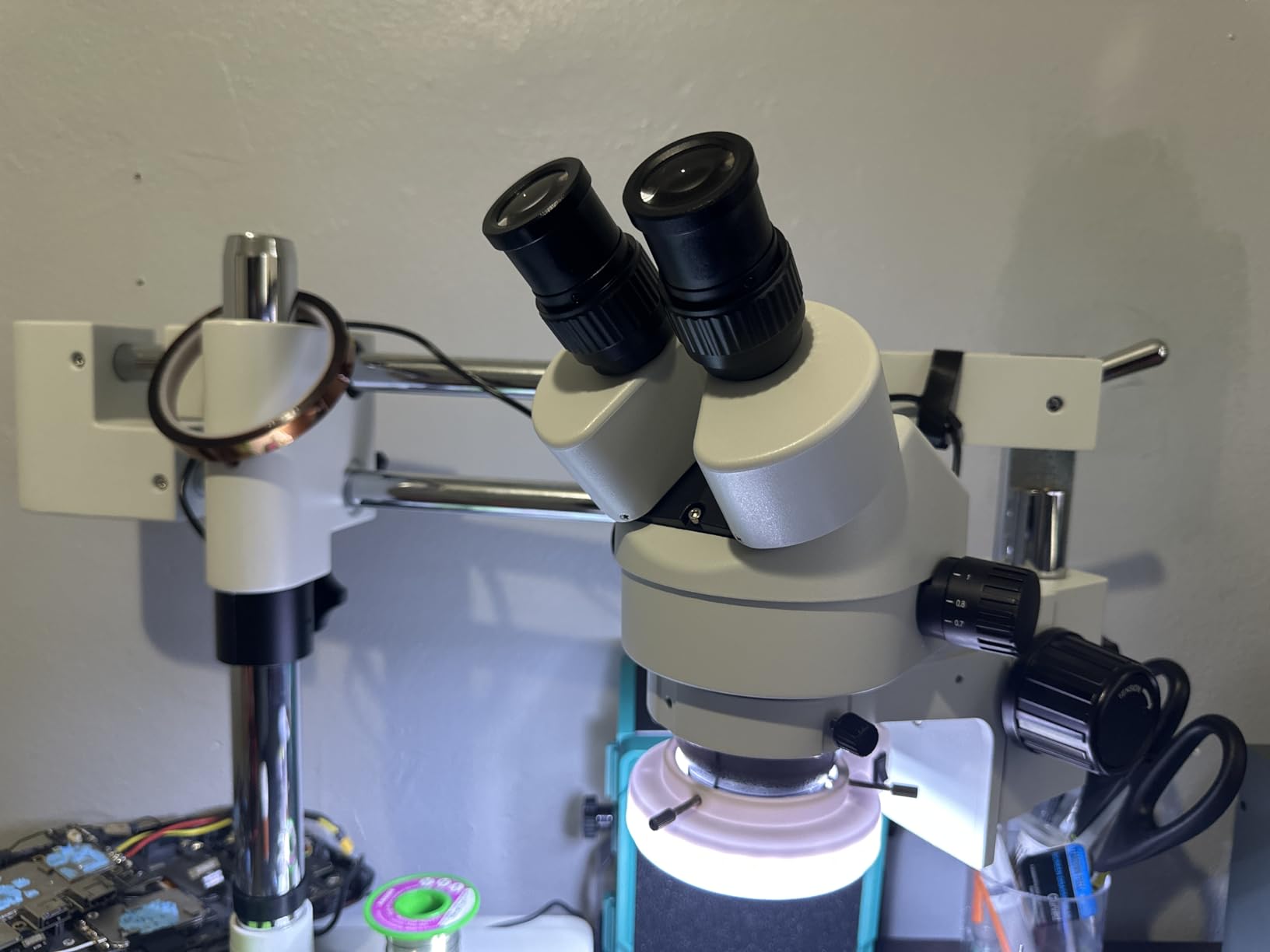
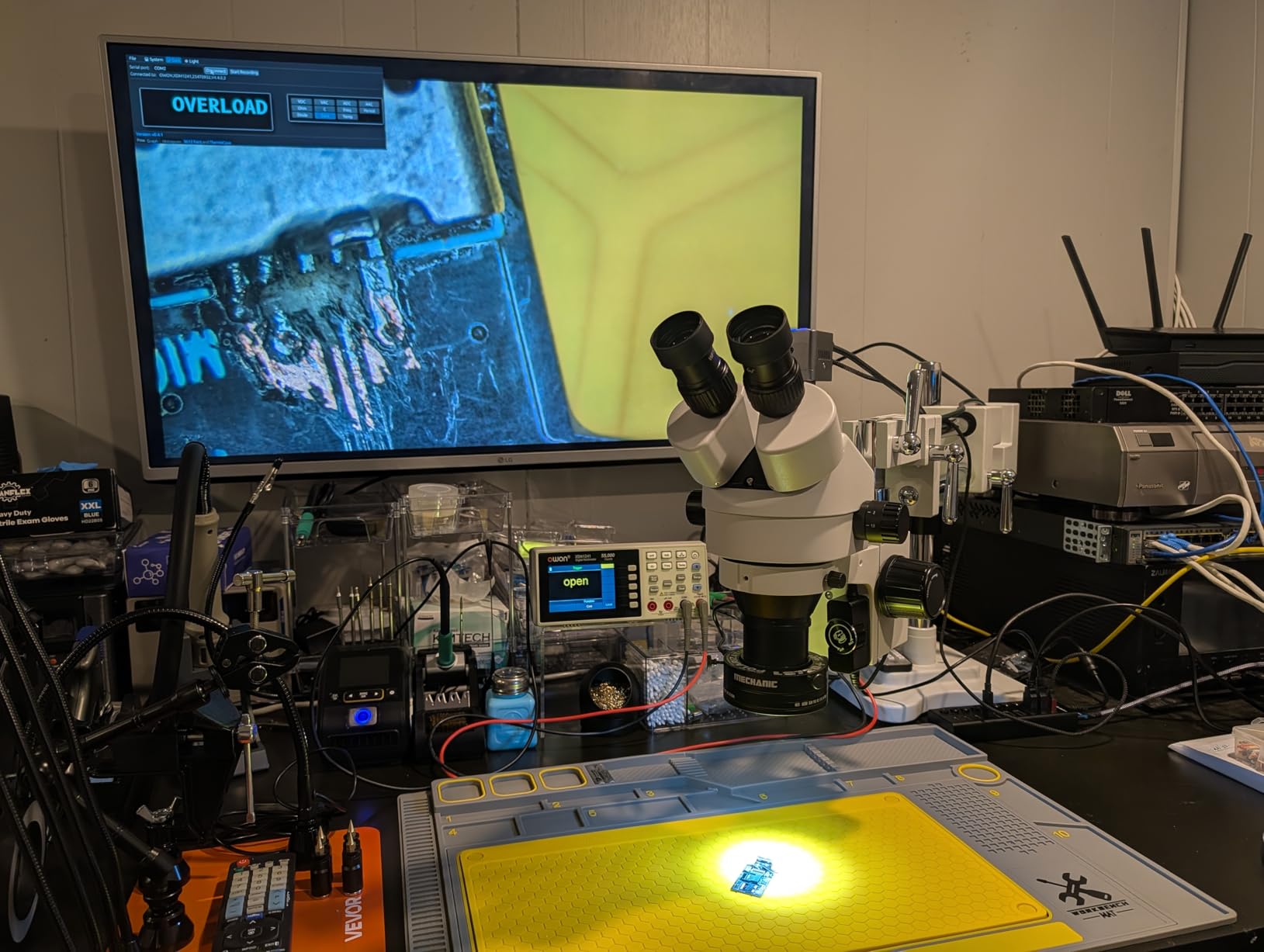
The heavy duty solid steel base weighs 18 lb, and the single arm boom uses ball-bearing glide technology that moves with little resistance and holds position when you let go. That combination of mass and glide is what keeps the image rock-steady during a long precision session, which is a bigger practical benefit than resolution on a static inspection image.
It is also the highest-selling pick in the Lab Stereo Microscopes category of this roundup, at a 4.5 average from 37 ratings, with 77 percent five-star. That combination of a deep review base and a healthy rating distribution is unusual in this category and is the main reason we trust it more than the thinner-spec alternatives.
What the boom arm buys you
Ball-bearing glide plus a steel base means the head moves across a wide working area and stays exactly where you put it, with a working distance long enough to get an iron, a hot air nozzle and a board holder under the head at the same time. For full-size mainboards and backplane panels, that clearance is the difference between comfortable work and constant repositioning.
Reviewers specifically praise the ability to move the whole rig to different heights without losing the subject, which matters when you alternate between a flat board and a board held in a fixture. The dimmable ring light also lets you dial the illumination down for glossy or black solder mask that blows out under a fixed brightness.
Plan your bench before ordering
Size is the real problem. Several owners report a total assembly length of around 30 inches, and one mounted theirs on a rolling cart to stop the arms tipping. The listed footprint is 19.5 by 11.5 by 19.5 inches, but the boom extends well past that. Measure the depth from the front of your desk to whatever is behind it before this one arrives.
On quality, owners describe the workmanship as adequate rather than premium and find it feels fragile at the head, and the assembly instructions are poor enough that several people relied on photos or video. Warranty cover is one year. And despite the simultaneous-observation claim in the listing, some buyers report losing one eyepiece when the camera is engaged, so treat the simul-focal behaviour as something to verify on your own unit rather than a guarantee.
9. SWIFT S7-TP520: Best Compact Pillar Setup with 100 mm Working Distance
SWIFT Trinocular Stereo Zoom Microscope with 56-Bulb LED Ring Light,3.5X-90X Magnification,WF10X Eyepieces,0.7X-4.5X Zoom Objective, 0.5X 2.0X Additional Objectives,Table Pillar Stand
3.5X-90X total range
4 inch 100 mm working distance
56-bulb LED ring light
Table pillar stand
Pros
- 3.5X-90X total range with 0.5X and 2.0X objectives included
- 100 mm working distance leaves room for tools under the head
- 56-bulb ring light stays cool on heat-sensitive boards
- Designed for eyeglass wearers
- Compact pillar footprint that will not tip
Cons
- Pillar stand cannot swing over large or tall assemblies
- Not simul-focal so the camera port affects the eyepiece view
- Small working floor compared with boom-stand models
The feature that sets this scope apart from the other pillar options is the 4 inch, or 100 mm, working distance. That is the number the buying guides keep repeating as the minimum for soldering, and very few scopes in this roundup state it this plainly. It means your iron tip, a pair of tweezers and the board itself all fit under the head at the same time, without awkward board angles.
Base magnification runs 7x to 45x from a 0.7x-4.5x objective with a 6.4:1 zoom ratio, and the included 0.5x and 2.0x additional objectives expand the total to 3.5x to 90x. As with the ZTEEERS boom, the top of that range is an inspection tool rather than a working one.
Two details are worth highlighting because they are rarely mentioned. The optical system is explicitly designed for eyeglass wearers, which is a genuine purchase blocker for a large share of buyers. And the vertical trinocular port doubles as a photo port, so the same head works for eyepiece viewing or camera attachment depending on what you need.
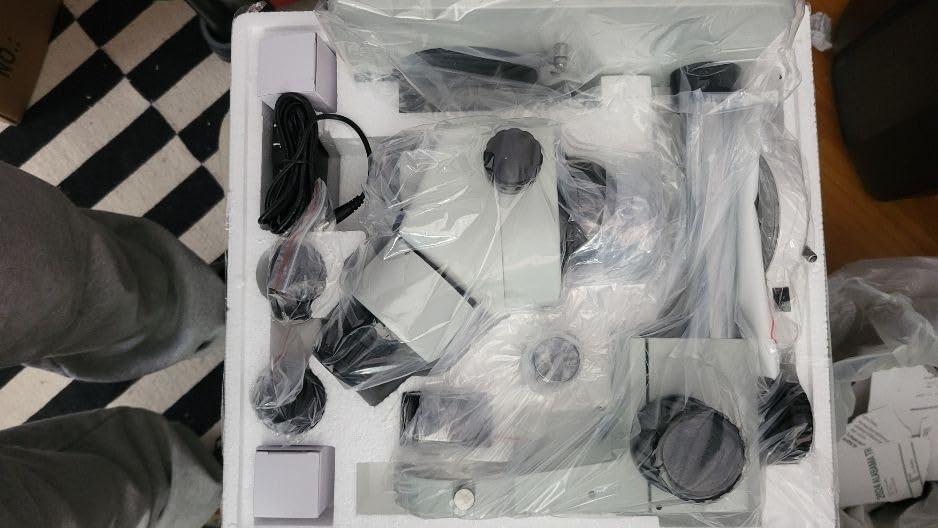
The 56-bulb LED ring light gives bright, shadow-free illumination with low heat output, which matters on a board with exposed components or a sensitive coating. Owners point to exactly this as the feature that made the scope usable on heat-sensitive work rather than only on hard, masked boards.
At under 10 pounds on a sturdy metal base, it stays put and will not tip when you lean on it, which is precisely what you want from a pillar stand. The pillar geometry is the point: it converts all of that energy into stability rather than reach.

Why a pillar stand can be the right answer
Reach is what you buy a boom arm for, and it is not always what you need. If your boards are flat, modest in size and consistently the same dimensions, a pillar stand gives you a smaller footprint, lower weight, more stability and a larger clear working floor under the head. For a single-board specialty like phone mainboard repair, that is the better trade.
The compact footprint also means the scope can live on a bench that already has a soldering station, a hot air gun and an ESD mat competing for space. You can slide it out of the way when you are doing assembly work and slide it back when you need inspection.
Where the limits show
A pillar stand simply cannot swing over a large or tall assembly, and the working floor is small next to the boom models. Like the SWIFT S7 above, this is not simul-focal, so engaging the camera affects the eyepiece view. Roughly a tenth of ratings sit at three stars, which points to some owners finding the image or focus adequate rather than exceptional, and first-time setup documentation is limited.
Our full stereo microscope roundup compares this against more pillar and boom options if you want a second opinion before committing.
10. Kaisi TX Trinocular: Best Soldering-Ready Bundle
Kaisi Professional Stereo Microscope,Trinocular Microscope for Soldering
Trinocular head keeps left eyepiece
7X-50X continuous zoom
14.9 by 10 inch work floor
Pros
- Keeps the left eyepiece usable while the camera port is active
- Sold explicitly for soldering with a fume extractor and silicone mat included
- WF10x23 eyepieces give a wider field than the common WF10x20
- 14.9 by 10 inch work floor plus three silicone parts trays
Cons
- Rubber eye cups included are hard and press painfully
- Working distance changes with each lens so focus must be reset
- No boom arm reach over large assemblies
This is the only scope in the roundup sold specifically as a soldering microscope rather than adapted from a lab model, and the design follows from that. The trinocular head is built so the left eyepiece stays usable when the camera is engaged, keeping all three views at the same frequency. On a traditional switchable trinocular, your depth perception disappears the moment you route the image to a screen.
Optically it runs a 0.7x-5x multi-coated zoom objective for continuous 7x to 50x, with a pair of WF10x23 eyepieces. Those are wider than the common WF10x20, which widens your field at any given magnification and reduces the eye and neck fatigue that owners report as the main ergonomic complaint with a stereo head. Adjustable eye distance makes it usable by people with different vision.
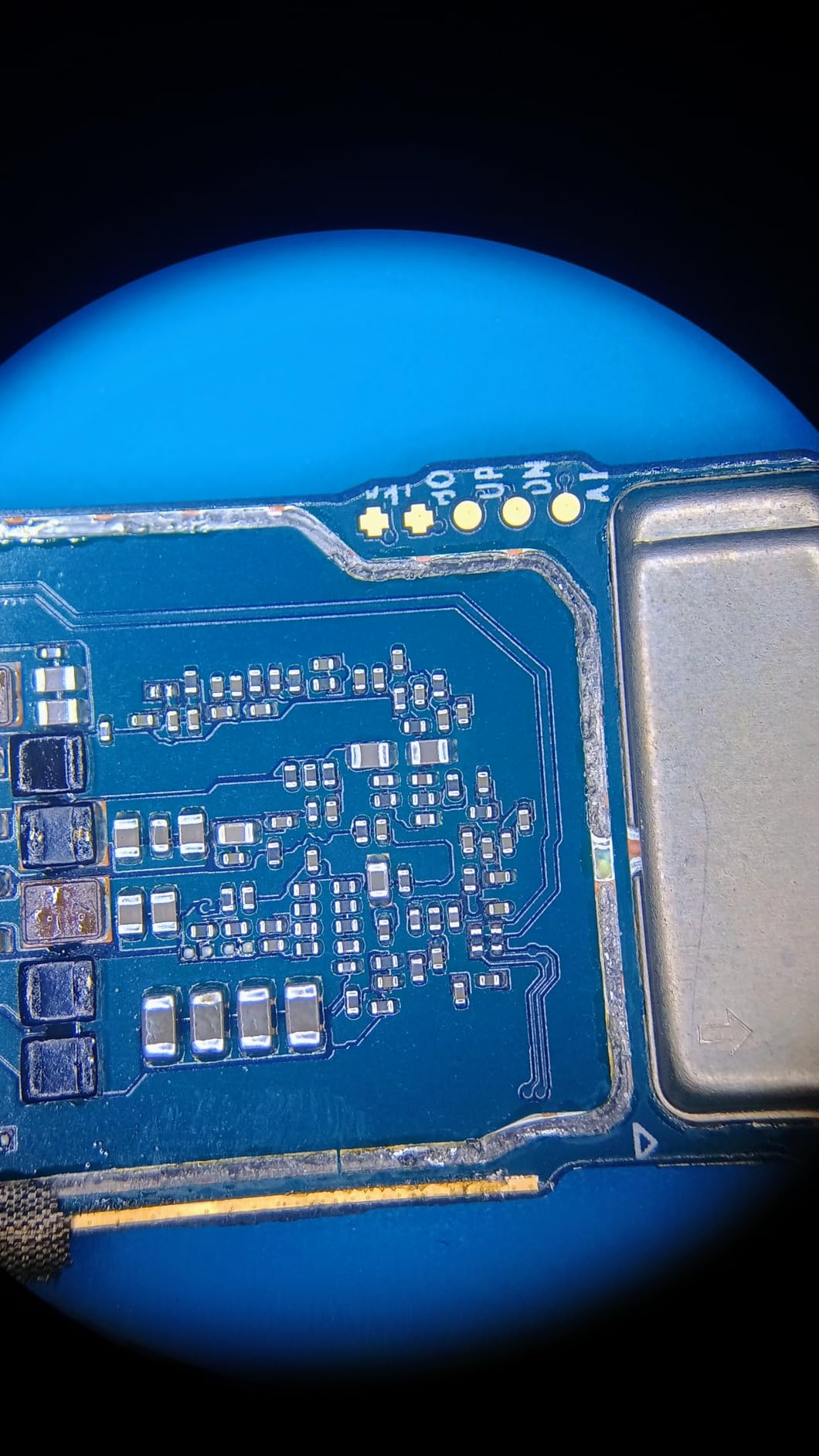
The work floor is 14.9 by 10 inches, and it comes with a 7.4 by 4.7 inch silicone soldering mat plus three small silicone parts trays. For micro-soldering, those trays stop 0201 components rolling off the board and disappearing, which is a small thing that saves real time across a session. A soldering exhaust fan is also included, because smoke drifting across the lens is a genuine problem you cannot solve later.
Support terms are worth noting: an unconditional return within 30 days and parts replacement within six months. That is stronger than the single-year-only cover on several imported scopes here, and for a first purchase it reduces the risk of a bad fit.
What makes this one soldering-specific
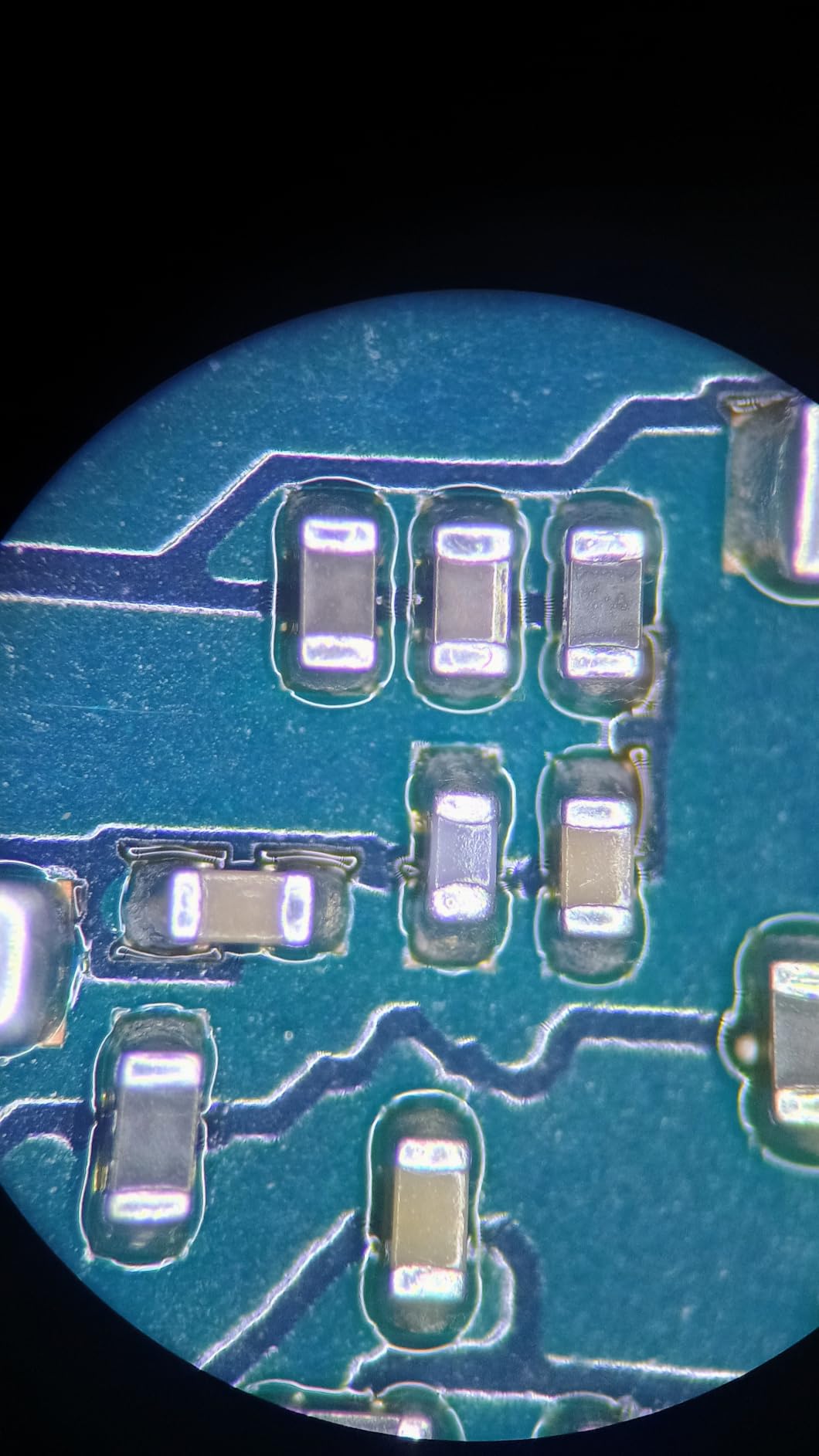
The difference is a set of decisions you would have to make yourself on a general-purpose scope. A fume extractor and an ESD-safe soldering mat in the box, three parts trays, wider eyepieces for fatigue reduction, and a head that keeps both eyes working while the camera records. Each is small, but together they remove the four things that most annoy people about bench work.
The 7x-50x range is also well matched to real work. The 0.7x objective setting gives a comfortable working view for soldering, and the manufacturer notes that working distance differs between the standard version and each Barlow lens, so focus has to be reset after a lens change. That is a small learning cost for a scope that arrives configured the way a solderer actually works.
What to fix before you start
The rubber eye cups supplied are hard and press painfully against the eyes over a long session. One buyer returned the unit for that reason and another recommended replacing them, and we would do the same. It is a five-minute fix and it makes an otherwise strong scope much more comfortable.
Be aware this is a pillar-style bench setup with no boom arm, so it will not reach over large assemblies, and the rating base is only 11 with 17 percent at three stars. Brand support is less established than the AmScope models. But if you want a soldering microscope rather than a general lab scope adapted to the job, this is the most coherent package of the ten.
Stereo vs Digital vs Trinocular: Which One Do You Actually Need?
The best type of microscope for soldering is a binocular stereo scope, because depth perception is what lets you place a tip on a pad without touching it. Everything else is a variation on how you get that three-dimensional view. The digital family shows you a flat screen image, which is fine for documentation and terrible for judging whether your tip is about to bridge two pads.
A binocular stereo scope sends the same optical path to both eyes through a pair of eyepieces, giving true depth cues and zero latency. A trinocular scope adds a third port for a camera. A simul-focal trinocular keeps the eyepieces and the camera path focused simultaneously, which is the configuration content creators and repair documentation users gravitate to. A digital microscope is a camera and a screen, and its trade-off is recording convenience against flatness and lag.
One warning about magnification marketing. Claims of 1000x and beyond on consumer scopes are almost always digital interpolation, not optical magnification, and they are useless for active soldering because the image is being upscaled rather than resolved. The practical optical ceiling for board work is 45x, and the useful working range is 7x to 25x. Judge every listing on the optical zoom range and the working distance, not the headline number.
If you want the honest version of this comparison with the digital side covered in depth, our digital microscope roundup walks through when a camera-first setup is the right call, and the soldering microscope guide handles the mixed cases.
How to Choose a Stereo Microscope for Soldering
Working distance: measure this first
Working distance, also called lens-to-object distance, is the gap between the front of the objective and the top surface of the board. It is measured at the highest in-focus position, and it is the single most important specification for soldering because it determines whether your iron, tweezers and board holder fit under the head together. For soldering, treat 100 mm, roughly 4 inches, as the absolute minimum and 150 mm or more as ideal.
Many scopes mount the objective low, which is why a 7x-45x head can still leave you with only 3 inches of practical clearance. A 0.5x reduction lens moves the head up and extends the working distance, and it is the accessory most consistently recommended across community buying advice for exactly this reason. If a listing does not state a working distance, assume it is short until proven otherwise.
Magnification and field of view
10x to 25x covers nearly all active SMD soldering, including 0402 and most 0201 work. The rest of the range is for inspection. A 7x-45x zoom head lets you stay at 7x to 15x while actually soldering and only push to 35x or 45x to inspect a joint you have finished, which is far more comfortable than swapping objectives every few minutes.
Field of view is the number that gets lost, and it is the one that determines how much board you can see at a given magnification. Wider is better, because a wide field means you can navigate to a location without losing your place. A 1-1/4 inch super wide field view, as on the SM-4NTP, keeps you oriented on the board at low power.
Illumination
Shadow-free illumination matters more than brightness. A ring light mounted above the objective throws light straight down onto the board from all sides, so a tall component or a tilted board does not cast a shadow across the joint you are working on. Several picks here include a 56-bulb or 80-LED ring light, and we consider it close to mandatory.
Prefer LED to halogen. LEDs run cool, which protects heat-sensitive components and avoids the hot bulbs that owners of entry-level halogen scopes complain about. A dimmer is a bonus, because glossy black solder mask reflects a fixed bright light straight back into your eyes.
Stand geometry and board size
A pillar stand raises and lowers the head on a post. It cannot swing over anything large or tall. It suits flat boards up to about the size of a phone mainboard.
A single-arm boom swings the head out over the bench so you sit upright, giving 8 or more inches of vertical clearance. A double-arm or articulating spring arm adds the ability to reach over tall assemblies and swing completely clear when idle. Boom arms trade footprint and weight for clearance, and the largest assemblies here run to roughly 30 inches end to end.
Our rule of thumb: pillar stand for single-board flat work, single-arm boom for general repair, articulating arm for mixed assemblies. Check the footprint against your bench depth before ordering any boom model.
Eyepieces, diopter and parfocal setup
Parfocal means the eyepieces stay in focus across magnification changes and, ideally, across lens changes. Non-parfocal setups drift out of focus every time you swap a lens, which is the top complaint in forum threads about shared benches. Wide-field eyepieces help because they keep a usable field at low power.
Diopter adjustment is the per-eye fine focus that lets one scope serve two people with different vision. A diopter ring on one eyepiece lets you correct your eye and leave the other side neutral, so a colleague can use the same instrument without refocusing from scratch. Interpupillary adjustment is the physical spacing between the tubes, and 48 to 75 mm is the normal range. If you wear glasses, buy a head with generous eye relief or one designed for spectacle wearers, and test it before committing.
Barlow lenses and the real system cost
A 0.5x Barlow, or reduction lens, halves magnification, doubles the working distance and widens the field. It is the highest-value accessory in this entire category. A 2x lens does the opposite, doubling magnification at the cost of clearance, and is mainly useful for inspection rather than soldering.
The scope is rarely the whole cost. A realistic bench also needs a 0.5x reduction lens, a ring light if the scope does not include one, an ESD mat, a fume extractor, and a camera or C-mount adapter if you want to record. Several picks here include most of those items, which is why the all-in-one bundles can cost less in practice than a bare scope plus accessories. Our soldering station guide covers the rest of the bench.
Common Mistakes and Lessons From the Forums
Most regret in this category comes from the same handful of mistakes. They show up repeatedly across soldering and electronics communities, and each has a simple mitigation.
Ignoring working distance. The most common thread. If the head mounts low, you will spend your session tilting boards to get a shadow-free angle instead of working flat. Fix: check the stated working distance first, and budget for a 0.5x reduction lens.
Chasing magnification numbers. Buying for 90x or 1000x when the useful working range is 7x to 25x. High power narrows your field, shortens your working distance and makes depth perception harder. Fix: prioritise zoom range and field of view over peak magnification.
Skipping the ring light. A scope without shadow-free lighting is a frustrating purchase. Fix: treat illumination as part of the scope, not an optional extra.
Buying a pillar stand for large-board work. If your boards do not fit comfortably under a post, you need reach. Fix: measure your largest board and pick the stand to match.
Expecting glasses to just work. Eye relief at the eyepiece blocks more purchases than any other spec. Fix: check eye relief, or test with your glasses on.
Buying used without a checklist. The used market has no editorial coverage but plenty of activity, so here is what to inspect. Check that focus holds at every magnification across the zoom range, which catches a head that has lost parfocal. Turn the focus knob through its full travel and look for creep under its own weight. Push the boom arm laterally and watch for a head that slides on the bar. Finally, look through the eyepieces at a bright light for fungus haze, and confirm the illumination and dimmer both function. If a scope has to be parfocaled by hand every session, walk away.
One last piece of honest advice from the community: adaptation is real. Beginners often resist a microscope because the first few sessions feel slower than a loupe. Give it a solid week of board work before you judge it. Almost everyone who does ends up at the conclusion that nothing feels too small anymore.
Frequently Asked Questions
What is the best type of microscope for soldering?
A binocular stereo microscope is the best type for soldering, because two eyepieces give true depth perception and zero video lag, letting you judge tip-to-pad distance in real time. A trinocular adds a camera port for documentation, a simul-focal trinocular keeps both paths in focus at once, and a digital scope trades depth perception for recording convenience.
What magnification is good for soldering?
10x to 25x covers nearly all active SMD soldering, including 0402 and most 0201 work. A 7x-45x zoom head lets you stay at 7x to 15x while actually soldering and only push to 35x or 45x for inspection. Claims of 1000x are almost always digital interpolation and are useless for real work.
How much working distance does a soldering microscope need?
Treat 100 mm, about 4 inches, as the absolute minimum and 150 mm or more as ideal. Working distance is measured from the front of the objective lens to the top surface of the board at the highest in-focus position, and it must allow your iron, tweezers and board holder to fit underneath at the same time. A 0.5x reduction lens is the usual fix when a scope mounts too low.
Is AmScope a good microscope brand?
Yes, and community users commonly describe it as the value option in this category rather than the premium one. The SE306R-PZ, SM-3T and SM-4NTP all carry 5 year manufacturer warranties, which is longer than the single-year cover common on imported scopes. The trade-off against cheaper imports is thin documentation and accessories sold separately.
What are the downsides of using a stereo microscope?
The main drawbacks are eye and neck strain from a fixed eyepiece position, a working distance that is often too short for irons and hot air nozzles, pillar stands that limit board size, and non-parfocal scopes that drift out of focus when lenses change. Mitigations include a 45-degree inclined head, wide-field eyepieces, a 0.5x reduction lens and a boom stand.
Which Stereo Microscope Should You Buy?
For most people reading this, the answer is the AmScope SE306R-PZ. It holds a 4.6 average across more reviews than any other pick here, the forward binocular head keeps both hands free at the bench, and 20x and 40x cover essentially all SMD soldering. It is our pick for the best stereo microscope for soldering because it does the core job well and does not ask you to pay for features you will not use.
Choose differently only for a clear reason. Record your work while you solder and you want true simul-focal, so pick the SM-4NTP. You are building a professional bench and want an upright posture over a large board, so pick the SM-3T with a 0.5x reduction lens. You need one box that includes a camera, a ring light and a fume extractor, so pick the TX-350E and verify the camera on arrival. You want a low-cost optical trinocular with the adapter already included, so pick the ZTEEERS 6X-45X.
Whatever you choose, the decisions that matter most are working distance and zoom range, not peak magnification. Get 100 mm or more of clearance, keep a 7x to 45x optical range, and add a 0.5x reduction lens if the head mounts low. That combination covers more real board work than any other spending decision on this list, and it is why these are the best stereo microscopes for soldering in 2026.