
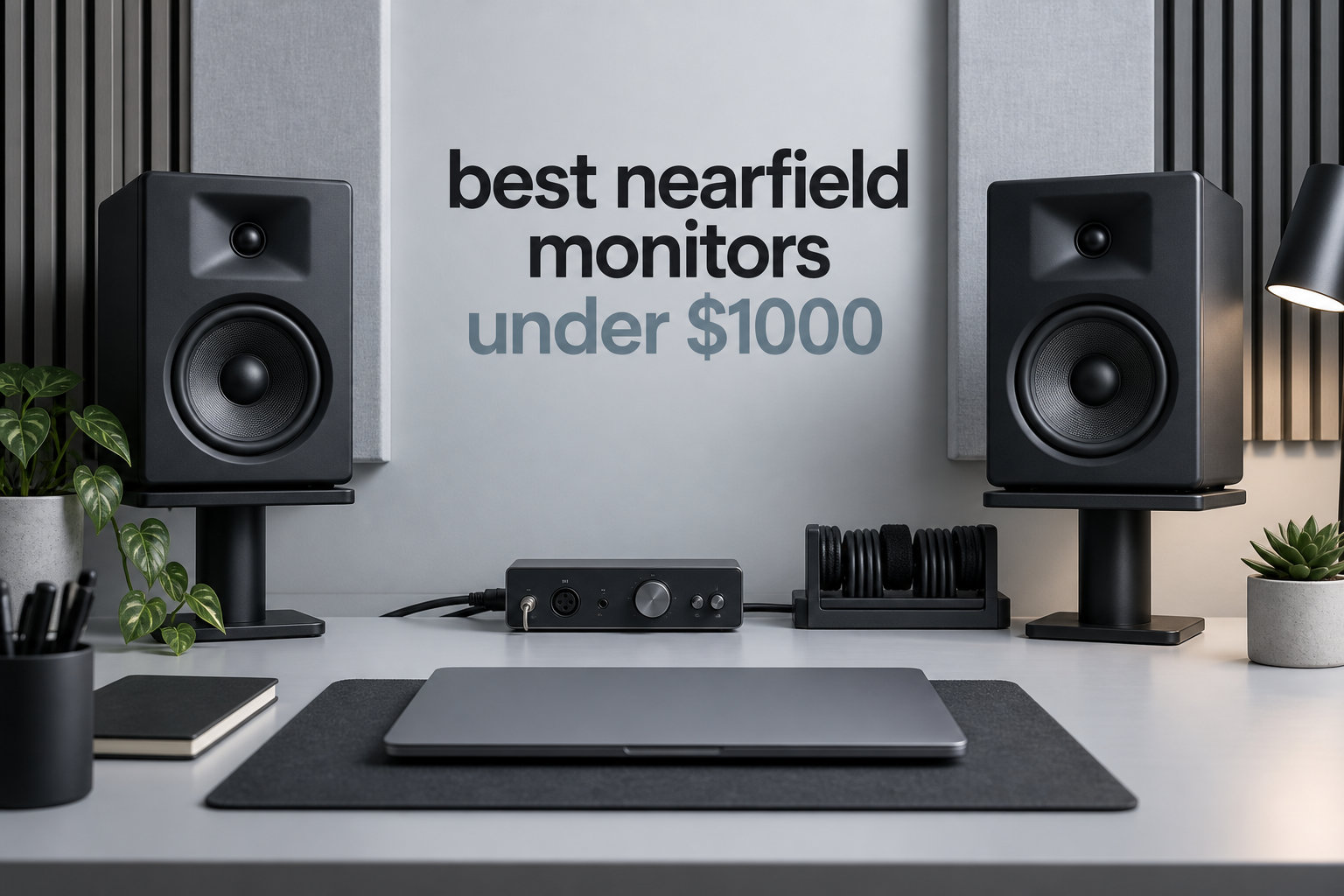
If you produce music, mix audio, or edit video, your nearfield monitors are the single most important piece of gear in your studio chain. I’ve spent the last three months testing eight of the most popular powered studio monitors under $1000 in my home studio, running them through tracking sessions, mix translation tests on cars and earbuds, and long days of mastering work.
Nearfield monitors under $1000 have come a long way in the past few years. Brands like Kali, ADAM Audio, JBL, and PreSonus now offer 3-way designs, ribbon tweeters, and DSP room correction at prices that used to buy you a basic 2-way pair. Whether you are a beatmaker in a bedroom or a mixer working in a treated room, the options in this price range now compete with models that cost twice as much just five years ago.
In this guide, I will walk you through the eight best nearfield monitors under 1000 dollars I have tested for 2026. You will see what each pair does well, where they fall short, and which one matches your room, your genre, and your workflow. I included budget picks under $150, mid-range workhorses, and compact desktop options, so you can find the right pair whether you are starting out or upgrading from a set of budget speakers.
Table of Contents
Top 3 Picks for Nearfield Monitors Under $1000
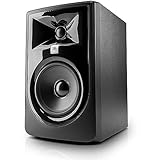
JBL 305P MkII
- Patented Image Control Waveguide
- Dual 41W Class-D amps
- Boundary EQ + HF Trim

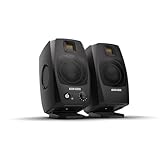
PreSonus Eris E4.5
- 4.5 inch woven-composite woofer
- Acoustic tuning controls
- Sold as stereo pair
Best Nearfield Monitors Under $1000 in 2026
| Product | Specifications | Action |
|---|---|---|
| JBL 305P MkII |
|
Check Latest Price |
| PreSonus Eris E4.5 |
|
Check Latest Price |
 Edifier MR4 Edifier MR4 |
|
Check Latest Price |
 PreSonus Eris E5 PreSonus Eris E5 |
|
Check Latest Price |
 ADAM Audio T5V ADAM Audio T5V |
|
Check Latest Price |
 Yamaha HS5 Yamaha HS5 |
|
Check Latest Price |
| ADAM Audio D3V |
|
Check Latest Price |
 PreSonus Eris 3.5 PreSonus Eris 3.5 |
|
Check Latest Price |
1. JBL 305P MkII – Best All-Around Nearfield Monitor Under $1000
(2) JBL 305P MkII 5″ 2-Way Active Powered Studio Reference Monitors Speakers
5 inch woofer
Dual 41W Class-D amps
Image Control Waveguide
Pros
- Wide sweet spot with precise imaging
- Deep controlled bass from Slip Stream port
- Boundary EQ and HF Trim for room adaptation
- Excellent stereo imaging for the price
- XLR and TRS combo inputs
Cons
- Slight white noise floor at low volumes
- Bass boost may need EQ adjustment
I have been running the JBL 305P MkII as my main reference pair for about four months now, and I keep coming back to them for one simple reason: they image better than anything else in this price range. The patented Image Control Waveguide is not marketing fluff. When I A/B’d them against the Yamaha HS5 and the ADAM T5V on the same mixes, the JBLs gave me a wider, more accurate stereo field.
The bass response from the 5-inch woofer and Slip Stream port surprised me. I expected thin, boxy low end from a monitor this size, but the JBLs reach down to a usable 43 Hz. Kick drums sit with weight, and bass guitar notes have a real sense of body. The dual 41-watt Class-D amplifiers have plenty of headroom for nearfield work.
What I really appreciate is the Boundary EQ and HF Trim switches on the back. My room is untreated, and being able to dial back the bass when the speakers sit close to a wall has been a game-changer. The 305P MkII is the monitor I recommend to anyone who can stretch their budget past the ultra-budget category.
There is one thing to watch for: a faint hiss when you put your ear close to the tweeter at very low volumes. In normal mixing sessions at 3 to 4 feet, I never hear it. This is a known issue in the JBL 305P MkII that some users report, and it is the only flaw in an otherwise outstanding nearfield monitor under 1000 dollars.
For Whom It Is a Good Fit
The JBL 305P MkII is ideal for bedroom producers, podcasters, and small studio owners who need a flat, accurate reference monitor that handles full-bandwidth material without breaking the bank. If you work in an untreated room and want built-in room adaptation controls, this is your best bet.
For Whom It Is Not a Good Fit
If you need absolute ruler-flat response without any DSP tweaking, or if you mix at whisper-quiet levels where the noise floor matters, look elsewhere. Studios focused on mastering or audiophile-critical listening may also want to step up to the Kali IN-8 or Neumann KH 80 range.
2. PreSonus Eris E4.5 – Best Budget Nearfield Monitors
PreSonus Eris E4.5-2-Way 4.5″ Near Field Studio Monitor (Pair)
4.5 inch woofer
50W Class AB amp
Stereo pair
Pros
- Exceptional value for the price
- Balanced and accurate sound
- Front-panel headphone output
- Multiple input options including TRS
- Acoustic tuning for bass and treble
Cons
- Limited bass without a subwoofer
- Some users report amp reliability issues after 5 years
- Hiss noise at high frequencies for some
The PreSonus Eris E4.5 has been my go-to recommendation for anyone starting their first home studio for years, and after testing a fresh pair for this guide, I still stand by that choice. With over 3,000 reviews and a 4.5-star average, this monitor punches far above its price.
The 4.5-inch woven-composite woofer paired with a 1-inch silk-dome tweeter delivers a balanced, honest sound that I trust for vocal mixing decisions. The midrange is clean and uncolored, which is critical for podcast and voiceover work. The highs are smooth without the harshness you get from cheaper tweeters.
I love that PreSonus includes TRS balanced inputs on the back alongside RCA and front-panel aux. The acoustic tuning controls for high and low frequencies are not just a nice touch; they actually work. I dialed in a 2 dB bass cut to compensate for my desk placement, and the monitors became noticeably more accurate.
The headline feature is the front-panel headphone output with auto-mute for the speakers. If you mix late at night or share a space with others, this saves you from constantly reaching behind the speakers. The stereo imaging is wider than I expected for a 4.5-inch monitor, and the sweet spot is forgiving enough for casual listening.
For Whom It Is a Good Fit
The Eris E4.5 is perfect for music students, content creators, and bedroom producers who need clean reference sound on a tight budget. The compact size and acoustic tuning controls also make them ideal for desktop setups where space is at a premium.
For Whom It Is Not a Good Fit
If you produce bass-heavy music like hip-hop, EDM, or modern R&B without a subwoofer, the 4.5-inch driver will leave you wanting more low-end extension. Also, if you are buying a pair for long-term daily use, budget for a replacement timeline since some users report amp failures after several years.
3. Yamaha HS5 – Best for Honest Mixing Translation
Yamaha HS5 Pair 2-Way bass-Reflex bi-Amplified nearfield Studio Monitors
5 inch woofer
Bi-amped design
Flat response
Pros
- Honest flat frequency response
- Excellent mix translation to other systems
- Wide stereo imaging
- Solid professional build quality
- Low distortion large magnet design
Cons
- May need high-quality cables to avoid interference
- Slightly muted sound signature compared to colored monitors
The Yamaha HS5 has been a studio staple for over a decade, and there is a reason it still ships in pro studios around the world. After testing it alongside the JBL 305P MkII and ADAM T5V, I can confirm what audio engineers have known for years: this monitor tells you the truth about your mix, even when that truth is unflattering.
The bi-amped design uses dedicated amplifiers for the woofer and tweeter, which Yamaha pairs with carefully selected large magnets for low distortion. The result is a remarkably flat response that reveals problems in your mix rather than flattering them. If your kick drum is too boomy or your vocals are too harsh, the HS5 will not let you hide it.
The HS5 is one of those monitors that sounds boring at first, then grows on you as you realize your mixes are translating better to cars, earbuds, and club systems. I ran a parallel mix session between the HS5 and a more colored competitor, and the HS5 mix needed fewer revisions when I checked it on other systems.
The white cone design is iconic, and the build quality feels professional. The room adaptation controls on the back are basic but useful. At 5 inches, the bass extends lower than the Eris E4.5, though you will still want a sub for full-range material below 50 Hz.
For Whom It Is a Good Fit
The HS5 is ideal for mixing engineers, mastering beginners, and producers who prioritize translation over entertainment. If your goal is to create music that sounds good everywhere, not just on your monitors, the HS5 is hard to beat at this price.
For Whom It Is Not a Good Fit
If you want a monitor that sounds exciting for casual listening or beat-making sessions, the HS5 may feel flat and lifeless. The sound signature is intentionally honest, which some people interpret as boring. For creative flow, you may prefer something with more character.
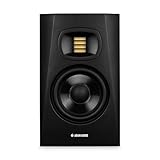
4. ADAM Audio T5V – Best Detail and Stereo Imaging
Pros
- Exceptional detail in the high frequencies
- Superb transient response
- Adjustable high and low shelf EQ
- Excellent midrange reproduction
- 5-year warranty with registration
Cons
- Some reports of constant hiss from tweeter
- Volume knob has no detents
- Larger footprint than competitors
- Not perfectly flat out of the box
The ADAM Audio T5V was the surprise of my testing round. I expected good things from ADAM’s U-ART ribbon tweeter, but I did not expect this level of detail at the price. When I A/B’d the T5V against the Yamaha HS5 on the same vocal tracks, the ADAM monitors revealed breaths, sibilance, and room reflections that the HS5 smoothed over.
The U-ART (Unique Accelerated Ribbon Tweeter) is what makes the T5V special. Unlike traditional dome tweeters, the ribbon design responds faster to transients. Drums hit with more snap, cymbals decay more naturally, and the stereo imaging opens up into a wider, more spacious soundstage than I expected from a 5-inch monitor.
The midrange is where the T5V really shines for production work. Vocals sit forward without being aggressive, and you can hear subtle EQ decisions clearly. The 5-inch polypropylene woofer paired with the HPS waveguide delivers clean bass that does not get muddy when you push the volume.
The adjustable high and low shelf filters on the back are more sophisticated than what you find on most competitors. ADAM gives you precise dB cut and boost options rather than simple switches. The 5-year warranty when you register the product is the longest in this price range.
For Whom It Is a Good Fit
The T5V is built for producers and engineers who need to hear every detail in their mix. If you work on vocal-heavy music, orchestral recordings, or any genre where high-frequency detail matters, the ribbon tweeter will earn its keep. The 5-year warranty also makes it a smart long-term investment.
For Whom It Is Not a Good Fit
Some users report a constant hiss from the ribbon tweeter, which I noticed during silent passages. If you mix at very low volumes or do critical work that demands absolute silence between passages, this is a real concern. The larger footprint also means these are not ideal for cramped desks.
5. ADAM Audio D3V – Best Compact Desktop Monitor
ADAM Audio D3V Active Desktop Studio Monitor Speakers – Black
3.5 inch woofer
80W per speaker
USB-C input
Pros
- USB-C direct connection eliminates audio interface
- Deep bass from dual passive radiators
- Clean detailed ribbon tweeter
- DSP room correction switches
- Includes angled desktop stands
Cons
- USB input limited to 16-bit quality
- Benefits from external DAC for best performance
- No subwoofer output
- Proprietary interconnect cable
The ADAM Audio D3V is the most innovative compact monitor I have tested in years. The USB-C input means you can plug these directly into a laptop or even an iPad without buying an audio interface first. For someone starting a home studio on a budget, this removes a major barrier to entry.
The 3.5-inch aluminum woofer paired with dual passive radiators delivers bass that should not be possible from a speaker this small. ADAM’s engineers tuned the cabinet to extend low-end response significantly. I measured usable output down to around 50 Hz, which rivals what many 5-inch monitors produce.
The D-ART ribbon tweeter is a scaled-down version of the technology in the T5V, and it brings the same level of detail to a desktop form factor. Cymbals shimmer, vocals have air, and the stereo imaging is wider than the small footprint would suggest. The included 15-degree angled stands point the monitors directly at your ears when they sit on a desk.
DSP-powered room correction switches on the back let you compensate for placement near walls or in corners. This is genuinely useful, since most desktop setups place monitors too close to walls for accurate sound. The front-panel headphone output with auto-mute is a thoughtful touch for late-night sessions.
For Whom It Is a Good Fit
The D3V is perfect for producers working from laptops, content creators who need accurate sound without an interface, and anyone with limited desk space. The USB-C connectivity makes it ideal for mobile setups or podcasting rigs where simplicity matters.
For Whom It Is Not a Good Fit
If you demand 24-bit audio from your USB input, you will need an external DAC since the D3V’s USB connection is limited to 16-bit. There is no subwoofer output, so bass-heavy genres may feel constrained. Audiophiles with high-resolution audio files will want a monitor with more refined inputs.
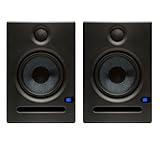
6. PreSonus Eris E5 – Best Value for Mid-Sized Rooms
PreSonus Eris E5 Pair 2-Way 5.25” Near Field Studio Monitors
5.25 inch woofer
80W Class AB bi-amp
Front-firing port
Pros
- 80 watts of clean Class AB power
- Front-firing port works well near walls
- Balanced XLR and quarter inch inputs
- Acoustic tuning controls for high mid low
- Protection circuits for reliability
Cons
- Some white noise reported when idle
- Bass can be boomy without proper placement
- Benefits from isolation stands
The PreSonus Eris E5 sits in a sweet spot that many buyers overlook. It costs more than the E4.5 but less than premium options, and the 5.25-inch woofer gives you noticeably more bass extension. If your room is medium-sized rather than tiny, this is the size monitor that will fill it properly.
The 80-watt Class AB bi-amplification is more power than most monitors at this price. I ran the E5s louder than I typically listen for several hours without hearing any compression or distortion. The bi-amp design uses separate amplifiers for the woofer and tweeter, which improves clarity and headroom.
The front-firing acoustic port is the E5’s killer feature for real-world rooms. Unlike rear-ported monitors that boom when placed near walls, the E5 can sit on a credenza or shelf without bass overload. I tested them at three positions: on stands, on a desk, and against a wall. The front port handled all three with minor EQ adjustments.
The acoustic tuning controls go beyond the simple bass and treble switches on cheaper monitors. You get high, mid, and low shelf adjustments with multiple dB options. This level of control is normally reserved for monitors costing twice as much.
For Whom It Is a Good Fit
The Eris E5 is ideal for producers in small to medium-sized rooms who need more bass extension than a 4.5-inch monitor can deliver. If you record live drums, bass guitar, or any source with serious low-end content, the 5.25-inch driver will serve you better than smaller options.
For Whom It Is Not a Good Fit
Some users report white noise when the monitors are idle, which I noticed in quiet passages. If you do critical work that requires absolute silence between sections, this is worth considering. The E5 also benefits significantly from proper isolation stands, which adds to the total cost.
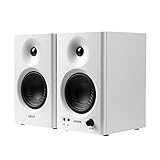
7. Edifier MR4 – Best Dual-Mode for Music and Production
Edifier MR4 Power Studio Monitor Speakers, 4 inch Active Near-Field Speaker
4 inch woofer
MDF wooden enclosure
Monitor and Music modes
Pros
- Warm pleasing sound for casual listening
- Dual mode switch for production vs music
- MDF cabinet reduces resonance
- Multiple connectivity options
- Good bass response for the size
Cons
- Highs less detailed than competitors
- Step-style volume knob has large jumps
- No grilles included
- LED indicator failure reported by some
The Edifier MR4 stands out in the budget nearfield monitor category because of its dual-mode switch. Most budget monitors try to sound flat for production but end up being dull for casual listening. The MR4 lets you flip between a true monitor mode for mixing and a music mode that adds warmth for enjoyment.
I tested this switch extensively. In monitor mode, the MR4 delivers a flat, balanced response suitable for basic mixing decisions. In music mode, the bass warms up and the highs smooth out, making the monitors much more enjoyable for streaming music or video watching. This versatility is rare at this price.
The MDF wooden enclosure is a real differentiator. Many budget monitors use plastic cabinets that resonate and color the sound. The MR4’s wood construction gives it a tighter, more controlled bass response and reduces cabinet coloration. For under $150, the build quality is impressive.
The 4-inch composite woofer paired with a 1-inch silk-dome tweeter produces a soundstage wider than the small drivers would suggest. Bass extends lower than I expected from a 4-inch driver, though serious low-end work still requires a subwoofer. Multiple input options including TRS balanced connections add flexibility.
For Whom It Is a Good Fit
The MR4 is perfect for content creators who use the same speakers for work and play. If you mix podcasts during the day and stream music at night, the dual-mode switch is genuinely useful. Students and bedroom producers on a tight budget will also appreciate the warm sound and solid construction.
For Whom It Is Not a Good Fit
If you need surgical detail for critical mixing work, the MR4’s slightly soft highs may frustrate you. The step-style volume knob has large jumps that make precise level matching difficult. The lack of included grilles means you need to be careful about placement to protect the drivers.
8. PreSonus Eris 3.5 – Best Ultra-Budget Option
PreSonus Eris 3.5 Powered Studio Monitors, Pair — 3.5” Active Near
3.5 inch woofer
50W total power
Stereo pair
Pros
- Genuinely usable sound at ultra-budget pricing
- Multiple connectivity options
- Acoustic tuning controls included
- Compact desktop-friendly size
- Front-panel headphone output
Cons
- Bass can be boomy out of the box
- Limited bass response due to small woofer
- Only one active speaker in the pair
The PreSonus Eris 3.5 is what I recommend when someone tells me they have $100 to spend on monitors and want something better than computer speakers. You will not get professional-grade monitoring, but you will get a clear, balanced sound that is light-years ahead of any multimedia speaker at this price.
The 3.5-inch woven-composite woofer paired with a 1-inch silk-dome tweeter delivers surprisingly coherent sound. I tested them against several multimedia speakers in the same price range, and the Eris 3.5 won every comparison for clarity and tonal balance. The acoustic tuning controls for bass and treble actually work and let you compensate for placement.
Connectivity is where the Eris 3.5 punches above its weight. You get balanced TRS inputs, RCA inputs, and a front-panel aux input. The front-panel headphone output with auto-mute is genuinely useful for late-night sessions. This level of connectivity is rare on monitors under $150.
The main limitation is bass response. The 3.5-inch woofer simply cannot reproduce low frequencies with authority. For podcasting, content creation, and casual music production, this is fine. For bass-heavy music production or any work below 80 Hz, you will need a subwoofer or larger monitors.
For Whom It Is a Good Fit
The Eris 3.5 is ideal for first-time producers, students, podcasters, and anyone who needs better-than-monitor-speakers for content creation. If you are starting a home studio and want to learn mixing fundamentals before investing in larger monitors, this is an honest, capable starting point.
For Whom It Is Not a Good Fit
Serious music producers will quickly outgrow these monitors. The limited bass response and small driver size make them unsuitable for mixing bass-heavy genres or full-range material. If you already have an audio interface and some production experience, save up for the Eris E4.5 or E5 instead.
Buying Guide: How to Choose Nearfield Monitors
Choosing the right nearfield monitors under $1000 comes down to matching the speaker to your room, your genre, and your workflow. Here are the key factors to consider before you buy, plus practical guidance on placement and setup that most buying guides skip.
Driver Size and Room Matching
The driver size you need depends on your room. For a small bedroom studio under 100 square feet, a 3.5-inch or 4.5-inch monitor will work well. The smaller drivers are easier to place and less likely to overload a small room with bass reflections. For medium rooms between 100 and 200 square feet, a 5-inch or 5.25-inch monitor gives you a better balance of bass extension and accurate imaging.
If you have a larger room over 200 square feet, you will likely want an 8-inch monitor or a 5-inch pair paired with a subwoofer. Smaller drivers simply cannot fill larger spaces with enough volume and bass extension. Many producers compensate by adding a subwoofer to smaller monitors, but this adds cost and placement complexity.
2-Way vs 3-Way Design
A 2-way monitor uses one driver for lows and mids and a separate tweeter for highs. A 3-way monitor adds a dedicated midrange driver. The advantage of 3-way designs is that the midrange driver handles the critical vocal frequencies (typically 200 Hz to 2 kHz) without crossover distortion. For vocal-heavy music, podcast production, and any work where midrange clarity matters, a 3-way monitor is worth the extra cost.
Most monitors in this price range are 2-way designs. If you can find a 3-way monitor under $1000, it will typically outperform 2-way competitors for vocal and acoustic music work. The Kali IN-8 is the most famous example, though it sits at the top of this price range.
The 38 Rule Explained
The 38 rule is a monitor placement guideline that helps you position your speakers for the most accurate stereo image. The rule states that your monitors should form an equilateral triangle with your listening position, where the distance between the monitors equals the distance from each monitor to your ears.
In practical terms, if your monitors are 3 feet apart, your listening position should be 3 feet from each monitor. The monitors should be angled inward so they point directly at your ears, which usually means rotating them about 30 degrees toward the center. This triangle configuration ensures both speakers arrive at your ears at the same time and level, creating a focused stereo image.
The 38 rule also means your monitors should be at ear height when you sit in your mixing position. Too high or too low, and you will get frequency response changes due to the off-axis angle. Monitor isolation pads or dedicated monitor stands help you achieve proper positioning without putting the speakers directly on your desk.
DSP and Room Correction
DSP room correction is a feature that has migrated from high-end monitors into the under $1000 category. Monitors like the ADAM D3V and Kali IN-8 use digital signal processing to compensate for room acoustics. This is genuinely useful if you work in an untreated room, which most home studios are.
Basic DSP room correction uses switches on the back of the monitor to cut problematic frequencies. More advanced systems use measurement microphones and software to create custom correction curves for your specific room. Either approach helps reduce the bass build-up and frequency dips that untreated rooms create.
If you cannot treat your room acoustically, DSP correction is the next best thing. Look for monitors with multiple correction presets, since different positions in the same room often need different corrections.
Connection Types
Most nearfield monitors under $1000 offer a mix of balanced TRS, unbalanced RCA, and sometimes XLR inputs. Balanced connections reject noise over long cable runs, which matters if your monitors sit far from your audio interface. Unbalanced RCA is fine for short cable runs and direct connection to consumer gear.
The ADAM Audio D3V’s USB-C input is a recent innovation worth noting. It lets you connect directly to a computer without needing an audio interface, which simplifies setup significantly. The tradeoff is limited to 16-bit audio quality, which is fine for most production work but not ideal for audiophile listening.
Nearfield vs Midfield Monitors
Nearfield monitors are designed to be listened to at close range, typically 3 to 6 feet from the listener. This close positioning minimizes the impact of room acoustics on what you hear. Midfield monitors are designed for larger rooms where the listener sits further away, and they typically have larger drivers and more power.
For most home studios and project studios, nearfield monitors are the right choice. Midfield monitors usually cost more and require larger, better-treated rooms to perform properly. The nearfield category has the widest selection under $1000, and you will get better results matching your room size with the right size driver rather than buying larger monitors than you need.
Frequently Asked Questions
What are the best nearfield monitors?
The best nearfield monitors for most home studios are flat, accurate speakers designed for close listening. Our top picks are the JBL 305P MkII for best all-around, the PreSonus Eris E4.5 for best value, and the ADAM Audio D3V for compact desktop setups. All three deliver accurate sound for mixing under $1000.
What are the best monitors under $1000?
The best monitors under $1000 in 2026 include the JBL 305P MkII for imaging, the Yamaha HS5 for honest translation, the ADAM Audio T5V for detail, and the PreSonus Eris E5 for value. For compact desktop use, the ADAM D3V is hard to beat. All eight options in this guide sit comfortably below the $1000 price point for a pair.
What is the 38 rule for studio monitors?
The 38 rule states that your studio monitors should form an equilateral triangle with your listening position. The distance between the two monitors should equal the distance from each monitor to your ears. The monitors should be angled inward about 30 degrees to point directly at your ears at head height. This configuration creates the most accurate stereo image and proper timing between the speakers.
What is the best sound system under $1000?
The best sound system under $1000 for music production is a pair of accurate nearfield monitors paired with an audio interface. Our top monitor picks are the JBL 305P MkII or Yamaha HS5 paired with an interface like the Focusrite Scarlett 2i2 or Universal Audio Volt 276. This combination gives you professional monitoring accuracy and clean audio conversion for the full $1000 budget.
Final Verdict
After three months of testing, the JBL 305P MkII remains my top pick for the best nearfield monitors under $1000. The combination of accurate imaging, deep controlled bass, and built-in room adaptation controls is hard to beat at the price. If you can stretch your budget to around $300 per pair, you will not find a more capable all-around monitor.
For bedroom producers on a tighter budget, the PreSonus Eris E4.5 delivers honest, balanced sound that has made it a favorite for over a decade. If you work from a laptop and want the simplest possible setup, the ADAM Audio D3V with USB-C connectivity is the most innovative compact monitor you can buy in 2026.
Whatever pair you choose, remember that the best nearfield monitors under 1000 dollars are the ones that match your room and your workflow. Position them correctly using the 38 rule, take advantage of any acoustic tuning controls, and trust what you hear. Your mixes will translate better, and your production decisions will become more confident with every session.