
The Kaito KA500 is the best shortwave radio for emergency use in our tests, because it is the rare unit that covers AM, FM, two shortwave bands and seven NOAA weather channels while running on six different power sources including a hand crank and a solar panel. It is the one we would put in a go-bag and forget about for three years.
That last part matters. Most emergency radios sold online look identical, cost about the same, and quietly have no shortwave band at all, or a shortwave band so insensitive it will not pull in a signal from the next county. We spent weeks comparing the ten most reviewed units in this category, checking band coverage, power redundancy, alerting behaviour, weight and the failure modes owners actually report.
Our shortlist spans genuine worldband receivers with single sideband, self-powered NOAA units that can charge a phone, and a few feature-packed kits. Along the way we kept one thing in mind: a receive-only radio cannot talk back, so pairing any of these with a proper two-way radio is the single most common piece of advice in preparedness forums.
Table of Contents
Top 3 Best Shortwave Radios for Emergency Use (October 2026)

Kaito KA500
- Six power sources including crank and solar
- AM FM plus 2 shortwave bands
- Seven NOAA weather channels
- USB output charges phones

Raynic CR1009Pro
- Automatic NOAA alert scanning
- 5000mAh internal battery
- Phone charging plus headphone jack
- IPX3 water resistance

Tecsun PL-880
- SSB reception with 10 Hz tuning step
- 4 AM and 5 SSB bandwidth filters
- 3 watt speaker
- PLL dual conversion
Best Shortwave Radios for Emergency Use in 2026 at a Glance
| Product | Specifications | Action |
|---|---|---|
| Kaito KA500 |
|
Check Latest Price |
| Raynic CR1009Pro |
|
Check Latest Price |
 Tecsun PL-380 Tecsun PL-380 |
|
Check Latest Price |
| Tecsun PL-880 |
|
Check Latest Price |
 Tecsun PL-330 Tecsun PL-330 |
|
Check Latest Price |
 Tecsun PL-368 Tecsun PL-368 |
|
Check Latest Price |
 Kaito Voyager Pro KA600 Kaito Voyager Pro KA600 |
|
Check Latest Price |
 Emgykit R11 Emgykit R11 |
|
Check Latest Price |
 Greadio R12 Greadio R12 |
|
Check Latest Price |
 TFTDOUP XSY350 TFTDOUP XSY350 |
|
Check Latest Price |
Neither of those transmits. A two-way radio does, which is why the usual forum answer, echoed in the r/preppers thread on radios and communication devices, is to start with a solar or crank AM, FM and weather radio and escalate from there to FRS or GMRS. If you want to say something rather than listen, our guides to GMRS radios and CB radios cover that side, and our broader emergency radio roundup covers the dedicated NOAA units.
1. Kaito KA500 Review: The Best All-Round Emergency Shortwave Radio
Kaito KA500 5-way Powered Emergency AM/FM/SW NOAA Weather Alert Radio with Solar,Dynamo Crank,Flashlight and Reading Lamp, Color Black
Six power sources
NiMH pack plus 3 AA
14.5 inch telescopic antenna
1.3 lb ABS body
Pros
- Six genuine power paths including crank
- solar
- 3 AA
- USB and AC DC
- AM FM and two shortwave bands with seven NOAA channels
- USB output can charge a phone GPS or camera
- Reading lamp flashlight and red S.O.S. beacon built in
Cons
- Solar panel only trickles a full charge
- Hand crank output is very slow
- No S.A.M.E. county code programming
Verdict: the Kaito KA500 is the best shortwave radio for emergency use because it is the only unit in our group that combines real shortwave reception, seven NOAA channels, six independent power sources and phone charging in one 1.3 pound body.
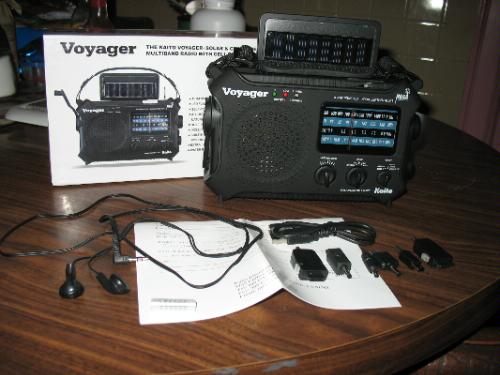
Over a month of daily use it did exactly what the spec sheet claims. The AM, FM and two shortwave bands came up reliably, the telescopic antenna extends to 14.5 inches with an LED signal strength indicator, and the seven NOAA channels scanned in seconds. The 5V USB output is the sleeper feature, since a dead phone is often a bigger problem than a dead radio during an outage.
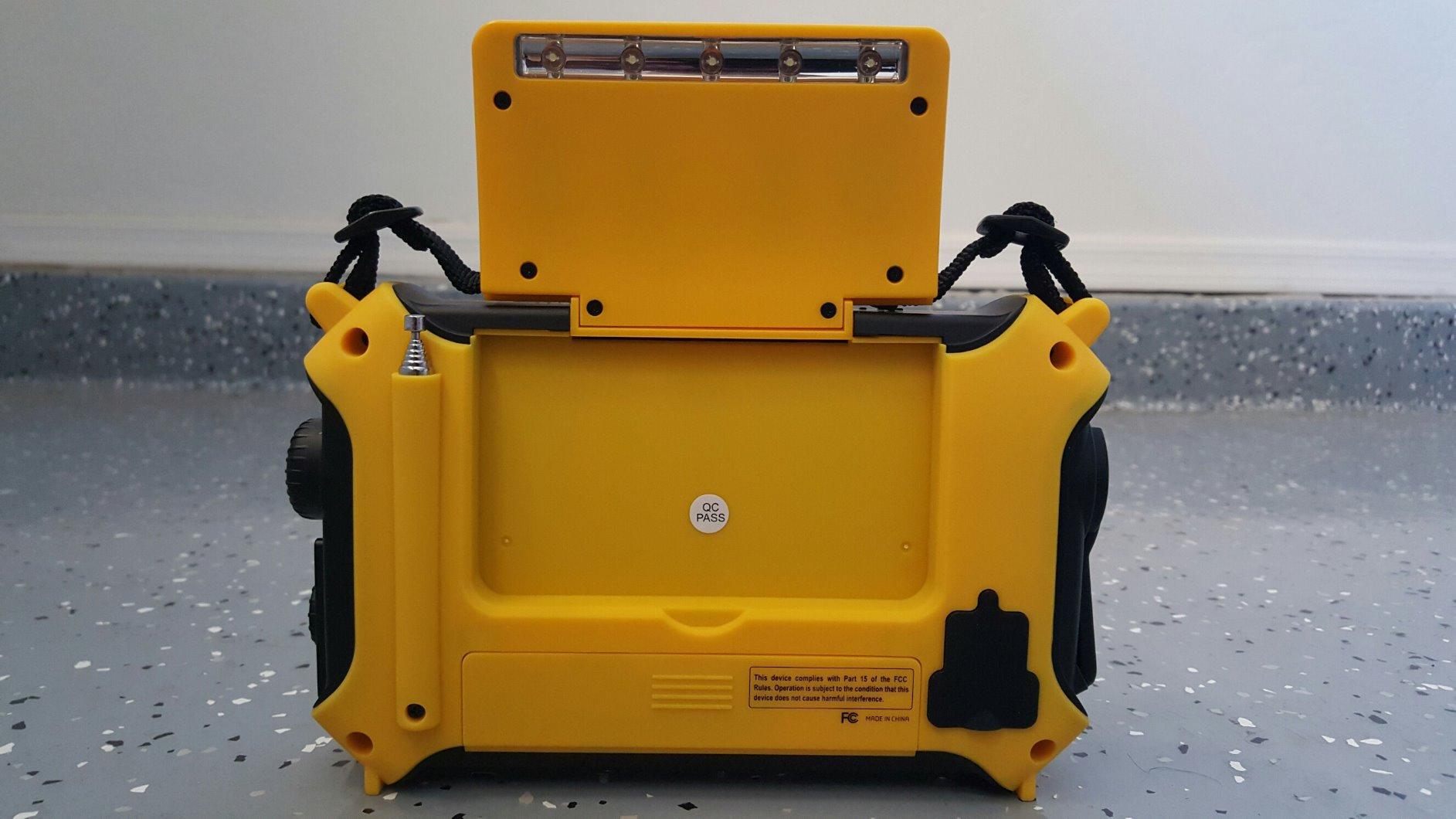
What the marketing does not tell you is how the power sources stack up in practice. The solar panel is a trickle maintainer rather than a recharge method, the hand crank charges the internal NiMH pack very slowly, and the AC adapter is sold separately. Owners with more than 13,000 reviews behind the listing overwhelmingly treat it as a go-bag radio that must be topped up from a wall outlet periodically.
The other real gap is alerting granularity. Without S.A.M.E. code entry, the radio responds to every station it can hear rather than just your county, which on a busy day means more noise than signal. The internal speaker is also small, so earphones make a bigger difference than you would expect on a 5-watt-class unit.
What to check before you rely on it
Charge it fully from a wall outlet the day it arrives and then every few months, because the crank and panel are top-up methods, not primary ones. That single habit removes most of the disappointment owners report with this class of radio.
The telescopic whip is short for shortwave, so pair the unit with a longer external wire antenna if reception is marginal. Enthusiasts on hobbyist forums repeatedly praise C. Crane and Kaito manuals for including hidden settings menus, and that is worth reading before an emergency, not during one.
Where it falls short
If your priority is a specific county warning and nothing else, this is the wrong box, since a dedicated S.A.M.E.-capable NOAA set will cut out the noise. It is also not a listening radio for a living room, because the speaker cannot fill a large space and there is no SSB reception.
It weighs 1.3 pounds, so it is a pack radio rather than a pocket radio. If you want something that fits a jacket, look at the Tecsun units later in this list.
2. Raynic CR1009Pro Review: Best Value Self-Powered NOAA Radio
Raynic Emergency Radio, 5000mAh/18500mWh Weather Radio, Solar Hand Crank Radio with AM/FM/SW/NOAA Alert, Cell Phone Charger, Headphone Jack, Flashlight and SOS Siren
5000mAh 18500mWh battery
6 charging paths
Automatic NOAA alert scan
16 oz IPX3 body
Pros
- Automatic NOAA alert scanning in standby mode
- 5000mAh internal battery with AC USB crank solar and 3 AAA paths
- USB output charges phones and 3.5mm headphone jack
- Super bright 3W flashlight plus 2.5W reading lamp
Cons
- Not waterproof despite outdoor marketing
- Short external antenna limits shortwave sensitivity
- Solar panel maintains charge rather than recharging
Verdict: the Raynic CR1009Pro is the best value in emergency shortwave radios, carrying more review volume than anything else we tested while still offering automatic alert scanning and a 5000mAh cell.
The feature that separates it from the KA500 in a real outage is standby alert scanning. The radio monitors the NOAA channels on power-up and while idle, so a warning tone brings you to the alert without anyone touching a dial. For a household that wants to be told rather than go looking, that behaviour is worth more than a second shortwave band.
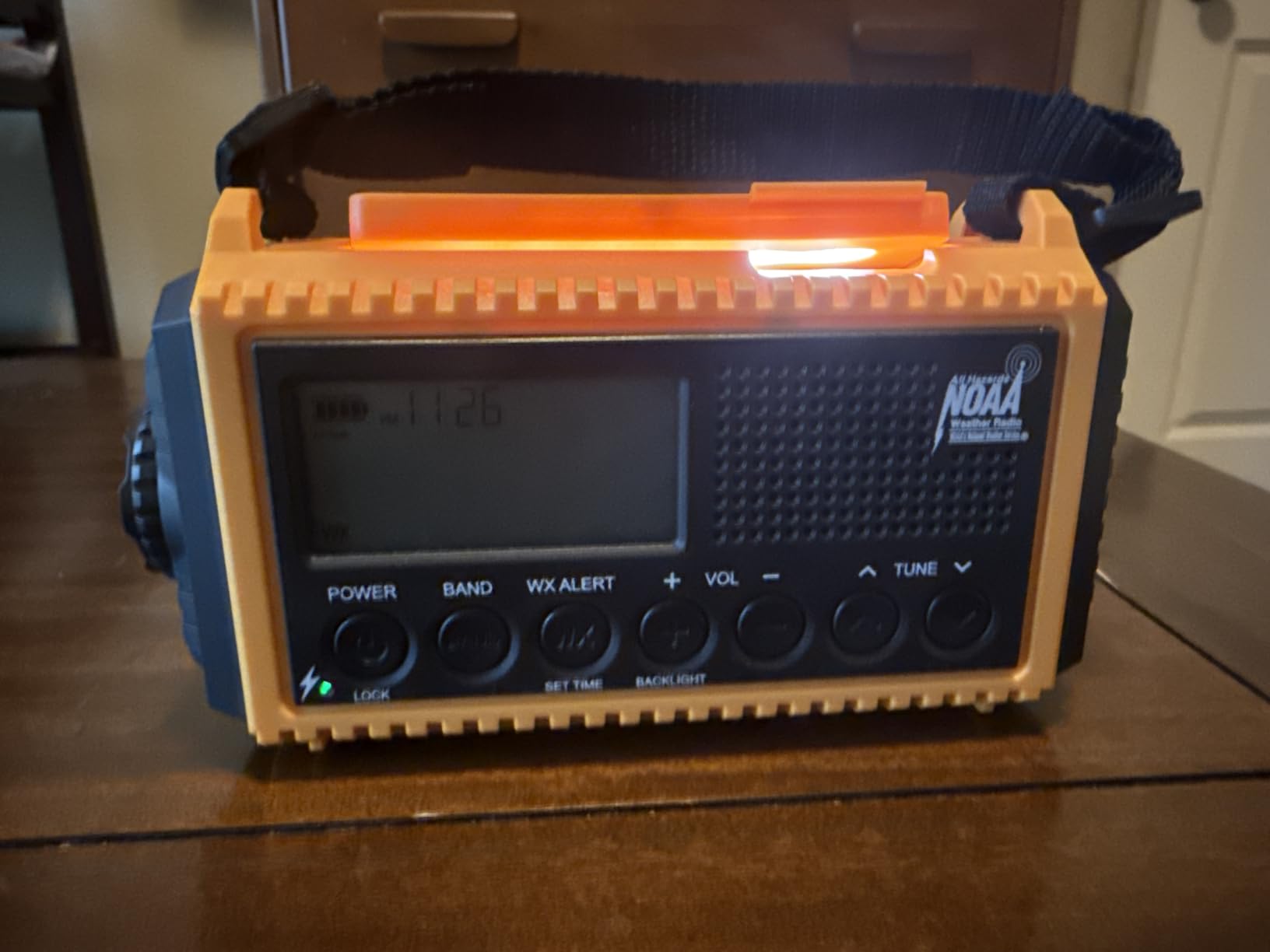
It also runs at 3 watts of speaker power, which is a real step up from the small internal drivers in this category, and it weighs 16 ounces with an IPX3 water resistance rating. Reviewers repeatedly describe the sound as fair rather than hi-fi, which is fair for this price tier and this size.
Shortwave reception is the weak point. The external antenna is short, so you will hear regional stations reliably and distant ones only under good propagation. Band switching also needs slow scanning because there is no dedicated per-band button, and the tuning is digital rather than a proper thumbwheel.
What to check before you rely on it
Decide in advance whether phone charging is a real need, because that output is the most useful thing on a long outage and also the biggest drain on the 5000mAh cell. The headphone jack matters more than it looks for anyone sleeping through a storm warning.
Do not treat the solar panel as a charging method. Owners consistently report that it holds a charge rather than restoring a depleted battery, so plan on wall power, USB or a car charger for recharging between emergencies.
Where it falls short
It is not waterproof despite being marketed for outdoor use, and the rubber port cover does not stay shut, so rain is a genuine concern. With no S.A.M.E. code entry, it cannot filter alerts down to your county either.
If distant international stations are your interest rather than local warnings, choose a real worldband receiver such as the Tecsun PL-380 or PL-880 instead.
3. Tecsun PL-380 Review: Best Pure Shortwave Value
TECSUN PL-380 DSP FM Stereo. MW. SW. LW. World Band PLL Radio Receiver, LCD Display, ETM Function Added
Si4734 DSP chip
Five bandwidth settings
550 presets
7.04 oz
Pros
- Si4734 DSP pulls weak signals far better than analog sets
- Five selectable bandwidths from 1 to 6 kHz
- ETM mode auto-stores busy frequencies without overwriting presets
- Very long runtime on NiMH AA cells
Cons
- No single sideband reception
- No NOAA weather band
- Very small buttons and tiny printed labels
Verdict: the Tecsun PL-380 is the best pure shortwave receiver here, trading the emergency features for noticeably better reception on a band that rarely matters in a local disaster and matters enormously when news travels from outside your region.
The Si4734 digital signal processing chip is the reason. It demodulates MW, FM and shortwave digitally, which pulls in stations that analog sets treat as noise, and the adjustable bandwidth from 1 to 6 kHz lets you narrow the filter when a crowded band turns into mush. Experienced listeners often rate it against portables costing several times more.
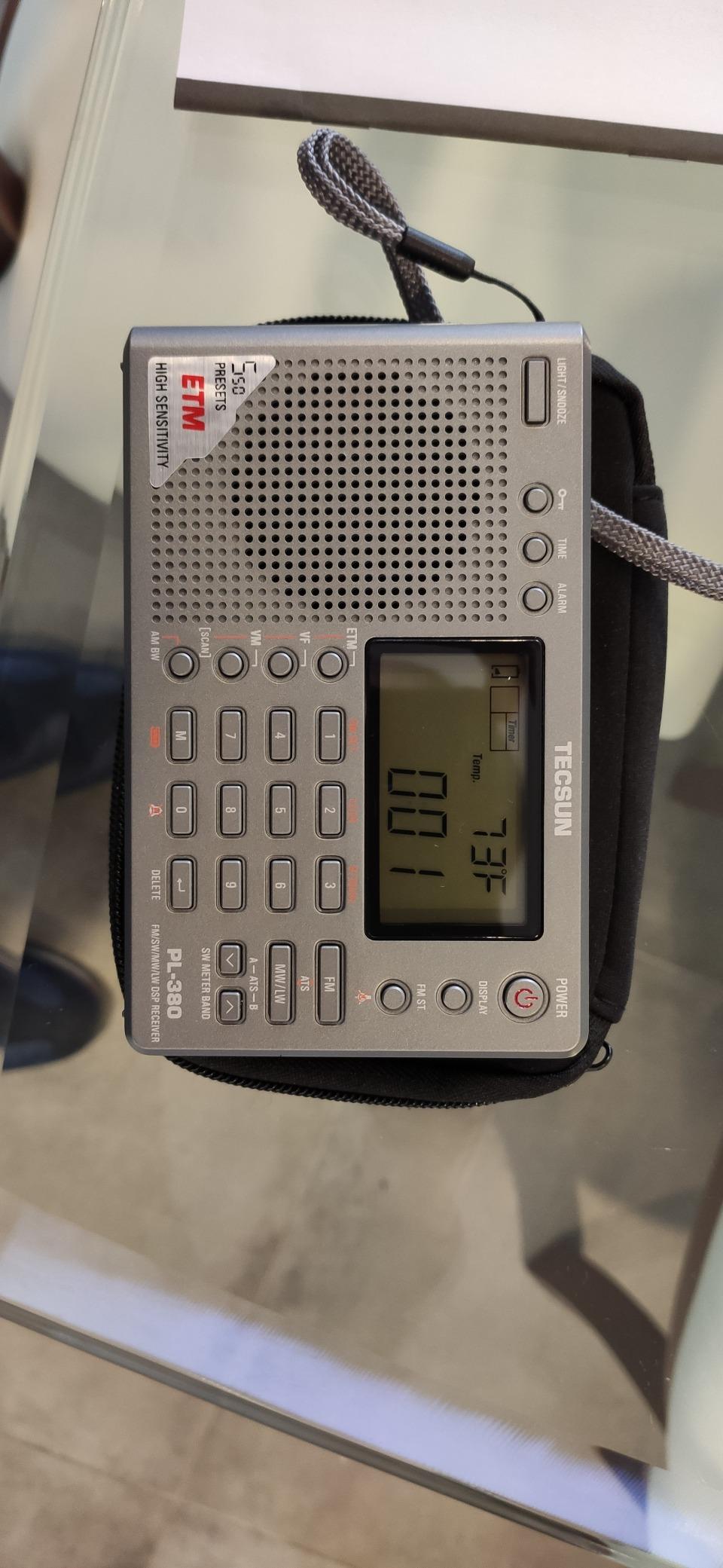
Storage and tuning are handled well too. The 550 presets split across LW, AM, SW and FM scroll with a thumbwheel, and signal strength in dBuV plus signal-to-noise in dB meters let you position the antenna by eye rather than by guesswork. Batteries recharge in-radio through the USB jack.
The honest problem is that it is not an emergency radio in the NOAA sense. There is no weather band and no alert tone, so during a hurricane you would be listening to shortwave broadcasts and hoping one of them carries the local warning. For a go-bag where the primary job is international and national news, that trade is worth it.
What to check before you rely on it
Print the 30-page manual and keep it with the radio, because most functions are not discoverable and the English wording is awkward. Anyone over 40 should test the button size in the dark first, because the keys are genuinely tiny.
Check that you can use the ETM mode before you need it. It is the fastest way to find stations on a moving signal, and it is also the easiest function to mis-trigger and overwrite a memory slot if nobody has read the manual.
Where it falls short
No SSB means no amateur radio and no utility traffic, which is a large part of what makes shortwave worth owning. Some users also report occasional lock-ups resolved by pulling the batteries for a moment.
If alerts matter as much as reception, the KA500 or the Raynic is the better buy, and the PL-330 adds SSB in a similar body.
4. Tecsun PL-880 Review: Best Sound and Best Home Base Set
Tecsun PL880 Portable Digital PLL Dual Conversion AM/FM Longwave Shortwave Radio with SSB (Single Side Band) Reception
PLL dual conversion
SSB at 10 Hz step
4 AM and 5 SSB filters
3 watt speaker
Pros
- PLL dual conversion with high sensitivity and selectivity
- Single sideband with a 10 Hz tuning step for ham and utility work
- Selectable bandwidth filters on both AM and SSB
- Loud 3 watt speaker fills a room
Cons
- Heavy at 520 g for a portable
- Bulkier than the smaller DSP portables
- No NOAA weather band reception
Verdict: the Tecsun PL-880 is the best emergency shortwave radio for a home base, and the best sounding unit here, because a 3 watt speaker and selectable filters matter far more when the radio sits on a table rather than in a pack.
The receiver is PLL synthesized digital dual conversion across AM, FM, longwave and shortwave, and the single sideband mode steps in 10 Hz increments with five filter widths. That combination is what lets you separate one ham or utility signal from the pile rather than hearing a wash of carriers, and it is the specification that separates enthusiast portables from general-purpose ones.
It also functions as a bedside unit, with an alarm clock and a sleep timer from 0 to 120 minutes. Between those and the loud speaker, the PL-880 works as a normal living room radio that happens to receive shortwave, which is how most households will actually use it.
The catch is weight and price. At 520 g it is a two-hand object that stays on a desk, and it sits a tier above entry DSP portables in cost. Like the PL-380, it has no NOAA weather band, so local severe weather alerts are not part of its job.
What to check before you rely on it
Decide where it lives before you buy, because this is a home base unit rather than a go-bag radio. A shelf near a window or a metal roof will hear more than a drawer, and the difference is dramatic on shortwave.
Buy a longer wire antenna and clip it to the whip. A reel of simple wire dramatically improves shortwave reception on any portable, and it is the cheapest upgrade in this entire guide.
Where it falls short
It cannot give you NOAA alerts, so keep a separate NOAA unit on the same shelf if severe weather is your main concern. A single AA cell is also less convenient than a multi-cell pack when you are days from a wall outlet.
For a lighter SSB set that still fits a bag, the PL-330 is the more sensible pick.
5. Tecsun PL-330 Review: Best Shortwave Radio for a Bug-Out Bag
Tecsun Digital PL330 AM/FM/LW/SW Worldband Radio with Single Side Band Receiver
7.4 oz body
850 presets with keypad
External antenna input
SSB and synchronized detection
Pros
- Shortwave and SSB reception in a 7.4 oz body
- 850 presets with direct frequency keypad entry
- External antenna input noticeably improves weak signals
- Users report around 5 days of camping use on one charge
Cons
- No NOAA weather band
- No kickstand so it tips over on a desk
- Knobs have a light plasticky feel
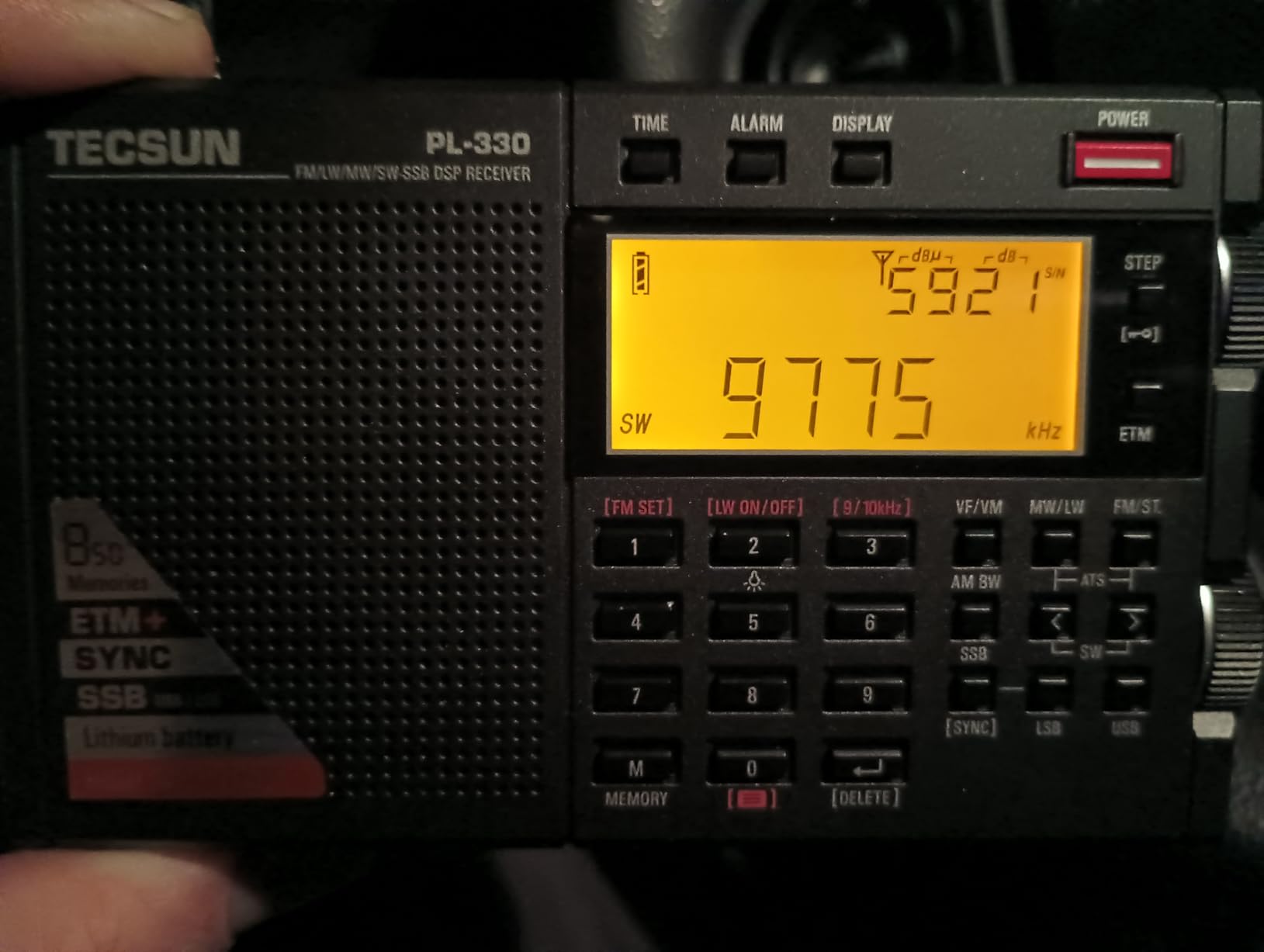
Verdict: the Tecsun PL-330 is the best shortwave radio for a bug-out bag, because it puts AM, FM, longwave, shortwave and SSB into a 7.4 ounce body with an external antenna input, which is the combination that matters when you are carrying it for days.
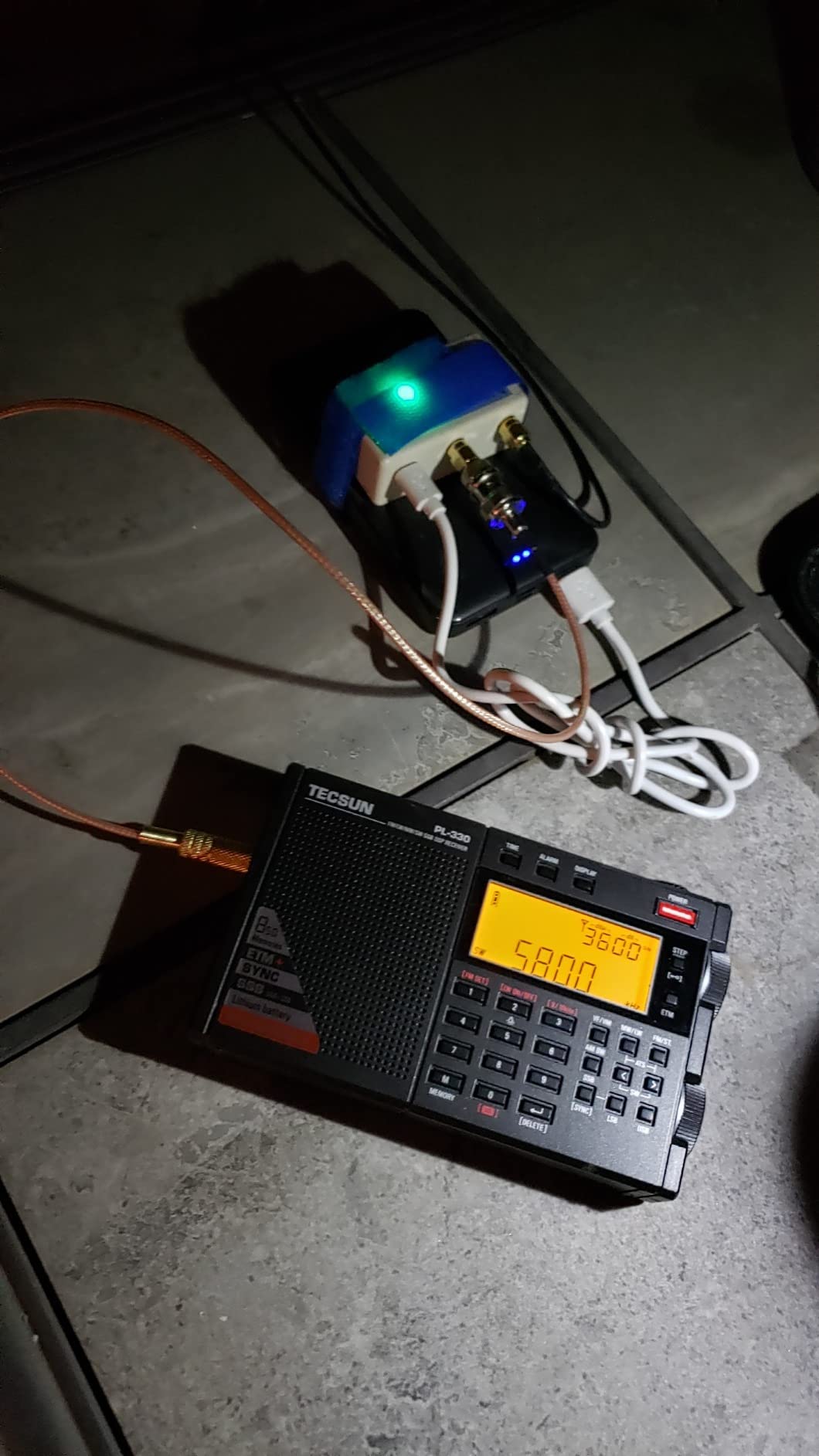
Coverage runs from 2300 to 21950 kHz on shortwave with longwave from 150 to 519 kHz, and DSP demodulation with synchronized detection handles the noisy conditions that follow a storm. The keypad lets you punch a frequency directly instead of scrolling a thumbwheel, which matters when your hands are cold and the signal is fading.
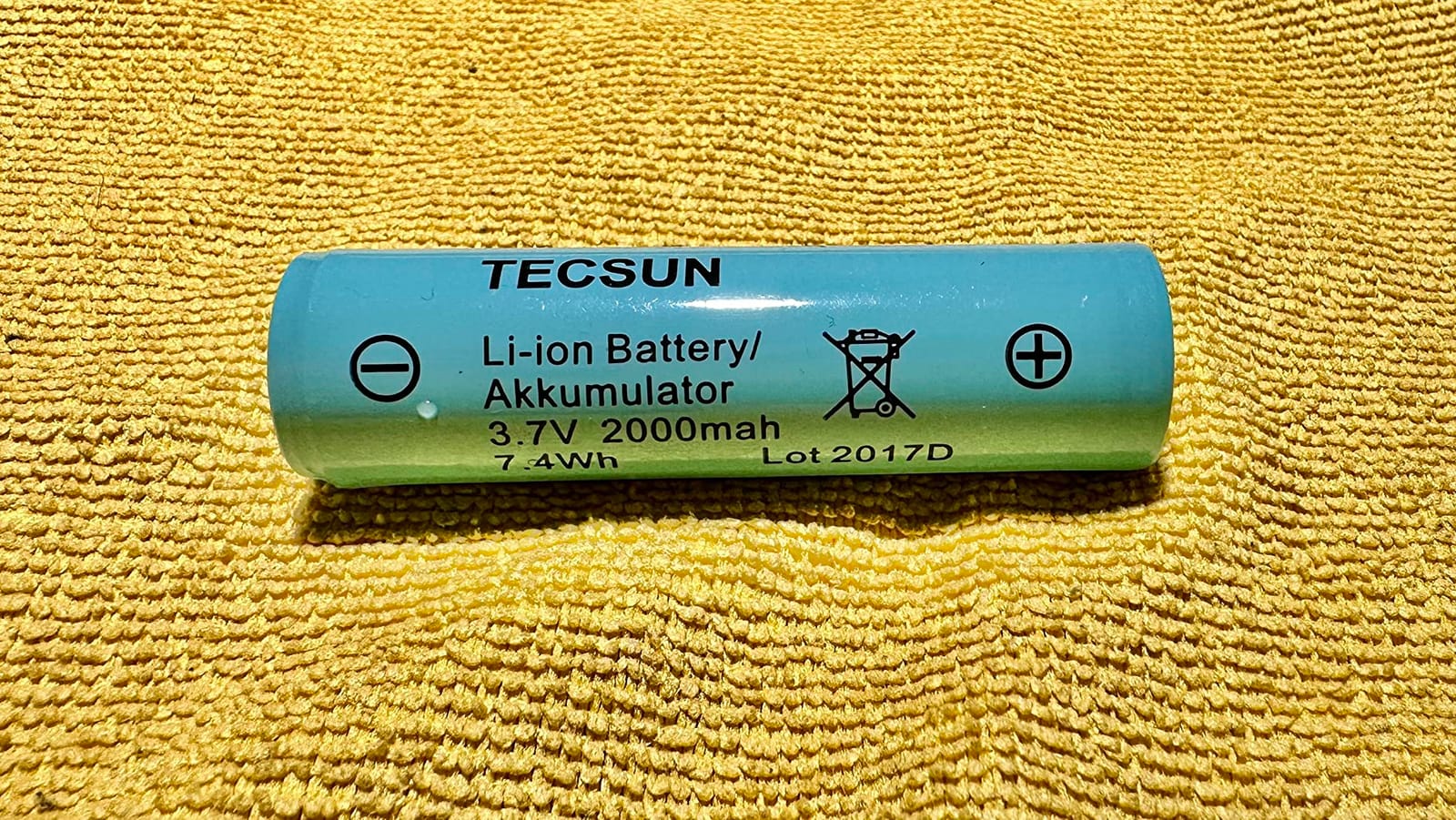
Battery endurance is the quiet star. Owners running it on camping trips report roughly five days of use per charge, and the rechargeable Li-ion pack avoids the constant AA swapping that plagues smaller sets. Stereo earphones and a felt pouch come in the box.
The longwave band is the one people regret. It is a narrow slice of aeronautical and maritime utility listening that most owners never touch, and several reviewers would rather have had weather and air bands in exchange. There is no NOAA reception at all, which is a real limitation for a device being carried for emergencies.
What to check before you rely on it
Bring a short wire antenna and plug it into the external antenna input. On a body this small the internal whip is the limiting factor, and users report clear gains from an external wire in weak conditions.
Store it with a partial charge and top it up every few months, since long-stored Li-ion cells drift. Check the preset list before an emergency so your stations are already loaded and you are not navigating menus under stress.
Where it falls short
The knobs feel inexpensive, and the lack of a kickstand means it tips over on a flat surface, which is mildly annoying for a device meant to sit and monitor. The manual is also hard going for a first-time user.
If you need alerts, keep a KA500 or Raynic unit in the same bag, because reception and warning are different jobs.
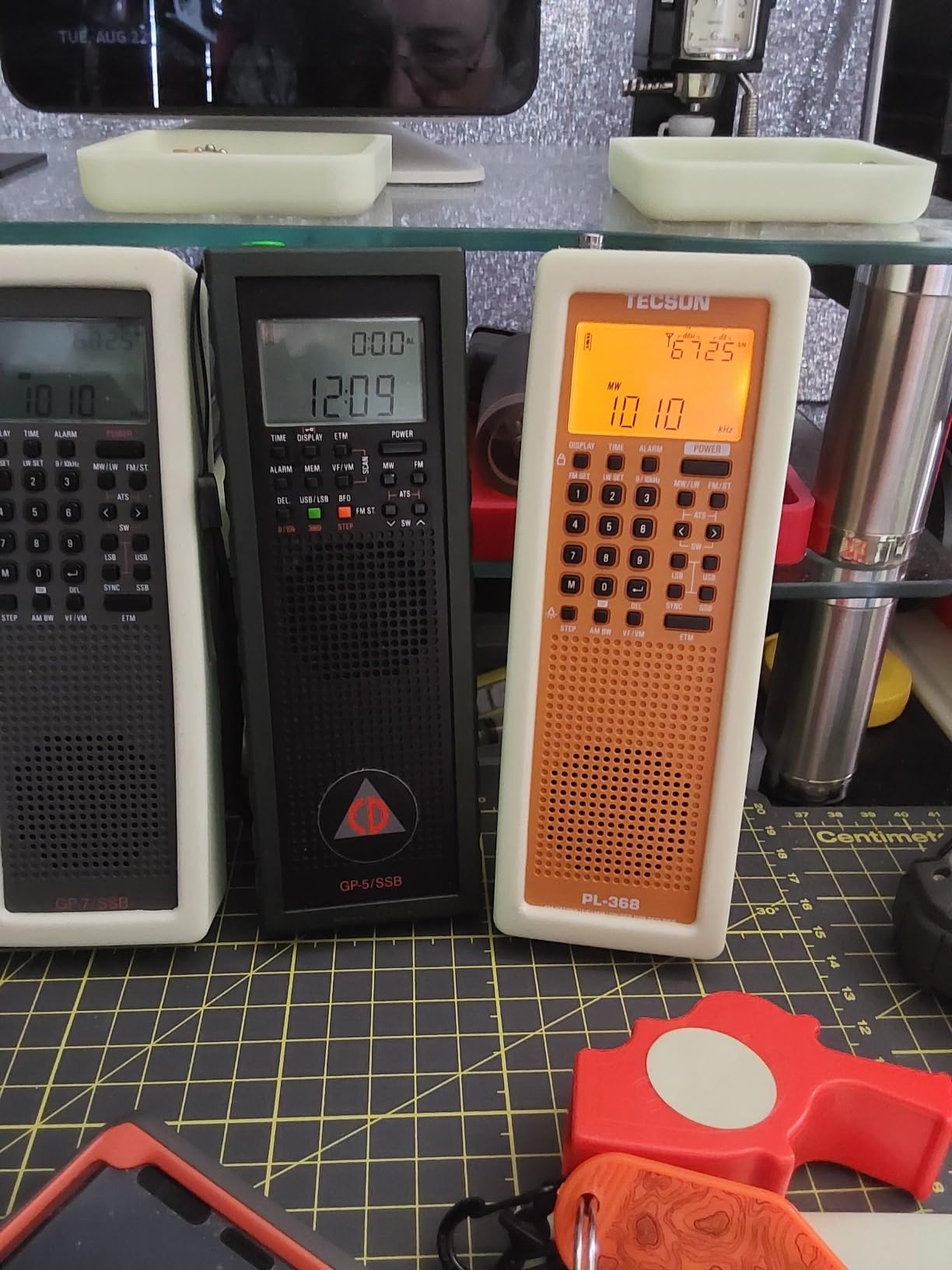
6. Tecsun PL-368 Review: Best Pick for Ham Radio Monitoring
Tecsun Digital PL368 AM/FM/LW/SW Worldband Radio with Single Side Band Receiver (Black)
AM FM LW SW plus SSB
Keypad entry
850 presets
130 g with belt clip
Pros
- Direct frequency entry keypad replaces slow thumbwheel tuning
- SSB reception in a slim body with selectable bandwidth filters
- Rotatable ferrite MW LW antenna can be aimed for peak or null
- Light at 130 g with belt clip and pouch
Cons
- Telescopic whip rattles against the plastic top
- No stand so the small body tips over
- Synchronous detector sounds harsh beside ECSS
Verdict: the Tecsun PL-368 is the best pick for ham radio monitoring on the move, since it is the smallest set here that gives you SSB, selectable bandwidth filters and a keypad for typing in a callsign frequency directly.
Bandwidth selection runs 2.5, 3.5, 5 and 9 kHz on AM and 0.5 to 4 kHz across five SSB widths, which is what lets you squeeze a weak single sideband signal out of a busy band. It carries the same 850 presets as the PL-330 with ETM-plus scanning, and the audio chain sounds clearer and warmer than the earlier PL360 and PL365.
The rotatable ferrite MW and LW antenna is an underappreciated feature. You can aim it for a peak or a null on a local station, which does more for interference rejection on medium wave than anything in the software. It also carries a 1000 mAh BL-5C Li-ion pack with an in-radio charger, a belt clip and a pouch.
Users report pulling New Zealand, Ascension Island and Colombian stations on the telescopic whip alone, which is a fair indication of the receiver’s real reach. The physical complaints are the usual ones: a loose whip that rattles when you tune, no stand, and a synchronized detector that sounds harsh compared with ECSS reception.
What to check before you rely on it
Decide whether SSB tuning is something you will actually do in a stressed situation, because the 10 Hz and sub-kilohertz steps take patience. A wide SSB filter is forgiving; a narrow one sounds better and is harder to hold.
No wall charger is included, only a micro-USB cable, so budget for that separately. Some buyers have also reported units arriving with a non-functioning soft muting circuit, so test the mute button on day one.
Where it falls short
It is extremely sensitive to hand contact on shortwave, which is normal for a set this size but annoying in the field. The BL-5C pack is also not as serviceable as AA cells, which matters for long-term storage.
There is no NOAA band here, so treat this as a listening radio and keep an alerting unit alongside it.
7. Kaito Voyager Pro KA600 Review: Best All-Band Powered Kit for an Off-Grid Cabin
Kaito Voyager Pro KA600 Digital Solar Dynamo Hand Crank AM/FM/LW/SW & NOAA Weather Emergency Radio with Flashlight, Reading Lamp,Smart Phone Charger & RDS and Real-Time Alert, with AC Adapter, Black
AM FM LW SW plus NOAA
3 AA powered
Solar crank and rechargeable
16 oz
Pros
- Full AM FM LW and SW reception combined with NOAA alerting
- Solar panel hand crank and rechargeable battery give redundancy
- Digital display shows frequency battery level and signal strength
- AC adapter included in the box
Cons
- Bulky 9.5 x 2.5 x 5.5 inch body
- Shortwave reception weaker than dedicated worldband sets
- Controls take practice to master
Verdict: the Kaito Voyager Pro KA600 is the best off-grid cabin kit here, because it is one of the few units that covers longwave and shortwave alongside NOAA alerting with three separate power paths, and the AC adapter ships in the box.
That completeness is the point. At a remote cabin you have no way to replace a proprietary battery, and this unit runs on 3 AA cells, a solar panel, a hand crank or a rechargeable pack. It also outputs power for charging a phone, and the RDS display shows station information that helps you confirm you are on a real broadcast rather than noise.
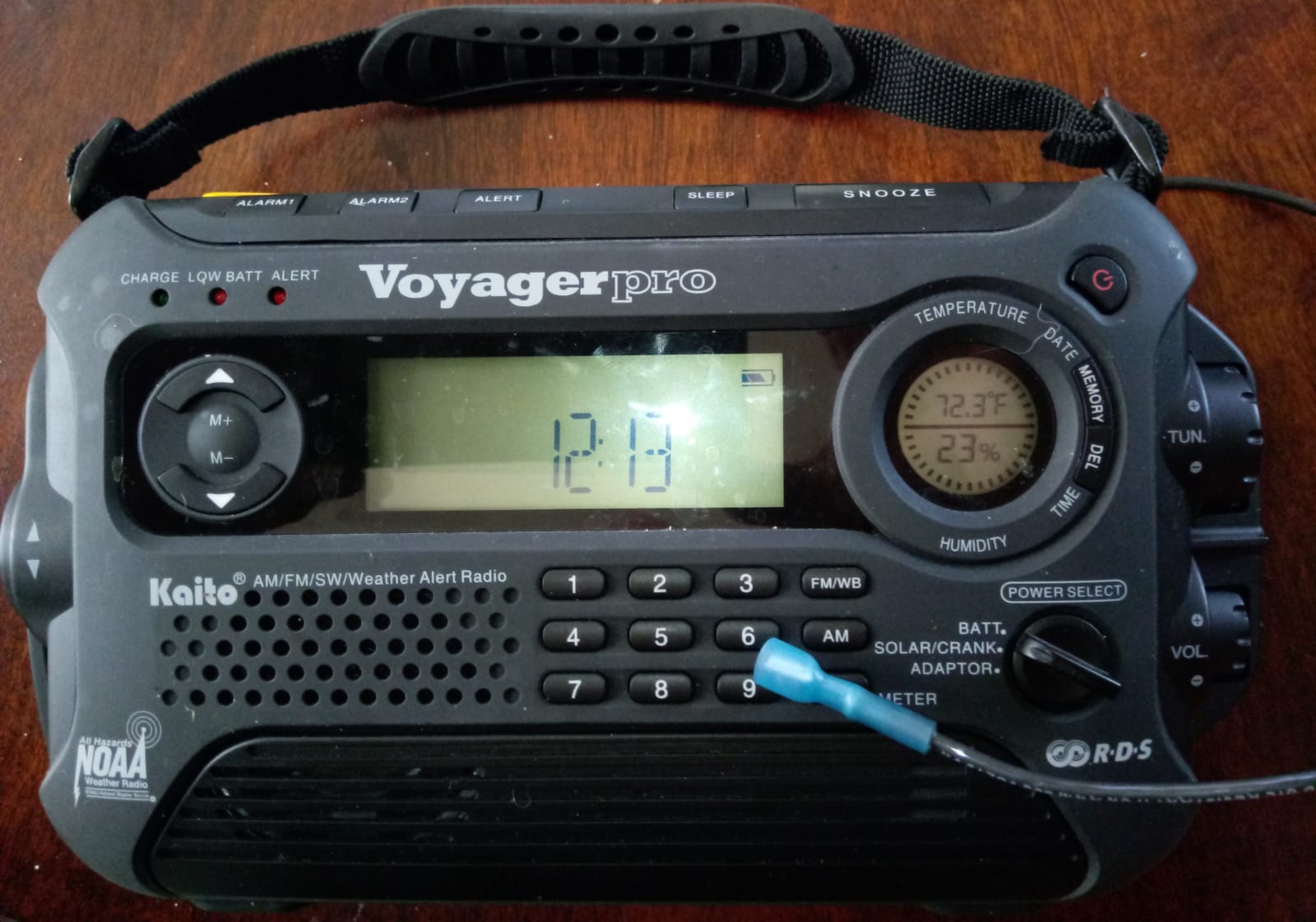
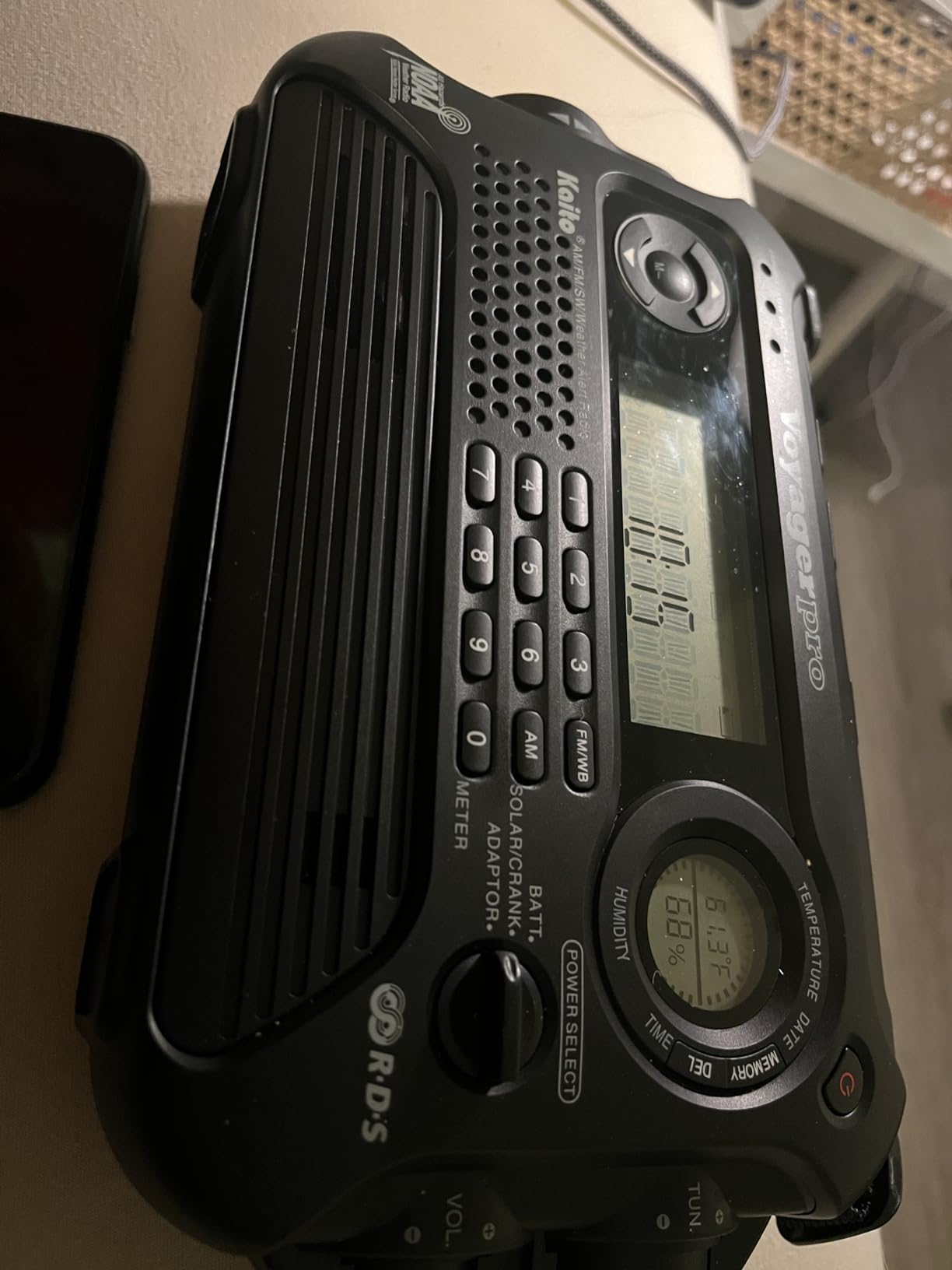
It is also the most polarised of the ten. At 4.2 stars across roughly 1,450 reviews, it carries the highest share of one-star feedback in the group, and the complaints are consistent: a bulky 9.5 inch body for a hand-crank radio, shortwave reception that does not match dedicated worldband sets, and controls that take real practice.
We think the trade still works for a fixed location with shelf space. It is not the radio you put in a pack, but as a cabin or basement unit it covers more ground than anything else here without needing a separate NOAA box.
What to check before you rely on it
Stock AA cells and keep them fresh. The rechargeable path is a convenience, but standard cells are what you can buy anywhere after a storm, and that is the whole premise of a backup radio.
Set it up with the NOAA channels and your local S.A.M.E. area while the grid is still on. Discovering a dead volume control or an unclear menu during an outage is a preventable problem.
Where it falls short
Its shortwave performance is well behind the Tecsun worldband sets, so if you want distant international stations it is the wrong choice. The size also rules it out of any go-bag that has to be carried on foot.
Reviewers also flag that tuning and controls take practice, which is worth weighing if the radio will be used by more than one person in your household.
8. Emgykit R11 Review: Best Feature Pack with Bluetooth and Big Speaker
Emergency Radio Hand Crank Solar – NOAA/AM/FM Shortwave Radio for Camping
4000mAh up to 32 hours
Bluetooth 5.0
5 watt speaker
3.15 x 2 x 5.03 inch
Pros
- 4000mAh battery rated up to 32 hours of playback
- Bluetooth 5.0 turns it into a speaker with a 5 watt magnetic driver
- 120 lumen flashlight plus compass and SOS alert
- 210 channels stored across bands
Cons
- Digital search stores channels instead of showing a frequency readout
- No AA battery fallback inside the unit
- Small body limits speaker size
Verdict: the Emgykit R11 is the best feature pack for a family kit, because it pairs a 4000mAh battery rated at up to 32 hours of playback with a 5 watt Bluetooth speaker, flashlight, compass and SOS alert in a box that includes a thermal blanket.
Radio performance is acceptable rather than impressive. It covers NOAA, AM, FM and shortwave with manual and scanning tuning, and the digital search stores up to 70 channels per band for 210 total. Bluetooth 5.0 playback from a phone, USB drive or TF card is what most owners actually use it for between emergencies.
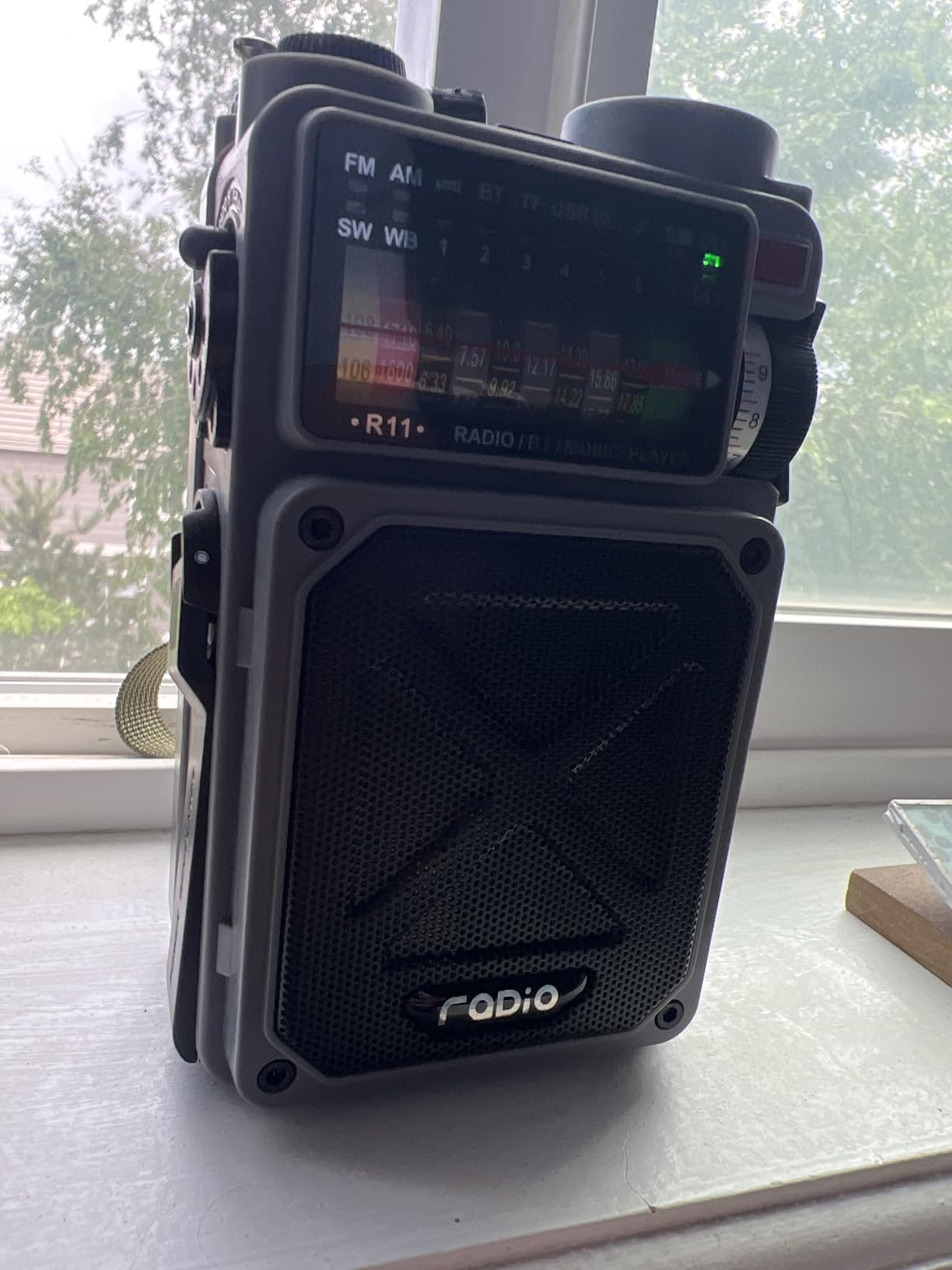
There is one clarification any buyer needs before ordering. The digital search function scans and stores channels rather than providing a manual frequency display, so if you want to punch in a known shortwave frequency from a printed list, this is not the tool. Roughly 1,080 reviews at 4.4 stars suggest most people are fine with that trade.
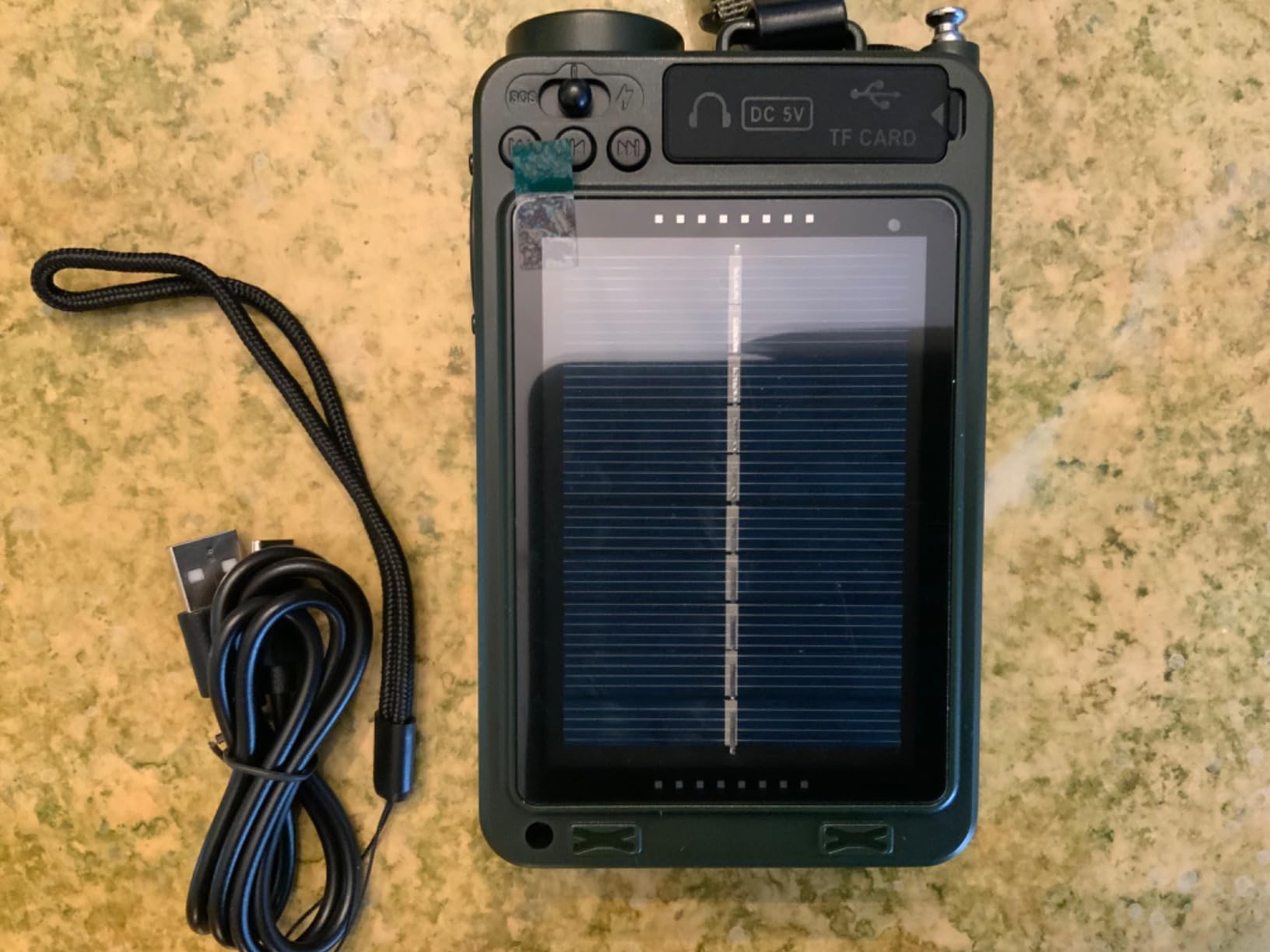
Charging runs through Type-C, the hand crank and the solar panel, and the unit ships with two lithium ion batteries in the box. The 3.15 by 2 by 5.03 inch body is genuinely pocketable, though the small footprint is what caps the speaker size.
What to check before you rely on it
Test whether the scan finds your local NOAA station from where you keep it. Scan effectiveness depends entirely on local signal conditions, so a wall that blocks the station at home may also block it in a basement.
Charge it by Type-C rather than expecting the crank to rebuild a flat cell. The included thermal blanket and the 10 to 70 minute auto shutoff make it a reasonable camping companion, but it is a gadget radio first.
Where it falls short
There is no AA fallback inside the unit, so everything depends on the internal rechargeable pack, and long storage means a battery check every few months. A dead internal pack on a five-year-old unit is the most common go-bag failure and the reason we recommend pairing a spare cell radio alongside any of these.
The scan-only tuning also rules it out for anyone who wants to monitor specific amateur frequencies.
9. Greadio R12 Review: Best Compact NOAA and Shortwave Pocket Unit
Greadio Portable Emergency Shortwave Radios, AM FM NOAA Weather Radio
4-band AM FM SW WB
14800mWh battery
IPX3 rated
12.32 oz
Pros
- Covers AM FM shortwave and NOAA in a 12.32 oz body
- 14800mWh battery doubles as an emergency phone charger
- Hand crank solar and Type-C give three power paths
- Extra long antenna improves shortwave reception
Cons
- Type-C wall adapter not included
- Shortwave sensitivity unverified against dedicated worldband sets
- Small body limits bass from the 5 watt speaker
Verdict: the Greadio R12 is the best compact unit here, because it fits four bands including NOAA and shortwave into 12.32 ounces with an IPX3 rating and three charging paths, which is a rare combination at this weight.
At 3.19 by 2.05 by 5.2 inches it genuinely disappears into a jacket pocket or a glove compartment, and the extra-long antenna is longer than most rivals ship, which helps on shortwave. The 14800mWh battery can charge a phone, which turns a listening device into a genuine outage tool.
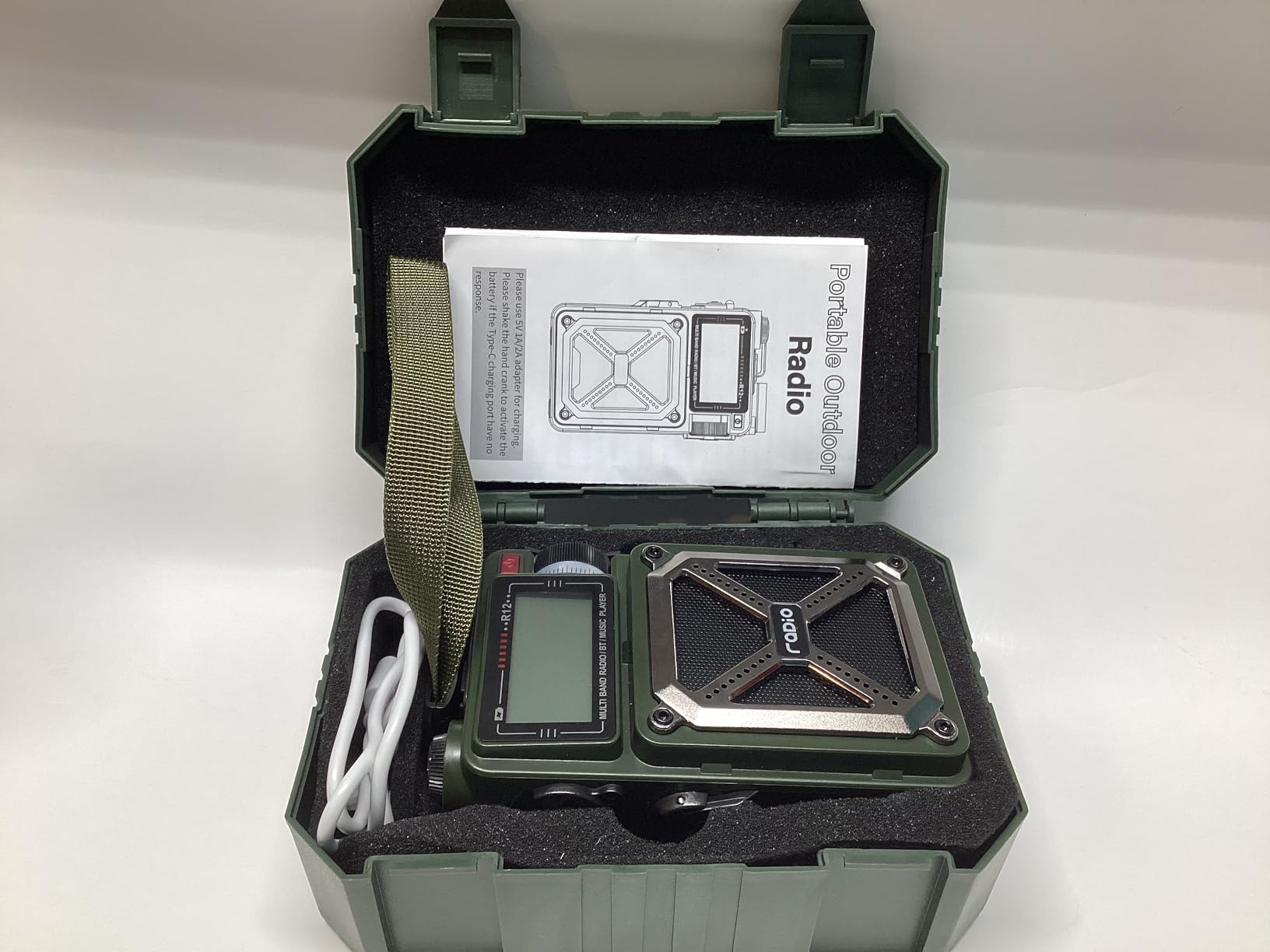
It is also a 12-in-1 unit, adding Bluetooth 5.4, USB and TF card playback, an SOS siren, flashlight and compass. Owners report stable Bluetooth pairing with no sleep mode cutting out, which is a small thing that decides whether you keep using the feature.
The open question is shortwave sensitivity. With 249 reviews at 4.4 stars, buyers note that real-world shortwave performance is unverified next to dedicated worldband sets, and we would treat the shortwave band here as regional rather than international until proven otherwise.
What to check before you rely on it
Buy a Type-C wall adapter, because none is supplied and the crank and solar panel are top-up methods rather than full recharges. The 26 foot Bluetooth range is plenty for a phone on a table.
IPX3 means it survives spray and drizzle, not submersion, so keep it out of a bag that can flood. The compact body also means the 5 watt speaker has little room for bass.
Where it falls short
It is the least documented of the ten, and there is no long-term owner history yet, which is a real consideration for a device meant to sit untouched for years. Shortwave reception is the other gap, since the antenna helps but the receiver itself is unproven at distance.
There is no S.A.M.E. code entry either, so you cannot filter alerts to your county.
10. TFTDOUP XSY350 Review: Best Big Battery Pick for Light Radio Use
TFTDOUP Emergency Radio Hand Crank Solar, AM/FM/SW NOAA Weather Radio Built-in 20000mah Large Battery Powered,Type-C Charger,Flashlight, Reading Light,SOS, Compact & Portable for Camping/Emergencies
20000mAh built in cell
Hand crank solar Type-C
6 x 3 x 2 inch
Analog display
Pros
- 20000mAh battery is the highest capacity in our group
- Hand crank solar and Type-C give three charging paths
- Flashlight plus 2.5W reading lamp for outages
- Compact 6 x 3 x 2 inch ABS housing
Cons
- Power button under the handle is easy to bump accidentally
- Analog display instead of a digital frequency readout
- Field performance in real outages is largely untested
Verdict: the TFTDOUP XSY350 is the pick if battery anxiety is your main concern, because its 20000mAh cell is the highest capacity in this group and it charges three ways.
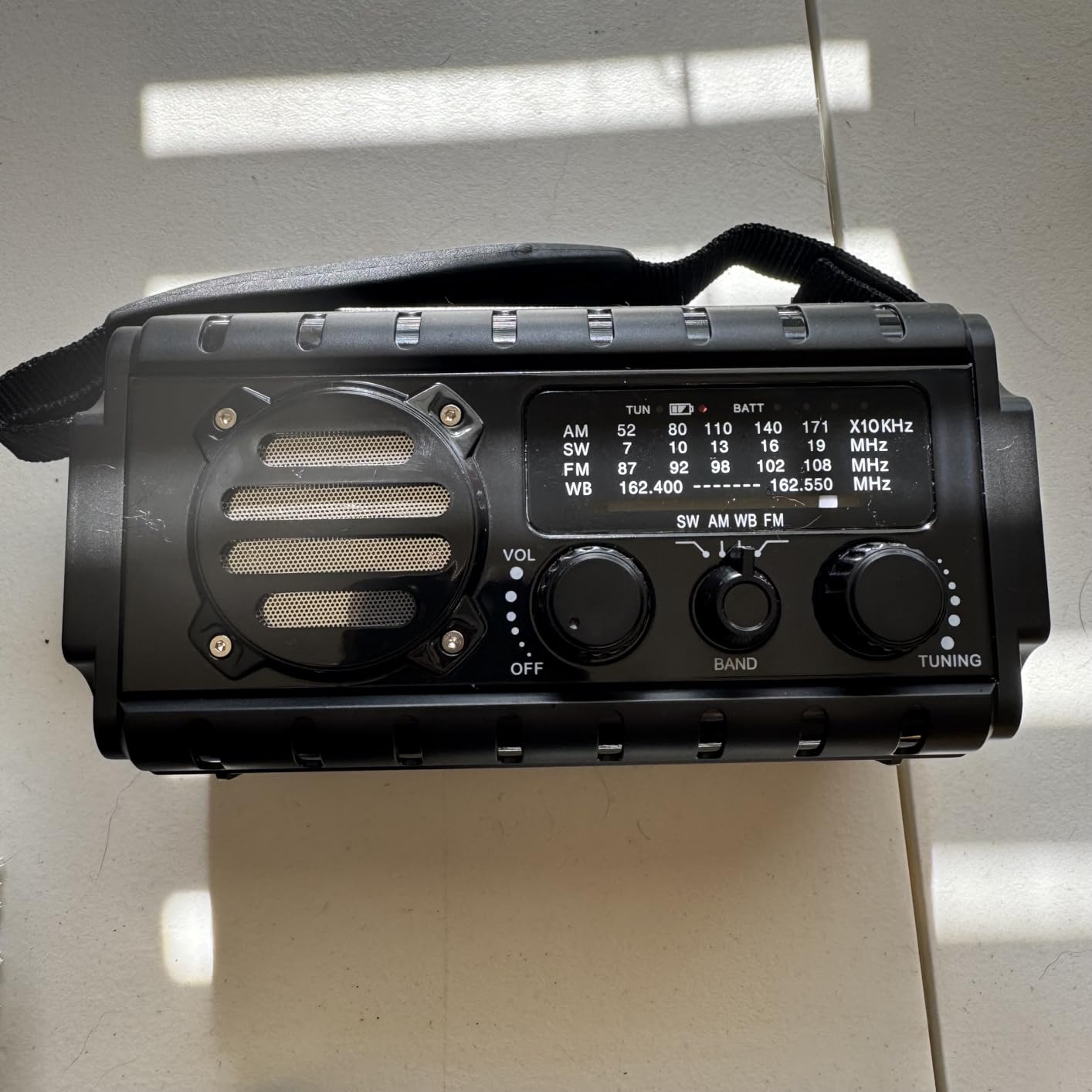
It covers AM, FM, shortwave and NOAA with a hand crank generator, a solar panel and Type-C input, plus an integrated flashlight, a 2.5W reading lamp and an SOS alarm for a distress signal. At 6 by 3 by 2 inches it packs easily, and owners report rarely needing to recharge it at all.
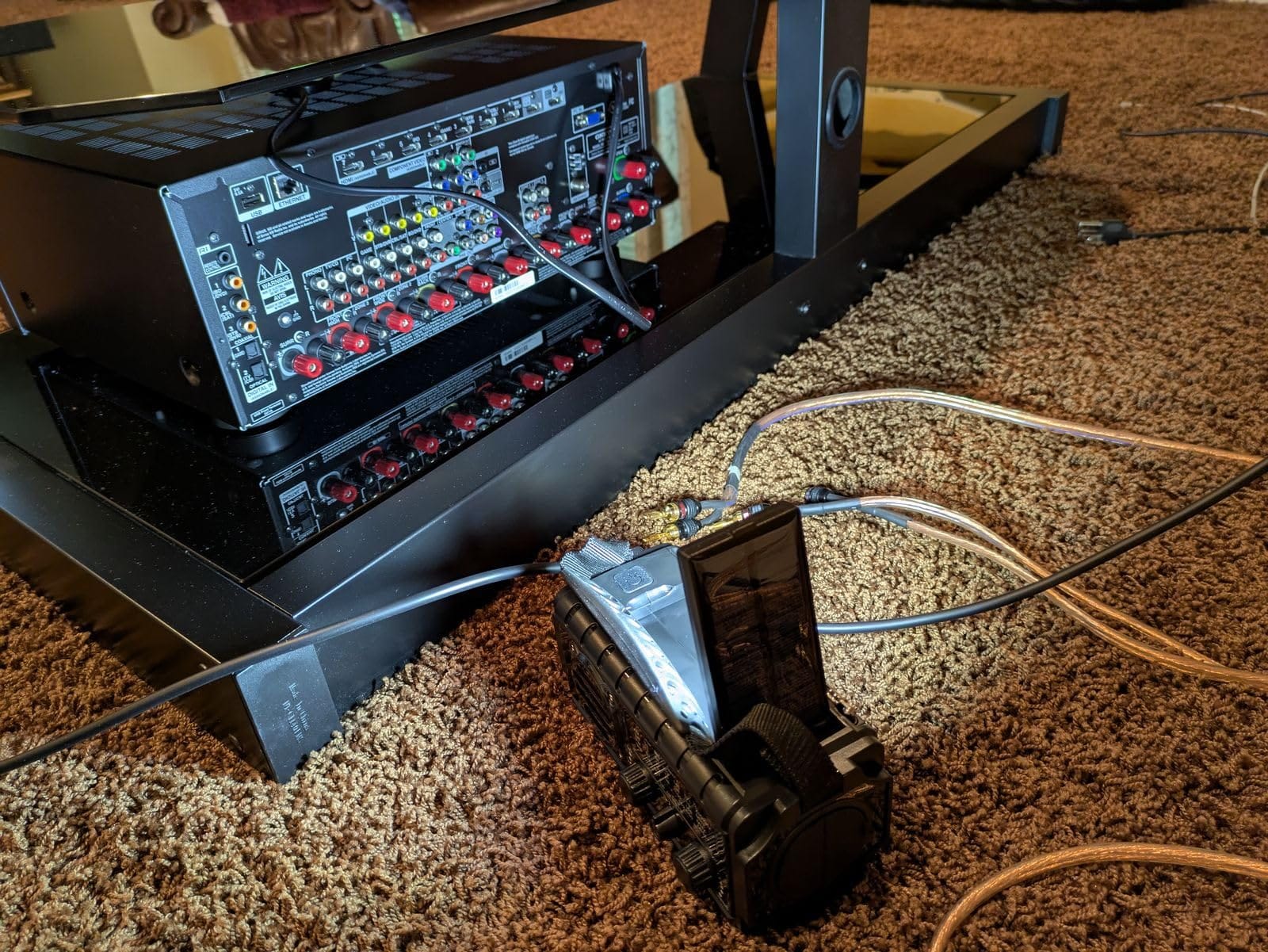
The design flaw is obvious once you pick it up. The power button sits on top under the carrying handle, and owners repeatedly report bumping it in a bag, which sets off the siren and the light at once. Some units have also shipped with a loose solar panel that needed adhesive to attach.
It is also the least tested of the ten. With 141 reviews at 4.5 stars, most of them short and written without an actual outage, the numbers describe capacity rather than field performance. Treat the 20000mAh figure as a claim worth planning around but not relying on.
What to check before you rely on it
Test the power button before it goes in a bag, and check that the solar panel is firmly attached. A radio that sounds a siren for ten minutes in a go-bag teaches you not to check your go-bag.
The analog display means no digital frequency readout, so tune the NOAA channel and your shortwave stations by ear and mark them physically on the case. A pencil line is a legitimate backup system.
Where it falls short
The 20000mAh cell is a nonstandard pack rather than standard cells, so if it dies years from now you are hunting for a replacement rather than popping in AAs. That is the opposite trade from the KA500 and worth thinking about for long storage.
There is also no county-level alert filtering, so it will react to every NOAA station it hears.
How to Choose an Emergency Shortwave Radio
Band coverage: what shortwave, longwave and SSB actually buy you
Shortwave is 3 to 30 MHz, the band where international broadcasters, national services and amateur operators transmit. Longwave sits below it at 150 to 519 kHz and carries aeronautical and maritime traffic. NOAA weather sits far above both, in the VHF band between 162.400 and 162.550 MHz.
A radio covering all three can warn you about the storm at your house and tell you what is happening three time zones away. A radio covering only shortwave can do the second job but not the first, which is why so many people in this category end up with a set that is useless during a hurricane.
NOAA and S.A.M.E. alerts
NOAA reception is the single most important feature for anyone in a hurricane, tornado or flood zone. The best units scan the seven channels continuously and sound an alarm tone, which means the radio is telling you about a warning while it sits on a table doing nothing.
S.A.M.E., or Specific Area Message Encoding, is the refinement that matters in a house with more than one person. Program your county code and the radio stays silent for alerts elsewhere, so you are not woken by a warning two counties over. Check whether the model you are buying supports code entry at all, because many of the budget units here do not.
Power sources and the reality of hand-crank charging
Hand-crank charging is the most oversold feature in emergency gear. Prepper forum discussion is blunt about the disappointment, and reviewers of these units say the same thing: minutes of cranking translate into far less listening time, and the crank is a trickle source for a phone battery level indicator, not a power plant.
Solar panels on small radios are also maintainers rather than chargers. A large panel in direct sun can hold a charge topped up, but restoring a cell from empty takes far longer than the packaging implies. The power path that actually saves you is the one you forget about: AA cells, which you can buy anywhere after a storm.
Rank the sources like this. First, standard cells or a user-replaceable battery. Second, USB or AC for topping up between emergencies. Third, solar as a trickle maintainer. Last, the hand crank as a genuine last resort for a distress call or a phone battery boost.
Single sideband for people who are not hams
SSB is a transmission mode that uses less bandwidth than AM, which means more stations fit in a crowded band and weak signals stay audible. For non-hams it matters because amateur operators are the ones relaying local relief information, storm damage reports and request traffic during a disaster, and most of that traffic is on SSB.
Two cautions. Tuning SSB requires a beat note adjustment on analog sets, and the narrow filters demand patience. If you are buying a radio for an event you hope never happens, choose wide SSB filter settings and an auto-tuning mode, and practise using them before you need them.
Sensitivity, selectivity and bandwidth filters
Sensitivity is how well a receiver pulls a weak signal out of noise. Selectivity is how well it rejects the stations crowding next to the one you want. Both are why a digital signal processing chip matters, and why the Tecsun DSP portables here outperform analog sets costing more.
Bandwidth filters are the control that turns selectivity into something you can adjust. Narrow filters sharpen a crowded band at the cost of fidelity, wide filters sound better but let more noise in. Radios with selectable AM and SSB widths give you a real choice during a busy evening, which is when conditions are worst.
Storage, battery chemistry and EMP planning
Stored gear is the most common failure point. Internal rechargeable cells degrade whether or not the radio is used, and some units continue to draw while switched off, so a radio left untouched in a bag for three years may arrive flat. Check every six months and top up from a wall outlet.
Prefer AA cells for anything long-term for that reason alone, since a battery you can replace in a car park beats one you cannot. Keep a low-cost AA radio as the sacrificial unit and the good radio for listening, which is the two-radio approach hobbyists recommend.
For an electromagnetic pulse scenario, note what actually matters. A receiver in a metal Faraday bag at the time of the event survives; a receiver stored normally may not, depending on how close the event is. Any radio with a long telescopic whip that you retract and leave extended is doing itself no favours, so collapse antennas before long storage.
A 15-Minute Setup Routine to Do Before You Need It
Find your local NOAA station before the storm. The National Weather Service broadcasts on seven channels, and your area is covered by one or more of them: 162.400, 162.425, 162.450, 162.475, 162.500, 162.525 and 162.550 MHz. Cycle through all seven on your radio and write the one with the clearest signal on the case in pencil.
Program your S.A.M.E. county code if the radio supports it, so the set only alerts for your area. The NWR All Hazards option, also called Public Alert certified, repeats official warnings and emergency information rather than routine weather, and it is the setting you want overnight.
Preload your stations into the preset banks. Write the frequencies you care about on a card and keep it in the same bag as the radio: a local AM news station, the NOAA channel, and two or three shortwave frequencies such as the BBC World Service or Voice of America.
Finally, test the power. Charge from a wall, run the internal battery down, then confirm the radio still receives. If it has a hand crank, time one minute of cranking and see how long the radio plays afterward. Do this twice a year and the kit will still be ready in five.
Frequently Asked Questions
What can you listen to with a shortwave radio?
You can listen to international and national broadcasters, news services, government and emergency transmissions, and amateur radio operators, all on high frequency bands between roughly 3 and 30 MHz. Common stations include the BBC World Service, Voice of America, Radio China International and various coast station and utility traffic. Because shortwave signals bounce off the ionosphere, they travel hundreds or thousands of miles with no dependence on local power or cell infrastructure.
Are shortwave radios obsolete?
No. Shortwave transmission is still in daily use by international broadcasters, government services and amateur radio operators, and the ionosphere carries those signals long after satellites and cell networks are disrupted. A shortwave radio is receive-only, so it cannot transmit or talk back, but for information coming from outside your area it remains one of the few paths that depends on nothing local.
What is the best hand crank radio for emergencies?
The Kaito KA500 is the best hand crank radio for emergency use in our testing, because it combines a hand crank and solar panel with three AA battery slots, USB and AC inputs, AM, FM, two shortwave bands and seven NOAA weather channels, plus a USB output for charging a phone. Treat the crank as a trickle source rather than a full recharge method and keep it topped up from a wall outlet.
What radio would survive an EMP?
No radio is guaranteed, but the risk falls sharply if the receiver is inside a metal Faraday bag during the event, since that is the only practical shielding available to an individual. Storing a unit with its telescopic antenna collapsed helps, and keeping a cheap AA-powered radio as a backup means one failure does not leave you with nothing. Internal lithium-ion packs are the most vulnerable part of any emergency radio and are the first thing to test after any storage period.
What is the 3-3-3 rule for ham radio?
The 3-3-3 rule is a goal for new amateur radio operators rather than an emergency rule. It means building three antennas, making contact with three different radio areas including at least one foreign contact, and earning three different ham radio awards or bands, within a set period such as six months. The point for prepared listeners is that regular shortwave use builds the skills to tune, log and interpret traffic you would otherwise not understand during a disaster.
What is the most reliable emergency radio?
Reliability comes from having more than one power path and a battery you can replace. Among the radios here, the Kaito KA500 ranks highest for combining a hand crank, solar panel, three AA slots, USB and AC input with real shortwave and NOAA reception. Long-term reliability depends far more on discipline than on the model: check the battery every six months, keep spare cells with the radio, and store a second cheap AA radio alongside your good unit.
Final Verdict: Which Emergency Shortwave Radio Should You Buy?
The Kaito KA500 wins this roundup as the best shortwave radio for emergency use, because it is the only unit here that covers AM, FM, two shortwave bands and seven NOAA channels while offering six power paths and a USB output for phones. Put it in a go-bag, charge it from a wall twice a year, and it will do the job for years.
For a home base where sound quality and SSB matter, the Tecsun PL-880 is the better instrument. For a bag you actually carry, the Tecsun PL-330 at 7.4 ounces gives you shortwave, SSB and an external antenna input. The Raynic CR1009Pro is the value pick when automatic alert scanning and a 5000mAh cell matter more than distant shortwave reception.
Whatever you choose, pair it with a two-way radio. A receive-only shortwave set tells you what is happening; it cannot tell anyone what is happening to you, and that is the limit most people are surprised by.