
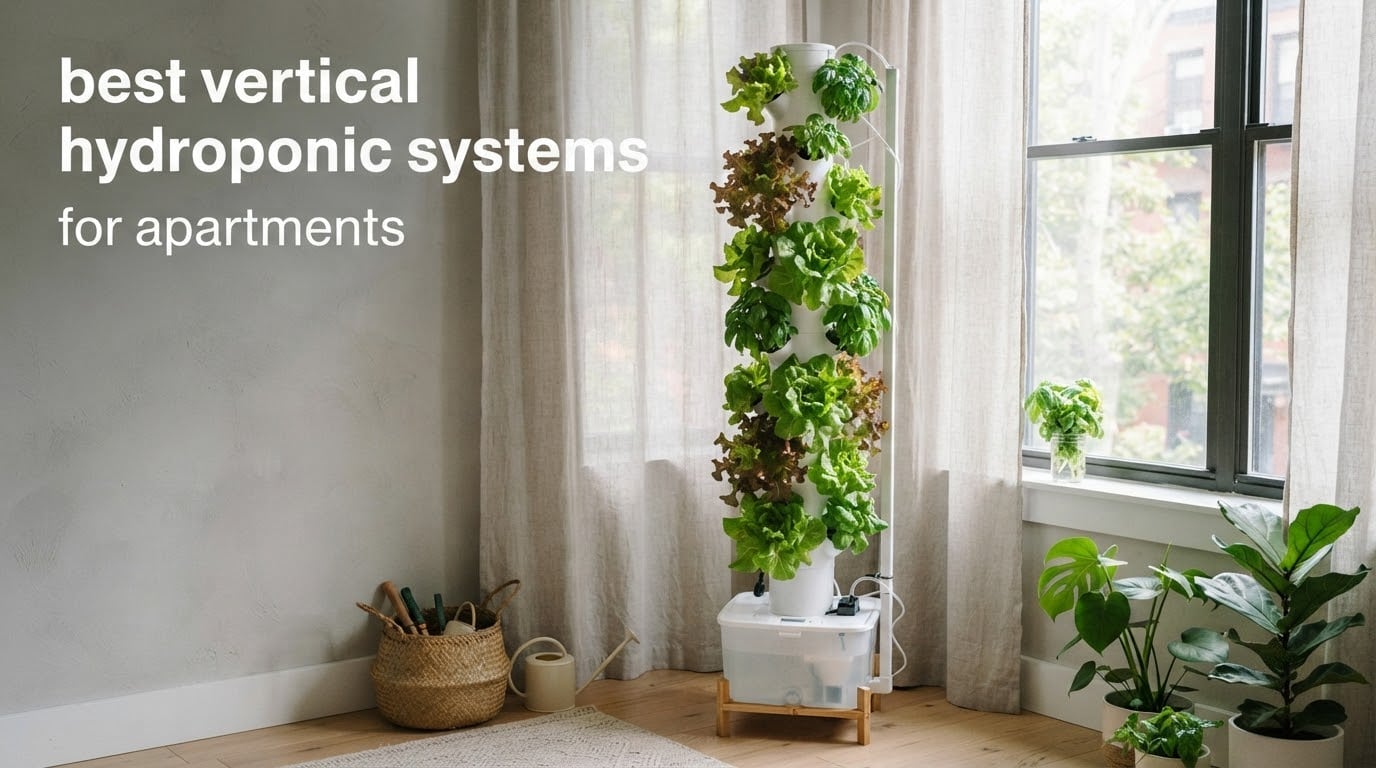
Apartment floor space runs out fast. A tower takes up about 2 square feet and gives you 20 to 30 growing sites, which is why the best vertical hydroponic systems for apartments have become the default answer for anyone who wants fresh greens without a balcony garden plot. The pump lifts nutrient solution from a base reservoir to the top of the column, water trickles down past exposed roots, and the plant grows upward instead of outward.
That is the honest upside. The catch is that a hydroponic tower is a machine, not a planter. It needs a plug, a reservoir refill every week or two, and 14 to 16 hours of light a day. It also puts a fan-cooled pump and a nutrient tank inside a room you share with other people.
So picking one is less about finding the biggest plant count and more about matching hardware to your specific constraints. Our team sorted through the apartment realities first: how much floor area is left after the couch, whether you have a sunny window or a dim hallway, how thick the walls are, whether your lease lets you run a device on the balcony, and how much weight a waterlogged reservoir puts on a small balcony slab. Only then did we rank the towers.
Below you will find 10 vertical hydroponic systems rated on capacity, footprint, lighting, automation and the maintenance reality of living with one in a rented flat. We also cover what actually grows well in a tower, which crops to skip, and the failure modes that show up in the first month. If you want the broader picture of tower design first, our guide to vertical grow towers covers the hardware side in more detail.
Table of Contents
Top 3 Vertical Hydroponic Systems For Apartments (October 2026)
Three systems stood out once the apartment filters were applied. The AOONEG 42-pod tower leads on capacity per dollar and on the six 30W light bars that keep upper tiers lit. The ALTO GARDEN GX wins on build quality with 2mm walls and a solid 360-degree shell, which matters when the base tank sits three feet from a neighbour’s bedroom wall. The Gardyn Home 4 is the pick if you want the most finished, furniture-grade object in the room and do not mind a higher outlay.

AOONEG 42-Pod Indoor Herb Garden
- 42 planting pods
- 6 x 30W LED lights
- 23L tank with 20-day autonomy
- Two-way memory timer
ALTO GARDEN GX 24-Net Pot Tower
- 2mm solid walls
- 10 gallon wheeled reservoir
- Complete starter kit
- No subscription

Gardyn Home 4 (30 Plants)
- 30 plants in 2 sq ft
- Alloy steel and aluminum frame
- AI plant coach
- Real-time water monitoring
All 10 Vertical Hydroponic Systems Side by Side
Plant capacity on this list runs from 20 sites to 70 sites, and reservoir size runs from 10 litres to 10 gallons. That spread matters more in a flat than the plant count alone, because a small tank on a big tower means refilling every few days and a large tank on a small tower can be too heavy to move. Use the table below to match tower to counter space before you read the individual reviews.
| Product | Specifications | Action |
|---|---|---|
| AOONEG 42-Pod Indoor Herb Garden |
|
Check Latest Price |
| Gardyn Home 4 (30 Plants) |
|
Check Latest Price |
 SJZX 5-Layer 30-Plant Tower SJZX 5-Layer 30-Plant Tower |
|
Check Latest Price |
 VEVOR 6-Tier 30-Pod Tower VEVOR 6-Tier 30-Pod Tower |
|
Check Latest Price |
 LYCereal 30-Plant Tower LYCereal 30-Plant Tower |
|
Check Latest Price |
| ALTO GARDEN GX 24-Net Pot Tower |
|
Check Latest Price |
 Lettuce Grow Farmstand Nook Lettuce Grow Farmstand Nook |
|
Check Latest Price |
 JPWDDWYT 35-Plant Tower JPWDDWYT 35-Plant Tower |
|
Check Latest Price |
 OvyNewzly 6-Layer 30-Site Tower OvyNewzly 6-Layer 30-Site Tower |
|
Check Latest Price |
 Generic 14-Layer 70-Slot Tower Generic 14-Layer 70-Slot Tower |
|
Check Latest Price |
1. AOONEG 42-Pod Indoor Herb Garden: Best Overall for Apartments
Hydroponics Growing System,AOONEG 42Pods Indoor Herb Garden with LED Grow Light,Hydroponics Growing System Kit with Automatic Timer,Pump System,Adjustable Height,No Seed
42 pods
23L tank
6 x 30W LED lights
Pros
- 42 planting pods in one column
- 6 x 30W LED lights with three timer settings
- Adjustable pump flow with low-water protection
- Food-grade PP5 plastic
- Extends upward to 23.6 inches
Cons
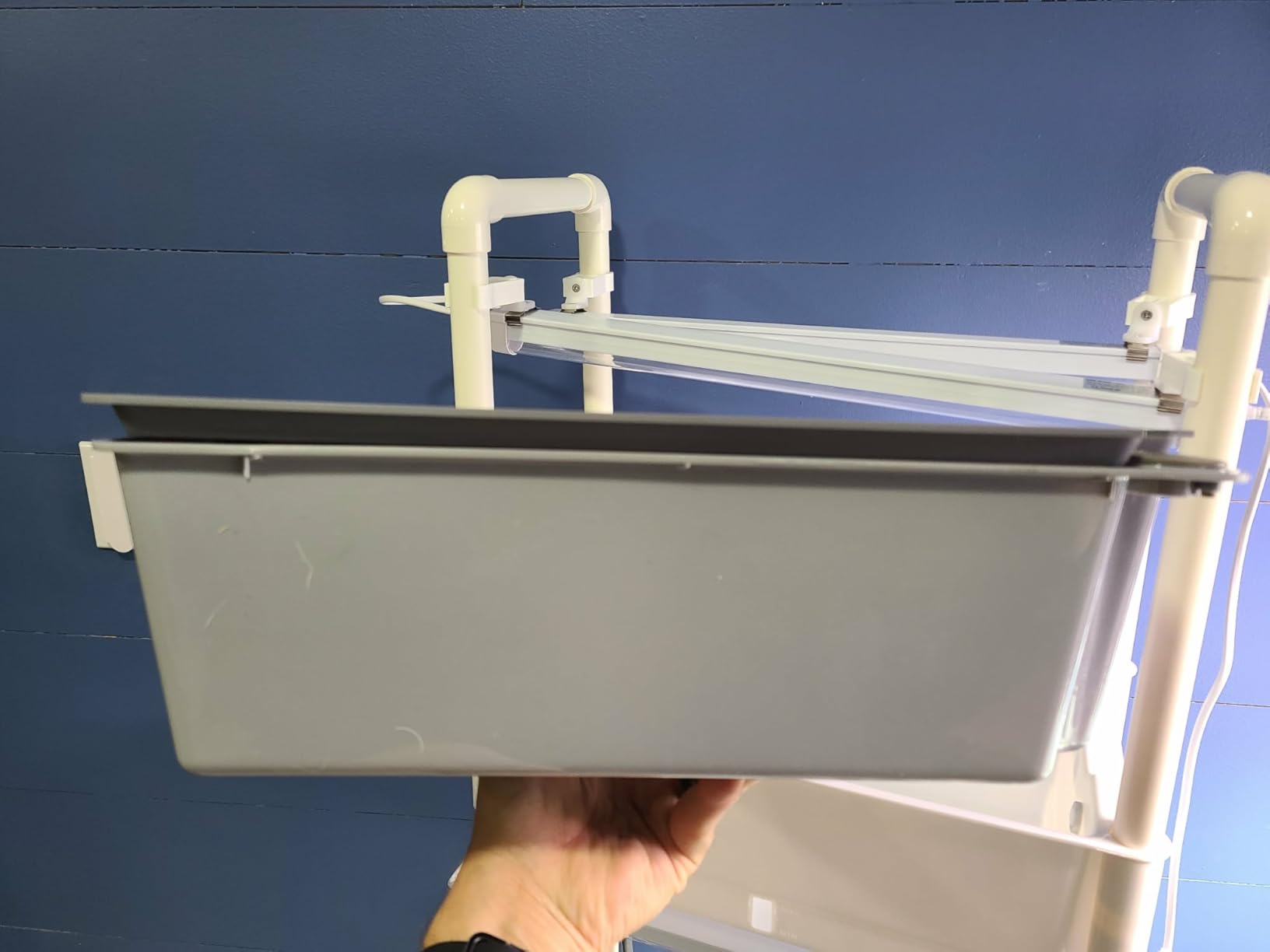
- Light bars can slide down over time
- Instructions are not very clear
- Some pump failures reported
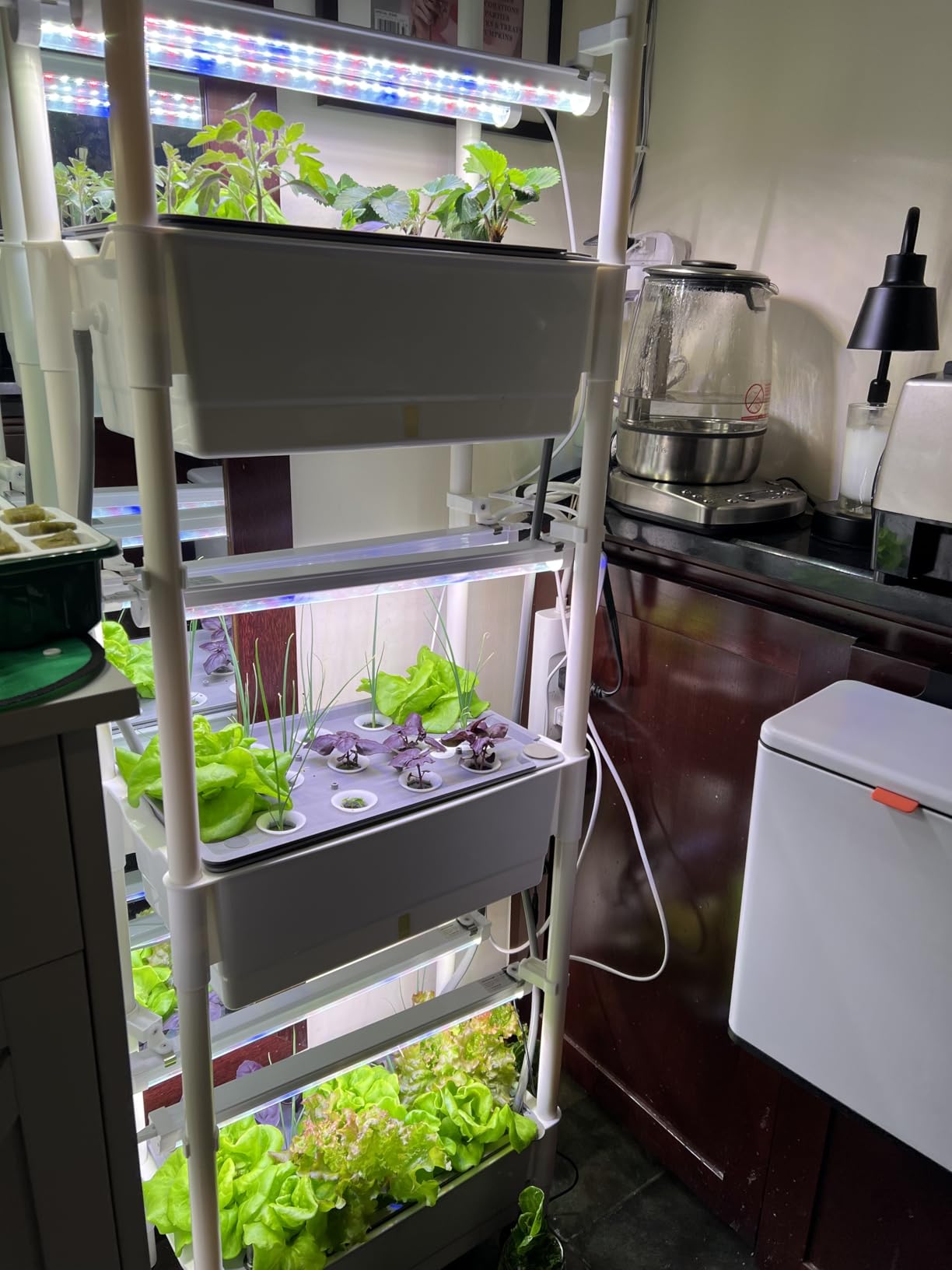
This is the tower we keep coming back to for small flats. It measures 18 by 9.8 by 59 inches and weighs 16 pounds, which means one person can carry it up a stairwell. The base holds 23 litres of water, and the spec sheet claims 20 days of autonomy between refills.
The lighting is the part that sets it apart from the cheaper towers. Instead of a single short strip over the top, you get six 30W bars, and that is the difference between a top tier that grows and a top tier that stretches. Three timer settings of 9, 12 and 15 hours cover most crops, and a two-way memory function restarts the cycle after a power cut.
Owners report lettuce, basil, parsley and small vegetables doing well in it. The pump is quiet enough to sit in a living room, and the flow rate is adjustable, which lets you back it down for seedlings. The column also extends upward by up to 23.6 inches as plants get taller.
The honest weakness is the 3.9 star average, which is the lowest among the ten towers we looked at. Light bars do drift downward on the extended frame and need re-seating, and the instruction booklet gets described as thin. The pump is the component to watch: a small number of owners report units failing within the first year.
Who this tower suits?
It suits a one-bedroom or studio flat where you want real salad output rather than a few herb pots. Forty-two sites is enough to run a rotation of loose-leaf lettuce, kale and herbs so you are never harvesting an empty tower.
It also suits anyone whose window gets weak light, because the six light bars carry the load rather than the sun. Plan to leave the tower where it is. Dragging a 59-inch tower around a carpeted room is how joints get loosened.
Who should skip it?
Skip it if you want a furniture piece. This is a functional plastic column and it looks like lab equipment next to a wood cabinet. It also lacks any app, so pump timing is a dial rather than a phone screen.
Fruiting plants are a stretch here. Six 30W bars will carry a cherry tomato, but the pod spacing and the short reservoir refill cycle make it a chore rather than a hobby. If tomatoes are the goal, look at a larger reservoir system instead.
2. Gardyn Home 4 (30 Plants): Best Premium Build for Small Rooms
Gardyn Home 4 Vertical Hydroponics Growing System Kit – 30 Plants
30 plants in 2 sq ft
Alloy steel frame
Real-time water monitoring
Pros
- Alloy steel and aluminum construction
- 30 plants inside 2 sq ft
- 30 yCubes with non-GMO seeds included
- AI plant coach with 30-day trial
- Sunrise and sunset lighting modes
Cons
- Highest outlay in this roundup
- AI features need a subscription after the trial
- Rated for indoor use only
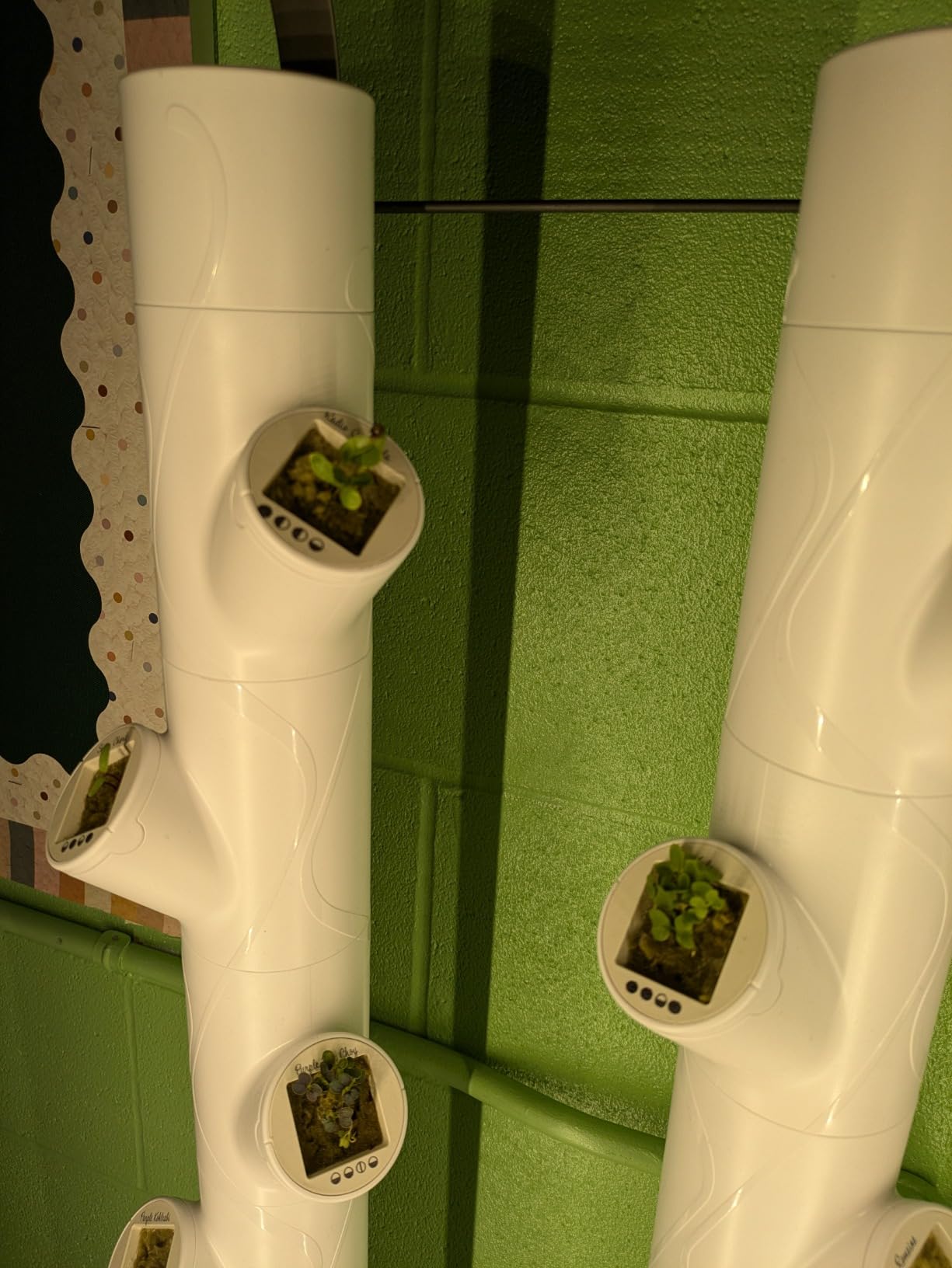
The Gardyn Home 4 is the one you put in the corner of a living room where guests will see it. The frame is alloy steel and aluminum rather than plastic, the finish is brushed, and the columns are built as 360-degree shells that come apart for cleaning. Capacity is 30 plants in 2 square feet of floor space.
Gardyn claims 95 percent less water use than soil gardening, and the tower ships with 30 yCubes of non-GMO seeds plus 10 bonus cubes. The AI plant coach, called Kelby, walks you through each crop for the first 30 days and then asks for a subscription if you want it to keep going.
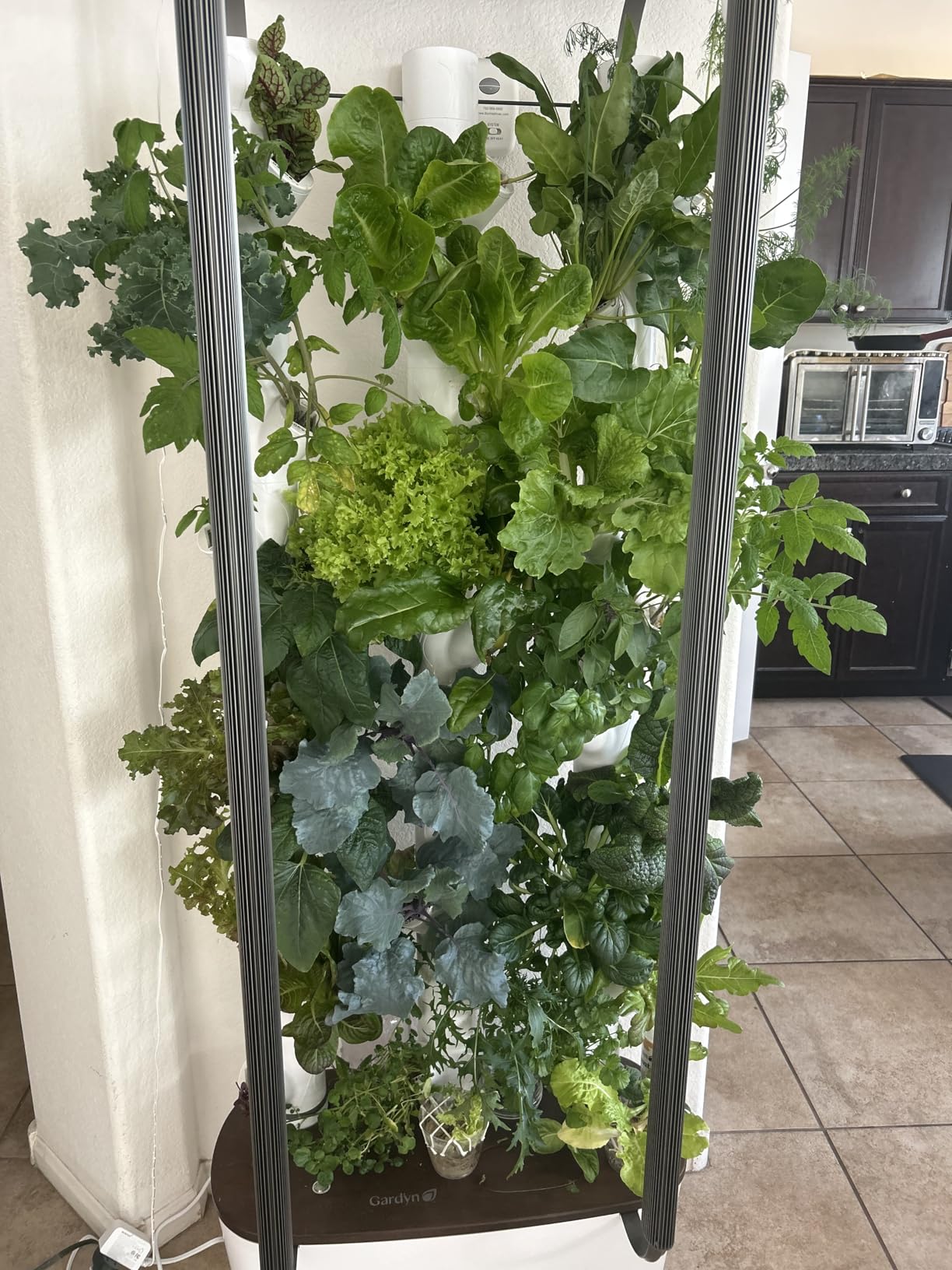
The lighting has sunrise and sunset modes rather than a blunt on-off switch, which makes it gentler on plants and easier on your eyes in an evening flat. There is real-time water measurement at the base, so you are not guessing whether the reservoir needs topping up.
What you are paying for is metal. Compared with the plastic towers on this list, the frame does not flex, does not wobble when you top up the reservoir, and looks correct in a living space. Owners consistently mention the build quality first when they explain why they kept it.
The catch is cost, and it is a large one. This is the most expensive tower in the group, and the subscription model sits on top of it. The Kelby trial is generous, but a system that leans on an app for guidance is a poor fit if you would rather read a manual and adjust by feel.
Who this tower suits?
It suits someone with a specific corner in mind and a room where a plastic column would look wrong. The brushed metal reads as furniture, and the sunrise and sunset modes keep evening light spill gentle for shared-wall buildings.
It also suits a grower who wants guidance handed to them. Thirty yCubes arrive ready to plant, and the coach tells you what stage each crop is at instead of leaving you guessing.
Who should skip it?
Skip it if you rent and plan to move within a year or two. The metal frame is the heaviest thing on this list that is not a full reservoir tower, and it is not the sort of thing you want to carry down three flights.
Skip it if you want to grow outdoors. This configuration is listed for indoor use, and the smart features are built around a fixed indoor spot rather than a moveable balcony position.
3. SJZX 5-Layer 30-Plant Tower: Best for App-Controlled Watering
SJZX Hydroponics Growing System Kit, 5-Layer Hydroponic Tower, 30 Planting Holes, Space-Saving Vertical Gardening System, Suitable for Both Indoor and Outdoor use Germination Kits
30 holes across 5 layers
12L tank
App-controlled smart timer
Pros
- 30 planting holes across 5 layers
- 12L tank with active circulation
- Smart socket timer with mobile app control
- BPA-free food-grade plastic
- Rated for indoor and outdoor use
Cons
- Pump may not shut off when water runs low
- Shallow circulation for new seedlings
- Some mold and mildew reports
This tower packages a smart socket timer with an app, which is unusual at this tier. The 5-layer column holds 30 planting holes, and the 12 litre tank sits under a circulation system that pushes water up and back around the root zone. The whole thing weighs 8.98 pounds.
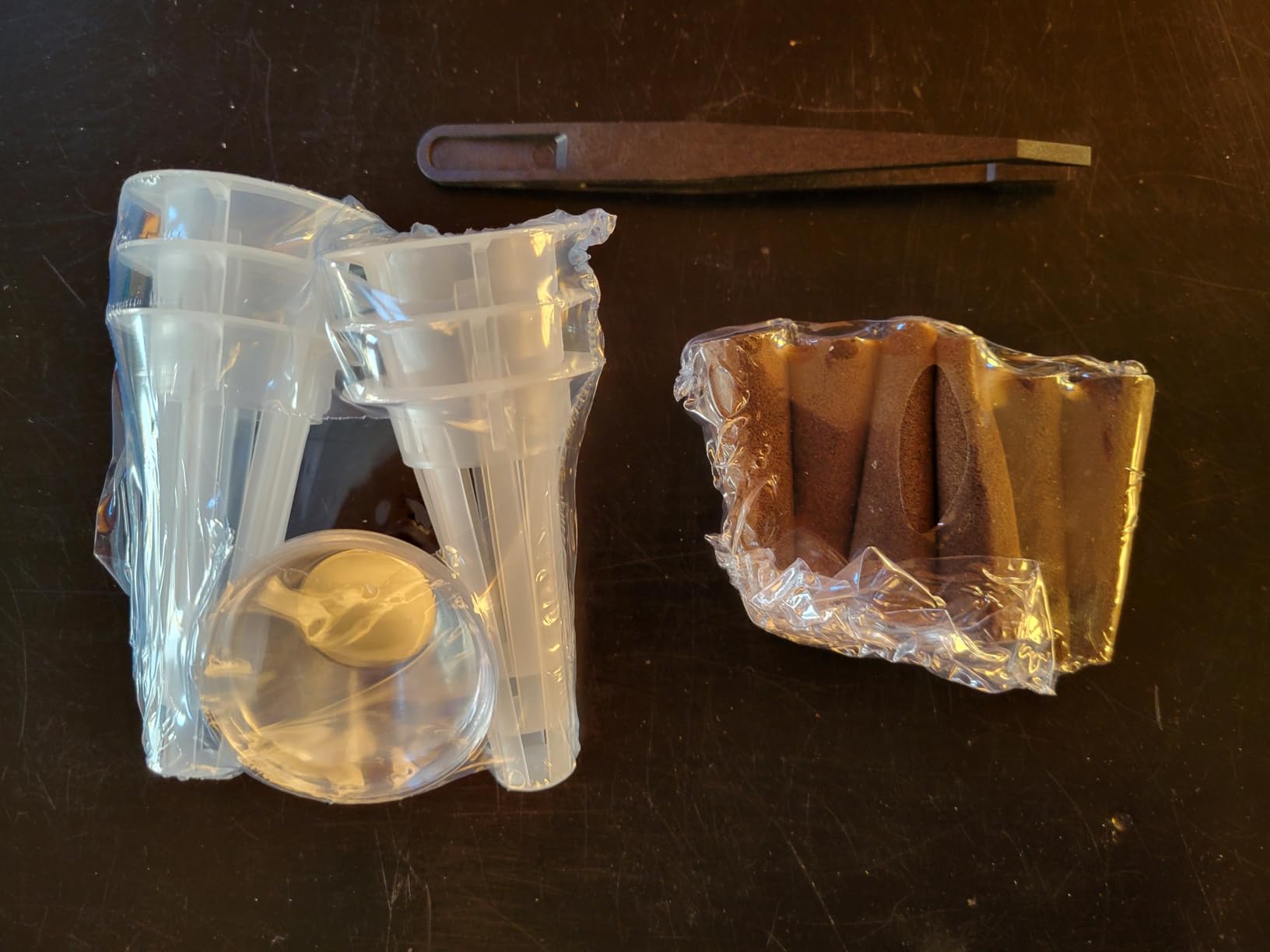
The kit is genuinely complete. You get five tower sections, the timer, the pump, a power adapter, a water gauge, a funnel, filter sponges, hose, tweezers, labels and planting baskets. Nothing needs a second order before the first seed goes in.
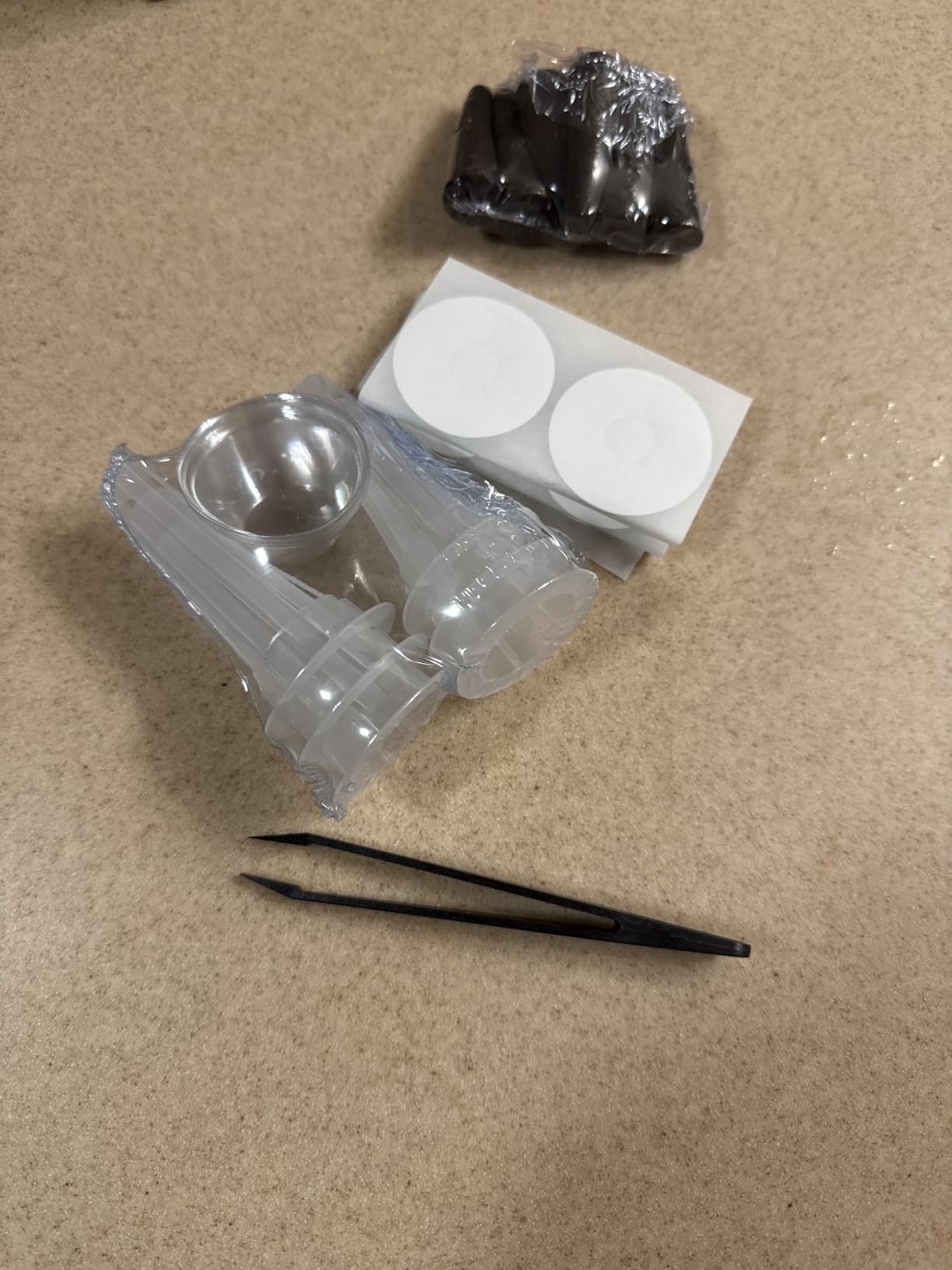
Owners like the build for the money and report good results with lettuce and herbs. The app control means the pump schedule can be changed from your phone, which is the one piece of automation most people actually use.
Two problems come up repeatedly. The pump does not always cut out when the water level drops, so a failed timer cycle can leave it running dry. Circulation can also sit too shallow for freshly germinated seedlings, and a few owners report mold appearing in the column during humid weather.
One more detail matters for anyone fitting this into a bucket-based setup: the tower base sits very tightly in a standard bucket lid. Test the fit before you commit to a bucket arrangement.
Who this tower suits?
It suits a grower who travels or works odd hours. Controlling the pump from your phone is genuinely useful if you are not home at the same time every day, and the smart timer handles the rest.
It also suits a balcony. This tower is listed for both indoor and outdoor use, and at 8.98 pounds it is light enough to move between a windowsill and an outdoor shelf when the season turns.
Who should skip it?
Skip it if you have pets or small children and the tower will sit at floor level in a play area. The pump has no low-water cutoff and the tank is not latched, so both are reasons to place it somewhere out of reach.
Skip it if you live somewhere with high summer humidity and weak ventilation. Mold reports cluster around humid conditions, and a tower in a sealed room is exactly the wrong place for it.
4. VEVOR 6-Tier 30-Pod Tower: Best Value
VEVOR Hydroponic Growing System with Grow Light, 30 Pods Vertical 6 Tiers Hydroponic Tower, Home Hydronic Garden with Water Pump, Plants Germination Kit for Indoor Herbs, Fruits and Vegetables
30 pods across 6 tiers
20L tank
16W LED with smart plug
Pros
- 30 pods across 6 tiers
- 20L tank with level window
- Tool-free modular assembly
- 7W DC pump rated at 600L/H
- Smart plug works with Alexa and Google Home
Cons
- Light bar too short for the top tier
- Some LEDs burn out early
- Pump is hard to reach for maintenance
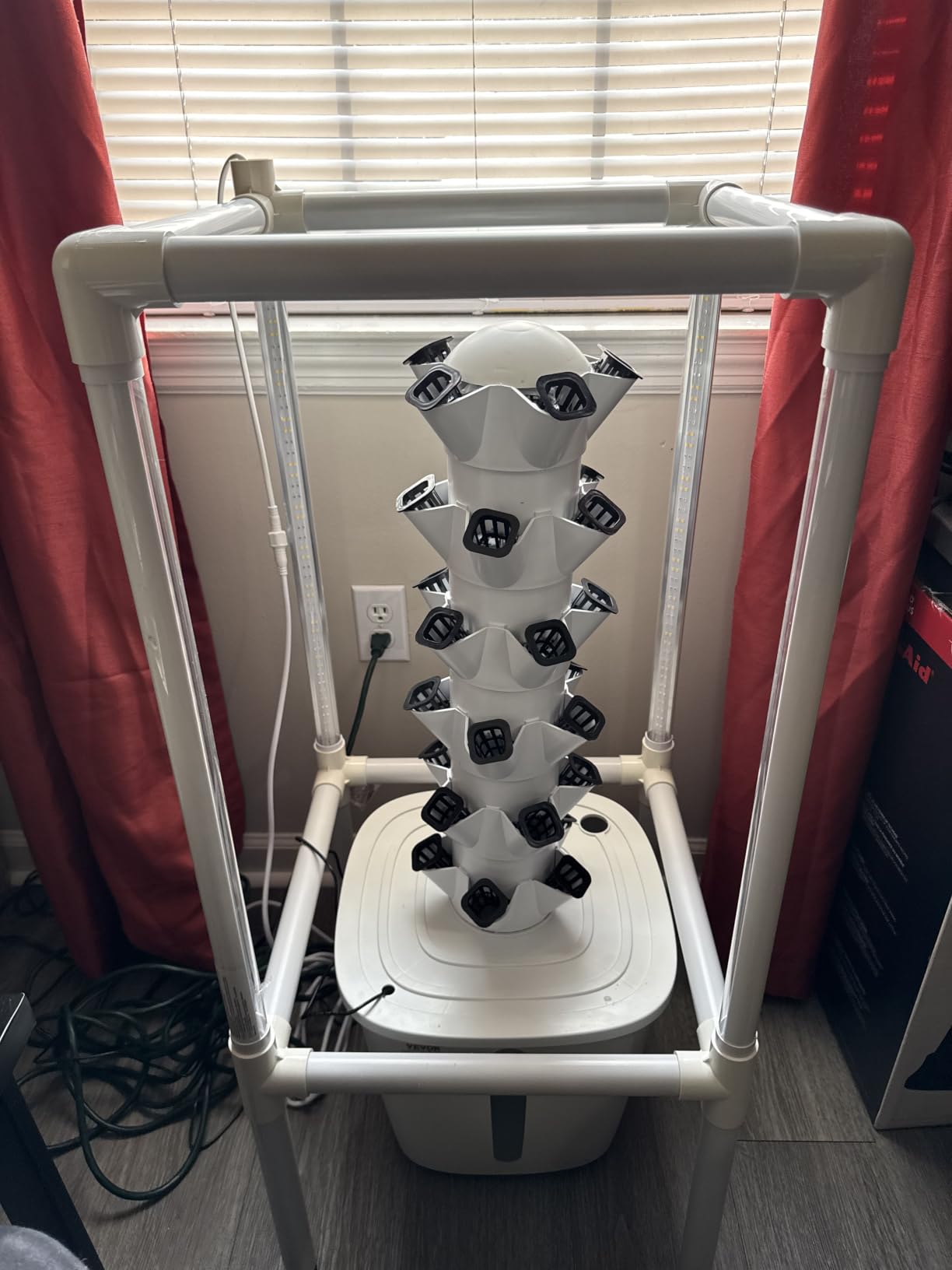
The VEVOR tower is the spec-sheet value pick. It weighs 14.11 pounds, stands 39.37 inches tall on a 16.93 inch square base, and holds 30 pods across 6 tiers with a 20 litre reservoir. That tank size is unusually generous at this tier and it cuts your refill frequency to roughly monthly.
The 7W DC micro-pump is rated at 600L per hour with a 2 metre lift, and owners describe it as quiet. Assembly is modular and tool-free, which matters when you are on a kitchen floor with limited space to work.
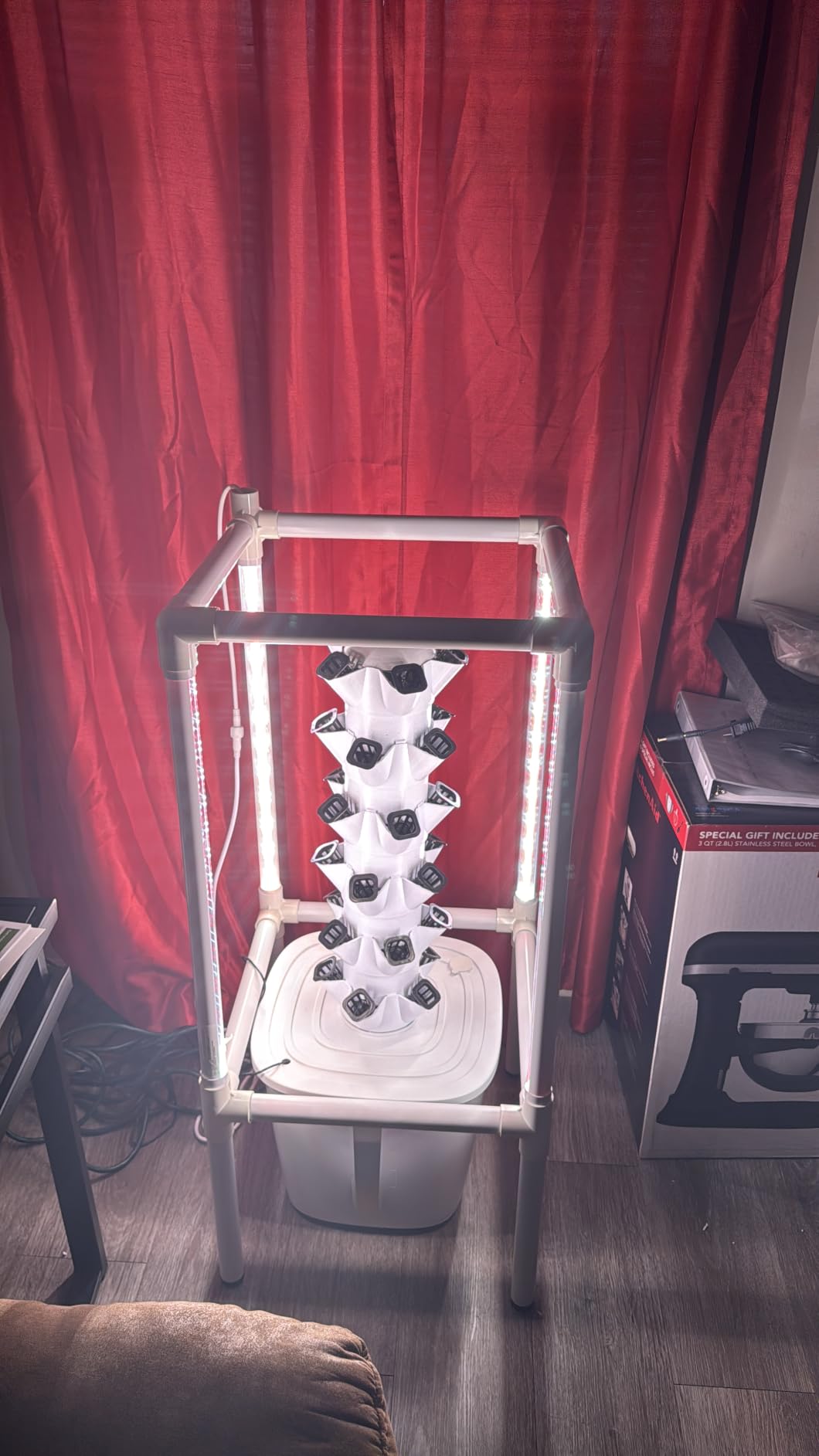
It also ships with a smart plug that works with Alexa and Google Home, so you can switch the light without touching the tower. The light itself is a single 16W bar with 96 LEDs at a 2808K colour temperature, and it is bright enough for lettuce, radishes and small herbs.
The weakness is lighting geometry. One bar at the top cannot reach the lower tiers evenly, and the top tier is the most exposed. Some owners also report individual LEDs failing within the first year, and the pump sits low enough that servicing it is awkward.
A design quirk to know before you buy: the pods are triangular rather than round, so standard round net pots and many off-the-shelf seed sponges will not fit without trimming.
Who this tower suits?
It suits a first-time buyer with a decent-sized counter. Twenty litres means you are not topping it up every weekend, which is the single biggest reason people abandon a tower in month two.
It also suits anyone who wants voice control of the light without an app account. The smart plug is a simple path into automation when you do not want to manage another phone app.
Who should skip it?
Skip it if you want herbs and greens only at the top of the tower. With a single light bar, the lower tiers get noticeably less and you will end up moving plants up and down to even things out.
Customer service is the other concern. Owners report slow responses, which is painful if a pump fails and you need a replacement part rather than a troubleshooting call.
5. LYCereal 30-Plant Foldable Tower: Best for Small Storage Spaces
LYCereal Hydroponics Growing System, 30-Plant Indoor Hydroponic Tower with Timer and Pump System, Plants Germination Kit, Vertical Hydroponic System for Gardening Lover (No Seed)
30 plants
10L tank
Level water gauge
Pros
- 30 plants on a 9.84 inch base
- 10L tank with level gauge
- Timer runs the pump 30 minutes on and off
- Compact footprint for gaps
- 64 growth sponges included
Cons
- Seeds sold separately
- Plastic construction feels basic
- Timer cycles are fixed at 30 minutes
The defining feature here is the narrow footprint. At 9.84 inches square it slots into a gap that a 16 inch base will not, and it stands just 33.86 inches tall, which keeps it under most counter heights and windowsills.
Set up, it holds 30 planting sites from a 10 litre tank. The tank has a water level gauge on the outside, so you check the water by looking at the front of the base rather than lifting a lid, and the pump runs on a timer so watering needs no daily attention.
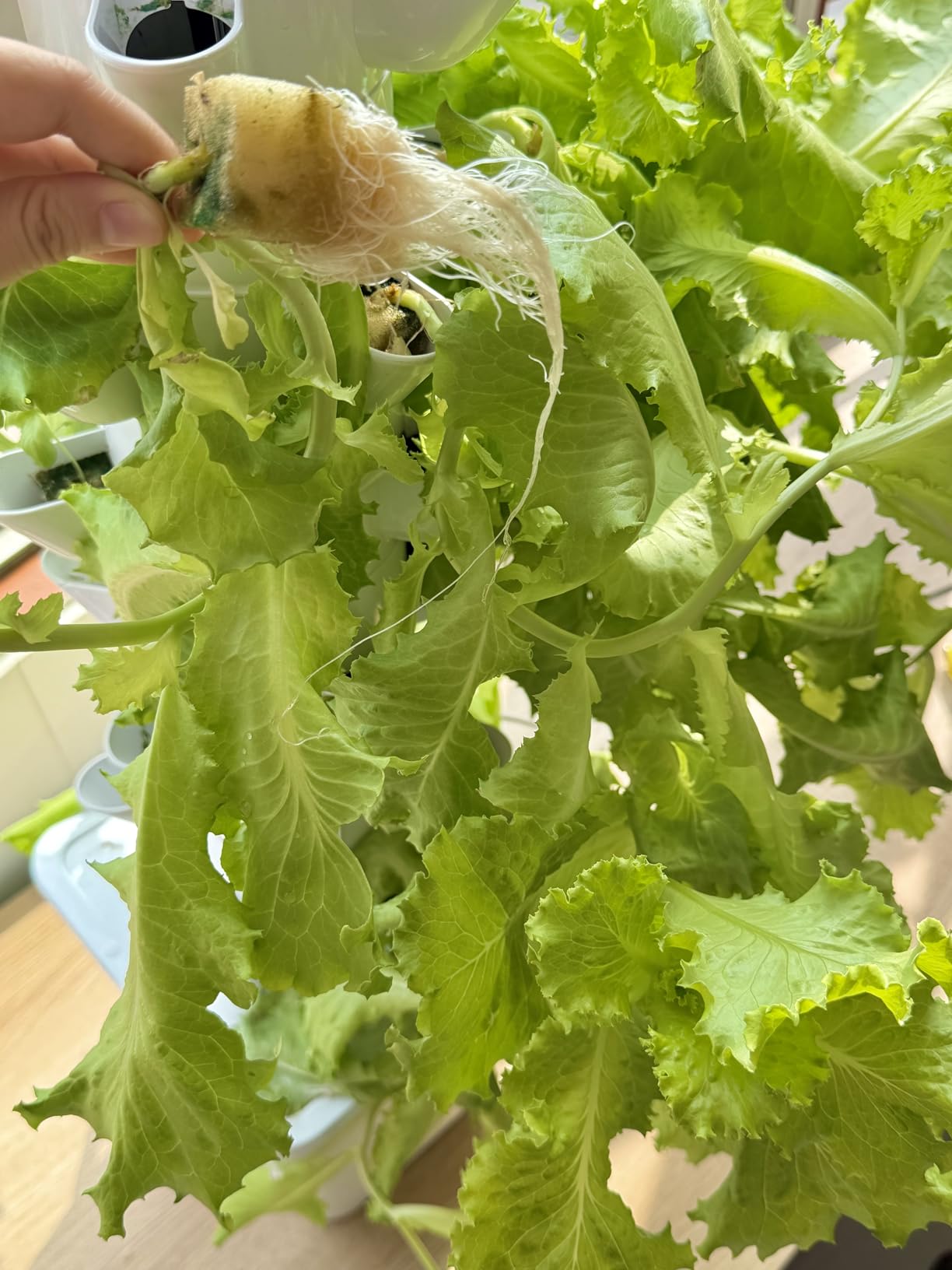
Owners describe maintenance in minutes per week rather than sessions, and the automated pump timer handles watering without intervention. The kit includes 64 growth sponges, a funnel, hose, filter, shower caps and a water gauge.
Be clear about what you are getting. There is no seed packet in the box, so you buy your own. The plastic feels thin compared with the metal-framed towers, and the pump timer is locked to 30 minutes on, 30 minutes off, with no adjustment.
That fixed cycle is fine for leafy greens and herbs. If you plan to run fruiting plants that need longer dry-down periods, the rigid schedule becomes a limitation rather than a convenience.
Who this tower suits?
It suits a studio flat where every square metre is spoken for and where a 16 inch base will not fit. The narrow base and low 33-inch height also make it an easy unit to move when you rearrange the kitchen.
It suits growers who want a mostly hands-off weekday cycle. The 30-minute timer keeps roots fed and aerated without daily attention.
Who should skip it?
Skip it if you want a unit that looks finished. The finish is smooth grey plastic and it will look like storage equipment in a nice kitchen.
Skip it if you plan to grow anything demanding. The fixed timer cannot be dialled back for a slower crop cycle, and the 10 litre reservoir is small for a 30-site tower with thirsty plants.
6. ALTO GARDEN GX 24-Net Pot Tower: Best for Build Quality
ALTO GARDEN GX Hydroponic Tower | Vertical Planter Tower | Hydroponics Growing System Kit | Food Grade with 24 Net Pots (with LED Grow Lights)
24 net pots
10 gallon wheeled tank
2mm solid walls
Pros
- 2mm walls with solid 360-degree construction
- 10 gallon reservoir on wheels
- Nutrients
- pH pen and rockwool all included
- No subscription fees
- 24 wide-spaced net pots
Cons
- Tallest footprint here at 20 by 20 inches
- Assembly video is hard to follow
- Indoor configuration only
The ALTO GARDEN GX is the sturdiest object in this roundup and the highest rated at 4.5 stars. The walls are 2mm thick, which is more than double what most plastic towers use, and each layer is a solid 360-degree shell with no leaky joints between sections.
That construction matters more than it sounds. Joints between stacked tower sections are the usual failure point, and that is where a base leak starts. Owners do not report that problem with this tower.
The base is a 10 gallon tank on casters, so you can roll the whole thing to a window or a better light position without draining it. LED lights are adjustable and have a built-in timer, and the pump has its own timer too.
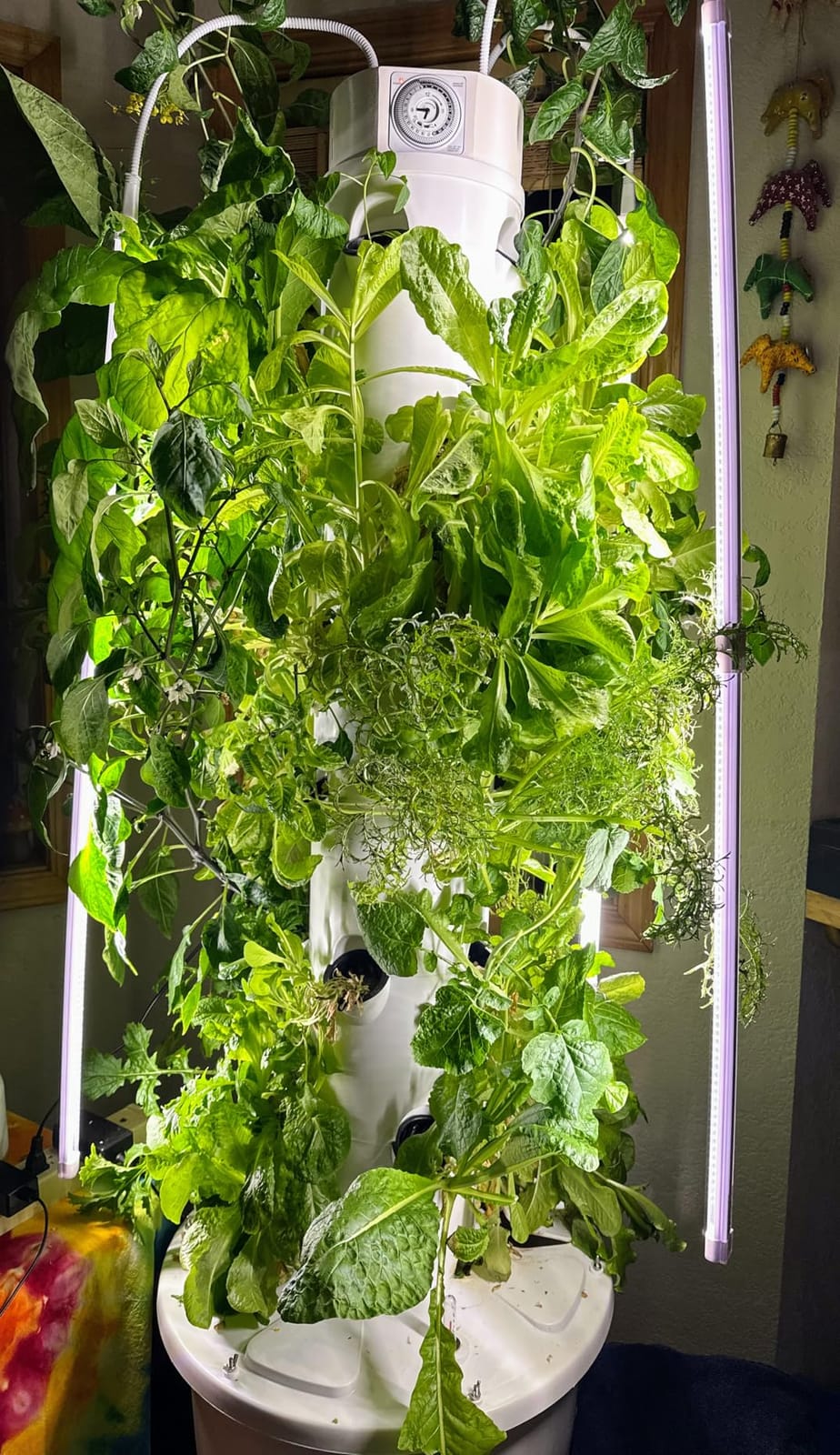
The starter kit is the most complete here. You get 30 rockwool cubes, A and B plant nutrients at 10 ounces each, a digital pH test pen, a four-head germination light with a clamp, a water gauge and 24 net pots.
There is no subscription, which is unusual in the premium tier and a genuine saving over a multi-year ownership period. The brand also claims 3x faster harvests, 30 percent greater yields and 95 percent water savings against soil farming.
The trade-offs are physical. At 20 by 20 by 66 inches it is the largest footprint on this list, and 66 inches is taller than many ceilings allow once you account for light clearance. There is also one report of a structural failure, and the assembly video is described as hard to follow, so budget an hour with the printed guide instead.
Who this tower suits?
It suits a grower who intends to keep one tower for years and is tired of replacing pumps and leaking bases. The build quality and the no-subscription model both point at long-term ownership.
It also suits anyone who wants to measure rather than guess. The included pH pen and nutrients remove the two most common beginner mistakes, which are dosing blind and letting pH drift.
Who should skip it?
Skip it if you have a low ceiling or a tight corner. A 20 inch square base and a 66 inch height is a real commitment in a studio, and a tower that will not fit is an expensive shelf.
Skip it if you plan to take it outside. This configuration is listed for indoor use, so moving it to a balcony in summer means hauling a full 10 gallon reservoir back in.
7. Lettuce Grow Farmstand Nook: Best for First-Time Growers
Lettuce Grow Farmstand Nook | 4ft 7in Vertical Hydroponic Garden Tower
20 plants
4ft 7in tower
Pre-grown seedlings
Pros
- 20 plants in a 17 inch base
- Pre-grown seedlings cut weeks off harvest time
- Bluetooth smart timer with an app
- Nutrients for 130+ plants included
- Self-watering and self-fertilizing
Cons
- Ongoing seedling refills are an extra cost
- 20 plants is a small capacity
- App needed for full guidance
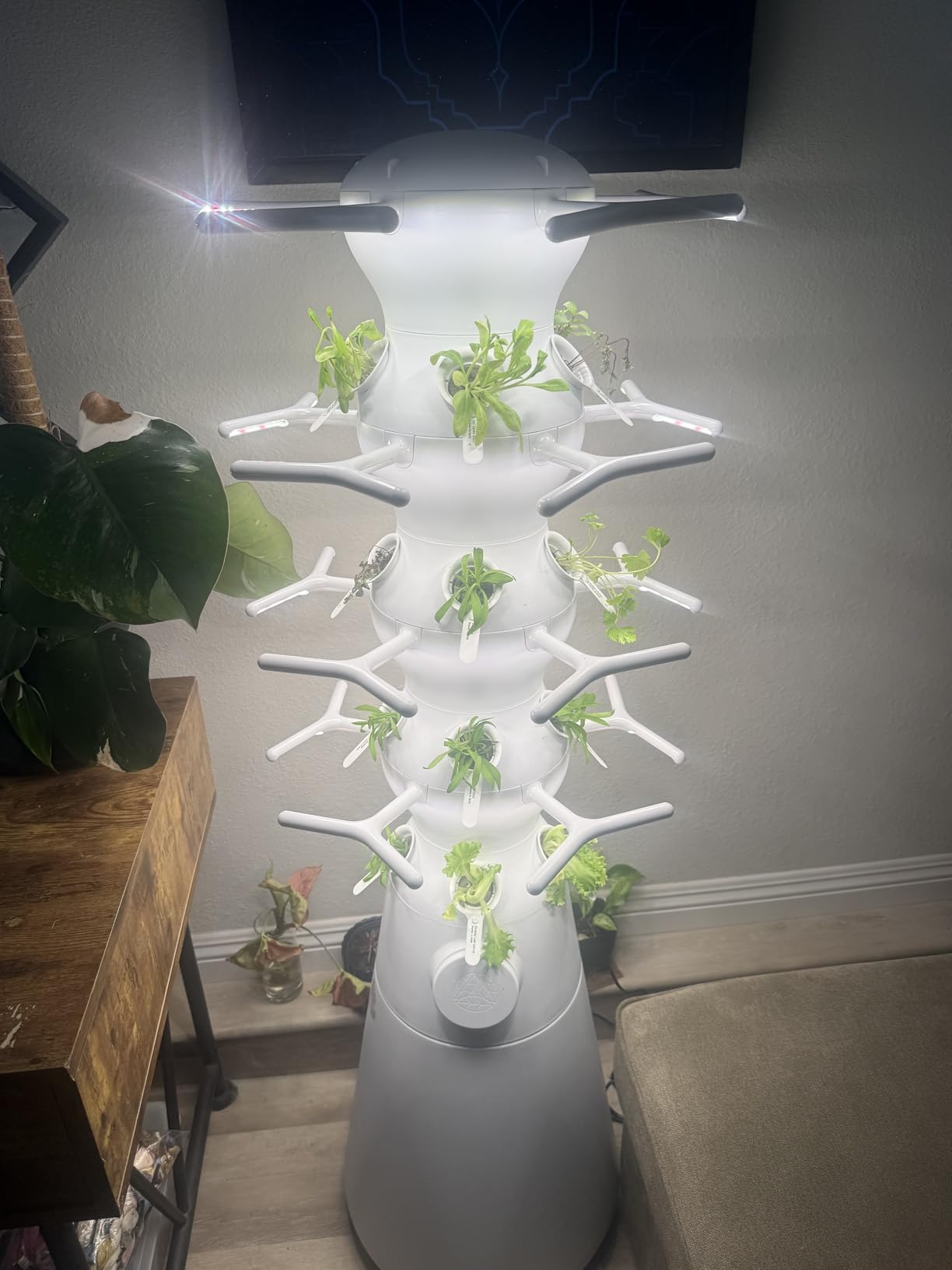
The Farmstand Nook is the least fiddly system here for someone who has never grown anything. Seedlings arrive pre-grown and alive rather than as seeds, so you skip germination entirely and cut roughly half the time to a first harvest. Owners report picking greens in about three weeks.
Capacity is 20 plants on a 17 by 17 inch base, standing 4 feet 7 inches tall. Watering and fertilising are both automatic, and a Bluetooth smart timer runs the pump and the lights without a manual switch.
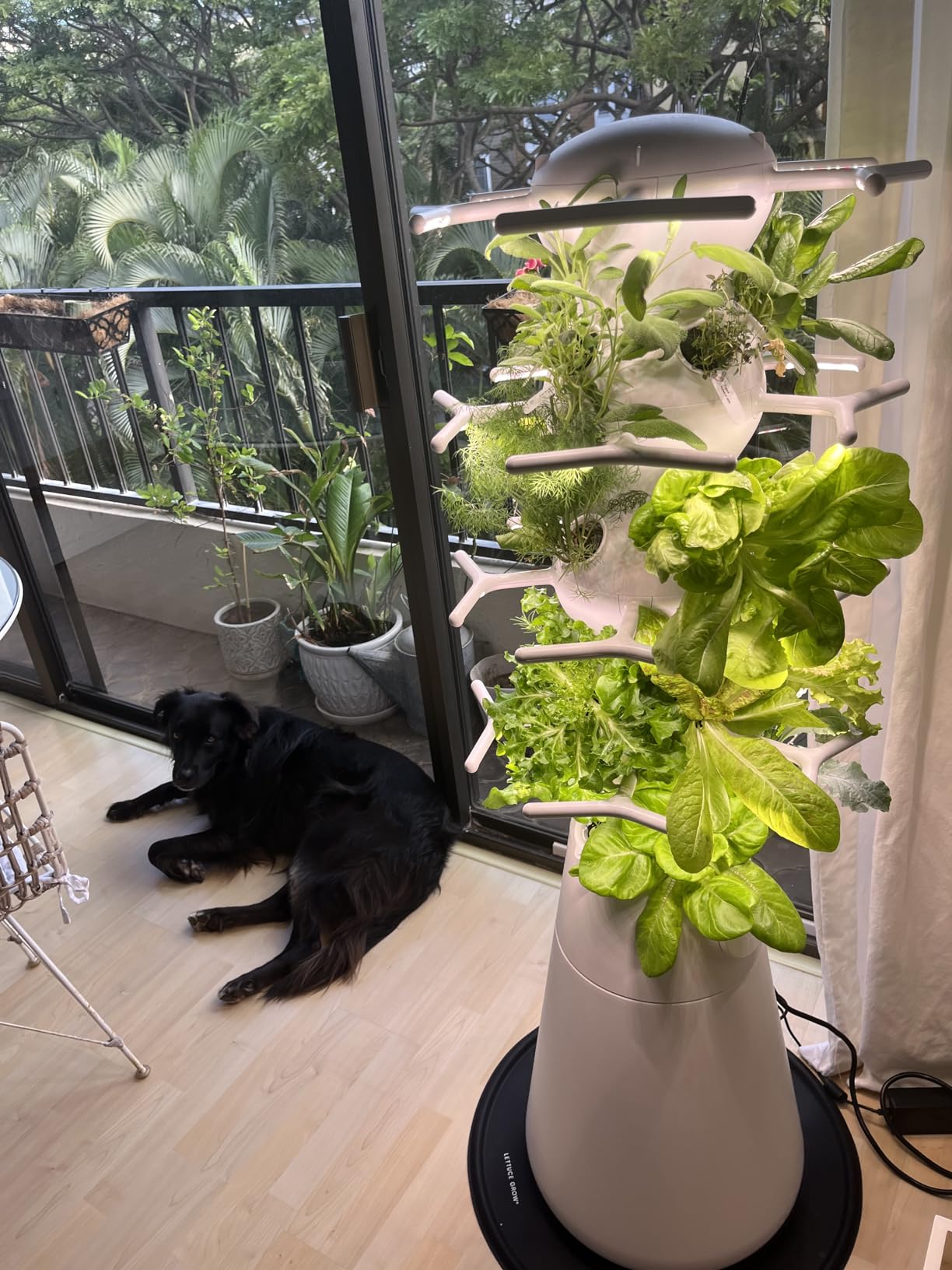
The app sends reminders and shows what stage each plant is at. Over 100 seasonal varieties are available, and the kit includes nutrient for 130 or more plants, grow cups, scoops and a pH kit. For a beginner, having the consumables already in the box removes a whole category of error.
The catch is continuity. Seedling refills are a recurring purchase, and owners note that as an ongoing cost rather than a one-off. At 20 plants it also has the smallest capacity in this group, and the tower weighs 28.3 pounds, which is the second heaviest here behind the wheeled reservoir system.
Full guidance sits behind the app. If you would rather follow a printed sheet and adjust by eye, you are giving up part of what makes this system easy.
Who this tower suits?
It suits someone with no soil, no garden and no patience for seed-starting. Pre-grown seedlings remove the least enjoyable and most failure-prone part of hydroponics.
It also suits a small kitchen corner. A 17 inch square base and a 4 foot height fit beside a fridge in a way a 66 inch premium tower does not, and the finish suits a domestic space.
Who should skip it?
Skip it if you want maximum output per square foot. Twenty plants is the smallest capacity here, so you will replace a full salad harvest with the output of a single lower tier on a 42-site tower.
Skip it if you dislike recurring ecosystem costs. The system is designed around proprietary seedlings, and buying outside that ecosystem is not really supported.
8. JPWDDWYT 35-Plant Tower: Best for Balconies and Patios
JPWDDWYT Hydroponics Tower Indoor Growing System Vertical Garden Planter Indoor Smart Garden Kit with Pump and Movable Water Tank Vegetable Plant Gift for Gardening Lover (35-Plants)
35 plants
18L tank
Timed top-down watering
Pros
- 35 planting sites on a compact body
- 18 litre water tank
- Automatic timed top-down watering cycle
- Light at 2.96 kg
- Listed for indoor and outdoor use
Cons
- PVC construction feels less durable
- Only a manual is listed as included
- Compact size limits mature plant size
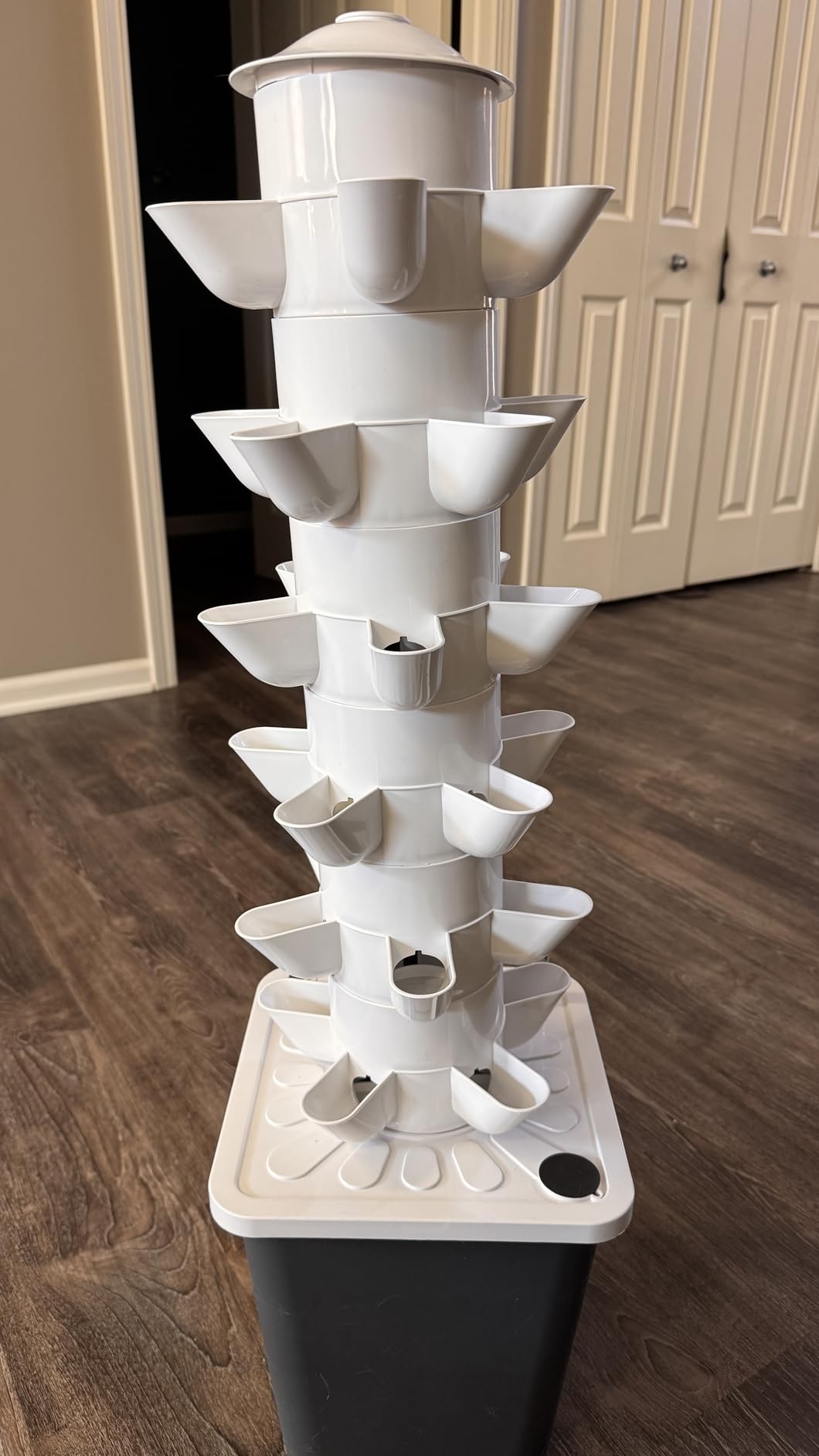
This is the tower to consider if your light comes from outside rather than from a light bar. It has no built-in lighting, which keeps the power draw to the pump alone, and it is listed for both indoor and outdoor use. That makes it a seasonal piece you bring out when the balcony gets sun and bring back in when it does not.
Capacity is 35 plants from an 18.02 litre tank, with automatic top-down watering on a timer. The body is PVC and weighs 2.96 kilograms, light enough to carry between rooms with a full tank.
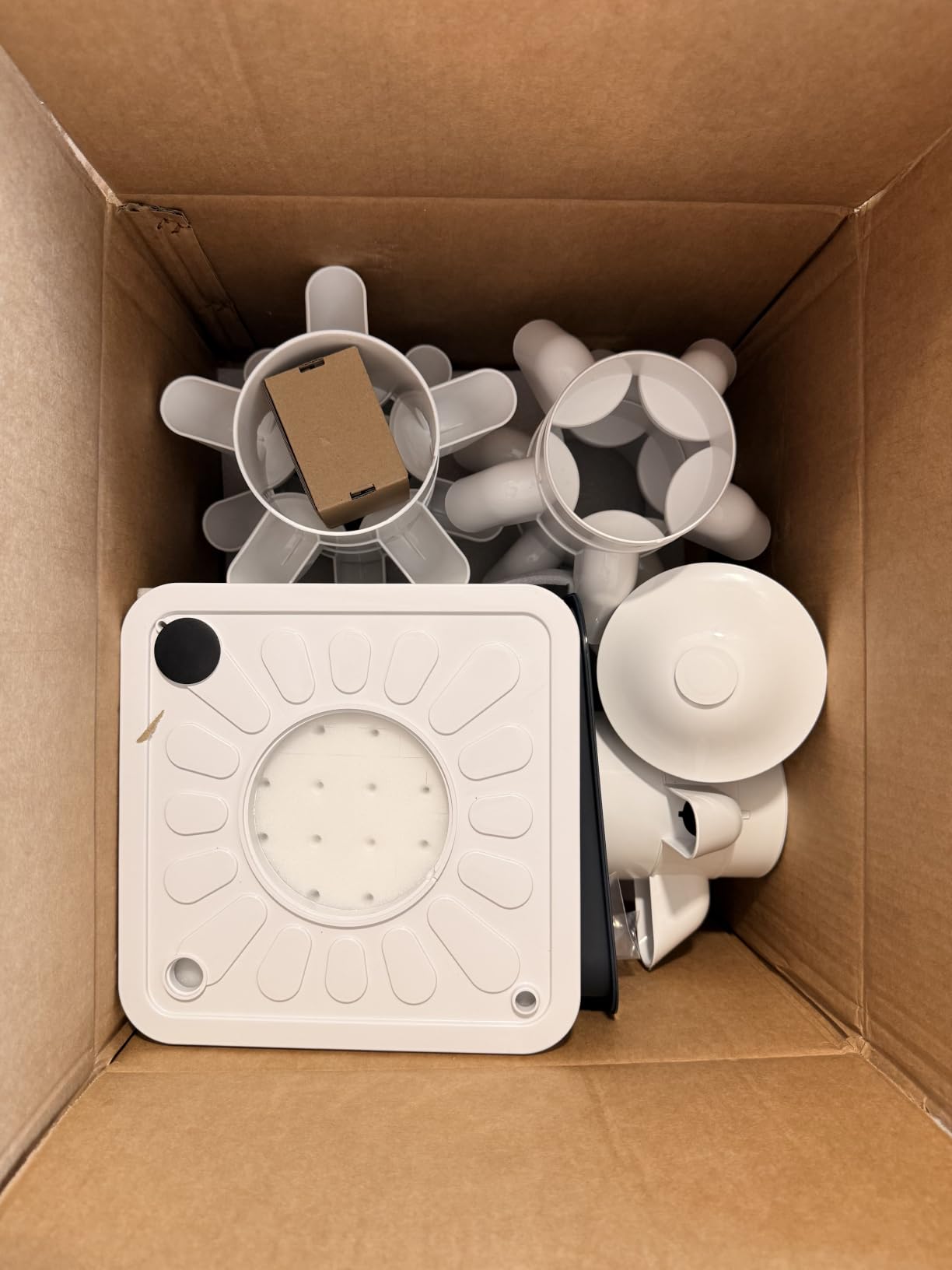
Owners treat it as a beginner-friendly option. The plant count is high for the class, the watering cycle runs itself, and there is no electronics to pair with an app.
The material is the weak point. PVC feels flexible and thin compared with the 2mm shells on the premium tower, and long UV exposure outdoors will shorten its life faster than indoor use would.
Also check the package contents carefully. Owners report that the listed bundle is thinner than expected, with a manual as the main documented inclusion, so plan on buying planting baskets and a timer separately if they are not in the box.
One practical note for balcony growers: check the reservoir weight before you commit. A full tank plus wet growing media is a lot of load, and it needs to sit on a surface rated for it rather than on a light plastic shelf.
Who this tower suits?
It suits a south-facing balcony or patio where natural light does the growing and you would rather not pay for electricity to do it. With no light bars, running cost stays at the pump.
It also suits a seasonal approach. Grow indoors through winter, move out for summer, and use the light weight to make that move without asking for help.
Who should skip it?
Skip it if your space has no direct sun. Without a grow light this becomes an outdoor-only purchase, and in a north-facing flat it will disappoint you within a month.
Skip it if you want a long service life outdoors. PVC in direct sun and wind is the least durable combination on this list.
9. OvyNewzly 6-Layer 30-Site Tower: Budget Pick
Hydroponic Tower Indoor Growing System Vertical Garden for Gardening Lover
30 sites
10L tank
15-minute assembly
Pros
- 30 sites across 6 layers
- Smart outlet for phone-controlled pump timing
- Assembles in 15 minutes with no tools
- Narrow 10 by 7.5 inch footprint
- 128 cultivating sponges included
Cons
- Pods can catch on sharp turns in the slots
- Pump is awkward to reach
- Small pool of reviews
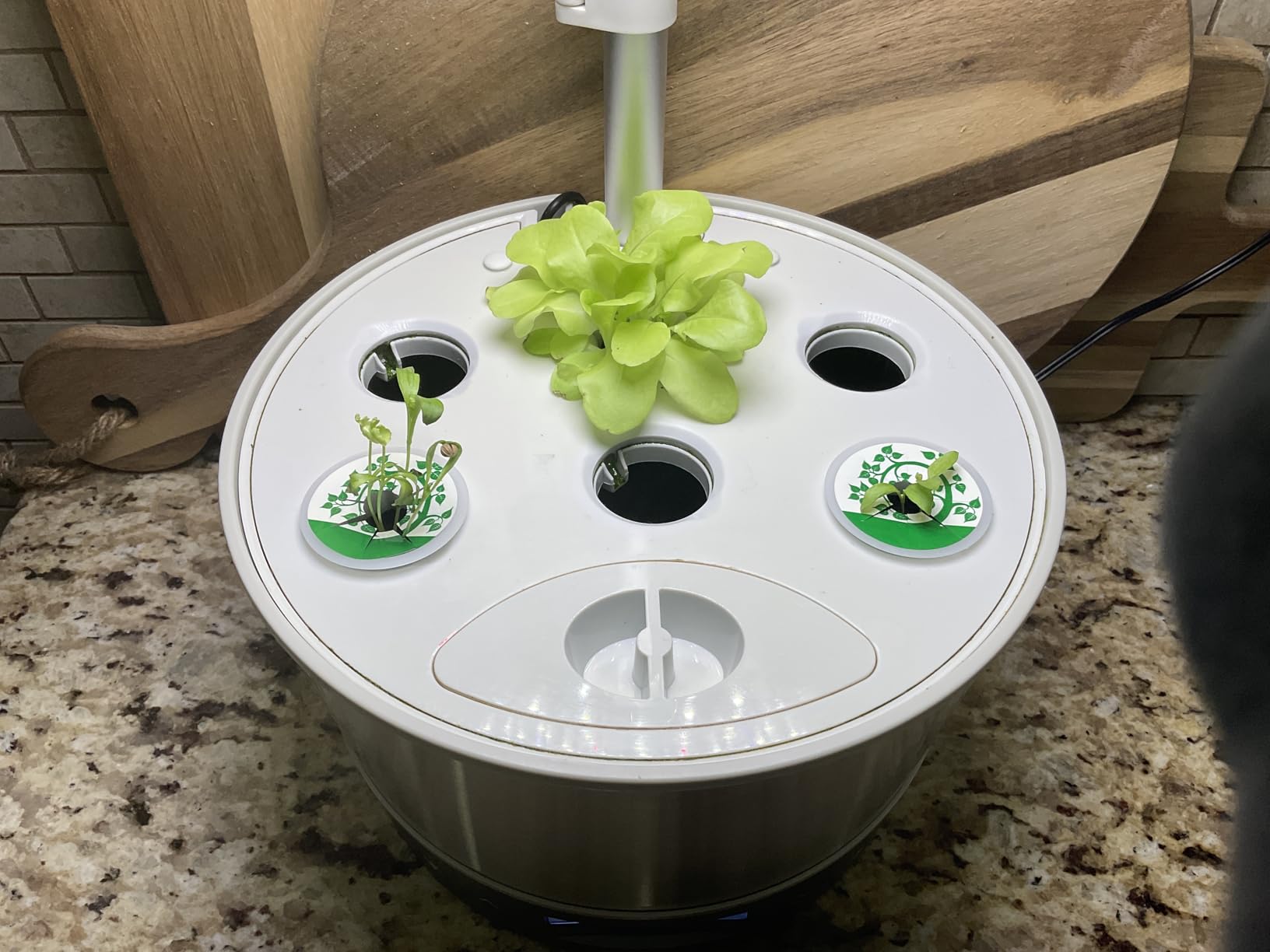
The narrowest tower in the group at 10 by 7.5 inches across and 33 inches tall, this one fits the gaps a full 16 inch base will not. It holds 30 planting sites across 6 layers from a 10 litre tank, and the footprint alone earns it a place in a small flat.
Assembly is quoted at 15 minutes with no tools, and the materials are food-grade BPA-free recyclable plastic. The box includes 128 cultivating sponges, 30 growth sponges, 30 planting baskets, a funnel, a water level indicator, a power adapter and a pump.
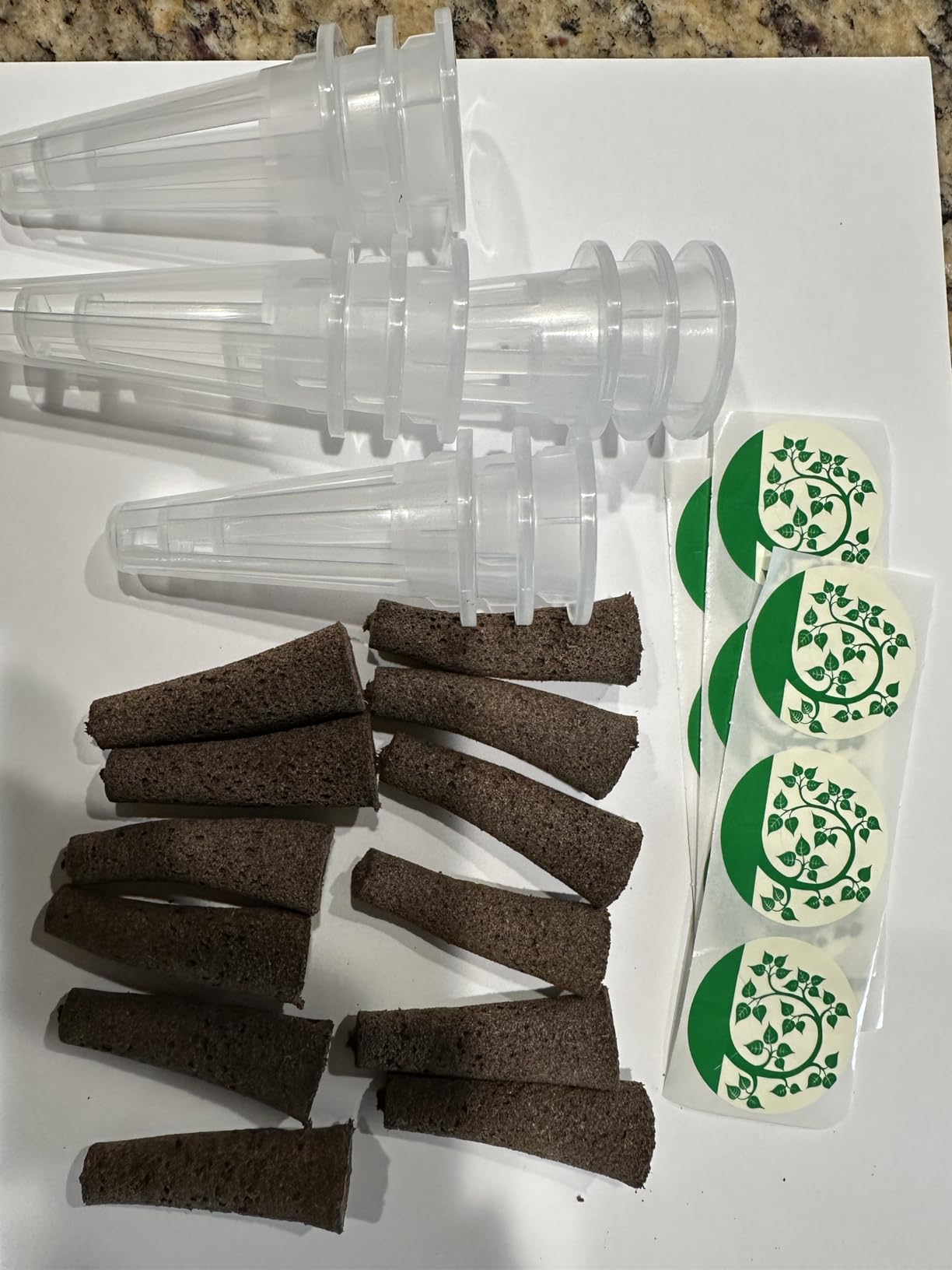
Water cycling runs top-down automatically, and the brand claims up to 95 percent water savings. A smart outlet lets you set pump timing from your phone, which is the only phone-based feature in this price class.
The pods are the weak point. Owners report that pods can catch on the sharp turns inside the slots, and light coverage does not reach the top tier well. Pump access is awkward when you need to clear a blockage.
It also has the smallest base of established feedback on this list, with 23 reviews at a 4.2 star average. That is not enough history to know how it behaves after a full year, so treat it as a first season purchase rather than a forever tower.
Who this tower suits?
It suits a kitchen gap, a narrow shelf or a bathroom windowsill where a 16 inch base will not go. The 10 inch width is the tightest footprint here and that is its whole argument.
It suits a first trial run. If you are not sure whether a hydroponic tower fits your routine, a compact unit that assembles in a quarter of an hour is a low-commitment way to find out.
Who should skip it?
Skip it if you want to grow more than herbs and lettuce. The slot turns make larger or heavier plants awkward, and the top tier gets less light than the rest.
Skip it if you need a proven long-term machine. With 23 reviews there is no track record to lean on when something fails.
10. Generic 14-Layer 70-Slot Tower: Best for Maximum Plant Count
Hydroponic Tower, 14-Layer Hydroponics Growing System Kit with 70 Slots, Vertical Garden System with 20L Water Tank and Pump for Indoor Outdoor Home, Balcony & Patio
70 slots across 14 layers
20L tank
5W light source
Pros
- 70 planting slots across 14 layers
- 20 litre tank with a submersible pump
- Flow design resists clogging and dry spots
- Weather-resistant for balcony use
- 15.7 inch square footprint
Cons
- Only a 5W light source
- Generic brand support
- Small pool of reviews
Capacity is the entire point of this tower. It stacks 70 planting slots across 14 layers on a 15.7 inch square base, standing 64.5 inches tall, and runs a 20 litre tank with a submersible pump. Nothing else in this roundup comes close on site count.
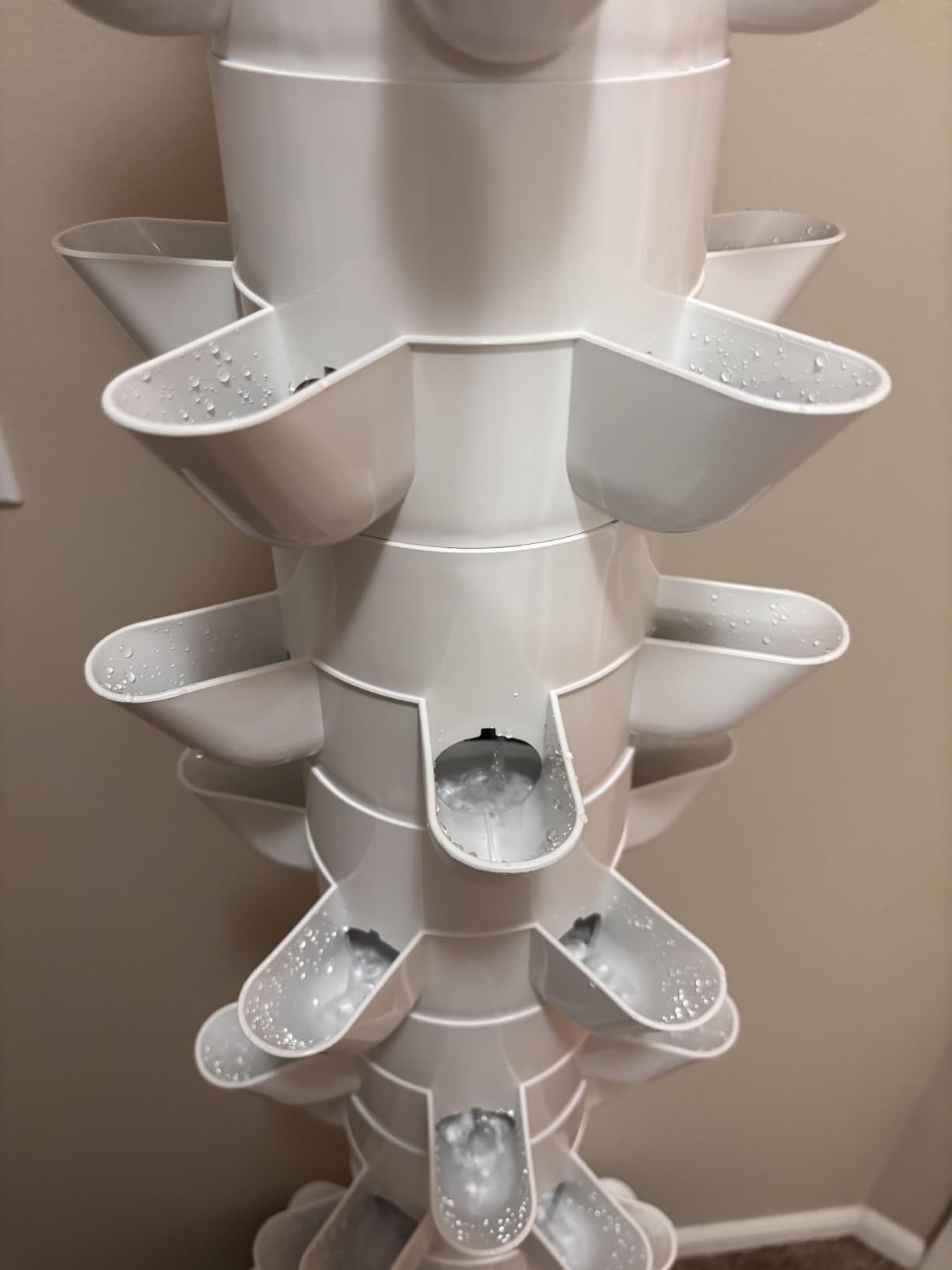
The flow design is worth noting too. Instead of drip lines that clog with organic matter, water runs top to bottom through the column, which is why the design is advertised as clog-resistant.
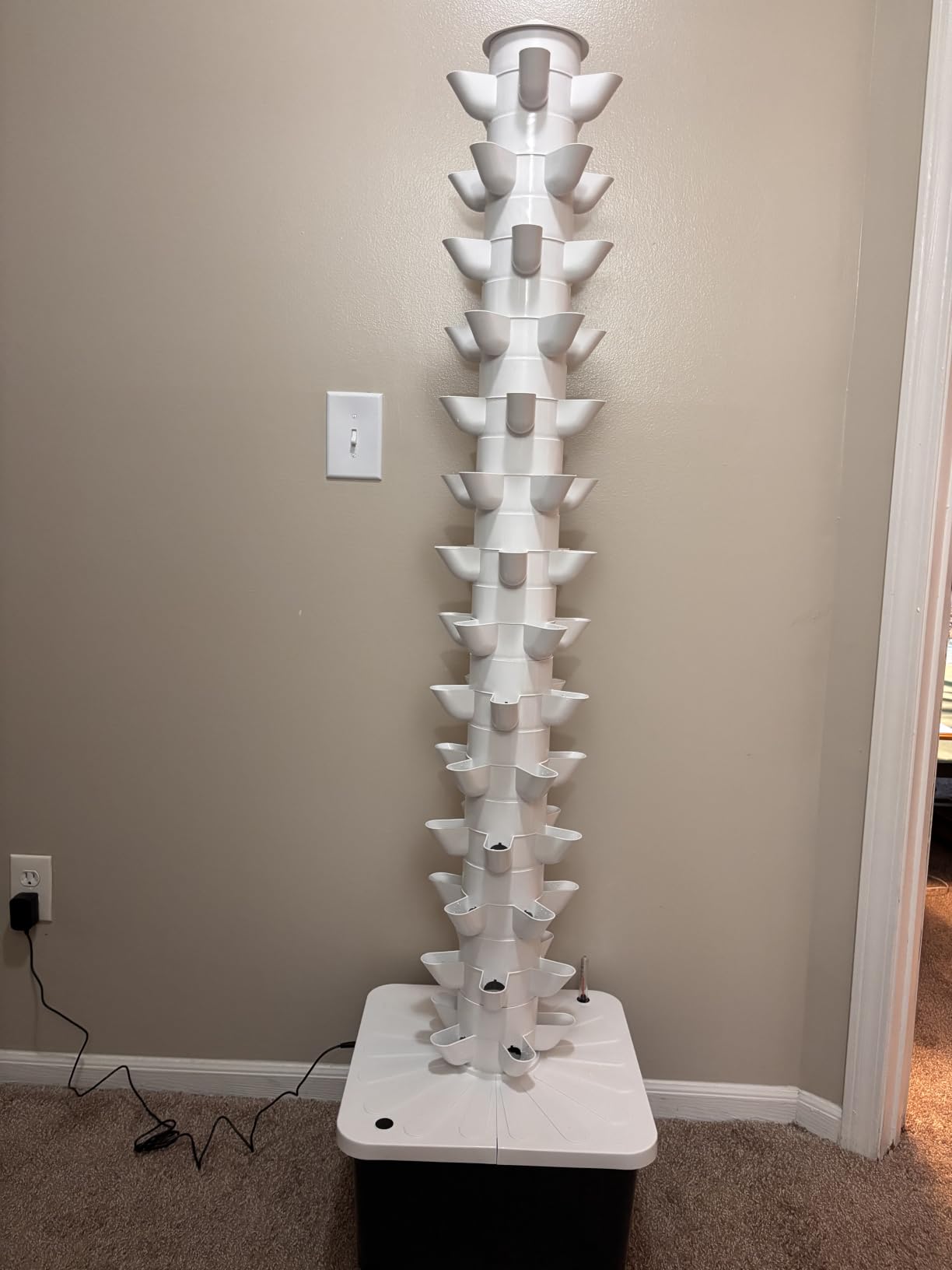
The tower is weather-resistant and works indoors or outdoors, so it can live on a balcony in summer. Variants exist at 70 pods, 70 slots and 56 slots if the full column is more than you need.
Now the reality check. The listed light source is 5 watts, which is far below what a 70-site tower needs. You will have to add your own grow lighting, and that cost is real. Support comes from a generic brand with only 17 reviews, so a pump failure means sourcing parts yourself.
Height is the other constraint. At 64.5 inches this needs a ceiling with clearance above it, and a 70-site column in a small flat needs a light source with enough reach to cover the lower layers. Plan the lighting before you buy the tower.
Who this tower suits?
It suits a shared flat or a small restaurant kitchen where you want a genuine salad supply rather than a novelty. Seventy sites can keep several people in loose-leaf greens for weeks.
It also suits anyone with a tall corner and a real lighting budget already spent elsewhere. If you already have a strong grow light, the capacity per square foot is the best on this list.
Who should skip it?
Skip it if you need a self-contained system. A 5 watt light source does not run 70 sites, and the tower is only worth buying if you plan to add lighting.
Skip it if support matters to you. With 17 reviews and no established brand behind the pump, a breakdown means improvising.
How to Choose a Vertical Hydroponic System for an Apartment?
Before comparing towers, it helps to know that most of what people call a hydroponic tower is a hybrid. A pure nutrient film technique system, or NFT, sends a thin sheet of water along a channel past bare roots and needs constant flow to keep the roots wet. Deep water culture, or DWC, suspends roots above a still reservoir and relies on an air pump for oxygen. Towers use a little of each: a pump feeds the top of the column and water falls past exposed roots, so you get flow at the top and a wet root zone below. If you want the channel-based approach instead of a column, our roundup of NFT hydroponic systems compares those directly.
The Kratky method is the passive option worth knowing about. No pump at all, roots reach down into a sealed container, and the air gap that forms as water drops keeps the roots oxygenated. It works, but it suits a few large plants rather than a tower of 30. Ebb and flow floods and drains a tray on a timer, which is hard to justify indoors where water splashes matter.
Six filters that decide it in an apartment
Footprint first. Measure the actual gap, including where the reservoir sticks out, and check the height against your ceiling with the light bars raised. A 66 inch tower needs headroom above it for the lights to sit correctly, and a tower that fits on the floor but not under the lights just becomes furniture.
Outlet access comes next. Every tower on this list needs power for the pump, and most also need power for lighting. A kitchen counter with a socket above the backsplash is close to ideal; a socket behind a sofa is not. If you plan to use a smart plug, check that the tower draws within its limits.
Noise matters in a shared-wall building. Pumps are quiet compared with a washing machine, but a column that buzzes through a thin wall at 2am is a problem. Placements near a bed are worse than placements near a hallway.
Light hours decide whether you can skip grow lights entirely. A south-facing balcony can carry herbs and greens with no lighting, which makes a non-lit tower like the 35-site model viable. A north-facing flat cannot, and the light bars are not optional there. If you are lighting a 16 to 30 site tower, the useful floor is around 30 to 50 watts for leafy greens.
Reservoir weight and refill frequency are the last pair. A 10 gallon tank full of water and wet media is heavy enough that you want casters, which is why the ALTO GARDEN includes them. Smaller 10 to 12 litre towers are easy to carry but need topping up every few days, and that is the most common reason people stop growing.
Finally, check your lease and your building rules before you buy. Continuous electrical use, balcony weight limits and shared-light policies are all plausible restrictions, and checking first costs nothing.
What to grow in a vertical tower, tier by tier?
Top tiers get the most light and the most airflow. Put compact, light crops there: loose-leaf lettuce, kale, pak choi and basil. These are also the fastest, with loose-leaf types ready in about 30 to 45 days.
Middle tiers suit root crops with modest height. Radishes, spinach, chard and cilantro all do well here because they are not trying to hold up a heavy fruit on a short root.
Bottom tiers are the shadiest and wettest. Fill them with low, spreading greens and herbs such as thyme, oregano and mint. Anything that grows tall or wide will shade its neighbours above it, so keep bottom-tier plants compact.
What to avoid in a tower: plants with deep or spreading root systems, anything that grows very tall or heavy on a single stem, and root vegetables that want far more horizontal space than a 3 inch site gives them. Tall crops also tip the column’s balance in an apartment, which matters on a balcony in wind.
Fruiting plants are possible, but with caveats. Dwarf cherry tomato and strawberry varieties can work in the highest tiers with strong light. They are heavier, thirstier and slower, and they raise the refill frequency of the whole tower.
First-30-days failure checklist
Pump death is the most reported problem across this category. Run the tower for an hour a day for the first week with the reservoir full, and confirm water actually reaches the top section before you plant anything.
Base leaks are the second. Check every joint between stacked sections while it is running, and put a tray under the base for the first week. A leak that runs unnoticed will empty a reservoir in under a day.
Clogged emitters show up as dry spots. Flush the lines monthly and keep organic matter out of the reservoir, since solid particles are what block the small passages.
Water temperature matters more than people expect. A reservoir sitting above roughly 85 F loses dissolved oxygen and invites root rot. Keep it shaded, out of direct sun, and top it up with cool water rather than warm.
Root rot appears as brown, slimy roots and a smell in the reservoir. It follows low oxygen, warm water or a neglected reservoir. Raise aeration, drop the temperature and do a full water change rather than topping off.
Algae shows up as green film in a tank that gets light. Keep the reservoir lid on and the outer surfaces dry.
Light burn shows up as pale or scorched leaves at the top tier. Move the top plants down or raise the bar, and keep a consistent 14 to 16 hour cycle rather than switching lights on at random times.
Household safety notes nobody mentions
Concentrated nutrient solution is not food grade. Keep the reservoir out of reach of children and pets, and never drink from the tank. Washing produce under running water before eating it is enough, and you do not need to sterilise it.
Tip-over is a real risk with tall columns, especially on a balcony. A 64 inch tower with a full reservoir has significant top-heaviness. Anchor it or place it against a solid wall, and never let children climb on it.
Humidity rises near a working tower because of evaporation and plant transpiration. In a small closed room that can encourage mould on the wall behind the unit. Keep some airflow and leave a gap between the tower and any wall.
Tap water varies by building. Chlorine and chloramine used for municipal supply can damage the roots over time, and hard water builds scale in the reservoir. If your water is heavily treated, let it stand uncovered overnight before filling the tank.
Frequently Asked Questions
What is the best vertical hydroponic system for indoor gardening?
For most apartments, the AOONEG 42-pod tower is the strongest overall pick because it packs 42 planting sites, six 30 watt LED bars and a 23 litre reservoir into an 18 by 9.8 inch footprint. It handles weak window light, runs quietly in a living space, and includes a memory timer so the light cycle restarts after a power cut. If your priority is build quality rather than plant count, the ALTO GARDEN GX wins on 2mm walls and a wheeled 10 gallon reservoir.
Which is better, NFT or DWC?
NFT sends a thin film of water along a channel and needs constant flow, so it uses very little water but fails if the pump stops. DWC suspends roots over still water and needs an air pump, so it uses more water but tolerates short pump outages. Most vertical towers blend both: a pump feeds the top of a column and water falls past exposed roots. For an apartment, the tower hybrid is usually easier because everything runs from a single base reservoir.
What are common vertical hydroponic problems?
The most common issues are pump failure, leaks at the joints between stacked tower sections, clogged emitters, warm reservoir water above roughly 85 F, root rot, algae and light burn on the top tier. Almost all of them show up in the first month. Test the pump and every joint before planting, flush lines monthly, keep the reservoir shaded and lidded, and hold a steady 14 to 16 hour light cycle.
Can you grow lettuce in a hydroponic tower?
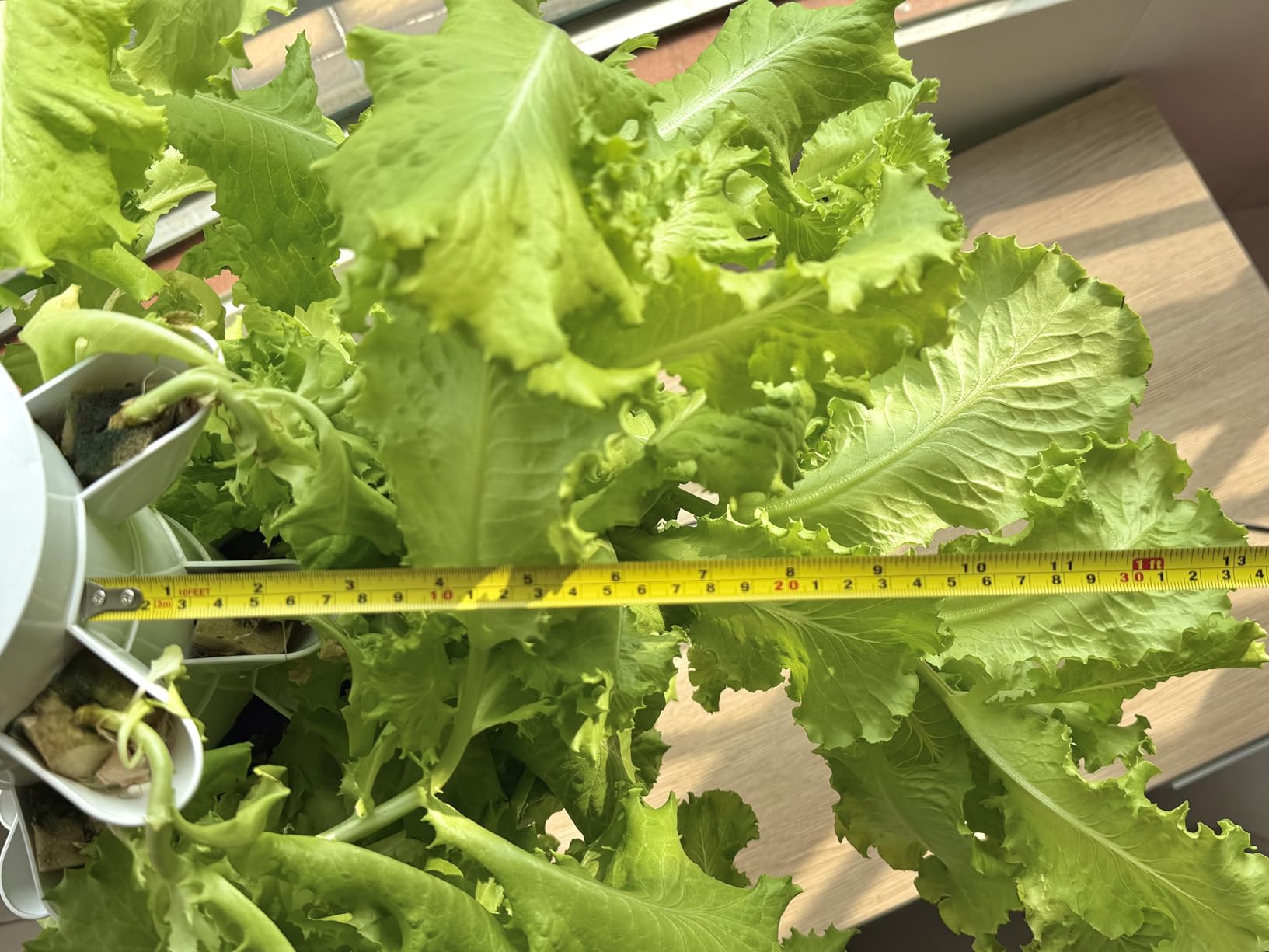
Yes. Lettuce is the ideal tower crop because it is fast, shallow-rooted and light enough for a small site. Loose-leaf varieties can be harvested in about 30 to 45 days, while head types need closer to 50 to 70 days. Place lettuce in the top and middle tiers where light is strongest, and expect to sow a new round every few weeks to keep a continuous supply.
What size hydroponic system is best for a small apartment?
For a studio or one-bedroom flat, capacity between 20 and 30 plants is usually plenty. Below 20 you are growing herbs and lettuce for two people, and above 30 you are managing refill frequency and electricity for crops you will not eat. Look for a footprint under 16 inches square, a reservoir of at least 10 litres to cut refill days, and light coverage that reaches the bottom tier.
Do hydroponic towers need electricity?
Almost all of them do, because the pump that lifts nutrient solution to the top of the column needs power. A typical tower runs a small DC pump continuously plus 30W to 180W of grow lighting on a 14 to 16 hour cycle. Passive Kratky containers need no power at all, but they suit a few large plants rather than a tower of 30, and a non-lit balcony tower still needs power for its pump.
Which Vertical Hydroponic System Fits Your Apartment?
For most flats, the AOONEG 42-pod tower is the pick. It has the most planting sites we tested, the light bars reach the top tier properly, and the base is narrow enough for a normal corner. If your ceiling is low or your kitchen is tighter than that, the OvyNewzly 30-site tower is the compact answer.
Choose the ALTO GARDEN GX when you want one tower that lasts and do not mind a taller frame, or the Lettuce Grow Farmstand Nook when you want your first harvest in about three weeks and the guidance handed to you. For a balcony with real sun, the JPWDDWYT 35-plant tower skips the lighting cost entirely.
Whichever you choose, test the pump and check every joint for a week before you plant anything, and keep the reservoir away from children and pets. That single habit prevents almost every failure we saw described by owners.
We will keep testing these towers and update this roundup through 2026 as new models land.