
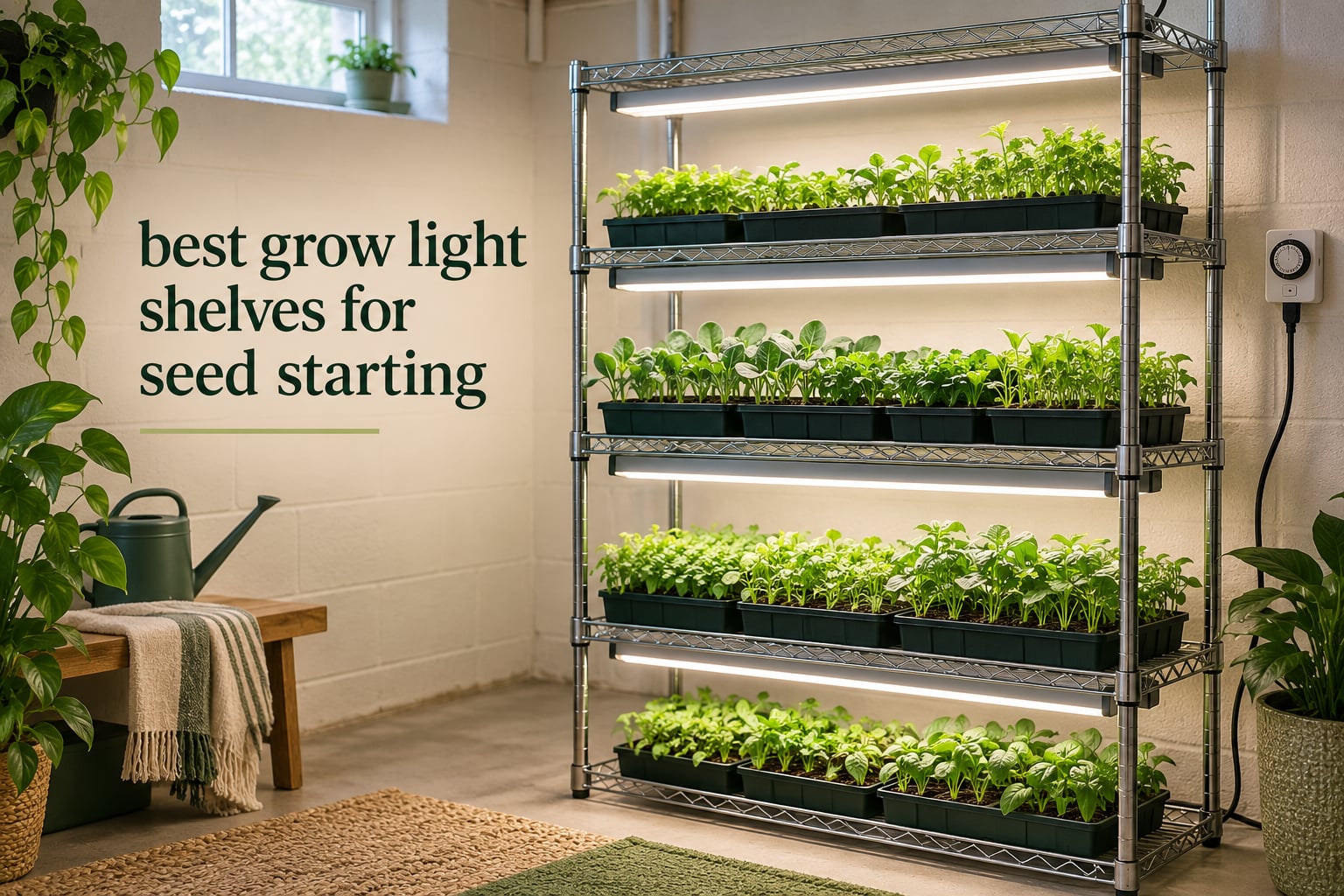
A sunny windowsill runs out of room about two weeks into a seed-starting season. Sowing tomatoes and peppers means 1020 trays stacked three and four high, and every tray that moves one foot from the glass gets noticeably paler than the one in front of it. That is the moment a grow light shelf earns its footprint: one unit where the shelf width, the fixture length and the tray size were designed to match each other.
We spent 2026 season comparing eight shelf-and-light systems built for indoor seed starting, from compact covered greenhouses to tall rolling towers. We measured each unit against the three numbers that actually decide whether seedlings come up strong: how many 1020 flats fit per tier, how closely the fixture length matches the shelf length, and whether the tier spacing leaves room for domed humidity covers.
This guide covers the best grow light shelves for seed starting, including which unit suits a basement, a garage or a small apartment shelf, and where bundled fixtures quietly fall short of what the listing implies. If you already know you want a shelf rather than a hanging light, start with the comparison table below; if you are still deciding, our grow light stand comparison covers the floor-standing alternative.
Table of Contents
Top 3 Best Grow Light Shelves for Seed Starting (October 2026)

Bstrip 4-Tier Greenhouse Shelf
- Four 20W full-spectrum lights
- 4/9/14 hour timer
- 27.2 by 19.9 by 61.8 inches

Bstrip DIY Plant Shelf Tower
- Eight 24W lights
- 192W total
- 6 configurable tiers
- lockable casters

The Bstrip four-tier covered shelf is the pick we kept coming back to during 2026. It pairs a 27.2 inch shelf with four 20W full-spectrum fixtures whose output is measured rather than guessed, and the roll-up zipper door holds humidity through the germination phase without adding a separate dome to every tray.
The taller Bstrip tower takes over when tray count matters more than footprint: eight lights, six configurable tiers and one-inch height increments let a single unit grow from germination to hardened seedlings. The SpeePlant wide greenhouse is the answer when you want a 39 inch tier so a 1020 flat and a grow pot sit side by side.
All 8 Grow Light Shelves at a Glance
| Product | Specifications | Action |
|---|---|---|
| Bstrip 4-Tier Greenhouse Shelf |
|
Check Latest Price |
| Bstrip DIY Plant Shelf Tower |
|
Check Latest Price |
| SpeePlant 4-Tier Wide Greenhouse |
|
Check Latest Price |
 Spider Farmer Mini Greenhouse Spider Farmer Mini Greenhouse |
|
Check Latest Price |
 JESLED Plant Shelf with Grow Light JESLED Plant Shelf with Grow Light |
|
Check Latest Price |
 Barrina CX3 Plant Stand Barrina CX3 Plant Stand |
|
Check Latest Price |
 FREELICHT 5-Tier Light Shelf FREELICHT 5-Tier Light Shelf |
|
Check Latest Price |
 Barrina LP600 Indoor Greenhouse Barrina LP600 Indoor Greenhouse |
|
Check Latest Price |
1. Bstrip Indoor Greenhouse Shelf with Grow Light – Best All-in-One for Seed Starting
Bstrip Indoor Greenhouse with Grow Light, 4x20W Plant Lights with Timer
27.2 by 19.9 by 61.8 inches
Four 20W full-spectrum lights
4, 9 and 14 hour timer cycles
Pros
- Compact footprint fits a 10 by 20 inch tray per tier
- Four tiers on a rigid steel pipe frame
- Roll-up zipper door and PVC cover hold humidity
- Built-in timer with 4
- 9 and 14 hour cycles
- Tool-free assembly
Cons
- Thinner plastics than solid-shelf competitors
- PVC cover blocks little light
- Weight rating is listed inconsistently
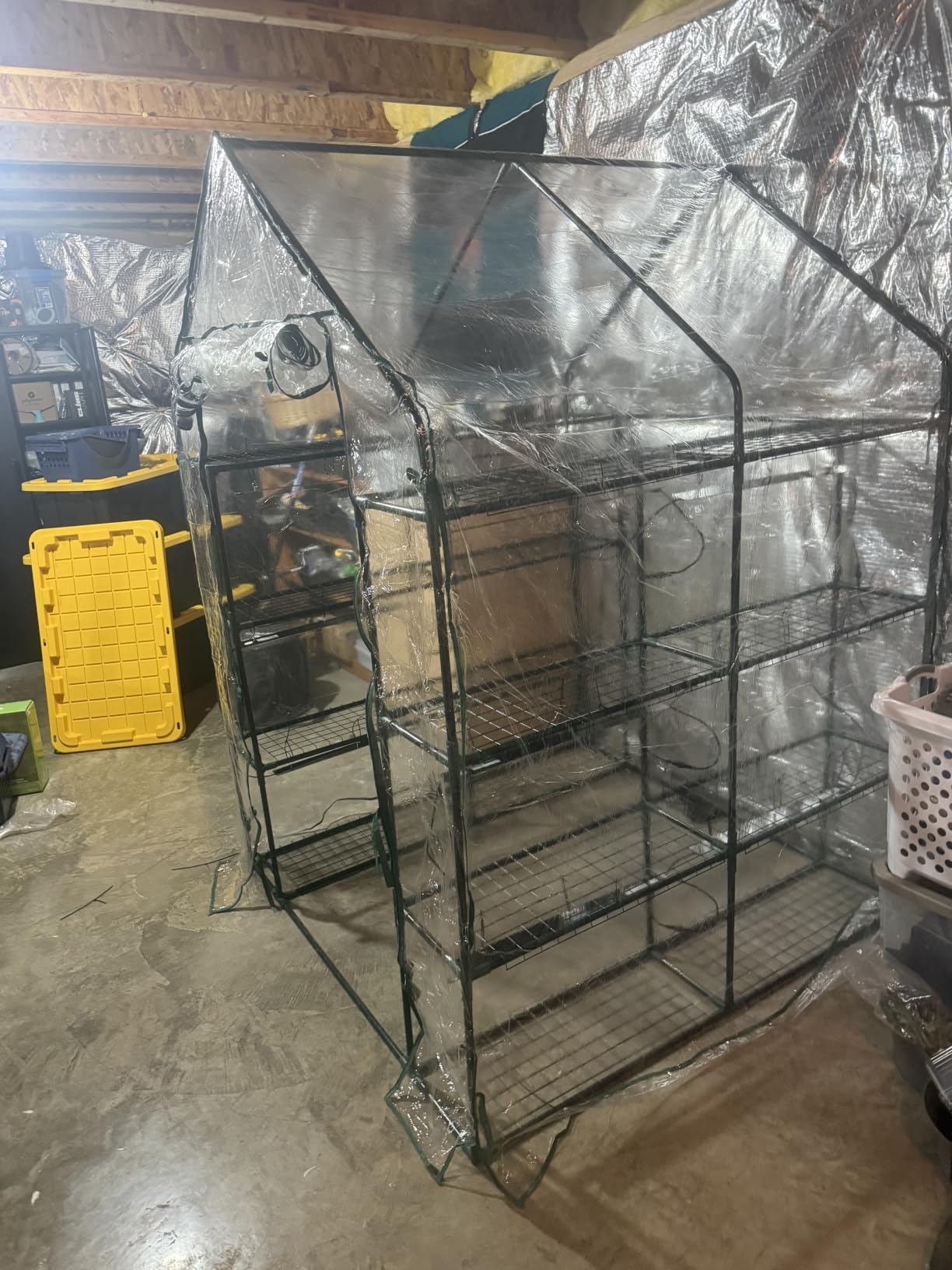
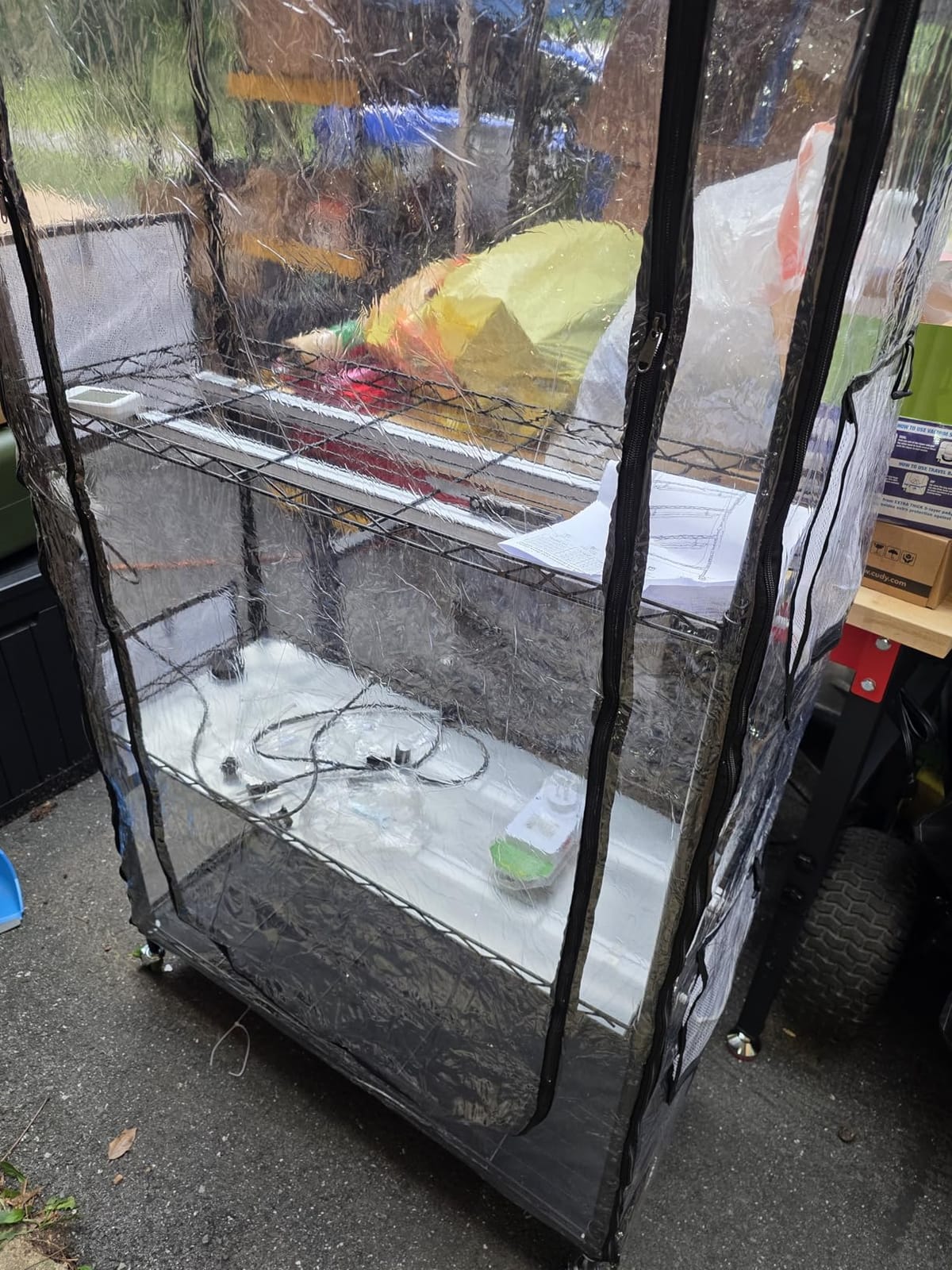
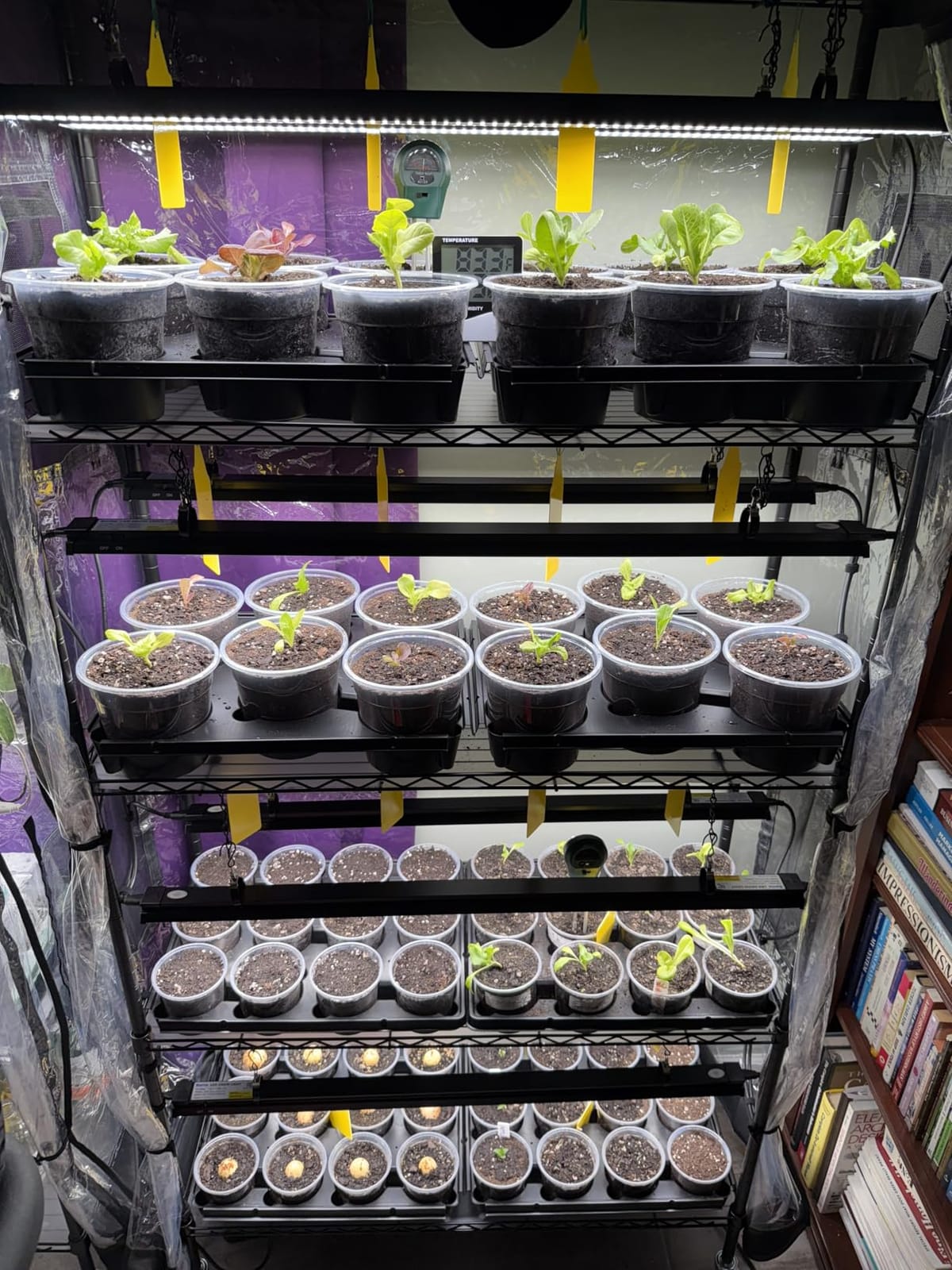
This is the unit we set up first for 2026, and it is the one we would put in front of someone starting seeds for the first time. Four shelves at 27.2 by 19.9 inches sit inside a PVC cover with a roll-up zipper door, so germination happens without a plastic dome on every tray. The shelf depth is the reason it works: 19.9 inches takes a 1020 flat flat and leaves room for labels and a small hand.
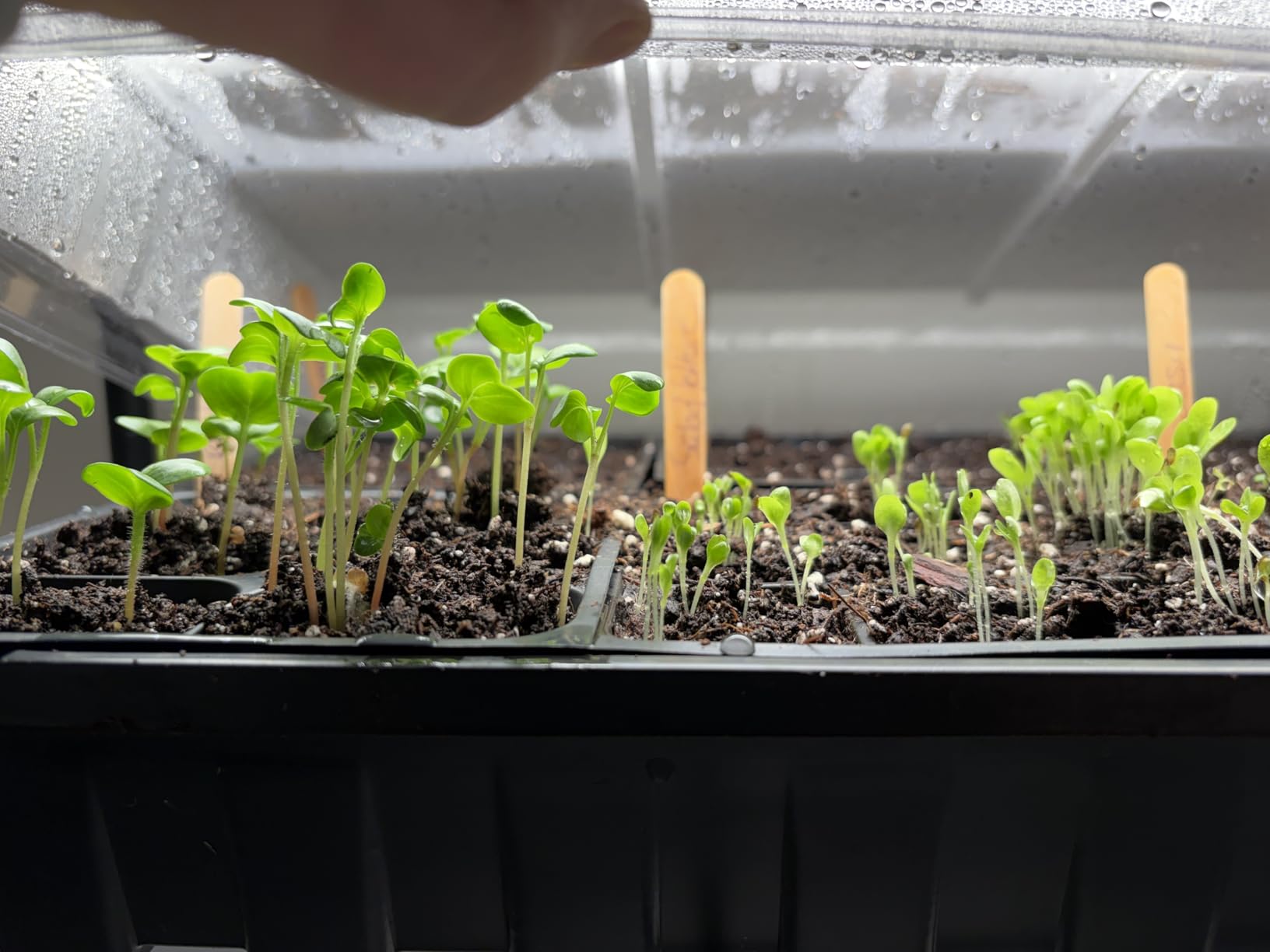
The lighting is the part that separates it from most bundled shelves. Each of the four bars is 20W full spectrum, rated at 389.3 micromol per square meter per second at four inches, and the timer offers 4, 9 or 14 hour cycles rather than a single fixed schedule. That matters for tomatoes and peppers, which do better on a longer day than the 9 hour preset we used for germination.
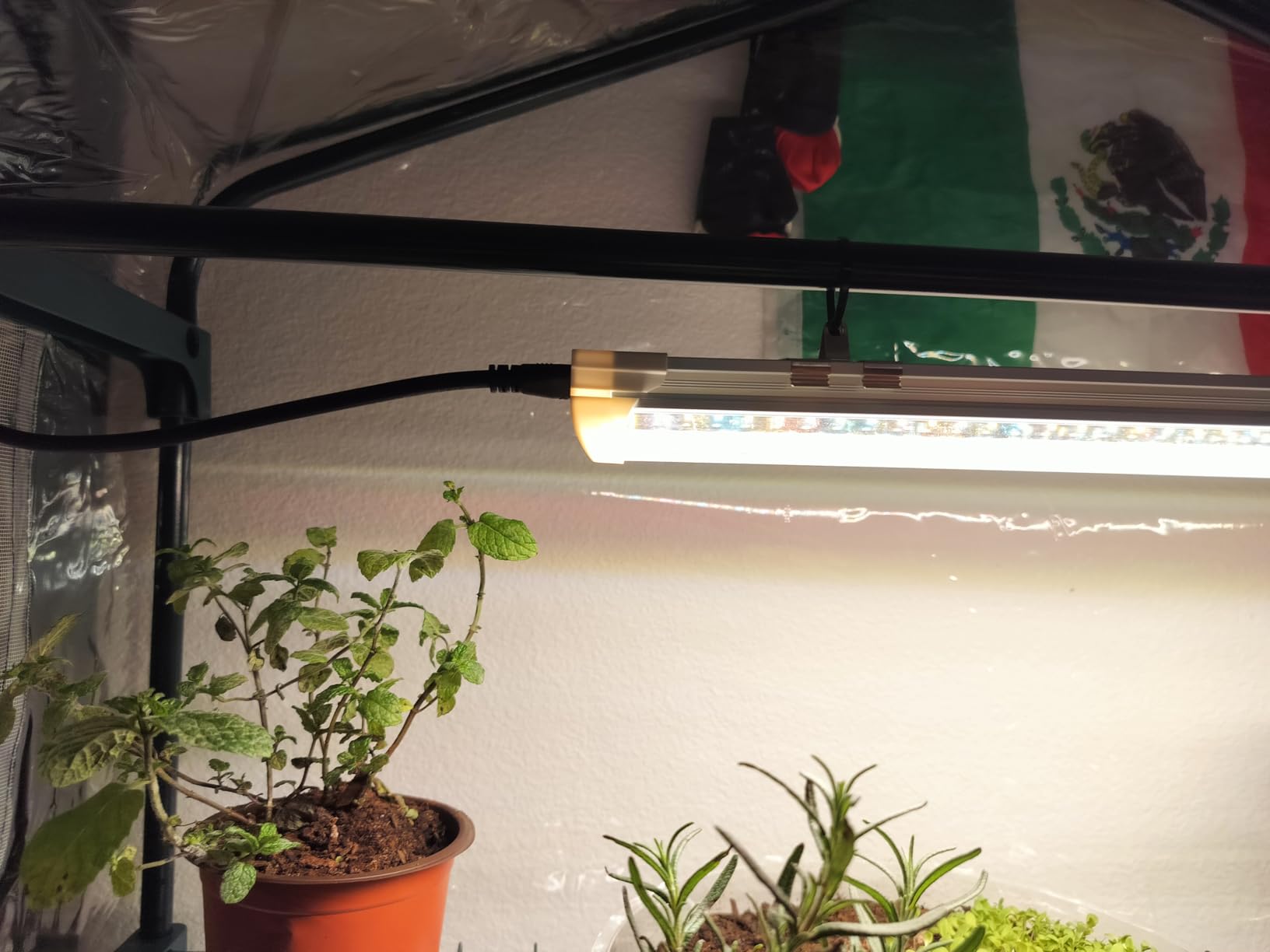
Assembly is genuinely tool-free, which saved us the usual hour of hunting for hex keys. Reviewers repeatedly mention that the tray-friendly spacing was the deciding factor, and that the included timer removed one more thing from the shopping list. Buyers also flag thinner plastics than the metal-shelf competitors, which shows up first at the zipper seam rather than the frame.
One inconsistency is worth knowing before you order: the weight capacity is listed as 352 pounds in the feature copy and 60 pounds in the specification block. Seed trays are light, so this only matters if you plan to use the bottom shelf for pots and watering cans. Our loaded four-tier run stayed well inside either figure.
Is this the right shelf if you are starting tomatoes and peppers indoors?
Yes, if one flat per tier across four tiers works for you. Four flats under light at 80W total is a comfortable starting capacity for a household growing a dozen tomato and pepper plants.
The timer presets are the sleeper feature. A 14 hour cycle on a 5000K-leaning full spectrum bar gives sturdier stems than a window, and the roll-up door lets you drop the humidity once true leaves appear.
What should you watch out for on this shelf?
The cover is basic PVC, so it limits light slightly and does little to buffer heat on a warm day. Keep the roll-up flap open during the light cycle if the room heats up.
If your flats are wider than 20 inches, or you want two flats side by side on one tier, this footprint will not take them. That is the moment to move up to a wider tier or a taller tower.
2. Bstrip DIY Plant Shelf with Grow Light – Best Configurable Tower
Bstrip DIY Plant Shelf with Grow Light, Adjustable, 29.5×13.8×70.9in
29.5 by 13.8 by 70.9 inches
Eight 24W lights, 192W total
Up to six tiers, one-inch increments
Pros
- Builds as one six-tier tower or two three-tier units
- Shelf height adjusts in one-inch increments
- Eight 24W full-spectrum lights for even coverage
- Locking casters move the whole unit
- Detailed illustrated assembly instructions
Cons
- Hanging chains are awkward to adjust
- Plastic shelf clips flex under heavy pots
- PP mats have no lip so trays catch runoff
This is the pick for anyone whose tray list grows past one shelf. The frame supports up to six configured layers, and the shelf height moves in one-inch increments, so you can raise a tier from a freshly sown flat to a six-cell tray of seedlings without rebuilding anything. Long-form owners describe it as transforming indoor seed starting and herb growing, and our own seedlings showed visible response within days of setup.
Light output is the strongest case for the money here. Eight 24W full-spectrum fixtures total 192W, and each is rated at 206.5 micromol per square meter per second at eight inches. Because the shelves are only 13.8 inches deep, one 1020 flat fits per tier, but you get up to six of them, which is 384 watts of light across a single rolling unit.
Eight industrial wheels, four of them with fixed locks, make the unit practical to move from a garage corner to a spare room. Six PP mats sit under the trays to keep water off the light housings, though they have no raised lip, so we put a tray beneath anything we water heavily. The frame is 35.8 pounds empty and lists a 270 pound total capacity.
The design flaws are in the accessories rather than the structure. Hanging chains are awkward to adjust once plants reach the fixture, plastic shelf clips are the weak link under heavier pots, and the protective film on each bulb is undocumented, so it can end up still on the lamp if nobody reads the manual.
Do you need this much wattage to start seeds?
No, but you do need this much capacity. 192W across six tiers is overkill for germination and exactly right for pricking out, potting on and holding stock plants until transplant.
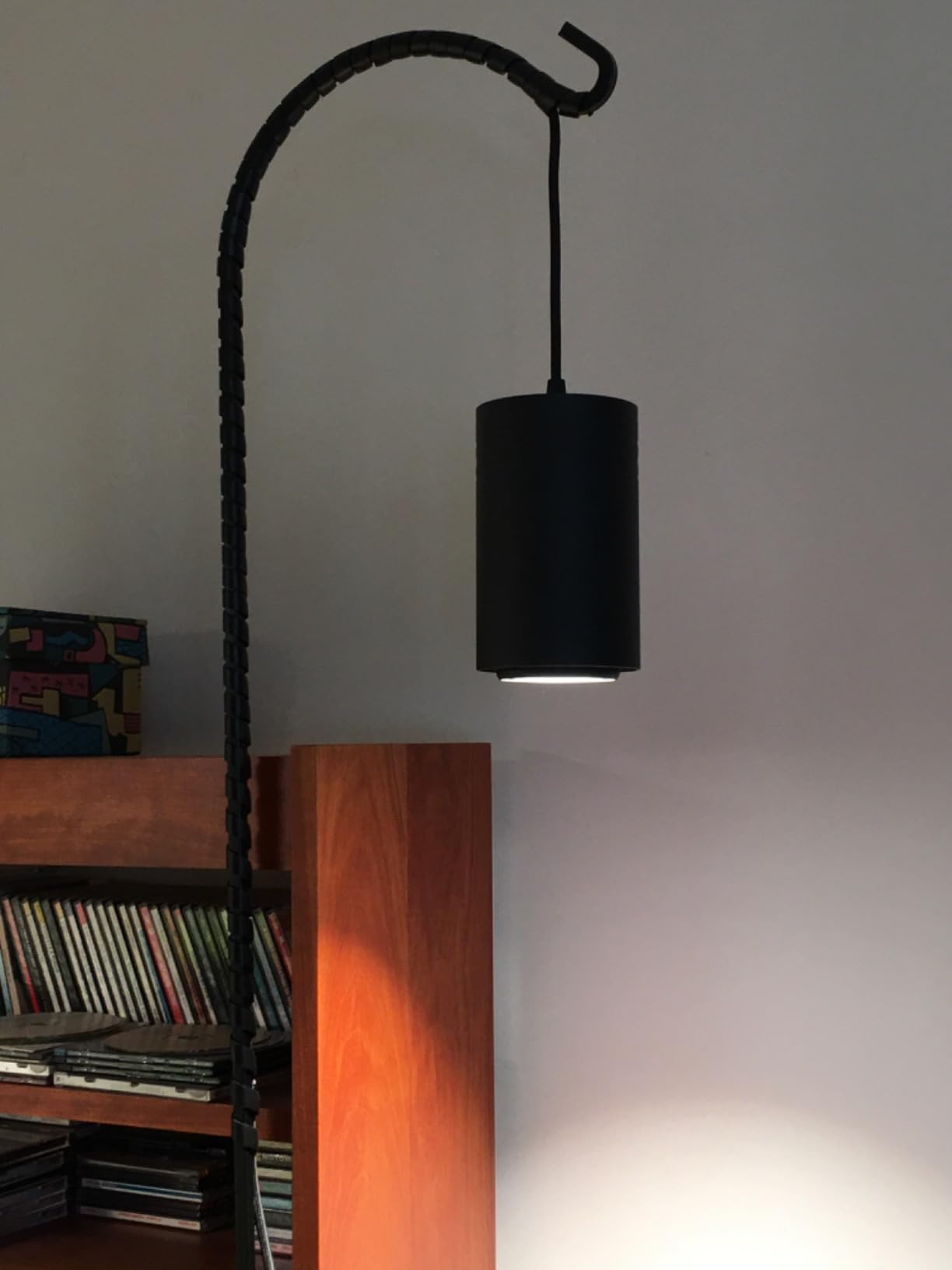
Because the fixtures hang rather than mount, keeping light close is a manual job. We found the one-inch increments enough to stay within a few inches of the canopy once seedlings stretched.
Where does the configuration flexibility pay off?
Two three-tier units beat one six-tier tower in a narrow basement, and the same box builds either way. Gardeners with a garage and a spare room can split it.
The trade-off is reach. The top shelf of the tower configuration is awkward to reach and hard to water once a canopy closes over it. If you will not use the top tier, build it as two shorter units.
3. SpeePlant 4-Tier Wide Greenhouse – Best Wide Tier for Pots and Flats
Speeplant Indoor Greenhouse with Grow Light, 4-Tier Plant Shelf, 39x19x63in
39 by 19 by 63 inches
Four 32W T5 lights, 128W total
Timer programmable in 15-minute steps
Pros
- 39 inch tiers give plenty of room for trays and pots
- Four 32W dual-reflector full-spectrum lights
- Mechanical timer handles daily cycles
- Tool-free assembly in about 20 to 30 minutes
- Ventilation windows and spill pouch manage water
Cons
- Directions are poorly written
- Top light hangs high enough to stretch seedlings
- No easy way to lower the lights as plants grow
The SpeePlant solves the tray math problem from the other direction: instead of more tiers, it gives you 39 inches of length on every tier. Each shelf holds a 1020 flat plus a run of pots along the front edge, and because the tiers can be removed or adjusted, a tier can be dropped entirely when a tray of tomatoes outgrows the height.
Lighting is four 32W 1.6 foot T5 fixtures with dual reflectors, 128W in total, and each fixture links in series so you can run up to eight together if you expand the setup later. Each tier carries 22 pounds, which is more than wet flats weigh, and the removable bottom spill pouch catches runoff from the tier above.
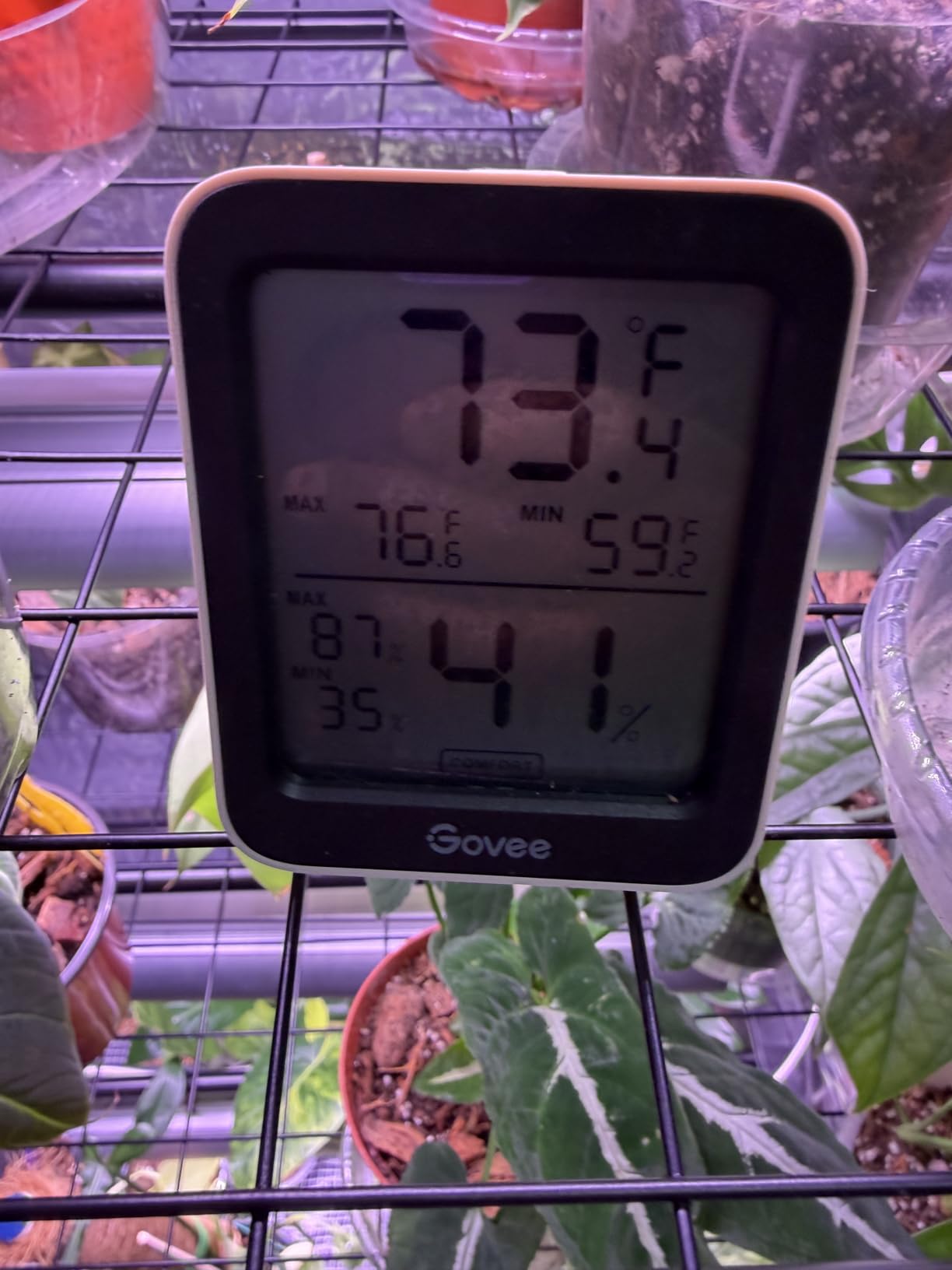
The 24-hour mechanical timer is programmable in 15-minute intervals, so a 16 hour photoperiod is a straightforward setting rather than an approximation. Buyers call the build easy and the lights effective for germinating seeds, and the two ventilation windows keep the PVC cover from turning the interior into a greenhouse oven in a warm room.
The recurring complaint is light height. The top fixture hangs high enough that seedlings stretch toward it, and there is no convenient way to lower the lights as plants grow, so you end up moving or rotating trays instead. Instructions are also widely criticised as unclear, so budget an extra twenty minutes over the advertised assembly time.
Is a 39 inch tier worth it if you only sow one tray at a time?
Not yet, but it becomes worth it the week you pot seedlings on. Wide tiers let flats and pots share one fixture, which is exactly the stage where narrow towers run out of depth.
The dual reflectors are the quiet advantage. Light gets pushed down and outward instead of pooling in a stripe under the tube, so a wide tier stays evenly lit across its length.
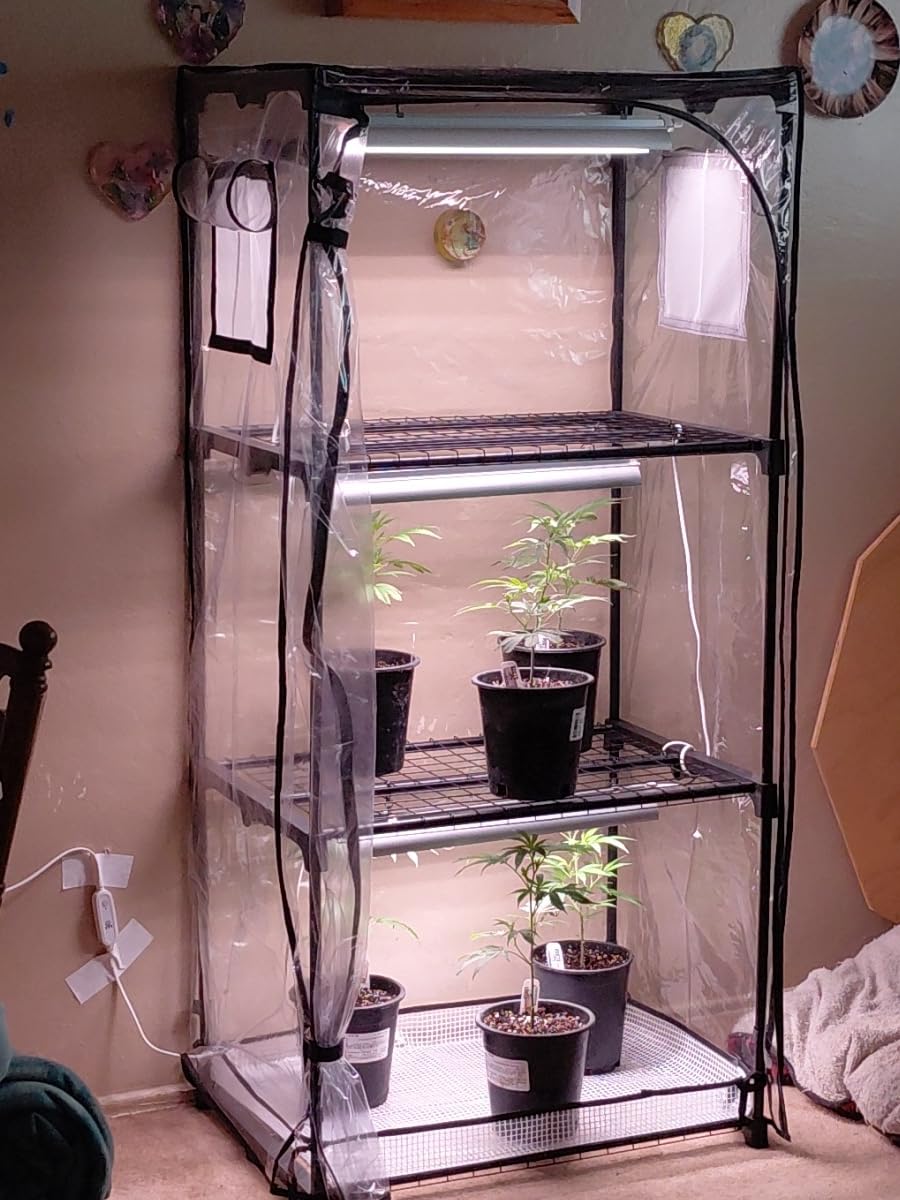
What should you watch out for on this unit?
Light height is the big one. Plan to measure seedling height weekly and reposition trays rather than expecting the fixture to come down to meet them.
The 22 pound per-tier rating is a limit for mixed use. A tray of wet mix plus a row of large pots adds up faster than it looks.
4. Spider Farmer Mini Greenhouse Plant Shelf – Best for Small Footprint and Light Lock
Spider Farmer 4 Tier Mini Greenhouse Plant Shelf with Grow Lights Indoor
12 by 12 by 47 inches
Six 10W full-spectrum light bars
110 lbs per tier, lockable casters
Pros
- Reflective mylar interior removes dark corners
- Blackout curtain keeps the room dark at night
- Waterproof drainage trays simplify bottom watering
- Four lockable swivel wheels
- Sturdy powder-coated frame
Cons
- 12 by 12 inch tiers will not hold a full 1020 flat
- Shelf height adjustment means partly disassembling
- 10W bars have no dimming and no timer
This is the most interesting enclosure in the roundup for anyone starting a small batch, and the least suitable for large ones. The 1680D waterproof Oxford fabric cover wraps a metal frame with a reflective silver interior, and the combination of clear viewing curtain and blackout curtain means a spare room or bedroom stays dark at night even with the lights on.
Six 10W full-spectrum LED bars come in the box, linkable and plug-and-play, with an LED lifespan listed at up to 50,000 hours and a one-year warranty with a 30-day replacement service. Buyers describe the build as solid with nothing wobbling, and they praise the reflective interior for distributing light evenly with no dark corners, which matters in a unit this narrow.
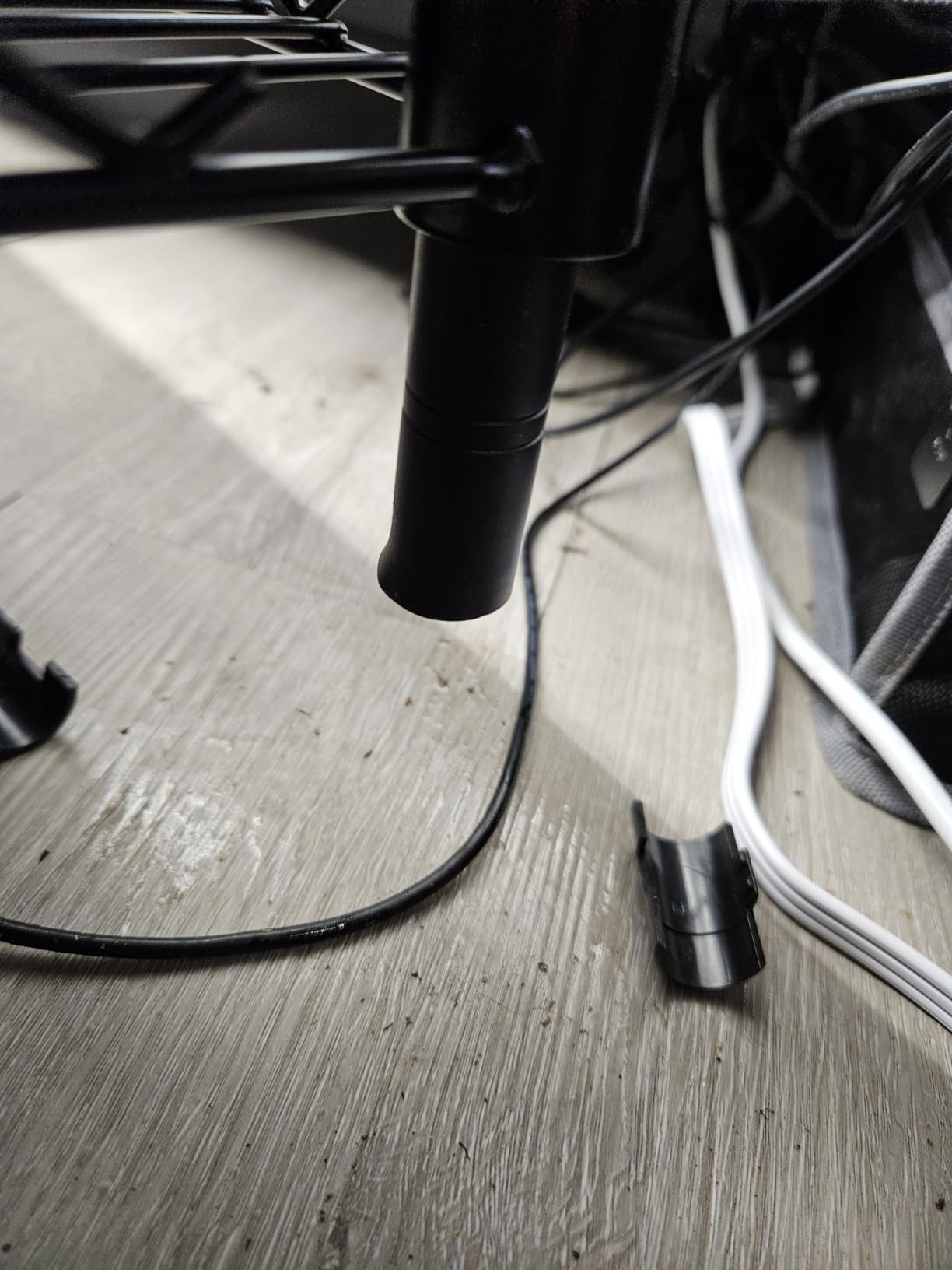
Three waterproof PVC trays with openable drainage holes make bottom watering simple, and the whole unit rolls on four lockable swivel wheels. It is genuinely useful for cuttings, microgreens and six-cell trays, and the humid micro-climate suits propagation work that an open shelf cannot do.
Here is the honest limitation: the tiers are 12 by 12 inches. A 1020 flat is 20 inches long and will overhang a shelf, so this unit works with small starter trays, not nursery flats. Some buyers also find the 10W bars underpowered at close range, and there is no dimming, spectrum or intensity control plus no timer included, which means buying a timer is part of the plan.
Can a 12 inch shelf really work for seed starting?
Yes, for six-cell or nine-cell trays, cuttings and microgreens, which is a real seed-starting job. No, if your plan depends on 1020 flats.
Adjusting shelf height often means partly taking the unit apart, so treat the shelf positions as fixed after the first week and choose your tray layout accordingly.
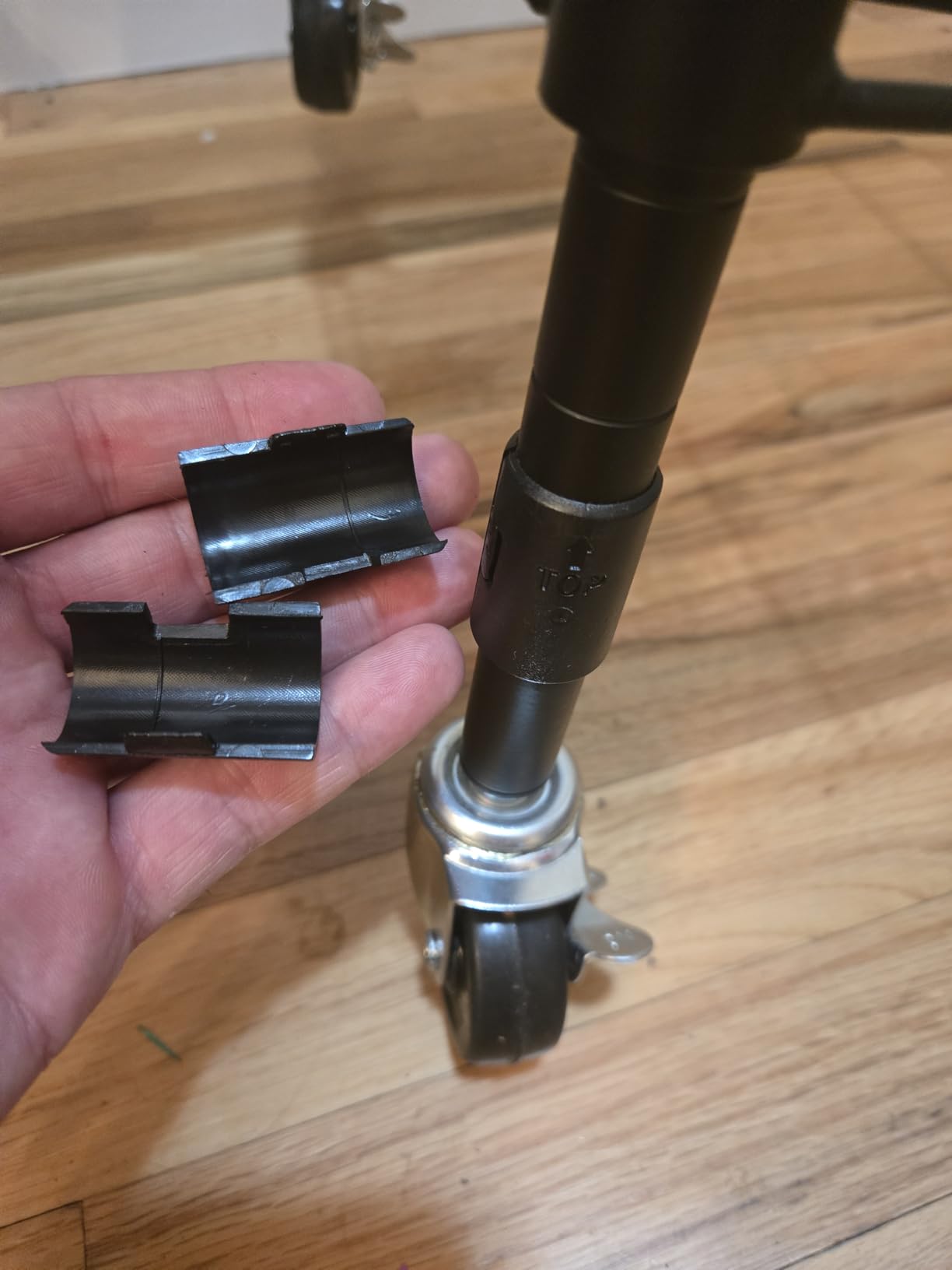
Is the blackout curtain worth the extra effort?
It is the reason to choose this unit over an open tower, particularly in a room where light spill matters. The viewing curtain lets you check germination without opening the zip.
The main zipper is the part reviewers expect to wear with heavy long-term use. If you run daily cycles for two full seasons, check it each spring.
5. JESLED Plant Shelf with Grow Light – Best for Per-Tier Light Control
JESLED Plant Shelf with Grow Light, 29.5×13.8x70IN
29.5 by 13.8 by 70.1 inches
Five adjustable tiers
Eight T8 lights, 5000K full spectrum
Pros
- Five tiers adjust to different plant heights
- Per-tier on and off switches plus a mechanical timer
- Built-in reflectors boost PPFD
- Lockable casters move it out of the way
- Thermo-hygrometer included for humidity checks
Cons
- Lights run hot
- so the cover needs venting
- Short connecting cables with some unfinished wire ends
- Shelf locking pieces can fail under light loads
The JESLED shelf is the one we would pick for a mixed batch, because you can light one tier and leave the rest dark. Eight T8 full-spectrum lights at 5000K are split across five adjustable tiers, and individual per-tier on and off switches sit alongside a mechanical timer, so freshly sown trays at the top do not get the same photoperiod as hardened seedlings below.
Total capacity is listed at 300 pounds, the stand is 29.5 by 13.8 by 70.1 inches, and a thermo-hygrometer is included in the box. Built-in reflectors raise PPFD at the canopy, which helps in a unit this narrow. Tool-free assembly and lockable casters make it easy to move out of the way during the day.
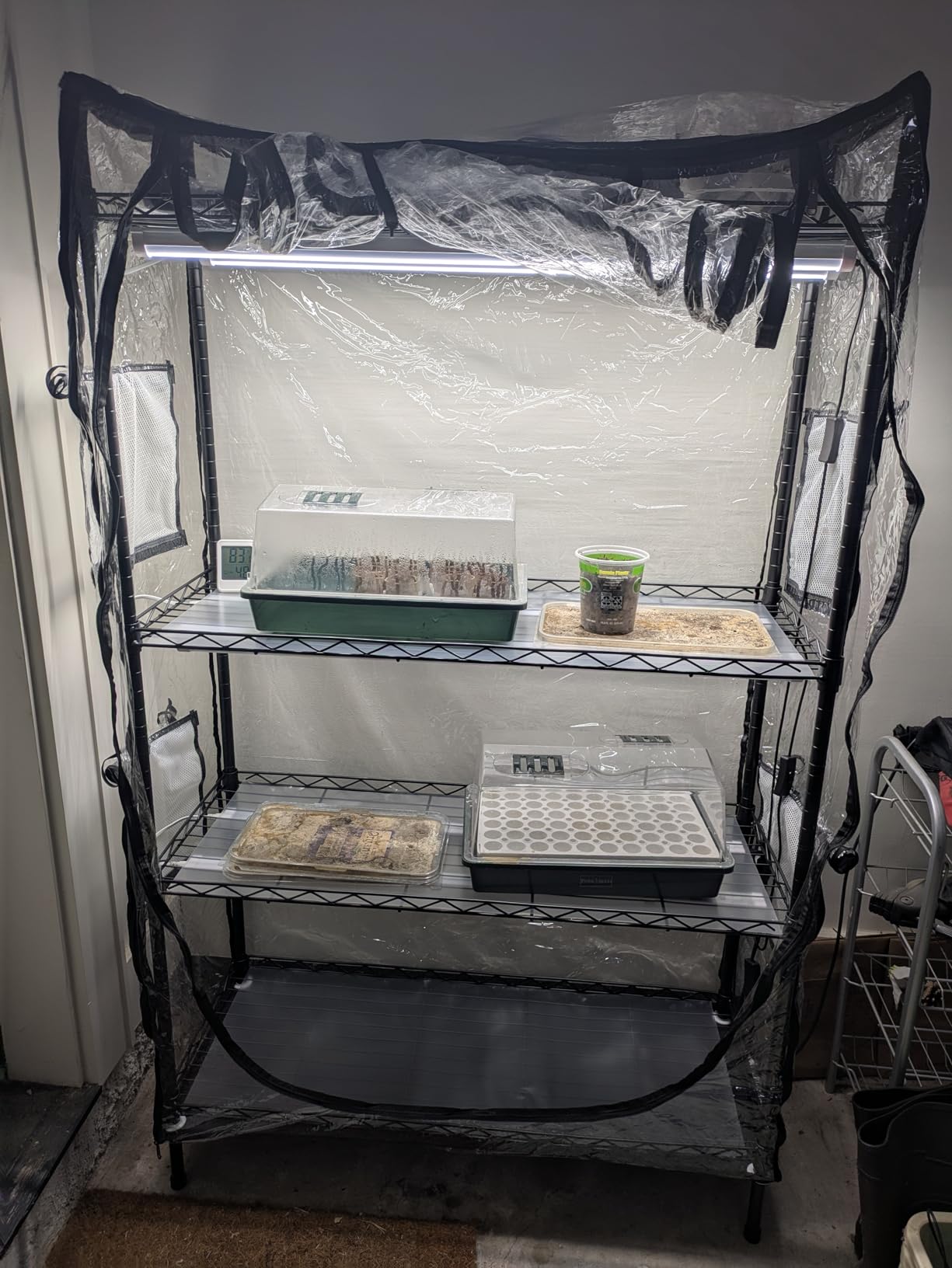
Reviewers highlight strong heat and humidity retention when the cover is zipped, which is exactly what germination needs, and they rate it as good value for starting large numbers of seedlings. The 5000K color temperature suits the blue-rich light seedlings prefer during early vegetative growth.
The heat is the real trade-off. Owners report the lights run hot enough to need the cover open and external fans, which is worth planning for in a warm basement or garage. Some also found the included connecting cables short, with unfinished wire ends, and reported shelf locking pieces failing under light loads, so inspect the fittings early rather than trusting them for a heavy potting-on stage.
Why does per-tier switching matter for seed starting?
Because a batch is rarely one stage. Germinating pepper seed and hardening four-week-old tomato seedlings rarely need the same day length, and separate switches let you run both from one shelf.
It also saves power. Running one tier instead of five for a week of germination drops the load from the full eight-fixture draw to two.
Where does this unit let you down?
Heat, mostly. The lights run hot enough that the cover needs opening and an external fan in a warm room, and the short connecting cables limit how you arrange fixtures.
There is no individual on and off switch on each individual light, only per tier, so fixtures within a tier always run together.
6. Barrina CX3 Plant Stand with Grow Light – Best Long Shelf Length
Barrina CX3 Plant Stand with Grow Light, 4-Tier, 108W, 35.4×13.8×70.9IN
35.4 by 13.8 by 70.9 inches
Four tiers, 90 lbs per tier
Three 36W T5 lights, 108W total
Pros
- 35.4 inch tiers fit standard trays and planters
- Height-adjustable tiers on a rolling frame
- 90 lbs per tier and 360 lbs total
- PP waterproof pads protect the fixtures
- Mechanical timer included in the box
Cons
- Open frame gives no humidity micro-climate
- Bar-style T5 fixtures offer no dimming or spectrum control
The CX3 earned the highest rating of any unit in this roundup at 4.7 across 175 reviews, with 85 percent of those ratings at five stars, so it is worth looking at even though the review count is modest. At 35.4 inches long, its tiers are among the widest here and take a 1020 flat with clearance at both ends plus a row of 3 inch pots along the front.
The stand is height-adjustable across four tiers, each rated to 90 pounds for a 360 pound total, and it rolls on a frame with wheels. Three 36W T5 2020T full-spectrum fixtures total 108W, each running at 5000K, and PP waterproof pads sit on every tier so watering does not reach the light housings. A mechanical timer socket is included, so the light cycle runs on schedule from day one.
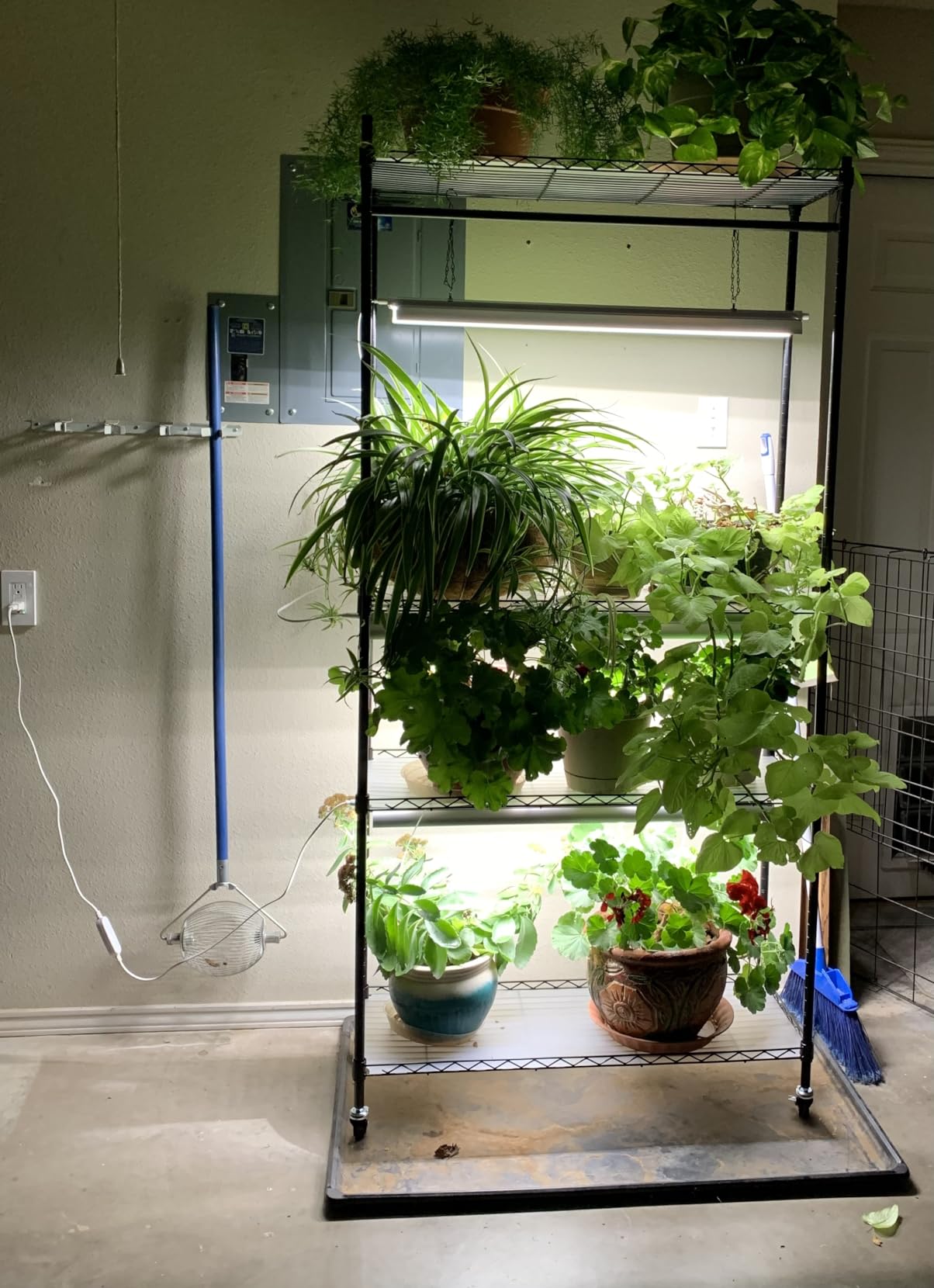
Barrina is the brand that comes up most often by name in seed-starting communities, and this model carries a two-year manufacturer warranty. Long tiers also make labelling easier, which saves real time when you are checking hundreds of tomato varieties for germination speed.
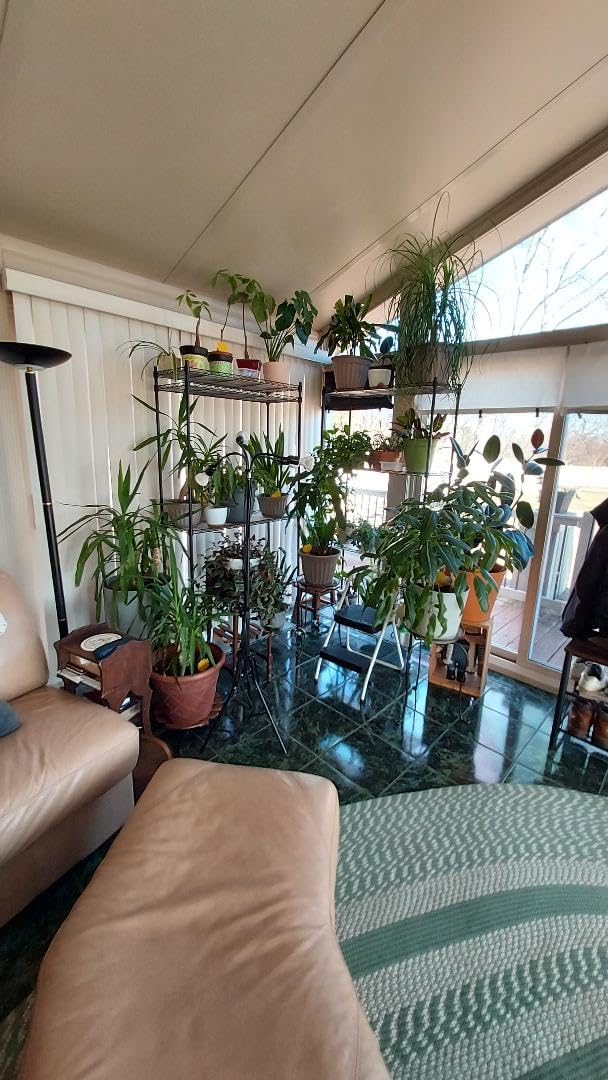
There is no cover. The open frame means no greenhouse micro-climate, so humidity control is entirely manual, and the bar-style T5 fixtures give you no dimming or spectrum control. Seedlings under a fixed-output bar need the light moved instead, so plan on adjusting height as they grow.
Why does shelf length matter more than brightness?
Because a fixture that is shorter than the shelf leaves the far end of every tray in shadow, and seedlings do not grow evenly across a tray. Thirty-five inches of tier with 35.4 inch fixtures covers the whole surface.
The 90 pound per-tier rating is also the highest in this group, which matters once the same shelf holds potted seedlings hardening off in spring rather than bare trays.
Who should skip this one?
Anyone whose plan depends on humidity domes or propagation chambers, since the open frame provides neither. Buy a covered model for cuttings and germination.
Anyone who wants to dim lights as seedlings emerge. There is no dimming, and bar fixtures hang at a fixed height.
7. FREELICHT 5-Tier Plant Shelf with Grow Light – Budget Pick Per Tier
FREELICHT Plant Stand with Grow Light 5-Tier, 4×30W 5000K, 29.5×13.8×61.5IN
29.5 by 13.8 by 61.5 inches
Four 30W 5000K lights
9, 12 and 15 hour timer modes
Pros
- Four 30W 5000K lights across five tiers
- Timer offers 9
- 12 and 15 hour modes
- Tier spacing adjusts for different plant sizes
- PP mats protect shelves from water
- Quick assembly with all hardware in one box
Cons
- Only two industrial wheels instead of four
- Open-frame design gives no humidity enclosure
The FREELICHT is the cheapest way in this roundup to get five lit tiers, and reviewers consistently call it affordable and bright. Four 30W full-spectrum fixtures at 5000K light five tiers on a 29.5 by 13.8 by 70 inch frame, with 80 pounds of capacity per tier and non-slip PP mats on each shelf.
Adjustable shelf spacing is the feature that earns its place after germination. Once tomato seedlings need more headroom, the upper tiers open up without taking the frame apart. The timer gives you 9, 12 or 15 hour cycles rather than a single fixed setting, and 5000K suits the blue-rich light seedlings prefer in early growth.
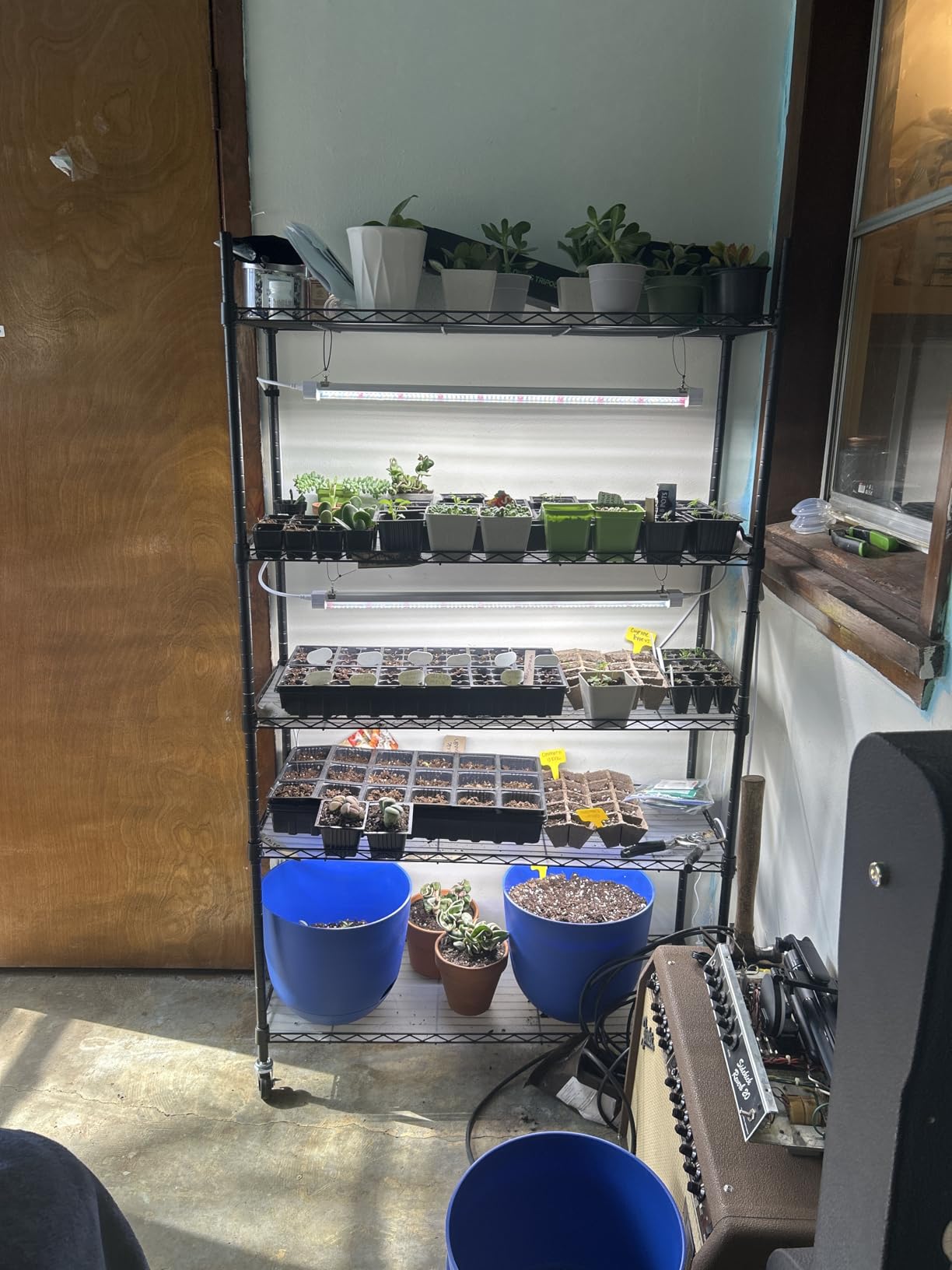
Assembly is quick and everything, including the timer cord, connecting cords, shelves, mats and wheels, arrives in one box. The unit weighs 21 pounds empty, which is light enough to reposition without wrestling, and it carries a two-year warranty.
Two cautions. Only two industrial wheels are fitted rather than four, so a fully loaded five-tier unit is less stable and harder to move than the tower-style shelves here, and we would load the bottom tiers first. It is also an open frame with no enclosure, so there is no humidity control and no light block at night. With 104 reviews behind a 4.6 rating, the feedback base is the smallest of the eight.
Is the cheapest five-tier unit here bright enough for seedlings?
Yes, at 30W per bar and 120W across the stand. Plenty of growers start seeds successfully with far less, and 5000K full spectrum is the right color temperature.
Where it is not enough is flowering crops and dense vegetative growth. This is a propagation shelf, not a finish-out rack.
What does buying this unit cost you in flexibility?
No dimming, no enclosure and two wheels. If you plan to grow the same shelf into a full indoor garden later, the covered units are a better starting platform.
The timer modes top out at 15 hours, which is fine for seedlings and short of the 16 hour photoperiod many growers run for young tomato transplants.
8. Barrina LP600 Indoor Greenhouse – Best for Compact Rooms and Apartments
Barrina LP600 Indoor Greenhouse with Grow Light, 5 Tier Stand with Tent
23.6 by 13.8 by 70.9 inches
Four 25W CRI 97 lights, 100W total
Five tiers with four vents
Pros
- CRI 97 lights with strong PPFD at close range
- Each light has its own on and off switch
- Sturdy shelving inside a well-made zippered tent
- Roll-away front opening gives full-width access
- Built-in wheels and tool-less assembly
Cons
- No guidance on shelf spacing in the instructions
- Tent sags if the top shelf is not at its highest setting
- Condensation drips to the floor so add a tray underneath
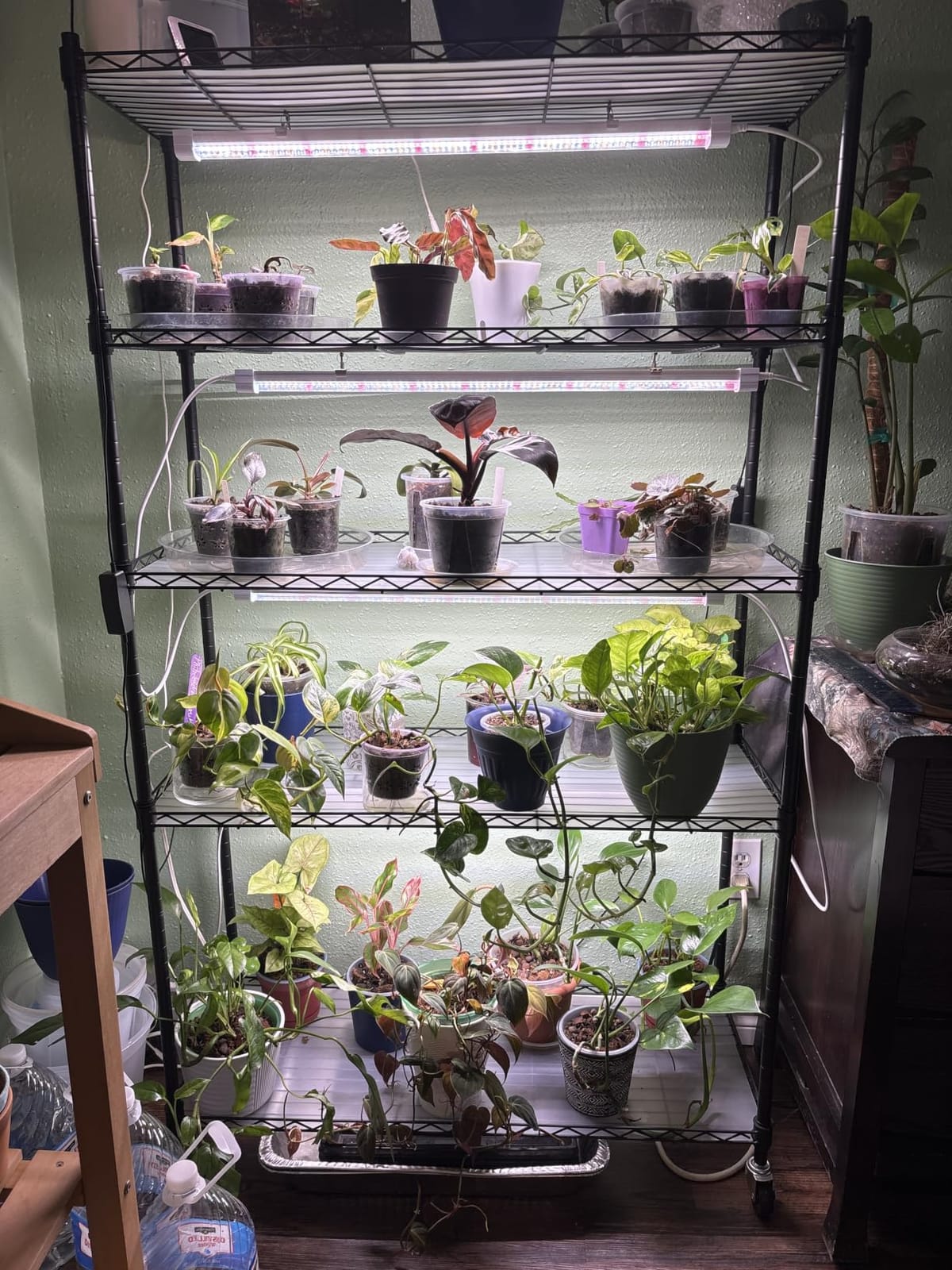
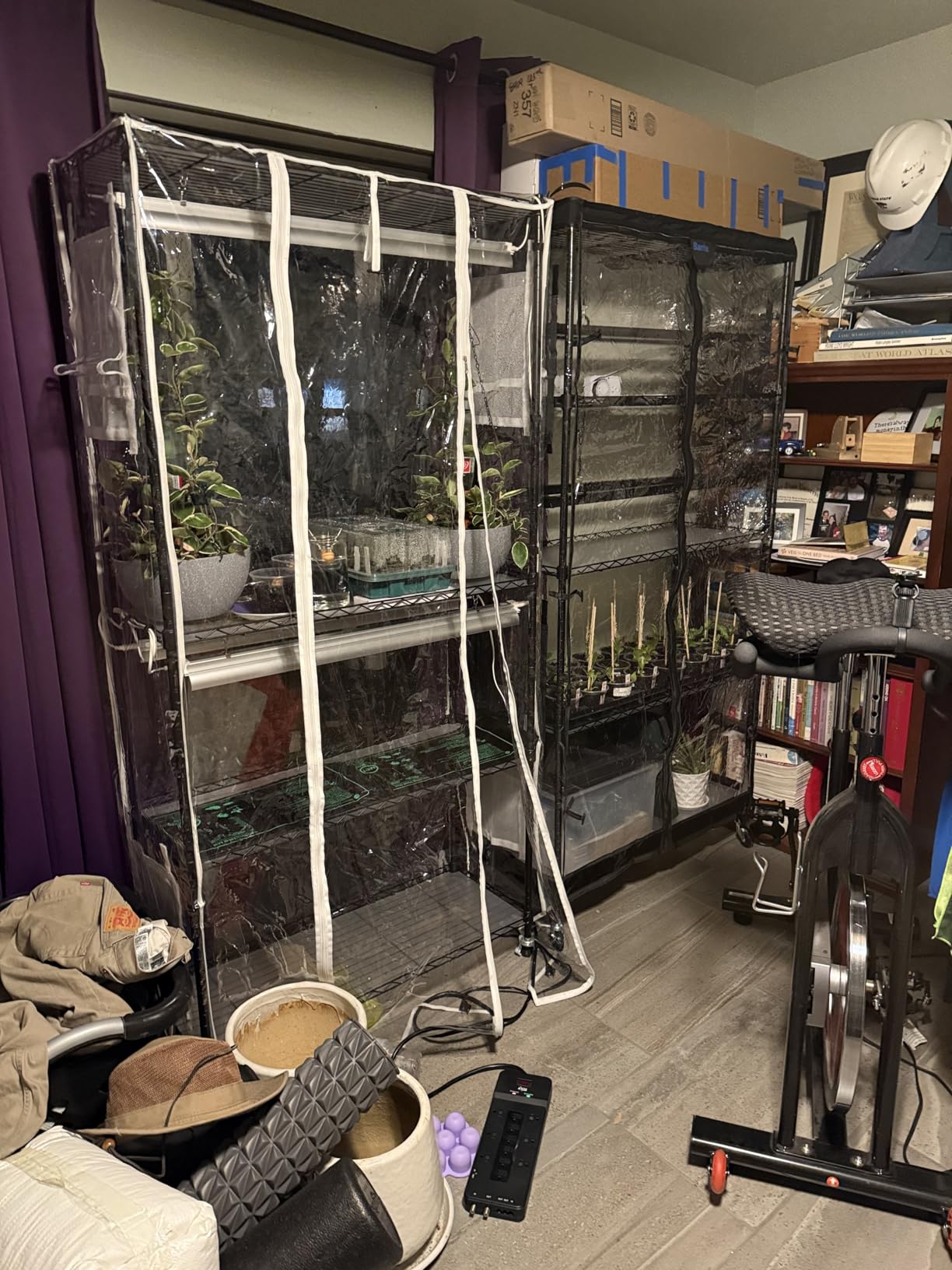
The LP600 is the smallest covered unit here at 23.6 inches wide, and it is the one to consider if a 39 inch shelf will not fit the space. Five adjustable tiers sit inside an EVA cover with a zippered door, four vents and a roll-away center front opening that gives full-width access to a tier without unzipping the whole panel.
The lights are the strongest technical claim in the roundup. Four 25W 1.6 foot 5000K fixtures run at CRI 97 and are rated at 431.9 micromol per square meter per second at just 3.9 inches, and each fixture has its own on and off switch. That switch-per-light control is more granular than the per-tier controls on the JESLED, and it lets you run two lights and leave two dark.
A mechanical 0 to 24 hour timer and a thermometer are included, the bottom cover collects soil and water, and the frame has built-in wheels with tool-less assembly. Buyers praise build quality, bright high-CRI output, adjustable shelves and humidity control for orchids, succulents and seedlings, and they note that the wheels let you move the unit between sunny windows as the season changes.
The trade-offs are honest ones. There is no guidance on shelf spacing in the instructions, the tent can sag if the top shelf is not set to its highest position, the bulky mechanical timer blocks other plugs in the outlet, and the included thermometer is not very accurate and fogs up. Condensation can drip onto the floor, so put a tray underneath, and no fan is included, which matters in a warm room.
Can a 23.6 inch shelf still hold standard seed trays?
Yes, one 10 by 20 inch flat per tier with limited margin, and five tiers give you a rolling batch of five flats in a slim footprint.
The extra 3 inches of length beyond a 20 inch flat is narrow enough that the tray sits close to the edges. Centre it rather than pushing it to one side.
Is CRI 97 worth anything for seedlings?
It shows up as truer colour on the leaves, which makes it easier to spot yellowing and nutrient problems early in a small crop.
For a seed-starting shelf the useful number is the PPFD figure at 3.9 inches. Higher values here mean the fixture can sit close, which suits a shallow shelf where headroom is tight.
How to Set Up a Grow Light Shelf
Setup is the same on every unit in this roundup, and getting it wrong in the first week costs you a fortnight of growth later. Work through these five steps in order, before you sow anything.
1. Level the shelf and check the light run. Set the unit where a proper outlet reaches without an extension cord, and confirm that each fixture spans most of its shelf. If a fixture is clearly shorter than the shelf, the far end of every tray will lean toward the light.
2. Position the lights 2 to 4 inches above the seed surface. Low-wattage strips and bars need to sit close, while panels need more room to spread light without bleaching. Adjustable tiers make this a ten-second change rather than a rebuild.
3. Set the timer before you plant. Sixteen hours on, eight hours off is the schedule most growers run for tomato and pepper starts, and it covers the units in this roundup that offer 15 or 16 hour modes directly.
4. Raise the lights as plants grow. A seedling that touches a fixture is a seedling that gets scorched. Check canopy height weekly and raise a tier or re-hang a bar before contact, not after.
5. Vent covered units once true leaves appear. Roll up the door or open the vents during the light cycle. Closed covers on warm days push interior temperature past what tender seedlings tolerate, which is why owners of the JESLED and this Barrina unit both mention external fans.
Run the electricity math on the biggest unit if you are planning two tiers of lights: 192W for 16 hours a day is just over 3 kWh a day, which adds up across a six-month indoor season. Our test setup rarely ran everything at once, and turning off unused tiers with the per-tier switches cut the weekly figure considerably.
How to Choose a Grow Light Shelf
What are the best shelves for grow lights?
The best shelves for grow lights are metal plant shelves whose tier length matches the fixture length, with adjustable tier heights and about 16 inches of clear space between tiers. For 1020 flats, a tier at least 20 inches long holds one tray lengthwise; four tiers of that size covers most household seed starting. Add wheels, a timer and waterproof pads if you will move and water the unit often.
1. Match fixture length to shelf length first. This is the make-or-break spec and the one most listings bury. A 35.4 inch tier lit by a 24 inch bar leaves an unlit strip where seedlings will stretch. Growers on r/gardening treat this as the first filter when comparing units.
2. Count trays per tier from real dimensions. Divide the tier length by 20 for flats laid lengthwise, then check the depth. Two flats side by side need 20 inches of depth, which none of the narrow towers here offer.
3. Aim for at least 16 inches of clear tier height. Sixteen inches works for almost every tray, and 21 inches on centre is the comfortable figure for the top tier once plants are tall. Shallow tiers also rule out domed humidity covers.
4. Prefer a light with a published output figure. Products listing micromol per square meter per second at a stated distance give you something to compare. Lumen ratings on a shelf listing tell you very little about a seedling canopy.
5. Check dimming and switching. Fixed-output bars force you to move trays. Per-tier switches or dimmable fixtures make it far easier to run a freshly sown tier separately from seedlings that need a longer day.
6. Look for a timer in the box. Every unit here except the Spider Farmer mini greenhouse includes one. Adding a mechanical timer afterwards is simple, but a timer socket that blocks other plugs is a recurring complaint.
7. Confirm load capacity for your real use. Wet flats and mix weigh far more than dry trays. The Barrina CX3 rates tiers at 90 pounds, the Spider Farmer shelf at 110 pounds, and the SpeePlant at 22 pounds per tier.
8. Decide on covered or open before you buy. Covered units buy you humidity for germination and propagation. Open frames are easier to ventilate, cheaper to run and easier to reach into. Barrina is one of the most repeated brand recommendations in seed-starting communities, and its covered and open models here sit at opposite ends of that choice.
Two related guides cover the other side of the setup: our grow light stands comparison if you already have shelving, and our light stands with shelves picks for narrower rooms. If you are working out seed prep rather than hardware, the beginner starting tips guide covers timing and sowing depth, and our best seed cleaners roundup helps you clear old seed before sowing.
Common Mistakes When Starting Seeds Under a Shelf Light
1. Trusting the lumen number. A bright-sounding figure tells you little about intensity at the canopy. A 10,000 lumen panel hanging far above a seed tray is dimmer in practice than a lower-wattage bar hung two inches above it, which is why the distance spec matters more than the headline number.
2. Lighting every tier at once. Germinating seed needs warmth and moisture more than a long day. Running the whole shelf at the same intensity wastes power and can bleach the paler seedlings sitting closest to a fixture.
3. Leaving lights at one height all season. Seedlings stretch toward a light that is too far away and scorch against one that is too close. Check canopy clearance weekly from the first week after emergence.
4. Assuming bundled fixtures cover the whole tier. Bundled plant-stand listings frequently ship fixtures that are adequate for the advertised demonstration and weak for the tier area they sit over. Check the published output figure and the distance it was measured at before you rely on it for a full batch.
5. Sealing up a covered unit in warm weather. Owners of the covered units in this roundup consistently report heat and condensation as the first failure mode. Open a vent during the light cycle and keep a tray underneath for drips.
Frequently Asked Questions
What are the best shelves for grow lights?
Metal plant shelves whose tier length matches the fixture length work best, with adjustable tier heights and about 16 inches of clear space between tiers. For 1020 flats, a tier at least 20 inches long holds one tray lengthwise, and four tiers covers most household seed starting.
Should I start seeds under grow lights?
Yes, if you are raising more than a single tray indoors. A bright south-facing window still delivers less light than seedlings need, so plants stretch and produce tall, thin stems that transplant poorly. A shelf-mounted grow light gives even, close, consistent light across every tray.
How many hours a day should seedlings get light?
Sixteen hours on and eight hours off is the schedule most growers run for tomato and pepper starts. Several shelves here include timers with 12, 14 or 15 hour presets, so check the timer before you add one separately.
How far should grow lights be from seedlings on a shelf?
Low-wattage strips and bars sit 2 to 4 inches above the seed surface, while panels need 12 to 24 inches to spread light without bleaching. Raise the fixture as seedlings grow rather than moving trays, and never let foliage touch a housing.
Is 10,000 lumens too bright for seedlings?
Not on its own, because lumens do not tell you intensity at the canopy. What matters is the distance from the fixture and whether the light is dimmable. Newly emerged seedlings do best with the light close and the intensity lowered rather than with fewer lumens.
Are Barrina grow lights a good brand?
Barrina is one of the most frequently recommended brand names in seed-starting communities, and its CX3 model earned the highest rating in this roundup. Barrina also publishes output figures in micromol per square meter per second, which makes comparison with other fixtures easier.
What is the lifespan of the LED lights on these shelves?
Spider Farmer lists up to 50,000 hours for the LED bars on its mini greenhouse shelf, which works out to many seasons of a 16 hour daily schedule. Barrina carries a two-year manufacturer warranty and FREELICHT a two-year warranty, so check the warranty terms as well as the hour rating.
Should I buy a bundled shelf and light or build my own?
A bundled unit is simpler and guarantees that fixture length matches shelf length, which is the spec most people get wrong when assembling separately. Building your own makes sense only if you already own wire shelving in the right length and can source matching fixtures.
Which Grow Light Shelf Should You Buy in 2026?
The Bstrip four-tier covered shelf is our pick for 2026. Four 20W fixtures with a published output figure, a timer with 4, 9 and 14 hour cycles, and a roll-up zipper door cover germination and early growth without a separate humidity dome on every tray. It held up as the most straightforward unit in the roundup, and it is the one we recommend to a first-time seed starter.
Buy the taller Bstrip tower instead if tray count matters more than footprint, the Barrina CX3 if you want long 35.4 inch tiers and the strongest rating we found, and the Barrina LP600 if 23.6 inches is all the space you have. Whatever you choose, match the fixture length to the shelf, run 16 hours a day, and move the light before the seedlings reach it.