
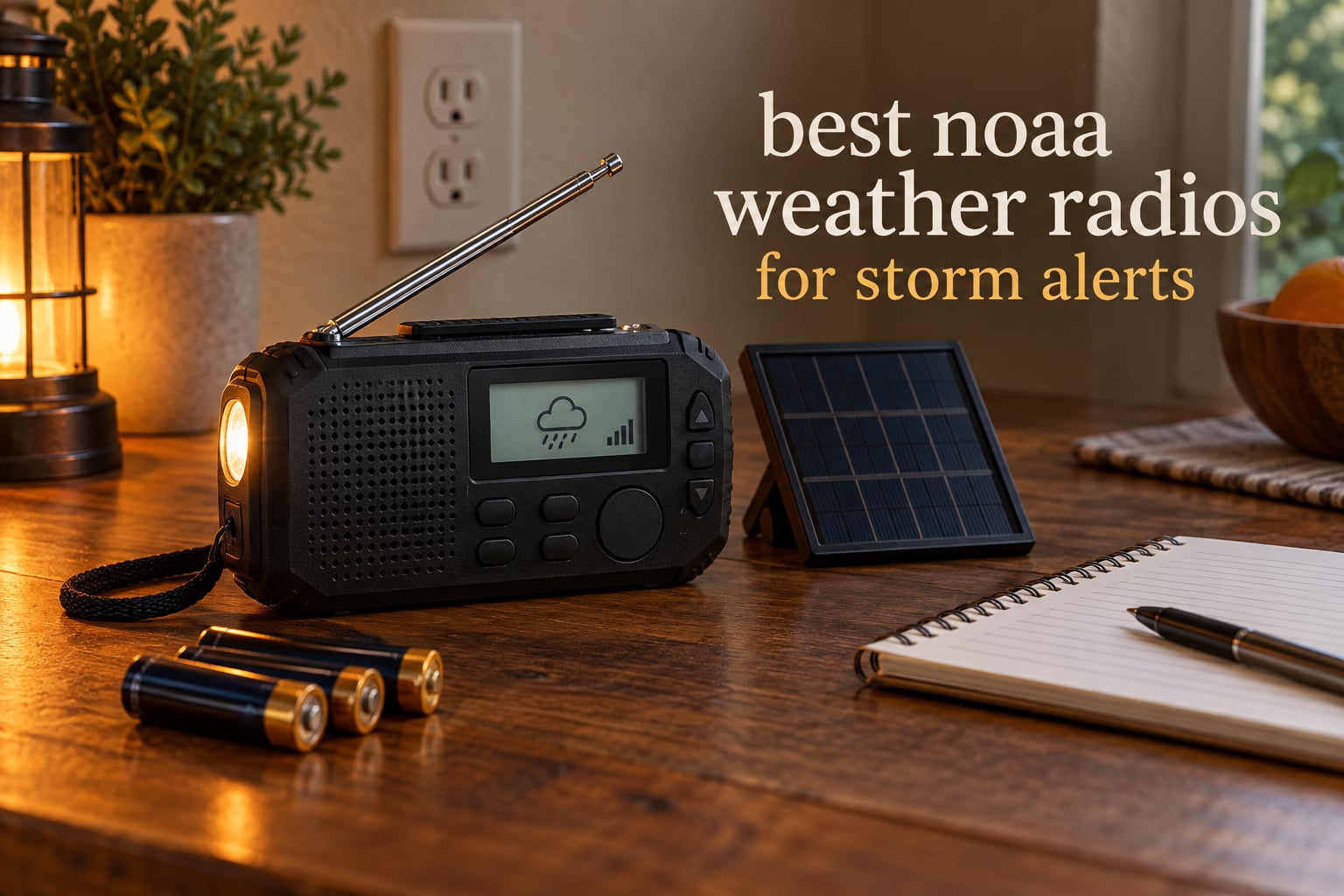
If you want one device that wakes you at 2 a.m. when a tornado warning is issued for your county, the best NOAA weather radios for storm alerts come down to two features most listings bury: automatic alert mode and S.A.M.E. county filtering. I went through ten of the highest-reviewed receivers in this category, read the spec sheets against the owner complaints, and sorted out which ones actually wake you and which ones just sit there until you turn the dial.
A NOAA weather radio is a receiver for the NOAA Weather Radio All Hazards network, a nationwide system of National Weather Service transmitters that broadcast continuous forecasts around the clock and push watches, warnings and emergency alerts without depending on your internet, your cell carrier, or your household electricity. That independence is the whole point. Cell towers, the power grid, and the internet tend to fail in the same storm that triggers the warning, and a phone can be silenced, dead, or out of coverage.
Here is the confusion that trips up most buyers, and it is the reason the second most popular result for this question is a forum thread rather than a review site. A weather alert radio sits in standby and switches itself on with a 1050 Hz attention tone, then decodes a S.A.M.E. code that identifies the event type, your county, and the expiry time. A weather band radio does nothing until a person manually tunes to one of the seven NOAA frequencies and listens. Both are sold as weather radios. Only one of them will wake you for a storm.
Every pick below is labelled as one or the other in the first sentence of its review, and I flag the models that lack S.A.M.E. county coding right up front. If you are putting together a full household kit, our broader emergency radio roundup covers the wider category, and the two-way radio guide covers the handheld option owners on the forums often pair with a NOAA set.
One safety note before we start. None of these radios is a replacement for official instructions. Call 911 for an immediate emergency, and follow current National Weather Service guidance for any real event.
Table of Contents
Top 3 Best NOAA Weather Radios for Storm Alerts (October 2026)

FosPower Model A1
- Hand crank
- solar and AAA power
- 7400mWh phone charging output
- Weather alert reception plus AM/FM

Midland WR120B
- S.A.M.E. programming for 25 counties
- NOAA Weather Scan with 60+ hazard types
- AC power with 6 AAA backup

Emgykit Hand Crank Radio
- Hand crank
- solar and Type-C charging
- 2000mAh phone backup battery
- 3W 140-lumen flashlight
The FosPower takes the overall slot because it is one of the few units here that combines standby alert reception, three independent power sources, and a phone-charging output, all backed by the largest review base in the group. The Midland WR120B is the one I would put beside a bed, because it is one of only two radios here that can filter alerts down to your own county. The Emgykit is the honest entry point when you want the functions and not the feature list.
All 10 Radios Compared in 2026
| Product | Specifications | Action |
|---|---|---|
| FosPower Model A1 |
|
Check Latest Price |
| Midland WR120B |
|
Check Latest Price |
 Raynic CR1009Pro Raynic CR1009Pro |
|
Check Latest Price |
 Kaito KA500 Kaito KA500 |
|
Check Latest Price |
 Eoxsmile Emergency Radio Eoxsmile Emergency Radio |
|
Check Latest Price |
 Leaton 10000mAh Leaton 10000mAh |
|
Check Latest Price |
 RunningSnail MD329 RunningSnail MD329 |
|
Check Latest Price |
 Mesqool 12000mAh Mesqool 12000mAh |
|
Check Latest Price |
 Nitigo 4000mAh Nitigo 4000mAh |
|
Check Latest Price |
| Emgykit Hand Crank Radio |
|
Check Latest Price |
Two columns matter more than everything else on that list. If a product has no S.A.M.E. county coding, it cannot tell you whether a warning is for your town or for a county far away, and owners on the weather forums report exactly that frustration. If it has no automatic alert scanning, it will only interrupt you for the channel you are already tuned to.
1. FosPower Model A1 – Best Overall NOAA Weather Radio
FosPower NOAA Emergency Weather Radio A1 7400mWh Solar Hand Crank (Orange)
7400mWh power bank output
Hand crank, solar and AAA
4 LED reading light and 1W flashlight
Limited lifetime warranty
Pros
- Combines standby alert reception with three independent power paths
- 7400mWh output can keep a phone or small tablet powered
- About 38000 ratings across the largest review base here
- Doubles as an everyday AM and FM radio
- Water resistant with a limited lifetime warranty
Cons
- Crank and solar are trickle sources rather than real charging methods
- 2000mAh cell is modest for larger devices
- No S.A.M.E. county coding
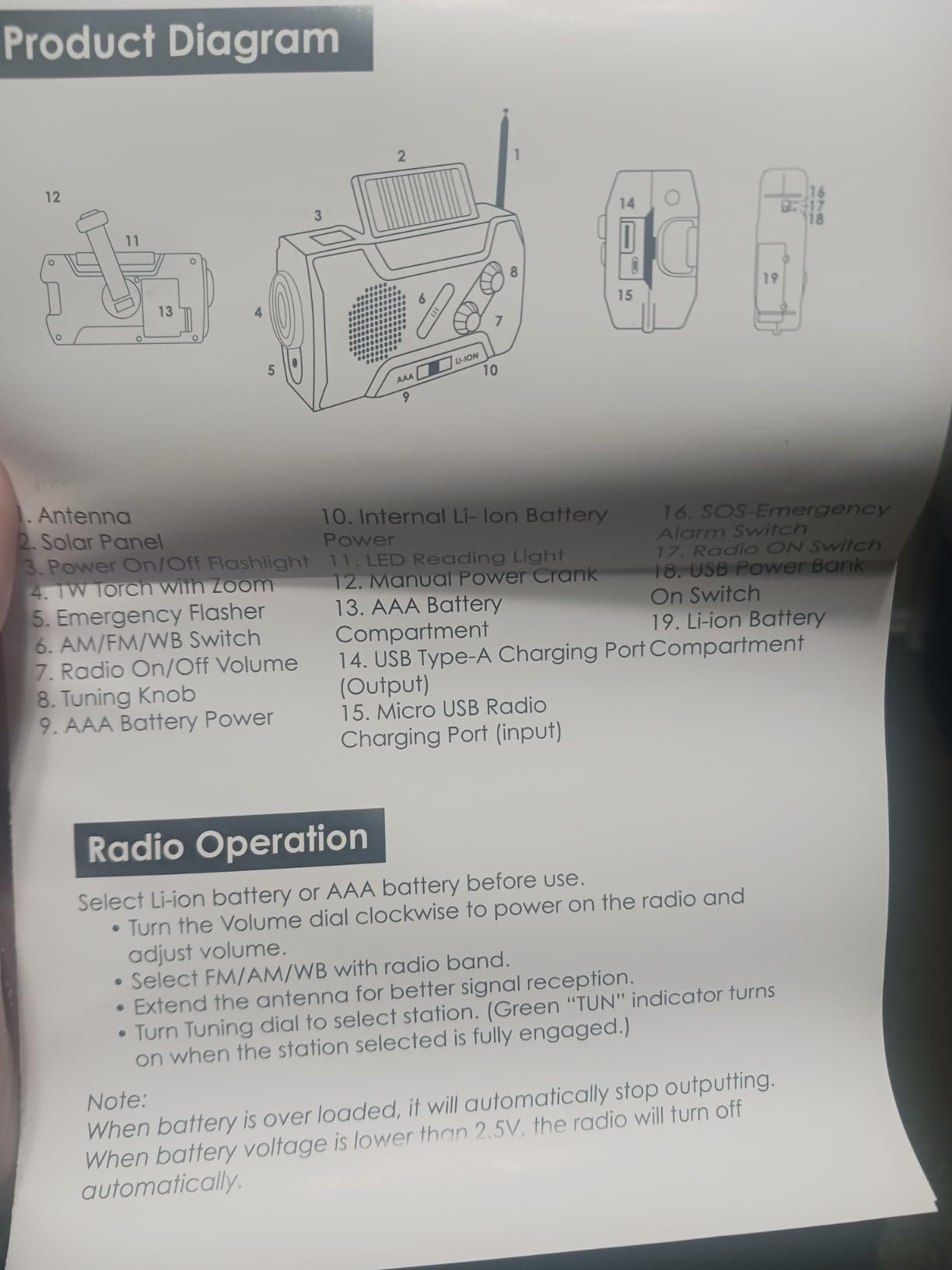
The FosPower Model A1 is the most rounded radio in this roundup, and it is my pick if you want one device that covers a bedside, a go bag, and a weekend outdoors. It is a weather alert radio: it listens in standby and sounds an alert for broadcasts on the NOAA frequencies it is set to, and it also handles AM and FM for daily listening. It does not decode S.A.M.E. county codes, so you will hear alerts for the whole area your local transmitter covers, not just your county.
What separates it from the other crank portables is the combination of three genuinely independent power paths and a real output. The hand crank, the solar panel, and four AAA cells all feed the same internal battery, and the 7400mWh pack puts out enough current to keep a phone alive during an outage. At 310 g and 6.2 inches long it disappears into a jacket pocket, which is not true of the larger units in this list.
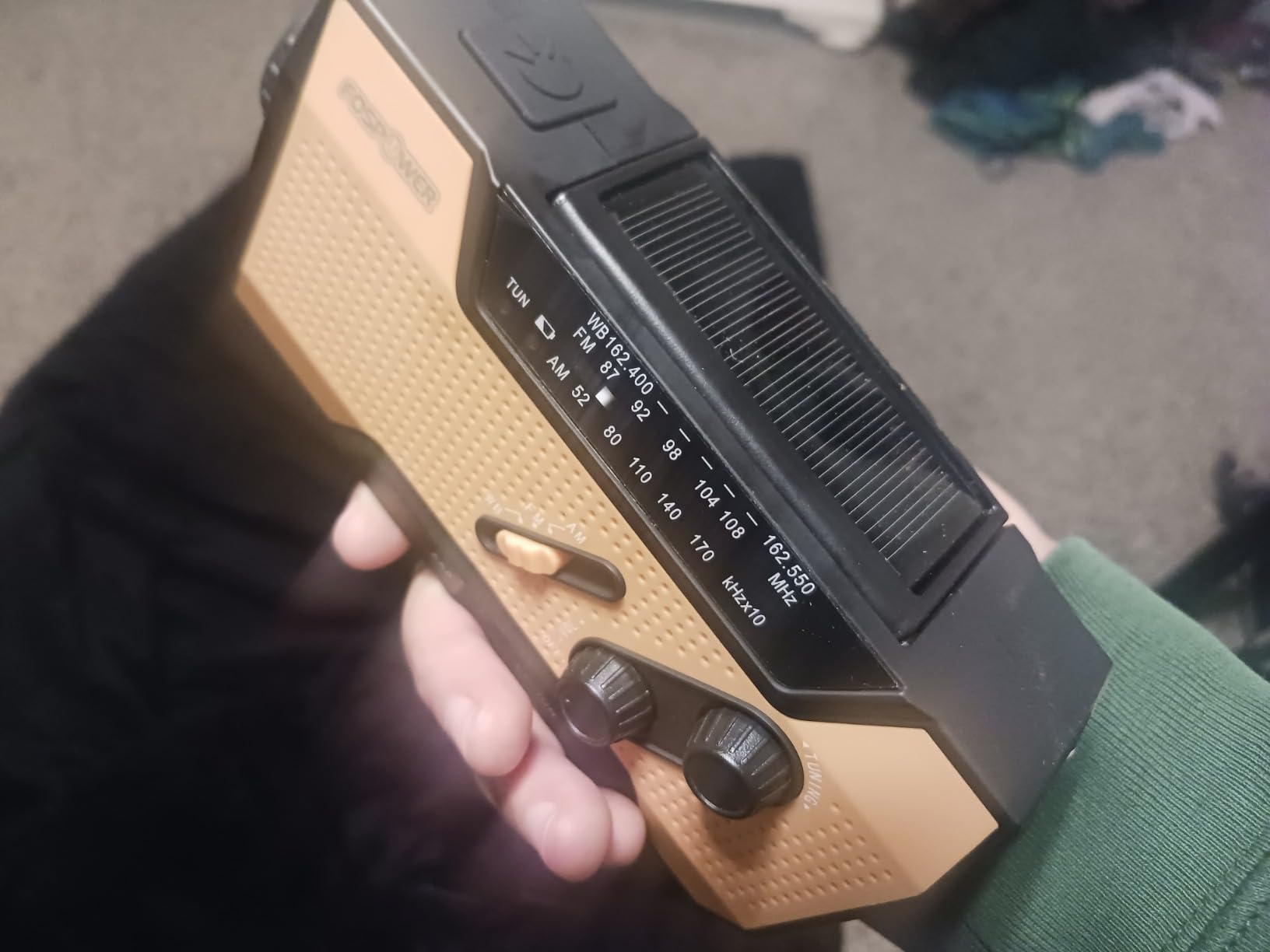
The lighting is unusually good for the size. A 4-LED reading light covers a page or a map, and a separate 1W flashlight handles a room or a path, so you are not holding one beam at a book. The speaker is rated at 2 watts, which is enough for alert audio in a small room and thin for a noisy kitchen.
It is also the most thoroughly reviewed product here, with close to 38000 ratings and about three-quarters five-star. Buyers consistently name the power bank capacity, the three-in-one power options, and the NOAA access as the reason they keep it. The most common complaint is the same one the manual hints at: the crank and the panel are emergency trickle sources, not charging methods you can plan around.
When the FosPower Model A1 is the right call
Choose it if your household needs one radio that does everything and you travel. The phone-charging output is the feature that changes behaviour in a real outage, because a dead phone is a phone that cannot call for help, and this one can give it a meaningful run.
It also makes sense as a go bag unit, since the AAA backup means you can grab spare cells from any drawer in the house. The reading light and flashlight combination means one small object replaces three, which matters when you are packing weight rather than shopping features.
When to skip the FosPower Model A1
Skip it if you are in a multi-county metro and get irritated by alerts for places you do not care about. Without S.A.M.E. filtering there is no way to narrow the scope, and owners on the forums describe the result as a radio that beeps for every advisory in the transmitter’s coverage area.
Skip it if you need a phone to be charged quickly. The 2000mAh cell inside means the output is fine for a phone in emergency but will not keep several devices moving, and the modest 2-watt speaker is not the choice for waking a heavy sleeper in a deep bedroom.
2. Midland WR120B – Best Desktop Radio for County-Level Storm Alerts
Midland – WR120B – NOAA Emergency Weather Alert Radio
S.A.M.E. for 25 counties
NOAA Weather Scan with 60+ hazard types
AC adapter with 6 AAA backup
16 ounces
Pros
- County filtering means alerts only fire for areas you program
- Weather Scan covers more than 60 hazard types
- Color-coded indicators show alert type and severity
- Runs on AAA backup during an outage
Cons
- Needs mains power for continuous monitoring
- Alert volume is not adjustable enough for some listeners
- S.A.M.E. coding works in the USA and Canada only
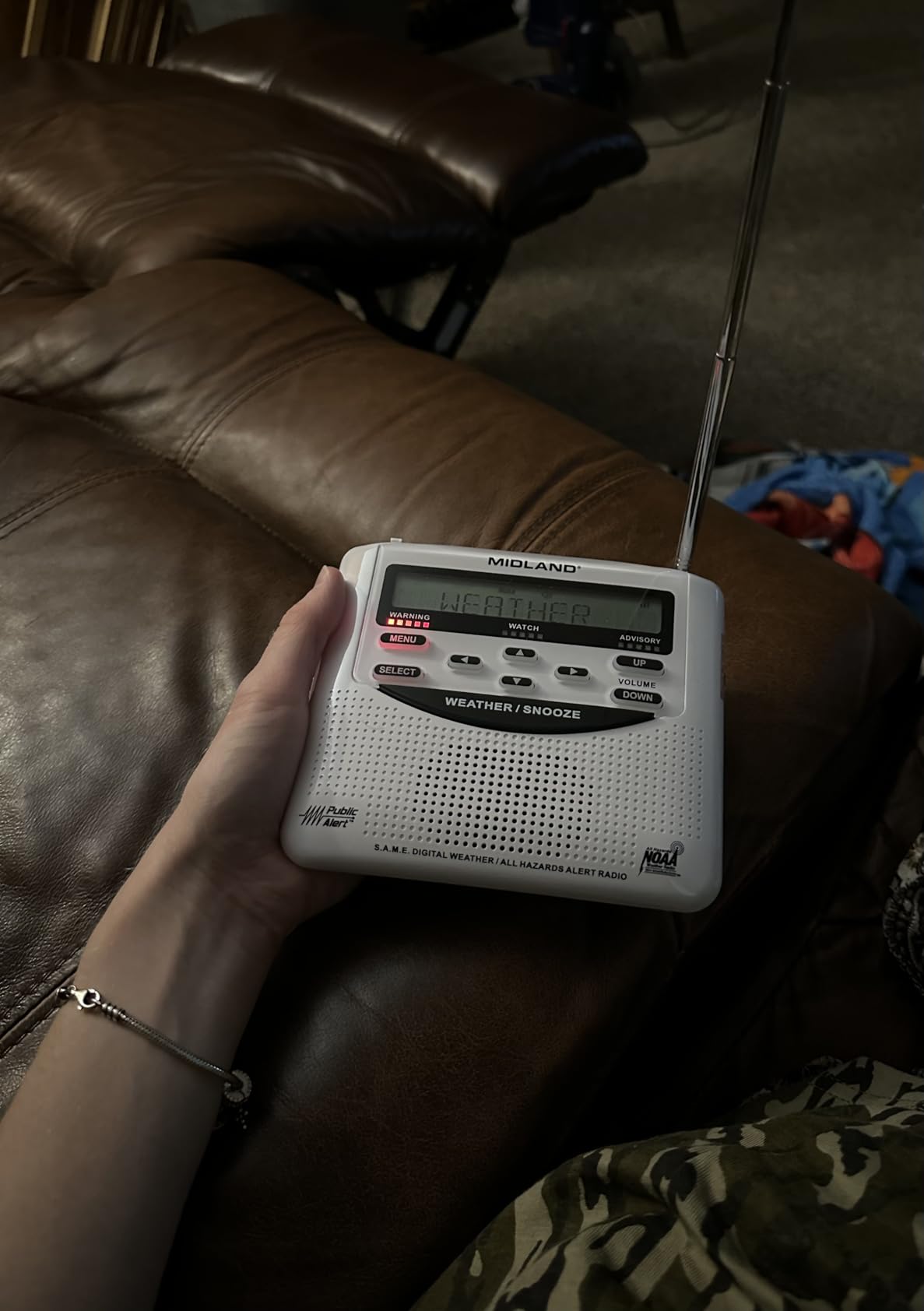
The Midland WR120B is the radio I would put on a bedside table, because its S.A.M.E. county filtering is the most flexible in this group and it does not need you to touch anything. It is a true weather alert radio with S.A.M.E. programming for up to 25 counties, so you can silence the counties you do not care about and still hear the one that matters.
The S.A.M.E. county filtering on the WR120B is what separates it from nearly everything else in this roundup. A weather alert radio that cannot filter by county will alert you for the whole broadcast area, which in a wide metro region can mean a siren for a storm two counties away while you lie awake listening to it. One owner reports clear reception inside a quarter-inch steel tornado shelter where a cell phone had no signal at all.
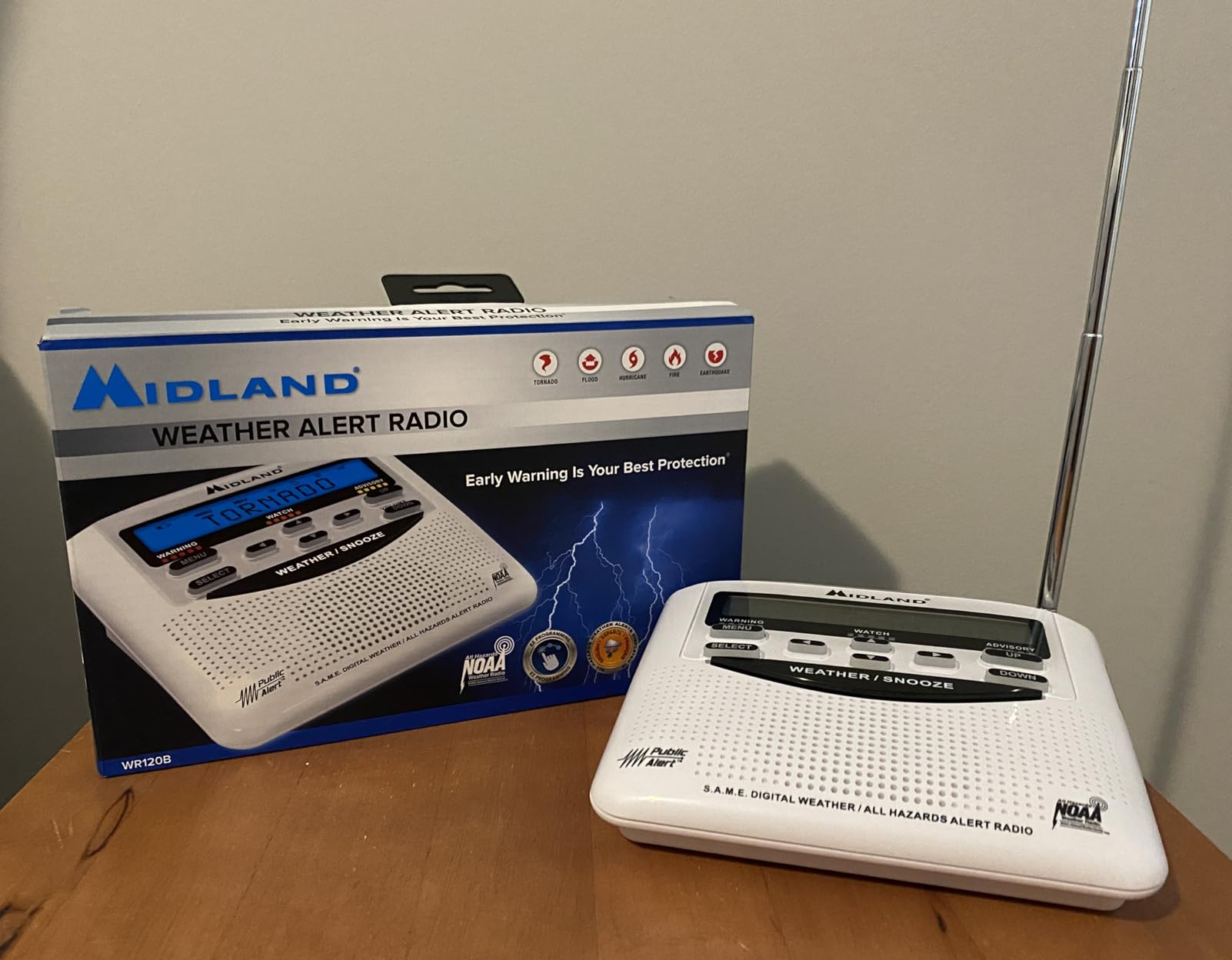
NOAA Weather Scan watches continuously and alerts on more than 60 types of hazard, and colour-coded indicators on the display tell you whether you are looking at a watch, a warning, or an emergency. The alert override function switches the radio on for an impending danger even when you have it set to another channel, which is the behaviour you want overnight.
Power is the trade-off. This is a plugged-in appliance with six AAA cells as backup, not a hand-crank unit, and the stand legs hold the display at an angle that some owners find hard to read if the unit is mounted on a wall. A handful of reviewers wish the alarm were louder, which is the mirror image of the complaint owners with too many counties program have.
Why the WR120B earns its place
The single deciding factor is county filtering. If you live in or near a large metro, or anywhere a warning regularly straddles a county line, programming a narrow list is the difference between an alert you act on and an alert you stop trusting.
It is also one of the few radios here with genuine continuous monitoring, so a bedroom placement is the intended use rather than a workaround. The LCD backlight can be set to stay on, which helps in a dark hallway when the alert wakes the whole house.
Where the WR120B falls short
It is a desktop unit. It stays where you plug it in, and if the outage that triggers the warning also kills the mains supply for long enough to flatten the AAAs, you are left with a silent device. Owners on the forums treat that as the deal breaker in the category, and it is a fair criticism here.
It also cannot travel, cannot charge a phone, and its S.A.M.E. coding is limited to the USA and Canada. If you want one radio for a car, a tent, and a kitchen, this is the wrong shape for the job.
3. Raynic CR1009Pro – Best Feature Density for a Portable Alert Radio
Raynic Emergency Radio, 5000mAh/18500mWh Weather Radio, Solar Hand Crank Radio with AM/FM/SW/NOAA Alert, Cell Phone Charger, Headphone Jack, Flashlight and SOS Siren
Automatic standby alert scanning
5000mAh internal battery
Six charging options
3W flashlight and 2.5W reading lamp
Pros
- Scans for alerts automatically in standby
- 5000mAh battery with USB phone output
- Three watts of flashlight plus a 2.5W reading lamp
- IPX3 water resistant and 16 ounces
Cons
- No S.A.M.E. county coding so you cannot limit alerts
- Short fixed antenna with no external connection
- Solar panel maintains charge rather than rebuilding it
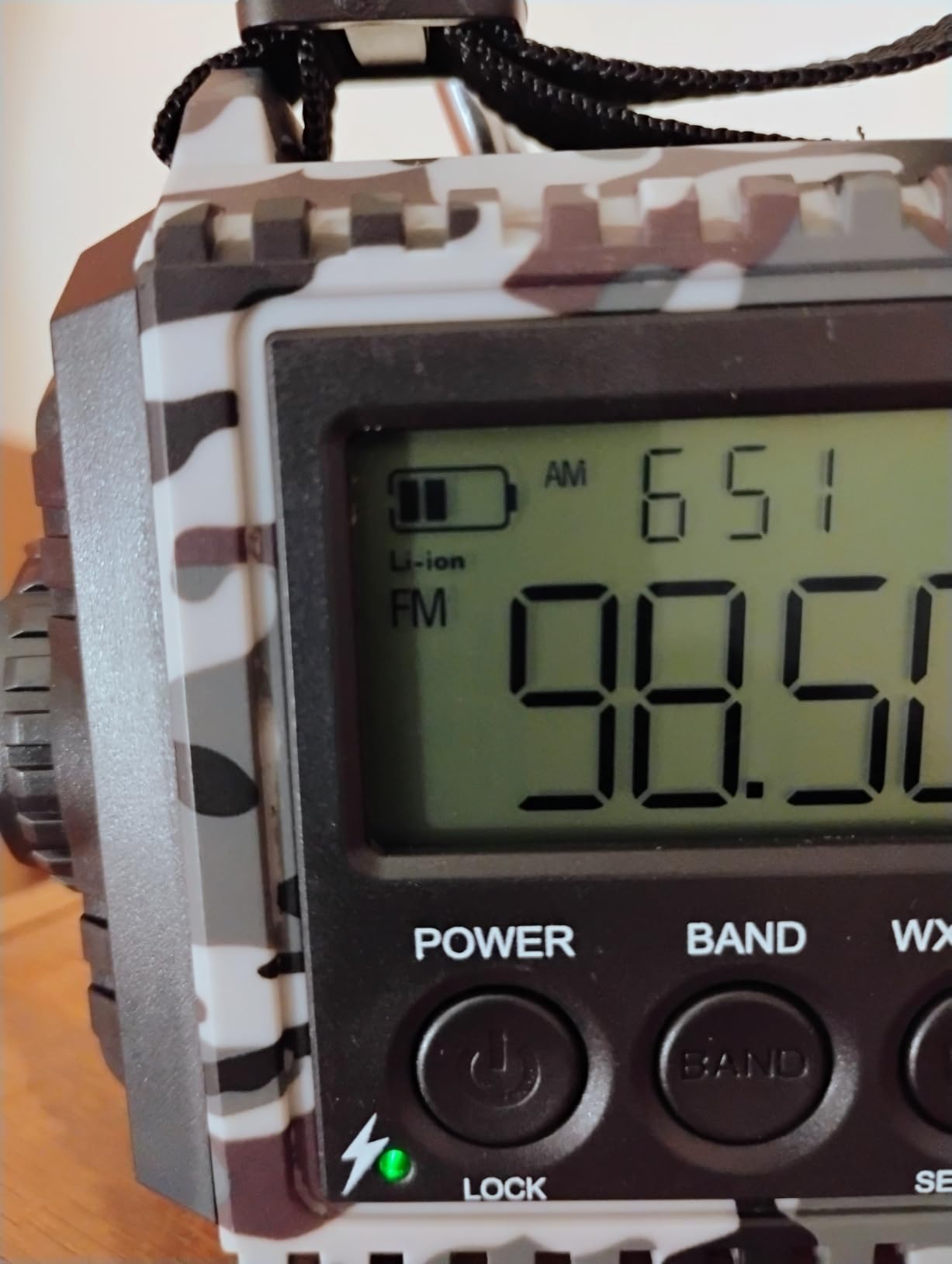
The Raynic CR1009Pro is one of the most feature-dense radios in this roundup, and in a category where feature lists are often decorative, most of that list actually works. It is a weather alert radio with automatic standby scanning, so it interrupts you without being tuned, but it has no S.A.M.E. county coding. Reviewers report alarms for coastal counties several zones away, which is the limitation to expect.
Power is the headline. Six paths feed the unit: a 5000mAh internal lithium pack, AC, USB-C, hand crank, solar, and AAA cells. The USB output charges phones, and a 3.5mm headphone jack gives you private listening when the room is asleep, which is a real feature rather than a novelty.
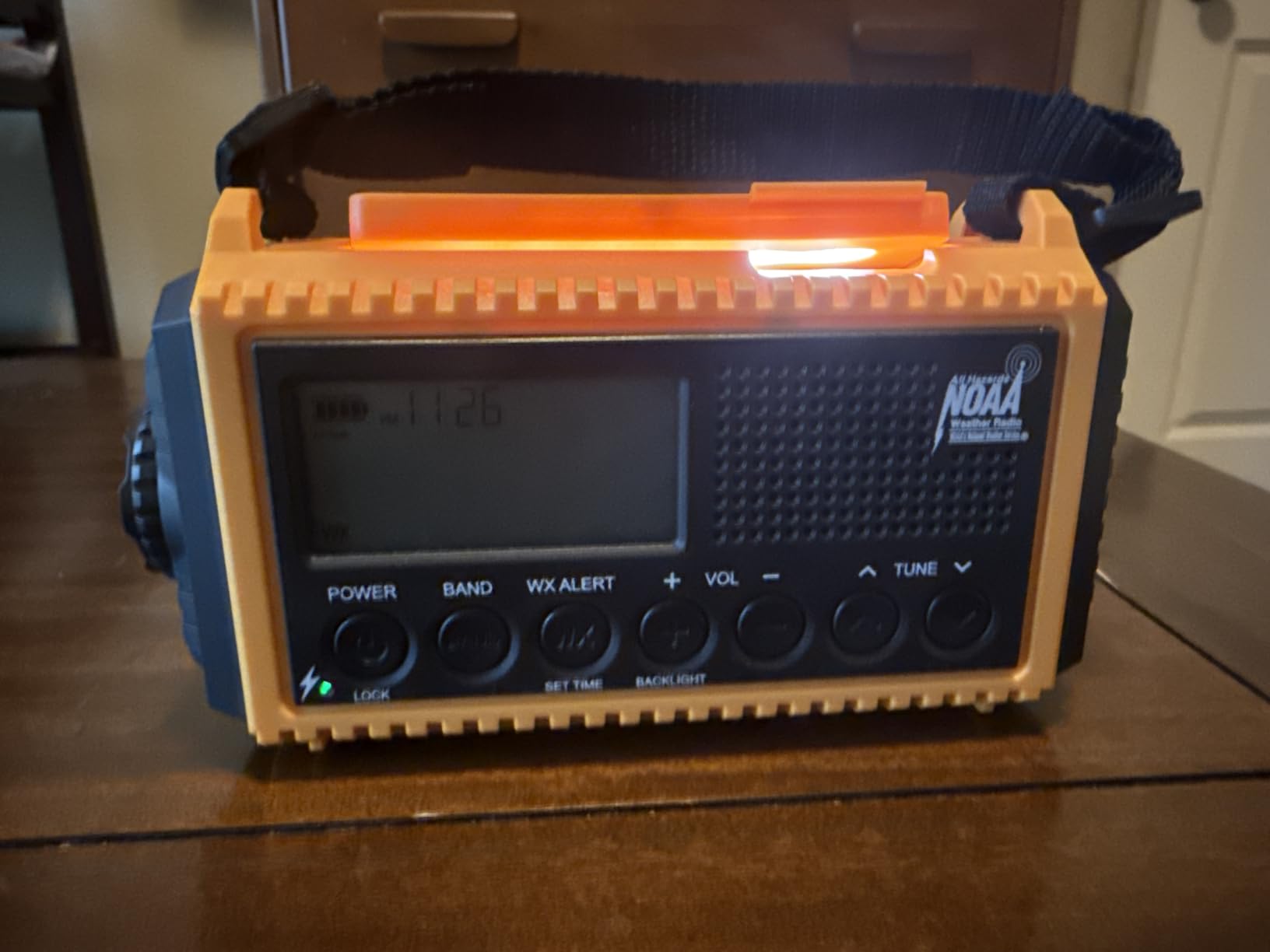
Reception punches above its weight. Several owners report that the NOAA bands match or beat larger home radios, which is unusual for a 16-ounce body with a short fixed antenna. The HD LCD shows battery level and tuning frequency, and the dimmer control is something owners of competing units wish they had.
The lighting pair is well matched for the size: a 3W super-bright flashlight plus a 2.5W reading lamp. The SOS siren with a flashing red light gives you a way to signal for help, and the strap compass is a small touch that earns its place on a camping trip.
Who should buy the Raynic
It suits anyone who wants one box to carry and one box to worry about. The feature density means a single device covers alerting, lighting, phone power, and music, which is the arrangement most households actually want before a storm season rather than a stack of single-purpose gadgets.
Headphone support makes it a good fit for a light sleeper or a shared apartment, since the alarm does not have to be loud in a quiet room. The IPX3 rating and 1.2-pound weight are also fine for a car kit or a weekend bag.
Where it falls down
The missing S.A.M.E. coding is the real limitation, not a detail. In a wide coverage area you will get alerts for areas you do not care about, and there is no menu setting to narrow them.
The short fixed antenna cannot be replaced or extended, so in weak-signal homes reception is what it is. It is also not waterproof, and the rubber covers over the USB and headphone jacks are reported not to stay in place. One owner received a unit with the internal battery missing, which is worth checking on arrival.
4. Kaito KA500 – Best Four-Band Radio for Off-Grid Listening
Kaito KA500 5-way Powered Solar Power,Dynamo Crank, Wind Up Emergency AM/FM/SW/NOAA Weather Alert Radio with Flashlight,Reading Lamp and Cellphone Charger, Yellow
14.5 inch telescopic antenna
Replaceable NiMH battery pack
Seven NOAA channels with PEAS
AM, FM and two shortwave bands
Pros
- 14.5 inch telescopic antenna with an LED signal strength indicator
- User-replaceable battery extends service life
- Six power inputs including USB and AC
- AM
- FM and two shortwave bands alongside NOAA
Cons
- No S.A.M.E. county coding and no automatic alert scanning
- No LCD display and tuning is by dial
- AC wall adapter is sold separately
The Kaito KA500 is the radio I would choose for reception in a weak-signal house, and the reason is physical rather than electronic. It carries a 14.5-inch telescopic antenna with an LED signal strength indicator, and owners consistently single that out as the feature that makes a difference when the transmitter is far away or the roof is metal.
It is a weather band radio, not a weather alert radio. It tunes to any of the seven NOAA channels manually, and there is no S.A.M.E. county coding and no automatic alert scanning, so it will not wake you for a storm unless you are already listening to that channel. If your region is a county-fragmented metro, that is a serious limitation to weigh.
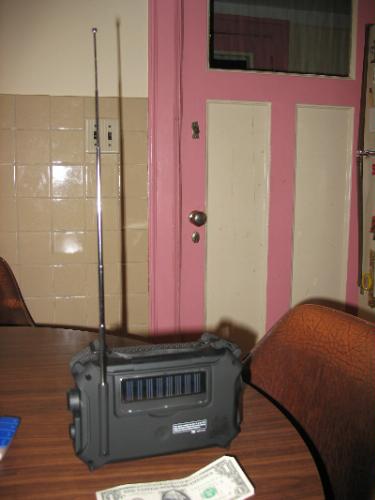
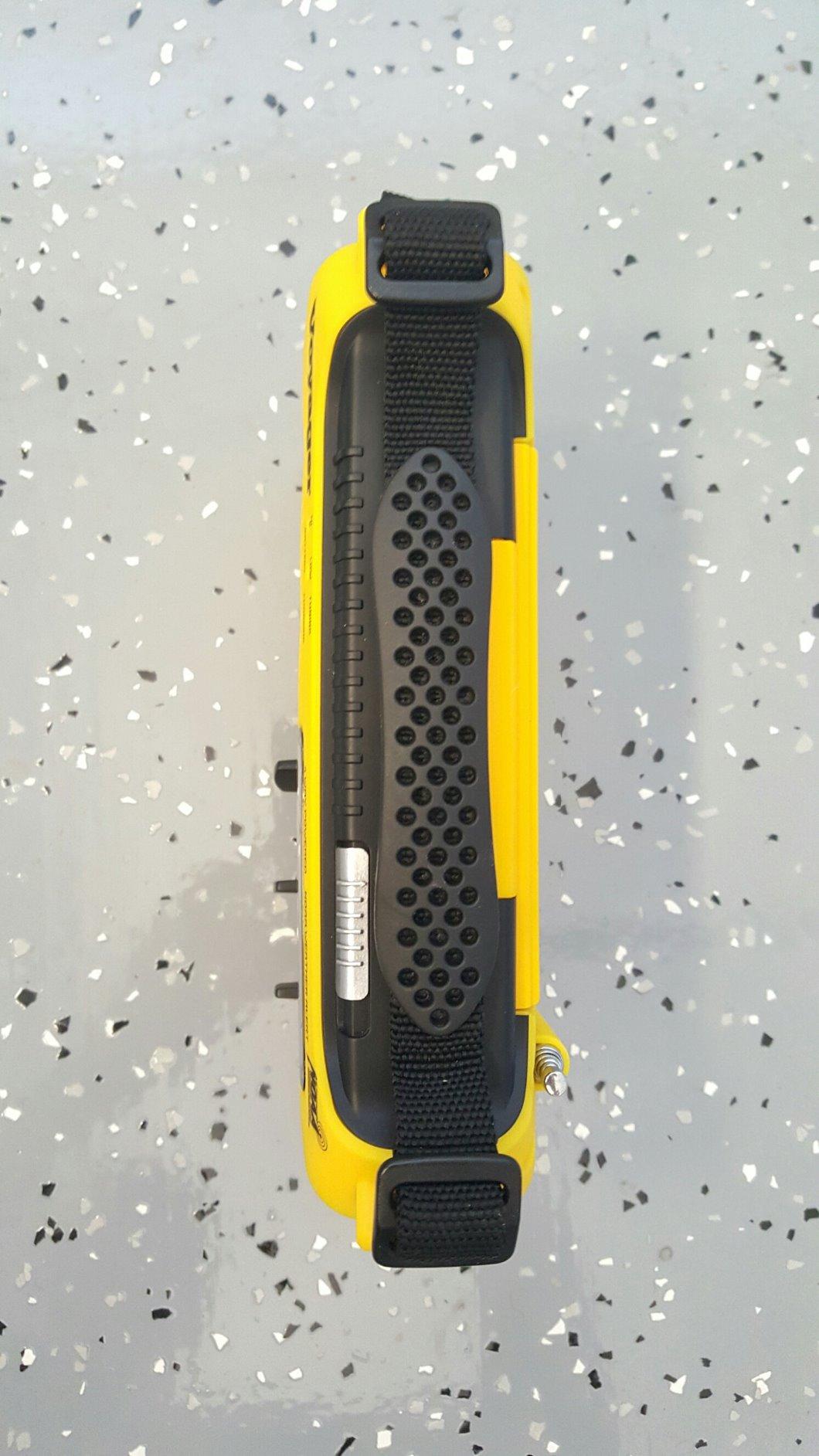
The power story is one of the most complete here. Six options feed the unit: hand crank, solar panel, a 3 AA battery compartment, 5V USB input, AC input, and a built-in replaceable NiMH pack. The replaceable pack is the detail that matters over years rather than months, and it is the kind of repairability owners consistently say they value more than raw battery capacity.
Coverage goes beyond weather. You get AM, FM, and two shortwave bands alongside the NOAA channels, and seven pre-programmed weather channels with PEAS alerts for the USA and Canada. The 5-LED reading lamp, flashlight, and red SOS beacon cover the lighting needs most people have at 3 a.m.
Why the KA500 works where others struggle
Antenna length and a signal strength light mean you can actually tune a station properly. On a crowded indoor band with several transmitters overlapping, a digital preset that picks the wrong one is worse than a dial you can watch while you adjust it.
It is also a genuinely useful off-grid radio, not just a NOAA box. Shortwave coverage means it is a real communications tool when the infrastructure is down, and six power inputs mean it will run from almost anything in the house.
When to skip the KA500
Skip it if being woken automatically is the point. Dial tuning with no display and no alert scanning means you will not learn about a warning until you happen to be on the right channel, and for storm alerts specifically that defeats the purpose.
The 8.3 inch body is the longest in this roundup and it needs a separate AC adapter for mains power. The NOAA coverage is USA and Canada only, which matters if you travel internationally.
5. Eoxsmile Emergency Radio – Best for Loud Alerts and Strong Lighting
Eoxsmile Emergency Radio with NOAA Weather Alert, Solar Hand Crank Portable
9-second SOS alarm with red strobe
5000mAh with five power sources
3W flashlight and 2.5W reading lamp
Up to 13 hours of FM
Pros
- Very loud 9-second siren with a flashing red light
- 5000mAh pack with five charging paths
- 3W flashlight reaching about 80 meters plus a two-level reading lamp
- Strong reception reported even under a metal roof
Cons
- No S.A.M.E. county coding
- Alerts stop when you switch to an AM or FM band
- AAA cells drain alongside the lithium pack
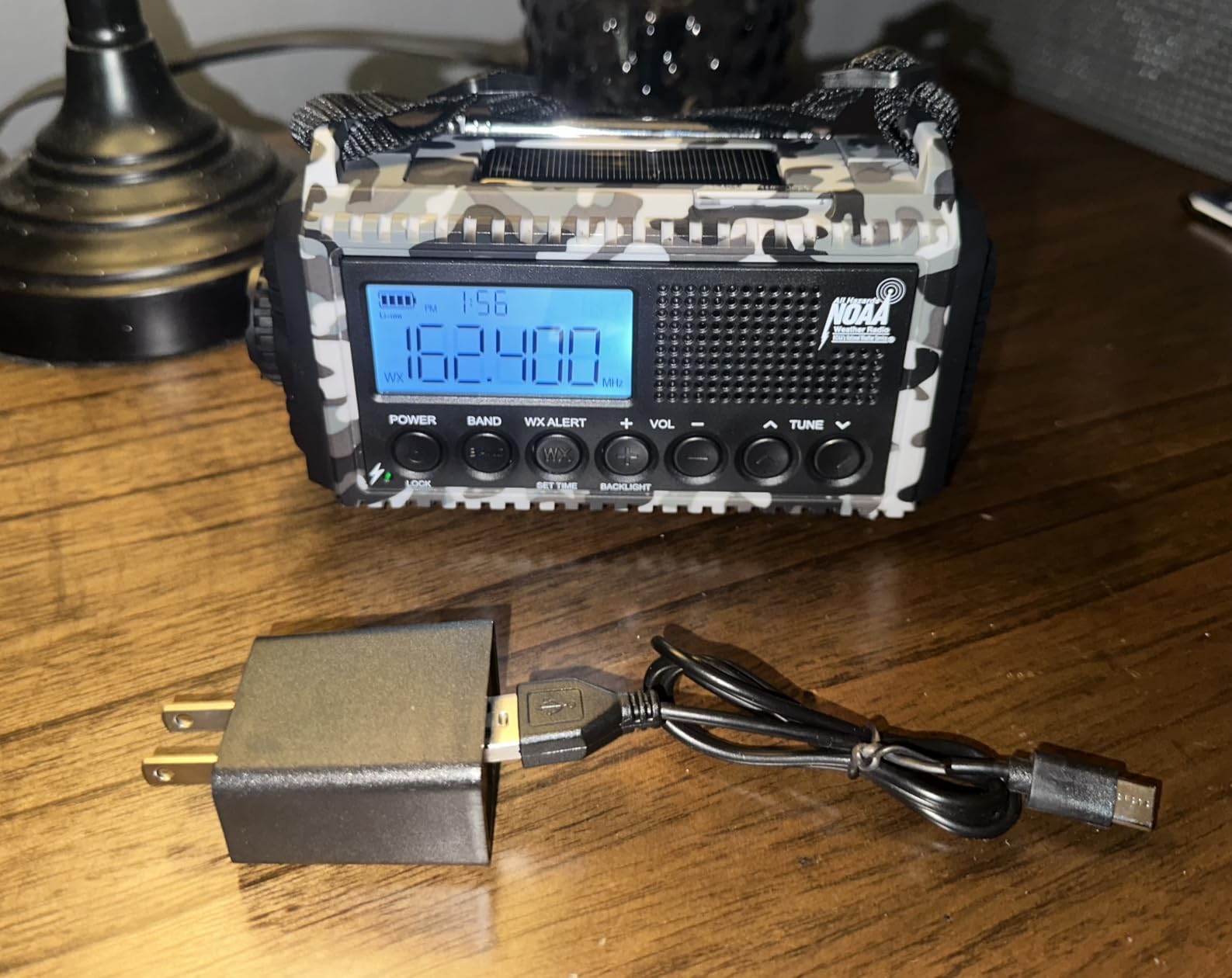
The Eoxsmile is built around one clear idea: be unmissable. It is a weather band radio with no S.A.M.E. county coding, and it will not interrupt you for a warning unless you are in standby or have alert mode enabled. What it does instead is make an enormous noise when an alert fires, with a 9-second SOS alarm and a flashing red light that you can see from another room.
For anyone who has to wake a household with a closed bedroom door, that combination is the reason to own one. The stated FM runtime of up to 13 hours per charge is the longest figure published for any of the crank portables here, which matters for a long outage where the radio is your only entertainment.
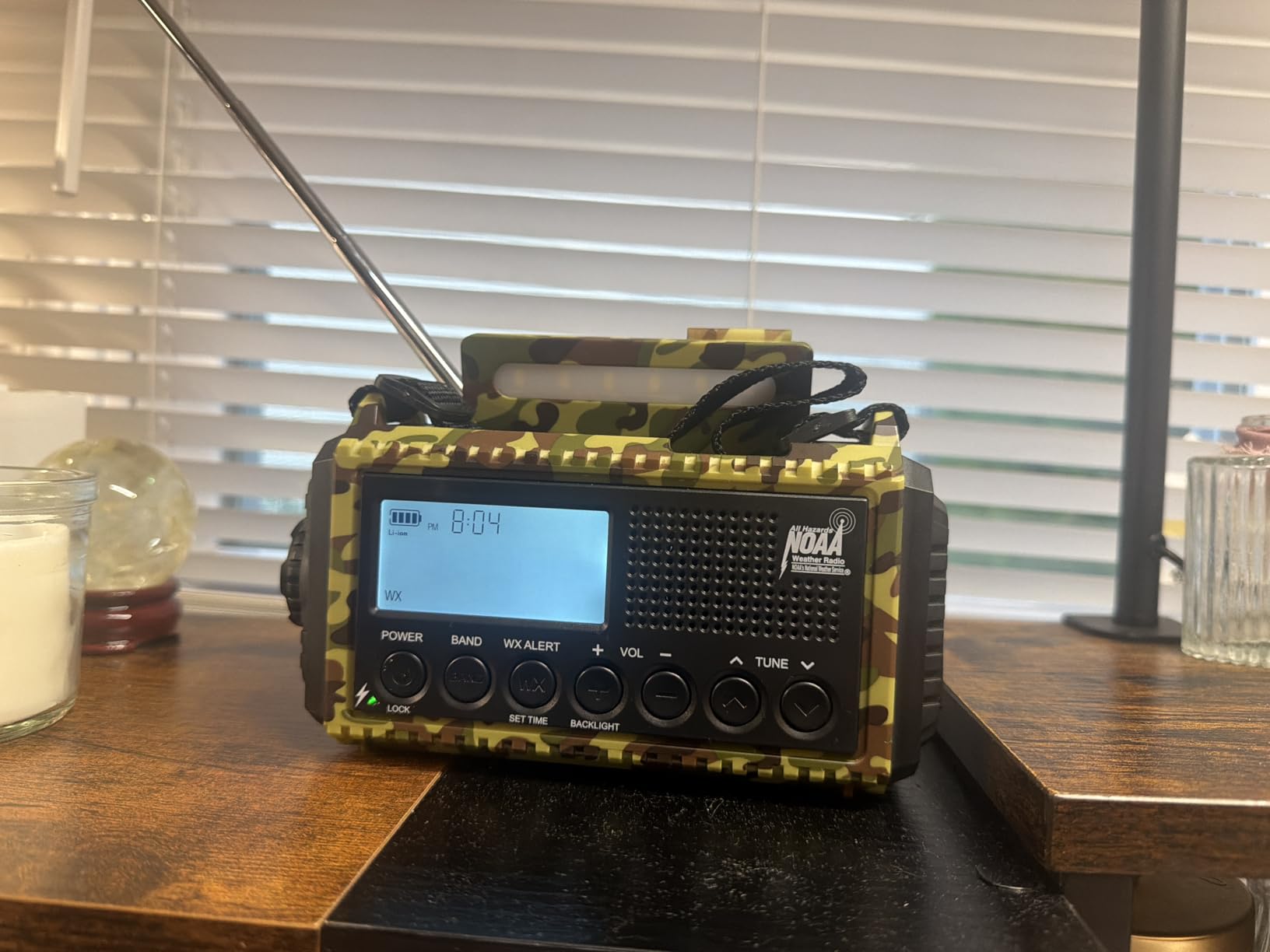
Power comes from five directions: a 5000mAh internal battery, solar, hand crank, a 5V plug, and three AAA cells. The telescopic antenna, a large volume knob, and a 3.5mm headphone jack complete the signal and control package, and owners report strong reception across all bands even under a metal roof.
The lighting pair suits the size of the unit. A 3W LED flashlight reaches about 80 meters and the two-level 2.5W reading lamp lights roughly 20 square meters, which is close to a small room. USB output charges more than one phone, and a compass, hand strap, and hang buckle come in the box.
Where the Eoxsmile earns its badge
If the household includes a deep sleeper, a hard-of-hearing member, or a child in another room, the alarm design matters more than county filtering. A radio that is easy to hear and easy to see solves a problem that a quieter, smarter unit does not.
It is also a solid value for a go bag, because the AAA compartment means you can top it up from any drawer, and the long FM runtime gives you real use during a multi-day outage instead of a device you switch on twice and put away.
What to know before you buy it
The biggest gotcha is that alerts only sound in standby or alert mode. Switch to an AM or FM band and alert monitoring stops silently, which catches out new owners who assume the radio is still watching while they listen to music.
AM reception is weak on low-power stations with no automatic gain control, so volume needs readjusting between stations. The AAA cells drain alongside the lithium pack rather than waiting as a clean backup, and charging a phone is slow at about 1 amp while reception can degrade during it.
6. Leaton 10000mAh – Best for Splash Resistance and Phone Backup
Leaton Hand Crank Emergency Radio, NOAA Weather Radio AM/FM,10000mAh
10000mAh battery with 5V/1A output
IPX6 splash resistance
Three-mode flashlight and reading lamp
Manual tuning only
Pros
- 10000mAh runs roughly one to one and a half phone charges
- Large controls and a big tuning knob
- About a minute of cranking gives 15 to 20 minutes of listening
- IPX6 protection against spray and splashing
Cons
- No automatic alerts and no S.A.M.E. county coding
- No headphone jack and no shortwave band
- 5V/1A output is slow for phone charging
The Leaton is a manual-tune weather band radio, and that is stated plainly in the listing: NOAA channels are tuned by hand, there is no automatic alert scanning, and there is no S.A.M.E. county coding. It will never wake you for a storm, so it belongs in a kit as a backup receiver and phone charger rather than as your primary alert device.
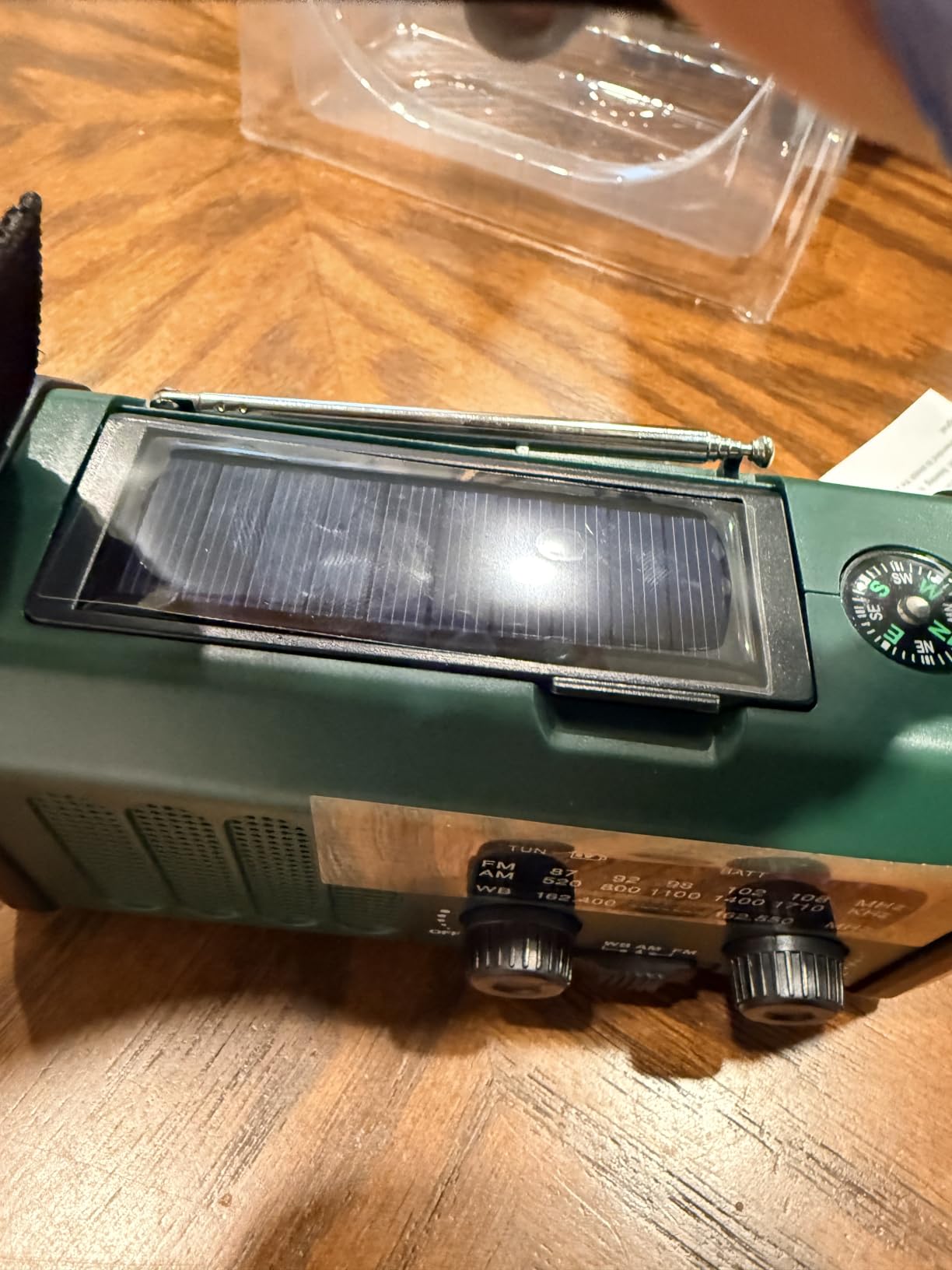
What it does have is the largest battery relative to its size in this group. The 10000mAh pack is roughly one to one and a half iPhone charges, and the 5V/1A USB output is a realistic emergency phone top-up rather than a token gesture. It also works while plugged in over USB-C, so mains power is one option among several.
The genuinely differentiating feature is the water protection. IPX6 means the body is rated against spray and splashing, which is a step up from the water-resistant language most products in this category use and a real advantage for a marine deck, a campsite, or a pickup bed in a storm.
The controls are built for hands that are not steady at 3 a.m. Large buttons, a big tuning knob, and clear labelling make it a good fit for an older household member. The three-mode flashlight runs high, low, and SOS, with a 1.3W reading lamp alongside it and a compass built into the body.
Why the Leaton is worth a second look
Two things here are rare in a budget crank radio. A 10000mAh internal battery gives it real staying power in an outage, and IPX6 splash resistance means it can live in a vehicle or on a boat rather than needing to be carried indoors.
The crank is also more than decorative by the numbers here: about a minute of cranking is reported to give 15 to 20 minutes of listening, which is a better ratio than most of the portables in this roundup.
Where it does not fit
Do not buy it as your storm alert radio. With no automatic alerting and no county filtering, it will sit silent through a warning unless someone happens to be turning the dial, and that is precisely the failure owners on the forums complain about in band-only units.
There is no headphone jack for private listening, no shortwave band for off-grid news, and the 5V/1A output is slow if you are trying to revive a phone quickly. Splash resistance is also not immersion, and the warranty runs one year.
7. RunningSnail MD329 – Best for Visual Alerting and Basement Placement
RunningSnail NOAA Weather Radio with 80+Emergency Alerts, 23 S.A.M.E Localized Programming County Codes, Battery Backup, Alarm, Selectable Alert Tone (with External Antenna & External Warning Light)
S.A.M.E. for 23 county codes
80+ switchable alert types
110dB maximum siren
Bundled antenna and warning light
Pros
- Real county-level filtering with All
- Multiple or Single modes
- 80-plus alert types with individual on and off switches
- 110dB siren and a bundled external warning light
- External antenna included for basement and interior rooms
Cons
- NOAA only with no AM or FM reception
- 3 AA batteries are not included and last hours not days
- Highest one-star share of the radios in this group
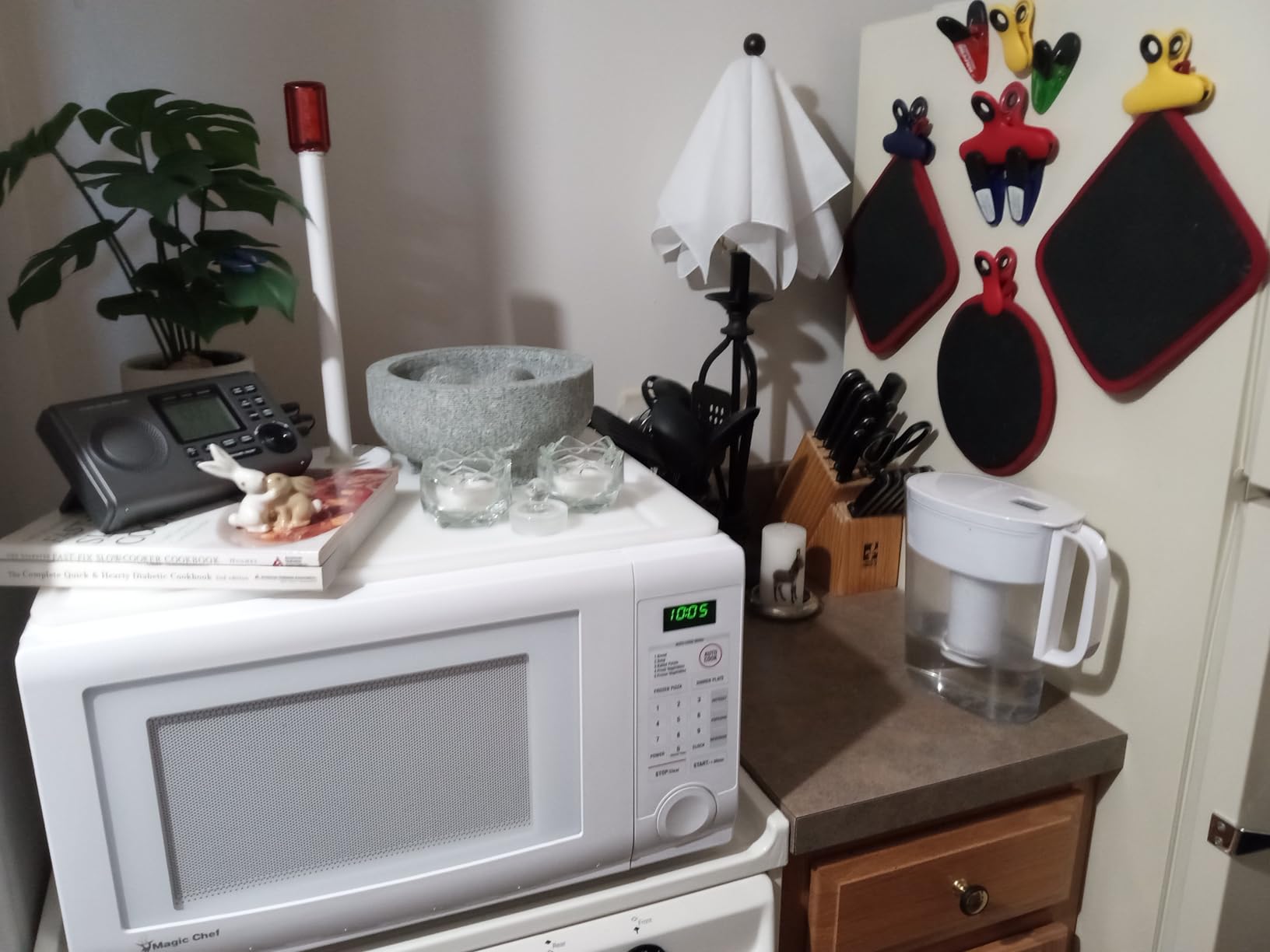
The RunningSnail MD329 is the other radio here with real S.A.M.E. county programming, and it is the more compact of the two. It holds up to 23 county codes with All, Multiple or Single County modes, and it carries more than 80 alert types that you can switch on or off individually, including voice, siren, and visual modes. That control over which alerts fire is the feature alert-fatigued owners ask for.
It is a dedicated home console rather than a portable, and it is built for placement problems the other units here do not solve. A bundled external antenna and external warning light are included, which means you can put the radio in a basement or an interior room and still see the alert somewhere else in the house.
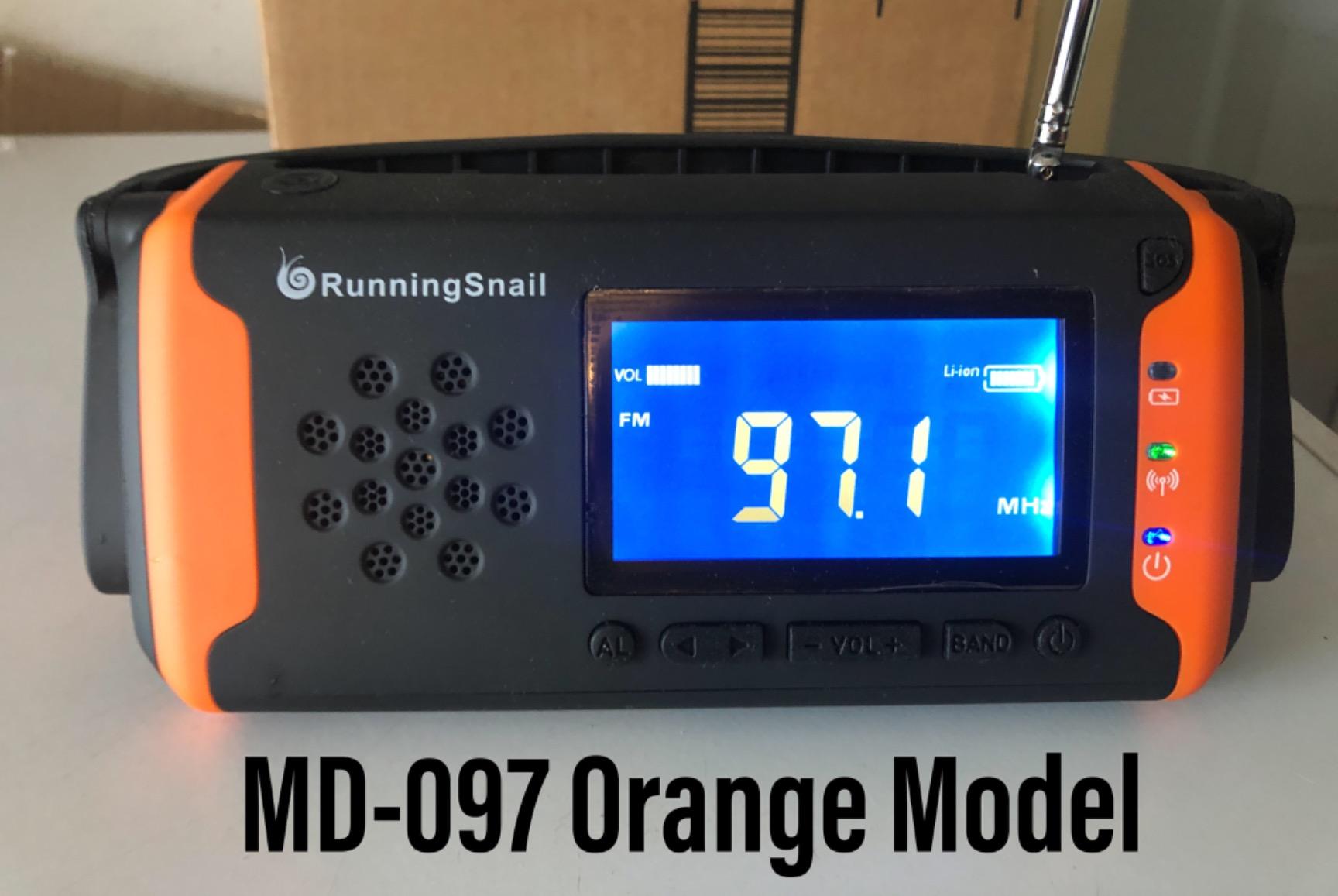
The 110dB maximum siren output is higher than the other sirens specified in this roundup, and the selectable alert tone lets you pick something that cuts through a house rather than a sound you will start tuning out. A digital clock, date, smart alarm, and nine-minute snooze make it usable as a bedroom clock as well as a warning device.
Power is mains plus three AA cells, with more than 54 hours of operation claimed on the backup. That is real but it is hours, not days, and the batteries are not included. It is also NOAA only, with no AM or FM, so it is purely a warning device with nothing to listen to.
Why the MD329 suits a hearing-impaired household
The bundled external warning light is the reason this radio exists in our lineup. A visual alert placed in a hallway or a bedroom gives a household member who cannot rely on an audible siren a real chance to respond, and no other portable in this group offers that.
It is also a strong fit for a large metro. Individual alert toggles plus Multiple County mode let you build a list that follows your actual risk rather than a whole transmitter coverage area, which is the noise problem owners complain about most.
What to watch out for
This radio scores 4.2, the lowest average in the group, and the reason is a nine-percent share of one-star ratings, the highest here. That points to a meaningful defect rate, so buy it with the expectation of checking it early and often rather than assuming it will simply work.
One built-in system alert cannot be customised or disabled, which is an odd gap in an otherwise granular alert menu. It is also mains-dependent with no crank or solar path, and NOAA-only means there is no radio to fall back on for general information.
8. Mesqool 12000mAh – Best Solar Panel and Battery in the Roundup
Solar Radio Emergency Hand Crank 12000mAh with Clear Signal
12000mAh lithium battery
8500mm2 monocrystalline panel
Upgraded crank generator
3-year warranty
Pros
- A true 12000mAh battery with more capacity than any other unit here
- Dual USB outputs for phone charging
- Solar panel more than four times the area of typical competing panels
- Three-year replacement warranty
Cons
- Heaviest unit in the roundup at 1.6 pounds
- Analog dial with no LCD readout and no S.A.M.E. coding
- No shortwave band
The Mesqool 12000mAh is the radio you buy when the question is power, and on that axis it leads the roundup. It is a manual-tune weather band radio with no S.A.M.E. county coding and no automatic alert scanning, so it will not wake you for a storm, but it holds the largest battery in the group, and its panel is large enough to do real work rather than simply hold a charge steady.
The panel is an 8500mm2 monocrystalline surface, more than four times the area of the 2000mm2 polysilicon panels typical on competing models. That difference is the whole argument for this radio over a cheaper crank unit: a larger panel can top up a battery that has actually been drained, instead of merely maintaining a full one.
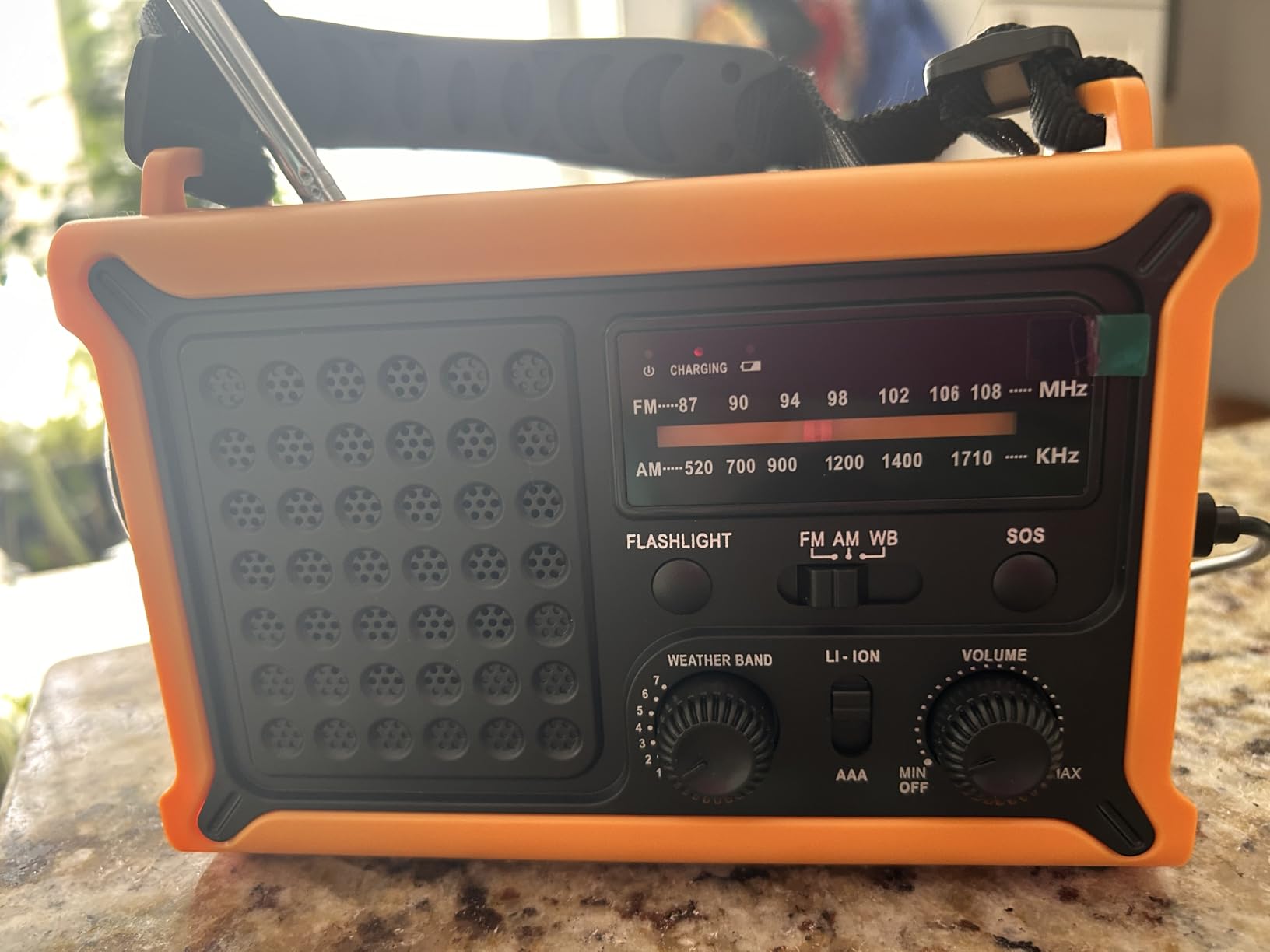
The hand crank is also upgraded rather than nominal, with a larger copper coil, a reinforced magnet, and an extended low-effort crank arm. Alongside the 12000mAh pack you get solar, Type-C input at 5V/2A, and three AAA cells, so there are five ways in and dual USB outputs for getting a phone running again.
Reception is handled by a high-sensitivity chip with noise reduction and an extended antenna, and the 5-watt speaker is among the loudest in the portable group. The flashlight reaches about 260 feet and the flip-up frosted reading lamp has two brightness levels, with an ergonomic non-slip body and a large tuning knob.
Why the Mesqool is worth the extra weight
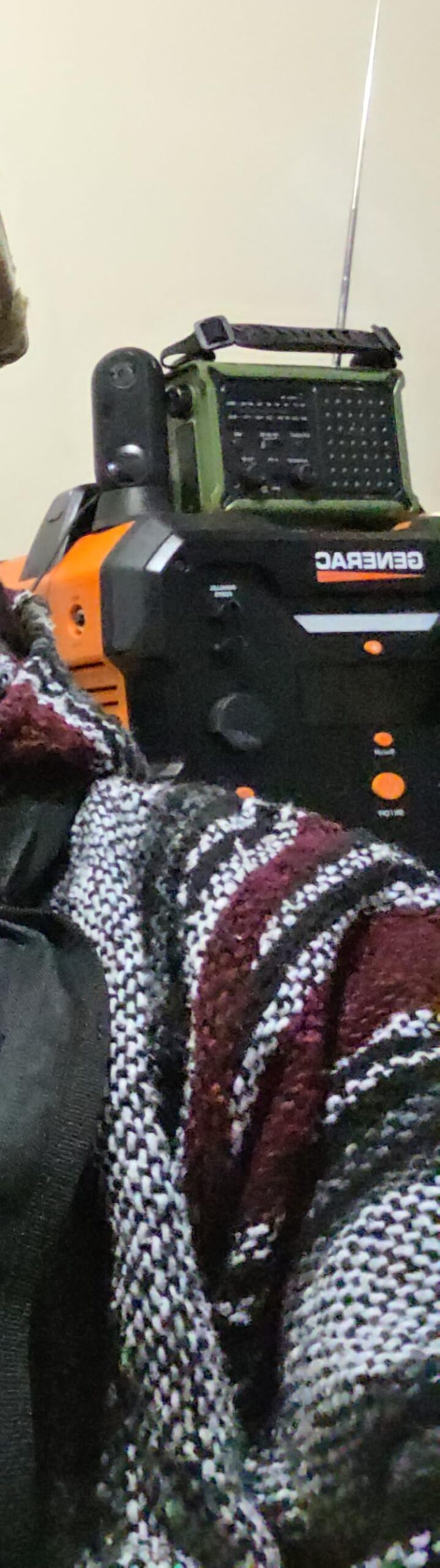
If your plan is a long outage rather than a single alert, battery capacity is the specification that matters and this is the one with the most of it. The 12000mAh pack with dual outputs can carry several phones through a day, which no other unit in this roundup manages.
The three-year replacement and refund warranty is also longer than the coverage on the others here, which is meaningful on a device whose most valuable feature is a battery that is expected to sit unused for months. Recharge it every three to six months and it will be ready.
Where it is the wrong choice
It weighs 1.6 pounds, the heaviest body in the group, which rules it out for an ultralight pack or a glove box. Tuning is by analog dial with no LCD frequency readout, so you are adjusting blind at night.
And to be direct about the storm-alert use case: with no S.A.M.E. coding and no automatic alert scanning, it will stay silent through a warning unless you happen to be on the right channel. There is no shortwave band either, so it is narrower in coverage than the Kaito.
9. Nitigo 4000mAh – Best Compact Travel Radio
NITIGO Emergency Weather Radio, 4000mAh NOAA Weather Radio Solar Charging
4000mAh rechargeable pack
Solar, hand crank and USB
180-degree rotating reading lamp
300 g and 5.31 inches long
Pros
- Compact full-feature body at 300 g
- Still covers solar
- hand crank and USB charging
- Retractable 180-degree reading lamp plus a bright flashlight
- Loud SOS alarm with a flashing light
Cons
- 4000mAh pack limits how much phone charging you can do
- No S.A.M.E. coding or automatic alert scanning
- Analog tuner with no frequency display
The Nitigo is the one to pack when grams matter, and it does not give up much to get there. At 300 g and 5.31 inches long it is among the most compact bodies in the roundup, yet it still carries solar, hand crank, and USB charging plus a 4000mAh rechargeable pack and a USB output for emergency phone power.
It is a manual weather band radio with no S.A.M.E. county coding and no automatic alert scanning, so you tune the NOAA channel yourself and it will not interrupt you for a warning. It is a backup receiver, a light source, and a phone top-up, not the radio that wakes the house.
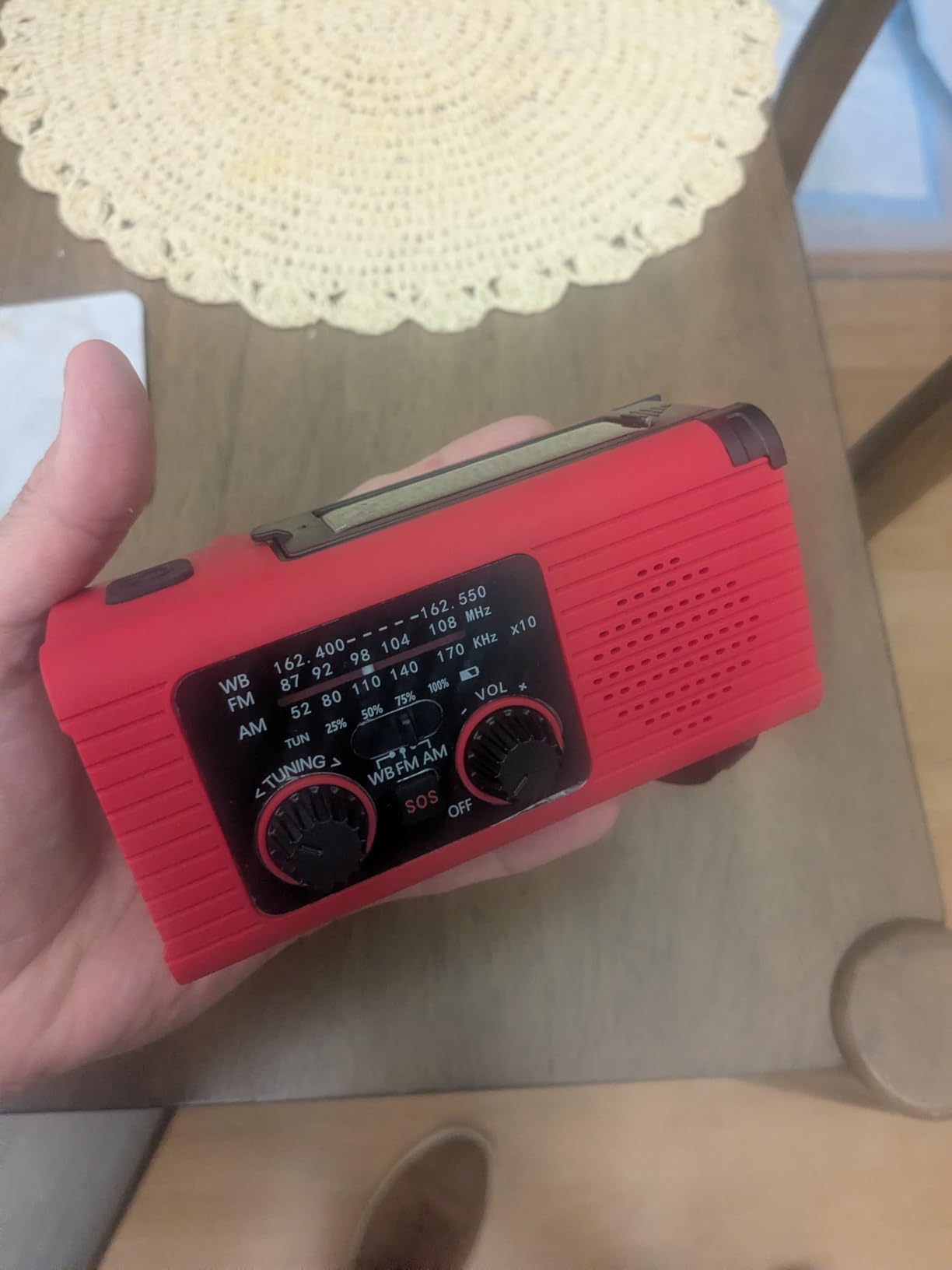
The adjustable high-gain antenna is a sensible inclusion on a unit this small, and reception on the NOAA and FM bands is reported as strong indoors and out. AM is the weaker band, with lower-rated reviews pointing at sensitivity on local AM stations.
The lighting is the interesting part. Alongside an ultra-bright LED flashlight there is a retractable reading lamp that swivels through 180 degrees, which lets you aim it into a tent or across a table without repositioning the whole radio. A loud SOS alarm with a flashing light provides a distress signal, and a 3.5mm headphone jack gives private listening.
Where the Nitigo fits best
It is a go bag radio, a car kit radio, and a camping radio. The lanyard, the compact body, and the combination of flashlight, reading lamp, and alarm mean one small object covers the tasks that would otherwise take three, and the battery is rechargeable from three directions.
It is also a compact body with all three charging methods, which makes it an easy first radio for a household building a kit gradually rather than all at once.
What you give up for the size
The 4000mAh pack is modest next to the 10000mAh and 12000mAh models here, which limits how much phone charging you can do. If the plan is reviving a phone in a long outage, a larger pack such as the Leaton or Mesqool serves the job better.
There is no frequency display and no auto-scan, only a simple analog-style tuner, and no shortwave band. The rotating lamp mechanism is reported by some reviewers as fiddly, and the lower-rated reviews also flag weaker AM reception.
10. Emgykit Hand Crank Radio – Best Budget NOAA Radio
Emgykit Hand Crank Radio with AM/FM/NOAA Weather Band,for Emergencies
AM, FM and NOAA reception
2000mAh 7400mWh battery
3W 140-lumen flashlight
SOS siren above 80 dB
Pros
- Most compact body in the group at 0.23 kg
- Pocket-sized at 5.1 by 2.1 by 2.4 inches
- Three charging methods and a phone-charging output
- Reviewers report clear local and NOAA reception
Cons
- 2000mAh pack is among the smallest here
- so phone charging is limited
- No S.A.M.E. coding and no automatic alert scanning
- Not waterproof and no reading lamp
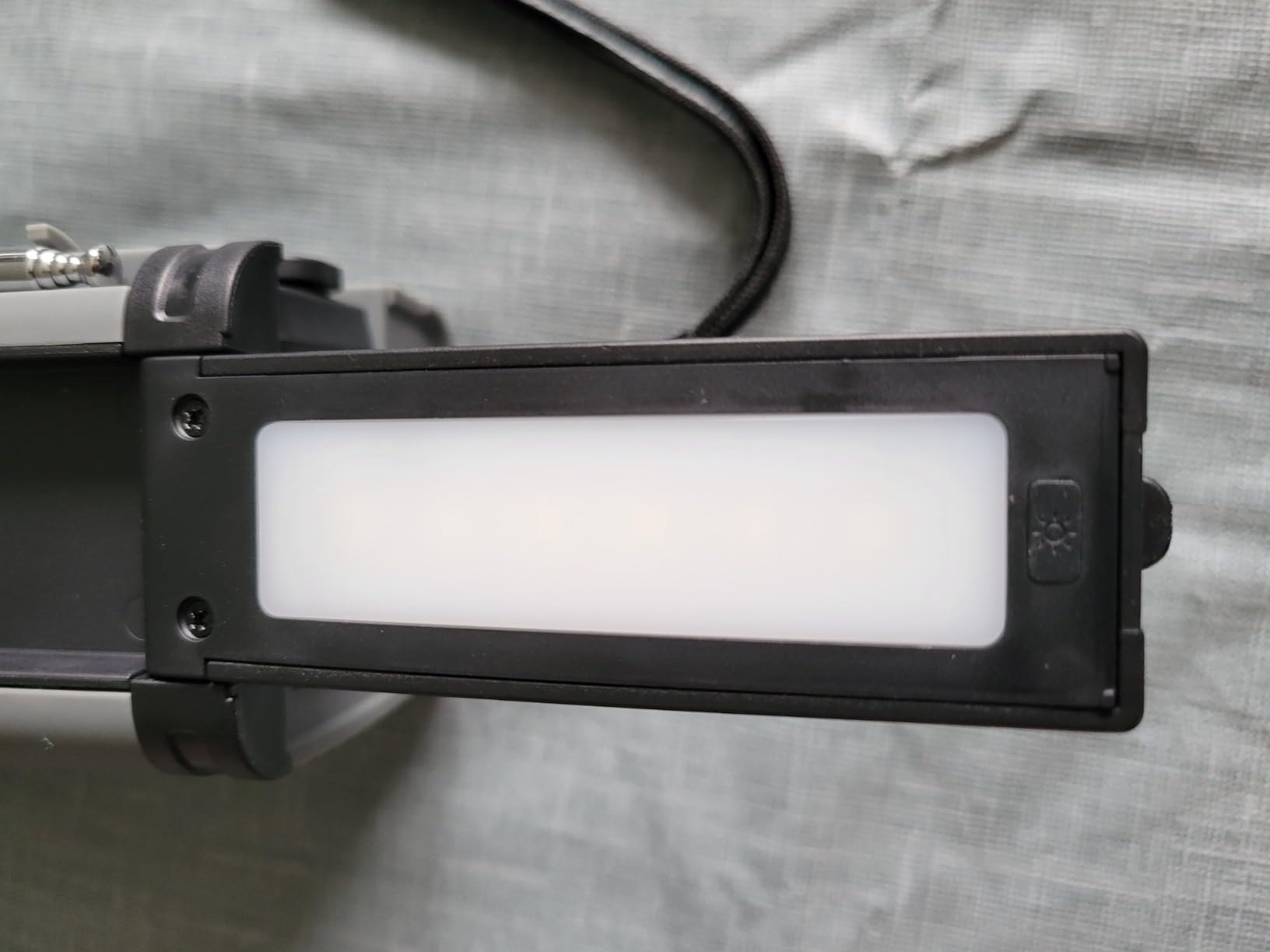
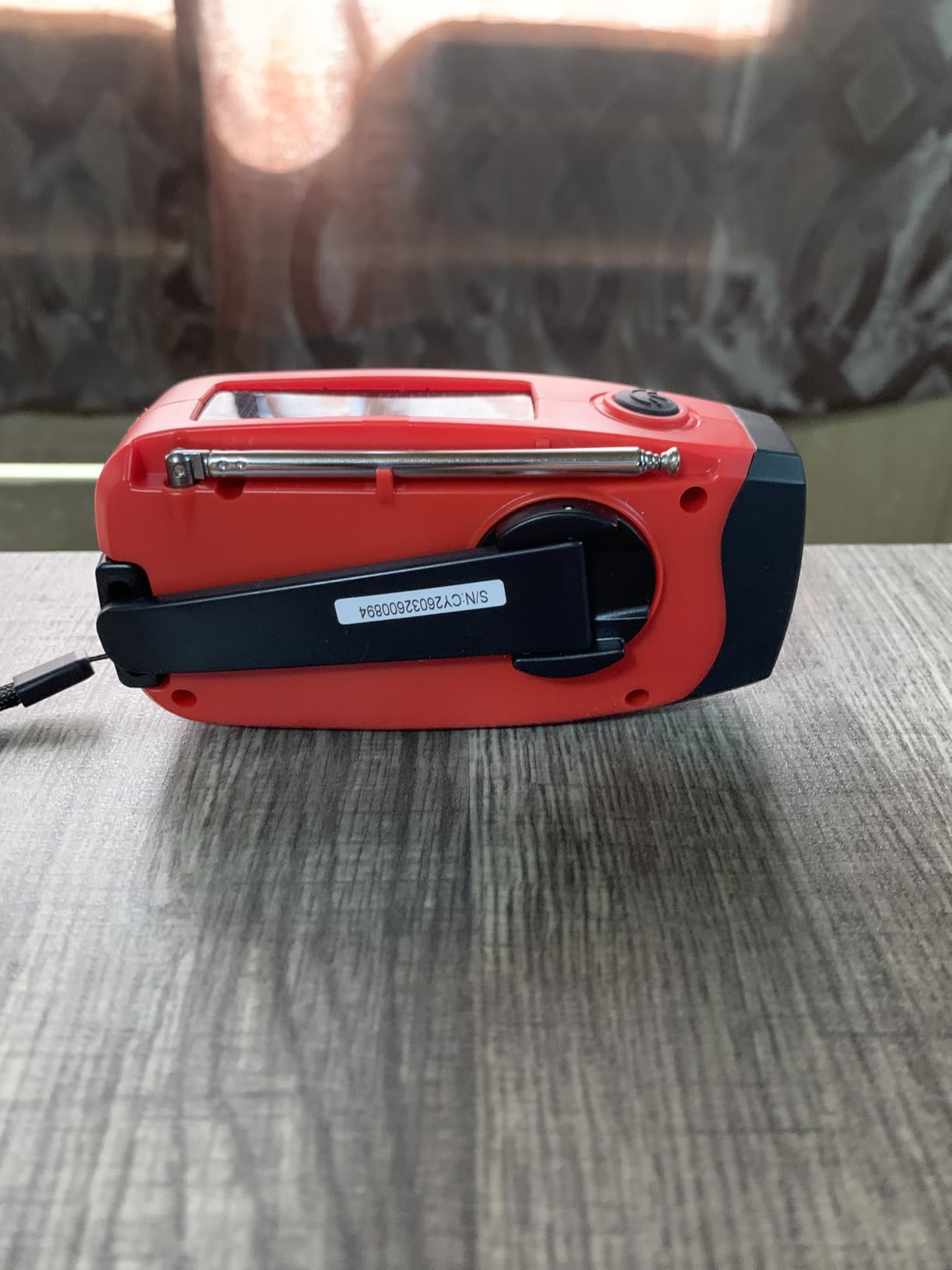
The Emgykit is the budget pick, and it does something the more expensive portables here do not: it fits in a pocket. At 5.16 by 2.09 by 2.6 inches and 0.23 kg it is the most compact body in the roundup, and reviewers describe it as cheap peace of mind rather than a serious piece of equipment.
It is a manual weather band radio with no S.A.M.E. county coding and no automatic alert scanning. It receives AM, FM, and the NOAA band, and it tunes the weather channel yourself. For storm alerts specifically, treat it as a fourth-line backup, not the radio that wakes your household.
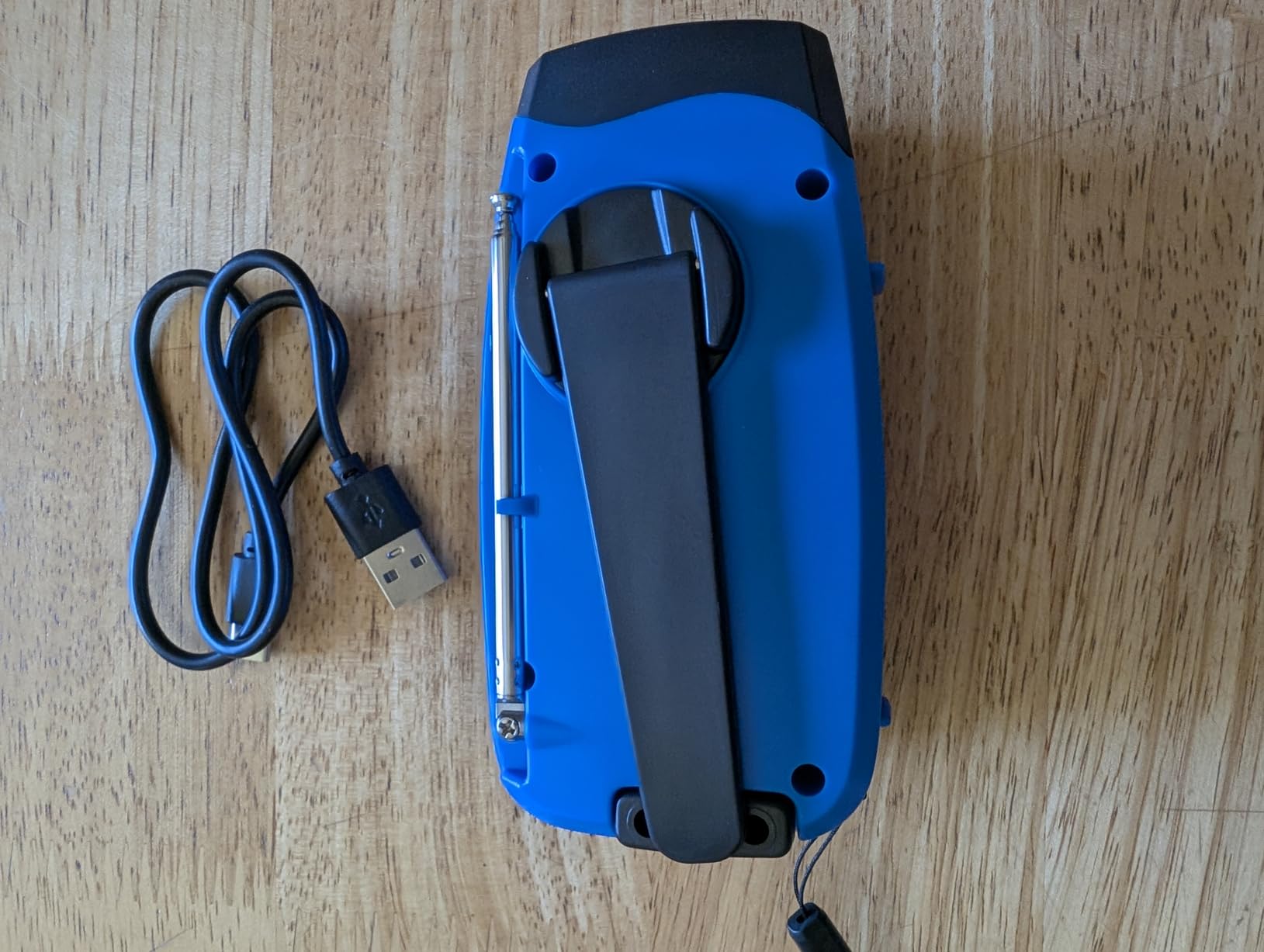
Three charging methods keep it alive: hand crank, solar panel, and Type-C. The 2000mAh, 7400mWh internal battery is one of the smaller packs here, so phone charging is limited to a genuine emergency top-up, but it will do it. It is also one of the few budget units with an SOS distress function, and holding the button for three seconds triggers an above-80 dB siren to attract attention.
Reception exceeds what the price suggests. Owners report clear local and NOAA stations, in some cases better than several car radios, and long runtime at full volume for its size. The upgraded 3W three-LED flashlight produces 140 lumens, which is a genuinely usable outage light.
Who the Emgykit works for
It suits anyone who wants NOAA reception in a pocket, a glove box, a desk drawer, or a go bag without spending much. The three charging methods mean it does not depend on a wall outlet or a battery format you have to keep in stock.
It is also a reasonable second radio for a household, since a second receiver gives you redundancy in a house with thick walls, a metal roof, or a distant transmitter.
What you trade away
The 2000mAh battery is one of the smaller packs here, so the phone-charging function is a genuine emergency measure rather than a plan. There is no reading lamp, only the single flashlight, and no shortwave band or LCD display.
It is not waterproof, which several reviewers flag, and charging is slow, with one owner reporting only a quarter of a charge after several hours of sun. The 1-watt speaker is also modest for alarm volume, and the plastic housing reads as cheap to some owners even though the functionality is not in question.
Weather Alert vs Weather Band: What the Difference Means
A weather alert radio sits in standby with the NOAA channel selected, watches for the 1050 Hz attention tone, and switches itself on. It then decodes a S.A.M.E. code to learn the event type, the affected county, and when the message expires, so it can wake you for a storm that actually covers your town.
A weather band radio does none of that. It receives the same NOAA frequencies and lets you listen on demand, but it stays silent until you turn the dial. Nothing about a band-only radio makes it alert you, and that is the single distinction most buyers in this category get wrong.
The related mistake is assuming the alert reaches only your county. Without S.A.M.E. coding, a receiver responds to the entire broadcast area of the transmitter serving you, which can be a dozen counties. Owners on the weather forums report alarms for coastal areas several zones away, and the fix is programming a narrow county list rather than a wider one.
One more failure mode worth knowing before you buy. Some radios lock out their other functions when alert mode is engaged, so the receiver that warns you also stops playing AM and FM until you leave alert mode. Check the manual, because it turns an ordinary radio into a single-purpose device overnight.
How to Program Your S.A.M.E. County Code
Program the code once, properly, and the radio stops telling you about storms that do not concern you. The National Weather Service does not implement sub-county codes, so a county list is the finest filtering the network offers.
1. Find your code. The National Weather Service publishes a S.A.M.E. code lookup by county and by ZIP code on weather.gov. Use that rather than codes posted in social threads, which owners on the forums report are frequently wrong or out of date.
2. Add neighbouring counties. Users in multi-county metro areas recommend programming your own county plus the adjacent ones, because storms regularly straddle a border and a warning issued for the next county over is often the one that reaches you.
3. Open the county menu on the radio. On most Midland and Kaito units this is reached by holding the Menu or Alert button for a few seconds until the setup screen appears, then stepping to the county option.
4. Choose the right mode. All County wakes you for everything, Multiple County lets you add a list, and Single County is for one area. Multiple County is what most people in warning-prone regions actually want.
5. Enter each code and confirm. Codes are six digits beginning with 0 for the contiguous United States. Press enter after each one and let the radio validate before moving on.
6. Test it. The National Weather Service runs a weekly alert test on Wednesdays, usually in the morning local time. If your radio sounds the test tone and shows the right event, the alert path is confirmed. Owners on the forums treat that single test as the only credible proof their radio works.
Where to Place Your Radios and How to Test Them
Reception is a recurring surprise in this category. A radio that sounds clear in the kitchen may fail in a basement or an inner bedroom, and metal roofs are worse. The fix is placement, not a better antenna, for most houses.
Put the desktop alert console in a room with a window, on the wall closest to your local transmitter rather than in a basement. If you buy a console with a bundled external antenna, such as the RunningSnail, use it to move the receiver to a better spot and keep the speaker where you can hear it.
Put a second portable in the go bag and a third in the vehicle. Owners who have had a radio fail during a real event generally recommend a multi-location strategy, because one receiver in one room is a single point of failure.
Check reception before storm season rather than during it. Listen to the NOAA channel in each room you plan to use, at the volume you would actually have at night. If it is marginal in a room, put a portable there instead of a desktop unit.
On battery care, align your radio check with your smoke alarm check and with the pre-storm-season routine. Lithium packs that sit for months lose charge, and crank radios are the classic example of a device that looked fine in January and had nothing left in March. Recharge every three to six months for storage.
One practical tip for households that want a broader picture: a NOAA radio tells you what the National Weather Service is broadcasting, and a two-way radio gives you local talk groups. Our GMRS radio guide covers the licensing-free option, and the marine radio roundup covers the band that matters on the water.
Why Your NOAA Weather Radio Is Not Alerting
If your radio is silent, work through these in order. Most cases are one of the first three, and all three take under five minutes to check.
1. Check the mode. A radio in tuning mode is not monitoring. Make sure it is in alert mode or alert standby, with a NOAA channel selected.
2. Check the county list. If the S.A.M.E. code is wrong, empty, or set to a county you do not live in, alerts for your area will be ignored. Re-run the lookup on weather.gov.
3. Check for a lockout. Some units disable every other function while alert mode is engaged. Leaving alert mode restores normal operation, and the manual will say so.
4. Check the backup cells. A desktop unit that is silent after a long outage has usually flattened its backup batteries. Replace them on a schedule rather than waiting.
5. Check the reset path. On most Midland and Eton units, remove the backup batteries, hold the volume or Alert button to enter the menu, choose the factory reset option, then re-enter your location and county code.
6. Check placement and legacy decoding. Move closer to a window, and if your receiver is older, confirm it decodes multi-county S.A.M.E. codes rather than only the older single-event letters, which is a known cause of missed warnings.
On the beeping complaint, the 1050 Hz attention tone fires for every watch, warning, and advisory in your programmed area, and many receivers offer no volume attenuation. The fixes are narrow the county list, disable the alert types you do not want, or move to a band-only radio if you only want to listen on demand.
What to Look for Before You Buy
Automatic alert mode comes first, and no other specification matters if it is missing. Confirm the radio scans in standby rather than simply receiving the weather band. If the listing does not say plainly, assume it does not alert.
S.A.M.E. county filtering is second. It is the difference between alerts for your county and alerts for the whole transmitter area, and it is the feature most of the crank portables in this roundup lack. If you live in a metro area with many counties, treat it as non-negotiable.
Power redundancy is third. Ask what happens when the grid goes down, and confirm the backup path is real. A radio with AAA backup is easier to keep alive than one with a sealed lithium pack, and a replaceable cell is better than a pack you cannot swap.
Battery format matters more than capacity in a household. Matching the AA and AAA cells you already buy in bulk means a two-year-old radio still works in a five-year emergency. Capacity still matters for phone charging, where the Mesqool and Leaton lead.
Finally, think about the category honestly. Radios in this roundup are not waterproof in the sense that claim usually implies; most are water-resistant against spray at best, and weather-resistant is not waterproof. If it lives outdoors or on a boat, look for an IPX rating. And for hearing-impaired household members, a radio with a strobe or an external warning light is worth more than one with a slightly better speaker.
Frequently Asked Questions
What does NOAA Weather Radio mean?
A NOAA weather radio receives broadcasts from the NOAA Weather Radio All Hazards network, a nationwide system of National Weather Service transmitters. It plays continuous forecasts and pushes watches, warnings, and emergency alerts around the clock without needing your internet, cell carrier, or household electricity.
Why won’t my NOAA weather radio work?
The usual causes are that the radio is in tuning mode instead of alert standby, the S.A.M.E. county code is wrong or empty, alert mode has locked out other functions, the backup batteries are dead, or the indoor signal is too weak. Check the mode, re-enter the county code from the National Weather Service lookup, and listen near a window.
Why does my NOAA weather radio keep beeping?
The 1050 Hz attention tone sounds for every watch, warning, and advisory covering your programmed area, and many receivers have no volume attenuation. Narrow the S.A.M.E. county list, switch off alert types you do not want, or choose a band-only radio if you prefer on-demand listening instead of alerts.
How do I reset my NOAA weather radio?
Remove the backup batteries, then hold the volume or Alert button to enter the menu and choose the factory reset option. Power the radio back up, select your location, and re-enter your S.A.M.E. county code from the National Weather Service lookup. Exact button names vary by model, so check the manual.
What does SAME code mean?
S.A.M.E. stands for Specific Area Message Encoding. It is the code carried in NOAA broadcasts that encodes the event type, the affected county or counties, and when the message expires. A programmed receiver uses it to wake only for your area. The National Weather Service does not implement sub-county codes.
Do I need a NOAA weather radio if I have a phone?
Yes, if you want a warning that does not depend on infrastructure. Cell towers, the power grid, and the internet often fail in the same storm that triggers the warning, and a phone can be silenced, dead, or out of coverage. NOAA All Hazards also broadcasts non-weather emergencies such as evacuations and Amber alerts.
What is the difference between a weather band and weather alert radio?
A weather band radio receives the seven NOAA frequencies and lets you listen on demand, but it stays silent until you tune it. A weather alert radio sits in standby, sounds a 1050 Hz tone, and switches itself on, decoding a S.A.M.E. code so it wakes only for your county. Only the second kind will warn you.
Conclusion
The best NOAA weather radios for storm alerts are not the ones with the biggest batteries, and the evidence across 10 products makes that plain. Two radios in this lineup decode S.A.M.E. county codes and monitor continuously: the Midland WR120B, which I would put on a bedside table, and the RunningSnail MD329, which adds a bundled external antenna and warning light for a household that needs visual alerting.
For everything that is not a fixed bedside unit, the FosPower Model A1 is the one I recommend, because standby alert reception, three independent power sources, and a 7400mWh phone-charging output in a 310 g body is a combination none of the other portables here put together. The Emgykit covers the same functions in a pocket at a fraction of the outlay, and the Mesqool carries the most power for a long outage thanks to its 12000mAh pack and oversized solar panel.
Program the county code from the National Weather Service lookup rather than a forum post, add the neighbouring counties, and confirm the whole system by catching the Wednesday weekly test. Then put a second radio in the go bag and a third in the vehicle, because a single receiver in a single room is a single point of failure when it matters most.