
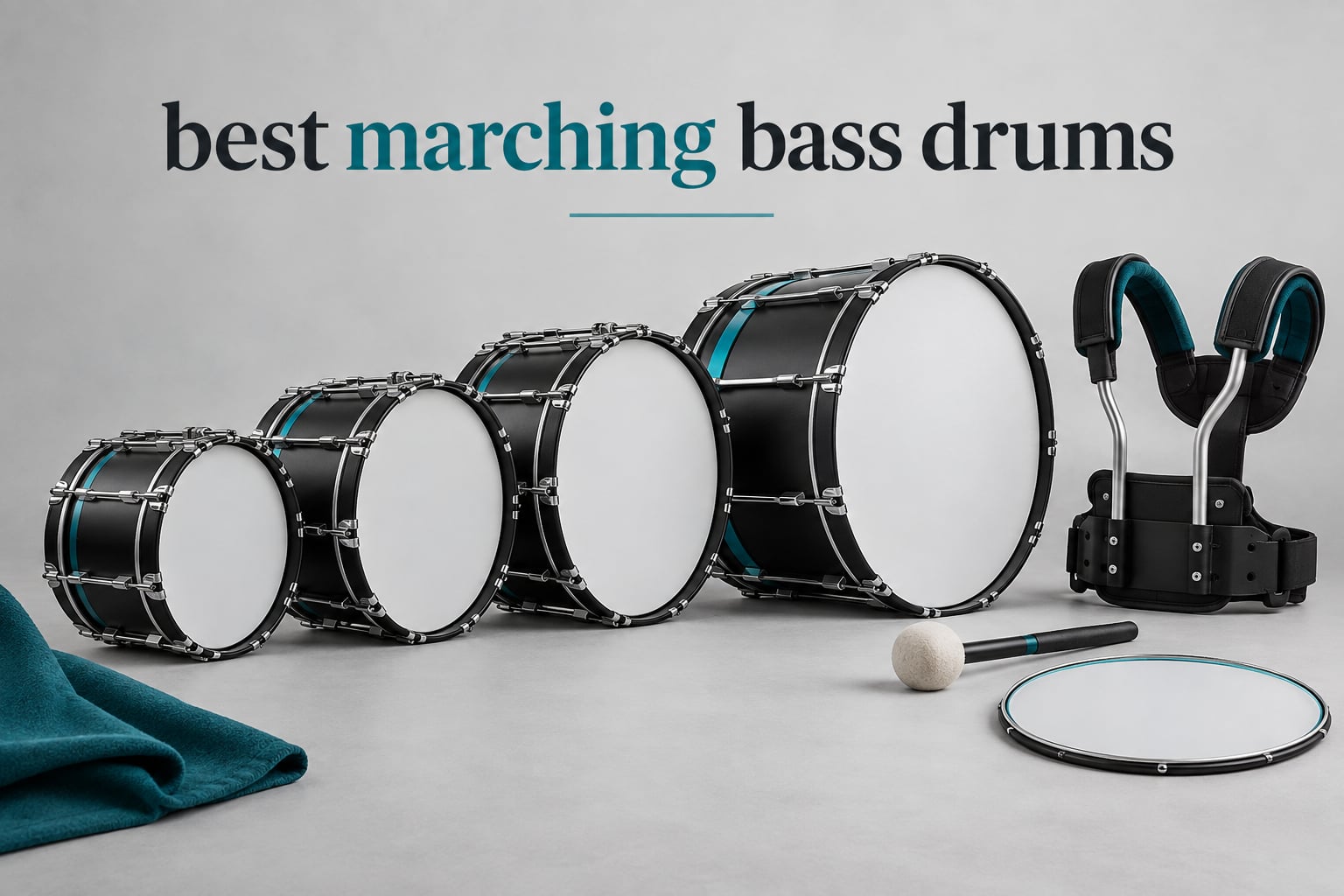
Playing a bass line is one of the heaviest jobs in a marching battery, and the drum you pick decides how loud, how heavy, and how long your players last in July. Every roundup we looked at while putting this together skipped the two numbers that actually decide the purchase: diameter and carried weight. So we built the best marching bass drums list around them, comparing ten drums across the full 12-inch to 28-inch spread that a youth program, a high school line, and a drum corps will each ask for.
A marching bass drum is not a concert bass drum. A concert drum sits on legs in a hall and is tuned to the orchestra, while a marching drum hangs vertically from a shoulder or vest harness and is struck with hard mallets while the player moves. The shell is deeper, the hardware is reinforced for a beating, and the weight is a design target rather than an accident.
That weight is the whole conversation. On marching forums, players consistently describe carrying a bass as one of the harder sections, not an easy one, and a line of 28-inch drums plus tenors and cymbals is called brutal more often than it is called manageable. Our picks below are listed with the weights the manufacturers publish, so you can match a drum to the players you actually have rather than to a brochure. If you want the same low-end thinking applied to home audio instead of a drumline, our bass guitar roundup covers a different kind of low end entirely.
Table of Contents
Top 3 Best Marching Bass Drums in 2026

Pearl Finalist Birch Marching Bass Drum
- 6-ply 7.5mm birch shell
- 1.5 inch maple hoops
- Reinforced oversized claws
- 3-year warranty

Pearl Competitor 28×14 Marching Bass Drum
- 28 by 14 inch corps size
- Competitor series platform
- Listed at 21 pounds

GEWA BASIX 24 x 12 Marching Bass Drum
- 6-ply wooden shell
- 10 tension rods
- Strap and beater included
Every Pick at a Glance in 2026
Ten drums, three tiers of use. The table below covers a full 28-inch corps shell, a set of high school and college sizes, and the youth end of the range, so you can see the trade between diameter and weight in one view.
| Product | Specifications | Action |
|---|---|---|
| Pearl Finalist Birch Marching Bass Drum |
|
Check Latest Price |
| Pearl Competitor 28×14 Marching Bass Drum |
|
Check Latest Price |
 Yamaha Power-Lite 24×13 Marching Bass Drum Yamaha Power-Lite 24×13 Marching Bass Drum |
|
Check Latest Price |
 Mapex Quantum Mark II 20×14 Marching Bass Drum Mapex Quantum Mark II 20×14 Marching Bass Drum |
|
Check Latest Price |
| GEWA BASIX 24 x 12 Marching Bass Drum |
|
Check Latest Price |
 Yamaha MB-6300 22-Inch Marching Bass Drum Yamaha MB-6300 22-Inch Marching Bass Drum |
|
Check Latest Price |
 Pearl Competitor 16×14 Marching Bass Drum Pearl Competitor 16×14 Marching Bass Drum |
|
Check Latest Price |
 Yamaha Power-Lite 20×13 Marching Bass Drum Yamaha Power-Lite 20×13 Marching Bass Drum |
|
Check Latest Price |
 Mapex Qualifier 18×14 Marching Bass Drum Mapex Qualifier 18×14 Marching Bass Drum |
|
Check Latest Price |
 DIMAVERY 422 Marching Bass Drum 12×22 DIMAVERY 422 Marching Bass Drum 12×22 |
|
Check Latest Price |
1. Pearl Finalist Birch Marching Bass Drum — the Most Flexible Pick in the Lineup
Pearl Finalist Birch Marching Bass Drum (FBDB3014/A33)*
Shell: 6-ply 7.5mm birch
Hoops: 1.5 inch maple
Warranty: 3 years
Pros
- Widest size range of the group at 14 to 30 inch
- 6-ply 7.5mm birch with a medium-depth mid-cut profile
- 1.5 inch maple hoops with oversized reinforced claws
- 3-year warranty is the longest coverage here
Cons
- Weight is not published for this listing
- 30 inch shell is the heaviest option for a youth line
Best for: a program that might change size tier, or a director building a bass line across more than one age group. The Finalist Birch is the one drum here that covers 14 inch through 30 inch in the same shell platform, and that flexibility is what made it our top pick after we weighed all ten against each other.
The construction is the interesting part. A 6-ply birch shell at 7.5mm with a medium-depth mid-cut profile is a deliberate weight move, since the mid-cut profile takes material out of the shell where the drum does not need it. The 1.5 inch maple hoops and the oversized reinforced claws are built for the abuse of a full season of field work rather than a single parade.
The listing covers a long run of diameters: 14, 16, 18, 20, 22, 26, 28, and 30 inch, in Pure White and Midnight Black. Buyers rate it 5 out of 5 across the reviews that exist, and the warranty runs three years, which is the longest coverage listed among these ten products.
One caveat matters here. No weight figure is published for this listing, so you are choosing on shell construction and size range rather than on a measured carry number. If your director wants a specific weight target, ask the retailer for the figure on the exact diameter before you order. The smaller diameters are the practical option for a youth line, and the 30 inch shell is the heaviest thing a beginner will ever be asked to carry.
Where it earns its place
The single-platform approach is the quiet advantage. If a program replaces one drum four years from now, the replacement matches the tone and the hardware of what came before, which a mixed-brand line rarely manages. It also means a director moving a line from 16 inch to 20 inch is not re-searching the category.
For indoor winter percussion and college ensembles that want a bright, cutting low end, the birch shell profile suits them. Players describe birch as loud and bright enough to cut through a full ensemble, and that is the right character when the bass line is competing with horns rather than supporting them.
Where it is a harder sell
The absence of a published weight undercuts the single most useful number in this category. Two reviews is a thin sample, so long-term durability after a full outdoor season is not proven by customer history. The 30 inch variant is also a serious load and belongs in a corps program, not a high school battery.
For a school buying its first set, this is a bigger commitment than a first drum needs to be. Pair it with the smaller sizes in the range rather than reaching for the biggest shell available.
2. Pearl Competitor 28×14 Marching Bass Drum — Full Corps Diameter
Pearl CMB2814NC33 Competitor 28″x14″ White Marching Bass Drum
Shell: 28 by 14 inch
Series: Competitor
Listed weight: 21 pounds
Pros
- Full 28 inch corps diameter
- Competitor series is a standard scholastic and DCI platform
- 21 pounds is a moderate figure for a shell this size
- Pure White finish matches typical uniform schemes
Cons
- No shell material or hoop detail in the listing
- No published customer ratings for this listing
Best for: a scholastic line or a WGI group that has settled on the full corps diameter. Twenty-eight inches is the top of the range that modern practice actually marches, and this is the drum that gets you there without going past it.
The Competitor series is the platform most widely used at this tier, and the 14 inch depth is the standard corps shell depth. Depth is what gives a marching bass its boom, and a 12 inch shell at the same diameter would sound noticeably thinner underneath a full battery.
The listed weight of 21 pounds is the number to plan around. That is lighter than the 24 inch Yamaha in this roundup despite a larger diameter, which tells you shell construction matters more than size alone. If your players are already carrying full-size tenors and cymbals, that figure is the difference between a sustainable season and a rough one.
The specification listing is sparse. It gives no shell material, no hoop detail, and no customer ratings, so you are buying on the model designation and the physical dimensions. Ask for the shell spec and the drum-only weight in writing before you commit a program budget.
Where it earns its place
A full 28 inch bass in a scholastic line changes the balance of the whole battery. The low end stops being felt only in the chest and starts being heard as a distinct line across a stadium, which is the point when a front ensemble is trying to build a unified sound.
It is also the diameter that matches the rest of a corps-tier tenors package. Pairing a 28 inch bass with much smaller tenors leaves a gap in the spectrum that the line has to fill with volume instead of pitch.
Where it is a harder sell
For a high school program this is at the heavy end of what the players will want to carry every week, and forum discussion is consistent on that point. Several players note that many high school lines do not need to march the largest available drum.
With no published reviews and no shell material listed, you lose the two signals that help most when you cannot test the drum in person. Buy it from a retailer who will confirm the spec, and budget the carrier separately if your listing does not include one.
3. Yamaha Power-Lite 24×13 Marching Bass Drum — The School Line Sweet Spot
Yamaha 6300 Series Power-Lite 24-inch x 13-inch Marching Bass Drum – White
Shell: 24 by 13 inch birch
Hoops: Birch mahogany
Warranty: 2 years
Pros
- 24 inch diameter projects well past smaller shells
- Power-Lite construction holds 24.6 pounds at this diameter
- Deep resonant tone suits outdoor ensembles
- 2-year warranty
Cons
- Included components field lists a snare drum which is an apparent catalogue error
- No published customer ratings
Best for: a high school marching band that wants more projection than a 20 inch gives without going to a full corps shell. Twenty-four inches is the diameter where a school line usually stops, and the Power-Lite build is aimed at exactly that carry weight.
The tone profile is described as deep and resonant, which is the right register for a bass line working under brass. The birch shell with birch mahogany hoops gives a warm character rather than the bright cut of birch alone, and that warmth is what a school line usually wants for a long outdoor show.
The weight figure is the reason this drum made the list. Twenty-four inches of diameter at 24.6 pounds is a modest number for the size, and it sits only three pounds above the 20 inch Power-Lite from the same series. When the diameter gain costs about three pounds, it is an easy upgrade to justify.
There is one data problem in the listing worth flagging. The included components field names a snare drum, which is almost certainly a catalogue error rather than something you will receive in the box. Confirm the actual contents with the seller, and treat carrier and mallets as separate purchases until you have that in writing.
Where it earns its place
It is the size that scales with a program. A high school that marches 24 inch basses today is running a line that will still work when a player moves up to a larger ensemble, and the diameter matches the tenor range most collegiate lines are building toward.
For a director running halftime shows and parade routes on a fixed budget, the two-year warranty and the Power-Lite weight target make this an easy approval. It is the drum you can order once and stop thinking about.
Where it is a harder sell
Twenty-four pounds before the carrier is still a real load for a younger battery, and it is heavier than the 28 inch Pearl Competitor listed at 21 pounds. If your players are small or new, look at a smaller shell or a lighter carrier setup.
No customer reviews are published for this listing, so durability over a full season is unproven by customer history rather than by any reported failure. The misleading components field is the practical risk here, not the drum itself.
4. Mapex Quantum Mark II 20×14 Marching Bass Drum — Full-Bore Tone at School Size
Mapex Quantum Mark II Marching Bass Drum – 14-inch x 20-inch, Gloss Black
Shell: 20 by 14 inch maple
Hardware: Eyebolt adjustment
Warranty: 2 years
Pros
- 20 inch diameter is the most common high school bass size
- Reinforcement ring with an eyebolt adjustment system for hardware tuning
- Maple shell for a warm thundering boom
- 2-year warranty
Cons
- Heaviest published carry figure in this group at 26.6 pounds
- Listing colour name conflicts with the title
- No published customer ratings
Best for: a line that wants the deepest, warmest low end it can get from a school-size drum. The 20 inch diameter is the most common high school bass size on the market, and this shell is built to sound like the biggest drum in the line.
Maple is the other major shell wood in this category, and the character is different from birch. Players describe maple as warm and balanced, and the stated tone profile here is a warm thundering boom. That is a good match for a winter indoor set where the bass has to carry without competing.
The reinforcement ring with an eyebolt adjustment system is the feature that separates this drum from a school-grade shell. It lets you tension the hardware without fighting the shell, which matters over a season of daily rehearsal and a full outdoor run.
The tradeoff is weight. At 26.6 pounds this is the heaviest published figure among these ten drums, heavier than every 24 inch shell in the roundup despite being four inches smaller. That makes it a strong match for a college line and a poor match for a first-year battery.
Where it earns its place
Tone is the argument here. If your program is judged on how the bass line sounds rather than on what it costs, a maple shell at 14 inch depth delivers more fundamental than the lighter birch options at shallower depths.
For a college marching band or an indoor percussion ensemble with a fixed repertoire, the adjustability of the reinforcement ring pays off quickly. Players can move the drum between a gym floor and a field without fighting the hardware each time.
Where it is a harder sell
Twenty-six pounds before the carrier is the single biggest number in this roundup. Forum posters regularly describe that kind of load as brutal when it is combined with tenors and cymbals, and younger players should not be handed this drum first.
The listing also carries a colour name conflict, where the title says Gloss Black and the specification field says Silver Diamond Dazzle. Confirm which finish you are actually getting before you order, because a mismatched colour is hard to return once a drum has been drilled for a harness.
5. GEWA BASIX 24 x 12 Marching Bass Drum — the Complete Starter Package
BASIX F893121 24 x 12-Inch Marching Bassdrum
Shell: 6-ply wood
Size: 24 by 12 inch
Includes: Strap and beater
Pros
- 6-ply wooden shell with a loud punchy tone
- Carrying strap and beater are both in the box
- Only one size offered which keeps the buying decision simple
- Rated 5 out of 5 by the buyer who reviewed it
Cons
- Only a single 24 by 12 inch variant is offered
- Shallow 12 inch depth limits low-end projection versus a 14 inch shell
Best for: a club, a youth program, or a school line that needs one drum and one beater and does not want to chase down accessories separately, which removes the most common first-purchase headache.
The shell is 6-ply wood with ten tension rods, and the buyer review describes a loud, punchy drum that was easy to disassemble and repaint in club colours. That repaint detail matters more than it sounds: matching a drum to a uniform colour scheme is a real requirement for many school programs, and a shell that takes paint well saves a lot of arguing.
At 24 inches the projection is genuinely there. A 12 inch depth is shallower than the 14 inch corps shells, and you will hear that in the sub-frequency content under a full ensemble, but for a parade, a talent show, or a club performance it is more than sufficient.
The published weight is given in metric at 6.7 kilograms. There is only one variant size in this listing, so the decision is not a comparison between diameters. It is a decision about whether a 12 inch depth is enough for the ensemble you are marching.
Where it earns its place
Package completeness is the real value driver. Most drum-only listings leave you sourcing a carrier, a mallet, and a strap before the drum is playable at all, and this one closes two of those three gaps in the box.
It is also the pick for a beginner who will grow out of a specific size. A club bass that repaints easily is not a wasted purchase, and the loud tone means a new player is heard immediately in rehearsal.
Where it is a harder sell
One review is a very thin basis for any long-term durability claim, and a 12 inch shell will not hold a fundamental the way a 14 inch shell does. If your ensemble is competitive and indoor, this is the wrong depth.
The strap is a basic carrying strap rather than a padded vest carrier, so shoulder comfort over a long parade route is a separate purchase. For a high school line that marches long distances, budget for a proper carrier.
6. Yamaha MB-6300 22-Inch Marching Bass Drum — Built for Parade Routes
Yamaha MB-6300 Power-Lite Series 22-inch Marching Bass Drum – White
Shell: 22 by 13 inch birch
Hoops: Birch mahogany
Warranty: 2 years
Pros
- Power-Lite design targets carry weight on long routes
- Deep resonant tone profile
- Birch shell with birch mahogany hoops
- Ranks fourth in Amazon's marching bass drum category
Cons
- Listing states accessories are not included
- No published customer ratings
Best for: a program that marches distance as often as it marches stadium. The Power-Lite series exists to cut carried weight, and at 22 inches and 22.6 pounds this is the middle of the Yamaha range where that design brief pays off.
Twenty-two inches sits between the 20 inch and 24 inch sizes in the same series, and it is the version most programs end up with. The depth of 13 inches gives a reasonable amount of low-end weight without the full 14 inch corps shell, and the tone profile is described as deep and resonant.
Its category position is worth noting. This listing ranks in the top five of Amazon’s marching bass drums category, which is a demand signal even though no customer reviews are published. It is a widely ordered drum, and the availability of matching sizes around it makes a line build straightforward.
The accessories note on this listing is explicit: the carrier, sling, and mallet are not included. That is normal for a drum-only listing, but it means your real outlay is the drum plus a carrier plus mallets plus heads. Budget the whole package rather than the drum.
Where it earns its place
Twenty-two inches is a size that works for high school and for college without the extremes of either end. It projects past a marching crowd, and the weight stays in a range that a typical high school bass player can carry for a full rehearsal block.
If your program plays indoor winter percussion as well as outdoor, the deep resonant tone works in both rooms. That versatility is what makes this a safe centre-of-the-lineup choice.
Where it is a harder sell
Twenty-two point six pounds before the carrier is not the lightest option here, and it is heavier than both the 28 inch Pearl Competitor and the 20 inch Power-Lite figures. You are buying a middle ground, not a minimum.
With no published reviews and no accessories in the box, the first season is a trial period. Buy it from a seller who will confirm the shell spec and the drum-only weight, and pair it with a carrier you have already stress-tested.
7. Pearl Competitor 16×14 Marching Bass Drum — the Youth End of the Line
16X14 Competitor Marching Bass Drum Pure White
Shell: 16 by 14 inch
Series: Competitor
Listed weight: 21 pounds
Pros
- 16 by 14 inch is the most compact tier in this roundup
- Competitor series shell with a warm resonant tone profile
- 21 pound listed weight suits younger battery players
- 14 inch depth keeps real low-end content
Cons
- Costs more than comparable 16 inch birch alternatives
- No published customer ratings
Best for: a middle school or youth battery where the players are small and the drum has to stay manageable. Sixteen inches with a 14 inch depth gives you a real marching shell without asking a twelve-year-old to carry a corps drum.
The tone profile is described as warm and resonant, which suits a youth ensemble that is developing its sound. At 16 inches you are not going to project the sub-frequency of a 28 inch shell, and you should not try. A youth line that sounds tight together beats a youth line that sounds enormous.
The 21 pound listed weight is the useful part. It matches the figure published for the 28 inch Pearl Competitor, which tells you that shell construction is doing the work here rather than diameter alone. Same weight, eight inches less of shell to swing around.
The honest drawback is cost positioning. This listing sits above comparable 16 inch birch alternatives from the same manufacturer’s own range, and there is no published customer review history to justify the premium. If a program is buying on a tight budget, the birch option at a smaller diameter is the better value.
Where it earns its place
A 14 inch depth at 16 inches is a genuinely useful proportion. Shallow youth drums at the same diameter sound thin and disappear under a snare line, and this shell keeps enough depth to produce a low note that a director can actually build a line around.
Using the same Competitor platform as the larger shell means a program can mix sizes without a change in tone character. For a youth program that feeds into a high school program, that continuity is worth planning for.
Where it is a harder sell
The price gap against comparable birch drums is the reason a budget-driven director should look elsewhere. This is not a bad drum, it is an expensive one at this size, and the extra spend is buying the platform rather than a fundamentally better shell.
Sixteen inches will not cut through a full ensemble outdoors. If your program plays on a stadium field rather than a local field, a larger diameter in the same series is the safer choice.
8. Yamaha Power-Lite 20×13 Marching Bass Drum — 20 Inches at 21.5 Pounds
Yamaha 6300 Series Power-Lite 20-inch x 13-inch Marching Bass Drum – White
Shell: 20 by 13 inch birch
Hoops: Birch mahogany
Warranty: 2 years
Pros
- 21.5 pounds is the lightest listed figure among the full-size shells
- 20 inch diameter is the common high school size
- 13 inch depth keeps weight down without going thin
- Warm and powerful tone profile
Cons
- Listing states accessories are not included
- No published customer ratings
Best for: a battery that wants a full-size marching shell without asking first-year players to absorb a corps-tier load. The 13 inch depth here is the compromise that keeps a full-size shell light, and it is why this drum anchors the middle of our list.
Compare the 21.5 pound figure to the Mapex Quantum Mark II at 20 by 14 inches, which lists 26.6 pounds. Same diameter, one inch shallower, and over five pounds lighter.
That five-pound difference matters more than any spec line. Forum discussion about carried weight is consistent: the total load on a bass player’s frame includes tenors, cymbals, and the drum, and every pound taken off the bass comes off the shoulders.
The accessory note applies again: the listing states accessories are not included. Plan for a carrier, a pair of mallets, and heads as separate line items. Two years of warranty coverage is standard for this series.
Where it earns its place
This is the drum to buy when the players are the constraint. A twenty inch Power-Lite gives a high school line a proper marching shell without asking first-year players to absorb a corps-tier load, and the warm tone profile works for both indoor and outdoor sets.
It pairs naturally with the 22 inch and 24 inch versions from the same series, so a program can build a size ladder using one platform. Matching hardware across a line simplifies spares and reduces the number of variables during rehearsal.
Where it is a harder sell
Twenty inches will not throw the fundamental of a 24 or 28 inch shell, and a director who wants the low end to be heard across a stadium will find it underwhelming. It is a weight decision as much as a sound decision.
There are no published customer reviews for this listing, so nothing here reports how the shell has held up over a season. Treat it as a well-specified drum from an established maker, and confirm the weight figure with the seller before ordering.
9. Mapex Qualifier 18×14 Marching Bass Drum — a Middle Step with a Warranty Behind It
Mapex Qualifier Marching Bass Drum – 18-inch x 14-inch, Gloss White
Shell: 18 by 14 inch
Material: Aluminum
Warranty: 2 years
Pros
- 18 by 14 inch bridges the youth and school tiers
- Aluminum shell holds carry weight to 21.8 pounds
- Backed by a 2-year warranty
- Gloss White finish
Cons
- Aluminum shell sounds brighter and more focused than a wood shell
- No published customer ratings to gauge durability
Best for: a program stepping up from youth sizes without jumping to a full high school diameter. Eighteen inches is an awkward number that sits neatly between the 16 and 20 inch options, and at 21.8 pounds it stays inside a manageable load.
The unusual thing about this drum is the shell material. Most marching bass drums at this tier use birch, maple, or poplar, and this one is aluminum. That changes the tone profile more than the diameter does: aluminum is bright and focused rather than warm, and it responds faster to a mallet stroke.
The listed weight of 21.8 pounds is competitive for an 18 inch shell. It comes in under the 20 inch Yamaha by a small margin despite being two inches smaller, which is a direct result of the aluminum construction shedding weight the wood shells carry.
Two years of warranty coverage is the strongest published commitment among the Mapex listings here. No customer reviews are published for this listing, so the assessment rests on the specification list and the manufacturer’s construction claims rather than on reported field experience.
Where it earns its place
If your ensemble is indoor-leaning or your director wants more attack than warmth, the aluminum shell is a genuine differentiator. Players who want the bass line to cut rather than fill will prefer it to a wood shell of the same size.
Eighteen inches is also a smart bridge drum. A player moving up from a 16 inch youth shell can handle it, and a program can add a 20 inch beside it later without a step change in the line’s balance.
Where it is a harder sell
If your program marches outdoors and wants the warm, rolling low end that players describe for wood shells, aluminum will disappoint. The tone is focused rather than foundational.
Eighteen inches is not a common size, so replacement drums and matching parts are harder to source than at 16, 20, or 22 inches. For a program that expects to keep the drum for many years, that is a real consideration.
10. DIMAVERY 422 Marching Bass Drum 12×22 — a Shallow Shell That Carries Light
DIMAVERY mB – 422-Marching Drum Bass Drum, 12 x 22
Shell: Bass wood
Size: 12 by 22 inch
Listed weight: 26.5 pounds
Pros
- 22 inch diameter with a shallow 12 inch depth
- Bass wood shell construction
- Rated 4.6 out of 5 by verified buyers
- Straightforward build with no premium hardware to strip
Cons
- 26.5 pounds is heavier than most shells here despite the shallow depth
- Limited specification detail published for the listing
Best for: a first drum, a practice room, or a youth program where the diameter matters more than the depth. Twenty-two inches gives you real presence, and the 12 inch shell keeps the drum from becoming a full project.
The shell is bass wood with a 12 inch depth, and the construction is straightforward rather than refined. That is exactly what you want from an entry drum: no features that can fail, no premium hardware to strip, and a diameter that sounds like a bass drum.
Buyers rate it 4.6 out of 5, and the reviews that exist are positive, with a verified purchase reporting fast delivery and a satisfying overall experience. Two reviews is a small sample, but there is no pattern of complaints in the ratings distribution, which shows 5 stars and 4 stars only.
The listed weight of 26.5 pounds is the surprise here. A shallow shell does not automatically mean a light drum, and this one is heavier than every 22 inch and 24 inch shell in the roundup. If carried weight is your top concern, the depth saving does not deliver what the dimensions suggest.
Where it earns its place
Twenty-two inches is the diameter that reads as a real marching bass without the depth commitment. For rehearsal rooms, talent shows, and indoor ensembles where low end is more important than projection, the shallow shell is a practical choice.
The finish is white and silver, which suits a uniform scheme that has not yet been decided. It is also a straightforward drum to maintain, with nothing in the specification list that needs specialist knowledge to keep playing well.
Where it is a harder sell
Twenty-six and a half pounds before the carrier puts this at the heavy end of the group despite looking like the light option. Test the weight with a real carrier before committing a youth line to it.
The specification detail published is thin, so the shell thickness, hoop material, and hardware grade are not stated. For a first drum that is acceptable. For a program replacing a drum that has to survive a full outdoor season, ask the retailer for the construction spec first.
How to Choose a Marching Bass Drum
Work through these decisions in order. Start with diameter, because it fixes almost everything else, then shell wood and ply count, then the carrier, then heads and mallets.
Shell wood and ply count
Birch, maple, and poplar are the three woods you will see most, and players describe them consistently. Birch gives a loud, bright tone that cuts through a full ensemble, maple gives a warm and balanced tone with more rolling low end, and poplar is the cost-effective substitute for either.
Ply count changes the character on top of the wood. More plies and thicker plies add mass and a slower attack with a deeper fundamental. The Pearl Finalist Birch uses a 6-ply 7.5mm birch shell with a medium-depth mid-cut profile, which takes weight out where the drum does not need it, and the GEWA BASIX uses a 6-ply wooden shell with ten tension rods.
Carrier and what a drum-only listing leaves out
Most of the listings in this roundup are drum-only. That means you are still buying a carrier, a mallet or mallets, a set of heads, and a case for transport. For a youth or high school line, that extra spend is often larger than the difference between two drums in the same tier.
The GEWA BASIX is the exception here, since the carrying strap and the beater are both in the box. Two listings explicitly state that accessories are not included, and one listing has an included components field that names a snare drum, which is almost certainly a catalogue error. Ask what is actually in the box before you order.
Heads and mallets
Head choice matters more than most buyers expect. Three head families come up constantly in drummer discussion: the Remo Powermax, the Aquarian Superkick II, and the Evans Emad 2. All three are bass drum heads, not drums, and none of them belongs in a list of marching bass drums even though more than one roundup on the internet has put one there.
For mallets, front ensemble players generally use larger mallets for the low end and rear ensemble players use sticks or smaller mallets. Match the mallet to the size of the drum. A large mallet on a 16 inch shell gives very little control, and a small mallet on a 28 inch shell asks the player to work far too hard.
Tuning a bass line to unison
Tuning is the question that comes up most and gets answered least in published guides. The rule is simple: the entire bass line shares one fundamental, and that fundamental is set against the tenor or quint pitch rather than against an arbitrary note.
Players on r/drumline describe the same problem, where the front ensemble wants to tune high and bass players are not sure what pitch to match. Start every drum in the line at the same pitch, then adjust the resonant head on each one until the note sits together. Equal temperament does not apply here. You are matching a fundamental, not building a chromatic instrument.
A good carrier outlasts the drum and is usually the smarter first purchase, since it can be reused across every drum your program buys later. That is the practical answer to a question most roundups ignore.
Indoor versus outdoor setup
A gym floor and a stadium field are different instruments. Indoors, a controlled environment rewards damping and a shorter ring, and many programs reach for indoor heads or added damping in winter. Outdoors, the opposite applies: you want projection, and a longer ring that carries to the back of the stadium. If you are chasing the same low-end effect in a listening room rather than a field, our soundbar roundup covers that side of the problem.
Carrier height is a related question. Players ask whether a drum sitting up near the head is normal, and the answer from experienced marchers is that a high carrier plate is not required. Several users note that many high school lines do not need to raise it as high as they currently do, and lowering it reduces shoulder strain over a long route.
One more practical note for schools. Corps-tier drums at 26 inches and above are frequently delivered oversized, which means someone in your organisation has to unload it and move it indoors. Factor that into your purchase timeline rather than discovering it the week of rehearsal.
Frequently Asked Questions
What is the best marching bass drum?
The best marching bass drum depends on your ensemble level. For a program that may change tiers, the Pearl Finalist Birch covers 14 to 30 inches on one platform with a 6-ply birch shell. For a full corps diameter, the Pearl Competitor 28×14 is the standard choice and is listed at 21 pounds. For high school, the Yamaha Power-Lite 24×13 balances projection against a 24.6 pound listed weight.
What are the recommended sizes for marching bass drums?
Youth and beginner programs march 14 to 16 inch drums, high school lines use 18 to 22 inches, college lines run 20 to 24 inches, and DCI or WGI corps march 26 to 28 inch shells. Sizes at 30 inches and above are largely legacy. A bass line can run as few as four players at 16, 18, 22, and 26 inches, with the largest drum at the front.
How heavy is a 28 inch marching bass drum?
The Pearl Competitor 28 by 14 inch marching bass drum is listed at 21 pounds. Weight varies with shell construction and depth rather than diameter alone, since a 20 inch drum with a 14 inch depth is listed at 26.6 pounds in this roundup. These figures are drum-only and do not include the carrier or the mallet.
What should marching bass drums be tuned to?
Every drum in a bass line should share one fundamental, tuned against the pitch of the tenor or quint line rather than an arbitrary note. Start each drum at the same pitch and adjust the resonant head until the notes sit together. You are matching a fundamental across the line, not building a chromatic instrument.
Are Pearl drums better than Yamaha?
Neither brand wins at every size. The Pearl Competitor 28 by 14 inch is listed at 21 pounds while the Yamaha Power-Lite 24 by 13 inch is listed at 24.6 pounds, so the larger Pearl shell is the lighter option in this group. The Pearl Finalist Birch also offers a wider size range and a 3-year warranty, while both Yamaha Power-Lite sizes carry a 2-year warranty.
Final Pick: Which Marching Bass Drum Should You Buy?
The Pearl Finalist Birch is our best marching bass drum pick for one reason: it is the only drum here that spans 14 to 30 inches on a single shell platform, so a program can change tiers without changing tone or hardware. The 6-ply 7.5mm birch shell with a medium-depth mid-cut profile, the 1.5 inch maple hoops, and the three-year warranty are the details that hold up.
For a corps-tier line, the Pearl Competitor 28×14 is the right diameter, and its 21 pound listed weight is the best figure in the largest size class we reviewed. For a high school band, the Yamaha Power-Lite 24×13 gives you the projection at a weight your players can carry. For a youth program, either the 16 inch Pearl Competitor or the 20 inch Yamaha Power-Lite at 21.5 pounds keeps the load realistic.
Before you order anything, ask your director two questions: which diameter does the rest of the battery use, and does your carrier fit the new drum. Those two answers will eliminate half of this list on their own. If you are still deciding, our guide to home theater bass covers the completely different problem of low frequency in a living room.