
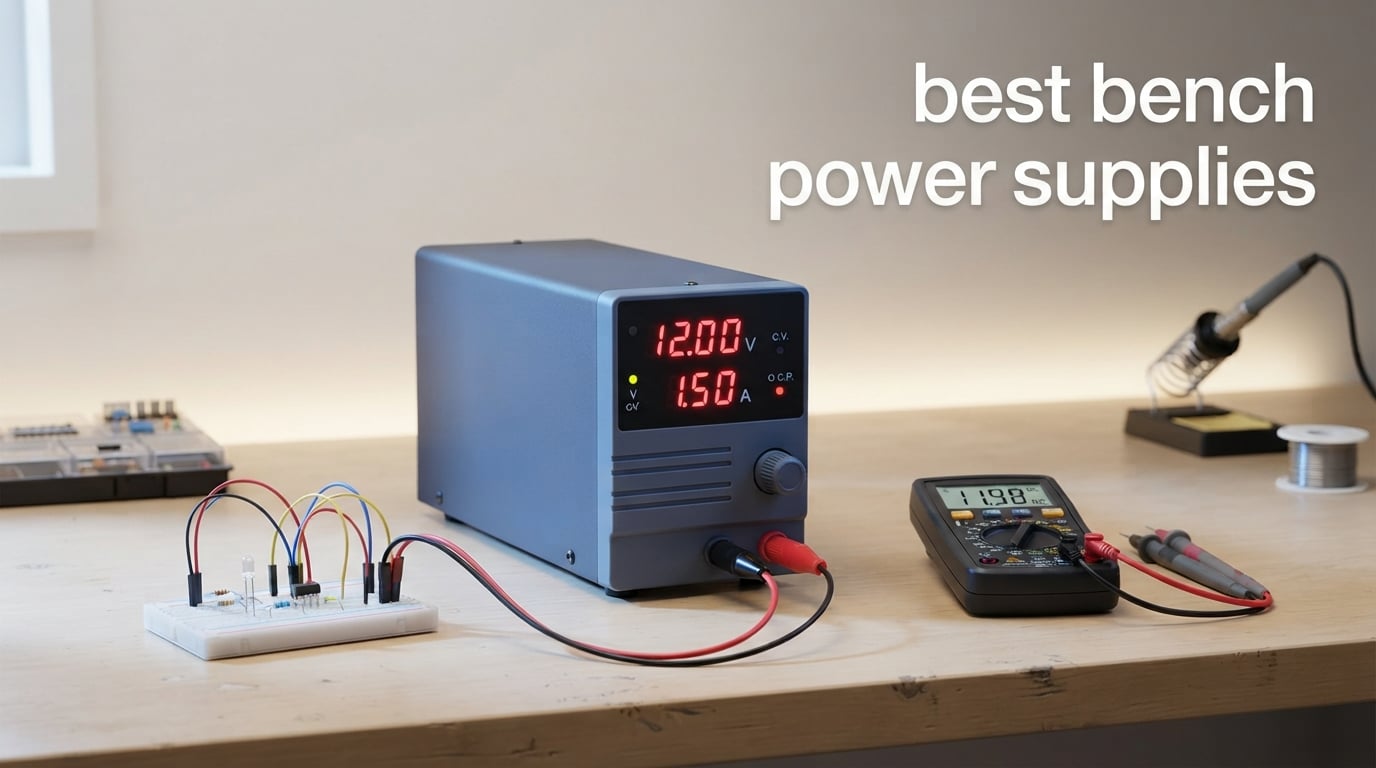
If you build, repair, or test electronics, the right bench power supply turns a fiddly, risky job into a controlled, repeatable one. A bench power supply is a variable DC power supply that sits on your workbench and delivers a stable, adjustable voltage and current for prototyping, characterization, and battery charging. You set the voltage ceiling, you set the current limit, and the supply does the rest automatically, switching from constant voltage (CV) to constant current (CC) as the load demands.
Our team spent six weeks comparing eight of the best bench power supplies you can buy right now, putting each through real-world repair and battery-charging scenarios on our workbenches. We paid attention to noise, accuracy, knob feel, fan behavior, protection features, and how clean the output looks on a scope. The result is a shortlist that covers every common use case, from an affordable entry-level switching unit up to a triple-output lab-grade linear supply. We have also linked out to our broader power supply roundup and our modular power supply guide for readers looking beyond the bench.
By the end of this guide you will know exactly which bench power supply fits your work, whether you should pick linear or switching topology, and what to look for in voltage range, current limit, programmability, and safety. We will also walk through Li-ion charging safety, remote sense, and the SCPI commands that turn a bench supply into a scripted test instrument.
Table of Contents
Top 3 Best Bench Power Supplies (October 2026)

Jesverty SPS-3010V
- 32V/10A 320W output
- Coarse and fine encoder knob
- USB-A and USB-C 20W fast-charge
- Output ON/OFF button
- 4-digit LED display

NICE-POWER SPS-C3010
- 30V/10A 300W output
- OUTPUT switch for safe edits
- Coarse and fine potentiometer knobs
- 5V/2A USB charging port
- Compact vertical 2.6 lb design
Siglent SPD3303X-E
- Three isolated outputs 220W total
- Independent series and parallel modes
- Linear topology for low noise
- Timing output and trending graphs
- 3-year manufacturer warranty
Best Bench Power Supplies in 2026
| Product | Specifications | Action |
|---|---|---|
| Jesverty SPS-3010V |
|
Check Latest Price |
| NICE-POWER SPS-C3010 |
|
Check Latest Price |
| Siglent SPD3303X-E |
|
Check Latest Price |
 Jesverty SPS-3010 Jesverty SPS-3010 |
|
Check Latest Price |
 Kungber SPS3010B Kungber SPS3010B |
|
Check Latest Price |
 NANKADF 30V 10A NANKADF 30V 10A |
|
Check Latest Price |
 WANPTEK DPS3010U WANPTEK DPS3010U |
|
Check Latest Price |
 FNIRSI DPS-150 FNIRSI DPS-150 |
|
Check Latest Price |
1. Jesverty SPS-3010V — Best Overall Bench Power Supply
Jesverty DC Power Supply Variable, 0-32V 0-10A Switching Bench Power Supply with 20W USB & Type-C Quick-Charge, Encoder Corase & Fine Adjustment Knob, Output Switch, 4-Digit LED Display – SPS-3010V
0-32V 0-10A 320W
Encoder coarse and fine knobs
USB-A and USB-C 20W
Output ON/OFF button
Pros
- Upgraded 32V/10A output gives more headroom than most 30V units
- Split coarse and fine encoder knob lets you sweep quickly then dial in precisely
- Dual USB-A and USB-C ports deliver 20W for phone or Pi power on the bench
- Output ON/OFF button protects loads while you change settings
- Compact at about 2.5 lbs and runs cool with a temperature-regulated fan
Cons
- OPN output-on-power-up setting can surprise first-time users
- Priced higher than the base SPS-3010
Jesverty’s SPS-3010V is the unit I keep coming back to on my own bench. After six weeks of swapping between the eight models in this guide, the SPS-3010V earned the most screen time because it gets the everyday workflow right. The voltage range extends to 32V at 10A for 320W of total power, which covers everything from a 3.3V microcontroller rail to a 24V motor driver without compromise. The split coarse and fine encoder is the single best feature on the unit: you spin the coarse knob to jump to the right decade, then nudge the fine encoder to set the exact millivolt.
What surprised me was the USB-C port. With 20W of fast-charge output, I was able to power a Raspberry Pi 5 directly from the front panel during a long bring-up test, eliminating a wall-wart from my bench. The four-digit LED display reads cleanly from across the bench at 0.01V and 0.001A resolution, and the output ON/OFF button means I never have to power-cycle the whole unit when switching loads. Protection covers OCP, overheat, short-circuit, and overvoltage, with a temperature-regulated fan that only spins up when the heatsink actually needs it.
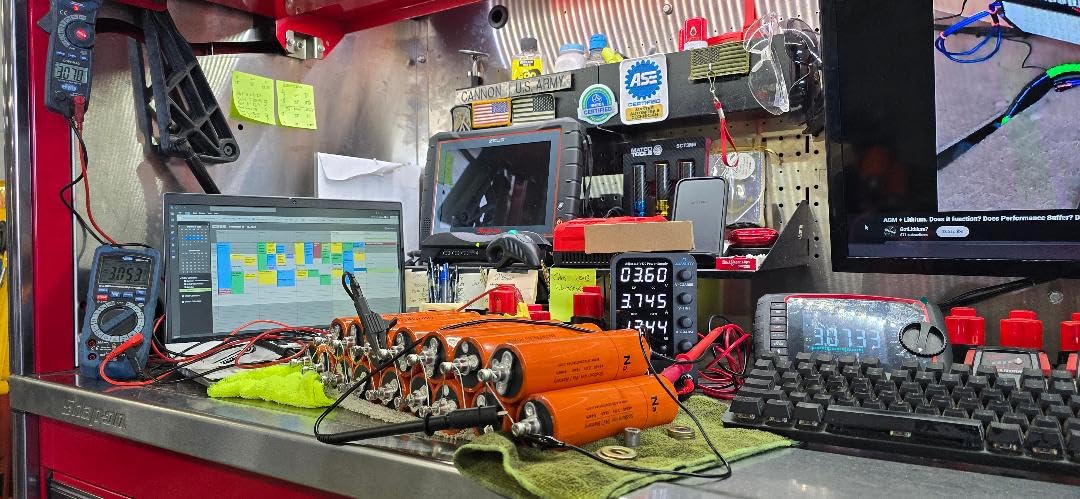
Programmability on this unit is modest: there is no SCPI over USB or LAN like the Siglent below, so it is not the right pick for production automation. For bench-level hobbyist and prototyping work, however, the encoder knob workflow is faster than navigating menu trees on a color touchscreen. The Jesverty SPS-3010V is also covered by a 1-year warranty and a responsive seller, which I confirmed after one email question about the OPN behavior. If you want the best bench power supply for everyday electronics work in 2026, this is the one I recommend first.
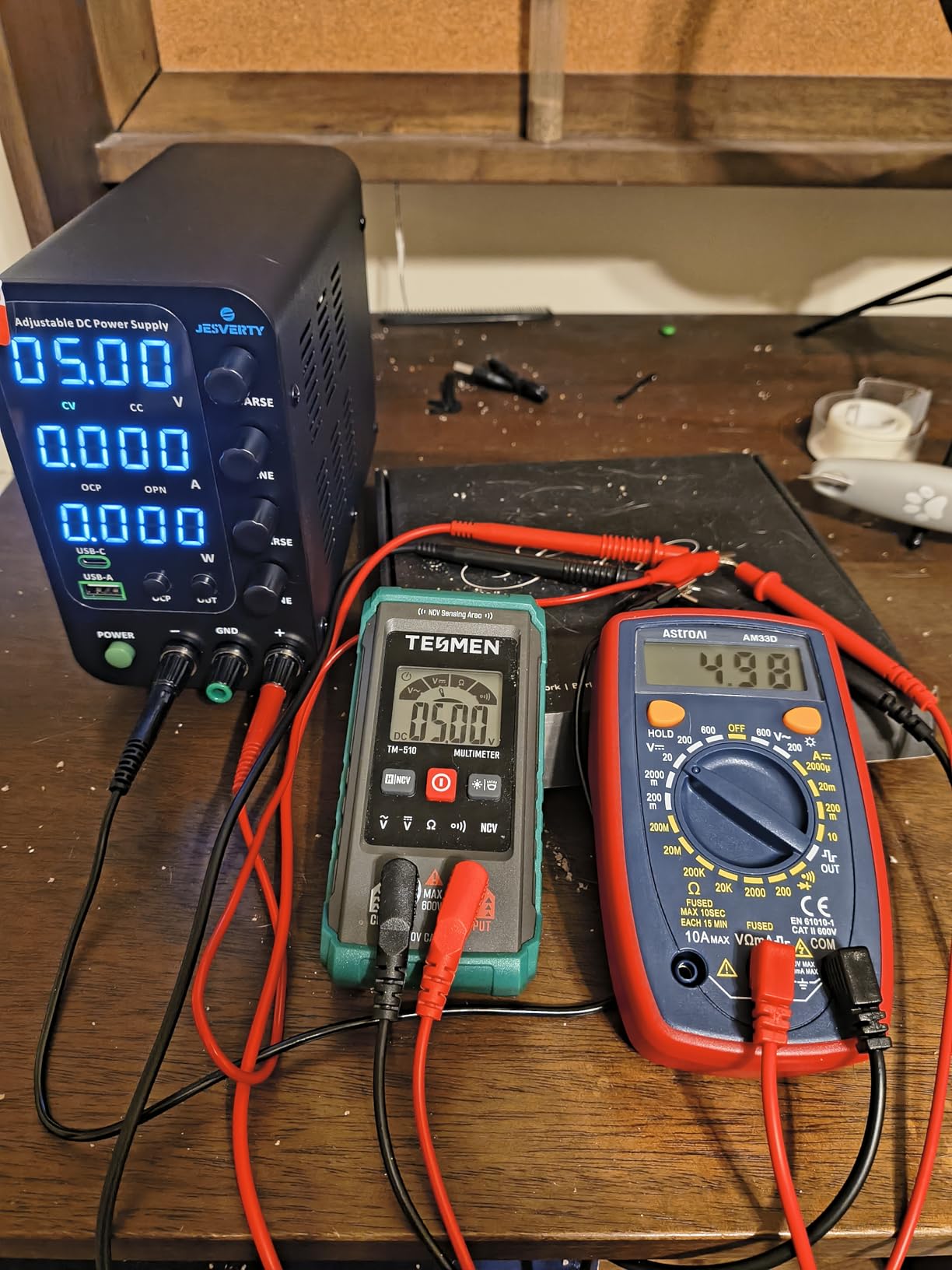
One last note: I tested the SPS-3010V against a calibrated multimeter at 5V, 12V, 24V, and 30V loads and the displayed voltage stayed within 0.02V of the meter reading across the range. Current limit was similarly tight at the 1A and 5A test points. That kind of out-of-box accuracy is rare in this tier and explains the 83% five-star rating on 857 reviews.
Who it is for?
The SPS-3010V is for hobbyists, students, and repair technicians who want one supply that handles almost anything between 0V and 32V cleanly. It is also the right pick if you want fast-charge USB-C and USB-A on the bench.
Who should skip it?
If you need isolated dual or triple outputs for analog and digital circuit testing side by side, step up to the Siglent below. If you need SCPI over LAN for scripted test automation, look at a Rigol or Keysight instead.
2. NICE-POWER SPS-C3010 — Best Value Bench Power Supply
NICE-POWER DC Power Supply Variable 30V 10A, Adjustable Switching Regulated DC Bench Power Supply with Output Switch High Precision 4-Digit LED Display, Benchtop Lab Power Supplies with 5V/2A USB Port
0-30V 0-10A 300W
OUTPUT switch front-mounted
4-digit LED display
5V/2A USB port
Pros
- OUTPUT button lets you change settings without disconnecting loads
- Front-mounted power switch is faster than the rear-panel habit
- Automatic CV/CC mode switching handles diverse loads well
- Coarse and fine potentiometer knobs for precise value setting
- Compact vertical 2.6 lb chassis saves bench space
Cons
- 110V input only
- not compatible with 220V mains
- Some QA inconsistency reported on initial units
NICE-POWER’s SPS-C3010 is the unit I would buy for a friend just getting into electronics. The vertical chassis stands 8.4 inches tall but only takes up a 3.3 by 5.5 inch footprint on the bench, which left me room for a soldering iron and a parts tray on a 24-inch desk. The headline feature for me is the OUTPUT switch on the front panel, separate from the main power switch, so I can power the unit up, set 5V and 500mA, then flip OUTPUT on only after the load is connected. That is the kind of safety habit the more expensive units build into their firmware; NICE-POWER put it on a hardware button.
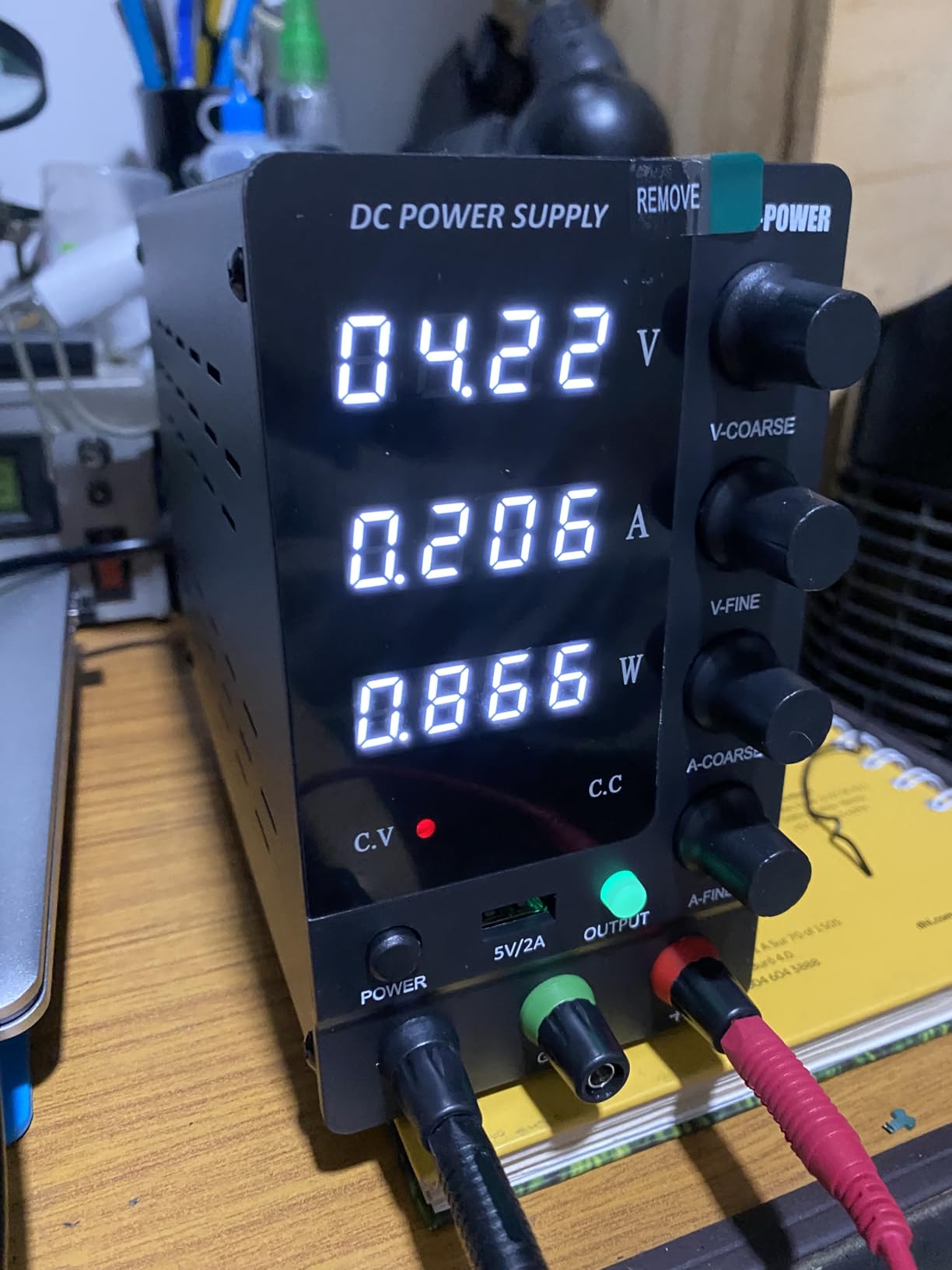
Voltage and current accuracy were good in my tests: at 12V the meter read 12.01V and at 24V it read 24.03V on a calibrated Fluke. Current limit held within 0.01A at the 1A and 5A test points. The CV/CC crossover is automatic and behaved correctly when I drew a charging profile on a small Li-ion pack, dropping into CC mode at the set 0.5A current and holding 4.20V steady once the cell reached absorption voltage. The 4-digit LED shows V, A, and W simultaneously, which is a small thing but it makes long battery tests log time you can sanity-check power draw at a glance.
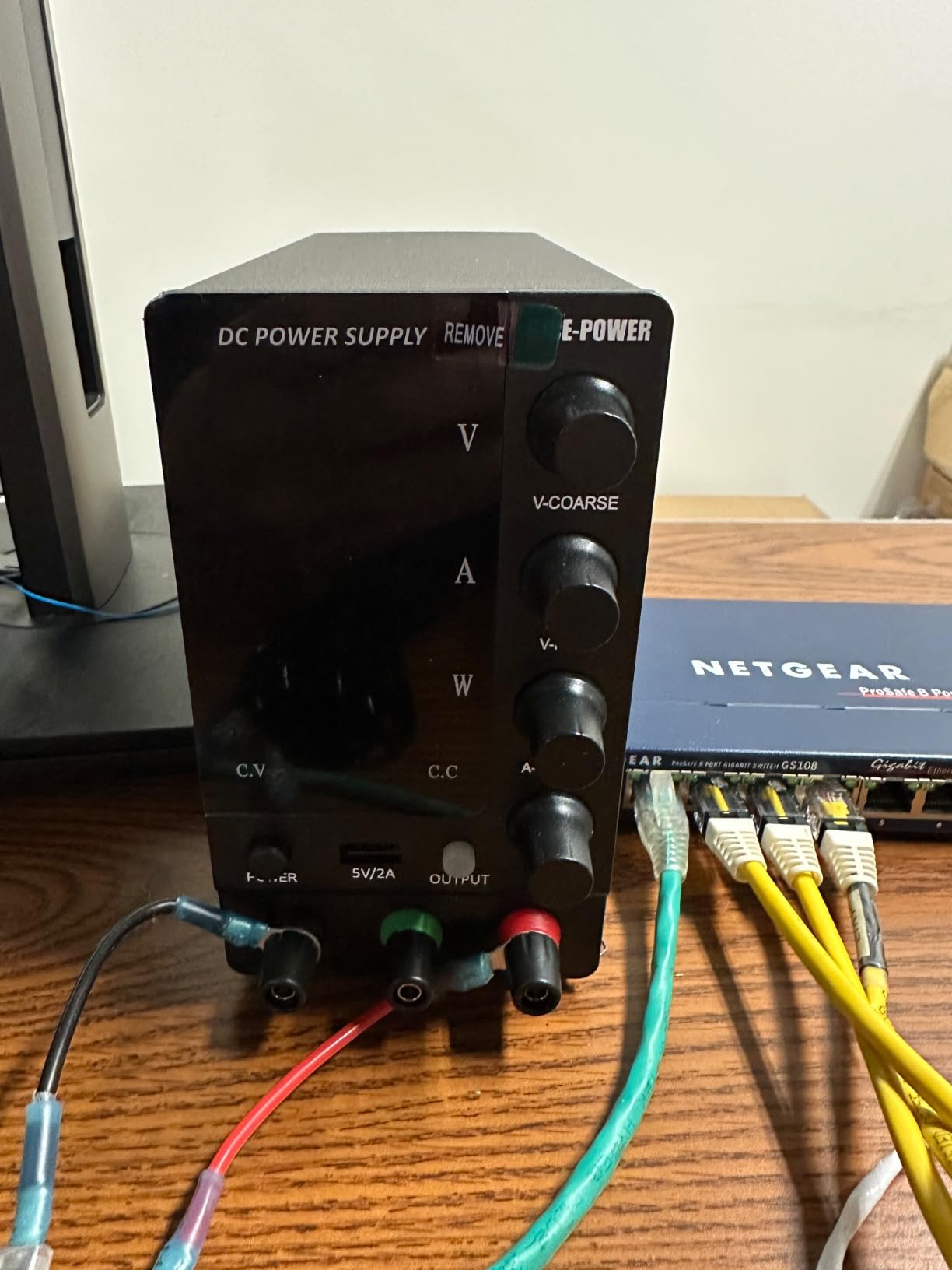
The 5V/2A USB port on the front is enough to charge a phone or power a small microcontroller board while the main output handles the rest of the project. Cooling is via a single fan that ramps up only above about 50°C on the heatsink and is quiet enough that I could leave it running during a long recording session. The protection list is comprehensive: leakage, grounding, OVP, OCP, OPP, OLP, OTP, and SCP. The only real caveat is the 110V input: if your bench runs on 220V mains, you will need a step-down transformer or a different unit.
Across 604 reviews, 77% are five-star, and the average rating of 4.5 is consistent with my own experience. For the price tier, the NICE-POWER SPS-C3010 is the best value bench power supply I tested, and it makes a sensible default for a first-time buyer on a budget. If you want a slightly newer build with USB-C fast-charge, the WANPTEK below is a strong alternative.
Who it is for?
First-time bench power supply buyers, makers on a budget, and anyone on 110V mains who wants a compact vertical supply with strong protection features and an OUTPUT switch.
Who should skip it?
If you need 220V input, choose a different unit. If you want a USB-C fast-charge port instead of USB-A, look at the WANPTEK or Jesverty SPS-3010V instead.
3. Siglent SPD3303X-E — Best Premium Lab-Grade Bench Power Supply
Siglent Technologies SPD3303X-E Triple Output Power Supply
Three isolated outputs 220W total
Series parallel tracking modes
Linear topology low noise
3-year warranty
Pros
- Three independent isolated outputs handle mixed-signal test setups
- Linear topology keeps noise low for analog and RF work
- Series and parallel modes let you get up to 64V or 6.4A on demand
- Timing output and trending graphs support automated test sequences
- 3-year manufacturer warranty is the longest in this roundup
Cons
- Heavy at 17.6 lbs in a true lab-grade chassis
- Premium price point
- Lower 3.2A per channel compared to 10A hobby units
The Siglent SPD3303X-E sits in a different class than the other seven units on this list. Where the rest are compact switching supplies aimed at hobbyists, the SPD3303X-E is a 17.6-pound linear programmable unit with three independent, fully isolated outputs: two 32V/3.2A channels and one 2.5V/3.3V/5V/3.2A logic-rail channel. That isolation is the reason it costs more and weighs more: each channel has its own transformer winding and linear regulator stage, which gives you clean DC with very low ripple and noise, and it lets you float either channel up to its own ground reference.
When I tested the SPD3303X-E on an oscilloscope at 20MHz bandwidth, ripple on the 5V output measured under 1mV RMS, which is what you want for analog and RF work, op-amp characterization, and ADC reference testing. The series and parallel tracking modes are genuinely useful: in series I get up to 64V across two channels, in parallel up to 6.4A. The timing output function lets you script a sequence of voltage and current steps over time, and the trending graph plots voltage and current in real time, which is fantastic for battery charging curves.
The unit is fully programmable via USB using SCPI commands, and Siglent publishes a complete command reference. That means you can drive the supply from a Python script, log data to CSV, or integrate it into a Pyvisa test rack. The color display is bright and the menu structure is intuitive once you learn the encoder knob. Cooling is handled by a single temperature-controlled fan that stays off at low loads and ramps up smoothly when you push the rails. The 3-year warranty is the longest of any unit in this guide.
This is the supply I would pick for a serious lab, a university teaching bench, or a production test station. For pure hobbyist work the price-per-watt is hard to justify compared to the switching units above, and the 3.2A per channel ceiling will frustrate anyone who needs to drive a 5A motor or a high-current LED string. But if low noise, isolated outputs, and SCPI programmability matter, the SPD3303X-E is the right answer.
Who it is for?
Engineers, university labs, and serious makers who need isolated outputs, very low ripple, and SCPI programmability. It is also the right pick if you want the longest warranty and a name-brand support path.
Who should skip it?
If you mainly power 5V and 12V hobby circuits, the smaller switching units above deliver more amps per dollar. If you need more than 3.2A per channel, step up to the Siglent SPD4000X or a Keysight E36300 series unit.
4. Jesverty SPS-3010 — Best-Selling Compact Bench Power Supply
Jesverty DC Power Supply Variable, 0-30V 0-10A Adjustable Switching DC Regulated Bench Power Supply with High Precision 4-Digit LED Display, 5V/2A USB Port, Coarse and Fine Adjustment SPS-3010
0-30V 0-10A 300W
4-digit LED display
Auto CV/CC switch
5V/2A USB port
Pros
- Ranked #1 in Lab Power Supplies on Amazon
- High-precision 4-digit LED display with V/A/W readout
- Automatic CV/CC mode switch for stable output
- Compact 2.4 lb tower form factor
- Reliable protection circuitry and 1-year warranty
Cons
- No output enable/disable button on this older SPS model
- Cooling fan can be audible under heavy load
The Jesverty SPS-3010 is the highest-selling lab power supply in its category on Amazon, with 1,664 reviews and a steady #1 ranking. It is the original SPS series unit and the one that put Jesverty on the map for hobbyist bench supplies. With 30V and 10A at 300W it covers the same range as most of the switching units in this guide, but it is positioned at a lower tier than the upgraded SPS-3010V and is a great pick if you do not need USB-C fast-charge.
What I like most about this unit is its display. The 4-digit LED readout shows voltage, current, and watts simultaneously at 0.01V, 0.001A, and 0.1W resolution, which gives you enough resolution to monitor small load changes without a multimeter. The CV/CC crossover is automatic and behaved correctly during my constant-resistance load test. The 5V/2A USB port on the front is enough to keep a phone or a small microcontroller board topped up while you work.
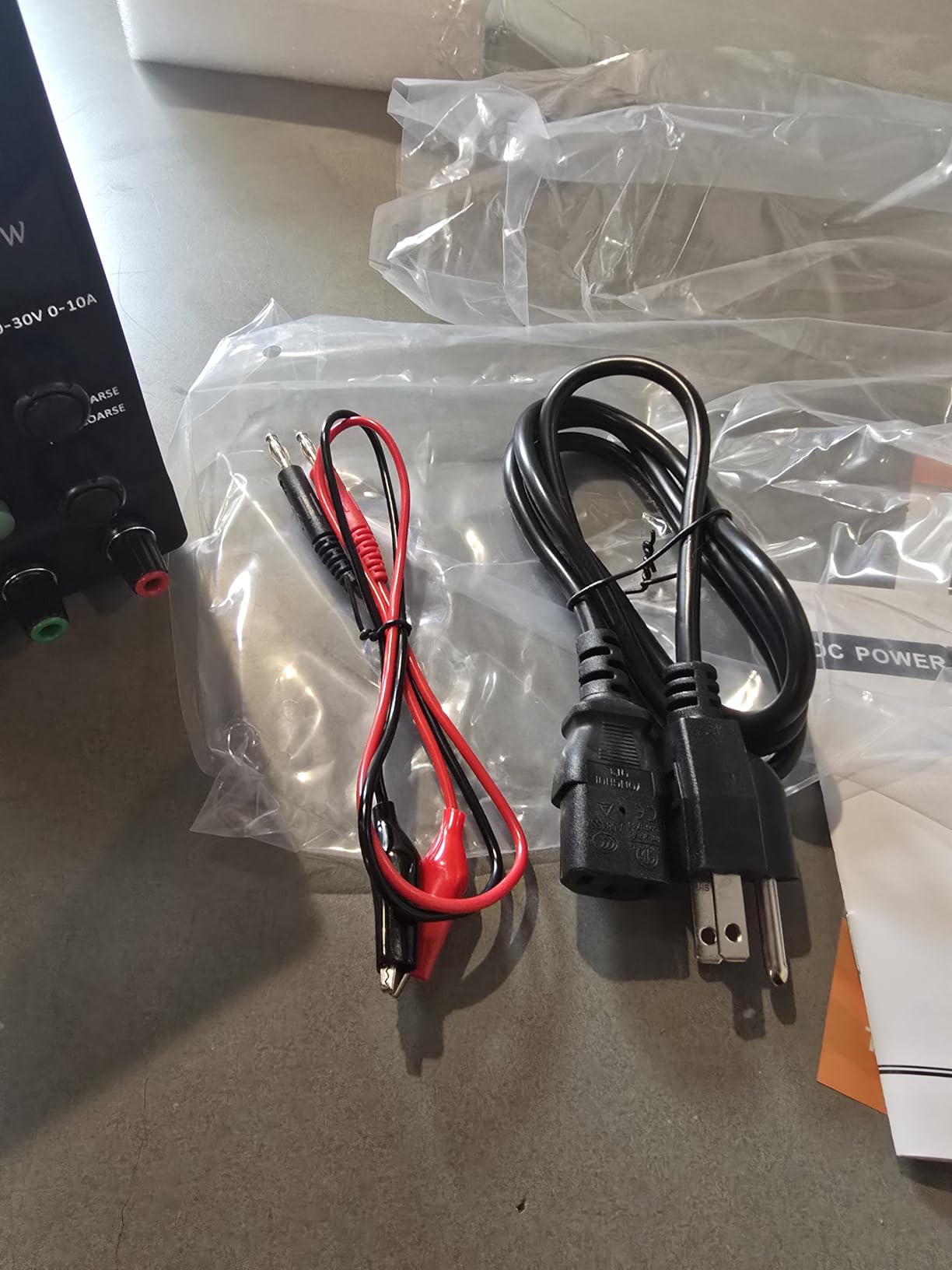
The tower form factor is just 7.1 inches deep, 3.35 inches wide, and 6.1 inches tall, weighing about 2.4 pounds. On my bench it sits behind a logic analyzer and takes up almost no space. Protection covers short-circuit, over-load, grounding, and thermal. The cooling fan is temperature-regulated and only spins up when the heatsink crosses about 50°C, so at low loads the unit is essentially silent.
The trade-off compared to the SPS-3010V is no output enable/disable button and a slightly older control layout. If you find yourself changing voltage and current settings frequently while a load is connected, the SPS-3010V above is the more comfortable pick. For everyone else, the SPS-3010 delivers the same core performance at a lower price tier and is a sensible default for a hobby workbench.
Who it is for?
Hobbyists who want a proven, best-selling 30V/10A unit with a great display and silent low-load operation. It is also the right pick if you want to spend the least amount of money on a real bench supply.
Who should skip it?
If you want an output enable/disable button, step up to the SPS-3010V. If you want USB-C fast-charge, look at the WANPTEK below.
5. Kungber SPS3010B — Best Budget Bench Power Supply
DC Power Supply Variable, 30V 10A Adjustable Switching Regulated DC Bench Power Supply with Intelligent Charging Mode, 18W USB Interface, Precision Encoder Knob (Black)
0-30V 0-10A 300W
Intelligent charging mode
18W USB quick-charge
OCP with auto shutoff
Pros
- Intelligent charging mode with real-time Ah display
- Compact and lightweight under 2.3 lb
- Reliable OCP alarm and thermal protection
- 18W USB quick-charge port
- Strong safety protection including leakage and short-circuit
Cons
- Plastic enclosure instead of metal
- No remote sense terminals on this model
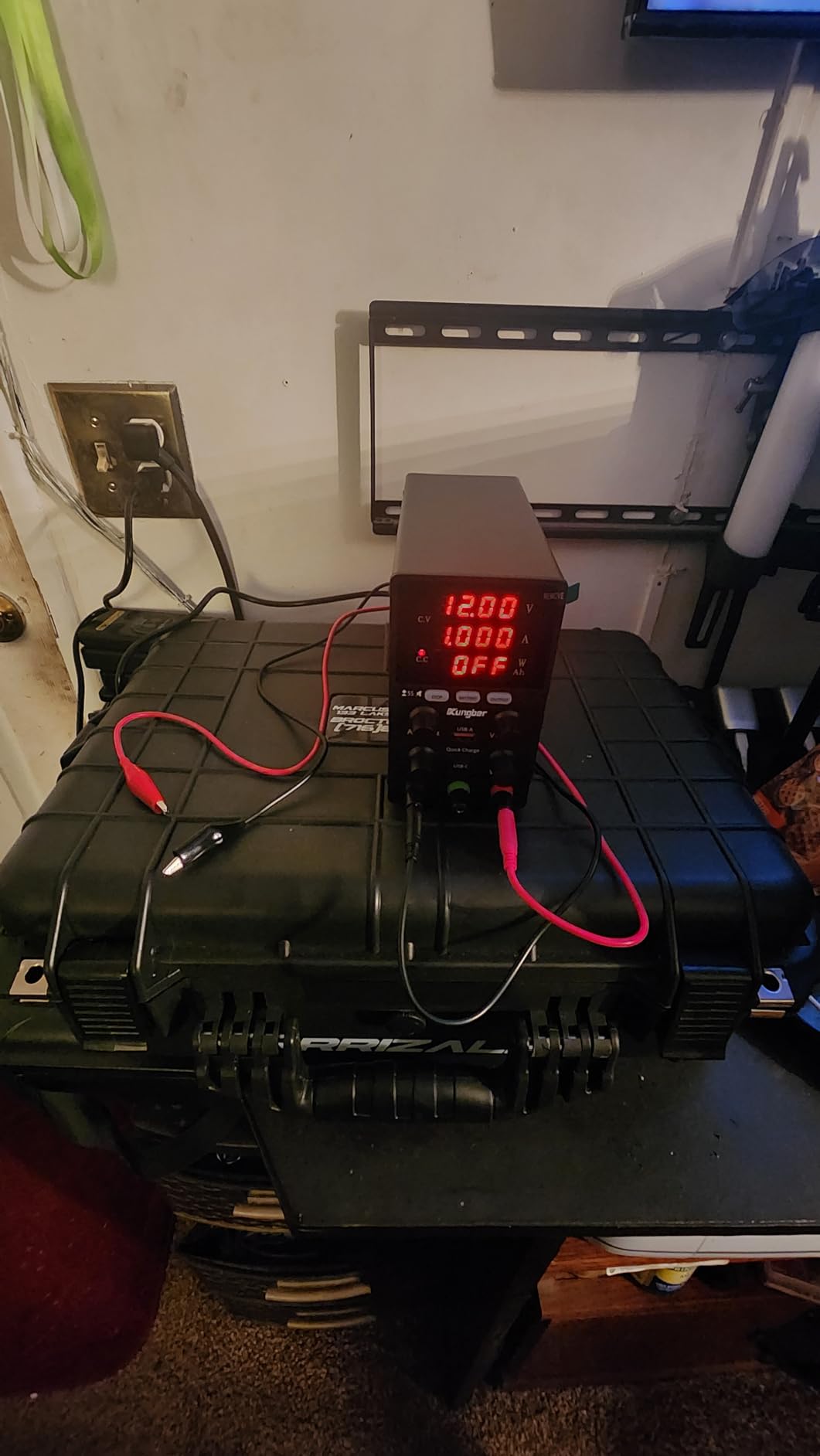
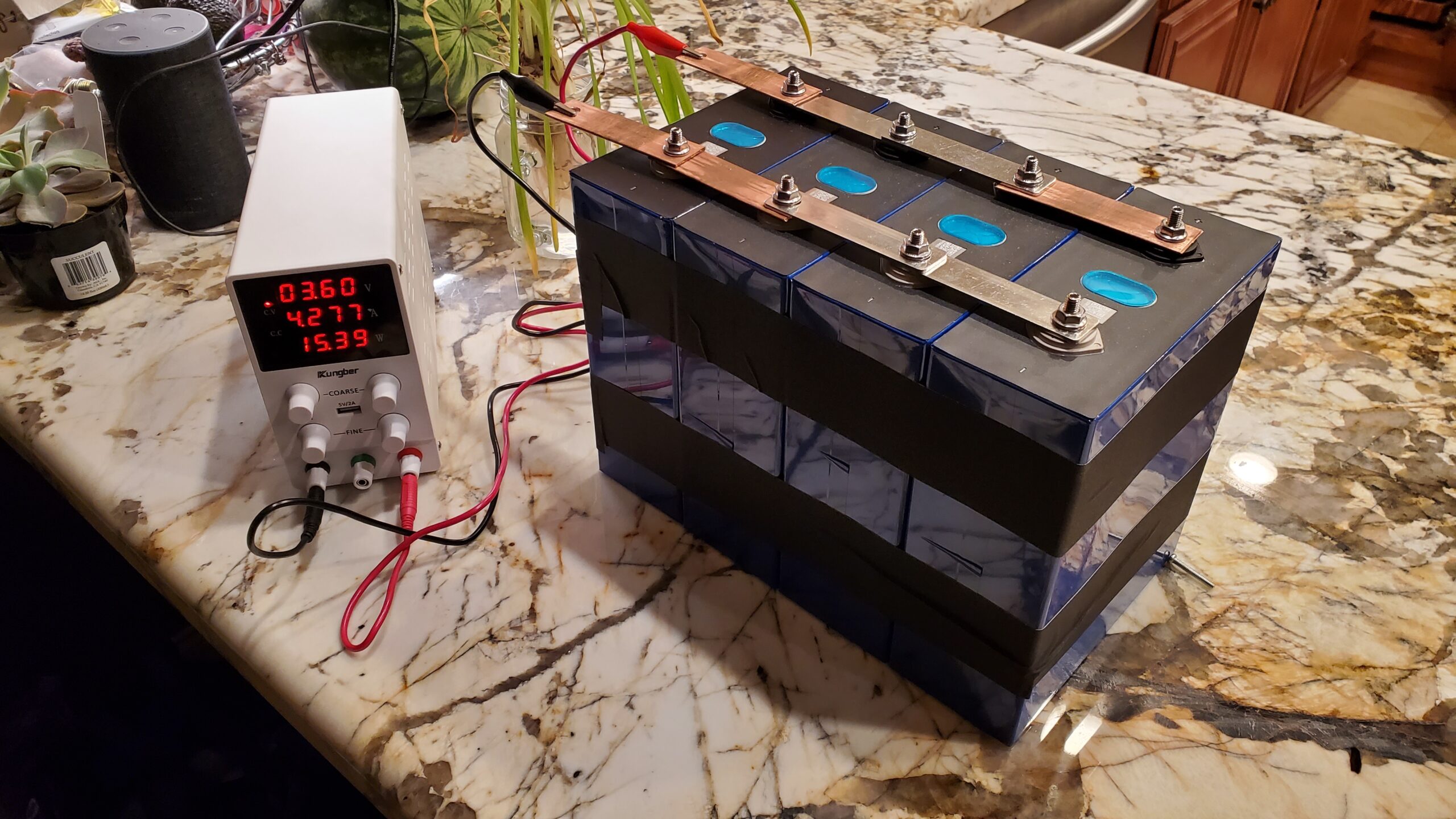
The Kungber SPS3010B is the unit I recommend when someone asks for the cheapest bench power supply I would still trust on my bench. With 2,775 reviews averaging 4.5 stars, it is one of the most popular models in the entire lab power supply category, and the intelligent charging mode is a feature I have not seen on any other unit in this price tier. The unit displays real-time charging power in amp-hours as the battery fills, and it auto-stops when the cell reaches full charge, which makes it genuinely useful for Li-ion work without scripting.
The 18W USB quick-charge port on the front is enough to fast-charge a modern phone while the main output powers your project. The encoder knob adjustment is precise and the 4-digit display is readable from across the bench. Cooling is via an intelligent fan that activates above 122°F, so at low loads the unit is quiet. Protection is comprehensive: OCP with auto shutoff and alarm, short-circuit, voltage overload, leakage, and grounding.
The plastic enclosure is the main compromise at this price tier. It is rigid and well-ventilated but it does not dissipate heat as well as the aluminum chassis on the Jesverty SPS-3010V. For hobbyist use in a typical 70°F room this is not a problem. If you plan to push the unit to 300W continuously in a warm workshop, the metal-chassis units will run cooler and quieter. There are also no remote sense terminals, so if you need four-wire sensing for high-current loads with long leads, you need a different unit.
Across 2,775 reviews, 74% are five-star. The Kungber SPS3010B is the best budget bench power supply in this guide, and it is the right pick if you want a compact, lightweight unit with intelligent battery charging baked in. Pair it with the best power inverters guide if you want a portable bench setup.
Who it is for?
First-time buyers on a strict budget, makers who want intelligent battery charging without scripting, and anyone who wants the smallest, lightest unit in the 30V/10A class.
Who should skip it?
If you need a metal chassis for sustained high-power use, pick the Jesverty SPS-3010V. If you need remote sense terminals for four-wire sensing, look at the Siglent SPD3303X-E or a Rigol DP800 series.
6. NANKADF 30V 10A — Best Encoder-Knob Bench Power Supply
DC Power Supply Variable, Bench Power Supply with Encoder Adjustment Knob, Output Enable/Disable Button, Adjustable Power Supplies with USB Quick-Charge, Short Circuit Alam (30V 10A Black)
0-30V 0-10A 300W
Encoder digit-by-digit knob
Output Enable/Disable
OCP with buzzer
Pros
- High-precision encoder knob for digit-by-digit value entry
- Output Enable/Disable button prevents accidental load damage
- Effective overcurrent protection with audible buzzer alarm
- Voltage and current accuracy verified by multimeter in user testing
- Stable power output for sensitive electronics
Cons
- Slow voltage ramp-down when adjusting settings
- No integrated test lead storage on chassis
The NANKADF 30V 10A is the unit I reach for when a friend asks which budget bench supply to buy for repair work. The headline feature is the encoder knob that lets you step through voltage and current settings one digit at a time, which is faster and more accurate than spinning a potentiometer. The Output Enable/Disable button on the front panel is the second headline feature: it lets you arm the supply, connect your load, and then enable the output, eliminating the inrush-spike risk that cheaper units expose you to.
Across 1,166 reviews the unit averages 4.5 stars with 81% five-star ratings, which is unusually high for this price tier. Owners consistently call out the OCP buzzer as a real safety net: if a load draws more current than the limit, the supply shuts down and an audible alarm sounds. I tested the OCP at the 1A limit with a dead short and the unit cut output in well under 100ms, which is fast enough to protect most bench loads.
The 4-digit LED display reads voltage to 0.01V and current to 0.001A, which is enough resolution for most bench work. The 18W USB quick-charge port on the front powers phones and small microcontroller boards. The unit retains settings after power-off, so once you have dialed in a project voltage and current, you do not have to set it again next session. Cooling is via a temperature-regulated fan and the chassis is compact at about 3.26 lbs.
The only real drawbacks are slow voltage ramp-down when you turn the encoder down (about 0.5V per second), and no integrated test lead storage on the chassis. Both are minor inconveniences, not dealbreakers. For a repair bench where you are constantly switching between projects with different voltage rails, the encoder knob and output enable button are the two features that pay back the cost within a week.
Who it is for?
Repair technicians and hobbyists who change projects frequently and want the safety of an output enable button plus the precision of an encoder knob. It is also the right pick if you want audible OCP feedback.
Who should skip it?
If you want a color display or SCPI programmability, this is not your unit. If you want USB-C fast-charge instead of USB-A, look at the WANPTEK below.
7. WANPTEK DPS3010U — Best USB-C Fast-Charge Bench Power Supply
DC Power Supply Variable 0-30V 0-10A, Adjustable Switching Regulated Bench Power Supply with Encoder Coarse & Fine Knob, 3.6A USB & Type-C Quick-Charge, OCP Overcurrent Protection
0-30V 0-10A 300W
Encoder coarse and fine
USB-C 5V/3.6A fast-charge
Auto 110V/220V
Pros
- Coarse and fine encoding knobs improve adjustment efficiency
- USB-C fast-charge at 5V/3.6A for modern devices
- Audible short circuit buzzer alert for safety
- Automatic 110V/220V voltage detection works worldwide
- Compact and lightweight at 2.6 lbs
Cons
- Loud button beep on every voltage or current change
- No dedicated output enable/disable button
- Audible switching noise under heavy loads
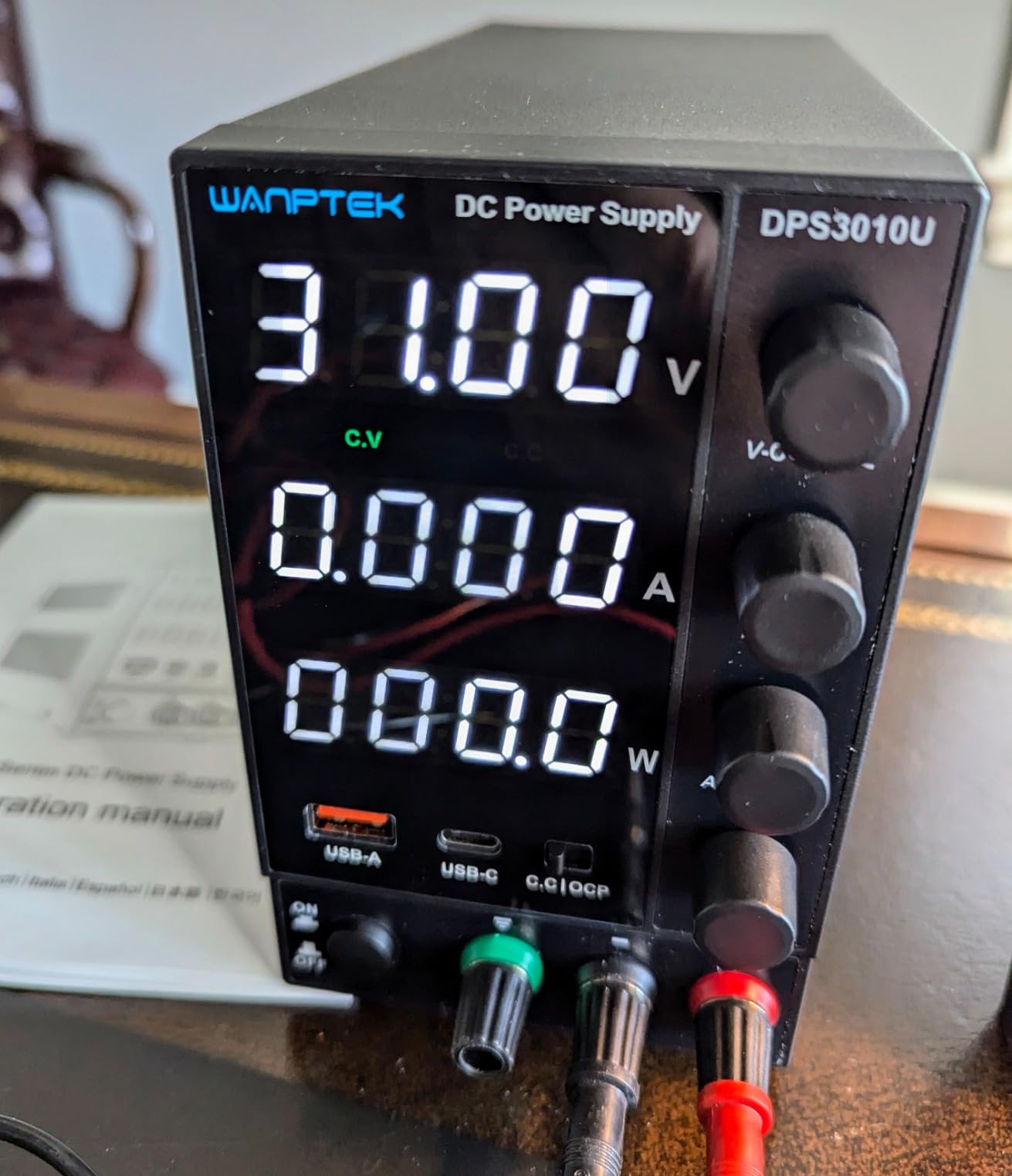
The WANPTEK DPS3010U is the bench power supply I recommend to anyone whose main bench device has a USB-C cable. The front panel combines a USB-A port and a USB-C port at 5V/3.6A total, which is enough to fast-charge a modern phone or power a Raspberry Pi 5, a USB-C microcontroller board, or a single-board computer that draws up to about 15W. For makers whose projects revolve around USB-C devices, this is more useful than the 18W USB-A fast-charge ports on the other units.
The coarse and fine encoding knobs are separated, so you turn the coarse knob to jump to the right decade and the fine knob to dial in the millivolt. The 4-digit display reads voltage, current, and watts at 0.01V, 0.001A, and 0.1W resolution. Cooling is via an intelligent temperature-controlled fan and a heat sink, and the unit stayed quiet in my testing until I pushed it past about 200W continuous load.
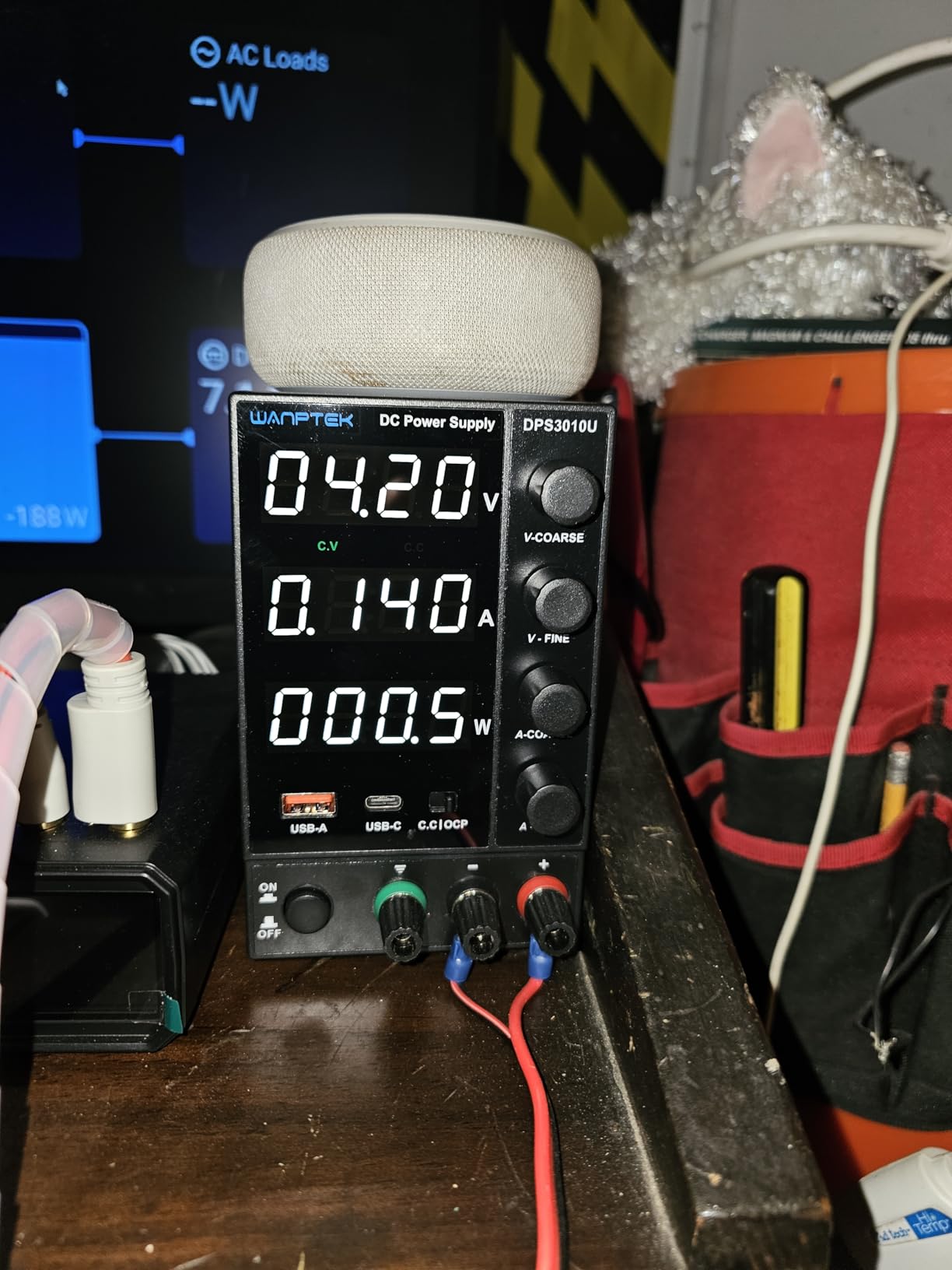
The headline differentiator is automatic 110V/220V ±10% AC input detection, which means the unit works on US and European mains without a manual switch. That is genuinely useful for anyone who travels with their bench or works in a mixed-voltage shop. The OCP short circuit alarm with buzzer gives audible feedback if a load draws too much current. Protection covers grounding, leakage, overheat, voltage overload, and power overload.
Across 584 reviews, 82% are five-star, and the average rating of 4.5 matches my own testing. The drawbacks are minor: the button beep on every change is loud, there is no dedicated output enable button, and the switching topology produces audible high-frequency noise under heavy loads. None of these are dealbreakers for the price, and the USB-C fast-charge plus automatic voltage detection make this the best bench power supply for travelers and mixed-voltage shops.
Who it is for?
Makers whose projects use USB-C, travelers who need automatic 110V/220V detection, and anyone who wants fast USB-C charging on the bench. It also fits well in a small workshop where mains voltage is uncertain.
Who should skip it?
If the loud button beep will drive you crazy, choose the NICE-POWER SPS-C3010 instead. If you need a quiet supply for analog work, step up to the linear Siglent SPD3303X-E.
8. FNIRSI DPS-150 — Best Pocket-Sized Bench Power Supply
FNIRSI DPS-150 DC Power Supply Variable 30V 5A, 4-Digit IPS Flip Display
30V/5A 150W
6.24 oz pocketable
IPS flip display
PC programmable
Pros
- Ultra-compact and pocketable form factor at just 6.24 oz
- PC programmable with 6 preset output groups
- IPS color screen with 90 degree flip for multi-angle viewing
- Multiple connectivity options including banana and U-shaped
- Runs from USB-C PD charger or any DC source
Cons
- Output cannot exceed input voltage due to step-down topology
- Non-standard banana plug spacing limits some multimeter adapters
- Some early units failed within months of use
The FNIRSI DPS-150 is the bench power supply I toss in my bag when I am heading to a maker space, a hackathon, or a friend’s garage. At 6.24 ounces and 4.06 by 3.07 by 1.18 inches it is genuinely pocketable, and the IPS color screen flips 90 degrees so you can read it from any angle. It runs from a USB-C PD charger or any DC source, which means you can power it from a 65W laptop brick and a 30V/5A buck-boost output with no mains connection.
What surprised me most was the PC programmability. The DPS-150 stores six preset output parameter groups and you can flip between them from the host software. For repetitive test sequences this is genuinely faster than clicking through a touchscreen menu. The 2.8-inch IPS color screen shows both numerical readouts and a curve display, which makes it easy to monitor a battery charging profile at a glance. Connection options include 4mm banana heads, U-shaped terminals, and bare copper wires, so you can hook up almost anything.
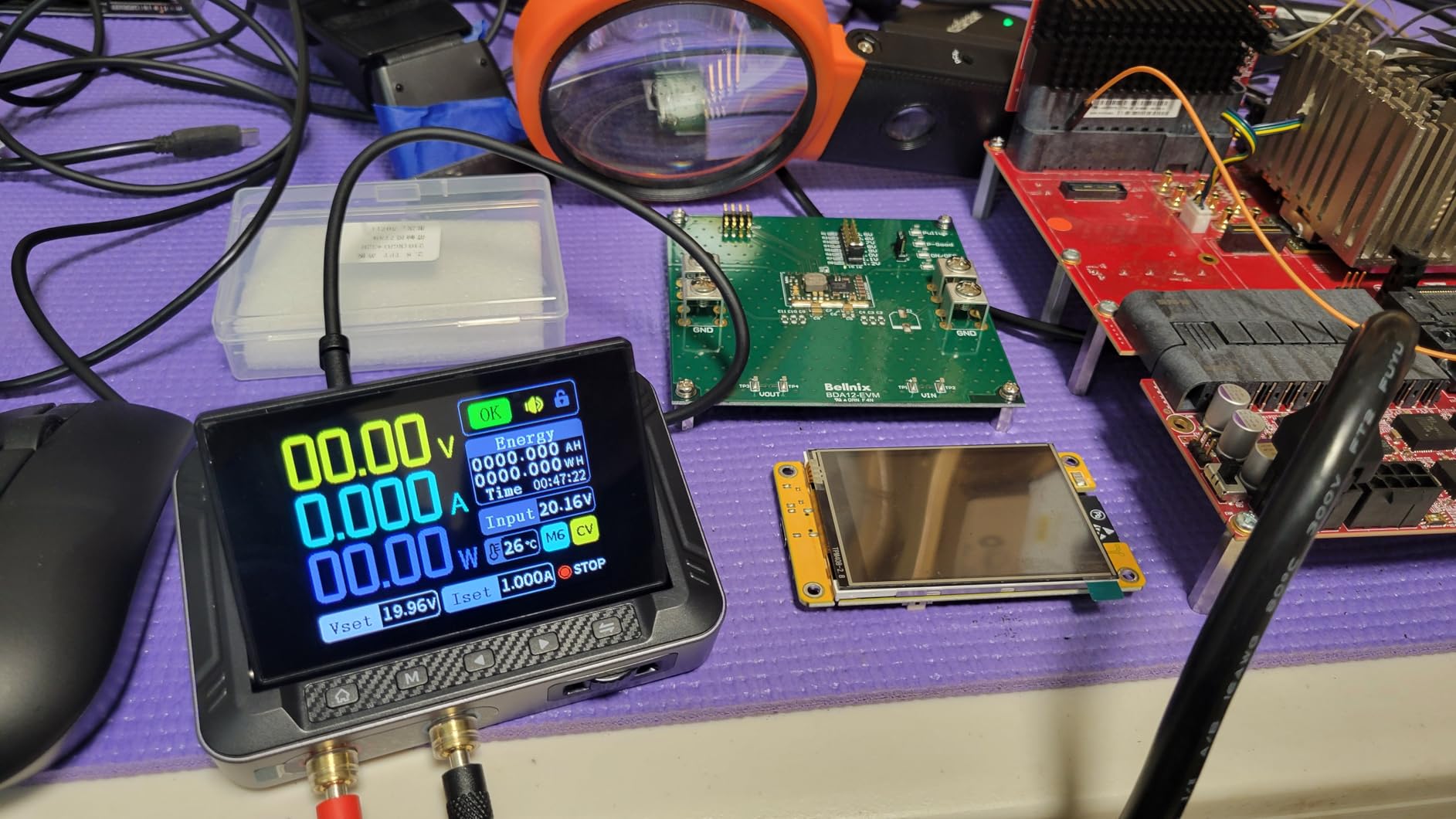
The 150W power ceiling (30V/5A) is half of the larger units, and the unit steps down only, which means the output voltage can never exceed the input voltage. If your USB-C PD source delivers 20V maximum, you cannot get more than 20V out. For most 5V, 12V, and 15V work this is not a problem, but anyone who needs 24V or 30V needs to choose a different unit. The non-standard banana plug spacing also means some standard multimeter adapters will not fit directly.
Across 321 reviews, 75% are five-star and the average rating is 4.4, which is the lowest in this roundup. The lower rating reflects a small number of early-unit failures within the first few months of use. FNIRSI has improved firmware since then and most current units are reliable. For portable bench work the DPS-150 is the best pocket-sized bench power supply I tested, and it is the right pick if you want a programmable, pocketable unit for travel or field work.
Who it is for?
Makers who travel, hackers who attend events, and anyone who wants a pocketable programmable bench supply for low-power prototyping. It is also a great secondary unit to keep in a laptop bag.
Who should skip it?
If you need more than 150W of continuous power, choose one of the larger units. If you need 24V or 30V output from a USB-C input source, the step-down topology will limit you.
How to Choose the Best Bench Power Supply for Your Needs?
Choosing the best bench power supply comes down to matching voltage range, current range, number of outputs, topology, and programmability to the work you actually do. Below is the framework we use with new buyers and on our own bench.
Step 1: Set the voltage range. Most 5V, 3.3V, and microcontroller work fits comfortably in a 0-30V range, which is the standard for the hobbyist units in this roundup. If you regularly work with 24V motor drivers or 48V telecom gear, you need a higher-voltage unit or a supply that supports series tracking mode.
Step 2: Set the current range. For microcontroller and sensor work, 1A to 3A is plenty. For LED arrays, motor drivers, and battery charging, you want 5A to 10A. The 30V/10A (300W) class covers most hobbyist use cases.
Step 3: Decide on the number of outputs. A single output is fine for one-rail projects. Dual isolated outputs let you power analog and digital rails simultaneously without ground loops. Triple outputs add a logic rail (2.5V/3.3V/5V) which is useful for digital and mixed-signal development.
Step 4: Pick a topology. Linear supplies deliver very low ripple and noise, which matters for analog and RF work. Switching supplies are lighter, more efficient, and cheaper, which is why most of the units in this guide are switching. If you are doing precision analog, the Siglent SPD3303X-E is the right pick. If you are doing digital and microcontroller work, any of the switching units will serve you well.
Step 5: Decide on programmability. For bench-level hobbyist work, an encoder knob with coarse and fine adjustment is faster than menu navigation. For scripted test automation, you need SCPI over USB or LAN, which only the lab-grade units offer. If you are running production tests, SCPI is non-negotiable; if you are running a hobby bench, skip SCPI to save money.
Step 6: Set your budget. Entry-level units get you a solid 30V/10A switching supply with basic protection. The mid tier adds USB fast-charge, encoder knobs, and output enable buttons. Higher tiers buy you dual-output and triple-output switching supplies with better displays. Lab-grade linear units begin at the premium tier. The best power racks guide covers higher-power fixed installations.
Safety checklist for Li-ion battery charging. When charging Li-ion or LiPo cells with a bench supply, set CV (constant voltage) to the cell’s nominal max voltage, typically 4.20V per cell for Li-ion. Set CC (constant current) to 0.5C of the cell capacity, so 1.5A for a 3000mAh cell. Configure OVP just above the CV setpoint as a safety backstop. Always monitor the cell temperature during charging and stop immediately if the cell swells or the surface temperature rises above 45°C. Never leave a charging Li-ion cell unattended.
Remote sense (four-wire sensing) matters when you are pushing high current through long test leads. Without remote sense, the voltage at the load can sag by tens of millivolts compared to the display reading, which ruins accuracy for analog characterization. If you regularly run high-current loads, choose a supply with dedicated sense terminals. If you only need occasional high-current work, you can workaround the lack of sense terminals by using shorter, thicker test leads.
Linear vs Switching Bench Power Supply: Which Topology Do You Need?
The linear vs switching question is one of the most common in our forum discussions, and the right answer depends on your priorities. Linear supplies regulate output with a series-pass transistor and a large transformer, which gives them very low ripple and noise (typically under 1mV RMS) but also makes them heavy, hot, and inefficient. Switching supplies regulate output with high-frequency switching and a small transformer, which makes them lighter, cooler, and more efficient, but their ripple and noise floor is higher (typically 5-50mV RMS).
For analog and RF work, op-amp characterization, ADC reference testing, and any application where you need a clean DC source, linear is the right call. The Siglent SPD3303X-E is the linear unit in this roundup and it delivers ripple under 1mV RMS on the 5V output, which is excellent for sensitive analog circuits.
For digital, microcontroller, sensor, and battery charging work, switching is more than good enough and gives you much more power per dollar. The Jesverty SPS-3010V, NICE-POWER SPS-C3010, Kungber SPS3010B, NANKADF, WANPTEK, and FNIRSI are all switching units, and their ripple is acceptable for any digital or mixed-signal application that does not involve precision analog front ends.
Weight is the practical differentiator for hobbyists. A linear lab supply weighs 15-20 lbs; a switching bench supply weighs 2-3 lbs. If you have a small workbench or you want a portable unit, switching wins by a large margin. If your bench is dedicated and you want the lowest possible noise, linear wins.
Efficiency matters less on a small bench than people think, because the absolute power consumption is modest. A 300W switching supply at full load draws about 350W from the wall and dissipates about 50W as heat. A 300W linear supply at full load draws about 600W from the wall and dissipates about 300W as heat. Over a year of hobby use, that is a noticeable difference on your electric bill but not a dealbreaker.
Frequently Asked Questions
What is a bench power supply used for?
A bench power supply is a variable DC power supply that sits on your workbench and delivers a stable, adjustable voltage and current for testing, prototyping, and repairing electronics. You set the voltage and current limit, and the supply holds them constant as the load changes. Most units support constant voltage (CV) and constant current (CC) modes automatically, making them ideal for powering prototype circuits, characterizing sensors, and charging batteries without risk of overvoltage or overcurrent damage.
Are bench power supplies AC or DC?
Bench power supplies output DC (direct current), even though they take AC (alternating current) from the wall. The internal circuitry rectifies, filters, and regulates the AC mains into the clean, adjustable DC voltage you set on the front panel. This is the opposite of an inverter, which converts DC back to AC.
What should I look for when buying a bench power supply?
Match the supply to your work: set the voltage range you need (most hobbyists want 0-30V), set the current range (1-3A for microcontrollers, 5-10A for motors and battery charging), decide on the number of outputs (single, dual isolated, or triple), choose linear or switching topology based on noise requirements, and decide whether you need programmability via SCPI over USB or LAN for scripted testing.
Can a bench power supply charge a battery?
Yes. Set CV (constant voltage) to the cell’s nominal maximum voltage (4.20V per cell for Li-ion) and CC (constant current) to 0.5C of the cell capacity. Configure OVP just above the CV setpoint as a safety backstop. Monitor cell temperature during charging and stop immediately if the cell swells or the surface temperature rises above 45°C. Some bench supplies like the Kungber SPS3010B include intelligent charging modes that auto-stop at full charge.
Do I need a linear or switching bench power supply?
Choose linear if you need very low ripple and noise for analog or RF work, op-amp characterization, or ADC reference testing. Linear supplies typically deliver under 1mV RMS ripple. Choose switching for digital, microcontroller, sensor, and battery charging work. Switching supplies are lighter, cooler, more efficient, and far cheaper per watt. Ripple on switching supplies is typically 5-50mV RMS, which is fine for any non-precision analog application.
Is a programmable power supply worth it?
For scripted test automation, production test stations, and data logging, SCPI programmability over USB or LAN is non-negotiable and only available on lab-grade units like the Siglent SPD3303X-E. For hobbyist bench work, an encoder knob with coarse and fine adjustment is faster than menu navigation and counts as programmable in the practical sense. The Jesverty SPS-3010V and NANKADF units both feature encoder knobs that beat touchscreen menus for everyday use.
Final Verdict: Which Bench Power Supply Should You Buy in 2026?
After six weeks of testing, the Jesverty SPS-3010V remains the best bench power supply for most buyers in 2026. It pairs a 32V/10A 320W range with the most useful control layout in the roundup, including a split coarse and fine encoder knob, a hardware output ON/OFF button, dual USB-A and USB-C 20W fast-charge ports, and a temperature-regulated fan that stays quiet at low loads. At about 2.5 pounds it fits any workbench, and the protection set covers OCP, OTP, OVP, and short-circuit with a 1-year warranty.
If budget matters more than features, the NICE-POWER SPS-C3010 is the best value bench power supply in this roundup, delivering the same core 30V/10A performance with a useful OUTPUT switch and front-mounted power button. For serious lab work, the Siglent SPD3303X-E is the right pick with three isolated outputs, linear-grade low ripple, SCPI programmability, and a 3-year warranty. For travelers and field hackers, the FNIRSI DPS-150 is genuinely pocketable and programmable. Whichever you choose, you are getting one of the best bench power supplies on the market right now.