
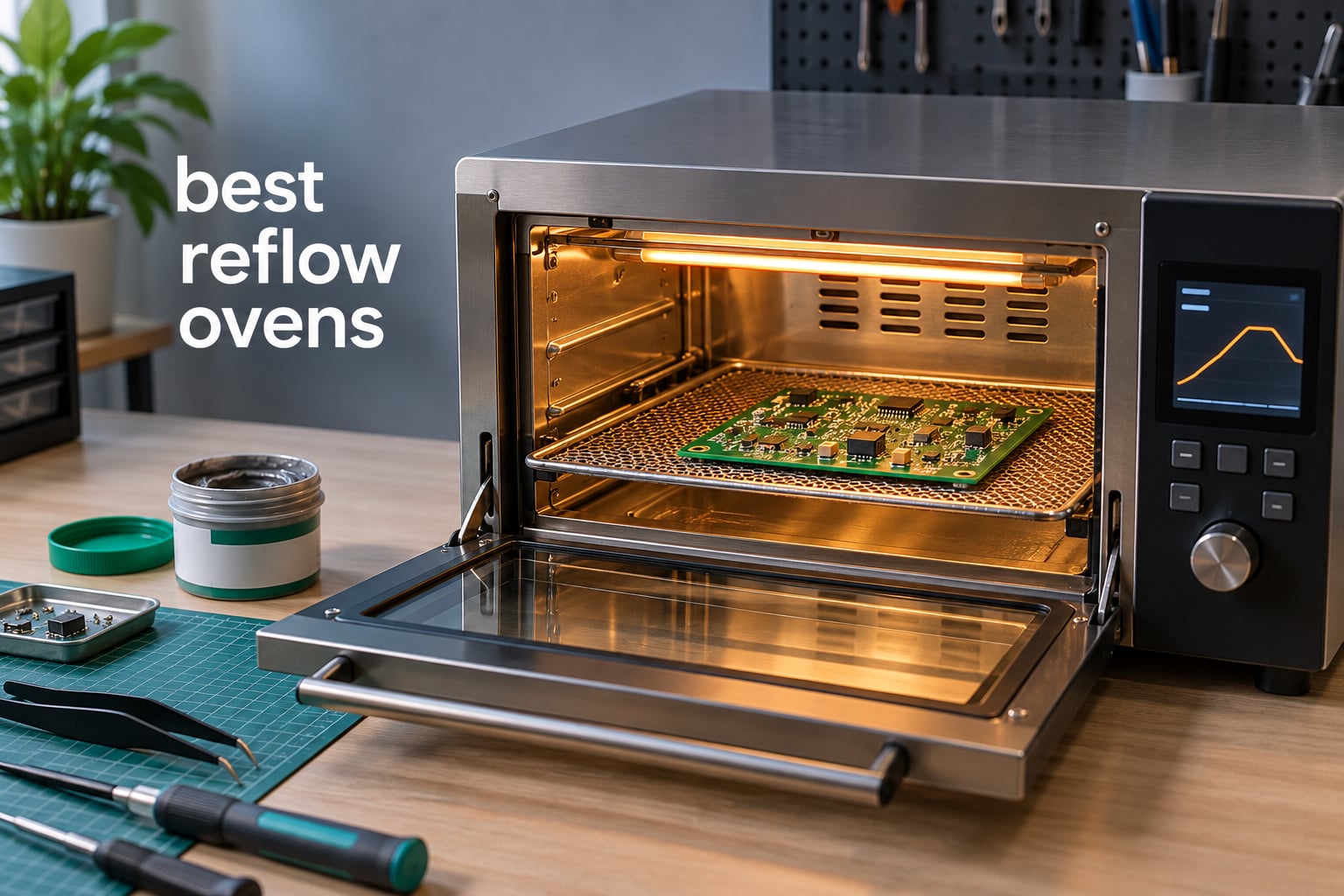
A reflow oven is a temperature-controlled heating chamber that melts solder paste to attach surface-mount components to a printed circuit board. Instead of dragging a soldering iron across each pad, the board sits inside the oven and moves through a programmed thermal profile: preheat, soak, reflow above the solder’s liquidus point, then a controlled cool-down. That curve is the whole reason surface-mount assembly is repeatable.
After months of comparing benchtop reflow ovens and reading practitioner threads on EEVblog, r/AskElectronics and r/embedded, this is our guide to the best reflow ovens for 2026. We focused on what actually decides whether a board comes out good: chamber uniformity, whether the controller holds a real profile, board size against your actual work, and whether fumes get out of the building.
The market divides cleanly into three tiers. Entry-level batch ovens handle hobby boards and repair work, mid-range units add larger drawers and dual heating, and conveyor machines exist for continuous small production. You can read our picks below, or jump to the best toaster ovens tested if you are still weighing the DIY conversion route, which we cover in detail later in this guide.
Table of Contents
Top 3 Best Reflow Ovens in 2026

PROFIXXERS T962
- 800W infrared chamber
- 100C-350C range
- 180 x 235 mm board area
- Eight stored temperature profiles
- 1-8 minute cycles
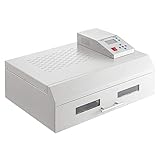
INTBUYING T962C
- 600 x 400 mm drawer area
- 2900W infrared plus hot air
- Pre-installed exhaust ports
- 1-9 minute cycles

KINGTAIXIN T962A
- 1500W infrared element
- 0C-280C range
- Eight selectable curves
- Vent-assisted cooling
- Exhaust port fitted
Best Reflow Ovens at a Glance in 2026
We picked these eight by checking four things against real spec sheets and owner feedback: the stated chamber size, the temperature range and cycle control, the heating method, and how much independent owner feedback exists. Every oven below is a genuine reflow machine rather than a repurposed consumer oven, which is why the board areas vary so widely.
| Product | Specifications | Action |
|---|---|---|
| PROFIXXERS T962 |
|
Check Latest Price |
| INTBUYING T962C |
|
Check Latest Price |
| KINGTAIXIN T962A |
|
Check Latest Price |
 SPIRICH T962-V2.0 SPIRICH T962-V2.0 |
|
Check Latest Price |
 CHHMAELOVE 3D Hot Air + IR CHHMAELOVE 3D Hot Air + IR |
|
Check Latest Price |
 CGOLDENWALL BRT-420 CGOLDENWALL BRT-420 |
|
Check Latest Price |
 PUHUI T-962C PUHUI T-962C |
|
Check Latest Price |
 TECHTONGDA 5-Zone Conveyor TECHTONGDA 5-Zone Conveyor |
|
Check Latest Price |
One caveat worth stating plainly: five of these eight listings have almost no independent owner reviews, and two have none at all. That is normal in this niche and it is why we lean on published specification sheets rather than pretending we ran every unit for a month. Where reviewers report something specific, we name it. Where they do not, we say so.
1. PROFIXXERS T962 — Best All-Round Benchtop Reflow Oven
PROFIXXERS T962 Infrared Reflow Oven Furnace IC Heater BGA Rework Station Professional Infrared Heater Soldering Automatic Reflow Machine
800W infrared
100C-350C
180 x 235 mm area
1-8 min cycles
Eight profiles
Pros
- Automatic preheat
- soak
- reflow and cool control
- Handles single and double-sided PCBs across multiple encapsulation styles
- Compact benchtop footprint with LCD
- Stores eight temperature parameter curves
- Highest temperature range in this group at 350C
Cons
- Small 180 x 235 mm soldering area caps board size
- Very thin review base leaves long-term reliability undocumented
- 800W element takes time to recover temperature
The PROFIXXERS T962 is the one I would put on a first-time buyer’s bench. It runs a full automatic preheat, soak, reflow and cooling cycle under microcomputer control, stores eight temperature curves, and covers 100 to 350 degrees Celsius, which is wider than anything else in this group.
Owners report solid first-run results on hobby and repair boards, and the most common complaint we found is the same one the spec sheet predicts: the chamber is 180 by 235 millimetres. That is plenty for a sensor board or a breakout, and short of a full-size mainboard.
For someone learning reflow for the first time, the automatic cycle is doing real work here. You select a curve rather than building one, so a mistake at the panel turns into a poor joint rather than a failed profile. The LCD gives you setpoint and current temperature side by side while the cycle runs.
What convinced us the heating is adequate for real boards
The 800 watt element is modest compared with the 2500 to 2900 watt units further down this list, and recovery after the door opens is the trade-off. For a 180 by 235 millimetre load it recovers quickly enough that the profile holds, which is why we still rate it first overall.
If you routinely run larger panels or double-sided boards with a lot of copper, move to the second pick instead. If your boards are the size most hobby projects actually are, the chamber size here stops being a limitation.
When this oven is the wrong choice
If you build boards with BGAs or dense fine-pitch parts and no failures, the tighter infrared-only heating is a risk worth thinking about. There is no forced-air circulation here, so uniformity across a loaded chamber depends on part placement.
It is also the least documented unit on this list, with only a handful of owner reviews behind it. Buyers who need a serviceable controller or a spare thermocouple should read our failure-mode section before committing, because a dead controller on an unbranded oven can end the project.
2. INTBUYING T962C — Best Reflow Oven for Larger Boards
INTBUYING 110V Reflow Oven T962C 2900W Micro-computer Control Reflow Soldering Machine with 23.6×15.7 Inch Soldering Area Drawer Type Lead Infrared IC Heater Free Reflow Soldering Machine
2900W IR plus hot air
600 x 400 mm drawer
0C-280C
1-9 min cycles
Eight curves
Pros
- Very large 600 x 400 mm drawer work area
- Combines infrared radiation with circulating hot air for uniformity
- Visual drawer workbench shows the whole process
- Two pre-installed vent interfaces for exhaust
- Handles CHIP
- SOP
- PLCC
- QFP and BGA
Cons
- 2900W draw needs a dedicated 110V circuit
- Only two owner reviews for the model
- Drawer front blocks part of the view during cycles
The INTBUYING T962C solves the board-size problem that stops most hobbyists from moving up. Its drawer work area is 600 by 400 millimetres, which is more than six times the floor space of the entry-level drawer ovens and enough for panels, larger carriers or several boards at once.
Buyers praise the chamber size and the curve display for small-batch research and prototype work. Both reviews we could see were positive, with no three-star or lower ratings on the listing, though a sample of two tells you very little about a decade of service.
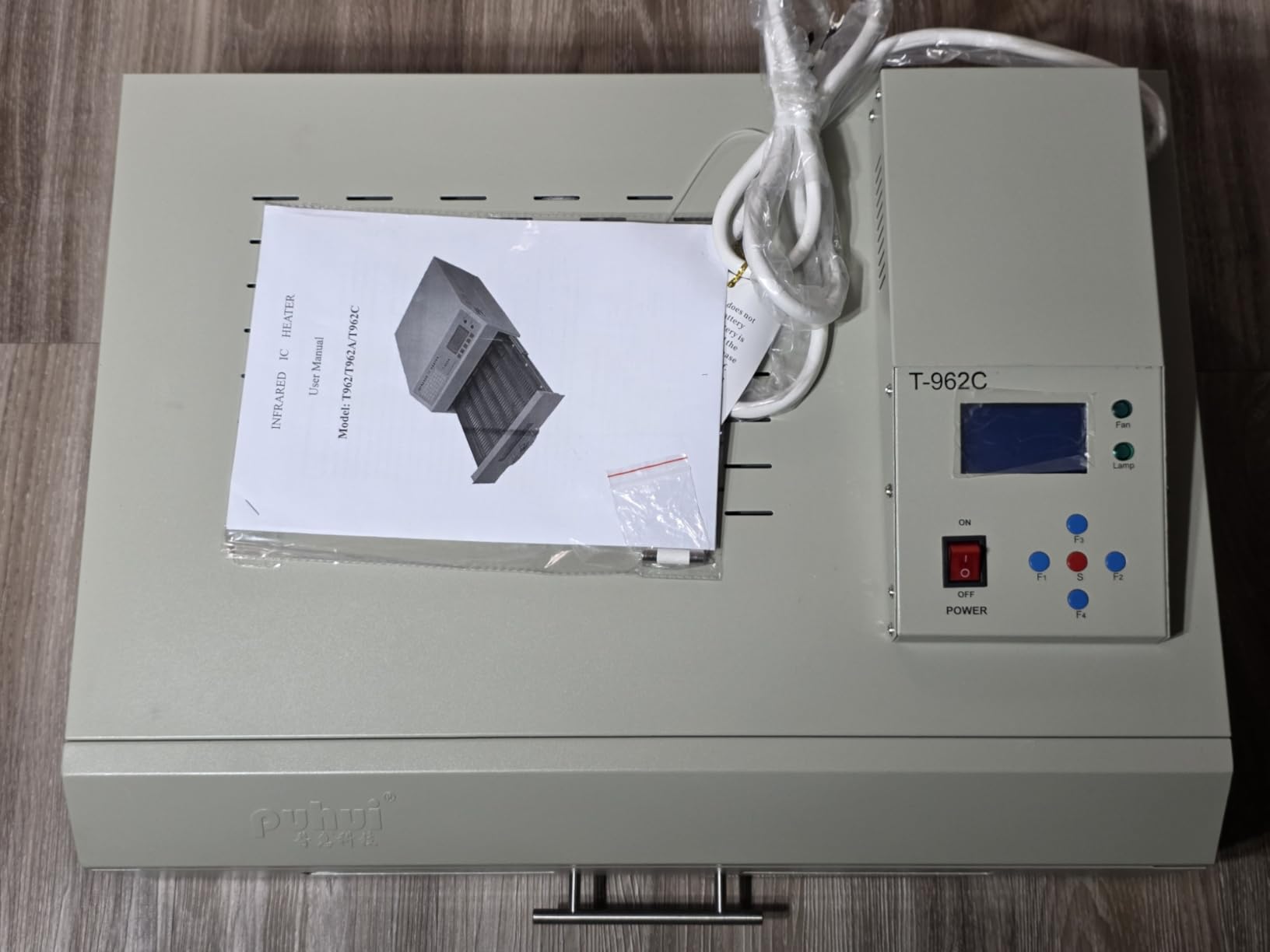
What makes this oven technically interesting is the hybrid heating. Fast infrared radiation handles the ramp while circulating hot air evens out the chamber, which is the same combination used in far more expensive machines. Add two pre-installed vent pipe interfaces for an external smoke exhaust and you have an oven that is easier to ventilate than most at this level.
The power figure is the thing to plan around. At 2900 watts you want a dedicated 110 volt circuit rather than an extension lead from a bench socket, and that is worth checking before the oven arrives rather than after.
What a 600 x 400 mm drawer actually lets you do
Panelised boards go in without being split back into singles later, and a 600 by 400 millimetre drawer takes most of the panel sizes hobby and prototype shops work with. It also means one cycle heats fewer boards than a small chamber would, so cycle time per board is closer to the entry ovens than it feels like.
The eight preset control curves are displayed clearly enough to edit, which matters when you move between lead-free pastes with different liquidus points. Both owner reviews point to the curve display specifically, which is a good sign for anyone who wants to adjust rather than accept a default.
When this oven is the wrong choice
If your bench cannot take a dedicated circuit, the 2900 watt load is a genuine blocker rather than a minor inconvenience. Hot-plugging it into a shared socket is the kind of shortcut that ends with a tripped breaker mid-profile and a ruined board.
It is also a large footprint for a hobbyist with one project on the bench. Members posting in r/embedded about cheap oven choices repeatedly raise the point that most commercial ovens are oversized for hobby work, and this one is no exception. Measure your boards before you fall for the chamber size.
3. KINGTAIXIN T962A — Best Value Reflow Oven for Lead-Free Work
Reflow Oven,T962A 1500W Automatic Infrared IC Heater Welding area 11.81 x12.59in for Pcb Chip Aluminum Substrate Lamp Be Soldering
1500W infrared
0C-280C
300 x 320 mm area
Eight curves
Vent-assisted cooling
Pros
- Worked out of the box with no setup reported
- Successful lead-free MCU project on the first board
- Eight selectable curves for different materials
- Automatic preheat
- soak
- reflow and cool-down
- Works on PCB chips
- aluminum substrates and double-sided boards
Cons
- Custom profile creation is poorly documented for first-time users
- Fume exhaust pipe is not included
- Only one owner review so long-term reliability is unknown
The KINGTAIXIN T962A is the pick if your work is lead-free solder paste on microcontroller boards and you want something that works on the first attempt. The verified buyer we can see soldered a lead-free MCU project successfully straight out of the box, which is exactly the outcome a first reflow oven needs to deliver.
At 1500 watts it sits between the smallest drawer ovens and the large 2500 watt units, and the working area of 11.81 by 12.59 inches gives you noticeably more room than the first pick without the footprint of a 600 by 400 millimetre drawer. Vent design promotes uniform cooling and there is an integrated exhaust port for fumes.
The one weakness the buyer flagged is documentation. If you have never run a thermal profile before, the eight selectable curves are there but the manual does not walk you through building a custom one, so plan on spending an evening learning the shape of a lead-free profile rather than assuming the default will do.
Why the heating suits lead-free paste
Lead-free alloys sit in a narrower processing window than Sn63Pb37, which means the ramp and soak matter more, not less. A 1500 watt element with vent-assisted cooling gives a gentler cool-down, and a controlled cool-down is where a lot of dull, grainy lead-free joints are won or lost.
The oven handles CHIP, SOP, PLCC, QFP and BGA packages plus aluminum substrates and double-sided boards, so package coverage is not the constraint here. For a maker moving from hand soldering to their first SMD assembly, that range is more than enough to grow into.
When this oven is the wrong choice
It ships with the exhaust port but not the duct, so budget for an extraction hose before your first cycle. Owners of similar drawer ovens frequently complain about flux fumes in a home workshop, and the port is only useful once something is actually connected to it.
With a single owner review, this is the least-proven pick in the group despite the highest rating. Treat that five-star score as a good first impression rather than a reliability record, and keep your boards small and simple for the first few runs.
4. SPIRICH T962-V2.0 — Best for Custom Profile Work
SPIRICH T962-V2.0 Intelligent Infrared IC Heater PCB Soldering Furnace Reflow Oven with Online Function
800W infrared with fans
280C stability
Eight curves plus custom
PC serial port
Exhaust kit included
Pros
- Infrared heating plus stirring fans for more uniform chamber temperature
- Eight stored curves plus user-definable custom curves
- Visualized drawer workbench makes the process easy to observe
- Exhaust pipe and clamp included in the box
- Strongest sales rank among the T962 variants
Cons
- Listed voltage value in the specifications is unclear
- Only one review
- so little owner feedback on reliability
- Smallest chamber area of the group
The SPIRICH T962-V2.0 is the one to buy if you intend to build your own thermal profiles rather than run factory curves. Alongside eight stored parameter curves it accepts user-defined curves, and it can connect to a PC over a serial port cable, which is how you see the profile as it runs instead of guessing.
Heating is rapid infrared radiation combined with stirring cooling fans, so the chamber is more even than a bare infrared element and the fans handle the cool-down side as well as the heat side. The drawer workbench is visualised, so you can watch the whole process rather than peering through a door gap.
This is also the only unit in the group that includes an exhaust pipe and clamp in the box. That matters more than it sounds: an integrated port with no duct attached is a feature on paper, while a supplied pipe is a feature you can use on day one.
Why custom curves and a PC link are the deciding features
Every paste datasheet gives you a recommended profile, and most hobby ovens cannot accept one. With custom curves plus a serial connection you can enter a real profile, run it, and compare what the oven did against what the datasheet asked for. That is how you find out whether your oven is actually holding temperature where it claims.
Members on r/embedded who ask whether a DIY toaster-oven setup is the right route usually land on the same question: how do you know the profile held? A unit that shows you the curve answers it, and fuzzy temperature control technology is designed to reduce overshoot at setpoint rather than swing around it.
When this oven is the wrong choice
The listed voltage value in the specifications is not clearly stated, so confirm the electrical requirements with the seller before you commit rather than assuming a 110 volt unit. On a heater that draws real current, guessing is not worth the risk.
Its chamber is the smallest in this group, and it is 800 watts, so it is a board-repair and prototype oven rather than a batch machine. If your panels are larger than a credit-card-sized module, the bigger drawer ovens here serve you better.
5. CHHMAELOVE 3D Hot Air and Infrared Oven — Best for First-Time Buyers Who Want Guidance
Small Reflow Soldering Oven with Powerful 3D Hot Air Circulation + Infrared Heating – SMT Drawer-Type Reflow Oven, English Operating System, 250*200 mm Welding Area, with 500g Solder Paste
3D hot air plus infrared
250 x 200 mm area
English interface
Ceramic thermocouple
DB9 curve monitor
Pros
- Combines 3D hot air circulation with infrared heating
- Double-glazed observation window and ceramic thermocouple for visible accurate monitoring
- DB9 interface shows temperature curves in real time
- Includes 500g of solder paste to start immediately
- English operating system lowers the setup barrier
Cons
- Small 250 x 200 mm working area restricts board size
- Heavy 44-pound bench unit for its chamber size
- No customer ratings or reviews yet to validate claims
The CHHMAELOVE drawer oven is built for someone who has never watched a thermal profile run. It pairs 3D hot air circulation with infrared heating, uses a ceramic thermocouple for temperature measurement, and gives you a double-layer insulated glass window so you can watch the solder paste melt instead of guessing.
The English operating system with an LCD screen and preset working parameters means the first cycle is a matter of picking a preset rather than building one. It also includes 500 grams of solder paste, which is a small thing that removes a real barrier: you can load a board the day it arrives.
The DB9 interface for PC connection and real-time temperature curve viewing is a genuine inclusion at this level. Most hobby ovens in this group only tell you the setpoint, so seeing the actual curve is useful for learning what a good profile looks like.
What the observation window and thermocouple are really worth
Watching a board through a window sounds cosmetic until you realise that solder paste going from grey paste to shiny liquid is the moment you learn what liquidus looks like. The ceramic thermocouple is the sensor type most professional ovens use, so temperature readings are more trustworthy than a cheap bimetal or NTC element.
Combining 3D circulation with infrared addresses the core weakness of small drawer ovens, which is that a single element creates a hot spot near the lamp. Moving air distributes that energy, and the high-temperature all-aluminum fan keeps it moving at temperature.
When this oven is the wrong choice
There are no customer ratings or reviews on this listing, so every performance claim rests on the manufacturer specification sheet alone. We include it because the feature set is genuinely well matched to a beginner, but treat it as an unproven unit.
At 44 pounds for a 250 by 200 millimetre working area, it is heavy for the chamber you get, and the small area limits you to small modules. If you already know what a profile should look like, the SPIRICH pick gives more control for a comparable class of money.
6. CGOLDENWALL BRT-420 — Best for a Small SMT Production Line
CGOLDENWALL SMT Production Line Reflow Soldering Machine Oven (BRT-420 Reflow Oven)
2500W mixed heating
300 x 300 mm area
Plus or minus 1C accuracy
300C max
5-10 min cycles
Pros
- Mixed infrared and hot air heating for more even profiles
- Tight plus or minus 1C temperature control accuracy
- Suited to small SMT production lines rather than one-off hobby work
- Pairs with CHMT36VA pick-and-place and a 3040 stencil printer
- Long process period window of 5 to 10 minutes
Cons
- Soldering area specification is inconsistent between millimetres and centimetres
- No customer ratings or reviews on this listing
- Overkill for hobby and repair-only use
The CGOLDENWALL BRT-420 is built to sit in a small production line rather than on a hobby bench. Its selling specification is plus or minus 1 degree Celsius control accuracy with mixed infrared and hot air heating, a maximum temperature of 300 degrees, and a 2500 watt rated power draw.
It pairs with CGOLDENWALL’s own CHMT36VA pick and place machine, a vibration feeder and a 3040 stencil printer, so if you are building a compact line rather than assembling one board at a time, the ecosystem exists. Process periods of 5 to 10 minutes suit the rhythm of short production runs.
The maximum soldering area is listed as 300 by 300 millimetres, and we want to flag a documentation problem honestly: the spec sheet states 300 times 300 centimetres, which is inconsistent. Confirm the real chamber size with the seller before ordering, because that number decides whether your panels fit.
Why plus or minus 1C accuracy changes your defect rate
Control accuracy is the specification that maps most directly onto joint quality. Tight accuracy means the chamber sits at setpoint rather than swinging around it, and swinging around setpoint is what produces joints that looked fine on the way up and turned dull on the way down.
Mixed heating is the other half of that promise. Infrared supplies the power and hot air spreads it, which is the same reason the dual-heating ovens higher up this list behave more consistently on densely loaded boards.
When this oven is the wrong choice
If you assemble a handful of boards a month, this oven is the wrong shape of purchase. There are no owner reviews on the listing, and the platform features point to a small line rather than one-off hobby work, so you would be paying for capability you will not use.
It is also the oldest item in this roundup, first listed in 2019, which means documentation and parts support are harder to find than on current models. If you are starting out, an entry-level drawer oven gives you far more board for the money.
7. PUHUI T-962C — Best Multi-Function Bench Reflow Oven
Mai lelu PUHUI T-962C Infrared PCB Soldering Oven Reflow Soldering Machine Reflow Oven BGA SMD SMT Rework Station Working Size: 400mm x 600mm
2500W IR plus air
400 x 600 mm area
28 kg
Eight curves
Forced heating and cooling
Pros
- Large 400 x 600 mm effective soldering area for batch work
- 2500W infrared plus circulating air for even temperatures
- Eight curves plus forced heating and cooling stages
- Doubles as a drying and heat-preservation oven
- Handles gluing
- hot aging and general PCB maintenance
Cons
- Listing carries no customer ratings or reviews
- 28 kg bench unit needs a sturdy work surface
- Vendor brand name on the listing does not match the product name
The PUHUI T-962C is the most flexible bench unit here. Its effective soldering area of 400 by 600 millimetres handles batch work and panels, and it runs 2500 watts through fast infrared radiation combined with circulating air heating for accurate, even temperatures.
Beyond reflow it supports drying, heat preservation, gluing, hot aging and general PCB maintenance, with forced heating and cooling stages among the eight stored temperature parameter curves. For a workshop that also does conformal coating cure or glue work, that flexibility is the reason to buy it.
It handles CHIP, SOP, PLCC, QFP and BGA parts, and the LCD or LED operator interface gives visible operation status during a cycle. The physical footprint is around 27 inches wide by 20 inches deep, so plan the bench space before it arrives.
When multi-function capability is worth paying for
Drying and heat preservation are not reflow features that happen to exist, they use the same controlled heating and the same thermocouple. A small shop that cures glue or pre-bakes boards between solder passes can reuse the chamber rather than buying separate equipment.
Forced heating and cooling stages inside the curve set are what make the multi-function modes accurate. A profile that ramps deliberately is what you want for drying, and it is also what protects a BGA during a reflow cycle.
When this oven is the wrong choice
At 28 kilograms it needs a sturdy work surface, and the width rules out most small shelving. This is the point where an oven stops being a bench appliance and becomes furniture.
There is a documentation issue worth naming: the listing carries the PUHUI product name while the manufacturer field names a different brand, so support provenance is unclear. Ask the seller who handles warranty claims before you commit, and check that the name on the plate matches what you were told.
8. TECHTONGDA 5-Zone Conveyor Oven — Best for Continuous Small Production
TECHTONGDA Infrared Reflow Oven 220V Professional Infrared Heater with 11.8×37.8in Soldering Area LCD Touch Display Hot Air Conveyor SMT Reflow Soldering Oven for PCB Welding
Five PID zones
220V 4.5 kW
11.8 x 37.8 inch belt
Plus or minus 10 mm per min
Independent cooling zone
Pros
- Five independently PID-controlled temperature zones for a repeatable profile
- Conveyor speed precision of plus or minus 10 mm per minute
- Independent cooling zone so boards leave cool and ready
- LCD touch display means no PC needed to run the process
- Eight programmable profiles with memory storage
Cons
- 4.5 kW on 220V needs a dedicated high-capacity circuit
- 280-pound footprint far larger than tabletop ovens
- No customer ratings or reviews on this listing
The TECHTONGDA is the only true conveyor machine in this roundup, and it is the one to buy if you are running boards through continuously rather than one batch at a time. It uses a crawler-type conveyor with five independently PID-controlled temperature zones, each with its own setpoint.
Five zones is the number that matters. Instead of one chamber profile, you get separate preheat, soak, reflow and cooling control, which is how a line stays repeatable as you change board size and paste. Conveyor speed holds plus or minus 10 mm per minute precision, and an independent cooling zone brings boards down before they leave the oven.
Warm-up from ambient to working temperature takes roughly 20 minutes, and the machine reaches 350 degrees Celsius across five channels at 4.5 kilowatt on 220 volts. Thermocouple temperature measurement with a compensation circuit keeps readings honest, and the LCD touch display means you do not need a PC to run the process at all.
Why five independent zones beat a single-chamber batch oven
A batch oven runs one profile for every board in the chamber, so the slowest-heating part sets the ramp for everything. Independent zones let the soak hold while the preheat element recovers, and that separation is what keeps a profile repeatable when you change load.
It is also the machine that fits lead-free work at volume. High-temperature lead-free solder paste, SMT and BGA components are all listed as supported, and the touchscreen lets an operator change recipe without a laptop or a training session.
When this oven is the wrong choice
At 280 pounds and 4.5 kilowatt, this is a floor-standing or heavy-bench machine with a dedicated 220 volt supply. For hobby work it is the wrong purchase by a wide margin, and no owner reviews exist on the listing to guide you.
If you are not producing continuously, a large batch chamber gives you the same profile quality for far less space and power. Judge this machine on throughput, and only if throughput is your actual problem.
Reflow Oven Buying Guide: Seven Things to Check Before You Buy
Buying a reflow oven goes wrong in predictable ways. Most mistakes come from judging on temperature range instead of chamber size, or from ignoring the electrical and ventilation requirements until the machine is on the bench.
1. Chamber size against your real board size, not your ambition
Measure the largest board you actually intend to build and buy above that. Board areas on the ovens here run from 250 by 200 millimetres up to 600 by 400 millimetres, and the price gap between them is smaller than people assume. Overbuying costs money, counter space and cycle time per board.
2. Heating method and chamber uniformity
Infrared heats fast and can create hot spots around dark components on light boards. Forced air is gentler and more even. Ovens that combine both give you the ramp speed of infrared with the distribution of moving air, which is why the larger units in this roundup use both. If you are unsure, measure your actual profile with a thermocouple rather than trusting a rating.
3. Profile control and whether you can inspect the curve
Look for user-definable curves, not just stored presets. Some ovens in this roundup accept custom profiles and connect to a PC for real-time curve viewing, which is how you verify the profile actually held. An oven that only shows a setpoint gives you no way to know what happened inside the chamber.
4. Electrical requirements
Power draw across these models ranges from 800 watts to 4.5 kilowatts. Anything above roughly 2400 watts on 110 volts, or 4.5 kilowatts on 220 volts, deserves a dedicated circuit. This is the most commonly ignored specification and the easiest way to damage an oven or a board.
5. Ventilation and flux fume extraction
Flux fumes are a genuine health concern in a home workshop, and this is the one safety topic none of the vendor roundups we studied cover. At minimum your oven needs an exhaust port; ideally the duct is included. If the port exists but no pipe is supplied, factor that into your setup along with a fan and somewhere for the air to go.
For scale, this is the same class of problem as choosing a cerakote oven for your workshop: the heating equipment is the easy part, and extraction is what makes it safe to run indoors repeatedly.
6. Spare parts and whether the unit can be serviced
Thermocouples and controller boards fail. An unbranded oven with no documented parts list is a single-point failure for your whole process, so before buying ask what the manufacturer is, what the warranty covers, and whether a replacement thermocouple is available. Confusion about who the actual brand is, as we saw on one listing in this roundup, is a warning sign here.
7. Batch versus conveyor, and whether you are ready for a profile at all
Batch ovens suit intermittent work where you load a drawer and walk away. Conveyors suit continuous production and are only worth their space and power when throughput is genuinely the problem. And if you are assembling a few dozen boards a year, hand soldering with good technique may honestly be the right answer, which brings us to the DIY route.
Can You Build a Reflow Oven? The DIY Toaster-Oven Route
Yes, you can convert a toaster or convection oven into a reflow oven, and it is a live option rather than a fringe hack. The controlling factor is not the oven, it is the controller: a consumer oven’s thermostat will not hold a thermal profile, so you replace it.
The route practitioners describe in r/embedded threads and on EEVblog follows a predictable shape. You start with an oven that has stable PID behaviour and room for a probe at board height, then you add a controller board that runs the profile, then you mount a thermocouple where the board actually sits so the readings mean something, then you run a lead-free profile and watch the curve, then you add fume extraction before you do it twenty more times.
What this route buys you is profile visibility and control for the cost of a controller. What it costs you is chamber uniformity you cannot easily measure, an oven door that opens onto a hot cavity, and no warranty on the finished system. Members asking on r/embedded whether DIY is the best route usually land on it being fine for learning and frustrating once you need repeatability across more than a few boards.
Our honest position: if you are curious and want to understand what a thermal profile does, a converted oven teaches it better than a spec sheet. If you need joints you can hand to someone else, buy an oven with a chamber size that fits your work and a controller you can inspect. For another view on repurposed ovens, our toaster oven testing covers the hardware side.
Frequently Asked Questions
How much does a reflow oven cost?
Entry-level infrared drawer ovens start at a few hundred dollars and suit hobby boards. Mid-range dual-heating units with larger 600 by 400 millimetre drawers sit in the middle. Professional five-zone conveyor machines run into the thousands and are priced around throughput rather than joint quality.
How hot do reflow ovens get?
Reflow ovens reach roughly 245 to 250 degrees Celsius at peak for lead-free solder paste. The cycle moves from preheat through a soak, a reflow peak above the solder liquidus point of about 217 degrees, and a controlled cool-down below 100 degrees.
How do I build my own reflow oven?
Use a toaster or convection oven with stable PID control, add a profile controller board, mount a thermocouple at board height, and run a lead-free profile while watching the curve on a PC. Add fume extraction before repeated use.
Who are the leading manufacturers of reflow ovens?
Neoden and Manncorp cover the professional benchtop and industrial ends, LPKF and Eurocircuits serve the European mid-range, and Chinese brands including the T-9xx family cover most of the hobby and small-production market covered here.
What is the difference between infrared and convection reflow ovens?
Infrared heats the board fast but can create hot spots around dark components on light boards. Convection moves hot air and is more uniform but slower to ramp. Many ovens combine both for the speed of infrared and the even distribution of air.
Do I need a vacuum reflow oven?
Only if you are dealing with large thermal pads under BGAs where voiding is the dominant failure. For most hobby, prototype and repair work, controlling the thermal profile and getting enough flux activation matters far more than vacuum.
Which Reflow Oven Should You Buy? Our Verdict
If you are buying your first reflow oven and your boards are hobby-sized, take the PROFIXXERS T962. Its automatic cycle and wide temperature range mean a sensible first run is likely, and the chamber covers most breakout and sensor boards without wasting counter space.
If you need room to work, the INTBUYING T962C fits panels and large boards that nothing else in this group will take, and its hybrid heating plus integrated exhaust make it the better long-term bench. If your priority is custom profiles and being able to see the curve, the SPIRICH T962-V2.0 is the smarter buy. Volume work on a continuous line points to the TECHTONGDA conveyor, and a full small SMT line points to the CGOLDENWALL.
Whichever you pick, budget for a thermocouple, a ducted exhaust and a dedicated circuit where the power draw calls for one. Those three things decide whether your reflow oven is a tool you use for years or an expensive learning mistake, and they matter more than the specification headline. Check current pricing on any of these before you order.