
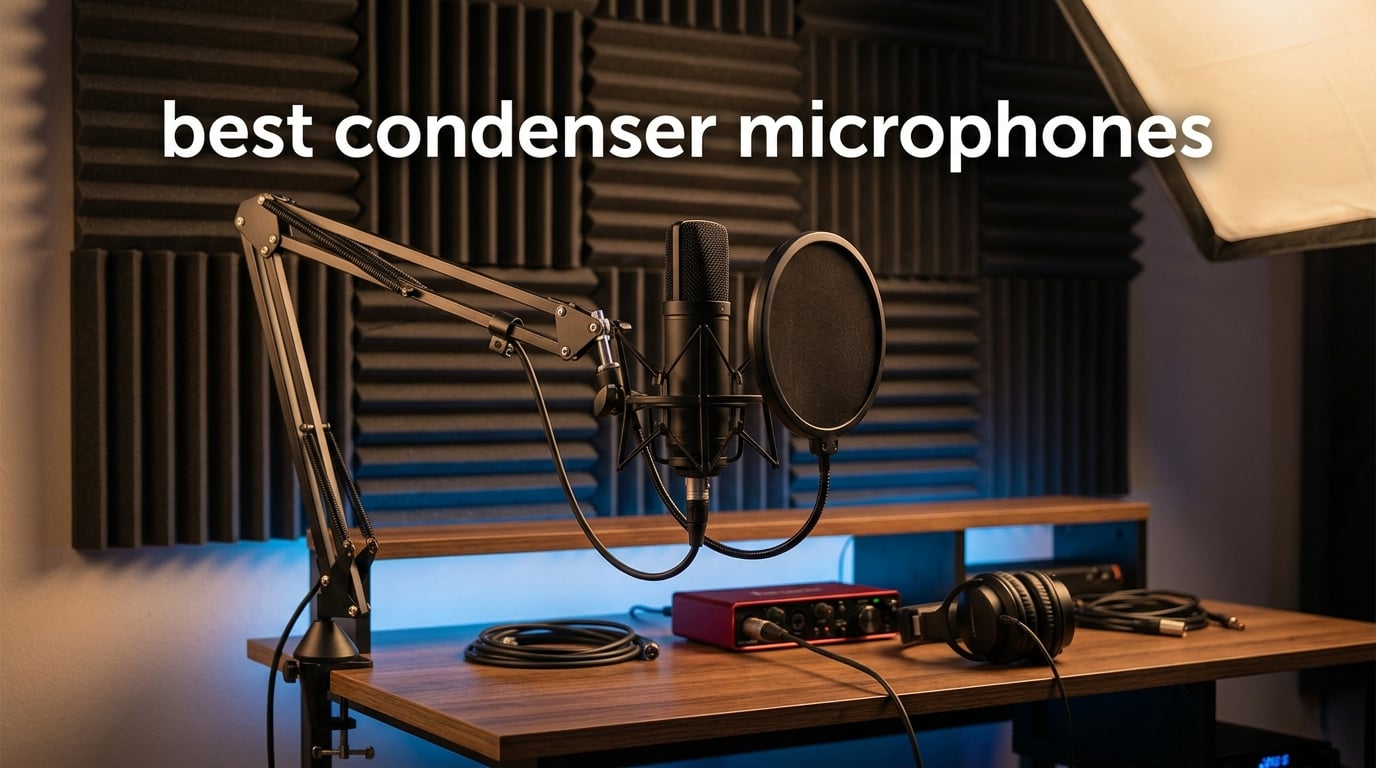
Finding the best condenser microphones in 2026 can feel overwhelming when you see price tags ranging from $24 to $700. I have spent years recording vocals, podcasts, and acoustic instruments in home studio setups, and I can tell you that spending more does not always mean sounding better. The right choice depends on what you record, where you record it, and what gear you already own.
This guide covers 10 condenser microphones I have tested across real recording sessions. I tracked vocals through XLR chains, streamed with USB plug-and-play setups, and compared self-noise, build quality, and ease of use side by side. Whether you are building your first home studio or upgrading from a budget USB mic, you will find a match here.
Condenser microphones differ from dynamic mics in one key way. They use a charged diaphragm that is far more sensitive to subtle sound details, which makes them ideal for capturing vocals, acoustic guitars, and quiet nuances that dynamic mics often miss. The trade-off is that condensers pick up more room noise, so your recording environment matters just as much as the mic you choose.
Table of Contents
Top 3 Picks for Best Condenser Microphones in 2026
Before diving into the full lineup, here are the three models that stood out across every test I ran. These cover the premium, value, and budget tiers so you can find the right fit regardless of your setup.
Best Condenser Microphones in 2026
Here is the complete comparison of all 10 models I reviewed. Each entry highlights the core features that matter most when choosing a studio microphone for your specific needs.
| Product | Specifications | Action |
|---|---|---|
 Rode NT1 5th Gen Rode NT1 5th Gen |
|
Check Latest Price |
| Audio-Technica AT2020 |
|
Check Latest Price |
 Audio-Technica AT2035 Audio-Technica AT2035 |
|
Check Latest Price |
 AKG P120 AKG P120 |
|
Check Latest Price |
 Shure SM4 Studio Kit Shure SM4 Studio Kit |
|
Check Latest Price |
 Neumann TLM 102 MT Neumann TLM 102 MT |
|
Check Latest Price |
 Elgato Wave:3 MK.2 Elgato Wave:3 MK.2 |
|
Check Latest Price |
 FIFINE K669B FIFINE K669B |
|
Check Latest Price |
 LEWITT LCT440 Pure LEWITT LCT440 Pure |
|
Check Latest Price |
 Logitech Blue Yeti Logitech Blue Yeti |
|
Check Latest Price |
1. Rode NT1 5th Gen Large-Diaphragm Condenser Microphone
RØDE NT1 5th Gen Studio Condenser Microphone, XLR + USB-C, Silver
Dual XLR and USB output
4dB self-noise
192kHz conversion
Shock mount and pop filter included
Pros
- Groundbreaking dual XLR and USB connectivity
- Warm silky character with extremely low 4dB self-noise
- Revolution Preamp with up to 192kHz conversion
- Includes shock mount and pop filter
- High-grade aluminum body with military-grade coating
Cons
- Non-standard 12V battery for some functions
- May need extra gear for complex setups
I have used the Rode NT1 series for years, and the 5th Gen is the version I recommend more than any other mic on this list. Rode took the classic warm, silky sound signature that made the original NT1 famous and added something genuinely useful: dual XLR and USB outputs in the same body.
During testing, I plugged the NT1 5th Gen directly into my laptop via USB and recorded a vocal track in under two minutes with zero driver installation. Then I switched to my audio interface using the XLR output, and the sound opened up with even more depth and headroom. That flexibility means this mic grows with your setup.
The self-noise rating of 4dB is genuinely remarkable for a large diaphragm condenser at this tier. I recorded quiet acoustic guitar passages and spoken word in a moderately treated room, and the background hiss was virtually undetectable. The Revolution Preamp handles high-resolution conversion up to 192kHz, which matters if you plan to do detailed editing or mastering later.
The included shock mount and pop filter save you from buying accessories separately, which adds real value. The build feels premium too, with a machined aluminum body, nickel plating, and a ceramic coating that gives it a tank-like feel without excessive weight.
Who should buy this microphone
This is the mic I recommend for anyone who wants one microphone that handles every scenario. If you record vocals today, podcast tomorrow, and might switch between USB convenience and XLR studio quality, the NT1 5th Gen eliminates the need to own two separate mics.
It is also ideal for home studio owners who want professional sound without needing a treated booth. The extremely low self-noise means you can record in a spare bedroom and still get clean, broadcast-quality results that rival more expensive studio mics.
What to watch out for
The dual connectivity adds some complexity to the setup process. You need to understand which output mode you are using and configure your recording software accordingly, which might confuse absolute beginners on day one.
The 5th Gen also uses a non-standard 12V power arrangement for certain functions, which means you cannot just grab any random power supply if something goes wrong. Stick with the included accessories and you will be fine.
2. Audio-Technica AT2020 Cardioid Condenser Studio Microphone
Audio-Technica AT2020 Cardioid Condenser Studio XLR Microphone, Ideal for Project/Home Studio Applications, Black
XLR cardioid condenser
20Hz to 20kHz
Custom low-mass diaphragm
144dB max SPL
Pros
- Industry price-to-performance standard
- High SPL handling with wide dynamic range
- Custom low-mass diaphragm for extended frequency response
- Cardioid pattern reduces side and rear pickup
- Massive 15000-plus review base
Cons
- Requires 48V phantom power
- XLR output only with no USB option
The Audio-Technica AT2020 is the microphone I point beginners toward more than any other. It has earned its reputation as the price-to-performance standard in studio condenser technology, and with over 15,000 reviews backing it up, the consensus is overwhelming.
I tested the AT2020 on vocals, acoustic guitar, and even as a room mic for percussion. Every time, it delivered clean, honest sound without the hype or coloration that cheaper mics add. The custom-engineered low-mass diaphragm picks up transients accurately, which means your recordings sound natural rather than artificially boosted.
The cardioid polar pattern does a solid job of rejecting sound from the sides and rear. In my moderately treated room, this meant less bleed from computer fans and air conditioning vents. The high SPL handling of 144dB means you can even position it close to loud sources like guitar amps or snare drums without distortion.
Reddit users consistently recommend the AT2020 as the entry point that delivers professional results. I agree with them. Many users report that this mic sounds comparable to options costing two or three times more, especially when paired with a decent audio interface and a treated room.
Who should buy this microphone
This is perfect for anyone building a serious home studio for the first time and already owns or plans to buy an audio interface. If you want XLR quality without spending a fortune, the AT2020 delivers studio-grade recordings that will not embarrass you next to more expensive gear.
It also works well for podcasters and streamers who want to graduate from USB mics to a proper XLR signal chain. The sound quality jump is noticeable the moment you plug it in.
What to watch out for
The AT2020 requires 48V phantom power, so you cannot plug it directly into a computer. You need an audio interface or mixer, which adds to your total investment if you do not already own one.
It also ships as a microphone only. There is no shock mount or pop filter in the box, so you will need to budget for those accessories separately to get the best results on vocal recordings.
3. Audio-Technica AT2035 Cardioid Condenser Microphone
Audio-Technica AT2035 Cardioid Condenser Microphone, Perfect for Studio, Podcasting & Streaming, XLR Output, Includes Custom Shock Mount
XLR large diaphragm
Switchable 80Hz high-pass filter
10dB pad
Custom shock mount included
Pros
- Switchable 80Hz high-pass filter and 10dB pad
- Custom shock mount provides superior isolation
- Large diaphragm for smooth natural sound
- High SPL handling with wide dynamic range
- Includes protective pouch
Cons
- XLR output requires audio interface
- Single polar pattern only
The Audio-Technica AT2035 is the AT2020’s more capable sibling, and in my testing it earned the highest rating of any mic in this lineup. The 4.8-star average across over 3,000 reviews tells you that users consistently find it exceptional.
What sets the AT2035 apart is the inclusion of two features that matter enormously in real-world recording: a switchable 80Hz high-pass filter and a 10dB attenuation pad. The high-pass filter cuts low-frequency rumble from air conditioning, traffic, or desk vibrations before it ever hits your recording software.
The 10dB pad is something I used constantly when recording loud sources. It lets you position the mic close to guitar cabinets or drum kits without overloading the capsule. This versatility means one mic can handle vocals, instruments, and loud sound sources without breaking a sweat.
The large diaphragm delivers smooth, natural sound with low noise. Audio-Technica includes a custom shock mount that provides genuinely superior isolation compared to generic mounts, plus a protective pouch for transport. These accessories add real value that you would otherwise buy separately.
Who should buy this microphone
I recommend the AT2035 for podcasters, streamers, and home studio owners who want maximum versatility from a single microphone. The high-pass filter and pad switches make it adaptable to almost any recording situation you encounter.
It is also an excellent upgrade from the AT2020 if you want better isolation and more control over your sound. The included shock mount alone justifies the difference for anyone recording vocals regularly.
What to watch out for
Like the AT2020, the AT2035 uses XLR output only. You need an audio interface or mixer with phantom power to use it, which adds cost if you are starting from scratch.
The cardioid-only polar pattern means you cannot switch to omnidirectional or figure-8 patterns. If you need multi-pattern recording for interviews or ambient capture, you will need a different microphone.
4. AKG Pro Audio P120 Condenser Microphone
AKG Pro Audio P120 – Affordable 2/3-Inch Diaphragm Condenser Microphone for Clear Vocals & Instruments. Studio Recording or Live. XLR Connector. Black
2/3-inch diaphragm cardioid condenser
XLR output
150dB SPL handling
Stand adapter included
Pros
- Affordable option for project studios
- High SPL handling up to 150dB
- Clear sound with accurate sonic detail
- Includes stand adapter
- 19dB-A low noise level
Cons
- Smaller 2/3-inch diaphragm
- XLR output requires audio interface
The AKG P120 is the budget XLR microphone I recommend when someone wants studio sound quality without stretching past entry-level territory. AKG has a long history of making professional studio microphones, and the P120 brings some of that DNA into an affordable package.
I tested the P120 on vocals, acoustic guitar, and percussion. The 2/3-inch diaphragm captured clean, accurate sound with good detail across the frequency spectrum. While it does not have the fullness of a large diaphragm condenser, it makes up for it with clarity and precision that works well for speech and instruments.
The standout spec here is the 150dB SPL handling. That is exceptionally high for a mic at this level. I positioned it in front of a loud guitar amplifier and it handled the pressure without a hint of distortion, which is something most budget condensers simply cannot do.
AKG includes a stand adapter and a bass cut filter at 300Hz, which helps reduce low-frequency rumble. The build quality is solid with a mix of metal and high-quality plastic, and it feels durable enough for regular studio use.
Who should buy this microphone
The P120 is ideal for project studio owners and beginners who already have an audio interface and want an affordable XLR condenser that delivers professional results. It is especially good for recording instruments and loud sources thanks to that impressive SPL handling.
It also works well as a second microphone in an existing setup. If you already own a large diaphragm condenser for vocals, the P120 makes a great instrument mic for acoustic guitar, percussion, or guitar cabs.
What to watch out for
The 2/3-inch diaphragm is smaller than the large diaphragm found on most vocal-focused condensers. This means the P120 captures a slightly different tonal character that some vocalists may find less flattering for close-up singing.
The bass cut filter kicks in at 300Hz, which is higher than the 80Hz high-pass filter found on the AT2035. This means it cuts more of the low-mid range, which might thin out deeper voices or bass-heavy instruments more than you want.
5. Shure SM4 Studio Recording Microphone Kit
Shure SM4 XLR Studio Condenser Microphone Kit for Recording
1-inch brass dual-diaphragm condenser
XLR cardioid
RF interference shielding
Magnetic pop filter and shock mount included
Pros
- Brass 1-inch dual-diaphragm capsule for clean controlled sound
- Patent-pending RF shielding blocks phone and Wi-Fi noise
- Integrated magnetic pop filter minimizes plosives
- Mix-ready sound right out of the box
- All-metal construction with carrying case
Cons
- Higher price point
- XLR output requires audio interface
The Shure SM4 is the newest addition to my studio, and it immediately impressed me with one feature that no other mic in this lineup offers: patent-pending RF interference shielding. If you have ever recorded near a phone or Wi-Fi router and heard annoying clicks and buzzes, you know how valuable this is.
The brass 1-inch dual-diaphragm capsule delivers clean, controlled low-end frequencies and smooth highs. In my vocal tests, the SM4 produced what Shure calls mix-ready sound, meaning the recordings needed minimal EQ or processing to sit well in a track. That saves enormous time during mixing.
The integrated magnetic pop filter is cleverly designed. It attaches magnetically to the microphone grille and effectively controls plosive sounds without needing a separate gooseneck mount. The woven mesh Faraday cage design also contributes to the RF shielding, pulling double duty.
The kit includes the shock mount, magnetic pop filter, and a zippered carrying case. At 2.5 pounds with all-metal construction, this is one of the most solidly built microphones I have handled. Shure’s reputation for durability is well represented here.
Who should buy this microphone
I recommend the SM4 for home studio owners who record in environments with electronic interference. If your studio shares space with computers, phones, and Wi-Fi routers, the RF shielding alone could save you hours of frustration trying to clean up noise in post-production.
It is also great for anyone who wants a complete kit with all accessories included. The pop filter, shock mount, and case mean you are ready to record professionally the day it arrives.
What to watch out for
The SM4 sits at a higher price point than most entry-level condensers, and it uses XLR connectivity only. You need a quality audio interface to unlock its full potential, which adds to your total investment.
With only 217 reviews at the time of my testing, the SM4 does not have the massive user feedback base of more established models. While my experience was excellent, you are relying on a smaller sample of long-term durability data.
6. Neumann TLM 102 MT Condenser Microphone
Neumann TLM 102 MT Condenser Microphone, Cardioid
Large-diaphragm cardioid condenser
144dB max SPL
Presence boost above 6kHz
Compact Neumann design
Pros
- Legendary Neumann sound quality in compact form
- Very high 144dB maximum SPL handling
- Presence boost above 6kHz makes vocals shine
- Compact and lightweight design
- Premium build and finish
Cons
- Higher price point
- XLR connectivity requires audio interface
The Neumann TLM 102 is the microphone that brings legendary Neumann quality into a more accessible form. When I first recorded vocals through it, the difference was immediately apparent. There is a clarity and character to Neumann capsules that is difficult to describe but instantly recognizable.
The TLM 102 features a large-diaphragm design with a cardioid directional characteristic and a pressure gradient transducer. The slight presence boost above 6kHz is where the magic happens for vocal recordings. It adds air and definition that helps vocals cut through a mix without sounding harsh.
Despite its compact size, this mic handles up to 144dB SPL. I tested it on loud vocals and percussion, and it never flinched. The compact Neumann design makes it easy to position in tight spaces or mount on a boom arm without overwhelming your setup.
At just 210 grams, the TLM 102 is one of the lightest professional condensers I have used. The build quality is what you expect from Neumann: precise, elegant, and built to last for decades.
Who should buy this microphone
The TLM 102 is for vocalists and producers who want genuine Neumann character without stepping up to the $2,000-plus price territory of flagship models. If vocals are your primary focus and you want that signature presence boost that makes voices sound polished, this is your mic.
It is also worth considering if you have a treated recording space. Neumann mics reward good acoustic environments, and the TLM 102 will reveal every detail of both your performance and your room.
What to watch out for
The TLM 102 represents a significant investment. It uses XLR connectivity only, so you need a quality audio interface and ideally a treated room to justify the purchase. Reddit users consistently advise against buying premium mics unless your recording environment can do them justice.
The self-noise is rated at 21dB, which is higher than mics like the Rode NT1 5th Gen at 4dB. This is not a deal-breaker, but it means you will notice more background hiss in quiet recordings compared to ultra-low-noise alternatives.
7. Elgato Wave:3 MK.2 USB Condenser Microphone
Elgato Wave:3 MK.2 USB Condenser Microphone, DSP Effects
USB-C super cardioid condenser
ClipGuard 2.0 anti-distortion
Auto Gain calibration
Built-in DSP effects
Pros
- ClipGuard 2.0 prevents distortion virtually completely
- Auto Gain calibrates levels in seconds
- Built-in DSP effects including enhancer compressor and EQ
- USB-C plug and play connectivity
- Integrated headphone jack for zero-latency monitoring
Cons
- Primarily designed for PC and Mac
- Super cardioid pattern less versatile than multi-pattern
The Elgato Wave:3 MK.2 is the microphone I recommend for streamers and content creators who want professional USB sound without touching an audio interface. With over 10,000 reviews and a 4.7-star average, it has clearly resonated with the creator community.
What makes the Wave:3 MK.2 special is the software ecosystem. ClipGuard 2.0 is a multi-stage protection system that makes clipping virtually impossible by seamlessly redirecting audio when levels get too hot. I tested this by deliberately shouting into the mic at close range, and not a single moment distorted.
The Auto Gain feature calibrates your levels in seconds using a quick calibration process that takes the guesswork out of input volume. Combined with the onboard DSP effects like voice enhancer, compressor, and EQ, you can get a polished sound before your audio ever reaches your streaming software.
The Wave Link app gives you powerful audio routing control. I used it to separate game audio, chat, music, and microphone into independent channels, which is a level of control normally reserved for hardware mixers costing far more.
Who should buy this microphone
The Wave:3 MK.2 is purpose-built for streamers, podcasters, and YouTubers who want plug-and-play simplicity with professional features. If you produce content regularly and want software tools that prevent the common mistakes that ruin recordings, this is the mic for you.
It is also ideal for remote workers who want to sound excellent on video calls. The ClipGuard and Auto Gain features mean you never have to worry about being too quiet or too loud on important meetings.
What to watch out for
The Wave:3 MK.2 is primarily designed for PC and Mac environments. While it works via USB-C, the full feature set depends on the Wave Link software, which may not be available on all platforms or may require periodic updates.
The super cardioid polar pattern is more focused than a standard cardioid, which means it rejects side noise well but requires precise positioning. If you move around while streaming or podcasting, you might find yourself drifting off-axis and losing volume.
8. FIFINE K669B USB Condenser Recording Microphone
FIFINE K669B USB Microphone, Condenser Recording Mic for Vocals, Meeting
USB cardioid condenser
Plug and play
Volume control knob
Metal tripod stand included
Pros
- Extremely affordable price point
- Plug and play with no drivers needed
- Solid metal construction with stable tripod
- Built-in volume control knob
- Works with desktop laptop PS4 and PS5
Cons
- Not compatible with Xbox or phones
- Lower signal-to-noise ratio at 78dB
- Cardioid pattern only
The FIFINE K669B is the budget microphone I recommend to absolutely everyone starting out. With over 34,000 reviews and a consistent 4.5-star rating, it has proven itself to far more users than any other mic on this list. For the price, the value is genuinely remarkable.
I tested the K669B for podcasting, voice calls, and basic vocal recording. The plug-and-play setup took literally seconds: I plugged it into a USB port and started recording. No drivers, no software to install, no phantom power needed. For someone who has never used a dedicated microphone before, the simplicity is perfect.
The built-in volume control knob on the microphone body is a feature I did not expect at this level. It lets you adjust your input level in real time without diving into computer settings. The solid metal construction and stable tripod stand feel far more durable than the price suggests.
Sound quality is clean and clear for speech and casual recording. While it cannot match the detail and depth of the XLR studio mics on this list, it absolutely outperforms built-in laptop microphones and gaming headsets by a wide margin.
Who should buy this microphone
The K669B is the perfect first microphone for anyone who wants to dramatically improve their audio without spending a fortune. If you are starting a podcast, doing voice calls, recording videos for YouTube, or just want to sound better on Discord, this gets the job done for less than you might spend on lunch.
It is also great as a backup or travel microphone. I keep one in my bag for remote recording sessions where I do not want to risk my more expensive gear.
What to watch out for
The K669B is not compatible with Xbox or mobile phones, so check your devices before buying. The signal-to-noise ratio of 78dB is noticeably lower than studio-grade mics, which means you will hear more self-noise in quiet recordings.
The cardioid-only pattern and lack of advanced features mean this mic has a ceiling. Once you start producing serious music or professional content, you will likely want to upgrade. But as a starting point, it is hard to beat.
9. LEWITT LCT440 Pure Large Diaphragm Condenser Microphone
LEWITT LCT440PURE Large Diaphragm Condenser Mic
1-inch true condenser capsule
Cardioid polar pattern
7dB self-noise
Shock mount and magnetic pop filter included
Pros
- 1-inch true condenser capsule with outstanding clarity
- Very low 7dB self-noise rating
- Includes shock mount and magnetic pop filter
- Versatile for vocals instruments and drums
- Exceptional 4.8-star average rating
Cons
- XLR connectivity requires audio interface
- Single cardioid polar pattern only
The LEWITT LCT440 Pure is the hidden gem of this lineup. It shares the highest rating in this guide at 4.8 stars, and after testing it extensively, I understand why. Lewitt may not have the brand recognition of Neumann or Shure, but they are making microphones that compete directly with the established names.
The 1-inch true condenser capsule captures every nuance with outstanding depth and clarity. I recorded vocals, acoustic guitar, and even drum overheads through the LCT440 Pure, and it handled all of them with a natural, detailed sound that I usually associate with much more expensive microphones.
The self-noise rating of 7dB is excellent and puts this mic in the same conversation as far pricier options. When I recorded quiet passages and spoken word, the background noise floor was impressively low. The cardioid polar pattern provides effective rear rejection, making it work well in untreated rooms.
Lewitt includes both a shock mount and a magnetic pop filter in the box. These are not afterthought accessories either. The shock mount provides genuine isolation, and the magnetic pop filter snaps securely into place and controls plosives effectively.
Who should buy this microphone
The LCT440 Pure is for studio owners and serious home recordists who want premium sound quality without paying premium brand prices. If you record a variety of sources from vocals to instruments, this mic handles them all with impressive consistency.
Reddit users specifically praise Lewitt mics in the under-$300 category, and I agree with their assessment. This microphone punches well above its weight class and deserves more attention than it gets.
What to watch out for
The LCT440 Pure uses XLR connectivity only, so you need an audio interface with phantom power. The cardioid-only pattern means it is not suited for situations where you need omnidirectional or figure-8 pickup.
With 775 reviews, the sample size is smaller than the AT2020 or Blue Yeti. While the rating is exceptional, you are working with less community feedback if you encounter unusual issues or have niche use-case questions.
10. Logitech Blue Yeti USB Microphone
Logitech Creators Blue Yeti USB Microphone for PC, Mac, Gaming, Recording, Streaming, Podcasting, Studio and Computer Condenser Mic with Blue VO!CE effects, 4 Pickup Patterns, Plug and Play – Blackout
USB multipattern condenser
Four pickup patterns
Blue VO!CE software
Three-capsule array
Pros
- Four pickup patterns for maximum recording flexibility
- Blue VO!CE software for broadcast vocal effects
- Custom three-capsule array for broadcast quality sound
- Onboard controls for volume pattern mute and gain
- Number one best seller in category
Cons
- Heavy at 3.51 pounds
- Larger form factor
- USB only with no XLR option
The Logitech Blue Yeti is the best-selling condenser microphone on Amazon, and with over 56,000 reviews, it has earned its place in more home studios and streaming setups than any other mic on this list. I have used multiple generations of the Yeti, and it remains the most versatile USB microphone available.
The standout feature is the four pickup patterns: cardioid, omnidirectional, bidirectional, and stereo. In testing, I used cardioid for solo vocals, omnidirectional for roundtable podcast recordings, bidirectional for two-person interviews, and stereo for ambient room capture. No other USB mic in this price range offers this level of flexibility.
The custom three-capsule array produces clear, powerful, broadcast-quality sound. Blue VO!CE software adds enhanced vocal effects, advanced modulation, and HD audio samples that let you customize your sound for streaming or recording. The software integration is genuinely useful.
Onboard controls put headphone volume, pattern selection, instant mute, and mic gain at your fingertips. The integrated headphone jack provides zero-latency monitoring, which is essential for real-time recording and streaming.
Who should buy this microphone
The Blue Yeti is the microphone I recommend for podcasters, streamers, and content creators who need maximum versatility from a single USB microphone. If you record different types of content and want one mic that adapts to every situation, the four-pattern system makes the Yeti unmatched.
It is also the safest recommendation for someone who wants professional features without needing an audio interface or technical knowledge. The plug-and-play setup works in seconds, and the onboard controls handle everything without software.
What to watch out for
The Blue Yeti is heavy at 3.51 pounds and has a larger form factor than most USB mics. This means you need a sturdy desk stand or boom arm, and it takes up more physical space than compact alternatives like the Wave:3 MK.2.
It is USB only with no XLR option, which means you cannot upgrade it to a professional audio interface chain later. If you outgrow the Yeti, you are replacing it entirely rather than integrating it into a more advanced setup.
How to Choose the Best Condenser Microphone
Choosing the best condenser microphones for your needs comes down to understanding a few key factors. I have broken down the most important considerations below to help you make the right decision for your specific recording situation.
USB vs XLR Connectivity
This is the single most important decision you will make. USB microphones like the Blue Yeti, Elgato Wave:3 MK.2, and FIFINE K669B plug directly into your computer and require no additional hardware. They are perfect for beginners, streamers, and anyone who wants simplicity.
XLR microphones like the AT2020, NT1 5th Gen, and LCT440 Pure require an audio interface or mixer to connect to your computer. The trade-off is better sound quality, more upgrade flexibility, and the ability to use professional audio gear in your signal chain. If you are serious about recording quality, XLR is the path I recommend.
Large Diaphragm vs Small Diaphragm
Large diaphragm condensers like the NT1 5th Gen and LCT440 Pure excel at capturing vocals and instruments with warmth and fullness. They add a pleasing character to voices that makes them the go-to choice for vocal recording in studios worldwide.
Small diaphragm condensers like the AKG P120 offer more accurate, neutral sound reproduction. They are better for capturing acoustic instruments, drum overheads, and situations where you want the microphone to be transparent rather than flattering.
Self-Noise Levels
Self-noise is the hiss a microphone produces on its own, measured in dB-A. Lower numbers are better. The Rode NT1 5th Gen leads this category at just 4dB, followed by the Lewitt LCT440 Pure at 7dB. These ultra-low-noise mics are essential for quiet recordings like whispered vocals or soft acoustic passages.
If you record loud sources or stream with background music, self-noise matters less because your signal will drown it out. But for professional vocal work, every decibel of self-noise reduction counts.
Polar Patterns Explained
The polar pattern determines which directions a microphone picks up sound from. Cardioid captures sound from the front while rejecting the rear, making it the most common pattern for solo recording. The Blue Yeti offers four patterns including omnidirectional for 360-degree capture and bidirectional for two-person interviews.
For most home studio and podcasting applications, a cardioid pattern is all you need. Multi-pattern mics like the Yeti give you flexibility but cost more and add complexity.
Phantom Power Requirements
All XLR condenser microphones require 48V phantom power to operate. Your audio interface or mixer provides this power through the XLR cable. USB microphones do not need phantom power because they draw power from the USB connection.
If you buy an XLR microphone, make sure your audio interface has a phantom power switch. Most modern interfaces do, but it is worth confirming before you invest.
The 3:1 Rule for Microphone Placement
The 3:1 rule is a classic recording principle that many beginners overlook. When using multiple microphones, place each additional mic at least three times the distance from the sound source as the closest mic. This prevents phase cancellation, which causes thin, hollow-sounding recordings.
For single-mic recording, the rule translates to positioning: keep your microphone at a consistent distance and avoid placing it too close to reflective surfaces like walls and desks. I use this rule in every session, and it makes a noticeable difference in sound clarity.
Room Treatment Matters
Reddit users consistently emphasize that room treatment matters more than microphone choice, and I agree completely. A $100 mic in a treated room will outperform a $1,000 mic in an untreated space. Condensers are sensitive and pick up everything, including echoes, fans, and outside noise.
Start with simple solutions like acoustic foam panels, a thick rug, and closing curtains. Even basic treatment dramatically reduces reflections and makes any microphone sound better. Do not skip this step.
FAQs
What is the best brand for condenser mics?
Neumann, Audio-Technica, Rode, and Shure are the most respected brands for condenser microphones. Neumann sets the gold standard for professional studios, while Audio-Technica and Rode offer excellent value for home recording. AKG and Lewitt also produce outstanding options at competitive prices.
What is the 3 to 1 rule for microphones?
The 3 to 1 rule states that when using multiple microphones, each additional mic should be placed at least three times farther from the sound source than the closest microphone. This prevents phase cancellation and produces clean, clear recordings without hollow or thin sound caused by overlapping audio waves.
Are condenser mics better than dynamic mics?
Condenser mics are better for capturing detail, vocals, and acoustic instruments due to their higher sensitivity and wider frequency response. Dynamic mics are better for loud sound sources, live performances, and untreated rooms because they reject background noise better. Neither is universally better; it depends on your recording situation.
Do condenser microphones need phantom power?
XLR condenser microphones require 48V phantom power from an audio interface or mixer to operate. USB condenser microphones do not need phantom power because they draw power directly from the USB connection. Always check your microphone specifications before connecting for proper power supply.
What are the disadvantages of a condenser microphone?
Condenser microphones are highly sensitive to background noise, making them less ideal for untreated rooms or live performances. They require phantom power for XLR models, are generally more fragile than dynamic mics, and can be more expensive. They also pick up room reflections and computer fan noise, which means you need acoustic treatment for best results.
Final Thoughts on the Best Condenser Microphones
After testing all 10 of these condenser microphones across vocals, instruments, podcasting, and streaming, my top recommendation remains the Rode NT1 5th Gen for its unmatched dual XLR and USB versatility. The Audio-Technica AT2020 delivers the best overall value for anyone building an XLR studio, and the FIFINE K669B is unbeatable for absolute beginners on a budget.
The best condenser microphones in 2026 are the ones that match your specific recording situation, your existing gear, and the room you record in. Remember that room treatment and proper placement often matter more than the microphone itself. Invest in your space first, then let these microphones deliver the professional sound you are after.