
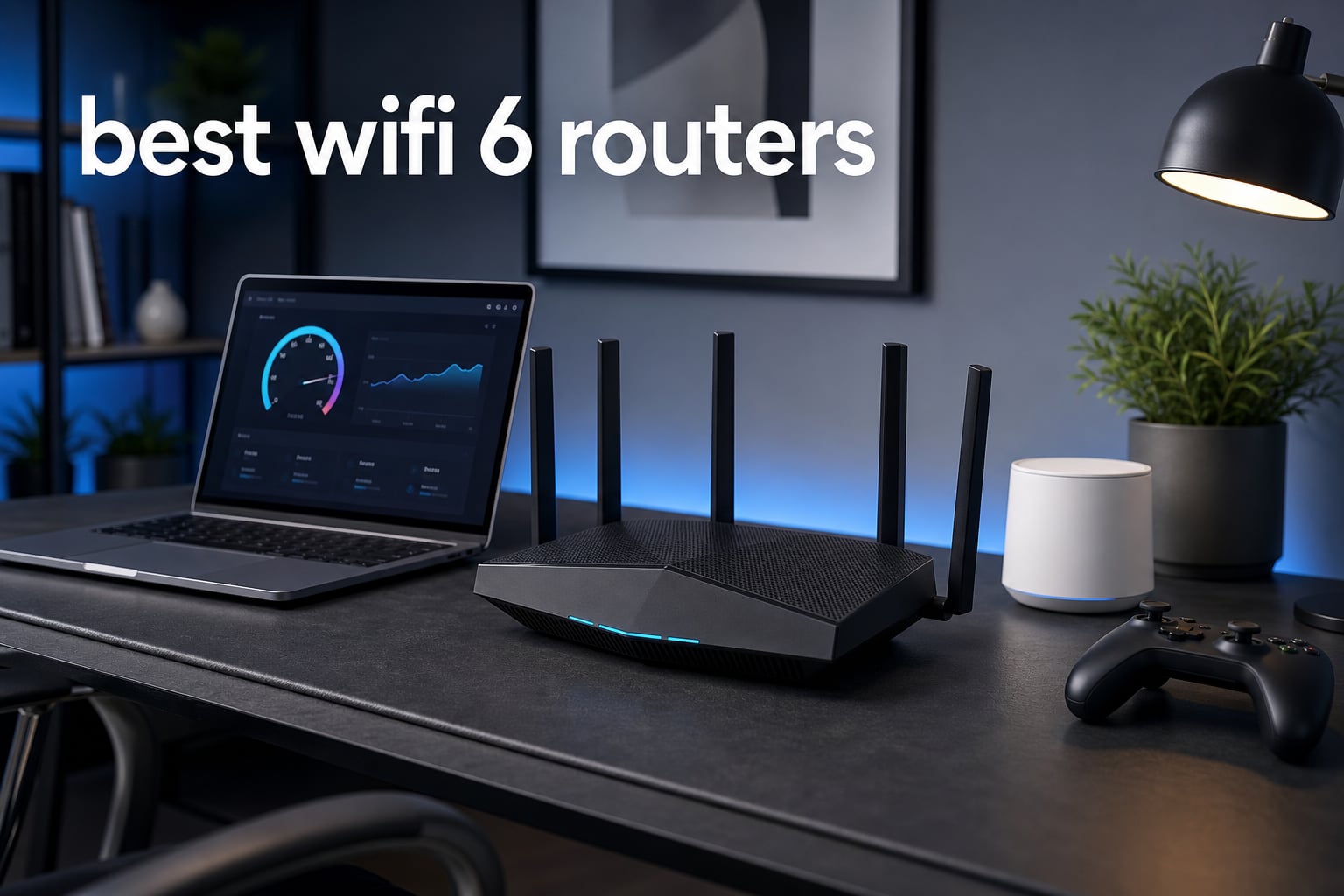
Finding the best wifi 6 routers is less about chasing the biggest number on a box and more about matching the router to the way your home connects. A small apartment with a few phones has different needs from a busy house where video calls, 4K streaming, consoles, cameras, and smart speakers all compete for airtime.
WiFi 6, also called 802.11ax, improves how a router shares capacity among devices. OFDMA divides a channel into smaller transmissions, while MU-MIMO helps serve multiple devices at once; both matter most when the network is busy, not when one laptop is sitting beside the router.
I also think it is wise to set expectations before shopping. A fast fiber plan does not mean every wireless device will reproduce its wired speed, because client hardware, distance, walls, channel congestion, and the selected band all play a part.
For this guide, we compared the 10 analyzed routers and mesh systems by their verified band configuration, stated coverage or device capacity, Ethernet options, security tools, and management features. The short version is simple: choose a single router for a compact, open space; choose mesh when rooms or floors create weak areas; and give gaming or network-heavy homes enough wired capacity to match their internet service.
Table of Contents
The Top 3 Picks for WiFi 6 Routers Answer Most Home Needs (September 2026)
Our editor’s choice is the GL.iNet Flint 2 for people who want unusually strong VPN capability, multi-gig Ethernet, and room for more than 100 devices. The TP-Link Archer AX55 is the balanced choice when you want AX3000 WiFi 6, EasyMesh expansion, USB sharing, and both VPN client and server support in one conventional router.
The Archer AX21 is the straightforward entry pick: it has AX1800 dual-band WiFi 6, four high-gain antennas, beamforming, and a built-in VPN server. For a whole-home system, skip past these single-router choices to the Deco X55 or Deco XE75 reviews, because node placement and backhaul matter more than a single unit’s stated peak speed.
The Best WiFi 6 Routers in 2026 at a Glance
This overview puts single routers, WiFi 6 mesh, and WiFi 6E mesh in the same place, but they solve different problems. A router with external antennas can be a sensible fit for one central location, while a multi-node system places a stronger signal closer to the rooms where people use it.
The highest quoted wireless rate is not a universal winner. Check the client devices you already own, the number of wired devices, and whether a future node can use Ethernet backhaul before treating a large throughput number as the deciding factor.
| Product | Specifications | Action |
|---|---|---|
 GL.iNet Flint 2 GL.iNet Flint 2 |
|
Check Latest Price |
 TP-Link Archer AX73 TP-Link Archer AX73 |
|
Check Latest Price |
 TP-Link Archer AX21 TP-Link Archer AX21 |
|
Check Latest Price |
 TP-Link Deco X55 3-Pack TP-Link Deco X55 3-Pack |
|
Check Latest Price |
 TP-Link Archer AX55 TP-Link Archer AX55 |
|
Check Latest Price |
 eero 6+ 3-Pack eero 6+ 3-Pack |
|
Check Latest Price |
 ASUS RT-AX1800S ASUS RT-AX1800S |
|
Check Latest Price |
 ASUS ROG GT-AXE16000 ASUS ROG GT-AXE16000 |
|
Check Latest Price |
 TP-Link Deco XE75 3-Pack TP-Link Deco XE75 3-Pack |
|
Check Latest Price |
 NETGEAR R6700AX NETGEAR R6700AX |
|
Check Latest Price |
1. GL.iNet Flint 2 Is the Best Choice for VPN-Heavy and Custom Networks
GL.iNet GL-MT6000 Flint 2 Wi-Fi 6 Gaming Router Dual 2.5G Ports
WiFi 6
2 x 2.5G ports
WireGuard up to 900Mbps
Pros
- Two 2.5G Ethernet ports
- WireGuard up to 900Mbps
- 100+ device support
- AdGuard Home
Cons
- Firmware update may be needed
- VPN speed varies by ISP
The Flint 2 is the most specialized single-router choice here, and that is exactly why it stands out. Its WiFi 6 design is paired with two 2.5G Ethernet ports, four 1G ports, and six total ports, which gives a home office or gaming desk more flexibility than the usual all-gigabit layout.
I would put it first for someone who expects to use a VPN regularly rather than occasionally. GL.iNet lists WireGuard throughput up to 900Mbps and OpenVPN throughput up to 880Mbps, although actual VPN performance still depends on the ISP, server, and network conditions.
There is also a practical device-density case for it. The manufacturer lists 8-stream WiFi 6, 1GB of DDR4 memory, and support for more than 100 devices, details that make more sense for a smart home full of cameras, speakers, switches, and consoles than for a minimal setup.
Its 4.6 rating from 2,835 reviews is strong, and its stated two-year warranty gives buyers a defined support window. The trade-off is that it is more configurable than a basic app-first router, and the data notes that a firmware update may be needed for the best experience.
The Flint 2 fits homes that need fast VPN traffic
Choose this model when VPN routing, multi-WAN, or network-level filtering is part of the plan. AdGuard Home support, guest mode, QoS, and a Linux operating system place it in a different class from a simple plug-in router.
For a workstation or console with 2.5G Ethernet, the pair of 2.5G ports is the deciding hardware detail. I would still use Ethernet for latency-sensitive work and treat the WiFi network as the flexible layer around it.
The Flint 2 needs a user who wants configuration choices
It is not the obvious pick for someone who only wants the shortest possible setup. The retractable antennas and wide-coverage claim are useful, but there is no stated square-foot figure to use as a room-by-room promise.
It also should not be bought solely for the advertised VPN number. VPN throughput changes with the encryption protocol, server location, and internet connection, so the listed figures are capabilities rather than a guaranteed result.
2. TP-Link Archer AX73 Is the Best Long-Range Single Router for Busy Streaming Homes
TP-Link AX5400 WiFi 6 Router (Archer AX73)
AX5400 WiFi 6
6 antennas
USB 3.0 sharing
Pros
- Up to 5400Mbps WiFi
- Six antennas and beamforming
- MU-MIMO and OFDMA
- USB 3.0 port
Cons
- Can run warm under heavy load
- All Ethernet ports are Gigabit
The Archer AX73 is a conventional dual-band router aimed at homes that want more reach and wireless headroom without adding mesh nodes right away. Its AX5400 class WiFi, six fixed antennas, high-power FEM, and beamforming are the stated coverage tools.
TP-Link lists up to 5,400Mbps of WiFi and 4T4R plus HE160 on the 5GHz band. Those figures describe the router’s wireless capability, not a promise that a phone or laptop will receive that rate, but they show why it is better matched to newer, capable clients.
The hardware also includes five total ports, Gigabit Ethernet, and USB 3.0 for media sharing. I like that combination for a household that still has a wired television, console, desktop, or storage device in the same area as the router.
With a 4.5 rating from 8,665 reviews, this is one of the more established options in the list. The main limitation in the supplied data is heat under heavy load, so it deserves open shelf space rather than a closed entertainment cabinet.
The Archer AX73 works when a central router can reach the whole home
It makes sense in a home where the modem can sit near the center and the far rooms are not separated by several dense walls or floors. Six antennas and beamforming help direct the signal, but placement still comes before antenna count.
The combination of MU-MIMO and OFDMA is useful when several devices stream, video conference, or play online at once. For a family with a mix of WiFi 5 and WiFi 6 clients, its backward compatibility keeps older gear connected too.
The Archer AX73 is not a substitute for a well-placed mesh system
If the weak spot is at the other end of a long home or on a separate floor, one stronger router may not solve it. A mesh kit with a node closer to that room is the more direct answer.
Buyers who need multi-gig wired networking should also look elsewhere in this guide. The listed LAN bandwidth is Gigabit, which is appropriate for many connections but not the same as a multi-gig port plan.
3. TP-Link Archer AX21 Is the Best Simple WiFi 6 Upgrade for Smaller Homes
TP-Link AX1800 WiFi 6 Router (Archer AX21 V5)
AX1800 dual-band
4 antennas
OpenVPN and PPTP server
Pros
- OFDMA for more devices
- Four high-gain antennas
- Built-in VPN server
- Alexa compatible
Cons
- Speed varies with range
- AX1800 class is modest
The Archer AX21 is the plain-spoken WiFi 6 upgrade in this group. It combines AX1800 dual-band service with four high-gain antennas, beamforming, Gigabit Ethernet, and an app or voice-control approach that suits people replacing an older router.
Its stated wireless split is up to 1,200Mbps on 5GHz and up to 574Mbps on 2.4GHz. That 2.4GHz band remains useful for longer-range smart devices, while 5GHz is normally the better place for nearby laptops, consoles, and streaming hardware.
OFDMA is the feature I would focus on rather than the headline rate. It is built to manage multiple transmissions efficiently, which can make a compact household with several phones, tablets, and smart devices feel less congested.
The AX21 carries a 4.4 rating from 24,447 reviews, the largest review count among these selections. It also includes OpenVPN and PPTP server support and works with all internet service providers according to the supplied product data.
The Archer AX21 suits an uncomplicated first WiFi 6 router
This model is a reasonable fit for a small home or apartment where the router can live in an open central position. It has four antennas and the usual four LAN plus one WAN port arrangement, so basic wired connections are covered.
Alexa compatibility may help households already using voice controls, but it should not decide the purchase. The stronger reasons are its WiFi 6 support, WPA3 support, and approachable core feature set.
The Archer AX21 is limited for very fast or very large networks
AX1800 is not the choice I would make for a home that expects heavy simultaneous 4K streaming, large file transfers, and demanding wireless gaming at long range. A higher class router or a mesh system gives more breathing room.
TP-Link says performance varies by conditions and distance, which is a useful reminder that location matters. If a room already has poor signal from an existing router, plan for a node or wired access point instead of assuming this single unit will change the floor plan.
4. TP-Link Deco X55 Is the Best WiFi 6 Mesh System for Large Connected Homes
TP-Link Deco X55 AX3000 WiFi 6 Mesh System, Deco X55(3-Pack)
AX3000 mesh
6500 sq ft
Up to 150 devices
Pros
- Up to 6500 sq ft coverage
- 150-device capacity
- Ethernet backhaul support
- Three Gigabit ports per unit
Cons
- Requires a separate modem
- All ports are Gigabit
The Deco X55 answers a different question from the single routers above: how do you get a usable signal through a larger home? This three-unit AX3000 WiFi 6 system is listed for up to 6,500 square feet and up to 150 devices.
That range figure is only a planning starting point, because walls, floors, and node placement change the result. Still, three units give you the option to place signal closer to the rooms where people actually work, stream, or use smart-home devices.
I especially like the Ethernet backhaul support for homes that already have wired runs. Each unit has three Gigabit Ethernet ports, so a wired backhaul can preserve wireless capacity for clients instead of asking every node-to-node connection to share the air.
AI-Driven Mesh, the Deco app, guest mode, WPA3-Personal, and HomeShield are part of the package. Its 4.4 rating from 12,926 reviews supports its place as the broad-coverage choice, while the separate-modem requirement is important to check before installation.
The Deco X55 is made for coverage problems across rooms and floors
Use the X55 when the weak area is not close enough to a central router for antenna changes to help much. A node placed with a good connection to the main unit is more useful than a node hidden at the edge of an already weak signal.
It also fits a home with many cameras, televisions, tablets, and smart devices. The listed 150-device capacity speaks directly to the crowded-network concern that comes up often in smart-home setups.
The Deco X55 works best when the modem and node locations are planned first
This is not a modem, so it needs a separate modem or gateway in the internet path. Buyers should also decide whether the three units will talk wirelessly or through Ethernet before mounting or hiding them.
If you need the 6GHz band, this dual-band model is not the one to choose. The Deco XE75 later in this guide adds WiFi 6E and a tri-band layout for homes with compatible clients and dense local interference.
5. TP-Link Archer AX55 Is the Best Balanced Router with Mesh and VPN Flexibility
TP-Link Dual-Band AX3000 Wi-Fi 6 Wireless Gigabit Internet Router for Home
AX3000 dual-band
EasyMesh
VPN client and server
Pros
- OFDMA reduces latency
- EasyMesh compatible
- VPN client and server
- USB 3.0 sharing
Cons
- May need a separate modem
- Gigabit Ethernet only
The Archer AX55 is the all-round single-router recommendation because its feature list has few obvious holes. It is an AX3000 dual-band WiFi 6 router with 2,402Mbps on 5GHz and 574Mbps on 2.4GHz, four external antennas, beamforming, USB 3.0, and five ports.
It also supports both VPN server and VPN client modes. I see that as more useful than a check-box feature for households that need a laptop, a work device, or the router itself to take part in a controlled VPN setup.
TP-Link includes OFDMA for reduced latency and jitter, plus a larger heat sink for cooling. Those are relevant details for online gaming and streaming, even though no router can remove latency created by the game server or internet route.
The 4.4 rating from 10,726 reviews gives this model a large feedback base. Target Wake Time can help compatible mobile and smart devices use power more efficiently, while HomeShield and WPA3 add useful security layers.
The Archer AX55 gives growing homes an EasyMesh path
EasyMesh compatibility is the point that separates the AX55 from a router you will replace when coverage changes. It can be a sensible first step for a home that is compact now but may need wider coverage later.
For a single central location, its four high-gain antennas and beamforming are the immediate benefits. The mesh option is a future planning feature, not a reason to avoid good router placement today.
The Archer AX55 has Gigabit limits buyers should recognize
The listed wired ports are Gigabit, so it is not intended as a multi-gig switching hub. If you have a multi-gig internet tier and wired devices built around it, the Flint 2 or the ROG model has more relevant port hardware.
Like many routers, it may need a separate modem depending on the internet provider. Check whether your provider’s gateway must remain in place and whether it can be put into the right operating mode before ordering a new router.
6. eero 6+ Is the Best WiFi 6 Mesh for Smart-Home Simplicity
Amazon eero 6+ mesh wifi system – Supports internet plans up to a Gigabit, Coverage up to 4,500 sq. ft., Connect 75+ devices, 3-pack
WiFi 6 mesh
4500 sq ft
Thread and Zigbee hub
Pros
- Up to 4500 sq ft coverage
- Supports 75+ devices
- Built-in Thread and Zigbee
- Automatic security updates
Cons
- Advanced features need subscription
- Extra nodes may be needed
The eero 6+ makes its case through straightforward mesh management and smart-home integration. This three-pack is listed for coverage up to 4,500 square feet, support for more than 75 devices, WiFi 6, 160MHz channels, and internet plans up to a Gigabit.
Its built-in Thread and Zigbee smart-home hub is the feature that separates it from several other mesh kits. I would consider that useful for a home that is actively adding compatible smart-home gear and prefers fewer separate hubs.
TrueMesh is intended to reduce dead spots, and the eero app is the management route. The supplied data also names automatic security updates, which helps a router stay maintained without turning firmware checks into a recurring task.
It has a 4.4 rating from 10,385 reviews. The notes do flag that advanced features require a subscription and that very large homes may still need more nodes, so its simplicity does not remove the need to plan coverage.
The eero 6+ makes sense when smart-home management is a priority
Pick this system if your network includes Thread or Zigbee devices and you want a built-in hub as part of the WiFi setup. That can reduce the number of devices competing for space near the router.
The stated 75-plus-device support is also a good fit for an active smart home. Put the main eero by the modem and distribute the other units where people need coverage rather than placing all three near the same room.
The eero 6+ has feature boundaries worth checking before setup
Buyers who want every advanced control included from the start should read the subscription terms first. The product data specifically says advanced features require a subscription, so that detail should not be a surprise after installation.
It is also not described as a 6GHz WiFi 6E system. If reducing interference through a third band is the main goal and your clients support it, the Deco XE75 is the better match in this lineup.
7. ASUS RT-AX1800S Is the Best Router for Included Security and AiMesh Growth
ASUS RT-AX1800S Dual Band WiFi 6 Extendable Router, Subscription-Free Network Security, Parental Control, Built-in VPN, AiMesh Compatible, Gaming & Streaming, Smart Home
AX1800 dual-band
AiMesh
Built-in VPN
Pros
- Subscription-free AiProtection
- Built-in VPN
- AiMesh compatible
- Five Gigabit ports
Cons
- Requires a separate modem
- Limited to AX1800 speeds
The ASUS RT-AX1800S is a good option for a home that values included network controls as much as raw wireless class. It is an AX1800 dual-band WiFi 6 router with MU-MIMO, OFDMA, four external antennas, 1024-QAM, and five Gigabit ports.
AiProtection Classic powered by Trend Micro and parental controls are the differentiators here. The data describes the security as subscription-free, which makes the included security and control tools easy to weigh against routers that reserve extra features for a separate service.
ASUS also includes Instant Guard, a one-click secure VPN function, plus built-in VPN capability. I would choose it for a household that wants a simple protected connection option without starting with a more technical custom-router interface.
A 4.4 rating from 2,683 reviews and AiMesh compatibility round out the appeal. The router is still limited to an 1,800Mbps total class and is not modem-compatible, so it belongs in a modest network that may expand through compatible ASUS hardware later.
The RT-AX1800S helps families who want controls included
AiProtection Classic and parental controls are the clearest reasons to buy this router. Those tools are useful when the network needs to serve shared family devices rather than only one desktop and phone.
The five Gigabit ports offer four LAN connections plus one WAN connection. That is enough for a console, television, desktop, and another wired device without immediately adding a switch.
The RT-AX1800S suits moderate wireless demands rather than maximum throughput
Its AX1800 class is practical for everyday browsing, streaming, smart-home use, and gaming, but it is not aimed at the heaviest high-speed WiFi workload. Users with many high-end WiFi clients may prefer an AX3000, AX5400, or WiFi 6E selection.
AiMesh gives you an expansion route, but it remains a separate-router approach. A buyer who needs whole-home coverage from day one may find a three-unit Deco or eero package easier to position.
8. ASUS ROG Rapture GT-AXE16000 Is the Best High-End WiFi 6E Gaming Router
ASUS ROG Rapture WiFi 6E Gaming Router (GT-AXE16000) – Quad-Band, 6 GHz Ready, Dual 10G Ports, 2.5G WAN Port, AiMesh Support, Triple-Level Game Acceleration, Lifetime Internet Security, Instant Guard
WiFi 6E quad-band
Dual 10G ports
Triple game acceleration
Pros
- 6GHz WiFi 6E band
- Dual 10G ports
- 2.5G WAN
- Triple-level game acceleration
Cons
- Large physical footprint
- High power consumption
- Not smart-home compatible
The ROG Rapture GT-AXE16000 is the specialized high-end answer for a network built around gaming hardware and multi-gig wired connections. It is a quad-band WiFi 6E router with a listed 16,000Mbps total rate, a 6GHz band, dual 10G ports, and a 2.5G WAN port.
I would not choose it merely because it has the largest number in the roundup. I would choose it when a home already has compatible WiFi 6E clients, a fast wired network, or a gaming setup that can use its port options and Triple-Level Game Acceleration.
The 6GHz band is valuable because compatible devices can use it away from the older 2.4GHz and 5GHz traffic. It is not a range miracle, and older devices cannot join that band, but it gives current WiFi 6E equipment another route through a crowded network.
This ASUS has a 4.4 rating from 768 reviews, 12 antennas, 2GB RAM, AiMesh support, RangeBoost Plus, Instant Guard, and lifetime internet security. Its listed size is 13.94 by 13.94 by 7.6 inches, so plan an open, stable spot for it.
The GT-AXE16000 fits multi-gig gaming and high-capacity wired networks
Dual 10G ports and a 2.5G WAN port are its headline practical advantages. They matter when the internet connection and local devices can actually exceed Gigabit Ethernet, such as a high-speed desktop, server, or switch.
Game acceleration can be useful for traffic prioritization, but it is not a substitute for a stable internet route. A wired Ethernet connection remains the first choice for the most consistent competitive-gaming link.
The GT-AXE16000 needs space, compatible clients, and a clear use case
Its large chassis and stated high power consumption make it a poor fit for a hidden shelf or a small network with only basic devices. The impressive port and band layout are unnecessary if every client is WiFi 5 or lower and the WAN is Gigabit.
It is also listed as not smart-home compatible. For a smart-home-centered setup, choose a system with a stated hub function, such as the eero 6+, or focus on device capacity and placement with one of the Deco kits.
9. TP-Link Deco XE75 Is the Best WiFi 6E Mesh for the Largest Homes
TP-Link Deco XE75 AXE5400 Tri-Band WiFi 6E System, 3-Pack
WiFi 6E tri-band mesh
7200 sq ft
Up to 200 devices
Pros
- Up to 7200 sq ft coverage
- 6GHz band
- 200-device support
- AI-driven mesh
Cons
- Internal antennas are fixed
- Advanced HomeShield features need subscription
The Deco XE75 brings WiFi 6E into a three-unit mesh system, which makes it the broadest-coverage pick in this comparison. TP-Link lists up to 7,200 square feet, support for 200 devices, tri-band operation, and a 5,400Mbps combined rate across 2.4GHz, 5GHz, and 6GHz.
The extra 6GHz band is the reason to choose it over the Deco X55. Compatible devices can use a newer, less crowded band, while the mesh layout lets the network put a unit closer to distant rooms instead of relying on a single router’s reach.
It uses AI-Driven Mesh and supports setup through the Deco app. With nine total listed Gigabit ports across the three units, it also gives a large home several places to connect wired gear, although the individual ports are still Gigabit.
The XE75 has a 4.3 rating from 2,123 reviews. HomeShield is included, but the supplied data says advanced HomeShield features require a subscription, and its internal antennas cannot be adjusted to suit a difficult placement.
The Deco XE75 is designed for high device counts and wide coverage
This is the WiFi 6 mesh system I would favor for a very large home that has many compatible clients and active rooms. Its stated 200-device support is the highest device-capacity claim in the analyzed set.
Place each unit to create a chain of strong connections rather than putting the final unit in a dead zone. If Ethernet backhaul is available in the home, connect nodes by wire wherever the layout permits for the most predictable mesh link.
The Deco XE75 only benefits WiFi 6E clients on its 6GHz band
WiFi 6 and older clients can still use the system, but they do not gain access to the 6GHz band. A buyer with mostly older devices may get the coverage benefit without using the feature that distinguishes this kit.
The internal-antenna design keeps the units neat but removes antenna-angle adjustments. That makes careful placement and avoiding enclosed cabinets more important in a difficult home layout.
10. NETGEAR R6700AX Is the Best Basic Router for a Small, Low-Device Home
NETGEAR Nighthawk WiFi 6 Router R6700AX, Up to 1,500 sq ft, 1.8 Gbps
AX1800 dual-band
1500 sq ft
Up to 20 devices
Pros
- Four Gigabit LAN ports
- WPA3 and auto updates
- Works with major ISP types
- Nighthawk app setup
Cons
- Up to 1500 sq ft only
- Supports up to 20 devices
- No modem built in
The NETGEAR R6700AX is the smallest-scope router in the roundup, and that clarity is helpful. It offers dual-band AX1800 WiFi 6, stated coverage up to 1,500 square feet, support for up to 20 devices, four Gigabit Ethernet LAN ports, and WPA3 security.
I would see it as a basic replacement router for an apartment, smaller house, or secondary network where the device count is known and limited. It works with cable, fiber, DSL, and satellite internet service according to NETGEAR, but it is router-only and has no coax input.
The Nighthawk app or web browser handles setup and management, while automatic firmware updates help with routine maintenance. Its 4.2 rating from 731 reviews is lower than the other choices here, but its limits are stated plainly enough to make a suitable use case easy to identify.
The key is not to stretch it beyond its plan. A home with many smart devices, multiple consoles, or distant dead spots will be better served by the higher-capacity AX55, AX73, or a multi-node mesh kit.
The R6700AX fits compact homes with a predictable device count
Choose it when 1,500 square feet and 20 devices are realistic numbers for your household. Four Gigabit LAN ports also make it convenient for a desktop, console, television, and another wired device in one room.
WPA3 and automatic updates are meaningful basic protections, and the supported ISP list is broad. Free expert help is also included in the listed features, which may be reassuring for a first router setup.
The R6700AX is not the right answer for large or crowded WiFi networks
Its coverage and device claims are well below the mesh systems and several higher-capacity routers in this guide. Do not use it as a cure for signal loss across multiple floors, thick walls, or a far detached room.
It is dual-band only and has no modem function. Confirm that your existing modem or provider gateway can hand off an Ethernet connection to the router before selecting it.
The Right WiFi 6 Router Depends on Your Home, Devices, and Wired Plan
Start with the coverage problem, not the advertised maximum rate. If the modem can be located centrally and your home is compact or open, a single router such as the Archer AX21, AX55, AX73, or RT-AX1800S may be enough.
If the weak signal is separated by several walls, a floor, or a long hallway, use mesh instead. The Deco X55, eero 6+, and Deco XE75 spread the connection across multiple units, so a phone or laptop can join a nearer node.
The device count tells you whether WiFi 6 efficiency will matter
Count the devices that remain connected even when nobody is holding them. Cameras, speakers, lights, thermostats, televisions, printers, and appliances can make a network much busier than a quick headcount suggests.
OFDMA and MU-MIMO are designed for this multi-device situation. They do not make an old client faster than its own radio allows, but they help a WiFi 6 router schedule traffic for a crowded household more efficiently.
The wired ports should match your internet service and local devices
Gigabit Ethernet is enough for many homes and appears on every router or node in this comparison. A console, desktop, or media player on Ethernet avoids WiFi interference and leaves more wireless capacity for mobile devices.
For multi-gig networking, look specifically at the Flint 2 with two 2.5G ports or the GT-AXE16000 with dual 10G ports and a 2.5G WAN port. Do not assume that an AX rating means the wired ports are multi-gig.
The WiFi 6E band matters only when your clients can join it
WiFi 6E adds 6GHz alongside 2.4GHz and 5GHz. In this guide, the ROG GT-AXE16000 and Deco XE75 support that band, giving compatible equipment another channel option when the older bands are congested.
Check the WiFi specifications of your phones, laptops, and consoles before making 6GHz the deciding feature. WiFi 6 and WiFi 5 devices can still connect to these systems, but they cannot use the 6GHz radio.
The mesh backhaul and node locations decide real whole-home coverage
Mesh systems are not magic range extenders. Put the primary node by the modem in an open location, then put the next node where it still receives a good signal instead of placing it at the farthest dead spot.
Ethernet backhaul is the strongest option when the home has network cabling. The Deco X55 explicitly supports it, and wired node links reduce the need for the mesh to carry its own connection wirelessly.
The security and control tools should suit the people using the network
At a minimum, look for WPA3 and current firmware updates. The eero 6+ lists automatic security updates, the NETGEAR lists WPA3 and automatic updates, and the ASUS RT-AX1800S includes AiProtection Classic and parental controls.
For a guest network, separate visitors and temporary devices from the main household network. For a smart home with many devices, update devices one group at a time after major router changes so it is easier to find a compatibility issue.
FAQs
What is the best WiFi 6 router for most people?
The TP-Link Archer AX55 is the most balanced single-router choice because it combines AX3000 dual-band WiFi 6, four antennas with beamforming, EasyMesh compatibility, USB 3.0, and VPN client and server support. Choose the Deco X55 instead if your priority is coverage across a large home.
What WiFi 6 router has the best range?
For the broadest stated whole-home coverage, the TP-Link Deco XE75 three-pack is listed for up to 7,200 square feet. Its three-node WiFi 6E mesh design is better suited to distant rooms and multiple floors than relying on one centrally placed router.
What is the best budget WiFi 6 router?
The TP-Link Archer AX21 is the entry pick because it offers AX1800 dual-band WiFi 6, OFDMA, four high-gain antennas with beamforming, Gigabit Ethernet, WPA3, and VPN server support. It fits a smaller home better than a large or device-heavy network.
What WiFi 6 router is best for gaming?
The ASUS ROG Rapture GT-AXE16000 is the gaming-focused option, with WiFi 6E, a 6GHz band, Dual 10G ports, a 2.5G WAN port, and Triple-Level Game Acceleration. For a more configurable gaming and VPN setup, the GL.iNet Flint 2 adds two 2.5G ports and stated high VPN throughput.
How do I choose the right WiFi 6 router for my home?
First match the router to your coverage layout, then count connected devices and check your wired port needs. Pick mesh for distant rooms or several floors, confirm that WiFi 6E clients exist before prioritizing 6GHz, and use Ethernet backhaul when your home has the cabling for it.
The Best Choice Comes Down to Coverage and Control
The best wifi 6 routers for a single central location are the GL.iNet Flint 2 for VPN and multi-gig flexibility, the Archer AX55 for balanced everyday features, and the Archer AX21 for a simpler AX1800 upgrade. The Archer AX73 is a stronger single-router candidate when antenna-led coverage and higher-class WiFi matter more than a mesh layout.
For a house with hard-to-reach rooms, choose the Deco X55 for WiFi 6 mesh, the eero 6+ for a built-in Thread and Zigbee hub, or the Deco XE75 for WiFi 6E mesh and the largest stated coverage. Take a few minutes to map the modem location, wired devices, and dead spots before choosing; that small check is more useful than selecting by one maximum-speed figure in 2026.