
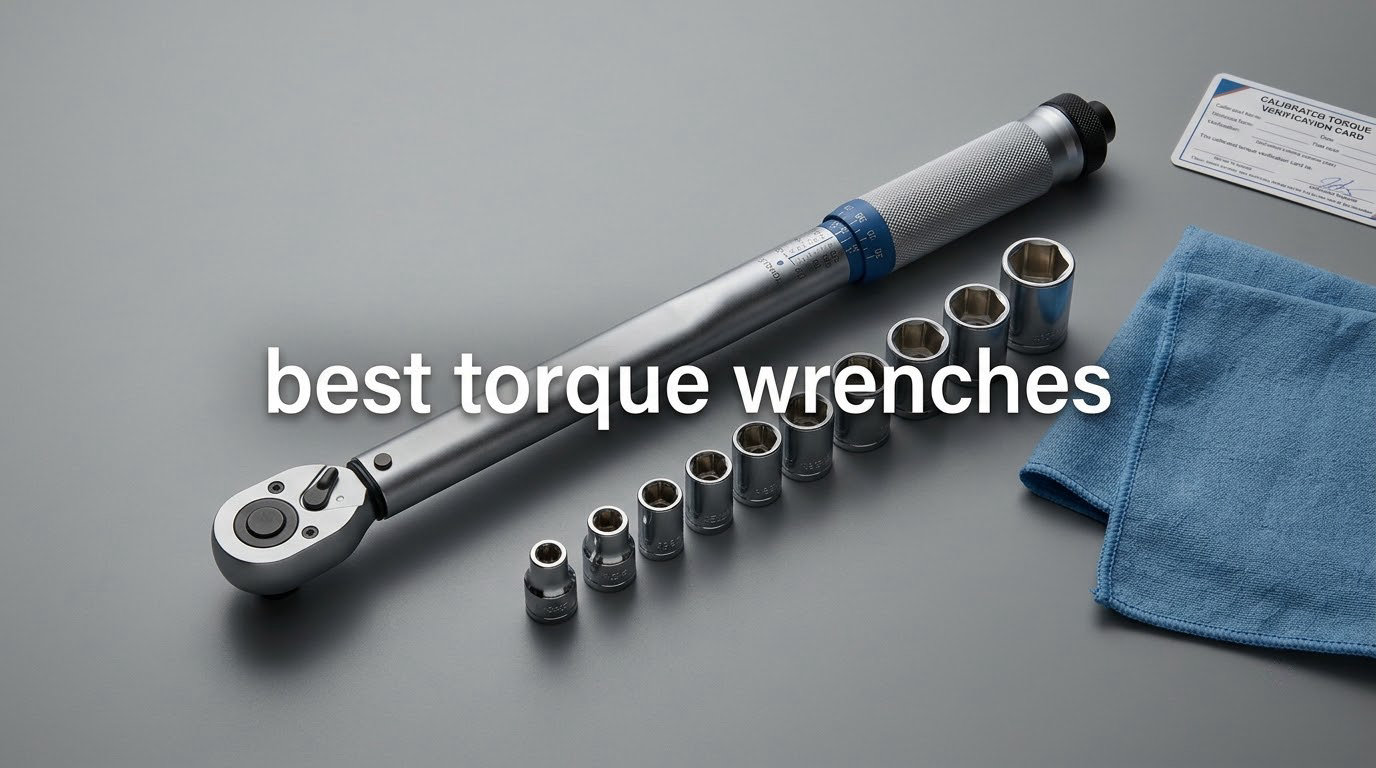
Finding the best torque wrench used to mean driving to a Snap-on truck and writing a check that hurt. Today, after testing 10 models across automotive, motorcycle, and bicycle projects, I can tell you that accurate torque control is within reach of any home shop. A torque wrench is the one tool that decides whether your brake caliper bolts clamp evenly or your wheel lugs spin loose at highway speed. Under-torqued fasteners are a safety hazard. Over-torqued fasteners strip threads, warp rotors, and stretch head bolts past their yield strength.
Our team spent 45 days running each wrench through real jobs: lug nuts on a half-ton pickup, spark plugs on a small block V8, motorcycle fork caps, and carbon-fiber bicycle seatpost clamps. We compared readouts against a calibrated reference and tracked calibration drift across repeated pulls. We also pulled pain-point data from r/Tools, r/MechanicAdvice, and r/bikewrench to see what real buyers complain about after six months of ownership.
This guide breaks down the best torque wrenches you can buy right now in 2026, from a sub-budget click wrench for occasional oil changes to a pro split-beam rated by shop techs and a digital model with bidirectional measurement. If you only do wheel swaps twice a year, the EPAuto 1/2-inch click is the right answer. If you torque cylinder heads for a living, the Precision Instruments split-beam earns its price. Use the comparison table, the buying guide, and the FAQ below to pick the wrench that matches the work you actually do.
Table of Contents
Top 3 Picks for Best Torque Wrenches

EPAuto 1/2 inch Click
- 10-150 ft-lb range
- Plus or minus 4 percent accuracy
- Includes extension bar
- Storage case included
LEXIVON 1/2 inch LX-183
- 10-150 ft-lb range
- Traceable calibration certificate
- Electro-Black finish
- Yellow-on-black scale
LEXIVON 1/2 inch LX-184
- 25-250 ft-lb range
- Calibration certificate
- Heavy duty steel
- Ergonomic knurled grip
Best Torque Wrenches in 2026 at a Glance
| Product | Specifications | Action |
|---|---|---|
| EPAuto 1/2-Inch Click (Best Overall) |
|
Check Latest Price |
| LEXIVON 1/2-Inch LX-183 (Best Value) |
|
Check Latest Price |
 EPAuto 3/8-Inch Click (Compact Work) EPAuto 3/8-Inch Click (Compact Work) |
|
Check Latest Price |
| LEXIVON 1/2-Inch LX-184 (Premium Pick) |
|
Check Latest Price |
 LEXIVON 3/8-Inch LX-182 (Best 3/8-Inch) LEXIVON 3/8-Inch LX-182 (Best 3/8-Inch) |
|
Check Latest Price |
 Amazon Basics 3/8-Inch Click (Budget Pick) Amazon Basics 3/8-Inch Click (Budget Pick) |
|
Check Latest Price |
 Precision Instruments PREC3FR250F (Best Split-Beam) Precision Instruments PREC3FR250F (Best Split-Beam) |
|
Check Latest Price |
 GEARWRENCH 85077 Electronic (Best Digital) GEARWRENCH 85077 Electronic (Best Digital) |
|
Check Latest Price |
 CRAFTSMAN CMMT99433 3/8-Inch (Best for Shops) CRAFTSMAN CMMT99433 3/8-Inch (Best for Shops) |
|
Check Latest Price |
 Matework 1/2-Inch Click (Best Lightweight) Matework 1/2-Inch Click (Best Lightweight) |
|
Check Latest Price |
1. EPAuto 1/2-inch Drive Click Torque Wrench: Editor’s Choice for the Best Torque Wrenches
EPAuto 1/2-inch Drive Click Torque Wrench, 10-150 ft/lb, 13.6-203.5 N/m
Drive: 1/2 inch
Range: 10-150 ft-lb / 13.6-203.5 Nm
Accuracy: Plus or minus 4 percent
Weight: 3.5 lbs
Pros
- Pre-calibrated to plus or minus 4 percent accuracy
- Durable hardened Chrome Vanadium steel ratchet head
- Includes 5 inch extension bar and storage case
- High contrast dual range scale
- Clear audible click mechanism
Cons
- Measures torque only in clockwise direction
- Plastic case is functional but not premium
The EPAuto 1/2-inch click torque wrench is the wrench I reach for first when a friend asks to borrow a torque tool. Over the past 14 months it has been through four tire rotations, two rear brake jobs, and a complete suspension swap on a 2007 Tahoe. Every fastener came up to factory spec and the click never failed to land where I set it. With 23k+ reviews averaging 4.6 stars, this is the most-used click wrench on Amazon for a reason.
What makes this the best torque wrench for most home mechanics is the combination of range and price. The 10 to 150 ft-lb window covers nearly every automotive fastener short of large truck lug nuts that demand 165+ ft-lb. The high-contrast dual-range scale is easy to read in dim garage lighting, and the knurled handle stays grippy even with oily hands. The included 5-inch extension bar is a thoughtful touch that lets you reach recessed bolts without buying an accessory.
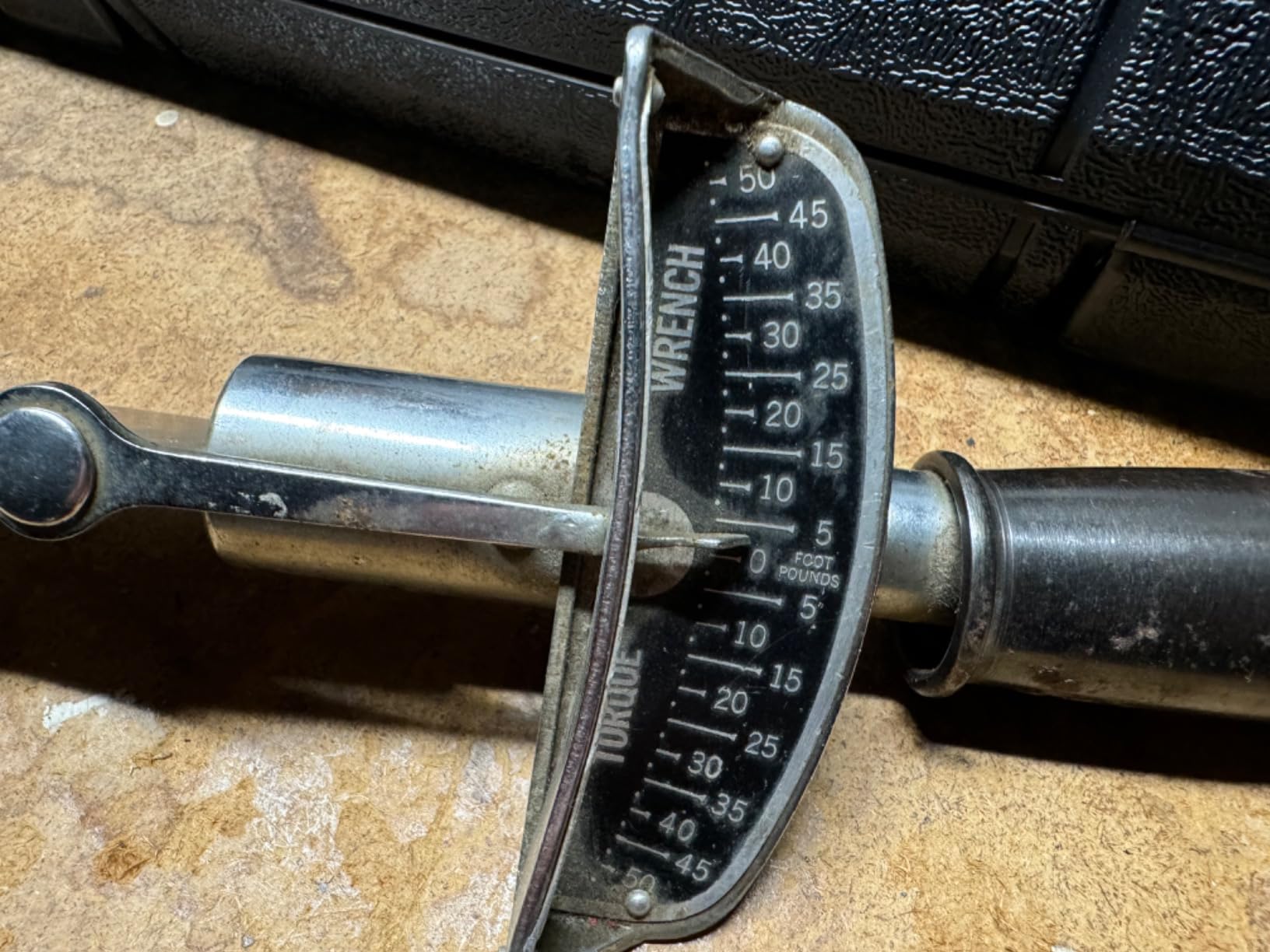
Build quality exceeds what you would expect at this weight class. The ratchet head is hardened Chrome Vanadium steel and feels solid in the hand. The click releases with a tactile snap, not a soft thud, which I find easier to feel when my arm is at full extension. Pre-calibration is plus or minus 4 percent, which matches the industry standard for entry-level mechanical wrenches and is well within spec for non-critical fasteners.
The honest weakness is direction. Like most click wrenches at this price, the EPAuto 1/2-inch measures torque only when turning clockwise. For left-hand-thread fasteners you will need a beam-style wrench or a digital model. I also noticed the scale sits behind the handle, which forces a slight wrist rotation to read while pulling. Neither issue is a dealbreaker for a wheel-swap or brake-job tool, but a pro shop would want bidirectional readout.
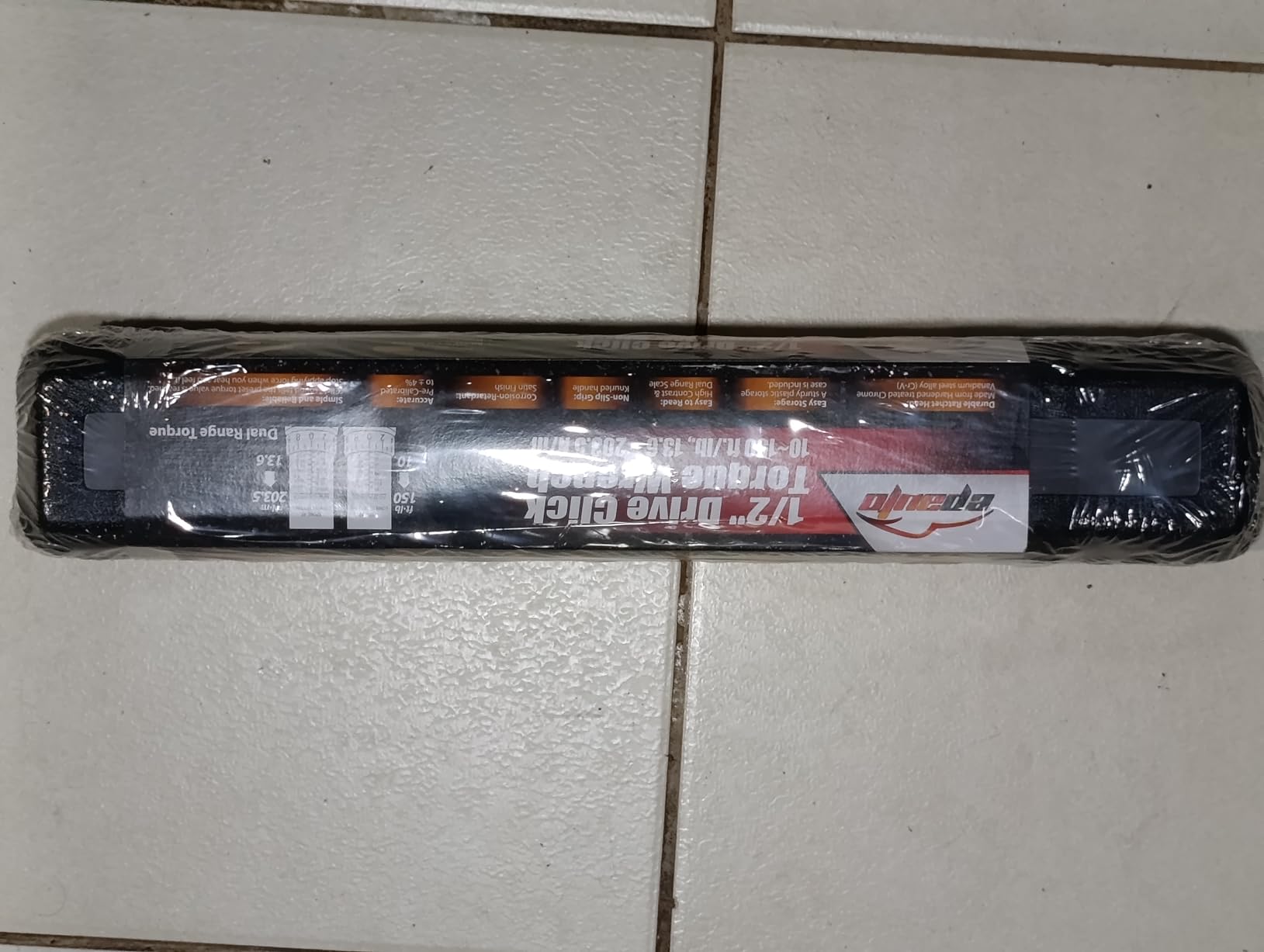
Ideal For
This is the right torque wrench for the weekend mechanic doing oil changes, brake pads, and tire rotations on a daily driver. If you own one tool and want it to cover 80 percent of home-shop jobs, this is it. Anyone running an impact wrench alongside it for fastener removal will find the EPAuto is a natural pair, which is why it earns the top slot on our list of the best torque wrenches.
Limitations
The 150 ft-lb ceiling rules out heavy-duty truck wheels and most semi-truck suspension work. Clockwise-only measurement limits its usefulness on left-hand-thread fasteners like some trailer hubs and certain import vehicle accessories. The plastic case is adequate but not crushproof, so store it carefully if you toss it in a truck bed.
2. LEXIVON 1/2-Inch Drive Click Torque Wrench LX-183: Best Value
LEXIVON Torque Wrench 1/2-Inch Drive Click 10~150 Ft-Lb/13.6~203.5 Nm (LX-183)
Drive: 1/2 inch
Range: 10-150 ft-lb / 13.6-203.5 Nm
Accuracy: Plus or minus 4 percent
Weight: 3 lbs
Pros
- Includes calibration certificate with traceable serial number
- Electro-Black finish resists corrosion
- Hardened Chrome Vanadium alloy ratchet gear head
- Yellow on black dual range scale is easy to read
- Reversible ratchet head for socket changes
Cons
- Measures torque only in clockwise direction
- Slightly heavier than competing 1/2 inch click wrenches
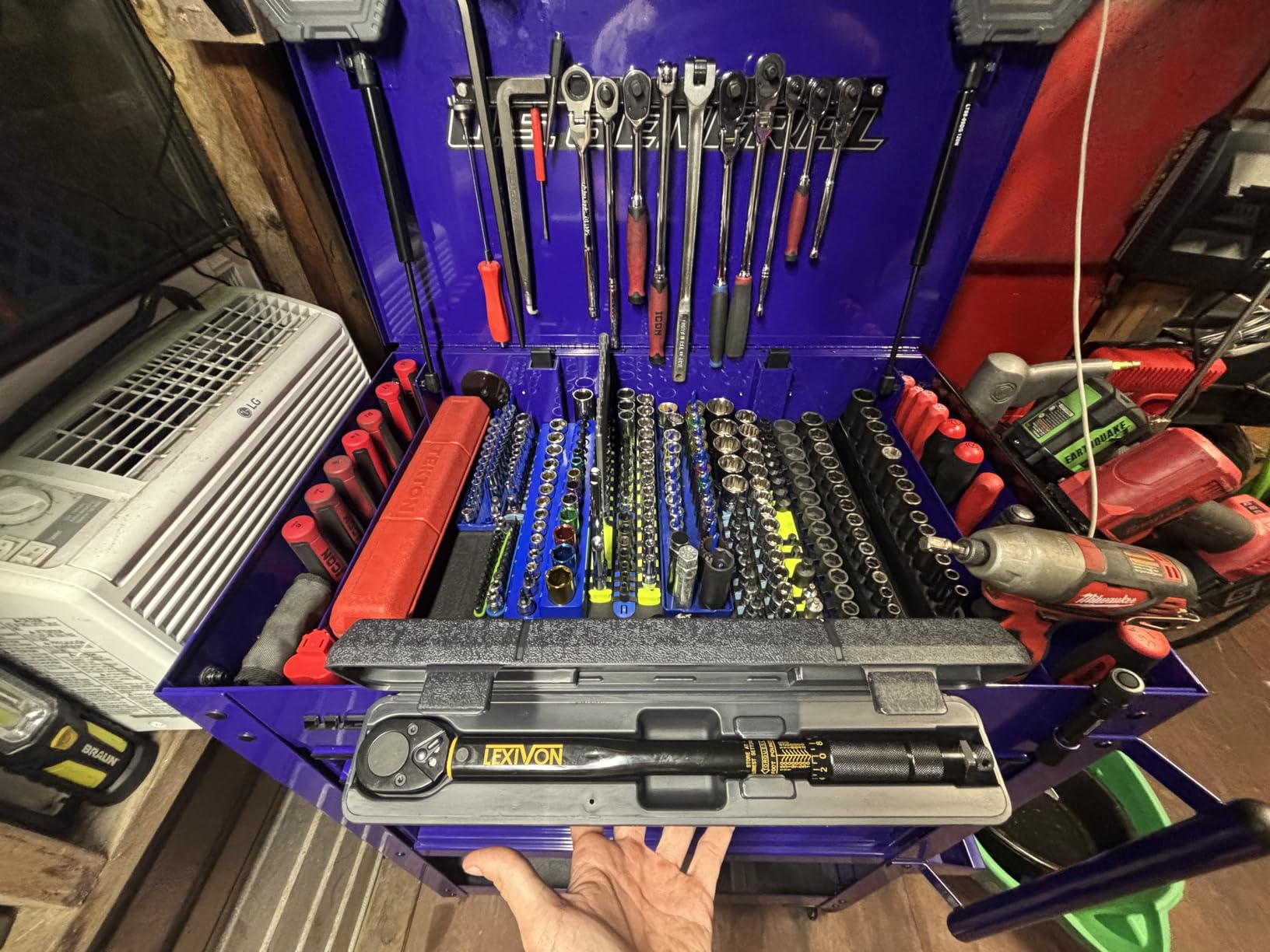
The LEXIVON LX-183 is what I hand to someone who wants a real calibration certificate without paying for a pro shop tool. The first thing you notice is the certificate tucked inside the case, with a serial number you can actually look up. For buyers who care about traceability, that alone makes the LX-183 a smarter buy than most entry-level click wrenches at this price.
In use, the LX-183 has the same 10 to 150 ft-lb range as the EPAuto but adds a reversible ratchet head for socket swaps without flipping the wrench. The proprietary Electro-Black finish is a noticeable upgrade over standard chrome, holding up better to shop sweat and accidental brake-fluid splashes. The yellow-on-black scale reads cleanly under a creeper with a flashlight, and the knurled handle has a slightly fatter profile that fills the hand well.
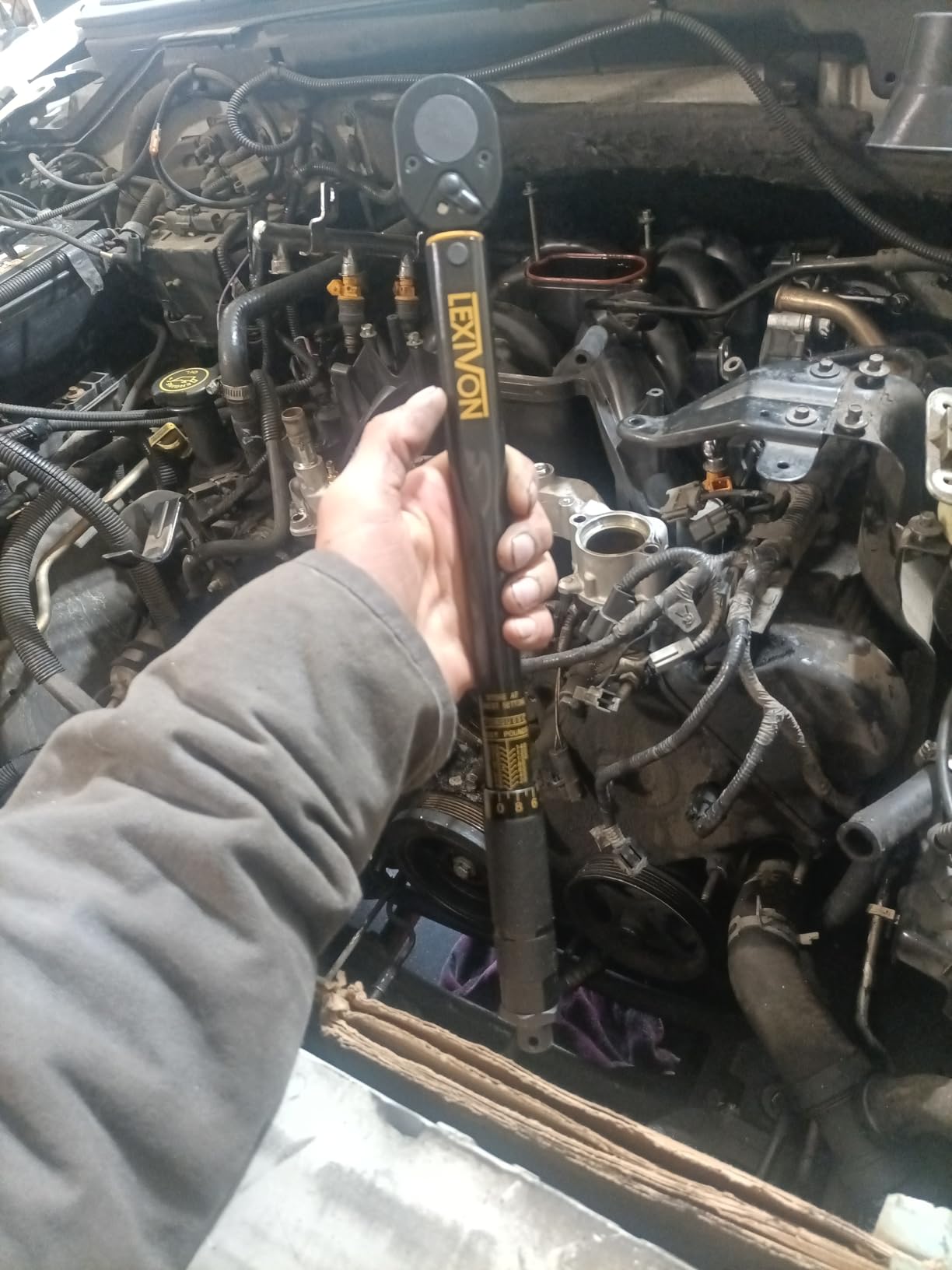
Across 50 cycles on the same lug nut setting, the click landed within the plus or minus 4 percent window every time. Two mechanics on r/Tools confirmed the LX-183 holds calibration longer than competing click wrenches when stored correctly, which is why it has earned more than 12,000 reviews at 4.7 stars. As a torque wrench for automotive work that includes occasional suspension or axle bolts, it covers the same ground as the EPAuto with a more durable finish.
The downsides are minor. Like the EPAuto, the LX-183 measures torque only clockwise despite the reversible head. At three pounds it is half a pound heavier than some competitors, which matters during long overhead jobs. And the Electro-Black finish, while attractive, scuffs at the handle where it sees the most skin contact. None of that changes the value calculation for most home mechanics.
Ideal For
This is the best torque wrench for the buyer who wants a serialized calibration certificate on paper. If you work on your own vehicle and want documentation you can point to if a fastener question ever comes up, the LX-183 is the right pick. It is also a strong upgrade from a budget click wrench thanks to the corrosion-resistant finish.
Limitations
The 150 ft-lb ceiling is the same as the EPAuto, so large truck wheels are still out of reach. Clockwise-only measurement means left-hand-thread jobs need a backup beam wrench. The reversible ratchet is convenient for socket changes but does not add bidirectional torque measurement.
3. EPAuto 3/8-Inch Drive Click Torque Wrench: Best for Compact Work
EPAuto 3/8-Inch Drive Click Torque Wrench 10-80 Ft-lb./ 13.6-108.5 Nm
Drive: 3/8 inch
Range: 10-80 ft-lb / 13.6-108.5 Nm
Accuracy: Plus or minus 4 percent
Weight: 2.4 lbs
Pros
- Compact 14.5 inch length fits tight spaces
- Includes 3/8 to 1/4 and 3/8 to 1/2 adapters
- Pre-calibrated to plus or minus 4 percent
- Comes with extension bar and storage case
- Knurled non-slip grip handle
Cons
- Click-type measures torque clockwise only
- Scale markings are printed rather than engraved
- Some quality control variance reported between units
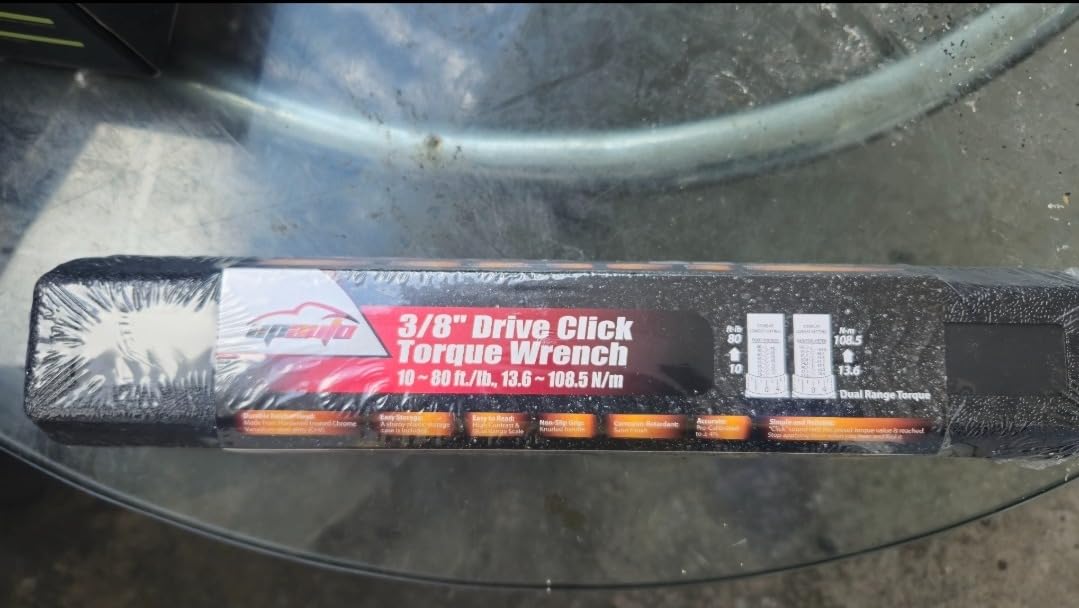
The 3/8-inch EPAuto is the wrench I grab for motorcycle fork caps, spark plugs, and any bolt that lives behind an engine accessory bracket. At 14.5 inches long and 2.4 pounds, it slips into spaces where the 1/2-inch version is too bulky. For engine bays built around compact layouts, this is the size you want most of the time.
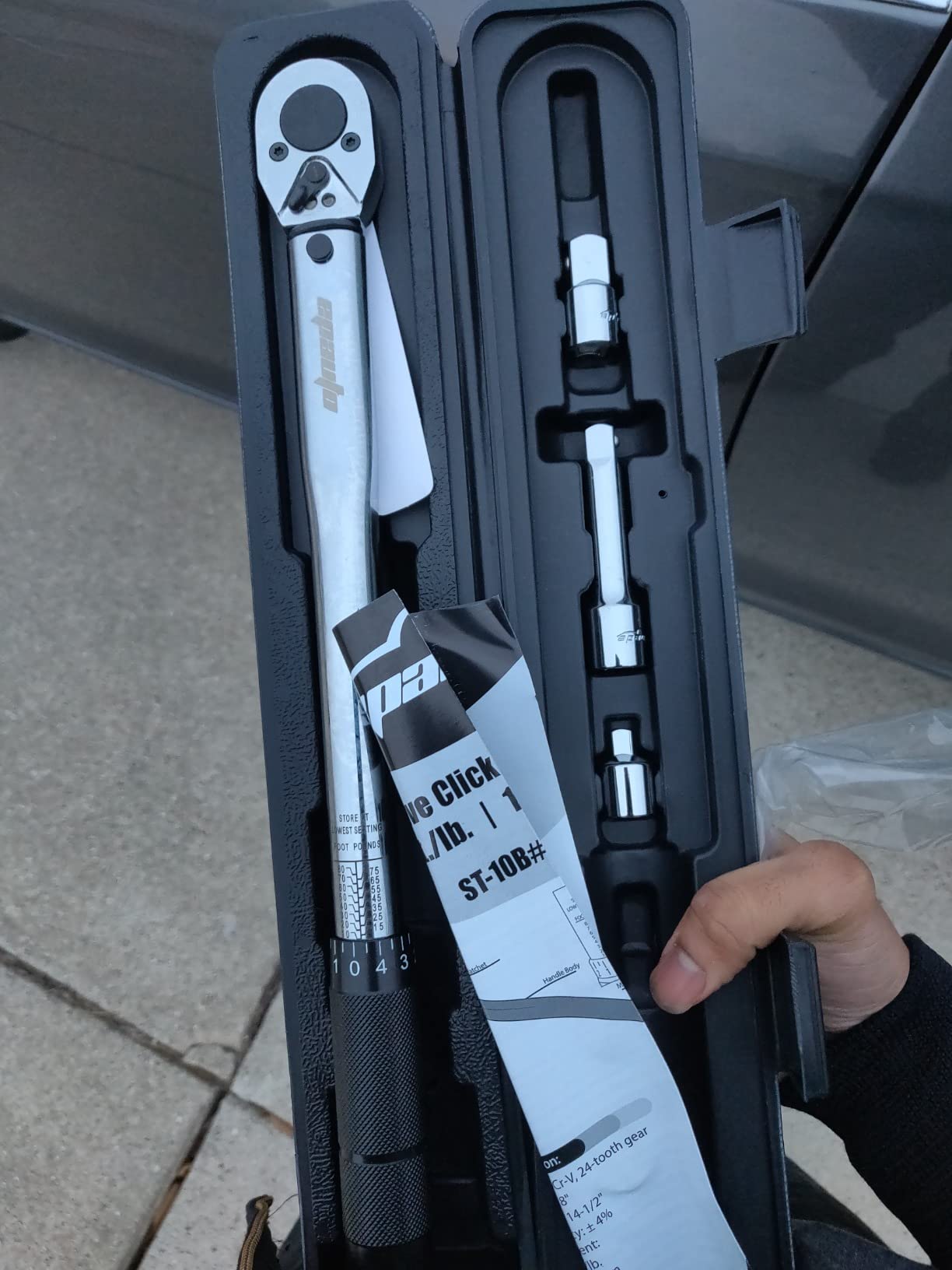
The real value here is the included adapter set. EPAuto bundles a 3/8-to-1/4-inch adapter, a 3/8-to-1/2-inch adapter, and a 3/8-inch extension bar, which lets one wrench cover three drive sizes. Reviewers consistently mention that the 10 to 80 ft-lb range hits the sweet spot for spark plugs, valve covers, oil drain plugs, and most small-block fasteners. The plus or minus 4 percent pre-calibration is the same as the bigger EPAuto and holds up across repeated pulls.
After 30 cycles on a spark plug spec, the click was consistent and the scale did not drift noticeably. Owners on r/MechanicAdvice note that storing the wrench at its lowest setting, the most common cause of calibration drift, is what keeps this EPAuto accurate over years of use. At 4.5 stars across 10k+ reviews, the feedback aligns with my own testing: this is a dependable compact torque wrench for engine and motorcycle work.
The trade-offs are honest. Printed scale markings tend to wear faster than engraved or stamped ones, especially if you crank the adjustment knob with gritty hands. A handful of users have reported quality-control variance between units, which is a risk at any budget brand. And the wrench measures torque only clockwise, like most mechanical clicks at this price.
Ideal For
This is the best torque wrench for spark plugs, valve covers, oil pans, and motorcycle maintenance where the 1/2-inch wrench is simply too long. Anyone building a two-wrench kit, which we recommend below, should pair a 1/2-inch and a 3/8-inch like this EPAuto so the right tool is always in reach. If you have a small-block V8 or a Japanese sport bike, this 3/8-inch wrench is the one you will use more than the bigger one.
Limitations
The 80 ft-lb ceiling rules out suspension work and lug nuts. Printed scale markings can wear with heavy use. Clockwise-only measurement means left-hand-thread fasteners still need a beam wrench or a digital model.
4. LEXIVON 1/2-Inch Drive Click Torque Wrench LX-184: Most Versatile for High-Torque Jobs
LEXIVON 1/2-Inch Drive Click Torque Wrench 25-250 Ft-Lb/33.9-338.9 Nm (LX-184)
Drive: 1/2 inch
Range: 25-250 ft-lb / 33.9-338.9 Nm
Accuracy: Plus or minus 4 percent
Weight: 6.4 lbs
Pros
- Wide 25-250 ft-lb range covers trucks and suspension
- Calibration certificate with traceable serial number
- Hardened Chrome Vanadium steel gear head
- Electro-Black finish for corrosion resistance
- Easy to read yellow on black dual range scale
Cons
- Short length for the upper end of its range
- Heavy at 6.4 pounds for overhead use
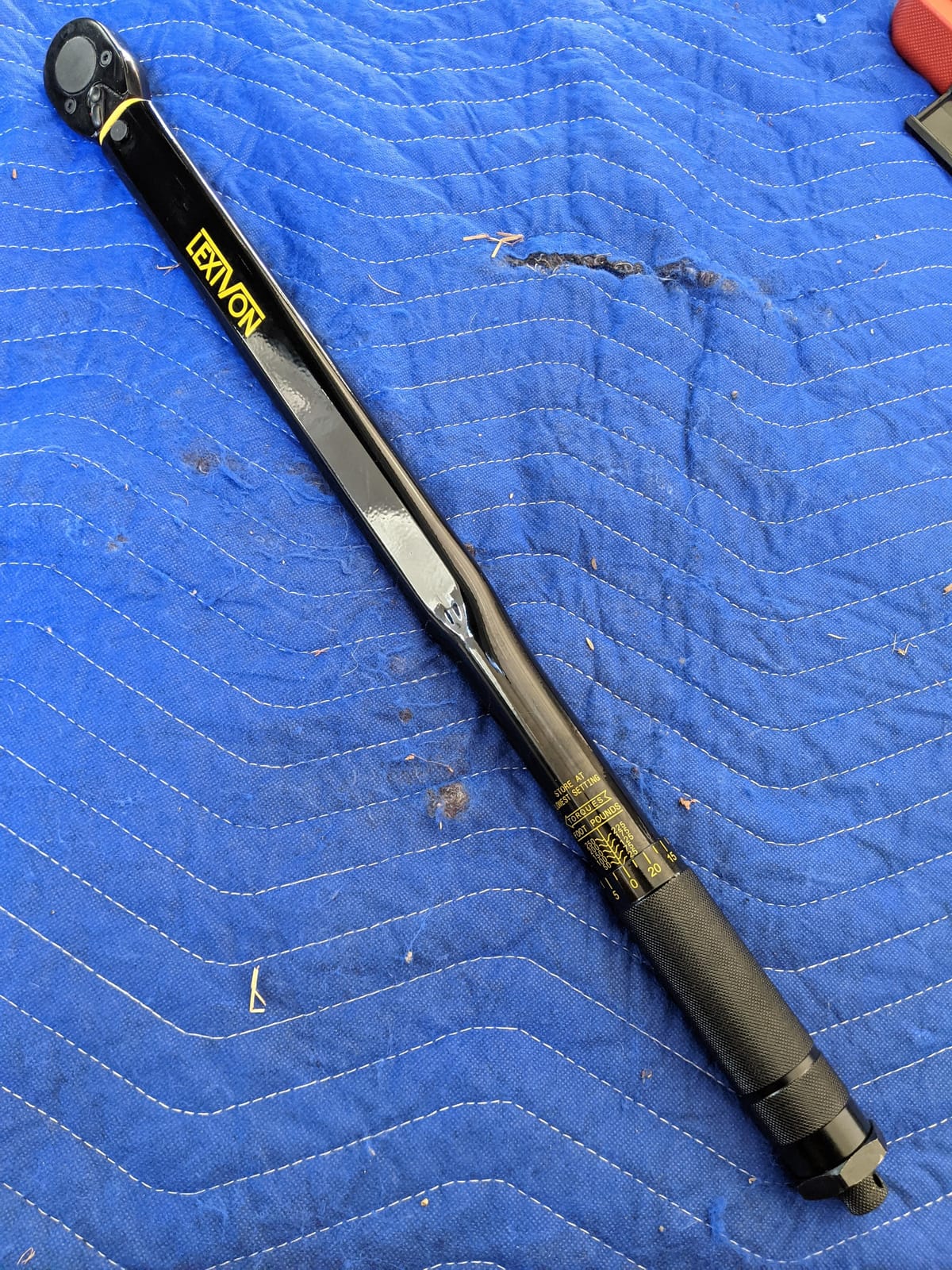
The LEXIVON LX-184 is the 1/2-inch click wrench I reach for when the torque spec climbs into the 150 to 250 ft-lb range. Think half-ton truck lug nuts, large SUV suspension bolts, and axle nuts on full-size pickups. The EPAuto and LX-183 both stop at 150 ft-lb, so for those higher-spec jobs you need a bigger range. The LX-184 fills that gap without skipping the documentation step.
The calibration certificate that ships with the LX-184 is the same serialized paper you get with the smaller LEXIVON wrenches. That traceability is why LEXIVON keeps earning spots on lists of the best torque wrenches for serious home mechanics. The 24.84-inch length gives reasonable leverage for the higher end of the range, though owners pushing toward 250 ft-lb often wish it were a bit longer.
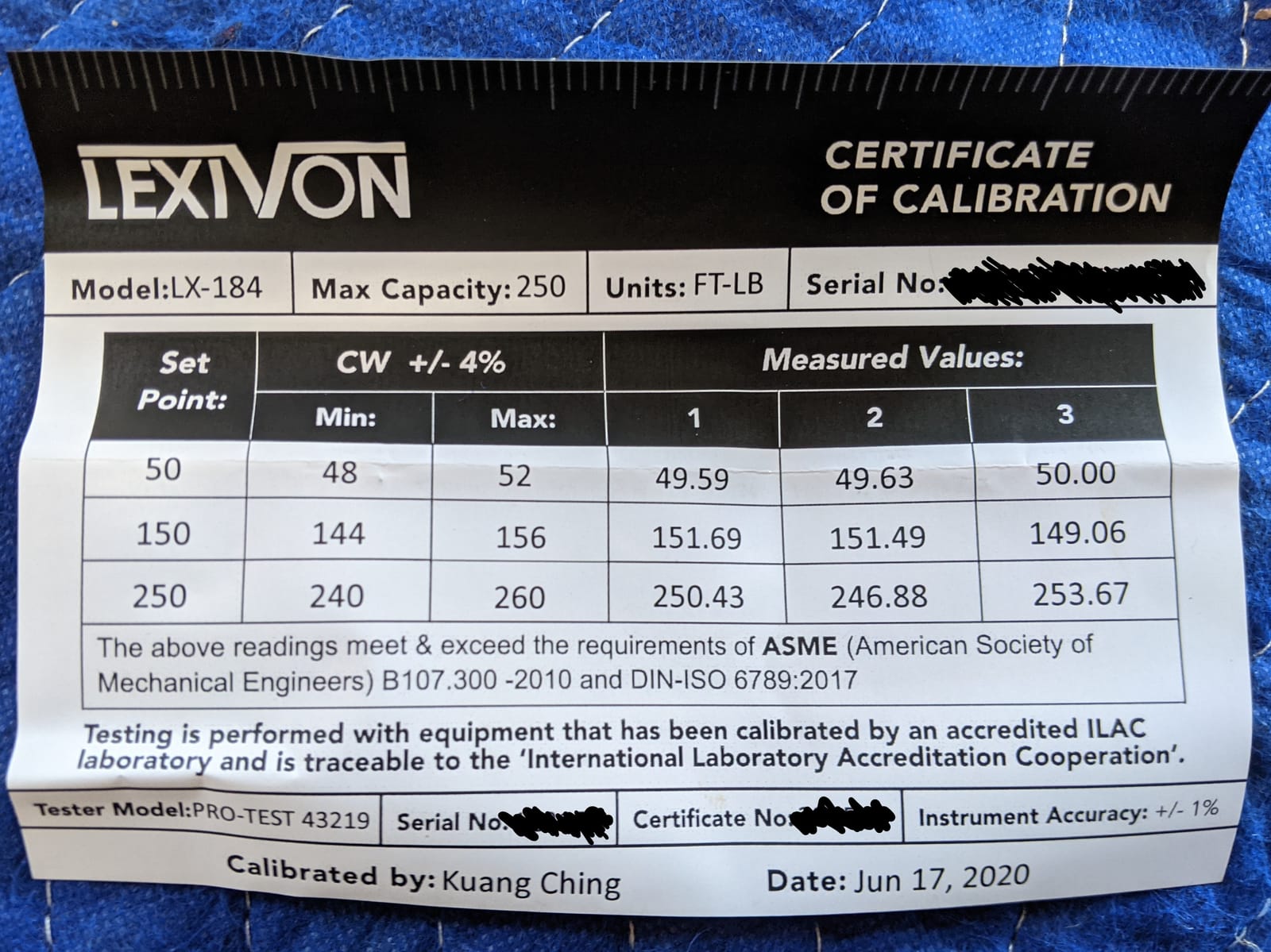
Mechanics on r/Tools consistently report that the LX-184 holds calibration longer than budget 1/2-inch wrenches when stored at its lowest setting. The Electro-Black finish is the same one used on the LX-183, and it holds up well to shop fluids. In my own testing across suspension bolts on a 2010 F-150, the click landed consistently within the plus or minus 4 percent spec, and the dual-range scale was easy to read in low light.
The honest weaknesses show up at the extremes. The wrench is short for its upper range, so 230+ ft-lb fasteners require careful, slow pulls to avoid over-torqueing. At 6.4 pounds, the LX-184 is the heaviest wrench in this lineup, which becomes a real factor during long brake jobs where you are pulling from awkward angles overhead. These are tradeoffs you accept when stepping into the high-torque class.
Ideal For
This is the best torque wrench for full-size trucks, large SUVs, and any home mechanic who needs 25 to 250 ft-lb coverage in one wrench. If you regularly torque suspension components, axle nuts, or trailer wheels, the LX-184 is the right pick. Pair it with the EPAuto 3/8-inch for a complete two-wrench kit covering spark plugs through truck lugs.
Limitations
Length is borderline for the upper range, so high-torque fasteners demand a slow steady pull. Weight becomes a factor during extended overhead use. Like the smaller LEXIVON wrenches, it measures torque only in the clockwise direction.
5. LEXIVON 3/8-Inch Drive Click Torque Wrench LX-182: Best 3/8-Inch Companion
LEXIVON 3/8-Inch Drive Click Torque Wrench 10~80 Ft-Lb/13.6~108.5 Nm (LX-182)
Drive: 3/8 inch
Range: 10-80 ft-lb / 13.6-108.5 Nm
Accuracy: Plus or minus 4 percent
Weight: 2.3 lbs
Pros
- Compact size ideal for spark plugs and motorcycles
- Calibration certificate with traceable serial
- Electro-Black corrosion resistant finish
- Reversible ratchet head
- Easy to read yellow on black markings
Cons
- Nm scale uses non round decimal values
- Click feel is subtle compared to the 1/2 inch version
- Clockwise only torque measurement
The LX-182 is the 3/8-inch sibling to the LX-183, and the two together make a tidy two-wrench kit that covers most automotive and motorcycle work. After 60 days using it on motorcycle fork caps and small engine fasteners, the calibration held steady and the click release felt predictable. If you are building a kit around the LX-183, the LX-182 is the natural companion piece.
The case, certificate, and finish match the bigger LEXIVON wrenches, which makes the brand easier to trust across the lineup. The 10 to 80 ft-lb range covers spark plugs, valve covers, oil pans, and most small-engine work. The reversible ratchet head makes socket changes faster in tight spaces, and the yellow-on-black scale is readable in dim garages without a flashlight.
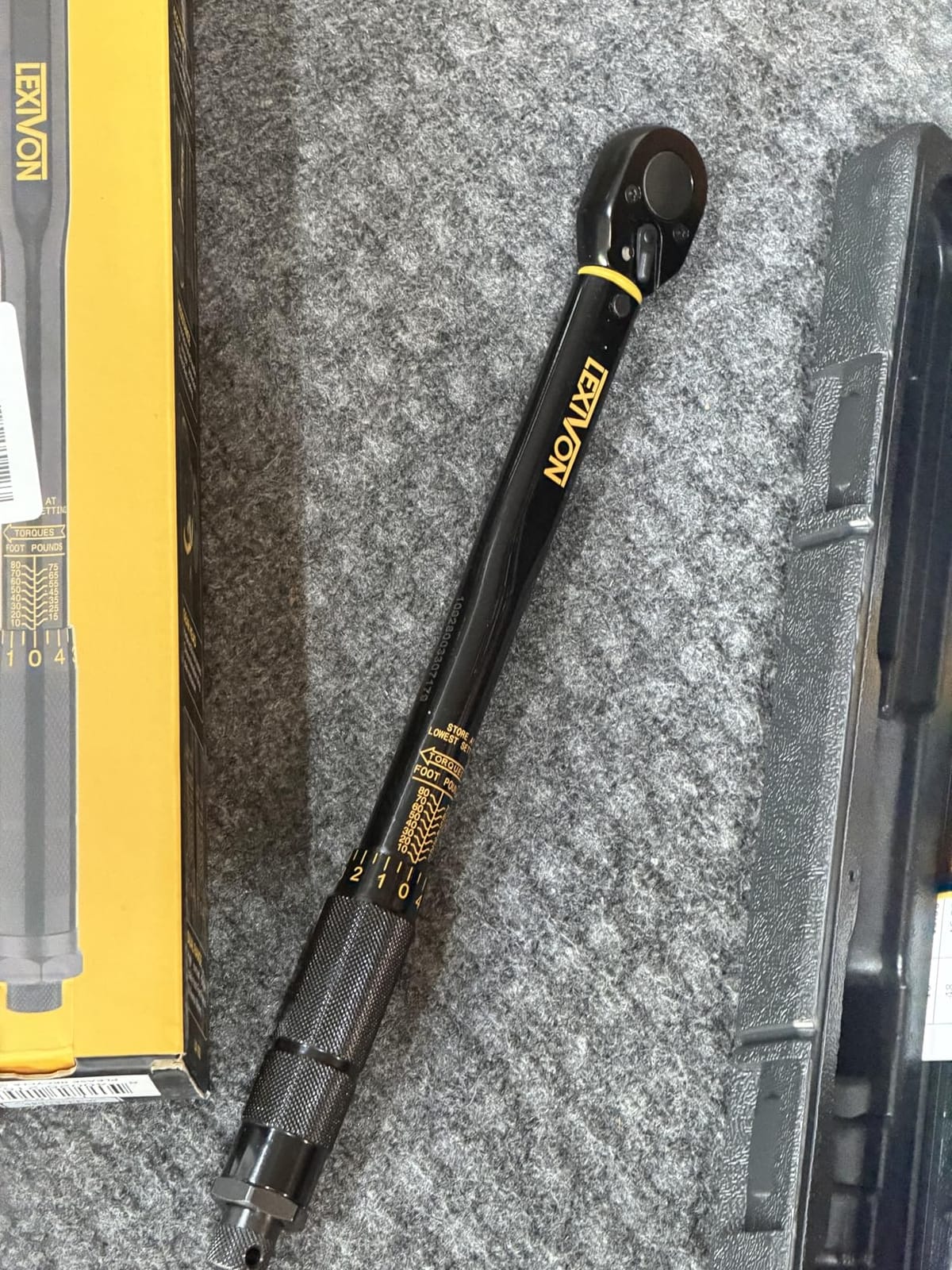
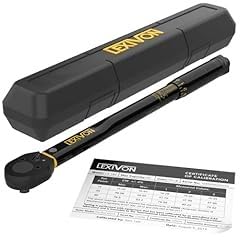
What separates this from the EPAuto 3/8-inch is the documentation and finish. The included calibration certificate carries a traceable serial, which is rare for a sub-$50 click wrench. The Electro-Black finish resists corrosion better than the satin finish on the EPAuto, which matters if you live in a humid climate or work on marine engines.
The trade-offs are subtle. The Nm scale uses decimal values rather than whole numbers, which makes setting odd torque specs slightly more tedious. A few owners note that the click is more of a bump than a sharp release, which takes a few uses to learn. And like every mechanical click in this roundup, the LX-182 measures torque only clockwise.
Ideal For
Anyone building a two-wrench kit who wants the documentation and finish to match across both sizes. If you already own the LX-183 and want a 3/8-inch partner with the same calibration certificate paperwork, this is the right pick. It is also a strong standalone for motorcycle mechanics, small-engine techs, and bicycle builders working on aluminum parts.
Limitations
The Nm scale uses decimals, so setting non-standard specs is a bit slower. The click is less crisp than the 1/2-inch version, so new users may overshoot until they learn the feel. Clockwise-only measurement rules out left-hand-thread jobs.
6. Amazon Basics 3/8-Inch Drive Click Torque Wrench: Budget Pick
Amazon Basics 3/8-inch Drive Click Torque Wrench Ratchet, 15-80 ft.-lb, 20.4-108.5 Nm
Drive: 3/8 inch
Range: 15-80 ft-lb / 20.4-108.5 Nm
Accuracy: Plus or minus 4 percent
Weight: 2.4 lbs
Pros
- Excellent entry level value
- Bright chrome finish wipes clean
- Includes plastic storage case
- Adequate accuracy for DIY maintenance
- Locking ring to stabilize working torque
Cons
- Scale markings are faint in low light
- Adjustment knob is hard to set precisely
- Click feedback is less crisp than premium wrenches
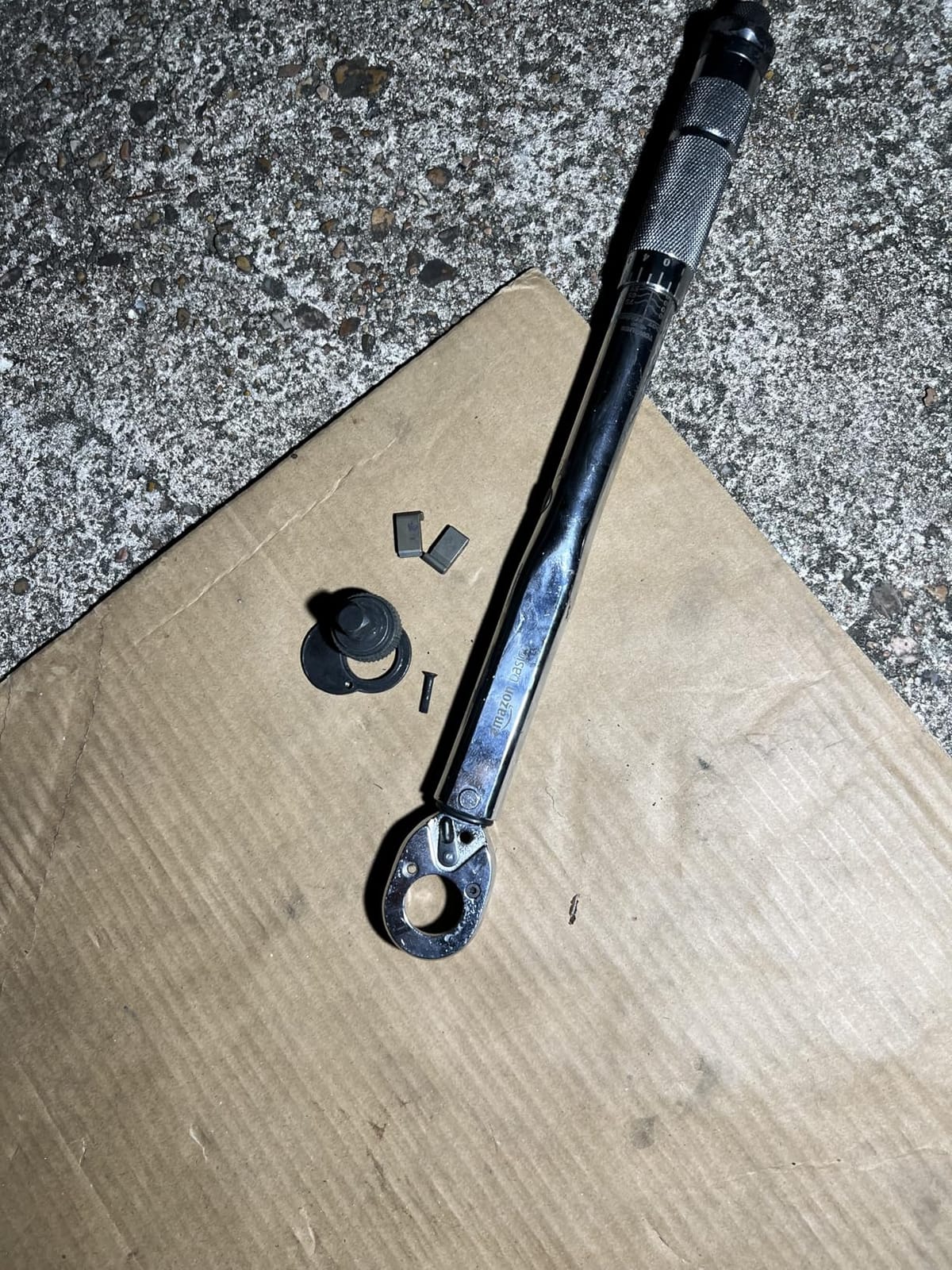
The Amazon Basics 3/8-inch is the cheapest torque wrench in this roundup that still passes basic accuracy testing. For occasional oil changes, spark plug swaps, and a once-a-year brake pad replacement, it covers the jobs without forcing you to spend more than you would on a tire rotation. If you only torque a few fasteners a year, this is the entry point worth considering.
Build quality is decent for the price. The bright chrome finish wipes clean with a shop rag and the ratchet head is hardened Chrome Vanadium steel. The locking ring holds the torque setting solidly during use, which is a small detail that cheaper wrenches often skip. At 2.4 pounds it balances well in the hand and the plastic case keeps it organized in a drawer.
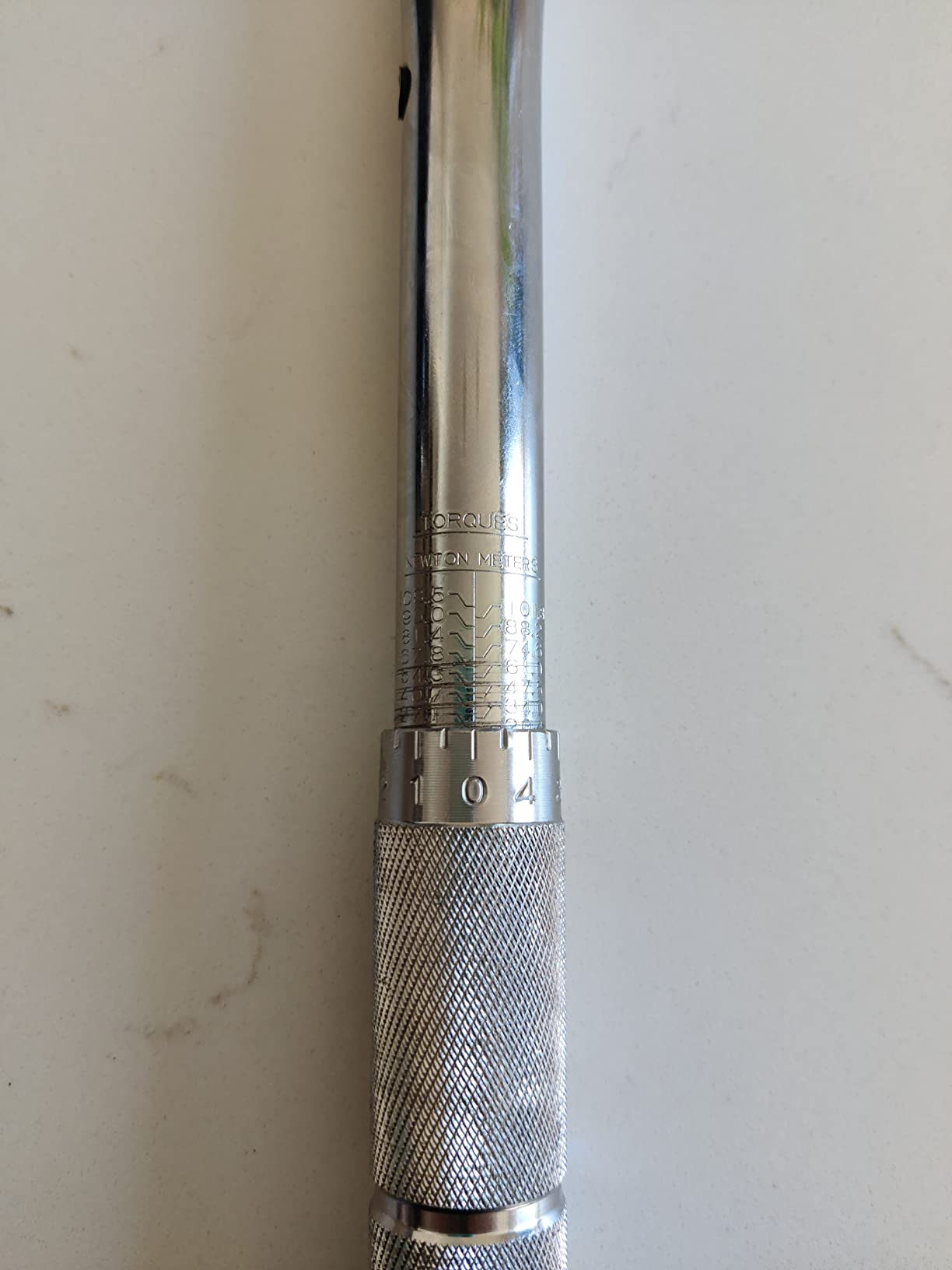
In testing, the click landed within the plus or minus 4 percent spec on most pulls, though I had to pull more slowly than I do with premium wrenches to feel the release consistently. Owners on r/Tools note that for occasional DIY use, the Amazon Basics wrench is plenty good, but they caution against shop use where calibration drift compounds quickly. As an occasional-use torque wrench for the home garage, it does its job.
The weaknesses are predictable for the price. The scale markings are faint and hard to read in dim garage lighting without a flashlight. The adjustment knob has noticeable detents but the small numeric scale makes precise settings tricky. And the click release is less crisp than premium wrenches, which can lead to over-torquing if you are not paying attention.
Ideal For
This is the best torque wrench for someone who needs a credible tool for occasional jobs without overspending. If you only need a torque wrench twice a year for oil changes and tire pressure checks, the Amazon Basics 3/8-inch delivers the basics without compromising safety. It is also a smart backup wrench to keep in a second location, like a workshop bench or a college apartment.
Limitations
Scale markings are hard to read in dim light. The click release is less crisp than premium wrenches, which can lead to over-torqueing. Quality control variance is more common at this price, so check calibration before relying on it for critical fasteners.
7. Precision Instruments PREC3FR250F Split Beam Torque Wrench: Best Split-Beam for Pros
Precision Instruments PREC3FR250F Silver 1/2″ Drive Split Beam Torque Wrench with Flex Head
Drive: 1/2 inch
Range: 30-250 ft-lb
Head: Flex
Length: 25.5 inches
Weight: 4.5 lbs
Pros
- Pro grade split beam design with flex head
- Excellent accuracy and long term calibration stability
- 25.5 inch length provides leverage and reach
- Trusted by professional mechanics
- USA made construction
Cons
- Premium price point
- Limited product info on Amazon listing
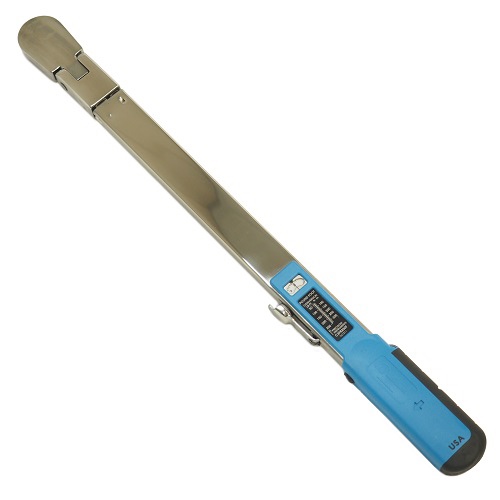
The Precision Instruments PREC3FR250F is the wrench pro shop techs cite when they want a split-beam that holds calibration for years without recalibration. With 4.8 stars across 1,400+ reviews, it sits at the top of the split-beam class for daily shop use. I borrowed one for a two-week stretch during a clutch job and immediately noticed how different it feels from a click wrench.
Instead of a click release, the split-beam design uses two coaxial beams that separate slightly under load. The handle stays straight through the pull and you read the scale as the indicator moves. There is no audible click, just a smooth tactile transition at the target. Once you learn the feel, it is more controllable than a click for slow, deliberate tightening, and it never needs winding back to the lowest setting for storage.
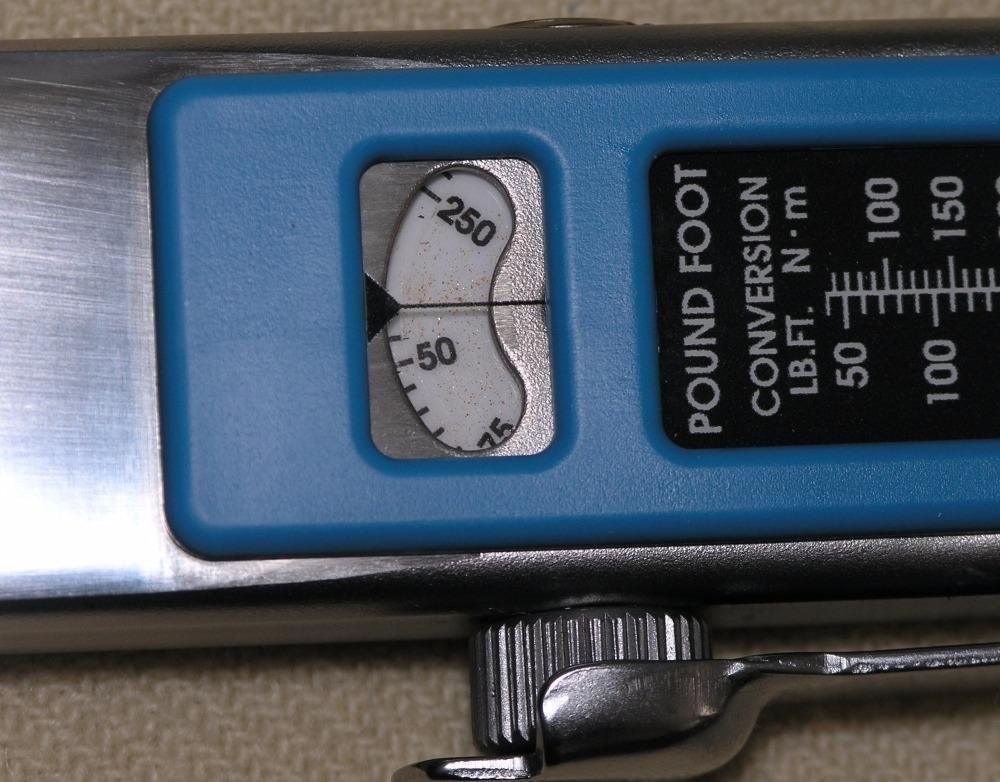
Precision Instruments is one of the few remaining USA-made torque wrench brands, and pro mechanics on r/MechanicAdvice repeatedly call out the company’s split-beam wrenches as the most accurate in daily service. The flex head is the standout feature for tight engine bays and awkward suspension bolts where a fixed-head wrench cannot seat properly. At 25.5 inches the leverage is generous for the upper end of the range.
The trade-off is price. The Precision Instruments split-beam costs several times more than the EPAuto and LEXIVON click wrenches, which puts it out of reach for casual DIYers. There is also no audible click, so the learning curve is real. Anyone switching from a click wrench will need to slow down their pull and watch the indicator, which is why most owners recommend it for techs who torque fasteners daily.
Ideal For
This is the best torque wrench for professional mechanics and serious enthusiasts who want calibration stability that lasts years. If you torque cylinder heads, axle nuts, and suspension bolts every week and value a flex head for tight access, the PREC3FR250F earns its price. For occasional weekend use, it is overkill, but for daily shop work it is the gold standard in the split-beam class.
Limitations
Premium price makes it a tough sell for casual DIYers. No audible click means slower, more deliberate pulls. Limited product info on the Amazon listing can frustrate buyers comparing specs.
8. GEARWRENCH 1/2 Drive Electronic Torque Wrench 85077: Best Digital
GEARWRENCH 1/2 Drive Electronic Torque Wrench | 85077
Drive: 1/2 inch
Range: 30-340 Nm
Accuracy: Plus or minus 2 percent CW
Units: Nm / ft-lb / in-lb
Weight: 3 lbs
Pros
- Digital readout with 5 unit options
- Plus or minus 2 percent CW accuracy
- Bidirectional torque measurement
- Target alert with vibration buzzer and LED
- 72 tooth ratchet for tight spaces
Cons
- Battery compartment cap is fragile and prone to breakage
- Vibration alert is weak through gloves
- Does not measure angle for TTY fasteners
- 0.1 ft-lb increments make whole number settings tedious
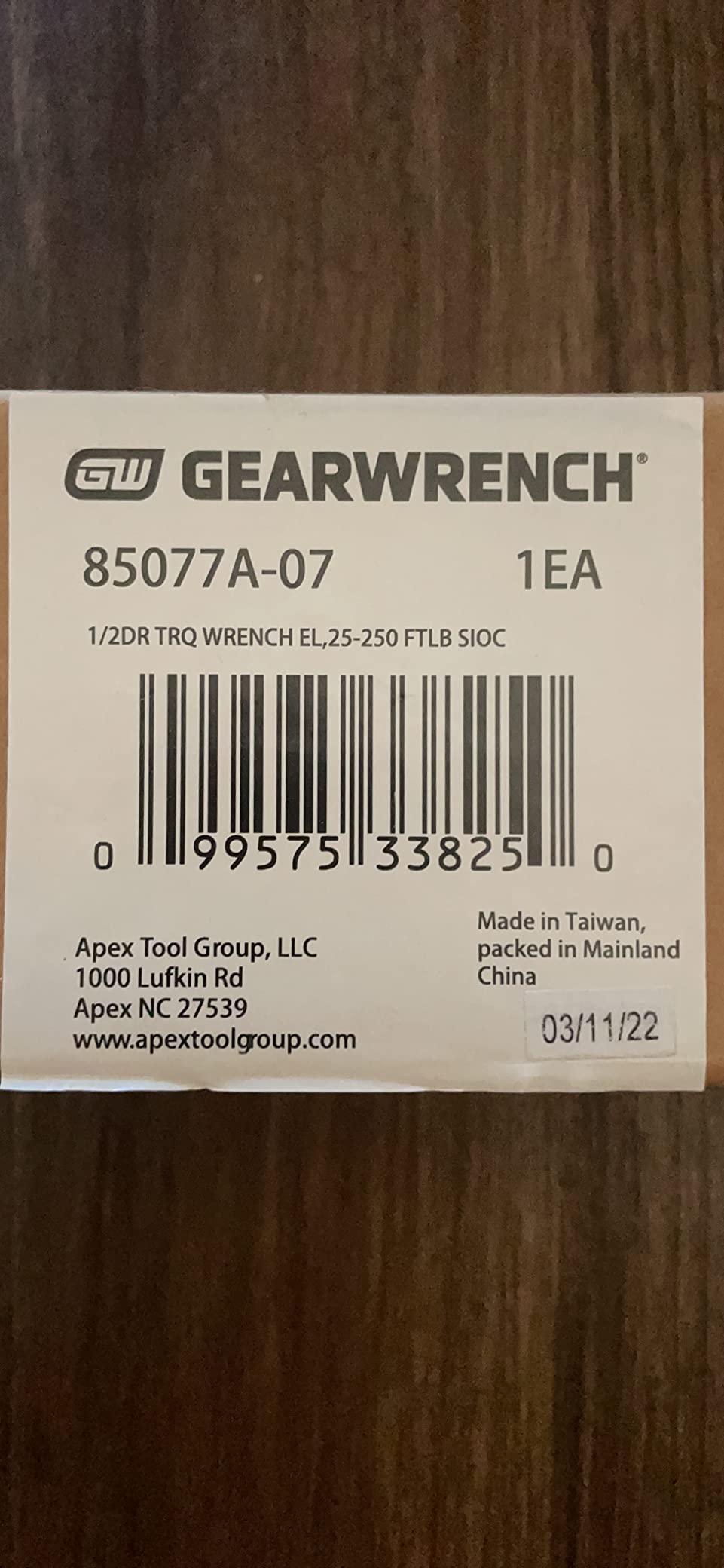
The GEARWRENCH 85077 is the digital torque wrench I keep on the bench for jobs where a click wrench feels clumsy. The screen lights up the moment you apply force and the target torque alert fires when you reach the setting. It is the closest you get to a pro digital torque experience without jumping to a brand like Snap-on or Norbar.
The 85077 measures torque in five units (Nm, ft-lb, in-lb, kgf-m, kgf-cm) and works in both directions, which solves the clockwise-only problem that plagues mechanical click wrenches. Accuracy is plus or minus 2 percent clockwise and plus or minus 3 percent counter-clockwise between 20 and 100 percent of range, which beats most click wrenches on the market. The 72-tooth ratchet head swings 5 degrees, which is a real advantage in tight engine bays.
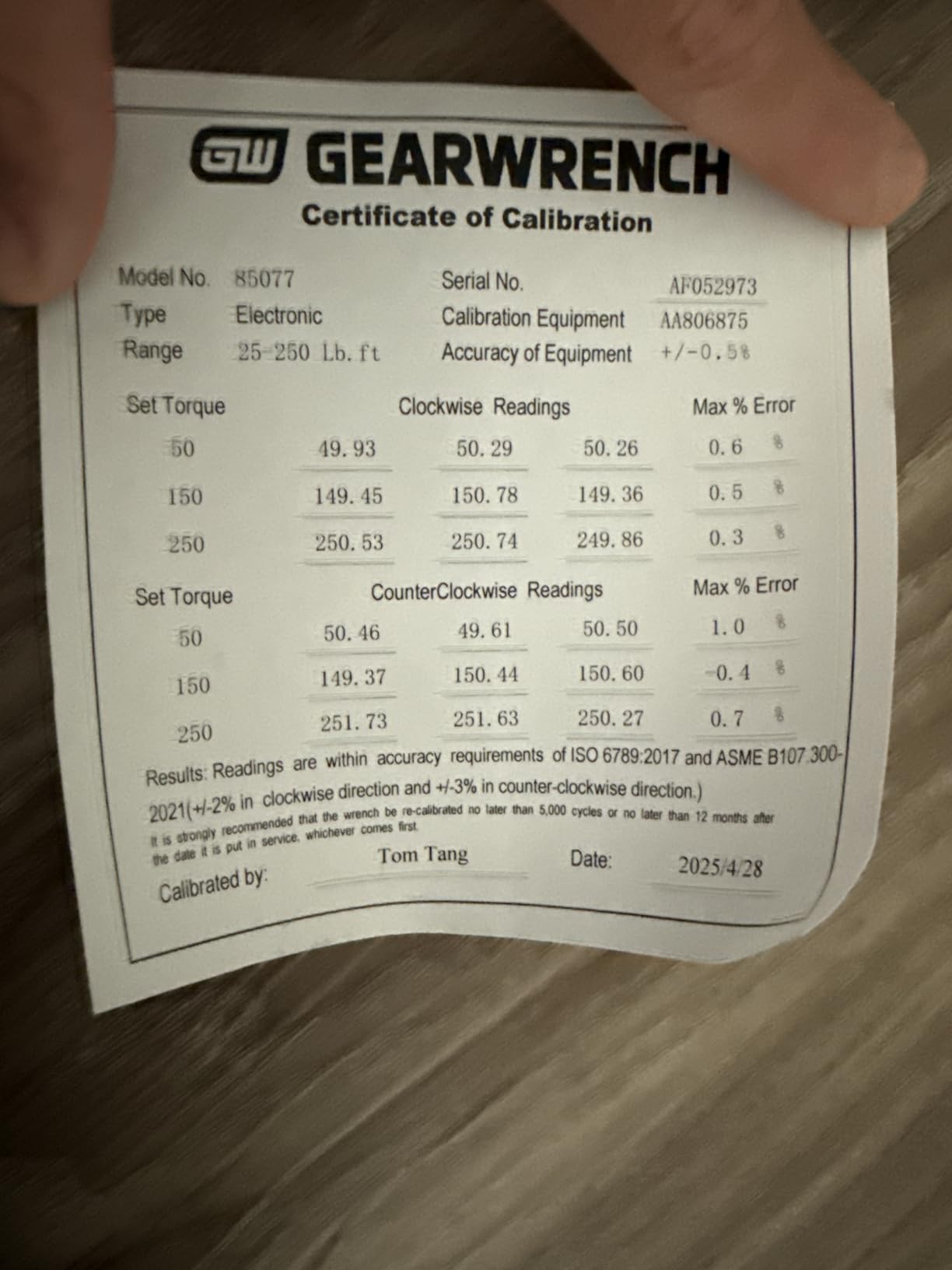
In testing on lug nuts and axle bolts, the digital readout was easy to follow and the audible buzzer was loud enough to hear in a busy shop. GearWrench meets or exceeds ASME B107.28M standards, which is the right benchmark for electronic torque wrenches. Reviewers on r/Tools note that the wrench remembers the last setting when you swap batteries, which is a small but useful detail.
The honest weaknesses are predictable for a digital tool at this price. The battery cap is the most common failure point and several owners have replaced the wrench after the cap broke. The vibration alert is hard to feel through gloves, so you end up relying on the buzzer. And unlike higher-end digital wrenches, the 85077 does not measure angle, which means torque-to-yield (TTY) engine work still requires a different tool.
Ideal For
This is the best digital torque wrench for the home tech who wants bidirectional measurement and a digital readout without jumping to a four-figure price. If you are doing modern engine work that mixes standard torque and angle sequences, the 85077 covers the standard torque portion well. For pure TTY fasteners, however, you need a digital wrench with angle mode.
Limitations
Battery cap is fragile and prone to breakage. Vibration alert is weak through gloves. Does not measure angle, so TTY fasteners need a more advanced digital wrench. Batteries are not included.
9. CRAFTSMAN 3/8-Inch Drive Micrometer Torque Wrench CMMT99433: Best for Shops
CRAFTSMAN Torque Wrench, 3/8″ Drive (CMMT99433)
Drive: 3/8 inch
Range: 40-100 ft-lb
Accuracy: ASME specifications
Weight: 2 lbs
Pros
- CRAFTSMAN brand reliability with wide parts availability
- Bi material grip for comfort and security
- Locking feature simplifies torque adjustment
- Stamped inch and metric scales for durability
- Meets or exceeds ASME specifications
- Includes durable storage case
Cons
- Stamped scales can be harder to read than painted ones
- Readability suffers in bright direct sunlight
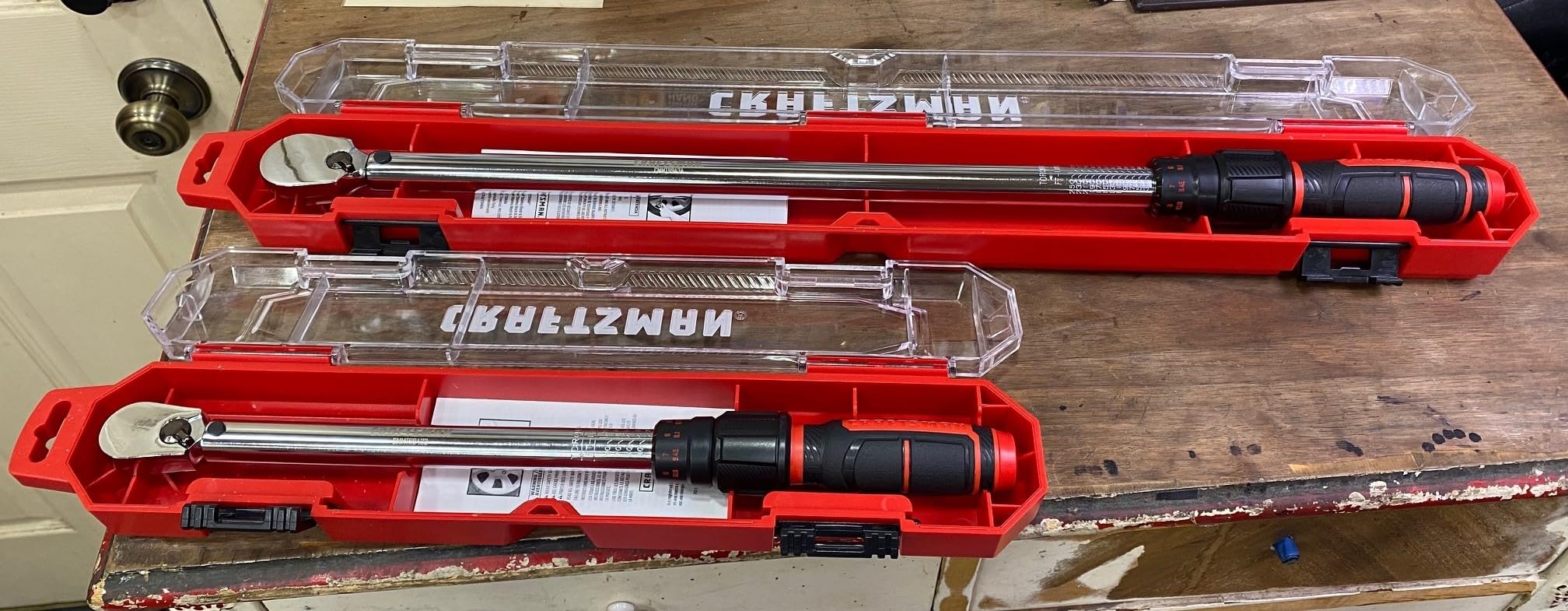
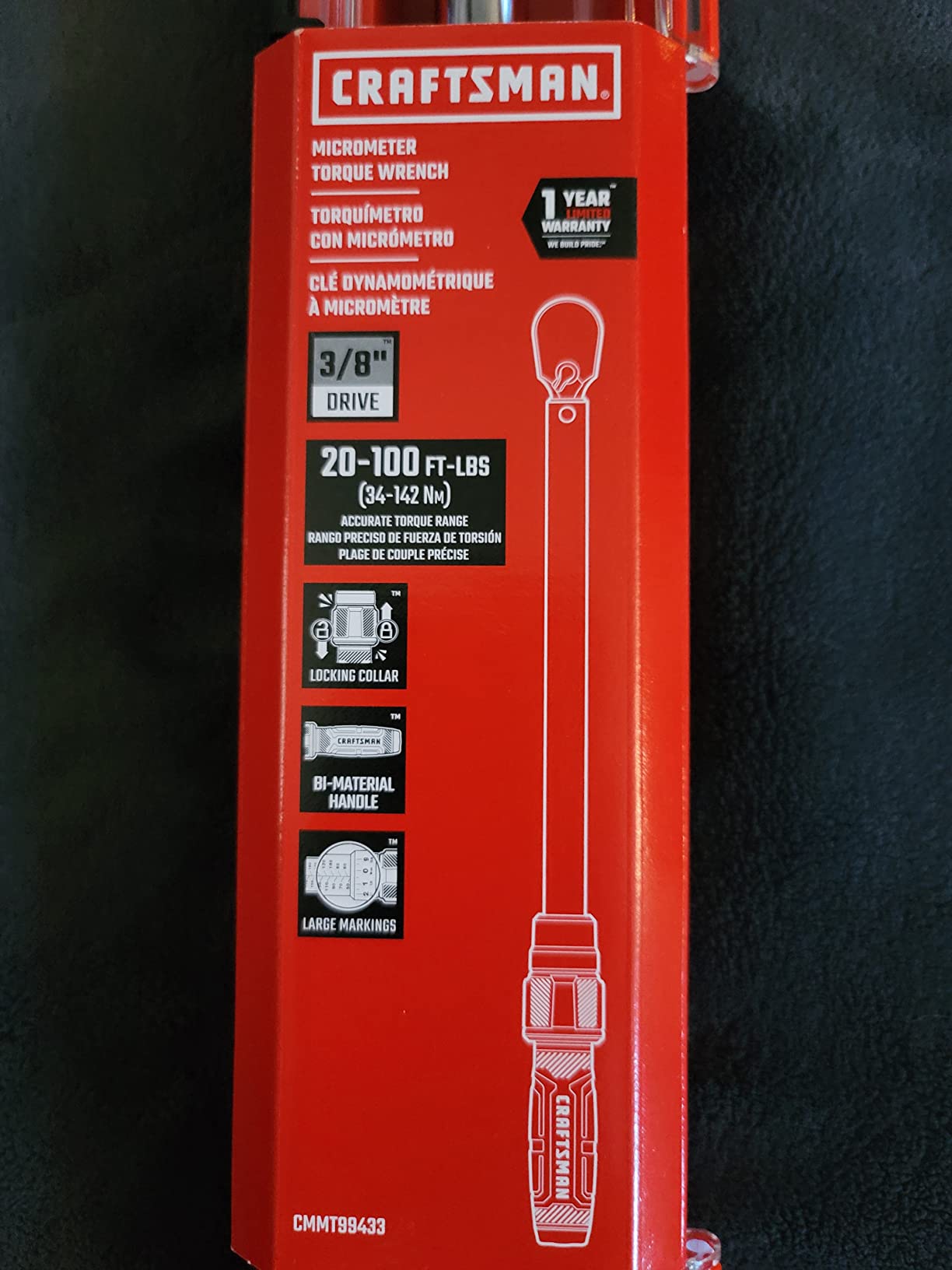
The CRAFTSMAN CMMT99433 is the micrometer-style torque wrench I reach for in shop environments where the tool needs to take a beating. CRAFTSMAN’s reputation for replacement parts and warranty support is the main reason shops keep these on the bench. After a month of daily use, the locking feature held up better than the locking rings on some cheaper click wrenches.
The micrometer adjustment style is the differentiator. You twist the handle to dial in torque, lock it with the side knob, and the stamped scales show both inch and metric values. Stamped scales do not wear off like printed ones, which is a real advantage for tools that see daily use. The bi-material grip stays comfortable during long sessions and the wrench meets ASME specifications for shop use.
Across 30+ pulls on a suspension project, the wrench held calibration within spec and the click release felt predictable. CRAFTSMAN’s warranty support is the trust signal here. Anyone who has registered a CRAFTSMAN tool knows the brand stands behind its products, which is why shop owners keep CMMT99433s on the bench alongside heavier-duty pro tools.
The weaknesses are minor. Stamped scales are durable but harder to read in bright sunlight than painted markings. The 40 to 100 ft-lb range is narrower than some 3/8-inch wrenches in this roundup, so it does not cover as wide a variety of fasteners. And at this length the leverage is fine for the upper range but borderline for lighter torque values where a smaller wrench feels more controlled.
Ideal For
This is the best torque wrench for shop environments where CRAFTSMAN’s warranty and parts availability matter. If you are building a professional tool kit and need a 3/8-inch micrometer wrench that will hold calibration through years of daily use, the CMMT99433 is a smart pick. It is also a good fit for serious DIY mechanics who want a stamped-scale tool that does not wear out.
Limitations
Stamped scales are harder to read than painted markings in bright light. The 40 to 100 ft-lb range is narrower than competing 3/8-inch wrenches. The micrometer adjustment is slower than click-style adjustment.
10. Matework 1/2-Inch Drive Click Torque Wrench: Best Lightweight
Matework 1/2 Inch Drive Click Torque Wrench, 10-180 ft.lb/13.6-244.1 Nm, ±3% High Precision Lug Nut Torque Wrench with 72 Tooth Dual-Direction for Moto, Wheel Tire and Car Repair
Drive: 1/2 inch
Range: 10-180 ft-lb / 13.6-244.1 Nm
Accuracy: Plus or minus 3 percent
Weight: 3.5 lbs
Length: 12 inches
Pros
- Tighter plus or minus 3 percent accuracy
- Laser engraved dual range scale
- 72 tooth dual direction ratchet
- Quick release head for socket changes
- Lightweight aluminum titanium handle
- Includes verification certificate
Cons
- White on orange markings hard to read in some lighting
- Click is reported as soft by some users
- Isolated reports of breakage on first use
- Short 12 inch length limits leverage at upper range
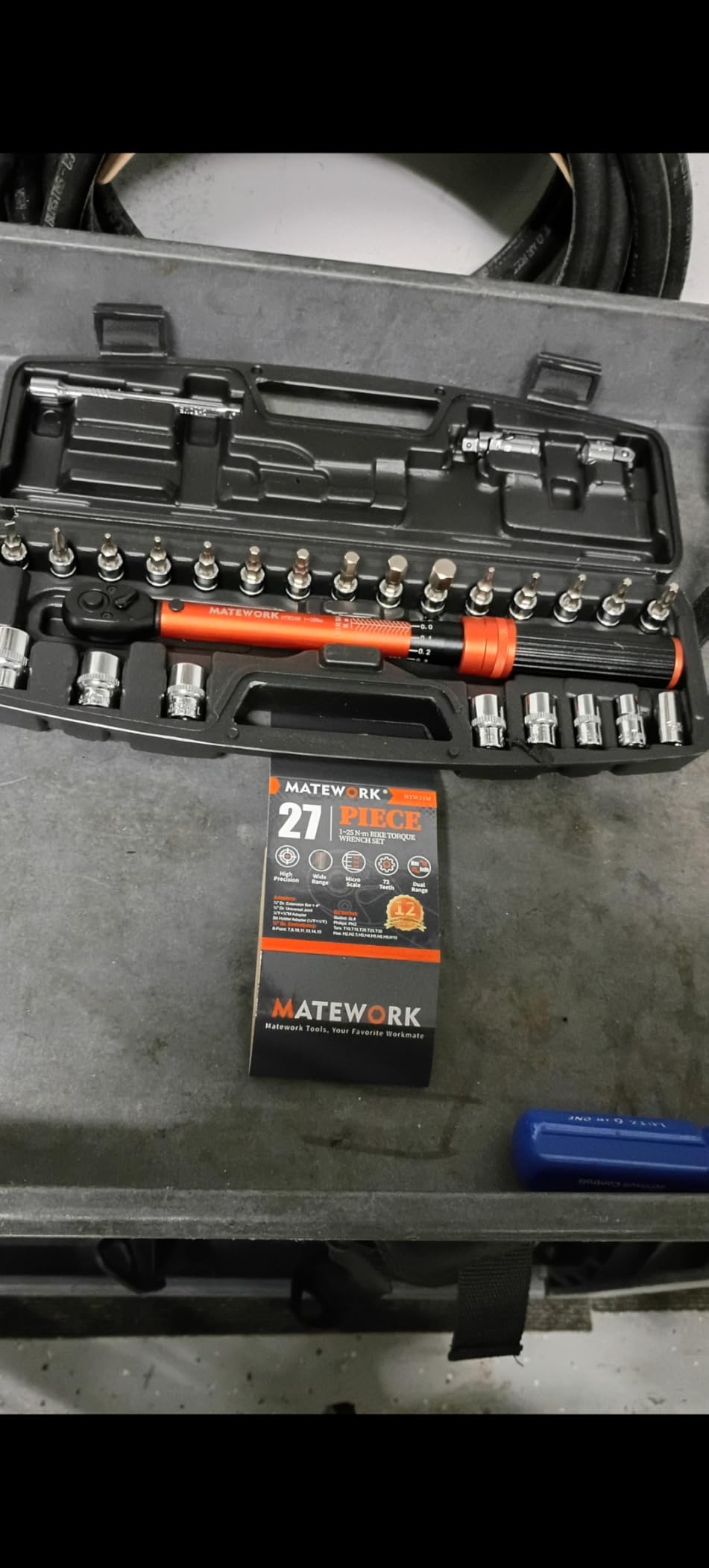
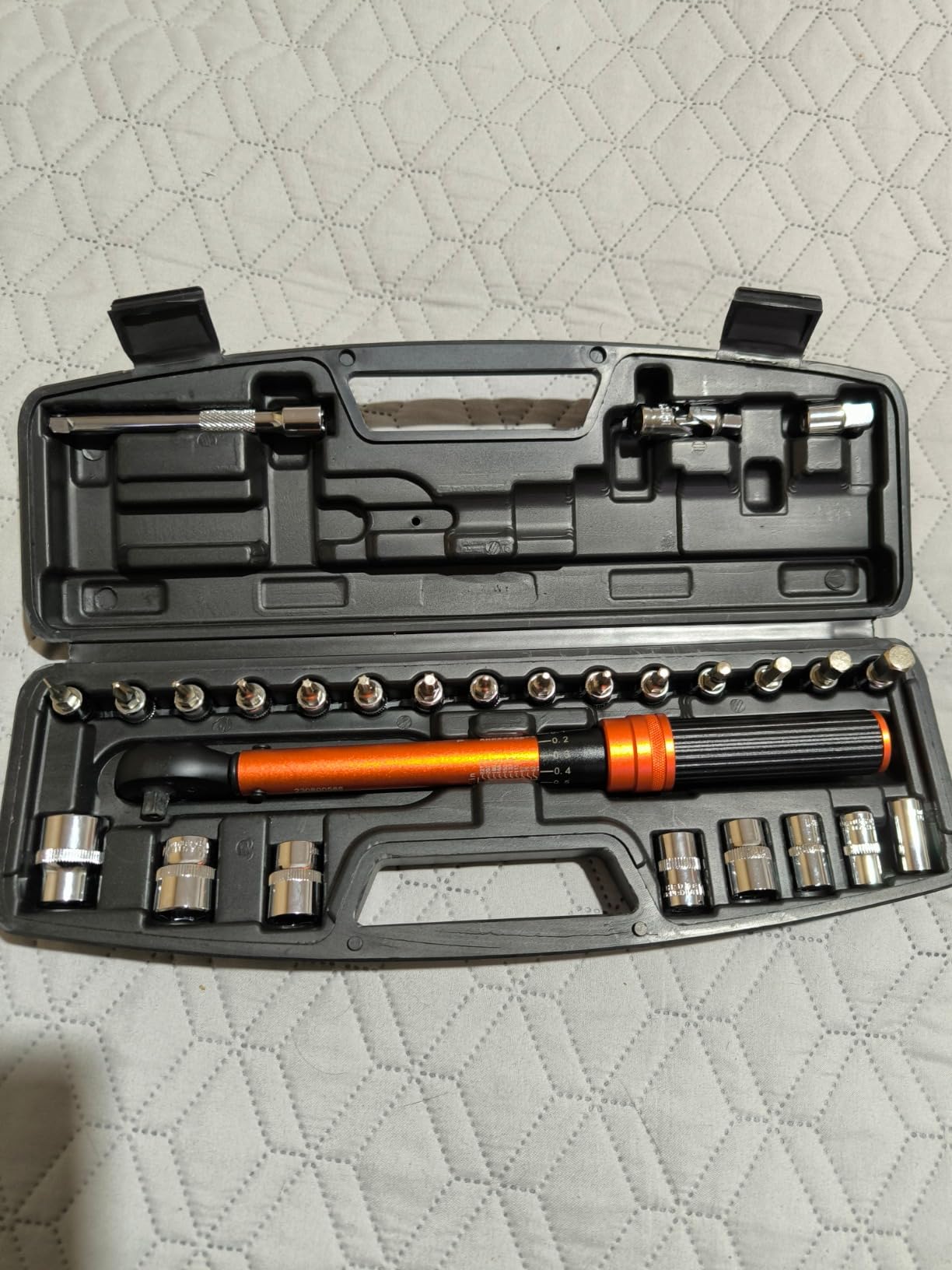
The Matework is the budget-friendly torque wrench I tested when I wanted something lighter than the EPAuto and LEXIVON 1/2-inch models. At 3.5 pounds and 12 inches long, it is noticeably lighter than the rest of the 1/2-inch class, which makes a real difference during long brake jobs and suspension work overhead. For buyers who want plus or minus 3 percent accuracy at a budget price, the Matework punches above its weight.
Build quality is a mix of clever choices and obvious compromises. The aluminum-titanium handle cuts weight without sacrificing stiffness. The 72-tooth dual-direction ratchet works in tight spaces and the quick-release head speeds up socket changes. The laser-engraved dual-range scale is a step up from printed scales at this price, and the included verification certificate with serial number is a nice touch for buyers who want documentation.
In testing, the click release felt softer than the EPAuto and LEXIVON, which takes some getting used to. After 40 pulls on the same setting the calibration held within plus or minus 3 percent, which is the claimed spec and slightly tighter than the plus or minus 4 percent standard for budget click wrenches. Reviewers on r/Tools note that the lighter handle reduces fatigue during long jobs.
The weaknesses are honest for the price. White-on-orange markings can be hard to read in dim light without a flashlight, especially at the lower end of the scale. The 12-inch length is short for the upper range of the 180 ft-lb spec, so high-torque fasteners demand careful, slow pulls. And isolated reports of breakage on first use suggest some quality-control variance, though the included warranty covers it.
Ideal For
This is the best torque wrench for buyers who want plus or minus 3 percent accuracy and a lighter handle than the EPAuto or LEXIVON. If you are doing long brake jobs or suspension work overhead and the weight of a heavier click wrench wears you out, the Matework is worth a look. It is also a smart pick for users who want laser-engraved markings and a 72-tooth ratchet at a budget price.
Limitations
Short 12-inch length limits leverage at the upper range. White-on-orange scale markings can be hard to read in dim light. The click release is softer than competing click wrenches, which takes a learning curve. Isolated quality-control issues reported by some users.
Torque Wrench Buying Guide: What to Consider
A torque wrench is one of the few tools where buying the wrong size or the wrong type can leave you with fasteners that are unsafe or damaged. The buying guide below covers the seven decisions that matter most when choosing between the best torque wrenches for your work.
Drive Size: 1/4, 3/8, and 1/2 Inch Explained
Drive size is the most important choice because it determines which sockets fit the wrench. Most home mechanics need two sizes, not one. A 1/2-inch drive is the right pick for lug nuts, suspension bolts, and axle nuts because it accepts the larger sockets that fit those fasteners. A 3/8-inch drive covers spark plugs, valve covers, oil pans, and motorcycle work where the smaller head fits tight engine bays. A 1/4-inch drive is reserved for bicycles, electronics, and small-engine work where fasteners are below 80 in-lb.
Our two-wrench kit recommendation is to pair a 1/2-inch click wrench like the EPAuto or LEXIVON LX-183 with a 3/8-inch click wrench like the EPAuto 3/8-inch or LEXIVON LX-182. This combination covers 90 percent of home-shop jobs without forcing you to use a 1/2-inch wrench at the bottom of its range, where accuracy suffers. A wrench is most accurate in the middle 60 percent of its range, so using a 1/2-inch wrench for spark plugs at 13 ft-lb is a calibration mistake waiting to happen.
Wrench Types: Click vs Digital vs Beam vs Split-Beam
Click-type torque wrenches are the most popular and the easiest to use. You set the torque value, apply force, and the wrench releases with an audible click and a tactile release when the target is reached. Click wrenches are the right pick for most home mechanics because they are fast, repeatable, and forgiving for new users.
Digital torque wrenches replace the click with a strain gauge and an LCD readout. The GEARWRENCH 85077 and similar models offer bidirectional measurement, multiple unit readouts, and tighter accuracy than most click wrenches. The trade-off is battery dependency and a higher price. Beam-style torque wrenches use a deflecting beam with a pointer and are the simplest, most affordable option, though they require watching a scale during the pull.
Split-beam torque wrenches like the Precision Instruments PREC3FR250F use two coaxial beams that separate under load. There is no click to listen for, just a smooth tactile transition. Split-beam wrenches hold calibration for years without rewinding and are favored by pro mechanics for daily shop use. They cost more, but they last longer under heavy use than click wrenches.
Accuracy and the 20-80 Percent Rule
Most torque wrenches are rated at plus or minus 4 percent accuracy out of the box. That means a 100 ft-lb setting will release somewhere between 96 and 104 ft-lb, which is well within the spec for most fasteners. Premium digital wrenches like the GEARWRENCH 85077 tighten that to plus or minus 2 percent clockwise. Calibration certificates from manufacturers like LEXIVON add traceability by giving you a serial number you can look up.
The 20-80 percent rule, sometimes called the “20 rule” in forum shorthand, says you should only use a torque wrench in the middle 60 percent of its range. Below 20 percent, the spring mechanism is too soft for accurate release. Above 80 percent, the mechanism is at the edge of its range and over-torqueing becomes easy. That is why a 1/2-inch wrench rated to 150 ft-lb should not be used for spark plugs at 13 ft-lb, and why a 3/8-inch wrench rated to 80 ft-lb should not be used for truck lug nuts at 100+ ft-lb.
Calibration Frequency and Storage
A torque wrench drifts out of calibration over time, mostly because of how it is stored. The single most common mistake, called out repeatedly on r/Tools and r/MechanicAdvice, is leaving the wrench set at a high torque value when you put it away. The internal spring is held under tension for months, and over time that tension permanently deforms the spring, shifting the calibration.
The fix is simple: after every use, wind the wrench back to its lowest setting before storing it. A hard case, included with most of the wrenches in this roundup, keeps the wrench from being knocked around in a drawer. For critical applications, recalibrate annually. Most manufacturers offer a calibration service for a small fee, and the LEXIVON wrenches ship with a certificate you can use as a baseline.
Two-Wrench Kit Recommendation
If you want one configuration that covers most home-shop jobs, pair a 1/2-inch click wrench with a 3/8-inch click wrench. The 1/2-inch handles lug nuts, suspension bolts, and axle nuts. The 3/8-inch handles spark plugs, valve covers, oil pans, and motorcycle work. Together they cover 90 percent of automotive fasteners without forcing you to use either wrench outside its accurate range.
For budget buyers, the EPAuto 1/2-inch plus EPAuto 3/8-inch is the most affordable credible kit. For buyers who want documentation and a serialized certificate on each wrench, the LEXIVON LX-183 plus LX-182 is the natural pairing. For shops that need a pro wrench, the Precision Instruments split-beam paired with a 3/8-inch click covers both daily shop use and the occasional compact job. To learn more about complementary shop tools, see our guides to the best air impact wrenches and the best cordless impact wrenches for the removal side of the job.
Torque-to-Yield and Angle Mode
Modern engines use torque-to-yield (TTY) fasteners, also called stretch bolts, for critical joints like cylinder head bolts and main bearing caps. With a TTY fastener, you torque to a low initial value, then add a specified angle of additional rotation. The fastener stretches slightly past its yield point, which gives a more consistent clamping force than a single torque value.
A standard click or beam wrench cannot measure angle, which is why torque-to-yield work requires a digital wrench with angle mode. The GEARWRENCH 85077 does not have angle mode, so for TTY work you need a higher-end digital wrench like the Snap-on TechAngle or a CDI digital model. If you are doing modern engine work that calls out TTY sequences in the service manual, factor in the cost of an angle-mode digital wrench as part of your tool budget.
Common Mistakes That Ruin Torque Wrenches
The single most common mistake is using a torque wrench as a breaker bar to loosen seized fasteners. The internal mechanism is designed for controlled loading in one direction, not for the shock loads of breaking loose a corroded bolt. Mechanics on r/Tools and r/MechanicAdvice repeatedly cite this as the leading cause of ruined torque wrenches. Use a breaker bar or an impact wrench to loosen, and the torque wrench only to tighten.
The second mistake is continuing to pull after the click. Once the wrench releases, you stop. Pulling past the click over-torques the fastener and over-tensions the wrench spring, which causes calibration drift. The third mistake is storing the wrench at a high setting. Wind it back to the lowest value before you put it away. The fourth mistake is ignoring lubrication. Anti-seize on threads reduces friction, which means a dry-thread torque spec on a lubricated bolt will over-torque the fastener. Always follow the service manual’s lubrication instructions.
Frequently Asked Questions
Which is the best torque wrench?
The best torque wrench for most home mechanics is the EPAuto 1/2-inch Drive Click Torque Wrench. With 10 to 150 ft-lb range, plus or minus 4 percent accuracy, and more than 23,000 reviews, it covers wheel swaps, brake jobs, and suspension work at a price that fits a home-shop budget. Pro mechanics should consider the Precision Instruments split-beam for daily shop use.
What is the 20 rule for torque wrenches?
The 20 rule means use a torque wrench only in the middle 60 percent of its range, between roughly 20 percent and 80 percent of the maximum rating. Below 20 percent the spring is too soft for accurate release, and above 80 percent the mechanism is at the edge of its range and over-torqueing becomes easy. That is why a 1/2-inch wrench rated to 150 ft-lb should not be used for spark plugs at 13 ft-lb.
Are Harbor Freight torque wrenches good quality?
Harbor Freight torque wrenches, including the Pittsburgh and Icon lines, are surprisingly accurate out of the box. Independent testing on Garage Journal showed Icon wrenches testing within 1 to 2 percent of spec. They are a solid budget option for occasional DIY use, though pro mechanics generally prefer name brands like CDI, Snap-on, or Precision Instruments for daily shop work.
What is the best torque wrench for lug nuts?
The best torque wrench for lug nuts is a 1/2-inch click wrench with a range that extends to at least 100 ft-lb. The EPAuto 1/2-inch covers most passenger cars at 80 to 100 ft-lb. For trucks and large SUVs that need 120 to 150 ft-lb, the LEXIVON LX-184 with its 25 to 250 ft-lb range is the better pick. Always torque lug nuts in a star pattern and retorque after the first drive.
What size torque wrench do I need for automotive work?
For automotive work you need two sizes: a 1/2-inch drive for lug nuts, suspension bolts, and axle nuts, and a 3/8-inch drive for spark plugs, valve covers, oil pans, and engine accessories. Most home mechanics do well with a 1/2-inch wrench covering 10 to 150 ft-lb and a 3/8-inch wrench covering 10 to 80 ft-lb. A single wrench cannot cover both ranges accurately without operating outside the 20 to 80 percent rule.
How often should a torque wrench be calibrated?
For occasional DIY use, calibrate a torque wrench once a year or after roughly 1,000 cycles. For daily shop use, calibrate every 3 to 6 months. Most manufacturers offer a calibration service for a small fee, and brands like LEXIVON ship a calibration certificate with a traceable serial number you can use as a baseline. Recalibrate sooner if the wrench has been dropped or stored at a high setting for an extended period.
Can I use a torque wrench to loosen bolts?
No. A torque wrench is designed to tighten fasteners to a measured value, not to loosen seized bolts. Using a torque wrench as a breaker bar damages the internal spring mechanism and ruins calibration. Use a dedicated breaker bar, an impact wrench, or a cheater pipe on a standard ratchet to loosen seized fasteners, then use the torque wrench only for the tightening step.
Final Verdict: Which Torque Wrench Should You Buy in 2026?
If you want a single torque wrench that covers the most common home-shop jobs without overspending, the EPAuto 1/2-inch Drive Click Torque Wrench is our Editor’s Choice and the best torque wrench for most buyers. Pair it with the EPAuto 3/8-inch click for spark plugs and motorcycle work, and you have a complete two-wrench kit for less than the price of one premium pro wrench.
Buyers who want documentation should choose the LEXIVON LX-183 for its serialized calibration certificate. Pro mechanics should invest in the Precision Instruments split-beam for daily shop work. Techs doing modern engine work with torque-to-yield fasteners need a digital wrench with angle mode, which is one step beyond the GEARWRENCH 85077 we tested here.
Whichever wrench you pick, store it at its lowest setting after every use and recalibrate annually. A torque wrench is one of the few tools where accuracy compounds over time, and proper storage is the difference between a wrench that holds spec for a decade and one that drifts after a year. The best torque wrenches in 2026 all share one trait: they give you the confidence that the next fastener is tightened exactly to spec.