
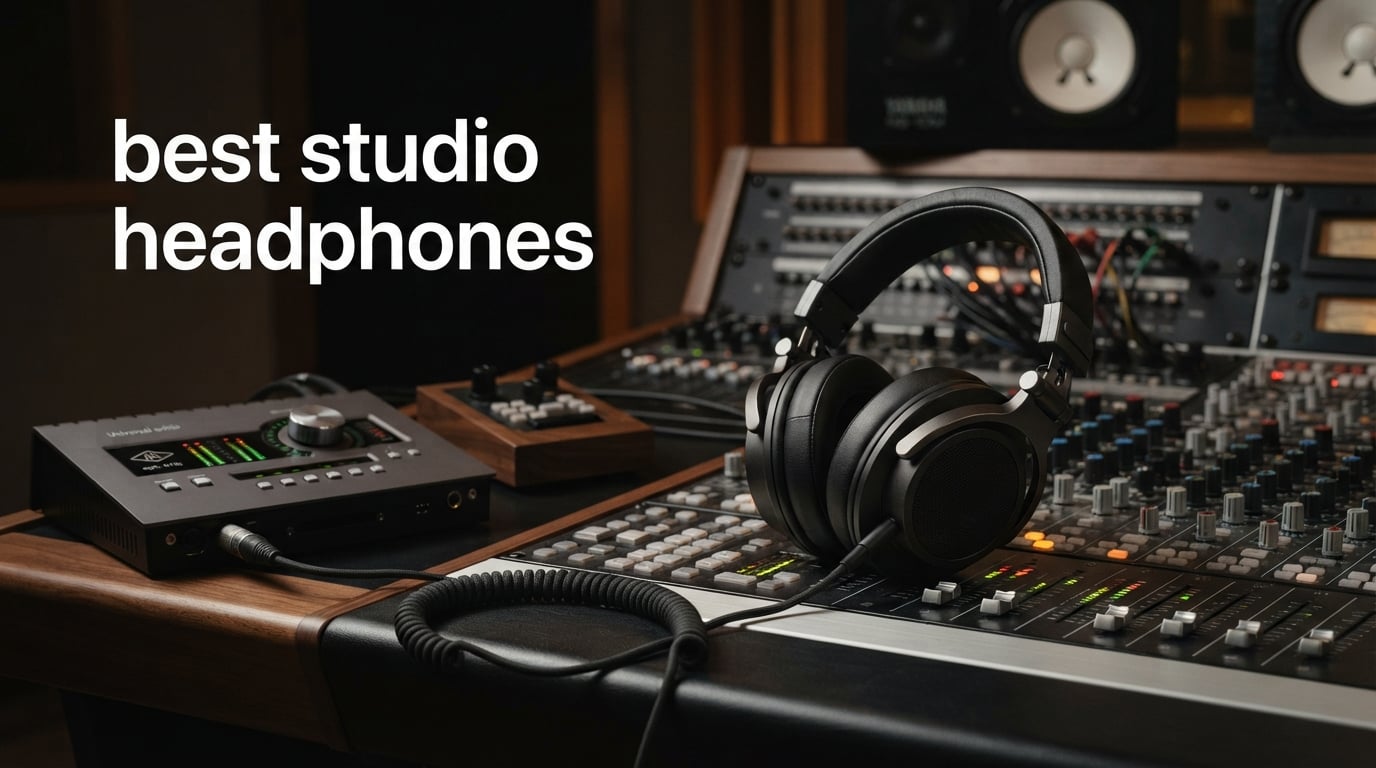
The best studio headphones are not simply the pair with the biggest specification list. They are the pair that lets you hear a mix honestly enough to make a decision, while fitting the room, the source device, and the job in front of you.
For mixing and mastering in a quiet room, I would start with open back headphones because their airflow and broad soundstage can make placement and reverb easier to judge. For tracking vocals, podcasting beside a microphone, or editing around other people, closed back headphones are the sensible starting point because sound leakage and outside noise both matter.
This guide compares 12 wired studio monitor headphones using the verified product information available for each model: driver approach, impedance, frequency range, cable arrangement, weight, pads, and stated isolation. I have not treated a wide frequency range as a guarantee of a flat response, and I have not ranked a model as right for everybody.
That distinction matters. Producers in community discussions repeatedly ask whether an amp is needed, whether open backs can be used for vocals, and whether a headset will stay comfortable through a long session; those are practical questions, so every review below calls out the match rather than chasing a single winner.
Table of Contents
These Are the Top 3 Studio Headphones for Different Jobs in 2026
Choose the HD 490 PRO for spacious, reference-minded work in a quiet room, the DT 700 PRO X when isolation is part of the assignment, and the MH700 when you need a straightforward low-impedance wired option with reversible cups. The table and full reviews explain where the other nine models fit.

These 12 Studio Headphones Make Up the 2026 Shortlist
The quick view below includes every model in this guide. Use it to narrow the field by enclosure type, impedance, comfort hardware, and cable arrangement before reading the detailed fit notes.
| Product | Specifications | Action |
|---|---|---|
 Sennheiser HD 490 PRO Sennheiser HD 490 PRO |
|
Check Latest Price |
 Sennheiser HD 480 PRO Sennheiser HD 480 PRO |
|
Check Latest Price |
 MAONO MH700 MAONO MH700 |
|
Check Latest Price |
 beyerdynamic DT 1990 PRO MKII beyerdynamic DT 1990 PRO MKII |
|
Check Latest Price |
 beyerdynamic DT 900 PRO X beyerdynamic DT 900 PRO X |
|
Check Latest Price |
| beyerdynamic DT 700 PRO X |
|
Check Latest Price |
 beyerdynamic DT 770 PRO X beyerdynamic DT 770 PRO X |
|
Check Latest Price |
 Shure SRH440A Shure SRH440A |
|
Check Latest Price |
| beyerdynamic DT 990 PRO X |
|
Check Latest Price |
 Audio-Technica ATH-R50X Audio-Technica ATH-R50X |
|
Check Latest Price |
 Sony MDR-M1 Sony MDR-M1 |
|
Check Latest Price |
 RØDE NTH-100 RØDE NTH-100 |
|
Check Latest Price |
1. Sennheiser HD 490 PRO Is the Open-Back Pick for Precise Placement
HD 490 PRO Open-Back Professional Headphone
Open-back
130 ohms
5Hz to 36kHz
Two pad sets
Pros
- Wide soundstage
- Precise localization
- Two task pad sets
- Washable pads
Cons
- Wired only
- No isolation
The HD 490 PRO makes its case with an open-frame architecture, a 130-ohm load, and a stated 5 Hz to 36 kHz range. Its two included pad sets are unusually purposeful: one is for producing and one is for mixing, so the physical interface can match the task rather than forcing a one-pad compromise.
I would put this at the top of the list for a quiet editing desk where panning, ambience, and low-end definition need close attention. Sennheiser specifically describes a wide dimensional soundstage and ultra-precise localization, while its low-frequency cylinder system is intended to keep bass full and clearly defined.
At 200 grams, it is notably light on paper, and the washable, replaceable pads are a practical long-term detail. The cable can connect on either earcup, and the coil structure is designed to block cable-borne noise, which is helpful when you move around a work surface.
The tradeoff is fundamental rather than minor: this is not a tracking headphone in a room with an active microphone, and it offers no noise cancellation. Its 130-ohm impedance also makes source matching worth checking; a capable interface or dedicated headphone output is the safer pairing than assuming every laptop socket will provide the same headroom.
It fits quiet-room mixing and long editing sessions
The wide open-back presentation, light 200-gram specification, and replaceable pads point toward producers and editors who work for hours in a quiet space. The model is also a strong fit if you want separate pad options for production work and mix review.
It does not fit vocal tracking or loud shared rooms
Open backs leak sound by design, so the artist can hear the cue mix outside the cups and a nearby microphone can hear it too. Pick a closed-back option below when isolation, privacy, or a noisy work area is part of the brief.
2. Sennheiser HD 480 PRO Is the Closed-Back Pick for Focused Tracking
HD 480 PRO Professional Closed-Back Studio Headphones, Black
Closed-back
130 ohms
107dB sensitivity
Angled earcups
Pros
- Passive shielding
- Clear neodymium drivers
- Glasses-friendly pads
- Detachable cable
Cons
- Wired only
- 130-ohm load
The HD 480 PRO takes the closed-back route with advanced neodymium drivers, multi-stage passive shielding, and a 130-ohm impedance. It also brings a vibration attenuation system, a detail that speaks directly to keeping unwanted mechanical behavior out of critical listening.
For recording headphones, the important story is containment. The closed construction and passive noise control are designed to keep a cue mix more contained than an open design, which is why I would look here for vocal takes, spoken-word work, or sessions where a performer needs concentration.
Comfort gets more than a passing mention in its build. The earcups are angled to reduce pressure points, while grooved pads are specifically intended to accommodate eyeglasses; left and right jacks, braille markers, and a detachable cable round out a work-focused design.
The same source consideration applies as with the HD 490 PRO. A 130-ohm model can work well from an appropriate interface, but buyers should check the manufacturer guidance for their interface and listen for adequate level before committing to it as a mobile-only solution.
It works best when isolation and clarity must coexist
This is the Sennheiser choice for tracking, voice recording, and focused editing where the open HD 490 PRO would spill too much sound. Its shielding, closed cups, and comfort details are the reasons to choose it over a more open alternative.
It is less convenient for casual phone-only listening
The wired 130-ohm setup is aimed at studio use, not wireless convenience. A lower-impedance option is simpler when the same headphones must serve a small portable device as often as an interface.
3. MAONO MH700 Is the Accessible Closed-Back Starter for Creators
MAONO MH700 Wired Studio Headphone for Podcast Recording DJ Mixing Monitor
Closed-back
32 ohms
50mm drivers
Reversible cups
Pros
- Easy 32-ohm load
- 50mm drivers
- Foldable design
- Two plug sizes
Cons
- Wired only
- No water resistance
The MH700 is a closed-back wired model built around 50 mm dynamic drivers, a 32-ohm impedance, and a stated 20 Hz to 20 kHz range. That impedance is the headline for new producers: it is a less demanding electrical load than several studio-focused alternatives here.
I would consider it a practical first pair for basic beat-making, voice monitoring, DJ-style one-ear work, and entry-level recording. The earcups reverse through 180 degrees, it folds for transport, and the package supports both 3.5 mm and 6.35 mm audio connections.
MAONO describes balanced highs, mids, and lows with minimal distortion, plus soft over-ear cups and a lightweight metal headband. Those are welcome basics, but I would still treat the headphone as a tool to learn on rather than a substitute for cross-checking a finished mix on several systems.
The detachable cables and plug-in lock are useful service details at this level. Its listed 400-gram weight is not especially light, so people who are sensitive to clamp or heat should make comfort a personal check rather than relying on the phrase “over-ear.”
It suits beginners who need flexible wired connections
The 32-ohm design, reversible cups, foldable form, and two common connector sizes make sense for a creator switching among a computer, small interface, controller, and recording setup. It supplies the basic studio workflow without adding an amplification question first.
It is not the choice for isolated critical mastering
A claimed wide or balanced sound is not the same as a personal reference built through repeat listening. Use it for creation and tracking, then compare important tonal decisions on speakers, another headphone, or both.
4. beyerdynamic DT 1990 PRO MKII Is the Premium Open-Back for Detailed Mix Work
beyerdynamic DT 1990 Pro MKII (30 Ohm), Open-Back Studio Headphones
Open-back
30 ohms
TESLA.45 drivers
Two velour pad sets
Pros
- Natural soundstage
- Low 30-ohm impedance
- Two pad sets
- Hard case included
Cons
- No isolation
- Wired only
The DT 1990 PRO MKII pairs an open-back circumaural design with TESLA.45 drivers and a notably low 30-ohm impedance. That combination is appealing for an engineer who wants a high-spec open reference headphone without choosing a high-impedance model solely for studio credentials.
Its stated strengths are a wide natural soundstage and precise imaging for professional mixing. I would use those descriptions as a reason to audition it for placement decisions, transient editing, and depth work, not as a claim that it will make every mix translate without a second reference.
Two interchangeable velour pad sets give the owner a choice between bass-focused and analytical listening, while the memory-foam headband targets long sessions. The included straight 3 m cable, coiled 5 m cable, detachable mini-XLR connection, and hard case make it equipped for a fixed studio and transport.
It remains an open-back headphone, so the absence of noise isolation is a firm limitation rather than a flaw. Choose it for a controlled room, and remember that its listed 454-gram weight makes a personal fit check sensible for all-day work.
It serves mix engineers who want pad and cable options
The two pad sets and two cable styles offer meaningful choice for a user who changes tasks rather than a decorative bundle. The 30-ohm impedance can also simplify pairing with many headphone outputs, though output quality still varies by device.
It is unsuitable when microphones are live nearby
The open enclosure does not isolate the performer or contain playback. For vocal tracking, field work, or a busy home, a closed-back model such as the DT 700 PRO X or MDR-M1 is the more appropriate starting point.
5. beyerdynamic DT 900 PRO X Is the Spacious Mid-Impedance Mixing Choice
beyerdynamic DT 900 PRO X Studio Mixing Open Back Headphones
Open-back
48 ohms
STELLAR.45 drivers
345g
Pros
- Wide soundstage
- 48-ohm compatibility
- Replaceable velour pads
- Two cables
Cons
- No isolation
- Wired only
The DT 900 PRO X is an open-back studio model using 48-ohm STELLAR.45 drivers and a stated 5 Hz to 40 kHz range. Its 345-gram specification is lighter than the DT 1990 PRO MKII, and the soft velour pads are replaceable.
I would put it on a mixing and editing shortlist for someone who wants open-back spatial cues without a 130-ohm load. The product information emphasizes a wide natural soundstage and neutral, balanced tuning, both attributes that matter when you are learning how your reference headphones portray a mix.
It includes 1.8 m and 3 m detachable mini-XLR cables, plus a 3.5 mm jack and 6.3 mm adapter. Those options make desk routing cleaner and remove one common worry about a permanently attached lead.
As with any open design, sound leakage sets the boundary. It is built for the person at the mix position, not for an artist recording beside an open microphone, and its wired setup is intentionally studio-first.
It makes sense for editing on interfaces and desktop sources
The 48-ohm impedance is a useful middle ground for common interfaces, DACs, and computer-connected gear. The included cable lengths also make it easier to keep a short desktop run tidy or reach a rack farther from the chair.
It is not made for private cue mixes during recording
Even a very detailed open-back headphone leaks playback. Closed cups are the correct tool when spill into a vocal microphone, nearby listener distraction, or outside noise is the deciding factor.
6. beyerdynamic DT 700 PRO X Is the Closed-Back All-Rounder for Recording
beyerdynamic DT 700 PRO X Closed-Back Studio Headphones with Stellar.45 Driver for Recording and Monitoring on All Playback Devices
Closed-back
48 ohms
STELLAR.45 drivers
Two straight cables
Pros
- Useful isolation
- 48-ohm driver
- Comfort-focused pads
- Two detachable cables
Cons
- Wired only
- Closed cups can feel warm
The DT 700 PRO X is the closed-back counterpart to the DT 900 PRO X, retaining the 48-ohm STELLAR.45 driver approach while prioritizing sound isolation. For a one-pair setup that must handle tracking, editing, and general production, that practical separation is persuasive.
Its manufacturer details call out detailed, punchy performance and a balanced studio sound signature. I would treat it as a monitoring choice for recording performers, working in a shared space, or making edits where outside noise makes an open reference pair impractical.
Comfort receives serious attention through soft velour pads and a memory-foam headband. It comes with 1.8 m and 3 m detachable straight cables, as well as a threaded small connector and adapter for studio-size sockets.
The predictable limitation is heat and enclosure pressure during long takes, which can affect some listeners more than others. Closed back headphones protect a cue mix, but they also alter how isolated the user feels, so take short breaks before making final balance decisions.
It handles vocal tracking and one-pair home studios well
This is a strong route for creators who cannot dedicate one headphone to tracking and another to mixing. Its closed construction reduces spill, while the 48-ohm driver and supplied cables keep it compatible with typical wired setups.
It is less natural for open-room spatial checking
Closed cups intentionally change the relationship between the ear and room. If your main task is judging width, room tone, and reverb tails in a silent space, an open-back sibling is the better comparison.
7. beyerdynamic DT 770 PRO X Is the Practical Closed-Back for Daily Sessions
beyerdynamic DT 770 Pro X (48 Ohm), Closed-Back Studio Headphones, Black
Closed-back
48 ohms
STELLAR.45 driver
Locking mini-XLR
Pros
- 48-ohm flexibility
- Velour pads
- Locking detachable cable
- Replaceable parts
Cons
- Wired only
- Closed-back fatigue possible
The DT 770 PRO X uses a 48-ohm STELLAR.45 driver in a closed-back professional monitor format. Its listed 5 Hz to 40 kHz range, soft velour pads, and ergonomic headband make it a familiar kind of specification set for extended recording and editing use.
I would shortlist it for a creator who wants a closed pair that can move among an interface, laptop, DAC, or amplifier without beginning with a difficult impedance match. The product data itself identifies that 48-ohm load as suitable across those source categories.
A 3 m detachable straight cable locks to the earcup with mini-XLR, and a threaded adapter is included for a studio-size output. Replaceable components are another real advantage when the headphone is used daily rather than pulled out only for occasional listening.
Closed cups can still create fatigue for some people, a limitation the product notes acknowledge. The proper response is not to avoid closed backs altogether; it is to choose them for their job, set reasonable monitor level, and give ears a reset between long passes.
It is a dependable choice for creators who move between sources
The 48-ohm specification and supplied adapter remove friction from a computer-and-interface workflow. A locking detachable cable also adds reassurance when you frequently stand up, rotate in a chair, or reconfigure a workspace.
It does not replace an open reference for final spatial decisions
Its closed-back function is isolation, which is exactly what tracking needs. Use another perspective for final room and width judgments if you notice yourself working in closed cups for many uninterrupted hours.
8. Shure SRH440A Is the Foldable Closed-Back for Portable Monitoring
Shure SRH440A Over-Ear Wired Studio Headphones for Recording
Closed-back
40 ohms
40mm drivers
Foldable design
Pros
- 40-ohm load
- Foldable build
- Noise isolation
- Locking cable
Cons
- Wired only
- Shorter stated range
The Shure SRH440A is a closed-back over-ear model with 40 mm neodymium drivers, 40-ohm impedance, and a stated 10 Hz to 22 kHz response. It is one of the most straightforward options here for a person who needs monitoring gear that can fold and travel.
Its sound-isolating construction and balanced, detailed studio-grade positioning make it appropriate for basic recording, dialogue work, editing, and reference checks away from a full desk. I would not pretend that a specification range alone tells you how it will translate, but the 40-ohm load is friendly to many ordinary wired sources.
The adjustable headband, 9.01-ounce listed weight, collapsible layout, and detachable locking cable are all useful day-to-day features. A threaded adapter is included, which avoids scrambling for a separate connector when moving from a computer to a standard interface jack.
One reported limitation is that the cable may not be as easily replaceable as some buyers expect, despite its detachable locking arrangement. If serviceability is the deciding factor, compare the connector scheme closely with models that explicitly describe replaceable parts.
It is useful for compact workspaces and location edits
The foldable design and closed isolation fit a creator who works in more than one place. It can also be a sensible reference companion for video editing, podcast recording, and carrying a wired pair in a production bag.
It is not designed around the widest published response range
The stated 10 Hz to 22 kHz range is narrower than several competitors in this group. That fact alone should not settle a purchase, but it tells you to focus on how accurately and comfortably you can work with the headphone rather than chasing headline numbers.
9. beyerdynamic DT 990 PRO X Is the Open-Back Option for Airy Critical Listening
beyerdynamic DT 990 Pro X (48 Ohm), Open-Back Studio Headphones, Black
Open-back
48 ohms
STELLAR.45 driver
Velour pads
Pros
- Natural soundstage
- 48-ohm driver
- Light construction
- Serviceable parts
Cons
- Sound leakage
- May need stronger output
The DT 990 PRO X is an open-back model with a 48-ohm STELLAR.45 driver, stated 5 Hz to 40 kHz range, and a 0.39-kilogram listed weight. It is presented as a critical-listening studio monitor headphone with a natural soundstage and bright high-frequency detail.
I would compare it with the DT 900 PRO X if you want an open Beyerdynamic reference but are deciding based on comfort, fit, and the particular tonal perspective you prefer. Its soft circumaural velour pads and 3 m detachable locking mini-XLR cable make it built for a stationary mix position.
The serviceable-parts claim is a meaningful factor for long ownership. Earpads, cable arrangements, and repair access are easy to overlook when choosing studio gear, yet they matter once a headphone becomes the familiar reference used on every project.
The product information says a headphone amp may be needed for its best performance, even with its 48-ohm specification. Read that as a reminder to verify the actual output power and volume margin of your interface or DAC rather than deciding from impedance alone.
It supports quiet-room mix checks and detailed editing
The open design and natural soundstage are the reasons to select this model for panning, ambience, and high-frequency examination. Its detachable cable and serviceable design support a workhorse role at a desk.
It cannot isolate a performer during a take
Sound leakage is stated directly in the product information, so it is a poor fit for recording beside sensitive microphones. Its open enclosure also makes it less useful when household or office noise competes with the work.
10. Audio-Technica ATH-R50X Is the Light Open-Back for Broad Reference Work
Audio-Technica ATH-R50X Open-Back Headphones
Open-back
50 ohms
207g
Two detachable cables
Pros
- Light 207g build
- Wide soundstage
- Two cables
- Accurate midrange
Cons
- Sound leakage
- Lower sensitivity
The ATH-R50X is a fully open-back reference headphone with 50-ohm impedance, 93.3 dB sensitivity, and a 207-gram listed weight. Audio-Technica says its unrestricted airflow removes internal resonance and contributes to quick transient response, extended bass, accurate mids, and a wide realistic soundstage.
That is an appealing recipe for mixing headphones when physical comfort is as important as openness. I would look closely at it for long arrangement sessions, editing transients, and general music production in a silent room where external noise and playback spill are not concerns.
It includes two detachable cables, one 3 m and one 1.2 m, joining through a 2.5 mm twist-lock earcup connector. The shorter option is useful at a desk; the longer one is more forgiving when an interface or rack sits farther away.
Its lower 93.3 dB sensitivity is the specification that should slow down a hurried purchase. A 50-ohm headphone is not automatically hard to drive, but sensitivity and a source’s actual output both influence usable level, so test the pairing where possible.
It is a strong fit for low-fatigue open-back sessions
At 207 grams, it is among the lightest listed models in this guide. Pair that with open airflow and two cable lengths, and it suits a focused creator who stays at a quiet desk for extended editing and mix work.
It needs a thoughtful source pairing before purchase
The lower stated sensitivity means you should not assume a weak output will give the same working headroom as an interface or dedicated headphone amp. Check the source documentation and listen at a safe level before making it your only monitoring reference.
11. Sony MDR-M1 Is the Lightweight Closed-Back for Reference and Isolation
Sony MDR-M1 Professional Reference Closed Monitor Headphones
Closed-back
50 ohms
216g
5Hz to 80kHz
Pros
- Light 216g build
- High isolation
- Two cable lengths
- Replaceable pads
Cons
- Wired only
- No water resistance
The Sony MDR-M1 is a professional reference closed monitor headphone with 40 mm dynamic drivers, 50-ohm impedance, 102 dB sensitivity, and a listed weight of 216 grams. Sony states a 5 Hz to 80 kHz playback range and a closed acoustic structure with high sound isolation.
I would put it on the shortlist for creators who need a light closed-back pair for recording, editing, and field-oriented work. The low listed weight is especially notable because closed headphones can become tiring when their isolation is useful but their physical feel is not.
Soft thick earpads, detachable cables in two lengths, replaceable earpads, and both 3.5 mm and 6.3 mm connectivity support day-to-day studio use. Those are the practical details that make a headphone easier to live with after the first week.
The ultra-wide published frequency range should be read as a capability claim, not a response graph. What matters in the final decision is whether vocal presence, low-end balance, and edit details stay consistent enough for you to learn the headphone across many references.
It fits creators who need closed-back comfort without bulk
The 216-gram weight, soft pads, and sound-isolating structure make this a compelling choice for long recording or editing periods. Two included cable lengths also keep it flexible across desk and portable setups.
It still needs cross-checking for mix translation
No closed reference headphone removes the benefit of another listening perspective. Compare completed work on speakers or another familiar system, particularly when you are making low-frequency or stereo-width decisions.
12. RØDE NTH-100 Is the Comfort-Focused Closed-Back for Content Work
RØDE NTH-100 Professional Over-Ear Headphones for Content Creation
Closed-back
32 ohms
CoolTech gel pads
Locking cable
Pros
- 32-ohm compatibility
- CoolTech gel
- Alcantara cushions
- Locking cable
Cons
- Lower rating
- Durability concerns reported
The RØDE NTH-100 is a closed-back professional over-ear model with 32-ohm impedance, 110 dB sensitivity, custom-matched 40 mm drivers, and a stated 5 Hz to 35 kHz range in its technical details. It is explicitly positioned for music production, mixing, audio editing, and content creation.
Its clearest differentiator is physical comfort: Alcantara cushions on the earcups and headband, with CoolTech gel integrated into the earpads. I would consider it first when heat buildup and ear fatigue have stopped you from wearing closed headphones long enough to finish an edit.
The removable cable locks into place, and the 32-ohm load is convenient for a broad set of wired devices. The recorded product data also notes a lifetime manufacturer warranty with registration, a point worth confirming directly with the maker before relying on it.
There is a more mixed ownership signal here than with the higher-rated choices: its rating is 4.2 from 1.2k+ reviews, and the product review notes mention some durability concerns. That does not erase its comfort-oriented design, but it makes careful handling and warranty terms more relevant.
It helps creators who prioritize cool, padded long-session comfort
The CoolTech gel and Alcantara cushioning are unusually specific comfort features in this group. They make sense for podcast editors, video creators, and producers who need closed-back isolation but struggle with warm earpads.
It deserves closer scrutiny from buyers focused on long-term durability
Reported durability concerns mean this is not the one to buy casually without reviewing current warranty coverage and handling the cable connection carefully. Buyers who value broad serviceability may prefer models that explicitly describe replaceable components.
These Buying Rules Help You Choose Studio Headphones Correctly
Start with the recording environment, not a brand. The single most useful choice is between an open-back and closed-back enclosure because it changes how the headphone interacts with your room, microphone, and attention.
Open-back headphones are best for quiet mixing and mastering
Open-back headphones allow air to move through the earcups, which can create a broader, less enclosed sense of space. They are well suited to mixing, mastering, arrangement, and critical listening in a quiet room because soundstage and localization are easier to examine.
The drawback is sound leakage in both directions. You hear the room around you, people nearby can hear your playback, and a microphone can capture that playback, so they are a poor choice for tracking vocals or monitoring near live mics.
Closed-back headphones are best for tracking and noisy rooms
Closed-back headphones contain more playback and reduce outside distraction through passive isolation. Use them for recording vocals, podcasting, field work, shared spaces, and any session where a cue mix must stay out of a microphone.
They can feel warmer or more pressurized over time, and their isolation changes the listening experience. Take regular breaks and make final spatial or low-end decisions on a second familiar reference when the project allows.
Impedance is a source-matching check, not a quality score
Impedance, measured in ohms, describes an electrical load presented to the headphone output. A lower number does not mean lower sound quality, and a higher number does not automatically mean a dedicated amplifier is required; sensitivity and the source’s available power also affect the result.
Models in this guide range from 30 ohms to 130 ohms. A 30-, 32-, 40-, 48-, or 50-ohm pair is generally a simpler starting point for a computer or modest interface, while the 130-ohm Sennheisers deserve a closer look at the output guidance for the actual interface or amplifier you own.
Do a practical check rather than guessing: connect the headphone to your normal source, play a well-known reference track, and see whether it reaches a comfortable working level without maxing the volume. If the level is weak or the output sounds strained, a stronger headphone output is the logical next step.
Comfort is a production feature, not an afterthought
Long sessions reveal issues that a short listen misses: pad heat, temple pressure with glasses, headband hot spots, and cable drag. Compare listed weight, pad material, clamp feel, and earcup depth, but treat a personal fit as the deciding test.
The HD 490 PRO and ATH-R50X have low listed weights, the MDR-M1 is also light at 216 grams, and the RØDE emphasizes cooling gel. The HD 480 PRO specifically calls out angled earcups and glasses-friendly grooves, while several Beyerdynamic models specify velour pads and replaceable components.
Frequency response claims need context before they guide a purchase
A frequency range tells you the limits a maker states the product can reproduce, but it does not show how loud or even each frequency is within that range. A flat or neutral monitoring experience is about the shape of the response, fit on your head, source, and the reference material you know.
Learn one good headphone deeply, then cross-check decisions. Use familiar commercial tracks, listen for vocal level and bass balance, and compare your work on speakers, a car system, or other trusted playback rather than changing a mix solely because one headphone makes a detail sound unusual.
Cables and repairability decide whether a favorite pair stays useful
Detachable cables are valuable because cables often take the most physical abuse in a home studio. The models here use several approaches, including mini-XLR, twist-lock, locking connectors, dual earcup jacks, and ordinary plug-and-adapter arrangements.
Replaceable pads and serviceable parts matter too. Sweat, use, and time change pads, which can alter comfort and fit; a model that can accept fresh pads and a new cable has a better chance of remaining your familiar reference.
Safe listening habits protect your most important monitoring tool
The 60/60 rule is a practical reminder: listen at no more than about 60% volume for no more than 60 minutes before taking a break. It is not a calibrated safety measurement because output levels vary, but the habit reduces the temptation to mix louder as fatigue sets in.
When you need more detail, first lower outside noise, take a short pause, or compare on a second reference. Louder monitoring can feel exciting while making tonal balance and fatigue harder to judge.
These Answers Cover the Most Common Studio Headphone Questions
What headphones do most studios use?
Most studios use more than one headphone type: closed-back models for tracking performers and open-back reference headphones for mixing in quiet rooms. The common trait is not one brand but dependable wired monitoring, a familiar sound, comfortable pads, and a source that can drive the headphones properly.
What are the number 1 rated headphones?
In this 12-model group, the Sennheiser HD 490 PRO and HD 480 PRO have the highest listed rating at 4.7. The HD 490 PRO is the better match for quiet-room open-back mixing, while the HD 480 PRO is the better match for closed-back monitoring and isolation.
What is the 60 60 rule for headphones?
The 60/60 rule means keeping headphone listening at roughly 60% volume for up to 60 minutes, then taking a break. It is a simple habit rather than a precise sound-level standard, since device output and headphone sensitivity vary.
What are the most comfortable studio headphones?
Comfort depends on head shape and glasses, but strong options in this group include the light 200-gram Sennheiser HD 490 PRO, 207-gram Audio-Technica ATH-R50X, 216-gram Sony MDR-M1, and RØDE NTH-100 with CoolTech gel pads. Look for suitable weight, pad depth, low pressure points, and replaceable cushions.
The Right Studio Headphones Match Your Room and Your Work
For the best studio headphones in 2026, my clearest split is simple: choose the Sennheiser HD 490 PRO, DT 1990 PRO MKII, DT 900 PRO X, DT 990 PRO X, or ATH-R50X for quiet open-back reference work; choose the HD 480 PRO, DT 700 PRO X, DT 770 PRO X, Shure SRH440A, Sony MDR-M1, MAONO MH700, or RØDE NTH-100 when isolation matters.
Start with the enclosure type, confirm that your interface can drive the impedance and sensitivity combination, and treat comfort and replaceable parts as real production criteria. A familiar wired pair used thoughtfully will tell you more than an impressive specification list used in the wrong room.