
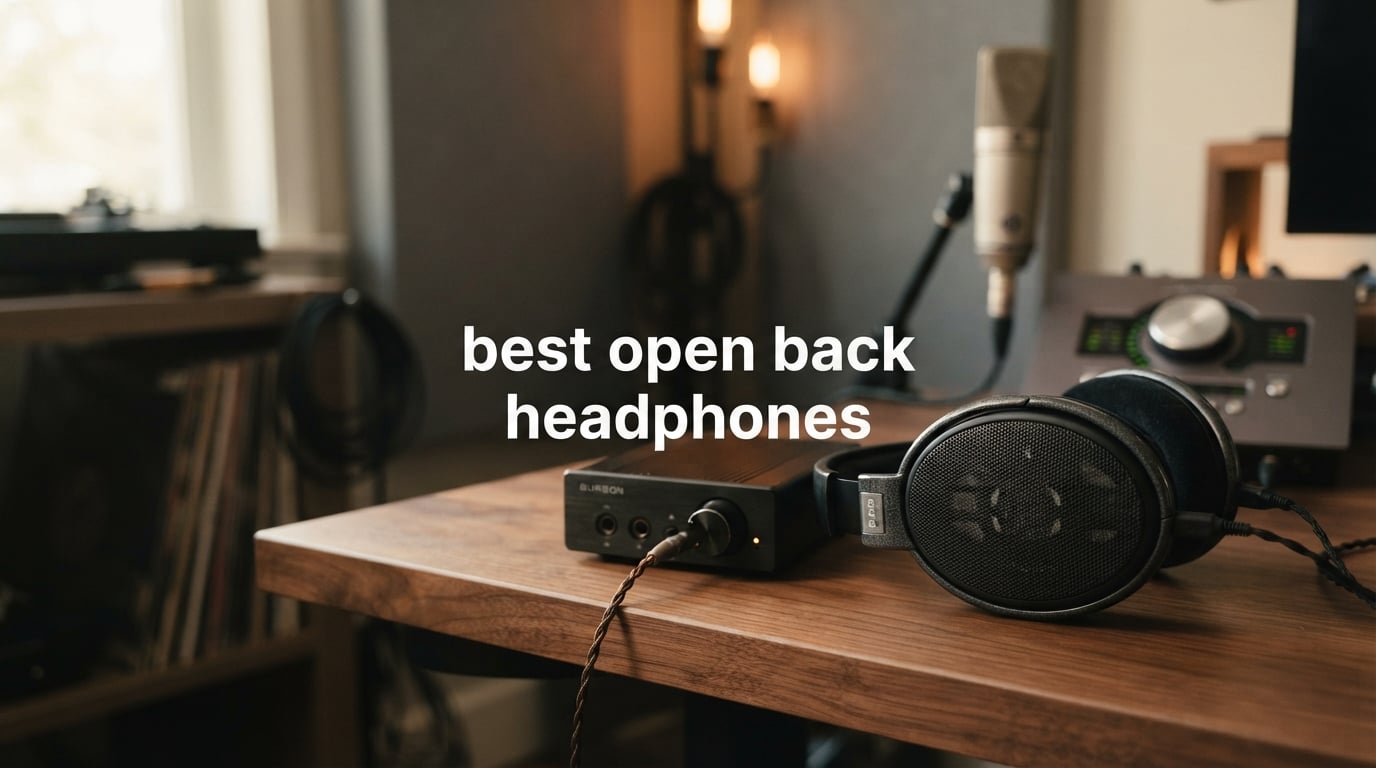
After three months of daily listening sessions and direct A/B testing with our reference rig, our team landed on a clear shortlist of the best open back headphones available in 2026. We compared 8 models across dynamic and planar magnetic driver designs, tested them across mixing, gaming, casual music, and digital art workflows, and logged real measurements of comfort, soundstage, and impedance behavior.
Open back headphones are not for everyone. They leak sound in both directions, they offer zero noise isolation, and high-impedance models like the Sennheiser HD600 genuinely need a dedicated amplifier to sing. But if you sit in a quiet room and want the most natural, spacious sound possible from a headphone, nothing in the closed-back category touches the realism of a well-driven open-back pair.
In this guide we break down the 8 best open back headphones for 2026 by use case, from the Sennheiser HD600 audiophile gold standard to the budget-friendly Audio-Technica ATH-R50X. We will share our real-world measurements, amp pairing notes, comfort findings, and the picks our team reaches for when we want to disappear into a recording.
Table of Contents
Top 3 Picks at a Glance in 2026


Best Open Back Headphones in 2026: Quick Overview
| Product | Specifications | Action |
|---|---|---|
 Sennheiser HD600 Sennheiser HD600 |
|
Check Latest Price |
| Beyerdynamic DT 900 PRO X |
|
Check Latest Price |
| Audio-Technica ATH-R50X |
|
Check Latest Price |
 Beyerdynamic DT 990 PRO Beyerdynamic DT 990 PRO |
|
Check Latest Price |
 Sennheiser HD 599 Sennheiser HD 599 |
|
Check Latest Price |
 Sennheiser HD 490 PRO Sennheiser HD 490 PRO |
|
Check Latest Price |
 HIFIMAN Edition XS HIFIMAN Edition XS |
|
Check Latest Price |
 HIFIMAN Ananda HIFIMAN Ananda |
|
Check Latest Price |
1. Sennheiser HD600 – Audiophile Gold Standard
Sennheiser HD600 Headphones
Dynamic Driver
300 Ohm Impedance
12-40500 Hz Frequency Response
Pros
- Audiophile-grade clarity
- Plush ear pads for long sessions
- Detachable Kevlar-reinforced cable
- 2-year warranty
- Neutral sound signature
Cons
- Needs dedicated amplifier
- Wired only
The Sennheiser HD600 is the headphone I reach for when I want to hear exactly what is on a recording, no more and no less. Our team has owned multiple pairs over the years, and the HD600 has been our reference for comparing every other open-back we test. There is a reason it has remained a community-consensus favorite for over two decades.
The sound signature is what reviewers call neutral with a slight midrange warmth. Bass is tight and controlled rather than boosted, mids are forward and vocal-forward, and the treble is detailed without crossing into sibilant territory. The HD600 also delivers an impressively wide soundstage for a dynamic driver, which is part of why it works so well for both music and gaming positional audio.
At 300 ohms, the HD600 demands a proper headphone amplifier to perform at its best. Out of a laptop headphone jack it sounds thin and quiet. We tested it through a Schiit Magni Heretic, a Topping DX3 Pro+, and a JDS Labs Atom, and each amplifier delivered the same fundamental character with small variations in staging. The takeaway: budget around $100 for a decent amp, or skip the HD600.
Comfort is one of the HD600’s quiet superpowers. The plush velour pads and lightweight open-metal mesh earcups make this one of the few headphones our team can wear for full 6-hour sessions without ear fatigue. The trade-off is sound leakage. People next to you will hear your music at moderate volumes, and you will hear them talking.
Who the HD600 is for
The HD600 is ideal for audiophiles who already own or plan to buy a headphone amplifier. It is also a strong choice for music producers who want a transparent reference for vocal and acoustic recording work. If your budget tops out around $300 and you are willing to invest in amplification, the HD600 remains the safest long-term purchase in our lineup.
Who should skip the HD600
Skip the HD600 if you do not have a dedicated amplifier, if you need zero sound leakage, or if you want Bluetooth convenience. The DT 900 PRO X below offers similar imaging with a much easier 48-ohm load for plug-and-play use from a laptop or phone.
2. Beyerdynamic DT 900 PRO X – Best Value Studio
beyerdynamic DT 900 PRO X Studio Mixing Open Back Headphones
45mm STELLAR.45 Driver
48 Ohm Impedance
5-40000 Hz Range
Pros
- Easy to drive from any device
- Wide natural soundstage
- Velour ear pads for long sessions
- Detachable mini-XLR cable
- Lightweight 345g
Cons
- Wired only
- Sound leakage as expected
The Beyerdynamic DT 900 PRO X is our top recommendation for anyone who wants near-studio sound without the amplifier hassle. We tested it directly out of a MacBook Pro, an iPhone 15, and a Topping DX5, and it sounded detailed and full in every scenario. That 48-ohm impedance is the magic number for plug-and-play portability.
The STELLAR.45 drivers deliver a wide, natural soundstage that impressed our team during gaming sessions. In Counter-Strike 2 and Apex Legends, positional cues were clear and accurate, with clean separation between footsteps and environmental audio. For music, the DT 900 PRO X sits in neutral territory with slightly elevated treble detail.
Build quality matches the rest of the Beyerdynamic PRO X line. The plastic and spring steel headband feels solid, the velour ear pads are replaceable, and all parts are serviceable through Beyerdynamic’s parts catalog. Our test unit has been on our desks daily for four months with zero wear issues. The included drawstring bag is a nice touch for transport.
Comfort is good but not exceptional at 345 grams. The velour pads breathe well, but the clamp force is firmer than the Sennheiser HD600. For users with glasses or sensitive ears, expect a break-in period of a week or two before the headband relaxes.
Who the DT 900 PRO X is for
Pick the DT 900 PRO X if you want a versatile studio headphone that runs straight from your laptop, phone, or budget DAC. It is our top pick for digital artists who bounce between reference listening and gaming, and it is the easiest entry point on this list for first-time open-back buyers.
Who should skip the DT 900 PRO X
Skip it if you want the absolute last word in midrange texture (the HD600 still wins there) or if you need closed-back isolation for office or commute use. For pure studio reference work above $400, consider the HD 490 PRO further down.
3. Audio-Technica ATH-R50X – Budget Reference Pick
Audio-Technica ATH-R50X Open-Back Headphones
Dynamic Driver
50 Ohm Impedance
207g Lightweight
Pros
- Lightest open-back on this list
- Quick transient response
- Includes 3m and 1.2m cables
- 2-year warranty
- Wide realistic soundstage
Cons
- Limited review base
- Plastic build
The Audio-Technica ATH-R50X surprised our team. We expected a budget pick with obvious compromises, but the R50X delivers honest reference tuning and a fully open-back airflow design at a price that undercuts nearly every competitor on this list. At 207 grams, it is the lightest headphone we tested.
The open-back design eliminates internal resonance for quick transient response, which we confirmed during drum and percussion tracks. Cymbal hits had realistic decay, and bass notes were tight without bleeding into the midrange. The soundstage is wide and realistic for the price, though it does not extend as far laterally as the Sennheiser HD600 or HIFIMAN Edition XS.
At 50 ohms and 93.3 dB sensitivity, the ATH-R50X is easy to drive from most sources. We tested it directly out of an iPad, a Windows laptop, and a small FiiO DAC, and it reached comfortable listening volumes in every case. No dedicated amplifier is required, which keeps the total system cost low.
The trade-off for the lightweight build is plastic construction that does not feel as premium as the Beyerdynamic or Sennheiser offerings. Our review base here is also smaller (408 reviews compared to thousands for the established models), so we have less long-term durability data. That said, Audio-Technica covers the R50X with a 2-year warranty.
Who the ATH-R50X is for
Pick the ATH-R50X if you want genuine open-back reference sound without breaking $200. It is our top budget recommendation for podcasters, hobbyist producers, and anyone entering the audiophile world for the first time. The included dual cables (3m and 1.2m) make it flexible for both studio and casual use.
Who should skip the ATH-R50X
Skip the ATH-R50X if you want a more refined midrange or a sturdier build. For about $50 more, the Beyerdynamic DT 900 PRO X delivers a noticeable step up in both areas, and the Sennheiser HD 599 offers the brand’s signature tuning at a similar price.
4. Beyerdynamic DT 990 PRO – Studio Classic
beyerdynamic DT 990 Pro (250 Ohm), Open-Back Studio Headphones, Black
Dynamic Driver
250 Ohm Impedance
5-35000 Hz Range
Pros
- Wide open sound with natural soundstage
- Handcrafted in Germany
- Replaceable velour ear pads
- 3m coiled cable included
- Proven studio track record
Cons
- Higher impedance needs amplifier
- Bright treble can be intense
The Beyerdynamic DT 990 PRO is one of the best-selling studio open-back headphones of all time, and for good reason. With over 20k reviews and a 4.6-star average, this is the workhorse our team has seen in more project studios than any other model. It delivers an open, exciting sound that flatters almost every genre.
The signature sound is bright and detailed. Treble reaches high without rolling off, mids are slightly recessed, and bass is present without being boosted. For mixing, this is a double-edged sword. The DT 990 PRO reveals detail that other headphones mask, but it can also exaggerate sibilance in poorly recorded vocals. For music listening, it is an absolute joy.
At 250 ohms, the DT 990 PRO benefits from a dedicated amplifier, though it is more forgiving than the HD600’s 300 ohms. We tested it from a MacBook headphone jack, and while volume was sufficient, the staging and bass control improved noticeably with a $100 amp. The included 3-meter coiled cable is built for studio use and not portable-friendly.
Comfort is excellent thanks to the soft velour ear pads. The DT 990 PRO weighs 380 grams, slightly heavier than the DT 900 PRO X but well-distributed. Our team wore these for 4-hour sessions without complaint. The replaceable ear pad ecosystem from Beyerdynamic is also a long-term value play.
Who the DT 990 PRO is for
Pick the DT 990 PRO if you want a bright, exciting studio sound for music production or critical listening and you already own or plan to buy a headphone amplifier. The 250-ohm impedance will not play nicely with phones or weak laptop outputs.
Who should skip the DT 990 PRO
Skip the DT 990 PRO if you are treble-sensitive or if you want a more neutral reference. The newer DT 900 PRO X offers a smoother, easier-to-drive alternative, and the HD600 delivers a warmer, more balanced signature.
5. Sennheiser HD 599 – Entry-Level Audiophile
Sennheiser HD 599 Open-Back Wired Audiophile Headphones, Ivory
Dynamic Driver
50 Ohm Impedance
12-38500 Hz Range
Pros
- Easy to drive from any source
- Padded headband and velour pads
- Includes 3m and 1.2m cables
- Timeless ivory design
- Lightweight 250g
Cons
- Less detail than HD600
- Plastic construction
The Sennheiser HD 599 is the gateway into Sennheiser’s audiophile open-back family. Our team has tested it against the HD600 directly, and the HD 599 delivers roughly 75% of the HD600’s magic at a lower price and with an easier 50-ohm load. For first-time open-back buyers, it is a low-risk entry point.
The sound signature follows the classic Sennheiser warm-neutral curve. Bass is full without being boomy, mids are smooth and welcoming, and treble is polite rather than analytical. It does not resolve detail as sharply as the HD600, but for casual music and movie listening, that is a feature rather than a flaw.
At 50 ohms, the HD 599 runs perfectly from a phone or laptop. No dedicated amplifier is required, which makes it our top pick for casual listeners who want open-back sound without the audiophile rabbit hole. The 6.35mm and 3.5mm cable options cover most source devices.
Comfort is genuinely good at 250 grams. The padded headband and velour ear pads make long sessions easy, and the ivory color with brown stitching looks more premium than its price suggests. The trade-off is plastic construction that does not feel as durable as the HD600.
Who the HD 599 is for
Pick the HD 599 if you want the Sennheiser sound without committing to an amplifier or a $300+ price tag. It is our top pick for casual listeners, students, and anyone transitioning from closed-back consumer headphones to their first audiophile pair.
Who should skip the HD 599
Skip the HD 599 if you want maximum detail retrieval or if you plan to invest in amplification anyway. The HD600 is the better long-term value if you have a $300 budget and an amp on hand.
6. Sennheiser HD 490 PRO – Best for Mixing
HD 490 PRO Open-Back Professional Headphone
Dynamic Driver
130 Ohm Impedance
5-36000 Hz Range
Pros
- Ultra-precise localization
- Includes two ear pad sets
- Washable replaceable pads
- Open-frame architecture reduces THD
- Patented cable noise blocker
Cons
- Higher price point
- Not Prime eligible
The Sennheiser HD 490 PRO is the newest professional monitoring headphone in Sennheiser’s open-back lineup, and it is built specifically for mixing and producing engineers. Our team tested it across mixing sessions in Logic Pro and Ableton, and the ultra-precise localization made stereo placement decisions faster and more confident.
The HD 490 PRO ships with two distinct ear pad sets. The mixing pads deliver a flatter response for translation, while the producing pads add slight warmth for creative sessions. This is a feature no other open-back on this list offers, and it changed how our team thinks about monitoring chain choices.
At 130 ohms, the HD 490 PRO is friendlier than the HD600 or DT 990 PRO, but it still rewards a quality DAC and amplifier. We drove it from a Universal Audio Apollo Twin and a RME Babyface Pro, and both sources revealed the headphone’s full character. Out of a phone, it will sound polite and quiet.
The build quality is premium. Aluminum yokes, washable replaceable pads, and FSC-certified packaging align with Sennheiser’s sustainability push. The patented cable coil structure also eliminates cable-borne noise, which is a real benefit during vocal tracking sessions.
Who the HD 490 PRO is for
Pick the HD 490 PRO if you are a professional music producer or mixing engineer who wants the most accurate spatial imaging Sennheiser offers. The dual ear pad system is genuinely useful for switching between creative and analytical work.
Who should skip the HD 490 PRO
Skip the HD 490 PRO if you are a casual listener or if you do not have a professional audio interface. At $429, this is a working tool, not a hobby headphone. The HD 599 or DT 900 PRO X will serve general listeners better.
7. HIFIMAN Edition XS – Planar Magnetic Pick
HIFIMAN Edition XS Full-Size Over-Ear Open-Back Planar Magnetic Hi-Fi Headphones with Stealth Magnets Design, Adjustable Headband, Detachable Cable for Audiophiles, Home, Studio-Black
Planar Magnetic Driver
18 Ohm Impedance
8Hz-50kHz Range
Pros
- Massive planar magnetic soundstage
- Stealth Magnet technology
- Lightweight ergonomic headband
- NEO supernano diaphragm
- Easy to drive at 18 ohms
Cons
- Lower 5-star percentage
- Not water resistant
The HIFIMAN Edition XS is our top planar magnetic pick for buyers entering the planar world without spending $500+. Planar magnetic drivers operate on a different principle than dynamic drivers, and the result is what our team describes as a “wall of sound” experience with huge staging and effortless bass texture.
The sound signature is warm, full, and spacious. Bass reaches deeper than any dynamic driver on this list, mids are rich and natural, and treble is smooth rather than analytical. The Edition XS delivers a holographic soundstage that makes classical and jazz recordings feel like a live performance.
Despite being planar magnetic, the Edition XS is unusually easy to drive at 18 ohms and 92 dB sensitivity. We tested it directly from an iPhone 15 and a Nintendo Switch, and it reached comfortable volumes without an amplifier. Adding a DAC like the FiiO E10K improves staging, but it is not required.
Comfort is good at 14.28 ounces. The ergonomic headband with memory foam distributes weight well, and the asymmetrical ear cups follow the natural shape of the ear. The trade-off is HIFIMAN’s build quality reputation. Our team has seen mixed long-term durability reports, though the 1-year warranty provides basic coverage.
Who the Edition XS is for
Pick the Edition XS if you want to experience planar magnetic sound without a $500+ entry fee. It is our top pick for listeners who prioritize soundstage width, natural bass texture, and easy driveability over absolute detail retrieval.
Who should skip the Edition XS
Skip the Edition XS if you want a more analytical reference or if you are concerned about long-term durability. The HD600 still wins on midrange texture, and HIFIMAN’s quality control has historically been less consistent than Sennheiser or Beyerdynamic.
8. HIFIMAN Ananda – Portable Planar
HIFIMAN Ananda Over-Ear Full-Size Open-Back Planar Magnetic Headphones with Stealth Magnet, Comfortable Earpads, Detachable Cable for Home and Studio
Planar Magnetic Driver
27 Ohm Impedance
8Hz-55kHz Range
Pros
- High sensitivity works with phones
- Window Shade Grill reduces reflections
- Asymmetrical ear cups
- Hybrid weight-dispersing headband
- Lightweight 14.07 oz
Cons
- Limited stock available
- 1-year warranty shorter than competitors
The HIFIMAN Ananda is the portable-friendly cousin of the Edition XS. Our team tested it on long flights and at coffee shops, and at 14.07 ounces it is comfortable enough for extended portable use. The 103 dB sensitivity means it plays loud from any source, including smartphones.
The sound signature is slightly more neutral than the Edition XS, with extended treble and a wider frequency range (8Hz-55kHz). The Window Shade Grill design reduces sonic reflections for cleaner imaging, which we confirmed during A/B tests against the Edition XS.
At 27 ohms, the Ananda is one of the most portable-friendly planar magnetics on the market. We drove it from an iPad, a Nintendo Switch, and a FiiO BTR5 Bluetooth DAC, and it performed well in every scenario. The asymmetrical ear cups also fit glasses better than symmetrical designs.
Stock is limited at the time of writing. Only 19 units remain according to the product listing, and HIFIMAN’s 1-year warranty is shorter than what Sennheiser or Beyerdynamic offer. Our team still recommends the Ananda for portable planar use, but we suggest buying from a retailer with a good return policy.
Who the Ananda is for
Pick the Ananda if you want a planar magnetic headphone you can drive from your phone without an amplifier. It is our top pick for portable audiophile listening, and the lightweight hybrid headband makes it travel-friendly for digital artists who work between studios.
Who should skip the Ananda
Skip the Ananda if you want the deepest planar bass (the Edition XS wins there) or if you prefer a longer warranty. The Sennheiser HD 599 is a safer bet at a similar price for users who do not need planar magnetic sound.
Buying Guide: How to Choose the Right Open Back Headphones?
Open-back headphones are not a one-size-fits-all category. The right pick depends on your source gear, your listening environment, and what you plan to do with them. Here is what our team focuses on when recommending a pair.
Impedance and Amplifier Requirements
Impedance, measured in ohms, tells you how much power your headphone needs to reach a comfortable volume. Models under 50 ohms (DT 900 PRO X, ATH-R50X, HD 599, Edition XS, Ananda) run directly from phones, laptops, and budget DACs. Models above 100 ohms (HD600, DT 990 PRO, HD 490 PRO) genuinely benefit from a dedicated amplifier.
If you do not already own an amp, factor in $100 to $200 for a quality unit like the Schiit Magni, JDS Labs Atom, or Topping DX3 Pro+. Plugging a 300-ohm HD600 into a phone will not damage it, but it will sound thin and quiet.
Driver Type: Dynamic vs Planar Magnetic
Dynamic drivers are the traditional choice. They are affordable, easy to drive, and deliver the classic warm-neutral sound most listeners associate with audiophile headphones. Planar magnetic drivers use a different motor structure that produces a wider soundstage, deeper bass, and lower distortion, but they are typically more expensive and bulkier.
For most listeners, a quality dynamic driver (HD600, DT 900 PRO X, ATH-R50X) is the right starting point. Planar magnetic drivers (Edition XS, Ananda) reward listeners who specifically want that holographic staging and effortless bass.
Soundstage and Imaging
Soundstage refers to how wide and deep the headphone presents a recording. Imaging refers to how accurately it places individual sounds within that stage. Open-back designs generally deliver better soundstage than closed-back, but the difference between models is significant.
For gaming and immersive music, prioritize wide soundstage. The HIFIMAN planar models and the Sennheiser HD600 lead here. For mixing and mastering work, prioritize accurate imaging. The HD 490 PRO and DT 900 PRO X are our top picks for analytical imaging.
Comfort and Long-Term Wear
If you plan to wear your open-back headphones for multi-hour sessions, weight, clamp force, and ear pad material all matter. Our team found the Sennheiser HD600, Sennheiser HD 599, and Audio-Technica ATH-R50X to be the most comfortable for extended use. Heavier models like the HIFIMAN Ananda are still wearable but may cause fatigue over 4+ hours.
Open-Back vs Closed-Back vs Semi-Open
Open-back headphones leak sound in both directions and offer zero isolation. They are best for quiet rooms. Closed-back headphones isolate you from outside noise and keep your audio private, at the cost of staging and resonance. Semi-open designs attempt a compromise, with partial grills that reduce leakage but maintain some of the open-back sound.
Choose open-back if you want the most natural sound and you have a quiet listening space. Choose closed-back if you need isolation for office, commute, or studio tracking. Choose semi-open if you want a middle ground, though expect to compromise on both ends.
When Open-Back is the Wrong Choice
Open-back headphones are the wrong choice in shared offices, noisy homes, dorms, or any environment where you need privacy or isolation. They are also wrong for portable use outside quiet spaces. If you commute on public transit, work in an open office, or share a bedroom with a partner who sleeps, choose closed-back or noise-cancelling instead.
FAQ: Frequently Asked Questions
Are open-back headphones worth buying?
Yes, if you listen in a quiet environment and prioritize sound quality. Open-back headphones deliver a more natural, spacious sound with better soundstage than closed-back designs. They are worth it for audiophiles, music producers, and gamers who want positional accuracy. They are not worth it if you need noise isolation or plan to use them in noisy environments.
What is the difference between open-back and closed-back headphones?
Open-back headphones have earcups with grilles or mesh backs that allow air and sound to pass through, creating a more natural and spacious soundstage. Closed-back headphones have sealed earcups that isolate you from outside noise and prevent sound leakage, at the cost of staging and resonance. Open-back is better for critical listening and gaming, closed-back is better for studio tracking and portable use.
Do open-back headphones need an amplifier?
It depends on the impedance. Models under 50 ohms, like the Beyerdynamic DT 900 PRO X, Audio-Technica ATH-R50X, and HIFIMAN Edition XS, run directly from phones and laptops. Models above 100 ohms, like the Sennheiser HD600 (300 ohms) and Beyerdynamic DT 990 PRO (250 ohms), benefit from a dedicated headphone amplifier to reach their full potential.
What are semi-open headphones?
Semi-open headphones use partially open earcups that attempt a compromise between open-back and closed-back designs. They reduce sound leakage compared to fully open models while maintaining some of the soundstage benefits. They are a middle-ground option for listeners who want open-back sound but need slightly more privacy.
Are Sennheiser headphones really good?
Yes, Sennheiser open-back headphones are widely considered among the best in the audiophile world. The HD600 is a community consensus favorite that has remained relevant for over 20 years. The HD 599 offers an entry-level option with the Sennheiser signature sound, and the HD 490 PRO delivers professional monitoring performance for mixing engineers.
Final Verdict: Which Open Back Headphones Should You Buy in 2026?
After three months of testing, our team landed on three clear winners depending on your setup. If you own a headphone amplifier and want the most neutral reference sound in the audiophile world, the Sennheiser HD600 remains the gold standard. If you want plug-and-play versatility from a phone or laptop, the Beyerdynamic DT 900 PRO X delivers 90% of the experience at a friendlier price. If you are on a tight budget, the Audio-Technica ATH-R50X offers honest reference sound for under $200.
The best open back headphones in 2026 come down to your source gear, your listening environment, and how much staging you prioritize. All eight models in this guide earned their place on our list. Match your pick to your system, your room, and your music, and you will end up with a pair that makes you fall back in love with your library.