
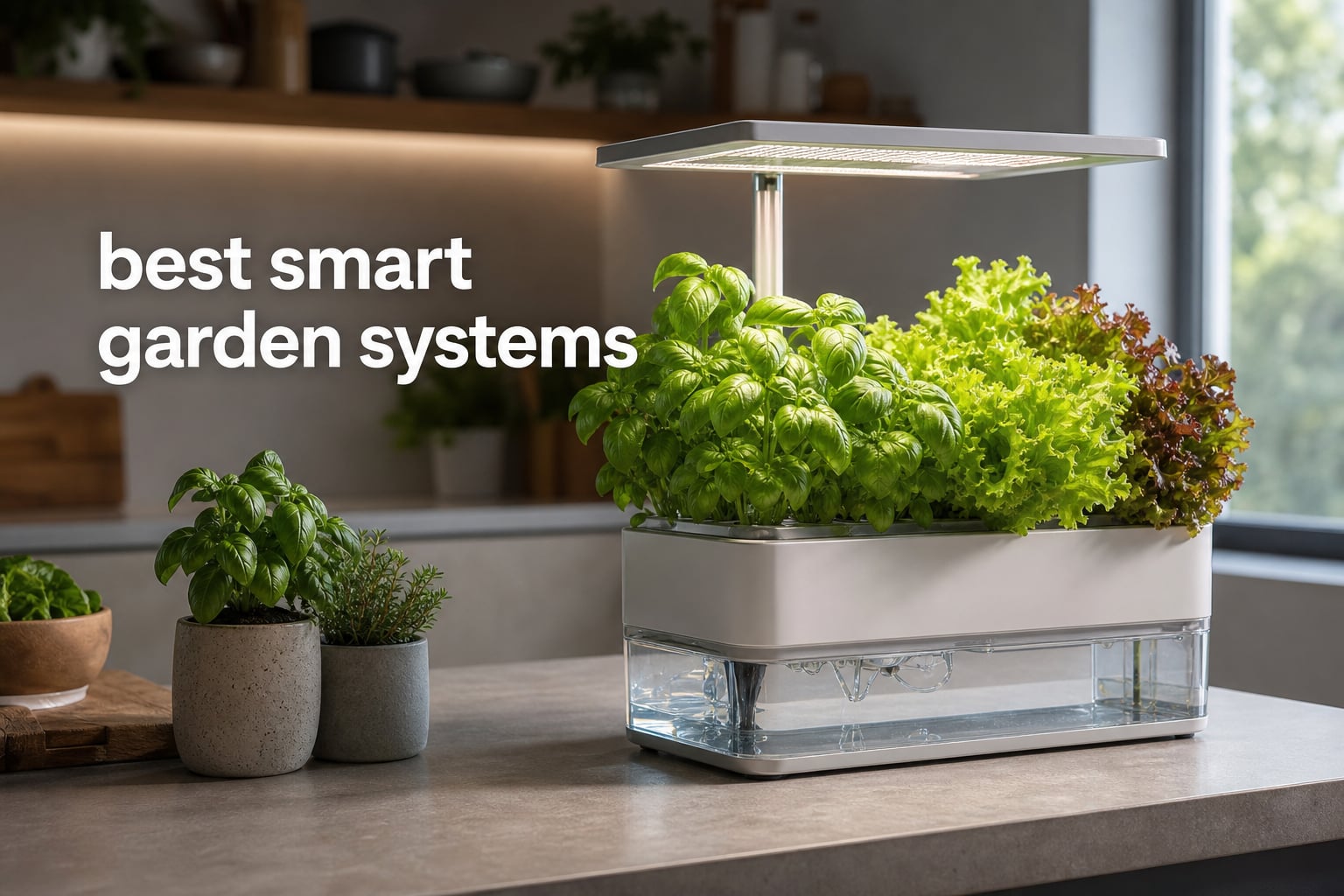
The best smart garden systems take the daily guesswork out of indoor growing: a reservoir feeds the roots, a pump circulates water, and LED grow lights follow a schedule. The result can be fresh herbs, leafy greens, and small vegetables in a kitchen, apartment, or office without soil spread across the counter.
I ranked the eight systems here by the details that change ownership most: growing capacity, tank size, light output and clearance, control options, reported pump noise, and the starter supplies included. We also kept the limits in view, because a long refill interval, an adjustable lamp, or app alerts mean very different things in a 10-pod countertop garden than in a 66-pod family setup.
A smart indoor garden is not magic, and no indoor planter makes every crop equally easy. Start with herbs and leafy greens, leave space between vigorous plants, and expect to buy seeds for models that include sponges rather than seeds; that honest starting point is more useful than a promise of instant harvests.
For 2026, the short version is simple: choose Growell for a roomy, straightforward 16-pod counter system, Ahopegarden’s 10-pod garden for compact everyday growing, and Gardyn Studio 2 when a narrow vertical garden with camera-based monitoring fits your room. The reviews below explain what each one actually provides so you can match its size to your plants and routine.
Table of Contents
The top 3 picks for smart garden systems cover most homes (September 2026)
These three choices separate simple countertop growing, compact everyday use, and a more advanced vertical setup. Their supplied specifications point to distinct needs rather than one universal winner.

Growell earns the editor’s-choice slot because its 16 planting positions pair with an 8L reservoir and a 28W full-spectrum lamp. Ahopegarden is the more compact answer when a kitchen counter is the hard limit, while Gardyn is for a buyer who wants vertical presentation and guided monitoring rather than a low-profile planter.
The best smart garden systems in 2026 range from 10 to 66 planting sites.
Use this at-a-glance comparison to narrow the field before reading the longer reviews. Capacity is not the same as plant size: basil, tomatoes, and other vigorous crops need more room than small herbs, even when every pod is available.
| Product | Specifications | Action |
|---|---|---|
 Growell 16-Pod Hydroponics System Growell 16-Pod Hydroponics System |
|
Check Latest Price |
| Ahopegarden 10-Pod Indoor Garden |
|
Check Latest Price |
 LetPot LPH-Air 10-Pod LetPot LPH-Air 10-Pod |
|
Check Latest Price |
 Sainlogic 12-Pod Smart Planter Sainlogic 12-Pod Smart Planter |
|
Check Latest Price |
 litokam 15-Pod Smart Garden litokam 15-Pod Smart Garden |
|
Check Latest Price |
 LetPot LPH-SE 12-Pod LetPot LPH-SE 12-Pod |
|
Check Latest Price |
 Gardyn Studio 2 Gardyn Studio 2 |
|
Check Latest Price |
 Ahopegarden 66-Pod System Ahopegarden 66-Pod System |
|
Check Latest Price |
All eight are indoor hydroponic systems, but their working styles differ sharply. The small planters fit a kitchen-herb routine; the 30-inch LetPot and vertical Gardyn allow more upward growth; and the 66-pod Ahopegarden is an indoor vegetable garden project that needs dedicated floor space.
1. Growell 16-Pod is the best all-around smart garden for roomy countertop growing.
Growell Hydroponics Growing System Kit, 16 Pods Indoor Garden with 28W Full Spectrum LED Grow Light, Auto Timer, 3 Smart Light Modes, 8L Large Herb Garden, Ideal Gardening Gift for Women, Men (Black)
16 pods
8L tank
28W LED
15.4 inch light
Pros
- 16 growing sites
- 8L reservoir
- three light modes
- pump under 40dB
Cons
- Seeds sold separately
- 17.7 inch-wide footprint
Growell is the most balanced pick in this group when you want to grow several herbs or greens without moving up to a floor-standing unit. Its listing gives it 16 pods, an 8L water tank, and a 28W full-spectrum grow light, which is a notably generous combination for a tabletop indoor garden system.
I would choose this model for a household that cooks often and wants basil, cilantro, lettuce, and smaller herbs cycling through one planter. The 4.7 rating from 453 reviews is encouraging, but the usable capacity still depends on spacing plants instead of treating all 16 openings as mature-plant slots.
The light offers Vegetable, Flowers & Fruits, and Herbs modes, plus 16-hour and 22-hour timer choices. Its pole adjusts to 15.4 inches, so it gives young plants room to grow before they crowd the LEDs.
Growell specifies a 30-minute circulation cycle and a pump below 40dB, a meaningful detail for anyone put off by pump noise in a kitchen. The maker also says the 8L tank can go four weeks without a water change, though water level, room temperature, and plant size will all shorten or extend real refill timing.
The large reservoir makes Growell a better fit for several thirsty plants.
An 8L tank reduces the frequency of topping up compared with the three-to-five-liter countertop options here. That does not remove routine checks, especially once roots and foliage are established, but it gives a busy beginner more margin for a missed day.
The kit includes 16 sponges, baskets, domes, labels, covers, tweezers, and two-part plant food. Seeds are separate, so I would decide on a seed source before the unit arrives rather than assuming each opening starts with a complete pod.
The adjustable lamp makes Growell practical for herbs and compact vegetables.
The 15.4-inch adjustment range is helpful for herbs that rise above the deck, and the three light modes make crop selection less one-size-fits-all. It is still a counter garden at 17.7 inches wide, so measure the placement before choosing it.
Choose this one when capacity and fewer refills rank above phone control. Its physical control panel, light flexibility, quiet-pump specification, and 16-site layout make it the clearest general-purpose choice in this roundup.
2. Ahopegarden 10-Pod is the best compact choice for a kitchen herb garden.
Ahopegarden Indoor Garden Hydroponics Growing System: 10 Pods Kit with LED
10 stations
3L reservoir
14.5 inch lamp
auto timer
Pros
- Compact counter size
- water-level window
- 10 stations
- full-spectrum light
Cons
- 3L tank
- only eight baskets and sponges supplied
Ahopegarden’s 10-pod garden is the practical counter-first option. At 11.97 by 6.69 by 6.69 inches, it takes up much less depth than the Growell, which matters in a rental kitchen or a worktop already shared with appliances.
Its rating is 4.6 from 3.2k reviews, the largest review base among these eight products. The reported customer feedback points to ease of use and compact placement, two traits that matter more to a first-time grower than advanced settings they may never use.
The water reservoir uses recirculation, and a see-through window lets you inspect the level without opening the garden. The lamp has full-spectrum LEDs, vegetable and flower/fruit modes, a 16-on/8-off timer, and a post adjustable to 14.5 inches.
The limitation is its 3L capacity. It needs a closer eye than the models with five liters or more, and the included-components list specifies eight baskets and eight sponges despite the 10 growing stations.
The small footprint makes Ahopegarden sensible for narrow counters.
This is the easy answer for someone whose gardening space is a strip beside the sink or a bright-looking corner of the office. Its low, compact shape is less visually demanding than an upright tower and still holds enough sites for a rotating mix of herbs.
I would start with fewer than 10 vigorous plants, then fill unused openings with covers as the kit allows. That approach leaves airflow around basil or lettuce rather than inviting a dense, shaded canopy.
The water-level window makes daily ownership less opaque for beginners.
A visible water level is a modest feature with a large practical benefit: you can check the reservoir at a glance. It is particularly useful on a 3L unit, where fast-growing plants can change the refill rhythm quickly.
Pick Ahopegarden if simple controls, small dimensions, and a well-established review record matter most. Plan on seeds or additional grow media if you expect every one of the ten positions to be planted from day one.
3. LetPot LPH-Air is the best smart garden for app-based reminders.
Pros
- Wi-Fi controls
- water alerts
- custom light schedule
- silent mode
Cons
- Seeds sold separately
- 3.5L tank
LetPot LPH-Air moves beyond timer-only growing with Wi-Fi and app control. Its LetPot app provides water-level alerts and lets the owner set lighting across a full 24-hour schedule, which is useful when the garden lives somewhere you do not walk past every day.
The system holds 10 pods and has a 24W full-spectrum LED lamp. It carries a 4.6 rating from 1k reviews, and its supplied information highlights customizable lighting, remote monitoring, BPA-free resin, and lifetime premier customer support.
The light rod adjusts to 14 inches, making this another good fit for herbs, leaf lettuce, and compact greens rather than long-season fruiting plants. LetPot describes a four-liter tank in its features and a 3.5-liter capacity in the product details, so I would treat its advertised 14-to-21-day watering interval as a guide rather than a fixed promise.
App control is useful only if it reduces a task you would otherwise forget. It does not replace checking roots, trimming crowded plants, or adding nutrient solution when the garden calls for it.
The remote alerts make LPH-Air useful when the garden is out of sight.
A water-level notification is the standout feature here. It makes more sense for a desk, studio, or second kitchen than for a planter directly beside your coffee maker, where a clear reservoir window may be enough.
The app also supports custom lighting schedules instead of locking you to a single timer. That flexibility can help if the LEDs are too bright during an evening routine, a common concern raised by indoor-garden owners.
The ten-pod format keeps LPH-Air focused on compact crops.
Ten holes sound like a broad garden, but plant size decides how many remain productive at once. Use the adjustable lamp and covers to focus on a manageable group of herbs or lettuces, and let larger plants have room.
Choose LPH-Air when notification-led care is more appealing than a manual timer. Buy seeds separately, and keep in mind that its tank is smaller than the Growell, LPH-SE, and 66-pod Ahopegarden options.
4. Sainlogic 12-Pod is the quietest smart garden option on the supplied specifications.
Sainlogic Hydroponics Growing System, 12-Pod Indoor Herb Garden with 24W LED Grow Light, WiFi App Control, Adjustable Height, Quiet Pump & Auto Timer for Herbs and Vegetables
12 pods
24W LED
Wi-Fi app
pump under 20dB
Pros
- Pump under 20dB
- DND mode
- 10-level dimming
- 12 pods
Cons
- Smaller review base
- blue-only color
Sainlogic is the garden I would put closest to a desk or sleeping area because its supplied pump rating is below 20dB and it includes a DND mode that pauses operation for 12 nighttime hours. Noise is an often-missed buying factor, especially in a studio apartment where the kitchen and bedroom overlap.
It has 12 pods, a 24W full-spectrum lamp, two light modes for vegetative and flowering growth, and an adjustable panel height. A Smart Life app adds Wi-Fi monitoring and supports lighting schedules from zero to 24 hours.
The 10-level dimming control is another practical advantage in a shared room. Instead of accepting maximum brightness all day, you can reduce the LED output when the garden is in a visually busy spot while still following the plant-care guidance for the crop.
This model has a 4.6 rating from 172 reviews, so its review sample is much smaller than Ahopegarden’s or the LPH-SE’s. That is not a defect, but it means I would give more weight to its stated features than make large assumptions from its review volume.
The quiet pump and DND mode make Sainlogic suited to shared living spaces.
Forum discussions around indoor hydroponics often mention pump cycles as more noticeable than expected. A specified sub-20dB pump and a scheduled 12-hour quiet period directly address that concern, though room acoustics can still change what you hear.
The clear water scale also helps cut down on unnecessary opening and checking. Pair that visual check with the app rather than relying on one signal alone.
The light controls give Sainlogic a flexible placement advantage.
Vegetative and flower modes, dimming, and custom schedules create more control than a single automatic cycle. The detachable light pole is meant to make cleaning easier, which can matter once nutrient residue and roots need attention.
Choose this model if quiet operation is a deciding feature and you want 12 positions without a large garden frame. The trade-offs are its newer, smaller review base and its single blue color option.
5. litokam 15-Pod is the best high-capacity countertop smart garden.
litokam Hydroponics Growing System Kit, 15 Pods Indoor Herb Garden with Smart APP & Quiet Pump, 24W LED Light, Auto Timer, Perfect Indoor Garden for Herbs, Vegetables & Flowers, Ideal for Plant Lovers
15 pods
5L tank
24W LED
app and touch controls
Pros
- 15 pods
- 5L transparent tank
- pump under 20dB
- low-water shutoff
Cons
- Seeds not included
- limited review volume
litokam packs 15 planting sites into a tabletop garden while retaining app and touch-panel control. That places it between the 16-pod Growell and the larger-format vertical systems: it gives you a fuller planting plan without asking for a dedicated floor location.
The unit uses a 5L transparent tank, a 24W full-spectrum light, 16-hour daily timer, and vegetable and fruit modes. Its adjustable arm reaches 14 inches, and the system offers 10 brightness levels for a more tailored light setup.
litokam also specifies a 30-minute water-circulation cycle, a pump below 20dB, and a low-water safety shutoff. The claimed two-to-three-week refill interval is a useful baseline, but an owner growing a full tray of large herbs should expect to check more frequently.
It is rated 4.6 from 117 reviews. The lower count does not erase the feature set, but a buyer who values a long ownership trail may prefer the 1k-plus-review LetPot models or Ahopegarden’s 3.2k-review 10-pod garden.
The 15 planting sites make litokam flexible for varied herb rotations.
Fifteen spots are useful for starting a mix of herbs, lettuce, and flowers, but they should not all be treated as permanent mature plants. The included domes and support stakes help with early growth and plant management, while spacing remains the gardener’s job.
Its transparent reservoir lets you see the water level, a feature I prefer over guessing based only on a reminder. That direct view also makes it easier to identify when a busy growing period is using more water than normal.
The low-water shutoff makes litokam a more forgiving app-enabled choice.
Low-water protection is a sensible safety feature for people who travel occasionally or overlook a notification. It should be treated as a backup rather than permission to leave a full garden unattended for long periods.
Choose litokam if you want one of the largest countertop capacities, quiet-pump specifications, and both physical and phone controls. Be ready to provide seeds, and judge the lighter review history alongside the published features.
6. LetPot LPH-SE is the best smart garden for taller indoor plants.
LETPOT LPH-SE Hydroponics Growing System, 12 Pods Smart Herb Garden Kit Indoor, Indoor Garden, APP & WiFi Controlled, with 24W Growing LED, 5.5L Water Tank, Pump System, Automatic Timer
12 pods
5.5L tank
30 inch lamp
Wi-Fi app
Pros
- 30 inch light height
- 5.5L tank
- stainless steel exterior
- lifetime service
Cons
- No drainage holes
- water level needs monitoring
LetPot LPH-SE stands out because its LED rod rises to 30 inches, far beyond the 14-to-15.4-inch range of several countertop models here. That clearance is the reason to consider it when you want plants to continue upward rather than hitting the light early.
It holds 12 cups, uses a 24W full-spectrum LED system, and offers vegetative and blooming modes. The 5.5L tank is listed as lasting up to three weeks, and Wi-Fi connects the system to the LetPot app for reminder functions and remote hardware or app upgrades.
The double-layer body combines a stainless-steel surface with a resin inner wall. That construction and the 16-by-7-by-9.8-inch dimensions make it more substantial than a basic plastic planter while remaining a countertop-sized format.
The rating is 4.5 from 1,733 reviews. That broad review count gives this model more ownership history than most smart-enabled gardens in the list, although the supplied drawbacks still matter: it has no drainage holes and requires water-level monitoring.
The 30-inch lamp clearance creates room for plants that do not stay low.
Light height is one of the first specifications I check because it can determine whether you are harvesting compact herbs or attempting taller leafy growth. The LPH-SE offers much more vertical headroom, but it also needs clear space above the counter.
The two plant modes can support different growth stages, while the app’s adjustable schedule gives you control over when the garden lights the room. That combination is useful for growers who are willing to learn a few controls rather than press a single timer button.
The 5.5L tank and washable exterior support a longer care interval.
A larger tank usually means less frequent topping up, and the stainless steel surface should be easier to wipe after routine garden work. It does not make cleaning optional: roots, tray surfaces, and the reservoir still need periodic care.
Choose LPH-SE for light clearance, a durable-looking outer surface, and a large review base. It is less ideal for anyone who wants a drain-ready setup or zero interest in checking the reservoir.
7. Gardyn Studio 2 is the best premium vertical smart garden for guided plant monitoring.
Gardyn Studio 2 Hydroponics Growing System – 16 Plants, Smart Tower
16 plants
vertical format
camera monitoring
AI assistant
Pros
- Narrow vertical design
- plant camera
- AI health guidance
- sealed columns
Cons
- Learning curve with AI features
- requires tall placement space
Gardyn Studio 2 takes a different path from the low countertop gardens. It grows up to 16 non-GMO plants in a vertical form measuring 54 by 17 by 12 inches, so it is built for a narrow floor footprint and needs a tall, dedicated spot.
The major differentiator is its monitoring package: an ultra-wide high-resolution camera views the garden, and the Kelby AI assistant provides real-time plant-health guidance. Sunrise and sunset LED modes are designed to mimic the rhythm of natural light, while the app supplies step-by-step support.
The Studio 2 has a 4.5 rating from 146 reviews. It includes seeds, LED lights, and the planter container, which gives a new gardener a more complete starting package than systems that supply grow media but require seeds from elsewhere.
Gardyn’s no-cleaning columns use watertight silicone seals, a thoughtful response to the cleaning burden many indoor growers mention. Even so, a garden with 16 plants still needs harvesting, observation, and the space to keep leaves from becoming crowded.
The vertical form gives Gardyn a strong answer for small floor footprints.
A 17-inch width is much easier to place than a wide horizontal rack, provided you have the 54-inch height and access for plant care. It can act as a functional decor piece, but that should not hide the fact that it is a larger object than a countertop planter.
This format is well suited to an apartment dweller who wants a visible indoor growing station without sacrificing a large section of counter. It is not the right answer for a cabinet-height kitchen or anyone who intends to store it between grows.
The camera and AI guidance make Gardyn more helpful for observational learning.
Camera-based tracking and Kelby’s plant-health guidance can give a beginner more feedback than a simple timer. The trade-off is a learning curve: a buyer should be comfortable using the app and interpreting guidance rather than wanting a fully manual garden.
Choose Gardyn Studio 2 when vertical growing, included non-GMO plants, and guided monitoring matter more than a basic tabletop layout. Its sealed columns reduce one cleaning concern, while the physical height and smart features ask for more commitment.
8. Ahopegarden 66-Pod is the best high-output system for serious indoor growing.
Ahopegarden Indoor Garden Hydroponics Growing System Kit: 66 Pods Plant Herb Garden Germination Kit with LED Grow Light, 30L Large Capacity Kitchen Hydroponics Planter Grower for Vegetable Fruit
66 pods
30L capacity
53W LED
three water zones
Pros
- 66 growing sites
- 30L across three tanks
- 53W LED
- independent pumps
Cons
- 22 pound unit
- large footprint
Ahopegarden’s 66-pod system is not a small kitchen herb garden; it is the indoor vegetable garden choice for a family or an enthusiastic grower. It has 66 sites across a triple-layer hydroponic design, with three independent 10L tanks for a stated total capacity of 30L.
The 53W dual-mode LED system offers 16-hour and 22-hour schedules. Ahopegarden says its 22-hour setting can boost vegetable yields by 50 percent for crops such as tomatoes, but that is a manufacturer claim rather than a universal result; crop choice, pruning, nutrients, and room conditions still decide the harvest.
Independent pumps permit zone planting, meaning different sections can receive tailored nutrients for different crops. That is a major step up from a single-reservoir planter, particularly if you are separating herbs from larger vegetables with different care needs.
The system measures 25.59 by 14.96 by 21.65 inches and weighs 22 pounds. It has a 4.5 rating from 86 reviews, a silent-pump claim, adjustable lights up to 14.68 inches, a collapsible frame, and 360-degree mobility.
The three water zones make Ahopegarden better for mixed-crop planning.
Zone planting is the feature that turns this from a large collection of holes into a more serious growing system. It gives the owner a way to organize crops by their needs instead of forcing every plant into one water-and-nutrient routine.
That flexibility also adds responsibility. Plan which crops go in each zone, label seedlings, and avoid filling all 66 positions with plants that mature at the same size and date.
The large frame rewards a permanent, accessible placement.
The wheels and collapsible frame help with movement and storage, but a filled 30L garden is not something most people will want to shift often. Pick a location with access to power, room for the lamp adjustment, and a straightforward route for refilling and cleaning.
Choose this Ahopegarden only when you genuinely want large-scale indoor output. It offers the highest capacity in this list, but its weight and size make it a poor match for a tiny counter or a casual one-herb experiment.
Choose a smart garden by matching its capacity, light, and care routine to your home.
The right smart garden is the one you will refill, harvest, and clean without resentment. Before choosing a model, work through the following decisions in order; they prevent most mismatches between an appealing product page and daily life.
The first decision is whether you need a countertop planter or a vertical garden.
Countertop models such as Ahopegarden’s 10-pod system, Growell, Sainlogic, litokam, and both LetPot gardens are made for herbs and modest leafy-green growing. Measure not just the deck space but the clear height above it, because an adjustable lamp is useful only when it can rise freely.
Gardyn Studio 2 uses height to hold 16 plants in a narrow footprint, while the 66-pod Ahopegarden needs a bigger, accessible floor area. A large system is not automatically better: it means more plants to thin, harvest, refill, and keep clean.
The plant plan should decide how many pods you actually need.
Herbs such as basil, parsley, cilantro, chives, mint, and oregano suit small indoor hydroponic gardens well. Leaf lettuces and compact greens can also work, while fruiting crops need more light, height, spacing, time, and nutrient attention than a dense pod count may suggest.
Start fewer plants than the maximum number of holes if you are growing fast, bushy varieties. Covers on unused sites help you keep a realistic plant plan rather than crowding every opening because it is available.
The reservoir size should match how often you can check water.
A three-liter tank like the Ahopegarden 10-pod needs more frequent attention than Growell’s 8L tank or Ahopegarden’s 30L triple-tank system. App alerts and clear water windows make checking easier, but neither changes the fact that larger, thirstier plants draw down water faster.
Follow the supplied refill intervals as starting estimates, not guarantees. Heating, humidity, plant maturity, and light schedules can change how much water the garden uses, so the first few weeks should include regular visual checks.
The light controls and clearance determine what the garden can support.
Every system here uses LED grow lights, but wattage, modes, dimming, schedule control, and adjustable height differ. A short lamp clearance is fine for herbs and lettuce; LetPot LPH-SE’s 30-inch rod is the clearest pick if you want more room for upward growth.
Consider where the light will shine during the evening. Models with dimming, custom schedules, or a nighttime pause can be more comfortable in a kitchen, desk area, or studio where bright LEDs would otherwise dominate the room.
The pump specification and cleaning access shape long-term comfort.
Forum discussions repeatedly flag pump noise, bright lights, expensive replacement pods, and unexpected maintenance as common frustrations. Sainlogic and litokam list pumps under 20dB, Growell lists a pump under 40dB, and several models offer silent or quiet modes; those are manufacturer specifications, not a promise that every room will sound the same.
Ask how you will clean the tank, tray, pump, and roots before you plant. Gardyn’s sealed columns and Sainlogic’s detachable light pole address parts of the cleaning task, while a no-drainage design such as the LPH-SE calls for a deliberate emptying routine.
The supply plan matters as much as the hardware.
Some gardens include nutrients, sponges, baskets, domes, or starter plants, but not every kit includes seeds. The Growell, LPH-Air, and litokam descriptions specifically call out that seeds are separate, and Ahopegarden’s 10-pod kit lists only eight baskets and sponges for its ten stations.
Check whether you prefer a branded pod ecosystem or want the freedom to select your own seeds and compatible grow media. Replacement supplies, nutrient solution, and cleaning time are recurring parts of hydroponic ownership, so a garden with easy-to-find consumables is often the calmer choice.
The electricity question has no one-size-fits-all answer.
Energy use depends on the lamp wattage, daily light schedule, pump cycle, and local electric rate. A 24W or 28W lamp scheduled for 16 hours is a different load from the Ahopegarden 66-pod system’s 53W lamp on a 22-hour setting, so use the supplied wattage and your local rate for a realistic estimate.
Do not ignore the practical benefit, though: these systems can let people in northern climates grow herbs year-round without an outdoor season. The trade-off is committing to light, water, nutrients, and a few minutes of plant care rather than expecting zero maintenance.
FAQs
What is the best indoor garden system for beginners?
The Ahopegarden 10-Pod Indoor Garden is the simplest beginner pick in this list because it has a compact counter format, automatic 16-hour timer, water-level window, adjustable lamp, and 10 stations. Growell is a better beginner choice when you want more planting room and an 8L reservoir, but it needs a wider counter.
How much does a smart garden cost?
There is no single figure because garden capacity, LED output, app hardware, tank size, and included supplies vary widely. Compare replacement seed, sponge, basket, and nutrient availability as well as the hardware, since those supplies are part of long-term ownership.
Do smart garden systems really work?
Yes, smart garden systems can grow herbs and compact greens indoors by pairing a nutrient-water reservoir, circulating pump, and scheduled LED grow light. Results still depend on seed quality, plant spacing, water level, nutrients, cleaning, light height, and choosing crops suited to the available space.
What can you grow in a smart garden?
Most smart gardens are well suited to basil, parsley, cilantro, chives, mint, oregano, leaf lettuce, and other compact greens. Larger fruiting crops need more light, vertical clearance, spacing, and care, so use an adjustable-height model and avoid overfilling every pod.
Are indoor hydroponic gardens worth it?
Indoor hydroponic gardens are worth it for people who will use fresh herbs or greens regularly and want year-round growing without outdoor soil. They are less suitable for anyone unwilling to refill water, add nutrients, clean the reservoir, manage light brightness, and buy replacement growing supplies when needed.
Growell is the best smart garden system for most homes in 2026.
Among the best smart garden systems, Growell gives most households the clearest mix of 16 planting sites, an 8L tank, a 28W adjustable grow light, and a stated quiet-pump design. Ahopegarden’s 10-pod unit is the simpler compact alternative, Sainlogic is the noise-conscious app choice, and LetPot LPH-SE gives taller plants more lamp clearance.
Choose Gardyn Studio 2 if a vertical garden and camera-guided monitoring fit your space, or choose the 66-pod Ahopegarden only when you are ready for a large indoor-growing routine. Start with the size of your counter or floor space, decide what you actually want to eat, and select the system whose refill and cleaning routine you will keep.