
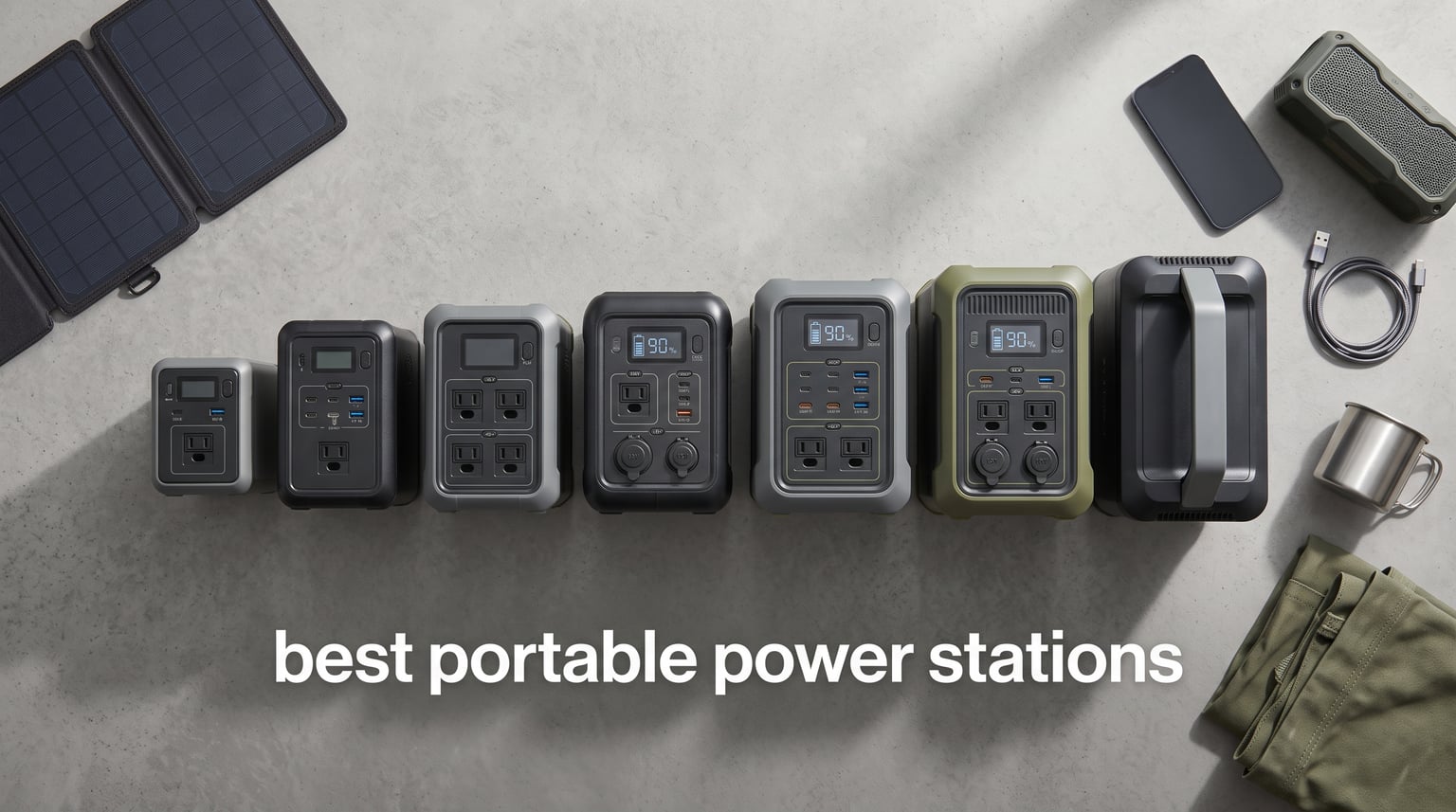
The best portable power stations make more sense when you start with the appliance, not the brand. A compact battery that keeps phones, cameras, a laptop, and a small light running is a very different purchase from a unit expected to support a refrigerator, power tools, or a long outage.
A portable power station is a rechargeable battery with an inverter, AC outlets, DC ports, and USB charging. It stores energy in watt-hours (Wh), converts battery power for household-style plugs, and can usually recharge from a wall outlet, a vehicle, or compatible solar panels without the fumes and constant engine sound of a gas generator.
For 2026, my short answer is that there is no single best brand for every person. Jackery, Anker, EcoFlow, and BLUETTI each have a sensible role here: capacity and output decide whether the unit can do the job, while charging speed, weight, ports, warranty, and expansion decide whether it will be pleasant to own.
Our editorial calls below are based on the listed manufacturer specifications, customer ratings and review counts, and the needs raised repeatedly by camping, overlanding, and van-life communities. I do not treat a high watt-hour figure as a promise of a certain runtime, because inverter losses, appliance cycling, temperature, and the device’s real draw all change the result.
If I were choosing today, I would start with the Jackery Explorer 1000 v2 for a balanced roughly 1kWh setup, move to the Jackery Explorer 2000 v2 for longer backup, and look at the EcoFlow DELTA Pro only when a large expandable system is truly justified. The smaller Jackery Explorer 300 and Anker SOLIX C300 are much easier to carry, but their 300W-class output puts clear limits on what they can run.
Table of Contents
These are the top 3 portable power station picks
These three choices cover the common middle ground: a balanced camping-and-backup unit, a faster-charging 1kWh alternative, and a quieter smaller-capacity option. The stated capacity, continuous AC output, and one deciding feature are the fastest way to separate them.
Jackery Explorer 1000 v2: 1,070Wh, 1,500W AC output, 23.8-pound carry weight, and an emergency charge mode listed at one hour.
Anker SOLIX C1000: 1,056Wh, 1,800W AC output, 11 ports, and a stated 58-minute full wall charge.
BLUETTI AC70: 768Wh, 1,000W AC output, 2,000W power lifting, and a manufacturer-described quiet operating profile.
Top 3 Picks – Best Portable Power Stations in 2026
Best Portable Power Stations in 2026 Comparison
Read the capacity first, then the continuous AC output. A 292Wh unit can be excellent for personal electronics, while a 2,042Wh or 3,600Wh battery has a better starting point for larger appliances and longer emergency backup; neither can run a device whose starting or running demand exceeds its supported output.
Weight is the next reality check. The 7.1-pound Explorer 300 can go in a car with little thought, while the 99-pound DELTA Pro is better understood as a roll-to-where-you-need-it system rather than a grab-and-go camp battery.
| Product | Specifications | Action |
|---|---|---|
 Jackery Explorer 1000 v2 Jackery Explorer 1000 v2 |
|
Check Latest Price |
 Anker SOLIX C1000 Anker SOLIX C1000 |
|
Check Latest Price |
 EcoFlow DELTA 3 Classic EcoFlow DELTA 3 Classic |
|
Check Latest Price |
 BLUETTI AC70 BLUETTI AC70 |
|
Check Latest Price |
 Jackery Explorer 300 Jackery Explorer 300 |
|
Check Latest Price |
 Anker SOLIX C300 Anker SOLIX C300 |
|
Check Latest Price |
 Jackery Explorer 2000 v2 Jackery Explorer 2000 v2 |
|
Check Latest Price |
 EcoFlow DELTA Pro EcoFlow DELTA Pro |
|
Check Latest Price |
1. Jackery Explorer 1000 v2 is the best balanced 1kWh choice
Jackery Explorer 1000 v2 Portable Power Station,1070Wh,1500W
1070Wh LiFePO4
1500W AC, 3000W surge
23.8 lb
7 ports
Pros
- 1500W continuous output
- Light 23.8 lb build
- Fast emergency charge
- 4000 cycle rating
- 100W USB-C
Cons
- Jackery panels only
- One-year warranty
The Explorer 1000 v2 lands in the capacity range I would suggest for a serious weekend camp setup, a small RV load plan, or selective home backup. Its listed 1,070Wh battery and 1,500W continuous AC output give it meaningfully more headroom than the 300W compact models without forcing you into the much heavier large-system class.
The 3,000W surge figure matters for devices that pull extra power on startup, although I would still check the appliance label before assuming compatibility. Jackery lists a 100W USB-C PD output, so a laptop can charge directly rather than occupying an AC outlet and its wall adapter.
Portability is a strong part of the case. At 23.8 pounds and 12.87 by 8.82 by 9.72 inches, it is one of the easier 1kWh-class units to move from vehicle to campsite or from a closet to a room during an outage.
Jackery lists a default full charge in 1.7 hours and an emergency charge in one hour, plus a 4,000-cycle battery rating. That combination is practical for someone who will recharge often, though the listed one-year warranty is shorter than the five-year coverage attached to several alternatives here.
This model suits campers and backup users who need balanced power
I would put this at the top of a list for people who need more than phone charging but do not need a 2kWh battery. Its 1,500W inverter has scope for many common small appliances, while the capacity is still restrained enough for one person to carry.
The seven listed outputs include three AC outlets, two USB-C ports, one USB-A, and a DC car outlet. That layout works well when a group has mixed charging needs rather than one high-demand device.
This model is less suitable when solar-panel freedom or longer coverage matters
The stated solar-panel compatibility is limited to Jackery panels. That is an important fit issue for anyone who already owns panels or wants to choose from a wider connector ecosystem.
I would also compare warranty terms closely if the station will be an essential backup appliance. The 4,000-cycle claim is encouraging, but warranty length and support still shape the ownership experience people worry about in long-term forum discussions.
2. Anker SOLIX C1000 is the fast-charging 1kWh alternative
Anker SOLIX C1000 Portable Power Station with Car Charging Cable, 1,056Wh
1056Wh LiFePO4
1800W AC, 2400W peak
27.6 lb
11 ports
Pros
- 1800W output
- 58 minute charge
- 11 ports
- 600W solar input
- Five-year warranty
Cons
- 27.6 lb weight
- 3000 cycle rating
The SOLIX C1000 is the one I would compare directly with the Explorer 1000 v2 when wall-charging speed and higher continuous output are the deciding points. It pairs 1,056Wh with an 1,800W inverter and a 2,400W peak rating, which gives it a larger running-power cushion for appliances within that limit.
Anker states a full charge in 58 minutes. That is a useful number for a station that returns from a trip depleted or needs to be made ready before weather arrives, but rapid charging can also mean fan activity, so it is worth putting the unit where sound will not bother sleepers.
The listed 11 ports and up to 600W solar recharging are the practical advantages for a multi-device camp group or a household backup corner. I also like that the app can customize charging speeds, since a less aggressive mode may be welcome when you are prioritizing sound over the fastest refill.
At 27.6 pounds, it is heavier than the Jackery 1000 v2 but remains a one-person carry for many adults. Anker lists a five-year warranty and 3,000 battery cycles, which gives this model a stronger stated coverage period even though its cycle figure is lower than the Jackery’s listed 4,000.
This model suits users who want fast recharging and higher AC headroom
The C1000 is a good match for a person who wants a roughly 1kWh lithium power station to refill quickly between uses. The 1,800W continuous output also makes it more flexible than 1,000W and 1,500W choices when the planned appliance draw is close to those limits.
I would particularly consider it for a home emergency kit with varied device types because the port count is generous. You still need to total the watts being drawn at the same time; many ports do not increase the station’s total inverter limit.
This model is less suitable when carry weight is the first filter
The extra power does not make this a featherweight unit. If repeated loading, flights of stairs, or a long walk from parking to camp are part of the routine, the listed 27.6-pound weight deserves a real-world lift before buying.
It is also wise to separate battery longevity from warranty coverage. Anker’s listed 3,000 cycles and five-year warranty are both useful data points, but neither substitutes for keeping the battery within its stated operating and charging guidance.
3. EcoFlow DELTA 3 Classic is the port-rich UPS-capable pick
EF ECOFLOW Portable Power Station Delta 3 Classic, 1024Wh 1800W AC
1024Wh LiFePO4
1800W AC, 3600W surge
15 outlets
45 minute 80% charge
Pros
- 15 outlets
- 1800W output
- Fast UPS switching
- 45 minute 80% charge
- App controls
Cons
- No DELTA 2 extra battery
- Listed 15 lb weight needs checking
The DELTA 3 Classic makes the strongest case for a mixed home-office and emergency role. Its listed 1,024Wh LiFePO4 battery and 1,800W AC output are comparable with the Anker C1000, while its 15 outlets and under-10-millisecond UPS switching focus attention on keeping several lower-draw devices connected.
EcoFlow says X-Boost supports up to 2,600W and lists a 3,600W surge figure. I would not read that as permission to run any 2,600W appliance without checking the manufacturer’s specific X-Boost conditions, because continuous output is still the first number to match against an appliance label.
A stated 0-to-80-percent charge in 45 minutes is strong for a 1kWh portable power supply. The 100W USB-C output and app-based Storm Alert also make sense for people who want direct laptop charging and a more connected outage-preparation setup.
EcoFlow lists 15 pounds as the unit weight, 15 total outlets, and a five-year warranty. The very low listed weight relative to similar-capacity stations is a specification I would personally confirm in the current product documentation before planning around it, but the feature set is clear: many outlets, fast charging, and quick backup switching.
This model suits a desk, modem, and multi-device backup role
The fast UPS switching is the deciding feature for a setup where a modem, computer, monitor, or other sensitive electronics need a short interruption rather than a long restart. It is also useful for a camping base where many small accessories need their own ports.
I would use the display and app to watch total draw instead of treating the many outlets as unlimited capacity. A 1,024Wh battery still empties much faster under a heavy appliance load than under a router-and-laptop load.
This model is less suitable for owners invested in the DELTA 2 battery family
The DELTA 3 Classic is not compatible with the DELTA 2 Smart Extra Battery. That is a simple but important compatibility boundary if you are buying into an expandable battery plan rather than a single stand-alone station.
People who prefer the simplest possible control scheme may also find app features unnecessary. The app can be helpful, but forum users correctly point out that app quality should be a secondary consideration after output, capacity, and physical controls.
4. BLUETTI AC70 is the quieter smaller-capacity camping choice
BLUETTI AC70 Portable Power Station 768Wh 1000W LFP Battery Solar Generator
768Wh LiFePO4
1000W AC, 2000W lifting
22.5 lb
100W USB-C
Pros
- Quiet operation
- 2000W power lifting
- 45 minute 80% charge
- 500W solar input
- 3000 plus cycles
Cons
- 768Wh capacity
- Two-year warranty
The BLUETTI AC70 is for the buyer who needs more than a small personal battery but does not need the full roughly 1kWh class. Its 768Wh LiFePO4 battery and 1,000W AC inverter make it a sensible power station for camping when lights, cameras, a laptop, a small fan, and selected cooking or cooling gear are the plan.
BLUETTI lists 2,000W power lifting, but its basic continuous AC output remains 1,000W. I would build a packing list around that continuous rating and treat power lifting as a feature to verify for the individual resistive appliance, not a replacement for careful wattage matching.
The listed 0-to-80-percent charge time is 45 minutes, with a full charge in 1.5 hours, and the stated solar input reaches 500W. Those are useful figures for a short camping window in which you want to refill during a drive or when solar conditions are good.
Noise comes up often in campground conversations because a fan that is fine at midday can be disruptive in a quiet tent or van at night. BLUETTI describes the AC70 as super quiet, so it is one of the models I would place on the shortlist for sleep-adjacent use, while still acknowledging that no decibel figure is provided in this product data.
This model suits campers who value moderate capacity and quieter operation
The 22.5-pound weight is manageable for a station with 768Wh on board. Its 100W USB-C port also lets a modern laptop charge efficiently without wasting an AC outlet.
I would choose it for a road trip or car camp where the plan favors several moderate loads over one demanding appliance. Seven total outputs are enough for a small group, but capacity management still matters overnight.
This model is less suitable for long outages and high continuous loads
The 768Wh battery is smaller than the 1,024Wh through 1,070Wh models above it, so reserve time is the tradeoff. A refrigerator, for example, cycles on and off and may need more energy over a full day than an initial plug-in check suggests.
The listed two-year warranty is also shorter than the five-year coverage on the Anker C1000, EcoFlow DELTA 3 Classic, Jackery Explorer 2000 v2, and EcoFlow DELTA Pro. That does not make the AC70 a poor choice, but it belongs in a warranty comparison.
5. Jackery Explorer 300 is the lightweight essentials-only choice
Jackery Explorer 300 Portable Power Station,292Wh
292Wh LiFePO4
300W AC, 500W surge
7.1 lb
100W USB-C
Pros
- Only 7.1 lb
- 100W USB-C
- 4000 cycle rating
- Small footprint
- Solar recharge support
Cons
- 300W output
- 292Wh capacity
The Explorer 300 is a different category of tool from the 1kWh stations. At 292Wh with a 300W AC output and a 7.1-pound weight, it is made for personal electronics, lights, camera batteries, and modest low-watt accessories rather than a broad home-backup role.
That limit is not a flaw if it matches the assignment. I would rather carry this small Jackery on a photography day, a short tent-camping trip, or a vehicle emergency kit than haul a much larger battery just to charge a phone, drone, laptop, and headlamp.
The 100W USB-C PD input and output is a welcome feature in a compact unit, and Jackery lists 80 percent solar charging in 2.8 hours with a 100W panel. The battery carries a listed 4,000-cycle rating, which is a strong longevity figure for a small station used frequently.
The station has two AC outlets, two USB-A ports, one USB-C PD port, and one car port. I would plan around direct DC and USB charging wherever possible because running a small device through an AC inverter adds conversion losses.
This model suits solo travel and personal electronics
A 7.1-pound portable power station is easy to keep in a vehicle or carry from a picnic table to a tent. The 292Wh capacity is far more useful for repeated phone and camera charging than a bare power bank, while remaining much less cumbersome than a camp battery.
It also suits anyone who values a simple, maintenance-light backup for selected low-draw items. Jackery describes it as fume-free, quiet, and maintenance-free in operation, which is the practical contrast with a small gas generator.
This model is not the right answer for refrigerators or power tools
The 300W continuous rating is the boundary to respect. Many kitchen appliances, heaters, hair tools, compressors, and job-site tools either exceed that draw or need a startup surge beyond the listed 500W peak.
I would move up to at least the BLUETTI AC70 for moderate appliance plans and to a 1kWh or 2kWh model for longer backup. A small battery can be excellent at its intended task without being an emergency power solution for a whole room.
6. Anker SOLIX C300 is the compact USB-C-forward choice
Anker SOLIX C300 Portable Power Station, 288Wh Solar Generator for Camping
288Wh LiFePO4
300W AC, 600W surge
140W USB-C
25dB
Pros
- 140W two-way USB-C
- 25dB operation
- Five-year warranty
- Compact form
- 3000 cycles
Cons
- 300W AC limit
- Panel compatibility limits
The SOLIX C300 competes with the Explorer 300 in the compact class, but its connection strategy is more laptop-centric. It combines a 288Wh LiFePO4 battery and 300W AC output with 140W two-way USB-C charging, which is a strong feature if fast USB-C charging is the main reason you want portable power.
Anker lists a 600W surge rating, a charge time of 68 minutes, and 80 percent in 50 minutes. It also states a 25dB operating level, making this one of the few products in the group with a specific quiet-operation number instead of a general claim.
The listed port selection includes three AC outlets, a car socket, two 140W USB-C ports, an additional 15W USB-C port, and a USB-A port. That is a useful spread for a mobile work bag or small camp table, although all simultaneous loads still share the 300W total AC limit.
At 4.13 kilograms in the product data, this is a compact station built around frequent movement rather than long appliance runtime. Anker lists a five-year warranty and 3,000 cycles, adding a longer stated coverage period than many portable units of this size.
This model suits fast USB-C charging and quiet small-space use
I would pick the C300 over a basic 300W station for a laptop-heavy kit, especially when two USB-C devices may need high-power charging at the same time. Charging by USB-C can keep desk and camp setups tidier than carrying extra AC bricks.
The 25dB figure is also worth attention for a van, tent vestibule, hotel room during an outage, or any place where fan noise affects sleep. Reported quiet operation is a real quality-of-life feature, not just a specification line.
This model is not suitable for panel compatibility assumptions or large loads
It is not compatible with Anker SOLIX PS30, PS200, or PS400 panels according to the product data. Confirm the exact panel model and connector path before treating solar charging as part of the purchase.
Its 288Wh capacity and 300W output keep it firmly in the personal-power category. The best portable power stations for a refrigerator, power tools, or serious home backup need substantially more continuous output and stored energy.
7. Jackery Explorer 2000 v2 is the practical 2kWh backup pick
Jackery Explorer 2000 v2 Portable Power Station, 2042Wh, 2200W AC Output
2042Wh LiFePO4
2200W AC
39.5 lb
30dB silent mode
Pros
- 2042Wh capacity
- 2200W output
- 39.5 lb for size
- 30dB charging mode
- Five-year warranty
Cons
- Large to carry
- Only three AC outlets
The Explorer 2000 v2 is where portable backup begins to feel capable of more than a short convenience window. Its 2,042Wh LiFePO4 battery and 2,200W AC output give it nearly twice the stored energy of the 1kWh models, with more continuous power for appliances that stay within its rating.
Jackery lists a 39.5-pound weight and says the design is 41 percent lighter and 34 percent smaller than typical 2kWh units. It is not a casual carry, but that weight is far less intimidating than the 99-pound DELTA Pro for someone who needs to move the station without a cart.
The stated 0-to-80-percent AC charge time is 66 minutes, and the silent charging mode is rated at 30dB. A 20-millisecond UPS switching figure and a 100W USB-C PD port round out a useful emergency setup for networking equipment, phones, laptops, and selected household loads.
The listed solar figure is six hours with 400W panels, while the product details name three AC outlets. That outlet count is lower than some smaller models, so I would plan the actual plug-in arrangement before buying rather than assuming capacity automatically means a large number of sockets.
This model suits longer backup, RV, and higher-demand camp plans
This is the Jackery I would consider for a refrigerator plan, a longer outage, or RV use after calculating the appliance’s average draw and startup demand. A 2,042Wh battery gives more operating margin, but only measured appliance consumption can turn that capacity into a dependable time estimate.
The 2,200W inverter is also a meaningful move beyond 1,000W and 1,500W units. It broadens the list of compatible appliances, provided their running watts and startup behavior fit inside the system’s stated limits.
This model is less suitable when frequent carrying and many AC outlets matter
Even at a relatively restrained 39.5 pounds for its capacity, this is a lift that many users will not want to repeat often. Plan a stable storage spot and a simple path to the location where it will be used.
Three AC outlets can be enough for a focused backup setup, but it is less flexible for a table full of wall-powered devices. A power strip may seem like an answer, yet the combined load still cannot exceed the 2,200W output rating.
8. EcoFlow DELTA Pro is the high-output expandable system
EF ECOFLOW Portable Power Station 3600Wh DELTA Pro, 120V 3600W AC Output
3600Wh LiFePO4
3600W AC, 7200W surge
99 lb
25kWh expansion
Pros
- 3600Wh capacity
- 3600W output
- Expandable to 25kWh
- Five AC outlets
- Five charging methods
Cons
- 99 lb weight
- Large footprint
The DELTA Pro is the most powerful portable power station in this group by both listed capacity and continuous AC output. Its 3,600Wh LiFePO4 battery, 3,600W output, and 7,200W surge capability are designed for larger backup demands, RV use, and job-site-style loads rather than a casual tent-camping kit.
EcoFlow lists X-Boost up to 4,500W, dual-unit pairing for 7,200W output, and expansion to 25kWh with extra batteries. Those figures make it a system rather than merely a battery generator, which is attractive for a household whose needs may grow over time.
It has five AC outlets and 15 output methods, plus wall, solar, vehicle, generator, and EV-station charging paths. The stated wall-charge time is 1.8 hours at 3,000W or 2.7 hours at 1,800W, while the solar claim is 2.8 hours with four 400W panels under suitable conditions.
There is a clear physical cost to all that capability: the listed weight is 99 pounds and dimensions are 25 by 11.2 by 16.4 inches. I would treat this as movable only with planning and place it near the intended backup loads, rather than expecting one person to relocate it repeatedly.
This model suits serious home backup and expandable off-grid systems
The DELTA Pro makes sense when a 1kWh or 2kWh station cannot meet the energy plan and expansion is a real possibility. Van-life and overlanding users often value an expandable system because battery needs can increase after adding a fridge, communications gear, or longer stays away from shore power.
Its 3,600W continuous output gives a much wider appliance range than every other product here. I would still make a written list of expected simultaneous loads, because large inverter capacity does not remove the limits of stored energy or circuit planning.
This model is not a sensible choice for carry-first camping
Ninety-nine pounds changes the meaning of portable. It may roll or move between fixed points, but it is not the station I would choose for a campsite reached by a trail, frequent car loading, or a small apartment with stairs.
The system’s expansion and charging options are useful only if they fit your future plan. For phone, laptop, lighting, and modest camp loads, a smaller LiFePO4 station is easier to store, move, and keep charged.
Choose the right portable power station by matching your actual load
The simplest buying rule is to choose output in watts for what must run now and capacity in watt-hours for how long it must run. Do not buy a battery based on a brand name, a large review count, or the number of ports before these two figures make sense for your appliances.
Calculate capacity by converting appliance draw into watt-hours
Start with the device’s wattage, then multiply by the number of hours you expect it to run. A 60W laptop used for five hours needs about 300Wh before charging losses, while a 100W device used for eight hours needs about 800Wh.
Battery stations do not deliver every stored watt-hour to an AC device because the inverter and charging process consume some energy. I would leave a healthy buffer rather than treating a 1,000Wh label as exactly 10 hours for a 100W load.
Appliances with compressors, motors, heating elements, and temperature controls need extra care. A refrigerator does not draw its maximum wattage every minute, but its compressor can draw a startup surge and it may cycle often during warm weather or when the door opens.
Match continuous output before relying on surge or power-lifting claims
Continuous AC output is the number that describes what the inverter can support while an appliance runs. A 300W station is for low-demand electronics, a 1,000W to 1,800W station covers a wider camping and backup set, and a 2,200W or 3,600W system is for more demanding plans.
Surge power helps a motor start, but it is not extra continuous power. Treat the 3,000W Jackery Explorer 1000 v2 surge, 2,400W Anker C1000 peak, and 7,200W DELTA Pro surge as startup allowances within their documented conditions, not routine operating ratings.
Power lifting and X-Boost features need the same caution. They can be useful for specific compatible loads, but I would buy a station whose normal AC output already supports the core appliance whenever possible.
Prefer LiFePO4 when frequent use and cycle life matter
Every product in this selection uses a LiFePO4 battery. This chemistry is commonly chosen for long cycle life, and the listed ratings here range from 3,000 cycles on several models to 4,000 cycles for the Jackery Explorer 1000 v2 and Explorer 300.
Cycle counts are useful comparison data, not a guarantee that every owner gets identical service life. Storage temperature, charging habits, discharge depth, and the unit’s management system all affect real battery aging.
Warranty deserves its own line in your notes. The models here list coverage from one year on the Explorer 1000 v2 and two years on the BLUETTI AC70 to five years on several Anker, EcoFlow, and Jackery models; that difference matters if the station is an important home backup tool.
Plan solar charging around input limits and real conditions
Solar panels can make a portable power station much more useful off-grid, but panel wattage alone does not tell the full story. Check the station’s solar input limit, the connector compatibility, panel angle, weather, shading, and the time available to charge.
The Anker C1000 lists up to 600W solar recharging, the BLUETTI AC70 lists 500W, and the DELTA Pro has a stated 2.8-hour figure with four 400W panels. Those figures are best understood as favorable-condition targets rather than day-long guarantees.
Compatibility can be the hidden issue. The Explorer 1000 v2 is listed as compatible only with Jackery solar panels, while the SOLIX C300 excludes several specific Anker panel models, so verify the exact station-and-panel pairing before adding solar to the plan.
Choose weight and noise for the place where you will sleep
Capacity has a carrying cost. The Explorer 300 at 7.1 pounds and the C300 at 4.13 kilograms suit frequent movement, whereas the 39.5-pound Explorer 2000 v2 and 99-pound DELTA Pro should have an intentional storage and transport plan.
Noise is also more than a convenience detail. The C300 lists 25dB operation, the Explorer 2000 v2 lists a 30dB silent charging mode, and the AC70 is described as super quiet; these are meaningful clues for tent, van, and bedroom-adjacent use.
Fan behavior can change with charge speed, ambient temperature, and load. If sleeping near the station is likely, use lower-demand charging modes when available and position the unit with clear ventilation away from your sleeping area.
Pick ports, app control, and UPS switching only after power needs are met
A port-rich station can make life easier, but it cannot create more total capacity or output. The DELTA 3 Classic lists 15 outlets and under-10-millisecond UPS switching, while the C1000 lists 11 ports; both are convenient when several small devices must stay connected.
USB-C PD is especially useful for current laptops, tablets, camera gear, and phones. The C300’s two 140W USB-C ports are a standout compact-station feature, while several larger picks list 100W USB-C output.
App control can help monitor input, output, and settings, but it should not be the main reason to choose a unit. Forum users raise app reliability concerns with some brands, so physical controls, clear status information, and the right electrical specifications come first.
Choose a model category that fits the job rather than chasing maximum capacity
For phone, camera, laptop, and light-duty camping, choose the Jackery Explorer 300 or Anker SOLIX C300. For a fuller camp setup, a small appliance, or selected home backup, choose the BLUETTI AC70, Jackery Explorer 1000 v2, Anker SOLIX C1000, or EcoFlow DELTA 3 Classic based on output, charging, and port priorities.
For a refrigerator plan, RV use, or a longer outage, the Explorer 2000 v2 gives much more energy with a manageable-for-its-class form factor. For high-draw backup and a system that may expand, the DELTA Pro has the clearest specification advantage but demands space and a realistic plan for its 99-pound weight.
These answers cover common portable power station questions
Which brand of portable power station is best?
The best brand depends on the job. Jackery is a strong fit for straightforward portable capacity, Anker emphasizes fast charging and long listed warranties, EcoFlow offers high-output and expandable systems, and BLUETTI offers a 768Wh option with quiet-operation emphasis. Compare watt-hours, continuous AC output, warranty, solar compatibility, and weight before choosing.
Is there a better brand than Jackery?
No brand is automatically better than Jackery for every use. The Anker SOLIX C1000 has higher listed continuous output and faster stated wall charging than the Explorer 1000 v2, while EcoFlow offers more outlets and fast UPS switching on the DELTA 3 Classic. Jackery remains compelling when its capacity, carry weight, and solar ecosystem fit your needs.
Which is the most powerful portable power station?
Among the eight products compared here, the EcoFlow DELTA Pro is the most powerful. It lists 3,600Wh of LiFePO4 capacity, 3,600W continuous AC output, 7,200W surge capability, and expansion up to 25kWh with extra batteries. Its 99-pound weight makes it better for planned backup than frequent carrying.
What is the best portable power station Consumer Reports?
Consumer Reports has its own testing and rating process, so readers should consult its current results directly for that organization’s recommendation. For a specification-based comparison, the Jackery Explorer 1000 v2 is the balanced 1kWh pick here, the Anker SOLIX C1000 offers 1,800W output and rapid stated charging, and the EcoFlow DELTA Pro is the high-capacity system choice.
The right choice is the station that matches your load and carrying plan
The best portable power stations are not interchangeable batteries. Choose the Explorer 300 or SOLIX C300 for light, mobile electronics; the Explorer 1000 v2, SOLIX C1000, DELTA 3 Classic, or AC70 for a more complete camp or selective backup kit; and the Explorer 2000 v2 or DELTA Pro when reserve energy and higher output are the priority.
For 2026, write down your appliance watts, the hours you need, and whether you can actually move the unit where it must work. That short exercise will do more for a good purchase than a badge, a port count, or an oversized capacity claim.