
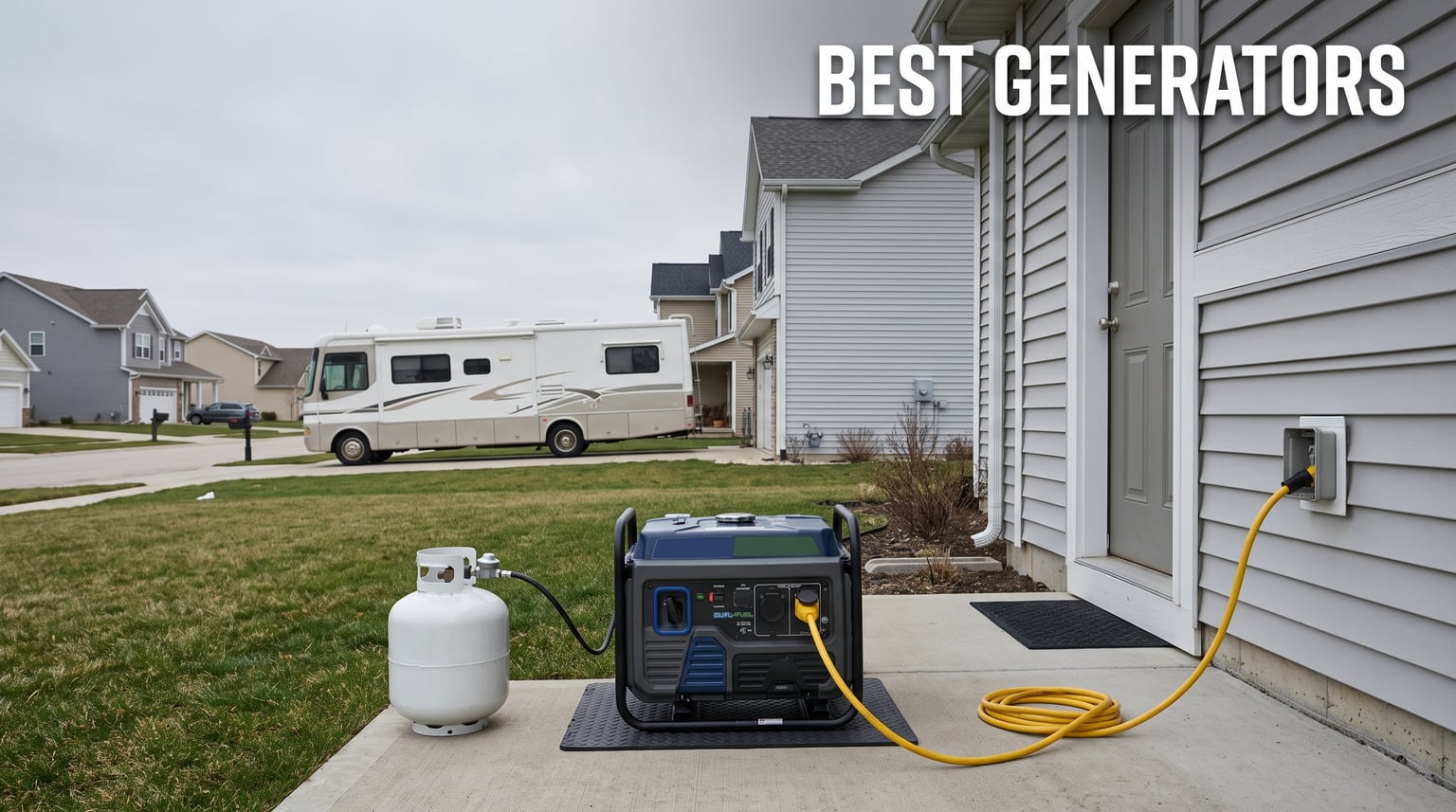
The best generators solve very different problems: keeping a refrigerator and well pump running during an outage, powering an RV hookup, or charging a laptop quietly at camp. My short answer is that the Westinghouse iGen12000DFc is the strongest high-output home-backup choice here, while the A-iPower SUA4300iD gives portable users dual-fuel flexibility and the PowerSmart DB5035 focuses on quieter, clean inverter output.
This guide compares nine verified models for 2026, including a battery power station, compact inverter generators, and large dual-fuel machines. I focused on running watts rather than peak-only marketing, stated fuel options, outlet configuration, CO protection, runtime conditions, portability, warranty information, and the supplied customer-rating signals.
A generator converts stored energy or engine fuel into electricity, but it cannot safely make up for a mismatched load list or an unsafe connection. Before choosing one, write down the running watts and starting watts for the appliances you truly need, then decide whether you need clean inverter power, 240-volt capability, an RV outlet, or fuel flexibility.
Table of Contents
Top 3 Picks – Best Generators in 2026
These picks are not interchangeable. The Westinghouse is the home-backup leader for a large 120/240-volt load, the A-iPower is the more compact dual-fuel option for RV and portable use, and the PowerSmart is the quieter choice when 3,200 running watts is enough.
Best Generators in 2026 Compariosn
Use the comparison below as a screening tool, not a substitute for totaling your own appliances. Running wattage tells you the sustained ceiling; starting wattage matters when motors in equipment such as refrigerators, pumps, or air conditioners first turn on.
| Product | Specifications | Action |
|---|---|---|
 Jackery Explorer 1000 v2 Jackery Explorer 1000 v2 |
|
Check Latest Price |
 Westinghouse iGen12000DFc Westinghouse iGen12000DFc |
|
Check Latest Price |
 Oxseryn OXOG08 Oxseryn OXOG08 |
|
Check Latest Price |
 PowerSmart DB5035 PowerSmart DB5035 |
|
Check Latest Price |
 AMERISUN AM5046C AMERISUN AM5046C |
|
Check Latest Price |
 DuroStar DS13000MX DuroStar DS13000MX |
|
Check Latest Price |
 A-iPower SUA4300iD A-iPower SUA4300iD |
|
Check Latest Price |
 WEN DF680iX WEN DF680iX |
|
Check Latest Price |
 Generac iQ5200 DF Generac iQ5200 DF |
|
Check Latest Price |
1. Jackery Explorer 1000 v2 is the quiet battery option for modest essential loads
Jackery Explorer 1000 v2 Portable Power Station,1070Wh,1500W
1070Wh LiFePO4
1500W AC
23.8 lb
1 hr fast charge
Pros
- 23.8 lb portable design
- 1500W AC output
- 100W USB-C ports
- 4000-cycle LiFePO4 battery
Cons
- Solar panel optional
- Fast charge needs app emergency mode
I would choose the Jackery Explorer 1000 v2 when silence, carrying ease, and device-friendly battery power matter more than engine-driven capacity. At 23.8 pounds, it is in a different portability class from the wheeled fuel generators in this roundup, and its 1,070Wh battery is paired with 1,500 watts of AC output and a 3,000-watt surge rating.
The supplied rating is 4.7 from 3,428 reviews, the highest rating-and-volume combination among these selections. Its review summary repeatedly points to the compact form, fast charging, and outdoor versatility, which fits camping, a short emergency-power window, and RV use with a controlled load plan.
This is a battery-powered, solar-capable power station rather than a gasoline or propane generator. That distinction matters: its three AC outlets, two 100W USB-C ports, USB-A port, and car port make it well suited to electronics and small appliances, but battery capacity still determines how long an appliance can run.
The product data lists one-hour charging through the Jackery app and ChargeShield 2.0 technology. I would treat the app step as a real trade-off because emergency mode must be enabled each time for that fast-charge behavior, and the solar panel is optional rather than included.
Its battery capacity and recharge speed fit quiet, planned backup
The stated 1,070Wh capacity gives readers a concrete starting point for planning a phone, router, light, or small appliance load. I would check each device’s wattage and leave headroom instead of assuming the 1,500-watt output means every household appliance is appropriate.
Jackery states 4,000 charge cycles while retaining 70% capacity and describes a 10-year lifespan. That is a useful durability signal for people who will cycle the unit often, not just store it for rare outages.
Its outlet mix suits electronics and small portable equipment
The two 100W USB-C ports are a meaningful advantage for direct laptop and tablet charging, while the three AC outlets cover conventional plugs. Smart App Control also provides charging and quiet-mode controls without changing the need to manage a finite battery.
For the best generators for camping, this is the cleanest fit in the group when combustion noise and fuel handling are unwanted. It is not the pick for extended whole-home backup or a large 240-volt load.
2. Westinghouse iGen12000DFc is the high-output dual-fuel home-backup pick
Westinghouse 12000 Peak Watt Dual Fuel Portable Inverter Generator, Remote Electric Start, Transfer Switch Ready, Gas and Propane Powered, Low THD – Safe for Electronics, Parallel Capable, CO Sensor
9000W running
12000W peak
Dual fuel
120/240V
Pros
- High 9000W running output
- 50A transfer ready
- Low THD inverter power
- Remote start
Cons
- 187.4 lb weight
- Large equipment footprint
The Westinghouse iGen12000DFc is the model I would start with for a serious home-load plan because it lists 9,000 running watts and 12,000 peak watts on gasoline. On propane, the supplied specifications state 8,100 running watts and 11,000 peak watts, so the fuel choice changes available capacity.
Its 4.6 rating comes from 684 reviews, and the product summary specifically highlights transfer-switch readiness and low-THD output for sensitive electronics. That combination is stronger than simply having a large peak-watt number: it joins high sustained output with a 50-amp 120/240-volt connection and 30-amp twist-lock support.
For day-to-day operation, Westinghouse lists remote electric start via a key fob, Eco Mode, a fuel selector, a CO sensor, low-oil shutdown, and an LED data center. The data center displays fuel level, power output, runtime, and voltage, which are the numbers I would watch while balancing an outage load.
Weight is the clear compromise. At 187.4 pounds and 30.2 by 25.2 by 26.6 inches, this is a pre-positioned backup machine, not a unit most people will casually lift into a vehicle.
Its 120/240-volt outlets support a transfer-switch plan
The 50-amp 120/240-volt and 30-amp twist-lock outlets make this model transfer-switch ready according to its supplied data. A licensed electrician should select and install a transfer switch or approved interlock; never feed power backward through a wall outlet.
Its 457cc engine, 9.8-gallon tank, and stated runtime up to 19 hours at 25% load show why load management matters. The 17-hour general runtime listing and the 19-hour 25% figure are not guarantees at a heavier draw.
Its dual-fuel system provides emergency fuel flexibility
Gasoline can deliver the model’s maximum stated output, while propane offers another fuel path when gasoline storage or availability is a concern. Forum discussions consistently value this option during outages, but the lower propane wattage must be included in the sizing calculation.
Westinghouse provides a three-year limited warranty in the supplied listing. I would register the unit, run it only outdoors far from doors and vents, and follow the manual’s maintenance schedule before relying on it in a storm.
3. Oxseryn OXOG08 is the 4,000-running-watt RV-ready inverter choice
Oxseryn 5000W Inverter Generator Gas Powered, Portable Open Frame Generator
4000W running
5000W peak
RV 30A
70 dBA
Pros
- 4000 running watts
- Low THD inverter output
- RV-ready 30A outlet
- 59 lb carry weight
Cons
- 70 dBA operation
- Gasoline only
The Oxseryn OXOG08 sits in the useful middle ground between small camping units and heavy home-backup equipment. Its 223cc four-stroke engine is specified at 4,000 running watts and 5,000 starting watts, and the 59-pound weight is far more manageable than the large 120/240-volt models.
I see the best fit as an RV, outdoor, or limited-home-backup machine where a 30-amp RV outlet is needed and the appliance list stays controlled. The supplied review data shows a 4.6 rating from 339 reviews, with users summarized as appreciating its output and RV readiness.
It is an open-frame gasoline inverter generator with low THD, which is relevant for electronics that need cleaner power than a conventional generator can provide. ECO Mode, a built-in fuel gauge, and a two-gallon tank support simpler monitoring, while the product lists up to 10 hours at 25% load.
The limitation I would not minimize is its listed 70 dBA operating noise. That may be acceptable for a job site or an appropriately placed emergency setup, but it is less appealing when quiet camping or close neighbors drive the decision.
Its RV-ready outlet matches a defined portable-load plan
The dedicated 30-amp RV outlet prevents the need to add an adapter for a compatible RV connection. It does not remove the need to add the air conditioner, microwave, battery charger, and other loads before using them together.
This generator provides 120 volts rather than a stated 240-volt home connection. I would choose it for selected circuits through an approved setup, not assume it can replace the high-output Westinghouse or DuroStar for every home system.
Its inverter design favors electronics, while its noise sets the boundary
Low-THD inverter technology is the reason I would consider this model for phones, laptops, and other sensitive devices. That clean-power feature is paired with a listed 70 dBA noise level, so output quality and acoustic comfort do not always move together.
The one-year manufacturer warranty is shorter than the two- and three-year terms stated for several alternatives here. For a buyer who expects regular use, that shorter coverage deserves as much attention as the wattage number.
4. PowerSmart DB5035 is the quieter 3,200-running-watt portable inverter
PowerSmart 4000 Watt Portable Inverter Generator for Camping or Home Use
3200W running
3600W peak
59 dBA
Low THD
Pros
- 59 dBA listed noise
- Clean power under 3% THD
- 30A twist-lock
- Parallel capable
Cons
- 3200W running limit
- Parallel kit separate
The PowerSmart DB5035 is a strong match when a smaller portable generator needs to stay as quiet as possible without giving up an inverter design. It provides 3,200 rated watts and 3,600 peak watts, weighs 50.7 pounds, and lists 59 dBA measured from 23 feet.
Its 4.6 rating from 267 reviews is supported by a summary that praises quiet operation and clean output. I would regard it as a compact backup or campground unit, not a whole-home solution: the 3,200-watt running ceiling is the decision-making number.
The unit lists THD below 3%, an L5-30R 30-amp twist-lock, a 20-amp household outlet, a 12V DC port, and two USB ports. That is a practical connection mix for a small RV plan, electronics, and household essentials that have already been totaled.
Runtime is listed two ways in the supplied data: up to 10 hours generally and up to eight hours at 25% load in the technical details. I would use the load-specific statement as the more useful planning figure and keep spare fuel procedures consistent with the manual.
Its 59 dBA rating makes noise a primary reason to choose it
A stated 59 dBA at 23 feet is lower than the 70 dBA figures listed for the Oxseryn and AMERISUN models. Actual perceived sound still changes with distance, surrounding walls, ground surface, and load, so placement remains important.
For camping or a neighborhood outage, I would still position any fuel-powered generator outdoors and away from open windows. Quiet does not mean safe for indoor, garage, or enclosed use.
Its parallel capability leaves room to scale later
The DB5035 is parallel capable, so two compatible units can be connected for more available power when using the appropriate kit. The kit is not included, which should be part of the equipment plan rather than an afterthought.
PowerSmart states a two-year limited warranty and lifetime technical support. That stated coverage is a useful counterweight to the model’s lower output when buyers value support and a less cumbersome form factor.
5. AMERISUN AM5046C is the wheeled 5,000-watt inverter with CO sensing
AMERISUN 5000W Gas Inverter Generator Super Quiet, CO Sensor
5000W output
CO sensor
RV 30A
Wheels included
Pros
- CO alarm light
- Wheels and handle
- RV-ready 30A outlet
- Parallel ready
Cons
- 70 dBA listed noise
- Weight not stated
The AMERISUN AM5046C combines a stated 5,000-watt inverter output with features aimed at moving and monitoring a larger portable unit. I would consider it for an RV or a home-essential load list that needs more headroom than a 3,200-watt model provides but does not require a 240-volt connection.
The supplied rating is 4.5 from 260 reviews. Its summary calls out the CO detection feature, included wheel and handle kit, and a quieter-use focus, though the technical data lists 70 dBA, so buyers should use that stated number rather than assume near-silent operation.
The 223cc four-stroke engine, 3.43-gallon tank, and claimed runtime up to 10 hours at 50% load make the load condition unusually clear. Four 120V 20-amp AC outlets, one 120V 30-amp RV outlet, two USB ports, and a DC car port create a broad portable connection set.
One listing field identifies natural gas as its fuel type, while the technical details call it a gas four-stroke engine. Because those supplied fields conflict, I would confirm the manufacturer manual and included equipment before buying fuel or making an emergency plan around a particular fuel source.
Its CO sensor and portable controls prioritize monitored operation
The CO sensor uses an alarm light, and the product is described as EPA certified and CARB compliant. Those features are safeguards, not permission to operate close to a house, camper, garage, or other enclosed space.
The control-panel arrangement supplies four household AC outlets plus an RV-ready outlet. I would label the circuits or devices on a load list so the available output is not consumed by an unexpected appliance start.
Its wheel kit suits ground-level movement rather than lifting
Wheels and a handle are included, which is especially useful for a machine whose weight is not specified in the supplied product data. I would still plan for stable, level placement and a two-person move if the actual unit weight proves substantial.
AMERISUN lists a two-year limited warranty with lifetime technical support. That stated term makes this a more reassuring option than the one-year Oxseryn for a buyer who values coverage alongside output.
6. DuroStar DS13000MX is the highest-output 50-amp whole-home contender
DuroStar DS13000MX 13,000-Watt 500cc Dual Fuel Portable Generator – Gas and Propane, Remote Electric Start, Whole Home Power Backup, Transfer Switch Ready, RV & Emergency Ready
10500W running
13000W peak
Dual fuel
50A ready
Pros
- 10500 running watts
- 50A transfer ready
- Gas and propane
- Remote electric start
Cons
- 220 lb weight
- Large storage demand
The DuroStar DS13000MX has the largest stated sustained output in this roundup: 10,500 running watts and 13,000 starting watts. I would put it on the shortlist for a whole-home backup plan with a properly sized transfer switch, provided the owner has a storage location and a realistic way to move its 220-pound frame.
Its 4.5 rating comes from 203 reviews, and the listing summary describes strong regard for home-backup applications. The headline benefits are dual-fuel operation, a 50-amp transfer-switch-ready outlet, push-button electric start, remote control, and CO Alert monitoring.
Its 500cc four-stroke engine and 8.3-gallon tank match the scale of its intended job. The all-metal construction and included wheel and handle kit indicate a heavy-duty portable configuration, but wheels do not make a 220-pound generator easy to transport over stairs, soft ground, or into a vehicle.
I also like that the included components list is specific: oil funnel, spark-plug wrench, tool set, propane regulator, remote control, and owner manual are named. Having a regulator in the box reduces uncertainty for the propane setup, though fuel selection and storage practices still need advance planning.
Its 50-amp connection supports large planned home loads
The 50-amp outlet is designed for a transfer-switch-ready connection, which is the appropriate route for selected home circuits. The model’s high wattage does not mean every circuit can run at once; motor starts and simultaneous heating loads can still exceed a plan.
The 80 percent rule is a useful operating boundary for a generator this capable. For 10,500 running watts, a conservative continuous target is about 8,400 watts, leaving room for appliance starting surges and avoiding a constant full-load condition.
Its dual-fuel design supports emergency preparation choices
Gasoline and propane operation allow a household to choose fuel based on storage, availability, and the output required. The product description says gasoline offers maximum power and propane can support longer runtimes and cleaner emissions, but the exact load and fuel conditions matter.
DuroStar supplies a three-year limited factory warranty. I would test-run a newly installed backup setup before an outage, then follow the manual for oil, fuel, and storage service rather than letting a high-output unit sit unused for long periods.
7. A-iPower SUA4300iD is the compact dual-fuel RV and camping choice
A-iPower 4300W Gas Propane Inverter Generator, Lightweight, Fuel Sense
3450W gas running
Dual fuel
63dB
RV adaptor
Pros
- Gas and propane
- 54.8 lb portable
- 63dB listed sound
- 30A RV adaptor included
Cons
- Lower propane output
- Recoil start
The A-iPower SUA4300iD is the model I would choose for portable dual-fuel flexibility without stepping up to a near-100-pound machine. It weighs 54.8 pounds and states 3,450 running watts with 4,300 starting watts on gasoline, while propane produces 3,100 running watts and 3,900 starting watts.
This generator has the highest supplied review volume among the fuel-powered models here: 2,362 reviews and a 4.3 rating. The provided summary praises portability and dual-fuel capability, which tracks with the 1.6-gallon tank, telescoping handle, flat-free wheels, and included LPG hose with regulator.
It uses inverter technology with 3% THD and lists sound as low as 63dB. A CO sensor indicator light, LED light, and data-center display give the owner useful operational feedback, while the supplied 30-amp RV adaptor makes the RV purpose unusually direct.
The trade-off is capacity. This is a capable portable generator for selected loads, but its running wattage is below the Oxseryn and AMERISUN, and propane reduces output further.
Its fuel-specific wattage requires a two-column load list
For a dual-fuel generator, I recommend writing one load total for gasoline and a second, lower-capacity total for propane. The difference here is 350 running watts, enough to affect whether another appliance can run during an outage.
Its listed runtime is 7.5 hours at 25% load on gasoline. That is a useful reference point for light use, but it should not be projected unchanged to a heavier RV air-conditioner or home-appliance load.
Its included RV adaptor and wheels make portable setup simpler
A-iPower includes a 30-amp RV adaptor, DC charging cables, parallel cables, and the LPG hose with regulator in the listed components. Those inclusions make it easier to start with the intended use, although the manual remains the authority for every connection.
The three-year limited manufacturer warranty is a meaningful stated coverage term for a portable model. For an RV owner, the combination of 63dB listed sound, wheels, clean output, and dual fuel is more persuasive than peak watts alone.
8. WEN DF680iX is the dual-fuel 240-volt generator with EV-backup support
WEN 6800-Watt Dual Fuel RV-Ready Electric Start Portable Inverter Generator with Fuel Shut Off and CO Watchdog for Electric Vehicle Backup (DF680iX)
5100W gas rated
Dual fuel
240V
Fuel shutoff
Pros
- 240V configuration
- Fuel shutoff
- CO Watchdog
- EV backup support
Cons
- 99.2 lb weight
- Availability may vary
The WEN DF680iX occupies a distinct position because it combines a 240-volt configuration with a compact-inverter format and stated low-power Level 2 charging for battery and hybrid electric vehicles. On gasoline, it lists 5,100 rated watts and 6,800 surge watts; on propane, it lists 4,500 rated watts and 6,000 surge watts.
I would consider it for a household or RV owner whose load plan includes a 120/240-volt receptacle or the specific EV-backup capability described by WEN. The supplied data shows a 4.3 rating from 333 reviews and notes that users praise its dual-fuel configuration and EV charging support.
At 99.2 pounds, it is not a carry-alone generator, but onboard wheels and a telescoping pull handle suit driveway or campsite positioning. The outlet set is extensive: L14-30R 120/240V, two 120V receptacles, TT-30R RV receptacle, 12V DC, two USB ports, and a voltage selector.
The feature I would give extra weight is fuel shutoff, designed to use the remaining fuel in the carburetor before shutdown. It addresses a real maintenance concern raised in generator communities, where stale fuel and infrequent use can create avoidable starting trouble.
Its 240-volt configuration suits selected advanced backup uses
The bonded-neutral 240V configuration is the reason this model can offer the stated low-power Level 2 EV charging support. Confirm the vehicle’s requirements, receptacle, wiring, and the generator manual before connecting any EV equipment.
For a home backup arrangement, the L14-30R outlet is not a substitute for correct transfer equipment. A licensed electrician can determine whether this generator, a transfer switch, and the intended circuits are compatible.
Its fuel shutoff adds a practical maintenance advantage
Fuel shutoff is intended to empty fuel from the carburetor after operation, which can help maximize generator lifespan according to WEN. It does not eliminate the need to check oil, inspect the air filter, exercise the machine, and manage stored fuel as directed.
WEN includes a three-year limited warranty in the supplied information. That warranty, CO Watchdog shutdown sensor, and tool-free LPG quick connector make it a thoughtful choice for people who need more than a simple 120-volt camping generator.
9. Generac iQ5200 DF is the polished electric-start dual-fuel inverter
Generac 5,200 Watt Dual-Fuel Portable Inverter Generator, Outdoor Use
3900W gas running
Dual fuel
COsense
Electric start
Pros
- Electric start
- Clean power under 3% THD
- Up to 11h propane runtime
- USB-A and USB-C
Cons
- 107 lb weight
- 47 supplied reviews
The Generac iQ5200 DF is a useful option for someone who values a fully featured inverter generator, push-button start, and propane flexibility. It lists 3,900 running watts and 5,200 starting watts on gasoline, then 3,500 and 4,700 watts respectively on propane.
The supplied rating is 4.2 from 47 reviews, so I would give its lower review volume proper weight next to its specifications. The available review summary highlights quiet operation and clean output, while its Economy Mode is designed to reduce both fuel use and noise.
Generac states less than 3% THD, COsense automatic CO shutdown, a 120V 30-amp outlet, two 20-amp GFCI outlets, USB-A, USB-C, and a real-time LED display. These details make it convenient for electronics and RV-oriented loads, provided the load stays within the running-watt limit.
It weighs 107 pounds but includes never-flat wheels and a folding handle. That is manageable across firm ground, yet it is still a two-person lift for many users and not comparable to the 23.8-pound Jackery or 50.7-pound PowerSmart for carrying.
Its runtime figures show the benefit of propane flexibility
Generac lists up to nine hours on gasoline or 11 hours on propane at 50% load, plus up to 15 hours on gas at 25% load. Those different conditions show why any runtime figure must always be read with its stated load and fuel.
The included LP hose, battery, engine oil, funnel, and tool kit help a new owner prepare the unit. I would still stage the fuel, calculate the intended appliances, and confirm local storage rules before an emergency occurs.
Its maintenance interval gives new owners a usable starting schedule
The listing specifies a first oil change at 20 hours, then every 100 hours or annually. That is unusually actionable manufacturer guidance and directly addresses the concern that a generator can fail when it has been stored without routine service.
Generac states a three-year limited residential warranty and a two-year limited commercial warranty. For a buyer who prefers electric start and a detailed feature set over maximum wattage, this is the clearest fit.
Choosing the right generator starts with watts, fuel, and connection type
Start with the appliances you cannot do without, not with a generator’s peak-watt label. List every running watt requirement, add the highest starting surge that may occur at the same time, and then choose a unit whose sustained rating leaves meaningful headroom.
The 80 percent rule keeps a generator below constant full load
The 80 percent rule means planning to use roughly 80% of a generator’s running-watt rating for continuous demand. This leaves capacity for motor-starting surges and avoids treating the maximum running number as the normal operating target.
For example, a 4,000-running-watt generator has a conservative continuous target around 3,200 watts. That does not mean every 3,200-watt appliance combination is safe without checking starting watts, voltage, and each circuit’s limit.
Inverter, conventional, and battery generators solve different problems
An inverter generator produces controlled electrical output that models here describe as low THD, making it a sensible choice for laptops, phones, televisions, and other sensitive electronics. The Westinghouse, Oxseryn, PowerSmart, A-iPower, WEN, and Generac all state low-THD or inverter-output features.
A battery power station such as the Jackery has no engine exhaust during use and is quiet, but its stored watt-hours limit duration. Large engine-driven models provide extended operation with fuel but require outdoor operation, fuel management, and regular maintenance.
A conventional high-output portable generator can be a better fit for large home loads, but buyers should compare its stated outlet configuration and power quality instead of assuming any high-watt model matches every transfer setup. For a generator for home, 120/240-volt output and a correctly installed transfer switch can matter as much as wattage.
Dual fuel and propane options improve flexibility but change available output
Gasoline and propane are the fuel choices stated for the Westinghouse, DuroStar, A-iPower, WEN, and Generac models. Dual fuel is useful because an outage can make one fuel harder to obtain, yet the supplied data shows propane output is lower on several models.
For example, A-iPower lists 3,450 running watts on gasoline and 3,100 on propane; WEN lists 5,100 on gasoline and 4,500 on propane. Size for the fuel you expect to use, not only for the best-case gasoline figure.
Fuel choice also changes storage and maintenance tasks. Follow local rules, use approved containers, and do not assume a propane-capable machine can run on natural gas unless its manufacturer documentation specifically says so; the conflicting AMERISUN listing fields are a good reason to verify rather than guess.
Noise ratings matter most for camping and close neighbors
A quiet generator is more than a comfort feature for camping, RV parks, and dense neighborhoods. In this group, stated noise figures include 59 dBA for the PowerSmart from 23 feet, 63dB for the A-iPower, and 70 dBA for both the Oxseryn and AMERISUN.
Those figures are useful for comparison, not a promise of identical real-world loudness. Engine load, distance, ground surface, and walls affect what a neighbor or camper hears, so position the generator thoughtfully while preserving safe clearance from structures.
Safety and maintenance determine whether backup power is ready when needed
Every fuel-powered generator belongs outdoors, away from doors, windows, vents, and enclosed areas. CO sensors such as Westinghouse’s CO sensor, DuroStar’s CO Alert, WEN’s Watchdog, and Generac’s COsense are important protective features, but they never make indoor operation acceptable.
Use a transfer switch or approved interlock installed by a licensed electrician for home circuits. Never connect a portable generator directly to a wall outlet, because backfeeding can injure utility workers, damage equipment, and create a serious fire hazard.
Maintenance answers a common forum worry about generators that fail after sitting unused. Exercise the unit as its manual directs, inspect oil and air filtration, manage fuel before storage, and pay attention to features such as WEN’s fuel shutoff or Generac’s stated oil-change interval.
Brand reliability is best judged through support, coverage, and product-specific evidence
No brand name alone can promise trouble-free ownership. In this set, supplied warranty terms range from one year for the Oxseryn, two years for PowerSmart and AMERISUN, to three-year terms for Westinghouse, DuroStar, A-iPower, and WEN; Generac lists three years residential and two years commercial.
Customer ratings add context but are not laboratory reliability results. I would weigh review volume, stated warranty coverage, dealer or service access in your area, manual clarity, and the maintenance features that fit your willingness to keep the unit ready.
FAQs
What is the most reliable generator brand?
No brand can guarantee reliability for every model or owner. Compare the specific generator’s warranty, service access, review volume, stated maintenance features, and correct sizing. In this group, Westinghouse, DuroStar, A-iPower, and WEN list three-year limited coverage, while Generac lists three years for residential use.
What is the 80% rule for generators?
The 80% rule means keeping normal continuous demand near 80% of a generator’s running-watt rating. A 4,000-running-watt generator therefore has a conservative continuous target of about 3,200 watts, leaving room for appliance starting surges and avoiding constant full-load operation.
Which brand of generator is best?
The best brand depends on the load and fuel plan. Westinghouse and DuroStar suit high-output home backup, A-iPower and WEN bring dual-fuel inverter options, PowerSmart prioritizes a lower stated noise figure, and Jackery provides a quiet battery-power alternative for smaller loads.
What are the top 10 generators?
This guide evaluates nine selected generators rather than claiming a top ten. The list includes the Jackery Explorer 1000 v2, Westinghouse iGen12000DFc, Oxseryn OXOG08, PowerSmart DB5035, AMERISUN AM5046C, DuroStar DS13000MX, A-iPower SUA4300iD, WEN DF680iX, and Generac iQ5200 DF.
The Westinghouse is the leading home-backup choice, but your load list decides
For high-demand home backup, I would begin with the Westinghouse iGen12000DFc and compare the DuroStar DS13000MX if 10,500 running watts and a 50-amp connection better fit the plan. For a portable dual-fuel RV generator, the A-iPower and WEN offer more targeted choices, while the Jackery serves quiet battery-powered essentials.
The best generators in 2026 are the ones that match your actual watts, voltage, fuel plan, noise setting, and safe connection method. Check the manual and your appliance labels before buying, then test the completed setup well before the next outage or trip.