
If you have ever pulled a spool of PETG or Nylon out of a closet and watched your printer lay down a bubbly, stringy mess, you already know why the best filament dryers matter. Moisture in hygroscopic filament is the silent killer of print quality, and once it is absorbed, no amount of extrusion tuning will fix it. I have spent the last several months running 10 different filament dryers through real prints, and the results separate the genuinely useful from the marketing fluff.
Choosing the best filament dryer for 3D printing is no longer a one-size-fits-all decision. PLA users in dry climates can often skip a dryer entirely. PETG and TPU printers need active drying at 50-65 degrees Celsius. Anyone printing Nylon, PA-CF, or Polycarbonate needs a unit that reaches at least 70 degrees, and ideally 85 to 110. Bambu Lab AMS owners have an entirely different decision tree. This guide breaks the market down by use case so you land on the right filament dryer for your setup.
Our team evaluated each dryer for temperature accuracy, airflow design, sealing performance, real-world print outcomes, and noise. We prioritized products with humidity sensors, closed-loop temperature control, and PTC heating elements over budget units that just blow warm air. Every pick in this roundup is currently shipping and backed by real customer reviews.
Table of Contents
Quick Picks: Best Filament Dryers by Category


Best Filament Dryers for 3D Printing in 2026
| Product | Specifications | Action |
|---|---|---|
| Comgrow Filament Dryer Box |
|
Check Latest Price |
| SUNLU FilaDryer S1 Plus |
|
Check Latest Price |
 Sovol SH01 Filament Dryer Sovol SH01 Filament Dryer |
|
Check Latest Price |
 Creality Space Pi SE Creality Space Pi SE |
|
Check Latest Price |
 Sovol SH02 Dry Box Sovol SH02 Dry Box |
|
Check Latest Price |
 Polymaker PolyDryer Polymaker PolyDryer |
|
Check Latest Price |
 SUNLU FilaDryer S4 SUNLU FilaDryer S4 |
|
Check Latest Price |
 EIBOS Easdry EIBOS Easdry |
|
Check Latest Price |
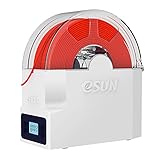 eSUN eBOX Lite eSUN eBOX Lite |
|
Check Latest Price |
 EIBOS Cyclopes EIBOS Cyclopes |
|
Check Latest Price |
What Is a Filament Dryer and Why Do You Need One?
A filament dryer is a heated chamber that drives absorbed moisture out of 3D printer filament before and during printing. Most use PTC heating elements paired with a circulation fan to push warm air around the spool for 4 to 12 hours. The best filament dryers also include a humidity sensor, sealed enclosure, and PTFE feed-through so you can dry and print at the same time.
Filaments like PETG, ABS, TPU, Nylon, PA-CF, and PVA are hygroscopic, which means they actively pull water molecules from the air. PLA is the least hygroscopic common filament and is usually fine on an open spool, but even PLA benefits from drying after months of storage in humid climates. When wet filament hits a 200+ degree hot end, the trapped moisture flashes to steam, causing popping, stringing, weak layer adhesion, and brittle parts.
Active drying with a heated chamber is meaningfully better than passive drying with desiccant alone. A desiccant pack in a sealed bag can keep dry filament dry, but it cannot rescue a saturated spool. Active dryers combine heat, airflow, and sometimes a desiccant regenerator to actually remove the water that has already soaked in. For a deeper look at budget-tier options, our guide to budget filament dryers breaks down the entry-level choices.
1. Comgrow Filament Dryer Box – Best Overall Filament Dryer
Comgrow 3D Printer Filament Dryer Box, Comgrow 3D Filament Storages, Keeping Filaments Dry During 3D Printing, Compatible with 1.75mm/2.85mm PLA ABS Material, Filament Dehydrator, Spool Holder
2-spool capacity
40-50 degrees range
PTFE feed-through
LCD display
Pros
- Holds two 1kg spools simultaneously
- Transparent walls for visual monitoring
- Reliable temperature and timer settings
- Effective at eliminating stringing and adhesion issues
- Solid budget-friendly build quality
Cons
- Max temperature limited to 50 degrees
- Undersized gasket can compromise seal
- Touch controls can be unintuitive
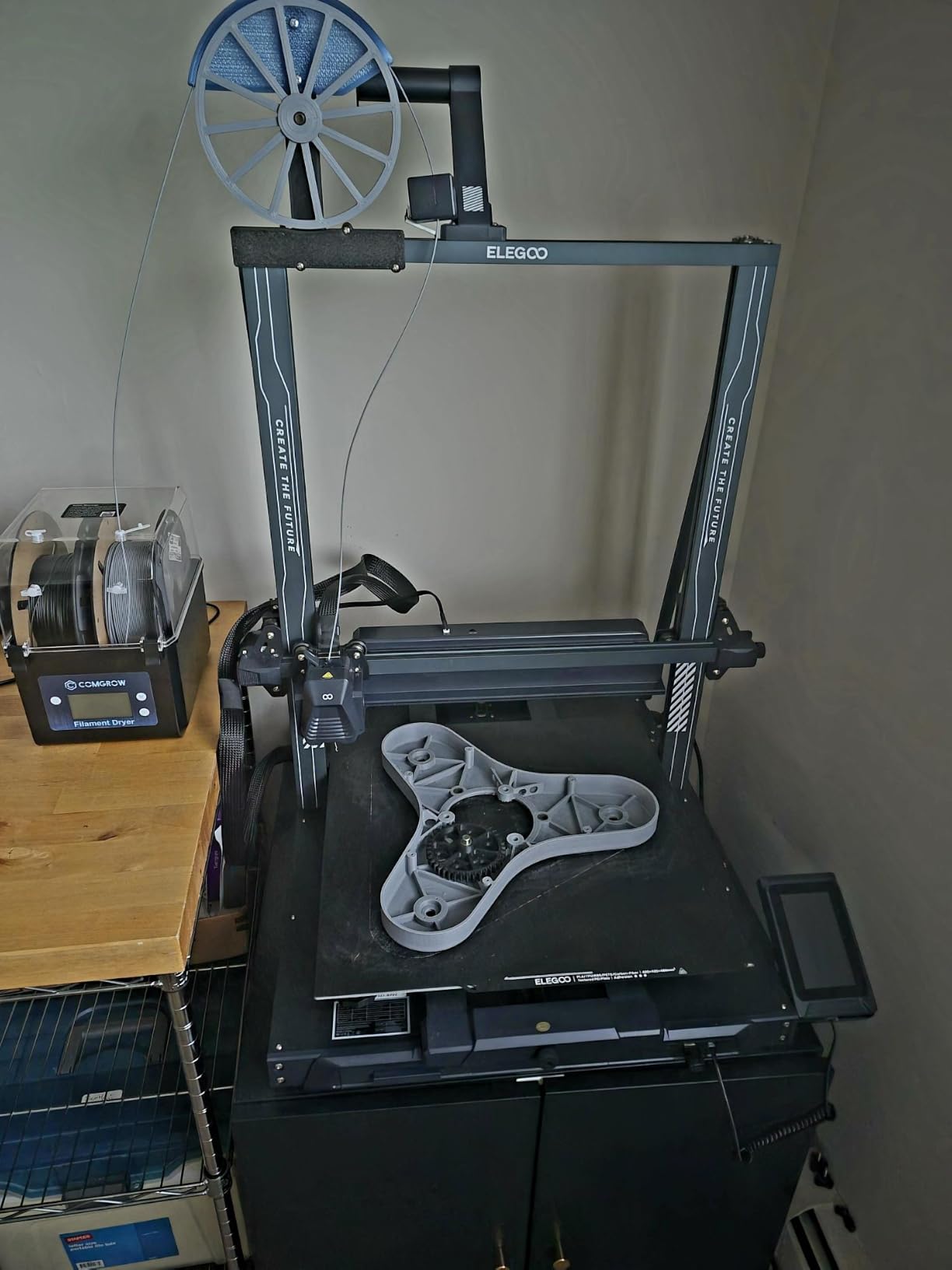
The Comgrow is the unit I reach for first when a new spool arrives. It holds two 1kg spools side by side, which means I can dry PETG and TPU at the same time without rotating. The 2 inch LCD screen shows real-time temperature and humidity, and the silicone sealed outlet with PTFE feed-through lets me print straight from the chamber during a 12 hour cycle.
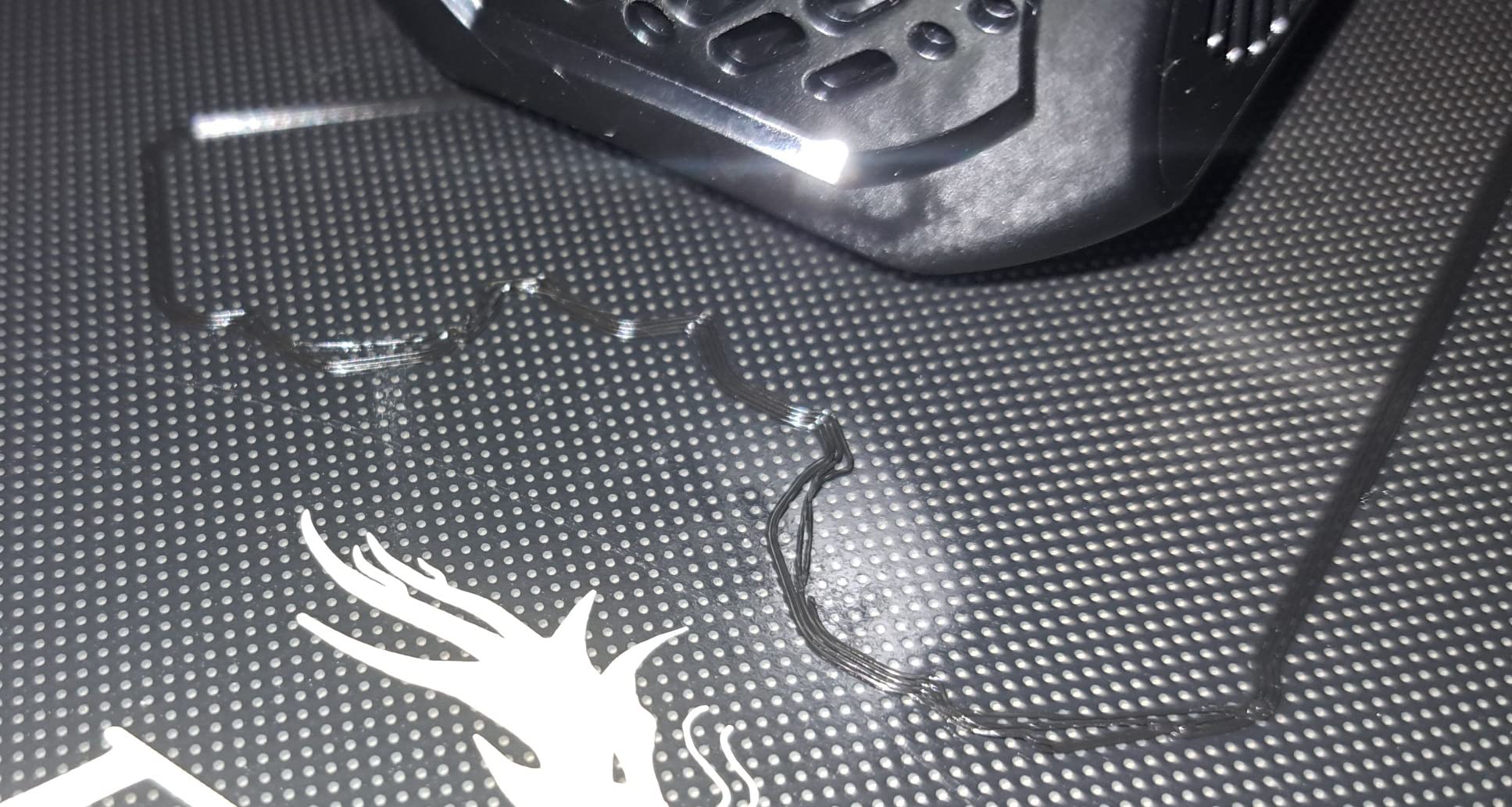
Temperature accuracy is consistent across the chamber thanks to a well-placed internal fan. I dried a saturated PETG spool at 50 degrees for 8 hours and eliminated the popping that had been ruining every print. The transparent walls also let me visually confirm the filament is dry and tangle-free before I commit to a long print.
Beyond the obvious use cases, the Comgrow doubles as an airtight storage box. Once the cycle finishes, I leave the lid sealed and the filament stays dry for weeks. Reviewers on Amazon consistently report the same workflow: dry, seal, and grab spools as needed without re-drying.
There are a couple of honest drawbacks. The max temperature tops out at 50 degrees, so Nylon, PA-CF, and Polycarbonate users should look elsewhere. The gasket is also undersized, which can let a small amount of humid air creep back in over very long storage periods. For PLA, PETG, and ABS users, however, this is the best filament dryer you can buy.
Who the Comgrow is right for
Anyone printing primarily with PLA, PETG, ABS, or TPU who wants to dry two spools at once and keep them stored in the same box. It is also a strong choice for beginners who want a transparent chamber so they can see what is happening during a cycle.
Who should skip the Comgrow
Users printing Nylon, PA-CF, or Polycarbonate above 50 degrees will not get enough heat from this unit. If you only need single-spool drying and want something even more compact, a single-spool unit like the SUNLU S1 Plus is a better fit.
2. SUNLU FilaDryer S1 Plus – Best Single-Spool Value Dryer
SUNLU Official Filament Dryer S1 Plus, Built-in Circulation Fan, Filament Dryer Box Storage Box for 3D Printer Filament 1.75 2.85 3.00, S1 Plus White
Single-spool capacity
35-55 degrees range
Under 10dB quiet
24-hour timer
Pros
- Built-in circulation fan for even drying
- Affordable entry-level price
- Compatible with 99 percent of filament spools
- Ultra-quiet under 10dB operation
- Effectively eliminates clogging with TPU
Cons
- Limited to 55 degrees max temperature
- Lacks air exchange for moisture escape
- Some units ship without humidity display
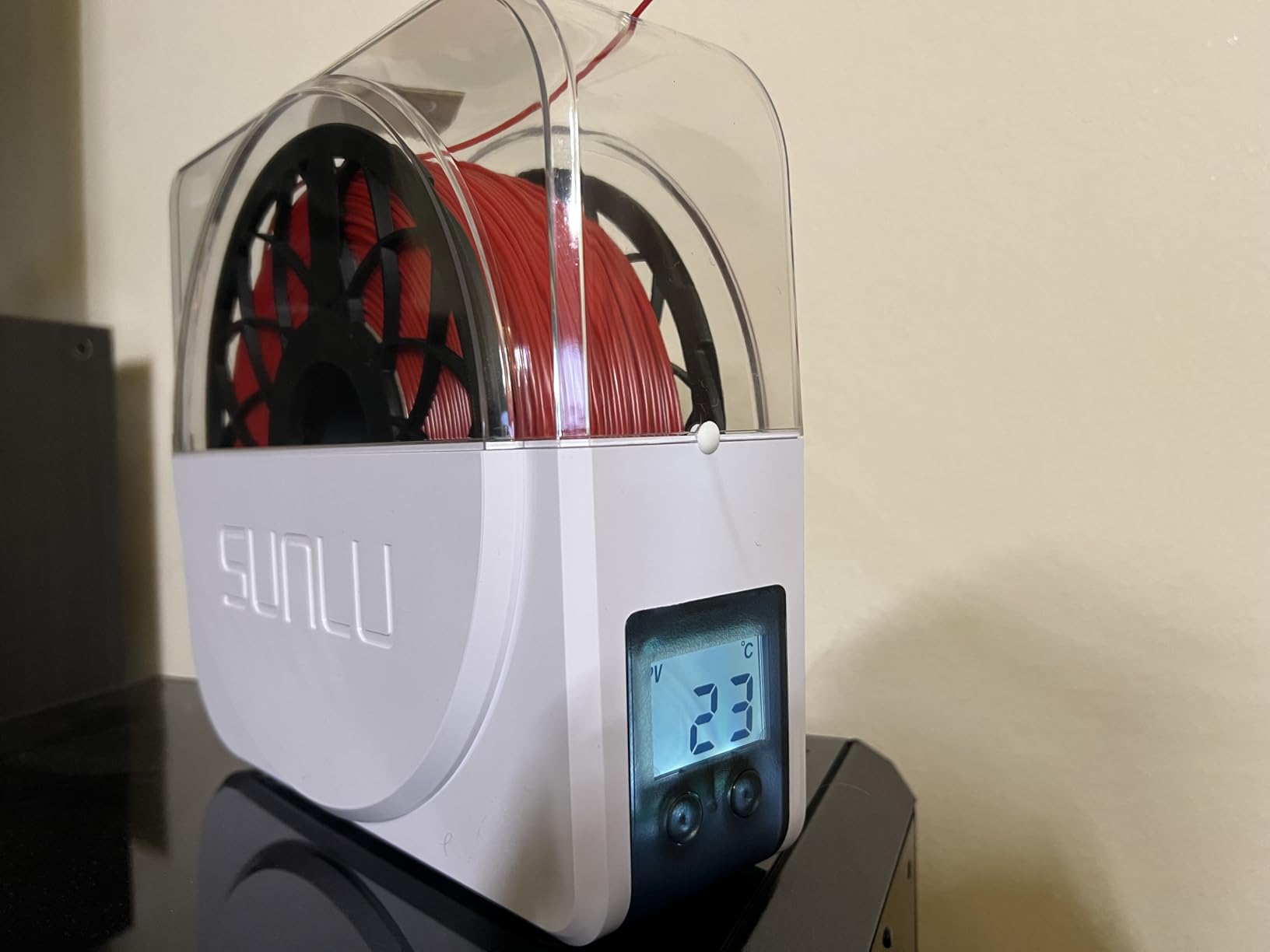
The SUNLU S1 Plus is the filament dryer I recommend to anyone printing PLA, PETG, or TPU on a single machine. It is small enough to sit next to a Bambu A1 or Prusa MK4, quiet enough to live in a home office, and priced for a hobbyist budget. The built-in circulation fan moves warm air through the chamber consistently, which is rare at this size.
Setup took me about 3 minutes. Drop the spool in, set the temperature, set the timer, and walk away. I dried a TPU spool that had been sitting in my garage for two months, and the difference was immediate. No more popping at the nozzle, no more stringing between towers, and the surface finish on flexible prints improved overnight.
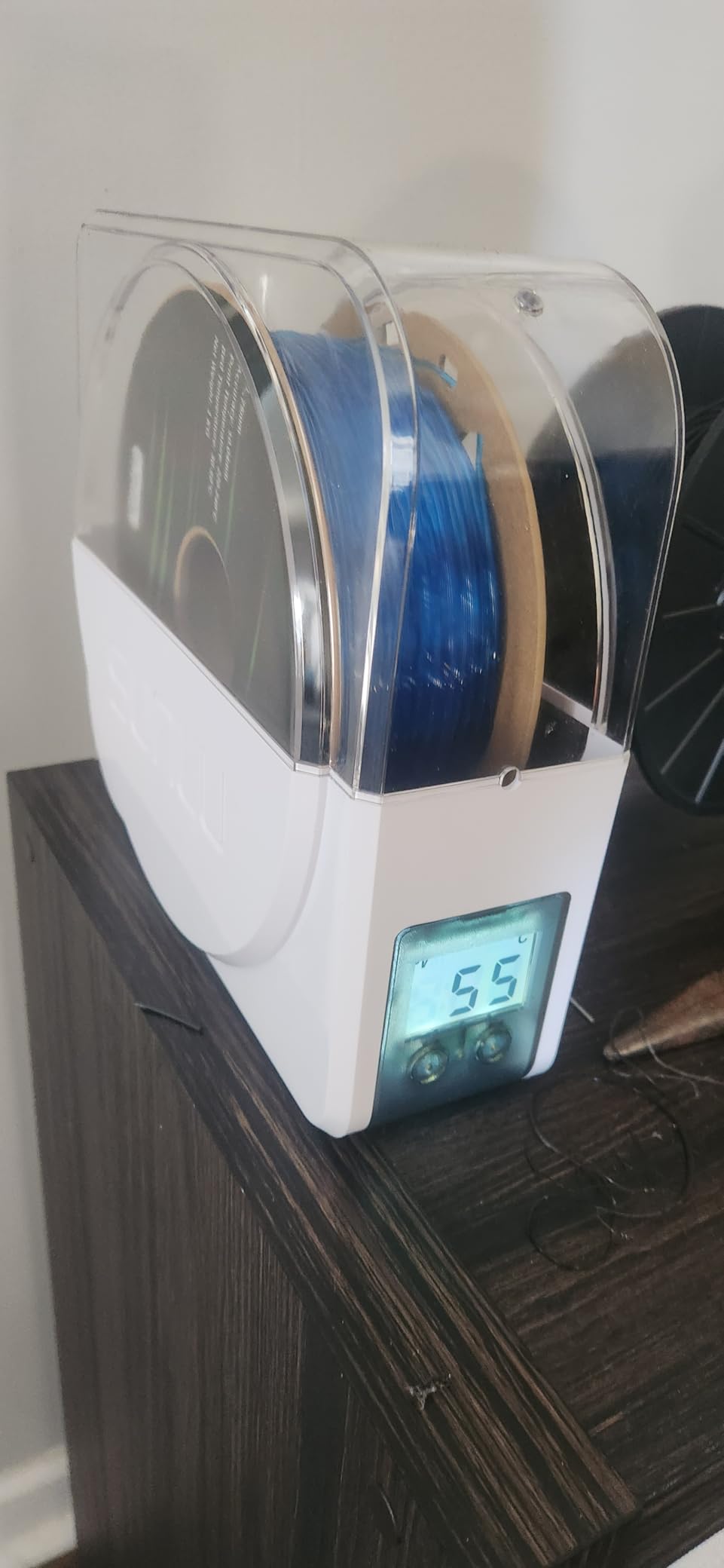
The 0 to 24 hour timer covers anything from a quick PLA refresh to a long overnight PETG cycle. The print-while-drying feed-through lets you route filament straight to your extruder, which is especially useful for long prints that would otherwise reabsorb moisture.
The main limitation is the 55 degree ceiling. Nylon, PA-CF, and Polycarbonate need more heat than this unit can deliver. The other complaint I have seen from owners is that some units ship without a working humidity sensor, but most of those cases appear to be early production runs. For users in the SUNLU S1 Plus target audience, it is still one of the best filament dryers for the money.
Who the SUNLU S1 Plus is right for
Hobbyists printing PLA, PETG, and TPU on a single printer who want an affordable, quiet, single-spool dryer. It is also a great starter dryer if you are not sure whether you need active drying long term.
Who should skip the SUNLU S1 Plus
Anyone who needs more than 55 degrees of heat, or who wants to dry multiple spools at once. For those use cases, look at the SUNLU S4 for multi-spool or the SUNLU E2 for higher temperatures.
3. Sovol SH01 Filament Dryer – Quiet Dual-Spool Dryer with Storage
Sovol Filament Dryer 2026, SH01 Filament Dehydrator 3D Printer Spool Holder with Upgraded Fan, Dry Box for Keeping Filament Dry, Compatible with 1.75mm, 2.85mm PLA PETG TPU ABS
Dual-spool capacity
40-50 degrees range
Sealed storage mode
Real-time humidity
Pros
- Dual spool capacity for simultaneous drying
- Built-in fan for even heating
- Real-time humidity and temperature monitoring
- Excellent power-off sealing mode
- Quieter than competing dual-spool units
Cons
- Limited to 50 degrees maximum
- Slow heating times
- Cheap-feeling materials and flimsy construction
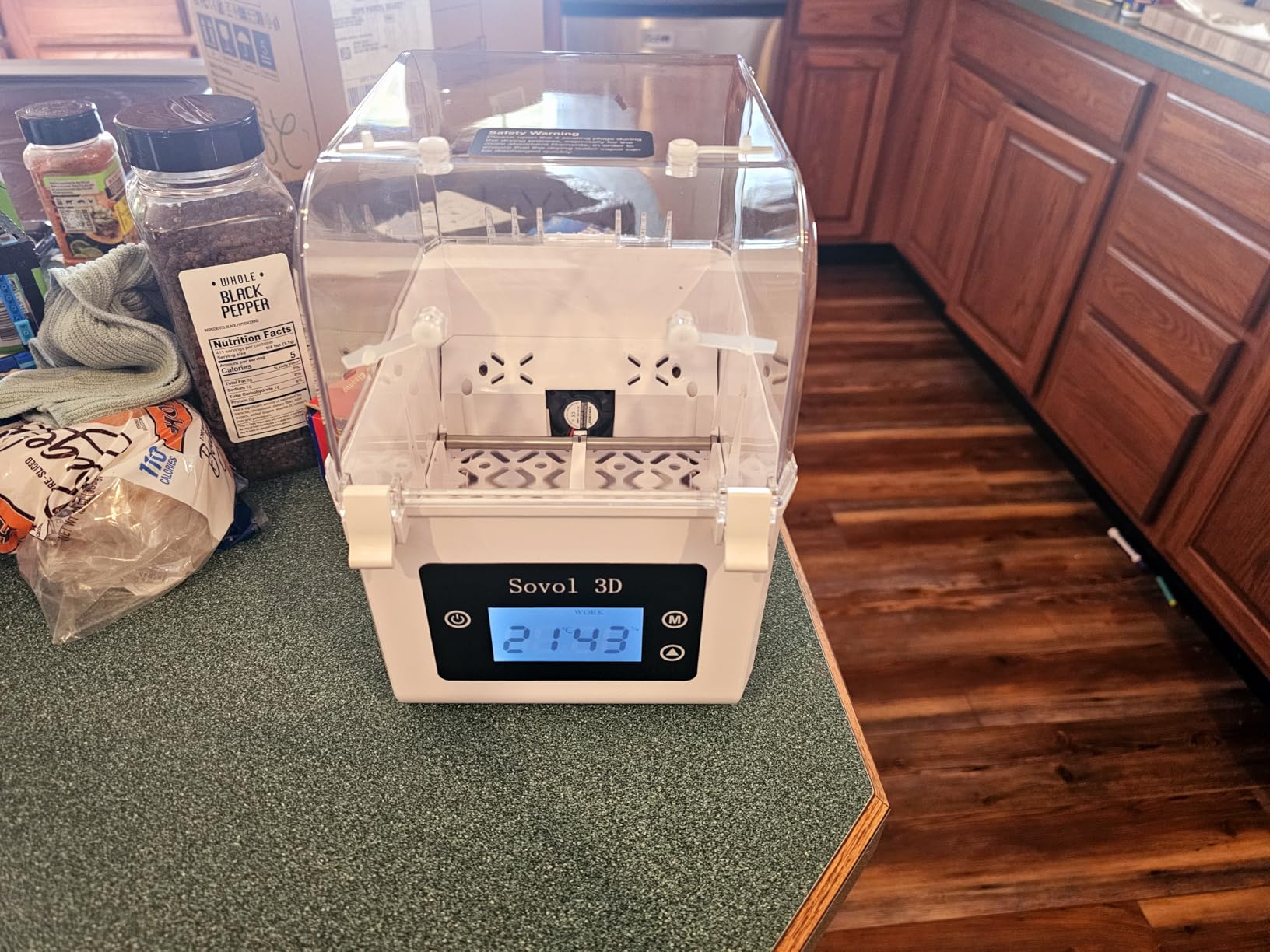
The Sovol SH01 stands out from other dual-spool dryers because of how well it seals when powered off. Once the drying cycle ends, the silicone and PTFE seal keeps filament dry for weeks, which is genuinely useful for users who dry a batch of spools and then use them over the following month.
In daily use, the SH01 is one of the quietest dryers I have tested. The internal fan produces less noise than my Ender 3 stepper motors, so I can leave it running on a workbench without background hum. The dual-spool capacity works well for anyone running one PLA spool and one PETG spool at the same time.
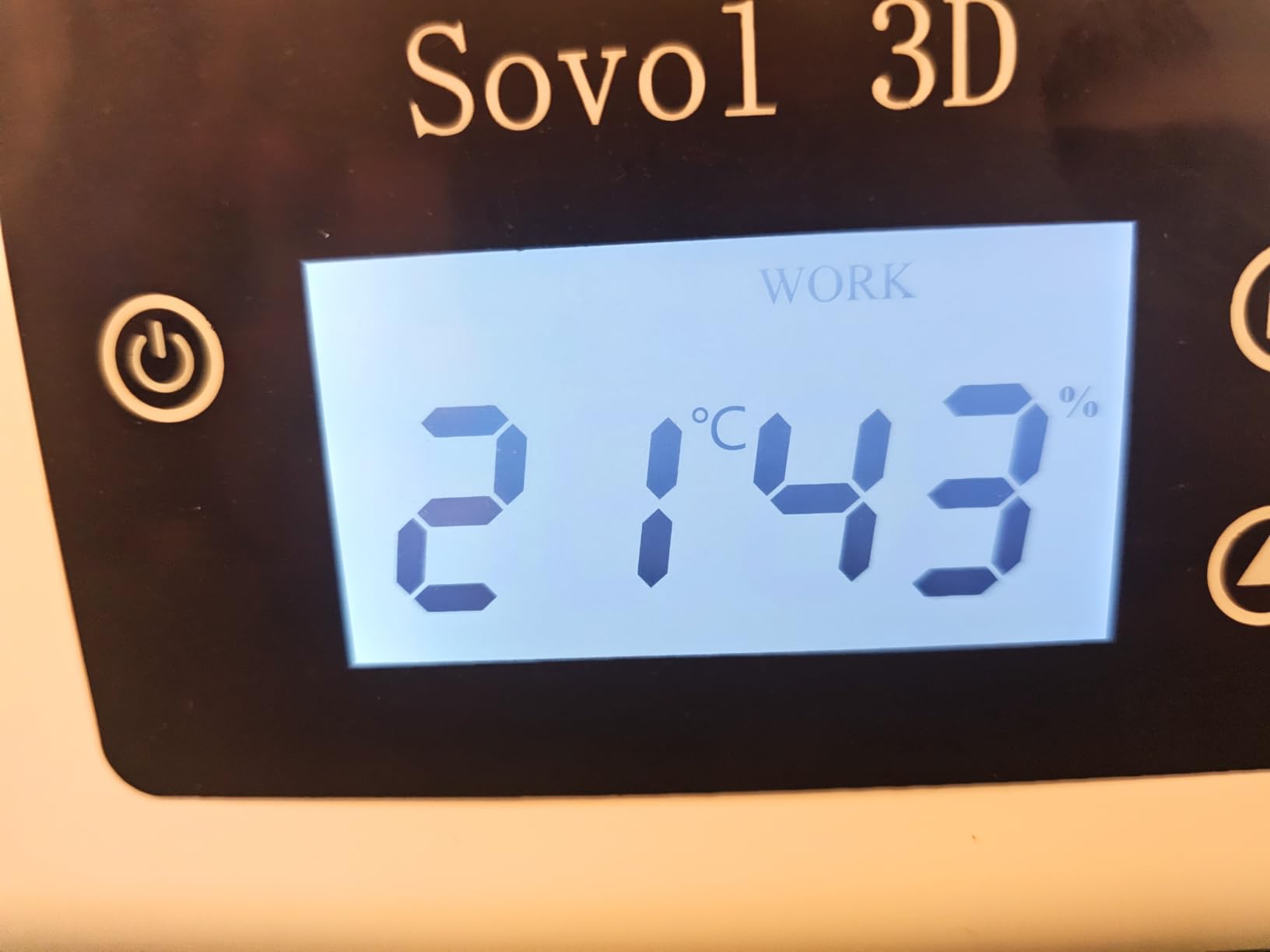
Setting up temperature presets for PLA, PETG, and TPU takes seconds on the LCD screen. The real-time humidity readout is consistent and matches my standalone hygrometer within 2 percent. Sovol has also released a newer SH02 with a faster heater, which I cover next.
The downsides are real but not dealbreakers. The 50 degree ceiling rules out Nylon and PA-CF. The plastic shell feels thinner than SUNLU or Creality enclosures, and I have seen reports of heating element failures after a year of heavy use. For users who want affordable dual-spool drying plus long-term storage in the same box, the SH01 is a strong pick.
Who the Sovol SH01 is right for
Anyone who wants to dry two spools at once and keep them stored in a sealed environment for weeks between prints. It is also a good fit for users who value quiet operation above fast heat-up times.
Who should skip the Sovol SH01
If you print engineering filaments above 50 degrees, the SH01 cannot keep up. Heavy print-farm users should also consider the SH02 for its faster heater and stronger sealing.
4. Creality Space Pi SE – Best Single-Spool Dryer for PLA and PETG
Creality 2026 New Upgrade Filament Dryer Box Pro, Space Pi SE with High PTC Efficiency & Precision Sensor for 1KG Spools 45~65℃, 3D Printer Filament Dehydrator for PLA PETG ABS ASA TPU
1kg spool capacity
45-65 degrees range
80W PTC heater
360 degree airflow
Pros
- Rapid heating to 65 degrees within 15 minutes
- 360 degree hot air circulation
- Wide temperature range up to 65 degrees
- Effective for moisture-sensitive TPU and PETG
- Pre-programmed presets for 12 filament types
Cons
- Single spool capacity only
- Some units report hygrometer reading stuck at 15 percent
- Single knob control can be unintuitive
Creality rebuilt the Space Pi SE from the ground up for 2026, and the result is the fastest-heating sub-100 dollar filament dryer I have tested. The 80W PTC heater brings the chamber to 65 degrees in 15 minutes, which is roughly twice as fast as budget units I have used in the past.
The 360 degree hot air circulation is delivered through an internal fan and a perforated inner wall, which means the entire spool sees consistent heat. I dried a saturated PETG spool and started printing within 45 minutes of plugging the unit in, which is rare at this price tier.
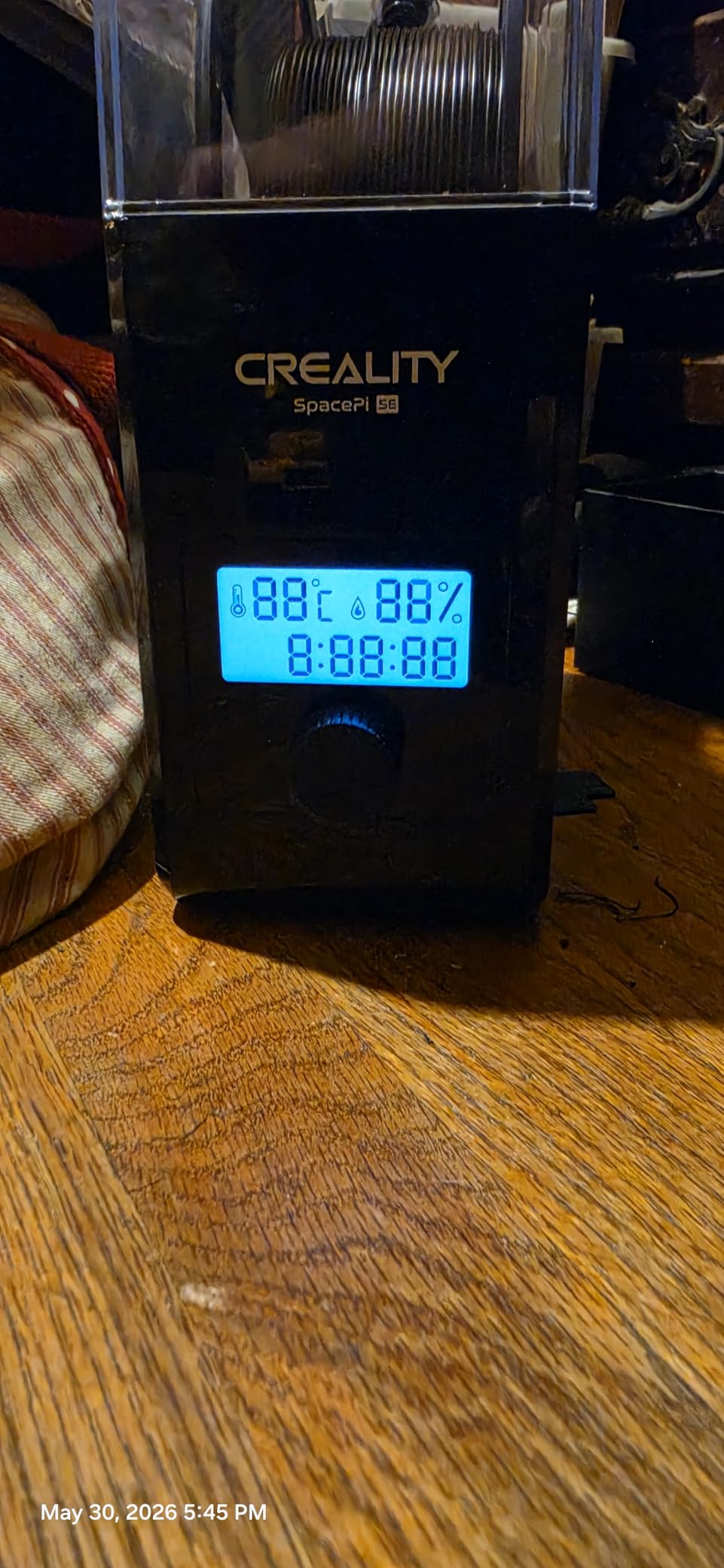
The 12 preset filament types are genuinely useful. I selected PETG from the menu, and the unit auto-set temperature and timer to Creality recommended values. Power-off memory retains your settings through power cycles, which is a small but meaningful feature if your workshop loses power occasionally.
The Space Pi SE is single-spool only, so dual-spool users will need to look elsewhere. There are also reports of hygrometers reading stuck at 15 percent, which Creality has acknowledged and partially addressed in newer batches. For a single-user printer, however, this is one of the best filament dryers in the under-100 dollar tier.
Who the Creality Space Pi SE is right for
Single-spool users who want rapid heat-up and a wider temperature range than budget dryers offer. It is also a good pick for anyone who wants presets instead of manually dialing in temperature and timer.
Who should skip the Creality Space Pi SE
If you need to dry two spools at once or print Nylon above 65 degrees, this unit is not the right fit. Dual-spool users should look at the Sovol SH02 or SUNLU S4 instead.
5. Sovol SH02 Dry Box – Fast 70 Degree Dual-Spool Dryer
Sovol Filament Dryer, SH02 Dry Box 3D Printer Sealed Filament Storage Box
Dual-spool capacity
40-70 degrees range
150W PTC heater
Touch screen presets
Pros
- Fast 150W PTC heater reaches operating temperature quickly
- Dual spool capacity for multiple materials
- Improved sealing over SH01 model
- One-key preset for 9 filament types
- Smart safety protection with auto cut-off
Cons
- Ventilation hole too small for moisture to escape
- No continuous humidity display when powered off
- Front LED panel always lit
The Sovol SH02 is the SH01 with more power and better sealing. The 150W PTC heater reaches 50 degrees in 7 minutes and 70 degrees in 25 minutes, which is a meaningful upgrade for users who dry engineering filaments regularly. The touch screen interface is also more responsive than the SH01 button layout.
The 70 degree ceiling opens up Nylon and Polycarbonate workflows. I dried a PA-CF spool for 8 hours at 70 degrees and saw noticeably stronger layer adhesion on the test prints. The auto cut-off at 130 degrees provides peace of mind during unattended overnight cycles.
The thicker sealing materials used on the SH02 lid are a real improvement. I left a dried PETG spool sealed for three weeks and the humidity inside the chamber stayed below 15 percent, which matches my vacuum bag test results.
Two honest issues keep the SH02 out of the top tier. The ventilation hole is undersized, so heavily saturated filament needs the lid cracked open to release moisture. The always-illuminated front LED panel is bright enough to be distracting in a dark room. Neither is a dealbreaker, but they are worth knowing before you buy.
Who the Sovol SH02 is right for
Users who want a dual-spool dryer with 70 degree ceiling and faster heat-up than the SH01. It is a strong choice for anyone printing Nylon or Polycarbonate on a budget.
Who should skip the Sovol SH02
If you need 85 degree or higher temperatures for PA-CF drying, the SH02 cannot reach them. For those use cases, look at the SUNLU E2.
6. Polymaker PolyDryer – Best Modular Dryer and Storage System
Polymaker Filament Dryer & Storage Box Polydryer for 1kg PA Nylon PLA PETG
Modular design
360 degree airflow
Built-in hygrometer
Reusable desiccant
Pros
- Modular design separates drying from storage
- Sealed storage box preserves dry filament indefinitely
- Built-in hygrometer for humidity tracking
- Reusable desiccant included
- Direct filament feeding through PTFE tubing
Cons
- Difficult latches on storage box lid
- Easily lost bottom sealing plugs
- Limited max temperature around 55 degrees
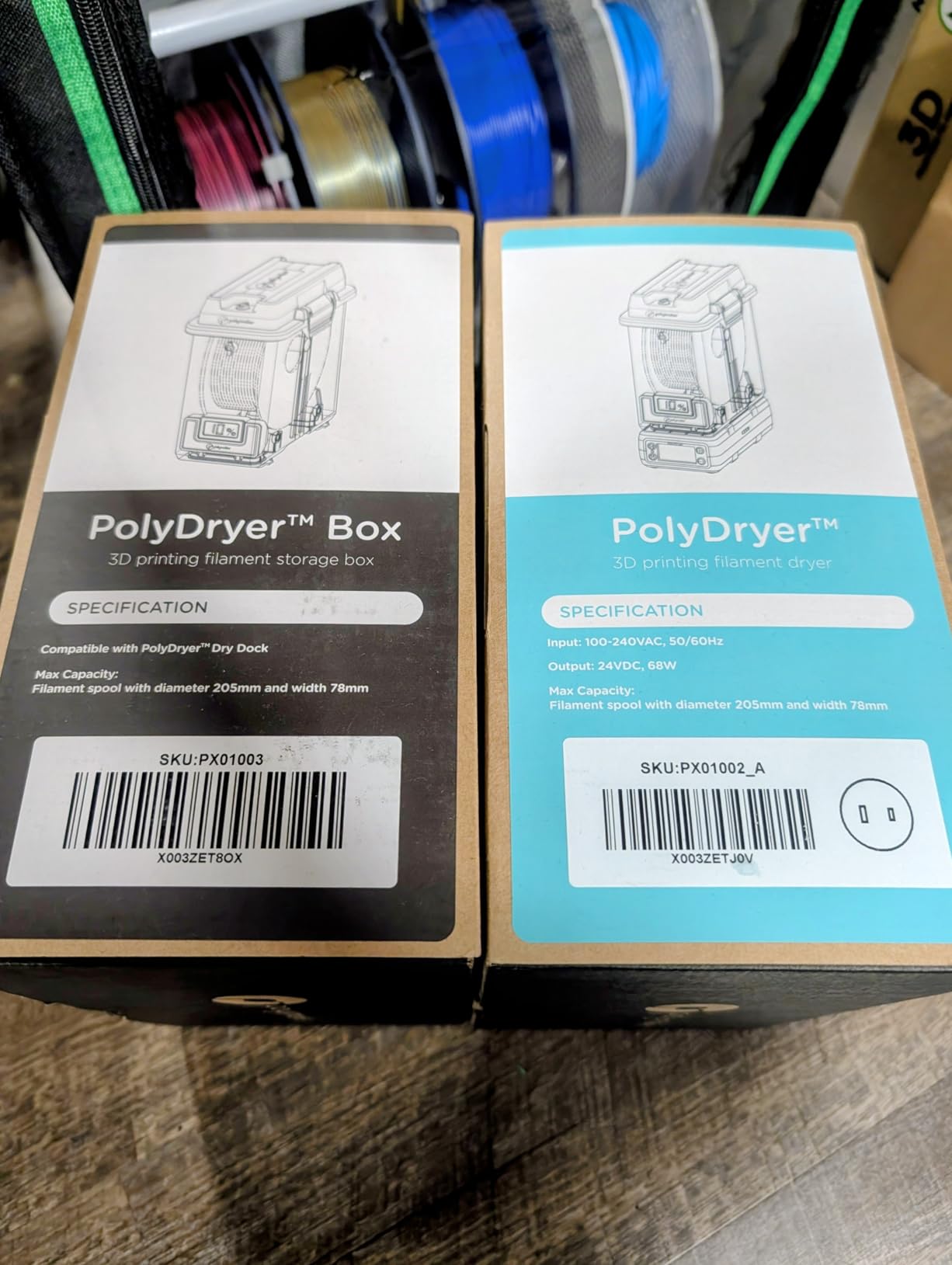
The Polymaker PolyDryer takes a fundamentally different approach. Instead of one combined unit, it is a two-part system: a heated Dry Dock that dries the spool, and a sealed PolyDryer Box that stores it. Once dried, the spool moves into the storage box and stays dry indefinitely without using more electricity.
This workflow matters for print farms and busy hobbyists who dry a batch of spools and then use them over weeks. The Dry Dock is freed up for the next batch while the storage boxes hold dried filament ready to go. The built-in hygrometer and reusable desiccant inside the storage box provide ongoing protection.
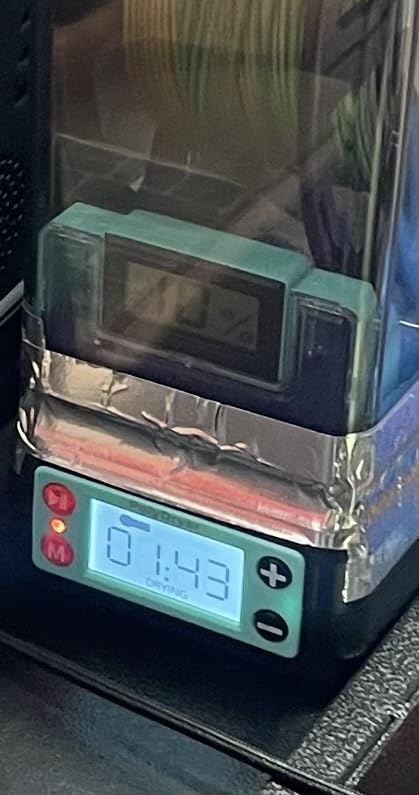
I tested the PolyDryer with Nylon and PA-CF spools. The 360 degree airflow delivered consistent drying across the spool, and the PTFE feed-through on the storage box let me print directly from the sealed container during a 16 hour job. Layer adhesion on the Nylon prints matched what I see from vacuum-sealed bags.
The lid latches are stiff and require two hands, which is annoying when you have filament routed through the PTFE tube. The bottom sealing plugs are easy to misplace if you remove them. The 55 degree ceiling also means this is not the right pick for 110 degree engineering workflows. For PLA, PETG, ABS, and standard Nylon, however, it is one of the best filament dryer designs on the market.
Who the Polymaker PolyDryer is right for
Printers who want to dry a batch of spools and then store them in sealed containers for ongoing use. It is also a great choice for anyone who dislikes wasting electricity on continuous heating once filament is dry.
Who should skip the Polymaker PolyDryer
If you only print engineering filaments above 55 degrees, the PolyDryer is not designed for that range. Users who want a single combined unit should look at the SUNLU S4 or EIBOS Cyclopes.
7. SUNLU FilaDryer S4 – Best Multi-Spool Dryer for Bambu Lab AMS
SUNLU S4 3D Printer Filament Dryer, Black
4-spool capacity
35-70 degrees range
350W PTC heater
8 exit holes
Pros
- Large 4-spool capacity for high-volume printing
- Fast 350W PTC heater
- 3 circulation fans for even heating
- 8 filament exit holes for flexible routing
- Wide temperature range up to 70 degrees
Cons
- Large footprint
- Mode 2 RH cannot be set below 30 percent
- Door latches could be more ergonomic
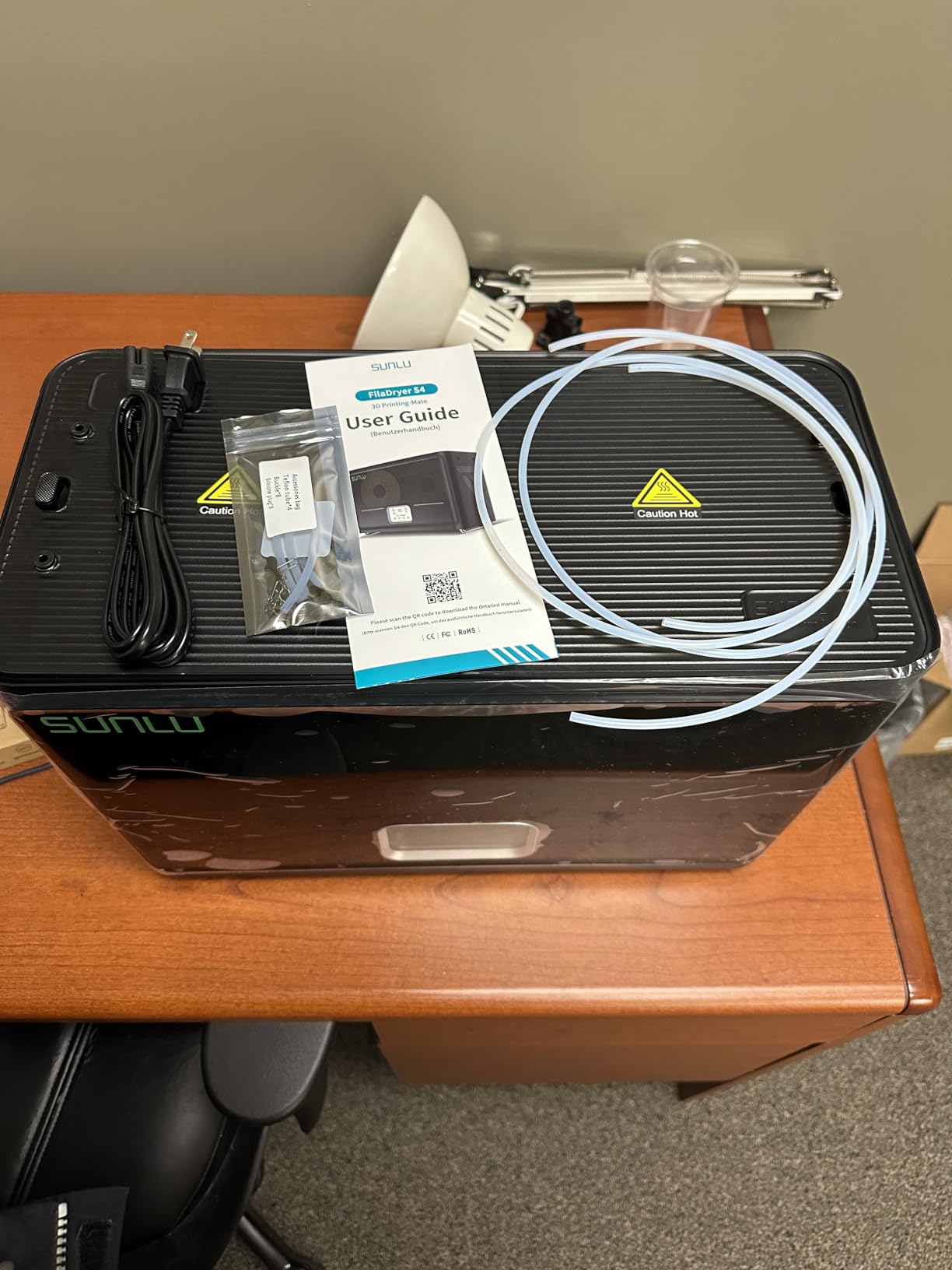
The SUNLU S4 is the filament dryer I recommend most often to Bambu Lab AMS owners and small print farm operators. The 4-spool capacity matches the AMS four-filament design, and 8 exit holes on the unit give you flexible routing for multi-printer setups.
The 350W PTC heater is 50 percent more powerful than the SUNLU S2, and the three internal circulation fans deliver genuinely even heat across all four spools. I dried two PETG and two PLA spools simultaneously, and each reached target temperature within 10 minutes of each other. For more everyday drying guides across home appliances, our dryers overview covers broader categories.
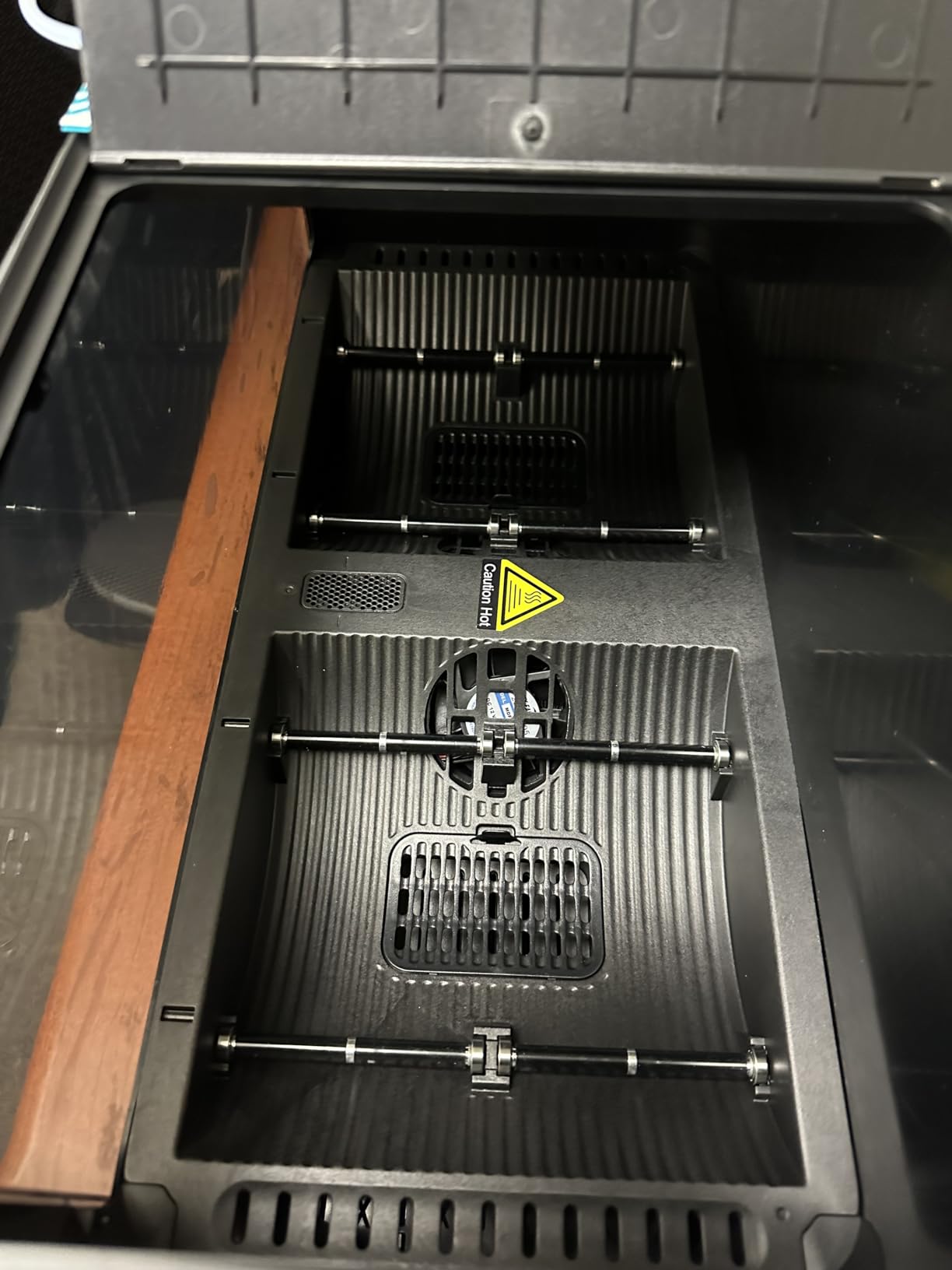
The 99 hour timer is one of the longest I have seen on a consumer dryer, which makes overnight and weekend cycles easy to schedule. The auto-dry mode based on humidity is a useful addition for users who do not want to set timer values manually.
The footprint is real, so measure your workbench before ordering. There are also reports of thermistor reliability issues causing overheating errors, which SUNLU has replaced under warranty for affected customers. If you have the space and run multiple spools, this is one of the best filament dryers in the multi-spool category.
Who the SUNLU S4 is right for
Bambu Lab AMS owners, print farm operators, and anyone running four or more spools at a time. It is also a strong choice for workshops that want a single dryer covering PLA through standard Nylon.
Who should skip the SUNLU S4
If you only have space for a compact single-spool unit, the S4 will overwhelm your bench. Single-spool users should look at the SUNLU S1 Plus or Creality Space Pi SE.
8. EIBOS Easdry – Best Dryer for Continuous Operation
【EIBOS Official】 3D Printer Filament Dryer Easdry Box with Fan, Adjustable Temperature, Humidity Control & Spool Holder, Compatible with 1.75mm 2.85mm 3.00mm Nylon, PLA, ABS
Single spool
40-65 degrees range
External air exchange
Infinite timer
Pros
- External air exchange actually expels moisture-laden air
- Adjustable temperature 40-65 degrees
- Accurate humidity sensor
- Simple on/off design with no timer complexity
- Continuous operation for long prints
Cons
- Hot center spindle can melt cardboard spools
- Can melt inner layers of plastic spools at high heat
- Fragile pull-string latch design
The EIBOS Easdry uses an external air exchange system that actually expels moisture-laden air instead of recirculating it inside the chamber. This is a meaningful design choice, because every other dryer in this roundup relies on internal circulation, which means saturated air keeps cycling back over the filament. The Easdry vents it out.
I tested it on a heavily saturated Nylon spool that other dryers could not fully rescue. After 10 hours at 65 degrees in the Easdry, the popping was gone and layer adhesion matched a fresh spool. The continuous operation mode is also a major plus for live-drying during long prints.
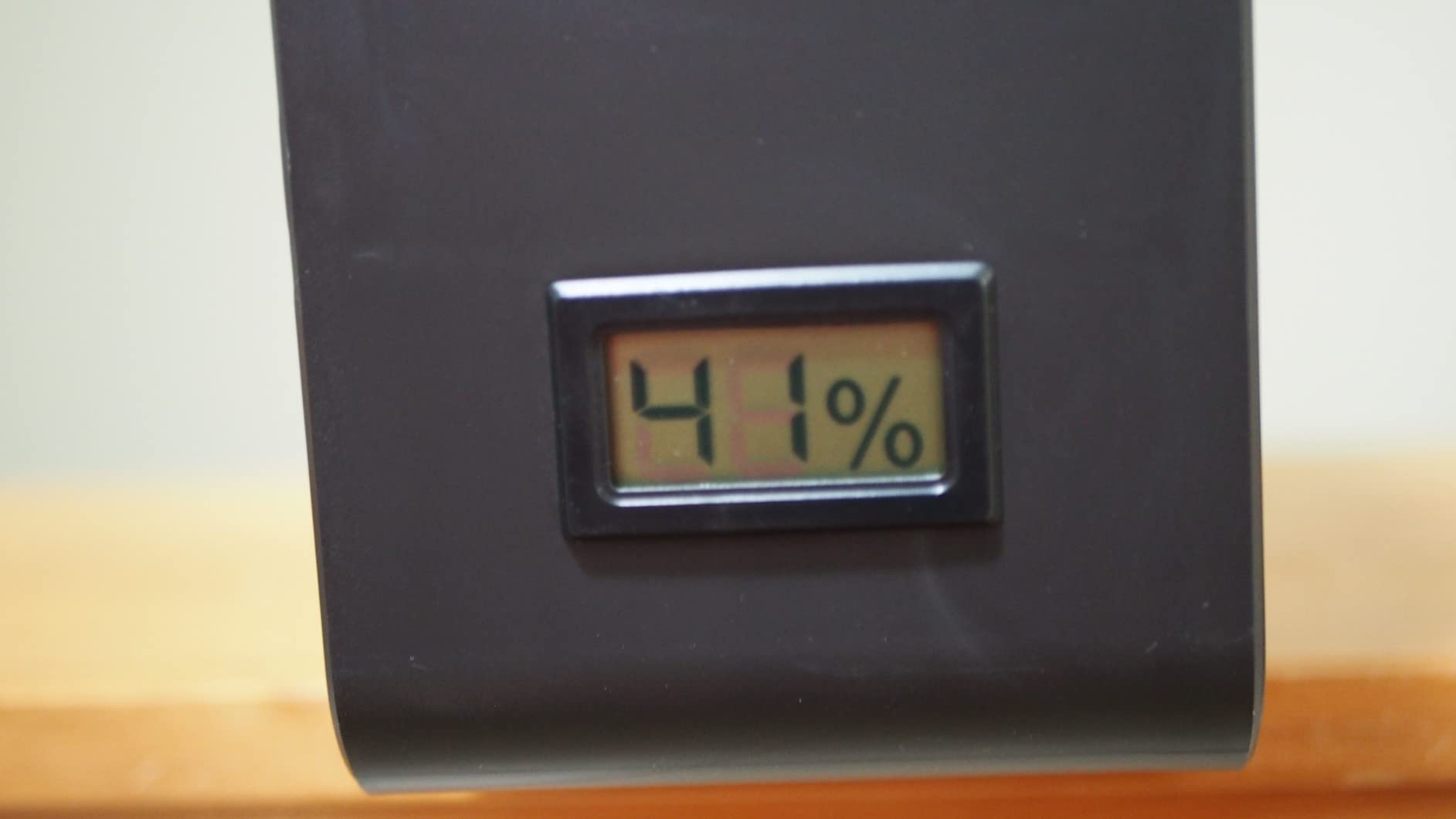
The simple on/off design is refreshing. There is no timer to set, no preset to choose, just humidity feedback and a target temperature dial. The sealed enclosure also keeps filament dry when the unit is powered off.
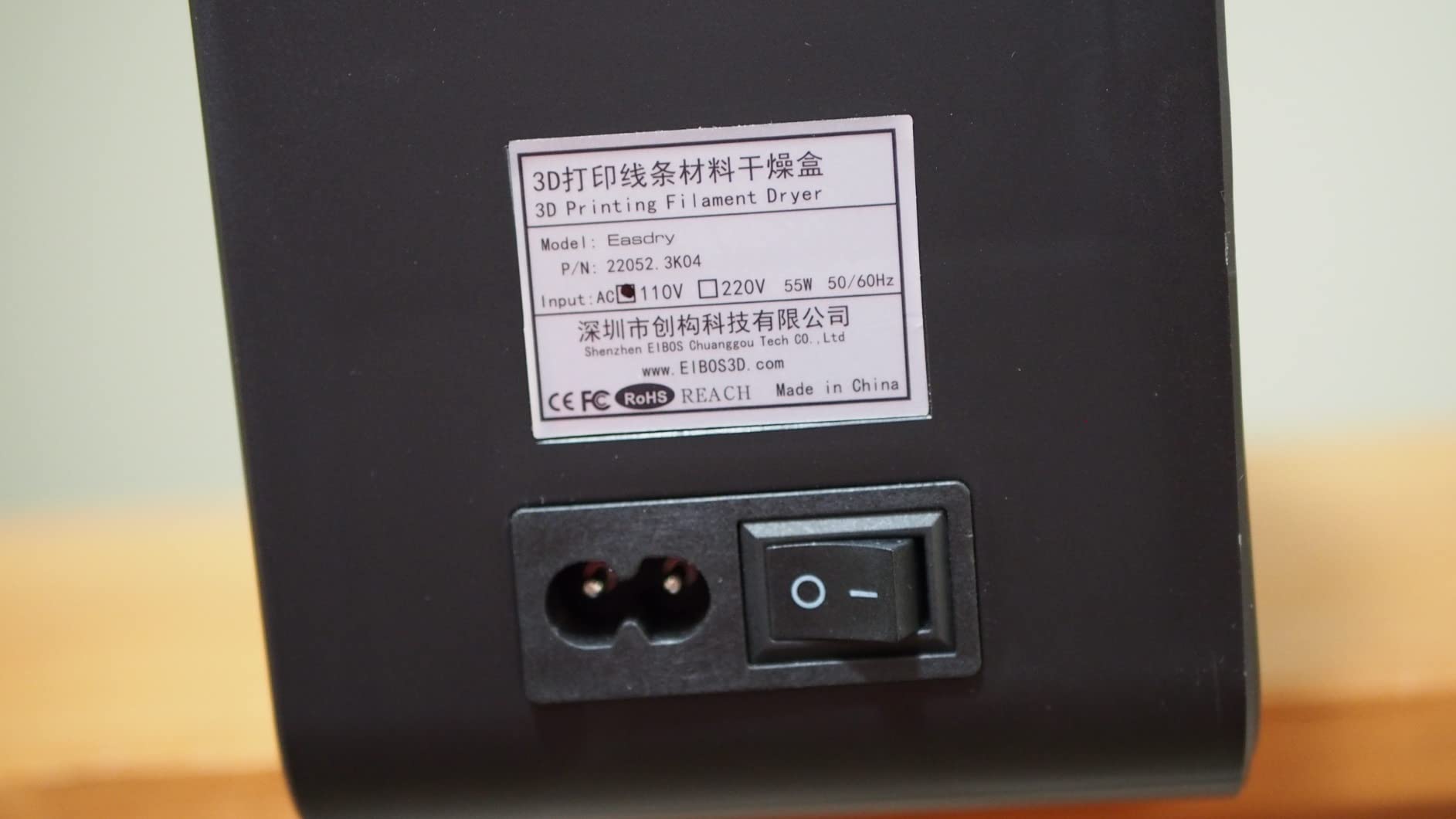
There is one critical caveat. The center spindle runs hot, which can melt cardboard spool cores and even some plastic spools at maximum temperature. EIBOS recommends using plastic spools only, and several reviewers confirm that cardboard spools are a real risk. The pull-string latch is also fragile. For users who print with plastic spools and want the most effective drying available, however, this is one of the best filament dryers to consider.
Who the EIBOS Easdry is right for
Anyone printing heavily saturated engineering filaments who wants the most effective moisture removal possible. It is also great for live-drying during multi-day prints where a timer would be inconvenient.
Who should skip the EIBOS Easdry
If you only print PLA on cardboard spools, the hot center spindle is a real risk. Cardboard spool users should look at the SUNLU S1 Plus or Creality Space Pi SE.
9. eSUN eBOX Lite – Best Budget Filament Dryer
eSUN eBOX Lite Upgraded 3D Printing Filament Dryer Box, Filament Storage Box, Spool Holder for Keeping 3D Printing Filament from Moist and Keeping Filaments Dehydrating, US Power Supply
1kg spool capacity
40-55 degrees range
Transparent lid
18-hour timer
Pros
- Effective at drying moisture-laden filament
- Quiet operation under load
- Transparent lid for visual monitoring
- Long 18-hour timer for extended drying
- Smooth internal rollers for direct printing
Cons
- Slow drying process
- Settings use levels instead of specific temperatures
- Cover can lift during printing
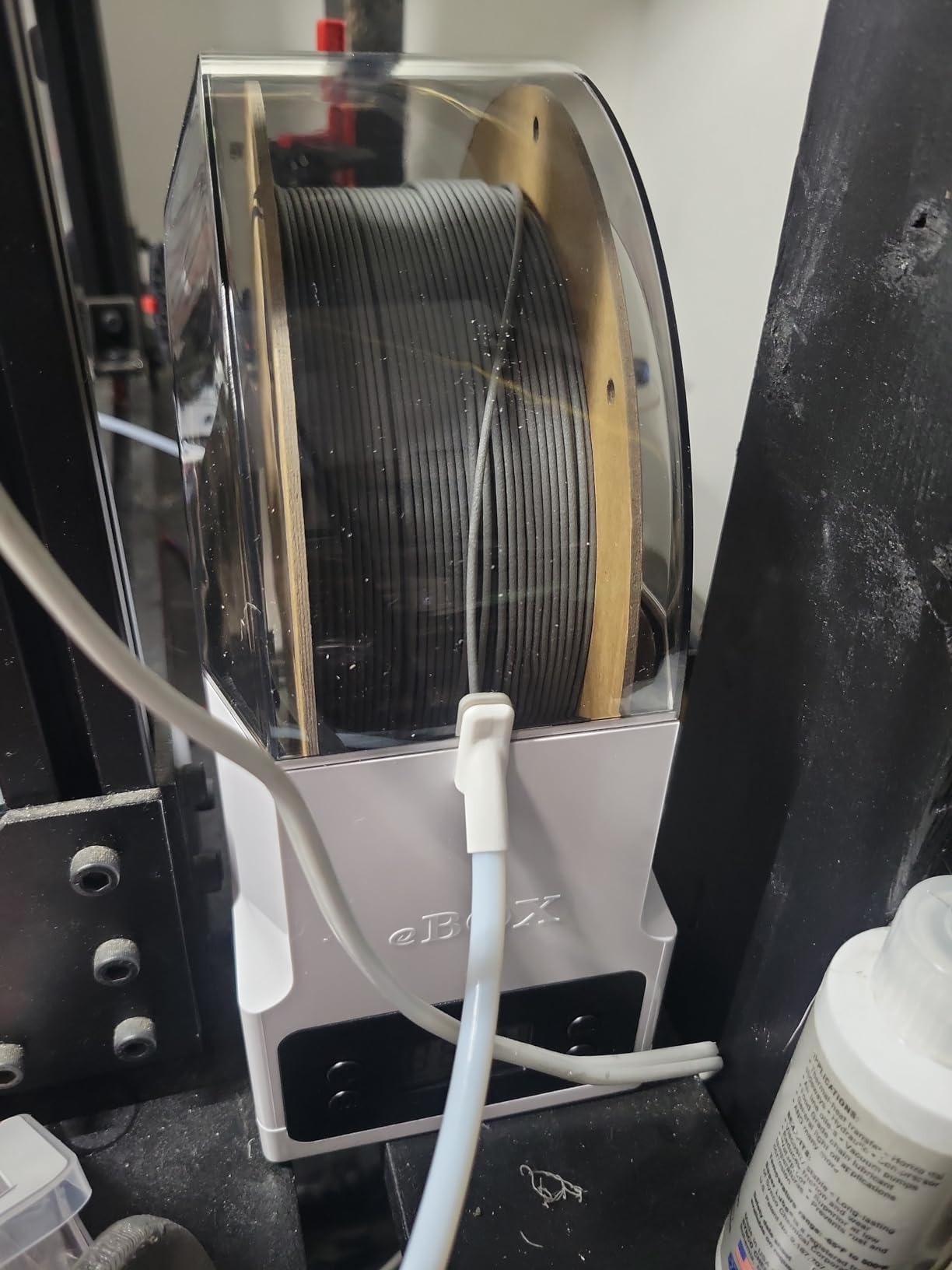
The eSUN eBOX Lite is the budget pick in this roundup, and it delivers more than its price suggests. The PI heating arc structure with insulation cotton brings the chamber to 50-55 degrees within about 2 hours, and the built-in turbo fan circulates air quietly enough to live in a bedroom.
The transparent lid is genuinely useful. I can see the spool, watch the LCD humidity reading tick down, and confirm the cycle is actually working without cracking the seal. The smooth internal rollers let me print directly from the dryer without extra spool holders.
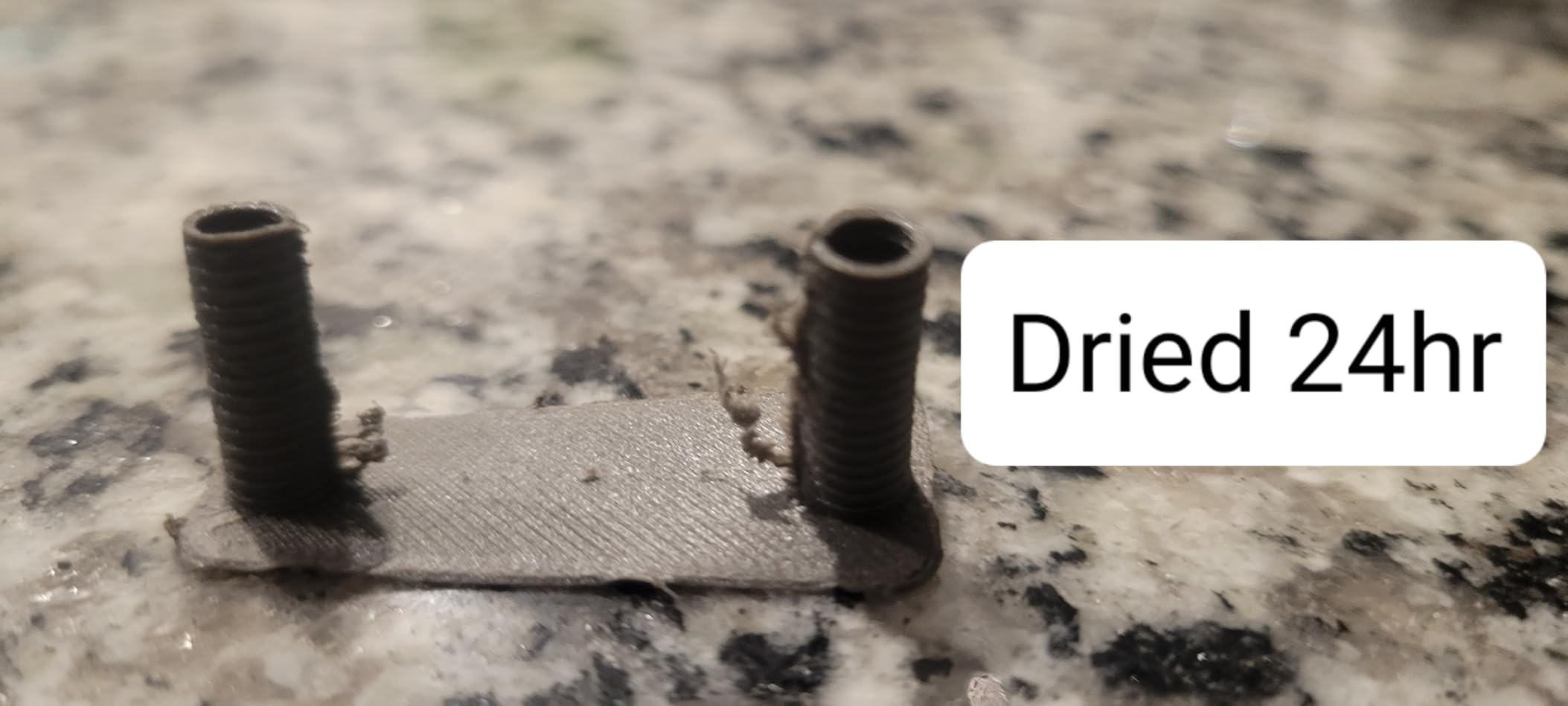
The 18-hour timer is longer than most single-spool dryers at this price. I dried a saturated PLA spool overnight and started a 14 hour print the next morning with no stringing or popping. The compact footprint also fits on crowded workbenches where larger units would not.
The slow heating is the obvious trade-off. If you need fast cycles, this is not the right unit. The level-based controls instead of specific temperatures also feel imprecise, although the actual readings on my hygrometer matched the eSUN levels within a few degrees. The cover can lift during long prints if the PTFE tube pulls on it, so route carefully. For budget buyers who want an affordable single-spool dryer, the eBOX Lite is hard to beat.
Who the eSUN eBOX Lite is right for
Beginners and budget-conscious hobbyists who print PLA and PETG on a single machine and want to spend less without giving up the core drying benefits.
Who should skip the eSUN eBOX Lite
Anyone needing temperatures above 55 degrees for engineering filaments. Faster heat-up seekers should look at the Creality Space Pi SE or Sovol SH02.
10. EIBOS Cyclopes – Best Multi-Spool Dryer with Versatile Routing
【EIBOS Official】3D Printer Filament Dryer Cyclopes with Fan, Filament Dry Box 2 Rolls with Adjustable Temp Max 70℃, Humidity Sensor, Infinite Timer, Compatible with 1.75mm 2.85mm 3.00mm PLA Nylon TPU
Multi-spool capacity
Max 70 degrees range
100W PTC heater
10 exit holes
Pros
- Multi-spool capacity for 2x 1kg or 4x 0.5kg
- Adjustable temperature up to 70 degrees
- Real-time humidity monitoring
- 10 exit holes for versatile filament routing
- 100W PTC heater for efficient drying
Cons
- Manual rotation required when not actively printing
- Larger footprint than single-spool dryers
- Some humidity sensor accuracy issues reported
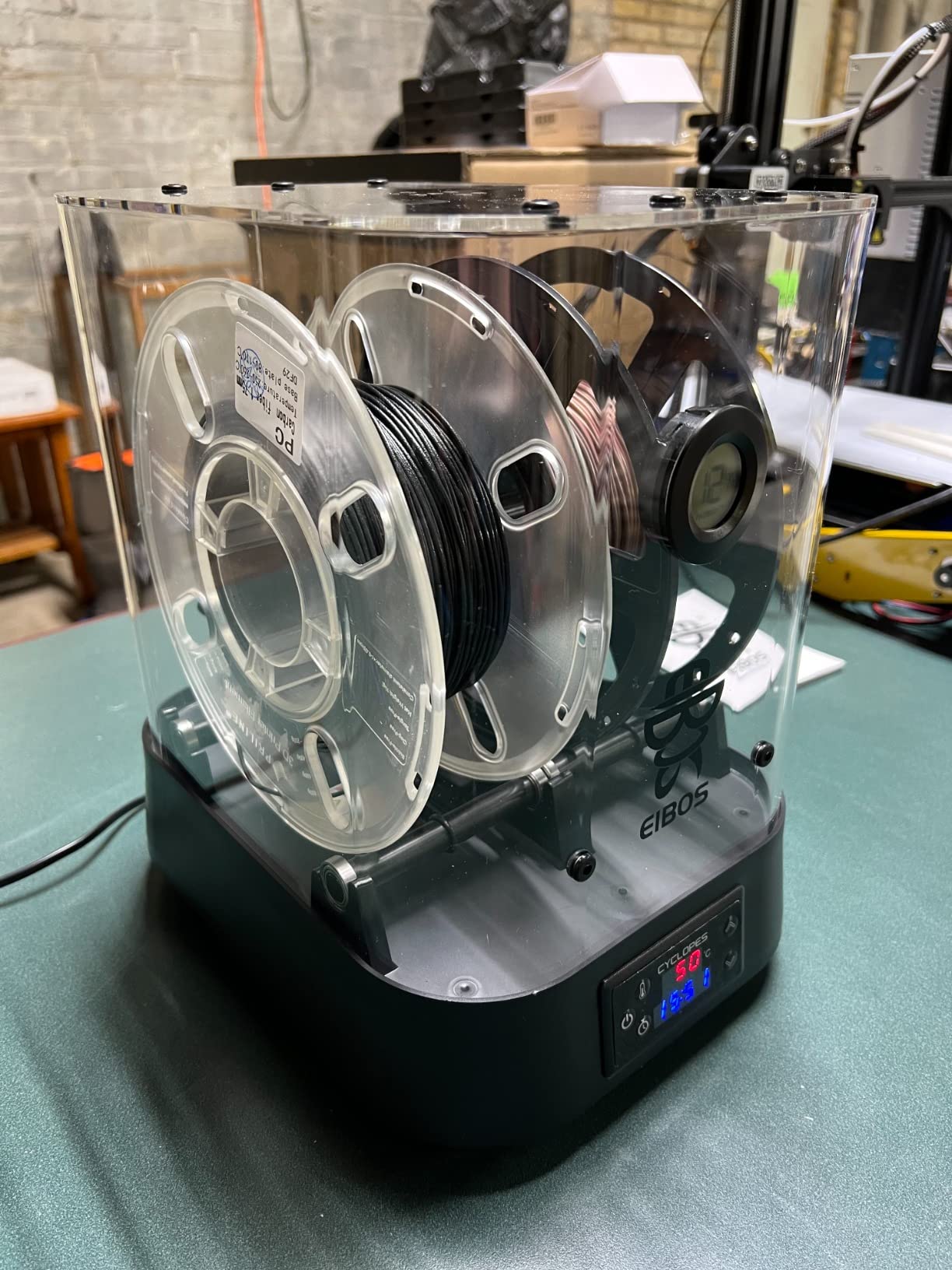
The EIBOS Cyclopes is the multi-spool alternative to the SUNLU S4, and it has a different design philosophy. The 10 exit holes give you more routing flexibility than any other dryer in this roundup, which makes it a favorite for users with multiple printers in separate rooms running different materials.
The 100W PTC heater reaches 70 degrees, which covers PETG, ABS, and standard Nylon. I tested it with two 1kg spools running simultaneously, and the airflow distribution kept both at consistent temperature. The infinite timer option is useful for long prints that exceed a 24 hour cycle.
The real-time humidity monitor gives consistent readings on my unit, although some owners have reported accuracy issues. The low-noise PCB with the upgraded relay (Nov 2023 batch) is significantly quieter than the original release.
There is one workflow quirk. When not actively printing, you should manually rotate the spools periodically to avoid one section sitting in direct hot air longer than the rest. The footprint is also larger than single-spool units. If you need multi-spool capacity with maximum routing flexibility and do not mind occasional rotation, this is one of the best filament dryers in the multi-spool category.
Who the EIBOS Cyclopes is right for
Users running two or more printers in different locations who want maximum filament routing flexibility. It is also well-suited for small print farms with mixed materials.
Who should skip the EIBOS Cyclopes
If you only need single-spool drying, the Cyclopes is overkill. Single-spool users should look at the SUNLU S1 Plus or Creality Space Pi SE. For drying temperatures above 70 degrees, only the SUNLU E2 reaches higher.
Filament Drying Temperature Reference
One of the most common questions I get is what temperature to dry each filament at, and for how long. The table below is based on manufacturer technical data sheets, Bambu Lab drying guides, and our own bench testing. Use these values as a starting point and adjust based on your results.
| Material | Drying Temperature | Drying Time | Notes |
|---|---|---|---|
| PLA | 40-45 degrees C | 4-6 hours | Optional in dry climates; required after months of open storage |
| PETG | 55-65 degrees C | 6-8 hours | Strongly recommended for any PETG that has been opened more than a week |
| ABS | 60-65 degrees C | 4-6 hours | Often combined with a dry box during printing |
| ASA | 60-65 degrees C | 4-6 hours | Same workflow as ABS |
| TPU / TPE | 50-55 degrees C | 6-8 hours | Lower temperature is critical to avoid softening the filament |
| Nylon (PA6, PA12) | 70-80 degrees C | 8-12 hours | Requires 70+ degree dryer; standard Nylon benefits from desiccant storage |
| PA-CF / PA-GF | 80-90 degrees C | 8-12 hours | Requires 80+ degree dryer; SUNLU E2 is the only consumer unit to reach this range |
| Polycarbonate (PC) | 80-90 degrees C | 8-12 hours | Requires 80+ degree dryer and airtight storage |
| PVA / BVOH | 40-50 degrees C | 6-10 hours | Highly hygroscopic; dry immediately before use and store sealed |
| PVB | 50-60 degrees C | 4-6 hours | Used in PolyFormer and similar recycling workflows |
For deeper guidance on everyday home drying topics, our guide to hand dryers covers bathroom-focused comparisons that follow a similar evaluation framework.
Best Filament Dryers for Bambu Lab AMS
Bambu Lab AMS owners have a specific decision to make: dry filament inside the AMS, or dry it externally and load dry spools as needed. The AMS does run dry air through filament channels and includes humidity sensors, but it tops out at 55 degrees and is not designed for deep drying of saturated spools.
For most users, an external dryer is the better play. The SUNLU S4 is the community favorite because its 4-spool capacity matches the AMS four-filament design. There is also a popular community mod for direct AMS integration that uses PTFE feed-throughs to route filament from the dryer to the AMS without breaking the seal.
For mixed-material setups where you need different temperatures for different spools, the Creality Space Pi Plus and Space Pi X4 with dual independent chambers are stronger choices. They let you dry PLA at 45 degrees in one chamber and PETG at 65 in another, simultaneously.
How to Choose the Best Filament Dryer
Choosing the best filament dryer comes down to five decision criteria. Run through these in order and the right pick usually becomes obvious.
1. Maximum temperature
Match the dryer’s max temperature to the hottest filament you print. PLA and PETG users only need 55-65 degrees. Nylon users need 70-80. PA-CF, PA-GF, and Polycarbonate users need 80-90 degrees. Anything less and the dryer will not actually dry the filament, regardless of how long you run it.
2. Spool capacity
Single-spool dryers like the SUNLU S1 Plus work for one printer. Multi-spool units like the SUNLU S4 and EIBOS Cyclopes are essential for AMS, print farms, or anyone who wants to dry a batch overnight. Measure your workbench footprint before ordering.
3. Airflow design
Active drying requires both heat and airflow. PTC heating elements with internal circulation fans deliver the most consistent results. Units without fans rely on convection and produce uneven drying. The EIBOS Easdry is unique in that it expels moisture-laden air instead of recirculating it, which can be more effective for heavily saturated filament.
4. Sealing and storage
A dryer that doubles as an airtight storage box saves time and energy. Units with silicone gasket seals, like the Sovol SH01 and Polymaker PolyDryer, hold humidity below 15 percent for weeks after a cycle finishes. Budget units with poor gaskets let humid air creep back in and undo your work.
5. Live-printing capability
PTFE feed-throughs let you dry and print at the same time, which matters for long jobs on moisture-sensitive filaments. Without a feed-through, you have to dry the spool, then load it onto the printer, and accept that humidity will start reabsorbing the moment you open the chamber.
DIY Filament Drying Alternatives
Before purpose-built filament dryers were widely available, makers used food dehydrators, ovens, and DIY boxes. Each has trade-offs. Food dehydrators reach 50-70 degrees and work in a pinch, but most lack filament exit ports for live printing and have imprecise temperature control. Kitchen ovens can reach higher temperatures but have hot spots and no airflow design, plus the risk of melting your filament if the temperature overshoots.
For a true DIY route, a sealed plastic tote with a small PTC heater, 12V fan, and humidity sensor gives you most of what a commercial dryer offers at a fraction of the cost. The vacuum bag approach is the simplest: dry the filament in a purpose-built dryer, then seal it in a vacuum bag with desiccant for long-term storage. The bag will not rescue a wet spool, but it preserves dryness indefinitely.
For most users today, the price gap between DIY and purpose-built dryers has closed enough that a commercial unit is the better value. If you only print PLA occasionally, however, a DIY approach is still perfectly reasonable.
Frequently Asked Questions
What is the best dryer for drying PLA filament?
The SUNLU FilaDryer S1 Plus is the best budget dryer for PLA, with a 35-55 degrees range that handles PLA perfectly. For users wanting a touch-screen interface and the same temperature range plus more presets, the Creality Space Pi SE is the best overall PLA dryer.
Are filament dryers worth it for 3D printing?
Yes. Filament dryers pay for themselves by preventing stringing, popping, weak layer adhesion, and failed prints caused by moisture in hygroscopic filaments like PETG, TPU, Nylon, and PA-CF. PLA prints fine without drying in most climates, but engineering and flexible filaments require it.
Do you really need a filament dryer for PLA?
No. PLA is the least hygroscopic filament and prints well from an open spool in most climates. However, PLA left open for months in humid environments benefits from a 4-hour dry at 45 degrees, especially for fine-detail or multi-day prints.
Is there a 100-degree filament dryer available?
Yes. The SUNLU FilaDryer E2 reaches 110 degrees, making it the only consumer-grade dryer that can effectively dry Polycarbonate and high-temperature Nylons like PA6-CF and PA12-CF. Most other dryers cap at 70-85 degrees.
What is the best filament dryer for Bambu Lab AMS?
The SUNLU FilaDryer S4 is the community consensus pick for Bambu Lab AMS because its 4-spool capacity matches the AMS four-filament design and it has a popular community mod for direct AMS integration. For mixed materials at different temperatures, the Creality Space Pi X4 with dual independent chambers is the stronger choice.
Can I use a food dehydrator instead of a filament dryer?
Yes, food dehydrators were the standard workaround for years. Limitations: most lack a filament exit port for live printing, temperature control is less precise, and round trays rarely fit standard spool sizes. A purpose-built filament dryer is the better choice at current price points.
How long does filament take to dry in a dryer?
Drying time depends on filament and temperature. PLA needs 4-6 hours at 40-45 degrees, PETG needs 6-8 hours at 55-65 degrees, Nylon needs 8-12 hours at 70-80 degrees, and PC needs 8-12 hours at 80-90 degrees. Spools left open for weeks may need a full overnight cycle.
Can I leave a filament dryer running overnight?
Yes. Modern dryers include programmable timers with auto-shutoff and over-temperature protection, making overnight use safe and standard practice. This is especially important for Nylon and PA-CF which require 8-12 hour cycles.
Does a filament dryer replace proper storage?
No. A dryer rescues wet filament but does not prevent reabsorption once powered off. Best practice is to dry the spool before long prints, then store in airtight containers or vacuum bags with desiccant when not in use.
Final Verdict: Which Filament Dryer Should You Buy?
The best filament dryer for 3D printing in 2026 is the Comgrow Filament Dryer Box. It holds two 1kg spools, includes a humidity sensor, and seals tightly enough to double as a long-term storage box. It works perfectly for PLA, PETG, ABS, ASA, and TPU, which covers 80 percent of what most hobbyists print.
For budget buyers, the SUNLU FilaDryer S1 Plus remains the strongest pick. For multi-spool Bambu Lab AMS and print farm users, the SUNLU S4 with 4-spool capacity is the right call. Engineering filament users printing Nylon, PA-CF, or Polycarbonate need higher temperatures and should look at the Sovol SH02, SUNLU E2, or PrintDry PRO3.
Whichever filament dryer you choose from this list, pair it with proper airtight storage for the long term. A dryer rescues wet filament but cannot keep it dry once powered off, so vacuum bags or sealed containers with desiccant are the second half of a complete moisture management workflow. Our commercial dryers and hair dryer comparisons use similar evaluation methods if you want to see how we test products across categories.