
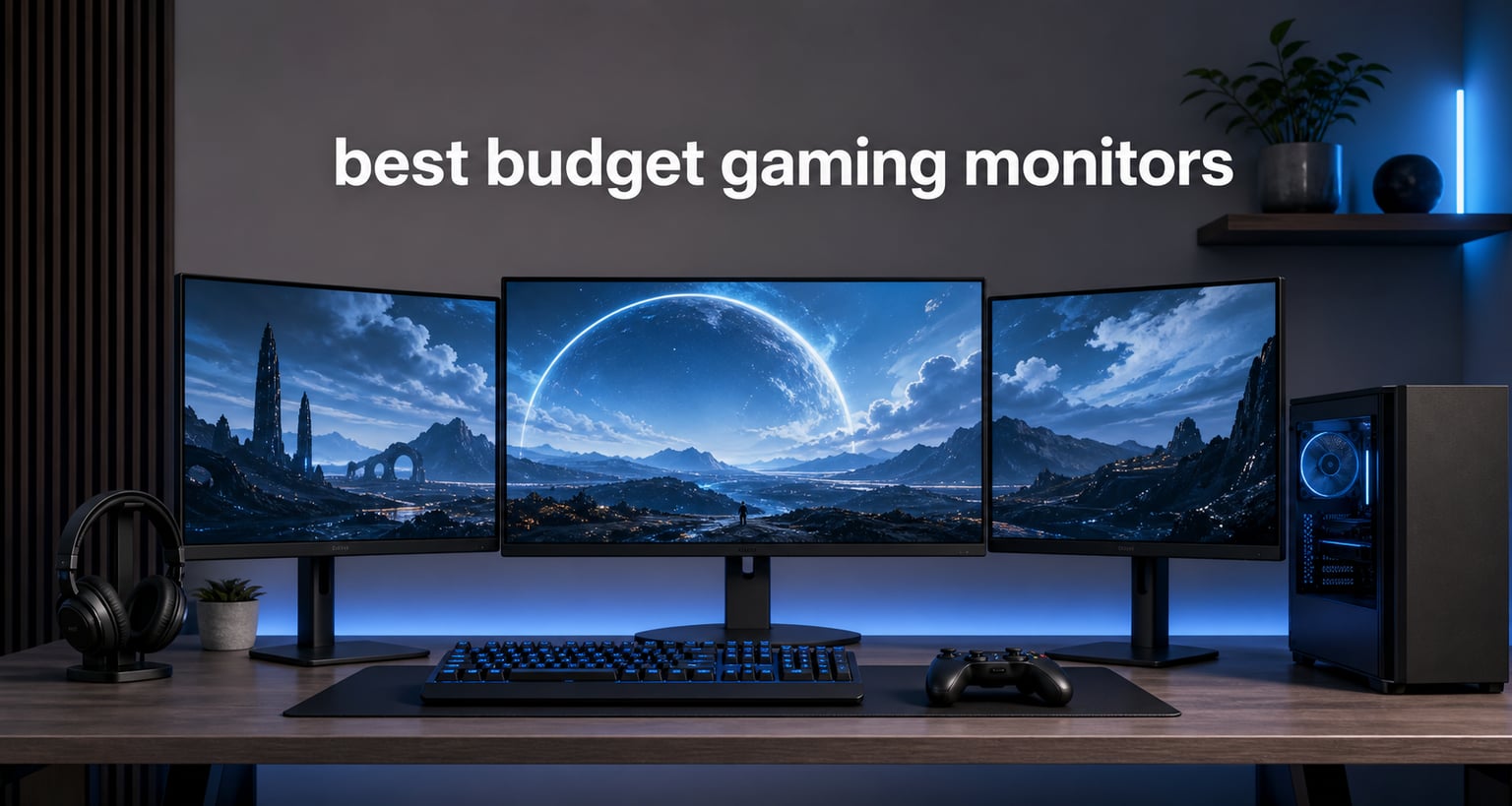
The best budget gaming monitors deliver the upgrades players feel first: a high refresh rate, adaptive sync, and enough resolution to make a desktop or console setup feel current. For this guide, I compared ten verified listings by panel type, resolution, refresh ceiling, claimed response time, connections, ergonomics, warranty details, customer rating, and review volume.
My short answer is that a 27-inch 1440p screen at 180Hz is the strongest all-round direction for a PC that can drive it. It supplies more workspace and finer detail than 1080p while keeping the motion benefit that makes a former 60Hz setup feel slow.
A lower-resolution 24-inch display still has a clear place. It asks less of the graphics card, fits smaller desks, and can be a sensible route for competitive games where consistent frame rate matters more than extra pixels.
I have not treated an HDR label as proof of dramatic HDR, nor a stated 1ms figure as a guarantee of identical motion behavior across every game mode. Those labels are useful starting points, but the panel, brightness, contrast, ports, stand, and return support should decide the final choice.
Community discussions repeatedly flag weak stands, dim screens in bright rooms, missing USB-C, and poor bundled cables as disappointments. The picks below call those trade-offs out rather than pretending every inexpensive display serves every desk.
Table of Contents
Top 3 picks answer the biggest budget gaming monitor needs in 2026
Choose the KTC for a curved 1440p VA panel with strong stated contrast, the Acer KG271U for IPS color coverage and fast claimed response, or the Sceptre when a compact 1080p screen and generous port selection make more sense.
Best budget gaming monitors in 2026 at a glance
Every model below supports a fast refresh rate and adaptive-sync technology. Use the comparison as a quick filter, then read the individual notes for the connections, screen format, adjustment range, and limitations that matter at your desk.
| Product | Specifications | Action |
|---|---|---|
 KTC H27S17 KTC H27S17 |
|
Check Latest Price |
 Acer Nitro EDA270U Acer Nitro EDA270U |
|
Check Latest Price |
 Acer Nitro KG271U Acer Nitro KG271U |
|
Check Latest Price |
 AOC CQ27G4H AOC CQ27G4H |
|
Check Latest Price |
 KOORUI 27E6QCA KOORUI 27E6QCA |
|
Check Latest Price |
 Acer Nitro KG241Y Acer Nitro KG241Y |
|
Check Latest Price |
 Acer Nitro XV271U Acer Nitro XV271U |
|
Check Latest Price |
 ASUS TUF VG27AQ3A ASUS TUF VG27AQ3A |
|
Check Latest Price |
 Sceptre E248B-FW165T Sceptre E248B-FW165T |
|
Check Latest Price |
 Xiaomi P27FBB-RGGL Xiaomi P27FBB-RGGL |
|
Check Latest Price |
1. KTC H27S17 is the best overall curved 1440p pick
KTC 27 inch Gaming Monitor, 1440P Curved Monitor, 180Hz, 2K, 1500R, H27S17
27 inch 1440p VA
180Hz and 1ms
1500R curved
Pros
- 1440p curved VA panel
- 180Hz refresh
- 4000:1 stated contrast
- 120% sRGB
- three-year warranty
Cons
- Only one USB 2.0 port
- limited HDMI count
The KTC H27S17 is my all-round recommendation because its 27-inch, 2560 by 1440 VA panel joins 180Hz operation with a 1500R curve and a stated 4000:1 contrast ratio. That is a sensible combination for single-player games and dark scenes, where VA contrast can give black areas more depth than a typical IPS panel.
It also lists FreeSync and G-Sync compatibility, HDR10, a matte screen, 350-candela brightness, and 120% sRGB coverage. The listing has a 4.6 rating from 1.8k+ reviews, so it has a more substantial customer record than several newer choices here.
For PC gaming, DisplayPort is the straightforward connection to prioritize when pursuing the full 180Hz specification. The two HDMI ports and one USB 2.0 port are useful, but this is not a USB-C dock or a KVM display.
I would keep expectations measured around HDR: HDR10 support is present, yet this is still an LCD without listed local dimming. Its real appeal is the 1440p, high-refresh VA formula, not a promise of premium HDR.
The KTC fits players who want depth and immersion
This is a strong fit for someone moving from a flat 1080p screen and wanting more detail without moving to a physically huge panel. The 1500R curve is most compelling when you sit centered and fairly close to the screen.
The anti-glare surface and blue-light filter are welcome for mixed evening use. A three-year manufacturer warranty also answers one of the common concerns people raise when buying from a less familiar display brand.
The KTC needs a desk that suits a curved VA screen
Buyers who work with color-critical still images should remember that gamut claims are not the same as a calibration report. Fast IPS alternatives below are safer if wide viewing angles and IPS behavior matter more than contrast.
Its connectivity is practical rather than expansive, and the listed weight is 14.8 pounds. Measure an arm or desk mount carefully if you plan to change the stock setup.
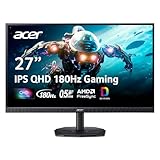
2. Acer Nitro KG271U is the best IPS color pick
Acer Nitro 27in QHD 2560×1440 IPS 180Hz Gaming Monitor KG271U N3bmiipx
27 inch 1440p IPS
180Hz and 0.5ms
DCI-P3 95%
Pros
- IPS viewing angles
- 180Hz refresh
- claimed 0.5ms response
- DCI-P3 95%
- built-in speakers
Cons
- 250-candela brightness
- 1000:1 stated contrast
The Acer Nitro KG271U is the clearest choice when you want a budget IPS gaming monitor that also handles desktop work, art references, and shared viewing well. Its 27-inch QHD IPS panel lists 95% DCI-P3 coverage, 180Hz refresh, and a claimed response time of up to 0.5ms.
IPS is not automatically better for every player, but its 178-degree viewing angle is helpful when you shift position or show something to another person. Acer also lists two HDMI 2.0 ports, one DisplayPort 1.2 connection, HDR10 support, and built-in speakers.
The stated 250-candela brightness is the trade-off I would focus on before buying. A dimmer room suits it best, while a sun-facing desk may call for light control or a display with a higher brightness figure.
Its 4.6 rating comes from just over 1k reviews. That feedback scale makes it easier to weigh its strong IPS color and speed claims against its familiar IPS limitation: listed contrast is 1000:1 rather than the deeper figures found on VA choices.
The Acer works best for games plus creative desktop tasks
Choose this one if your monitor will show both games and color-sensitive projects. The QHD pixel count gives timelines, browser tabs, and editing controls more room than 1080p without asking for the rendering load of 4K.
The tilt-adjustable stand and VESA support provide a route to better posture, although an arm may still be useful. Built-in speakers cover basic sound, but headphones or dedicated speakers remain the better gaming audio path.
The Acer is less suited to very bright rooms and black-level fans
A 250-candela rating can look muted in strong daylight, and IPS contrast is not its special strength. If your favorite games are dark horror or space titles, compare it closely with the KTC, KOORUI, or AOC VA models.
Also check the output limits of a console or laptop before expecting 180Hz. The panel can refresh that quickly, but the source device and cable determine the actual signal it receives.
3. Sceptre E248B-FW165T is the best compact 1080p pick
New! Sceptre 24-inch Prime Gaming Monitor DisplayPort x2 165Hz HDMI x2 165Hz Build-in Speakers, Machine Black 2027 (E248B-FW165T Series)
24 inch 1080p LED
165Hz and 1ms
two DP and HDMI
Pros
- Compact 24 inch size
- 165Hz on HDMI and DP
- dual DisplayPort
- Blue Light Shift
- VESA ready
Cons
- 1080p resolution
- no listed HDR support
The Sceptre E248B-FW165T makes sense for a first build, a smaller desk, or a competitive player who would rather put graphics power into frame rate than pixels. Its 24-inch Full HD panel runs at 165Hz through both HDMI and DisplayPort and lists 1ms blur reduction.
What stands out is the connection count: two DisplayPort and two HDMI inputs. That is unusually convenient for swapping between a PC, a console, and a work device without constantly changing cables.
The listing includes FreeSync, 94% sRGB, built-in speakers, VESA wall-mount compatibility, and Blue Light Shift. It has a 4.5 rating from nearly 900 reviews, a useful baseline for such a compact entry option.
1080p stays sharp enough at 24 inches for typical desktop distance. That smaller screen also avoids the softer-looking pixel density that can make 27-inch 1080p panels less appealing for text-heavy work.
The Sceptre is right for limited space and fast esports play
Players focused on shooters, sports games, and older GPUs can get a lot from 165Hz without needing a demanding graphics card. The screen’s modest dimensions also leave more mouse room, which can matter in low-sensitivity competitive setups.
Blue Light Shift is a useful comfort feature for long sessions, although it should not replace regular breaks and a comfortable brightness setting. VESA support helps if the bundled stand uses too much of the desk.
The Sceptre is not a replacement for a 1440p work display
There is no listed HDR support, and 1920 by 1080 does not provide the same text clarity or workspace as QHD. It is a targeted speed-and-space option rather than an all-purpose screen for heavy editing.
Check whether your device needs DisplayPort or HDMI before choosing a cable. The multiple ports are a real advantage, but the monitor does not list USB-C power or data connectivity.
4. AOC CQ27G4H is the best adjustable curved console-friendly pick
AOC 27″ Curved Gaming Monitor 2K QHD 180Hz VA AMD FreeSync Premium, CQ27G4H
27 inch 1440p VA
180Hz and 0.5ms
height-adjustable stand
Pros
- Height-adjustable stand
- 180Hz via DisplayPort
- FreeSync Premium
- flicker-free
- three-year zero-bright-dot warranty
Cons
- 144Hz via HDMI
- glossy finish can reflect
The AOC CQ27G4H solves a problem that budget buyers mention often: it includes a height-adjustable stand instead of treating ergonomics as an add-on. It pairs that convenience with a 27-inch 1440p 1500R VA panel, 180Hz through DisplayPort, and a claimed 0.5ms response time.
AOC lists FreeSync Premium, a 300-candela brightness figure, a 3000:1 contrast ratio, dual HDMI 2.0, DisplayPort 1.4, and console compatibility for Xbox, PS5, and Switch. The listing’s stated limit is 144Hz through HDMI, so PC users seeking 180Hz should use DisplayPort.
Its flicker-free and low-blue-light features address long-session comfort more directly than most models here. The three-year zero-bright-dot warranty is also meaningful reassurance, especially since pixel defects are a common worry with any new monitor.
This model has a 4.6 rating, but it is based on 137 reviews, far fewer than the KTC or KOORUI. I would read recent owner feedback for current quality-control patterns rather than treating the average score alone as the whole story.
The AOC suits console owners and posture-conscious desk setups
The listed HDMI 2.0 inputs make a console plus PC arrangement straightforward, while the height-adjustable stand can reduce the need for an immediate monitor arm. Its curved VA layout is particularly attractive for immersive single-player use.
The screen also has VESA compatibility if you later move to an arm. That flexibility matters because forum users regularly report that basic fixed stands are the first part of a low-cost setup they want to replace.
The AOC needs thoughtful room lighting and connection planning
The listing calls the finish glossy, so a window or lamp opposite the panel can create reflections. Position the desk and room light first; this is a physical limitation that settings cannot fully fix.
Console compatibility does not mean every console title will output QHD at a high frame rate. Confirm your particular console’s resolution and refresh options, then select the HDMI input and game setting accordingly.
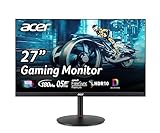
5. Acer Nitro XV271U is the best fully adjustable IPS pick
Acer Nitro 27in QHD 2560×1440 IPS 180Hz Gaming Monitor XV271U M3bmiiprx
27 inch 1440p IPS
180Hz and 0.5ms
height swivel pivot stand
Pros
- Full Ergostand adjustment
- IPS panel
- DCI-P3 95%
- FreeSync Premium
- 180Hz
Cons
- 250-candela brightness
- 144Hz through HDMI
The Acer Nitro XV271U M3bmiiprx is the best fit when stand adjustment is non-negotiable but you prefer an IPS panel. Acer’s Ergostand provides height, swivel, and pivot adjustment, so it accommodates a seated gaming position, standing desk use, or a vertical secondary-screen role.
The display itself is a 27-inch 2560 by 1440 IPS panel with FreeSync Premium, a 180Hz ceiling through DisplayPort, a 144Hz HDMI limit, and a claimed 0.5ms response time. Its listed 95% DCI-P3 coverage gives it a good mixed gaming-and-content-creation profile.
This is not only a specification on paper: adjustment changes how sustainable a setup feels after hours at the desk. A fixed screen that sits too low encourages neck strain, and buying an arm later can erase the savings of a cheaper model.
The main specification compromise is 250-nit brightness and a listed 1000:1 contrast ratio. Those are ordinary IPS trade-offs, not faults, but they make this less compelling than a VA pick for a bright, high-contrast movie experience.
The Acer fits multi-use desks that need a flexible stand
Pick the XV271U if you alternate between gaming, documents, photo references, and video. Its 178-degree viewing specification and IPS panel behavior are useful when the screen is not viewed from one exact centered spot.
The built-in two-watt speakers can handle alerts or casual video. Their presence is convenient, but do not expect them to substitute for dedicated sound in cinematic games.
The Acer favors DisplayPort PC users over maximum HDMI refresh
Use DisplayPort from a desktop computer to access the stated 180Hz refresh rate. Through HDMI, the listing specifies up to 144Hz, which is still fluid but relevant when comparing it against models that publish 165Hz operation on HDMI.
Its 4.5 rating is drawn from 2k+ reviews, providing a useful base of customer feedback. Consider that record alongside the brightness limitation and your actual room lighting.
6. ASUS TUF VG27AQ3A is the best motion-feature pick
ASUS TUF Gaming VG27AQ3A 27 Inch 1440p 180Hz G-SYNC Gaming Monitor
27 inch 1440p Fast IPS
180Hz and 1ms
ELMB Sync motion control
Pros
- Fast IPS panel
- ELMB Sync
- FreeSync Premium and G-Sync
- 130% sRGB
- flicker-free
Cons
- 1000:1 stated contrast
- more focused on PC features
The ASUS TUF VG27AQ3A is the most feature-led 1440p Fast IPS option in this group. Alongside its 180Hz refresh rate and stated 1ms response time, it lists Extreme Low Motion Blur Sync, commonly shortened to ELMB Sync, for players who want another motion-clarity control to explore.
It supports both FreeSync Premium and G-Sync compatibility, has HDR10 support, and lists 130% sRGB color gamut coverage. That broad-gamut figure can make color look punchy, though it is worth using an appropriate color mode when accurate sRGB work matters.
The listing includes HDMI, DisplayPort, built-in speakers, a blue-light filter, and flicker-free operation. Its 4.5 rating from 1.3k+ reviews supplies a reasonable amount of owner evidence for a screen with this gaming-focused feature set.
ELMB Sync is not a reason to skip the basics. A stable frame rate, correct adaptive-sync setting, and a comfortable brightness level will make a larger difference for most players than endlessly changing motion modes.
The ASUS fits PC players who want motion controls to experiment with
This is a natural candidate for fast shooters where perceived blur and tracking targets matter. Fast IPS also keeps viewing angles broad, which helps if the monitor is slightly angled on a multi-screen desk.
Use FreeSync or G-Sync based on the graphics system and compatible setup. Adaptive sync matches the monitor refresh to changing game frame rates, reducing tearing without requiring an artificially locked display rhythm.
The ASUS does not offer VA-style contrast for dark-room games
Its listed 1000:1 contrast figure is typical for IPS rather than VA. A player who values deep blacks in a dim room should favor the KTC, AOC, or KOORUI instead of choosing only by the 180Hz headline.
It also makes sense to verify stand adjustment and exact port behavior from the current listing before ordering. The supplied data emphasizes panel and motion features more than ergonomic range.
7. Acer Nitro EDA270U is the best speaker-equipped curved alternative
Acer Nitro 27in QHD 2560×1440 Curved 180Hz Gaming Monitor EDA270U Pbmiipx
27 inch 1440p curved
180Hz and 1ms
FreeSync Premium speakers
Pros
- 180Hz curved QHD
- FreeSync Premium
- built-in speakers
- two HDMI ports
- three-year parts warranty
Cons
- 250-nit brightness
- 170-degree viewing angle
The Acer Nitro EDA270U brings the familiar 27-inch curved QHD concept with two built-in speakers and FreeSync Premium. It lists 180Hz refresh, 1ms VRB response time, a 1500R curve, one DisplayPort 1.2, and two HDMI 2.0 connections.
It is an appealing straightforward choice for someone who wants a clean desk without immediately adding speakers. The 1500R curve places the screen edges slightly closer to the viewer, which can feel more involving in driving games and wide HUDs.
Acer specifies 250-nit brightness, a matte finish, tilt adjustment, and 75 by 75 millimeter VESA compatibility. The three-year parts-and-labor warranty is an important practical detail, particularly because low-cost monitor buyers often worry about support after the first months.
Its 4.6 rating comes from 1.2k+ reviews. That is a favorable sign, although a high average should not override the basic requirement to check your desk lighting before choosing a 250-nit display.
The Acer suits simple PC and console desks needing basic audio
The two HDMI ports make it convenient to leave two devices connected. The built-in speakers are a functional convenience for casual use, video, or backup audio when a headset is not on hand.
Curvature is a personal preference, but 27 inches is a manageable size for it. Sit directly in front of the display to get the intended effect rather than placing it as an off-angle second screen.
The Acer is less compelling for bright shared rooms
The 250-nit specification means ambient light deserves attention, and the listed 170-degree viewing angle is narrower than IPS alternatives. If multiple people regularly view the screen from the side, an IPS choice is easier to recommend.
Its stand only lists tilt adjustment, so factor in a VESA arm if height placement is wrong for you. That is better decided before the monitor is on the desk than after cables are already routed.
8. KOORUI 27E6QCA is the best high-contrast curved alternative
KOORUI 27 Inch Curved Gaming Monitor QHD 180Hz, 1ms 1500R VA Display
27 inch 1440p curved
180Hz and 1ms
4000:1 contrast
Pros
- 4000:1 stated contrast
- 180Hz refresh
- 90% DCI-P3
- DP 1.4 and dual HDMI
- VESA 100x100
Cons
- Screen warranty is one year
- 1ms claim is slower than 0.5ms listings
The KOORUI 27E6QCA offers the same attractive core as the stronger VA contenders: a 27-inch 1440p 1500R curved panel, 180Hz refresh, and a stated 4000:1 contrast ratio. It lists HDR10, 90% DCI-P3 coverage, and 300-candela brightness.
Its inputs are well suited to a multi-device desk: DisplayPort 1.4 plus dual HDMI 2.0, with VESA 100 by 100 millimeter support. The listed 1ms GTG response is enough to signal gaming intent, though response claims from different brands are not directly interchangeable.
This is the most review-rich product in the group, with a 4.5 rating from 5.4k+ reviews. That volume suggests many buyers have tried the formula, and the data summary specifically points to favorable comments on value, color reproduction, and gaming behavior.
The warranty language needs closer attention than the headline specs. The listing states one year for the display screen and three years for other accessories, which is a shorter panel commitment than the three-year terms listed by KTC, Acer, and AOC options.
The KOORUI works for contrast-first players with several devices
Dark game environments and movies are the reason to consider its VA panel. A 4000:1 stated contrast ratio can create a more convincing sense of depth than the 1000:1 figures listed on the IPS competitors.
The 300-candela brightness figure is also a step up from the 250-nit screens in this guide. It is not a guarantee for every room, but it gives the KOORUI a better starting point for moderately bright spaces.
The KOORUI requires careful warranty expectations
Do not assume every part has the same coverage period. The listing distinguishes the display screen from accessories, and that distinction is worth reading in full before committing to a panel you plan to use daily.
The unit lists only tilt adjustment, so a VESA arm may be the sensible long-term ergonomic answer. This is exactly the kind of stand limitation that owners often mention after focusing only on refresh rate.
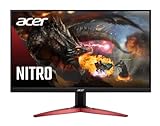
9. Acer Nitro KG241Y is the best first-build 1080p option
Acer Nitro 23.8in FHD 1920×1080 180Hz Gaming Monitor KG241Y Sbiip
23.8 inch 1080p VA
165Hz and 1ms
FreeSync Premium
Pros
- 165Hz refresh
- FreeSync Premium
- compact 23.8 inch size
- dual HDMI
- VESA 100x100
Cons
- 250-nit brightness
- limited color gamut
The Acer Nitro KG241Y is a clean answer for a first gaming PC where 1080p performance is the priority. Its 23.8-inch VA display lists a 165Hz refresh rate, 1ms VRB response time, AMD FreeSync Premium, and a Full HD 1920 by 1080 resolution.
At this size, Full HD has a practical pixel density for a normal desk position. It gives modest graphics cards a much better chance of sustaining high frame rates than QHD, which matters more than a higher monitor ceiling if the system cannot reach it.
The monitor has one DisplayPort 1.2 port, two HDMI 2.0 ports, a thin-bezel ZeroFrame design, HDR-ready labeling, and VESA 100 by 100 millimeter compatibility. Its 4.5 score is backed by 4.2k+ reviews, the second-largest customer base in this roundup.
The limitations are clear: Acer lists 250 nits of brightness and NTSC 72% color gamut. It is a gaming-first screen, not the choice I would make for serious color correction or a very sunny desk.
The Acer suits attainable high-frame-rate gaming
Pair this with a system that plays competitive titles at high frame rates and the 165Hz panel can feel substantially more responsive than a conventional 60Hz display. FreeSync Premium helps smooth the changing frame rate range that real games produce.
The compact panel is easy to position and makes a practical dual-monitor companion. VESA support gives you an upgrade route if the included stand does not suit the desk height.
The Acer is not the one for QHD workspace and wide color
Its 1080p resolution leaves less room for multitasking than a 27-inch QHD display. The limited stated gamut also means it is not the safest tool for color-dependent illustration, photo finishing, or print matching.
HDR-ready is not the same as high-impact HDR performance. Treat it as a compatibility feature, then set expectations around the monitor’s core strengths: refresh rate, compact size, and adaptive sync.
10. Xiaomi P27FBB-RGGL is the best calibrated 1080p IPS option
Xiaomi Gaming Monitor 27in 165Hz 1ms GTG 1920*1080 Fast IPS HDR10 FreeSync Premium Professional Calibration 99% sRGB 178° Wide Angle Tilt Adjustment TUV Low Blue Light Computer Screen Desktop Monitor
27 inch 1080p Fast IPS
165Hz and 1ms
99% sRGB calibrated
Pros
- Fast IPS panel
- 99% sRGB
- Delta E under 2 calibration
- TUV low blue light
- FreeSync Premium
Cons
- One HDMI port
- limited review history
- 250-nit brightness
The Xiaomi P27FBB-RGGL is the unusual choice here: a 27-inch 1080p Fast IPS panel that prioritizes stated calibration and eye-comfort credentials. It lists 165Hz, 1ms GTG, FreeSync Premium, HDR10, 99% sRGB, and professional calibration with Delta E below 2.
That color-focused specification makes it interesting for a player who also wants to browse, sketch, or edit on the same display. TUV low-blue-light certification and DC dimming for flicker-free operation are thoughtful additions for people who spend long stretches in front of a screen.
There are two important cautions. The display has only one listed HDMI port, which reduces its flexibility for multiple devices, and its 4.5 rating is based on just 29 reviews, a much smaller sample than every other high-review pick here.
Its 250-candela brightness and 1000:1 stated contrast are conventional IPS figures. I would choose it for the stated color calibration and comfort features, not for dark-scene contrast or bright-room punch.
The Xiaomi suits color-aware 1080p gaming and long work sessions
Fast IPS, 99% sRGB, and a Delta E below 2 specification create an appealing dual-purpose outline. The 165Hz refresh is still enough for responsive play while the calibration claim speaks to more measured color presentation.
Flicker-free DC dimming and TUV low blue light are useful quality-of-life features. They work best alongside sensible screen brightness, a comfortable viewing distance, and regular time away from the desk.
The Xiaomi is constrained by resolution and one HDMI input
A 27-inch 1080p screen has lower pixel density than the 24-inch Sceptre or Acer 1080p models. If you read dense text all day, sit farther back or strongly consider one of the QHD picks instead.
Plan your connection before buying, because one HDMI input is restrictive for a PC-and-console desk. The modest review count also means the longer-established models offer more owner feedback to study.
Choosing a budget gaming monitor starts with resolution and frame rate
Choose 1440p when your PC can sustain satisfying frame rates at 2560 by 1440 and you want a 27-inch screen for both games and work. Choose 1080p when your graphics hardware is modest, competitive performance is the goal, or the desk calls for a 24-inch panel.
A high refresh rate is visible because the display shows more updates each second. Moving from 60Hz to 144Hz or 165Hz is a major practical leap for motion clarity and input feel; moving from 165Hz to 180Hz is smaller, so do not sacrifice panel quality or ergonomics only to chase it.
1440p is the balanced choice for most 27-inch PC setups
At 27 inches, QHD gives games finer detail and makes text, timelines, and multiple windows more comfortable than Full HD. It requires more graphics performance, so check realistic benchmarks for the games you actually play rather than judging a GPU from one esports title.
All of the 1440p models in this guide list 180Hz, but source output and cable choice still govern the delivered signal. DisplayPort is often the straightforward PC route, while the listed HDMI maximum differs by model.
1080p is the sensible choice when consistent frames matter most
Full HD is not obsolete. A 23.8- or 24-inch 1080p panel can look appropriately sharp at a desk and lets more systems reach the frame rate that makes 165Hz worthwhile.
A 27-inch 1080p monitor is more of a deliberate compromise. It can work for relaxed viewing distances and color-focused use, but QHD is generally more comfortable for close text and detailed desktop tasks.
Panel type decides whether contrast or viewing angles matter more
VA panels, such as the KTC, AOC, KOORUI, and Acer KG241Y, list much higher contrast figures. They are attractive for dark rooms, cinematic games, and players who value deep-looking blacks, while their curved designs can add a more enclosed feel.
IPS and Fast IPS panels, such as the Acer KG271U, XV271U, ASUS, and Xiaomi, prioritize wide viewing angles and are usually the safer mixed-use choice. Their listed 1000:1 contrast figures also explain why a VA option may look more satisfying in very dark scenes.
Adaptive sync reduces tearing when the game frame rate changes
FreeSync and G-Sync Compatible support allow a screen to vary its refresh timing to follow the game’s frame output. That reduces tearing and can make uneven performance look smoother than a fixed-refresh display.
Enable it in the monitor menu and graphics settings, then test it in a familiar game. The source device, connection type, driver settings, and game mode can all affect whether it is available.
HDR labels need realistic expectations on budget LCD monitors
HDR10 or HDR-ready means the display can accept HDR content, but it does not by itself tell you how dramatic highlights or black levels will look. Brightness, contrast, and local dimming are the specifications that usually determine the more dramatic HDR effect.
None of these verified listings specifies local dimming. Consider HDR compatibility a useful extra, then choose by the core traits you will see every day: panel type, resolution, refresh rate, and room-light suitability.
Console compatibility depends on ports, game support, and output modes
For a budget gaming monitor for PS5 or Xbox, start by confirming the console’s supported resolution and refresh modes for each game. Then check the monitor’s HDMI specification and published HDMI refresh limit rather than assuming its maximum DisplayPort refresh carries over.
The AOC CQ27G4H explicitly lists Xbox, PS5, and Switch compatibility and has dual HDMI 2.0. The Sceptre also has dual HDMI inputs, while the Xiaomi lists only one HDMI input; these details are more useful than a generic console claim.
Ports, stands, and eye comfort affect daily ownership more than expected
DisplayPort and dual HDMI inputs make a shared PC-and-console desk easier to manage. USB-C is not listed on these models, so laptop owners needing single-cable charging and video should not assume that function is present.
Forum users often complain about fixed stands and crowded bases after the purchase. The AOC height-adjustable stand and Acer XV271U Ergostand are standout included options; VESA support on several others gives you a path to an arm.
Flicker-free operation, blue-light modes, and matte coatings can improve comfort, but they are supporting features rather than a cure for long sessions. Set brightness to the room, place the screen at a comfortable height, and take regular breaks.
Frequently asked questions answer the final buying decisions
Is 240Hz overkill for gaming?
240Hz is not overkill for players who can sustain very high frame rates in competitive games, but it is not the first priority for most budget builds. A good 1440p 165Hz or 180Hz monitor with adaptive sync, a suitable panel, and a usable stand is often the more balanced choice.
Are budget monitors good for gaming?
Yes. The verified models in this guide show that budget screens can offer 165Hz or 180Hz refresh rates, adaptive sync, and either 1080p or 1440p resolution. Check brightness, panel type, connections, and stand adjustment because those are the common trade-offs.
What refresh rate do I need for gaming?
144Hz is a strong starting point for noticeably smoother gaming, while 165Hz and 180Hz are excellent targets when your hardware can supply the frames. Choose a refresh rate your PC or console can actually use in your preferred games.
What is the best 1440p monitor for the money?
The KTC H27S17 is the most balanced verified 1440p choice here because it combines a 27-inch curved VA panel, 180Hz refresh, adaptive sync, 350-candela brightness, and a three-year manufacturer warranty. The Acer Nitro KG271U is the better alternative when IPS color and viewing angles matter more.
Do I need FreeSync or G-Sync for gaming?
Adaptive sync is strongly recommended when supported by your graphics hardware because it reduces screen tearing as frame rate changes. FreeSync and G-Sync Compatible displays can provide this benefit, but the device, cable, and settings must all support the chosen mode.
The best budget gaming monitors depend on your PC, room, and desk
For the most balanced 1440p curved experience, I would start with the KTC H27S17. Choose the Acer Nitro KG271U or XV271U when IPS color and viewing angles lead the decision, the AOC when included height adjustment and console-ready ports matter, or the Sceptre and Acer KG241Y when compact 1080p performance is the goal.
The best budget gaming monitors in 2026 are not defined by one headline specification. Match resolution to your hardware, panel type to your room and games, and ports plus ergonomics to the devices and desk you actually use.