
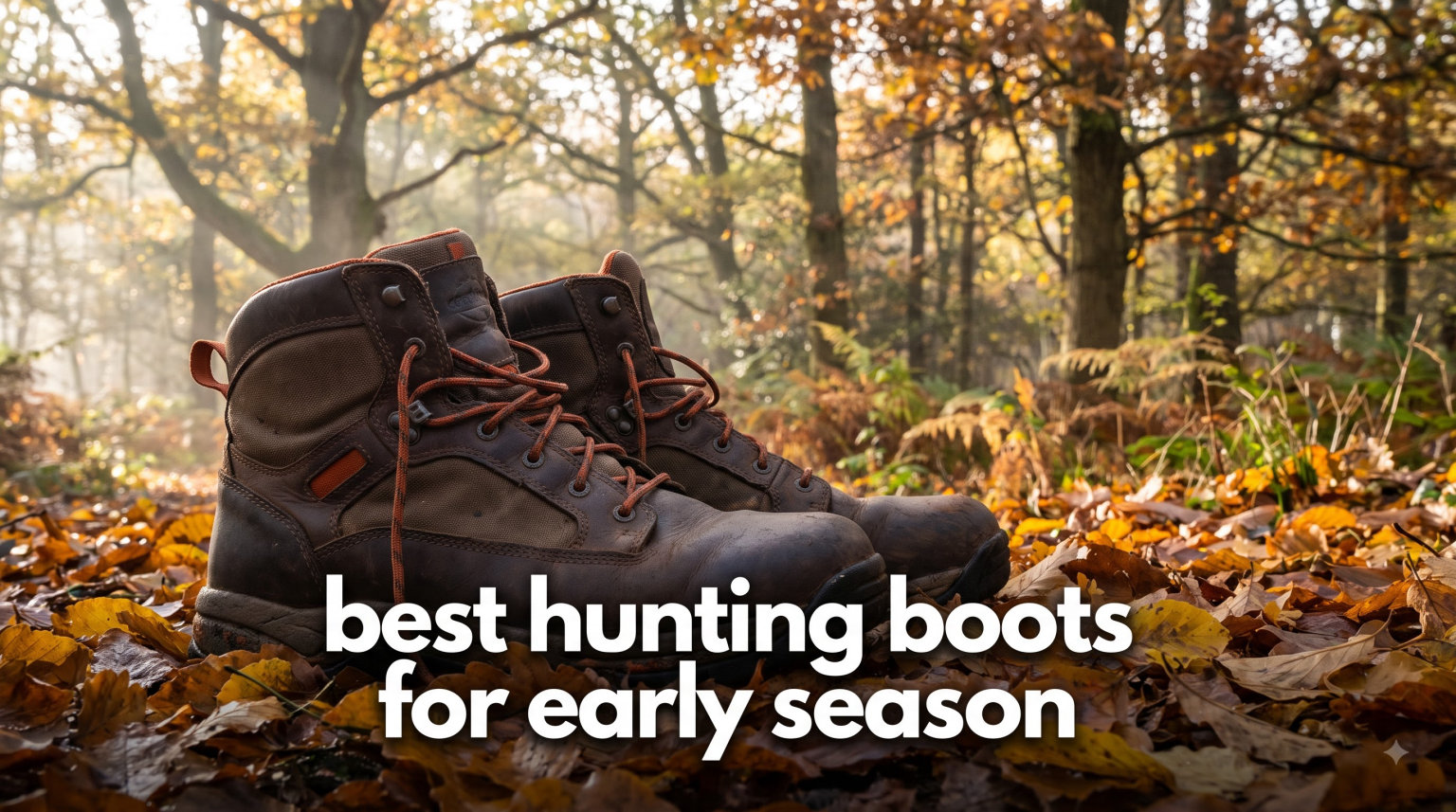
The first week of archery season always decides which boots I trust for the rest of the year. In early September the mornings sit in the low 40s, by mid-afternoon it is pushing 70, and my feet are the only part of me that cannot shed a layer. That 30-degree swing is exactly why the best hunting boots for early season look nothing like the insulated tanks most people pull out in November.
This year my hunting partner and I ran 10 pairs through the stuff that actually ruins an early season hunt: wet grass at first light, steep switchbacks on the way to a glassing knob, creek crossings, and long sits where sweat has nowhere to go. We tracked blisters, soaked socks, and how many miles it took each boot to stop fighting our feet. Some of these boots surprised us.
Below you will find our top three picks, a comparison table of all 10 boots, individual reviews with the good and the bad, and a buying guide built around the questions hunters argue about everywhere — uninsulated versus 200g, waterproof versus breathable, and how much break-in a boot really needs.
Table of Contents
Top 3 Picks for Early Season Hunting Boots in 2026
If you only have time to read one section, here it is. These three won on different criteria: the Meindl EuroLight Hunter for mountain hunts where every ounce counts, the Irish Setter Elk Tracker for the best durability and breathability per dollar, and the MUCK Edgewater Classic for hunters who spend the whole season in wet ground.

Meindl EuroLight Hunter GTX
- Uninsulated Gore-Tex
- 3.1 lb per pair
- Full-grain leather
- Zero break-in drama

Irish Setter Elk Tracker
- Uninsulated
- Goodyear welt resoleable
- UltraDry waterproof
- ScentBan odor control

MUCK Edgewater Classic Mid
- 5mm neoprene
- No break-in needed
- 100% waterproof
- Self-cleaning mud sole
The Meindl is the boot I reach for when the hunt involves a pack, vertical gain, and warm afternoons — it is the lightest full-grain leather boot in the test and breathes like a hiking shoe. The Elk Tracker is the workhorse: a Goodyear welt means you resole it instead of replacing it, and the uninsulated build keeps feet from cooking on the walk in. The Edgewater is the value play when your early season happens in marsh edges, creek bottoms, or farm fields where rubber is the only sane choice.
Best Hunting Boots for Early Season in 2026: Quick Comparison
Here is the full field of 10 side by side, sorted roughly from dedicated mountain boots down to budget and rubber options.
| Product | Specifications | Action |
|---|---|---|
| Meindl EuroLight Hunter GTX |
|
Check Latest Price |
| Irish Setter Elk Tracker |
|
Check Latest Price |
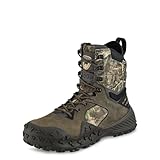 Irish Setter VaprTrek 8 inch Irish Setter VaprTrek 8 inch |
|
Check Latest Price |
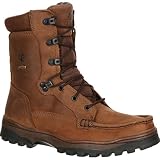 ROCKY Outback Gore-Tex ROCKY Outback Gore-Tex |
|
Check Latest Price |
 Under Armour Hovr Dawn 2.0 Under Armour Hovr Dawn 2.0 |
|
Check Latest Price |
 MUCK Woody Max MUCK Woody Max |
|
Check Latest Price |
| MUCK Edgewater Classic Mid |
|
Check Latest Price |
 LITE BOOTS EVA Pull-On LITE BOOTS EVA Pull-On |
|
Check Latest Price |
 Hunthor 6mm Neoprene Camo Hunthor 6mm Neoprene Camo |
|
Check Latest Price |
 XPETI Thermator Mid XPETI Thermator Mid |
|
Check Latest Price |
One note on reading that table: insulation numbers matter less than construction type in the early season. An uninsulated leather boot with a breathable membrane usually feels cooler than a rubber boot with no insulation at all, because rubber traps sweat instead of passing it.
1. Meindl EuroLight Hunter GTX – Lightest Full-Grain Boot in the Test
EuroLight Hunter Uninsulated 10 D
Uninsulated Gore-Tex
Full-grain leather
3.1 lb per pair
Flex rating A/B
Made in Italy
Pros
- Genuinely ultralight for a full-grain leather boot
- Gore-Tex lining is waterproof and breathable
- Uninsulated build is ideal for 40F to 70F hunts
- Duo-Dur III outsole grips rock and shale
- No real break-in period
Cons
- Sizing runs a half size large
- Premium price
- Meant for light loads rather than heavy packs
I carried the EuroLight Hunter on a three-day September elk trip and the first thing I noticed was how quickly I stopped noticing them. At 3.1 pounds per pair they weigh less than most hunting boots by a wide margin, and Meindl calls them their lightest and most flexible boot. On long climbs that savings shows up in the last hour of the day.
The build is old-school in the best way: full-grain leather uppers, a Gore-Tex lining, and a company that has been making boots in the Alps for three centuries. The A/B light-flex rating means the sole bends enough for quiet stalking while still holding your foot steady on sidehills.
Because they are uninsulated, these are close to a purpose-built answer for early season heat. My socks stayed drier in these than in anything else with a waterproof membrane, since the leather and lining move vapor instead of trapping it. No insulation plus a breathable membrane is exactly what a 60-degree afternoon on a mountainside calls for.
Two things to know before ordering. Meindl says these fit a half size large and our experience backs that up, so order down a half size. And the light flex that makes them comfortable also means they are rated for light loads — hauling a heavy pack out with quartered elk calls for a stiffer boot.
The Duo-Dur III rubber outsole was confident on shale and wet rock where cheaper soles skate. Traction was never the limiting factor on any approach we took in these, and the memory-foam insoles kept the underfoot feel cushioned on long descents.
How much weight can the EuroLight handle on a mountain hunt?
Think daypack to lightweight overnight loads. The midsole and light flex are tuned for fast travel and big miles, not 60-pound packs on descents.
For archery elk, spot-and-stalk mule deer, and early season scouting at altitude, they are about as good as it gets without a full mountain boot.
Is the Gore-Tex lining too hot for September?
In our testing, no — it was the best-behaved membrane in the group. Because the boot is uninsulated and the leather is relatively thin, vapor escapes faster than in insulated or all-rubber options.
In genuinely hot Southern early seasons pushing 80 degrees, a non-waterproof boot still runs cooler. Everywhere else the trade is worth it for dew and afternoon thunderstorms.
2. Irish Setter Elk Tracker – The Resoleable Workhorse
Irish Setter Elk Tracker 10″ Mens Hunting Boot, Brown, 10
Uninsulated
UltraDry waterproof
Goodyear welt resoleable
Bulls-Eye Air Bob sole
Steel shank
Pros
- Goodyear welt construction means you can resole instead of replace
- Uninsulated for real early season breathability
- UltraDry waterproofing with moisture management lining
- ScentBan odor control in footbed and lining
- Aggressive Air Bob sole grips mud and rock
Cons
- Runs narrow especially in wide sizes
- Ankle pinch during the first weeks
- Not the fastest break-in
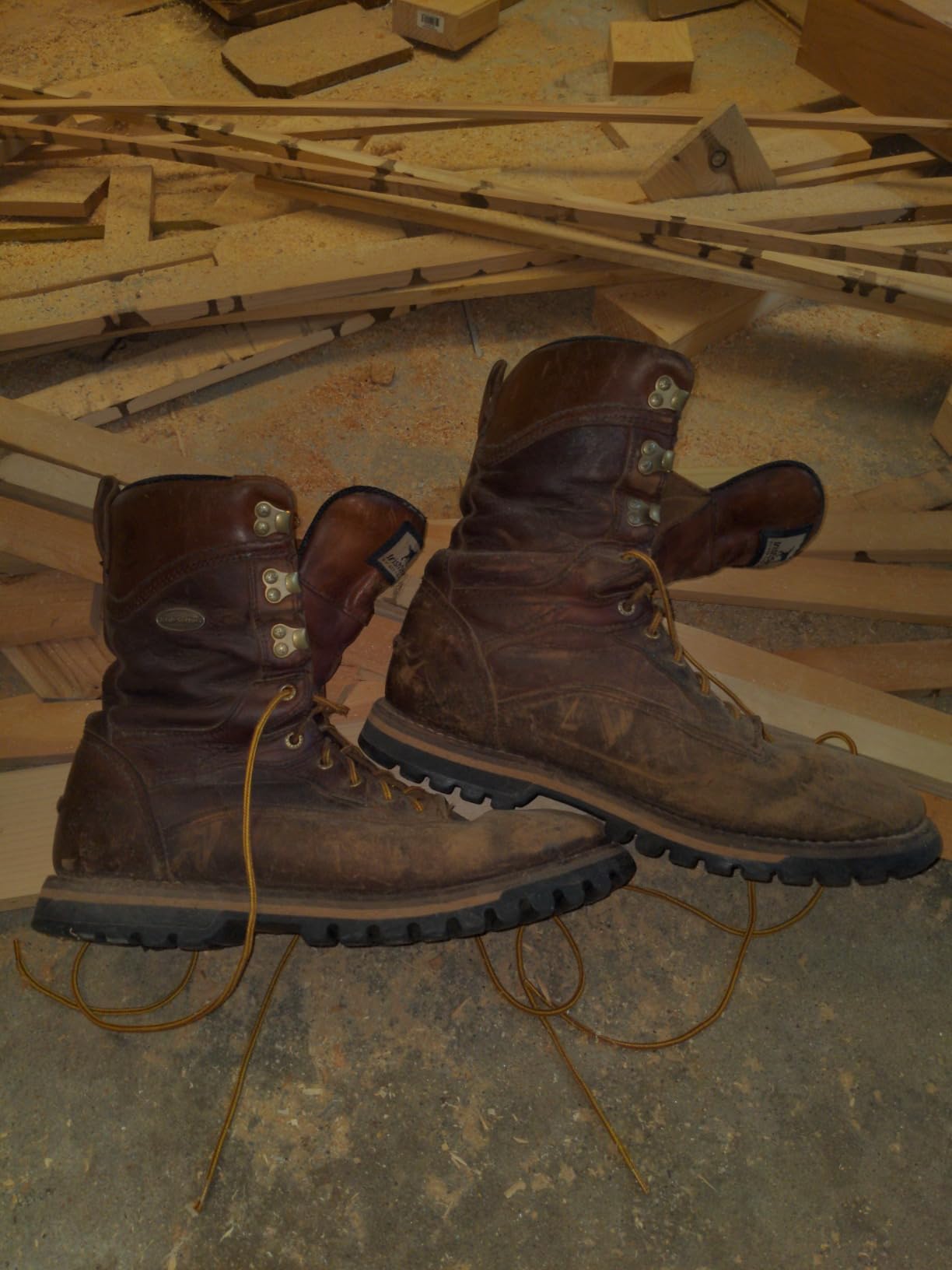
The Elk Tracker is the boot I recommend when someone wants one pair to last a decade instead of three pairs lasting three seasons each. The sole is stitched rather than glued, so when the tread wears out a cobbler can replace it. That single feature changes the math on cost per year of use.
For early season work the important spec is what is missing — insulation. There is none, so heat from a hard climb escapes instead of pooling around your socks. UltraDry waterproofing and a moisture-management lining keep dew and creek water out while sweat vapor finds a path out.
Underfoot you get a cork EVA footbed with memory foam over a steel shank, all riding on a Bulls-Eye Air Bob sole. Air Bob lugs bite in mud, shed debris, and hold loose rock. Reviewers consistently mention durability and comfort after break-in, with 77 percent rating them five stars.
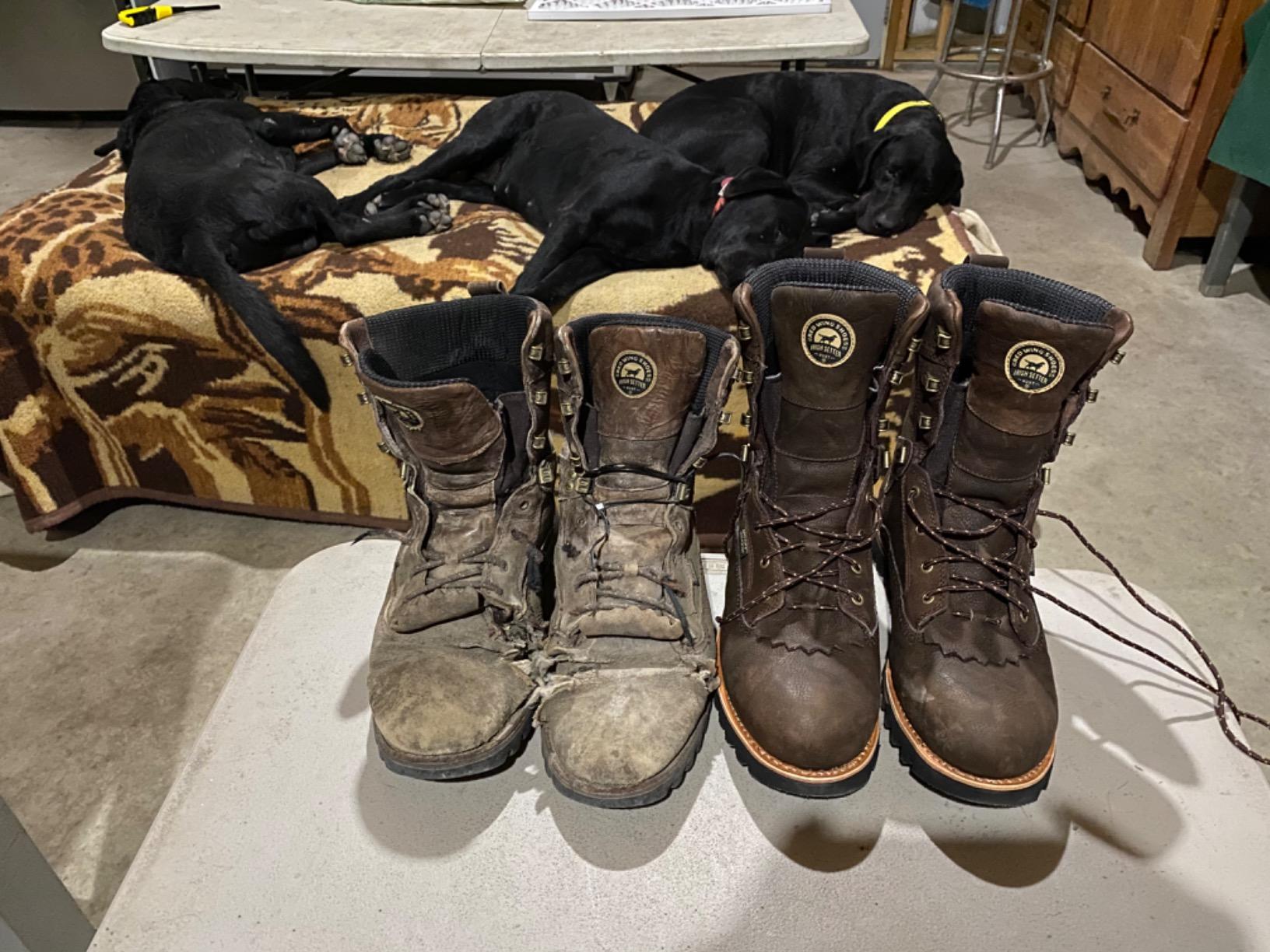
Be honest about fit before ordering. A meaningful number of long-term owners report a narrow last, and even hunters who order wide sometimes find the toe box tighter than expected. There is also a known pinch point at the ankle during the first weeks of wear.
That leads to the second caveat: these are not a wear-them-once-then-hunt boot. Budget a couple of weeks of yard work and short hikes before opening day. Once they conform to your ankle the complaints fade, but skipping break-in is how people get blisters in a treestand.
One last note: the Air Bob sole is superb off-road and less happy on pavement. A few owners who wear them on concrete regularly report accelerated wear, so factor that in if your hunts involve roads.
How long does the Elk Tracker take to break in?
Plan on two to three weeks of regular wear before a full day afield. The leather upper is stiff out of the box and the ankle pinch most owners mention lives in weeks one and two.
If you can put 20 to 30 miles on them before the season, the leather molds to your ankle and the pinch disappears.
Can you actually get these resoled, and is it worth it?
Yes — that is the main argument over cheaper glue-built options. Any cobbler who handles Goodyear welt work can stitch on a new sole for far less than a replacement pair.
Hunters who rotate two pairs and condition the leather regularly report multiple resoles from one upper.
3. Irish Setter VaprTrek 8 inch – Flexible Synthetic All-Rounder
Irish Setter VaprTrek 8″ Mens Hunting Boot, Mossy Oak, 10.5
400g PrimaLoft insulation
UltraDry waterproof
ArmaTec heel protection
EnerG EVA midsole
8 inch height
Pros
- Highest customer rating in our test at 4.8 stars
- EnerG sugarcane EVA midsole fights fatigue
- ArmaTec heel protection adds durability
- Padded ankle pod and Cushin tongue
- Multi-directional Hex Lite lugs
Cons
- 400g insulation runs warm above 60F
- Stock availability fluctuates
- Cement construction is not resoleable
The VaprTrek is the boot I hand to hunters whose early season bleeds toward late season — high-elevation hunts, October trips at altitude, or anyone whose mornings start near freezing. It carries the best customer rating in our entire test at 4.8 stars, with 86 percent of buyers giving five stars.
What makes it interesting is how it feels compared to a traditional leather boot. The synthetic and camo-leather upper with flex zones bends far more easily than the Elk Tracker, and the padded ankle pod plus stretch collar keep the cuff comfortable against your calf and Achilles on long walks.
The platform is thoughtful too. An EnerG midsole made from sugarcane-derived EVA gives a high-rebound feel that cuts fatigue, ScentBan odor control is baked into the leather, lining, and footbed, and ArmaTec reinforcement protects the heel where most boots scuff through first.
Now the honest early season problem: 400g of PrimaLoft insulation is a lot for a 70-degree afternoon. On a warm September climb my feet ran noticeably warmer here than in the uninsulated Meindl or Elk Tracker. Below roughly 50 degrees that insulation flips from liability to luxury.
Construction is cement rather than welted, so there is no resoling path. Availability can also be spotty in specific camo patterns and sizes, so if you find your size in stock it is worth not waiting.
Where does 400g insulation actually make sense?
Roughly 30F to 50F is the sweet spot, or colder with steady movement. High-country archery seasons opening in late August, October mountain hunts, and all-day sits that start at dawn frost all fit.
If your early season is lowland and tops 65F by afternoon, uninsulated boots serve you better. Use the temperature band, not the calendar.
How does the VaprTrek compare to the Elk Tracker?
The VaprTrek is lighter, more flexible, quieter on the draw, and better cushioned for long hikes. The Elk Tracker is more traditional, resoleable, and uninsulated for warmer conditions.
Warm weather and longevity — Elk Tracker. Cold mornings, big miles, and all-day comfort — VaprTrek.
4. ROCKY Outback Gore-Tex – The Wet-Country Leather Option
ROCKY Outback Gore-Tex Waterproof Boot, Light Brown, Size 8.5(WI)
Gore-Tex lining
Full-grain leather upper
Terra Suspension footbed
Outback outsole
Wide sizes available
Pros
- Genuine Gore-Tex waterproof-breathable construction
- Full-grain leather holds up for years
- Terra Suspension footbed is comfortable out of the box
- Minimal break-in
- Wide sizing available
Cons
- Not very breathable in warm weather
- Some stitching and glue quality control complaints
- Soft ankle flex gives less protection on rocks
The Outback has been around since 2009 and that longevity is the pitch. With 837 reviews and a 4.4 rating it is one of the most proven boots in the category, and owners routinely report years of hard use. For wet timber, swamp edges, and rainy early seasons, full-grain leather over Gore-Tex is hard to argue with.
Out-of-the-box comfort is a real strength. The Terra Suspension footbed provides support and cushioning from day one, and the consensus among long-term owners is that these need very little break-in compared with welted leather boots. If your season starts in two weeks, that matters.
Underfoot, the Outback outsole is designed for stability on rugged ground and the package gives solid ankle coverage. Wide sizes are available, which is rare at this level and makes these a genuine option for hunters who usually size up and fight heel slip.
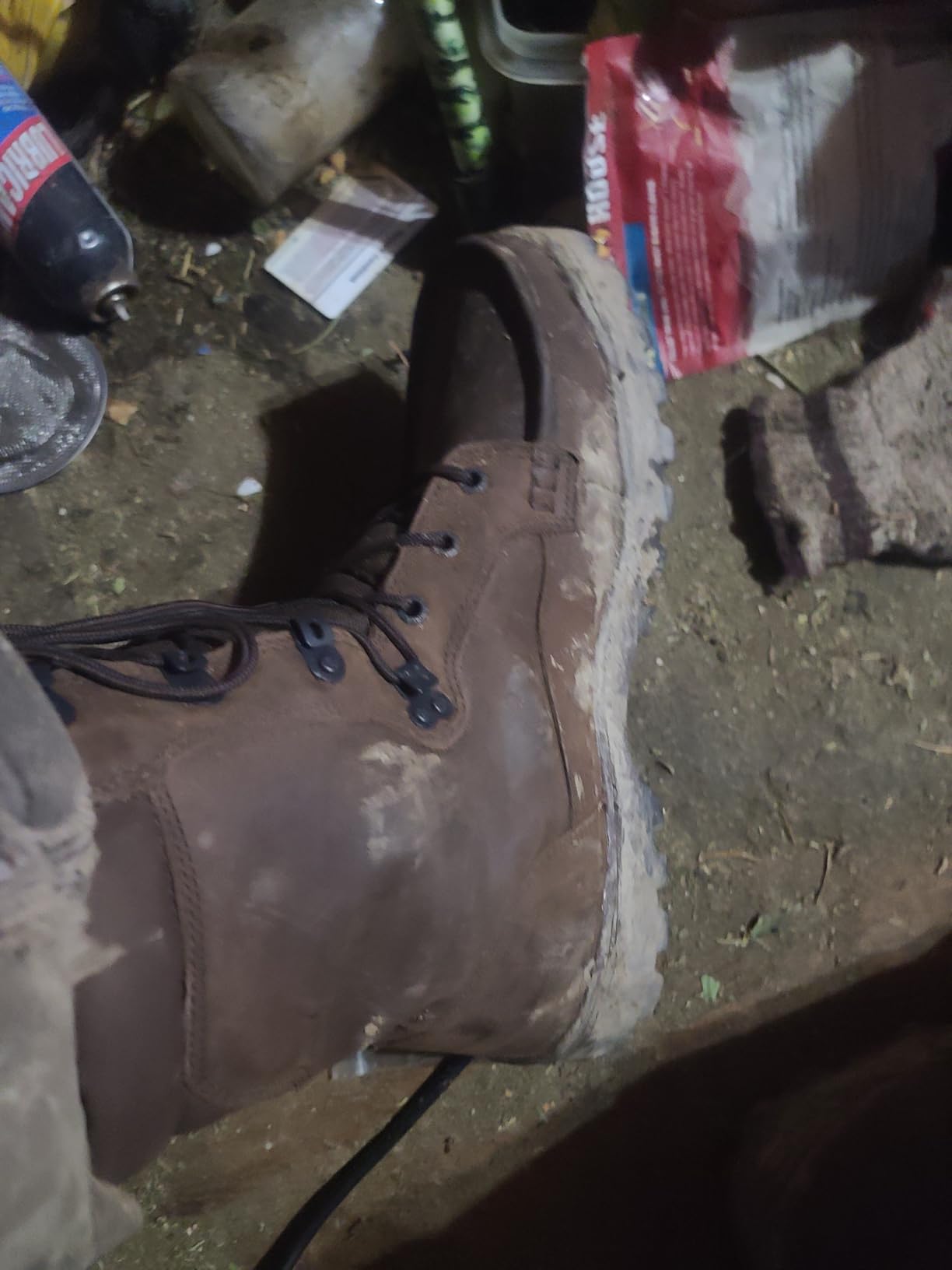
The weaknesses are consistent across hundreds of reviews. Breathability is the biggest: this is a substantial leather boot built for severe wet conditions, and in warm weather feet sweat. Early season walkers will find these run hot next to the uninsulated options above.
Quality control is the other theme. A minority of owners report stitching issues, glue failures over time, and a tongue that is now fabric rather than full leather. The soft ankle flex is comfortable on flats but gives less protection when you roll over a rock under a pack.
Treat these as a wet-condition specialist rather than a hot-weather boot and the equation works. Hunters in the Pacific Northwest and the South rate them highly for exactly that job.
Do the ROCKY Outback boots run hot in September?
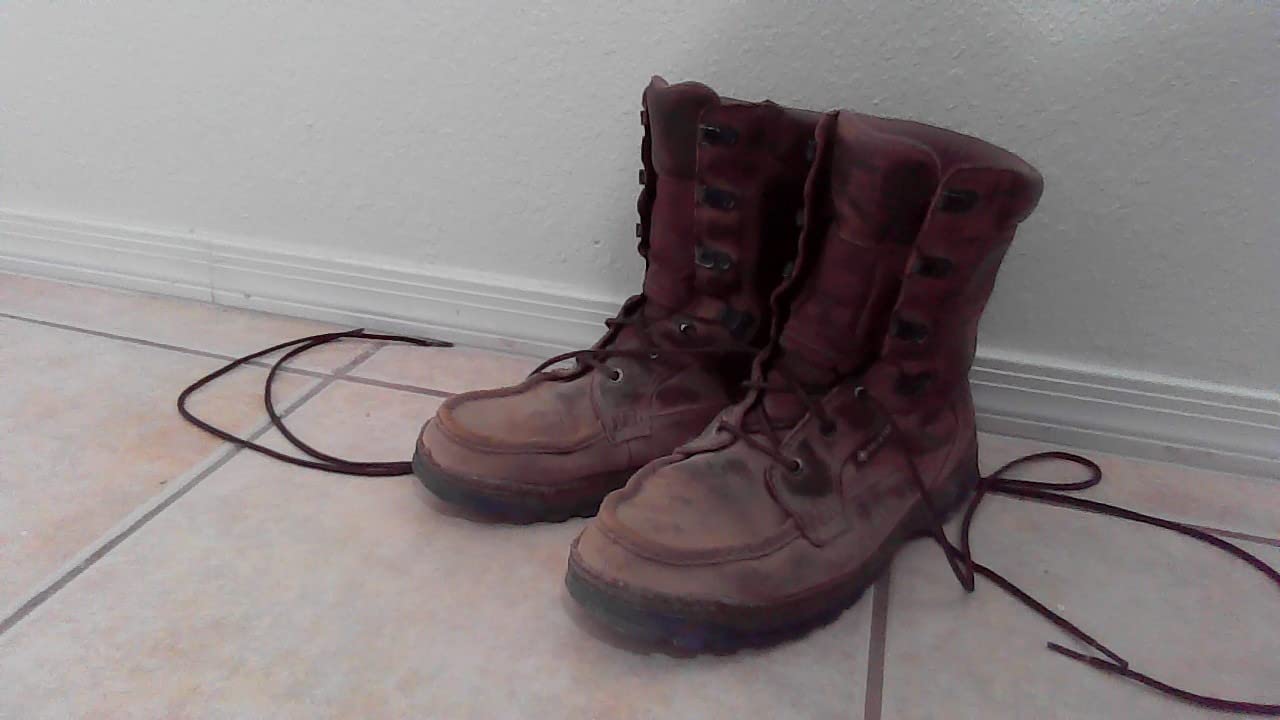
Compared with an uninsulated synthetic boot, yes. The leather upper and wet-conditions design prioritize keeping water out over dumping heat, so a 70-degree afternoon gets noticeable.
They are at their best when the early season is wet and cool — rain, wet grass, creek bottoms, and temperatures under about 60 degrees.
How is the fit for wide feet?
This is one of the better options in the test because wide sizes are offered directly rather than forcing you to size up. Wide-footed owners report a good fit with midweight merino socks.
Narrow feet should plan on lacing tightly or adding a higher-volume insole to take up slack.
5. Under Armour Hovr Dawn 2.0 – The Sneaker-Like Hunting Boot
Under Armour Whitetail HOVR Dawn 2.0 Waterproof Boots Ridge Reaper Camo Barren/Bayou/Khaki Size 8 3025573-900018
2.4 lb per pair
HOVR cushioning
Waterproof
Moisture-wicking lining
Aggressive tread
Pros
- Feels like a sneaker with boot-level support
- No break-in period needed
- Lightweight at 2.4 pounds per pair
- Grips well in mud and snow
- Aggressive camo pattern options
Cons
- Runs narrow
- Stock insoles deserve an upgrade
- Sole durability complaints after heavy use
- Lace clips take patience
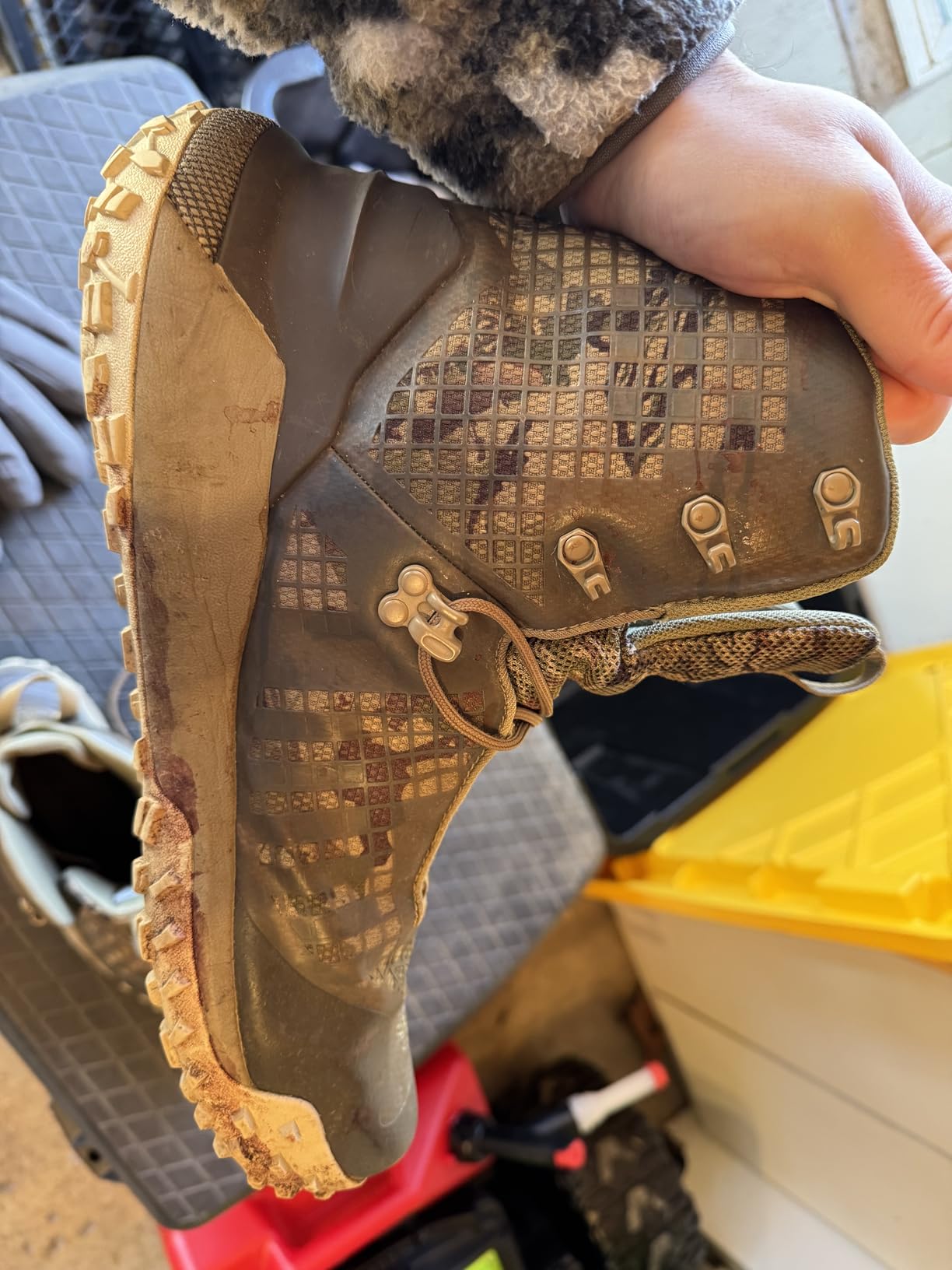
The Hovr Dawn 2.0 is what happens when an athletic shoe company builds a hunting boot, and for early season that is largely a compliment. At 2.4 pounds per pair they are the lightest traditional-style boot in our test, and the HOVR cushioning gives an energy-return feel you expect from a running shoe.
For warm-weather hunting the formula works. The boot is uninsulated with a moisture-wicking lining, so on active September walks it stays cooler than the leather and rubber options here. Owners describe putting them on and hunting the same day with zero break-in — the most common compliment across 325 reviews.
Traction is better than the price suggests. The aggressive tread handles mud, wet grass, and early snow confidently, and the boot gives decent ankle support for a mid-height design. Public land scouting and spot and stalk over gentle terrain are squarely in its wheelhouse.
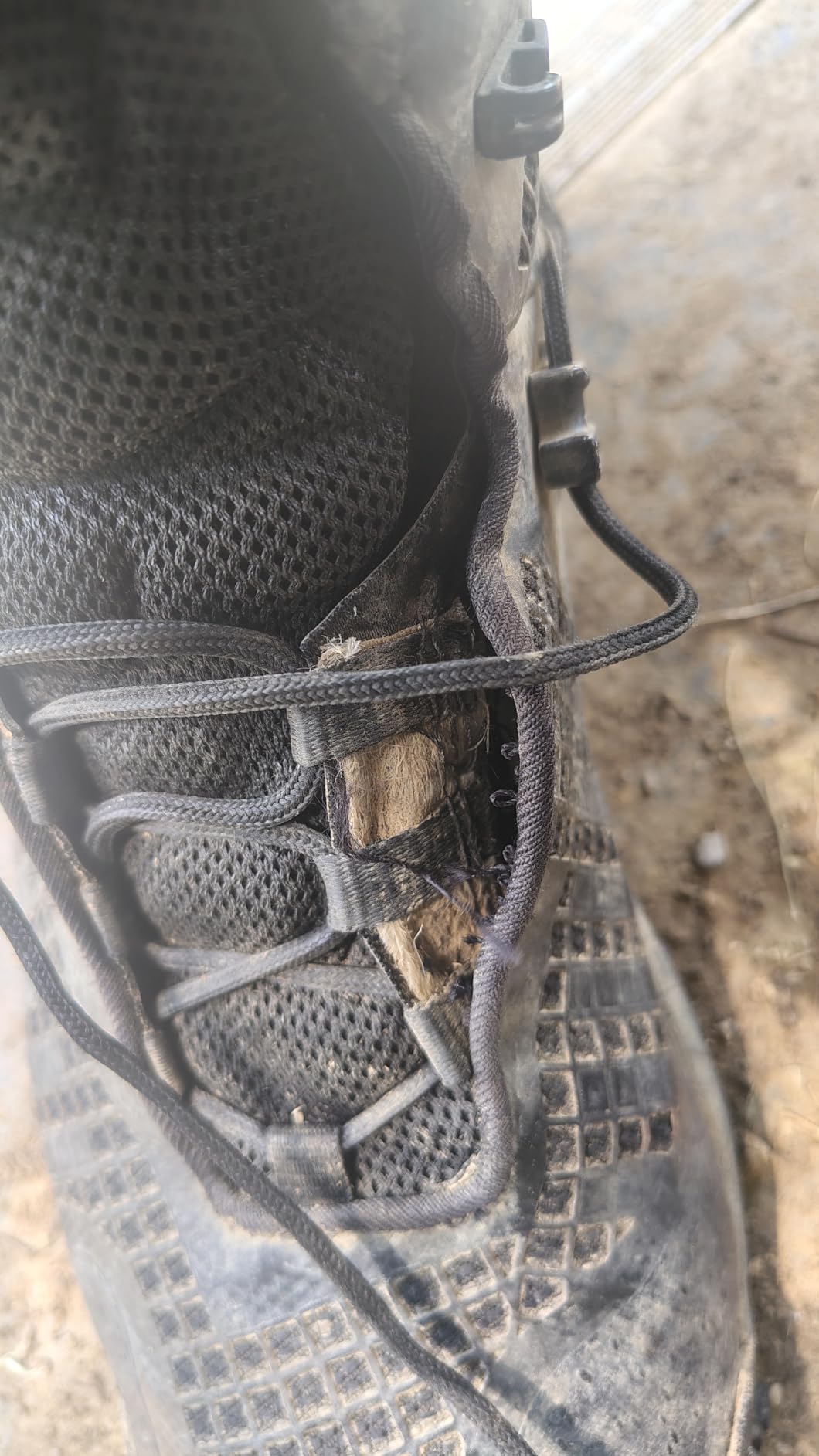
Fit is the main landmine. These run narrow, and wide-footed hunters consistently report pressure across the forefoot. Try them on with the socks you actually hunt in, or choose the wide-friendly ROCKY Outback instead.
The stock insole is thin even by boot standards and most owners swap it. There are also reports of sole wear and separation after a season or two of hard use, so these are better as a lightweight warm-day pair than your only boot for daily abuse.
Small annoyance worth knowing: the lace system uses clips that are fiddly to thread, especially with cold or gloved hands at dawn.
Can you wear the Hovr Dawn 2.0 for spot and stalk?
Yes, and it is one of their best use cases. The flexible athletic sole is quiet on dry leaves and gravel, and the light weight keeps your legs fresh for long approaches.
On steep, rocky terrain with a heavy pack they give less underfoot protection than a full-height mountain boot.
Are these waterproof enough for creek crossings?
They handle wet grass, shallow puddles, and light rain well. The waterproofing is rated for typical hunting moisture, not sustained submersion.
For regular deep crossings or standing in water, a rubber boot like the MUCK options below keeps you drier every time.
6. MUCK Woody Max – The Rubber Boot That Outlives Decades
MUCK Men’s Mossy Oak® Break Up Country™ Woody Max Boot, Brown, Size 10(M)
Fleece lined
Extended rubber exterior
Stretch-fit topline
EVA molded midsole
16 inch height
Pros
- 4.8 stars across nearly 3
- 500 reviews
- Owners report 16-plus years of use
- Completely waterproof rubber construction
- Comfortable out of the box with no break-in
- Stretch-fit topline seals out debris
Cons
- Fleece lining runs very warm in hot weather
- Heavier than leather or EVA options
- Not suited to steep mountain terrain
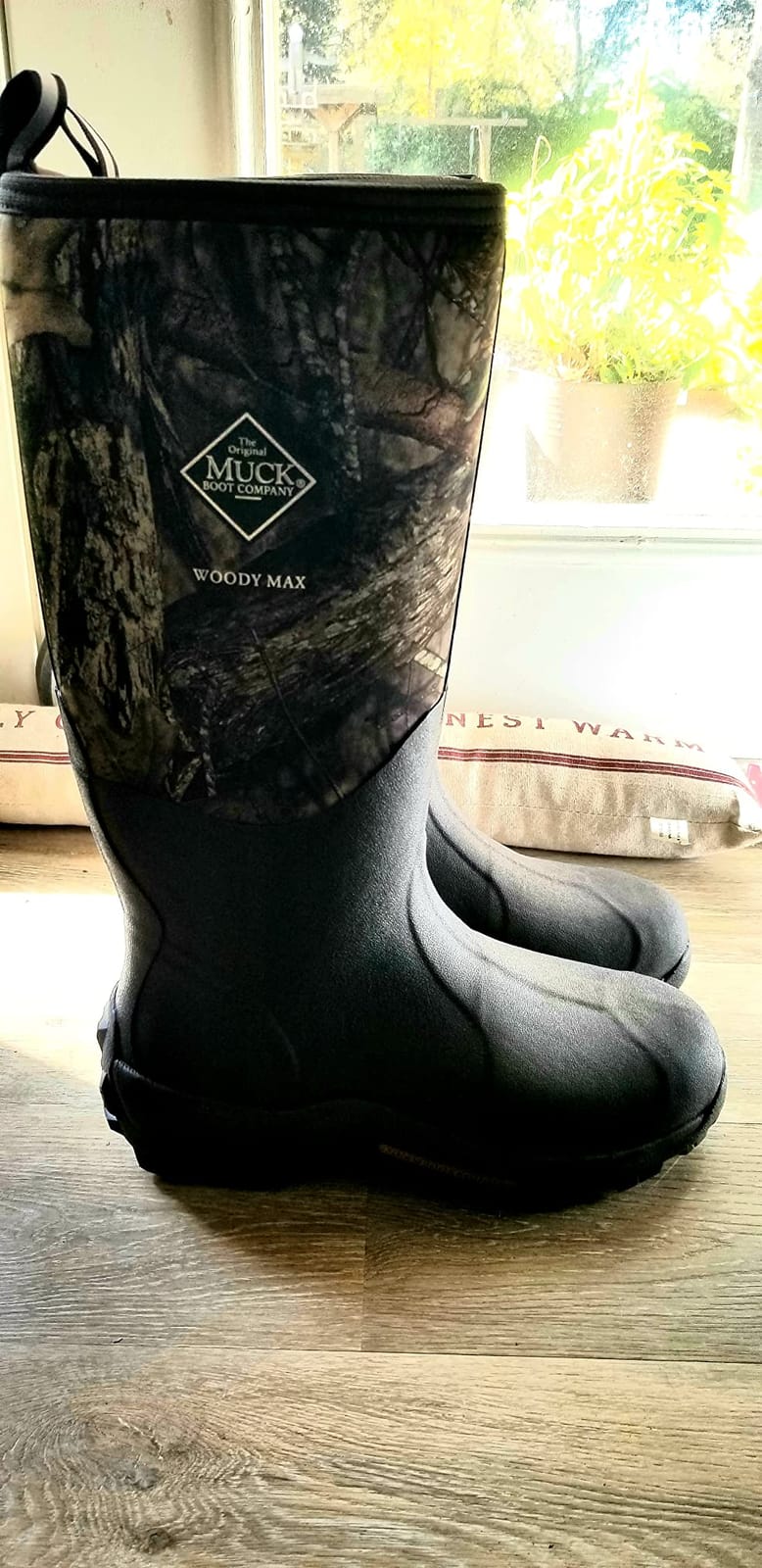
The Woody Max is a legend in the rubber boot world and the numbers back it up: 4.8 stars across 3,418 reviews, among the most-purchased hunting boots anywhere. The reason owners stay loyal is durability — multiple reviewers report pairs still hunting strong after sixteen years.
The construction is classic MUCK: a high-grade extended rubber exterior with warm fleece lining, a contoured EVA midsole, and a stretch-fit topline that snugs your calf to keep warmth in and water and debris out. Nothing about that recipe requires break-in. You pull them on and go hunt.
For the parts of early season that involve sitting still in wet places, they are excellent. Ground-blind hunters, whitetail hunters crossing saturated fields, and anyone dealing with dew, puddles, or marsh edges get complete waterproofing with zero maintenance — rinse the mud off and they are ready tomorrow.
For active warm-weather hunting, the fleece lining is a genuine drawback. This is the insulated boot of the rubber category, and on a warm afternoon walk your feet will overheat. Reviewers state it plainly: these can be very warm in hot weather.
Weight is the other consideration. At 4.5 pounds per pair they are heavier than the Meindl, the Under Armour, or the EVA pull-ons, and the soft rubber sole gives less support on steep ground. Long climbs in big country are not what these were built for.
The right mental model: the Woody Max is a scent-conscious, weatherproof sit boot that happens to walk well, not a hiking boot that happens to be waterproof. Used that way, nothing in this test lasts longer.
How warm is the fleece lining on an early season hunt?
Comfortable in the 30s and 40s, warm in the 50s, and too hot above that if you are walking. On a 70-degree afternoon in a ground blind, most hunters will find their socks soaked by midday.
Lightweight merino instead of heavy wool socks extends them further into warm weather than you would expect.
Is the Woody Max snake-proof?
No, and this matters for early season hunters in snake country. The rubber shell adds a layer, but MUCK does not rate this model as snake-proof and the flexible upper is not puncture-rated.
If snakes are a real concern where you hunt, look at a purpose-built snake boot instead.
7. MUCK Edgewater Classic Mid – Best Budget Rubber Boot
MUCK Men’s Mossy Oak® Break-Up Country™ Fieldblazer Classic Tall Boot, Mossy Oak Break Up Country, Size 9(M)
5mm neoprene bootie
Mid height
Self-cleaning calendered outsole
Rubber overlay
Roomy fit
Pros
- No break-in period at all
- Excellent waterproofing for wetland hunting
- Self-cleaning sole excels in mud
- Roomy enough for thick socks
- Outstanding value with 4.7 stars from 2
- 361 reviews
Cons
- Sizing runs loose
- Not warm enough for extreme cold
- Rare defective units leak
The Edgewater Classic Mid is the boot I recommend when someone wants waterproof rubber performance without the insulated warmth of the Woody Max. Same trusted MUCK platform — 4.7 stars from 2,361 reviewers — in a lighter, shorter, cooler package that suits early season better.
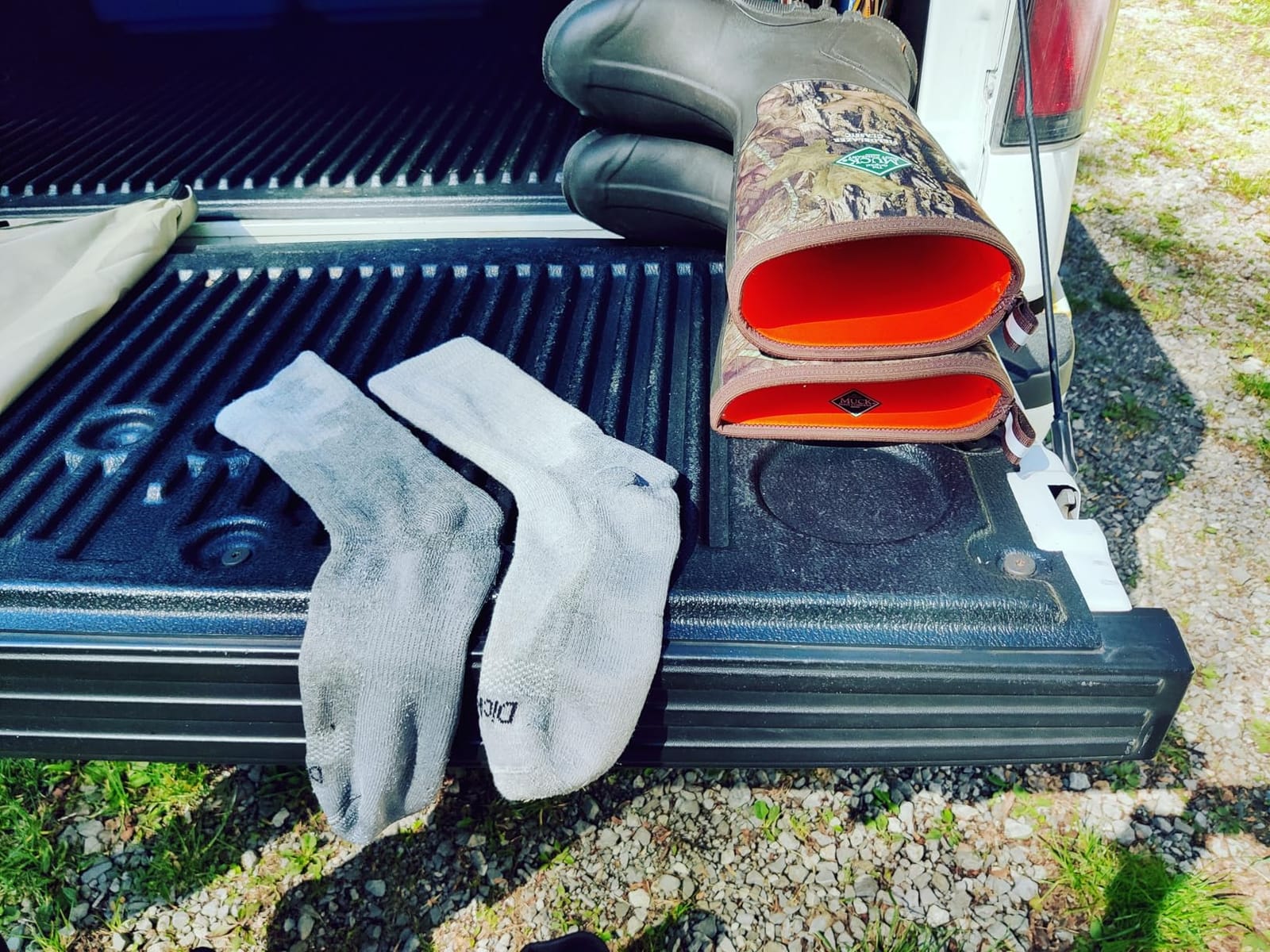
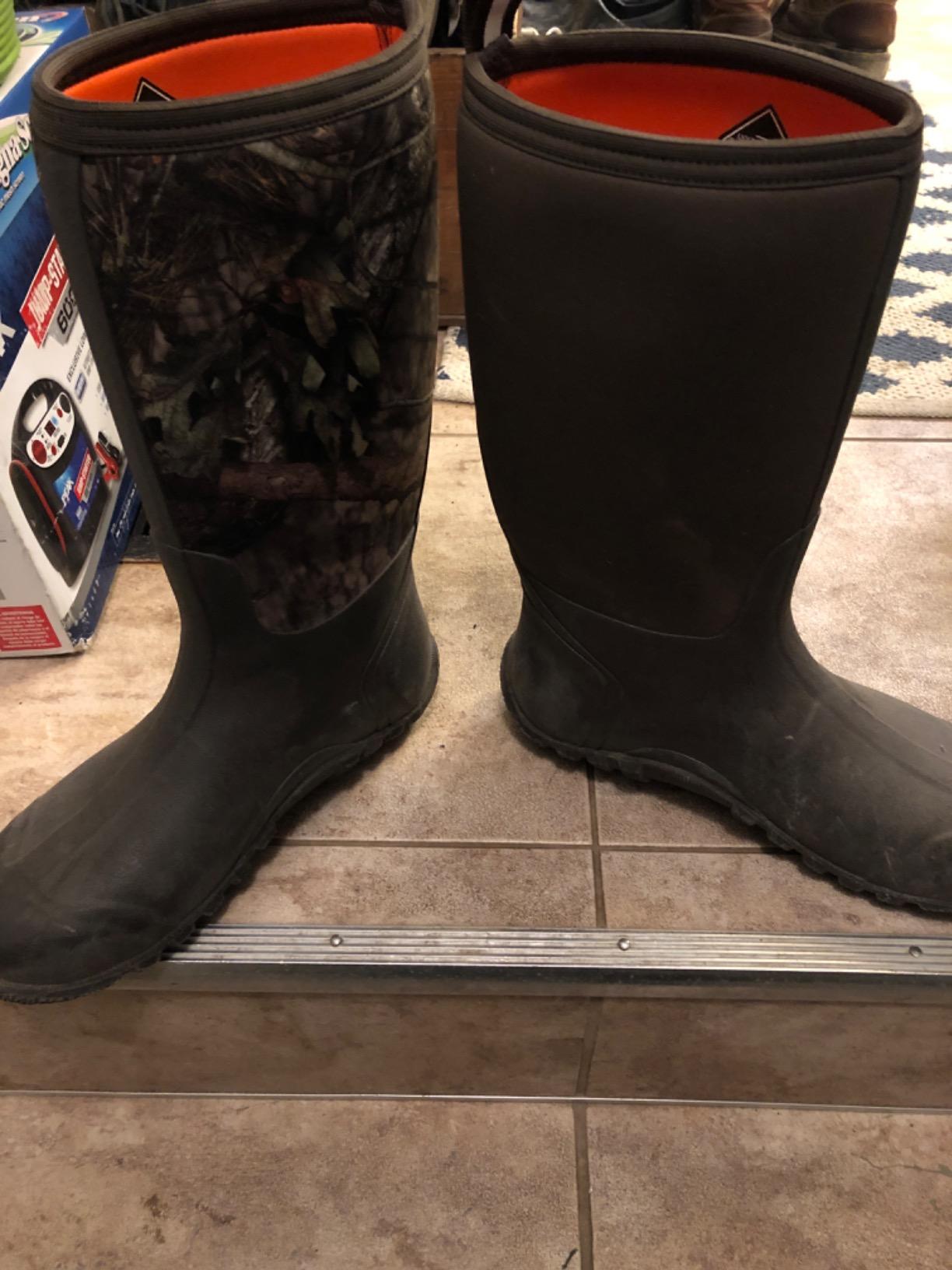
The build is a 5mm neoprene bootie inside a rubber overlay with a self-cleaning calendered outsole. That sole is the hidden early season benefit: wet mud that would pack into a deep-lug leather sole and add a pound per foot just slides off these instead.
Comfort is immediate. Neoprene flexes with your foot rather than against it, so there is no break-in whatsoever, and the roomy interior happily takes a midweight merino sock. Waterfowl hunters and anyone crossing wet ground early and often rate these the best value in rubber.
Two cautions from owners. Sizing runs loose and MUCK suggests half sizes order up, but narrow feet will see slop without a thicker insole. And a small number of units arrive with defects that let water in, so test yours in a shallow puddle before the season.
Also know what these are not. The mid height sits lower on the calf than a 16-inch boot, so deep water over the cuff is a non-starter, and the neoprene gives moderate rather than heavy insulation for genuinely cold mornings.
As an early season tool — wet fields, mud, creek edges, warm afternoons — they hit a value sweet spot that is hard to beat, which is why they earned our budget pick slot in the top three.
Does the mid height let in water?
Only if you exceed it. The neoprene and rubber keep you dry up to the collar, so dew, puddles, and shallow crossings are fine. Above the cuff, water pours in and stays in.
Hunters who regularly cross deeper water should move up to a tall 16-inch boot instead of the mid.
How should you size the Edgewater?
True to slightly loose is the pattern, and MUCK advises half sizes to order up. The roomy cut is intentional so you can layer socks.
If you run lightweight early season socks, consider your normal size or a half size down and add an insole to lock your heel.
8. LITE BOOTS EVA Pull-On – Half the Weight of Rubber
LITE BOOTS Rubber Hunting Boots for Men – Ultra-Light 13 oz EVA, 16″ Waterproof Pull-On Boots for Early Season Hunting, Fishing & Farm Work, Non-Slip Mud Boot
13 oz per boot
Seamless EVA
16 inch shaft
Deep-lug tread
10 to 80F comfort range
Pros
- Weighs half what neoprene boots weigh
- Seamless one-piece construction cannot leak at a seam
- True to size with a roomy toe box
- Rinses clean in seconds
- Pull-on speed for daily use
Cons
- Durability complaints including rips
- Foam sole feels sharp objects underfoot
- Suction makes them hard to pull off
- Runs hot with no ventilation
These are the wild card of our test and the lightest boots here by a wide margin: 13 ounces per boot, roughly half the weight of a comparable neoprene rubber boot. On paper that makes them an early season revelation for hunters walking long distances to stands or doing food-plot work between hunts.
The construction is a single piece of molded EVA foam with no seams at all, which is why they are completely waterproof — there is no seam to fail. The 16-inch shaft gives tall-boot coverage and the deep-lug outsole grips mud, wet leaves, and slick banks well.
The manufacturer rates them comfortable from 10F to 80F and true to size with room for thick socks or liners. For the money they are one of the cheapest paths to a genuinely tall, genuinely waterproof boot.
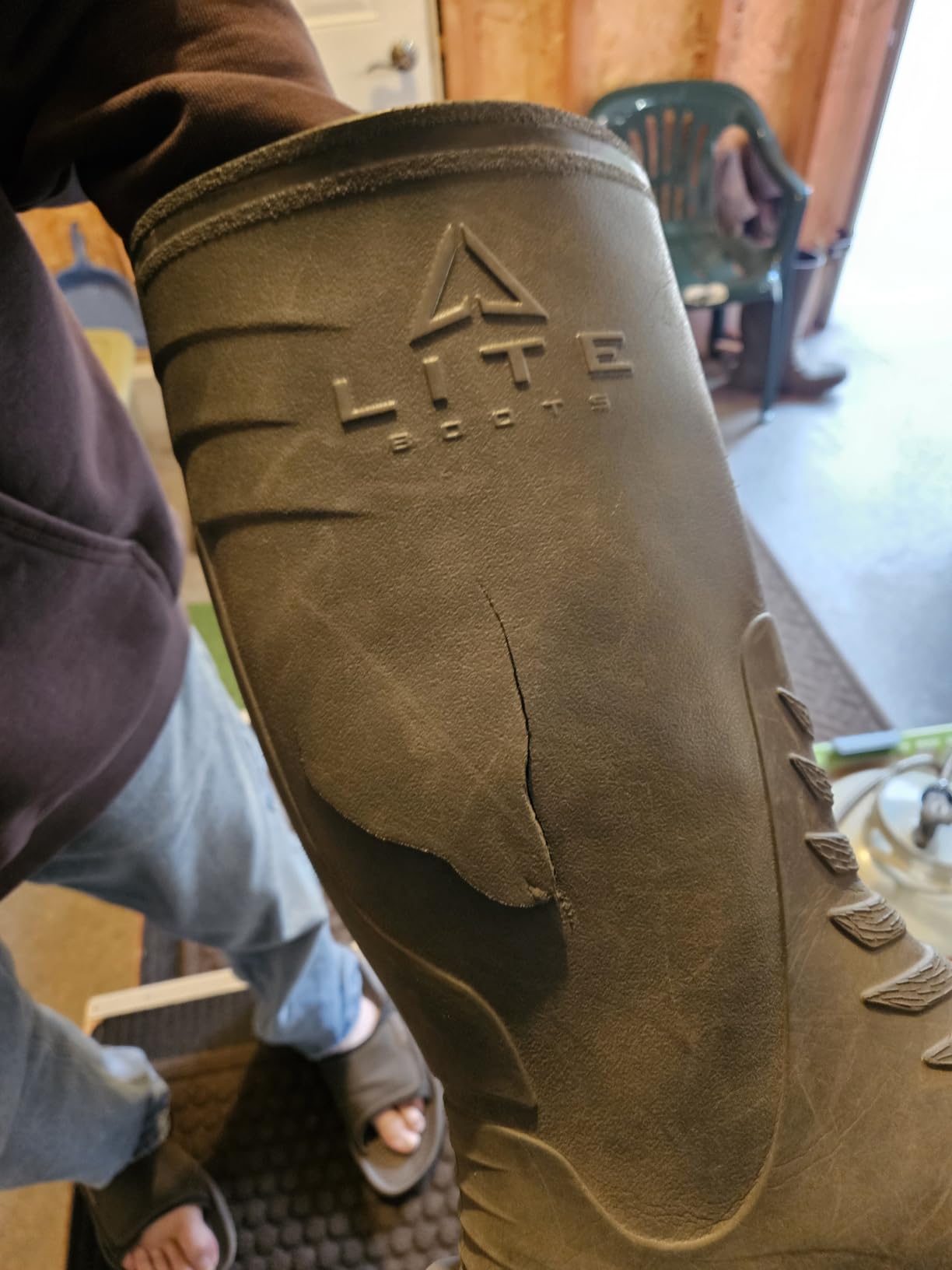
Now the honest part. Durability is the recurring complaint — some owners report tears in the foam after limited use, and EVA is simply not as puncture-resistant as rubber or leather. Thick brush and sharp sticks are where these show their limits.
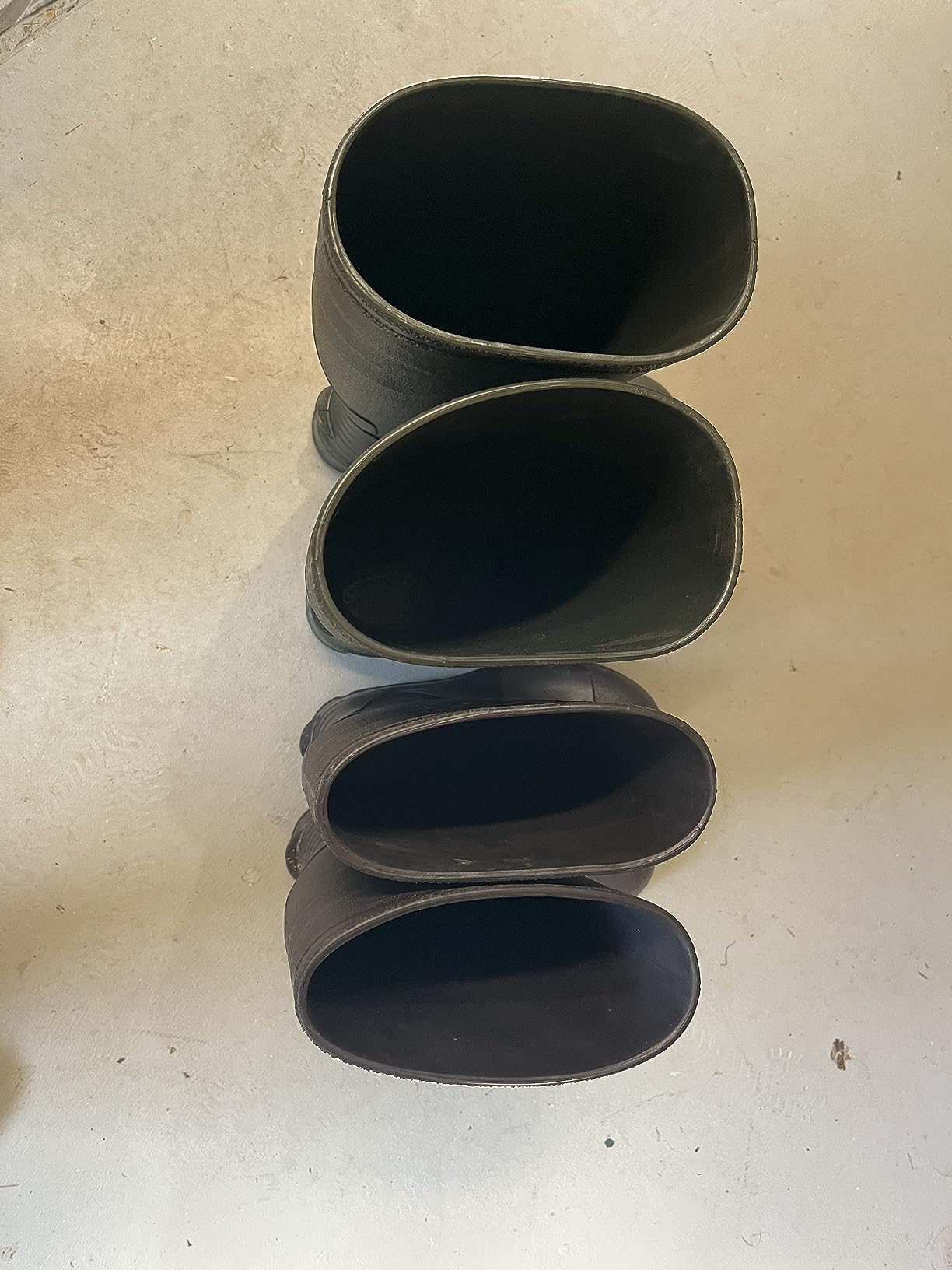
Underfoot, foam is foam: you feel sharp rocks and stubbed toes more than in a rubber or lugged leather boot. And because the seamless shell has zero ventilation, they can feel hot on warm days, which cuts against their early season pitch. Removal takes practice too, since the snug fit creates suction.
Used within their limits — open fields, food plots, feeder duty, mud, and walking on easier ground — the weight advantage is real and noticeable by the end of a long day.
How durable are EVA boots compared to rubber?
Not as durable, and that is the trade for weight. Rubber resists punctures and abrasion that can tear EVA foam, and reported rips tend to happen in brush and rocky ground.
For open fields, food plots, feeder duty, and mud they hold up fine. In dense brush, expect a shorter life.
Are these a good choice for warm weather hunting?
For walking, yes — the light weight keeps legs fresh and the shell dries instantly. For sitting still in heat, no, since there is no ventilation path.
They work best as a mobility-focused early season boot for hunters who cover ground.
9. Hunthor 6mm Neoprene – Cheapest Way to a Waterproof Hunting Boot
Hunthor Rubber Hunting Boots for Men, Waterproof with EVA Midsole
6mm neoprene
Full rubber shell
Comfort rated -4F to 50F
Reinforced heel and toe
Next Camo G2
Pros
- Full waterproof rubber shell for a budget price
- 6mm neoprene insulation covers cool mornings
- Reinforced rubber at heel Achilles and toe
- Fade-resistant Next Camo G2 finish
- True to size with adjustable strap
Cons
- Material can puncture on sticks and branches
- Not for prolonged extreme cold
- Interior lining quality control complaints
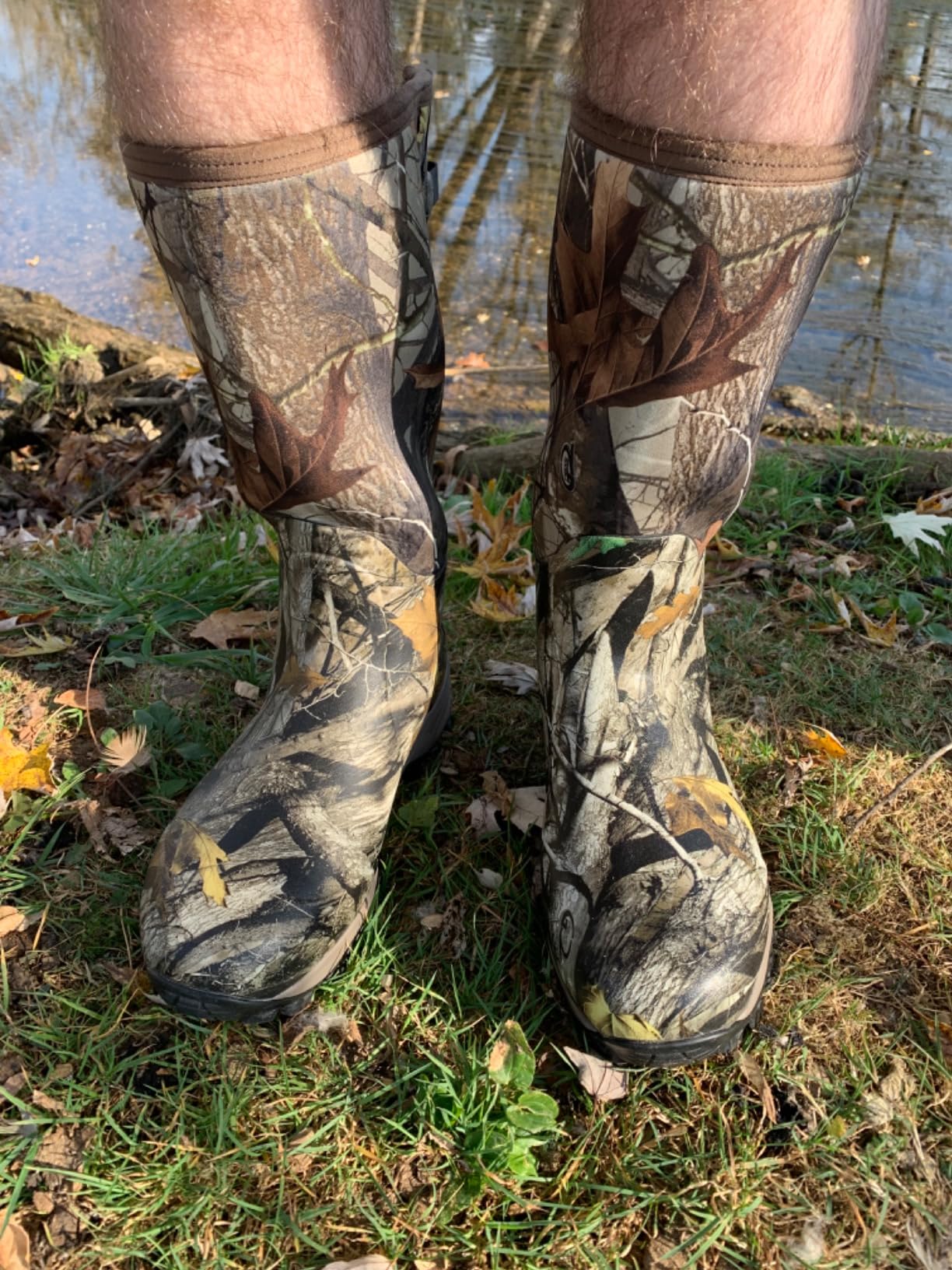
The Hunthor is here for hunters who need waterproof boots this week without a big spend, and for that job it is surprisingly competent. A 4.5-star rating from 337 reviewers is respectable for any budget boot, and the feature list reads like one costing far more.
You get a full rubber shell with sealed seams, 6mm neoprene insulation, a lightweight EVA midsole, a steel hook core for stability, and a rubber outsole described as excellent on slippery surfaces. Reinforced rubber at the heel, Achilles, and toe addresses the highest-wear zones.
For early season use the comfort rating of -4F to 50F is the spec to watch. The top end lines up with cool early season mornings, and hunters who mostly sit rather than walk stay comfortable across a wide band. The adjustable strap makes on and off easy.
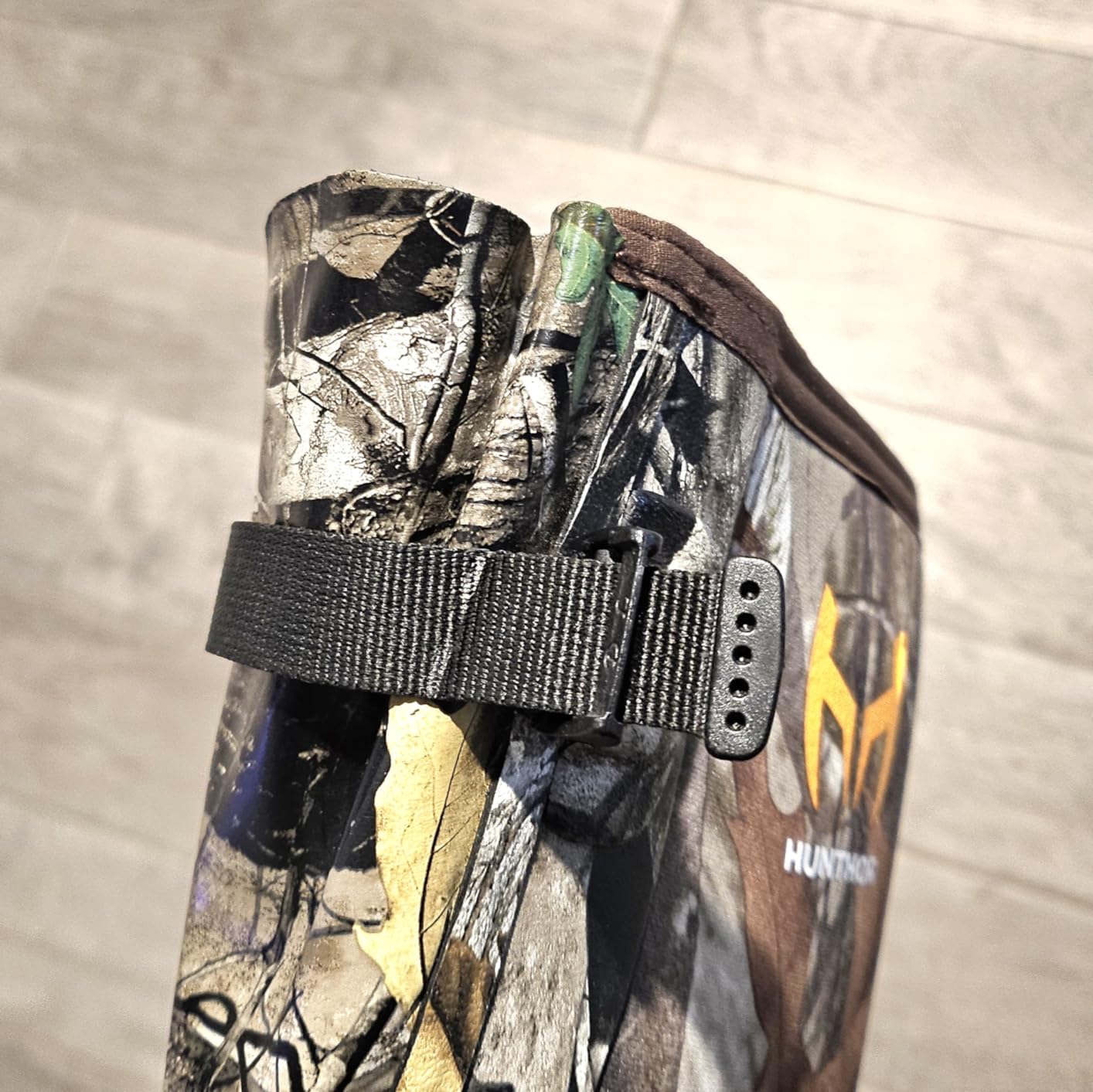
The durability picture is where expectations need adjusting. Multiple owners report the shell puncturing from sticks and branches, so these are not the boots for busting through dense cover. A few others flag interior lining quality control issues.
The insulation story is mixed as well. Six millimeters handles cool mornings but is not rated for prolonged extreme cold despite the sub-zero comfort claim — treat that as a survival rating rather than a comfort one.
What you are buying is honest value: a genuinely waterproof, traction-capable camo boot for occasional use, farm and feeder duty, or a backup pair in the truck. For a young hunter’s first pair, they make a lot of sense.
What conditions suit the Hunthor best?
Cool, wet, and moderate — wet fields, mud, rain, and mornings in the 30s and 40s with highs under about 60. That covers a lot of standard early season sitting and walking.
Avoid hot afternoons with heavy walking and dense brush where punctures happen.
How does it compare to the MUCK Edgewater?
The Edgewater is better built, more flexible, and has a much longer track record across thousands more reviews. The Hunthor costs far less and adds 6mm of insulation plus a taller shaft for cold, wet sits.
If the budget is fixed the Hunthor is defensible. If you can stretch, the MUCK is the one you keep for a decade.
10. XPETI Thermator Mid – The Featherweight Budget Hiker
XPETI Men’s Thermator Mid-Rise Waterproof Hiking Boot Insulated Non-Slip camouflage 11
XPETI-DRY membrane
7mm multi-directional lugs
EVA midsole
Rubber toe cap
Mid-rise height
Pros
- Extremely lightweight and comfortable from day one
- Excellent traction from 7mm aggressive lugs
- Solid ankle support for a mid-rise
- 4.4 stars from more than 7
- 700 reviewers
- Rubber toe cap protects against impacts
Cons
- Waterproofing is unreliable with many leak reports
- Soles may separate after months of use
- Not for prolonged water exposure
- Sizing guidance can be confusing
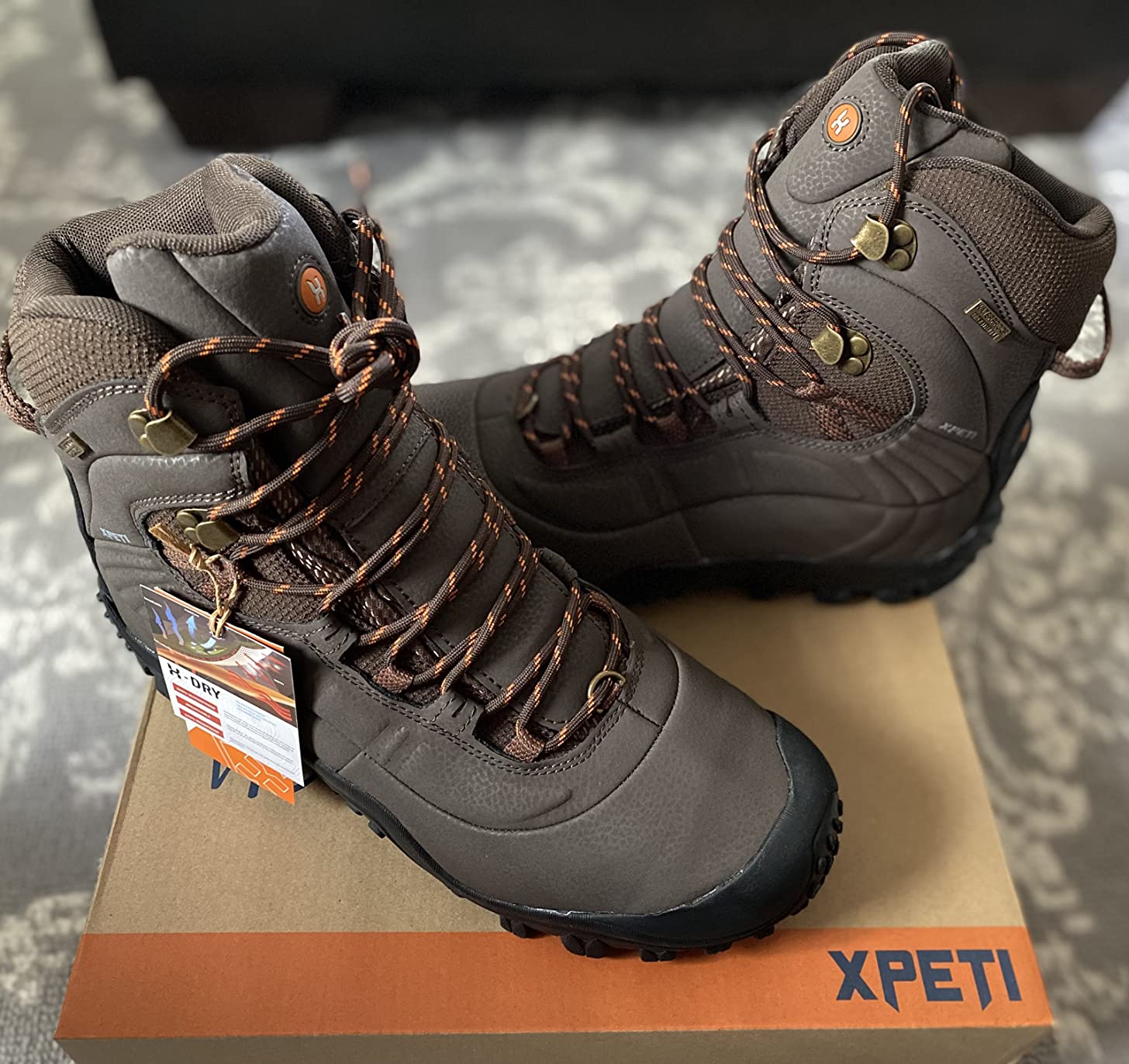
The Thermator is the most-reviewed boot in our test by a factor of two — 7,738 reviews and a 4.4-star rating — because it delivers lightweight-hiker comfort at a price that barely registers next to premium hunting boots. It earns a spot as the cheapest way into a supportive, grippy early season boot.
For warm-weather walks it is genuinely pleasant. The mesh upper with moisture-wicking lining and EVA midsole feels closer to a trail runner than a boot, the rubber toe cap protects against stubbed toes, and the XPETI-GRIP outsole with 7mm lugs grips loose ground and mud better than anything else at this level.
Ankle support is a surprise strength. The mid-rise design locks the heel and holds the ankle steady enough that several owners use them for loaded day hikes. If your early season means miles of logging roads and gentle timber, these cover that ground comfortably for very little money.
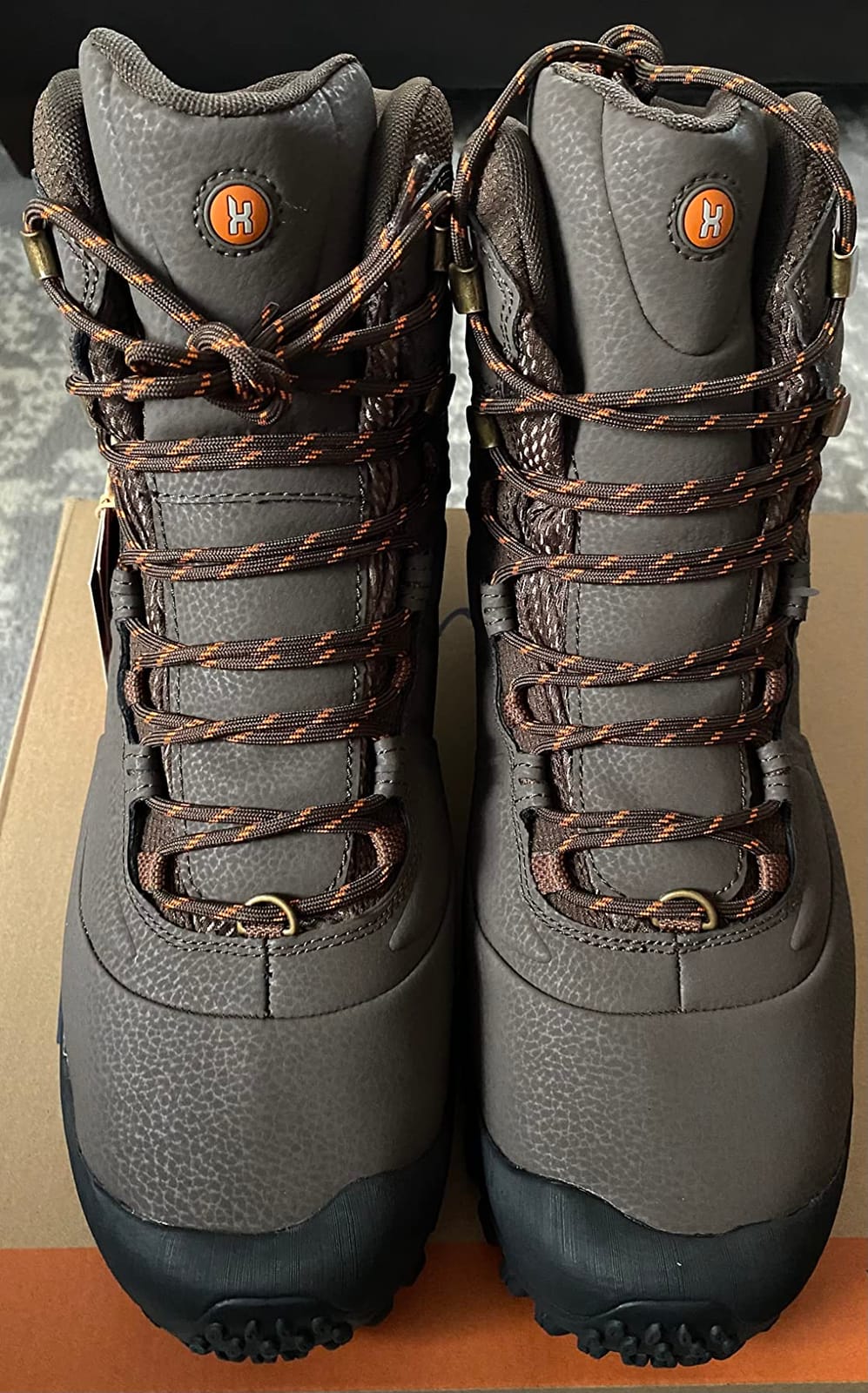
Now the disqualifier for many hunters: waterproofing is not dependable. A consistent stream of reviews report water entering where the rubber rand meets the mesh upper, with wet feet in sustained rain, deep puddles, or creek crossings. XPETI-DRY handles light moisture fine, but treat these as water-resistant.
Durability follows the same pattern. Comfort and grip are excellent out of the box, but some owners report sole separation after roughly six months of hard use, along with occasional lining defects and confusing sizing between versions.
The honest framing: these are fantastic dry-terrain early season boots and a gamble in anything wet. If your hunts involve dew-soaked fields or regular water, spend the extra on the Irish Setter or a MUCK.
Are the XPETI Thermator boots actually waterproof?
Not reliably. Light rain and damp grass are fine, but a meaningful share of owners report leaks at the rubber-to-mesh seam under sustained wet conditions.
If you only need dry-terrain performance and grip they are a bargain. If you need guaranteed waterproofing, this is the wrong boot on this list.
Do they work as a dedicated early season hiking boot?
Yes, and that is their best role. Low weight, a cushioned midsole, aggressive lugs, and real ankle support suit covering miles on trails, roads, and dry timber during scouting season.
Keep them out of sustained wet terrain and they deliver performance well beyond their cost.
Early Season Hunting Boot Buying Guide
Choosing among the best hunting boots for early season comes down to five decisions: insulation, breathability versus waterproofing, weight, ankle support, and break-in time. Here is how we work through each one, plus the sock system and care routine that make any boot perform better.
How Much Insulation for 40F to 70F
For the classic early season band of 40F to 70F, uninsulated is the right answer for most hunters. Zero insulation lets heat from climbing escape instead of soaking your socks, and you fine-tune warmth with sock weight instead.
Light insulation from 200g to 400g earns its keep in specific situations: high-elevation seasons that open in late August, October mountain hunts, and long sedentary sits. As a rough rule, uninsulated suits active hunting above 50F, 200g suits 40F to 55F, and 400g suits 30F to 50F.
Neoprene follows its own scale. Five millimeters is moderate and flexible while 6mm plus fleece leans warm. Rubber and EVA boots with no ventilation also run hotter than their insulation numbers suggest.
Breathability vs Waterproofing
This is the core early season tension and the top complaint on every hunting forum: waterproof boots that do not breathe turn into swamp foot by noon. Membranes that block water also slow vapor leaving the boot.
A breathable membrane like Gore-Tex, as in the Meindl and ROCKY Outback, is the middle path — dry feet through dew and rain with reasonable vapor transfer on the climb. An uninsulated boot with a quality membrane is the most versatile early season setup.
Full rubber, neoprene, and EVA are effectively waterproof forever but breathe barely at all. They win when water is the primary threat and lose when heat and miles are. Our practical split: membrane boots for covering country, rubber for sitting in wet places.
Weight and Midsole Flex
Weight is the most underrated early season spec because it compounds. Over ten miles the difference between a 3-pound pair and a 4.5-pound pair is thousands of pounds of cumulative load, which is why ultralight boots dominate mountain hunting.
Match flex to your hunt. A soft sole like the Meindl A/B or the Under Armour HOVR is quieter for stalking; a stiffer sole with a shank, like the Elk Tracker’s steel shank, protects your feet on rock and under loads. Tall cuffs support ankles on sidehills while mid-height boots run cooler.
Ankle Support and Terrain Match
Terrain should drive your choice more than brand loyalty. Steep, rocky country demands a tall cuff, stiff sole, and shank — which is why the Meindl and Elk Tracker top our mountain list. Rolling timber and farmland are forgiving enough for flexible mids like the Under Armour or XPETI.
Wet ground flips the priority. When the threat is water and mud rather than elevation, traction and waterproofing beat ankle structure — MUCK and Hunthor territory. Soft cuffs and flexible ankles are comfortable but raise the risk of a roll on uneven rock.
If you hunt two very different terrains, two purpose-built pairs beat one compromised expensive pair. That is also the fastest way to stop destroying your good mountain boots in the field.
The Early Season Sock System
In warm weather your sock does most of the moisture work, so start with a lightweight or midweight merino wool sock rather than the heavy cushion sock you wear in November. Merino manages moisture and resists odor far better than cotton, the one material to avoid entirely.
Many early season hunters carry a spare pair and swap at midday — dry socks at noon reset your feet and prevent the softened skin that blisters. It costs nothing and it works.
Fit is the last piece. Try boots on with the exact socks you will hunt in, since one sock-weight change can shift whether a boot fits. A slipping heel or pinching toe box will hurt by mile five.
Break-In Timeline
Traditional full-grain leather boots like the Elk Tracker need two to four weeks and roughly 20 to 30 miles before a full day afield, with the ankle pinch showing up in the first fortnight. Start with short walks and add distance as the leather softens.
Synthetic, neoprene, and membrane boots need far less — the Under Armour, both MUCK models, and the XPETI are effectively zero break-in, which owners cite as a top reason to buy. Seamless EVA is also immediate.
Whatever you buy, do not debut new boots on opening day. Wear them on chores and scouting trips first, and address hot spots while you can still return them.
Snake Protection and Scent Control
Early season overlaps with peak snake activity across much of the country, and standard hunting boots — including rubber MUCK models — are not snake-rated. If you hunt timber, CRP, or river bottoms in snake country, a purpose-built snake boot is cheap insurance.
Scent control is quieter but real. Rubber and EVA shells hold less odor than leather and rinse clean in seconds, and Irish Setter builds ScentBan into the VaprTrek and Elk Tracker. Sweat itself is a scent source, so a breathable boot plus merino socks does more than any spray.
Boot Care in Mud and Sweat
Early season is the hardest season on boots: mud, sweat, and heat break down leather and glue faster than cold does. Rinse mud off after every hunt and dry boots at room temperature with the insoles pulled — never next to a fire, since baked glue kills soles.
Leather needs conditioning a few times a season to keep the upper from cracking and the waterproofing performing. Rubber and EVA just need a rinse and a dry storage spot. Rotate two pairs if you hunt hard, because boots need a full day to dry internally.
Frequently Asked Questions
What is the best hunting boot for whitetail hunting?
For whitetail hunting the best boot depends on how you hunt. Sit hunters in treestands and ground blinds do best with waterproof rubber like the MUCK Woody Max or MUCK Edgewater, since total waterproofing and zero break-in matter more than breathability. Walk-in hunters covering a mile or more to their stand should pick the Irish Setter Elk Tracker or ROCKY Outback for a supportive leather build that handles the walk without cooking your feet on the climb.
What are the best boots for late-season hunting?
Late season calls for insulated boots with 400g to 800g of insulation, aggressive lugs for snow and ice, and a tall waterproof build. In our test the Irish Setter VaprTrek with 400g PrimaLoft and the fleece-lined MUCK Woody Max are the two that extend furthest into cold weather, handling frosty mornings and cold sits well below what uninsulated early season boots can manage.
What is the most comfortable hunting boot?
Comfort comes down to break-in and cushioning. The Under Armour Hovr Dawn 2.0 is the most sneaker-like boot we tested with HOVR cushioning and zero break-in, while both MUCK models are pull-on comfortable from day one. Among leather boots, the Meindl EuroLight Hunter wins for cushioned lightweight comfort and the ROCKY Outback earns consistent praise for out-of-the-box comfort across more than 800 reviews.
What is the warmest hunting boot on the market?
Among the boots we tested the MUCK Woody Max is the warmest, pairing a fleece lining with a stretch-fit topline that seals in heat, followed by the 400g PrimaLoft Irish Setter VaprTrek and the 6mm neoprene Hunthor. Note that these are late-season choices rather than early season picks, since that same warmth causes overheating during active hunts above 50 degrees.
What are the best boots for early season elk hunting?
Early season elk hunting means steep country, big miles, and warm afternoons, so you want an uninsulated, lightweight, supportive boot. The Meindl EuroLight Hunter GTX is our top pick thanks to its 3.1-pound weight, Gore-Tex breathability, and Duo-Dur III traction on rock. The Irish Setter Elk Tracker is the value alternative with a steel shank and resoleable Goodyear welt, and the Under Armour Hovr Dawn 2.0 works for hunters who prefer a lighter athletic feel on moderate terrain.
Final Thoughts on the Best Hunting Boots for Early Season
After a full season of comparisons our winner is the Meindl EuroLight Hunter GTX, which does the hardest thing in this category: real leather-boot support at a weight and breathability level that suits warm-weather mountain hunting. The Irish Setter Elk Tracker is the smart buy if you want a boot you can resole for a decade, and the MUCK Edgewater Classic Mid is the value pick for hunters whose early season happens in mud and water.
Whatever you choose, buy it now rather than the week before the opener. Break them in, test the waterproofing in a puddle, and put a fresh pair of merino socks in your pack. Your feet will thank you somewhere around mile eight on a warm September afternoon.