
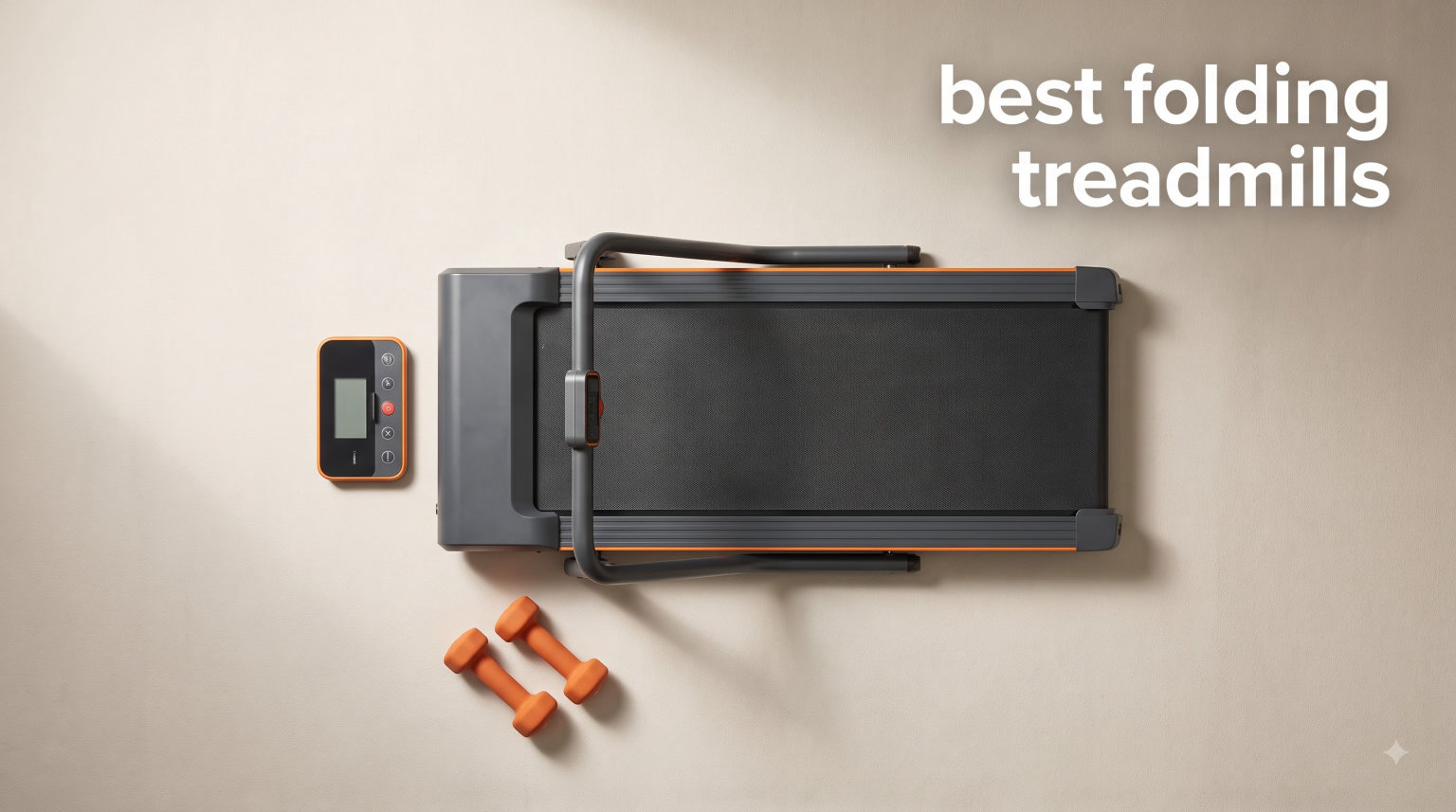
Most people who quit home cardio do it for one boring reason: the machine takes up too much space. A treadmill parked permanently in a living room becomes a clothes rack within six weeks. I have watched it happen to three separate friends, and one of them still has a yoga mat draped over the handrail as a permanent installation.
That is exactly why the best folding treadmills have taken over the home fitness market. You get a full walking or running surface when you need it, then the deck lifts vertically against the console and the floor space comes back. In a studio apartment or a garage that doubles as a workshop, that difference is not a nice-to-have. It is the difference between actually using the machine and resenting it.
This guide covers everything you need to pick a folding treadmill that lasts: the brands worth your money, the specs that actually matter, the noise and durability questions people get wrong, and the mistakes I see repeated in reviews constantly. Whether you want a light walking pad for under your desk or a cushioned deck for daily five-mile runs, there is a fold-up treadmill that fits your space and your training style.
Table of Contents
Why a Folding Treadmill Beats a Regular One in Small Homes
A folding treadmill uses a hydraulic or spring-assisted hinge at the back of the deck. When you lift the walking surface, it pivots upward until it locks against the console in a vertical position. That single motion cuts the machine’s footprint by roughly half, and often more.
The mechanism matters more than most buyers realize. A good hydraulic assist lets you lift the deck with one hand and lowers it slowly on its own, so the deck never slams into the floor. Cheap spring-only hinges drop fast, and I have seen decks crack tile and gouge hardwood because someone bought the $50-cheaper model.
Beyond the hinge, folding treadmills are simply lighter and narrower than their non-folding counterparts. Most fold up to be pushed into a closet, slid behind a sofa, or rolled into a corner on their transport wheels. That portability is why they dominate apartment fitness setups.
There are trade-offs, and I will be honest about them throughout this guide. Folding models usually have smaller belts, lower weight capacities, and frames with more flex than a commercial non-folding unit. If you are a 220-pound runner training for a marathon at 11 mph, you need to shop carefully at the top of the folding category rather than the middle.
Quick Picks: Best Folding Treadmills for 2026
Here is the short version if you do not want to read the full breakdown. These are the categories where each brand or style clearly leads, based on motor quality, deck size, folding design, warranty coverage, and owner feedback patterns.
1. Best overall: NordicTrack folding treadmills. Strong motors, generous cushioning, incline options, and the widest range of models from budget to premium. They hit the best balance of running feel and fold-up storage for most homes.
2. Best for serious runners: Sole folding treadmills. Heavier frames, higher weight capacities, and a folding design that does not feel like an afterthought. If you run more than you walk, start here.
3. Best value: ProForm folding treadmills. ProForm and NordicTrack share a parent company, so you get similar engineering and app integration at a lower price point, usually with a slightly simpler frame.
4. Best for streaming workouts: Horizon folding treadmills. QuickDial controls and a device shelf built for your own phone or tablet mean you can run any training app you already pay for, with no proprietary screen locking you in.
5. Best for tight spaces: A walking pad or under-desk folding treadmill. These slim, low-profile units slide under a bed or couch entirely, and they handle walking-pace workouts beautifully for a fraction of the cost of a full-size machine.
How I Picked These Folding Treadmills
I did not pick these on spec sheets alone. I focused on six criteria that consistently separate a machine people still use after two years from one that ends up on a resale listing.
Motor quality: Continuous horsepower, or CHP, is the honest measure of a motor. A 2.0 CHP motor is fine for walking. Runners need 2.75 to 3.0 CHP minimum, and heavier runners should look for 3.5 CHP or more to keep the motor from straining and overheating on long sessions.
Belt size: A 20-inch by 55-inch belt works for walking and light jogging. Runners over about six feet tall need 60 inches of length, and a 22-inch width gives you room to drift without stepping off the edge. This is the single most common regret in folding treadmill reviews.
Weight capacity: The frame rating tells you how solid the machine will feel. A 250-pound capacity is the entry level, 300 pounds is the sweet spot for most homes, and 350 to 400 pounds means a frame that barely flexes even at running speeds.
Folding mechanism: I looked for hydraulic-assisted lift with a slow, controlled descent. This protects your floor and your fingers, and it signals that the manufacturer did not cut corners on the single feature that defines the product.
Cushioning: Variable-response cushioning under the deck absorbs impact at the strike and firms up at the push-off. Good cushioning is why your knees forgive treadmill miles faster than road miles.
Warranty: A 10-year or lifetime frame warranty and at least a one-year labor warranty are the floor. Brands confident in their motors back them for 10 to 25 years. Short warranties on a folding machine are a red flag, because the hinge is a stressed component.
NordicTrack Folding Treadmills: Best Overall
NordicTrack is the default recommendation for a reason. Their folding line spans everything from compact walking models to incline trainers with powerful motors, and the folding mechanism across the range is hydraulic-assisted and genuinely easy to operate with one hand.
What sets NordicTrack apart is deck cushioning. Their Run Flex and similar cushioning systems are noticeably softer than bare-deck budget machines, which matters if you are coming back from a knee issue or you simply run a lot of miles indoors during winter. The belt glide stays quiet at moderate speeds too, and that combination of cushion and quiet is rare at mid-range prices.
The trade-off is their software approach. Many NordicTrack machines are built around their iFIT subscription platform, with rotating studio classes and outdoor route workouts that auto-adjust your incline. The classes are excellent, genuinely well-produced, and the global location runs are a real motivational tool. But you should be aware that the full experience depends on that recurring subscription, and you need to check the current terms on the specific model you are considering before you buy.
Incline is where NordicTrack earns its keep. Even their folding models offer motorized incline, and some go well beyond the standard 10 percent into decline territory as well. Walking at a 10 percent incline burns dramatically more calories than flat walking at the same speed, and it is far easier on your joints than trying to run faster.
I also appreciate that NordicTrack frames run stable for a folding design. Heavier runners over 250 pounds should stay in the upper half of the lineup where the frames and motors are rated for it, but the engineering holds up.
Who NordicTrack is good for
Runners and walkers who want a do-everything machine with strong cushioning, real incline, and guided workouts. If you get bored on a treadmill and quit, the iFIT library is the single best antidote on the market.
It is also the right pick if multiple people in one household will use the machine. The range of user profiles, speed settings, and workout variety covers a beginner walker and a seasoned runner in the same purchase.
Who should skip it
If you hate subscriptions and want a dumb machine that just runs, NordicTrack’s software-forward approach will frustrate you. Buy a Horizon or Sole instead and use whatever app you already like.
It is also not the budget pick. Entry NordicTrack folding models are reasonably priced, but the models that make the brand worth recommending sit in the mid and upper price tiers.
Sole Folding Treadmills: Best for Serious Runners
Sole builds folding treadmills that feel like non-folding machines. The frames are heavy, the decks are long, and the weight capacities run 350 to 400 pounds across much of the line, which tells you the chassis is not a compromise.
The motors are the standout. Sole routinely puts 3.0 to 4.0 CHP motors in folding frames, and that headroom means the motor is never working at its limit during a long run. Motors that strain get hot, and motors that get hot fail early. This is one of the quietest ways a brand can signal quality, and Sole signals it clearly.
Cushioning on Sole decks uses a variable system called Cushion Flex, which they claim reduces impact by up to 22 percent compared to road running. The number is theirs, not mine, but the on-deck feel is firm at push-off and forgiving at heel strike, which is exactly the right order. Long-run comfort on a Sole is among the best in the folding category.
The folding mechanism on Sole machines is hydraulic and drops slowly. Given that these are also some of the heaviest folding treadmills you can buy, that controlled descent is not a luxury feature. It is a safety requirement, and Sole implements it properly.
The weak spot is tech. Sole consoles are functional rather than flashy, with clear displays, standard preset programs, Bluetooth, and tablet holders rather than giant touchscreens. Some buyers love this simplicity. If you want a big immersive screen with streaming classes baked in, you will find the console underwhelming.
Who Sole is good for
Runners putting in 20-plus miles a week, heavier users who need a 350-pound-plus frame rating, and anyone who prioritizes durability over apps. Sole’s warranty coverage, often including a lifetime frame and motor warranty on higher models, backs up the build quality claim on paper.
It is also a strong pick for taller runners. Longer decks across the lineup mean a six-foot-two runner with a long stride is not constantly shortening their gait to stay on the belt.
Who should skip it
If you are primarily a walker looking for a light machine to slide into a closet, a Sole is overkill in both weight and price. A walking pad or a lighter Horizon model will serve you better for less.
Budget buyers should also look elsewhere. You are paying for the frame and motor, not features, and that is a trade that only makes sense if you will actually use the capacity.
Horizon Folding Treadmills: Best for Streaming Workouts
Horizon found a smart niche. Instead of locking you into a proprietary screen and subscription, they build folding treadmills with a sturdy device shelf and quick-access speed and incline dials right at your fingertips. You bring your own phone or tablet, open whatever app you already use, and go.
Those dial controls matter more than they sound like they would. During a workout, spinning a dial to change speed is faster and safer than stabbing at a touchscreen while bouncing at 7 mph. When you are doing interval work, that one design choice makes the entire session smoother.
Horizon motors are solidly mid-tier, typically 2.5 to 3.0 CHP depending on the model, which covers most home runners comfortably. Belt sizes run generous for the price, and the folding mechanisms are hydraulic-assisted with a soft-drop descent on the models I would recommend.
The frames are lighter than Sole’s, which is either a feature or a bug depending on your situation. Lighter means easier to move and easier to fold. Lighter also means a bit more flex at high speeds if you are a heavy runner, so match the model tier to your body weight and pace.
The brand also earns points for being one of the more apartment-friendly options. Belt noise at walking and jogging speeds stays conversational, which matters enormously if you have downstairs neighbors and a 6 a.m. workout habit.
Who Horizon is good for
People who already pay for a fitness app, whether that is a running coach app, a class platform, or just Netflix. The no-lock-in design means your treadmill is a platform, not a walled garden, and that is worth real money over the life of the machine.
It is also a great fit for interval training and run-walk programs. The dial controls shine whenever your workout changes speed frequently.
Who should skip it
If you want everything integrated out of the box with a big screen and no setup, Horizon’s bring-your-own-device philosophy adds friction. A ProForm or NordicTrack gives you that turnkey experience instead.
Elite runners chasing top speed and maximum frame rigidity may also find the upper Horizon models a step below Sole’s tank-like build.
ProForm Folding Treadmills: Best Value
ProForm and NordicTrack are owned by the same parent company, Icon Health and Fitness, and the family resemblance is real. You get similar motor designs, similar folding hardware, and access to the same iFIT workout ecosystem, generally at a lower price than the equivalent NordicTrack.
That makes ProForm the value play. Their folding treadmills routinely pack 2.6 to 3.25 CHP motors, decent belt sizes, and motorized incline into price points where competitors offer less. For a first home treadmill, the spec-per-dollar ratio is hard to beat.
The compromises show up in frame weight and refinement. ProForm machines tend to be lighter, with slightly lower weight capacities and a bit more deck flex than the NordicTrack one tier up. For walkers, joggers, and runners under about 200 pounds, those differences barely register in daily use.
Folding hardware on ProForm models is hydraulic-assisted on most current units, and the space-saving performance when folded is on par with anything in the class. Assembly is a genuine consideration here. Most units ship partially assembled and need an hour of work with two people, and the instructions assume some mechanical patience.
The iFIT integration is a real benefit at this price. Getting the same studio classes and global outdoor routes as a premium machine makes a budget treadmill feel like a much more expensive purchase, at least during the trial period that comes with the hardware.
Who ProForm is good for
First-time treadmill buyers and anyone who wants the most machine for the money. If you are unsure whether a treadmill will stick as a habit, ProForm lets you find out without a major financial commitment.
Walkers and light joggers get the best value here, since the frame and motor compromises that keep the price down matter least at lower speeds.
Who should skip it
Heavy runners and high-mileage athletes should spend up. A lighter frame that flexes at speed will feel unstable and will age faster under daily running loads than a Sole or an upper-tier NordicTrack.
Dedicated self-motivated users who never want a subscription should also check the terms carefully before buying, since ProForm’s best features are tied to the same platform as its sibling brand.
Bowflex Results Series: Best for Incline Training
Bowflex took a different angle with their folding treadmills, and the distinguishing feature is extended incline range. The Results Series machines offer motorized incline reaching up to 15 percent on the higher models, plus the ability to run at up to 12 mph for serious training.
Why care about 15 percent? Because incline walking is the most underrated fat-burning tool in home fitness. At a steep incline and a moderate walking pace, your heart rate climbs into a training zone that would normally require running, without the joint impact. Anyone with cranky knees, a lot of weight to lose, or a preference for low-impact work gets enormous value from that range.
The folding mechanism on the Results Series is hydraulic-assisted with a soft-drop feature, and the folded footprint is genuinely compact for machines this capable. That combination of a 15 percent incline and a folding frame is uncommon, since incline hardware usually eats into the space budget.
Bowflex also leans into app-based training through their JRNI platform, with coach-led workouts that adjust your machine automatically. The platform is smaller than iFIT’s library, but the adaptive coaching model is engaging if you like structured progression rather than browsing classes.
Where Bowflex falls behind is pure running feel. The decks are comfortable but not as plush as NordicTrack’s best, and the console experience is more functional than spectacular. This is a machine built around a training concept rather than around hardware excellence in every category.
Who Bowflex is good for
Incline walkers, hikers training for elevation, and anyone prioritizing low-impact calorie burn. If your typical workout is a brisk steep walk rather than a run, this is the single best fit in the entire folding category.
It is also strong for households where one person walks and another runs, since the speed range extends high enough to serve both.
Who should skip it
Pure runners who never touch incline should spend their budget on motor and cushioning instead. A Sole gives you a better straight-line running experience for similar money.
If you already subscribe to a different fitness platform, Bowflex’s ecosystem lock-in is a mild annoyance rather than a dealbreaker, but it is worth knowing going in.
Walking Pads: Best Under-Desk Folding Treadmill
Walking pads, sometimes called under-desk treadmills, are the fastest-growing slice of the folding treadmill market, and for good reason. These slim machines sit low to the ground, have handrail-free decks, and fold in half or slide flat under a sofa or bed when you are done.
The use case is powerful. Walking at 1 to 3 mph while you work, read, or watch TV adds thousands of steps to a day without blocking out dedicated workout time. For remote workers, this category solves the sitting problem more effectively than any standing desk, because you actually move instead of just standing still.
Brands like Sunnify, WalkingPad, and a long list of others populate this space, and quality varies widely. The reliable ones share a few traits: a brushless hub motor for quiet operation, a weight capacity around 220 to 265 pounds, a top speed near 6 mph for the two-in-one models that double as light jogging machines, and a fold that genuinely reduces the stored height.
Know the limits before buying. A walking pad is not a running treadmill. The belts are narrow and short, the motors are small, and pushing one to daily jog speeds will kill it early. There are hybrid models with detachable handrails that bridge the gap, and those are the right choice if you want both walking and light jogging from one machine.
Noise is the standout strength of a good walking pad. At walking speeds, the best units are quiet enough to take a voice call while using one, which no full-size treadmill can claim. That single trait makes them viable in shared offices and apartments where a conventional treadmill would be impossible.
Who a walking pad is good for
Desk workers, apartment dwellers with truly minimal space, and seniors who want gentle daily movement without climbing onto a tall deck. The low step-up height is a real safety benefit for anyone with balance concerns.
It is also the budget-friendliest entry into home cardio, full stop. If you are not sure you will stick with it, start here before committing to a full-size folding machine.
Who should skip it
Anyone who wants to run. Narrow belts at jogging speeds invite stumbles, and the motors are not built for sustained loads. Buy a proper folding treadmill with a 60-inch belt instead.
Heavier users should also check capacity ratings carefully, since many walking pads top out at 220 to 265 pounds, below the 300-plus standard of full-size machines.
Budget Folding Treadmills Under $500
There is a real market of folding treadmills in the $300 to $500 range, and I want to be straight about what you are getting. At this price, something has to give, and it is usually the motor, the frame, or the warranty.
The good budget machines are honest about being walking machines. They pair a modest 1.5 to 2.0 CHP motor with a shorter, narrower belt, a manual or basic motorized incline, and a lightweight folding frame. Used as intended, at walking and occasional light jogging speeds, they hold up fine for a long time.
The problems start when budget machines are marketed as running treadmills. A 2.0 CHP motor driving a 220-pound runner at 8 mph is running at its ceiling every single session. Motors in that situation heat up, belts slip, and the machine fails within a year or two. Read the fine print on motor rating and weight capacity before you trust any budget marketing claim.
Folding hardware at this price is usually spring-assisted rather than hydraulic, which means the deck drops fast when you release it. Keep fingers clear, keep pets out of the room, and consider a mat underneath to protect your floor from the impact.
Warranty is the quiet differentiator. A budget machine with a one-year parts warranty tells you exactly how long the manufacturer expects it to last. When you find one with three to five years on the motor, that is a brand standing behind its build, and it should move up your list.
My honest advice for this tier: if your budget is under $500 and you plan to walk, buy with confidence. If your budget is under $500 and you plan to run, save longer. A failed treadmill is more expensive than a delayed one.
Who budget folding treadmills are good for
Walkers, beginners testing whether home cardio sticks, and people in temporary living situations like a one-year lease or a college apartment. The low commitment cuts both ways, and it is the right call in these scenarios.
Who should skip them
Runners, users over about 220 pounds, and anyone planning daily long sessions. The math on motor life and frame stress does not work at this price, and no brand has solved it yet.
Folding Treadmills for Seniors: What Actually Matters
Safety features matter more than speed specs when choosing a folding treadmill for an older user, and the priorities change completely. The console stats that impress a 30-year-old runner are close to irrelevant here.
Start with step-up height and handrails. A lower deck makes mounting and dismounting safer, and long, grippy side rails give something to hold onto if balance wavers. Walking pads score well on step-up height but poorly on handrails, which is why a low full-size folding model or a hybrid with rails is often the better senior choice.
Next is the emergency stop system. A magnetic safety key that clips to clothing and kills the belt instantly if the user stumbles is non-negotiable. Every machine I would recommend for seniors has one, and it should be the first thing you check on any model you consider.
Speed control granularity is underrated. Machines that adjust in fine 0.1 mph increments let a senior find a comfortable exact pace, rather than jumping between speeds that are too slow and too fast. Large, physical buttons beat touchscreens here too, since wet or shaky fingers handle real buttons far better.
Cushioning is a genuine medical-adjacent benefit. Softer decks reduce joint load for arthritic hips and knees, making daily walking sustainable where pavement would cause flare-ups. Variable cushioning systems that stay firm at push-off are better than uniformly mushy decks, which can feel unstable.
Finally, the folding mechanism itself needs a slow descent for senior use. A hydraulic soft-drop keeps hands away from the heaviest moving part, and one-handed operation means nobody is wrestling a heavy deck while balancing.
Who senior-focused features are good for
Older adults building daily walking habits, people recovering joint mobility under a doctor’s guidance, and family members buying for a parent. In all three cases, prioritize safety features, cushioning, and control simplicity over motor power and incline range.
Who should skip them
Fit older runners who already train regularly do not need the simplified console and lower speed ceiling. If a senior in your life is an experienced runner, shop the mainstream Sole or Horizon recommendations instead of the safety-focused tier.
Buying Guide: How to Choose the Best Folding Treadmill
Here is the framework I use, distilled into the decisions that actually change what you should buy. Work through these in order and you will land on the right machine quickly.
Motor power, matched to what you actually do. Walkers and light joggers are well served by 2.0 to 2.5 CHP. Regular runners need 2.75 to 3.0 CHP. Runners over 200 pounds or anyone doing long sessions should look at 3.25 CHP and up. Ignore peak horsepower ratings in marketing, because continuous rating is the only honest number.
Belt size, matched to your stride. A 55-inch belt suits walkers and users under about five-foot-ten. If you are taller or you run, get 60 inches. Width matters too: 20 inches is standard and workable, while 22 inches gives you room to drift at speed, which prevents those unnerving near-miss moments at the edge.
Weight capacity, with a buffer. Pick a machine rated at least 50 pounds above your body weight. That buffer is not marketing cushion, it is a proxy for frame stiffness. A machine near its rated limit flexes, wobbles at speed, and wears out faster across every component.
Folding mechanism quality. Hydraulic or gas-shock assist with a slow controlled descent is the standard to insist on. Check the folded dimensions against your actual storage spot, including whether the folded machine will stand in a closet or needs to lie flat. Measure the unfolded footprint too, because you need clearance behind the belt for safety.
Cushioning system. Look for variable or responsive cushioning rather than a uniformly soft deck. The best systems absorb impact at foot strike and firm up for push-off, which protects joints without making the deck feel unstable. This is the feature that keeps you running on the machine rather than merely owning it.
Incline, if you will use it. Motorized incline up to 10 or 12 percent dramatically increases workout variety and calorie burn, especially for walkers. Manual incline, usually two or three preset positions set by hand, is cheaper but rarely gets adjusted once the novelty wears off.
Noise level. Every treadmill is quiet in the showroom and louder in your apartment. Belt and deck noise at walking pace is manageable on most decent machines, but motor whine and footfall thump at running speeds travel through floors. A thick treadmill mat underneath helps with both noise and floor protection, and it is a cheap fix for a common complaint.
Console and tech. Decide whether you want an integrated touchscreen with a subscription class library, or a simple display with a device shelf and Bluetooth. Both approaches work. The mistake is buying a big screen you will not subscribe to, or a bare console when you know you need guided workouts to stay consistent.
Warranty coverage. Read the frame, motor, parts, and labor warranties separately. A lifetime frame and motor warranty with one-year labor is a strong sign of confidence. Anything under three years on the motor for a folding machine should make you hesitate, since the folding frame adds stress that fixed frames never see.
Assembly reality. Budget two hours and a second person for most full-size folding treadmills. Some ship nearly fully assembled and others arrive as a box of panels, so check recent buyer feedback on assembly before you order, especially if you are tackling it alone.
Frequently Asked Questions
What is the best folding treadmill for home use?
For most homes, a NordicTrack folding treadmill is the best all-around pick thanks to its cushioning, motorized incline, and range of models. Runners who log serious weekly mileage should step up to a Sole for the heavier frame and stronger motor, and apartment dwellers who only walk should consider a slim under-desk walking pad instead.
How much does a good folding treadmill cost?
Expect to spend $300 to $500 for a reliable walking-focused machine, $600 to $1,200 for a solid mid-range model that handles light running, and $1,500 to $2,500 for a premium folding treadmill with a strong motor, long deck, and full warranty coverage. Anything under $300 is usually a walking pad rather than a full treadmill.
What features should I look for in a folding treadmill?
Prioritize a continuous-duty motor of at least 2.75 CHP for running, a belt of 20 by 60 inches if you are tall or a runner, a weight capacity about 50 pounds above your body weight, and a hydraulic-assisted folding mechanism with a slow descent. Motorized incline, variable cushioning, and a warranty of at least 10 years on the frame round out the list.
Are folding treadmills durable enough for regular use?
Yes, when the model is matched to the workload. A quality folding treadmill from Sole, NordicTrack, or Horizon handles daily use for many years, and their lifetime frame warranties reflect that. Problems arise when a light walking machine is used for daily running, because the motor and frame run at their limit and wear out early.
What is the difference between folding and non-folding treadmills?
Folding treadmills lift the deck vertically to reclaim about half the floor space, making them ideal for apartments and multipurpose rooms. Non-folding treadmills have stiffer frames, often larger belts, and higher weight capacities, but they occupy that floor space permanently. Performance at the top end of the folding category now closes most of the gap for home use.
Can folding treadmills handle heavy users?
Many can. Sole folding models support 350 to 400 pounds, and several NordicTrack machines are rated around 300 to 350 pounds. The key is buying a capacity well above your actual weight, because a frame running near its limit flexes, feels unstable at speed, and wears out faster across every component.
Do folding treadmills have good cushioning?
The better ones do. Brands like NordicTrack and Sole use variable cushioning that softens at foot strike and firms at push-off, reducing joint impact compared with road running. Budget models often use a basic thin deck, so if joint comfort is a priority, check for a named cushioning system rather than a generic deck.
Final Verdict
The best folding treadmills in 2026 prove you no longer have to choose between a serious machine and a livable home. NordicTrack leads as the best overall pick for its cushioning and incline range. Sole is the choice for runners who need a tank-like frame and a motor with headroom. Horizon wins for stream-anywhere workouts, ProForm delivers the strongest value, and a good walking pad is unbeatable for desks and tiny apartments.
Whatever you choose, buy to your real body and real habits rather than the aspirational version. Match the motor to your pace, the belt to your stride, and the weight capacity to your frame with room to spare. Those three decisions determine whether you own a machine for two years or ten.
Then measure your space, including the folded footprint and the clearance behind the belt, before you order anything. The best folding treadmill is the one that fits your room on day one and still fits your routine a year later.