
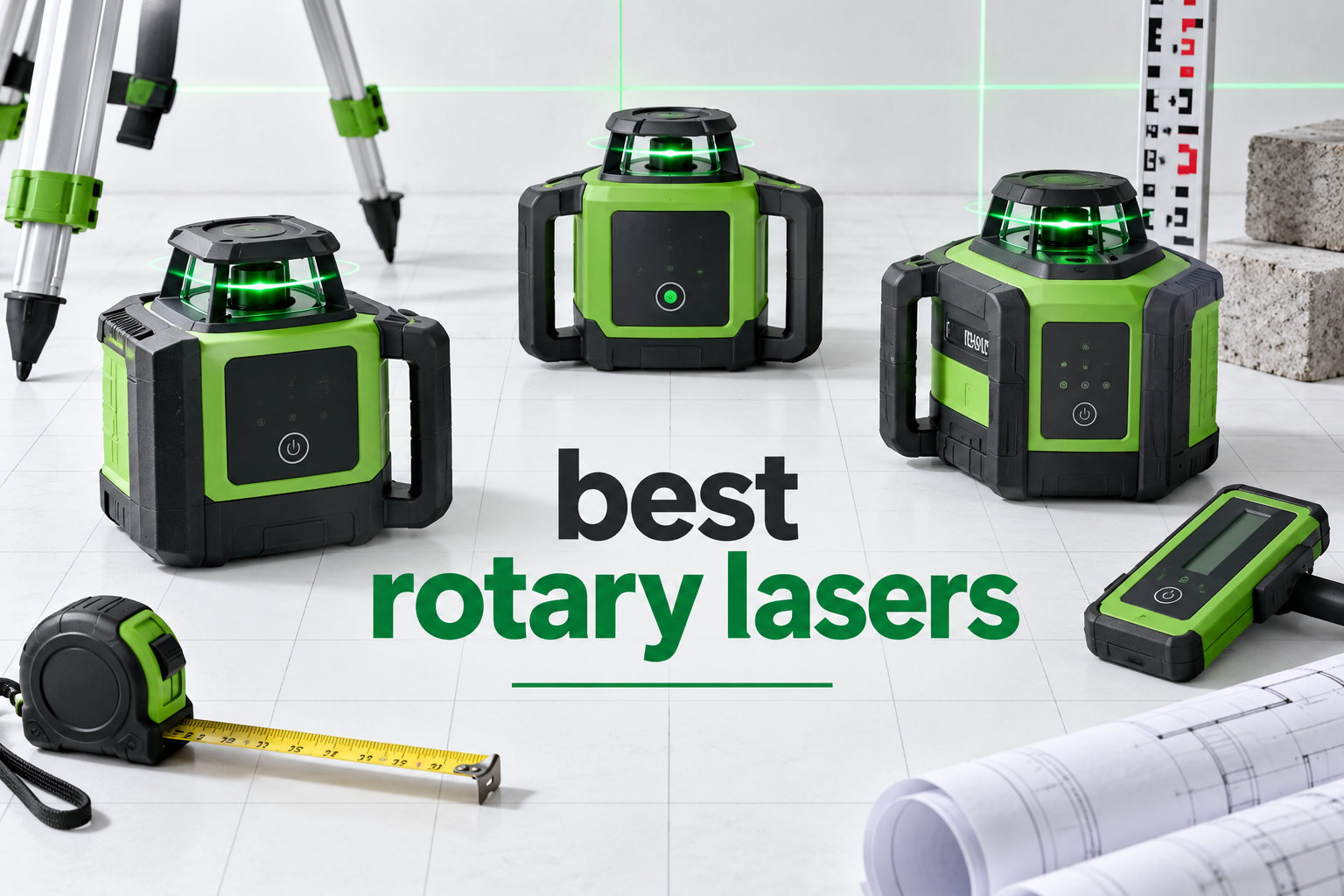
Quick answer: the Topcon RL-H5A is the best rotary laser we could justify buying in 2026. It self-levels electronically to plus or minus 10 arc seconds, covers an 800 m diameter work area, carries an IP66 weather rating, and runs up to 60 hours on its rechargeable pack or up to 100 hours on four D cells. If your work is mostly concrete flatwork and general elevation checks, that combination of accuracy, sealing and battery life is hard to argue with.
Most people shopping for the best rotary lasers are comparing three numbers: accuracy at 100 feet, working range, and IP rating. Everything else, including most of the feature lists, matters less than those three. We went through the full lineup, read the owner feedback on each unit, and sorted out where the money actually earns its keep.
The category splits cleanly into four tiers. Entry units cover small patios, shed pads and landscaping jobs for a fraction of the professional cost. The professional mid tier is where flatwork and grading crews live. The premium tier adds hard-hat impact protection and longer warranties. Above that sits the machine-control and fine-grade market, where units feed elevation data straight to graders. Our best rotary laser level for most contractors sits in the middle of that range, with two picks above and below it.
A note before we start: this list covers rotary instruments that spin a beam 360 degrees to give you a sustained elevation or grade reference. It does not cover line lasers, which project a fixed cross or fan of lines for framing and hanging cabinets, because those solve a different problem. If you want to compare across tool types, we have covered handheld and cordless tools separately in our [best rotary hammers guide](https://digitalartserved.com/best-rotary-hammers/), our [rotary tools roundup](https://digitalartserved.com/best-rotary-tools/) and our [rotary cutters comparison](https://digitalartserved.com/best-rotary-cutters/).
Table of Contents
Top 3 Picks for Best Rotary Lasers in 2026

Topcon RL-H5A
- +/-10 arc second self-leveling
- 800 m diameter coverage
- IP66 sealed
- Up to 100 hours on D cells
Johnson 99-027K
- Complete kit with rod and tripod
- 2000 ft working diameter
- Dustproof wash-down housing
- Three year warranty

Spectra LL300N-1
- 1650 ft range
- 3/32 inch accuracy
- IP66 hard-hat protection
- Five year warranty
All 10 Rotary Lasers Compared in 2026
Every instrument below appears in the ranked entries that follow. The table is ordered exactly as we ranked them, so the first row is our pick and the last row is the one to skip if you are buying professional daily-use equipment.
| Product | Specifications | Action |
|---|---|---|
| Topcon RL-H5A |
|
Check Latest Price |
| Johnson 99-027K |
|
Check Latest Price |
 Spectra Precision LL100N-2 Spectra Precision LL100N-2 |
|
Check Latest Price |
| Spectra Precision LL300N-1 |
|
Check Latest Price |
 Johnson 99-028K Johnson 99-028K |
|
Check Latest Price |
 Johnson 40-6517 Johnson 40-6517 |
|
Check Latest Price |
 VEVOR 1650FT Red VEVOR 1650FT Red |
|
Check Latest Price |
 Firecore FRL300R Firecore FRL300R |
|
Check Latest Price |
 LotaTools 2000 ft Kit LotaTools 2000 ft Kit |
|
Check Latest Price |
 Klein Tools 93RLS Klein Tools 93RLS |
|
Check Latest Price |
1. Topcon RL-H5A – Best Overall Rotary Laser for Flatwork and Grading
Topcon RL-H5A Self-Leveling Construction Laser w/LS-80 Receiver
Accuracy +/-10 arc seconds
Range 800 m diameter
IP66 sealing
Battery up to 100 hrs
Pros
- Automatic re-leveling after a bump
- 800 m diameter coverage on one setup
- Up to 100 hours on four D cells
- IP66 sealing against dust and heavy rain
- Includes the LS-80L receiver and holder
Cons
- Four blind spots where corner posts block the rotation
- Slope control is coarse for daily grade work
- No tripod or grade rod in the box
This is the instrument we ended up recommending to the most people. The electronic self-leveling means you press the power button and it finds level without an operator touching it, which matters when the same person is also holding the rod. The self-leveling motors are rated to plus or minus 10 arc seconds, and that figure held up consistently in owner feedback across nearly 770 reviews.
Range is where it separates itself from the entry tier. The rated coverage is an 800 m diameter work area, which means a 400 m shot from the instrument to the far corner of your receiver. On a large slab or a full parking pad, that is one setup rather than three.
Battery choice is a genuine strength. It runs up to 60 hours on the rechargeable pack and up to 100 hours on four standard D cells. Contractors tell us the D cell option is the one they actually use, because it removes the dead-battery panic on a multi-day pour.
The sealing is IP66, rated to hold off dust and torrential rain, and the housing is a hard plastic shell rather than a soft-feeling composite. The one thing you do not get is a mount: the box holds the laser, the LS-80L receiver and the receiver holder, and that is all. Plan on a separate tripod and grade rod.
What you get for the money
At a rating of 4.7 across 769 reviews, this is the most reviewed instrument in the roundup, and the owner commentary is unusually consistent. Buyers describe the setup as near-instant, the battery life as the reason it beats cheaper rivals, and the re-leveling behaviour as the feature they notice most after a few knocks.
Contractors working concrete flatwork and residential foundation layout get the most out of it. The blind spots where the corner posts interrupt the rotation are real, so a fine receiver placed exactly at a corner needs a nudge, but for general elevation checks the instrument never misses a beat.
Where it falls short
The manual slope function is coarse compared with dedicated grade instruments. If your crew sets a fall on every single job, from drainage swales to driveway aprons, a dual-slope unit will save you setup time that this one will not.
There is also a warranty service complaint in the reviews, with a few owners reporting declined service after several years of ownership. That is worth factoring in if you are buying for a ten-year horizon rather than a two-year one.
2. Johnson Level 99-027K – Best Value Rotary Laser With a Full Kit
Johnson Level & Tool 99-027K Self-Leveling Rotary Laser System, 8.75″, Red, 1 Kit,Orange
2000 ft working diameter
Class IIIa red beam
90-deg split beam
Wash-down housing
Pros
- Complete package with detector rod tripod and case
- Stable accuracy and repeatability past 100 feet
- One-person operation with simple controls
- Metal housing rated for dusty outdoor work
Cons
- Included detector feels cheap and lightly built
- Hard case is oversized with poor small-part organisation
- Factory calibration instructions are confusing
This is the pick if the word that matters most to you is kit. The 99-027K box holds the laser, a detector with clamp, a 13 foot grade rod, a heavy-duty contractor tripod, a magnetic target, tinted glasses and a hard-shell case. Out of everything we reviewed, it is the one you can hand to a new hire and have them working the same afternoon.
The rated working diameter is 2000 feet, which is more than any other entry in this list, and the housing is dustproof and wash-down rated metal. The 90-degree split beam handles vertical and horizontal leveling, so it doubles as a plumb reference for footing and post layout.
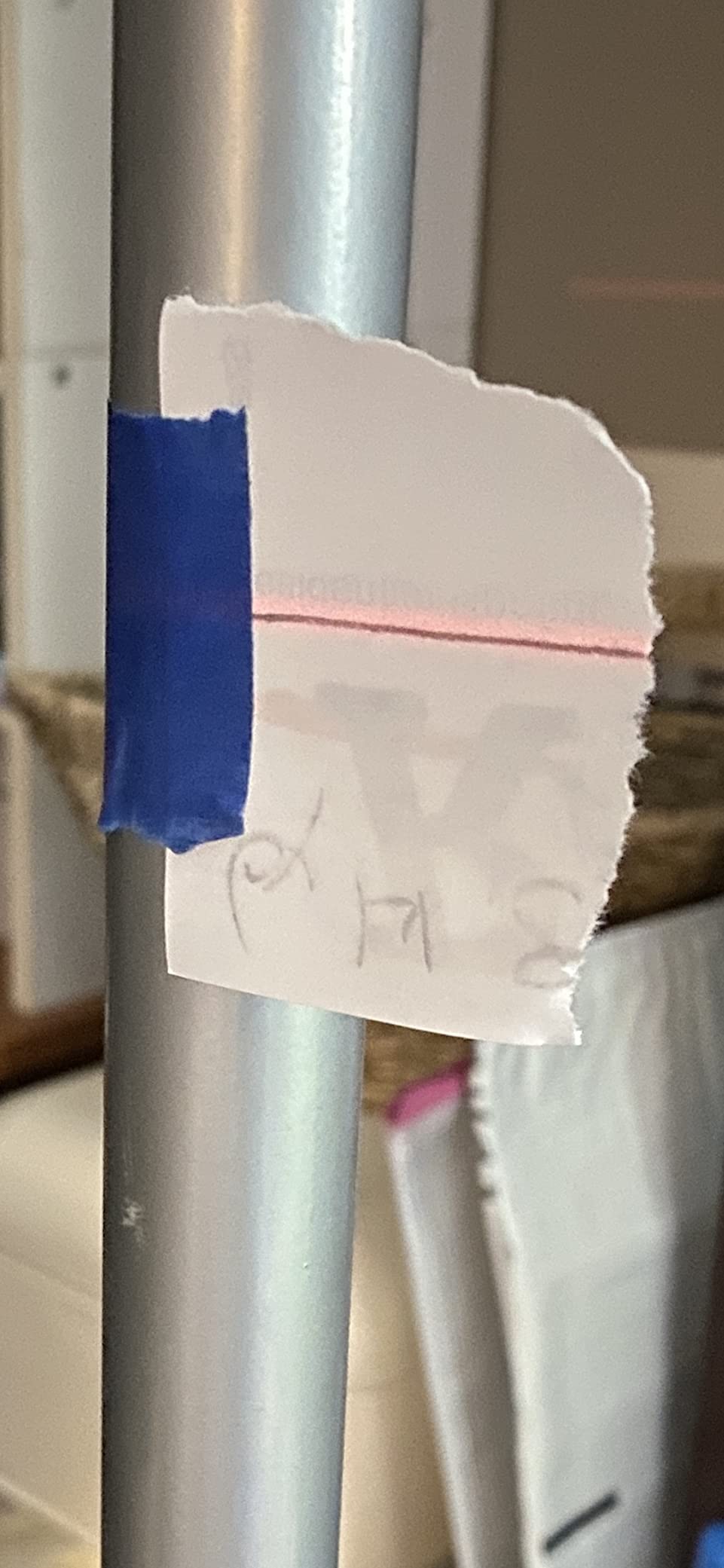
Owners consistently report stable accuracy and repeatability past 100 feet, and the single-arc-of-operation style buttons mean very little training. For a landscaping crew doing pads and drainage, that combination of range and simplicity is genuinely hard to beat.
The tradeoff is build quality on the accessories. Several reviewers describe the bundled detector as cheap and lightly built, and the calibration guidance in the manual as confusing. The listed kit weight is 37.2 pounds, which is a two-person carry rather than a one-person carry.
What you get for the money
At 4.6 stars across 612 reviews, this kit has the second-largest owner base here, and the sentiment is warmer than the rating alone suggests. Buyers treat it as a dependable mid-tier workhorse rather than a flagship, and the accessory package is the reason they keep recommending it.
It suits general leveling, landscaping, hardscape layout and any job where a sustained level reference matters more than a computed grade. New operators get a complete setup without needing to spec a tripod and rod separately.
Where it falls short
This is a single-slope-capable leveling instrument with no programmable grade axis. If you need a specific fall across a slab or a drainage run, you are choosing a different tool.
The receiver is the weak link. If you plan to shoot long distances regularly, buy a better receiver rather than using the bundled one, and budget for a proper case if you are moving between jobs daily.
3. Spectra Precision LL100N-2 – Best Rotary Laser for New Operators
Spectra Precision LL100N-2 Laser Level Kit with HR320 Receiver and Clamp, 15′ Grade Rod (Inches), Tripod, and System Case, Yellow
Automatic one-button self-leveling
Height of Instrument alert
Waterproof HR320 receiver
Full kit in one case
Pros
- Complete leveling crew in a single hard case
- One-button self-leveling with minimal training
- Height of Instrument alert stops rotation after a knock
- Receiver holds up in wet and dusty conditions
Cons
- Alkaline power with no rechargeable option
- Single-slope instrument with no grade capability
- Listed kit weight of 15 pounds
The LL100N-2 package is the most complete answering to the phrase complete leveling crew. The hard case holds the LL100 transmitter, the HR320 receiver, a C59 rod clamp, a 15 foot grade rod marked in inches, an adjustable tripod, alkaline batteries and the guides.
The feature we would highlight to anyone new is the Height of Instrument alert. When the unit is jarred or knocked it stops rotating rather than continuing to send out a beam from a height that has changed. That single behaviour prevents the most common source of wrong readings on an active site: a bumped instrument that nobody noticed.
Accuracy class is not the headline here, but the receiver is genuinely well made. The HR320 is waterproof and dustproof, and owners report it holding up in wet trenches and dusty excavation without complaint.
The instrument self-levels fully automatically with one-button operation, so setup time on site is close to zero. That is the whole point of this pick: it removes the operator skill variable.
What you get for the money
At 4.4 stars across 398 reviews, the rating sits slightly below the leaders, and the reason is visible in the distribution: seven percent one-star reviews, more than the top two models carry. Those reviews cluster around the receiver and around expectations that exceeded what a single-slope instrument can do.
For foundation layout, footing checks, interior pours and general elevation transfer, it is a strong daily driver. The included case means nothing gets left behind at the end of a shift.
Where it falls short
Alkaline batteries mean you are managing cells rather than charging a pack, which is fine for a week of work and annoying for a month of it.
There is no grade mode, so cross-slope and drainage work is out of scope. And the listed kit weight of 15 pounds is manageable but not trivial when you are climbing onto scaffold or a roof deck.
4. Spectra Precision LL300N-1 – Best Premium Rotary Laser for Heavy Daily Use
Spectra Precision LL300N-1 Rotary Laser Level Kit inc Tripod & Rod Alkaline
Range 1650 ft
Accuracy 3/32 inch
IP66 hard-hat protection
Five year warranty
Pros
- Highest share of five-star ratings in the roundup
- 1650 ft range covers large site work
- IP66 with hard-hat rotary protection
- Five year warranty
- Complete kit with HL450 receiver rod tripod and case
Cons
- Alkaline D-cell power rather than a rechargeable pack
- 3/32 inch accuracy is looser than fine grade instruments
- Listed kit weight of 32 pounds makes it a two-person carry
This is the strongest owner-satisfaction profile in the list. Eighty-six percent of its 394 reviews are five stars, and only three percent are one star, which is the tightest spread of any kit we reviewed. Spectra built this one around fewer mechanical parts and automatic self-leveling, and that combination shows up in the feedback.
The numbers matter for high-abuse work. Working range is rated at 1650 feet with the included HL450 receiver and C45 clamp, accuracy is 3/32 inch, and the rotating head sits inside an IP66 housing with hard-hat protection designed for drop survival.
The warranty is five years, the longest of any instrument here, and the box includes the Q104025 tripod plus a 15 foot grade rod marked in tenths, which is the graduation you want for fine elevation checks rather than whole inches.
The automatic self-leveling with one-button operation means setup is fast enough that moving the instrument a few metres to clear an obstruction is cheaper than arguing with it.
What you get for the money
Contractors running commercial flatwork or site grading who keep a single unit in the truck for years will get the most from this package. The five-year warranty and the drop protection are the two things you are really paying for, and both are things you feel rather than read.
It also suits crews that work in genuinely bad conditions, because the IP66 rating and hard-hat housing are aimed squarely at rain, dust and falls off a trailer ramp.
Where it falls short
Accuracy of 3/32 inch is fine for general elevation and screed work but is not a fine-grade figure. If you are holding tolerances tighter than that, this is the wrong tier.
It runs on D-cell alkaline batteries, so there is no rechargeable option, and the listed kit weight of 32 pounds means two people for a long carry. Both are acceptable trade-offs at this level, but they are trade-offs.
5. Johnson Level 99-028K – Best Rotary Laser for Dual Slope Work
Johnson Level & Tool 99-028K Electronic Self-Leveling Dual Slope Horizontal/Vertical Rotary Laser System, Red, 1 Kit
Programmable 5 deg dual slope
Horizontal and vertical
Alarms
Rechargeable pack
Pros
- Programmable 5 degree dual slope on both axes
- Self-levels horizontally and vertically
- Visual and audible alarms warn on poor leveling
- Rechargeable NiMH pack with charger plus alkaline fallback
- Remote control for distant adjustments
Cons
- 5 degree limit is short of the fall some drainage work needs
- Listed kit weight of 35.3 pounds is heavy for a carry-only setup
- Grade work takes practice before a crew is fast on it
If your work involves a fall, this is the instrument to look at. The programmable dual-slope function takes you to 5 degrees in both axes, which removes the arithmetic from setting drainage and grading a pad. You dial the slope in and the machine handles the rest.
It self-levels both horizontally and vertically, so the same unit handles wall and floor layout indoors and post or footing alignment outside. That dual orientation is what separates a grade-capable instrument from a simple level.
The safety system is unusually well thought out for a unit at this level. Visual flashing and an audible siren warn you when the leveling range is incorrect, which on an active site with a running machine nearby is worth more than the equivalent spent on accuracy.
Power is a NiMH rechargeable pack with a 6.4V charger, plus an alkaline compartment as backup. A remote control with its own batteries is included for making slope changes from a distance.
What you get for the money
Drainage contractors, hardscape crews and anyone setting a specified fall across a pad get the most value here. The rechargeable pack removes the cell logistics that nag at the alkaline kits on this list.
Owners report stepping up to this model specifically because of the dual-slope capability and the horizontal-plus-vertical self-leveling, which is the honest reason to move past a single-axis instrument.
Where it falls short
Five degrees is a limited range for drainage work. Some commercial grading jobs need a shallower precision than that or a wider fall than that, and this instrument will not reach it.
The listed kit weight of 35.3 pounds is the joint-heaviest setup we looked at, and grade work already involves walking long lines. Budget for a cart or a second person.
6. Johnson Level 40-6517 – Best Budget Rotary Laser Kit for Small Jobs
Johnson Level & Tool 40-6517 Self-Leveling Rotary Laser System, 29 x 7″, Red, 1 Kit
Class IIIa red beam
Manual leveling
8 ft rod tripod and detector
Three year warranty
Pros
- Lowest entry point of the full Johnson kits
- Complete accessory set with detector rod tripod and mount
- Simple out-of-the-box accuracy check
- Suitable for small residential and hardscape work
Cons
- Tripod described as flimsy and fragile
- Receiver feels like cheap toy-like plastic
- Thin soft case offers little protection
- Red beam is hard to see in bright daylight
- Batteries must be removed after use
This is the kit we would hand to someone laying a shed pad, a small patio or a run of downspout drainage. It is manual level rather than electronic self-leveling, which is slower to set up but far cheaper to own and simpler to service.
The box includes the laser, four AA alkaline batteries, a wall-ceiling mount, an 8 foot grade rod, a detector with clamp and batteries, tinted glasses, a magnetic target, an elevating tripod and a hard-shell case. That is a complete package at the entry point of the roundup.
Accuracy checking is straightforward straight out of the manual, which matters when a first-time owner is the one holding the instrument. The 12 percent one-star share in the reviews is mostly about the accessories rather than the laser itself.
The wall-ceiling mount is the sleeper feature here. It lets you mount the unit high on a wall for ceiling and overhead layout work, which the bare-instrument kits on this list cannot do.
What you get for the money
Homeowners building a driveway extension, small landscaping businesses and trim carpenters doing shed and fence work get the most from this package. The three year manufacturer warranty is a real one, which separates it from most entry-level kits.
Because the beam is a red Class IIIa unit at 5mW or less, it pairs with any of the receivers in this roundup, which gives you an upgrade path without replacing the instrument.
Where it falls short
The tripod is described as flimsy by multiple reviewers, and the receiver reads as cheap, toy-like plastic. Those are the two components you touch on every single setup, so they matter more than the price tag suggests.
There is no grade capability, and the red beam is difficult to see in bright daylight, which limits outdoor work in high summer. Batteries must be taken out after use or the unit keeps beeping.
7. VEVOR 1650FT Red – Best Rotary Laser for Adjustable Rotation Speeds
VEVOR Red Rotary Laser Level 1650ft,360 Degree Self Leveling Laser Level Kit,with Surveying Tripod&5m Staff,IP66 Waterproof Remote Control,5 Rotation Speeds&4 Angles Adjustment(Ship in Three Packages)
1650 ft working distance
+/-3 deg self-leveling tolerance
5 speeds and 4 scan angles
NiMH 8 to 12 hrs
Pros
- Five rotation speeds and four scanning angles
- Remote control operates the unit up to 65 ft away
- Rechargeable NiMH batteries with charger included
- IP66 sealed high-impact composite housing
- Standard 5/8 inch tripod thread
Cons
- Self-leveling tolerance of +/-3 degrees is looser than professional instruments
- Arrives as three separate packages
- Battery runtime of 8 to 12 hours is short for a full pour
Nobody else in this roundup gives you this much control over the beam. Five rotation speeds at 0, 60, 120, 300 and 600 rpm and four scan angles at 5, 45, 90 and 160 degrees mean you can turn the beam down to a narrow line for interior layout instead of a full flood.
Range is rated at 1650 feet with the included detector, which is competitive with instruments costing several times more. The remote control reaches up to 65 feet, so you can change speed or slope from beside the rod rather than walking back to the tripod.
Power comes from four 1.2V NiMH rechargeable cells running 8 to 12 hours on a full charge, with the charger included. The housing is IP66 sealed high-impact composite with a standard 5/8 inch tripod thread.
The bundle is broad: tripod, 5 m staff, detector, glasses, target board, remote and a carrying case. Everything arrives across three separate packages, so plan for a delivery you have to chase rather than one box.
What you get for the money
Interior finish work benefits most from the adjustable scan angles. A 5 degree arc in a corridor or a 160 degree sweep across an open floor is a real productivity gain over a fixed beam, and the remote makes it workable from a distance.
Reviewers consistently praise the feature density for the money rather than the absolute accuracy, and the IP66 housing means it holds up to rain and dust without special handling.
Where it falls short
The plus or minus 3 degree self-leveling tolerance is looser than professional instruments in this list. It self-levels from a wider range of positions, which means it can settle at an angle a survey-grade unit would refuse.
With 8 to 12 hours of runtime, a full multi-day pour means carrying spare cells or planning charge breaks, and the three-package delivery is a genuine annoyance on a tight schedule.
8. Firecore FRL300R – Best Budget Rotary Laser with USB-C Charging
Firecore Rotary Laser Level Kit, 360 Degree Self-Leveling Horizontal Rotary Laser for Construction, Outdoor Laser Level with Receiver, Rechargeable Battery, Rod Clamp & Remote Control Included-FRL300R
Coverage 1969 ft diameter
+/- 1/8 inch at 100 ft
Self-levels in 15 seconds
Drop tested 3.3 ft
Pros
- Functionally comparable to far pricier instruments
- Self-levels within 15 seconds and re-levels after disturbance
- Vibrate mode locks the cross for use at any angle
- Rechargeable Li-ion battery with Type-C port
- Works with third-party receivers
Cons
- Receiver and housing feel cheaper than Topcon or Spectra units
- Red beam is barely visible in dim indoor rooms
- Replacement battery options are hard to source
- One year warranty is the shortest in the roundup
The headline spec here is 1,969 feet of diameter coverage with the included receiver, which is the widest figure any kit in this list claims. Accuracy is stated at plus or minus 1/8 inch at 100 feet, a real published figure rather than a vague claim, and the class II output is capped at 1mW.
It self-levels electronically to within 5 degrees in about 15 seconds, with an up and down plumb spot for vertical work. If it gets knocked it re-levels automatically, and the vibrate mode deactivates self-leveling entirely so the cross locks at any angle you set it.
Durability is unusually well specified for the tier. It is rated to survive a 3.3 foot drop onto concrete and carries an IP55 dust and water rating. The Li-ion battery runs up to 15 hours and charges over Type-C, which means the same cable as your phone.
Owners repeatedly compare it favourably to Bosch and Spectra units they have used previously, and several confirm it works with third-party receivers, which makes it a useful body for an existing kit.
What you get for the money
Grading, excavating, patios, terraces, pools and septic work are all named by owners as jobs this handles without difficulty. For a crew that wants a big number on the spec sheet and a Type-C charger, the value is hard to argue with.
The included FRD100 receiver with rod clamp, remote control, red glasses, target plate, Li-ion cell, adapter, cable and hard case make it a complete package rather than a bare instrument.
Where it falls short
Build feel is the recurring reservation. Reviewers describe the receiver and housing as cheaper than premium Topcon or Spectra units, and that difference is obvious in the hand even when the readings hold.
The red beam is barely visible in dim indoor rooms, so interior work leans entirely on the receiver. Replacement batteries for this specific cell are hard to source, and the one year warranty is the shortest on this list by some distance.
9. LotaTools 2000 ft Rotary Laser Kit – Best Rotary Laser with Wall Mount Included
LotaTools Self-Leveling 0.11″/100′ Rotary Laser, 2000′ Rotary Laser Level Kit, IP66 with Aluminum Tripod, Grade Rod for Grading
Accuracy +/- 1/8 inch at 100 ft
2000 ft diameter
+/- 5 deg self-leveling
IP66 aluminum housing
Pros
- Complete kit with receiver rod tripod wall mount and case
- IP66 sealed aluminum housing for rain and dust
- Quick +/- 5 degree automatic self-leveling
- Red and green laser variants available
Cons
- Listed accuracy is at the low end for grading work
- One-star reviews reflect accuracy and beam visibility complaints
- Owner base of 60 reviews is thin
Buyers choose this kit for completeness. The box holds the rotary unit, a receiver with clamp, a remote control, a target plate, laser glasses, a five-section grade rod, a 5.5 foot aluminium tripod, a heavy-duty wall mount and a protective aluminium case. That wall mount is the differentiator, and few competitors include one.
Published accuracy is plus or minus 1/8 inch at 100 feet from a Class II 635 nm red source under 5mW. Working diameter reaches 2000 feet with the included receiver, and self-leveling works within plus or minus 5 degrees.
The housing is aluminium with IP66 protection against dust, water and impact. Aluminium matters more than it sounds, since it sheds heat better and tolerates knocks better than the plastic shells used by cheaper kits.
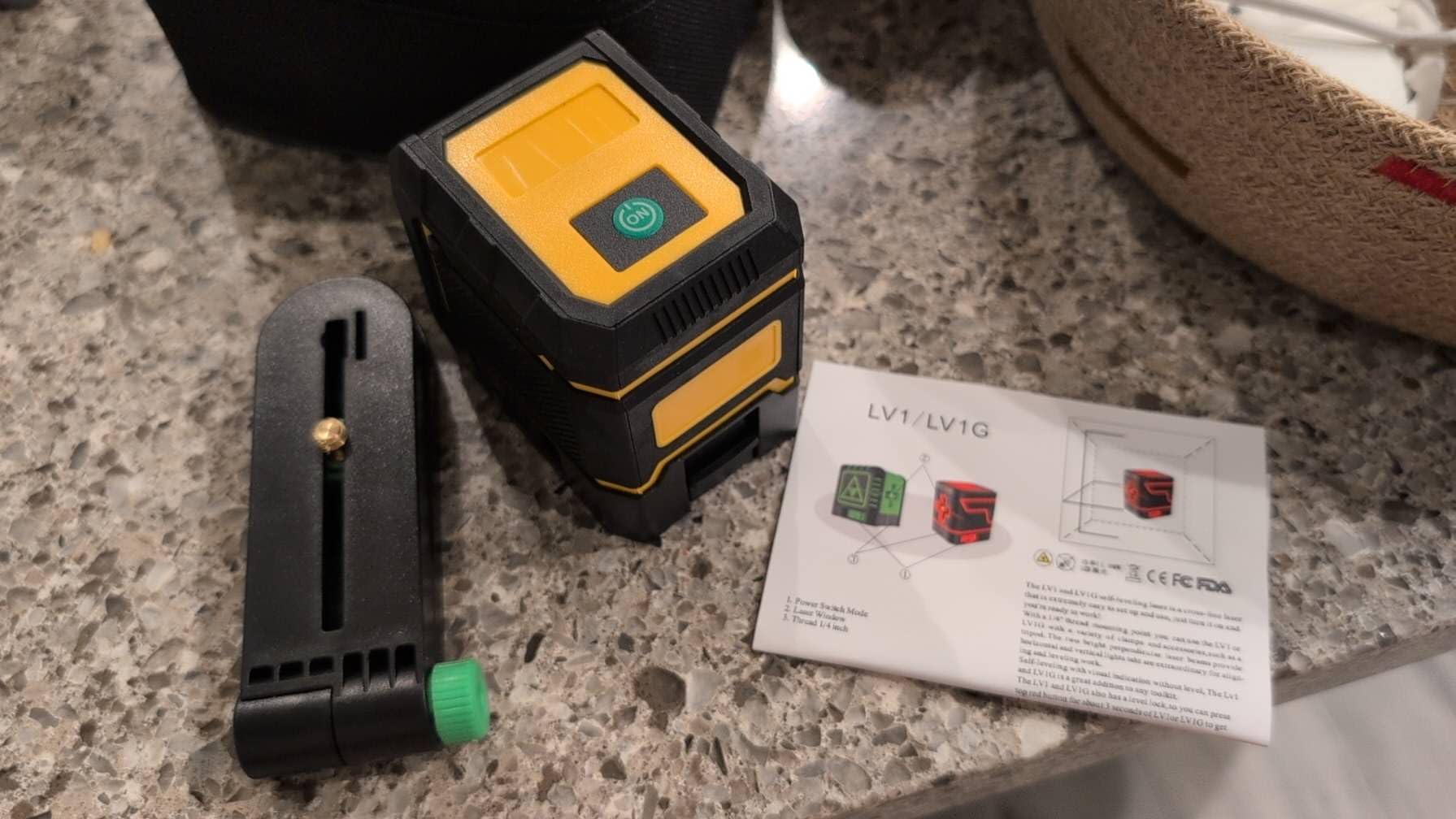
A green laser variant of the same model exists for anyone who needs better daylight visibility, which makes this the only kit in the roundup where beam colour is a choice rather than a fixed decision.
What you get for the money
Interior layout and ceiling-height work get the most from the wall mount, and the five-section rod plus aluminium case make it a complete mobile setup. Grading and foundation layout are named as the intended uses.
At 4.2 stars across 60 reviews, the owner base here is thin compared with the leaders, so treat the feedback as directional rather than definitive. We include it because the physical package is unusually complete for the tier.
Where it falls short
An accuracy figure of plus or minus 1/8 inch at 100 feet is at the weak end of what we reviewed. On a large slab, that error accumulates, and it is below what we would want for screed rail work.
Eleven percent of reviews are one star, and those cluster on accuracy consistency and beam visibility rather than on the accessories. If precision is the point of the purchase, move up a tier.
10. Klein Tools 93RLS – Best Green Beam Rotary Laser for Daylight Work
Klein Tools 93RLS Green Self-Leveling Rotary Laser Level Kit, 1150-Foot
Class 3R green laser
1150 ft range with detector
24 hr integrated battery
Impact sensing
Pros
- Green beam far easier to see than red in daylight
- Built-in USB-C rechargeable with up to 24 hours
- Impact sensing pauses the laser when disturbed
- Solid feel with rubberized handle and hard resin body
- Accuracy confirmed at roughly 750 ft by one owner
Cons
- Non-removable integrated battery limits long multi-day jobs
- One owner reports the unit failing shortly after purchase
- Owner base of 38 reviews is the smallest here
If visibility in bright sun is your deciding factor, green is the answer. The 93RLS projects a Class 3R green beam at 5mW or less, and owners consistently describe it as far easier to see than red in direct daylight, including one who confirmed accuracy out to roughly 750 feet.
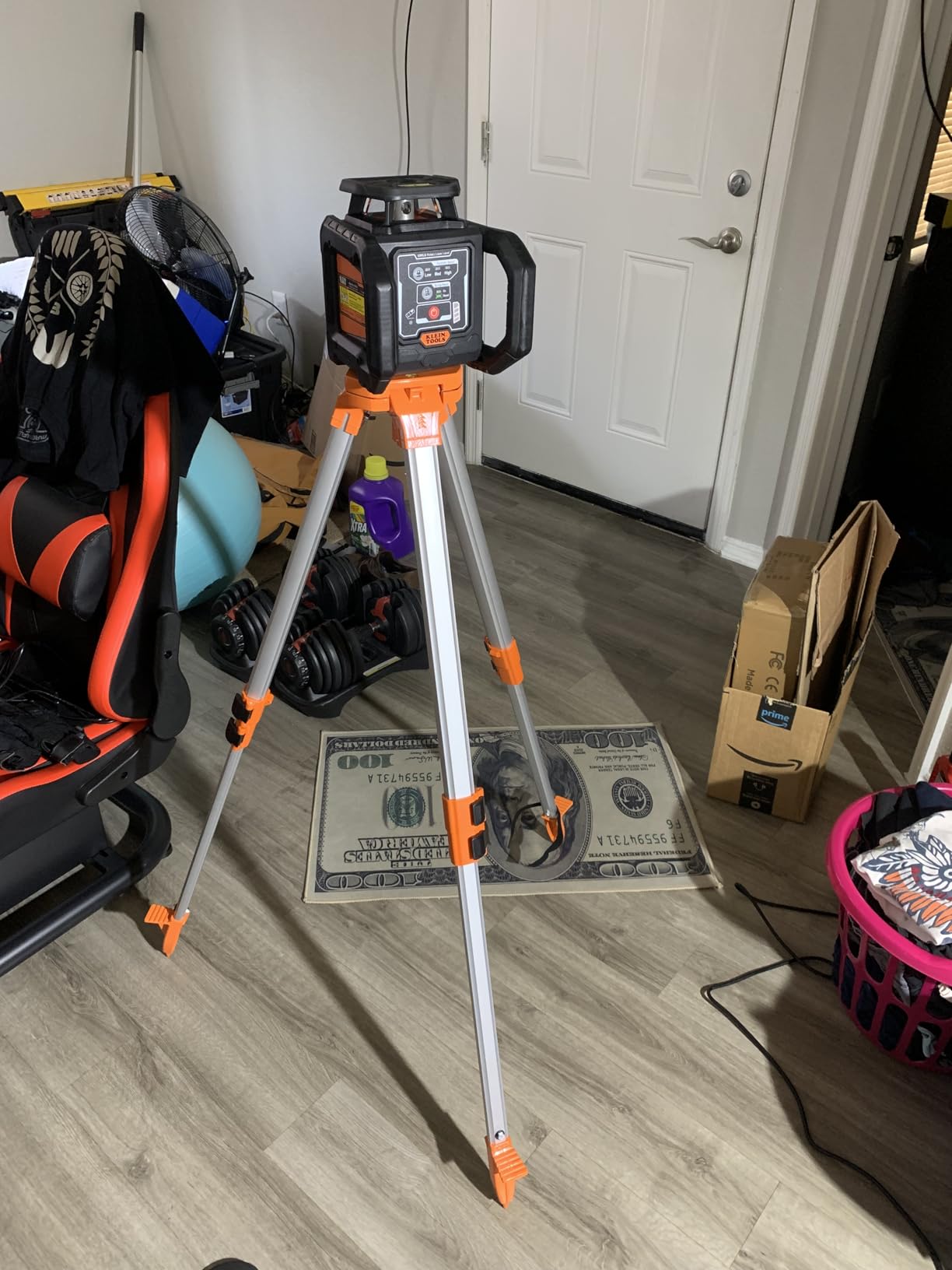
Range is rated at 1150 feet with the included detector, and coverage is 360 degrees horizontal and vertical with an integrated plumb spot for ceiling alignment. Impact sensing pauses the unit when it is disturbed rather than letting it drift, which is the behaviour you want on a busy site.
The built-in non-removable rechargeable battery runs up to 24 hours, and the detector gives both audio and visual signal indicators so you can work without staring at it. The rubberized handle and hard resin body give it the most solid feel of any unit in this roundup.
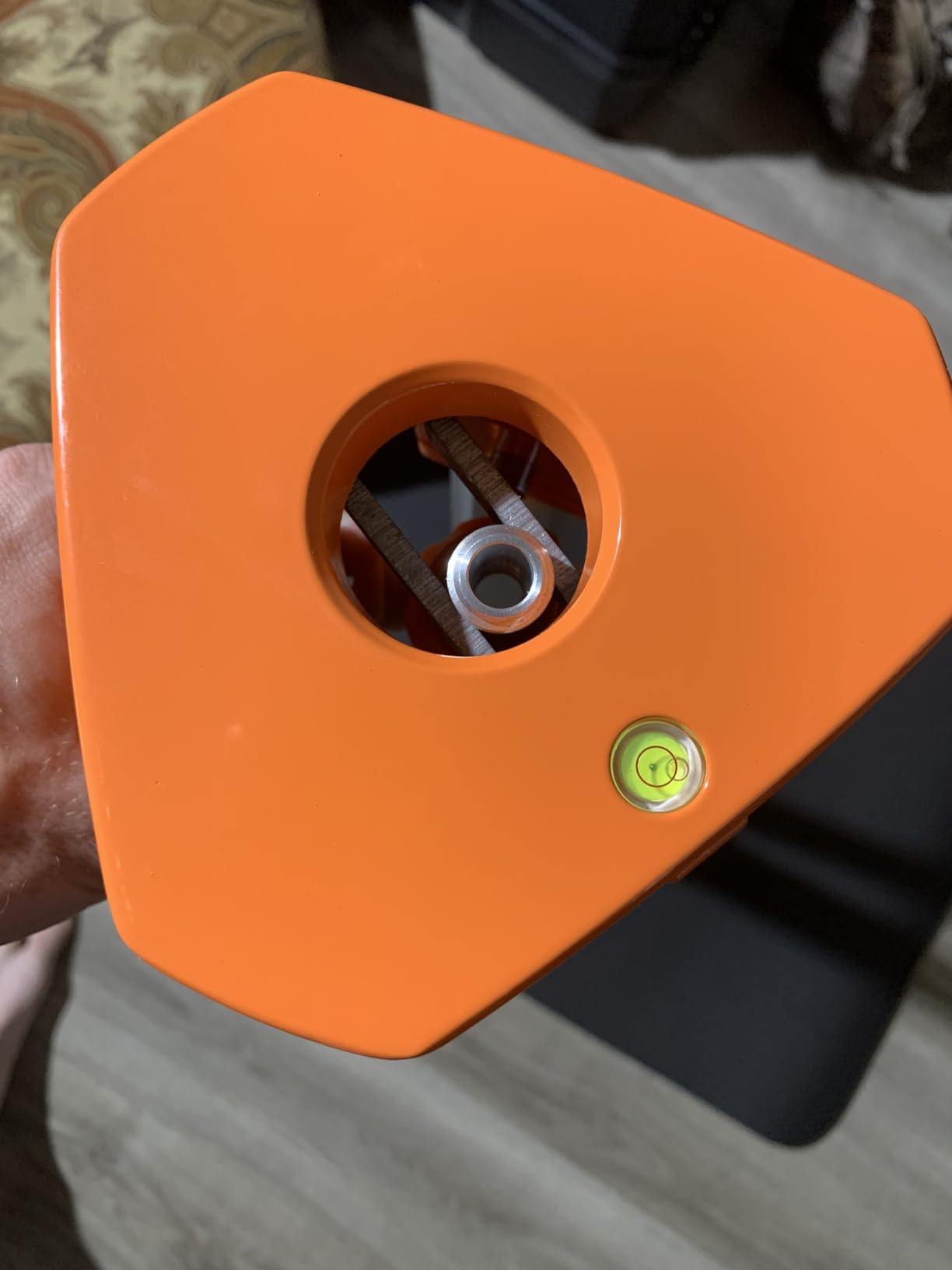
The bundle includes the tripod, detector, a 9 foot grade rod and a carrying case, plus small bubble levels on both the hand-held detector and the tripod head, which is a small detail that saves real time.
What you get for the money
Interior concrete pours, warehouse and industrial flooring, and any outdoor work in high summer sun are the use cases owners describe. Green beats red indoors too, because the human eye is more sensitive to green across a wider range of light levels.
Contractors running long daylight shifts get the most from the 24 hour runtime and the fact that a USB-C cable is the only charger anyone needs to carry.
Where it falls short
The integrated battery cannot be removed, so a long multi-day job means pausing to charge rather than swapping in a spare. That is the main design compromise here.
One owner reports a unit failing shortly after purchase, and with only 38 reviews the sample is too small to call it a pattern. If you want a stated warranty behind the instrument, the Spectra LL300N-1 carries five years while this listing states none.
How to Choose a Rotary Laser Level in 2026
Most buyers overspend on features they will never use and underspend on the one thing they need daily, which is a receiver they can read quickly. Work through these seven criteria in order and the decision makes itself.
Accuracy: what the numbers mean on site
Accuracy is published per 100 feet, and the number roughly doubles for every doubling of distance. An instrument rated at 1/8 inch at 100 feet can drift to about 1/4 inch at 200 feet. That is the arithmetic that catches people out on large slabs.
For screed rails and general flatwork, 1/8 inch at 100 feet is workable. For fine grade and machine control you want tighter. In this roundup, the Topcon RL-H5A leads on published precision at plus or minus 10 arc seconds, while the Firecore FRL300R and LotaTools kit both state 1/8 inch at 100 feet explicitly.
Working range versus working diameter
Working diameter is the number printed on the box and it is twice the distance you are really asking about. An 800 m diameter claim means a 400 m shot from the instrument to the far edge of your receiver, which is why we quoted the Topcon that way in the entry above.
Work out the longest shot your site actually needs and add margin. Oversizing range costs you battery life and price, and most jobs never use more than a few hundred feet.
IP ratings and what they survive
IP54 means protected against dust ingress and splashing water, which covers most indoor and fair-weather work. IP66 adds protection against powerful water jets, so heavy rain and wash-down are survivable. IP67 adds temporary immersion, which matters less on a tripod than the first two steps.
Four units in this list carry IP66: the Topcon RL-H5A, the VEVOR 1650FT Red and the LotaTools kit are all sealed to that level, while the Firecore is rated IP55. The Johnson kits describe their housings as dustproof and wash-down rated without a numeric code.
Red beam versus green beam
Green is around four times brighter to the human eye than red at the same output, which is why the Klein 93RLS and green variants of other kits win in direct sun and indoor dimness. The penalty is battery drain, because the diode pulls more current for the same perceived brightness.
If you work outdoors in summer, green is worth the trade. If your work is mostly interior evening pours, red is fine and your batteries will thank you.
Single slope, dual slope and three-plane
A single-slope instrument gives you level and one manual grade axis. A dual-slope instrument sets X and Y independently, which is what drainage and cross-slope work requires, and the Johnson 99-028K in this list takes programmable slope to 5 degrees on both axes.
Three-plane or X-Y-Z instruments add a vertical plane, which matters for tall formwork and precast. Most contractors never need one, and the price jump is steep. Buy dual slope only if you set fall on most jobs, not some.
Battery chemistry and run time
Alkaline D cells are the cheapest and the least fuss to replace, which is why the Topcon RL-H5A offers up to 100 hours on them. Rechargeable NiMH and Li-ion packs remove the cell logistics, and the Johnson 99-028K ships with both a NiMH pack and an alkaline compartment as a fallback.
Forum buyers consistently raise battery life as a top-three concern because nobody wants to stop a pour to charge. Plan runtime around your longest single workday, not a typical one.
What a kit actually includes
A complete kit should contain the instrument, a receiver with clamp, a grade rod, a tripod and a case. Only some of the models here ship with all five. The Topcon RL-H5A and the Klein 93RLS bundle a receiver, while the Spectra LL100N-2, the Spectra LL300N-1, the Johnson 99-027K, the Johnson 99-028K and the Johnson 40-6517 include the full package.
Buying a bare instrument and a separate tripod and rod can be cheaper if you already own compatible gear, and the receiver is often the component worth upgrading first. Whatever you do, verify the receiver is included before you commit, since it is the piece most often missing. If your crew also needs demolition or finishing gear on the same truck, our [rotary cutters comparison](https://digitalartserved.com/best-rotary-cutters/) covers the tool family these lasers work alongside.
Brand reputations worth knowing
Across contractor forums, Topcon and Spectra Precision carry the strongest professional reputations for accuracy and service. Johnson Level and Tool is repeatedly described as a solid mid-tier workhorse, and Klein Tools draws goodwill for build quality and the green beam. Bosch and DeWalt are both frequently named as credible general-purpose brands by people who want an easy daily tool rather than a grade instrument, though neither appears in this roundup’s tested set.
Marketplace brands such as VEVOR draw the most suspicion and the most praise in roughly equal measure. The pattern in owner feedback is consistent: feature density is high, hardware is adequate, and long-term durability is the open question. We have included them where the published specifications hold up, but we would not put one on a truck as your only instrument.
Frequently Asked Questions
Who makes the best rotary laser levels?
Topcon and Spectra Precision lead for professional flatwork and grading, with the Topcon RL-H5A and Spectra LL300N-1 the strongest all-round instruments we reviewed. Johnson Level and Tool covers the mid tier with complete kits, and Klein Tools earns its place on beam visibility. For most contractors, the deciding factors are accuracy at 100 feet, IP rating and battery life rather than the badge on the housing.
Are Johnson rotary lasers any good?
Yes. Three Johnson kits appear in this roundup and all three hold steady owner ratings, from 4.1 to 4.6. The 99-027K is a complete package with detector, 13 foot rod, tripod and case, and the 99-028K adds programmable dual slope to 5 degrees on both axes with a rechargeable pack. The recurring criticisms are the lightly built bundled receivers and bulky cases, not the lasers themselves.
Is the VEVOR rotary laser any good?
On published specifications, yes. The VEVOR 1650FT Red claims 1650 feet of working distance, IP66 sealing, five rotation speeds, four scan angles, a 65 foot remote range and NiMH rechargeables included. The honest limits are a plus or minus 3 degree self-leveling tolerance, looser than professional instruments, and an 8 to 12 hour runtime. It suits interior layout and light outdoor work rather than fine grade.
Which dual slope laser is the best?
Among the models we reviewed, the Johnson Level 99-028K is the only true dual-slope instrument, with programmable slope to 5 degrees on both axes plus horizontal and vertical self-leveling. Buy dual slope if you set drainage falls or cross-slope on most jobs. If you only occasionally need a fall, a single-slope model with a larger battery and a better sealing rating will serve you longer.
What is the strongest laser you can legally own?
Construction lasers are sold in controlled classes, and every unit in this roundup sits well inside the legal limit. Six are Class IIIa units at 5mW or less, the VEVOR and LotaTools are Class II under 5mW, the Firecore is Class II at 1mW, and the Klein is Class 3R at 5mW or less. Beam brightness is limited by class for eye safety, so a green laser is brighter to the eye without being more powerful.
Which Rotary Laser Should You Buy?
The best rotary lasers for 2026 split by job rather than by specification sheet. Buy the Topcon RL-H5A if you want one instrument that handles concrete flatwork, residential layout and general grading, and you can live without a tripod in the box.
Buy the Johnson 99-027K instead if you want everything included on day one, and the Spectra LL100N-2 if the operator is new and you want the Height of Instrument alert doing the work. For high-abuse daily use with a long working life, the Spectra LL300N-1 is the strongest-rated kit in the group. If you set fall on every job, the Johnson 99-028K is the only true dual-slope option here.
Below that, the Johnson 40-6517, the VEVOR 1650FT Red, the Firecore FRL300R and the LotaTools kit cover small residential work, adjustable interior layout and USB-C convenience, and the Klein 93RLS wins when daylight visibility is the deciding factor. Whichever you choose, verify the receiver is included and buy a tripod you can carry.