
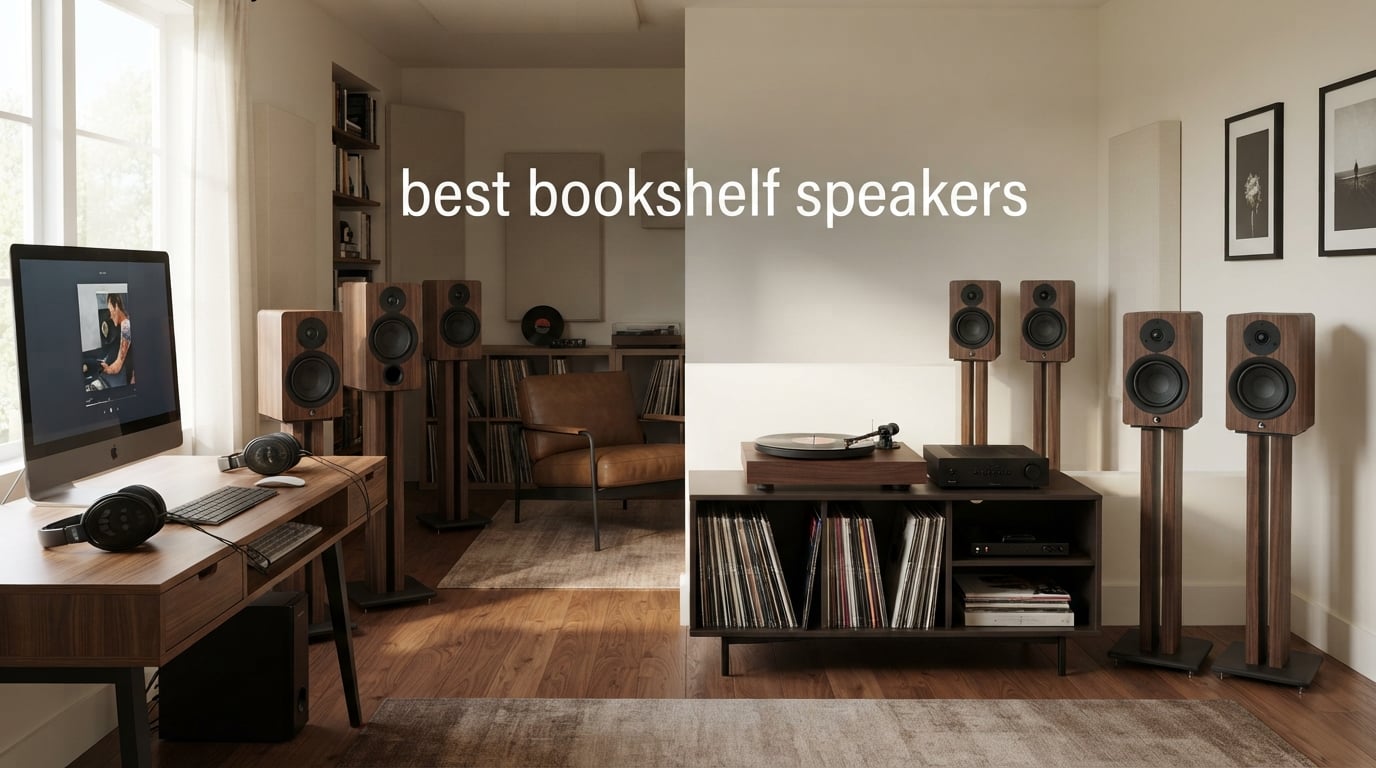
The best bookshelf speakers make a modest stereo system feel intentional: a dedicated tweeter handles the highs, a woofer covers the middle and bass, and the left and right cabinets create a real soundstage. They fit on a shelf, desk, or stands, but a bookshelf is a placement category rather than a reason to wedge a speaker into furniture.
The short answer is that passive speakers suit listeners who already own, or want to choose, an amplifier or receiver; powered speakers put amplification inside one cabinet and make connection simpler. Our eight picks span both paths, from a compact Bluetooth pair for a desk to three-way passive speakers intended for a full stereo or surround system.
I built this guide around the published driver, power, connection, size, and customer-review data for every model. That matters because forum discussions repeatedly show that the right answer is less about a logo and more about room size, source gear, placement, and whether you want the flexibility of separate components.
For a direct first choice, take the SVS Ultra Evolution Bookshelf if you are building a wired passive system and want its three-way, force-balanced design. Choose Edifier’s S3000MKII instead when you need a powerful active pair with Bluetooth, XLR, optical, coaxial, and RCA connections without adding an external amplifier.
Table of Contents
The top three picks cover passive hi-fi, powered flexibility, and compact convenience (August 2026)
These three answers cover the most common buying decisions. The SVS is the feature-rich passive choice, the Edifier is the all-in-one powered system, and Audio-Technica’s small AT-SP3XWH is the straightforward pick for a small desk or turntable area.

The best bookshelf speakers in 2026 range from compact active pairs to serious passive systems
Use this overview to narrow the field before reading the full sections. Powered models need a mains outlet but no receiver; the SVS and Sony entries are wired passive speakers and therefore need speaker cable plus a suitable amplifier or AV receiver.
| Product | Specifications | Action |
|---|---|---|
| SVS Ultra Evolution Bookshelf |
|
View Details |
 Edifier S3000MKII Edifier S3000MKII |
|
View Details |
 Audio-Technica AT-SP3XWH Audio-Technica AT-SP3XWH |
|
View Details |
 Sony SS-CS5M2 Sony SS-CS5M2 |
|
View Details |
 SVS Ultra Evolution Nano SVS Ultra Evolution Nano |
|
View Details |
 Edifier M60 Edifier M60 |
|
View Details |
 MEVOSTO DS19 MEVOSTO DS19 |
|
View Details |
 Saiyin DS6701S Saiyin DS6701S |
|
View Details |
The SVS Ultra Evolution Bookshelf is the fullest-featured passive pick
SVS Ultra Evolution Bookshelf Speakers- Pair (Piano Gloss White)
Three-way
6.5 inch drivers
400 watt maximum
Pros
- Three-way crossover
- Diamond coated tweeter
- Force-balanced woofers
- Five-year warranty
Cons
- Wired only
- Needs an amplifier
The SVS Ultra Evolution Bookshelf is a pair of wired, three-way speakers made for someone assembling a serious stereo or surround setup. Its published design combines a diamond-coated aluminum dome tweeter, dual opposing active woofers in a force-balanced array, and a three-way crossover with premium components.
That driver layout is the reason this is my top passive recommendation for listeners who want more than a basic two-way box. SVS also specifies time-aligned cabinet architecture, so the product is aimed at keeping the output from its drivers aligned at the listening position.
The cabinet measures 11.25 inches deep, 8.66 inches wide, and 14.88 inches high, so plan on real shelf depth or, better still, sturdy speaker stands. A published 400-watt maximum output rating and stereo or surround modes place it naturally in a system built around a capable amplifier or AV receiver.
There is no wireless connection, app streaming, or direct TV input here. That is a limitation for a simple desktop system, but it also keeps the decision clean: choose your own source components and amplification, then run ordinary speaker cable to the binding posts.
This speaker suits a dedicated wired music or home-theater system
Choose this SVS pair if you already have an amplifier, receiver, or a plan to buy one. Its published uses include music listening rooms, home theater, and recording studios, while the 5.1 or 7.1 channel designation makes it relevant as a front pair in a larger system.
It also makes sense for a listener who values a long ownership window, since SVS lists a five-year unconditional warranty. The available customer data is small at 21 reviews, but it records a 5.0 average rating.
This speaker needs space, wiring, and matching electronics
Skip it when your main goal is Bluetooth streaming from a phone, a USB desktop connection, or a single cable from a television. It is wired only, so it cannot make sound until an external amplifier supplies the signal and power.
Give its rear and sides breathing room rather than packing it against a wall or inside a closed cubby. Forum users often identify wall proximity as the source of muddy bass, and a stand lets you bring the tweeter closer to seated ear height.
The Edifier S3000MKII is the most complete powered stereo system
Edifier S3000MKII Hi-Res 2.0 Audiophile Speakers, 256W RMS, Home Audio
256 watt RMS
6.5 inch woofers
aptX HD Bluetooth
Pros
- No external amp
- Planar magnetic tweeters
- XLR input
- App and remote
Cons
- Large cabinets
- Powered system
The Edifier S3000MKII answers the question of what an active speaker system can replace: it combines amplification, wireless reception, and multiple inputs in a stereo pair. Edifier lists 256 watts RMS, 6.5-inch aluminum woofers, and planar magnetic tweeters, with one powered cabinet managing the system.
This is the selection for a listener who wants to connect several sources without purchasing a separate receiver. The product listing includes Bluetooth with aptX HD, RCA, optical, coaxial, USB-B, and XLR, so a computer, streamer, turntable with the right output stage, or TV with an appropriate digital output can share one pair.
The speakers communicate over dual-band 5.8 GHz wireless, while the controls include cabinet knobs, an app, and a remote. That is a notably wider connection set than most compact powered bookshelf speakers provide.
Physical scale is the trade-off. The listing gives packaged dimensions of 23.03 by 17.91 by 14.65 inches and calls out a 6.5-inch speaker size, so I would reserve a cabinet, credenza, or proper stands rather than assume this is a nearfield desktop pair.
This speaker suits people who want one system for several sources
Pick the S3000MKII for a living room, office, or music corner where a phone, computer, television, and analog source may all take turns. Its XLR input is useful where balanced gear is already in the chain, and its wired digital inputs avoid routing every source through Bluetooth.
The available review record shows a 5.0 average from 10 ratings. That is encouraging but limited, so I would base the decision chiefly on its documented input list, 256-watt RMS active design, and room fit.
This speaker is better on furniture or stands than on a crowded desk
Do not buy it for a tiny workstation just because it has Bluetooth. The large cabinet and 6.5-inch woofers call for more physical room and a wider left-right spread than a monitor shelf usually offers.
It also depends on mains power, as every powered pair does. If you prefer to change amplifiers later, or want a receiver to run several passive speakers for surround, the SVS or Sony passive paths are more appropriate.
The Audio-Technica AT-SP3XWH is the compact powered pick for simple setups
Audio-Technica AT-SP3XWH Powered Bookshelf Speaker
30 watt powered pair
3 inch woofers
Bluetooth and RCA
Pros
- Very compact
- Bluetooth multipoint
- RCA connection
- Speaker cable included
Cons
- 30 watt output
- Plastic enclosure
The Audio-Technica AT-SP3XWH is a compact active pair for the person who wants fewer boxes and a small footprint. Each system has a 30-watt output rating, 3-inch woofers, 1.1-inch tweeters, Bluetooth, and dual RCA jacks for a direct wired source.
At 5.4 inches deep, 4.9 inches wide, and 7.9 inches high, these are among the least demanding cabinets in this lineup. They fit the real-world use cases stated by Audio-Technica: a personal computer, smartphone, or turntable.
Bluetooth multipoint pairing is the standout convenience feature because two Bluetooth devices can stay connected. That helps a desk shared by a computer and phone, where repeatedly disconnecting and pairing is irritating.
The system includes speaker cable and international plug adapters, which supports its simple-setup role. The enclosure is plastic and the output is lower than larger choices, so it should be judged as a close-range or small-room speaker rather than a high-volume living-room solution.
This speaker suits desks, small rooms, and Bluetooth-first listeners
This model is a practical choice when space is limited and your main sources are a laptop, phone, or turntable with an appropriate output. Place the pair on either side of a monitor, form a modest listening triangle, and angle both cabinets toward your ears.
The customer record is more substantial than that of several higher-output options: 415 reviews with a 4.8 average rating. Its stated 10-meter Bluetooth range is also sufficient for ordinary room use.
This speaker will not replace a large-room stereo system
Choose a larger active design if deep bass output and high volume are priorities. A 3-inch woofer and 30 watts have clear physical limits, and a small cabinet cannot move the same amount of air as the five- or 6.5-inch designs here.
Plastic cabinetry may also matter to a buyer seeking wood or metal construction. There is no optical input listed, so a television or console connection needs an RCA-compatible route rather than a direct optical cable.
The Sony SS-CS5M2 is the accessible three-way passive choice for surround systems
Sony SS-CS5M2 3-Way 3-Driver Hi-Res Compact Bookshelf Speakers (Pair)
Three-way passive
5.12 inch woofer
6 ohms
Pros
- Dedicated super tweeter
- Hi-Res range
- 100 watt maximum
- Bass reflex cabinet
Cons
- Wired only
- Listed as one speaker
The Sony SS-CS5M2 gives a passive system builder a three-way layout with a 5.12-inch woofer, 25 mm tweeter, and 19 mm super tweeter. Sony publishes a 53 Hz to 50 kHz frequency response, a 6-ohm impedance, and 100-watt maximum input.
That combination makes it a logical entry for someone choosing a receiver for two-channel listening or home theater. The model is listed for home theater and 5.1 use, while the bass-reflex enclosure is intended to support its low-frequency performance.
The dedicated super tweeter is a meaningful point of difference from small two-way speakers. It gives the speaker a separate driver for the uppermost published range instead of asking a single conventional tweeter to cover all high frequencies.
One buying detail needs close attention: the listing identifies the package as a single speaker, not a stereo pair. Confirm the quantity you need before planning left, right, and any surround channels.
This speaker suits receiver owners building stereo or surround sound
Select the Sony if you want the control and upgrade path of passive speakers while keeping the driver specification easy to understand. A receiver or integrated amplifier that is designed to work with 6-ohm speakers is the required partner.
For home theater, use matching left and right placement and keep the tweeters near ear height. The 8.7-inch depth and 13.2-inch height are manageable on solid shelves, though stands still make placement easier.
This speaker requires an amplifier and careful quantity planning
It is not a Bluetooth speaker, USB computer speaker, or self-contained TV system. Speaker wire from an amplifier is mandatory, and the amplifier must be set up with the speaker’s 6-ohm load in mind.
Do not assume a single package completes a stereo pair. The product data says one unit, so check the retailer’s current package description before ordering and plan the left/right purchase accordingly.
The SVS Ultra Evolution Nano is the refined compact passive option
SVS Ultra Evolution Nano Bookshelf Speakers - Pair (Black Oak)
5.25 inch driver
150 watt maximum
Compact passive pair
Pros
- Rigid cabinet
- Diamond coated dome
- Flush drivers
- Compact form
Cons
- Wired only
- Needs an amplifier
The SVS Ultra Evolution Nano is a compact wired passive model with a 5.25-inch driver size and a 150-watt maximum output rating. SVS describes a composite glass-fiber cone, a diamond carbon-coated aluminum dome, and an FEA-optimized cabinet intended to reduce resonance.
I would put this high on the shortlist when cabinet size needs to stay controlled but the system is still centered on separate electronics. It is designated for home audio, music listening, and home theater, which makes it more flexible than a desktop-only design.
The construction details are unusually specific for a compact product. Chamfered front-baffle edges and flush-mounted drivers are included to improve high-frequency response, while the cabinet materials are listed as composite glass fiber, aluminum, and metal.
It weighs 31 pounds, so compact does not mean carefree placement. A shelf must be securely supported, and stable stands should be rated for the weight of each cabinet before you commit to a stand-mounted arrangement.
This speaker suits compact hi-fi systems with an existing amplifier
This SVS model is for a person who wants a smaller passive cabinet but does not want to give up a component-based system. It can act as a two-channel pair now and be reused in a home-theater system later if the receiver and room plan support it.
The 14 available ratings show a 4.8 average. As with other low-count data sets, the documented driver and cabinet design should carry more weight than a small ratings sample.
This speaker needs sturdy support and a wired source chain
A 31-pound speaker deserves more than a light desktop shelf or decorative stand. Put it on a rigid surface, use isolation or protective pads where needed, and leave clearance around the enclosure rather than treating it as a bookend.
It has no wireless technology and no internal amplifier. People wanting a direct USB-C computer connection, television optical input, or phone streaming should look to an active Edifier, MEVOSTO, Saiyin, or Audio-Technica option.
The Edifier M60 is the strongest compact desktop-oriented active pick
Edifier M60 Multimedia Speaker, 66W RMS Computer Speaker, Black
66 watt RMS
LDAC Bluetooth
USB-C and AUX
Pros
- USB-C input
- Hi-Res certified
- Included angled stands
- LDAC support
Cons
- Touch controls take practice
- Compact driver size
The Edifier M60 is a powered desktop pair that puts a 3-inch mid-bass driver and 1-inch silk dome tweeter in each small cabinet. Its 66-watt RMS system, Class-D amplification, built-in DSP, Bluetooth 5.3 with LDAC, USB-C, and AUX cover the connections most computer setups actually use.
This is my direct choice for a work desk because Edifier includes aluminum stands that angle the speakers upward by 15 degrees. That small physical detail makes more sense at a desk than a large cabinet designed to sit several feet away across a room.
Both wired and wireless Hi-Res Audio certification are listed, along with an app and cap-sensitive top touch panel. The stated 10-meter Bluetooth range is useful when a phone is the source, while USB-C gives a more direct computer route.
Each cabinet measures 3.93 inches deep, 6.61 inches wide, and 5.78 inches high. Those dimensions leave room for a monitor, keyboard, and a sensible left-right spread without requiring separate desk stands.
This speaker suits computer audio and close-range listening
Choose the M60 when your listening position is close to the speakers and USB-C is more useful than a receiver. The compact size, included angled stands, and multiple source options make it a neat fit for a desktop, small office, or dorm-style space.
Its review record is also the strongest volume of feedback in the group: about 1.8k reviews with a 4.6 average rating. Buyers specifically have access to documented Bluetooth, USB, and auxiliary options rather than relying on a single wireless connection.
This speaker favors nearfield use over room-filling scale
A 3-inch driver pair can be excellent at a desk, but it is not a substitute for a large living-room system with five- or 6.5-inch woofers. Keep the expected listening distance realistic and add a subwoofer only if the system and room need lower bass beyond what compact speakers can provide.
The touch panel may take time to learn, according to the review summary. If you prefer physical knobs and a remote for every adjustment, the MEVOSTO DS19 has both listed.
The MEVOSTO DS19 is the powered pick with the most direct tone adjustment
Active Bookshelf Speakers 36W RMS - BT 5.4 Wireless Speaker with 5 Inch Woofer, Silk Dome Tweeter PC Speakers - USB Digital Audio Studio Monitors Bass & Treble Adjust AUX Input for Record Player TV
5 inch woofer
Bluetooth 5.4
USB audio and EQ
Pros
- Bass and treble controls
- USB digital input
- Remote included
- Five inch woofers
Cons
- No Dolby Audio
- 36 watt RMS
The MEVOSTO DS19 is an active 2.0 pair that pairs 5-inch woofers with 1-inch silk dome tweeters. Its main appeal is control: it has 10-level bass and treble adjustment, physical precision knobs, a remote, Bluetooth 5.4, USB digital audio, RCA, and AUX inputs.
That feature list directly addresses a frequent ownership problem: a small room, hard desk, or wall position can make the tonal balance feel wrong. Rather than pretending one fixed tuning suits every room, this model gives you measured adjustment steps for bass and treble.
The product details report 36 watts RMS and 110 watts maximum, along with a stated 15-meter Bluetooth range. USB digital audio is described as lossless and low latency, making this a useful candidate for PC audio where Bluetooth delay is undesirable.
Its natural wood enclosure is listed as part of the product design, and the 10 by 9.6 by 5.9-inch dimensions place it between true mini desktop speakers and large standmounts. It can work by a computer, record player, or television with a compatible input path.
This speaker suits buyers who want simple EQ and broad wired inputs
Choose the DS19 when bass and treble controls matter as much as Bluetooth. The combination of USB, RCA, and AUX means an owner can connect a computer digitally, retain an analog source, and still stream wirelessly without an external amplifier.
The customer data contains 656 ratings at a 4.6 average. That is a useful volume of feedback for a model whose case rests on convenience and everyday flexibility.
This speaker is a stereo solution rather than a Dolby system
It does not support Dolby Audio, so it should not be selected as a replacement for a multichannel AV receiver arrangement. Treat it as a 2.0 stereo pair and send it a compatible analog, USB, or Bluetooth signal.
The published 80 Hz frequency-response figure should also guide expectations for deep bass. If low effects are central to your TV or music use, check whether a separate subwoofer can be connected in your broader source arrangement before deciding.
The Saiyin DS6701S is the simple active choice for TV, turntable, and computer inputs
Saiyin Powered Bluetooth Bookshelf Speakers
30 watt times two
Optical input
Bluetooth 5.3
Pros
- Optical and coaxial inputs
- Remote control
- No receiver needed
- Headphone output
Cons
- Lower output
- Turntable pairing may need transmitter
The Saiyin DS6701S is a powered bookshelf pair for a buyer who needs basic sources covered without an amplifier. The published list includes Bluetooth 5.3, optical and coaxial digital inputs, auxiliary and RCA connections, a 3.5 mm headphone output, plus a remote for volume and source switching.
This is the clearest TV-friendly option of the small active picks because an optical input is specifically listed. It is also compatible with computers, record players, and turntables, though the source device still needs the right output format.
The two cabinets use a 3.75-inch woofer and 0.5-inch silk dome horn tweeter with a 30 watts times two output rating. That makes the system better matched to a bedroom, desk, apartment, or modest TV area than to a very large open room.
A 4.4 average across about 2.1k reviews provides a broad customer-feedback base. The system has a three-year manufacturer warranty listed, which is helpful for an entry-level powered setup that may be used every day.
This speaker suits people who need direct digital TV connectivity
Select the Saiyin when an optical television output is part of the plan and you do not want a receiver. The remote and input switching are practical when a TV, computer, and Bluetooth phone all share the pair.
It is also a reasonable first stereo pair for a turntable setup, provided the turntable has a built-in phono preamp or you add one. A phono cartridge signal is not the same thing as a standard line-level RCA signal.
This speaker has realistic limits for power and turntable wireless use
The 30 watts times two output and smaller woofer are not designed for large-room volume or very deep bass. Give the speakers a sensible listening distance, avoid placing them in a sealed cabinet, and consider a larger five-inch powered option when room size grows.
Some turntables require a Bluetooth transmitter for wireless pairing, according to the available product information. Wired RCA remains the cleaner choice whenever the turntable provides a compatible line-level output.
The right bookshelf speaker choice starts with power, room size, and sources
Start by deciding whether you want a passive or powered system. Passive speakers such as the two SVS models and Sony require an amplifier or receiver, while active speakers such as the Edifiers, Audio-Technica, MEVOSTO, and Saiyin have amplification inside the system.
Powered speakers reduce boxes and cabling. Passive speakers let you choose, upgrade, or change the amplifier separately, which can matter if you later add a turntable preamp, streamer, television receiver, or surround channels.
Passive speakers need an amplifier that is comfortable with their stated load
Match the amplifier or receiver to the speaker’s published impedance and power guidance rather than buying by a vague watt figure. The Sony is explicitly listed at 6 ohms and 100 watts maximum; an amplifier designed for 6-ohm speakers is the sensible baseline for that model.
Read both manuals, use the manufacturer’s allowed impedance range, and do not run bare wire where it can short between terminals. Online discussions rightly focus on impedance because it is an electrical load, not a sound-quality score.
The passive SVS models also need speaker cable and an amplifier, but the product information here does not publish an impedance figure. Confirm that figure and your amplifier’s compatibility from current manufacturer documentation before you connect them.
Powered speakers need the input your source actually provides
For a computer, USB-C on the Edifier M60 or USB on the MEVOSTO DS19 provides a direct wired route. For a television, the Saiyin lists optical and coaxial inputs, while the S3000MKII lists optical, coaxial, RCA, XLR, Bluetooth, and USB-B.
For vinyl, check for a built-in phono preamp in the turntable. If it has one, its line-level output can go to an RCA input; if it does not, add a phono preamp between the turntable and powered speakers or amplifier.
Bluetooth is convenient, but it is not automatically the best connection for every job. Use a wired digital input when available for a computer or TV, and retain Bluetooth for casual phone listening where cable-free use matters more.
Room size should guide cabinet and woofer size expectations
Small desks and bedrooms reward compact pairs such as the Audio-Technica AT-SP3XWH or Edifier M60. Their 3-inch drivers suit close-range listening, and the M60’s included angled stands help direct the sound toward a desk listener.
A larger room gives five- and 6.5-inch woofers more room to justify their cabinet size. The MEVOSTO uses a 5-inch woofer, the SVS Nano lists a 5.25-inch driver, and the SVS Ultra Evolution Bookshelf plus S3000MKII use 6.5-inch driver or woofer sizes.
Do not expect a small speaker to reproduce the bottom octave of bass at the same level as a subwoofer or a larger speaker. If bass is missing after sensible placement, first check room position and source settings; then decide whether a subwoofer is appropriate.
Placement works best when the tweeters face the listener with room around the cabinets
Put the left and right speakers roughly as far apart as each speaker is from your listening seat, then form a triangle and toe them in slightly. This simple geometry is more useful than placing both speakers flat against a back wall.
Begin with clearance from the rear wall and adjust by ear, especially with bass-reflex designs such as the Sony. Wall distance affects bass weight, and a closed shelf can trap reflections that make voices and bass less distinct.
Stands are usually better than a crowded shelf because they bring drivers closer to ear height and let you set width precisely. For the 31-pound SVS Nano, verify the stand’s load rating; for small desktop speakers, the M60’s included angled stands already address the height problem.
A subwoofer is optional when the stereo pair already fits your room and listening habits
A subwoofer is not mandatory just because a speaker is called bookshelf-sized. It is useful when you want lower-frequency extension for film, electronic music, or a larger room, but it adds placement and crossover work.
Choose a speaker system with a documented subwoofer path if adding one is a firm requirement. The source, amplifier, or powered speaker must offer a compatible output or an alternative connection method; do not assume every compact stereo pair has a dedicated subwoofer output.
For apartment listening, a well-placed stereo pair may be the more considerate starting point. Low bass travels through structures easily, so volume, placement, and neighbor proximity matter as much as woofer diameter.
FAQs
Who makes the best bookshelf speakers?
There is no single best brand for every setup. In this guide, SVS is the strongest passive choice for a component system because its Ultra Evolution models use detailed multi-driver cabinet designs, while Edifier is the strongest all-in-one powered choice because the S3000MKII combines 256 watt RMS amplification with Bluetooth, XLR, RCA, optical, coaxial, and USB-B inputs.
What are the best active bookshelf speakers?
The best active choice here is the Edifier S3000MKII for broad source connectivity and 256 watt RMS output. The Edifier M60 is better suited to a computer desk with USB-C and compact angled stands, while the MEVOSTO DS19 offers USB audio and 10-level bass and treble adjustment. The Saiyin DS6701S adds optical input for a direct TV connection.
How do you connect bookshelf speakers?
Passive bookshelf speakers connect by speaker wire to a compatible amplifier or AV receiver. Powered speakers connect directly to an available input such as Bluetooth, RCA, optical, coaxial, USB, USB-C, or AUX. A turntable without a built-in phono preamp needs a phono preamp before it connects to a line-level input.
What speakers do audiophiles use?
Audiophile listeners use both passive and powered speakers, based on the room and component system. A passive choice such as the SVS Ultra Evolution Bookshelf or Ultra Evolution Nano lets the owner select the amplifier separately. A powered model such as the Edifier S3000MKII is simpler when its built-in amplification and broad input list fit the planned sources.
The best bookshelf speakers are the pair that fits your sources and room
For a wired component system, I would start with the SVS Ultra Evolution Bookshelf and select an amplifier that fits the complete system. For powered listening with the most connection options, the Edifier S3000MKII is the direct answer; for a computer desk, the Edifier M60’s USB-C input and angled stands make more sense.
Do not choose only by cabinet size or rating. The best bookshelf speakers in 2026 are the pair you can position correctly, connect cleanly to your sources, and use at the listening distance your room permits.