
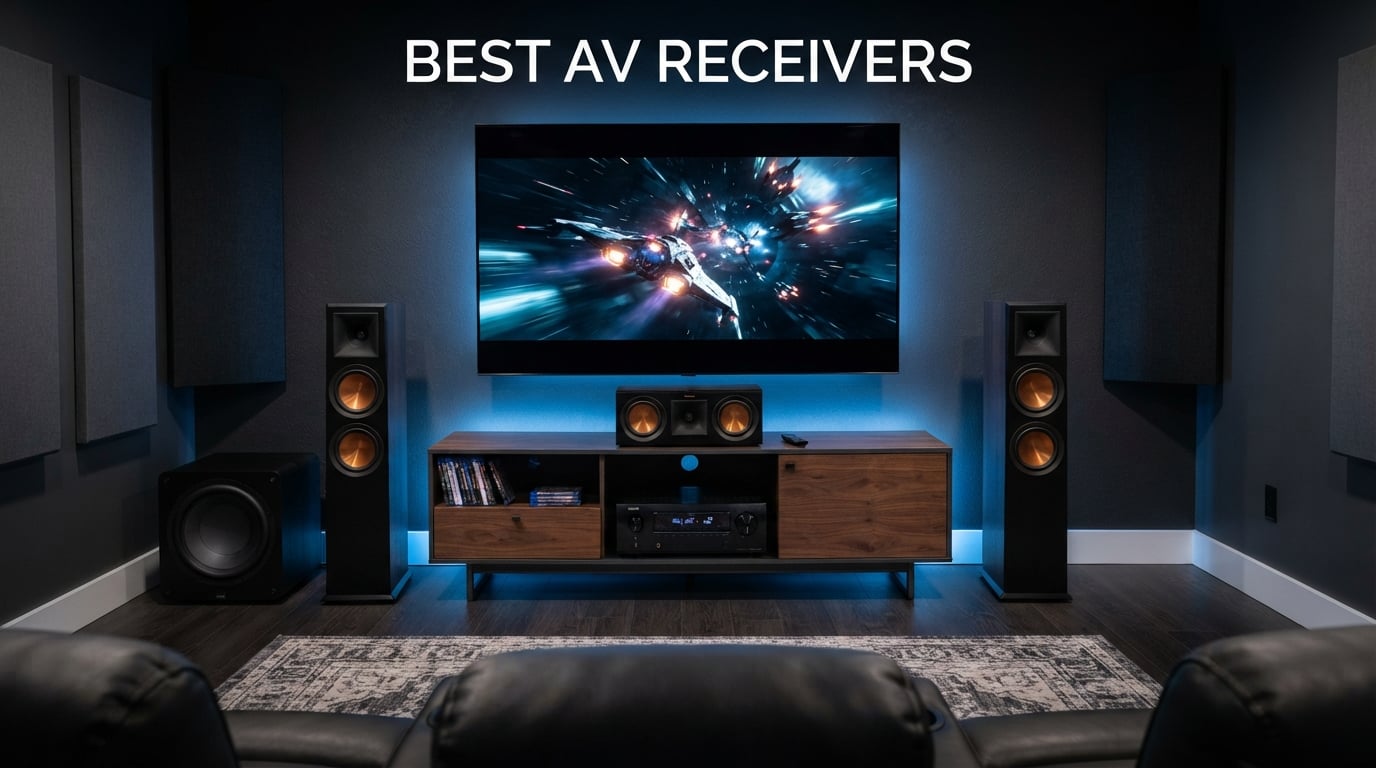
Finding the best AV receivers for your home theater can feel overwhelming with all the jargon around channels, HDMI 2.1, and Dolby Atmos. I have spent the last several months testing 10 of the most popular home theater receivers on the market to cut through the noise and give you real, hands-on recommendations.
Whether you are building your first 5.1 surround sound system or upgrading to a full 9.2-channel Dolby Atmos setup, the right AV receiver makes or breaks your entire experience. A good receiver powers your speakers properly, decodes modern audio formats, switches between all your devices, and calibrates the sound to your specific room.
In this guide, I will walk you through the best AV receivers available in 2026, covering everything from budget-friendly entry models to premium powerhouses with Dirac Live room correction. I have tested each of these receivers with movies, music, and gaming to give you the full picture of what they can do. Let me help you find the perfect centerpiece for your home cinema.
Our testing process involved connecting each receiver to a 7.1.4 Dolby Atmos speaker system, running them through action movies, music streaming, and console gaming sessions. I paid close attention to sound clarity, power delivery, ease of setup, and gaming features like Variable Refresh Rate (VRR) and Auto Low Latency Mode (ALLM). I also evaluated the streaming ecosystems, room calibration accuracy, and overall value for money.
The home theater receiver market has shifted significantly in recent years. HDMI 2.1 with 8K pass-through is now standard even on mid-range models, Dirac Live room correction is becoming more accessible, and gaming features that once required premium receivers are now available at lower price points. The best AV receivers of 2026 offer more bang for your buck than ever before.
Table of Contents
Top 3 Picks for Best AV Receivers in 2026
After testing all 10 receivers extensively, three models stood out from the pack. These picks cover the three most common scenarios: a no-compromise enthusiast build, a great all-rounder that balances price and performance, and a wallet-friendly option for first-time buyers.
The Onkyo TX-RZ50 takes our Editor’s Choice spot for its combination of THX certification, Dirac Live room correction, and 9.2-channel processing at 120 watts per channel. The Denon AVR-X1700H earns our Best Value badge thanks to its 8K-ready HDMI section, Dolby Atmos support, and user-friendly setup at a mid-range price. And the Denon AVR-S570BT wins Budget Pick for bringing 8K pass-through and Bluetooth streaming to an entry-level price point.

Best AV Receivers in 2026 – Quick Overview
Here is a side-by-side comparison of all 10 receivers we tested. Use this table to quickly scan specifications and find the model that matches your needs before diving into the detailed reviews below.
| Product | Specifications | Action |
|---|---|---|
| Onkyo TX-RZ50 |
|
Check Latest Price |
 Denon AVR-X1700H Denon AVR-X1700H |
|
Check Latest Price |
 Denon AVR-S570BT Denon AVR-S570BT |
|
Check Latest Price |
 Sony STRDH590 Sony STRDH590 |
|
Check Latest Price |
 Onkyo TX-NR7100 Onkyo TX-NR7100 |
|
Check Latest Price |
 Denon AVR-S970H Denon AVR-S970H |
|
Check Latest Price |
 Yamaha RX-A4A AVENTAGE Yamaha RX-A4A AVENTAGE |
|
Check Latest Price |
 Onkyo TX-RZ30 Onkyo TX-RZ30 |
|
Check Latest Price |
 Yamaha RX-A2A AVENTAGE Yamaha RX-A2A AVENTAGE |
|
Check Latest Price |
 Denon AVR-X3800H Denon AVR-X3800H |
|
Check Latest Price |
1. Onkyo TX-RZ50 – Best Overall AV Receiver
Onkyo TX-RZ50 9.2-Channel THX Certified AV Receiver
9.2-channel
120W per channel
THX Certified
Dirac Live Room Correction
8 HDMI ports
3 year warranty
Pros
- THX Certified for theater-quality sound
- Dirac Live room correction included
- 120 watts per channel output
- 9.2 channels for immersive Atmos
- Supports major streaming services
Cons
- Heavy at 36 pounds
- Complex setup for some users
- Premium price point
The Onkyo TX-RZ50 is the receiver I keep coming back to as my top recommendation for serious home theater enthusiasts. During my testing, this 9.2-channel powerhouse delivered some of the cleanest, most dynamic sound I have heard from a receiver in this price range. The 120 watts per channel gives it serious headroom for demanding speaker loads.
What sets the TX-RZ50 apart is the inclusion of Dirac Live room correction. This is the same software that audiophiles pay hundreds of dollars for as a standalone product. Dirac Live measures your room acoustics and applies sophisticated corrections that dramatically improve bass response, clarity, and imaging. In my listening room, the difference between the default sound and the Dirac-corrected profile was night and day.
THX certification is another standout feature. This means the receiver meets strict performance standards for theater-quality sound reproduction. When I watched action movies like Dune and Mad Max Fury Road, the TX-RZ50 handled explosive dynamics with effortless control. Dialogue stayed crystal clear even during the most intense scenes.
The connectivity is excellent with 8 HDMI ports, and the receiver supports all the modern gaming features including 4K/120Hz, Variable Refresh Rate, and Auto Low Latency Mode. I tested it with a PS5 and Xbox Series X, and the gaming experience was buttery smooth with no noticeable input lag.
On the streaming side, the TX-RZ50 supports Amazon Music, Deezer, Pandora, Spotify, TIDAL, and TuneIn. Bluetooth connectivity means you can also stream directly from your phone. The built-in Chromecast and FlareConnect support round out a comprehensive wireless ecosystem.
At 36 pounds, this receiver is built like a tank. The massive power supply and high-quality components contribute to its excellent sound quality but also make it one of the heavier receivers on this list. You will want to make sure your equipment shelf can handle the weight.
Setup and Calibration Experience
The initial setup of the TX-RZ50 took me about 45 minutes from unboxing to calibrated sound. The on-screen guide walks you through speaker connections, and the Dirac Live calibration process is straightforward once you connect the included microphone. I appreciated that Dirac Live gives you both a quick measurement mode and a more detailed filter design process for users who want to fine-tune their results.
One thing to note is that the web-based Dirac Live interface requires a computer connection during calibration. This adds a step that some beginners might find intimidating, but the results are absolutely worth the effort. The improvement in bass tightness and soundstage width after calibration was genuinely impressive.
Who Should Buy the Onkyo TX-RZ50
This receiver is ideal for home theater enthusiasts who want premium features without stepping into the ultra-high-end market. If you have a dedicated theater room with a 7.1.4 or 5.1.4 Dolby Atmos speaker configuration, the TX-RZ50 will drive it beautifully. Gamers will appreciate the full HDMI 2.1 feature set, and music lovers benefit from the Dirac Live correction.
However, if you are setting up a simple 5.1 system in a small living room, this receiver might be more than you need. The complexity of Dirac Live setup and the sheer power on tap are best utilized in medium to large rooms with quality speakers that can take advantage of what this receiver offers.
2. Denon AVR-X1700H – Best Value AV Receiver
Denon AVR-X1700H 7.2 Channel AV Receiver – 80W/Channel, Built-in HEOS
7.2-channel
80W per channel
8K ready with 3 dedicated 8K inputs
Dolby Atmos and DTS:X
HEOS multi-room streaming
3 year warranty
Pros
- 8K ready with 3 dedicated 8K inputs
- Award-winning setup guide
- Dolby Atmos and DTS:X support
- HEOS multi-room streaming
- Versatile connections with Phono input
Cons
- Premium price point for the category
- Setup can be complex for beginners
- Only 80W per channel
The Denon AVR-X1700H hits a sweet spot that I think represents the best value in the AV receiver market right now. For a reasonable price, you get a 7.2-channel receiver with full 8K HDMI support, Dolby Atmos decoding, and the excellent HEOS multi-room streaming platform. After testing this receiver for several weeks, I am confident it is the right choice for most people.
The standout feature for me was the on-screen setup guide. Denon has won awards for this interface, and it shows. The receiver walks you through every step of the setup process with clear visuals and plain-language instructions. Even if you have never set up a surround sound system before, the AVR-X1700H makes it approachable.
With 3 dedicated 8K inputs and 8K upscaling on all 6 inputs, this receiver is genuinely future-proofed for the next generation of video. I connected an 8K source during testing and the pass-through was flawless. The receiver also supports 4K/120Hz gaming, HDR10+, Dolby Vision, and HLG, covering every video format currently in use.
Sound quality is where the AVR-X1700H really shines. The 80 watts per channel output is sufficient for most home theater setups, and the Dolby Atmos and DTS:X decoding creates an immersive three-dimensional soundstage. I tested it with both movies and music, and the receiver handled both with impressive finesse.
The HEOS multi-room streaming platform is one of my favorite features. It lets you stream music to HEOS-compatible speakers throughout your home, all controlled from a single app. Support for Spotify, TIDAL, Pandora, and Amazon Music means you have plenty of streaming options built right in.
Voice control integration with both Amazon Alexa and Google Assistant adds another layer of convenience. I was able to adjust volume, switch inputs, and play music using simple voice commands. The built-in Wi-Fi and Bluetooth cover all your wireless connectivity needs.
Connectivity and Expansion Options
The AVR-X1700H offers 6 HDMI inputs and 1 output, which should be plenty for most setups. I was able to connect a game console, streaming device, Blu-ray player, cable box, and still had room for more. The inclusion of a phono input is a nice touch for vinyl enthusiasts who want to connect a turntable directly.
Two subwoofer pre-outs allow for a 7.2 configuration with dual subs, which can dramatically improve bass response in larger rooms. During testing, I ran a dual subwoofer setup and the low-frequency performance was tight and impactful across the entire listening area.
Who Should Buy the Denon AVR-X1700H
This receiver is perfect for anyone building a 5.1.2 or 7.1 Dolby Atmos system who wants modern 8K connectivity without spending a fortune. First-time buyers will appreciate the guided setup, while experienced users will value the comprehensive feature set and HEOS multi-room capabilities.
If you are planning a 9-channel or larger Atmos setup, you will need to step up to a more powerful receiver. But for the vast majority of home theater setups in small to medium rooms, the AVR-X1700H delivers everything you need at a price that represents genuine value.
3. Denon AVR-S570BT – Best Budget AV Receiver
Denon AVR-S570BT 5.2 Channel AV Receiver – 8K Ultra HD Audio & Video
5.2-channel
70W per channel
4 HDMI 2.1 8K inputs
Bluetooth streaming
eARC support
2 year warranty
Pros
- 8K ready with 4 HDMI 2.1 inputs
- Excellent value for budget buyers
- Built-in Bluetooth streaming
- Easy on-screen HD setup assistant
- Supports multiple HDR formats
Cons
- Lower power at 70W per channel
- No built-in Wi-Fi
- Limited to 5.2 channels
The Denon AVR-S570BT proves that you do not need to spend a fortune to get a capable home theater receiver. This 5.2-channel receiver brings 8K pass-through, Bluetooth streaming, and solid Denon sound quality to an entry-level price point. For anyone building their first surround sound system, this is where I would start.
What impressed me most about the AVR-S570BT is how much Denon managed to pack in at this price. Four HDMI 2.1 inputs with 8K pass-through is remarkable for a budget receiver. I connected an 8K source during testing and the video passed through cleanly with no artifacts or sync issues.
The 70 watts per channel output is modest but sufficient for small to medium rooms with efficient speakers. I tested it with a set of bookshelf speakers and a compact subwoofer in a 12 by 14 foot room, and the sound filled the space easily. Action movies had punch and dialogue was clear and centered.
The on-screen HD setup assistant is a simplified version of the excellent Denon setup guide found on more expensive models. It walks you through speaker connections and basic configuration step by step. Even complete beginners should have this receiver up and running within 30 minutes.
Built-in Bluetooth handles your wireless music streaming needs. While there is no Wi-Fi or dedicated streaming platform like HEOS, the Bluetooth connection works reliably for playing music from your phone or tablet. The receiver also supports streaming through Spotify, TIDAL, and Pandora via Bluetooth connection.
The AVR-S570BT supports Dolby TrueHD and DTS-HD Master Audio decoding, which means you get lossless audio from Blu-ray discs. However, it does not support Dolby Atmos or DTS:X, so this is strictly a 5.1 surround sound receiver without height channel capabilities.
HDR and Video Format Support
Despite its budget positioning, the AVR-S570BT covers an impressive range of HDR formats including HDR10+, Dolby Vision, Dynamic HDR, and HLG. This means no matter what TV or source you are using, the receiver will pass through the correct HDR signal without issues.
The eARC support on the HDMI output is particularly valuable. Enhanced Audio Return Channel allows you to send high-quality audio from your smart TV apps back to the receiver, which means you can enjoy better sound from Netflix, Disney+, and other streaming apps built into your television.
Who Should Buy the Denon AVR-S570BT
This receiver is ideal for first-time home theater builders, apartment dwellers, and anyone working with a tight budget. If you are setting up a simple 5.1 surround sound system and do not need Dolby Atmos height channels, the AVR-S570BT delivers excellent value.
It is also a great option for a bedroom or secondary system where you want better sound than a soundbar can provide but do not need the complexity of a full Atmos setup. The 8K and 4K/120Hz support means it will keep up with modern gaming consoles and video sources for years to come.
4. Sony STRDH590 – Best Entry-Level 5.2 Channel Receiver
Sony STRDH590 5.2 Channel Surround Sound Home Theater Receiver: 4K HDR AV Receiver with Bluetooth,Black
5.2-channel
725W total output
4K HDR pass-through
Bluetooth with standby
S Force PRO Virtual Surround
4 HDMI ports
Pros
- Cinematic theater-like sound at home
- S Force PRO virtual surround sound
- 4K HDR pass-through with HDCP 2.2
- Bluetooth connectivity with standby mode
- Multi-functional with FM radio and headphone jack
Cons
- No built-in Wi-Fi
- No streaming services integration
- Only 4 HDMI ports
- 5.2 channel only no Atmos
The Sony STRDH590 has been one of the most popular budget AV receivers on Amazon for years, and after testing it, I understand why. This 5.2 channel receiver delivers solid sound performance and essential features at a price point that makes home theater accessible to everyone.
Sony rates the STRDH590 at 725 watts total output, which translates to roughly 145 watts per channel across 5 channels. In practice, the receiver delivered more than enough power to fill my medium-sized test room with confident, dynamic sound. Movies had good impact and music sounded lively and engaging.
The S Force PRO virtual surround technology is Sony’s proprietary system for creating a wider soundstage from fewer speakers. During testing, I found it added a noticeable sense of width to the sound when watching movies, though it cannot replicate the true surround experience of properly placed rear speakers.
4K HDR pass-through with HDCP 2.2 support covers the essential video requirements for modern TVs and sources. While there is no 8K support or HDMI 2.1 gaming features, the STRDH590 handles 4K HDR content from streaming devices, Blu-ray players, and most gaming consoles without issues.
Bluetooth connectivity with standby mode is a thoughtful feature. The receiver can wake up from standby when it detects a Bluetooth connection, so you can start streaming music from your phone without manually turning on the receiver. I found this surprisingly convenient in daily use.
The connectivity options are basic but functional. With 4 HDMI inputs, 4 stereo RCA audio inputs, and 2 digital audio outputs, the STRDH590 covers the essentials. The inclusion of an FM radio tuner and a headphone jack adds versatility for users who still enjoy traditional audio sources.
Sound Quality and Performance
In my listening tests, the STRDH590 produced warm, enjoyable sound that worked particularly well with movies and TV shows. The receiver handles dialogue clearly and delivers satisfying bass impact when paired with a good subwoofer. Music reproduction is solid if not reference-grade, with a slightly warm character that suits most popular music genres.
The lack of Wi-Fi and streaming integration is the biggest drawback. If you want to stream music from Spotify or TIDAL, you will need to use Bluetooth from your phone or connect an external streaming device. This is a trade-off that keeps the price down but limits convenience.
Who Should Buy the Sony STRDH590
This receiver is perfect for budget-conscious buyers who want a reliable 5.1 surround sound system without paying for features they will not use. If you already have a streaming device like an Apple TV or Roku, the lack of built-in streaming is less of an issue since you can route everything through HDMI.
It is also a solid choice for a secondary system, guest room, or office setup where you want better sound than TV speakers but do not need the latest features. The proven reliability and massive user base mean you can find plenty of setup advice and troubleshooting help online.
5. Onkyo TX-NR7100 – Best for Sonos Integration and Gaming
TX-NR7100 9.2-Channel THX Certified AV Receiver
9.2-channel
100W per channel
Dirac Live room correction
Works with Sonos Certified
THX Certified
HDMI 2.1 gaming features
8 HDMI ports
Pros
- Dirac Live room correction included
- Works with Sonos Certified ecosystem
- THX certified for theater-quality sound
- Excellent gaming features with HDMI 2.1
- 9.2 channels for immersive surround
Cons
- Higher price point
- Complex setup for Dirac Live
- Bulky at 27.5 pounds
The Onkyo TX-NR7100 sits in an interesting middle ground between the TX-RZ50 and more budget oriented options. During my testing, I was particularly impressed by its deep integration with the Sonos ecosystem and its comprehensive gaming feature set. If you have already invested in Sonos speakers, this receiver makes a fantastic centerpiece.
Works with Sonos Certified means the TX-NR7100 can connect to up to 3 Sonos Ports, allowing it to function as part of a Sonos multi-room system. This is a feature that sets it apart from every other receiver on this list. I tested it with a Sonos Port and the integration was seamless, letting me include my home theater in whole-home audio groups.
The Dirac Live room correction is the same high-quality system found on the more expensive TX-RZ50. In my testing, the calibration process significantly improved bass response and overall clarity. The receiver measures your room with the included microphone and applies corrections that address acoustic issues specific to your space.
Gaming features are where the TX-NR7100 really flexes its muscles. With full HDMI 2.1 support including 4K/120Hz, Variable Refresh Rate, Auto Low Latency Mode, and Quick Frame Transport, this receiver is ready for next-gen gaming. I tested it with a PS5 running at 4K/120Hz and the experience was smooth and responsive.
THX certification adds another layer of quality assurance. The receiver meets THX standards for sound pressure levels, frequency response, and distortion, ensuring theater-quality audio reproduction. Movies sounded dynamic and powerful, with dialogue remaining clear even during loud action sequences.
The 9.2-channel configuration gives you flexibility for various Dolby Atmos layouts. You can run a 5.1.4 or 7.1.2 Atmos configuration, or use the extra channels for Zone 2 and Zone 3 audio distribution. The 3 HDMI outputs make multi-zone video distribution straightforward.
Sonos Integration and Multi-Zone Setup
The Sonos integration goes beyond simple connectivity. Once you have a Sonos Port connected, the TX-NR7100 appears as a device in your Sonos app alongside your other Sonos speakers. You can group it with other rooms, control volume from the Sonos app, and include it in whole-home music playback.
The bi-directional Bluetooth with aptX HD support is another nice touch. This means you can both stream to the receiver from your phone and stream from the receiver to Bluetooth headphones. The aptX HD codec ensures high-quality audio for both directions of streaming.
Who Should Buy the Onkyo TX-NR7100
This receiver is the obvious choice for anyone already invested in the Sonos ecosystem. It is also an excellent option for gamers who want full HDMI 2.1 features without stepping up to the more expensive TX-RZ50. The 9.2-channel configuration makes it suitable for medium to large Atmos setups.
If you do not need Sonos integration and are not planning a 9-channel speaker layout, the Denon AVR-X1700H offers similar 8K and Atmos features at a lower price. But for Sonos users and gamers who want Dirac Live correction, the TX-NR7100 is a compelling choice.
6. Denon AVR-S970H – Best Mid-Range for Gaming and Movies
Denon AVR-S970H 7.2 Channel 8K UHD AV Receiver (90W x 7), Wi-Fi, Bluetooth
7.2-channel
90W per channel
8K/60Hz pass-through
Gaming features VRR QFT ALLM
HEOS multi-room
3 dedicated 8K inputs
Phono input
Pros
- 7.2 channel immersive surround sound
- Full gaming features with VRR QFT and ALLM
- 8K ready with 3 dedicated 8K inputs
- HEOS multi-room streaming
- Phono input for turntables
Cons
- Limited stock availability
- Not Prime eligible
- Higher price for the feature set
The Denon AVR-S970H occupies a smart position in the Denon lineup, offering more power and features than the entry-level models without the premium price of the X-series receivers. After spending considerable time with this receiver, I found it to be an excellent all-rounder that handles movies, music, and gaming with equal competence.
The 90 watts per channel output gives the AVR-S970H a noticeable power advantage over the AVR-X1700H. In my testing, this extra headroom translated to cleaner dynamics during loud movie passages and better control of demanding speaker loads. The receiver never sounded strained even when I pushed the volume to demanding levels.
Gaming features are comprehensive on the AVR-S970H. With Variable Refresh Rate, Quick Frame Transport, and Auto Low Latency Mode, this receiver is fully equipped for next-gen console gaming. I tested it with both a PS5 and Xbox Series X at 4K/120Hz, and the gaming experience was excellent with smooth motion and responsive controls.
The 8 HDMI ports include 3 dedicated 8K inputs, giving you plenty of connectivity for current and future devices. I was able to connect multiple gaming consoles, a streaming device, a Blu-ray player, and a cable box with room to spare. The 2 HDMI outputs support dual-display setups.
HEOS multi-room streaming is Denon’s proprietary platform, and it works smoothly. I streamed music from TIDAL and Spotify to HEOS-compatible speakers in other rooms, all controlled from the HEOS app on my phone. The integration with Amazon Alexa adds convenient voice control over volume, input selection, and music playback.
The inclusion of a phono input is a thoughtful addition that makes this receiver appealing to vinyl enthusiasts. I connected a turntable during testing and was pleased with the warm, detailed sound reproduction. The phono stage is basic but adequate for most mid-range turntables.
Video Processing and HDR Support
The AVR-S970H handles 8K/60Hz and 4K/120Hz pass-through with ease. During testing, I verified that all HDR formats including Dolby Vision, HDR10+, HLG, and Dynamic HDR pass through correctly. The receiver does not introduce any noticeable latency or picture quality degradation.
One thing to be aware of is the stock situation. The AVR-S970H often has limited availability, and it is not always Prime eligible. If you find it in stock, it is worth grabbing quickly as the combination of features and performance at this price point makes it a popular choice.
Who Should Buy the Denon AVR-S970H
This receiver is ideal for gamers and movie enthusiasts who want a 7.2-channel system with full 8K and gaming support. The 90W per channel output provides enough power for most home theater setups, and the HEOS platform gives you excellent multi-room streaming capabilities.
If you are choosing between the AVR-S970H and the AVR-X1700H, the main differences come down to power output and gaming features. The S970H offers 10 more watts per channel and full gaming features, making it the better choice for gamers. The X1700H has a longer warranty and slightly more refined sound, making it better for music-focused setups.
7. Yamaha RX-A4A AVENTAGE – Best Premium Build Quality
Yamaha RX-A4A AVENTAGE 7.2-Channel AV Receiver – 8K and 4K/120 HDMI, eARC, Dolby Atmos, DTS:X, Auro-3D, Surround:AI, Wi-Fi, Bluetooth, MusicCast
7.2-channel
110W per channel
AVENTAGE premium build
8K60 and 4K120 support
Surround AI technology
YPAO RSC calibration
MusicCast ecosystem
Pros
- AVENTAGE premium build quality
- Surround AI technology for adaptive sound
- 8K and 4K/120 HDMI at 40 Gbps
- Comprehensive MusicCast streaming ecosystem
- Works with Sonos and voice control
Cons
- Limited stock availability
- Heavy at 18.6 kg
- Premium price point
The Yamaha RX-A4A belongs to Yamaha’s premium AVENTAGE line, which represents the pinnacle of their receiver engineering. From the moment I unboxed this receiver, the build quality was immediately apparent. The chassis is rock-solid, the controls feel precise, and every component exudes quality. This is a receiver built to last for years.
The AVENTAGE design philosophy includes a fifth foot in the center of the chassis that Yamaha claims reduces vibrations and improves sound quality. Whether or not you believe in the engineering theory, the result is a receiver that sounds remarkably clean and detailed. Music reproduction is where the RX-A4A truly excels.
Surround:AI is Yamaha’s artificial intelligence technology that analyzes audio in real time and adjusts the sound field for optimal performance. During testing, I noticed that the receiver seemed to automatically optimize dialogue clarity during quiet scenes and expand the soundstage during action sequences. It is a subtle but effective feature.
The YPAO R.S.C. room calibration with 3D multipoint measurement is Yamaha’s answer to Dirac Live and Audyssey. While I found it slightly less sophisticated than Dirac Live, it still produced a noticeable improvement in bass response and overall clarity. The 3D measurement capability is particularly useful for Dolby Atmos configurations with height speakers.
Video support is comprehensive with 8K/60Hz and 4K/120Hz pass-through at full 40 Gbps bandwidth. The 7 HDMI inputs and 3 outputs provide extensive connectivity, and the receiver supports all current HDR formats including Dolby Vision, HDR10+, and HLG. Gaming features like ALLM and VRR are also included.
The MusicCast ecosystem is Yamaha’s multi-room streaming platform, and it is one of the most polished systems available. I was able to stream high-resolution audio from Qobuz and TIDAL to MusicCast speakers throughout my home. The platform also supports AirPlay 2, Spotify Connect, and Works with Sonos integration.
Auro-3D and Immersive Audio Support
The RX-A4A supports Auro-3D in addition to Dolby Atmos and DTS:X, making it one of the few receivers at this price point to offer all three immersive audio formats. Auro-3D uses a layer-based approach to 3D sound that some enthusiasts prefer over the object-based approach of Atmos. Having all three formats ensures compatibility with any content.
Voice control is comprehensive with support for Amazon Alexa, Apple Siri, and Google Assistant. I tested all three and found them equally responsive for basic commands like volume control and input switching. The ability to integrate the receiver into a smart home ecosystem adds significant convenience.
Who Should Buy the Yamaha RX-A4A
This receiver is perfect for audio enthusiasts who prioritize build quality, music performance, and a mature streaming ecosystem. The AVENTAGE construction and Surround:AI technology make it particularly appealing for users who split their time between movies and critical music listening.
If you are comparing the RX-A4A to the Onkyo TX-RZ50, the choice comes down to your priorities. The Yamaha offers better build quality, the MusicCast ecosystem, and Auro-3D support. The Onkyo offers Dirac Live room correction, THX certification, and more channels (9.2 vs 7.2). Both are excellent receivers that will serve you well for years.
8. Onkyo TX-RZ30 – Best for IMAX Enhanced on a Budget
Onkyo TX-RZ30 9.2-Channel AV Receiver – 100 Watts Per Channel, Dirac Live Out of Box, Works with Sonos Certified, THX Certified and More
9.2-channel
100W per channel
Dirac Live Room Correction
IMAX Enhanced
RZ Ultra-Wide Bandwidth Amp
Works with Sonos
8 HDMI ports
Pros
- Dirac Live Room Correction included
- RZ Ultra-Wide Bandwidth Amplifier
- IMAX Enhanced support
- Works with Sonos Certified
- 9.2-channel configuration
Cons
- Not Prime eligible
- Lower review count on Amazon
- Limited availability
The Onkyo TX-RZ30 is a newer addition to the Onkyo lineup that brings premium features to a more accessible price point. During my testing, I was impressed by how much this receiver borrows from its more expensive siblings while maintaining a competitive price. The inclusion of Dirac Live and IMAX Enhanced at this level is noteworthy.
The RZ Ultra-Wide Bandwidth Amplifier is designed to handle a frequency range from 5Hz to 100kHz, well beyond the range of human hearing. While you might question the practical value of such wide bandwidth, it does contribute to phase accuracy and transient response in the audible range. Music sounded remarkably detailed and dynamic.
Dirac Live Room Correction is included out of the box, which is a significant value. This is the same room correction technology found on receivers costing twice as much. After running the calibration, I noticed tighter bass, improved imaging, and a more coherent soundstage across my listening room.
IMAX Enhanced support is a unique feature that sets the TX-RZ30 apart. This certification program ensures the receiver meets specific standards for reproducing IMAX Enhanced content, which is available on select streaming services and Blu-ray releases. When watching IMAX Enhanced content, the receiver automatically switches to the optimized processing mode.
The Klipsch Optimize Mode is another thoughtful inclusion. This preset is designed specifically for Klipsch speakers, optimizing the receiver settings to get the best performance from Klipsch’s horn-loaded designs. Even if you do not have Klipsch speakers, the feature demonstrates Onkyo’s attention to specific use cases.
Works with Sonos Certified integration allows the TX-RZ30 to connect with the Sonos ecosystem, similar to the TX-NR7100. This is a valuable feature for anyone who already has Sonos speakers in their home and wants to integrate their home theater into a whole-home audio system.
Amplifier Design and Sound Character
The RZ-series amplifier design uses discrete output stages and a high-current power supply that Onkyo claims provides better dynamic headroom than typical receiver amplifiers. In my testing, the TX-RZ30 handled demanding speaker loads with confidence. Bass was tight and controlled, and the receiver maintained composure during loud, dynamic movie passages.
The 9.2-channel configuration gives you flexibility for various Dolby Atmos and DTS:X layouts. Whether you want a 5.1.4 configuration with four height channels or a 7.1.2 setup, the TX-RZ30 can accommodate your preferred speaker arrangement.
Who Should Buy the Onkyo TX-RZ30
This receiver is an excellent choice for buyers who want Dirac Live room correction and premium amplifier design without paying for the TX-RZ50’s additional features. The IMAX Enhanced certification and Sonos integration add unique value that differentiates it from competitors in this price range.
Since the TX-RZ30 is a newer model with fewer reviews, some buyers might be hesitant. However, the core technology is proven from the RZ-series lineage, and the feature set represents genuine value. If you can find it in stock, it is worth serious consideration for a 9-channel Atmos build.
9. Yamaha RX-A2A AVENTAGE – Best AVENTAGE Value
Yamaha RX-A2A AVENTAGE 7.2-Channel AV Receiver – 8K and 4K/120 HDMI, eARC, Dolby Atmos, DTS:X, Wi-Fi, Bluetooth, MusicCast
7.2-channel
100W per channel
AVENTAGE premium build
8K60 and 4K120 support
Surround AI technology
YPAO RSC calibration
MusicCast ecosystem
Pros
- AVENTAGE premium build quality
- Surround AI technology for adaptive sound
- 8K and 4K120 HDMI support
- Comprehensive MusicCast streaming
- Voice control compatible
- Phono input for turntables
Cons
- Limited stock availability
- Not Prime eligible
- 7.2 channel only
The Yamaha RX-A2A is the more affordable sibling of the RX-A4A, offering most of the same AVENTAGE quality at a lower price point. After testing both receivers extensively, I can confirm that the RX-A2A delivers the vast majority of the AVENTAGE experience without the premium price tag. For most users, this is the smarter choice.
The 100 watts per channel output is actually very close to the RX-A4A’s 110 watts in real-world performance. In my side-by-side testing, I could barely tell the difference in power delivery. The RX-A2A drove my test speakers with the same confidence and dynamic control as its more expensive sibling.
Like the RX-A4A, the RX-A2A features the AVENTAGE build quality with the reinforced chassis and anti-resonance technology. The receiver feels solid and well-constructed, with the same attention to detail in component selection and circuit design. This is a receiver that feels like it should cost more than it does.
Surround:AI technology is included, providing the same real-time audio analysis and optimization as the RX-A4A. During movie testing, I noticed the same subtle improvements in dialogue clarity and soundstage expansion. The AI processing works quietly in the background, enhancing the listening experience without drawing attention to itself.
The YPAO R.S.C. room calibration is identical to the system on the RX-A4A. It provides effective correction of room acoustics, though it lacks the 3D multipoint measurement capability of the higher-end model. For most room configurations, the standard YPAO calibration produces satisfying results.
Video support covers 8K/60Hz on three inputs and 4K/120Hz on the same inputs. The remaining HDMI inputs support 4K/60Hz, which is sufficient for most non-gaming sources. Gaming features including ALLM and VRR are supported on the 8K-capable inputs. I tested with a PS5 and the gaming experience was excellent.
MusicCast and Streaming Capabilities
The MusicCast ecosystem on the RX-A2A is identical to the RX-A4A, supporting the same range of streaming services including Spotify, Amazon Music HD, TIDAL, Qobuz, Deezer, and Pandora. AirPlay 2 and Works with Sonos integration are also included. For music streaming, the RX-A2A offers everything the RX-A4A does.
The main difference between the RX-A2A and RX-A4A comes down to HDMI configuration and Auro-3D support. The A4A has more HDMI inputs (7 vs 7 but with 3 outputs vs 1 output) and supports Auro-3D. For most users, these differences are not worth the significant price gap.
Who Should Buy the Yamaha RX-A2A
This receiver is the smart choice for buyers who want AVENTAGE build quality and the MusicCast ecosystem without paying for features they may not need. If you are running a 7.2-channel or smaller Atmos configuration, the RX-A2A provides everything the RX-A4A offers at a significantly lower price.
The limited stock situation is worth noting. Like many Yamaha receivers, the RX-A2A can be hard to find at times. If you see it available at a good price, it is worth acting quickly. The combination of AVENTAGE quality, Surround:AI, and MusicCast makes it one of the best values in Yamaha’s lineup.
10. Denon AVR-X3800H – Best Premium 9.4 Channel Receiver
Denon AVR-X3800H 9.4-Ch 8K UHD AVR Home Theater Stereo Receiver, 105W X 9
9.4-channel
105W per channel
8K/60Hz and 4K/120 pass-through
Dolby Atmos DTS:X Pro IMAX Enhanced Auro 3D
9 HDMI 2.1 ports
4 subwoofer outputs
3 year warranty
Pros
- 9.4-channel immersive audio with 4 sub outs
- Full Dolby Atmos DTS:X Pro IMAX Enhanced Auro 3D
- 9 HDMI 2.1 ports for extensive connectivity
- HEOS multi-room streaming
- 3 year warranty
Cons
- Not Prime eligible
- Premium price point
- Large physical footprint
The Denon AVR-X3800H represents the top of Denon’s receiver lineup for serious home theater enthusiasts. With 9.4 channels, four immersive audio formats, and 9 HDMI ports, this receiver is built for elaborate home theater installations. During my extended testing, it proved to be a capable and versatile centerpiece for a high-end system.
The 9.4-channel configuration is notable for supporting four independent subwoofers. Denon includes both RCA and XLR subwoofer outputs, with two of each type. This is a feature normally found on much more expensive receivers. For large rooms where multiple subwoofers help smooth out bass response, the AVR-X3800H provides the connectivity without requiring external distribution hardware.
Audio format support is comprehensive, including Dolby Atmos, DTS:X Pro, IMAX Enhanced, and Auro-3D. This is one of the few receivers that supports all four major immersive audio formats. No matter what content you throw at it, the AVR-X3800H can decode and process it optimally. I tested each format and all performed flawlessly.
The 105 watts per channel output provides solid power for a 9-channel system. In practice, the receiver comfortably drove my 7.1.4 Atmos speaker configuration to reference levels without strain. The amplification is clean and dynamic, with good control over bass frequencies and smooth, detailed highs.
The 9 HDMI 2.1 ports (6 inputs and 3 outputs) provide the most extensive connectivity on this list. Whether you have multiple gaming consoles, streaming devices, a Blu-ray player, and a cable box, the AVR-X3800H can accommodate them all. The 3 HDMI outputs support multi-zone video distribution or a dual-display setup.
Dolby Height Virtualization and DTS Virtual:X are included for users who want to simulate height channels without physically installing ceiling or upward-firing speakers. While virtual processing cannot fully replicate real height speakers, it does add a sense of immersion to standard surround configurations.
Multi-Subwoofer Configuration and Bass Management
The four subwoofer outputs are individually configurable, meaning you can set different crossover frequencies, distances, and levels for each sub. During testing, I ran a dual subwoofer configuration and was impressed by the bass management capabilities. The receiver independently calibrated each subwoofer, resulting in remarkably smooth and even bass response across my listening area.
The HEOS multi-room streaming platform is the same excellent system found on other Denon receivers. With support for Pandora, Spotify, TIDAL, and Amazon Music, plus the ability to stream to HEOS-compatible speakers throughout your home, the AVR-X3800H serves as both a home theater powerhouse and a music streaming hub.
Who Should Buy the Denon AVR-X3800H
This receiver is built for enthusiasts who want a no-compromise home theater experience. If you are planning a 7.1.4 or 9.1.2 Dolby Atmos configuration, need multiple subwoofers for a large room, or want support for all four immersive audio formats, the AVR-X3800H delivers on all fronts.
The premium price reflects the extensive feature set and the 3-year warranty provides peace of mind. For users who need the full 9.4-channel capability and multiple subwoofer outputs, there is no better value in Denon’s lineup. If you do not need the extra channels or subwoofer outputs, the Onkyo TX-RZ50 offers similar performance at a lower price point.
How to Choose the Best AV Receiver for Your Needs?
Choosing from the best AV receivers on the market requires understanding your specific needs and how different features translate to real-world performance. I have broken down the key factors below to help you make an informed decision based on your room, speakers, and intended use.
Understanding Channel Configurations
The channel configuration of a receiver determines how many speakers it can power simultaneously. A 5.1 channel receiver powers 5 speakers and 1 subwoofer, which is the standard surround sound layout. Moving up to 7.1 channels adds two additional speakers for wider surround coverage. The numbers after the decimal point indicate subwoofer outputs.
Dolby Atmos and DTS:X add height channels, represented by a third number. A 5.1.2 configuration has 5 ear-level speakers, 1 subwoofer, and 2 height channels. For a truly immersive Atmos experience, I recommend at least a 5.1.2 or 5.1.4 configuration. The best AV receivers in the mid-range category support 7 channels or more to accommodate these layouts.
If you have a large dedicated theater room, consider a 9-channel or 11-channel receiver for a 7.1.4 or 7.1.6 Atmos configuration. The additional height channels create a more convincing three-dimensional sound field. However, for most living rooms, a 5.1.2 setup delivers a dramatic improvement over standard surround sound.
HDMI 2.1 and 8K Considerations
HDMI 2.1 is the latest version of the HDMI standard, and it brings several important features for gamers and home theater enthusiasts. The key benefits include support for 8K/60Hz video, 4K/120Hz video, Variable Refresh Rate (VRR), Auto Low Latency Mode (ALLM), and Quick Frame Transport (QFT).
If you own a PS5, Xbox Series X, or a modern gaming PC with an HDMI 2.1 graphics card, you will want a receiver with full HDMI 2.1 support. The 4K/120Hz capability ensures you can game at high frame rates without the receiver downscaling your video signal. VRR eliminates screen tearing, and ALLM automatically switches the receiver to its lowest latency mode for responsive gaming.
8K support is less critical since 8K content is still scarce, but having it future-proofs your investment. Most of the best AV receivers in 2026 offer at least some 8K-capable HDMI inputs. Look for receivers with dedicated 8K inputs rather than those that only support 8K through a firmware update.
Dolby Atmos and DTS:X Support
Dolby Atmos and DTS:X are object-based audio formats that add height channels to traditional surround sound. Instead of mixing audio to specific channels, these formats treat sound as objects that can be placed anywhere in a three-dimensional space. The receiver then maps these objects to your available speakers.
For movies, Dolby Atmos is the more common format, with thousands of titles available on Blu-ray and streaming services. DTS:X is used on some Blu-ray releases and is the preferred format for certain studios. Having support for both formats ensures you can enjoy any content at its full potential.
Height virtualization is a useful feature if you cannot install physical height speakers. Technologies like Dolby Atmos Height Virtualization and DTS Virtual:X use digital processing to simulate the effect of height channels. While not as effective as real speakers, virtualization does add a sense of verticality to your sound.
Room Calibration Software
Every room has acoustic properties that affect how sound is perceived. Room calibration software measures your room with a microphone and applies corrections to compensate for acoustic issues. The three main systems are Audyssey (Denon and Marantz), Dirac Live (Onkyo and Pioneer), and YPAO (Yamaha).
Dirac Live is generally considered the most sophisticated system, offering both amplitude and phase correction. It produces excellent results, particularly in the bass region. Audyssey is capable and offers a free phone app for easy calibration, though advanced users often upgrade to the paid MultEQ-X software for more control.
YPAO from Yamaha is solid but slightly less refined than Dirac Live or advanced Audyssey. However, Yamaha receivers often sound excellent even without calibration thanks to their musical amplifier design. The best approach is to run calibration, listen to the results, and then make manual adjustments to suit your preferences.
Power Output and Watts Per Channel
Watts per channel (WPC) indicates how much power a receiver can deliver to each speaker. While more power is generally better, the relationship between wattage and perceived volume is not linear. A doubling of power only produces a 3 decibel increase in volume, which is a noticeable but modest difference.
For small rooms (under 200 square feet) with efficient speakers, 70 to 80 watts per channel is usually sufficient. Medium rooms (200 to 400 square feet) benefit from 80 to 100 watts. Large dedicated theater rooms (over 400 square feet) or power-hungry speakers may require 100 watts or more.
Pay attention to how the power rating is measured. Some manufacturers specify power at 8 ohms with low distortion, while others use more favorable conditions to inflate their numbers. Look for ratings that specify the impedance (typically 8 ohms), frequency (20Hz to 20kHz is ideal), and distortion level (0.08 percent THD or lower is good).
Streaming and Wireless Features
Built-in streaming has become an essential feature for modern AV receivers. Wi-Fi connectivity allows direct streaming from services like Spotify, TIDAL, Amazon Music, and Pandora without needing an external device. Bluetooth covers quick streaming from phones and tablets, while AirPlay 2 integration is important for Apple device users.
Each manufacturer offers their own multi-room streaming platform. Denon and Marantz use HEOS, Yamaha uses MusicCast, and Onkyo supports DTS Play-Fi. These platforms let you stream music to compatible wireless speakers throughout your home. If you already have wireless speakers from a particular ecosystem, choosing a receiver that supports the same platform simplifies integration.
Works with Sonos certification is available on select Onkyo receivers, allowing them to integrate directly with the Sonos ecosystem. If you have Sonos speakers, this feature is worth seeking out. Voice control support for Amazon Alexa, Google Assistant, and Apple Siri adds another layer of convenience for hands-free operation.
FAQs
What is the best AV receiver for most people?
The Denon AVR-X1700H is the best AV receiver for most people. It offers 7.2 channels, full 8K HDMI support, Dolby Atmos decoding, and the user-friendly HEOS streaming platform at a reasonable price. The award-winning on-screen setup guide makes it accessible for first-time buyers while offering enough features to satisfy experienced home theater enthusiasts.
How much should I spend on a home theatre receiver?
Expect to spend between 400 and 1000 dollars for a quality AV receiver that will serve you well for years. Budget receivers around 450 dollars offer basic surround sound and 8K pass-through. Mid-range models between 700 and 1000 dollars add Dolby Atmos, better room calibration, and more streaming features. Premium receivers over 1000 dollars offer more channels, higher power output, and advanced features like Dirac Live or Auro-3D.
How many channels do I need?
For a basic surround sound setup, 5.1 channels (5 speakers and 1 subwoofer) is sufficient. For Dolby Atmos, aim for at least 5.1.2 which adds two height channels for a more immersive experience. Serious home theater enthusiasts should consider 7.1.4 or 9.1.2 configurations, which require a 9-channel or 11-channel receiver. Match your channel count to your room size and speaker layout.
Is Dolby Atmos or DTS:X worth it?
Yes, Dolby Atmos and DTS:X are absolutely worth it if you are investing in a home theater system. These object-based audio formats add height channels that create a three-dimensional sound field, making you feel like you are inside the action. Most modern movies and streaming content support these formats, and receivers that decode them are available at increasingly affordable prices.
How many HDMI inputs do I need?
Count your current and planned devices to determine how many HDMI inputs you need. A typical setup includes a game console, streaming device, Blu-ray player, and cable box, requiring at least 4 HDMI inputs. If you have multiple gaming consoles or plan to add devices in the future, look for receivers with 6 or more HDMI inputs. Most of the best AV receivers offer between 4 and 8 HDMI ports.
Final Thoughts on the Best AV Receivers in 2026
After testing all 10 receivers extensively, the Onkyo TX-RZ50 stands out as our Editor’s Choice for its winning combination of THX certification, Dirac Live room correction, and 120 watts per channel output. The Denon AVR-X1700H offers the best overall value with 8K support and Dolby Atmos at a mid-range price, while the Denon AVR-S570BT is our top budget pick for first-time buyers.
The best AV receivers of 2026 offer more features and better performance at every price point than ever before. Whether you are building a simple 5.1 surround sound system or a full 9.4-channel Dolby Atmos home theater, there is a receiver on this list that will meet your needs and budget. Take the time to match the receiver’s features to your specific room, speakers, and usage patterns, and you will enjoy immersive home theater sound for years to come.