
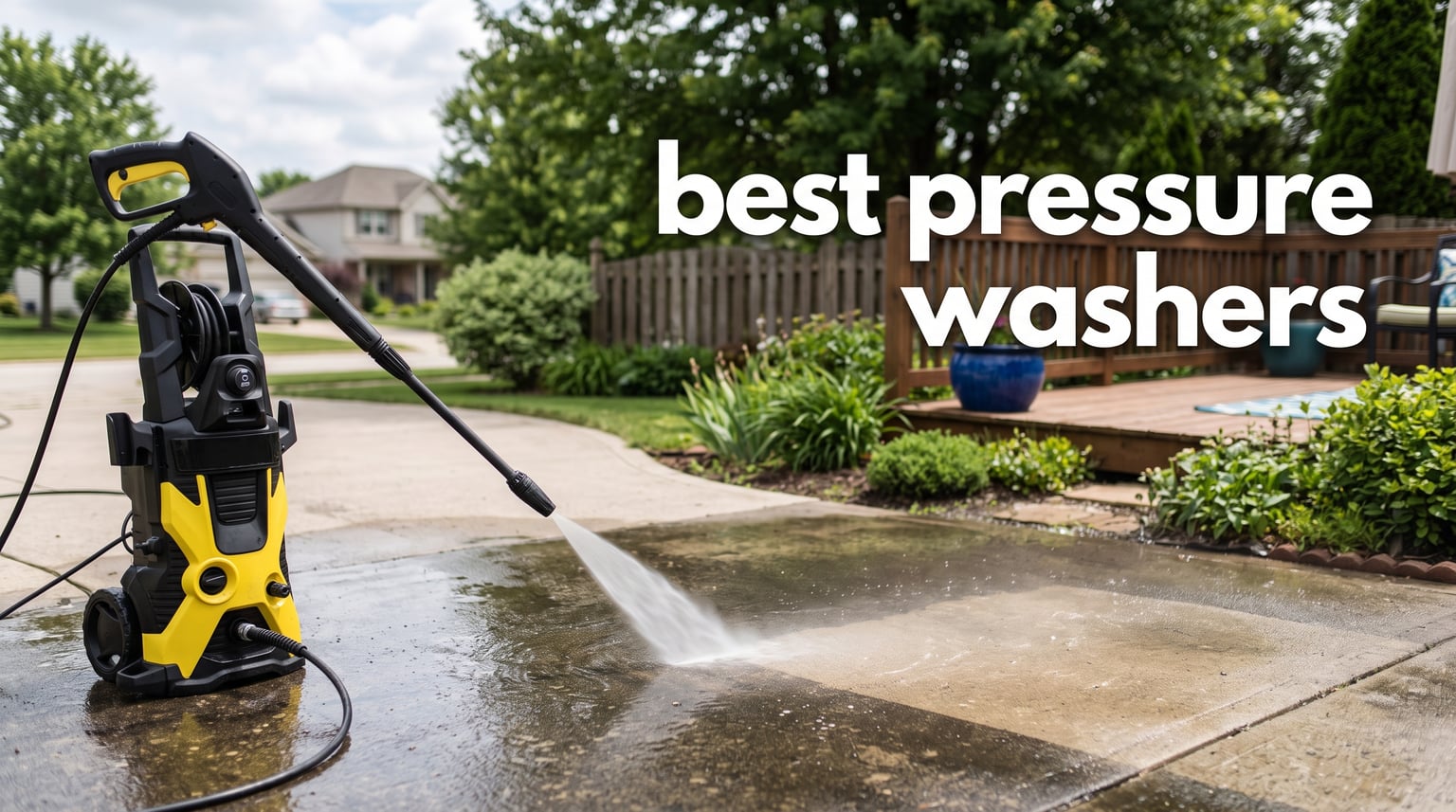
The best pressure washers make outdoor cleanup faster, but the right one is not simply the machine with the largest PSI number. A compact electric model can be the sensible answer for vehicles and patio furniture, while a gas machine with more water flow makes more sense when a long driveway or stubborn concrete is on the list.
For this 2026 guide, I compared all eight supplied models by their stated PSI, GPM, power source, hose reach, nozzle selection, motor or engine details, warranty information, and buyer-feedback summaries. PSI describes the force that breaks grime loose, while GPM tells you how quickly water carries it away.
My short version is simple: choose electric for quieter, lower-maintenance home work near an outlet; choose gas when water flow, range, and large hard surfaces matter more. We also looked at storage size, cord or hose reach, pump care, and the need to protect a pump from freezing temperatures.
Table of Contents
Top 3 Picks – Best Pressure Washers in 2026
These three picks give most homeowners a clear starting point. The Westinghouse WPX3000e is the broadest electric choice in this set, the ePX3100v is easier to carry and store, and the Simpson brings substantially higher water flow for larger exterior jobs.
Best Pressure Washers in 2026 Comparison
Use the comparison below to narrow the field by output and design before reading the longer reviews. The first three electric Westinghouse figures are maximum claims; their listed rated PSI and GPM are lower, so compare stated operating ratings when judging real-world workload.
| Product | Specifications | Action |
|---|---|---|
 Westinghouse ePX3100v Westinghouse ePX3100v |
|
Check Latest Price |
 Westinghouse WPX3000e Westinghouse WPX3000e |
|
Check Latest Price |
 Westinghouse WPX3400e Westinghouse WPX3400e |
|
Check Latest Price |
 Simpson Clean Machine CM61456 Simpson Clean Machine CM61456 |
|
Check Latest Price |
 aaculpet 3500 PSI Gas aaculpet 3500 PSI Gas |
|
Check Latest Price |
 Greenworks 1800 PSI Greenworks 1800 PSI |
|
Check Latest Price |
 Ezasin 3500 PSI Gas Ezasin 3500 PSI Gas |
|
Check Latest Price |
 Westinghouse WPX3000 Gas Westinghouse WPX3000 Gas |
|
Check Latest Price |
1. The Westinghouse ePX3100v is the compact pick for routine home cleanup
Westinghouse ePX3100v Electric Pressure Washer, 2100 Max PSI 1.76 Max GPM, Built-in Carry Handle, Detachable Foam Cannon, Pro-Style Steel Wand, 3-Nozzle Set, for Cars/Fences/Driveways/Home/Patios
2100 max PSI
1.76 max GPM
18 pound electric
Pros
- Very compact
- Easy carry handle
- Foam cannon included
- Auto-stop pump
Cons
- Lower rated output
- 20 foot hose
The ePX3100v is the model I would put first for someone who wants a small, grab-and-go electric pressure washer rather than a wheeled machine taking up floor space. Its stated 17.6-pound weight, built-in carry handle, and 15 by 8.5 by 11 inch body make that choice easy to understand.
Westinghouse lists 2100 maximum PSI and 1.76 maximum GPM, alongside 1800 rated PSI and 1.2 rated GPM. This is suited to cars, fences, patio furniture, and regular light grime, not the fastest route through a stained concrete expanse.
The detachable foam cannon separates detergent application from the rinse pass. The three-nozzle set gives fewer pattern options than some larger units, so begin at a wider spray angle and step closer only when the surface tolerates it.
The 20-foot nylon-braided hose and auto-stop pump address everyday convenience. Auto-stop stops the pump when the trigger is released, and the three-year limited warranty adds useful coverage.
This small machine is a sensible fit for apartments, cars, and limited storage
Pick this Westinghouse when carrying the washer from a closet, garage shelf, or small trunk matters as much as cleaning force. A nearby outdoor outlet and modest work area match its electric layout and 20-foot hose.
For car paint, use the soap or a broad fan pattern, stand well back at first, and avoid aiming at damaged paint, badges, seals, or delicate trim. The pressure washer for cars question is more about nozzle distance and technique than simply chasing a PSI rating.
This compact design is less suitable when driveways and long work zones are the priority
The supplied data does not position the ePX3100v as a high-flow concrete machine, and its rated 1.2 GPM will take longer to rinse broad areas than a 2.3 or 2.5 GPM gas model. A longer extension lead must be outdoor-rated and safely managed around water.
Users who often work far from power or need a turbo nozzle should look toward the larger models in this guide. Keep hose routing gentle during use and storage; enthusiasts often report that standard hoses can feel stiff or kink.
2. The Westinghouse WPX3000e is the most balanced electric option for mixed exterior jobs
Westinghouse WPX3000e Electric Pressure Washer, 3000 Max PSI and 1.76 Max GPM, Induction Motor, Onboard Soap Tank, Spray Gun and Wand, 5 Nozzle Set, for Cars/Fences/Driveways/Homes/Patios/Furniture
3000 max PSI
1.76 max GPM
Induction motor
Pros
- Induction motor
- Five nozzles
- 25 foot hose
- Steel frame
Cons
- 36.8 pounds
- Needs outlet
The WPX3000e earns the electric editor’s-choice position because it combines a stated 2600 rated PSI with an induction motor, a 25-foot super-flex hose, and a steel frame on 10-inch never-flat wheels. That is a practical step up from a carry-style washer when driveways, fences, siding, and patios share the same machine.
Westinghouse states 3000 maximum PSI and 1.76 maximum GPM, but its listed rated flow is 1.1 GPM. I would plan around the rated numbers rather than treating the maximum headline as continuous output.
The five quick-connect tips include 0-degree, 15-degree, 25-degree, soap, and turbo options. A turbo tip can reduce time on tough hard-surface dirt, but it concentrates the spray, so test it away from wood fibers, paint, window seals, and soft masonry.
The 0.45-gallon onboard soap tank is useful for siding or patio detergent, while the 35-foot GFCI cord adds reach from the outlet. Its 36.8-pound listed weight is manageable on wheels, though less convenient for lifting up steps than the ePX3100v.
This electric configuration works best for homeowners who want one versatile corded washer
This is my clear all-round electric choice for a home with accessible exterior outlets and a varied maintenance list. The induction motor, frame, hose length, soap tank, and nozzle set give it a complete package without gas-engine tasks.
Start with the 25-degree tip for general cleaning, reserving 15-degree or turbo work for durable surfaces after a cautious test. The detergent tank can make a siding or patio routine more orderly, but rinse detergent according to its directions.
This corded setup is not the best match for remote lots or nonstop commercial workloads
The WPX3000e’s cord limits it to safe access to GFCI-protected power, and its specified flow does not match the 2.3 to 2.5 GPM gas choices for large-area rinsing. Its axial three-piston auto-stop pump is a homeowner design, not a serviceable triplex pump for frequent professional duty.
For a long concrete drive, water volume can matter more than a peak PSI claim. Forum users phrase the principle well: PSI lifts, GPM washes, which is why a gas model can finish a broad surface faster.
3. The Westinghouse WPX3400e is the strongest electric choice for demanding home cleaning
Westinghouse WPX3400e Electric Pressure Washer, 3400 Max PSI and 2.0 Max GPM, Brushless Motor, Onboard Soap Tank, Spray Gun and Wand, 5 Nozzle Set, for Cars/Fences/Driveways/Homes/Patios/Furniture
3400 max PSI
2 max GPM
Brushless motor
Pros
- Brushless motor
- 2 max GPM
- Five nozzles
- Steel frame
Cons
- Requires outlet
- Rated flow is 1.1 GPM
The WPX3400e is for the homeowner who wants the highest stated performance in this electric group without changing to fuel power. Its brushless electric engine, 3400 maximum PSI, 2 maximum GPM, steel frame, and 10-inch never-flat wheels make it the more serious electric package.
As with its WPX3000e sibling, the supplied specification separates maximum from rated output: 3000 rated PSI and 1.1 rated GPM. That distinction prevents a peak number from becoming the whole buying decision.
The washer includes an axial three-piston auto-stop pump, a 0.45-gallon soap tank, a 25-foot super-flex hose in the feature set, and five quick-connect nozzles. These details give useful flexibility across detergent work, routine rinsing, and stubborn hard-surface spots.
A brushless motor avoids brush wear found in brushed motors. The hose, gun, nozzle, connections, and pump still need draining, inspection, and freeze protection.
This high-output electric model suits frequent driveway, fence, and patio maintenance near power
Choose it when you want an electric pressure washer with a substantial frame and motor design, and your work stays within reach of a protected outlet. The extra stated maximum output and 2 maximum GPM can appeal to users moving beyond occasional vehicle washing.
For decks, stay with a broad pattern, low pressure, and a consistent sweep; aggressive spray can raise wood grain or leave marks. The soap tank and broad nozzle selection support a sequence of pretreating, rinsing, and targeted cleaning.
This large electric platform is a poor fit when portability and remote operation matter most
The listed dimensions of 25.9 by 19.3 by 37.4 inches indicate a tall wheeled unit, not a small shelf-stored washer. There is no supplied weight, so I would not assume it is easy to lift simply because it rolls.
Its cord remains a hard boundary, and a gas unit is better for distant concrete work when fuel, noise, emissions, and engine service are acceptable. Keep all electrical connections dry and elevated.
4. The Simpson Clean Machine CM61456 is the clearest gas pick for large residential surfaces
Simpson Clean Machine 3200 PSI Gas Pressure Washer, 2.5 GPM, Turbo Nozzle
3200 PSI
2.5 GPM
174cc gas engine
Pros
- 2.5 GPM flow
- Turbo nozzle
- Low-oil shutdown
- Welded steel frame
Cons
- Gas maintenance
- Unavailable in California
The Simpson Clean Machine has the best stated flow rate in this roundup at 2.5 GPM, paired with 3200 PSI. For a big driveway, patio, or siding job, that flow advantage helps flush loosened dirt from a wide area more quickly.
Its 174cc engine has low-oil shutdown, and the OEM Technologies axial cam pump feeds a 25-foot high-pressure hose. Simpson also includes a built-in soap tank, four quick-connect tips, a turbo nozzle, 12-inch never-flat wheels, and a powder-coated welded steel frame.
The turbo nozzle is the standout accessory, with a warning attached. Its oscillating water jet can speed up durable concrete cleaning, but it is too concentrated for painted siding, delicate vehicle surfaces, or weathered wood.
At 50 pounds, this machine is far more mobile on its wheels than in the air. The warranty arrangement is two years for the engine, one year for the pump, five years for the frame, and 90 days for accessories.
This gas model is the better answer for sizable driveways and hard-surface cleaning days
Pick the Simpson when long hose-and-wand sessions on concrete are expected and you value 2.5 GPM over push-button electric start. It suits a homeowner comfortable checking oil, adding fuel, and following engine service instructions.
The 25-foot hose and large wheels give useful working range, while the frame is built for rolling around an outdoor work area. Run it outdoors only and follow the manual for ventilation, fuel handling, and cool-down time.
This gas machine is not the right choice for quiet jobs, indoor storage without preparation, or California buyers
It is listed as 49-state compliant and unavailable in California, so location is an immediate screening point. Gas engines also create more noise and exhaust than electric units, which can be a poor neighborly fit for short car washes or compact yards.
Gas ownership asks for regular oil checks and seasonal care. In freezing climates, drain water from the pump and use appropriate pump protection before storage; frozen water can damage an axial pump.
5. The aaculpet 3500 PSI gas washer offers high stated pressure and a large soap tank
Pros
- High stated output
- 3L soap tank
- 25 foot hose
- Steel frame
Cons
- Ships without oil
- 49-state compliant
The aaculpet gas washer is a high-output alternative with stated 3500 PSI and 2.3 GPM from a 212cc, 7HP, four-stroke engine. Those figures place it in the heavy-duty end of this eight-model group for driveways, decks, paint preparation, and similar outdoor tasks named in its listing.
Its 25-foot hose, steel frame, 10-inch wheels, and four quick-connect nozzles provide a familiar wheeled gas layout. The nozzle selection is 0-degree, 25-degree, 40-degree, and soap, which covers spot work, general cleaning, gentle rinsing, and detergent application.
The 3-liter soap tank is larger than the 0.45-gallon tanks on the two larger electric Westinghouse models. That capacity can help during extended detergent stages, though detergent must suit both the washer and the surface type.
One setup detail is explicit in the product data: the engine ships without oil. Treat that as a pre-start check, along with checking hose and gun connections and running water through the system before starting the engine.
This high-pressure gas configuration is useful for users who need strong outdoor cleaning capacity
Choose this one if a 2.3 GPM gas flow rate, larger detergent reservoir, and 25-foot work hose match the projects you actually have. The 40-degree tip gives a gentler starting point for many surfaces, while 25 degrees is a general-purpose fan pattern.
The supplied data calls the frame steel and includes 10-inch wheels, so it is designed to move around a job rather than be carried. It weighs 55 pounds, which makes steps, vehicle loading, and storage access part of the decision.
This engine-powered washer needs more owner attention than a plug-in electric model
The listing identifies it as 49-state compliant, so verify availability and rules for your location before choosing it. It also brings the normal gas-machine responsibilities: fuel handling, engine oil, noise, exhaust, and off-season storage preparation.
The 0-degree nozzle is for tightly focused, durable-surface work, not a default setting. Begin with the least aggressive pattern that works, move steadily, and do not spray people, animals, electrical equipment, windows, or fragile materials.
6. The Greenworks 1800 PSI is the straightforward light-duty choice for simple household tasks
Greenworks 1800 PSI (1.1 GPM) Electric Pressure Washer PWMA Certified
1800 PSI
1.1 GPM
20 foot hose
Pros
- Push-button start
- 35 foot GFCI cord
- Turbo nozzle
- Three-year warranty
Cons
- Light-duty output
- Needs outlet
The Greenworks 1800 PSI is deliberately simple: it is rated at 1800 PSI and 1.1 GPM for light-duty residential cleaning, with push-button operation instead of gas-engine maintenance. It is a logical option for small patios, outdoor furniture, bicycles, vehicles, and routine touch-up work.
Its accessories include a 40-degree nozzle, turbo nozzle, soap applicator, 20-foot tangle-free hose, gun, and a 35-foot GFCI power cord. The 35-foot cord can help where the outlet is set back from the washing area, though the cord still needs dry routing.
Do not mistake a turbo nozzle for a reason to use this washer on every job. It gives concentrated action for tough spots, whereas the 40-degree fan is the safer default for delicate cleaning and car rinse work.
Greenworks provides a three-year limited warranty and a universal quarter-inch quick-connect system. Its 10.63 by 9.06 by 12.8 inch dimensions make storage one of its strongest practical advantages.
This light-duty electric washer is best for occasional cleaning and first-time owners
Choose it when you want a low-maintenance residential pressure washer for ordinary grime rather than deep restoration. Push-button start, no fuel, no spark plugs, and no oil changes reduce the preparation required for quick jobs.
The buyer-feedback summary is positive for ease of use and light cleaning, while also noting limits on heavier work. That aligns with the stated 1.1 GPM flow: it can clean, but broad dirty surfaces will take time.
This low-flow washer is not the answer for large concrete or serious stain removal
If a driveway is the major job, moving to a 2.3 or 2.5 GPM gas unit changes rinse speed considerably. For recurring siding, deck restoration, or extensive concrete work, one of the higher-output Westinghouse or gas choices is more appropriate.
Use a GFCI-protected outlet, keep plugs dry, inspect the cord, and shut down before changing accessories. Let water flow through the system before turning the machine on so the pump does not run dry.
7. The Ezasin 3500 PSI gas washer is a heavy-duty option with a 209cc engine
Ezasin Gas Powered Pressure Washer 3500 PSI – 2.3 GPM Heavy Duty High Power Washer,209CC 7HP Engine with 25Ft Pressure Hose, Axial Aluminum Pump, Soap Tank, 4 Quick Connect Nozzle (Black)
3500 PSI
2.3 GPM
209cc 7HP engine
Pros
- 2.3 GPM flow
- Four nozzle set
- 10 inch tires
- 25 foot hose
Cons
- 63 pounds
- Gas and oil service
The Ezasin is another 3500 PSI and 2.3 GPM gas option, using a 209cc 7HP four-stroke OHV engine with recoil start. Its listed specifications make it a plausible choice for homeowners who need heavy-duty outdoor capacity and accept engine maintenance.
The axial aluminum pump, 25-foot high-pressure hose, four quick-connect nozzle heads, and 10-inch tires are its key equipment details. Nozzles include 0-degree, 25-degree, 40-degree, and soap patterns, so it covers targeted hard-surface work through detergent application.
At 63 pounds, it is the heaviest product in the group with a listed weight. Measure your shed threshold, stairs, and vehicle-loading route before choosing a machine that heavy.
Dual front rubber pads are supplied for support and stability when it is parked. The product data also describes a long-lasting axial cam pump, which benefits from proper water supply, winterization, and not being left running without trigger use.
This robust gas washer fits large outdoor spaces where flow rate matters more than compact storage
Pick the Ezasin for driveways, decks, and outdoor hard surfaces when 2.3 GPM and a 25-foot hose better fit the work than a corded unit. A gas machine also avoids relying on an outlet across a large property.
The 40-degree nozzle should be the first check for less durable surfaces, and the soap nozzle is for applying detergent rather than forceful rinsing. Follow with a broad, controlled rinse rather than holding the wand in one place.
This 63-pound gas model is a poor match for people seeking quiet, low-maintenance ownership
Recoil starting, gasoline, oil service, exhaust, and a heavy frame add commitments that do not come with the lightweight electric models. It is better suited to owners who will use its capacity enough to justify those trade-offs.
Before cold-weather storage, disconnect water, purge the pump according to the manual, and protect it from freezing. This routine is one of the most useful reliability habits raised in homeowner discussions, because freeze damage can end a pump’s life early.
8. The Westinghouse WPX3000 Gas is the balanced gas option with large never-flat wheels
Westinghouse WPX3000 Gas Pressure Washer, 3000 PSI and 2.3 GPM, Spray Gun and Wand, 4 Nozzle Set, for Cars/Fences/Driveways/Homes/Patios/Furniture
3000 PSI
2.3 GPM
212cc OHV engine
Pros
- 2.3 GPM flow
- 12 inch wheels
- 25 foot hose
- Three-year coverage
Cons
- Gas maintenance
- Recoil start
The Westinghouse WPX3000 Gas combines 3000 PSI and 2.3 GPM with a 212cc four-stroke OHV horizontal-shaft engine. It is a balanced choice for users who want more rinse volume and travel range than a corded electric washer, without moving to the highest stated PSI figures in the group.
Its equipment list includes a maintenance-free axial cam pump, 25-foot abrasion-resistant super-flex hose, detergent siphon, four nozzles, and 12-inch high-profile never-flat wheels. Those large wheels are useful when rolling across rougher ground or driveway edges.
Westinghouse lists 0-degree, 25-degree, 40-degree, and soap quick-connect tips. Reserve the narrow 0-degree option for tightly controlled work on robust material and treat the 25-degree nozzle as the likely starting point for general hard-surface cleaning.
The model weighs 50.7 pounds and has three-year limited service, labor, and parts coverage. Its product data notes that a residual oil or fuel smell can occur from factory testing, so open-air setup and a pre-use inspection make sense.
This wheeled gas washer works best for homeowners who want high flow and easy yard mobility
Choose this Westinghouse if 2.3 GPM, a 25-foot hose, and 12-inch never-flat wheels line up with your driveway, fence, patio, or exterior-furniture workload. Its detergent siphon is useful for a pretreat-and-rinse workflow without carrying a bulky onboard tank.
The 212cc engine and fuel-powered design provide location flexibility, but only outdoors. Keep the work area clear, check oil and fuel according to the manual, and allow the engine to cool before refueling.
This gas platform is less suitable for car paint and quick low-noise touch-up sessions
A 3000 PSI gas washer can wash a car only with a very wide fan, generous distance, low-pressure detergent use, and disciplined technique. It is not the first choice for someone whose main task is delicate vehicle detailing.
For a quiet short job near a house outlet, an electric machine is easier to start, store, and maintain. Gas power brings more noise, exhaust, and seasonal attention, all of which should be part of the decision.
The right pressure washer depends on your surface, water flow needs, and tolerance for maintenance
Start by listing the two jobs you will actually do most often. A machine chosen for a single annual driveway cleanup will feel very different in day-to-day ownership from one chosen for regular car washing and patio furniture.
Electric pressure washers are best for quiet, nearby, light-to-medium home cleaning
Electric models start with a button, produce no engine exhaust at the point of use, and avoid gas, oil changes, air filters, and spark plugs. They suit cars, furniture, fences, small patios, and periodic siding work when a safe outdoor outlet is close.
The trade-offs are cord management, outlet dependence, and usually lower listed flow for broad hard surfaces. The 18-pound ePX3100v prioritizes carrying ease, while the WPX3000e and WPX3400e prioritize a framed, wheeled build and broader accessory set.
Gas pressure washers are best for large concrete areas and work far from an outlet
Gas machines in this guide list 2.3 to 2.5 GPM, a useful advantage when rinsing a wide driveway or patio. They also bring 25-foot hoses and large wheels, giving a better working radius on open outdoor properties.
The trade-off is fuel handling, oil checks, pull-start operation, exhaust, and more noise. A gas engine must run outdoors, and it needs seasonal care rather than being placed on a shelf after use.
PSI is the force that loosens grime, while GPM is the water volume that rinses it away
PSI means pounds per square inch, or the force of the spray. GPM means gallons per minute, or the volume moving through the nozzle; higher GPM generally means a faster rinse on broad surfaces once dirt has been loosened.
For light car and furniture work, start with a broad fan and a gentle approach rather than targeting the largest number. For ordinary home use, roughly 1800 to 3000 PSI covers many tasks, but nozzle angle, distance, surface condition, and GPM determine whether that power is helpful or harmful.
Cars, windows, screens, and outdoor furniture: use detergent or a 40-degree fan, stay back, and work from the least aggressive setting.
Decks and fences: use a broad fan, keep the wand moving, and test a hidden area before cleaning the whole surface.
Patios and ordinary concrete: a 25-degree fan is a practical start; use a turbo nozzle only on durable surfaces after testing.
Heavily soiled driveways: a 2.3 to 2.5 GPM gas washer can shorten rinsing time, but it still needs steady, overlapping passes.
Quick-connect nozzle choice protects surfaces as much as it changes cleaning speed
A 0-degree tip creates a narrow stream and should be treated as a specialist tool for durable, targeted spots. A 25-degree tip is useful for general hard surfaces, 40 degrees is more forgiving, and the soap nozzle is for low-pressure detergent application.
Turbo nozzles rotate a concentrated jet and can clean durable concrete quickly, but they are not for delicate work. Test first, stand farther away than you think necessary, keep moving, and reduce aggression before increasing it.
Axial cam pumps suit homeowner schedules, while triplex pumps target frequent serviceable use
Every gas washer in this guide and the two larger Westinghouse electric machines list an axial-style pump. Axial cam pumps are common in residential equipment and are generally designed around intermittent home use rather than constant professional service.
A triplex pump is a more serviceable design often preferred for repeated commercial work, but none of the supplied products lists one. The relevant choice is whether your job volume matches a homeowner machine and whether you will maintain it properly.
Storage, hoses, and winter care often decide whether a washer remains convenient to own
Measure the storage spot before buying. The tiny Greenworks and ePX3100v make sense in tight spaces, while the tall wheeled models and 50- to 63-pound gas units need a clear floor location and a practical route to the work area.
After each job, turn off the supply, relieve hose pressure, drain water as directed, and coil the hose without sharp bends. If the supplied hose feels restrictive for your setup, a compatible hose upgrade may be worth considering after confirming connection type and pressure rating.
For freezing conditions, never leave water in the pump. Follow the manufacturer’s storage instructions and use appropriate pump protection because freezing water can damage internal pump parts.
A consistent cleaning workflow makes results safer and more even
Clear loose items, close nearby windows, sweep away grit, and inspect the surface before starting. Connect the water supply, purge air through the gun before switching on the machine, and select the broadest nozzle that can do the task.
Apply detergent from the bottom upward where the detergent directions allow it, let it dwell for the stated time, then rinse from the top downward. Keep the spray moving in overlapping passes so one area does not receive far more force than the next.
For vertical siding, avoid forcing water behind laps, vent openings, or loose trim. For concrete, a consistent walking pace matters more than blasting a stain repeatedly; pretreating can reduce the temptation to use an overly narrow pattern.
Realistic maintenance expectations make the final choice clearer
Electric units still need nozzle cleaning, hose checks, dry electrical connections, and pump protection. Their advantage is that there is no gasoline engine to service, which lowers the routine burden for occasional users.
Gas units need those same water-system habits plus fresh fuel management, engine oil attention, and outdoor-only operation. If you will only clean a vehicle and a small patio a few times per season, the less demanding electric route is usually the more sensible choice.
FAQs
Which is the most reliable pressure washer?
Reliability depends on matching the washer to the workload and following storage rules. In this group, the Westinghouse WPX3000e stands out for an induction motor, steel frame, auto-stop pump, 25-foot hose, and three-year limited warranty. For frequent large concrete jobs, the Simpson adds a welded steel frame and high 2.5 GPM flow, but it also requires normal gas-engine and pump care.
Which type of pressure washer is best?
Electric is best for quiet, lower-maintenance work near a protected outlet, such as cars, furniture, fences, and patios. Gas is best for large driveways, remote work areas, and faster rinsing because the gas models here list 2.3 to 2.5 GPM. Choose by your normal surface and storage habits, not peak PSI alone.
Is 3000 PSI too much to wash a car?
A 3000 PSI machine can damage paint, trim, seals, or decals if a narrow nozzle is used close to the vehicle. Use low-pressure soap or a broad 40-degree fan, stand well back, keep the wand moving, and never start with a 0-degree or turbo nozzle. A lower-output electric washer is easier for most casual car-wash routines.
What PSI pressure washer is best for home use?
For broad home use, 1800 to 3000 PSI covers many tasks when paired with the correct nozzle and technique. Around 1800 PSI suits light furniture and vehicle cleaning, while 2600 to 3000 rated PSI suits tougher patios, fences, and durable hard surfaces. Also compare GPM: higher flow rinses large areas more quickly.
The best choice is the washer that matches your regular work rather than its biggest headline number
For the best pressure washers in 2026, I would start with the Westinghouse WPX3000e when you want a versatile electric machine with an induction motor, soap tank, useful hose length, and wheeled frame. The ePX3100v makes more sense when low weight and small storage are the deciding factors.
For serious driveway cleaning, the Simpson Clean Machine’s 2.5 GPM rating is the most compelling specification in this list. Choose any gas model only if its greater flow and outdoor range outweigh the added noise, emissions, engine service, and winter-storage work.
Before making a final selection, return to the eight-model overview and compare rated output, hose reach, nozzle kit, and storage footprint against the surfaces you clean most. That check will lead to a better purchase than choosing on PSI alone.