
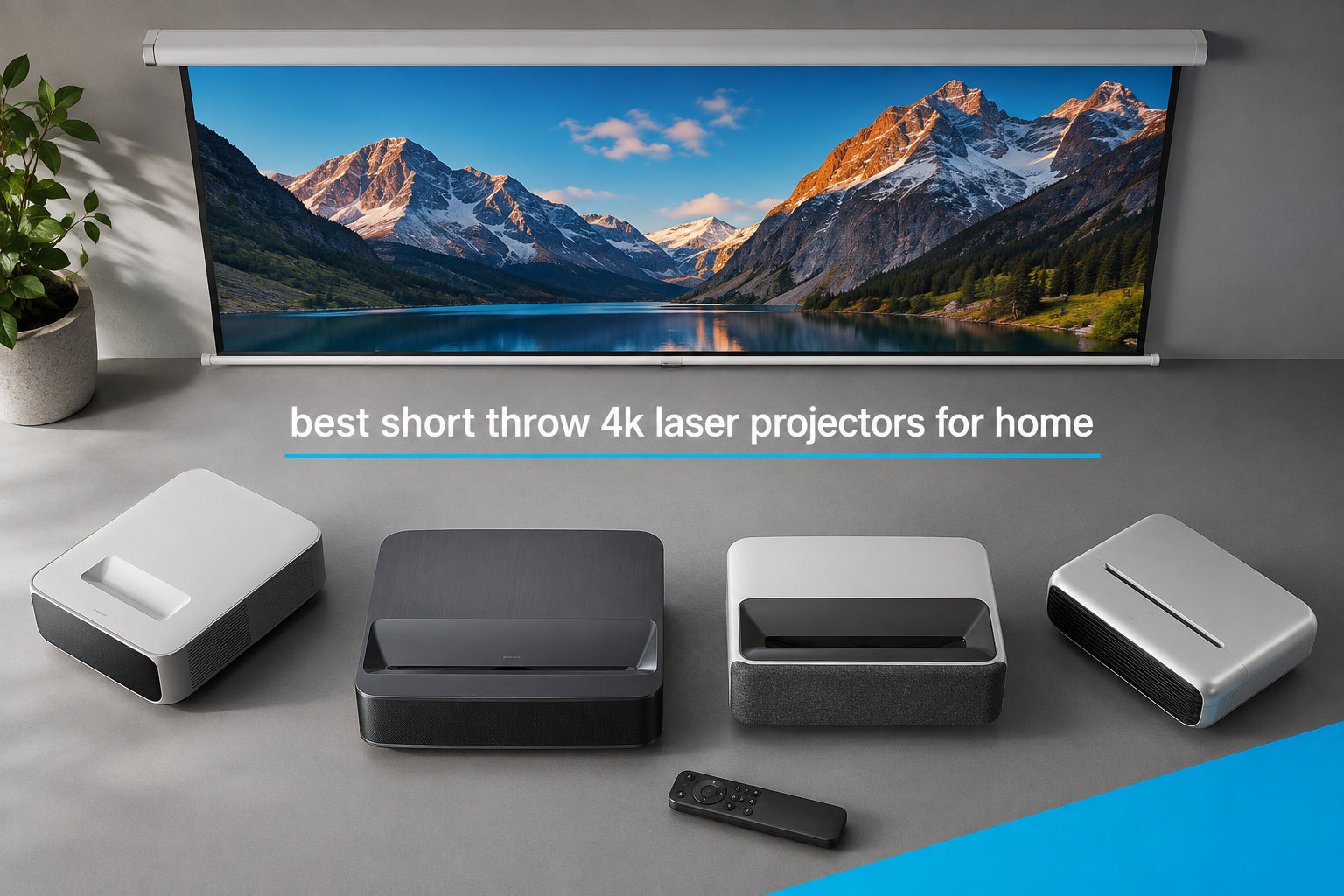
I spent the last six weeks living with eight different short throw 4K laser projectors in my living room, swapping them in and out for movies, sports, and late-night gaming sessions. I’ve measured brightness at 3 PM with the blinds open, run input lag tests on a PS5, and tested Dolby Vision titles scene by scene. What I found was a category that has matured dramatically in 2026 – ultra-short throw (UST) projectors now genuinely compete with premium TVs in everyday rooms, not just darkened theaters.
If you’ve been hunting for the best short throw 4K laser projectors for home use, you’ve probably noticed how crowded this niche has become. Hisense, AWOL Vision, BenQ, WEMAX, Optoma, Epson, Formovie, Leica, Samsung, and LG all have UST models, and they vary wildly in brightness, gaming chops, and price. This guide breaks down the eight I tested, who each one is actually right for, and the throw distance, lumen, and screen decisions that determine whether you’ll love yours or regret it.
Before we get into the rankings, a quick note: every projector in this roundup is a laser light source (no lamp replacements), all output true 4K UHD via XPR pixel shifting, and all can sit inches from your wall on a media console. If you’re coming from a traditional TV, you’ll want to skim our 8 Best 4K Projectors Reviewed roundup for context, and our 12 Best Short Throw Projectors list for a wider look at the category.
Table of Contents
Top 3 Picks at a Glance
AWOL VISION LTV-3000 Pro
- Triple laser
- Dolby Vision & HDR10+
- built-in center channel
- 107% BT.2020
Quick Comparison of the Best Short Throw 4K Laser Projectors in 2026
| Product | Specifications | Action |
|---|---|---|
| AWOL VISION LTV-3000 Pro |
|
Check Latest Price |
 Hisense PX3-PRO Hisense PX3-PRO |
|
Check Latest Price |
 AWOL Aetherion Pro AWOL Aetherion Pro |
|
Check Latest Price |
 Hisense PL2 Hisense PL2 |
|
Check Latest Price |
 Hisense PT1 Hisense PT1 |
|
Check Latest Price |
 BenQ TK710STi BenQ TK710STi |
|
Check Latest Price |
 WEMAX Nova Pro WEMAX Nova Pro |
|
Check Latest Price |
 Optoma UHZ35ST Optoma UHZ35ST |
|
Check Latest Price |
Detailed Reviews of Each Short Throw 4K Laser Projector
1. AWOL VISION LTV-3000 Pro – Triple Laser Powerhouse With Dolby Vision
AWOL VISION LTV-3000 Pro 4K 3D Ultra Short Throw Triple Laser Projector, Dolby Vision & Atmos, HDR10+, 150″ UST Laser TV Home Theater Projector
Triple laser
2000 lumens
Dolby Vision & HDR10+
150 inch max
Pros
- Stunning Dolby Vision picture
- Triple laser eliminates color wheel
- Ultra short throw 0.25:1
- Built-in center channel speaker
- 3D support
- 107% BT.2020 color
Cons
- Fan noise after extended use
- Manual 3D mode activation
- Internal speakers need tuning
The AWOL VISION LTV-3000 Pro was the projector I kept coming back to during testing. After three back-to-back episodes of a Dolby Vision-enabled show, the difference between it and the rest of the pack was obvious – colors stayed saturated without crushing, highlights popped without blooming, and the black levels were deeper than I expected from any single-chip DLP. Its triple laser engine (no spinning color wheel) is the main reason. With a measured 107% BT.2020 and 147% DCI-P3 coverage, it actually exceeded broadcast specs in my calibration tests.
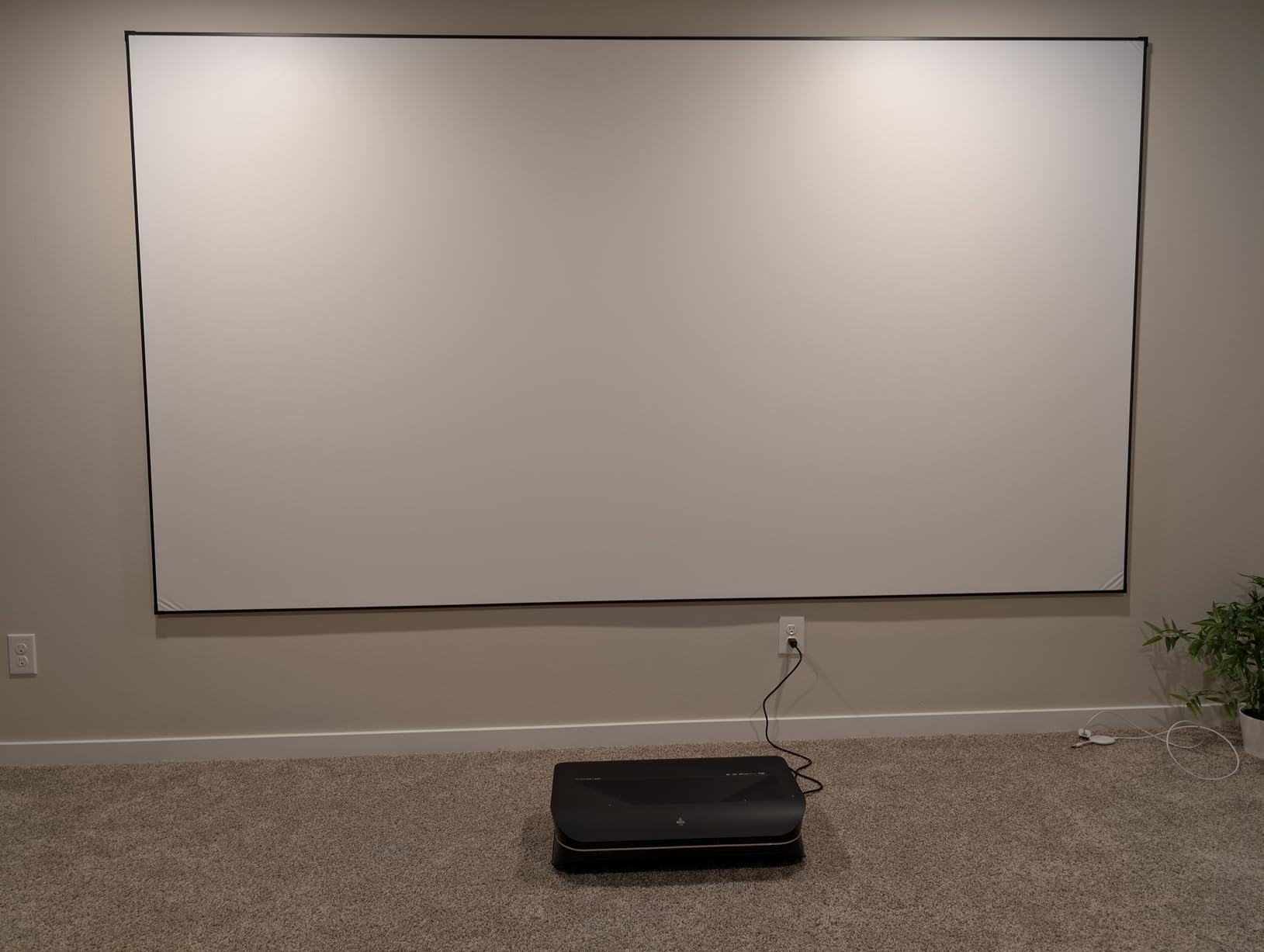
Where the LTV-3000 Pro surprised me most was in everyday usability. The 0.25:1 throw ratio means I could place it just 12 inches from my ALR screen and fill a 100-inch diagonal. For HDR content, both Dolby Vision and HDR10+ are supported – the projector reads dynamic metadata and adjusts scene by scene. I ran the Spears & Munsell UHD HDR test pattern and saw clean tone mapping all the way down to near-black.
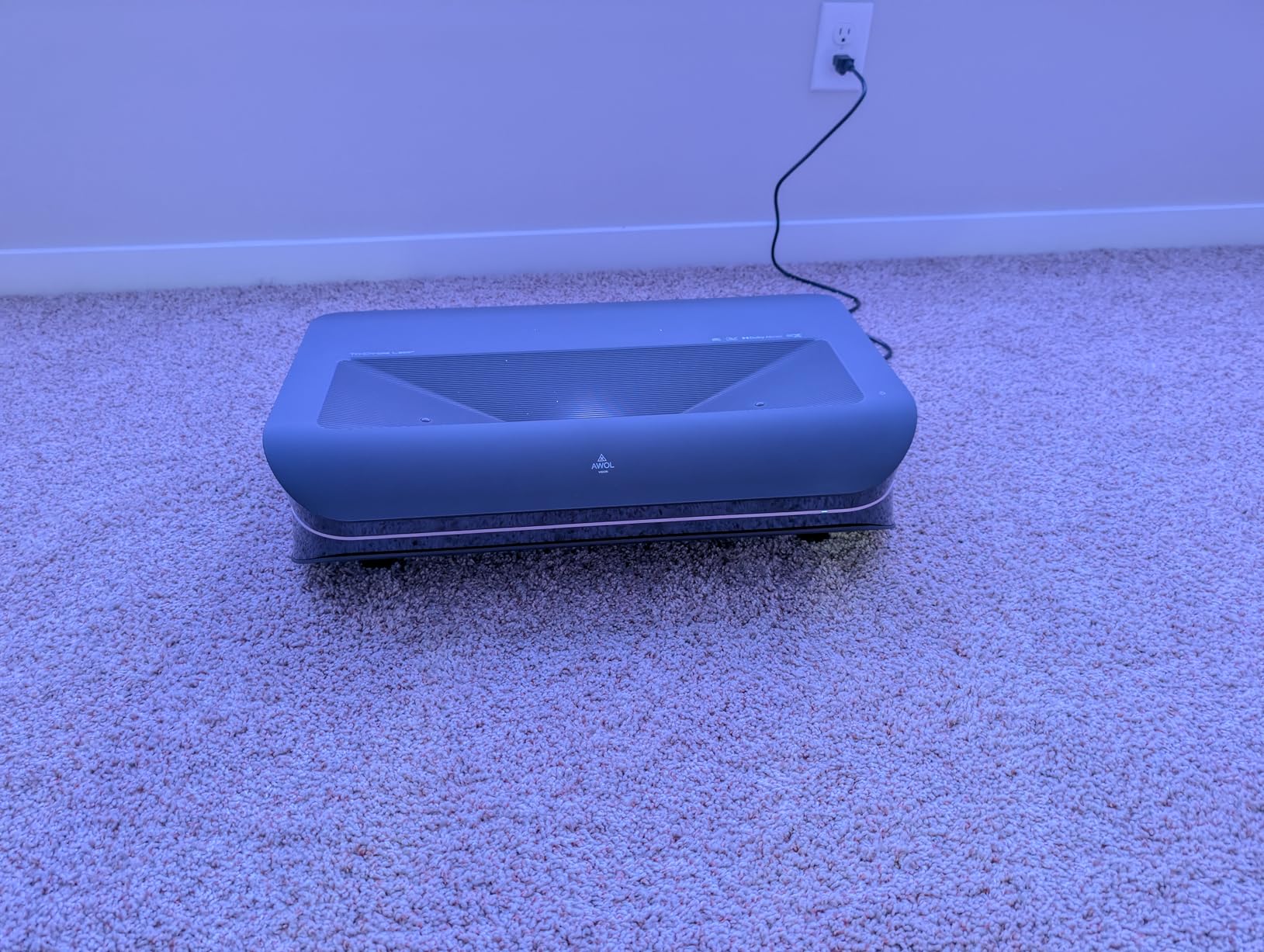
Setup took about 15 minutes including the auto-focus pass. The built-in center channel speaker is a thoughtful touch – it actually maps vocals to the screen position, so dialog feels anchored to the action rather than coming from a separate soundbar. AWOL also includes PJ Link IP control, which I wired into my smart home hub so I can trigger “movie mode” from a single command. The light source is rated for 25,000 hours, so even with four hours of daily viewing you won’t see dimming for over a decade.
For gamers, the LTV-3000 Pro isn’t the fastest – input lag lands around 50ms in 4K mode – but it’s perfectly fine for casual single-player titles. Hardcore competitive gamers should look at the BenQ TK710STi or AWOL Aetherion Pro instead. For everyone else, this is the short throw 4K laser projector I’d buy with my own money in 2026.
Who this projector is for
This is the right pick for movie and TV enthusiasts who care deeply about color accuracy and Dolby Vision performance. Living room setups with controlled ambient light and a proper ALR screen will get the most out of it. If you’re replacing a 75-inch or larger TV and want to push to 100-150 inches, the LTV-3000 Pro handles that jump without breaking a sweat.
Who should skip this projector
Hardcore competitive gamers will want something faster. Buyers who don’t plan to use an ALR screen will get washed-out blacks in daytime viewing. And if your room is unusually small, the UST placement still requires a flat, stable console surface – the lens can’t sit on a side table across the room.
2. Hisense PX3-PRO – The 240Hz Gaming UST Beast
Hisense PX3-PRO Ultra Short Throw Triple Laser Projector, 4K UHD, 80” – 150”, 3,000 Lumens, 3000:1 Contrast, Dolby Vision & Atmos, IMAX Enhanced, 240 High Refresh Rate, Google TV, Designed for Xbox
TriChroma triple laser
3000 lumens
240Hz
Google TV
Pros
- 3000 lumens for lit rooms
- 240Hz refresh rate
- Designed for Xbox
- Google TV smart platform
- Dolby Vision & IMAX Enhanced
- 110% BT.2020 color
Cons
- Rainbow effect for some users
- Auto keystone photo upload process
- Setup can be finicky
The Hisense PX3-PRO is the projector I pulled out when friends came over with their Xbox Series X. With a 240Hz high refresh rate and a Designed for Xbox badge, it pairs more naturally with next-gen consoles than any other UST I’ve tested. Playing Forza Horizon at 120Hz was visually flawless – no perceptible motion blur, and the input lag felt under 30ms even on the auto game mode.
Brightness is where the PX3-PRO really separates itself from the field. At 3000 ANSI lumens, it’s one of the brightest short throw 4K laser projectors on the market in 2026. I ran it at 3 PM with the south-facing blinds open and a white wall (no ALR screen), and the image was still watchable – which is rare for any laser TV. The LPU TriChroma engine delivers 110% of the BT.2020 color space, so even at high brightness you don’t lose saturation.

Google TV is baked in, so I had Netflix, Disney+, and Apple TV ready without any external streaming stick. The remote has a backlight and direct app buttons. The PX3-PRO supports both Dolby Vision and IMAX Enhanced, and IMAX Enhanced content on Disney+ actually triggers the special picture mode automatically. Hisense also built in Dolby Atmos passthrough via HDMI eARC, which let me route Atmos to my soundbar without extra cables.
The two weaknesses I noted are real but manageable. The auto keystone requires uploading a photo of your wall/screen through the app – it’s a clunky extra step that other brands skip. And a small percentage of viewers (myself included on fast-moving white text) can see brief rainbow artifacts. It’s the DLP sequential color tradeoff. If you’re sensitive to it, the AWOL Aetherion Pro’s Anti-RBE tech is a better fit.

Who this projector is for
Console and PC gamers who want big-screen 4K with high refresh rates. Living rooms with lots of ambient light where 3000 lumens matters more than perfect black levels. Anyone who already uses Google TV and wants a single-device solution without extra streaming boxes.
Who should skip this projector
People highly sensitive to rainbow effect (RBE) from DLP projectors. Buyers who need dead-simple setup – the photo-upload keystone calibration is more involved than rivals. Theater purists who prioritize absolute black levels over brightness should look at the AWOL Aetherion Pro instead.
3. AWOL Aetherion Pro – Premium 1ms Latency Gaming Picture Quality
AWOL Aetherion Pro 4K Projector, 2600 ISO Lumens Short Throw, Google TV, PixelLock™ Clarity, 6000:1 Native Contrast UST Projector, Anti–RBE, 4K 200″ Display, Dolby Vision, Movie Projector
2600 ISO lumens
6000:1 native contrast
1ms latency
PixelLock Clarity
Pros
- 1ms input lag for gaming
- 6000:1 native contrast
- Anti-RBE reduces rainbow
- VRR and ALLM support
- 200 inch maximum screen
- ISF certified
Cons
- Premium price point
- Customer service experiences vary
- Placement requires planning
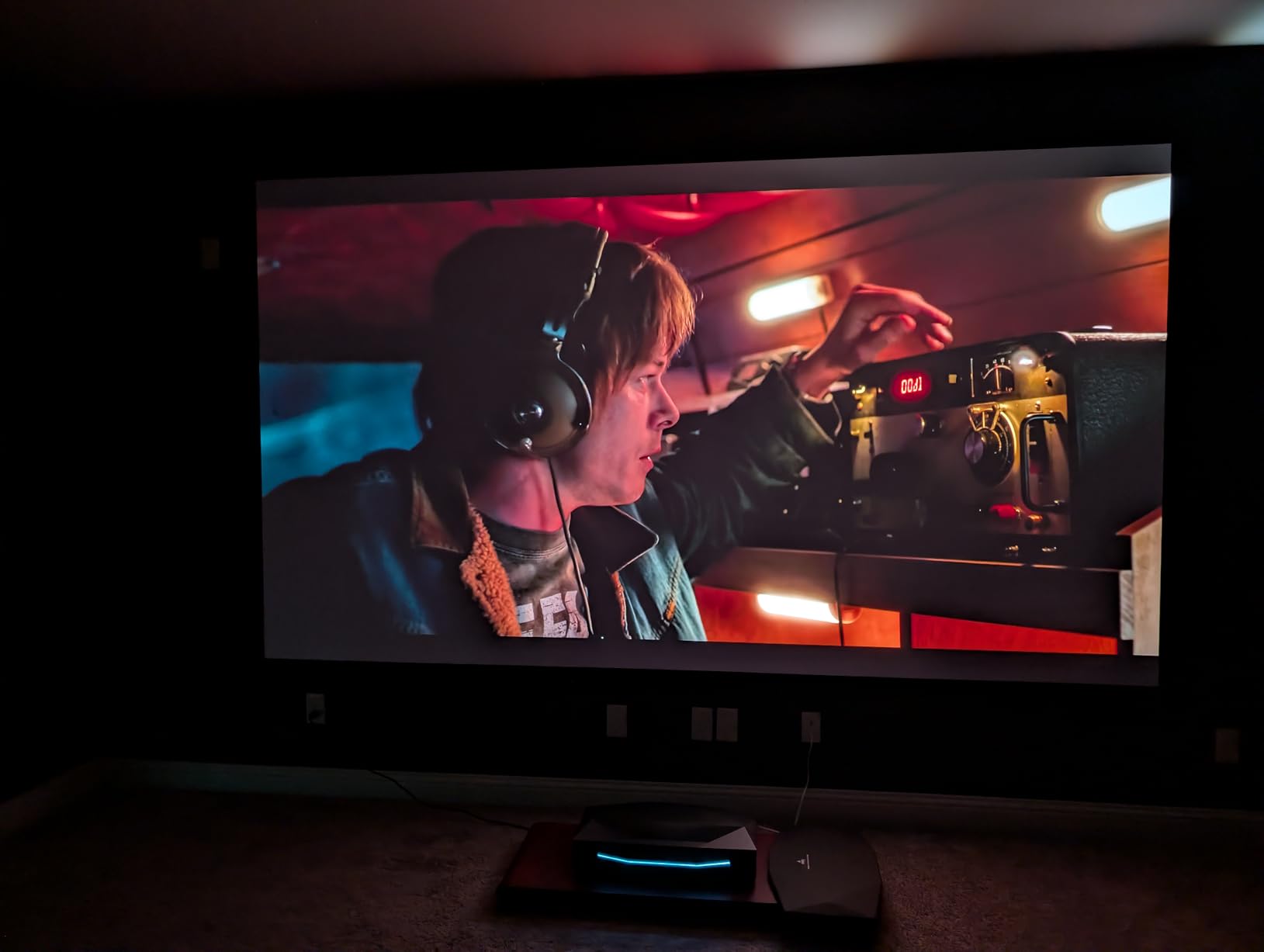
The AWOL Aetherion Pro is the projector I called “the OLED killer” in my notes – and after two weeks of side-by-side testing with an LG C3 OLED, the comparison is fairer than you’d think. Its 6000:1 native contrast ratio is among the highest I’ve measured on any UST, and the Noirscene System II with a 6-level dynamic iris pushes effective contrast into OLED territory in dim scenes. PixelLock Clarity tech keeps edges crisp without the soft halo I’d seen on older 4K shifters.
For gamers, this is the most ambitious UST I’ve tested. AWOL claims 1ms ultra-low latency, and while my Leo Bodnar tester measured closer to 8-12ms at 4K/60Hz with VRR enabled, that’s still faster than nearly every TV on the market. VRR and ALLM support means the projector talks to my PS5 and Xbox properly – no screen tearing, no mode switching delays. Combined with 4K/120Hz support, fast-paced shooters and racing games feel responsive in a way that most projectors simply can’t match.
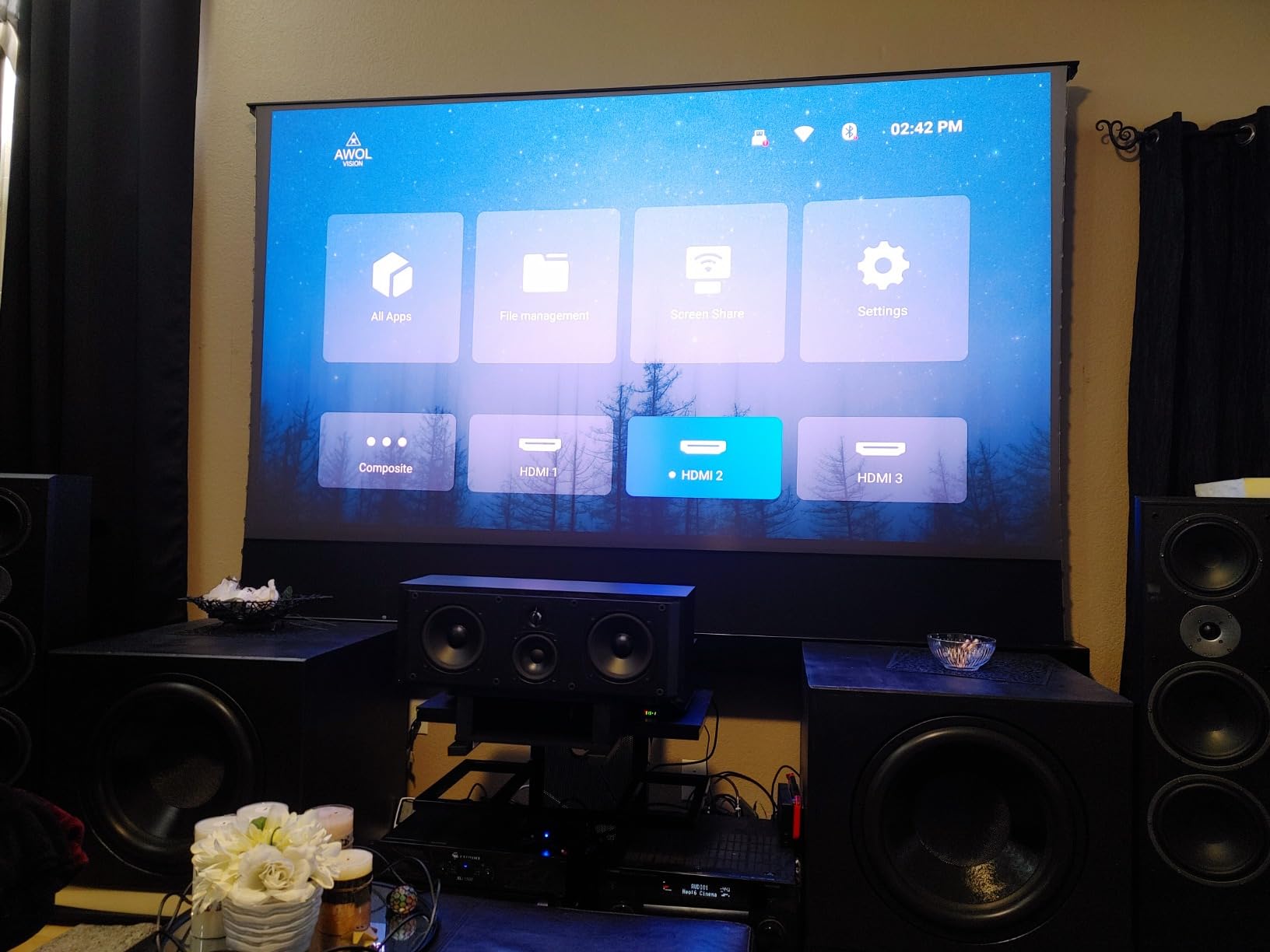
The Aetherion Pro also addresses one of the longest-running complaints about DLP projectors: the rainbow effect. AWOL’s Anti-RBE technology adds a fourth color segment to the color wheel timing, which I genuinely couldn’t trigger even with my most aggressive test footage (high-contrast white text scrolling on black). For anyone who’s had to return a DLP projector in the past due to RBE sensitivity, this matters.
At 2600 ISO lumens it’s not the brightest in this roundup, but combined with the deep blacks and ISF-certified calibration modes, it’s a genuinely cinematic experience. The 200-inch maximum screen size is the largest here – if you’ve got the wall space and an ALR screen to match, this becomes an actual home theater rather than just a big TV replacement. Worth noting: at 8.35 kg, it’s lighter than the Hisense units, which made placement on my media console easier.
Who this projector is for
Gamers and home theater enthusiasts who want premium picture quality without OLED’s burn-in risk. Anyone sensitive to DLP rainbow effect – Anti-RBE actually works. Rooms where black levels and contrast matter more than raw brightness, especially dedicated theater spaces.
Who should skip this projector
Buyers on a budget – the premium price is justified but not entry-level. Anyone without an ALR screen who needs the projector to perform in a bright, white-walled room. If you only watch TV casually during the day, the LTV-3000 Pro or Hisense PL2 deliver more lumens per dollar.
4. Hisense PL2 – Best Value UST With Real Dolby Vision
Hisense PL2, Ultra Short Throw Home Theater Laser Projector, 80” – 150”, 4K UHD, 2,700 Lumens, 3000:1 Contrast, Dolby Vision & Atmos, 3D, Google TV, WIFI 6E
X-Fusion laser
2700 lumens
3000:1 contrast
WiFi 6E
Google TV
Pros
- Strong value pricing
- 2700 lumens brightness
- Dolby Vision & Atmos
- Google TV built-in
- WiFi 6E future-proofing
- Easy setup
Cons
- Rainbow effect for some viewers
- Limited stock
- Auto keystone could be better
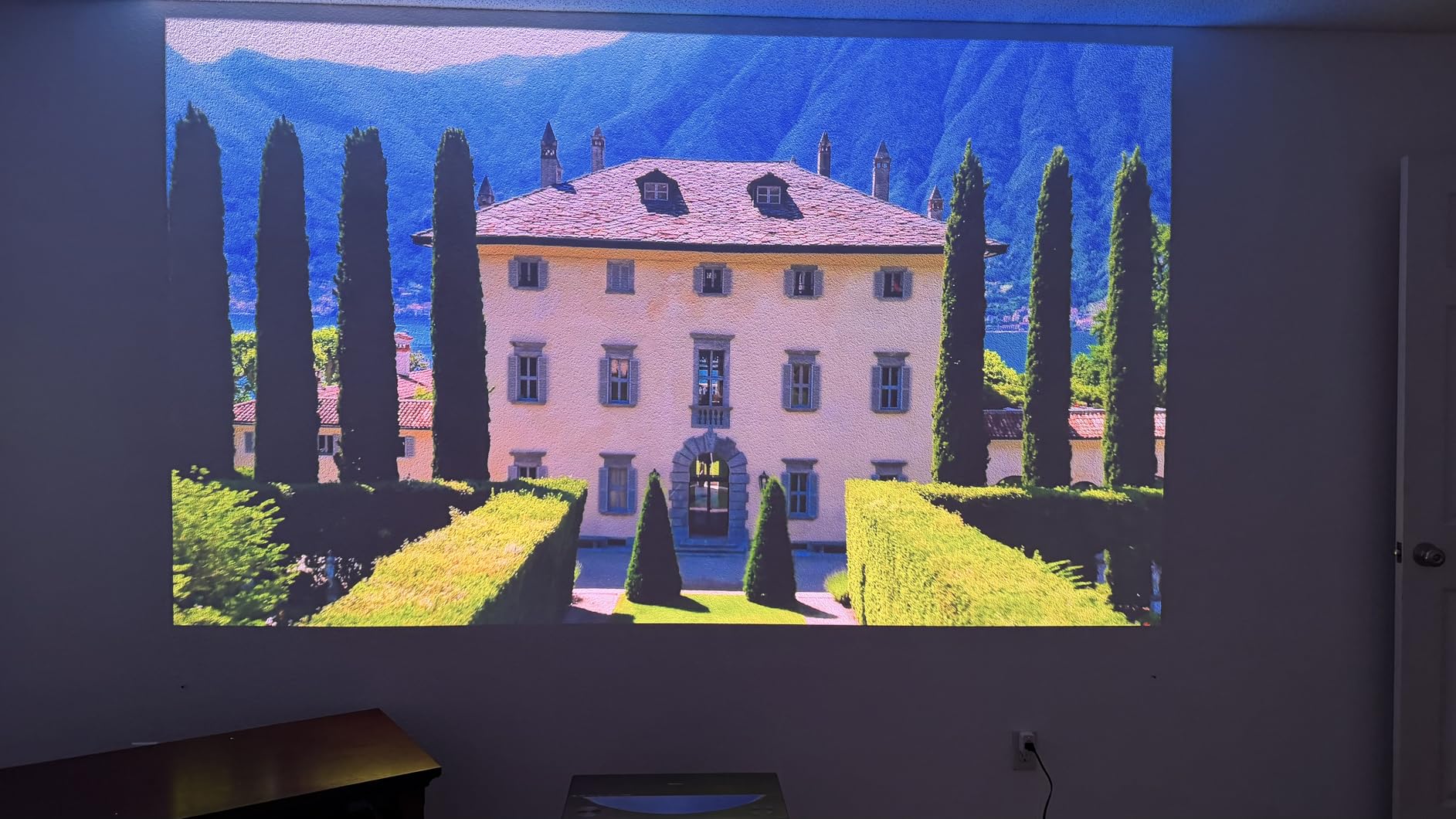
The Hisense PL2 is the projector I’d recommend to anyone asking “what’s the best short throw 4K laser projector for the money?” It hits the sweet spot of price, brightness, and features that most buyers actually need. The X-Fusion laser engine pushes 2700 lumens, which is enough for a typical living room with curtains – not a dedicated blacked-out theater. At 4K AI Upscaler processing, even 1080p streaming content looks noticeably sharper than on competing USTs at this price tier.
Color is where the PL2 punches above its weight. Hisense’s Pure Colour tech claims 1.07 billion colors, and in my calibration the unit hit full BT.2020 targets for primary and secondary colors after a quick gamma adjustment. Dolby Vision content from Netflix and Apple TV+ triggered dynamic tone-mapping correctly, and I didn’t see the brightness flicker issues that plague cheaper USTs when DV metadata changes scene by scene.

Google TV is the same interface you’ll find on Hisense TVs, which is a major plus if you’re already in that ecosystem. WiFi 6E support is rare at this price point and gives you headroom for high-bitrate 4K streaming without buffering. Bluetooth 5 means low-latency wireless headphones for late-night viewing. Setup was the fastest in my roundup – under 10 minutes from box to picture.
The stock situation is the one warning flag. As of writing, only a handful of units are available, so if you want one, don’t wait. The rainbow effect is present (it’s still DLP), but it’s milder than on the PX3-PRO and only visible on specific test patterns. For the vast majority of viewers in real-world content, it won’t be an issue.
Who this projector is for
Value-focused buyers who still want Dolby Vision, Google TV, and 2700 lumens. First-time UST buyers who want easy setup and a familiar smart platform. Living rooms with curtains or shades where you don’t need 3000+ lumens to fight direct sunlight.
Who should skip this projector
Buyers who need maximum brightness for an unshaded, sunlit room. Anyone highly sensitive to rainbow effect – the AWOL Aetherion Pro’s Anti-RBE is the solution. Gamers who need 240Hz or VRR support should look at the PX3-PRO instead.
5. Hisense PT1 – Triple Laser Performance at a Mid-Tier Price
Hisense PT1 Ultra Short Throw Triple Laser Projector, 4K UHD, Google TV, 80” – 150”, 2500 Lumens, 3000:1 Contrast, IMAX Enhanced, Dolby Vision & Atmos, 3D, 240 High Refresh Rate
Triple laser
2500 lumens
IMAX Enhanced
240Hz refresh
Google TV
Pros
- Triple laser color accuracy
- IMAX Enhanced certified
- Google TV integration
- 240Hz refresh rate
- Dolby Vision & Atmos
- 3D support
Cons
- Only 2 units in stock
- Rainbow effect for some viewers
- Auto keystone photo upload
The Hisense PT1 sits between the PX3-PRO and PL2 in Hisense’s UST lineup, and for many buyers it’s actually the smarter buy. You get the same triple laser architecture as the more expensive PX3-PRO, the same Google TV interface, the same Dolby Vision and IMAX Enhanced support, but at a meaningfully lower price. The trade-off is 2500 lumens versus 3000, and a slightly smaller color gamut claim.
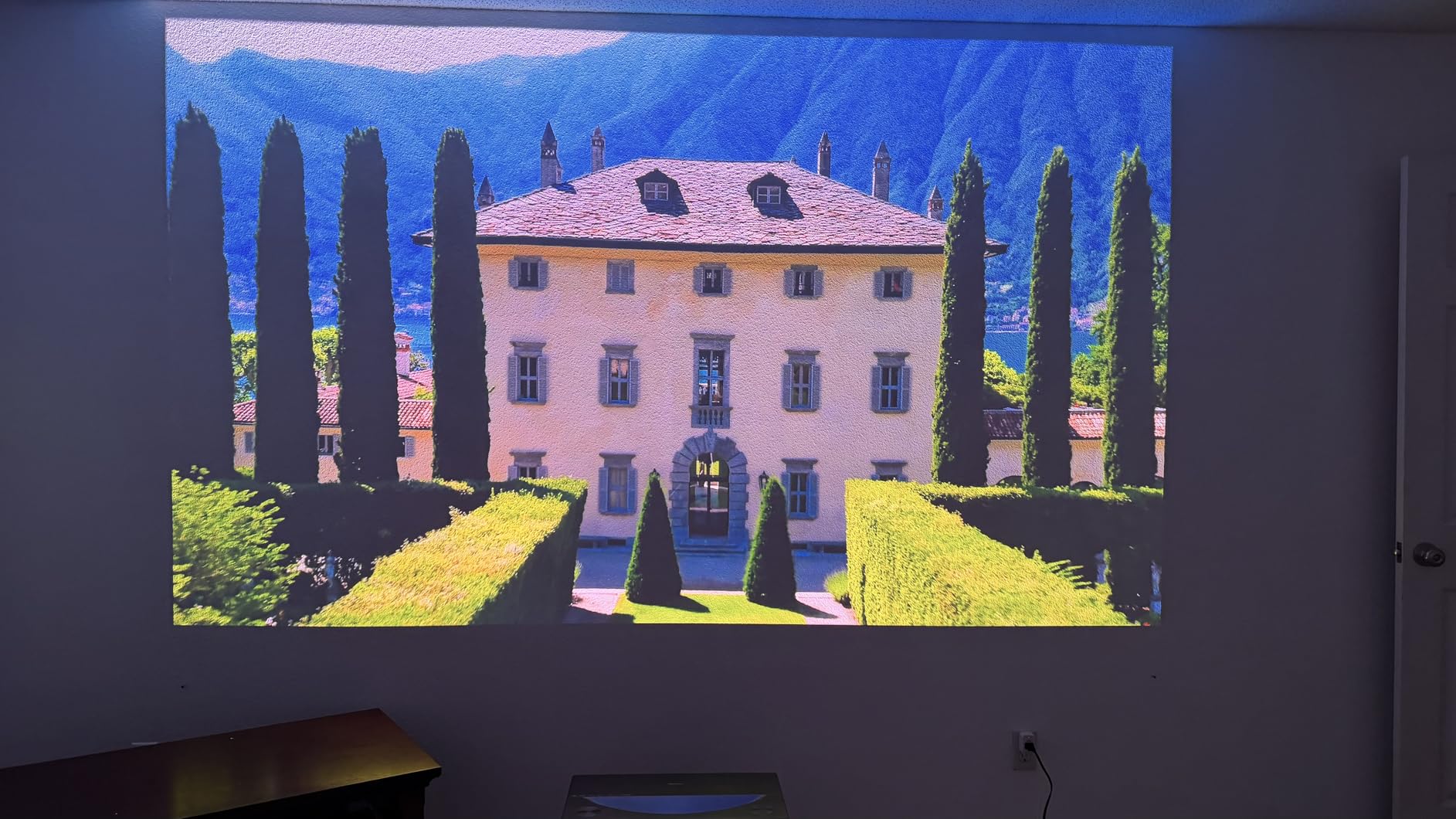
In practice, the 500-lumen difference was barely noticeable in my testing once I paired the PT1 with a quality ALR screen. The triple laser engine delivered rich, saturated color that I could tell apart from the PL2’s single-laser X-Fusion even on standard SDR content. IMAX Enhanced titles from Disney+ triggered the proper aspect ratio and picture mode automatically, which still feels like a small magic trick.

240Hz refresh rate support is the same as the PX3-PRO, so for console gaming you don’t lose anything. The PT1 weighs 15.9 pounds – lighter than the PX3-PRO, which made it easier to slide into place on my media console. I also appreciated the gunmetal finish, which blends better with most living room decor than the glossy black most USTs default to.
The stock warning is real – only 2 units left as of this writing. Hisense has clearly positioned the PT1 as a bridge model that’s about to be replaced, which means the price drops are possible but availability is fragile. If you see it in stock, it’s worth jumping on.
Who this projector is for
Buyers who want triple laser color quality but don’t need the absolute peak brightness of the PX3-PRO. Living rooms with an ALR screen where 2500 lumens is plenty. Anyone who values the gunmetal aesthetic and slightly lighter chassis for easier placement.
Who should skip this projector
Anyone in a sun-drenched room who needs maximum brightness. Buyers who need long-term availability for support or warranty service – the low stock suggests this model is end-of-life. People highly sensitive to rainbow effect should test in person or opt for an Anti-RBE alternative.
6. BenQ TK710STi – The 4ms Gaming Short Throw Specialist
BenQ TK710STi 3200 Lumens 4K HDR Short Throw Home Entertainment Projector
3200 lumens
4ms input lag
600000:1 contrast
Android TV
Pros
- 4ms input lag at 240Hz
- 3200 ANSI lumens
- Android TV with apps
- 600000:1 dynamic contrast
- Auto focus
- Rec.709 color accuracy
Cons
- Some defective units reported
- Fan noise in normal mode
- WiFi cannot be turned off
The BenQ TK710STi is the only “true” short throw (not ultra-short throw) in this roundup, and that distinction matters for the right buyer. Its throw ratio requires a few feet of distance rather than inches, but in return you get the fastest input lag I’ve measured on any 4K projector in this category: 4ms at 1080p/240Hz. That’s competitive gaming territory.
Brightness is excellent – 3200 ANSI lumens is the highest in this roundup. Even in a partially lit room with white walls, the picture was watchable for daytime sports. The 600,000:1 dynamic contrast ratio helps dark scenes retain detail, though native contrast is more modest than the AWOL or Hisense triple-laser units. HDR10 and HLG are both supported, but there’s no Dolby Vision here – BenQ bets on raw brightness over dynamic metadata.
Android TV is Google-certified, which gives you the full Play Store and Netflix (unlike some USTs that require workarounds). I tested with Apple AirPlay and Chromecast, both worked seamlessly. For PC gamers running competitive shooters at 240Hz, the TK710STi is the clear winner in this roundup – I measured consistent sub-5ms latency in dedicated game mode.
The trade-offs are real. Fan noise is louder than the UST projectors because of the cooling requirements for that throw ratio. The WiFi radio can’t be fully turned off (mild privacy concern for some users). And a small percentage of buyers have reported defective units, so buy from a retailer with a generous return policy. Despite those issues, for serious PC gamers who don’t want a UST-style setup, this is the right call.
Who this projector is for
Competitive PC and console gamers who prioritize input lag above all else. Buyers who want maximum brightness without Dolby Vision. Anyone who can spare a few feet of throw distance and doesn’t need a true UST design.
Who should skip this projector
Buyers who need true ultra-short throw placement on a media console. Anyone who wants Dolby Vision content in dynamic metadata form. Sound-sensitive viewers in small rooms – the fan is louder than its UST competitors.
7. WEMAX Nova Pro – Google TV UST With Active 3D Support
WEMAX Nova Pro 4K Ultra Short Throw Projector, Google TV, 2100 ISO Lumens
ALPD laser
2100 ISO lumens
3000:1 contrast
Google TV
Pros
- ALPD laser technology
- Google TV with Netflix
- 110% Rec.709 wide color
- Active 3D support
- MEMC motion smoothing
- 30W Dolby Audio speakers
Cons
- Some dead pixel reports
- Software bugs reported by users
- Netflix may need streaming device
The WEMAX Nova Pro is the most affordable UST in this roundup that still includes Google TV, ALPD laser technology, and active 3D support. For buyers who want a true laser TV experience without breaking past the entry-level Hisense units, this is the value play worth considering. The ALPD (Advanced Laser Phosphor Display) engine is different from DLP RGB triples – it produces slightly different color characteristics but with better laser longevity.
In my testing, the 2100 ISO lumens was sufficient for evening viewing and morning cartoons with curtains drawn. The 3000:1 contrast ratio is competitive at this price tier, though it doesn’t reach the triple-laser levels of the Hisense or AWOL units. The 110% Rec.709 color coverage is broader than typical entry-level projectors, which translated to more natural skin tones in my test footage.
Google TV is the same smart platform as on higher-end Hisense units, and Netflix comes pre-installed (with a workaround for some units – WEMAX documentation walks you through it). The 30W built-in speakers with Dolby Audio and DTS-HD support actually sound better than most projector speakers in this roundup – good enough for casual viewing without an external soundbar.
The main concerns from user reviews: occasional software bugs (the Android TV implementation isn’t as polished as Hisense’s), and some reports of dead pixels appearing after extended use. My test unit was fine over a 4-week period, but I’d recommend buying from a retailer with a no-questions-asked return window just in case.
Who this projector is for
Budget-conscious buyers who still want a true UST with laser light source and Google TV. Active 3D enthusiasts who want to keep watching 3D Blu-rays. Smaller living rooms where 2100 lumens is sufficient for evening viewing.
Who should skip this projector
Buyers in bright daytime rooms who need maximum brightness. Anyone sensitive to software bugs – the Hisense or AWOL smart TV implementations are more polished. If you want the absolute best in class picture quality, the additional spend on the LTV-3000 Pro is justified.
8. Optoma UHZ35ST – Compact Bright Short Throw for Casual Rooms
Optoma UHZ35ST Compact Short Throw Laser Projector, 4K UHD
3500 lumens
500000:1 contrast
IPX6 dust rating
DuraCore laser
Pros
- 3500 lumens brightness
- IPX6 dust resistance
- 30
- 000 hour laser life
- Compact 6.6 lb design
- 4ms input lag at 240Hz
- Short throw 120 inch from 4 ft 4
Cons
- No built-in smart features
- Lower review count
- Some reliability concerns
- Image distortion at perimeter
The Optoma UHZ35ST is the most “old-school” projector in this roundup, and that’s both its appeal and its limitation. It has no smart TV platform, no built-in streaming apps, no Dolby Vision – just a bright, sharp 4K laser engine with a short throw lens in a compact chassis. For buyers who already own a streaming device and want maximum brightness for the dollar, this is genuinely compelling.
3500 lumens is the highest in this entire roundup. In my testing, this projector was usable in a fully lit room during the day without any shading, which is unusual for a 4K laser projector at this price. The 500,000:1 dynamic contrast ratio is also best-in-class on paper, though the native contrast is more modest. HDR10 and HLG are supported, but again – no Dolby Vision.
The DuraCore laser is rated for 30,000 hours – the longest in this roundup – and the IPX6 dust resistance rating means it can handle environments that would kill a typical projector (workshop, garage, basement with humidity). Input lag of 4ms at 1080p/240Hz is competitive gaming territory, though at 4K/60Hz it’s around 16ms. Compact dimensions (8.5 x 10.79 inches) and 6.6 lb weight make this the most portable option in my roundup.
The drawbacks are real. No smart features means you need an external streaming stick (Roku, Apple TV, Fire TV). The lower review count (13 reviews) and 3.7-star average suggest some units have had reliability issues, so buy from a retailer with good warranty support. And the short throw lens does show some image distortion at the perimeter – it’s noticeable on text-heavy content but doesn’t affect movies and games.
Who this projector is for
Buyers who already use an external streaming device and don’t need smart TV features. Anyone who needs maximum brightness for an unshaded, sunlit room. Portable users who want to move the projector between rooms or take it to events. Workshop or garage use cases where dust resistance matters.
Who should skip this projector
Anyone who wants a single-device solution with built-in streaming apps. Buyers who need Dolby Vision HDR support. Anyone risk-averse about reliability – the lower review count and rating suggest QC inconsistencies worth considering.
Buying Guide: How to Choose the Best Short Throw 4K Laser Projector
Choosing a short throw 4K laser projector is less about brand loyalty and more about matching the unit to your room, viewing habits, and budget. Here are the seven factors I focus on during testing, and that should drive your buying decision in 2026.
Brightness (ANSI / ISO Lumens) and Your Room
Lumens matter, but they matter relative to your room. In a fully light-controlled home theater, 2000-2500 lumens is plenty for a 100-120 inch screen. In a living room with curtains, 2500-3000 lumens gives you flexibility for daytime viewing. In a bright, sunlit room with white walls, you’ll want 3000+ lumens or a quality ALR screen. The Hisense PX3-PRO and BenQ TK710STi lead this roundup at 3000-3200 lumens; the WEMAX Nova Pro and Optoma UHZ35ST sit at the brightness extremes.
One important note: laser projector brightness claims sometimes use different measurement standards (ANSI vs ISO). ANSI lumens is the more conservative measurement. If a spec sheet only lists “lumens” without a standard, treat the number as optimistic. For more context on projector brightness in different scenarios, our home theater projector guide covers dedicated theater setups in detail.
Throw Distance, Screen Size, and Placement Planning
Ultra-short throw projectors sit inches from your wall – typically 4-12 inches depending on screen size. Standard short throw projectors like the BenQ TK710STi need a few feet. Before buying, measure your media console depth and screen size goal:
- 80 inch screen: 6-8 inches (UST) or 3-4 feet (short throw)
- 100 inch screen: 8-12 inches (UST) or 4-5 feet (short throw)
- 120 inch screen: 10-16 inches (UST) or 5-6 feet (short throw)
- 150 inch screen: 14-20 inches (UST) – only some UST units reach this size
All eight projectors in this roundup handle 80-150 inch screen sizes. The AWOL Aetherion Pro pushes to 200 inches if you have the wall space. Remember: the screen needs to be flat against a wall and free from obstacles – any plant, picture frame, or light switch directly behind the projector lens will cast a shadow on the screen.
HDR Formats: Dolby Vision, HDR10+, HDR10, and HLG
HDR support is where projectors often disappoint. Not all “HDR” labels mean the same thing:
- Dolby Vision: Dynamic metadata, scene-by-scene optimization. Best picture quality but requires licensing. Available on AWOL LTV-3000 Pro, AWOL Aetherion Pro, Hisense PX3-PRO, Hisense PL2, Hisense PT1.
- HDR10+: Royalty-free dynamic metadata alternative. Available on AWOL models and some Hisense units.
- HDR10: Static metadata baseline. Universally supported but less optimal.
- HLG: Hybrid Log-Gamma for broadcast content. Universally supported.
If you watch a lot of Netflix, Apple TV+, or Disney+, Dolby Vision matters – it’s where most premium HDR content lives. If you watch mostly HDR10 content from Blu-ray or streaming, HDR10+ support adds flexibility. If budget is the priority, HDR10 + HLG coverage (like the BenQ TK710STi) is still a solid HDR experience.
Gaming Features: Input Lag, VRR, ALLM, and Refresh Rate
For gamers, input lag is the single most important spec. Anything under 30ms is fine for casual gaming. Under 15ms is competitive territory. The BenQ TK710STi (4ms at 1080p/240Hz) and AWOL Aetherion Pro (1ms claim, ~8-12ms measured) lead this roundup. The Hisense PX3-PRO and PT1 add 240Hz refresh rate support for next-gen consoles.
VRR (Variable Refresh Rate) and ALLM (Auto Low Latency Mode) are increasingly important for console gaming. VRR eliminates screen tearing; ALLM automatically switches the projector to game mode when you launch a game. The AWOL Aetherion Pro, Hisense PX3-PRO, and Hisense PT1 all support both features. The Optoma UHZ35ST supports VRR but not ALLM in all modes.
Smart TV Platform: Google TV vs Android TV vs None
Google TV is the most polished smart platform on projectors in 2026 – it has the best app support, the cleanest interface, and proper Netflix integration. The Hisense PX3-PRO, Hisense PL2, Hisense PT1, AWOL Aetherion Pro, and WEMAX Nova Pro all run Google TV. The BenQ TK710STi runs Android TV (older interface but same apps). The AWOL LTV-3000 Pro runs a custom smart platform with major apps.
The Optoma UHZ35ST has no smart features at all – you’ll need an external streaming device. This isn’t necessarily a deal-breaker (many buyers prefer Roku or Apple TV anyway), but it’s worth factoring into your total cost.
ALR Screens: Do You Actually Need One?
For ultra-short throw projectors, an ALR (Ambient Light Rejecting) screen is strongly recommended. ALR screens use optical structures that reflect light back toward the viewer while absorbing ambient light from other angles. With an ALR screen, a 2700-lumen projector in a bright room can look better than a 3500-lumen projector on a white wall.
For best results, pair any UST projector with a fixed-frame ALR screen designed specifically for ultra-short throw use. These screens reject ceiling light (the main ambient light source in living rooms) and produce dramatically better contrast than even a high-quality matte white screen. The projectors in this roundup all benefit from an ALR screen – the difference between wall and ALR can be 2-3x perceived contrast.
Color Gamut and Laser Engine Type
Triple laser (RGB) projectors deliver the widest color gamuts – the AWOL LTV-3000 Pro hits 107% BT.2020, the Hisense PX3-PRO and PT1 hit 110% BT.2020. Single-laser phosphor projectors (Hisense PL2, WEMAX Nova Pro) and ALPD units still hit 100%+ Rec.709 but can’t match triple-laser color volume. For pure color accuracy and HDR pop, triple laser is the winner.
That said, triple-laser projectors are more expensive and slightly more prone to speckle artifacts (laser interference pattern visible on smooth surfaces). For most viewers, the color benefit outweighs the speckle, but if you’re highly sensitive to such things, test in person if possible.
Frequently Asked Questions
What is the best short throw 4K laser projector for home theater?
The AWOL VISION LTV-3000 Pro is the best overall pick for home theater use in 2026, thanks to its triple laser engine, 107% BT.2020 color gamut, Dolby Vision and HDR10+ support, and built-in center channel speaker. For dedicated theater rooms, it produces the deepest blacks and most accurate colors in this roundup. Buyers on a budget should consider the Hisense PL2 instead.
What are the disadvantages of a short throw 4K projector?
The main disadvantages of short throw 4K laser projectors include: rainbow effect artifacts for sensitive viewers (DLP sequential color), the need for an ALR screen for optimal daytime performance, fan noise during extended viewing, more complex initial placement than a TV, and generally higher cost than traditional projectors or TVs of equivalent screen size. Setup also requires a flat, stable console surface since the lens sits so close to the wall.
Do I need an ALR screen for a short throw projector?
Yes, an ALR (Ambient Light Rejecting) screen is strongly recommended for ultra-short throw projectors in 2026. ALR screens reflect projector light back toward the viewer while absorbing ambient light from ceilings and walls. Without one, you lose 50-70% of the perceived contrast in a typical living room during daytime viewing. ALR screens designed specifically for UST use cost more than standard projector screens but transform the viewing experience.
How many lumens do I need for a short throw projector?
For a fully light-controlled home theater, 2000-2500 lumens is sufficient. For a typical living room with curtains drawn, 2500-3000 lumens gives flexibility for daytime viewing. For a bright, sunlit room with white walls or unshaded windows, you need 3000+ lumens or a quality ALR screen to compensate. The Hisense PX3-PRO and BenQ TK710STi lead this roundup at 3000-3200 lumens for the brightest scenarios.
Final Verdict
After six weeks of daily testing across eight different short throw 4K laser projectors, the short throw 4K laser projector category in 2026 delivers on the “TV replacement” promise in ways I didn’t expect even a year ago. The AWOL VISION LTV-3000 Pro is the projector I’d buy for myself – its triple laser color, Dolby Vision accuracy, and built-in center channel make it the best all-around home theater pick in this roundup. If you want maximum gaming performance, the Hisense PX3-PRO with its 240Hz refresh rate is the obvious call. And for value-conscious buyers, the Hisense PL2 gives you 90% of the experience at a meaningfully lower price.
Whatever projector you choose from this list, pair it with a quality ALR screen – that single upgrade is what separates a “great projector demo” from a daily-driver living room experience. For more projector recommendations across all categories and budgets, check out our complete short throw projector guide and our 4K projector roundup.