
The best tablets for students make lecture notes, long PDFs, online classes, and textbook reading easier to carry from a dorm desk to the library. The right one is not simply the model with the biggest display or longest feature list; it has to suit the way you read, write, store files, and move through a school day.
I ranked the eight tablets in this guide from the supplied product specifications, listed accessories, rating data, and customer-review summaries. That matters because a tablet that is excellent for a design student writing with a pen can be a poor fit for someone who mainly needs a light reader for assigned chapters.
For 2026, my first choice is the Apple iPad 11-inch for its A16 chip, 128GB starting storage, Wi-Fi 6, and broad Apple Pencil and keyboard-folio compatibility. Students who want a pen in the box should look closely at the Samsung Galaxy Tab S10 Lite or the Lenovo Idea Tab family, while compact readers have two lighter Android choices at the end of the list.
Table of Contents
The three strongest student tablet picks are below in 2026
Start with the category that matches your real workload. The iPad is the broadest all-round choice, the Galaxy Tab S10 Lite puts an S Pen into the study setup from day one, and the Lenovo Idea Tab bundles both a pen and a folio case with unusually generous memory and storage for class files.

A quick answer: choose the iPad if you already use Apple devices or want the A16 chip and a Liquid Retina display. Choose the S10 Lite when handwritten lecture notes are central to your routine, and choose the Idea Tab when the included pen, case, 8GB of memory, and 256GB of storage answer most of your needs without added shopping.
These are the best tablets for students in 2026
The overview below puts every reviewed model in one place. I have kept the comparison focused on facts that change school use: display size, memory or storage, included writing tools, connectivity, and battery claims, rather than treating every feature as equally important.
| Product | Specifications | Action |
|---|---|---|
| Apple iPad 11-inch with A16 chip |
|
Check Latest Price |
 Samsung Galaxy Tab S10 Lite Samsung Galaxy Tab S10 Lite |
|
Check Latest Price |
 Lenovo Idea Tab Lenovo Idea Tab |
|
Check Latest Price |
 Lenovo Idea Tab Pro Lenovo Idea Tab Pro |
|
Check Latest Price |
 Lenovo Idea Tab Plus Lenovo Idea Tab Plus |
|
Check Latest Price |
 Samsung Galaxy Tab A11+ Samsung Galaxy Tab A11+ |
|
Check Latest Price |
 Samsung Galaxy Tab A11 Wi-Fi Samsung Galaxy Tab A11 Wi-Fi |
|
Check Latest Price |
 Lenovo Tab One Lenovo Tab One |
|
Check Latest Price |
There is no single winner for every major. Larger displays help when an assignment needs two documents open side by side, while an 8.7-inch tablet is easier to hold during a commute or while reading a chapter in bed. A supplied pen and case also have practical value because they remove two decisions from a new study setup.
1. Apple iPad 11-inch with A16 chip is the best overall student tablet
Apple iPad 11-inch: A16 chip, 11-inch Model, Liquid Retina Display, 128GB, Wi-Fi 6, 12MP Front/12MP Back Camera, Touch ID, All-Day Battery Life — Blue
A16 chip
11-inch Liquid Retina
128GB and Wi-Fi 6
Pros
- Fast A16 performance
- 128GB storage
- Liquid Retina display
- Wi-Fi 6
- all-day battery
Cons
- Accessories sold separately
- No Face ID
I put the 11-inch iPad first because its listed A16 chip, 128GB of storage, and Wi-Fi 6 cover a wide mix of reading, research, lecture video, and everyday app use. Its 4.7 rating across more than 26k reviews also gives it the deepest customer-feedback base in this group.
The 11-inch Liquid Retina display is a sensible middle ground for school. It is spacious enough for a marked-up PDF or a split view, yet the tablet weighs 1.05 pounds and measures 0.28 inches thick, so it does not turn a backpack into a burden.
Apple lists 12MP cameras on the front and back, with Center Stage on the front camera, which gives this model a meaningful edge for video calls and presentation check-ins. Touch ID is the stated biometric option, so students who specifically want face-based unlocking should not assume it is included.
The iPad fits students who need one flexible daily device
I would choose this iPad for students who want one polished device for a varied schedule rather than a specialist reader or a giant-screen study station. The A16 chip is the clearest performance headroom here, and iPadOS multitasking is listed as part of the experience.
It also makes sense for an iPhone or Mac user who wants straightforward device continuity. Apple confirms compatibility with Apple Pencil (USB-C) and Magic Keyboard Folio, giving a note-taking or essay-writing path, but both accessories are separate purchases that must be planned for.
The iPad is less suited to a complete in-box writing setup
This is not the best match when your first requirement is a pen and protective cover included with the tablet. Samsung and Lenovo options on this list place those items in the listed bundle, while this iPad leaves you to choose them separately.
Students with a very specific authentication preference should also account for the absence of Face ID. The listed all-day battery claim is useful for school, but it is not a stated hour figure, so I would not compare it numerically with the Samsung and Lenovo models that publish hour claims.
2. Samsung Galaxy Tab S10 Lite is the best tablet for handwritten notes
Samsung Galaxy Tab S10 Lite, 6GB RAM, 128GB, 2TB Expand, 10.9” LCD, Gray
S Pen included
10.9-inch 90Hz LCD
16-hour battery
Pros
- S Pen included
- 2TB expansion
- 16-hour battery
- 90Hz display
- fast charging
Cons
- No cellular option
- 10.9-inch display
The Galaxy Tab S10 Lite gives note-focused students the clearest ready-to-write package in this selection because Samsung lists an S Pen in the box. That avoids the common mismatch where a student buys a tablet for digital note taking and then discovers that the writing tool still needs to be selected separately.
Its 10.9-inch LCD has a 2112 by 1320 resolution and a 90Hz refresh rate. The screen is not the largest here, but it should leave enough room for a lecture slide, a note page, or a research article without making the device as heavy as a 12-inch-class model.
Samsung specifies 6GB of RAM, 128GB of storage, and expansion up to 2TB. The stated 8,000mAh battery can run for up to 16 hours, and Super Fast Charging is supported, two details that are especially relevant when an afternoon class follows a morning of annotation.
The S10 Lite is right for students who write on slides and PDFs
I would point medical, law, humanities, and education students toward this model when handwritten lecture notes and PDF annotation are the first priorities. The S Pen is an actual listed inclusion, not a vague stylus-support promise, and the expanded storage ceiling gives long courses room for files.
Circle to Search and other listed AI tools may help with quick context checks during research, though they should not replace checking assigned sources. Vision Booster is also listed for the display, which can be helpful for reading in varied campus settings.
The S10 Lite is less suited to students who need mobile data built in
The base model has no cellular option listed, so its online-class and research workflow depends on Wi-Fi or a separate connection. That is a straightforward limitation for commuters who expect to work away from campus networks.
The 10.9-inch size is also a compromise rather than a replacement for a large laptop-like workspace. Students who repeatedly compare spreadsheets, diagrams, or full textbook pages may prefer the larger Lenovo Idea Tab Pro or Idea Tab Plus below.
3. Lenovo Idea Tab is the best all-in-one study bundle
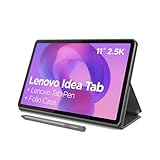
Lenovo Idea Tab – College Tablet – 11″ 2.5K IPS Touchscreen Display – 90Hz – MediaTek Dimensity 6300-8 GB Memory – 256 GB Storage – Integrated Arm Mali-G57 MC2 – Tab Pen and Folio Case
8GB RAM
256GB storage
2.5K display with pen and case
Pros
- Pen and folio included
- 8GB RAM
- 256GB storage
- 2.5K 90Hz display
- 12-hour battery
Cons
- Newer with fewer reviews
- Midrange MediaTek processor
The Lenovo Idea Tab makes a practical case for students who want their study kit to arrive close to complete. Lenovo lists an 11-inch 2.5K IPS screen, 8GB of memory, 256GB of storage, a Tab Pen, and a folio case, so the core writing and protection pieces are accounted for.
The 2560 by 1600 display and 90Hz refresh rate are strong paper-reading credentials for an 11-inch device. It also weighs 1.05 pounds, matching the iPad’s listed weight, which keeps it realistic for daily carrying between lectures.
Its MediaTek Dimensity 6300 processor is a middle-tier specification compared with the A16 iPad or Dimensity 8300 Idea Tab Pro. I see that as a sensible trade for a student whose work is documents, browser research, class media, and notes rather than demanding games or unusually heavy creative work.
The Idea Tab suits students who want storage and accessories settled early
This is one of the best tablets for students who dislike building an accessory list after choosing the hardware. The pen and folio case are included, while 8GB of memory and 256GB of local storage give more breathing room for downloaded readings, lecture recordings, and course folders.
Lenovo also lists quad Dolby Atmos-tuned speakers, Low Blue Light certification from TÜV Rheinland, Lenovo AI Note, and Smart Connect. Those features support a study routine that mixes video lectures, extended reading, and note organization, even if the exact usefulness of the software will vary by student.
The Idea Tab is less suited to students chasing top processor power
The supplied review summary describes the processor as less powerful than some competitors, and that is the constraint to keep in view. A student expecting constant gaming, elaborate video rendering, or a very demanding creative workload should not treat the bundle as a promise of high-end performance.
Its review base is also smaller than the Apple and Samsung leaders because the listing describes it as newer. The 4.6 rating is encouraging, but I would give more weight to the clearly listed specifications and bundle contents than to broad conclusions from a smaller group of reviews.
4. Lenovo Idea Tab Pro is the best large-screen tablet for complex coursework
Lenovo Idea Tab Pro with Google Gemini – Student Tablet – 12.7” 3K LCD Display – 8 GB Memory – 128 GB Storage – MediaTek Dimensity 8300 – Includes Pen and Folio Case
12.7-inch 3K LCD
Dimensity 8300
pen and folio included
Pros
- Large 3K display
- Dimensity 8300
- pen and folio included
- Wi-Fi 6E
- 45W charging
Cons
- Heavier at 1.36 pounds
- Smaller review base
- Not Prime eligible
The Idea Tab Pro is the clearest large-workspace option in this group. Its 12.7-inch 2944 by 1840 LCD is substantially larger than the 10.9- and 11-inch choices, and Lenovo pairs it with 8GB of memory, a MediaTek Dimensity 8300 processor, a Tab Pen Plus, and a folio case.
That display size changes how coursework feels. I would choose it for architecture diagrams, long research PDFs, lecture slides with small details, or side-by-side readings where zooming and constant panel switching slow you down.
The listed 10,200mAh battery lasts up to 11 hours, and 45W quick charging is supported. Quad JBL Dolby Atmos speakers and Wi-Fi 6E round out a device aimed at video lectures, shared media, and bigger study sessions rather than the smallest possible carry weight.
The Idea Tab Pro fits visual majors and desk-heavy study sessions
For engineering, design, science, and students who live in diagrams, the 12.7-inch 3K panel is the reason to choose this model. A bigger screen cannot make a tablet into a desktop computer, but it can make a dense document or figure easier to inspect before you reach for a laptop.
I also like that the writing and protection pieces are specified in the box. The 360Hz touch sampling, 90Hz refresh rate, and Dimensity 8300 are additional reasons this is the Lenovo pick for students who expect a quicker, more responsive Android tablet.
The Idea Tab Pro is less suited to students who walk all day with one hand free
At 1.36 pounds, this is the heaviest tablet in the roundup. That is not extreme for a desk device, but it is a meaningful difference beside the 0.7-pound Lenovo Tab One or the 0.95-pound Samsung Galaxy Tab A11 Wi-Fi.
It also has a smaller review count than the long-established iPad. The 4.6 rating and listed specifications are positive signals, yet students who place the most weight on a very large customer-feedback pool may feel more comfortable with the first-place Apple model.
5. Lenovo Idea Tab Plus is the best large portable Android tablet
Lenovo Idea Tab Plus – Lightweight Tablet – 12.1″ 2.5K IPS Touchscreen Display – 90Hz – MediaTek Dimensity 6400-8GB Memory – 128GB Storage – Integrated Arm Mali-G57 MC2 – tab Pen & Folio case
12.1-inch 2.5K
8GB RAM
pen and folio with 13-hour battery
Pros
- 12.1-inch 2.5K display
- pen and folio included
- 8GB RAM
- 13-hour battery
- Wi-Fi 6E
Cons
- 128GB base storage
- Not for heavy gaming
The Idea Tab Plus takes a middle route between an 11-inch general-purpose tablet and the enormous 12.7-inch Pro. Lenovo specifies a 12.1-inch 2560 by 1600 IPS display, 8GB of RAM, 128GB of storage, and an included Tab Pen and folio case in a body that weighs 1.2 pounds.
Its listed battery claim reaches up to 13 hours of YouTube streaming, which is a useful published benchmark for a lecture-heavy schedule even though actual academic use will mix different apps. The panel has a 90Hz refresh rate and brightness of up to 800 nits, supported by TÜV Rheinland Low Blue Light certification.
The Dimensity 6400 processor and Mali-G57 MC2 graphics should be viewed as study-oriented hardware. They are well aligned with notes, research, coursework, media, and reading, while Lenovo itself frames the limitation clearly through review feedback that says heavy gaming may not be its best role.
The Idea Tab Plus works for students who want a wide reading canvas
I would choose this for online learners and text-heavy majors that want more room than an 11-inch tablet provides without moving to the Pro’s 1.36-pound weight. The 12.1-inch screen can make a textbook page or a multi-column document less cramped while remaining a portable device.
It also has the kind of practical bundle that makes first-semester setup easier: a Tab Pen for writing and a folio case for protection and propping the screen up. Quad Dolby Atmos speakers, Wi-Fi 6E, and microSD support add to its usefulness for downloaded media and home study.
The Idea Tab Plus is less suited to students who need extensive local files immediately
The listed base storage is 128GB, half the capacity of the smaller Lenovo Idea Tab. MicroSD support creates a path for added space, but students with many offline video files, scans, and large art assets should plan their storage approach before the semester begins.
Its customer-review base is also only 227 reviews in the supplied data. The 4.6 rating and 82% five-star figure are good starting signs, but they are not as broad a feedback sample as the iPad’s more than 26k reviews.
6. Samsung Galaxy Tab A11+ is the best Android tablet for everyday multitasking
Samsung Galaxy Tab A11+ 6GB RAM, 128GB Storage, Expandable Storage, Gray
11-inch 90Hz LCD
6GB RAM
128GB expandable storage
Pros
- 6GB RAM
- 90Hz display
- expandable storage
- Dolby Atmos speakers
- 2-year warranty
Cons
- Basic cameras
- No cellular base model
The Galaxy Tab A11+ is a straightforward 11-inch Android tablet with a useful school-oriented core: 6GB of RAM, 128GB of storage, a 1920 by 1200 LCD at 90Hz, and expansion up to 256GB. Samsung also lists a MediaTek MT8775 octa-core processor and long battery life with fast charging.
Where this model stands out is everyday course multitasking rather than a bundled writing kit. The 6GB memory level should be more comfortable than the 4GB compact models when a student moves among a browser, note app, learning portal, and video call.
Samsung adds Dolby Atmos quad speakers, Google Gemini, and Circle to Search. Those are welcome extras for online classes and quick research, while the stated 2-year manufacturer warranty provides a form of coverage that the international Galaxy Tab A11 listing does not include.
The Galaxy Tab A11+ suits students who want an 11-inch Android generalist
I would choose this model for students who want a familiar Android tablet for documents, streaming classes, research, and light multi-app work, but do not need an included pen. The 11-inch size is easy to live with, and the 90Hz display should make scrolling through articles and interfaces feel smoother.
Expandable storage is a second strong point. A student who downloads course media or maintains a long archive of PDF readings has a clearer growth path than on a fixed-storage device, although the stated limit is 256GB rather than the 2TB ceiling on the S10 Lite.
The Galaxy Tab A11+ is less suited to students focused on camera quality or pen inclusion
The listing calls out a 5MP front camera and 8MP rear camera, and the supplied drawbacks characterize the cameras as basic. For normal calls that may be sufficient, but students who frequently record polished presentation videos should set expectations appropriately.
There is also no cellular option in the base model and no S Pen listed in the bundle. If handwritten notes are your main reason for buying a tablet, the S10 Lite or one of the pen-included Lenovo models is a more direct starting point.
7. Samsung Galaxy Tab A11 Wi-Fi is the best compact budget student tablet
Samsung Galaxy Tab A11 WiFi Model (International Version), 8.7 inches, 64GB + 4GB with Model Number SM-X133 (Gray)
8.7-inch 90Hz
4GB RAM
64GB with 2TB microSD support
Pros
- Compact 8.7-inch size
- 90Hz display
- 2TB microSD support
- 12-hour battery
- Android 15
Cons
- No warranty
- Charger not included
- 4GB RAM
The Galaxy Tab A11 Wi-Fi earns its place as the small, simple choice. It has an 8.7-inch 1340 by 800 LCD, 4GB of RAM, 64GB of storage, a 90Hz refresh rate, and a listed 12-hour battery life in a 0.95-pound frame.
That size is a feature for a student who reads between classes, carries minimal gear, or needs a secondary screen for assigned reading and course portals. The MediaTek Helio G99 processor, microSD support up to 2TB, USB-C, Bluetooth 5.3, and 3.5mm earjack make it a practical compact Android device.
There are trade-offs that should not be overlooked. The listing is an international version with no warranty, the charger is not included, and 4GB of RAM is a limitation when a student expects heavy multitasking across many applications.
The Galaxy Tab A11 Wi-Fi fits commuters and light study routines
I would choose the A11 Wi-Fi for focused reading, checking a learning-management system, viewing lecture clips, making light annotations, and keeping a small device in a day bag. Its 90Hz display is a notable touch at this size, and 64GB can be extended substantially through the microSD slot.
The 8MP rear and 5MP front cameras cover basic needs, while the compact proportions make it the Samsung model here that is easiest to grip for a long chapter. It is also a reasonable option for a student who already has a laptop and needs a lighter companion rather than a primary productivity tablet.
The Galaxy Tab A11 Wi-Fi is less suited to demanding multi-window work
Four gigabytes of RAM and a small 8.7-inch canvas make this a poor pick for complex multitasking, dense spreadsheets, or frequent side-by-side essay work. Those students should move to the A11+, S10 Lite, or one of Lenovo’s 8GB models.
The missing warranty and charger are concrete setup considerations, not small footnotes. I would factor both into the decision before selecting this international Wi-Fi version, particularly when the tablet is intended to last through several terms.
8. Lenovo Tab One is the best lightweight reader for students
Lenovo Tab One – Lightweight Tablet – up to 12.5 Hours of YouTube Streaming – 8.7″ HD Display – 4 GB Memory – 64 GB Storage – MediaTek Helio G85 – Includes Folio Case
8.7-inch HD display
4GB RAM
0.7 pounds with folio case
Pros
- Very light at 0.7 pounds
- Folio case included
- 12.5-hour battery
- Dolby Atmos speakers
- 15W charging
Cons
- 60Hz display
- HD resolution
- 4GB RAM
The Lenovo Tab One is the lightest product in this group at 0.7 pounds. Lenovo lists an 8.7-inch HD display, 4GB of RAM, 64GB of storage, a MediaTek Helio G85 processor, a folio case with a built-in stand, and battery life of up to 12.5 hours of YouTube streaming.
It is a reader-first tablet, and that is not a criticism. For a student who wants a compact device for chapters, course videos, flashcards, web research, and basic document viewing, the low carry weight and included stand case solve a real everyday problem.
Dual Dolby Atmos speakers, 480 nits of brightness, 15W fast charging, and Android 14 add useful fundamentals. The lower 4.3 rating and the supplied feedback about its 60Hz refresh rate and HD panel make it important to choose this for portability, not for maximum screen detail.
The Lenovo Tab One fits students who value the lightest bag possible
I would choose the Tab One for a student whose current laptop handles writing and heavier multitasking, while the tablet serves as a portable textbook and lecture companion. A folio case with a built-in stand is included, which is helpful for watching a recorded class on a small desk.
The listed battery figure and light body also make it a sensible pick for long reading days. Google Kids Space is included as well, which may be relevant for a shared family device, although it is not an academic feature by itself.
The Lenovo Tab One is less suited to detailed annotation and high-density documents
The 1340 by 800 HD display, 60Hz refresh rate, and 4GB of RAM place clear limits on this model. Students regularly marking up complex PDF diagrams, keeping many browser tabs open, or working with split views will get more usable room and headroom from the larger options.
There is no pen listed in the package, so it should not be selected on the assumption that it is ready for handwritten notes. Its strength is a simple, very light reader with a protective case, not an all-in-one digital writing workstation.
The right student tablet starts with your actual coursework
A good choice comes from matching the device to the work you repeat every week. The most useful checklist is not a list of marketing labels; it is a short set of decisions about platform, screen room, memory, storage, writing tools, keyboard needs, and connection habits.
iPad is best for Apple users, while Android offers more bundled choices
The iPad is the only Apple model in this set, and it pairs an A16 chip with iPadOS multitasking, Apple Pencil (USB-C) compatibility, and Magic Keyboard Folio compatibility. Students already using Apple devices may value that fit, but the pen and keyboard folio are separate accessories.
The Android choices offer more variety in display size and several bundles that include a pen or a folio case. Samsung’s S10 Lite includes an S Pen, while all three larger Lenovo Idea Tab models listed here include both a pen and folio case; that distinction can matter more than a minor specification difference.
An 11-inch display is the safest size for most students
An 11-inch class display balances reading space with backpack comfort. The iPad, Galaxy Tab A11+, and Lenovo Idea Tab sit in that range, and each weighs about 1.05 to 1.1 pounds according to the supplied listings.
Move to 12.1 or 12.7 inches when you often inspect diagrams, journal pages, slides, or two documents together. Move down to 8.7 inches when your main aim is a compact reader; the smaller screen is easier to carry but gives less workspace for writing and multi-window tasks.
Six gigabytes of RAM is a sensible floor for regular multitasking
RAM affects how comfortable a tablet feels when course portals, browsers, notes, documents, and video calls compete for attention. The supplied products range from 4GB on the compact Samsung and Lenovo to 6GB on both Samsung 11-inch models and 8GB on the three larger Lenovo Idea Tabs.
I would reserve 4GB models for lighter reading and single-app study routines. A 6GB or 8GB tablet is a better match for students who expect to jump among lecture notes, research tabs, and streaming classes without constantly narrowing the task to one app.
Storage needs depend on whether you keep coursework offline
128GB is a workable starting point for many students, and the iPad, Galaxy Tab S10 Lite, Galaxy Tab A11+, Idea Tab Pro, and Idea Tab Plus all list that capacity. The Lenovo Idea Tab has 256GB built in, while the compact models have 64GB.
Expansion changes the picture on supported Android models. The S10 Lite supports up to 2TB, the A11 supports up to 2TB, the A11+ lists expansion to 256GB, and the Idea Tab Plus lists microSD support; check the exact version and your likely file habits before relying on expansion.
A listed pen is more useful than assumed stylus support
For a tablet for note taking, the difference between compatibility and inclusion is important. The iPad works with Apple Pencil (USB-C), but it is separate, whereas the Galaxy Tab S10 Lite includes an S Pen and the Lenovo Idea Tab, Idea Tab Pro, and Idea Tab Plus include a pen.
Students who handwrite lecture notes should check this first, then consider the screen size they want to write on. The S10 Lite offers the longest stated battery figure in the pen-ready group at up to 16 hours, while the Lenovo models add folio cases to their listed packages.
A keyboard plan matters for essays and long-form assignments
Tablets are excellent companions for note taking, PDFs, research, and online classes, but a physical keyboard can still be more comfortable for sustained essay writing. The iPad specifically lists Magic Keyboard Folio compatibility, while the Lenovo bundles include folio cases, not a stated keyboard.
Do not assume that every case doubles as a keyboard or that every tablet can replace a laptop for every course. If your syllabus involves coding tools, specialized engineering software, desktop-only applications, or long reports, keep a laptop workflow available unless your school confirms otherwise.
Battery claims help, but charging habits still decide busy days
Published battery figures provide a useful comparison point: Samsung lists up to 16 hours for the S10 Lite, Lenovo lists up to 13 hours of YouTube streaming for the Idea Tab Plus and up to 12.5 hours for the Tab One, while the Galaxy Tab A11 lists 12 hours. The iPad and Galaxy Tab A11+ state all-day or long-lasting battery life without a listed hour figure in the supplied data.
Those figures do not predict one identical result because note apps, streaming video, brightness, Wi-Fi, and downloads all draw power differently. I would prioritize a charging routine and a USB-C cable location just as much as the headline claim, especially on days with back-to-back classes.
Student type should determine the shortlist before brand loyalty
For medical and law students who annotate large quantities of reading, choose the S10 Lite for its included S Pen and stated 16-hour battery, or the Idea Tab Pro for its 12.7-inch 3K screen. For design, engineering, and visual-science work, the larger Lenovo displays give more room to examine diagrams and course visuals.
For online learners, the iPad’s front-camera Center Stage, the Tab A11+ quad speakers, and the larger Lenovo screens each offer different advantages. For students who already own a capable laptop and only need a light second screen, the compact Galaxy Tab A11 Wi-Fi and Lenovo Tab One are more logical than carrying a large tablet everywhere.
The common mistakes are buying for a feature list instead of a workflow
The first mistake is assuming a pen, charger, warranty, keyboard, or cellular connection is part of every tablet package. This list contains separate-pencil iPad compatibility, pen-included Android models, a Galaxy Tab A11 Wi-Fi international model with no warranty and no included charger, and several Wi-Fi-focused choices.
The second mistake is overlooking weight and storage. A 12.7-inch device can be excellent on a desk but tiring in a crowded lecture hall, while a 64GB compact tablet may need a deliberate microSD or cloud-file plan after a semester of downloads.
The essential accessories depend on the tablet you select
Start with protection and writing. The Lenovo Idea Tab models already list a folio case, and the S10 Lite includes its S Pen; iPad students should budget their accessory planning around the separately compatible Apple Pencil (USB-C) and Magic Keyboard Folio if those tools fit their classes.
A reliable charging cable, a comfortable stand for online classes, and a method for moving or backing up course files are also practical additions. Keep any accessory choice tied to the ports and compatibility explicitly listed for your exact tablet rather than choosing by appearance alone.
These answers explain the most common student tablet questions
Which tab is best for a student?
The Apple iPad 11-inch with A16 chip is the best all-round choice in this guide because it combines 128GB storage, Wi-Fi 6, an 11-inch Liquid Retina display, Apple Pencil compatibility, and a 4.7 rating from more than 26k reviews. Choose the Samsung Galaxy Tab S10 Lite instead if an included S Pen and up to 16 hours of stated battery life are more important.
Which tablet is best for studies?
The best tablet for studies depends on the task. For handwritten notes and PDF annotation, the Samsung Galaxy Tab S10 Lite includes an S Pen. For large diagrams and dense reading, the Lenovo Idea Tab Pro has a 12.7-inch 3K display. For broad daily coursework, the Apple iPad 11-inch offers an A16 chip, 128GB, Wi-Fi 6, and keyboard-folio compatibility.
What is the best tablet to get for school?
Get the Apple iPad 11-inch if you want a flexible school tablet and are prepared to choose any pencil or keyboard accessories separately. Get the Lenovo Idea Tab if you want a Tab Pen and folio case included with 8GB of RAM and 256GB of storage. The right school tablet is the one that matches your notes, files, screen-size needs, and carrying routine.
What are the top five tablets?
The top five in this guide are the Apple iPad 11-inch with A16 chip, Samsung Galaxy Tab S10 Lite, Lenovo Idea Tab, Lenovo Idea Tab Pro, and Lenovo Idea Tab Plus. They cover different student needs: broad Apple performance, an included S Pen, a complete 11-inch bundle, a 12.7-inch 3K study screen, and a 12.1-inch Android reading canvas with a pen and folio case.
The best choice is the one that removes friction from your school day
The Apple iPad 11-inch remains my best overall pick because its A16 chip, 128GB storage, Wi-Fi 6, 11-inch Liquid Retina display, and Apple Pencil or keyboard-folio compatibility give it the broadest role across classes. It is the safest selection for a student who needs one strong device and already understands that the key accessories are separate.
The Samsung Galaxy Tab S10 Lite is my alternative for a note-first routine because its S Pen is included, its storage can grow to 2TB, and Samsung states up to 16 hours of battery life. The Lenovo Idea Tab is the compelling bundle option with 8GB of RAM, 256GB storage, a 2.5K display, a Tab Pen, and a folio case.
The best tablets for students in 2026 are not identical devices with different logos. Decide whether your hardest task is handwriting, long PDF reading, online classes, carrying less weight, or keeping a larger workspace open, then choose the model whose listed hardware and included tools solve that task first.