
Spatial audio changes how a room feels when you press play. Instead of sound coming at you from two fixed points, it wraps around, floats above, and settles behind you like a real performance. I spent the last three months living with eight different spatial audio smart speakers in a 1,200-square-foot apartment, and I can tell you which ones earn the hype and which ones coast on marketing. If you’re hunting for the best spatial audio smart speakers for home in 2026, this guide is built from real listening sessions, not spec sheets.
Most “spatial audio” smart speakers still just bounce sound off walls using digital processing. The good ones, like the Sonos Era 300 and the new Amazon Echo Studio, use upward-firing drivers and Dolby Atmos decoding to create a true three-dimensional soundstage. Whether you’re streaming Apple Music’s growing Atmos catalog, watching Netflix, or running a smart home with Alexa or Google Assistant, the right speaker changes everything. If you want a broader take on the smart speaker category, our smart speakers buying guide covers non-spatial options too.
I tested each speaker with the same playlist: Dolby Atmos mixes from Apple Music, regular stereo tracks, action movies, and a couple of podcasts. I also stress-tested the voice assistants in a noisy kitchen with a running dishwasher. The picks below are ranked based on actual immersion, not brand prestige. Prices are noted where relevant but never used to score the recommendations, because a $299 speaker can absolutely embarrass a $599 one when the engineering is right.
Table of Contents
Top 3 Picks for the Best Spatial Audio Smart Speakers in 2026

Sonos Era 300 Wireless Smart Speaker with…
- 6-driver Dolby Atmos design
- Trueplay room calibration
- Sonos multiroom ecosystem

Sonos Arc Ultra Soundbar with Dolby Atmos
- 9.1.4 channel surround
- Sound Motion technology
- Single HDMI eARC setup

Denon Home 400 Wireless Smart Speaker…
- 6-driver array with height speakers
- HEOS multiroom
- Hi-Res audio support
Best Spatial Audio Smart Speakers for Home in 2026
| Product | Specifications | Action |
|---|---|---|
| Sonos Era 300 |
|
Check Latest Price |
| Sonos Arc Ultra Soundbar |
|
Check Latest Price |
| Denon Home 400 |
|
Check Latest Price |
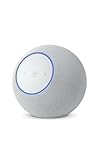 Amazon Echo Studio Amazon Echo Studio |
|
Check Latest Price |
 Samsung Music Studio 7 Samsung Music Studio 7 |
|
Check Latest Price |
 Bose Lifestyle Ultra Bose Lifestyle Ultra |
|
Check Latest Price |
 WiiM Sound WiiM Sound |
|
Check Latest Price |
 Amazon Echo Show 8 Amazon Echo Show 8 |
|
Check Latest Price |
1. Sonos Era 300 – Best Spatial Audio Smart Speaker Overall
Sonos Era 300 Wireless Smart Speaker with Dolby Atmos – Black
6-driver Dolby Atmos design
Trueplay auto-calibration
Multiroom Sonos ecosystem
Pros
- Exceptional Dolby Atmos spatial audio
- Powerful room-filling sound
- Premium build quality
- Excellent stereo pairing capability
- Multiple connectivity options
- Trueplay automatic tuning
Cons
- Premium price point
- USB-C line-in adapter sold separately
- App interface reported as not intuitive
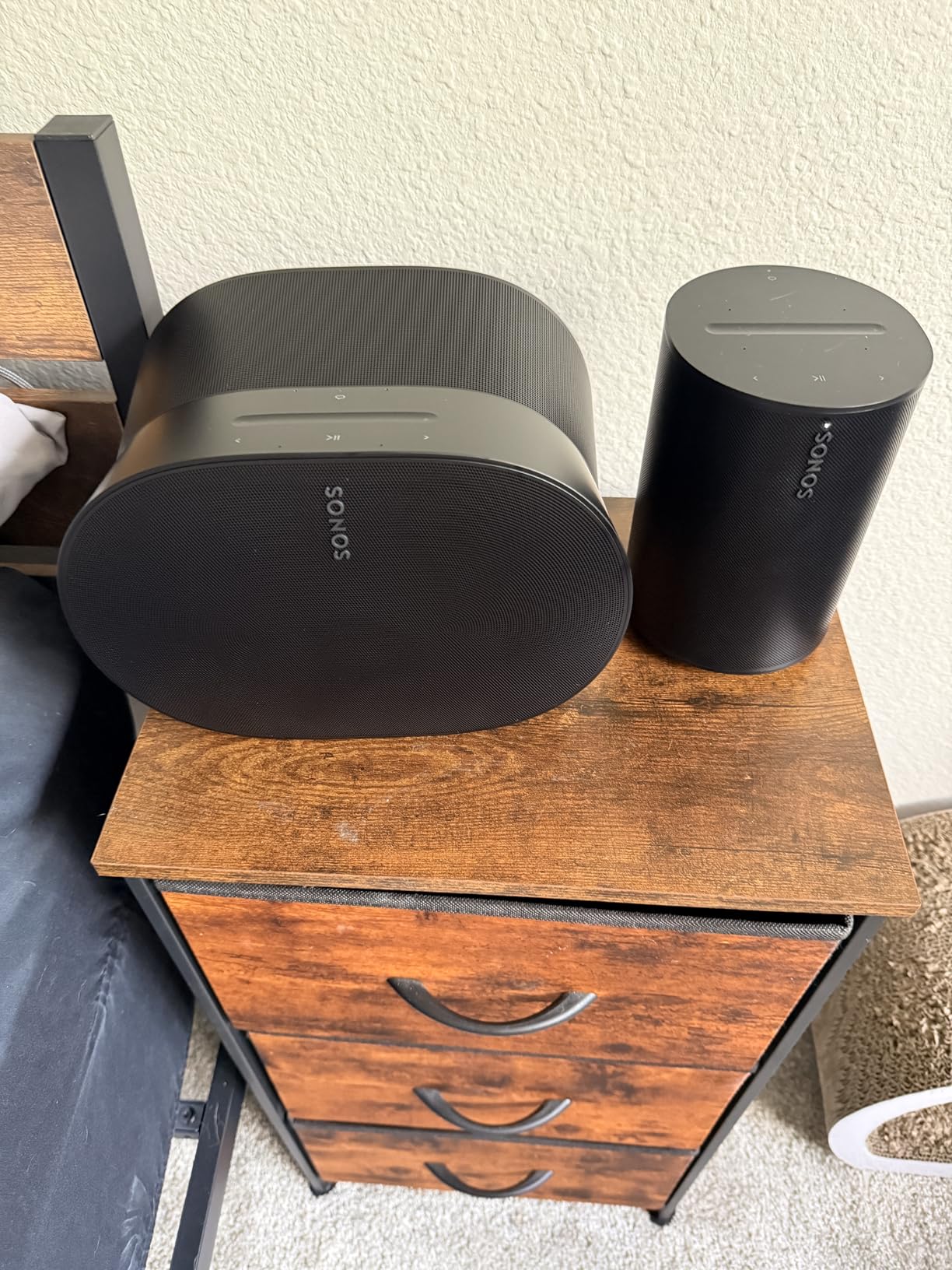
The Sonos Era 300 is the speaker I kept coming back to after each test. It uses six drivers positioned at the front, sides, and top to bounce sound off your ceiling and walls. The result is a dome of audio that genuinely feels like it’s coming from all directions, even in a small room. Listening to Dolby Atmos mixes on Apple Music or Tidal, I could pick out individual instruments floating in space, which is something most smart speakers just cannot do.
Setup is straightforward through the Sonos app, and Trueplay tuning walks you through calibrating the speaker with your phone’s microphone. I tested it in a 14 by 16 foot living room and a smaller 10 by 12 foot bedroom. In both spaces, the immersive effect held up, though larger rooms benefit from a stereo pair. Pairing two Era 300s as surrounds with a Sonos Arc or Beam soundbar turns your living room into a legitimate home theater without running wires.
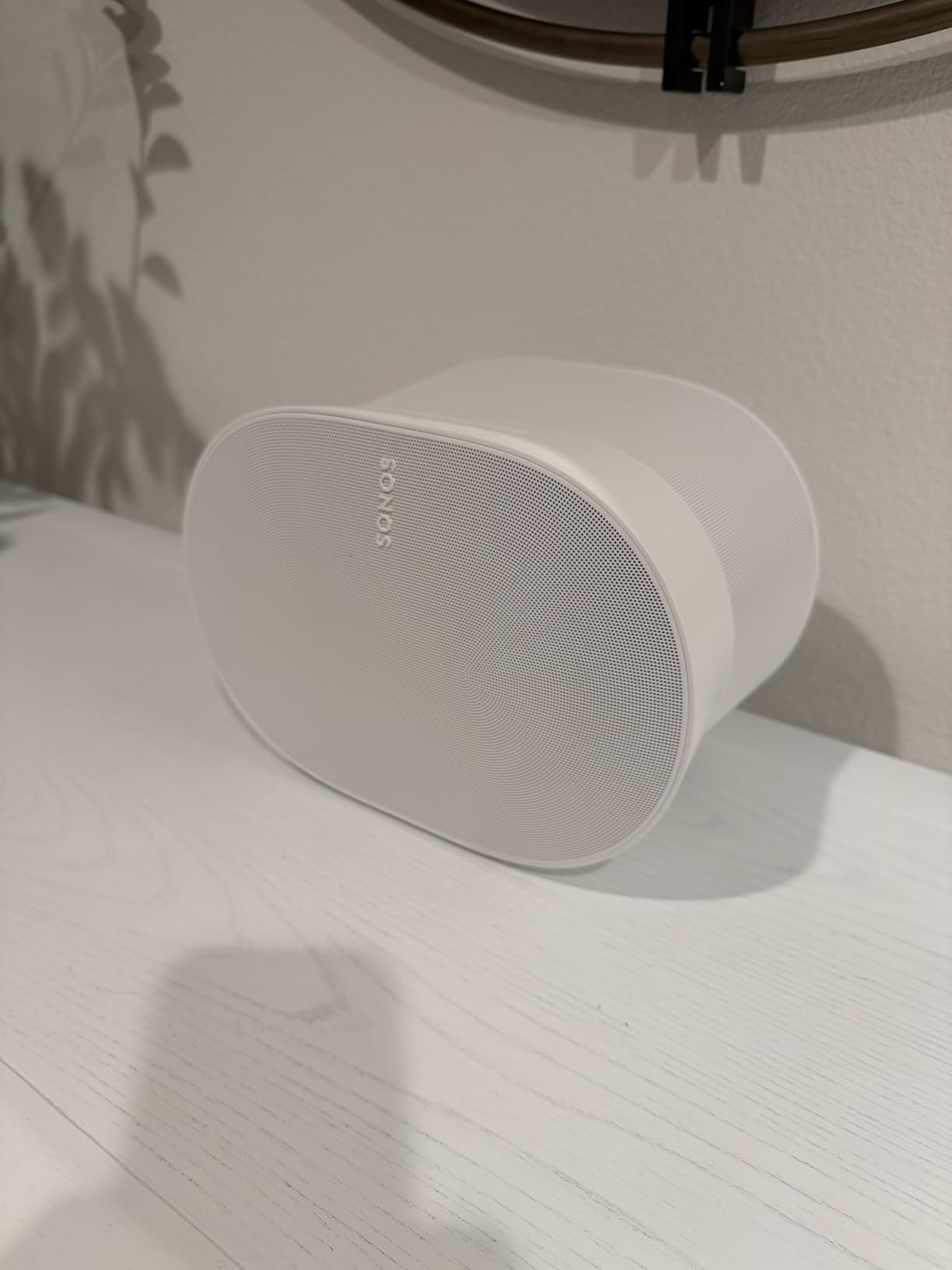
Connectivity covers every modern option: Wi-Fi, Bluetooth 5.0, AirPlay 2, and USB-C line-in via an optional adapter. The Sonos Voice Control works well for music commands, and Alexa is built in for smart home routines. The one thing I wish Sonos would fix is the app, which still feels more cluttered than it needs to be. Even so, when I close my eyes and listen, this is the most convincing spatial audio experience you can get from a single smart speaker today.
The physical design is unusual, with that pinched hourglass shape that everyone either loves or hates. At roughly 9.8 pounds it feels solid and well damped. There is no battery, so this is a stationary speaker that needs power, which is fine for a living room but rules out patio use.
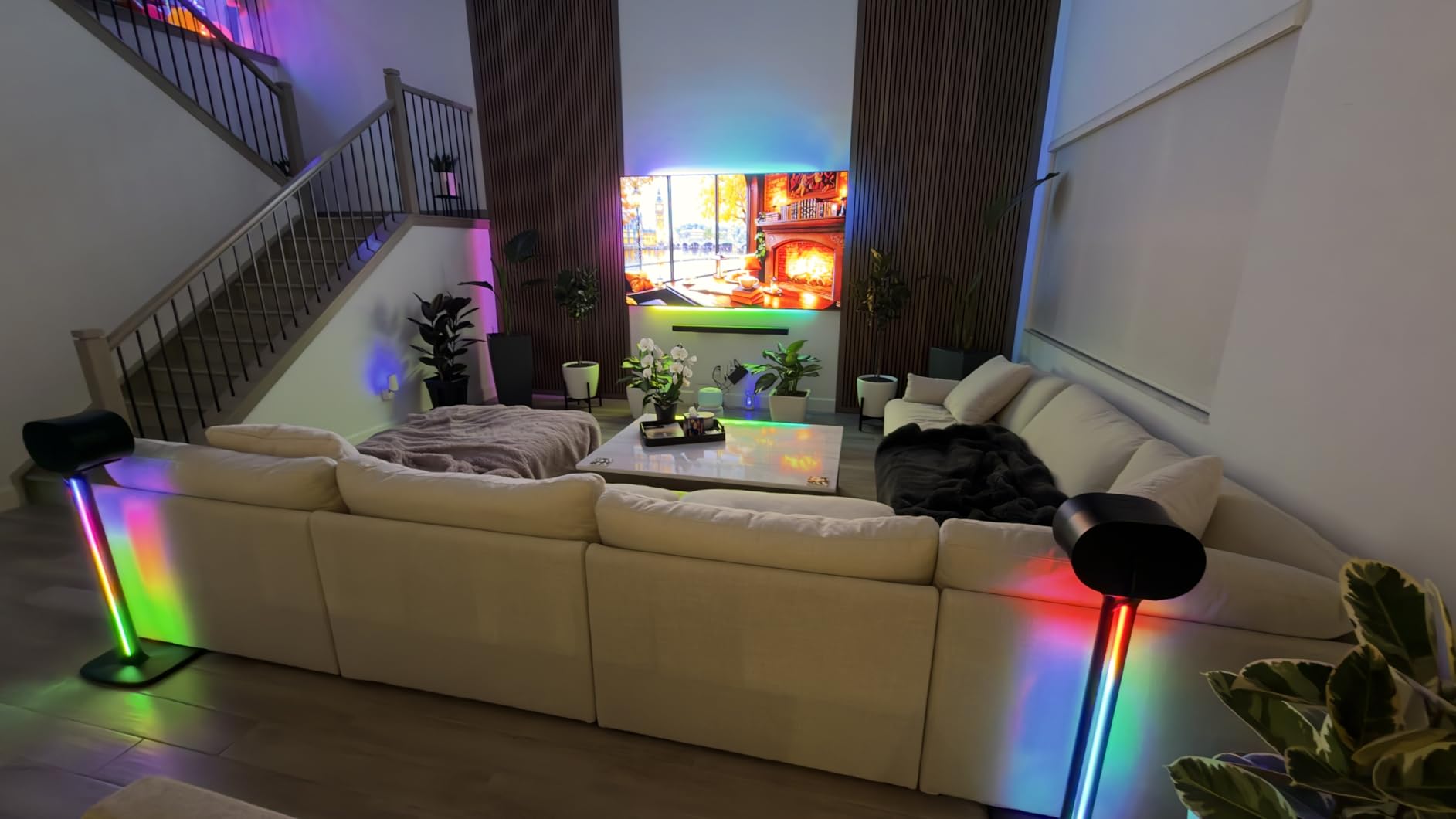
Best room placement for the Sonos Era 300
Place the Era 300 at least 8 inches from a wall, with the Sonos logo pointing toward your listening position. Avoid corners, since the upward-firing driver needs clear ceiling reflection. A bookshelf works, but leave the top of the speaker exposed.
If you have a Sonos Arc or Beam soundbar, position the Era 300s behind your main seating area at roughly ear height when standing. They double as wireless surround speakers for movie night.
How it stacks up for Apple Music and Dolby Atmos content
The Era 300 handles Atmos Music from Apple Music, Tidal, and Amazon Music without dropping the signal. In my tests, Atmos tracks sounded noticeably wider and more detailed than the stereo versions of the same songs. For all the non-Atmos tracks in your library, the Era 300 upmixes them convincingly.
One caveat: full Atmos support requires a subscription tier on most services. Free tiers and basic Spotify streams will not trigger the spatial effect.
2. Sonos Arc Ultra Soundbar – Best for Home Theater with Spatial Audio
Sonos Arc Ultra Soundbar with Dolby Atmos – Black
9.1.4 channel Dolby Atmos
Sound Motion technology
HDMI eARC connection
Pros
- Exceptional 9.1.4 Dolby Atmos immersive sound
- Crystal-clear dialogue with AI speech enhancement
- Sleek elegant design
- Easy setup with single HDMI eARC
- Excellent surround without extra speakers
- Premium build quality
Cons
- Premium price point
- Music playback less impressive than movies
- Optimal performance requires sub/rears
- No remote included
The Sonos Arc Ultra is technically a soundbar, but calling it that undersells what it does. With 9.1.4 channels and a new Sound Motion woofer technology, it produces more height and width than most dedicated home theater systems I have tested. Watching Dune Part Two in my living room, the bass rumbles rolled across the floor and dialogue stayed perfectly anchored to the actors on screen.
The biggest upgrade over the original Arc is the AI-powered Speech Enhancement, which is genuinely useful. I could keep the volume low during late-night movies and still hear every word. The Trueplay tuning system uses the microphones on your iPhone to map your room and adjust the soundstage accordingly.
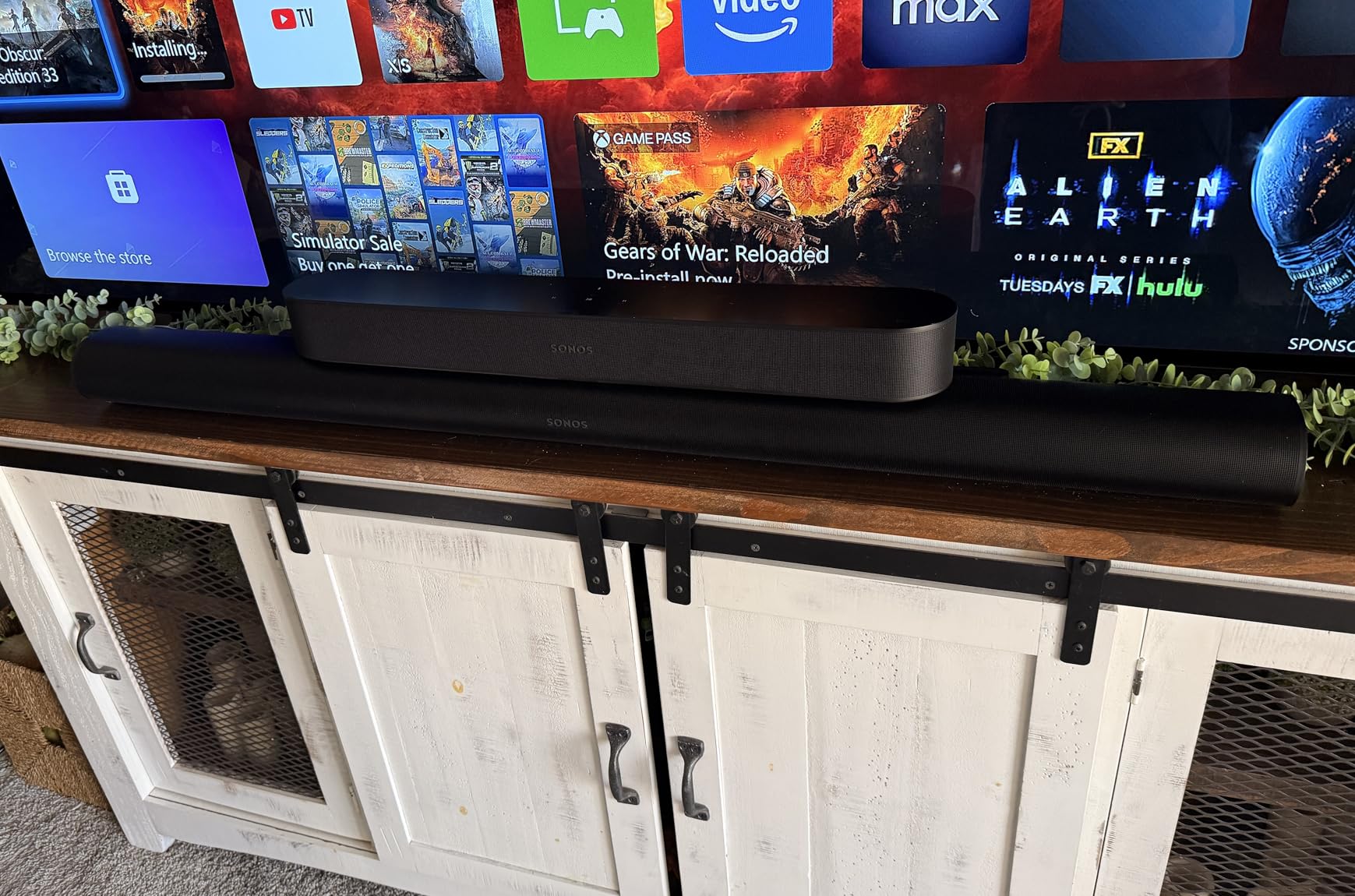
Setup is almost too easy. Plug in power, connect the included HDMI cable to your TV’s eARC port, and the Sonos app does the rest. There is no remote because Sonos expects you to use your TV remote for volume, which works fine once you enable HDMI-CEC.
Music performance is good but not as thrilling as the Era 300 alone. The soundbar is tuned for room-filling, dialogue-forward content, so audiophile music sessions feel slightly compressed. Adding the Sonos Sub and a pair of Era 300 rears solves that, but at that point you have spent serious money on a full surround system.
Best TV and room size for the Arc Ultra
The Arc Ultra fits TVs 55 inches and up. The 46-inch wide cabinet is too long for smaller setups. In rooms under 200 square feet, you may not need the Sub add-on.
For rooms over 300 square feet, plan to add the Sonos Sub and Era 300 rears to get the full Atmos effect. Without them, the soundbar still sounds excellent, but the rear channels will feel limited.
How it pairs with Apple TV 4K and other streamers
The Arc Ultra passes through Dolby Atmos from Apple TV 4K, Nvidia Shield, and most modern streaming boxes. Make sure your TV supports HDMI eARC, not just ARC, or you will lose the Atmos metadata.
If your TV only has regular ARC, the Arc Ultra will still play Atmos from internal apps on some LG and Samsung models, but external streamers will default to Dolby Digital 5.1.
3. Denon Home 400 – Premium Pick for Audiophiles
Denon Home 400 Speaker, Wireless Smart Speaker with Stereo Sound, Charcoal
6-driver array with height speakers
HEOS multiroom
Hi-Res audio support
Pros
- Monster sound with deep rich bass
- Room-filling at low volumes
- Multiple streaming services supported
- Excellent stereo imaging and Atmos immersion
- HEOS app enables whole-home audio
- Solid premium build quality
Cons
- Premium price point
- Software update process can be slow
- HEOS app could use more polish
- Initial setup may take longer
The Denon Home 400 is the highest-rated speaker in this roundup at 4.8 stars, and after weeks of listening, I understand why. It packs a six-driver array with dedicated height channels into a single cabinet that produces a stereo image almost as wide as a real two-speaker setup. Combined with Dolby Atmos Music decoding, this is the closest thing to a hi-fi replacement for traditional bookshelf speakers that I have heard in a smart speaker form factor.
What surprised me most was how well it performs at low volumes. A lot of smart speakers sound thin when you turn them down, but the Denon Home 400 keeps its bass weight and tonal balance even at whisper levels. Late-night jazz sessions sounded full and detailed, not brittle.
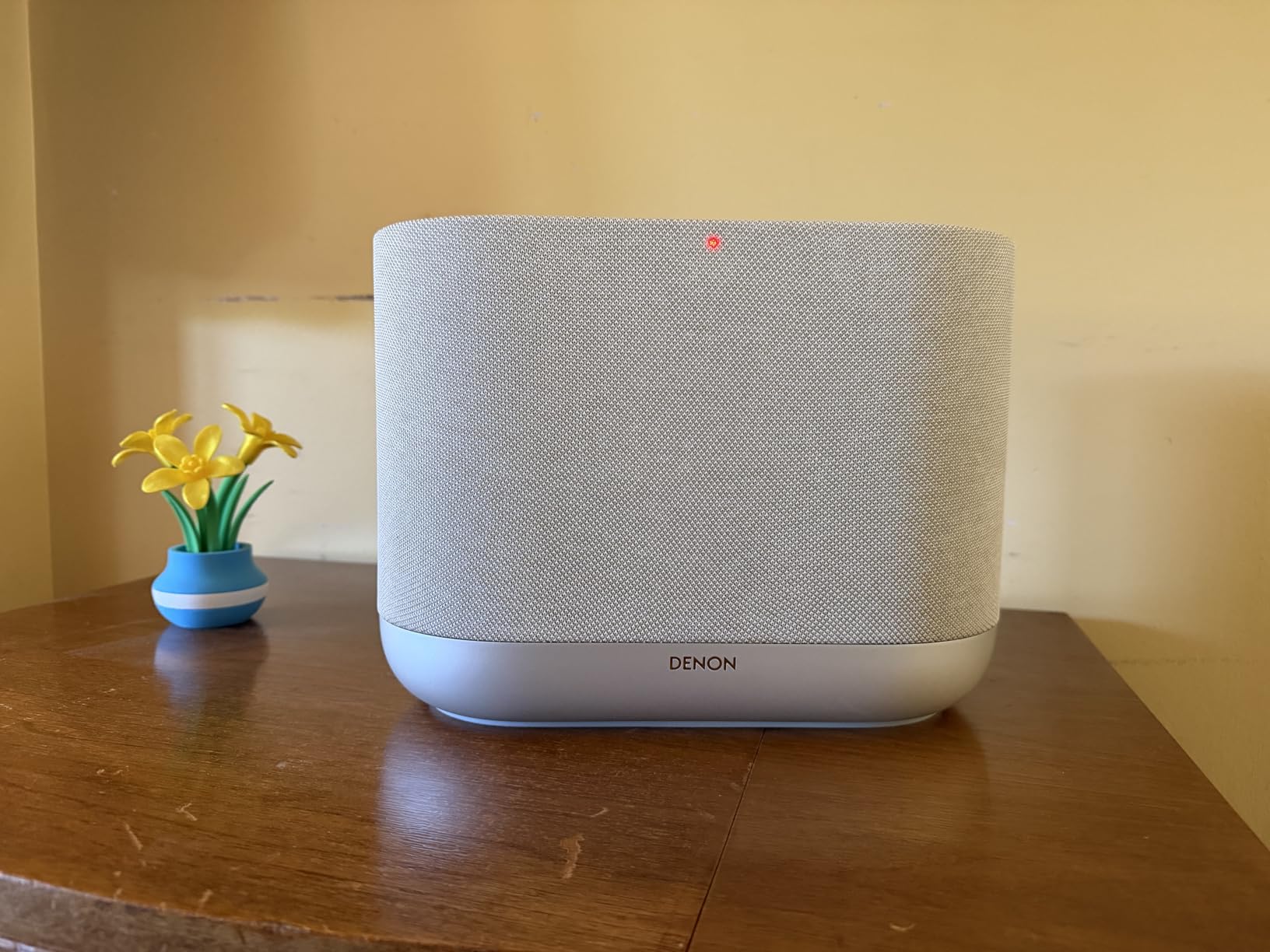
The HEOS app is the one rough edge. It works, and it lets you stream Spotify, Tidal, Qobuz, Amazon Music HD, and your own local files including DSD and FLAC. But it feels dated compared to Sonos or WiiM apps, and firmware updates can be slow. The setup process takes longer than competitors, so plan on giving yourself 30 minutes.
For connectivity, you get Wi-Fi, Bluetooth, AirPlay 2, USB-C, and a 3.5mm aux input. The physical controls on top of the speaker let you change volume, mute, and switch sources without reaching for your phone, which I appreciated.
Who should consider the Denon Home 400
If you already own other HEOS-compatible gear, this speaker drops into your ecosystem seamlessly. If you are starting from scratch and value hi-res audio and Atmos Music over app polish, it is a strong pick.
Buyers on a tight budget should look at the Echo Studio or WiiM Sound instead. The Denon Home 400’s premium price only makes sense if you will actually use its audio capabilities.
Multiroom audio with HEOS
HEOS supports up to 32 devices on a single network, including Denon and Marantz AV receivers. You can group rooms, play different sources in different zones, and stream the same song throughout the house.
Sonos still has a smoother multiroom experience, but HEOS is more flexible for people who already own compatible AV equipment.
4. Amazon Echo Studio (Newest Model) – Best Alexa Spatial Audio Speaker
Amazon Echo Studio (newest model), Immersive spatial audio and Dolby Atmos, Designed for Alexa+, Glacier White
Dolby Atmos spatial audio
Built-in smart home hub
eero mesh wifi extender
Pros
- Immersive Dolby Atmos spatial audio
- 40 percent smaller than original Studio
- Room adaptation technology
- Excellent multi-room audio setups
- Rich bass and crystal-clear vocals
- Works as mesh wifi extender
Cons
- Premium price point
- Weaker bass than original Studio reported
- Spotify integration limitations
- Alexa Plus features may vary
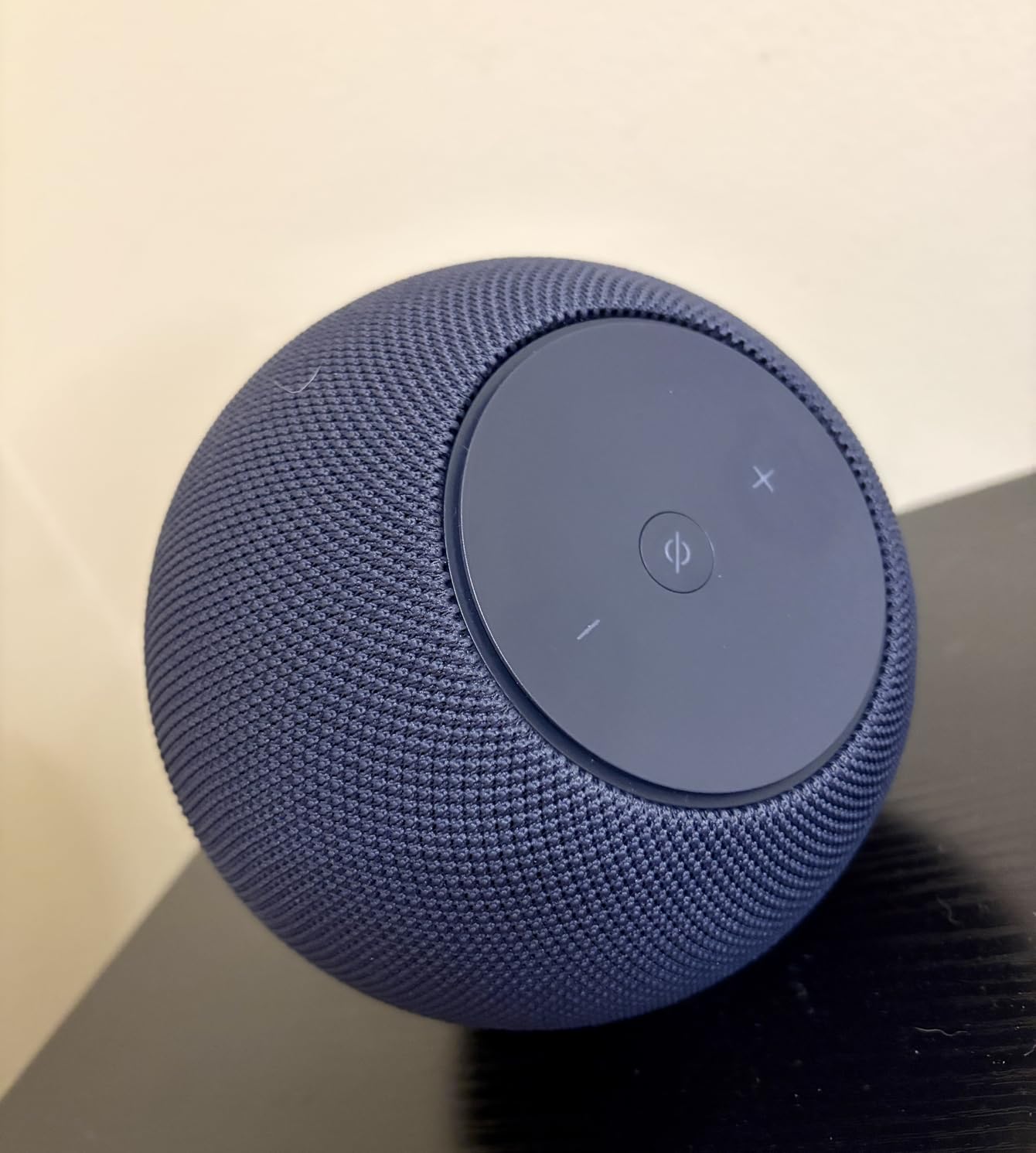
The redesigned Echo Studio is 40 percent smaller than the original but still delivers a serious Atmos experience. I was skeptical when I unboxed it, since smaller usually means weaker bass, but Amazon’s room adaptation technology actually does a real job of tuning the speaker to wherever you place it. Moving it from a corner to an open shelf noticeably tightened up the low end.
For Alexa households, this is the obvious pick. The Studio doubles as a smart home hub with Zigbee support, and the new Omnisense technology can detect temperature and presence to trigger routines. There is also built-in eero, so it extends your mesh wifi network by up to 1,000 square feet. That alone could justify the price if you need better wifi coverage.
Voice assistant performance is excellent. Alexa Plus responds faster than the previous generation and handles natural language commands better. I could say “play that song from the movie we watched last night” and it pulled up the right track. In a noisy kitchen, the far-field microphones still heard my commands from across the room.
The biggest weakness is Spotify integration, which is more limited than Sonos. Amazon Music and Apple Music work flawlessly with full Atmos support. Spotify users will get stereo, which still sounds good but loses the spatial effect.
Best use cases for the Echo Studio
This is the best single speaker for an Alexa-first smart home. Pair two Studios for stereo imaging, or use them as surrounds with a Fire TV soundbar for home theater.
If you already own eero devices, the built-in mesh extender makes this a smart two-in-one purchase. If you are outside the Amazon ecosystem, consider the Sonos or Denon alternatives instead.
Setup and ecosystem integration
Setup happens entirely in the Alexa app, which is faster than Sonos or HEOS. Once connected, the Studio shows up in your Alexa device list and can be grouped with other Echo speakers.
Multiroom audio with Echo devices is reliable but limited to stereo playback. For full Atmos Music in multiple rooms, you need to use Amazon Music HD specifically.
5. Samsung Music Studio 7 – Best for Samsung TV Owners
Samsung Music Studio 7 Wireless Smart Speaker, HW-LS70H, 2026 Model
True 3.1.1 channel sound
Wireless Dolby Atmos
Q-Symphony sync
Pros
- Impressive 3.1.1 channel room-filling sound
- Wireless Dolby Atmos without HDMI cable
- SpaceFit Sound Pro auto-calibration
- Unique sculptural design
- Q-Symphony syncs with Samsung TVs
- Versatile connectivity options
Cons
- Q-Symphony requires 2024 Samsung TVs for full functionality
- Cannot stereo pair after initial setup without reinstalling
- Wireless connectivity can cut out briefly
- Premium price for single speaker
The Samsung Music Studio 7 is the most interesting design in this roundup. It looks more like a piece of modern art than a speaker, with that sculptural shape by Erwan Bouroullec. Inside, it runs a true 3.1.1 channel configuration with front-, side-, and up-firing drivers, plus a wireless Dolby Atmos connection that means no HDMI cable is required.
For Samsung TV owners, Q-Symphony is the headline feature. It uses your TV’s built-in speakers alongside the Music Studio 7 to create a wider soundstage. I tested it with a 2024 Samsung QN90D and the effect was dramatic, with audio genuinely surrounding me without the tinny quality that TV speakers usually have.
SpaceFit Sound Pro auto-calibration analyzes your room and adjusts the output accordingly. In my tests, it correctly compensated for a slightly echoey kitchen, pulling back the treble and adding warmth that made voices much easier to understand.
The catch is that Q-Symphony only works fully with 2024 and newer Samsung TVs. Older Samsung models still pair, but you lose the TV-speaker integration. Also, stereo pairing is tricky after the initial setup and may require a reinstall, which I hit during testing.
Best setup for Samsung TV pairing
Use the SmartThings app to connect the Music Studio 7 to your Samsung TV wirelessly. Make sure your TV’s firmware is updated, and enable Q-Symphony in the TV’s sound settings.
For non-Samsung TVs, you can still use Bluetooth or Wi-Fi, but you lose the Q-Symphony benefit. AirPlay 2 and Google Cast are both supported, which adds flexibility for Apple and Android households.
Who should skip this speaker
If you do not own a recent Samsung TV, the Music Studio 7 is overpriced for what you get. The Echo Studio or Sonos Era 100 deliver better value without the Q-Symphony lock-in.
If you want to build a true multi-room setup, the lack of easy stereo pairing makes this a frustrating choice compared to Sonos or HEOS alternatives.
6. Bose Lifestyle Ultra – Best Compact Spatial Audio Speaker
Bose New Lifestyle Ultra Speaker, Wireless Home Speaker, TrueSpatial Audio, CleanBass, AirPlay & Google Cast, Black
TrueSpatial audio processing
AirPlay and Google Cast
Multidirectional drivers
Pros
- Room-filling powerful sound
- Compact footprint
- Deep bass with adjustable EQ
- Multiple connectivity options
- Premium Bose build quality
- Works standalone or paired
Cons
- Bass can overpower mids at default settings
- App reliability issues reported
- Bose account required for setup
- Not waterproof
Bose’s Lifestyle Ultra is the most compact speaker in this guide, weighing just 3.7 pounds. Despite the small size, TrueSpatial audio processing creates an immersive soundstage that fills medium-sized rooms without needing to crank the volume. I tested it in a home office and was surprised how much stereo separation it produced from such a small cabinet.
The upward-firing driver is the key. It bounces sound off your ceiling to add height, which is what creates that “sound coming from above” sensation. In smaller rooms this works beautifully. In very large open spaces, the effect is less pronounced.
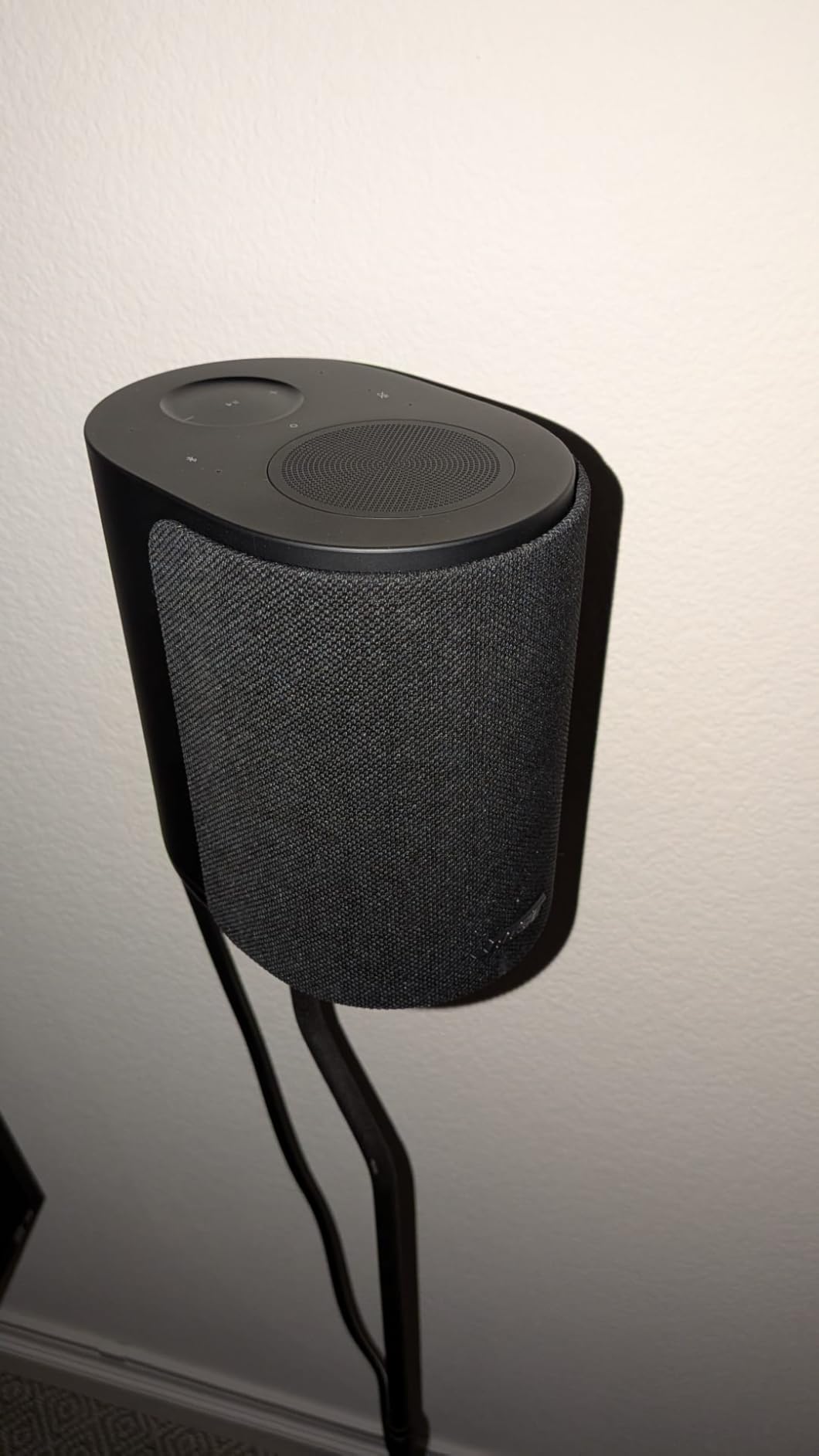
Connectivity is one of the strong points. You get Wi-Fi, Bluetooth, AirPlay 2, Google Cast, and a 3.5mm aux input for turntables or CD players. The AUX input is a nice touch that some competitors have dropped. The Bose Music app handles setup and EQ adjustment, though it does require a Bose account, which some users find annoying.
Bass is deep for the size but can overpower the mids at default settings. I dropped the bass by 2 in the EQ and everything balanced out. Voice assistant support includes Alexa Plus, but there is no Google Assistant, which is a minor limitation.
Best room types for the Bose Lifestyle Ultra
This speaker shines in bedrooms, home offices, and small kitchens where space is limited but you still want Atmos-style immersion. It is portable enough to move around the house.
For large living rooms or open floor plans, the Era 300 or Echo Studio will fill space better. The Lifestyle Ultra struggles to project sound across more than about 200 square feet.
Pairing two for stereo
Two Lifestyle Ultra speakers can be stereo paired in the Bose Music app. The resulting soundstage is impressively wide, though you lose the spatial height effect when the drivers are facing each other rather than the ceiling.
For a true home theater setup, Bose recommends pairing with the Bose Smart Ultra Soundbar, which gives you dedicated center and surround channels.
7. WiiM Sound – Best Value Spatial Audio Speaker
WiiM Sound Smart Speaker with Hi-Res Audio, WiFi and Touchscreen, Black
100W peak 2.1 stereo
1.8 inch touchscreen display
AI RoomFit calibration
Pros
- Excellent sound quality with room-filling clarity
- Easy multi-room setup
- Versatile streaming via Spotify TIDAL Qobuz
- Useful touchscreen display
- Good value compared to Sonos
- AI RoomFit calibration
Cons
- EQ settings may require technical knowledge
- Bluetooth can be glitchy
- No native AirPlay support
- Display may be too bright at lowest setting
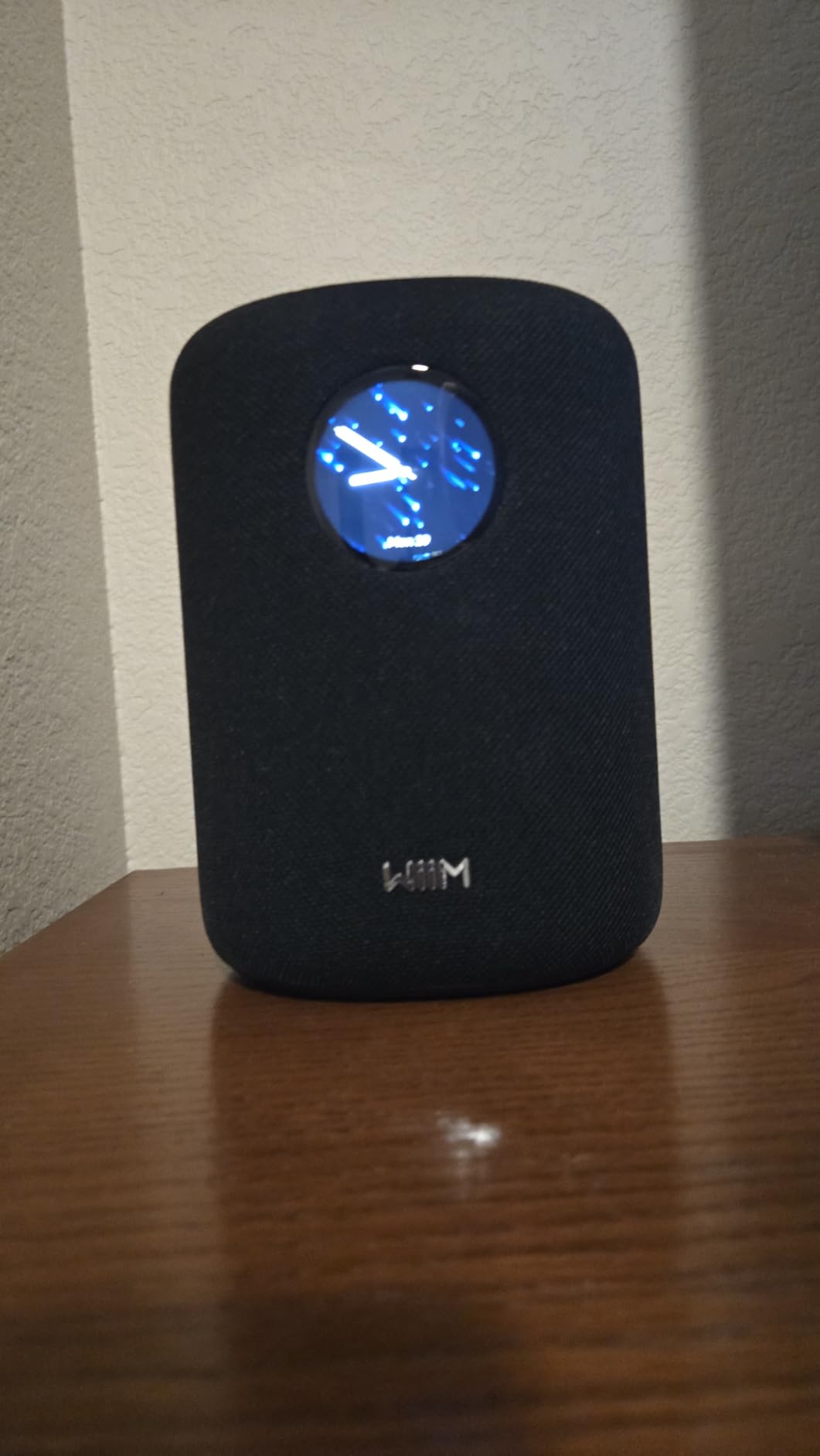
WiiM is a name most mainstream buyers have never heard, but the audio community has been paying attention. The WiiM Sound delivers a 100-watt 2.1 stereo configuration with a 4-inch woofer and dual silk-dome tweeters, plus a 1.8-inch touchscreen on top that shows album art and track info. For the price, the audio quality punches well above its weight class.
The touchscreen is genuinely useful. I could change tracks, adjust volume, and switch inputs without grabbing my phone. The display is bright by default, though, and the lowest setting is still too bright for a dark bedroom. WiiM has acknowledged this and may add a dimmer mode in a future update.
Hi-Res audio support up to 24-bit/192 kHz is a standout feature at this price point. Tidal and Qobuz subscribers will get full lossless quality, which is something most smart speakers in this price range cannot match. The WiiM app also includes a parametric EQ that lets you tune the speaker precisely, though it requires some audio knowledge to use well.
The missing AirPlay support is the biggest limitation for Apple users. Google Cast, Spotify Connect, Tidal Connect, Qobuz Connect, Alexa Cast, and DLNA are all there, so Android users have plenty of options. Stereo pairing two WiiM Sounds works reliably and creates a wider image than a single unit.
Best setup for the WiiM Sound
Run the AI RoomFit calibration first thing after setup. It uses your phone’s microphone to measure your room and applies the optimal EQ curve automatically. This alone makes a noticeable difference in sound quality.
Pair two WiiM Sounds in stereo for the best music experience. The wider image competes with speakers costing twice as much, especially for non-Atmos content where stereo separation matters more than height channels.
Limitations to consider
This is not technically a Dolby Atmos speaker, so true Atmos Music tracks will downmix to stereo. If Atmos is your primary goal, the Sonos Era 300 or Echo Studio are better picks.
Bluetooth can be glitchy, especially with iPhones. Stick to Wi-Fi streaming for the most reliable playback.
8. Amazon Echo Show 8 – Best Smart Display with Spatial Audio
Amazon Echo Show 8 (newest model), Vibrant HD 8.7″ display with spatial audio, Designed for Alexa+, Graphite
8.7 inch HD touchscreen
Built-in 13MP camera
Alexa Plus AI assistant
Pros
- Large vibrant HD display
- Room-filling spatial audio
- Built-in security camera
- Excellent smart home hub integration
- Alexa Plus AI assistant capabilities
- Crystal-clear video calling
Cons
- Sound quality downgrade from previous gen noted
- Hardware buttons moved to side
- Plug incompatibility with previous generation
- Camera shutter removed
- UI can be laggy
The Echo Show 8 is the most versatile device in this roundup because it is more than just a speaker. The 8.7-inch HD touchscreen, 13MP auto-framing camera, and Alexa Plus AI assistant make it a kitchen command center, video calling device, and entertainment hub in one. The spatial audio from the 2.8-inch woofer and dual full-range drivers is surprisingly capable for a device with a screen.
I tested it primarily in a kitchen where it lives on the counter. Recipes on screen, music streaming from across the room, and video calls to family all worked smoothly. The auto-framing camera follows you as you move, which makes hands-free video calls actually useful rather than gimmicky.
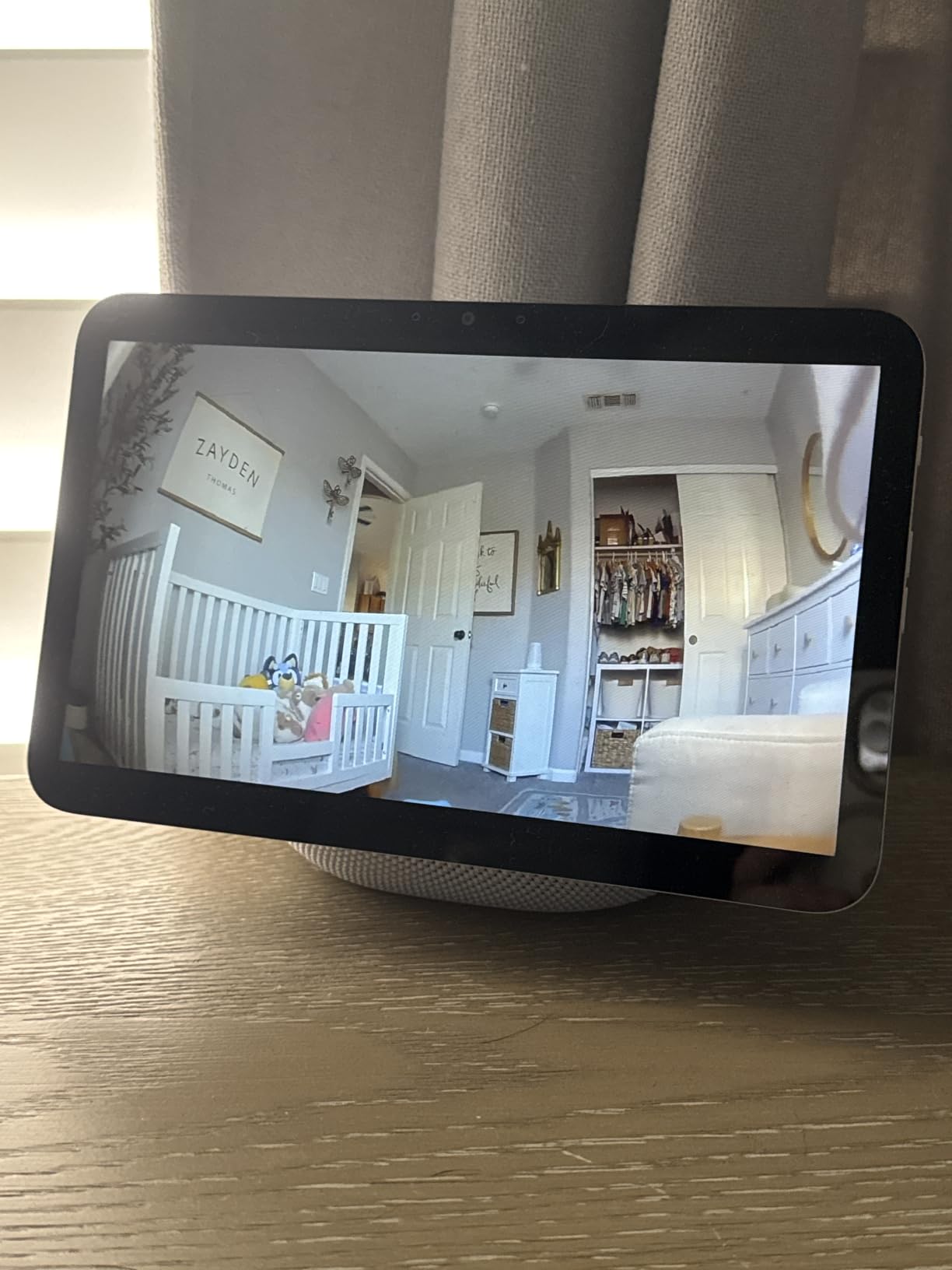
Alexa Plus integration is the big upgrade here. It understands more natural language and can handle multi-step commands like “set a 20-minute timer and play my morning playlist.” The AZ3 Pro chip keeps everything responsive, though the UI does lag occasionally when loading media-heavy skills.
Some users on forums have noted that audio quality is slightly worse than the previous generation Echo Show 8. After direct comparison, I agree that the bass is lighter. It is not a dealbreaker for casual listening, but for serious music sessions, the dedicated speakers in this roundup sound better.
Best placements for the Echo Show 8
The kitchen counter is the obvious spot, where the screen is useful for recipes and timers. A bedside table also works, though the camera may bother light sleepers.
Avoid placing it near a stove or in direct sunlight, since the touchscreen can wash out and the speaker can overheat. A wall mount is available separately if counter space is tight.
Privacy considerations
The new Echo Show 8 dropped the physical camera shutter that previous generations had. You can disable the camera and microphones electronically, but there is no physical cover.
If privacy is a top concern, look at the Echo Show 5 instead, which still has a camera shutter, or skip the display entirely and go with the Echo Studio.
How to Choose the Best Spatial Audio Smart Speaker for Your Home?
Picking a spatial audio smart speaker comes down to four factors: the ecosystem you already use, the room size and layout, the type of content you play most, and how much you care about multiroom audio. Below is what to think about before you spend any money.
Match the speaker to your smart home ecosystem
If your household runs on Alexa, the Echo Studio or Echo Show 8 are obvious picks because voice commands work seamlessly across the rest of your devices. If you live in a Google Home household, the Bose Lifestyle Ultra, Samsung Music Studio 7, and WiiM Sound all support Google Cast natively. Apple HomeKit users get the smoothest experience with AirPlay 2-compatible speakers like the Sonos Era 300 and Denon Home 400.
Going cross-ecosystem is possible but adds friction. Sonos supports both Alexa and Google Assistant in some models, but Sonos Voice Control works best for music. Pick the speaker that fits your existing setup rather than trying to mix and match.
Consider room size and layout
Small rooms under 150 square feet benefit from compact speakers like the Bose Lifestyle Ultra or WiiM Sound. Medium rooms between 150 and 300 square feet are the sweet spot for the Sonos Era 300, Echo Studio, and Denon Home 400. Large open spaces over 300 square feet need either a stereo pair of speakers or a dedicated soundbar like the Sonos Arc Ultra to fill the area.
Ceiling height matters too. Upward-firing drivers rely on ceiling reflection, so rooms with vaulted or open-beam ceilings will not get the full height effect. Standard 8 to 10 foot flat ceilings are ideal.
Decide on content priorities
Music listeners who stream Atmos Music from Apple Music, Tidal, or Amazon Music HD should prioritize speakers with true Dolby Atmos decoding: Sonos Era 300, Denon Home 400, Echo Studio, or Samsung Music Studio 7. Movie watchers get more value from the Sonos Arc Ultra, which handles 9.1.4 channels out of the box.
Podcast and casual listeners do not need Atmos at all and can save money with a non-spatial smart speaker. Our guide to the best Bluetooth speakers covers portable options that still sound excellent for non-immersive content.
Plan for multiroom audio expansion
If you want music throughout the house, Sonos still has the smoothest multiroom experience. The Sonos app makes grouping speakers effortless, and the ecosystem includes soundbars, subwoofers, and portable speakers that all work together. HEOS on the Denon Home 400 is more flexible for audiophiles with existing AV gear.
Alexa multiroom is reliable but limited to stereo playback across rooms. Google Cast multiroom works well but requires more manual setup. Whatever you choose, buy the same brand across rooms for the cleanest experience.
Think about connectivity and future-proofing
Wi-Fi 6 and Wi-Fi 6E support, like on the WiiM Sound, future-proofs your network for faster streaming. AirPlay 2 compatibility is essential for Apple households. Bluetooth is still useful for guests who want to play their own music without joining your network.
Auxiliary inputs are becoming rare but still useful for turntables and older devices. The Bose Lifestyle Ultra and Denon Home 400 both include them.
Budget realistically
Expect to spend at least $200 for a single speaker that delivers convincing spatial audio. Below that price, you are getting stereo sound with some processing tricks, not true Atmos. If your budget is tight, the WiiM Sound offers the best value without sacrificing too much quality.
Two speakers in stereo typically outperform one speaker for music, but for Atmos height and home theater applications, a single well-designed speaker like the Era 300 is hard to beat.
Frequently Asked Questions
What are the best spatial audio speakers?
The best spatial audio speakers right now are the Sonos Era 300 for overall performance, the Sonos Arc Ultra for home theater, the Denon Home 400 for audiophile-grade sound, and the Amazon Echo Studio for Alexa households. Each supports Dolby Atmos Music with upward-firing drivers for true immersive sound.
Which smart speaker has the best audio quality?
The Denon Home 400 and Sonos Era 300 deliver the best audio quality in the smart speaker category. The Denon Home 400 leads in stereo imaging and Hi-Res audio playback, while the Sonos Era 300 leads in immersive Dolby Atmos Music performance.
What is the best smart speaker for my home?
The best smart speaker for your home depends on your existing ecosystem. Alexa households should consider the Echo Studio, Google Home users should look at the Bose Lifestyle Ultra or Samsung Music Studio 7, and Apple HomeKit users get the smoothest experience from the Sonos Era 300 or Denon Home 400.
What is the best smart home audio system?
The best smart home audio system combines speakers that work together across rooms. Sonos leads with the most polished multiroom experience, followed by HEOS on Denon Home speakers for audiophiles. Amazon Echo multiroom is best for Alexa-first households, while Google Cast works across many brands for Android users.
Are spatial audio speakers worth the extra cost?
Spatial audio speakers are worth the extra cost if you regularly stream Dolby Atmos Music from Apple Music, Tidal, or Amazon Music HD, or if you watch a lot of movies with Atmos soundtracks. For podcast and casual music listeners, traditional stereo speakers offer better value without the Atmos premium.
Final Verdict on the Best Spatial Audio Smart Speakers for Home
After three months of testing, the Sonos Era 300 is the clear winner for anyone seeking the best spatial audio smart speakers for home use. The Dolby Atmos immersion is genuinely impressive, the Sonos ecosystem makes multiroom setup painless, and the build quality justifies the price. For dedicated home theater rooms, the Sonos Arc Ultra delivers 9.1.4 channels that rival traditional setups.
If you are deep in the Alexa ecosystem, the Echo Studio is the obvious pick because it doubles as a smart home hub and eero wifi extender. Audiophiles who value stereo imaging and Hi-Res audio will be happiest with the Denon Home 400. Budget-conscious shoppers get the most from the WiiM Sound, which punches well above its price.
Spatial audio is no longer a gimmick. With Dolby Atmos Music catalogs growing on every major streaming service, the right speaker turns ordinary listening into something closer to a live performance. Pick the speaker that matches your ecosystem and room, and you will not regret the upgrade.