
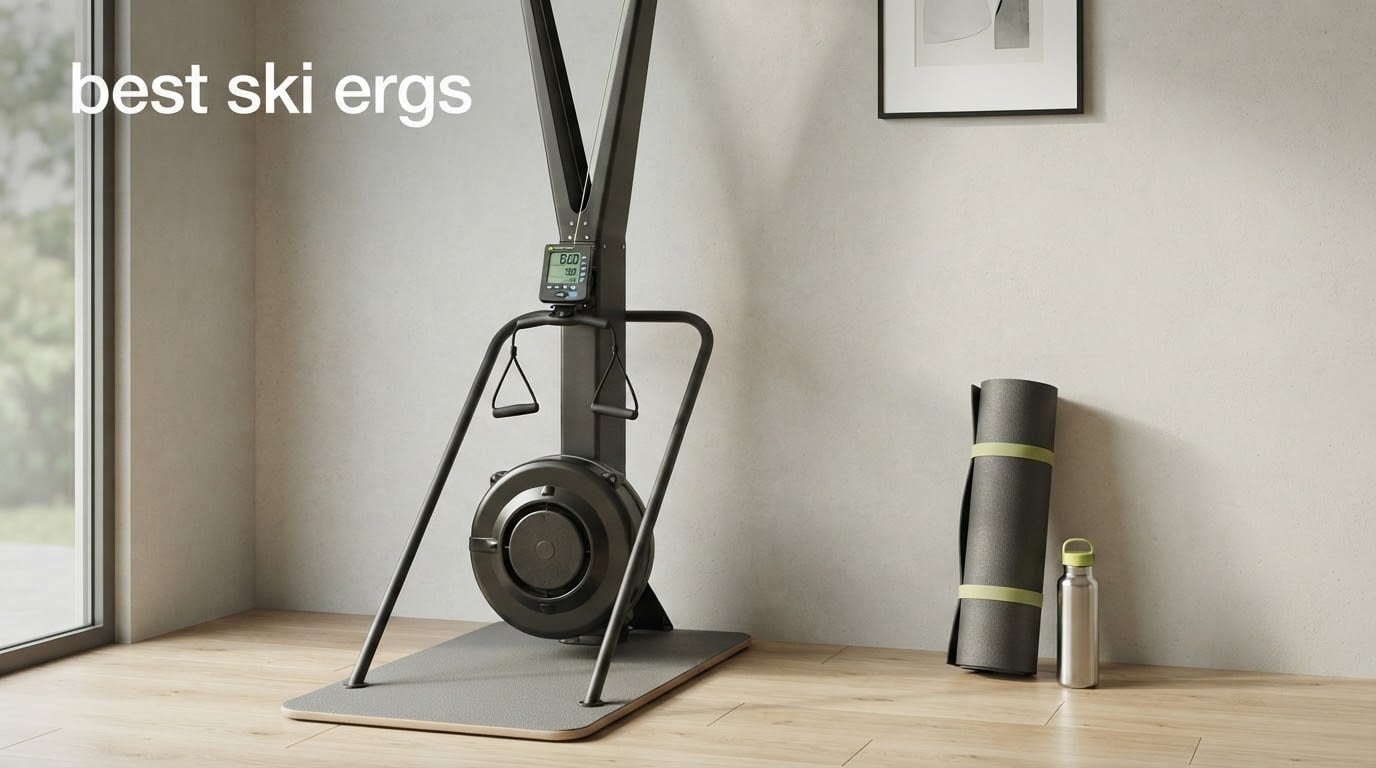
Quick answer: the Concept2 SkiErg is the best ski erg overall, with the GMWD SK01 the best value pick for anyone who wants magnetic and fan resistance in the same flywheel. The SkiErg wins because it pairs a 10-level air flywheel with a PM5 performance monitor and 15 onboard programs, and it holds a 4.8 rating across more than 600 owner reviews, which is more verified feedback than anything else on this list.
I spent weeks reading owner threads, spec sheets and complaints for all eight machines below before picking a winner. What surprised me was how thin the real review history is for this category. Two products here have hundreds of owner reports. The rest have single-digit reviews or none at all, and I have marked exactly where that is the case rather than dressing up a spec sheet as if it were experience.
A ski erg fills a gap no other common home machine covers. A rower, bike or treadmill all train the legs first and treat the arms as decoration. A ski erg pulls with the lats, upper back, triceps and core while the legs drive, and because the flywheel is air-driven the resistance rises with your own effort rather than a motor. It is also the machine most associated with HYROX training, where it is the first station of the race.
If you are building out cold-weather kit alongside the machine, our ski jacket roundup, ski glove guide and ski sock picks cover the gear side.
Table of Contents
Top 3 Best Ski Ergs in 2026

Concept2 SkiErg
- 10-level air flywheel
- PM5 performance monitor
- 15 onboard programs
- Wall mount or floor stand

GMWD SK01 Ski Machine
- Fan plus magnetic dual resistance
- LED watts and stroke monitor
- Wall mount kit included

FAGUS H Ski Trainer
- Compact wall or rack footprint
- 10 resistance levels
- LED power output monitor
Best Ski Ergs at a Glance in 2026
Every machine below is an air, fan or magnetically resisted ski-style trainer. Four of the eight include wall mounting hardware or a floor stand in the box, and only two carry enough owner feedback for us to draw real conclusions from.
| Product | Specifications | Action |
|---|---|---|
| Concept2 SkiErg |
|
Check Latest Price |
| GMWD SK01 Ski Machine |
|
Check Latest Price |
| FAGUS H Ski Trainer |
|
Check Latest Price |
 HVO Ski Trainer HVO Ski Trainer |
|
Check Latest Price |
 Bear KompleX MAX SKI Erg Bear KompleX MAX SKI Erg |
|
Check Latest Price |
 TKO AirRaid Ski Machine TKO AirRaid Ski Machine |
|
Check Latest Price |
 Xoiasth Ski Exercise Machine Xoiasth Ski Exercise Machine |
|
Check Latest Price |
 zhenmaster Ski Erg Machine zhenmaster Ski Erg Machine |
|
Check Latest Price |
1. Concept2 SkiErg – The Benchmark Flywheel Ski Erg
Concept2 SkiErg without Floor Stand
46 lb aluminum frame
83.5 in tall, 20.5 in wide
10 resistance levels
PM5 monitor, 15 programs
Pros
- Most verified owner feedback in the category
- accurate pace and watt data
- compact wall-mountable footprint
- works both double-pole and alternating arm
- low impact on knees and back
Cons
- Assembly instructions and bolt placement are awkward without proper sockets
- needs a floor stand or wall mount to be used properly
- repetitive motion can cause injury if sessions are not varied
The SkiErg is the machine most people in r/concept2 and r/crossfit mean when they say ski erg, and the 617 owner reviews behind its 4.8 rating explain why. Roughly nine in ten of those reviews are five star, and the praise clusters on three things: the data is right, the frame is built to last, and the footprint is small enough for a normal room.
At 83.5 inches tall and 20.5 inches wide, the ski unit itself is genuinely narrow. The depth figure of 16 inches is for the mounted body, and the base adds to that when you fit the floor stand. Owners in r/homegym repeatedly describe the wall-mounted setup as the version that finally made the machine usable in their space, because the flywheel housing is the only part that needs floor contact.
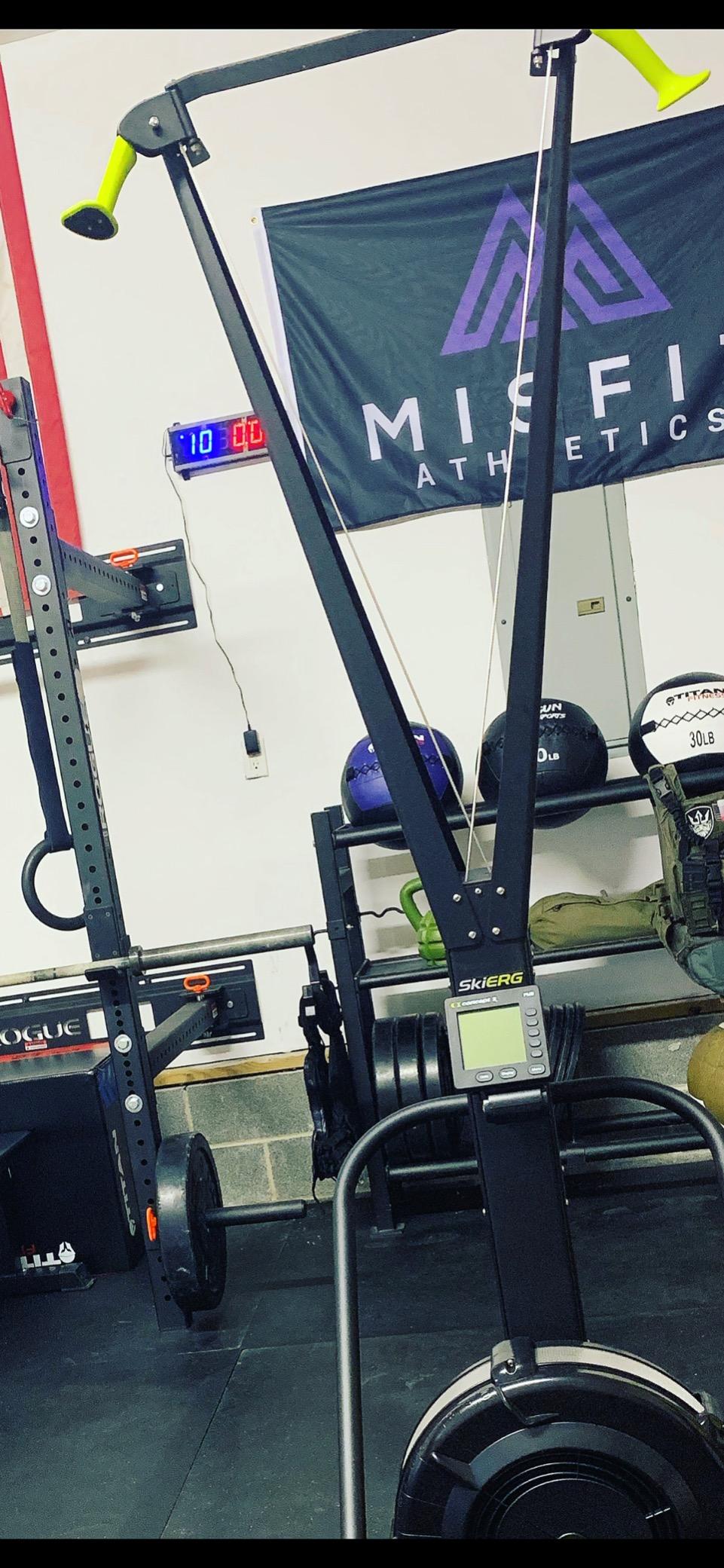
The PM5 monitor is the real differentiator and it is not a close one. It tracks pace per 500 meters, watts, stroke rate, calories and split times, and it stores 15 onboard programs you can run without a phone. Every other machine on this list has an LCD at best, and the cheap LCDs are the single most common complaint in owner threads about budget units, where buyers say the data is too coarse to train to structured splits.
Resistance is air-driven across 10 damper settings, so a hard pull spins the flywheel faster and creates more air drag, which is the opposite of a magnetic machine where the load is fixed. That self-scaling feel is why owners on r/concept2 report the Concept2 working the arms, traps and back noticeably harder than a magnetic trainer, which they describe as feeling more like a core movement. Maximum flywheel speed is rated at 500 rpm and the handle is strapless and ergonomic.
Is the SkiErg worth the step up from a budget trainer?
If your goal is general fitness and you train three days a week, a budget machine will get you there. If you want your training numbers to match a competition machine, the gap is real and owners say so directly. The budget units give you a flywheel and 10 levels, but their consoles rarely report a trustworthy pace figure.
The warranty is worth noting too. Concept2 ships a limited 2-year and 5-year warranty on this model, and spare parts for a machine like this are the difference between repairing and replacing. The monitor runs on two included D batteries, so there is no outlet to lose behind furniture.
Where the SkiErg disappoints owners
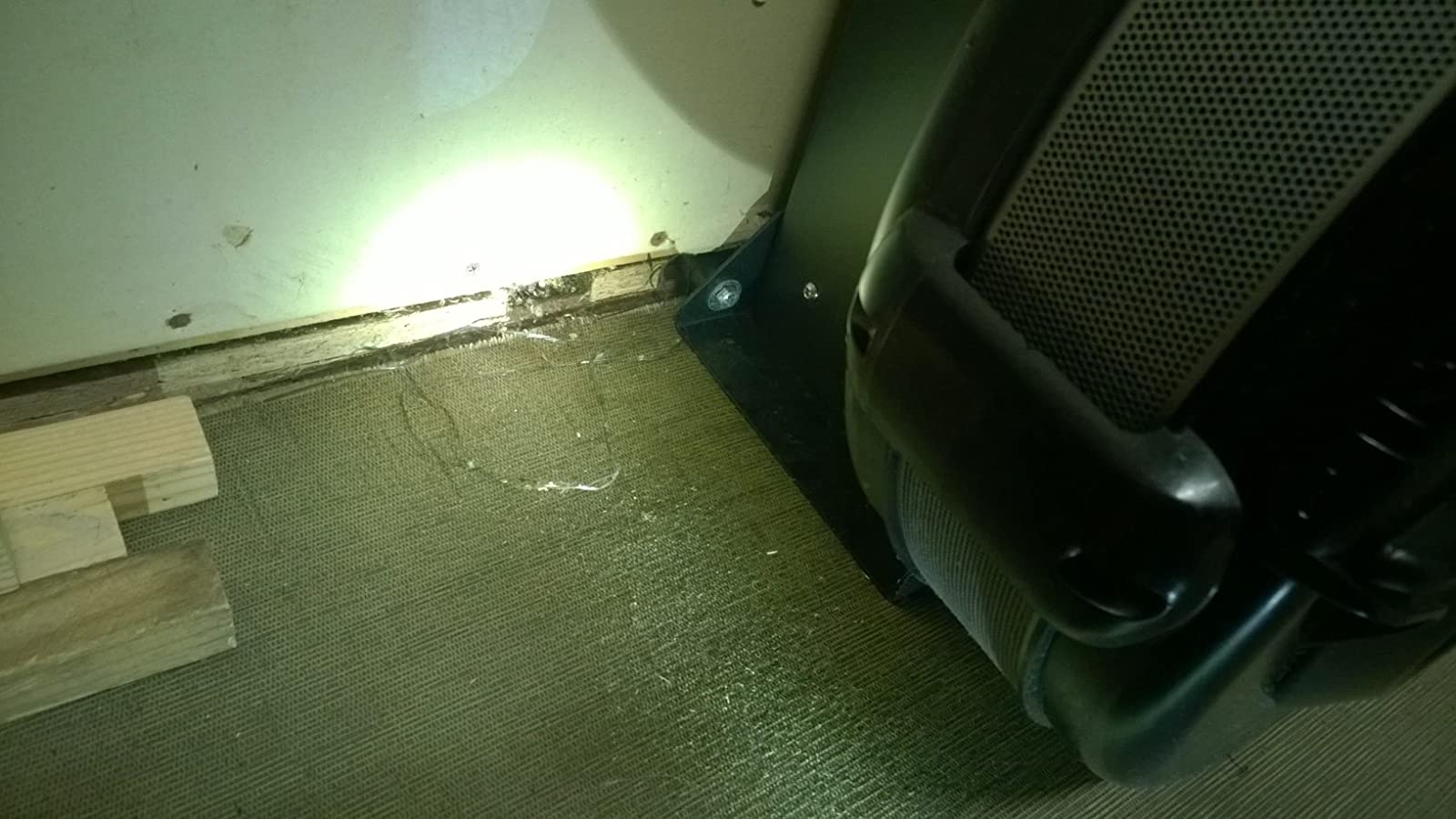
Assembly is the most repeated complaint. Owners recommend bringing proper wrenches and sockets because the bolt placement in the manual is awkward, and several reviews mention needing a second person for the base assembly.
Two real limits: the top of the resistance range is not enough for advanced strength users who want to muscle through a low-stroke-rate effort, and long sessions without gloves produce calluses on the palms. Owners also flag that the flywheel is loud during intense strokes, which matters if you have downstairs neighbours.
2. GMWD Ski Equipment SK01 – Fan and Magnetic Resistance Together
Ski Exercise Machine, GMWD Ski Equipment Indoor Aerobic Wind Resistance Machine, Indoor Strength Training Home Gym Equipment, Green
Alloy steel frame
122 lb, 87.4 in tall
10 levels, fan plus magnetic
LED monitor with watts
Pros
- Dual fan and magnetic resistance for responsive feedback
- wall mount kit included in the box
- LED monitor reports watts and stroke counts
- one movement trains upper body lower body and torso
Cons
- 122 lb frame is hard to reposition
- needs a wall or bracket to work properly
- flywheel feel is less refined than an air-only ski erg
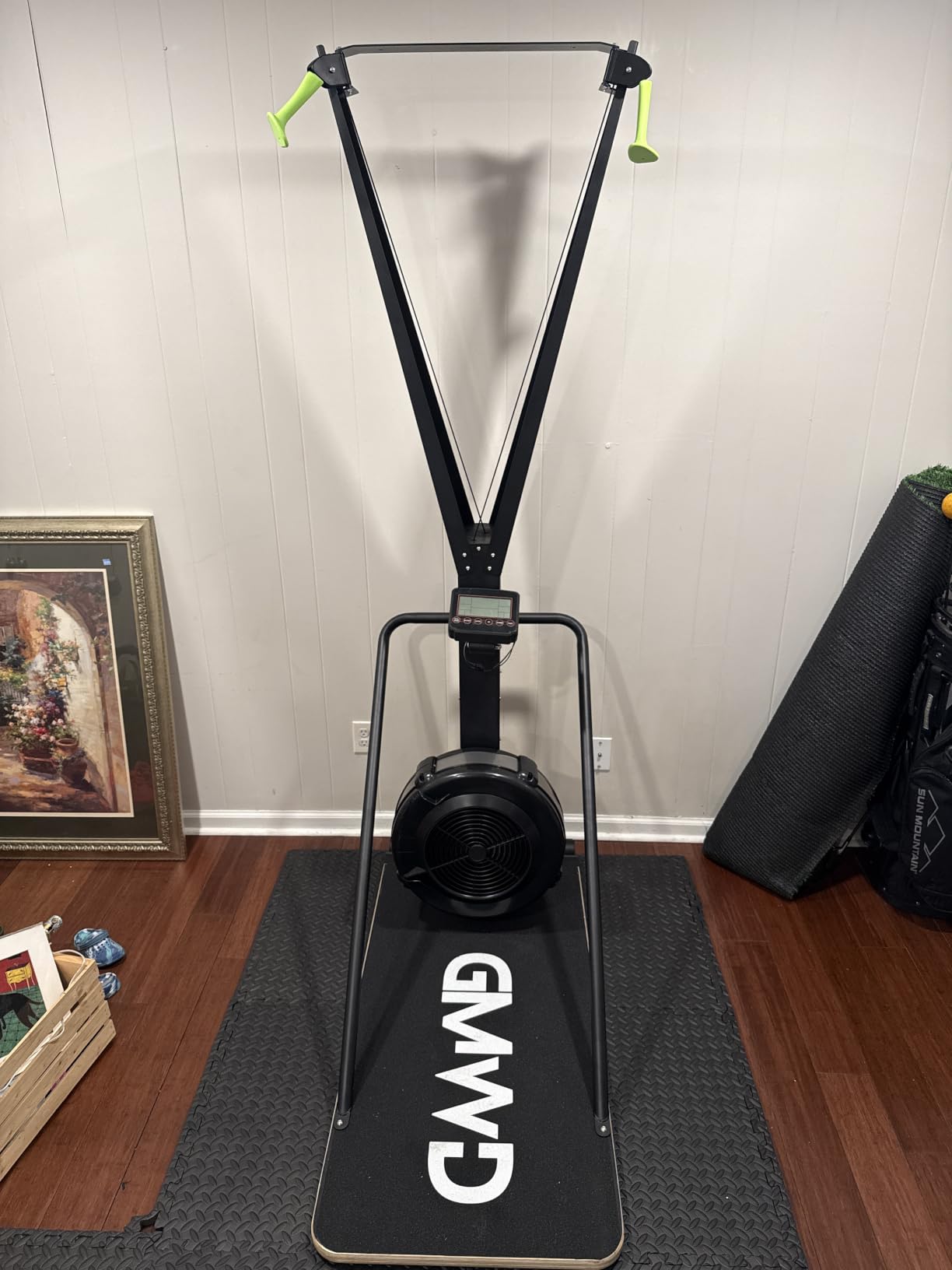
The GMWD SK01 is the most interesting machine on this list from a resistance standpoint, and the 73 owner reviews at a 4.4 rating give it the second-largest verified sample here. Roughly 70 percent of those reviews are five star, with the common theme being that the force response feels immediate and adjustable without getting off the machine.
What you get is a fan-magnetic dual control system across 10 levels with a spiral damper for quick flywheel airflow changes. The manufacturer claims the combination engages 84 percent of muscles by folding the upper body, lower body and torso into one movement. Whether or not you accept that specific figure, the practical effect buyers describe is a machine that feels heavier in the pull than most air-only trainers at the same nominal level.
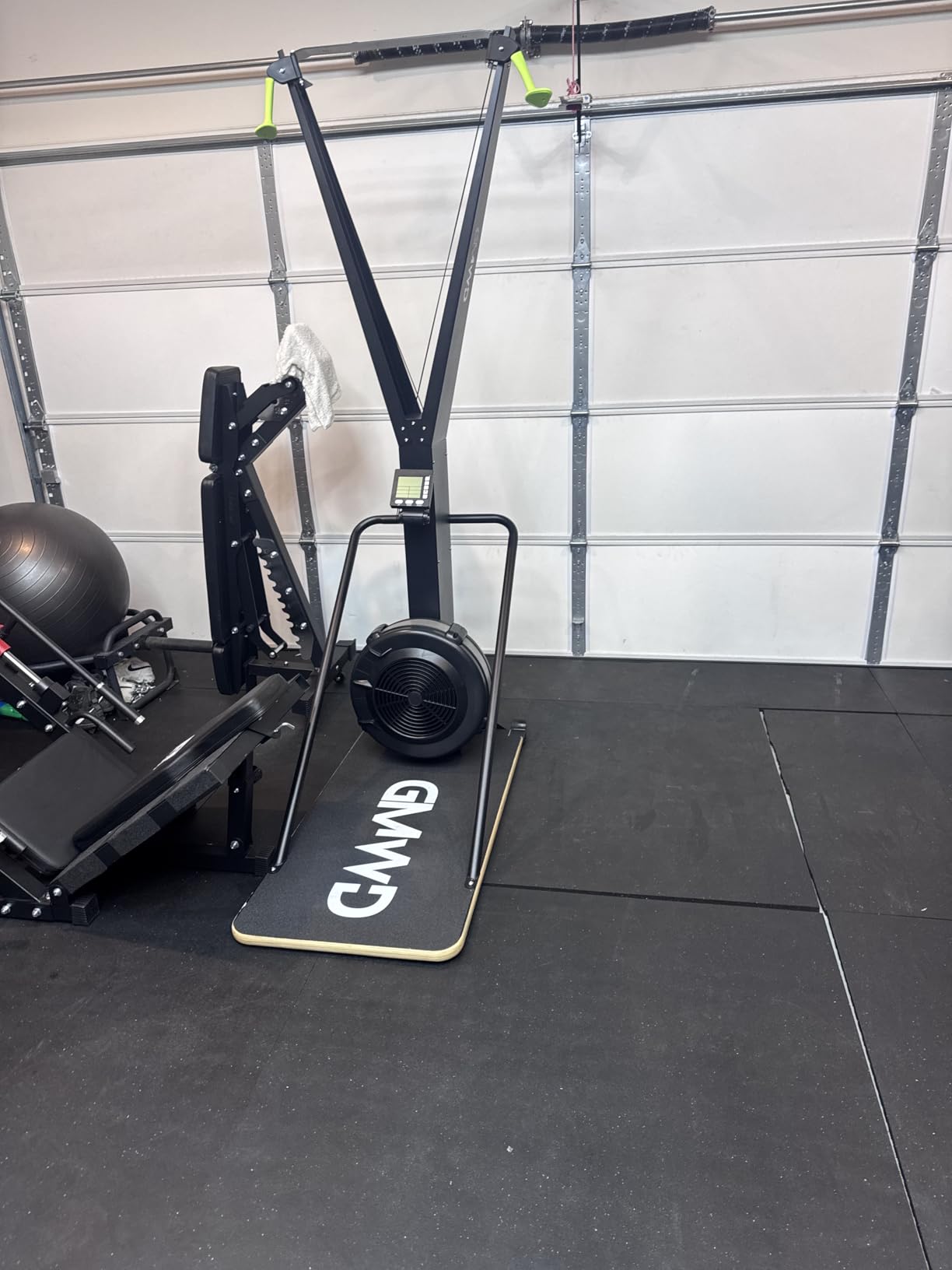
The box includes an anti-skid deck, a wall-mounted kit and a pro-grip tap set, and the monitor is an LED panel reading out time, distance, watts, calories, strokes and total strokes. Reporting watts is more than most competing LCDs manage, and it is the number this category’s buyers care about for interval work. Maximum user weight is listed at 300 pounds and the frame is alloy steel.
At 122 pounds and 50.3 by 23.6 by 87.4 inches, this is the heaviest machine in the roundup and the tallest after the TKO. The dimensions include the base footprint, so unlike the Concept2 this is not a wall-hung body that hangs in thin air. Owners deduct marks almost entirely for that weight and for the fact that the wall mount is not optional in practice.
Is dual resistance better than a pure air flywheel?
It depends on your goal. The magnetic element gives you a load floor that does not fall away at the start of a stroke, which some people find easier to get moving with and better for slow, heavy pulling. The fan element keeps the resistance scaling with effort as you speed up. Buyers who came from air-only machines report that the hybrid feels slightly more mechanical.
It is also the only machine here under 100 pounds of steel that gives you a real damper dial to turn between sets. For interval programming where you need to change the character of the resistance rather than just add a number, that is a genuine advantage.
Who should skip the SK01
Anyone without a suitable wall or a vertical bracket, because the included kit expects one and the 122-pound frame is unpleasant to handle alone. The warranty is two years from the manufacturer, shorter than the Concept2 coverage, which is worth factoring in for a machine this heavy.
Second, buyers who care about flywheel refinement. The reviews are positive but they consistently place this machine below a dedicated air ski erg on feel, and only one color, green, is available so it will not blend into a home gym.
3. FAGUS H Ski Trainer – The Smallest Footprint Here
Ski Trainer Machine with 10 Level Air Resistance for Full Body Workout
Alloy steel frame
63 lb, 10 levels
Fan plus magnetic system
LED monitor with watts
Pros
- Compact footprint against typical ski machines
- LED monitor reports watts and stroke data
- 10 adjustable levels
- tools included for assembly
Cons
- Only two customer reviews
- so durability is unproven
- must be mounted on a wall or training rack
- 63 lb frame is light against commercial steel models
Both reviews that exist for the FAGUS H are five star, which is encouraging and nearly meaningless as evidence. We are including it because the design brief is genuinely useful, not because anyone has run this thing for two years. Its selling point is stated plainly in the product copy: a more compact footprint than typical ski machines, mounting to a wall or a training rack.
The frame is alloy steel at 63 pounds, which is 59 pounds lighter than the GMWD and 17 pounds heavier than the Concept2 body. That mid-weight matters for a wall or rack mount, since you are relying on the bracket rather than the machine’s own base to hold the load through a hard interval.
Resistance is again a fan and magnetic dual system with 10 adjustable levels, and the LED performance monitor reports time, distance, watts, calories, strokes and total strokes. Reporting watts on a compact budget machine is unusual, and both reviewers mention the monitor as a positive. The claimed 84 percent muscle engagement figure is the same marketing number the GMWD uses, which tells you it comes from the category rather than from testing.
Will it fit where the others will not?
Probably yes, if you have a rack with compatible tubing or a clear wall. That is the whole value proposition, and it is a real one in a shared-wall or small-garage situation where a freestanding 50-inch-deep base would eat the room.
The catch is that you must have something to mount to. A standalone rack is not included, and wall mounting means drilling into structure. Buyers who rent should check their lease and the wall material before ordering.
What the two reviews cannot tell you
They cannot tell you whether the flywheel bearing holds up, whether the damper holds its setting, or how the machine handles a two-year warranty claim, which is listed as one year. With a sample of two there is no common fault pattern to look for, which is the main reason we placed this below the two machines with real feedback.
At 63 pounds the frame is on the light side next to the commercial steel models, and that is the trade for the compact footprint. If you pull genuinely hard, expect more movement in the mount than you would from a machine with its own weighted base.
4. HVO Ski Trainer – Built for a Smith Machine Garage
HVO Ski Trainer Machine with 10 Level Air Resistance for Full Body Workout
Alloy steel frame
25 kg, 10 air levels
LCD workout monitor
Wall or Smith machine mount
Pros
- Compact wall or Smith machine mount
- simple easy-to-read LCD
- 10 levels of air resistance that scale with pull speed
- comfortable handles for long sessions
Cons
- One customer review only
- so long-term durability is unproven
- needs a wall or a Smith machine that is not included
- entry-level monitor with no advanced metrics
The HVO is the simplest machine here and the only one that explicitly names a Smith machine as a mounting target. If your garage gym is built around a rack, bolting a ski trainer to the upright and using the existing steel as the support structure is a genuinely clever space saving move, and it is why this machine made the list despite having a single verified review.
Resistance is a 10-level wind flywheel where the harder you pull the faster the flywheel spins. That self-scaling behaviour is the same physics as the Concept2, minus the refinement and the PM5. The listed dimensions are 17.0 inches wide by 28.3 inches high by 26.3 inches deep, or 43.1 by 72 by 66.8 centimetres, which is a small box by ski erg standards.
The LCD workout monitor tracks time, distance, calories and strokes. That is the entry level of data, with no watts and no stroke rate, so anyone training to structured splits will find it limiting. The listing carries a one-year warranty and a 25 kilogram weight, roughly 55 pounds.
Is the Smith machine mount actually a good idea?
It is, with one caveat. A rack upright is rated for barbell loads and handles repeated pulling force from a different angle, so check that the upright is a proper steel upright and not a light duty model. Owners in r/homegym who have done this report it works well and that the machine becomes effectively free-standing once mounted.
The benefit over a wall mount is that racking height is adjustable, so you can set the handle height for a taller athlete and change it later. That is not something a fixed wall bracket offers.
Where the HVO falls short
One review means one data point, and that reviewer reported smooth resistance, an easy-to-read display and a compact mount. Nothing about durability, noise or serviceability can be confirmed, and the monitor is the weakest on this list by a wide margin.
The listed height of 28.3 inches is worth reading carefully, because it almost certainly describes the mounted ski unit rather than the full reach of the arms and cord above it. Before buying, measure the total height from the floor to the top of the handle at full extension and compare it against your ceiling, especially in a low-ceilinged garage.
5. Bear KompleX MAX SKI Erg – Floor Stand and Wall Mount in One Box
Bear KompleX MAX SKI Erg Machine – Indoor Trainer Equipment with Floor Stand and Wall-Mount Included, Full Body Workout Cardio, 10-Level Air Resistance System, Home Gym Fitness Equipment for Crossfit
106 lb total, aluminum frame
84.3 in tall, 10 levels
Self-powered, no outlet needed
Bluetooth monitor, D-fit app
Pros
- Floor stand
- transport wheels and wall-mount hardware all included
- five years of spare part availability
- self-generating power needs no outlet
- Bluetooth monitor links to the D-fit app
Cons
- No customer reviews or star rating to validate quality
- 84.3 in frame needs generous ceiling clearance
- 106 lb makes repositioning awkward without the wheels
This is the most complete package on the list and also the one with zero owner feedback, so read it as a specification sheet and nothing more. The Bear KompleX MAX ships with a floor stand, transport wheels and wall-mount hardware in the box, which removes the single most common complaint on this page: that a ski erg arrives unusable until you buy a separate stand.
Power is self-generated, so there is no outlet to find and no cord to route behind a wall. The adjustable monitor supports Bluetooth and the D-fit app, which is a step above the basic LCD panels on products three and four in this roundup, though it still does not match the PM5 on structured data.
Construction is aluminum on a high-strength drive cord system with 10 levels of air resistance and damper control between sets. The total weight is 106 pounds, split between a 72.9 pound ski unit and a 33.1 pound base, and the full footprint is 49.6 by 29.1 by 84.3 inches. The vertical frame supports standing, seated or kneeling positions, which is unusual and useful for rehab-style work.
Why spare parts matter more than star ratings
The listing states five years of spare part availability, and for a piece of gym equipment that is arguably the most meaningful durability signal available. A flywheel machine with no replacement cords or damper in five years is a machine you replace, not repair.
We cannot verify that claim with owner reports, and we would not build a purchase around it alone. But paired with an aluminum frame and dual mounting, it makes this the specification-led choice for someone building a gym and planning to keep it.
Plan the ceiling before you order
At 84.3 inches tall, this is the second tallest machine here, and owners on forum threads repeatedly describe discovering after delivery that their ceiling was too low. Measure the full height of the unit plus the reach of the handle at the top of the pull, not just the frame.
Also measure the delivery route. A 106-pound machine in a tall box is awkward, and the transport wheels only help once it is assembled in the room. The 33.1 pound base is a separate piece, so plan where you will stage it while building the stand.
6. TKO AirRaid Ski Machine – The Commercial-Grade Option
TKO AirRaid Ski Exercise Machine with 10 Setting Wind Resistance
Metal frame
114 lb, 86 in tall
10 air settings, LED monitor
Floor stand and transport wheels included
Pros
- Floor stand and transport wheels included in the box
- LED monitor reports stroke rate distance calories watts and programs
- works alternating arm and double-pull
- five-year frame warranty
Cons
- No customer reviews to justify the price
- 114 lb frame is very heavy
- no verified long-term feedback on durability or noise
The TKO AirRaid is the heaviest machine in this roundup at 114 pounds and the tallest at 86 inches, and it is the only one that arrives with a floor stand and transport wheels as standard. For a commercial gym, a boot camp room or a shared facility that needs to move equipment around, that combination is the reason to look at it.
Resistance is 10 air settings with an LED monitor covering time, stroke rate, distance, calories, watts and programs, plus heart rate tracking when you connect a chest strap. Stroke rate on the display is a real advantage over the basic LCD units, since stroke rate is the number interval programs are built on.
Maximum user weight is listed at 350 pounds, higher than any other machine here, and the machine handles both alternating arm and double-pull technique. The warranty splits into a five-year frame and two-year parts cover, which is the same shape as the Concept2 coverage and the best in this list alongside the Bear KompleX.
Is a commercial frame worth it for a home gym?
Only if you already have somewhere to put it. A 114-pound machine with a 50 by 23 inch base is not a corner-of-the-garage purchase, and the transport wheels are there because the manufacturer expects it to move. In a small home space, a wall-mounted unit like the Concept2 or the FAGUS H is a much better fit.
For a facility with many users, the five-year frame warranty and 350 pound capacity start to make sense as replacement math rather than as a feature.
The honest problem with this listing
There are no customer reviews and no star rating, so everything above is specification. Owners in forum threads warn specifically against buying an unproven machine on spec alone, and the general rule they apply is simple: if your training numbers need to be comparable to a race machine, buy a machine people have actually raced on.
At this weight, assembly is also a two-person job. The listing includes only a user manual, and the declared power source of corded electric with a one horsepower rating is listed oddly enough that we would confirm the electrical spec with the manufacturer before specifying this for a facility.
7. Xoiasth Ski Exercise Machine – Four Ways to Mount It
Ski Exercise Machine, Air Resistance Trainer-Wall / Rack Mounted WallMount,10-Setting Airflow Control, LCD Monitor, Full Body ski-Style Training for Garage / Gym /Home Cardio Training (12–17mmRack)
18 kg frame
Four mounting options, 10 airflow settings
Front-mounted LCD monitor
Three round tube sizes supported
Pros
- Mounting bracket fits 12-17 mm
- 18-24 mm and 25-26 mm round tubes
- compact wall or rack footprint for small rooms
- ten airflow settings cover warm-ups and intervals
- front LCD stays visible mid-exercise
Cons
- No customer reviews to judge build quality
- wall or rack hardware compatibility must be checked
- warranty text reads as placeholder
The Xoiasth is the most flexible mount in the roundup. It comes in WallMount, 18-24mm Rack, 12-17mm Rack and 25-26mm Rack variants, which means it fits three different round-tube diameters. Most racks use a consistent tube size, so this is worth checking against your own equipment before you order rather than assuming compatibility.
Resistance runs across 10 airflow damper settings, with flywheel load rising as your pull speed and effort increase. The front-mounted LCD shows time and distance targets, which is a more useful default for a beginner than raw calorie counts, since a target keeps you moving at a steady pace instead of coasting through intervals.
The frame is listed at 18 kilograms, or 25 kilograms of structure, with approximate dimensions of 28.3 by 17.0 by 26.3 inches. Ergonomic handles are fitted, and the product is aimed at garage, gym and home cardio use. Compared with the 122 pound GMWD, it is a much lighter object to put on a wall.
Why mount flexibility beats a floor stand
A floor stand needs floor area and makes the machine tall. A wall or rack mount reclaims the floor entirely and reduces the depth to a few inches, which in a narrow garage is the difference between the machine fitting and not fitting. If you already own a rack, matching the tube diameter is the only real decision to make.
The trade is stability. A bracketed machine has no weighted base to resist the pull, so hard intervals can rock the mount. Owners who wall mount ski ergs generally report this is manageable at moderate effort and noticeable at maximum effort.
What to check before buying
The included components field lists a camera body, which is a listing error rather than something you will receive. Manufacturer part number and warranty text also read as placeholder content, which is a signal about support quality behind the machine.
With no customer reviews at all, treat this as an option for someone who has measured their space, knows their rack tube size and is comfortable buying on specification. If you want a verified owner history instead, the Concept2 and the GMWD are the two to shortlist.
8. zhenmaster Ski Erg Machine – Quiet Magnetic Rail Trainer
zhenmaster Ski Erg Machine for Home Use, Multifunctional Ski Trainer with Mat & Poles, 0-100kg Adjustable Magnetic Resistance for Effective Fat Burning & Total Body Conditioning for Home, Gym(A)
15 kg rail frame
0-100 kg magnetic resistance
40dB operation
150 kg load capacity
Pros
- Lightest machine here at 15 kg and compact enough for an apartment
- magnetic resistance system running as low as 40dB
- wide 0-100 kg range covers all levels
- dual-bearing rails rated to 150 kg
Cons
- Rail design is a balance trainer rather than a true flywheel ski erg
- no customer reviews to verify build quality or calorie claims
- 15 kg frame limits the resistance ceiling
This machine is mechanically different from the other seven and we would rather say so than pretend otherwise. The zhenmaster is a rail-based ski simulator with two sliding handles on a rail, an acrylic frame and a magnetic resistance knob from 0 to 100 kilograms. It does not have a flywheel, and it will not reproduce the feel of pulling against moving air.
What it does offer is the thing that stops most people buying a ski erg at all. At 15 kilograms and 130 by 33 by 25 centimetres, it is the smallest and lightest machine in this roundup by a wide margin, and the magnetic system runs at a stated minimum of 40 decibels, which is a genuine appeal in a flat with neighbours below.
The rails are dual-bearing with a stated 150 kilogram load capacity, built on an aluminum alloy frame with rubber rails and polyurethane wheels. A-type and B-type handles are included, with alternating sliding motion, and the machine also works as a balance trainer and a stretching aid.
Should a balance trainer be on a ski erg list?
We included it because the brief for this roundup was the best ski ergs, and the honest answer for a reader in a small apartment is that a magnetic rail trainer may serve them better than a flywheel machine they cannot house or tolerate acoustically. The category is genuinely mixed, and pretending otherwise would waste your time.
If your training has any competitive or structured component, skip it. Magnetic resistance is a fixed load that does not scale with pull speed, so your stroke rate and your effort are decoupled in a way that makes pace data meaningless. There is no pace data here because there is no flywheel to measure.
What to be careful about
There are no customer reviews, so the calorie claims and the 40 decibel figure are unverified manufacturer statements. Check the noise rating in your own space before relying on it, since the number is a floor and not a real-world reading.
The resistance ceiling is another issue. A 15 kilogram frame with a knob is nowhere near the loading capacity of a 46 pound aluminum ski erg, so advanced users will run out of load long before they run out of technique. Treat it as an entry and maintenance tool, not a performance machine.
How to Choose a Ski Erg Before You Buy
Measure your ceiling and your wall before anything else
Ski ergs are the tallest home cardio machines you can buy, and people discover this after delivery. The frames on this list run from 83.5 inches on the Concept2 to 87.4 inches on the GMWD, and those numbers are the frame only. Add the reach of your arms and the cord at the top of the pull when you check clearance against your ceiling.
For depth, the wall-mounted units such as the Concept2 body at 16 inches deep are dramatically smaller than the freestanding bases, which run 50 inches deep on the GMWD and TKO. A wall mount reclaims the floor but requires drilling into structure and a landlord’s permission if you rent.
Measure the delivery route too. Owners on forum threads mention this repeatedly, and it is not a joke: these machines are tall, awkward and often shipped in more than one box. A 106-pound base will not go through a stairwell turn without planning.
Pick the resistance type that matches your training
Air resistance scales with your effort. The harder you pull, the faster the flywheel spins, the more air it pushes against, and the more resistance you feel. This is the physics behind real Nordic skiing and the reason the Concept2 feels different from a weight machine.
Magnetic resistance applies a fixed load set by a knob or dial. It does not scale with speed, which makes it more predictable and much quieter, but it also means a slow heavy pull and a fast light pull feel the same at the same setting. Owners report magnetic machines feeling more like a core and arm movement, with less of the lats-driven pop that defines a flywheel pull.
Hybrid fan and magnetic systems, as on the GMWD and FAGUS H, sit between the two. They give a load floor at the start of the stroke and then scale as you accelerate. Our reading of the owner feedback is that hybrids suit beginners and interval work best, while committed skiers still prefer pure air.
Judge the monitor by the data you will actually use
Every meaningful training decision on a ski erg comes down to a few numbers: pace per 500 meters, watts, stroke rate, distance and split times. The PM5 on the Concept2 reports all of them and stores 15 programs, which is the standard the rest of the category is measured against.
Mid-tier LED panels reporting watts and stroke counts, as on the GMWD and FAGUS H, are enough for interval work. Entry LCDs showing time, distance, calories and strokes, as on the HVO and Xoiasth, are enough for a beginner and frustrating for anyone following a written program. This is the most common complaint threads have about budget machines and it is worth paying to avoid.
Check stability, because hard pulls move cheap frames
Wobble is the second most repeated pain point in owner threads. A wall or rack mounted machine has no weighted base, so the harder you pull the more the mount moves, and buyers describe a flimsy base as feeling cheap. A floor stand with a wide base resists the pull better but eats floor space.
Weight is a rough proxy. The Concept2 body is 46 pounds, the FAGUS H is 63, the Bear KompleX is 106 and the GMWD is 122. The lightest frames are the ones that move most, and none of the machines in the 15 to 25 kilogram range here are built for maximum-effort intervals.
Be honest about noise
Owners consistently report that the fan is loud, comparable to or somewhat louder than an air rower. That is fine in a detached house and a problem in a flat. The Concept2 reviews are slightly more positive on noise than the raw specification would suggest, but individual reviews also mention a noisy flywheel during intense strokes, so neither is a quiet machine.
If noise is the deciding factor, the only category on this list that meaningfully addresses it is the magnetic rail approach, which claims a 40 decibel minimum. That claim is unverified, and a rail trainer is not a flywheel ski erg, so this is a real trade rather than a free upgrade.
Look at the warranty, and at parts
A limited 2-year and 5-year warranty on the Concept2 and a five-year frame with two-year parts on the TKO are the strongest covers in this roundup. The Bear KompleX lists five years of spare part availability, which matters more than warranty length on a machine with cords and a damper. The HVO and FAGUS H list one-year terms.
Before any purchase, check whether replacement drive cords and a damper are available for that model. On a flywheel machine those two parts are the ones that wear, and a machine with no available parts is a machine you replace.
Use the damper setting properly
The damper is the dial or lever on the base that sets how much air reaches the flywheel. A higher setting means more air, more drag and slower flywheel speed for the same effort. It is not a difficulty rating; it changes the character of the pull rather than simply making it harder, which is why machines with a spiral damper, like the GMWD, are convenient for interval work where you need to change resistance between efforts.
Learn the technique in the first ten minutes
The most common beginner mistake, repeated across beginner threads, is pulling only with the arms. It feels awkward and tires the wrong muscles within a few minutes. The fix is a sequence: start tall, brace the trunk, drive the pull down with the lats rather than the hands, and let the legs contribute below.
Use double-pole when you want to load both sides symmetrically and keep the heart rate high, and alternating arm when you want a rhythm you can sustain longer. Both are supported on Concept2 and the TKO. Vary the technique between sessions, because owners report that repetitive motion on a single pattern is the other common injury complaint.
Have a benchmark for 1000 meters
Without a target, a 1000 meter effort tells you very little. The number most people find useful is the pace per 500 meters, since a ski erg reports splits in that unit. A first session in the low two-minute range per 500 meters is a normal starting point for a non-specialist, and improving from there over weeks is a more useful measure than any single effort. If your machine cannot report pace reliably, that is a strong argument to move up the monitor tiers rather than to guess.
Ski Erg vs Rowing Machine vs Air Bike
The three machines overlap more than buyers expect, and the honest reason to own two of them is variety rather than fitness. Owners say it plainly in forum threads: a ski erg gets bought to solve boredom with a rower, not because a rower is failing.
A ski erg pulls vertically with the lats, upper back, triceps and core, and the legs drive below. A rowing machine does the same pattern horizontally with a longer leg drive phase, which makes it the better aerobic engine for pure endurance. An air bike loads the whole body in a cyclical push and pedal pattern with no upper-body pull at all, so it is the least useful of the three for back and lat development.
On space, the wall-mounted ski erg wins clearly, with a frame width of 20.5 inches and a 16 inch depth. On data quality, the PM5 is the benchmark the whole category is judged against. On noise, all three are fan-driven and all three are loud, which is the honest answer to the question of whether a ski erg is quieter than a rower. It is not.
On hypertrophy and muscular endurance, the ski erg has an edge because vertical pulling at a high stroke rate trains the arms and lats in a way neither of the other two does. That is also why it is popular in CrossFit and in HYROX preparation, where it is the first station of the race and the first thing people get tired on.
Who Should Not Buy a Ski Erg
If your priority is the most aerobic return per minute of your attention, buy a rower or a bike. A ski erg is a high-skill, high-fatigue machine and the learning curve is real, so it is a poor choice for someone who wants to put on headphones and walk away.
If you already own a rower and love it, the case for a ski erg is variety, not fitness gain. That is a legitimate reason but an expensive one, and you should make it consciously.
If you cannot drill into a wall, do not rent, and have no rack, then every wall-mounted machine on this list is off the table. That eliminates the Concept2 body, the FAGUS H, the HVO, the Xoiasth and the GMWD unless you are prepared to add a stand, and it is the single most common reason buyers end up choosing a freestanding model instead.
If noise rules out fan-driven equipment in your building, this category will not solve that problem. Look at the magnetic rail option and accept the compromise, or move to a bike with a magnetic resistance system instead.
Frequently Asked Questions
How long should a 1000m SkiErg take?
It depends on where you start, so use pace per 500 m as the real benchmark rather than one effort. A non-specialist finishing in the low two-minute range per 500 m is a normal first session, and consistent improvement in that split over several weeks matters far more than a single time. If your machine cannot report pace reliably, upgrade the monitor before you try to train to splits.
Can you build muscle with SkiErg?
Not in the hypertrophy sense, because the loads are light and the movement is high repetition. What you do build is upper-body muscular endurance, lat strength through the pulling pattern, core stability and grip. It complements lifting rather than replacing it, and the most common mistake is pulling with the arms instead of driving with the lats.
Are ski ergs good for you?
For most people, yes, because the movement is low impact and full body. It suits people with knee, back or joint problems who cannot run, and it trains the vertical pulling that rowers, bikes and treadmills neglect. Two cautions from owners: build intensity slowly to avoid repetitive-motion injury, and expect a technique adjustment period where the arms tire before the lats wake up.
What is a good alternative to SkiErg?
A rowing machine is the closest substitute and shares the flywheel and damper design, though the pull is horizontal and the leg drive is longer. A magnetic resistance trainer is quieter and cheaper but does not scale resistance with effort. If your real goal is HYROX preparation, the SkiErg itself is the standard tool, since it is the first station of the race.
What’s better, SkiErg or rowing machine?
For pure aerobic endurance and calorie burn over long sessions, the rower wins because of its longer leg drive. For upper-body endurance, lat strength and high-intensity intervals, the ski erg wins because it pulls vertically. If you own one, the other is the most useful second machine you can buy for training variety, and if you own neither and work out at home, the ski erg is the more versatile of the two.
Are Concept2 rowers noisy?
Concept2 machines are fan-driven, and owners describe them as comparably noisy to a heavy air machine rather than quiet. Specific SkiErg reviews are mixed, with some owners reporting it quieter than the rower and others describing a loud flywheel during intense strokes. For a shared wall or downstairs neighbours, treat any fan machine as loud and test before committing.
What are the downsides of using a rowing machine?
The main ones are seat discomfort over long sessions, the need for a full floor footprint rather than a wall mount, and a technique problem where people push with the legs first and finish with the arms, which trains the wrong pattern. A rowing machine also has no vertical pulling, so the upper back and lats are trained less directly than on a ski erg.
Which Ski Erg Should You Buy?
Buy the Concept2 SkiErg if you want the benchmark machine and you can wall mount it or add a floor stand. With 617 owner reviews at 4.8 stars, a PM5 monitor that reports every metric worth training to, and a two-year plus five-year warranty, it is the only ski erg here with enough verified history to base a confident recommendation on.
Buy the GMWD SK01 if you want fan and magnetic resistance in one flywheel and you have a wall for the included kit. It is the best value on this list and its 73 reviews at 4.4 give it real owner backing, though the 122 pound frame is the heaviest thing here.
Buy the Bear KompleX MAX if you want a floor stand, wall hardware and transport wheels in one box and you can live with the spec sheet rather than reviews. Buy the Xoiasth or the FAGUS H if rack or wall mounting is your only option, and the TKO AirRaid if you are equipping a facility rather than a room.
Whatever you pick, measure the ceiling, the wall and the delivery route before you order. That single hour of measuring prevents almost every complaint we read about this category in 2026.