
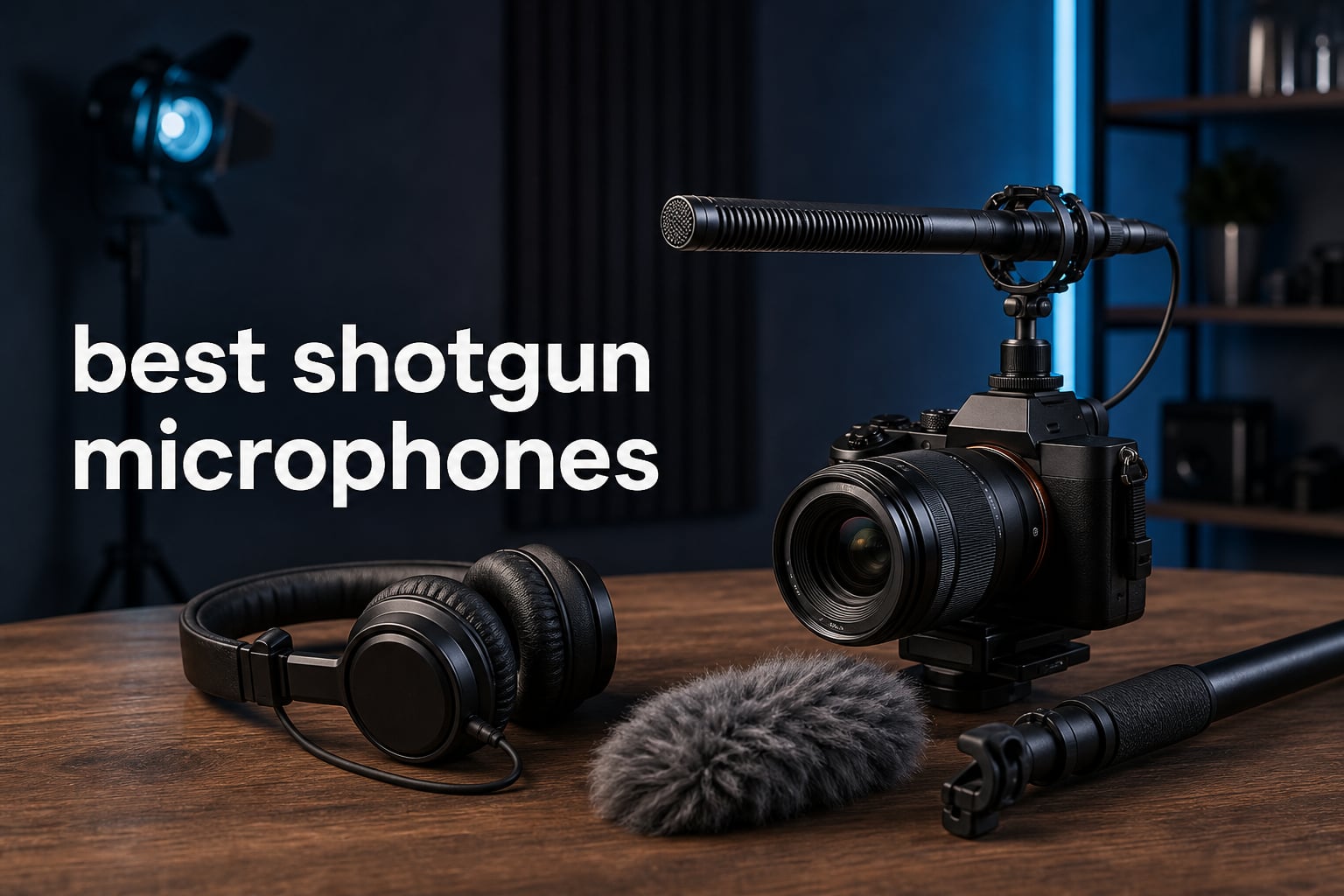
The best shotgun microphones make it easier to record a person in front of the camera while reducing the distraction from the sides and rear. That focus comes from a directional capsule and, on many designs, an interference tube that uses phase cancellation to narrow the usable pickup area.
For video makers, the right shotgun mic is less about a famous name and more about the distance to the speaker, the camera or recorder connection, available power, and the noise around the shoot. I would start with those four facts before comparing specifications, because a great XLR microphone is not much help when the camera only accepts a 3.5 mm input, and a tiny on-camera mic cannot replace a boom placed close to dialogue.
This guide compares eight current options for filmmaking, documentary work, interviews, YouTube, vlogging, and field recording. I have kept the recommendations tied to the supplied product data: stated connectivity, pickup modes, power arrangements, included accessories, ratings, and reported limitations rather than invented listening tests.
A quick definition helps set expectations: a shotgun microphone is a highly directional microphone, usually with a super-cardioid or similarly tight forward-focused pattern, meant to capture what is in front while rejecting much of the side and rear sound. It is excellent for dialogue and focused effects, but it is not a magic zoom lens for audio; distance, wind protection, room reflections, and aiming still decide the result.
Community discussions around location sound keep returning to the same mistakes: buying without checking phantom power, assuming every camera shoe works the same way, and ignoring wind or ugly off-axis room sound. Our selections below separate long-form XLR work, camera-shoe systems, tiny travel rigs, phone-friendly outputs, and a recorder-based alternative so you can begin with a fitting category.
Table of Contents
These are the top 3 picks for best shotgun microphones in 2026
The Sennheiser MKE 600 is the straightforward choice for a camera or camcorder setup that can work with XLR, especially when you want the fallback of battery power. Sony’s ECM-M1 is the specialized pick for compatible Sony cameras because its Multi Interface Shoe connection and eight selectable recording modes are its defining advantages.
For a compact rig that also needs a direct USB connection to a phone, tablet, or computer, the RØDE VideoMic GO II Helix is the clearest all-round starting point in this group. The other five models still make sense when their unusual strength—AI noise processing, a very small body, a broad accessory kit, or 32-bit-float recording—matches the assignment.

These eight shotgun microphones cover the main recording needs in 2026
The overview below is a fast way to sort the field. “XLR” points toward camera, recorder, or audio-interface workflows, while 3.5 mm and USB-C are more convenient on compact cameras, phones, tablets, or computers when the device supports the connection.
Feature labels are not a guarantee of clean dialogue by themselves. A low-cut filter can reduce low-frequency rumble, an isolation mount can reduce handling vibration, and a safety recording can protect against surprises, yet careful mic placement remains the first control to use.
| Product | Specifications | Action |
|---|---|---|
| Sennheiser MKE 600 Bundle |
|
Check Latest Price |
 Sony ECM-M1 Sony ECM-M1 |
|
Check Latest Price |
 Audio-Technica ATV-SG1 Audio-Technica ATV-SG1 |
|
Check Latest Price |
 BOYA BY-MM1 AI BOYA BY-MM1 AI |
|
Check Latest Price |
 RØDE VideoMic GO II Helix RØDE VideoMic GO II Helix |
|
Check Latest Price |
 Movo X1-Mini Movo X1-Mini |
|
Check Latest Price |
 RØDE VideoMicro II RØDE VideoMicro II |
|
Check Latest Price |
 Zoom M3 MicTrak Zoom M3 MicTrak |
|
Check Latest Price |
1. The Sennheiser MKE 600 is the strongest XLR choice for camera and boom work
Sennheiser MKE 600 Shotgun Microphone Bundled with Universal Shockmount + 20-Feet XLR Microphone Cable + Microfiber Cleaning Cloth (4 Items)
XLR output
Battery or phantom power
Low-cut filter
Pros
- High directivity
- Phantom or battery power
- Low-cut filter
- Shock mount included
Cons
- XLR-oriented workflow
- Battery-powered design
The MKE 600 is the most traditional location-sound choice in this list: a metal-bodied, unidirectional microphone with XLR connectivity and a stated focus on demanding video and camcorder work. Its supplied bundle information is unusually practical, listing the microphone, MZS 600 shock mount, foam windshield, an XLR-to-3.5 mm connection cable, a universal mount, an XLR cable, and a cleaning cloth.
I would put this at the top of the list for someone moving beyond a basic camera mic and building an XLR path through a camera, recorder, or audio interface. The 4.9 rating comes from 33 supplied reviews, which is a small review pool, but the listed rating distribution contains only four- and five-star responses.
The key flexibility is power. The MKE 600 can run from phantom power or a battery, so it can work when a camera or camcorder does not supply phantom power; that is a specific answer to one of the most common beginner compatibility problems.
The switchable low-cut filter is the other useful field feature, designed to reduce wind-related low-frequency noise. It does not replace a proper furry windshield in a breeze, but it gives you a way to reduce rumble before it crowds dialogue.
This microphone fits XLR-based video crews and mixed-power camera setups
Choose the MKE 600 if your camera, recorder, or interface has an XLR input, or if you are comfortable using the included connection cable as part of a camera setup. Its directivity is intended to favor sound from the direction the camera points while attenuating side and rear noise, a sensible fit for interviews, documentary scenes, and focused effects.
It is also a useful option when your available gear changes from shoot to shoot. A battery-capable microphone gives a practical fallback for an older camcorder or a compact rig that cannot deliver phantom power, while XLR keeps the main connection familiar to many video and audio workflows.
This microphone is less suitable for pocket-size rigs and USB-first creators
Skip it if the goal is the smallest possible microphone on a phone, tablet, or lightweight travel camera. The supplied information centers on an XLR connection and an XLR-oriented accessory bundle, not direct USB operation or a tiny shoe-mounted body.
Also consider how you will support it. A longer directional mic is often happier in a shock mount on a boom or a properly balanced camera, whereas a small handheld setup can feel less tidy with an XLR cable and a full-length microphone attached.
2. The Sony ECM-M1 is the best match for compatible Sony camera shoes
Sony Digital Shotgun Microphone ECM-M1,Black
Sony MI Shoe
Four capsules
Eight recording modes
Pros
- Four-capsule beamforming
- Eight selectable modes
- Rear dial controls
- Digital noise filters
Cons
- Requires Sony MI Shoe
- Nonstandard batteries
The Sony ECM-M1 is not a general XLR shotgun microphone; it is a camera-specific digital design that connects through Sony’s Multi Interface Shoe. That limitation is also its main attraction for the right owner, because the supplied data pairs the shoe connection with a digital audio interface, rear dial controls, and four microphone capsules using beamforming technology.
Its eight dial-selectable audio recording modes make it the most mode-driven product in this comparison. Rather than treating a shotgun pattern as the only tool, Sony gives the user multiple selectable capture approaches, plus a digital noise-cut filter and a low-cut filter.
I would only rank it highly after confirming camera compatibility, not before. For the compatible Sony user, reducing external cabling and using the camera shoe can create a more contained camera rig than an XLR mic and cable, and the ECM-M1 weighs a listed 2.3 ounces.
The reported 4.7 rating is drawn from 89 reviews, with supplied review insights noting that its digital signal processing is appreciated. That is helpful context, though the control modes still need deliberate selection for the scene instead of being treated as a set-and-forget fix.
This microphone fits Sony shooters who want selectable digital capture modes
Pick the ECM-M1 if you own a compatible Sony camera with the required Multi Interface Shoe and want the camera rig to carry the connection. The rear dial is a direct, physical way to choose among its eight recording modes rather than adding a separate control box or an XLR preamp.
It is particularly appealing for solo video work where switching the microphone’s behavior can be more useful than carrying several mics. The listed low-cut and digital noise-cut filters are relevant for everyday environmental noise, though their settings should still be checked with headphones whenever possible.
This microphone is unsuitable for non-Sony cameras and universal XLR systems
Do not choose this mic assuming that a shoe mount alone means compatibility. Its stated connection is Sony’s Multi Interface Shoe, so a standard cold shoe, a 3.5 mm camera input, a phone, or an XLR recorder is a different situation.
The power specification also lists nonstandard batteries. Before a long shoot, check the exact power arrangement and carry the required spares if the camera system does not provide the power behavior you expect.
3. The Audio-Technica ATV-SG1 is a focused on-camera option with flexible aiming
Audio-Technica ATV-SG1 On-Camera Shotgun Mic
14 mm diaphragm
100 mm acoustic tube
Rotating shoe mount
Pros
- Natural high-resolution sound
- Focused 100 mm tube
- Integrated shock mount
- 30-degree rotation
Cons
- Newer model
- Fewer supplied reviews
Audio-Technica built the ATV-SG1 around an on-camera form factor, but it includes details that make aiming less of an afterthought. The supplied feature list names a 14 mm large-diameter diaphragm, a 100 mm acoustic tube for directional pickup, an integrated shock mount, and a 12-sided shoe plate that rotates in 30-degree increments.
That rotating plate matters when the camera is not perfectly squared to the subject. I would rather make a small physical adjustment toward a speaker than assume a forward-facing mic will compensate for an off-center interview subject.
The product is listed at 13.8 ounces with dimensions of 5.04 by 1.42 by 3.23 inches. It is compact compared with a full boom-oriented shotgun, but it is still a deliberate on-camera accessory rather than an invisible travel mic.
Its 4.8 rating comes from 21 supplied reviews, and the review breakdown contains four- and five-star ratings only. Because it is a newer product with a smaller review total, I would treat those numbers as a good early sign rather than a substitute for checking compatibility and handling on your own camera.
This microphone fits creators who need precise on-camera orientation
The ATV-SG1 makes sense for a filmmaker using a hot shoe who wants an acoustic tube designed to keep the pickup focused while reducing background sound. The integrated shock mount is also relevant when operating a camera by hand, where small bumps and movement can travel into the mic mount.
Its 30-degree rotation increments are a practical feature for horizontal positioning. This is useful for a seated interview, an angled product demonstration, or a camera that is framed slightly to one side of the person speaking.
This microphone is less suitable for buyers who need extensive field history or direct USB
This is not the pick for someone who wants a large body of supplied customer-review history, since the available product data notes it as newer and gives it 21 reviews. It is also not presented as a direct USB microphone for computers, tablets, or phones.
Use its compact form as a reason to check your camera’s mounting balance, not as a reason to neglect placement. A microphone mounted on the camera remains farther from the talker than a boom mic, so quiet indoor speech from across the room will still be difficult.
4. The BOYA BY-MM1 AI is the flexible choice for app control and dual outputs
BOYA BY-MM1 AI On-Camera Shotgun Mic for Camera, DSLR, iPhone, Android
AI noise reduction
3.5 mm and USB-C
30-hour battery
Pros
- AI noise cancellation
- App controls
- Dual 3.5 mm and USB-C output
- 30-hour battery
Cons
- App connectivity reports
- Budget-brand positioning
The BOYA BY-MM1 AI brings more processing and control options than the simpler compact mics here. Its listed feature set includes a dedicated AI chip with Deep Neural Networks for adaptive noise cancellation, app control for low-cut, safety track, and monitoring settings, plus both 3.5 mm and USB-C outputs.
It also states 48 kHz/24-bit recording, an 80 dB signal-to-noise ratio, a 120 dB maximum SPL, a 9.7 mm capsule, and a super-cardioid pattern. Those specifications make it a feature-dense option for a creator who records to a camera one day and a phone or computer the next.
I would treat the claimed noise reduction as an aid, not permission to place the mic badly. Noise suppression can be useful when the unwanted sound is steady, but dialogue recorded closer to the source will usually sound more natural than heavily processed dialogue captured from far away.
The BY-MM1 AI is listed with up to 30 hours of continuous use and passthrough charging support. Its 4.6 rating is based on 40 supplied reviews; the data also flags reports of app connectivity issues, so the app should be installed, paired, and tested before an important shoot.
This microphone fits creators who alternate between cameras, phones, and computers
Choose this model when dual output is a central need. A 3.5 mm path suits many camera workflows, while USB-C creates an alternative for a phone, computer, or other USB-C device when that device supports the required audio input.
The app settings are useful for someone who wants access to gain, EQ presets, monitoring, low-cut, and a safety track from a control surface. The supplied package also lists a furry windshield, Rycote Lyre shock mount, cables, and a USB-C data cable, which gives a new user practical starting accessories.
This microphone is less suitable for creators who want no-app operation
Pass on the BY-MM1 AI if you want the fewest moving parts and no dependency on a companion app. The supplied review information specifically mentions some app connectivity reports, which makes a pre-shoot test a sensible habit.
It is also not a replacement for a full XLR boom solution when the job calls for a long cable run, external preamps, or a microphone positioned close above talent. Its strongest case is a compact, digitally connected content-creation rig with a need for flexible routing.
5. The RØDE VideoMic GO II Helix is the simplest light camera-and-USB all-rounder
RØDE VideoMic GO II Helix Ultra-Compact On-Camera Shotgun Microphone
3.5 mm and USB-C
57 g body
HELIX isolation mount
Pros
- Very lightweight
- Camera and USB outputs
- No battery needed
- HELIX isolation mount
Cons
- Plastic enclosure
- Limited physical controls
The RØDE VideoMic GO II Helix is built around removing setup friction. It has a listed 3.5 mm TRS output for cameras and a USB output for phones, tablets, and computers, with no battery required and no complex switches on the body.
At a listed 57 grams and 5.91 inches long, it belongs on compact mirrorless, DSLR, and small desktop rigs without adding much weight. RØDE includes the microphone, HELIX isolation mount, windshield, and SC14 cable in the supplied product data.
I would call this the most straightforward pick for someone who records both video and desktop audio but does not want to learn a detailed on-mic menu. Its 4.5 rating is supported by 502 supplied reviews, the largest review count in this roundup except for the VideoMicro II.
The lack of complicated controls is an advantage only if that is what you need. Advanced functions such as a high-pass filter, high-frequency boost, and pad are described as software-unlocked features through RØDE Central, so settings work differently from a microphone with dedicated physical switches.
This microphone fits lightweight camera rigs and USB-connected creators
Select the VideoMic GO II Helix if one mic needs to cover a 3.5 mm camera input and a direct USB connection on another day. That routing flexibility is a meaningful advantage for solo creators who record interviews, product videos, podcasts, calls, and short-form video across several devices.
The HELIX isolation mount is intended to reduce knocks, bumps, handling noise, wind effects, and plosives. It is useful protection for a moving camera, but I would still avoid touching the mic or cable during a take and add stronger wind protection outdoors.
This microphone is less suitable for users who need XLR or hardware controls
Do not choose it if your recorder or camera workflow is built around XLR. The stated outputs are 3.5 mm and USB-C, and adding adapters does not automatically provide the behavior or locking connection of a native XLR mic.
It is also a less direct choice for users who want to reach for physical gain and filter buttons during a shot. Its clean, simple body trades those controls for an easier setup, which is exactly right for some users and too limited for others.
6. The Movo X1-Mini is the accessory-rich universal kit for mobile recording
Movo X1-Mini Video Shotgun Mic for Camera – Supercardioid 3.5mm/USB-C Analog/Digital Camera Microphone for DSLR, iPhone and Android Smartphones, Computers – Compatible with Canon EOS, Nikon, Sony
3.5 mm and USB-C
Aluminum body
Accessory kit
Pros
- Wide device compatibility
- Aluminum construction
- Integrated shock mount
- Hard case and cables
Cons
- No wireless operation
- Super-cardioid needs careful aim
The Movo X1-Mini is designed to solve the “what cable or windscreen do I need?” problem in one purchase. The supplied package list includes the microphone, a Rycote shock mount, foam and furry windscreens, TRS and TRRS cables, a USB-C output cable, and a hard-sided carrying case.
Its stated compatibility spans iPhone, Android devices, cameras, camcorders, audio recorders, tablets, and laptops. That broad claim should still be checked against the port and adapter situation of your own device, but its 3.5 mm and USB-C approach is more flexible than a camera-specific shoe connection.
The X1-Mini uses a super-cardioid pattern, plug-in power, and an aluminum enclosure. It is listed with an 80 dB signal-to-noise ratio and support for up to 24-bit audio in digital mode, giving it a more specification-heavy profile than a basic analog camera mic.
Its 4.5 rating reflects 333 supplied reviews, but the detailed distribution includes some lower ratings as well as mostly positive feedback. I would view that as a reminder to test all included cables with the intended device while there is time to troubleshoot rather than assuming one connector works everywhere.
This microphone fits beginners who need cables, wind protection, and a case together
Choose the Movo if a bundled kit makes more sense than building a setup piece by piece. Having both foam and furry windscreens matters because the foam cover is for light air movement and plosive reduction, while a furry cover is normally the more appropriate starting point outdoors.
The hard case and aluminum construction also make it sensible for a creator who packs a kit frequently. An integrated shock mount and the separate Rycote mount are relevant for camera movement, though neither should be mistaken for a cure for a loose camera plate or a cable brushing the rig.
This microphone is less suitable for wireless setups and untested phone adapters
This is a wired microphone, not a wireless system, so it is not the answer for a presenter who must walk a long distance from the camera. A wireless lavalier or bodypack system may be more appropriate for that use case.
Universal compatibility is helpful but does not eliminate adapter checks. Smartphones vary in their USB-C and headset input behavior, so test the required cable path, power behavior, and recording app before relying on the mic for a one-time event.
7. The RØDE VideoMicro II is the smallest choice for a tidy on-camera rig
RØDE VideoMicro II Ultra-Compact On-Camera Shotgun Microphone for
80 mm long
39 g weight
Directional pickup
Pros
- Tiny and light
- Directional subject focus
- Helix isolation mount
- Furry windshield included
Cons
- 3.5 mm connection
- Plastic enclosure
The RØDE VideoMicro II is the compact specialist in this list. Its supplied features state an 80 mm length and 39 g weight, while the product details list a 3.14 by 0.85 by 0.85 inch body and a 24 g item weight; either figure points to a very small on-camera microphone, though buyers should confirm the exact packed configuration they are receiving.
It uses a directional pickup pattern intended to capture the subject more clearly while rejecting off-axis noise. The Helix isolation mount, built-in shoe mount, and cable management are all aimed at a minimal camera setup rather than a large recorder-based rig.
I would consider this when every gram and inch matter on a compact camera, phone cage, or travel kit. The 4.3 rating comes from 1,254 supplied reviews, which is the largest review total here and provides a wide pool of buyer feedback compared with the newer models.
The included kit is also useful: the data lists a Helix mount, foam windshield, furry WS12 windshield, and both TRS-to-TRRS and TRS-to-TRS patch cables. That gives you the correct cable types to begin with for many camera and phone-oriented setups, subject to the target device’s port requirements.
This microphone fits compact cameras, travel kits, and short-form shooting
Pick the VideoMicro II if a long microphone would block the viewfinder, throw off a small gimbal, or make a compact setup feel awkward. Its tiny size supports simple walk-and-talk, travel, product, and casual interview videos where the mic can remain close to the camera body.
The supplied furry windshield is valuable because outdoor recording is where small camera mics often disappoint first. Use it whenever wind is present, aim the microphone carefully, and record a short headphone-checked sample before a meaningful take.
This microphone is less suitable for distant dialogue and XLR sound bags
A compact on-camera microphone still sits on the camera, so it will not produce the same direct-to-voice ratio as a boom placed just out of frame. If the subject is several steps away, moving the mic closer does more than changing from one small camera mic to another.
It also has a stated 3.5 mm connection rather than XLR or USB-C. That is simple for many cameras, but less useful when the production already relies on locking XLR cables, audio mixers, or direct USB recording.
8. The Zoom M3 MicTrak is the best answer when recording backup audio matters most
Zoom M3 MicTrak On-Camera Shotgun Recorder for Filmmakers
32-bit float
Mono and stereo modes
Safety-track output
Pros
- 32-bit-float recording
- Three pickup modes
- RAW backup file
- Up to 12-hour power
Cons
- 318 g body
- Larger camera load
The Zoom M3 MicTrak takes a different route from a conventional camera mic because it is also a recorder. Its headline feature is 32-bit-float recording, described in the supplied data as a way to capture clip-free audio without setting gain in the usual way.
It offers mono for dialogue, 90-degree stereo, and 120-degree recording modes for ambience. A mid-side RAW file is always saved as a backup according to the product information, and there is also a 3.5 mm safety-track output for camera audio.
I would look at the M3 when a shoot has unpredictable levels and a separate recording backup has more value than the smallest possible camera rig. It records to SDXC storage up to 1TB, has USB-C for streaming or studio use, and is stated to run up to 12 hours on two AA batteries.
There is a real size trade-off. The M3 is listed at 318 g and 11.6 by 3.6 by 3.2 inches, so it is much more substantial than the tiny RØDE models; its 4.3 rating comes from 77 supplied reviews.
This microphone fits documentary work with changing levels and a need for backup files
Choose the M3 MicTrak when you want the microphone to capture its own recording rather than trusting only the camera’s audio input. The 32-bit-float design, RAW backup file, and safety-track output form a layered recording approach that is especially useful for unpredictable speech, changing scenes, and fast-moving documentary work.
The three pickup modes also give it more scene flexibility than a fixed mono shotgun mic. Mono is the obvious dialogue starting point, while 90-degree and 120-degree settings are relevant when the desired result includes the space or ambience around the camera.
This microphone is less suitable for light gimbals and minimal travel rigs
Skip the M3 if your priority is a nearly weightless camera top. Its listed 318 g weight and 11.6-inch dimensions need a stable mount and can change how a small camera balances, particularly on a lightweight gimbal.
Its recording features also create a more involved post-production path than a single direct camera track. That trade can be worthwhile for the backup and headroom benefits, but you need a clear plan for media cards, batteries, syncing, and file management.
The right shotgun microphone depends first on placement, power, and connection
Start with the physical question: where can the microphone sit during the shot? A boom microphone placed close above or below a speaker generally captures more direct voice and less room than any mic fixed to a distant camera, while an on-camera shotgun is fast, compact, and better than relying on the camera’s built-in mic for many situations.
For a walk-and-talk creator, a small shoe-mounted model is easy to carry and keeps framing simple. For a seated interview, a boom or stand often wins because the mic can be aimed at the mouth from a shorter distance without entering frame.
The connector should match the device before any sound-quality comparison
XLR is the standard connection to prioritize when using an audio recorder, mixer, interface, or camera with locking XLR inputs. It is designed for a production workflow with dedicated audio gear, and the Sennheiser MKE 600 is the clearest XLR-centered product in this group.
A 3.5 mm output is common for compact cameras and can be convenient, but check whether the receiving device needs TRS or TRRS wiring. The Movo and VideoMicro II package lists are useful examples of products that include different cable types, while the RØDE VideoMic GO II and BOYA add USB connectivity for certain devices.
Sony’s ECM-M1 is the reminder that “on-camera” does not always mean universal. Its Multi Interface Shoe is a Sony-specific connection path, so camera brand and model compatibility are part of the purchase decision rather than a detail to solve later.
The power choice should fit the longest realistic shooting day
Phantom power normally means 48V supplied from a recorder, mixer, interface, or compatible camera XLR input. It is a clean way to power a condenser microphone through the same XLR cable, but not every camera offers it and not every 3.5 mm input can supply it.
Plug-in power is different: it is the lower-voltage power often found on certain 3.5 mm microphone inputs. A mic designed for plug-in power, such as the Movo X1-Mini in its supplied description, is not automatically interchangeable with a phantom-powered XLR condenser.
Battery or internally powered models add flexibility but require a battery routine. The MKE 600 offers battery or phantom power, the BOYA states up to 30 hours with passthrough charging, and the Zoom uses two AA batteries for its stated 12-hour runtime; those are distinct workflows, so pack and test accordingly.
The pickup pattern matters, but off-axis sound decides the difficult rooms
A super-cardioid or unidirectional shotgun mic is meant to favor the front, not to erase every sound outside its aim. The interference tube helps reduce side pickup at some frequencies, but reflected sound from bare walls, traffic, air conditioners, or a loud crowd can still arrive at the mic.
Off-axis coloration is the change in tone of sounds that arrive from the sides rather than straight ahead. Two microphones can both reject side noise but make that leftover side noise sound different, which is why a spoken test in the actual room is more useful than choosing from a pattern name alone.
When testing, place the speaker where they will stand, listen through headphones, and have another person talk or make noise at the sides. Turn the mic slightly and compare whether the unwanted voice is merely quieter or also becomes distracting in tone; this simple test responds to a frequent concern raised in videography and field-recording discussions.
The length should serve the framing and working distance rather than a spec-sheet contest
Longer shotgun mics can offer a narrower forward focus at higher frequencies, but longer is not automatically better. Their length can make them harder to place on a small camera, more visible near the edge of a frame, and less convenient in tight indoor rooms.
Short models such as the VideoMicro II are convenient for run-and-gun work because they keep a rig small. A longer XLR-oriented model such as the MKE 600 can make more sense on a boom or full camera setup, where the added length and cable are easier to manage.
Do not expect any shotgun to pull clean dialogue from a very distant subject. The most reliable way to improve the voice-to-noise balance is to move the mic closer while keeping it aimed at the mouth or chest area and outside the frame.
The wind plan should include more than a low-cut filter
Wind creates large bursts of low-frequency energy that can overload a microphone before a filter has a chance to make the track pleasant. A low-cut filter, like the one listed for the MKE 600 and ECM-M1, can reduce rumble, but a foam cover or furry windshield is the first physical layer to add.
Use the furry windshield in any noticeable breeze, point the microphone slightly away from the wind when framing allows, and keep gaps in mounts and cables from rattling. The RØDE and Movo kits listed here include furry wind protection, which is a practical advantage for a new outdoor kit.
Humidity and moisture deserve equal care on location. Keep the mic dry, allow gear to acclimate when moving between temperatures, and store it in a dry case; RF-bias designs are often discussed for moisture tolerance, but none of the supplied products here is identified as RF-bias, so choose based on the confirmed data rather than assuming that feature.
A shotgun mic is not the best tool for every voice recording
A shotgun mic can work for a voice-over when it is positioned close, aimed carefully, and used in a controlled room, but a large untreated room can make the off-axis reflections more obvious. A conventional close-address microphone or a treated recording area may be the more forgiving approach for narration and audiobooks.
For interviews, a shotgun works well when it can stay close on a boom and the person stays roughly on axis. A lavalier becomes a better answer when the subject moves around, turns away frequently, or must be recorded at a distance from the camera.
For ambient field recording, a mono shotgun gives focus, while the Zoom M3’s 90-degree and 120-degree modes are designed to capture a broader stereo scene. Decide whether the finished track needs isolation, a natural sense of place, or both recorded separately.
These answers address the most common shotgun microphone questions
Are longer shotgun mics better?
No. A longer shotgun mic can offer a tighter forward focus in some situations, but it is harder to place on a small camera and does not overcome excessive distance from the speaker. Choose length based on your framing, mount, and ability to get the mic close.
What is the best use of shotgun mic?
A shotgun mic is best for capturing focused dialogue, interviews, documentary sound, and effects from in front of the microphone while reducing much of the side and rear noise. It works best when aimed carefully and placed as close to the source as the shot allows.
Is a shotgun mic good for recording vocals?
It can be, particularly for a close, controlled voice recording, but it is not always the easiest choice. In a reflective room, a close studio-style microphone or better room treatment can produce a more consistent vocal sound; a shotgun is more useful when directionality and off-camera placement matter.
What are the disadvantages of a shotgun mic?
Shotgun mics can sound less natural when the speaker moves far off axis, and they do not remove room reflections, wind, or distant noise by themselves. They also require careful aiming, compatible power and connectors, and enough proximity to the speaker to outperform a closer lavalier or boom option.
The best choice is the microphone that matches your camera and recording distance
For an XLR-led video setup with flexible powering, I would begin with the Sennheiser MKE 600. Sony camera owners who can use the Multi Interface Shoe should look closely at the ECM-M1, while the RØDE VideoMic GO II Helix is the easy compact option for switching between a camera and USB-connected devices.
Choose the Zoom M3 MicTrak when separate recording and 32-bit-float backup are central to the job, and choose the VideoMicro II when a very small camera rig matters most. The best shotgun microphones in 2026 still reward the same habits: confirm the connector and power, get the mic close, aim it deliberately, use wind protection, and listen on headphones before the important take.
Use the comparison cards to check the current listing for the model that fits your workflow, then run a short test with your actual camera or recorder. That final compatibility check is the small step that prevents the most common setup surprises.