
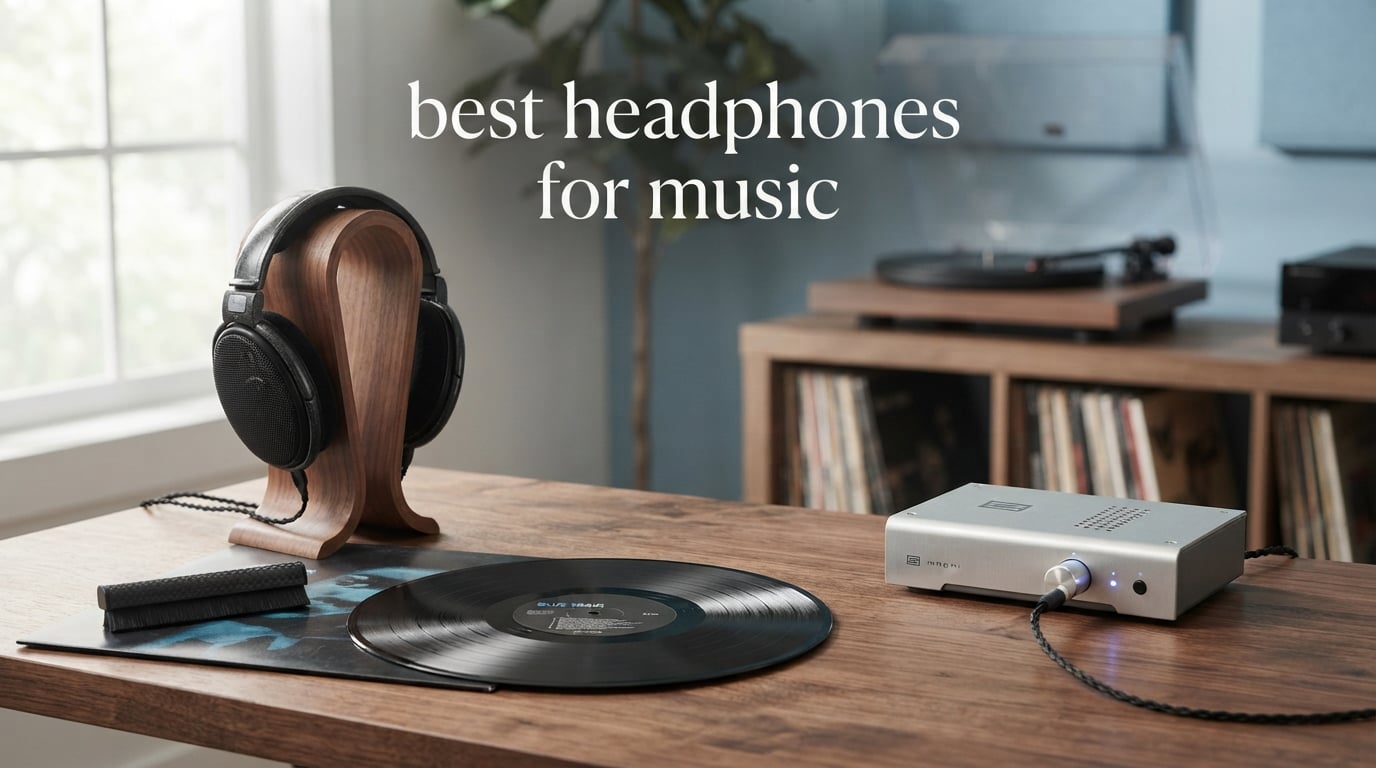
The Sennheiser HD 550 is our leading choice among the best headphones for music when quiet-room listening and an open presentation matter most. Its open-back build, 150-ohm dynamic driver design, 6 Hz to 39.5 kHz stated range, and reduced-clamp headband point toward a thoughtful home-listening package rather than an all-purpose travel headset.
There is no single right headphone for every album, room, or commute. I would choose a closed wireless model when outside noise is the issue, a wired open-back model when I want space around instruments, and a closed studio monitor when leakage would bother other people.
This guide compares all 12 available models using their supplied specifications, features, ratings, and customer-review totals. That matters because a 65-hour battery, a detachable cable, 48-ohm impedance, or a claimed 5 Hz to 80 kHz range can be meaningful, but only in the listening situation where it applies.
Table of Contents
The top 3 picks answer three different listening needs in 2026
Choose the HD 550 for open-back home listening, the Soundcore Q20i for long battery life and affordable ANC features, or the Sony WH-1000XM6 when active noise cancellation is the priority. These are not interchangeable: openness, isolation, and portability pull the decision in different directions.

These 12 headphones cover music listening in 2026
The overview below is a fast way to sort open-back home models, closed studio monitors, and wireless noise-cancelling headphones before reading the detailed notes. Ratings and review totals are the figures provided with these listings, not a substitute for matching the headphone to your source gear and environment.
| Product | Specifications | Action |
|---|---|---|
| Sennheiser HD 550 |
|
Check Latest Price |
 Soundcore Q20i Soundcore Q20i |
|
Check Latest Price |
 Beats Solo 4 Beats Solo 4 |
|
Check Latest Price |
 Apple AirPods Max 2 Apple AirPods Max 2 |
|
Check Latest Price |
 BERIBES WH202A BERIBES WH202A |
|
Check Latest Price |
 Beats Studio Pro Beats Studio Pro |
|
Check Latest Price |
 Bose QuietComfort Bose QuietComfort |
|
Check Latest Price |
 beyerdynamic DT 990 Pro X beyerdynamic DT 990 Pro X |
|
Check Latest Price |
 Sony MDR-M1 Sony MDR-M1 |
|
Check Latest Price |
 Sony WH-1000XM6 Sony WH-1000XM6 |
|
Check Latest Price |
 HIFIMAN Edition XS HIFIMAN Edition XS |
|
Check Latest Price |
 Sennheiser Momentum 4 Sennheiser Momentum 4 |
|
Check Latest Price |
1. Sennheiser HD 550 is the open-back pick for focused home listening
Pros
- Wide stated frequency range
- Reduced clamping force
- Metal mesh
- Wired accessories included
Cons
- No isolation
- Wired only
The HD 550 makes the most sense when the room is quiet and the point is to sit with music rather than block the world out. Its 4.7 rating comes from 57 supplied reviews, a much smaller sample than some wireless picks here, so I would read that rating as encouraging rather than decisive.
Sennheiser specifies a custom dynamic driver, 150-ohm impedance, and a 6 Hz to 39.5 kHz frequency range. The box includes a 1.80 m cable with a 3.5 mm plug, a screw-on 6.35 mm adapter, and a storage bag, which makes desktop and component-audio connections straightforward.
The HD 550 suits listeners who can accept sound leakage
Open-back headphones let sound move through the earcups, which can create a less boxed-in sense of space. It is a sensible fit for acoustic recordings, classical music, live sets, and games at home, but it will leak sound to people nearby.
The reduced clamping force and leatherette headband are relevant if your sessions run long. High-grade metal mesh and reduced plastic are also welcome signals for a model intended to stay at a desk rather than be tossed into a bag every day.
The HD 550 needs a source check before you buy
At 150 ohms, it is wise to check whether your laptop, phone adapter, interface, or amplifier has enough clean volume for your habits. The specification does not tell us its sensitivity, so nobody should promise a particular device will drive it perfectly without trying that pairing.
Buy this one for a quiet room, not for a train, office, or shared bedroom. It has no stated noise control, no Bluetooth connection, and no water resistance, all of which are fair trade-offs for a purpose-built open design.
2. Soundcore Q20i is the flexible low-cost wireless and ANC option
Soundcore by Anker Q20i Hybrid Active Noise Cancelling Headphones, Black
Hybrid ANC
40 mm drivers
40-hour ANC battery
Pros
- Hybrid ANC
- 22 EQ presets
- Dual connections
- Fast charging
Cons
- Hi-Res needs cable
- Not waterproof
The Soundcore Q20i is for someone who needs music to keep working around traffic, office chatter, or travel noise. Its supplied 4.6 rating is drawn from more than 69k reviews, and the feature set is unusually practical: hybrid active noise cancellation, transparency mode, multipoint-style dual connections, and app-based EQ.
Two internal and two external microphones power its noise cancellation, while 40 mm dynamic drivers and BassUp are its stated audio hardware. Soundcore lists 40 hours with ANC active, 60 hours in normal mode, and four hours of playback from a five-minute charge.
The Q20i gives commuters useful control over their environment
Hybrid ANC is more useful than passive isolation when a steady background hum competes with bass lines or quiet vocal passages. Transparency mode is just as practical when you need to hear an announcement or a colleague without removing the headphones.
The app has 22 EQ presets, which gives a listener a direct way to adjust the presentation rather than assume one factory tuning suits every genre. The ability to connect to two devices is also useful for switching between a computer and phone.
The Q20i works best when convenience outranks wired fidelity
The supplied listing says Hi-Res audio requires an auxiliary cable that is sold separately. That is an important detail for buyers expecting the highest-resolution wired mode straight from the box.
Its 16-ohm specification, Bluetooth 5.0, detachable cable, and 0.57-pound weight favor simple everyday use. It is water resistant rather than waterproof, so I would not treat it as sports gear for heavy rain or sweat.
3. Beats Solo 4 is the portable on-ear option with long battery life
Beats Solo 4 – Wireless On-Ear Bluetooth Headphones, Up to 50-Hour Battery Life, Ultra-Lightweight Comfort, Powerful and Balanced Sound, Apple & Android Compatible – Matte Black
On-ear wireless
50-hour battery
USB-C lossless
Pros
- Lightweight build
- Lossless wired modes
- Fast Fuel
- Apple and Android support
Cons
- On-ear fit
- No ANC stated
The Beats Solo 4 is a compact music headphone for listeners who prefer an on-ear fit instead of full over-ear cups. It carries a 4.6 rating across more than 27k supplied reviews, and its flexible connection story is a key attraction: Bluetooth for daily use plus lossless audio through USB-C or a 3.5 mm cable.
Beats lists up to 50 hours of battery life, with a ten-minute Fast Fuel charge providing up to five hours of playback. The custom acoustic architecture, updated drivers, and personalized Spatial Audio with dynamic head tracking are all aimed at a lively portable-listening experience.
The Solo 4 fits listeners who value small size and device flexibility
The Flex-grip headband, UltraPlush cushions, and ultra-light ergonomic design speak to portability more than passive isolation. It is an easy model to consider for a day of moving between a phone, laptop, and cable-connected source.
Apple and Android compatibility removes a common concern for mixed-device households. Class 1 Bluetooth is listed for extended range, while wired connections give you a fallback when you do not want to use the battery.
The Solo 4 is less suited to listeners who dislike ear pressure
On-ear pads rest on the ears, so fit should be considered more carefully than with deep over-ear cups. Some listeners prefer this lighter form, but others find over-ear headphones more comfortable during extended albums or work sessions.
There is no active noise cancellation in the provided feature list. If silence during commuting is essential, a model with explicit ANC, such as the Q20i, QuietComfort, or WH-1000XM6, is a clearer match.
4. Apple AirPods Max 2 is the Apple-first over-ear ANC choice
Apple AirPods Max 2 Wireless Over-Ear Headphones – Midnight
H2 chip
ANC and Adaptive Audio
20-hour battery
Pros
- Improved ANC
- Spatial Audio
- USB-C lossless
- Breathable canopy
Cons
- Some features need Apple Intelligence
- 20-hour stated battery
Apple AirPods Max 2 is the better fit for an iPhone-centered listening routine where Adaptive Audio and personalized Spatial Audio are part of the appeal. The supplied information gives it a 4.6 rating from 476 reviews and describes a current H2 chip, deep bass, expansive mids, and crisp highs.
Apple states up to 1.5 times more active noise cancellation than its prior generation, plus Conversation Awareness and Transparency mode. With ANC and Spatial Audio enabled, the listing specifies up to 20 hours of listening, so its battery figure is lower than several travel-focused alternatives here.
The AirPods Max 2 makes sense for feature-heavy Apple listening
Adaptive Audio adjusts the level of noise cancellation, while dynamic head tracking is part of personalized Spatial Audio. Those features appeal most to listeners who enjoy an adaptive, device-integrated experience rather than a simple wired reference headphone.
The breathable knit-mesh canopy and memory-foam cushions address long-session comfort, and USB-C offers a lossless audio path. Live Translation is also listed, though that feature requires compatible Apple Intelligence-enabled devices.
The AirPods Max 2 requires you to accept platform dependence
Some headline functions depend on Apple hardware and software support. Buyers using several non-Apple devices should weigh that against a model advertised with platform-neutral multipoint Bluetooth or a conventional wired input.
At 0.39 kilograms, it is not a featherweight option, and the stated 20-hour figure should be assessed against how often you travel. It is an over-ear ANC headphone, not an open-back alternative for natural sound leakage and room-like space.
5. BERIBES WH202A is the battery-first everyday wireless choice
BERIBES Bluetooth Headphones Over Ear Wireless HiFi Stereo Headsets 65H 6EQ
65-hour battery
Six EQ modes
Bluetooth 6.0
Pros
- Very long battery
- Light 0.38-pound build
- Wired option
- Foldable
Cons
- Passive isolation only
- Not water resistant
The BERIBES WH202A puts endurance first with a stated 65 hours of playtime from its 500 mAh battery. It has a 4.5 rating across more than 56k supplied reviews, and its 0.38-pound weight, foldable build, and wired-or-wireless connection make it an uncomplicated daily carry option.
Its 40 mm dynamic drivers, six EQ music modes, Bluetooth 6.0, and 20 Hz to 30 kHz listed range offer plenty of configuration for casual listening. A 3.5 mm cable connection is available when you need to preserve battery or use a non-Bluetooth source.
The WH202A is useful for listeners who hate charging often
Battery endurance is the clearest reason to choose this model. The figure is well suited to long workweeks, travel, or a household where headphones are shared and charging discipline is imperfect.
The six EQ modes can help a listener move toward a preferred bass, vocal, or other sound emphasis. I would treat those presets as tuning options rather than proof of audiophile neutrality, since the supplied information does not provide measured response data.
The WH202A does not replace a true ANC commuter headphone
Its noise control is listed as sound isolation, which means passive blocking from the earcups rather than active electronic cancellation. That distinction matters in engines, public transit, and other environments with persistent low-frequency noise.
It is not water resistant, and its Bluetooth range is listed at 10 meters. The headphone is a sensible basic choice for home, office, and light travel, but it is not presented as a weatherproof workout model.
6. Beats Studio Pro is the balanced wireless pick with USB-C lossless audio
Beats Studio Pro Premium Wireless Over-Ear Headphones- Up to 40-Hour Battery Life, Active Noise Cancelling, Great for Travel & Commuting, USB-C Lossless Audio, Apple & Android Compatible -Black
USB-C lossless
ANC
40-hour battery
Pros
- Balanced sound
- ANC and Transparency
- Spatial Audio
- UltraPlush cushions
Cons
- Lossless connection details are limited
- Wireless-first design
Beats Studio Pro combines everyday wireless listening with a clearly stated USB-C lossless audio feature. The supplied listing gives it a 4.5 rating based on more than 28k reviews and describes rich, balanced audio, active noise cancellation, transparency mode, and up to 40 hours of battery life.
This is the Beats alternative for someone who wants full over-ear cushions rather than the Solo 4’s on-ear approach. Its custom acoustic platform, Class 1 Bluetooth, voice-targeting microphones, and Spatial Audio with dynamic head tracking make it a broad feature model rather than a stripped-down studio monitor.
The Studio Pro serves commuting and desk listening in one design
ANC can make a quieter canvas for music in public, while Transparency mode lets outside sound through when it is useful. The 40-hour stated battery and Fast Fuel support make the wireless side less demanding to maintain.
USB-C lossless audio gives listeners an option beyond Bluetooth compression where their device and setup support it. The feature list also emphasizes clear calls, which helps if one headset must cover music and meetings.
The Studio Pro needs a careful look at your desired wired setup
The supplied product information identifies USB-C lossless audio but does not give a detailed traditional analogue-cable workflow. If a 3.5 mm source, interface, or receiver is central to your setup, confirm the included accessories and connection path before ordering.
UltraPlush cushions address comfort, but no fit is universal. Listeners who want an open soundstage or conventional studio monitoring should compare it with the HD 550, DT 990 Pro X, or MDR-M1 instead.
7. Bose QuietComfort is the comfort-led noise-cancelling over-ear choice
Bose QuietComfort Bluetooth Headphones, Wireless Headphones with Active Over Ear Noise Cancelling and Mic, Deep Bass, Up to 24 Hours of Playtime, Blue Dusk – Limited Edition Color
ANC
Adjustable EQ
24-hour battery
Pros
- Quiet and Aware modes
- Plush cushions
- Multipoint
- Wired option
Cons
- 2.5-hour charge
- Not water resistant
Bose QuietComfort is a straightforward choice for people who want active noise cancellation without giving up an adjustable EQ or a wired option. It has a supplied 4.5 rating from more than 20k reviews, plus Quiet and Aware Modes, multipoint Bluetooth, and a stated 24-hour battery life.
The 240-gram design uses dynamic drivers and plush earcup cushions. Bose lists a 3.5 mm jack, Bluetooth 5.1 with a 30-foot range, and app support, so it can fit a phone-centered routine while retaining a battery-free wired fallback.
The QuietComfort prioritizes a calmer listening space
Quiet Mode is the relevant setting when aircraft rumble or office sound competes with music, while Aware Mode is for maintaining awareness. The adjustable EQ is useful for tailoring the presentation rather than treating any one default signature as mandatory.
Multipoint Bluetooth helps a listener stay connected to two devices. That is a small feature with a large everyday payoff when music moves between a laptop and a phone.
The QuietComfort is not the longest-running travel model here
Its stated 24-hour battery is solid but trails the 40-hour, 50-hour, 60-hour, and 65-hour claims elsewhere in this roundup. Charging takes a stated 2.5 hours, which is another practical comparison point for frequent travelers.
It is not water resistant, so use it as an office, home, and travel headphone rather than an exposed outdoor exercise set. The wired option is a meaningful advantage for listeners who want to keep using it after the battery runs down.
8. beyerdynamic DT 990 Pro X is the serviceable open studio monitor
beyerdynamic DT 990 Pro X (48 Ohm), Open-Back Studio Headphones, Black
Open-back
48 ohms
STELLAR.45 driver
Pros
- Wide soundstage
- Mini-XLR cable
- Velour pads
- Serviceable parts
Cons
- Open design leaks sound
- Wired only
The beyerdynamic DT 990 Pro X is aimed at mixing, editing, and critical listening, and that intent is visible in the open-back design and STELLAR.45 driver. Its supplied 4.5 rating comes from 429 reviews, while the listing emphasizes detailed spatial imaging, brilliant high frequencies, and a 5 Hz to 40 kHz range.
At 48 ohms, this wired headphone is less intimidating on paper than many high-impedance studio options, though a capable interface or headphone output can still be helpful. The detachable three-meter cable uses a locking mini-XLR connector, and both 3.5 mm and 6.35 mm connections are listed.
The DT 990 Pro X favors analysis and soundstage over isolation
Open earcups are valuable when you want a broad, natural sense of placement across a mix or orchestra. That is why open-back models appear regularly in home studio conversations, especially where outside noise and leakage are not a problem.
Soft velour pads, a 0.64-pound construction claim, and lightweight design are useful for editing sessions. The product data also says the parts are serviceable, a meaningful long-term consideration that many wireless headphones do not address.
The DT 990 Pro X belongs in a private workspace
It cannot create a quiet bubble on a commute because sound enters and leaves through the open structure. A closed monitor such as the Sony MDR-M1 makes more sense for recording around microphones or working near other people.
The presentation is described as having brilliant highs, which is not the same thing as a guaranteed fit for every listener. If treble sensitivity is a concern, auditioning or checking a return policy is more sensible than relying on labels.
9. Sony MDR-M1 is the closed reference monitor for isolation
Sony MDR-M1 Professional Reference Closed Monitor Headphones
Closed-back
50 ohms
5 Hz to 80 kHz
Pros
- Strong isolation
- Light 216 g
- Detachable cables
- Wide stated range
Cons
- Limited review sample
- Wired only
The Sony MDR-M1 is the most direct choice here for a closed professional monitor with published isolation intent. It is rated 4.5 from 227 supplied reviews and pairs a closed acoustic structure with 40 mm drivers, 50-ohm impedance, detachable cables, and a claimed ultra-wideband 5 Hz to 80 kHz playback range.
At 216 grams, it is notably light for a full-size monitor, and Sony lists thick earpads plus screw-lock connectors. Those details fit recording, editing, and private music listening where controlled leakage matters more than an open soundstage.
The MDR-M1 works where open-back headphones are disruptive
Closed-back headphones keep more music in and outside sound out than open models, making them far more suitable near vocal microphones, in shared rooms, or around household noise. That is the main reason to choose the MDR-M1 over the HD 550 or DT 990 Pro X.
The detachable cables and screw-in adapter are practical studio details. A 3.5 mm jack is listed, and the 50-ohm rating should be manageable for many interfaces, although actual loudness also depends on the source.
The MDR-M1 is for reference-minded listeners, not ANC seekers
Its isolation comes from the closed acoustic structure, not active noise cancellation. It will not offer the adaptive settings, ambient modes, or electronic noise reduction found on the Bose, Sony WH-1000XM6, and Apple models.
The supplied review total is smaller than mainstream wireless alternatives, so it is especially worthwhile to focus on your own use case. For production work and closed-back music listening, its stated feature set is unusually well aligned.
10. Sony WH-1000XM6 is the feature-rich ANC travel headphone
Sony WH-1000XM6 The Best Noise Cancelling Wireless Headphones, Sandstone
QN3 processor
12 microphones
30-hour battery
Pros
- Advanced ANC
- Auto Ambient Sound
- Foldable case
- Carbon fiber driver
Cons
- No water resistance
- 4.3 rating
The Sony WH-1000XM6 is built around active noise cancellation, with a supplied 4.3 rating from more than 3.2k reviews. Sony lists the HD Noise Canceling Processor QN3, 12 microphones, AI-based beamforming, an Adaptive NC Optimizer, and a carbon-fiber dome driver.
A stated 30-hour battery, foldable design, and compact case make this an obvious travel-oriented option. Auto Ambient Sound is also useful when you want to move between focused listening and awareness without constantly taking the headphones off.
The WH-1000XM6 targets listeners facing changing noise
The Adaptive NC Optimizer is designed for circumstances that change, while 12 microphones and the QN3 processor are the advertised foundation of its cancellation system. This is the sort of feature set I would prioritize for flights, commutes, and busy offices.
The headphones were co-created with mastering engineers according to the supplied listing. That supports a music-first intention, but it does not mean every listener will prefer the final tuning over Bose, Sennheiser, Beats, or a wired studio headphone.
The WH-1000XM6 trades studio simplicity for travel features
There is no listed water resistance, so it is not a carefree workout headset. The provided customer summary also notes a 9% one-star share, a reminder to read recent reviews and confirm the specific features you value.
For stationary critical listening, a wired open-back or closed monitor avoids Bluetooth and battery management. For noise-heavy everyday listening, the Sony’s stated ANC hardware and foldable package are its strongest case.
11. HIFIMAN Edition XS is the planar magnetic choice for spacious home listening
HIFIMAN Edition XS Full-Size Over-Ear Open-Back Planar Magnetic Hi-Fi Headphones with Stealth Magnets Design, Adjustable Headband, Detachable Cable for Audiophiles, Home, Studio-Black
Planar magnetic
Open-back
18 ohms
Pros
- Wide soundstage
- Stealth magnets
- Fast diaphragm
- Detachable cable
Cons
- No isolation
- Wired only
The HIFIMAN Edition XS is the specialist choice for listeners curious about planar magnetic headphones and an open, wide presentation. It has a supplied 4.3 rating from 815 reviews, an 18-ohm rating, 92 dB sensitivity, and a stated 8 Hz to 50 kHz frequency range.
Its Stealth Magnet system and NEO supernano diaphragm are described as reducing distortion and improving fast response and detailed imaging. The open-back form and detachable 3.5 mm cable place it firmly in home or studio listening, not travel.
The Edition XS offers a different driver approach from dynamic models
Planar magnetic drivers use a thin diaphragm across a magnetic field, while common dynamic headphones use a voice-coil-and-cone-style arrangement. The driver type alone does not decide quality, but it is a real design distinction for buyers comparing the Edition XS with the HD 550 or DT 990 Pro X.
The 92 dB sensitivity is relatively modest, so the 18-ohm rating should not be viewed in isolation when thinking about power. A dedicated DAC/amp or a capable desktop source may offer more headroom than a basic phone output.
The Edition XS is best reserved for quiet, seated listening
Its open cups provide no stated noise control and leak sound. That gives it a poor fit for shared workspaces, libraries, transit, and recording near live microphones.
The adjustable headband uses memory foam, and the cable sockets are user-changeable. Those are good practical details, but the 14.28-ounce weight and fit should be considered by anyone who listens for several hours at a time.
12. Sennheiser Momentum 4 is the long-battery wireless all-rounder
Sennheiser Momentum 4 Wireless Headphones, ANC, 60 Hr Battery, Black
42 mm drivers
aptX Adaptive
60-hour battery
Pros
- Very long battery
- Adaptive ANC
- App EQ
- Foldable with case
Cons
- 4.0 rating
- Higher impedance listed
The Sennheiser Momentum 4 is the battery-focused premium wireless alternative, with a stated 60 hours of playback and a two-hour charge time. It holds a supplied 4.0 rating from more than 13k reviews, so I would give more weight to its specific features than assume it is a universal winner.
Sennheiser lists 42 mm transducers, aptX Adaptive, adaptive noise cancellation, Transparency Mode, four digital beamforming microphones, and a Smart Control Plus app with an equalizer. The package is also described as including a carry case, USB-C cable, audio cable, and airplane adapter.
The Momentum 4 makes long trips and long weeks easier
Sixty hours is the largest stated battery figure among the noise-cancelling premium models in this list. That reduces charging interruptions for travel and makes this a compelling choice for listeners who use one pair through work calls and music sessions.
Adaptive ANC and Transparency Mode cover the same two daily needs as many rivals: quiet when you want it and awareness when you need it. The integrated equalizer is useful for personal sound-signature changes.
The Momentum 4 needs a source and rating reality check
The supplied data lists 470-ohm impedance while describing Bluetooth 5.2 connectivity, so prospective wired listeners should verify the intended cable behavior and source compatibility. Do not interpret an impedance figure alone as a complete prediction of wireless performance.
Its 4.0 rating is lower than the other headline wireless models listed here despite a large review total. That makes current customer feedback, fit preference, and your need for the 60-hour battery especially important before choosing it.
The buying guide starts with where you listen
Start with your environment before comparing drivers, codecs, or marketing terms. A quiet room permits an open-back headphone; a train, office, or shared home usually rewards a closed-back headphone or active noise cancelling model.
Forum discussions repeatedly show the same frustration: people buy for a sound signature and then discover that leakage, an underpowered source, or a poor fit makes the model wrong for their life. Answer those practical questions first, then narrow the list.
Open-back headphones are best when space matters more than privacy
Open-back headphones such as the Sennheiser HD 550, beyerdynamic DT 990 Pro X, and HIFIMAN Edition XS allow air and sound to pass through the cups. They are often chosen for a more expansive soundstage and clearer sense of instrument placement at home.
The cost is leakage in both directions. People nearby may hear your music, and their conversation, keyboard, television, or traffic can enter your listening, so an open headphone is a poor quiet-zone solution.
Closed-back headphones are best when isolation matters more than openness
Closed headphones physically block more outside sound and limit what escapes from the earcups. The Sony MDR-M1 is the clear wired monitor example here, while the Bose QuietComfort, Sony WH-1000XM6, AirPods Max 2, Q20i, Studio Pro, and Momentum 4 add active noise cancellation.
ANC is particularly useful against ongoing low-frequency noise, but it does not make a headphone automatically more accurate for music. If your listening happens in a quiet office, home setup, or studio, a wired reference model may still be the more appropriate tool.
Wired headphones are best for simple, direct audio paths
A wired headphone avoids battery concerns and Bluetooth transmission, and it connects naturally to interfaces, DACs, receivers, and dedicated headphone amplifiers. The HD 550, DT 990 Pro X, MDR-M1, and Edition XS are the most direct wired options in this roundup.
Wireless models can still be very useful for music, especially when their features suit your day. The Solo 4, Studio Pro, Bose QuietComfort, and AirPods Max 2 all provide a wired path in the supplied data, while their wireless functions make movement and calls easier.
An amplifier helps when your current source lacks clean volume
Impedance is only one part of the question; sensitivity and the power output of your device matter too. The HD 550 is listed at 150 ohms, while the Edition XS is 18 ohms but has 92 dB sensitivity, showing why a simple “lower impedance is always easier” rule does not work.
If a headphone sounds too quiet, thin at normal volume, or distorted when you turn the source up, try a competent DAC/amp or an audio interface with a better headphone output. Do not buy an amplifier merely because a forum comment says every audiophile headphone needs one.
Genre matching works best as a sound-preference shortcut
For orchestral, acoustic, jazz, and live recordings, open-back models can be appealing because soundstage and imaging are among their stated strengths. The HD 550, DT 990 Pro X, and Edition XS are the relevant candidates if your room permits leakage.
For hip-hop, pop, electronic music, and commute listening, the Q20i’s BassUp and EQ presets, or ANC choices with adjustable EQ, may fit better. A neutral or monitor-style headphone remains a useful reference for production, but it is not the only enjoyable way to hear an album.
Comfort and repairability matter after the first week
Look at cup style, headband pressure, weight, pad material, and whether the cable can be replaced. On-ear Solo 4 headphones save bulk but press on the ears; models with full earcups, such as QuietComfort and Studio Pro, may suit longer use for some listeners.
The DT 990 Pro X stands out because the supplied information specifically calls its parts serviceable, and several wired models have detachable cables. Those details can matter more over years of ownership than a short list of app features.
These frequently asked questions give direct buying answers
What are the top 3 headphones?
The top three picks here are the Sennheiser HD 550 for quiet-room open-back listening, the Soundcore Q20i for hybrid ANC and EQ control, and the Sony WH-1000XM6 for active noise cancellation and travel. Choose by environment: the HD 550 leaks sound, while the other two are designed for portable use.
What are the best headphones for music in 2026?
The best headphones for music in 2026 depend on how and where you listen. The Sennheiser HD 550 is our home-listening choice, the Sony MDR-M1 is the closed wired monitor choice, and the Sony WH-1000XM6, Bose QuietComfort, and Soundcore Q20i are better suited to noise-heavy everyday listening.
Which headphone brand is best for music?
No single brand is best for every listener. Sennheiser, Sony, Bose, Beats, HIFIMAN, beyerdynamic, Soundcore, Apple, and BERIBES in this guide each emphasize different traits, including open-back listening, studio monitoring, noise cancellation, battery life, or device features. Match the model to your source gear and environment.
Are open-back or closed-back headphones better for music?
Open-back headphones are better for a spacious home-listening feel when leakage is acceptable. Closed-back headphones are better in shared rooms, studios, travel, and noisy places because they limit leakage and block more ambient sound. Neither enclosure is automatically better for every genre or listener.
Do I need an amplifier for music headphones?
You may need an amplifier if your source cannot deliver clean, comfortable volume to your particular headphone. Check both impedance and sensitivity, not just one number: the 150-ohm HD 550 and 92 dB-sensitivity Edition XS illustrate why source matching is more nuanced than a single specification.
The right music headphone is the one that fits your listening life
For the best headphones for music in 2026, start with the Sennheiser HD 550 for quiet open-back listening, the Sony MDR-M1 for a closed wired monitor, or a noise-cancelling wireless option when the world around you is part of the problem. Then choose the fit, connection type, and comfort details you will actually use every day.