
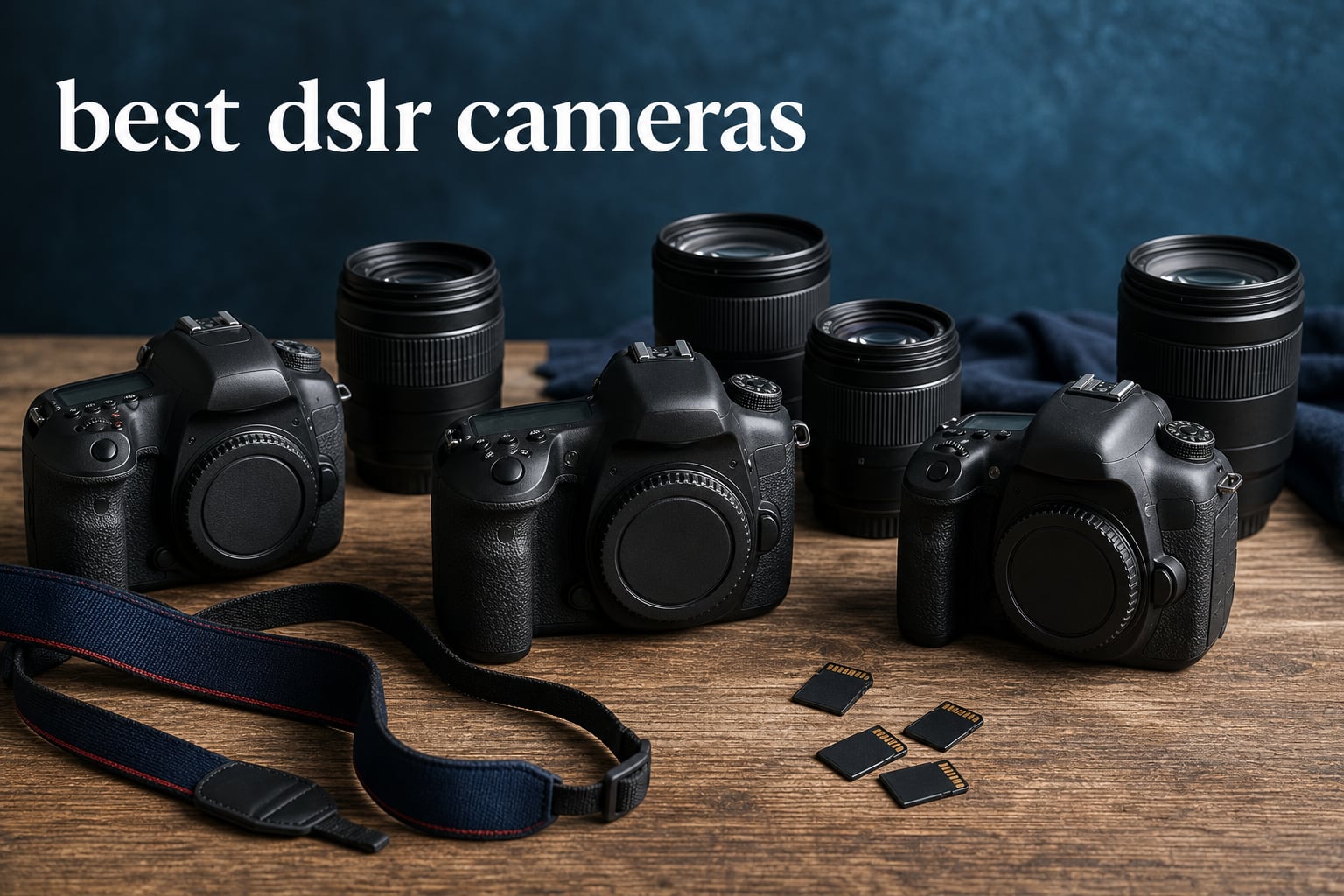
The best DSLR cameras remain a sensible choice in 2026 when you want an optical viewfinder, familiar physical controls, long shooting sessions, and access to established Canon and Nikon lens families. A digital SLR uses a mirror and prism to send light from the lens to the viewfinder; when the shutter fires, that mirror moves so the sensor can record the image.
That mechanism is older than the latest mirrorless designs, but it answers a real need. I still see a DSLR as a strong fit for people who prefer looking through the lens without a screen, want a camera that is direct to operate, or are building around compatible lenses rather than starting from zero.
This guide ranks ten currently supplied cameras by what their documented specifications say they do best, from the 45.7MP Nikon D850 to simple APS-C kits and renewed bodies. We have kept the focus on sensor format, focusing systems, burst speed, video, controls, connectivity, included lenses, and the compromises that actually shape a purchase.
Table of Contents
The top three picks are the Nikon D850, Nikon D3500, and renewed Nikon D3200 (2026)
1. Nikon D850: Its 45.7MP full-frame BSI sensor, 153-point autofocus system, tilting touchscreen, and up-to-9-fps shooting make it the clear first choice for detailed professional stills, wildlife, portraits, and large files with room to crop.
2. Nikon D3500: This compact APS-C kit pairs a 24.2MP sensor and stabilized 18-55mm lens with a straightforward control layout, 5-fps shooting, Bluetooth sharing, and a documented point-and-shoot-like learning curve. It is the easiest recommendation for someone moving up from a phone without needing advanced video.
3. Nikon D3200 Renewed: The renewed D3200 kit offers a 24.2MP APS-C sensor, included 18-55mm lens, built-in flash, and 1080p video in a compact body. Its 11-point autofocus system and fixed screen set clear limits, so I would choose it for deliberate learning rather than fast-moving work.
The best DSLR cameras in 2026 cover ten distinct shooting needs.
| Product | Specifications | Action |
|---|---|---|
 Canon EOS Rebel T7 with 18-55mm Canon EOS Rebel T7 with 18-55mm |
|
Check Latest Price |
 Nikon D3500 with 18-55mm VR Nikon D3500 with 18-55mm VR |
|
Check Latest Price |
 Canon EOS 5D Mark IV Body Canon EOS 5D Mark IV Body |
|
Check Latest Price |
 Nikon D850 Body Nikon D850 Body |
|
Check Latest Price |
 Nikon D7100 Body Nikon D7100 Body |
|
Check Latest Price |
 Nikon D7500 with 18-140mm Nikon D7500 with 18-140mm |
|
Check Latest Price |
 Nikon D5600 with 18-55mm VR Nikon D5600 with 18-55mm VR |
|
Check Latest Price |
 Nikon D780 Body Nikon D780 Body |
|
Check Latest Price |
 Nikon D3200 Renewed with 18-55mm Nikon D3200 Renewed with 18-55mm |
|
Check Latest Price |
 Canon EOS Rebel T6 Renewed with 18-55mm Canon EOS Rebel T6 Renewed with 18-55mm |
|
Check Latest Price |
Full-frame bodies in this list give a larger imaging area, while APS-C bodies apply a narrower field of view with a given lens. Neither format wins every job: the right choice turns on the lenses you need, the subjects you follow, and how much resolution or reach matters to your work.
Check whether a listing is body-only before treating it as ready to shoot. The D850, 5D Mark IV, D7100, and D780 are supplied as bodies here, while the other options include a stated kit lens; that difference changes what you can do on day one.
1. Nikon D850 is the best DSLR for high-resolution professional photography.
Nikon D850 FX-Format Digital SLR Camera Body
45.7MP full-frame
153-point AF
Up to 9 fps
4K video
Pros
- 45.7MP BSI sensor
- 153-point autofocus
- 9 fps shooting
- Tilting touchscreen
- 4K video
Cons
- No image stabilization
- Heavy body
- Body only
The D850 earns the top spot because its 45.7MP BSI full-frame sensor is the most detailed sensor in this group. Nikon also omits the optical low-pass filter, a choice intended to preserve fine detail, and its stated 153-point autofocus system is far beyond the entry-level arrangements found on the smaller cameras.
I would put this camera first for photographers who regularly crop, print large, or need one body to cover portraits, wildlife, product work, and carefully composed scenery. Community discussions repeatedly praise the D850’s ergonomics and dynamic range, and the supplied specifications support its reputation as a stills-first professional DSLR.
Speed is not sacrificed for resolution. It can shoot up to 9 frames per second at full resolution with full autofocus, while the tilting touchscreen makes low and high angles less awkward than a fixed-LCD body.
Video is meaningful rather than an afterthought: it records 4K Ultra HD, supports 8K and 4K time-lapse movies, and can record 1080p slow motion up to 120 fps. The trade-offs are equally clear: the body has no image stabilization, weighs 2.02 pounds, and needs a lens because this supplied version is body-only.
The D850 suits detail-led work and fast subjects.
Choose the D850 when resolution is a working requirement instead of a number on a specification sheet. The 45.7MP sensor gives latitude for large output and cropping, while 9-fps shooting and 153 autofocus points make it credible for action where a high-resolution body can otherwise feel slow.
The 3.2-inch tilting display also helps with ground-level scenes, overhead perspectives, and tripod compositions. Its optical viewfinder keeps the traditional DSLR experience central, so people who dislike viewing their subject through an electronic display have a strong reason to consider it.
The D850 system fits photographers prepared to choose lenses carefully.
This is a Nikon FX body, so lens selection should be part of the decision rather than an afterthought. Existing Nikon users can assess their compatible glass first; new buyers should identify the focal lengths their subjects demand before committing to a body-only camera.
For handheld video, remember the lack of in-body stabilization and select support or stabilized lenses accordingly. The D850 makes the most sense when its resolution, high-speed sequence shooting, and advanced autofocus will be used often enough to outweigh its size and the additional lens decision.
2. Canon EOS 5D Mark IV is the best Canon DSLR for full-frame hybrid work.
Canon EOS 5D Mark IV DSLR Camera (Body Only)
30.4MP full-frame
61-point AF
7 fps
4K video
Pros
- 30.4MP full-frame sensor
- 4K recording
- Dual Pixel CMOS AF
- 7 fps shooting
- Built-in Wi-Fi
Cons
- Body only
- 1.24 kg body
- Motion JPEG 4K
The Canon EOS 5D Mark IV is a full-frame DSLR with a 30.4MP CMOS sensor, a 61-point autofocus system, and up to 7-fps continuous shooting. It belongs near the top for photographers who want Canon EF-mount compatibility, substantial resolution, and video capability in one weather-ready-looking professional-style body, though the supplied data does not specify weather sealing.
Its most distinct operational feature is Dual Pixel CMOS AF for smooth autofocus during video or live view. That makes the camera easier to place in a mixed stills-and-video workflow than bodies whose focusing strengths sit mainly behind the optical viewfinder.
Video specifications include 4K Motion JPEG at 30 or 24 fps, Full HD up to 60 fps, and HD up to 120 fps. Built-in Wi-Fi supports wireless transfer, while the touchscreen LCD gives direct control without relying only on buttons.
The main limitations are practical ones. This listing is body-only, the camera weighs 1.24 kilograms, and 4K is specifically Motion JPEG, so I would check that file format against the editing and storage setup already in use.
The 5D Mark IV suits Canon photographers who need stills and video.
The 30.4MP full-frame sensor is a balanced choice when a photographer wants room for detailed output but does not need the D850’s 45.7MP capture. A 7-fps rate helps with moving people and events, while the broad ISO range of 100–32,000, expandable to 50–102,400, gives this body a documented low-light range.
For video creators, Dual Pixel CMOS AF and a touchscreen are the two features I would weigh most heavily. They improve live-view and video focusing behavior relative to a camera that only lists a conventional viewfinder autofocus setup.
The 5D Mark IV system fits photographers with an EF lens plan.
Because no lens comes in this package, first confirm which EF lenses you need for portraits, close work, wide scenes, or telephoto subjects. A body that already matches familiar Canon controls and compatible lenses can be a more sensible move than changing systems merely for a newer camera format.
Its size also deserves a hands-on check if possible. The 5D Mark IV is built for serious use, but a lighter APS-C DSLR may be the better fit for a photographer who carries a camera all day and does not need full-frame coverage.
3. Nikon D780 is the best DSLR for modern full-frame flexibility.
Pros
- 24.5MP full-frame
- Hybrid autofocus
- 4K recording
- Dual SD slots
- Tilting touchscreen
Cons
- No built-in flash
- 710g body
- Body only
The Nikon D780 takes a different route from the D850: it uses a 24.5MP full-frame sensor and EXPEED 6 processing instead of chasing the largest file. Its hybrid phase- and contrast-detection autofocus system, 4K UHD recording, and tilting 3.2-inch touchscreen make it the most modern-feeling Nikon full-frame option in this list.
I see the D780 as a practical choice for someone who wants an optical viewfinder yet also cares about live-view operation and video. It retains a 51-point autofocus system, shoots at 7 fps, and reaches a maximum shutter speed of 1/8000 second.
Dual SD card slots are a serious advantage over cameras with one slot, especially for long sessions or an in-camera backup routine. Wi-Fi and Bluetooth are built in, which makes transfer and remote-device use more convenient than a body that requires an optional wireless adapter.
There is no built-in flash, and the 710-gram body is not a tiny travel option. It is also body-only, so the D780 suits a buyer who has a clear lens plan rather than someone who needs an all-in-one starter kit.
The D780 suits photographers who want a DSLR with strong live-view tools.
The 24.5MP sensor is enough for detailed work without generating the D850’s much larger resolution files. Its hybrid autofocus specification is the important distinction for a photographer who alternates between the optical viewfinder and the rear screen, particularly for video or tripod work.
4K UHD and Full HD are both documented, and the tilting touchscreen gives physical flexibility when composing. That combination makes the D780 easier to recommend for mixed personal and commissioned work than an older full-frame DSLR limited to Full HD.
The D780 system suits photographers who need recording redundancy.
Two SD slots can matter more than a headline feature if you photograph events, travel, or long assignments. They let you structure storage with more flexibility than a single-slot camera, although a card strategy still needs to be set in the camera menus.
Since this is a body-only Nikon FX camera, account for lens coverage, carry weight, and the lack of a built-in flash. It is a very capable bridge for people who want DSLR handling with a newer set of connectivity and video specifications.
4. Nikon D7500 is the best APS-C DSLR for fast action and 4K video.
Nikon D7500 20.9MP DSLR Camera with AF-S DX NIKKOR 18-140mm f/3.5-5.6G ED VR Lens, Black
20.9MP APS-C
51-point AF
8 fps
4K UHD
Pros
- 8 fps shooting
- 51-point AF
- 4K UHD
- Tilting touchscreen
- 18-140mm VR lens
Cons
- APS-C crop factor
- Single card slot
The D7500 is the strongest APS-C action-oriented kit in this group. Its 20.9MP DX sensor, EXPEED 5 processor, 51-point autofocus system with 15 cross-type sensors, and 8-fps continuous shooting give it more pace and focusing depth than the beginner models.
The supplied version includes an AF-S DX 18-140mm f/3.5-5.6G ED VR lens, an unusually useful range for a first all-purpose setup. I would prioritize that flexibility for travel, family events, and outdoor subjects where changing lenses constantly is not realistic.
It records 4K UHD and Full HD with stereo sound, and its 3.2-inch touchscreen tilts for alternate angles. Built-in Wi-Fi and Bluetooth reduce the friction of sending selected images to a phone or tablet after a shoot.
The limitations are honest ones: this is an APS-C camera with a 1.5x crop factor, and it has a single memory card slot. For many wildlife and sports shooters, that crop can help frame distant subjects; for someone who needs the wider field of a full-frame body, it can be a constraint.
The D7500 suits fast-moving subjects and flexible everyday shooting.
An 8-fps rate is the clearest reason to choose the D7500 over the 5-fps D3500 or D5600. Pair that pace with 51 autofocus points and 15 cross-type sensors, and you have a documented feature set more suited to action sequences than a basic nine- or eleven-point system.
The included 18-140mm VR lens also makes the kit usable across a wide range of scenes immediately. It will not replace a specialist fast lens or long telephoto, but it gives a first-time Nikon DX user a broad starting focal range.
The D7500 system suits people who want DX reach without a body-only start.
APS-C changes the field of view of compatible lenses, which can be helpful when you want a tighter angle on distant subjects. Before buying, decide whether that framing behavior supports your common subjects better than full-frame coverage would.
The D7500 is also a sensible point of entry to Nikon DX lenses because the kit lens is already included. The single card slot remains its major workflow compromise, so photographers who require in-camera backup should look at the D780 or D7100 instead.
5. Nikon D7100 is the best APS-C DSLR for dual-card shooting controls.
Nikon D7100 24.1 MP DX-Format CMOS Digital SLR (Body Only)
24.1MP APS-C
51-point AF
6 fps
Dual SD slots
Pros
- 24.1MP DX sensor
- 51-point autofocus
- 6 fps burst
- Dual SD slots
- Stereo microphone
Cons
- Body only
- No image stabilization
- Wireless adapter extra
The Nikon D7100 is an enthusiast APS-C body that places control and storage flexibility ahead of newer connectivity. It has a 24.1MP DX-format sensor, 51-point autofocus system, and a 6-fps rate that Nikon states can continue for up to 100 shots.
Its dual SD card slots make it distinctive in this portion of the list. I would give that feature real weight for photographers who want to separate file types or set an in-camera backup, rather than treating every DSLR as equal once resolution is similar.
For video, the D7100 records 1080p with full-time autofocus and has a built-in stereo microphone. Its ISO range is stated as 100 to 6400, and the camera includes HDMI; wireless sharing requires the separate WU-1a adapter.
This is body-only and lacks image stabilization, so lenses and support matter. It is also an older model, but older does not mean unusable: the question is whether its documented autofocus, dual slots, and control set meet your work better than newer wireless features would.
The D7100 suits enthusiasts who prioritize controls and backup options.
Two SD slots are the practical headline here, with the 51-point autofocus system a close second. This body is a good match for a photographer who has outgrown an entry-level layout and wants more flexibility for longer shoots without moving to full frame.
The 24.1MP APS-C sensor delivers more stated resolution than the D7500’s 20.9MP sensor, but resolution alone is not the whole comparison. Choose between them by deciding whether 8 fps and 4K matter more than dual cards and the D7100’s specified 24.1MP capture.
The D7100 system suits Nikon users who can add the right lens and adapter.
Because this listing has no lens, a DX lens plan needs to come first. It also needs a separate WU-1a adapter for wireless sharing, a small detail that can matter to someone who expects immediate phone transfer after every session.
The lack of camera-body stabilization means stabilization depends on a compatible lens or shooting technique. A tripod, monopod, or VR lens can be more meaningful to this camera’s results than another menu feature, particularly for slower shutter speeds.
6. Nikon D3500 is the best DSLR for new photographers who want simplicity.
Nikon D3500 W/ AF-P DX NIKKOR 18-55mm f/3.5-5.6G VR Black
24.2MP APS-C
5 fps
18-55mm VR lens
Bluetooth
Pros
- Simple controls
- Compact body
- 24.2MP sensor
- 18-55mm VR lens
- SnapBridge sharing
Cons
- No 4K video
- Limited stock
- No advanced AF specification
The Nikon D3500 has the clearest beginner brief of any full kit here. It combines a 24.2MP APS-C sensor, 18-55mm AF-P DX VR lens, 5-fps continuous shooting, and Bluetooth 4.1 connectivity in a 13.76-ounce camera body.
Nikon describes it as as easy to use as a point-and-shoot camera, and that matches the community feedback in the research: it is frequently recommended because it is straightforward, compact, and gives people a noticeably larger sensor than a phone. The product information states that sensor is 15 times larger than typical smartphone sensors.
SnapBridge is the sharing route here, while 1080p Full HD video is available at the touch of a button. Optical image stabilization comes through the listed kit lens, an important practical aid for handheld stills and video.
Its boundaries are also simple: no 4K video is listed, and the camera’s supplied availability status is limited. I would not select it for complex video production or the most demanding tracking work, but it makes a persuasive first dedicated camera for still photography.
The D3500 suits beginners who want to learn photography without a complicated body.
A beginner should be able to spend time on focus, exposure, composition, and lens choice instead of fighting the controls. The D3500’s compact design, included stabilized 18-55mm lens, 24.2MP sensor, and point-and-shoot-like operating promise directly support that use.
At 5 fps, it offers more sequence speed than the 3-fps Canon Rebel T7 or renewed Rebel T6. That is enough for many everyday moments, while the VR lens and modest body weight make it easier to take the camera along often.
The D3500 system suits photographers who want a light Nikon DX kit.
The included 18-55mm VR lens covers a useful starting range, and Nikon DX compatibility leaves room to add lenses later as interests become clearer. Start with the kit lens long enough to find whether portraits, distant subjects, close details, or wide views are the real priority.
It is a DSLR built around the optical viewfinder and 1080p video rather than 4K or extensive video controls. That focus is a virtue for a stills learner, but a buyer whose main goal is video should move toward the D7500, D780, or 5D Mark IV.
7. Nikon D5600 is the best DSLR for a vari-angle touchscreen and simple sharing.
D5600 DX-Format Digital SLR w/AF-P DX NIKKOR 18-55mm f/3.5-5.6G VR
24.2MP APS-C
39-point AF
Vari-angle screen
1080p 60 fps
Pros
- Vari-angle touchscreen
- 39-point autofocus
- Wi-Fi and Bluetooth
- 24.2MP sensor
- 1080p 60 fps
Cons
- Single card slot
- 5 fps burst
- 1/4000 maximum shutter
The Nikon D5600 is the better choice over the D3500 when a movable touchscreen and more autofocus points matter. It uses a 24.2MP DX-format sensor, a 39-point autofocus system, and a 3.2-inch vari-angle touch screen in a 1.6-pound body.
That vari-angle display changes how you can compose low-level, overhead, and self-facing images without placing your eye to the viewfinder. I would particularly consider it for family photography, travel, close-to-the-ground compositions, and any learner who benefits from touching the focus area on screen.
It reaches 5 fps and records Full HD 1080p at 60 fps. SnapBridge Bluetooth and Wi-Fi with NFC provide several connection options, and the supplied kit includes an AF-P DX 18-55mm f/3.5-5.6G VR lens.
The D5600 has one memory slot, a maximum shutter speed of 1/4000 second, and no 4K listing. Those boundaries do not reduce its appeal as a light amateur camera, but they separate it from the action and video specification of the D7500.
The D5600 suits photographers who compose frequently from unusual angles.
The vari-angle touchscreen is more than a convenience feature when a rigid stance is impossible. It helps a photographer see the frame at low, high, or forward-facing positions, while the 39-point autofocus system is a documented step up from the basic nine- and eleven-point arrangements.
For clips, 1080p at 60 fps gives more flexibility than 1080p at 30 fps. If 4K delivery is non-negotiable, this is not the right body; if comfortable framing and approachable controls matter more, its screen has a clear advantage.
The D5600 system suits connected Nikon DX beginners and hobbyists.
The included 18-55mm VR lens and wireless options make the D5600 a coherent starting kit. Wi-Fi, Bluetooth, and NFC are documented ways to move selected images, which can make a dedicated camera feel less separate from a phone-centered sharing routine.
Choose it when the screen and 39-point autofocus will be used, not simply because it sits above a basic model. The D3500 is lighter and simpler, while the D7500 has faster shooting and 4K; the D5600 is the comfortable middle path for composition-led shooting.
8. Canon EOS Rebel T7 is the best Canon DSLR kit for straightforward still photography.
Canon EOS Rebel T7 DSLR Camera EF-S 18-55mm f/3.5-5.6 is II Lens Kit
24.1MP APS-C
9-point AF
18-55mm lens
Wi-Fi and NFC
Pros
- 24.1MP sensor
- Included 18-55mm lens
- Wi-Fi and NFC
- Scene Intelligent Auto
- Light 1.04-pound body
Cons
- 3 fps shooting
- 9-point autofocus
- No 4K video
The Canon EOS Rebel T7 is a basic but complete Canon APS-C kit. It brings a 24.1MP CMOS sensor, EF-S 18-55mm f/3.5-5.6 IS II lens, 9-point autofocus system, built-in Wi-Fi and NFC, and a lightweight 1.04-pound camera body.
Scene Intelligent Auto is part of its beginner-friendly proposition, and the optical viewfinder provides approximately 95% viewing coverage. I would treat the T7 as a stills-focused learning camera for someone who wants Canon controls and an included lens, rather than a body meant to chase demanding action or advanced video.
Its 3-fps continuous shooting and 9-point AF system explain the ranking. They are enough for posed subjects, travel, everyday images, and careful learning, but they give less margin for fast movement than the Nikon D3500, D5600, D7100, or D7500.
The camera records Full HD 1080p and can work with EOS Utility Webcam Beta Software. No 4K video is listed, so buyers seeking a regular video camera should treat that limitation as a deciding factor, not a minor footnote.
The Rebel T7 suits first-time Canon photographers who want a ready-to-use kit.
The kit lens and built-in image stabilization give the T7 an immediately usable foundation. A 24.1MP APS-C sensor and automatic scene support can help a newcomer focus on shooting, while Wi-Fi and NFC make transfer less intimidating.
Its 1.04-pound weight is also important for day trips and casual use. A camera carried regularly has more opportunity to teach exposure and composition than a technically advanced body that is left at home.
The Rebel T7 system suits deliberate subjects more than high-speed work.
With 3 fps and nine autofocus points, the T7 is best suited to moments where the photographer can anticipate framing and focus. That does not prohibit moving subjects, but it requires more timing and offers less tracking depth than the higher-ranked action bodies.
Canon EF-S lens compatibility gives a new owner a clear system direction. Begin with the supplied 18-55mm, then add only after the images show a repeated need that the kit range cannot answer.
9. Nikon D3200 Renewed is the best DSLR for basic 24.2MP learning.
Nikon D3200 24.2 MP CMOS Digital SLR with 18-55mm f/3.5-5.6 AF-S DX NIKKOR Zoom Lens (Certified Refurbished)
24.2MP APS-C
11-point AF
18-55mm lens
1080p video
Pros
- 24.2MP sensor
- Included 18-55mm lens
- Compact body
- Built-in flash
- 90-day renewed warranty
Cons
- 11-point autofocus
- Fixed LCD
- Renewed condition
The renewed Nikon D3200 is a compact entry-level kit with a 24.2MP DX-format CMOS sensor and an 18-55mm AF-S DX NIKKOR zoom lens. It is the simplest route here to a high-resolution APS-C stills camera with a built-in flash and 1080p movie recording.
Its EXPEED III processor, 4-fps continuous shooting, 3-inch LCD, and 11-point autofocus system are modest by current standards but clearly defined. I would see it as a camera for learning exposure, framing, and lens behavior with deliberate subjects rather than a tool for advanced tracking.
The listing identifies it as Amazon Renewed and provides a 90-day warranty. Renewed gear can be a reasonable direction when condition and included coverage are understood, but inspect the exact listing terms and test the camera’s controls, lens operation, card slot, and battery behavior promptly after delivery.
Its LCD is fixed and its stated ISO range is 100 to 6400 expanded. These specifications mean the D3200 has fewer compositional and low-light options than the D5600, yet its compact one-pound body and included lens keep the basic kit focused.
The D3200 suits learners who value a simple kit and documented coverage.
The 24.2MP sensor gives plenty of stated resolution for early photography practice, and the included 18-55mm lens means a new photographer can begin immediately. The built-in flash also provides a direct option for occasions where there is not enough light.
Its 90-day renewed warranty is relevant but does not replace a careful inspection. Test autofocus across the frame, examine the lens mounts and zoom ring, make sample files, and confirm that the battery and charger meet the exact listing’s contents.
The D3200 system suits patient stills practice rather than advanced video demands.
Eleven autofocus points and 4 fps give this camera a narrower assignment than the D3500 or D5600. For posed portraits, travel snapshots, and the technical foundations of DSLR photography, those limits can be entirely workable.
A photographer who needs a touch screen, a movable display, 4K, or more responsive autofocus should move up the list. The D3200 makes the most sense when the priority is a compact Nikon DX learning kit with transparent renewed status.
10. Canon EOS Rebel T6 Renewed is the best basic Canon DSLR for simple sharing.
Canon EOS Rebel T6 Digital SLR Camera Kit with EF-S 18-55mm f/3.5-5.6 is II Lens, Built-in WiFi and NFC – Black (Renewed)
18MP APS-C
9-point AF
Wi-Fi and NFC
1080p 30 fps
Pros
- Wi-Fi and NFC
- Included 18-55mm lens
- Built-in flash
- Scene Intelligent Auto
- One-year renewed warranty
Cons
- 18MP sensor
- 3 fps burst
- 9-point autofocus
The renewed Canon EOS Rebel T6 is a basic Canon kit with an 18MP APS-C CMOS sensor, EF-S 18-55mm f/3.5-5.6 IS II lens, Wi-Fi, NFC, and a built-in flash. It is positioned for a new photographer who wants a conventional DSLR experience and direct phone-sharing options.
Its DIGIC 4+ processor, 9-point autofocus system with a center cross-type point, and 3-fps continuous shooting place it firmly in the entry-level category. The product information also lists Scene Intelligent Auto, which can help a beginner start shooting before they understand every manual setting.
Full HD 1080p is available at 30 fps, while the stated ISO range is 100 to 6400 and expandable to H: 12800. These are credible basics, but there is no 4K listing, and its 18MP resolution trails the 24.1MP Rebel T7 and several 24.2MP Nikon options.
This is an Amazon Renewed camera with a stated one-year warranty. That longer documented coverage differentiates it from the renewed D3200’s 90-day warranty, though a buyer should still check the exact package contents and condition on the listing.
The Rebel T6 suits beginner Canon users who prioritize Wi-Fi and simple controls.
Wi-Fi and NFC make the Rebel T6 a natural fit for someone who wants to send selected images to a phone without adding another accessory. The included stabilized 18-55mm lens, flash, and automatic scene mode provide the parts needed for first steps in still photography.
The 18MP APS-C sensor is less about maximum file size and more about learning to make purposeful images. That is enough for many personal uses, but it is not the strongest fit for someone who expects extensive cropping or demands a faster sequence rate.
The Rebel T6 system suits a cautious renewed-camera purchase.
A one-year renewed warranty is a useful piece of the decision, particularly when comparing older DSLR bodies. Verify shutter operation, autofocus behavior, screen condition, lens function, connection ports, and included accessories as soon as the kit arrives.
Choose the Rebel T6 when the Canon kit, sharing features, and renewed coverage matter more than speed or resolution. Choose the T7 instead if 24.1MP resolution and a lighter listed body are the stronger priorities; choose the Nikon kits if their particular screens or autofocus systems fit better.
Choose a DSLR by sensor format, lenses, autofocus, and the way you shoot.
The best DSLR camera is not automatically the one with the largest sensor or the most autofocus points. Start by naming the subjects you shoot most often, the lenses you already own, whether you use video, and whether the camera must be a complete kit on arrival.
I would make this decision in a fixed order: system and lenses first, sensor size second, autofocus and burst rate third, then screen, video, storage, and connections. That order stops a buyer from paying attention to one headline specification while missing the parts that affect every shoot.
Full-frame is best for wider coverage, while APS-C is best when a smaller system or tighter framing helps.
A full-frame sensor measures roughly the same area as 35mm film, while APS-C is smaller. With the same focal-length lens, APS-C gives a narrower field of view; that can be useful for distant subjects, while full frame is often chosen when wider coverage and the larger sensor format are the preference.
Within this list, the D850, D780, and EOS 5D Mark IV are full-frame cameras. The D3500, D7500, D7100, D5600, D3200, Rebel T7, and Rebel T6 use APS-C sensors, so their kit lenses and lens choices should be evaluated as part of their smaller-sensor system.
Resolution is a separate decision from sensor size. The D850’s 45.7MP sensor provides the greatest stated resolution; the D7500 proves that an APS-C model can instead prioritize 8-fps shooting and 4K video, while the D3200 offers 24.2MP in a basic renewed kit.
Autofocus points and frames per second matter most for movement.
Autofocus-point count is not a complete measure of focusing quality, but it is a useful starting signal in this selection. The D850 lists 153 points, the D7500 and D7100 list 51, the D5600 lists 39, and the basic Canon and renewed Nikon options list nine or eleven points.
Burst rate tells you how many images a camera can capture per second in a sequence. The D850 reaches up to 9 fps, D7500 reaches 8 fps, the 5D Mark IV and D780 reach 7 fps, D7100 reaches 6 fps, D3500 and D5600 reach 5 fps, D3200 reaches 4 fps, and the T7 and T6 reach 3 fps.
For sports, wildlife, active children, or any unpredictable subject, choose the faster body and do not stop at megapixel count. For portraits, travel, and carefully timed scenes, a lower burst rate can be enough, leaving sensor, kit lens, body size, and screen position as more meaningful differences.
Video needs determine whether 4K, a movable screen, or video autofocus belongs on the must-have list.
Only some of these models list 4K video: Nikon D850, Nikon D7500, Nikon D780, and Canon EOS 5D Mark IV. The 5D Mark IV specifies 4K Motion JPEG at 30 or 24 fps, while the Nikon bodies list 4K UHD; that is why recording format and editing workflow deserve attention before choosing a video body.
For Full HD recording, the D5600 lists 1080p at 60 fps, and the D850 lists slow motion up to 120 fps at 1080p. The D3500, D7100, D3200, Rebel T7, and Rebel T6 offer 1080p capabilities, but their supporting features differ substantially.
Look at video focusing and screens too. The 5D Mark IV lists Dual Pixel CMOS AF, the D780 lists hybrid phase- and contrast-detection autofocus, and the D5600’s vari-angle touchscreen helps at nontraditional angles; a flat fixed LCD can shape the shooting experience more than a minor specification difference.
Lens compatibility should lead the brand decision, not follow it.
Canon and Nikon are not interchangeable systems. A Canon buyer should plan around EF and EF-S mount needs represented by the supplied Canon products, while Nikon buyers should determine whether their future lenses need DX or FX coverage and whether the selected body is APS-C or full frame.
This is where older DSLR systems still make sense. Established lens families, including legacy and third-party options, can offer a practical route to the focal lengths you need, but compatibility, autofocus behavior, and coverage must be checked lens by lens rather than assumed from a brand name.
Buying a kit has a different advantage from buying body-only. The D3500, D7500, D5600, D3200, Rebel T7, and Rebel T6 arrive with named lenses, so you can learn what focal lengths you use before adding glass; a body-only D850, D780, 5D Mark IV, or D7100 assumes you have already made that plan.
Battery endurance and repairability make a DSLR practical for long-term ownership.
Photography communities still point to optical viewfinders and large batteries as DSLR strengths, even as manufacturers put more attention on mirrorless lines. The optical finder does not require the sensor-and-screen viewing method of an electronic finder, and physical controls make many DSLRs comfortable to operate with the camera at eye level.
Older cameras can be durable tools, but buyers should distinguish between a camera that is still capable and one with uncertain support. Check local repair access, battery availability, lens condition, shutter operation, memory-card doors, screens, and connections; with renewed gear, use the stated warranty period to test every function early.
Community members regularly raise lens-system longevity and the difficulty of judging older gear from a listing alone. That concern is reasonable, so avoid treating a single body rating as the full story: the condition of the exact body, lenses, battery, charger, and return or warranty terms will affect ownership.
DSLRs are being phased out because brands focus new development on mirrorless systems, not because existing DSLRs cannot take excellent photos.
Mirrorless camera development has become the main focus for major manufacturers, which is why new DSLR bodies and lenses are less common. That does not change the abilities of a D850, 5D Mark IV, D780, D7500, or a well-kept beginner DSLR already available to photographers.
A DSLR remains worth buying in 2026 for photographers who value an optical viewfinder, long battery-oriented sessions, familiar controls, and access to the lenses that match their work. A mirrorless camera may be the better direction if you need the newest body development, an electronic viewfinder, or a system designed around current mirrorless lenses.
My practical advice is to choose the system that makes you want to carry and use the camera. The best DSLR cameras are still capable image-making tools when the selected body, lens plan, condition, and subjects align.
These DSLR camera questions have direct answers.
What brand of DSLR camera is the best?
Nikon is the strongest overall choice in this list for high-resolution and action-focused DSLRs, led by the 45.7MP D850. Canon is an excellent choice when its EF or EF-S lenses, Dual Pixel autofocus in the 5D Mark IV, or beginner kits such as the Rebel T7 suit your needs. The best brand is the one whose lenses and controls fit your subjects.
Why is DSLR being phased out?
DSLRs are being phased out because major camera makers concentrate new development on mirrorless systems. That is a market-direction change, not proof that DSLRs have stopped working: their optical viewfinders, established lens families, physical controls, and long-session battery advantages remain useful.
Are DSLR cameras still worth buying?
Yes. A DSLR is still worth buying in 2026 if you value an optical viewfinder, established Canon or Nikon lens compatibility, direct controls, and a camera whose documented features match your subjects. Check exact body condition, support options, lens compatibility, and whether the listing includes a lens before buying older or renewed equipment.
Which DSLR camera is best for photography?
The Nikon D850 is the best DSLR here for detail-led professional photography because it combines a 45.7MP full-frame sensor, a 153-point autofocus system, and up to 9-fps shooting. For beginners, choose the Nikon D3500; for a fast APS-C kit, choose the Nikon D7500; and for a Canon full-frame body with 4K video, choose the EOS 5D Mark IV.
The Nikon D850 is the best overall DSLR, while the D3500 is the clearest beginner choice.
For maximum detail and advanced autofocus, choose the Nikon D850. For a fast APS-C kit with 4K, choose the Nikon D7500; for a modern full-frame Nikon with dual slots, choose the D780; and for a Canon full-frame hybrid body, choose the EOS 5D Mark IV.
The best DSLR cameras in 2026 are the ones that match your subjects and your lens plan, not merely the newest-looking specification list. Pick a body that gives you the controls, sensor format, autofocus, and included equipment you will actually use, then spend time making images with it.