
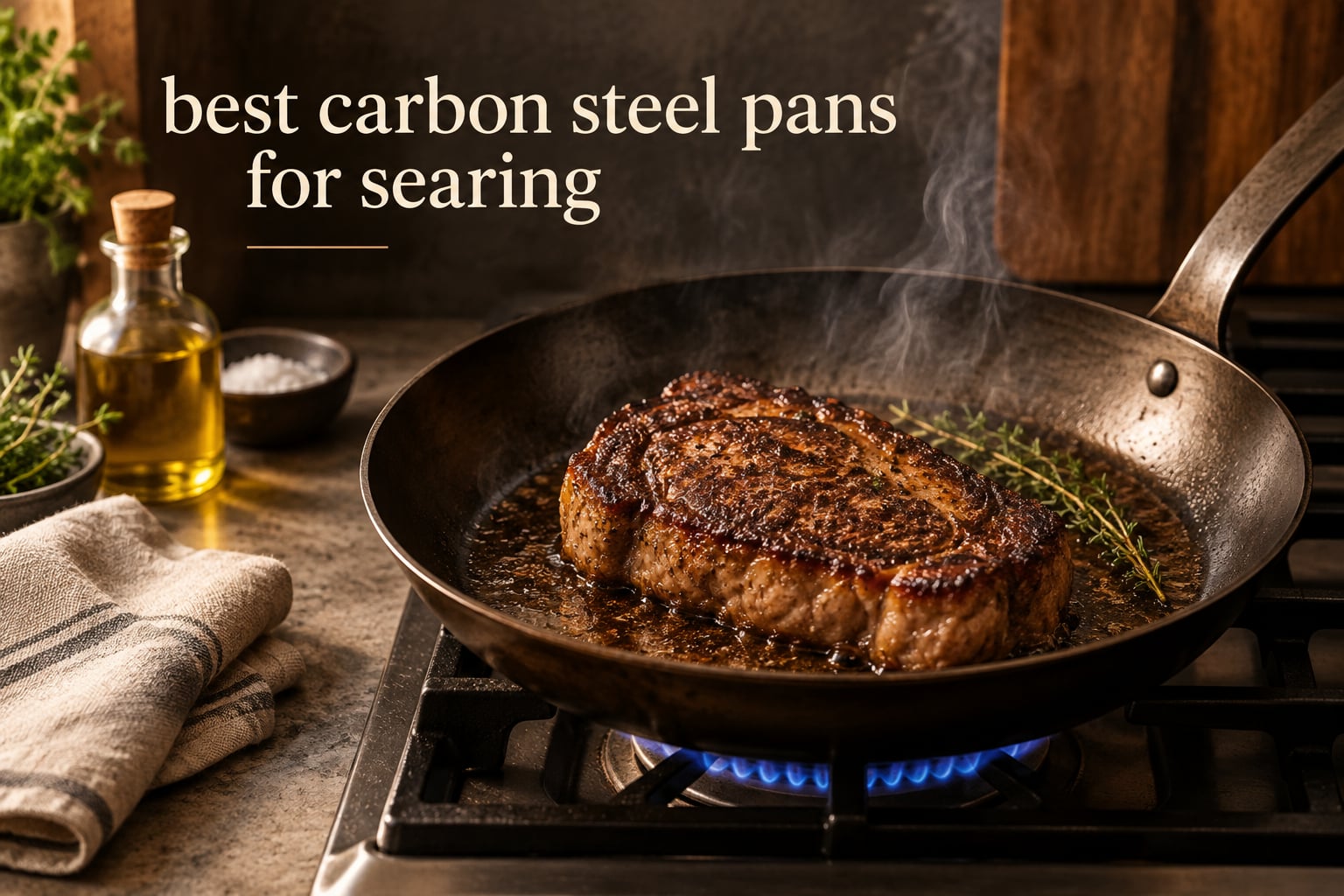
A good sear is a temperature problem before it is a technique problem. The pan has to get hot fast, hold an even temperature across the whole base, and not lose all of that heat the second a cold steak lands in it. Carbon steel is the material that solves two of those three cleanly, which is why it turned up in almost every professional kitchen we looked at.
If you want the short version: the de Buyer Mineral B is the best carbon steel pan for searing because its factory-flat base resists warping, it reaches searing heat in minutes rather than a quarter hour, and it carries the largest body of owner feedback of any pan in this group. The Matfer Bourgeat Black Carbon is the heavier, more thermal-mass option if you sear several cuts at once. The Lodge is the one to buy if you want something that works out of the box without a seasoning project first.
We compared ten carbon steel pans for this roundup, weighing them against the only criteria that matter when the goal is browning: how fast they heat, how evenly, how well they hold or lose temperature, how much usable flat surface sits over the flame, and whether the base stays flat over repeated high-heat cycles. This is the best carbon steel pans for searing guide for 2026, and it is organized around crust development rather than general-purpose versatility.
If you also want a pan for high-heat stir-frying rather than searing, our picks for the best carbon steel woks cover a different shape entirely.
Table of Contents
Top 3 Best Carbon Steel Pans for Searing (October 2026)

de Buyer Mineral B 8 Inch
- Factory-flat non-warping base
- Reaches sear heat fast
- Induction ready
- Lifetime warranty
Matfer Bourgeat Black 12 5/8 Inch
- 5.2 lb thermal mass
- Rivet-less welded handle
- Oven safe to 800F
- Induction ready

Lodge Pre-Seasoned 8 Inch
- Arrives fully seasoned
- Light 2.1 lb body
- PFAS-free surface
- Lifetime limited warranty
Best Carbon Steel Pans for Searing in 2026: Quick Overview
Every pan below is uncoated carbon steel. What separates them is weight, base geometry, how it arrives (pre-seasoned or raw), and the temperature ceiling it tolerates. Those four things decide how aggressively you can heat it and how long you can hold a sear before the pan gives up.
| Product | Specifications | Action |
|---|---|---|
| de Buyer Mineral B 8 Inch |
|
Check Latest Price |
| Matfer Bourgeat Black 12 5/8 Inch |
|
Check Latest Price |
| Lodge Pre-Seasoned 8 Inch |
|
Check Latest Price |
 Merten and Storck 12 Inch Merten and Storck 12 Inch |
|
Check Latest Price |
 Mauviel M’Steel 11 Inch Mauviel M’Steel 11 Inch |
|
Check Latest Price |
 YOSUKATA 10 1/4 Inch YOSUKATA 10 1/4 Inch |
|
Check Latest Price |
 Tramontina 12 Inch Tramontina 12 Inch |
|
Check Latest Price |
 OXO Outdoor 10 Inch OXO Outdoor 10 Inch |
|
Check Latest Price |
 STRATA Carbon Clad 12.5 Inch STRATA Carbon Clad 12.5 Inch |
|
Check Latest Price |
 Forge ELI 12 Inch Forge ELI 12 Inch |
|
Check Latest Price |
1. de Buyer Mineral B 8 Inch: Best Carbon Steel Pan for Searing Overall
de Buyer MINERAL B Carbon Steel Fry Pan – 8” Diameter, 5.5” Cooking Surface – Ideal for Searing, Sauteing & Reheating – Naturally Non-Stick Finish – Made in France
Weight: 0.9 kg
Cooking surface: 5.5 inch
Induction: yes
Oven: 400F for 10 min
Pros
- Heats faster than cast iron while holding heat
- Flat cooking surface that resists warping
- Handle stays manageable during normal stovetop use
- Made in France with a lifetime warranty
- Works on gas
- electric
- glass and induction
Cons
- Beeswax must be stripped before first seasoning
- Sides slope up sooner than most pans
- 0.9 kg is heavy for an 8 inch pan
- 5.5 inch surface suits one steak rather than a batch
The Mineral B is the pan I hand to someone who says they have failed at searing before. It is not the lightest pan here and it is not the biggest, but it is the most forgiving combination of fast heat-up, a base that stays flat, and a surface that improves every week it is used.
Owners consistently describe the same arc with this pan. The first few cooks are sticky. Then the seasoning starts to knit together, eggs release on their own, and somewhere around the two-month mark the pan starts behaving like the thing that sold them carbon steel in the first place. That patience requirement is real, and it is the single most common reason people give this pan up too early.
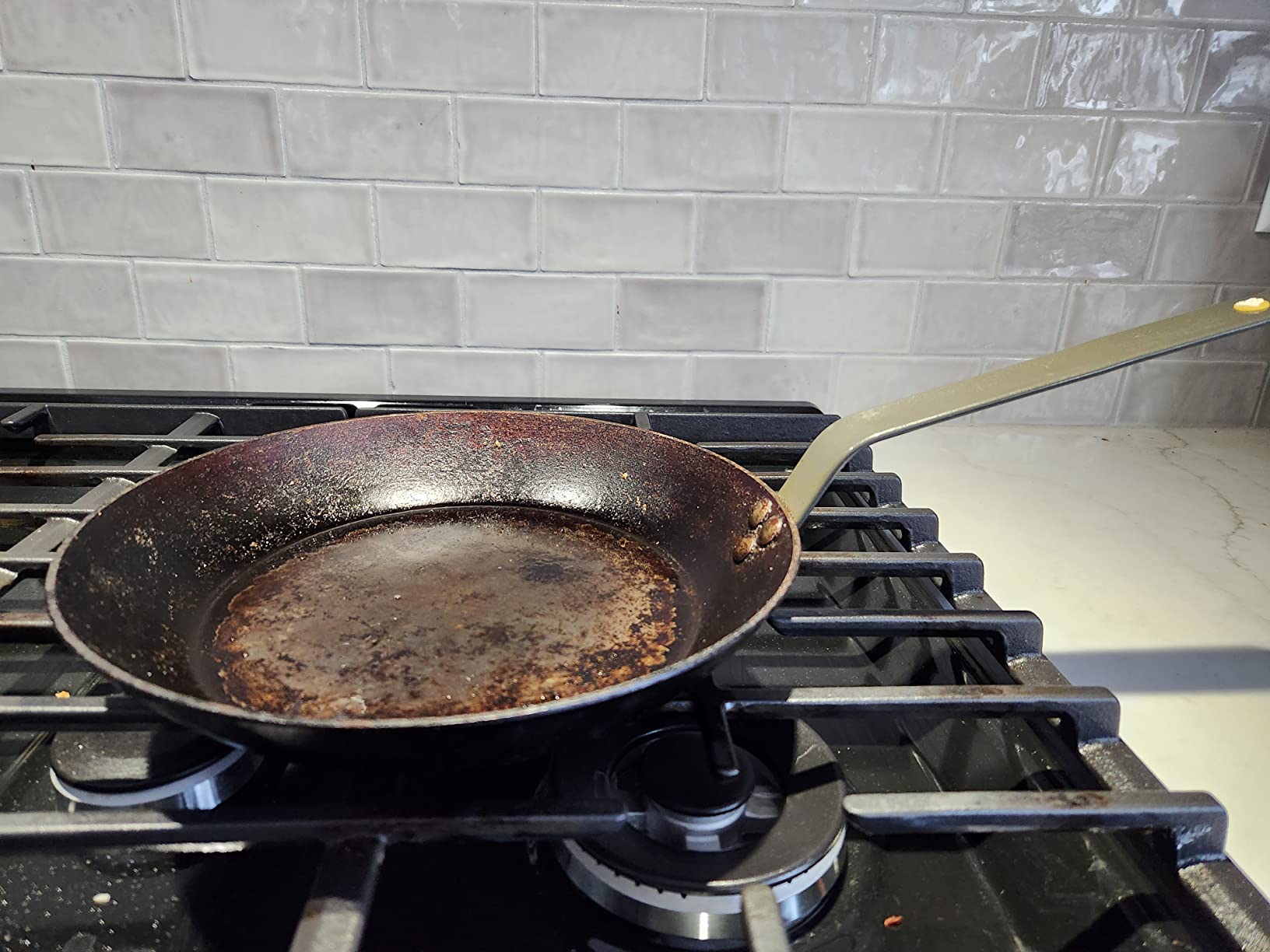
The number that matters for searing is the 5.5 inch cooking surface on an 8 inch pan. That is not a lot of flat area, and it means the pan is built for a single steak, a piece of fish, or a pan of vegetables rather than a double batch. Owners who want to brown two cuts at once tend to move up a size, and the same holds true for the heavier 10.5 and 12 inch versions of this line.
One detail catches people out. The pan ships with a beeswax coating meant to slow rust in transit, and if you season over it, the wax flakes into the patina and then flakes out of it later. The fix is not complicated: hot soapy water, a stiff brush, dry thoroughly, then start the seasoning cycle. Pans that skip this step are the ones that never seem to improve.
How it behaves during a long sear
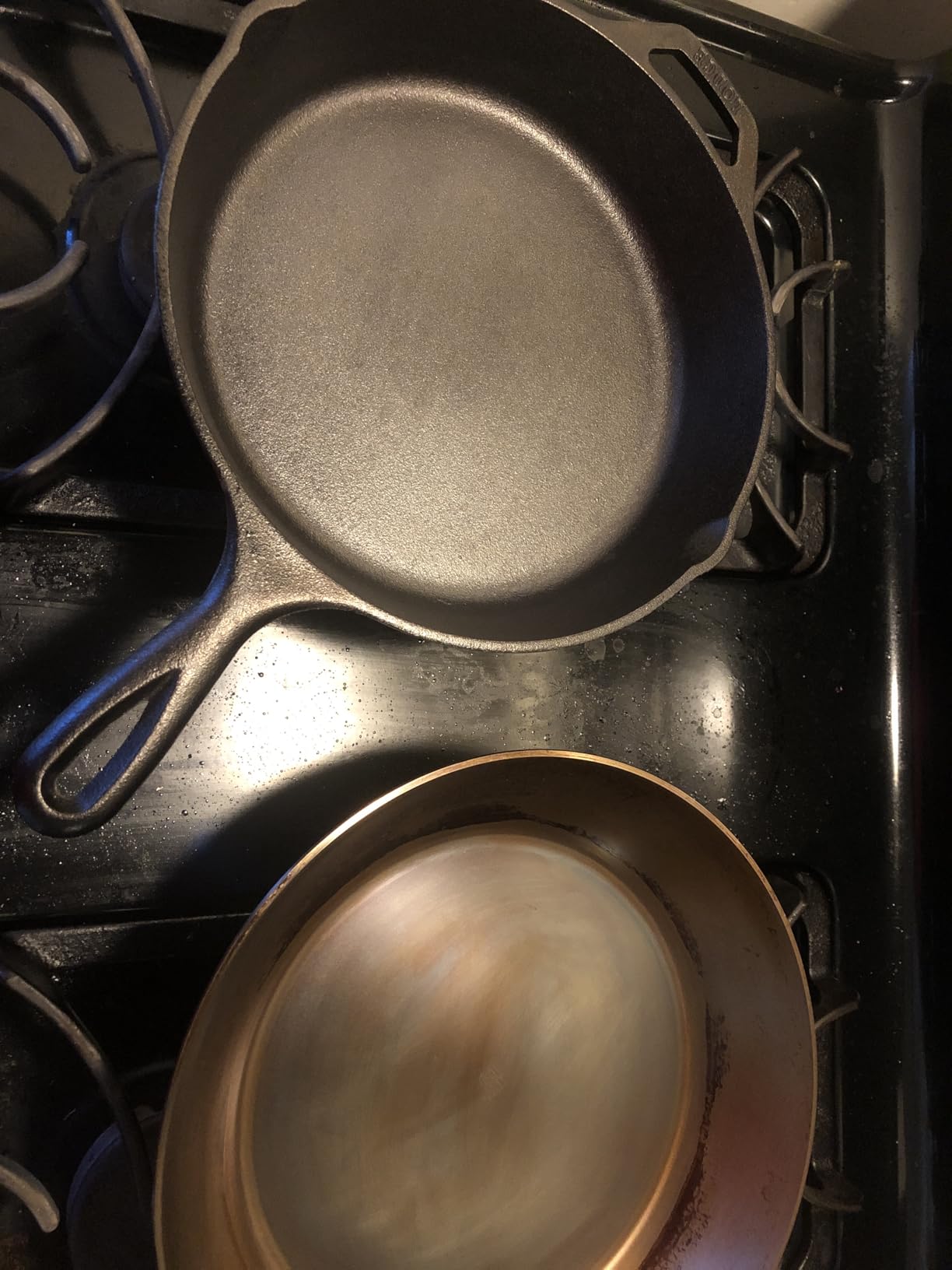
At 0.9 kg the Mineral B has enough mass to keep a sear going after the meat hits, without the sluggish feel of a much heavier pan. Owners report the handle disperses heat well enough to stay comfortable during ordinary stovetop work.
The oven ceiling is modest at 400F for up to 10 minutes, which rules out finishing a steak under the broiler in this pan. If oven finishing is part of your routine, look at the Matfer Bourgeat or the OXO instead.
Where it falls short for searing
The sloping side walls mean there is less flat area than the nominal diameter suggests, so the pan browns a single piece beautifully and crowds a second one. The beeswax removal step is also a genuine stumbling block that several owners call confusing.
Hand washing only, no harsh soap, and no dishwasher. For most cooks that is a fair trade for a surface with no synthetic coating on it, but it is a trade.
2. Matfer Bourgeat Black Carbon 12 5/8 Inch: Best Pan for Searing Several Steaks at Once
Matfer Bourgeat Black Carbon Steel Frying Pan, 12 5/8″
Weight: 5.2 pounds
Diameter: 12 5/8 inch
Oven: 800F
Open fire and induction
Pros
- Excellent heat distribution and temperature control
- Rivet-less welded handle is easy to keep clean
- Handles very high heat on any cooktop or open fire
- Made in France to commercial standards
- Ships with seasoning-based nonstick surface
Cons
- 5.2 pounds is heavy for a home cook
- Needs user seasoning before it releases well
- Keep acidic ingredients out of the pan
- Costs more than entry-level carbon steel
If searing is a two-steak-at-a-time job in your kitchen, this is the pan in the group with the surface area and the thermal mass to do it properly. The 12 5/8 inch diameter gives you room to lay cuts down with space between them, and 5.2 pounds means the temperature barely notices when cold meat arrives.
That mass is both the reason to buy it and the reason some cooks pass. A 5.2 pound pan plus a 1.5 pound steak plus tongs is a genuinely two-handed operation. If you like to lift and flip, a lighter pan suits you better. If you like to set the steak down, walk away for four minutes, and come back to a crust, this is the right tool.
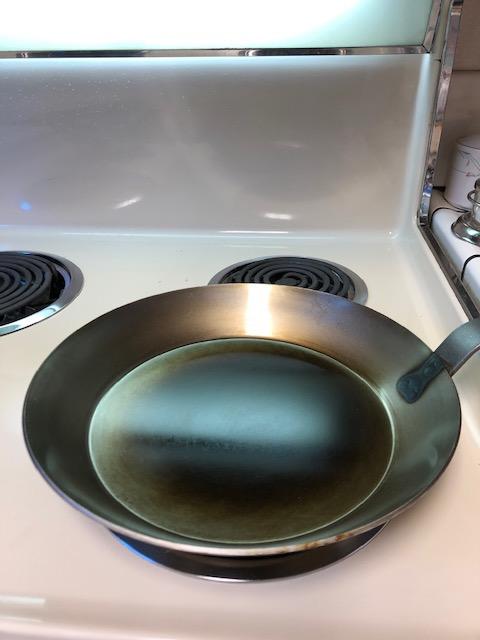
The construction is the quiet differentiator. The handle is welded to the pan body rather than riveted through it, so there is no crevice where burnt food, grease, or rust can start. Over a decade of daily service that matters more than it sounds, and owners cleaning up after several years of hard use tend to mention it first.
The 800F temperature rating is the highest in this group and it opens up work the others cannot do: open fire cooking, an outdoor grill, a campfire, or a pan under the broiler for a hard sear on cheese or a crusty top. The manufacturer is explicit that acidic ingredients such as vinegar, lemon juice, and tomato sauce should stay out of the pan, since acid attacks the seasoning layer that the sear depends on.
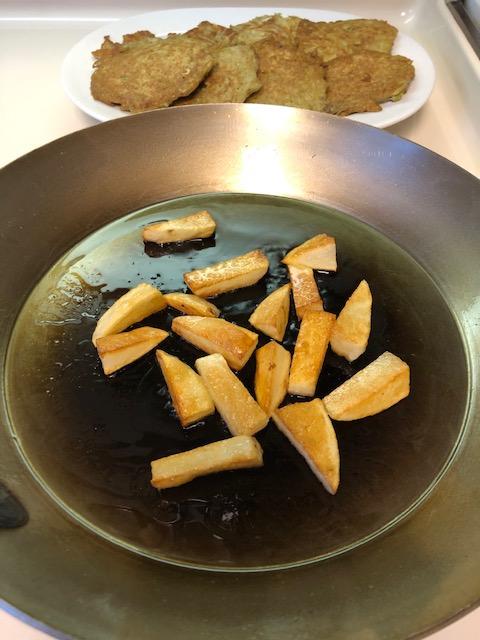
What the extra weight buys you
Thermal mass is the quiet hero of a hard sear. A heavier pan gives up less temperature when the food lands, so the browning never stops mid-cook. That is why this pan keeps working when lighter carbon steel pans start to steam.
It also takes a rough oven-to-table trajectory well, at any temperature up to 800F. The welded steel handle is angled for stirring and flipping, which matters if you use the pan for more than steaks.
Where it falls short for searing
The weight is the headline complaint, and it is not a small thing for a cook with wrist or back issues. It also has to be seasoned by you before it develops its release, unlike the Lodge or the Merten and Storck.
The acid restriction rules out deglazing a finished sear into a vinegar or tomato pan sauce in the same pan. Plan a second pan for that, or keep the acid for the plate.
3. Lodge Pre-Seasoned Carbon Steel 8 Inch: Best Value Carbon Steel Skillet for Searing
Lodge Pre-Seasoned Carbon Steel Skillet, Long Handle, 8 Inches
Weight: 2.1 pounds
Diameter: 8 inch
Oven: 500F
Induction: yes
Pros
- Arrives already seasoned and usable
- Lightest handling in the group at 2.1 pounds
- Quick temperature response for searing and sauteing
- PFAS-free and metal utensil safe
- Made in the USA with a lifetime limited warranty
Cons
- Pebbled factory surface needs multiple seasoning cycles
- Relatively thin steel if blasted from cold
- 8 inch surface limits batch cooking
- Plastic handle gets hot under the broiler
The Lodge is the answer to the most common objection about carbon steel, which is the commitment. It arrives seasoned, it handles like a well-seasoned pan from week one, and at 2.1 pounds it is the easiest to lift and toss of any pan here.
The catch is the surface itself. Lodge carbon steel comes out of the box with a coarse, pitted texture, and owners report that it takes roughly 8 to 10 seasoning cycles before it feels genuinely smooth. That is honest, and it is also a real advantage over raw pans, because every one of those cycles is food rather than a baking cycle.
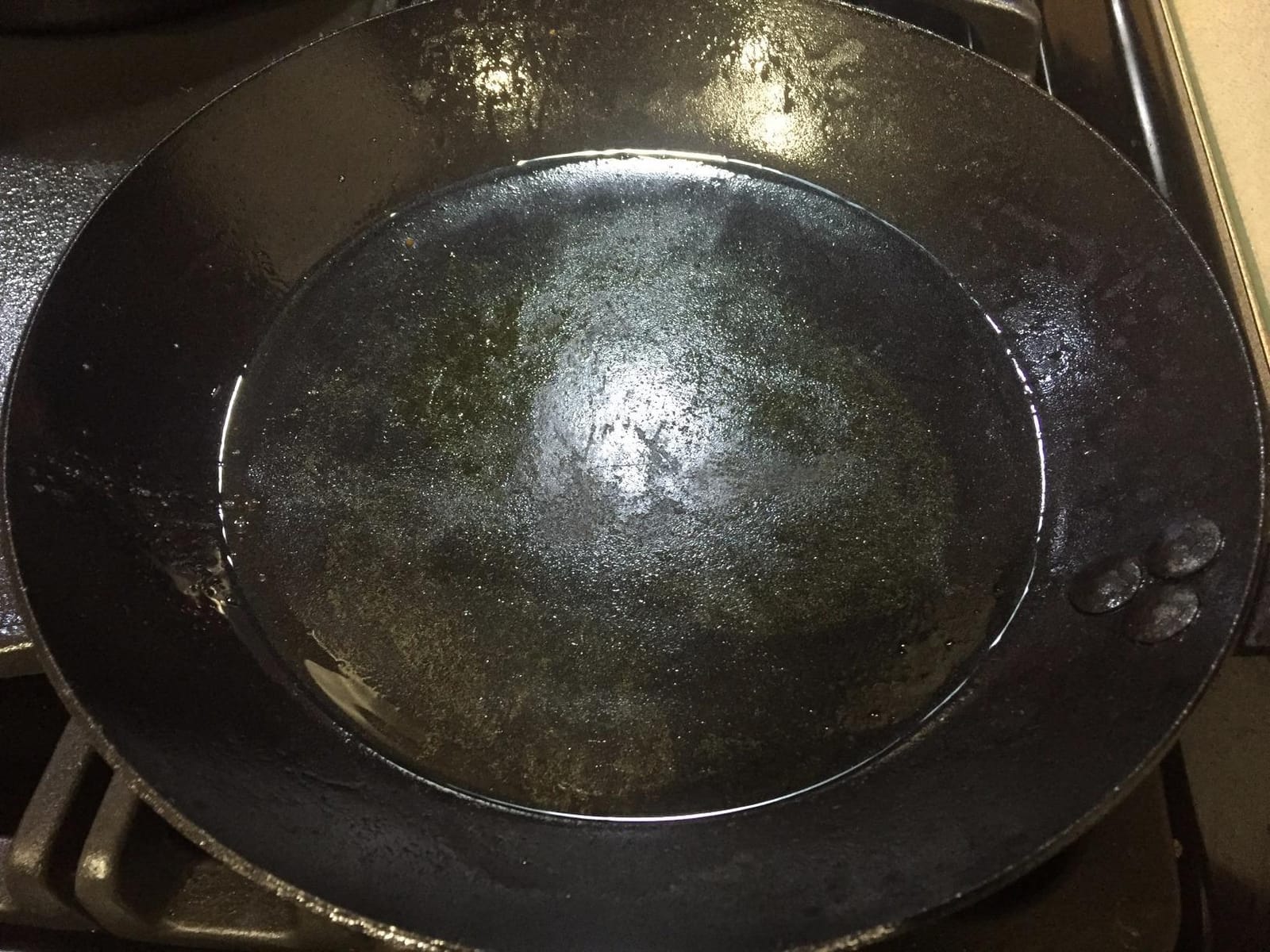
For searing specifically, what you get is fast response. Turn the burner up and this pan follows. The thin steel profile is a virtue for a cook who wants to move from a hard sear to a lower simmer without waiting, and it is a liability for anyone who blasts an empty pan from cold on a glass cooktop, where the base can bow.
The 8 inch size suits one person or one steak. Many owners buy this one alongside a 10 inch or 12 inch, and that is the sensible approach if you want a small pan for eggs and a large one for searing. At 2.1 pounds it is also the pan most likely to end up in a bag and over a campfire.
Why it works for weeknight searing
Preheat is quick and the pan responds to burner changes without lag. For a cook searing a single steak on a weeknight, that responsiveness is more useful than raw thermal mass, because the timing of dinner depends on it.
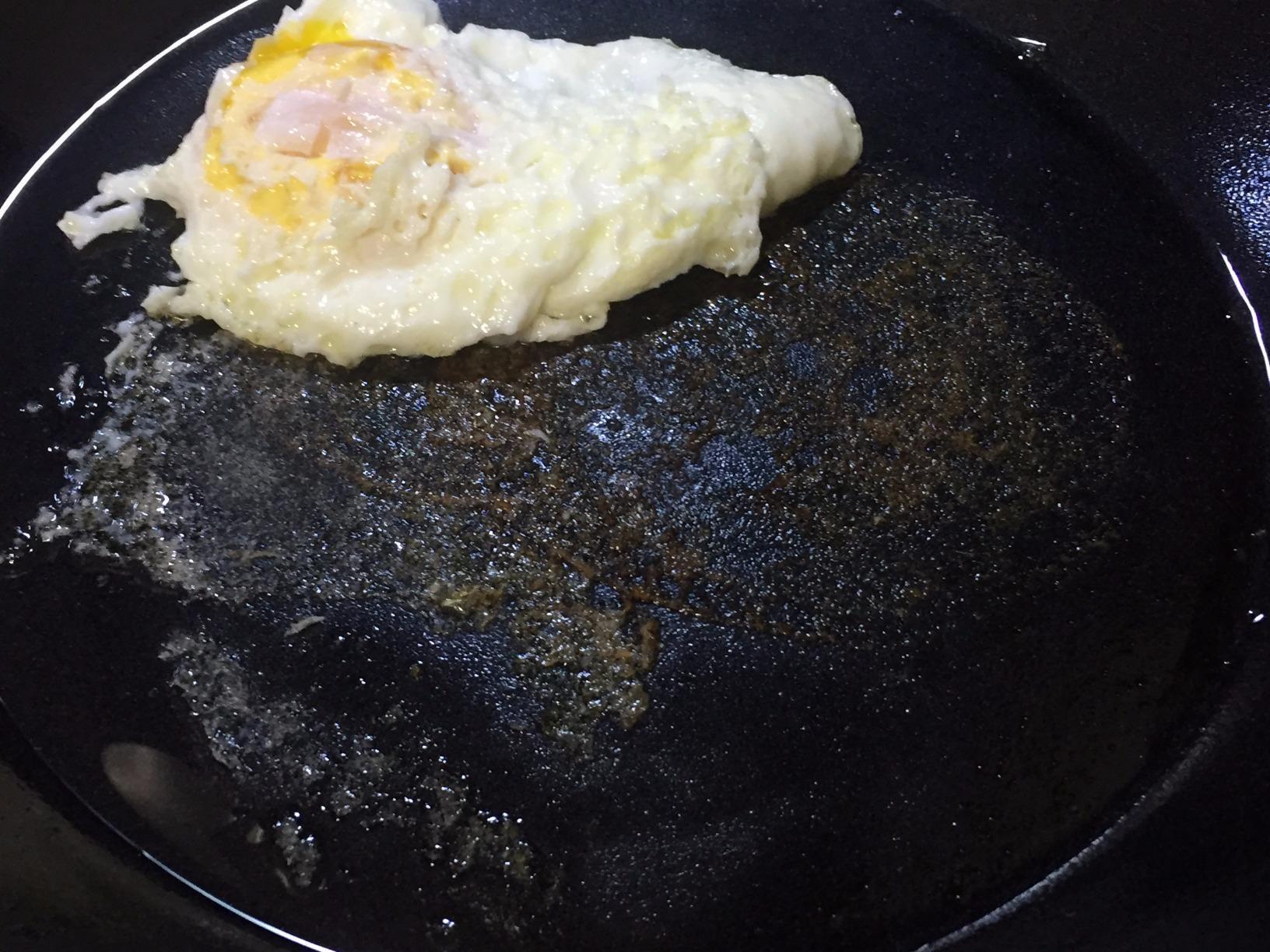
The surface takes browning and caramelizing well, and once the patina builds, owners report eggs releasing without fat, which is the single most persuasive argument for carbon steel to a skeptical cook.
Where it falls short for searing
The rough surface has a rough surface until you put in the work. Expect sticking in the first weeks, and expect the pan to feel coarse against a soft egg white before the cycles stack up.
The 500F ceiling with a plastic handle means no broiling and no open flame on the handle, and 8 inches is a one-steak pan. A 4.3 average across thousands of reviews reflects that split clearly: cooks who want a light, responsive pan rate it highly, and cooks wanting a big surface for batch searing move up a size.
4. Merten and Storck 12 Inch: Best for Large Batch Searing on a Flat Bottom
Merten & Storck Pre-Seasoned Carbon Steel 12″ Frying Pan Skillet, Cast Iron Lightweight, Durable, Sear Grill Broil Fry, Indoor Outdoor Cooking, Easy to Clean, Oven Safe, Induction, Steel Handle, Black
Weight: 1.5 kg
Diameter: 12 inch
Oven: 600F
Induction: yes
Pros
- Lighter than cast iron with fast heat response
- Flat bottom holds oil in place instead of pooling
- Pre-seasoned and fairly slick from the start
- Triple-riveted steel handle is sturdy
- Shrugs off metal utensils
Cons
- Very thin steel that can warp on glass or electric
- Less thermal mass makes long hard sears harder
- Protective wax coating needs thorough scrubbing
- Some owners find the surface so slick that flipping is awkward
A 12 inch flat bottom at about 3.3 pounds is a rare balance, and it is why this pan keeps showing up in searing conversations. You get the surface area of a large skillet without the arm weight of a cast iron or a heavy pro pan, and a flat base means your oil sits where the meat is instead of running to the edges.
That flat base is also the whole argument and the whole risk. Owners report the thin steel bowing on smooth glass and smooth-surface electric ranges, which produces hot spots, oil that migrates to one side, and a pan that spins slightly on the burner. On gas the same pan is reported to behave very differently, and on induction the manufacturer suggests heating gradually.
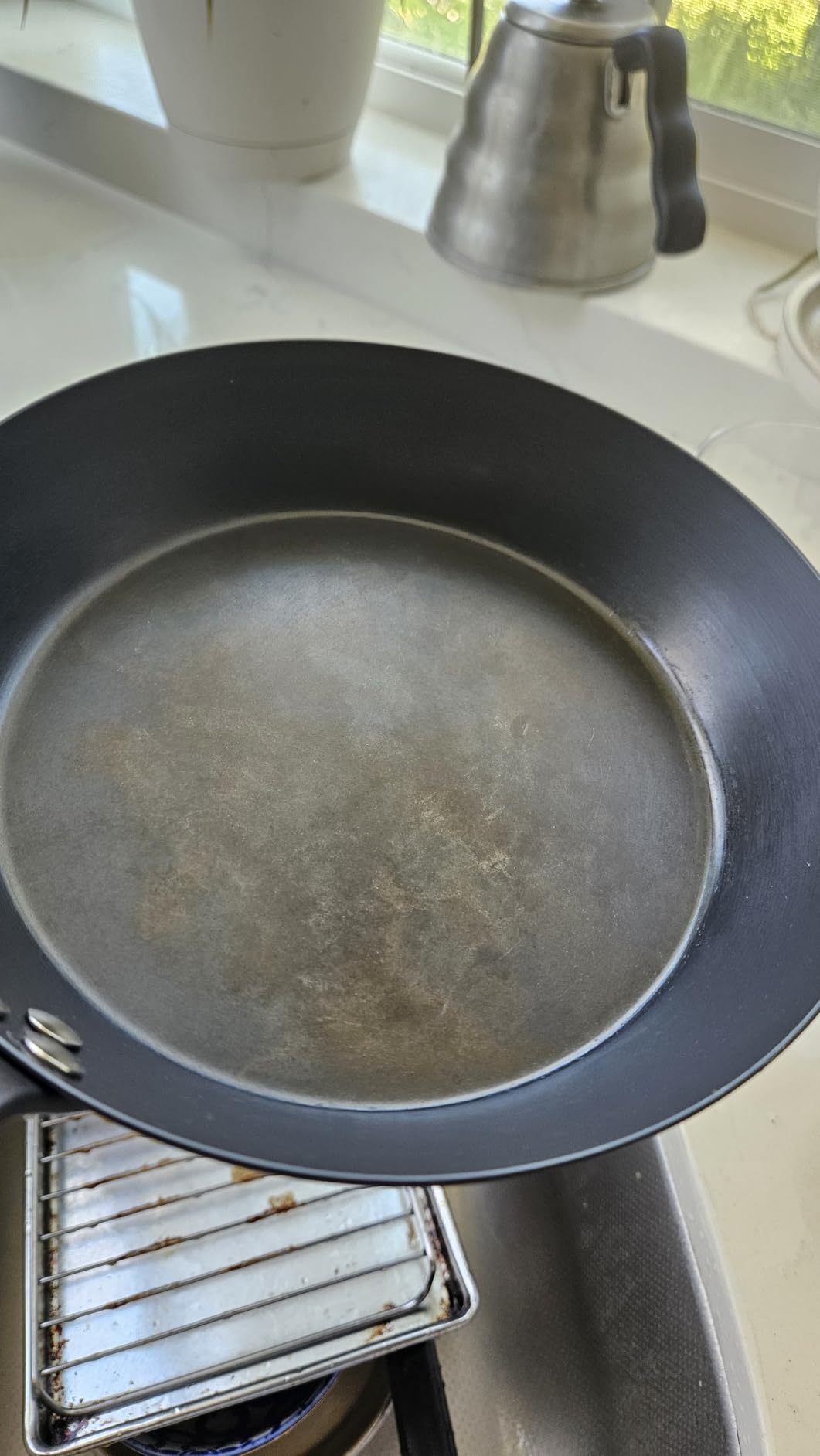
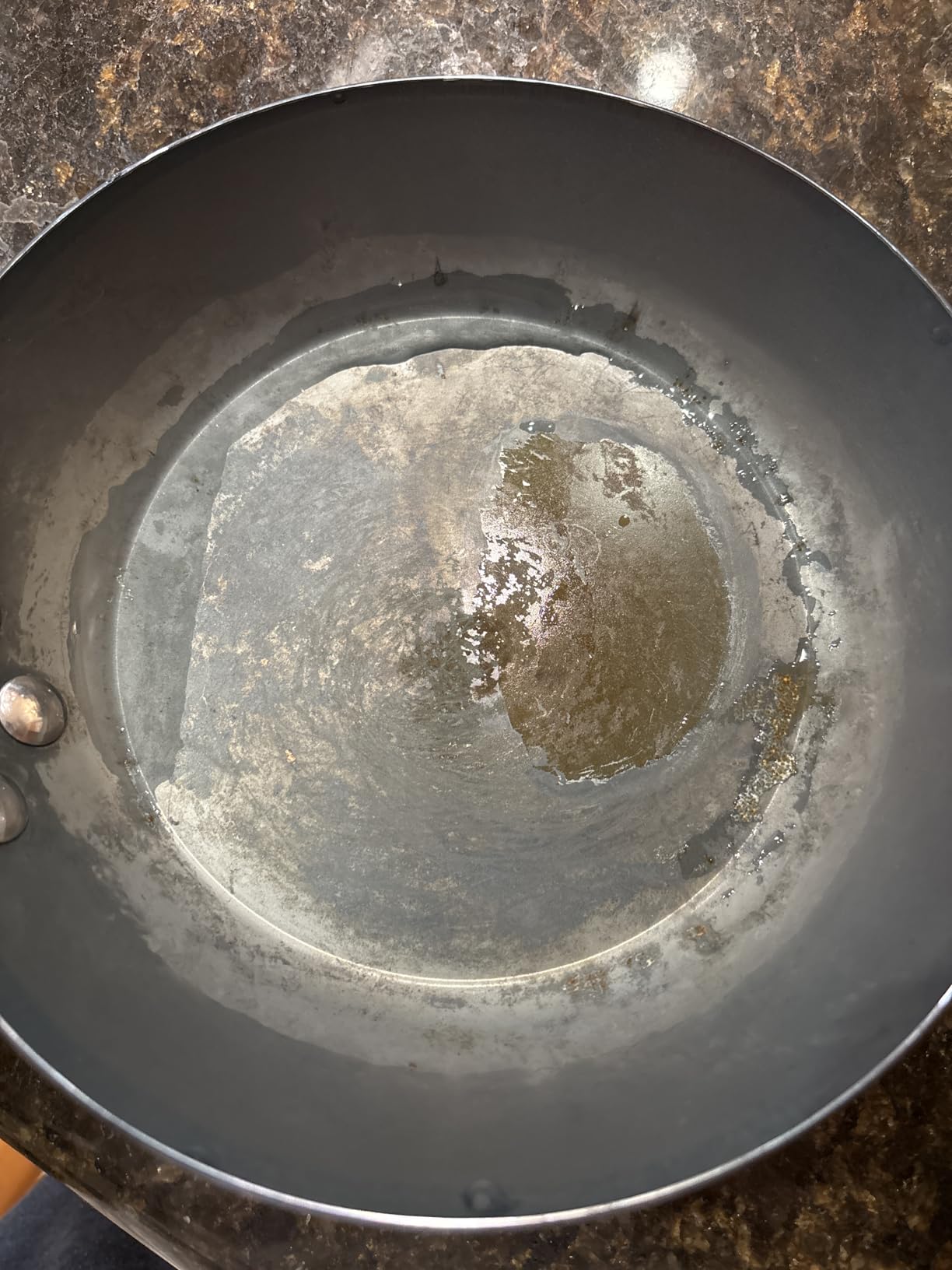
Like several pans here, it ships with a protective coating that owners have to scrub back to bare metal before the pan performs at its best. Once that is done, the seasoning builds quickly and the surface turns genuinely slick, and some reviewers go as far as saying it becomes too slick, which is a nice problem to have if you prefer tongs to spatulas.
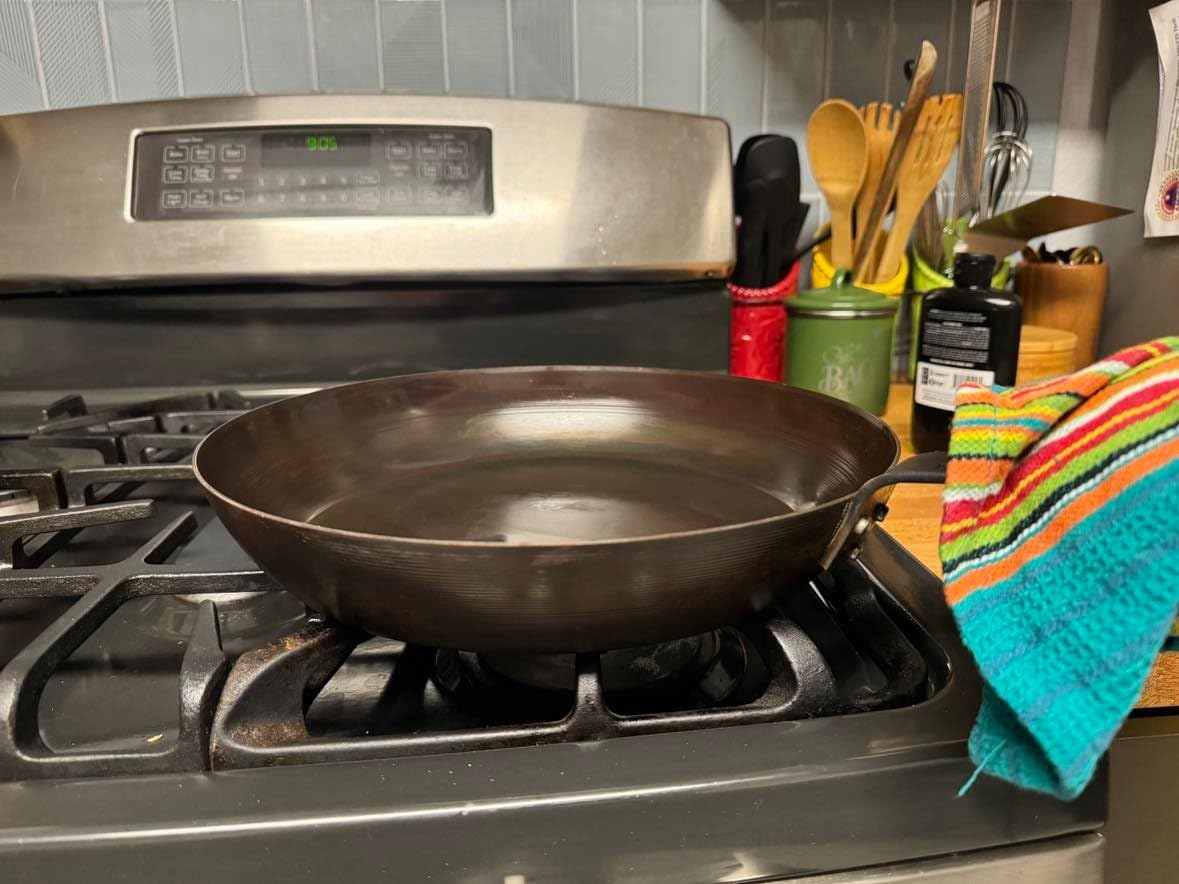
The triple-riveted steel handle stays cool during normal stovetop work according to most owners, and the pan is oven safe to 600F, which is enough to finish a seared fish fillet or roast a pan of vegetables after the burn.
When to choose this one over a heavier pan
Choose it when you sear for a table, when you want a 12 inch surface, and when lifting a hot heavy pan is a genuine annoyance. The fast response means the temperature tracks your burner rather than lagging behind it.
The flat bottom also makes it a good pan for griddling and for cooking more than one cut at a time, which is where the 12 inch dimension pays for itself.
Where it falls short for searing
Thin steel has less to give when cold meat lands, so a long hard sear is harder to sustain than in the Matfer. That is a physics outcome, not a defect.
On smooth glass or electric cooktops, heat it gradually rather than blasting it from cold. The wax coating and the warping complaints are the two recurring threads in the reviews, and both are manageable once you know about them.
5. Mauviel M’Steel 11 Inch: Best for Even Heating Across the Base
Mauviel M’Steel Black Carbon Natural Nonstick Frying Pan With Iron Handle, 11-in, Suitable For All Cooking Surfaces, Made in France
Weight: 2 kg
Diameter: 11 inch
Base: 21.5 cm
Oven: 680F
Pros
- Very even heat conduction for searing and browning
- Large flat surface relative to the pan diameter
- Solid iron handle works in the oven
- Responsive and light enough to toss vegetables
- Made in France with responsive support
Cons
- Beeswax is hard to remove with ordinary hot water
- Smoother surface takes several oven cycles to season
- About 2 mm thin
- so heat it slowly on electric
- Handle edges can need light sanding
Mauviel’s argument is conduction. Owners describe the browning across this pan as unusually uniform, which is exactly what you want when a crust should form at one consistent rate instead of catching in patches. On an 11 inch pan with a 21.5 cm cooking base, the ratio of flat area to total diameter is generous.
The solid iron handle is the feature that separates it from most of the group. It is oven capable and it stays workable on the cooktop, so the pan moves from a hard sear straight into a 680F oven without a tool change. For finishing a thick steak, that is a meaningful advantage over pans that stop at 400F or 500F.
Beeswax is the obstacle. The coating meant to protect the steel in transit is stubborn, and many owners had to boil water in the pan or run it hot in the oven for an extended period to shift it. It is a tedious first afternoon, and skipping it is the main reason some reviewers struggle with this pan.
Worth knowing before you buy: the wall is about 2 mm, which is thinner than several rivals here. Mauviel’s own guidance is to heat slowly and run the cooktop at roughly 60 percent rather than full blast, and reviewers who follow that advice report a pan that stays flat and seasons well.
At 2 kg the pan is in the middle of the weight range. It is heavy enough to hold temperature through a sear and light enough to shake for a stir-fry, and several owners compare it favorably with the de Buyer at 11 inches and below for being more responsive.
How it handles a four-minute sear
The even base means the crust forms at the same rate across the whole surface, so a single stationary sear produces an even crust rather than a dark edge and a pale middle. The 21.5 cm base is large enough to seat most cuts flat.
Then the pan goes in the oven at up to 680F to finish the interior. Few pans in this group combine a stovetop crust that even with an oven finish that hot.
Where it falls short for searing
Beeswax removal is the single most cited problem, and several owners describe it as a real trial. The smoother surface also makes seasoning slower than a pebbled pan, since there is less texture for the polymerized oil to grip.
At 2 mm it wants a gentle hand on electric and induction. Blasting a thin pan from a cold start is how thin pans warp, and a warped base is the end of consistent searing.
6. YOSUKATA 10 1/4 Inch: Best for Open Flame and Grill Searing
YOSUKATA 10 1/4″ Pre-Seasoned Carbon Steel Frying Pan
Weight: 1.4 kg
Diameter: 10 1/4 inch
Oven: 700F
Broiler safe
Pros
- Wooden handle stays cool and detaches for oven or grill
- Heats quickly and distributes heat evenly
- Light 3.1 pound body at 10.25 inches
- No synthetic coatings of any kind
- Works as a wok
- skillet or deep frying pan
Cons
- Lowest average rating in the group at 4.0
- Seasoning takes time and the pan sticks early on
- Detachable handle connection can loosen with use
- Small review base at 389 reviews
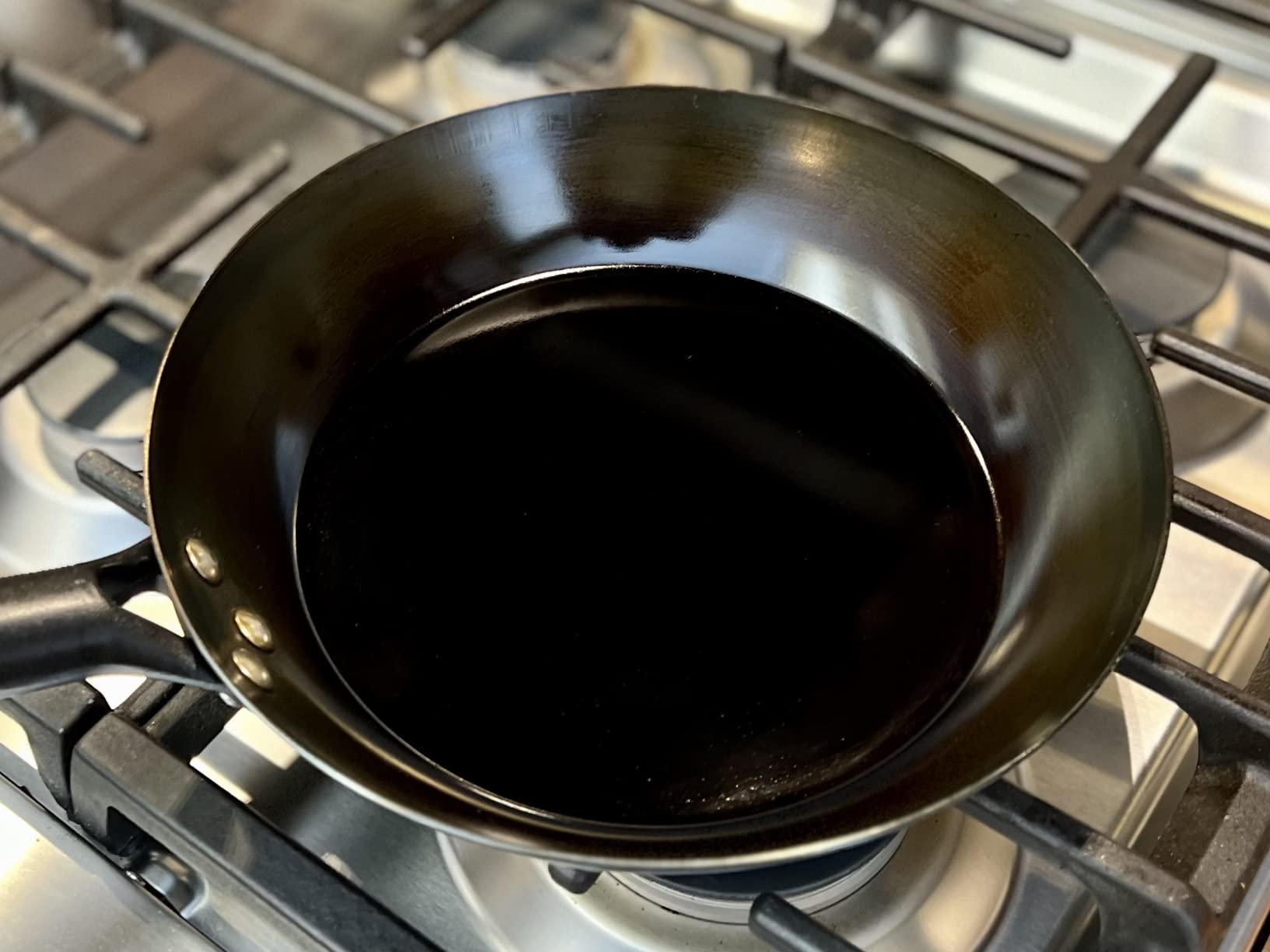
This is the pan to pack. The wooden handle stays cool on a stovetop and detaches so the pan body can go into a 700F oven, under a broiler, onto a grill, or over an open flame. For searing away from a kitchen, that flexibility is worth more than any amount of in-home versatility.
At about 3.1 pounds and 10.25 inches, it is also a fast heater with even distribution, which is what you want on a grill where the heat source is uneven. Reviewers routinely describe using it as a wok, a skillet, and a camping pan, and the manufacturer rates it for gas, electric, induction, grill, BBQ, and open flame.
The honest caveat is the rating. A 4.0 average across 389 reviews is the lowest in this group, and the spread is wide, with a meaningful share of one-star feedback. Most of that is about the first cooks, when the seasoning is not built and food sticks, plus some friction with the removable handle fitting.
If you are patient about seasoning, that 4.0 reflects a pan that has not been broken in yet rather than a flawed one. The same people who report early sticking tend to report strong performance later, which is the normal carbon steel curve.
Why searing outdoors is different
Outdoors, the pan rarely gets a stable, even heat source. A grill has hot spots and a wind; a campfire fluctuates. A pan that heats fast and distributes evenly handles that better than a slow, heavy one, which is why this design is a common choice for that job.
Detaching the handle means the pan body can sit directly over flame or under a broiler at up to 700F, which no fixed-handle wood or plastic handle pan can do.
Where it falls short for searing
The early sticking is the honest drawback, and there is no coating to soften it. The detachable handle adds a connection point that can loosen over time, and the handle is a small, light part that you will be gripping with a towel if the sear runs long.
At 10.25 inches it is a single-cut pan indoors. If your searing happens at a table for four, the 12 inch options above serve you better.
7. Tramontina 12 Inch with Silicone Grip: Best Budget 12 Inch Searing Pan
Tramontina Carbon Steel 12-Inch Large Frying Pan with Silicone Grip
Weight: 5.6 pounds
Diameter: 12 inch
Oven: 500F without sleeve
Lifetime warranty
Pros
- Nitro carbonized finish that improves with use
- Removable silicone sleeve makes the steel handle comfortable
- 12 inch surface for batch searing
- NSF certified with a lifetime warranty
- Carbon steel with a natural oil finish and no synthetic coating
Cons
- 5.6 pounds is heavy for a 12 inch pan
- Induction compatibility is listed inconsistently
- Sleeve must come off for oven use above 400F
- Thinnest evidence base in the group at 258 reviews
The Tramontina is the value entry here, and the value is in the size. A 12 inch carbon steel pan with a lifetime warranty and an NSF certification is not a combination you find at the bottom of the category, and for a cook who sears for a group, the surface area is the feature that matters.
The finish is nitro carbonized with a natural oil rather than a synthetic coating, and it behaves as owners expect: slick enough to work early, better after a few dozen cooks. The removable silicone sleeve is a genuinely good idea, because a bare riveted steel handle at searing heat is unpleasant to hold, and the sleeve fixes that without changing the pan’s oven capability.
There is one documented ambiguity worth flagging. The product listing shows smooth-surface induction among the compatible devices, while the written description states it is not suitable for induction. If you cook on induction, verify before you commit.
At 5.6 pounds this is the second-heaviest pan in the group, which buys thermal mass and costs you maneuverability. It is a set-it-down pan, not a flip-it-in-the-air pan. If you like to move food around with a toss, this is the wrong shape for the job.
With 258 reviews the evidence base here is the thinnest in the roundup, and the rating spread follows the familiar category pattern: owners who season the pan properly are enthusiastic, and first-week buyers who hit sticking are not. The 400F ceiling with the sleeve on, rising to 500F without it, also rules out broiler finishing.
When this pan makes sense
Buy it when you want one large pan for searing a batch, you want a lifetime warranty behind it, and you would rather not pay a premium for a European brand name. The 12 inch surface with a flat base does the core job well.
The silicone sleeve is the quiet upgrade over cheaper pans, and it matters most exactly when the pan is hottest.
Where it falls short for searing
The weight, at 5.6 pounds, is the first thing reviewers mention. The oven ceiling is low, the induction claim is inconsistent, and the review base is small enough that you are buying more on the spec sheet than on consensus.
Treat it as a solid first carbon steel pan rather than a forever one, and check your cooktop type before ordering.
8. OXO Outdoor 10 Inch: Best for Smoother Surface and Packable Camp Cooking
OXO Outdoor Pre-Seasoned Carbon Steel 10″ Frying Pan Skillet, Detachable Handle for Easy Storage, Indoor Use, Nonstick with Use, Induction Suitable,Oven & Broiler Safe,Browning, Grill,Sear,Saute,Black
Weight: 2.6 pounds
Diameter: 10 inch
Oven: 660F
Induction: yes
Pros
- Smoother cooking surface than pebbled rivals
- Detachable clip-on handle that nests for storage
- Lights at 2.6 pounds and heats fast
- Near nonstick once the factory coating is washed off
- Induction
- oven and broiler safe
Cons
- Clip-on handle wiggles and feels loose
- Handle ergonomics trail a fixed handle
- Small crown in the center of the surface
- Still too heavy for backpacking
- Some reports of rust or flaking over time
The OXO’s real advantage is surface texture. Where the Lodge and other pebbled pans need a long seasoning campaign to become smooth, this one starts closer to where you want to be, and owners specifically call out the smoother cooking surface as the difference in egg release and crust formation.
It also arrives pre-seasoned, so you wash it and start cooking. That removes the single biggest reason people abandon carbon steel in week one, and combined with the smooth surface it means this pan performs early. Reviewers describe it as close to nonstick out of the box once the protective coating is washed away, and they use it for burgers, steaks, eggs, and omelets.
The detachable clip-on handle is the second idea. It comes off for direct heat cooking and reverses for storage, which is why this pan packs flat in a cabinet or a camp box. It is not a backpacking weight, at 2.6 pounds, but for car camping or a home cook who wants one pan for two jobs, it works.
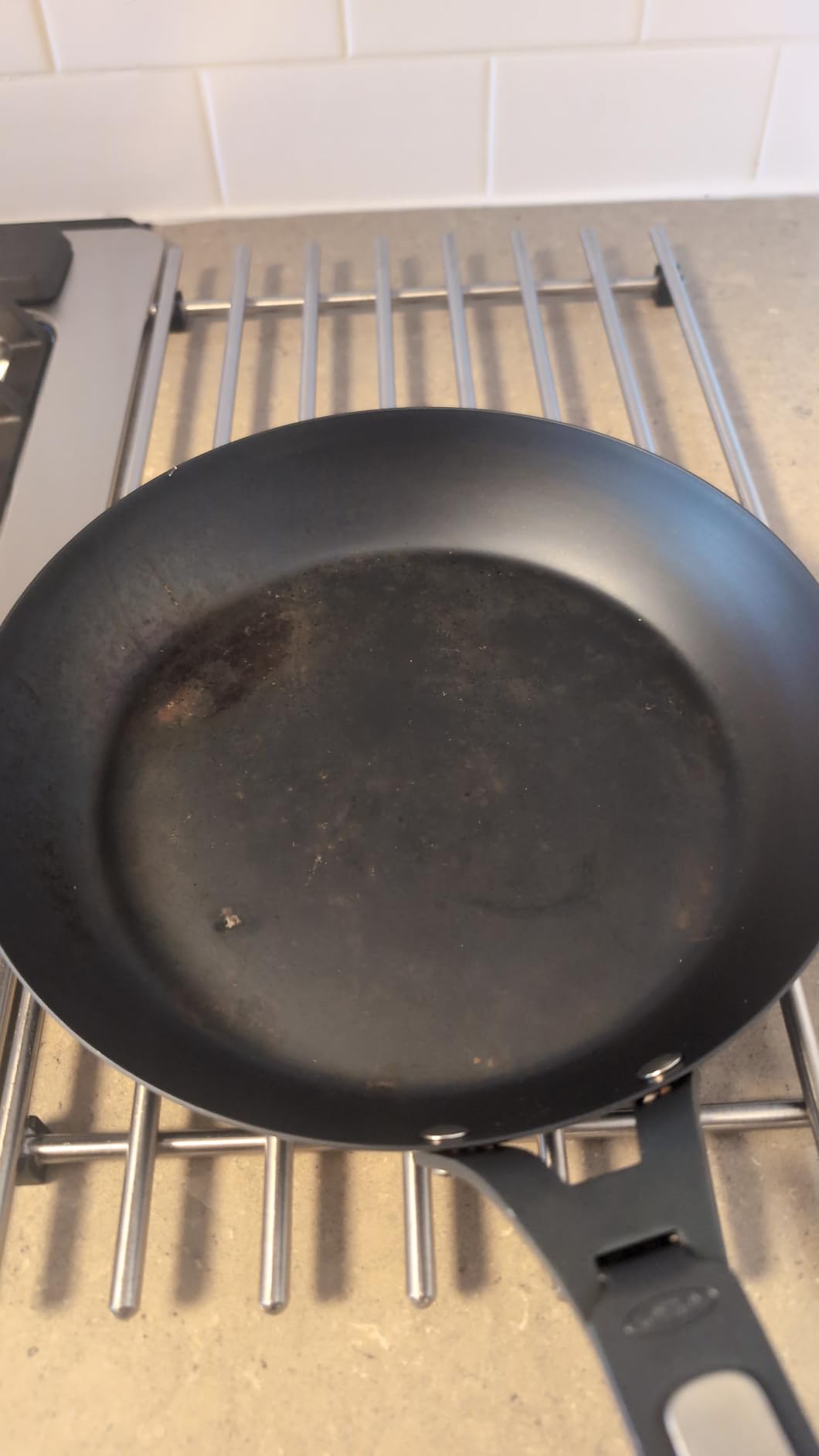
The 660F oven rating and broiler compatibility are the best combination of detachable-handle pan and high-heat finishing in this group. You can sear on the stovetop, pull the handle, and finish under the broiler or in a hot oven.
At 112 reviews, the evidence base is modest, but the sentiment is consistently positive. The one repeated negative is the handle itself, which several owners describe as wiggling and less refined than a fixed handle, leading some to reassign the pan to camping duty and buy a conventional one for the kitchen.
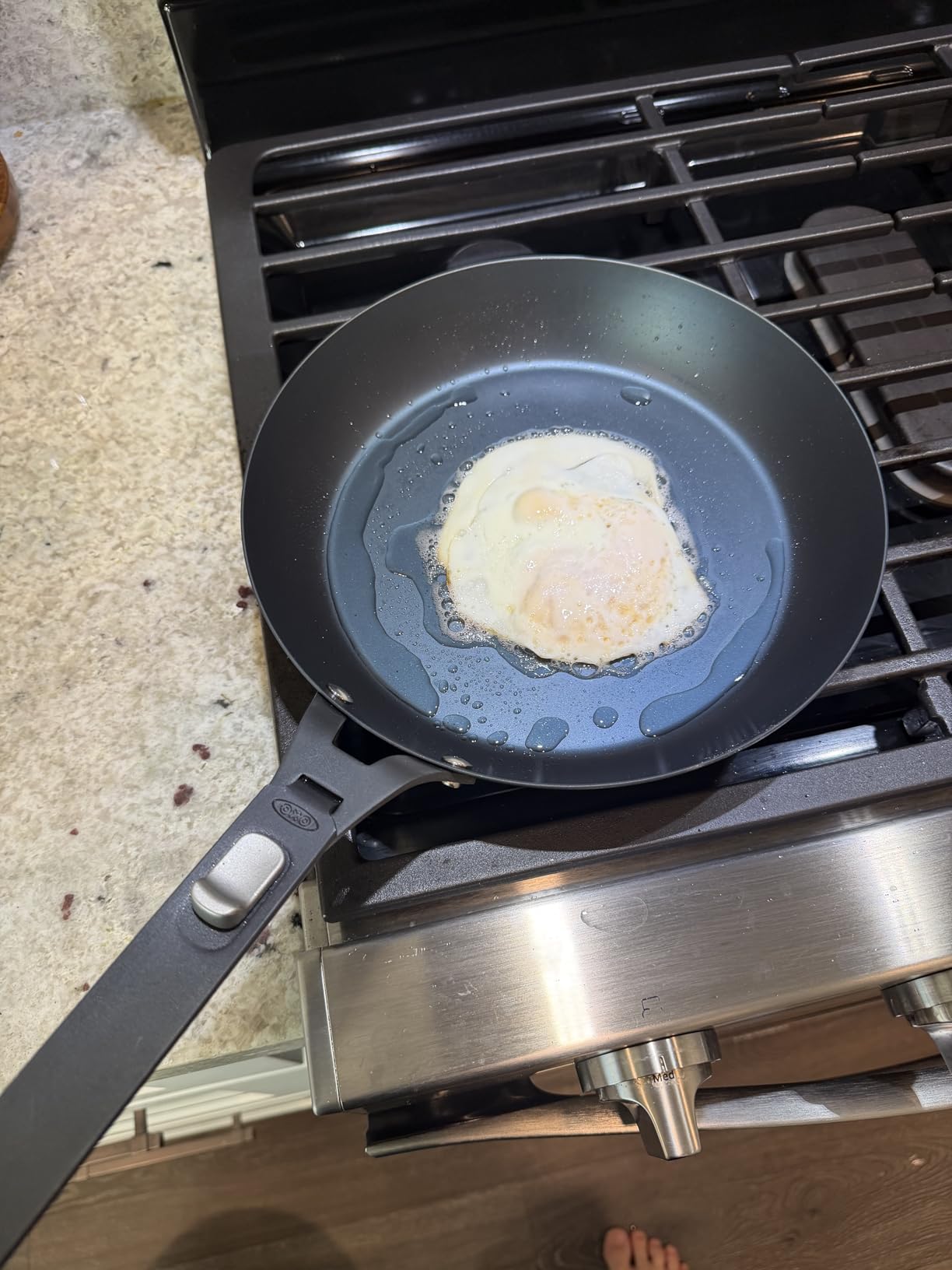
What the smooth surface changes
Texture drives seasoning. A rougher surface holds more polymerized oil and builds release faster but feels coarse against delicate food. A smoother surface sears more evenly and is easier to clean, and it needs more cycles to fully season.
For searing thick cuts, the smoother base means more even contact and a more consistent crust, which is exactly what the OXO is built for.
Where it falls short for searing
There is a slight crown in the center of the cooking surface, so a very large flat cut may touch at the edges rather than dead flat across. The clip-on handle is the weak point, and it matters during a long sear when you want a secure grip.
A small minority of owners report rust or coating flaking after extended use, and warranty support outside the US was described as unhelpful. Dry it after washing and it is a non-issue.
9. STRATA Carbon Clad Classic 12.5 Inch: Best for No Hot Spots
STRATA 12.5″ Carbon Clad® Classic – Carbon Steel Frying Pan – Gen 1
Weight: 4.3 pounds
Diameter: 12.5 inch
Oven: 600F
Unseasoned, arrives raw
Pros
- Only 3-ply build with an aluminum core in this group
- Aluminum core spreads heat evenly with no hot spots
- About half the weight of a solid carbon steel pan
- Cast stainless handle minimizes heat transfer
- Metal utensil safe and endlessly re-seasonable
Cons
- Arrives unseasoned and needs a full seasoning routine
- Takes 10 to 30 cooks to develop real stick resistance
- Highest cost per pan in the roundup
- Manufacturer advises against high heat on an empty pan
Every other pan here is a single layer of carbon steel, which means heat travels through it quickly and unevenly is possible. STRATA sandwiches an aluminum core between the steel layers, and that core is the whole point: it spreads heat across the base and eliminates hot spots, which is the condition a crust needs to form evenly.
The second benefit is weight. The 3-ply construction delivers a 12.5 inch pan at 4.3 pounds, roughly half the weight of a solid steel pan of similar size. For a large searing surface you can still lift one-handed, nothing else here does it.
The honest downside is the out-of-box experience. This pan ships unseasoned, and the manufacturer is clear that stick resistance typically takes 10 to 30 cooks to develop. Buyers who planned to cook that many times are delighted. Buyers who wanted a pan to use tomorrow are not.
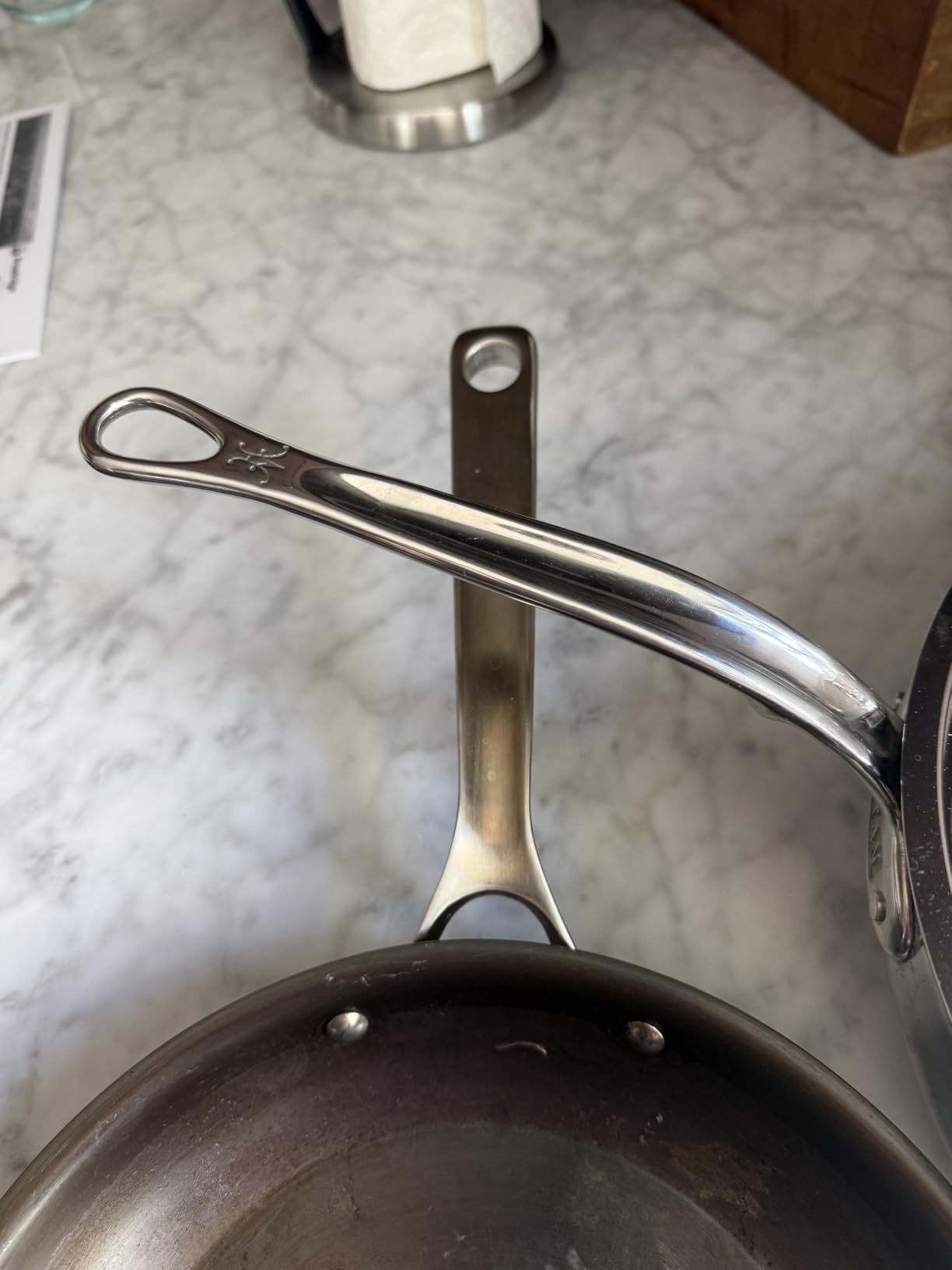
There is a second caution that matters for searing specifically: the maker advises against high heat on an empty pan and against rapid temperature changes. That is a different instruction from what you will find on the other pans, and it comes from the bonded core, which does not appreciate thermal shock. Build the sear in stages rather than slamming a cold pan onto maximum.
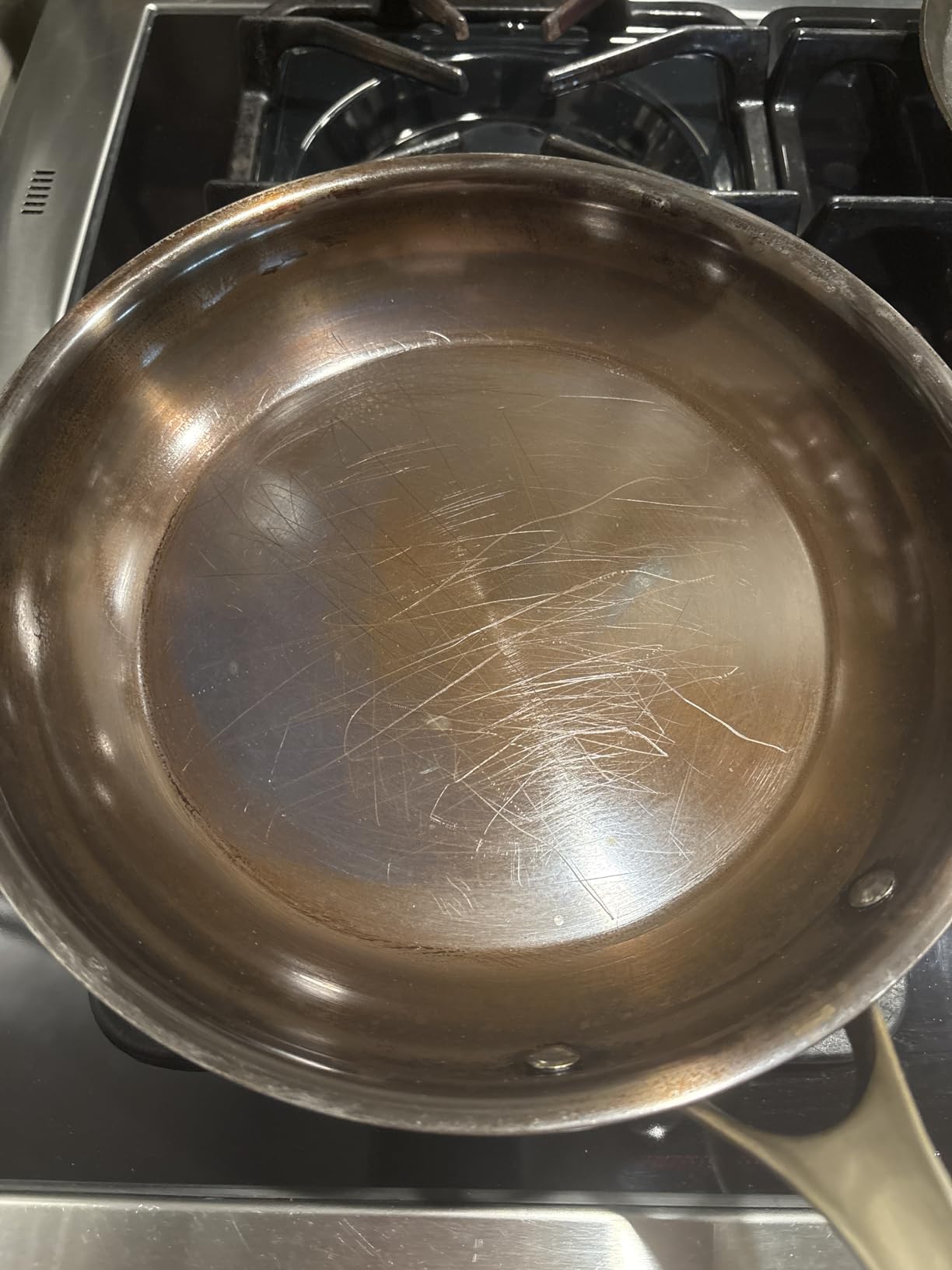
There is no PTFE or PFOA, it is metal utensil safe, and it is endlessly re-seasonable. The cast stainless handle is designed to minimize heat transfer, which addresses the hot-handle complaint that runs through reviews of several other pans here.
Why an aluminum core changes searing
Hot spots are the enemy of a good crust. An aluminum core conducts laterally as well as vertically, so the base reaches a uniform temperature rather than heating in a ring from the burner outward. That means the whole surface browns at the same rate.
The lighter weight means less thermal mass, so this pan gives up temperature a little faster than a solid steel pan when cold meat lands. In exchange you get evenness and easy handling.
Where it falls short for searing
The seasoning timeline is the honest cost. 10 to 30 cooks is a real commitment for anyone who wants a sear this week, and it is the reason this pan has the smallest audience of happy owners in the group.
With 87 reviews, this is the thinnest evidence base in the roundup, and the price is the highest. You are buying engineering here, and the pay-off arrives with the patina.
10. Forge ELI 12 Inch: Best Thickest Steel for Heavy Duty Searing
GRANMELIER Forge ELI 12-Inch Carbon Steel Frying Pan, Hand-Forged
Weight: 2.24 kg
Diameter: 12 inch
3 mm hand-forged steel
Open fire and induction
Pros
- Hand-forged from a single 11-gauge sheet above 99.5 percent iron
- Large smooth machined base for excellent crust development
- Very rigid pan that holds its shape under load
- Works on gas
- electric
- ceramic
- induction
- grill and campfire
- 12 inch size fits multiple steaks
Cons
- Very heavy and unwieldy for frequent tossing
- Rough forged side walls clean less easily than a smooth pan
- Handle transfers heat and needs a towel or mitt
- Preheat on induction is slower than the marketing suggests
- Must be seasoned before first use or it will rust
This is the most interesting pan in the group for anyone who thinks about searing as a physics exercise. It is hand-forged from a single 11-gauge sheet of high-iron carbon steel above 99.5 percent pure iron, at 3 mm thick, with a large smooth machined base and rougher forged side walls. Reviewers rate the machined base as an outstanding browning surface, which is the part that touches your steak.
It also holds heat without collapsing when food hits the surface, which is the property that separates a good searing pan from a merely hot one. Owners describe the pan as rigid and well balanced, with a handle that gives good control when setting down and lifting a heavy sear.
At 2.24 kg it is heavy. This is a set-it-down-and-wait pan, and if your technique involves lifting and flipping, it will feel slow. The same weight is why reviewers compare it favorably to cast iron for durability while noting it responds faster.
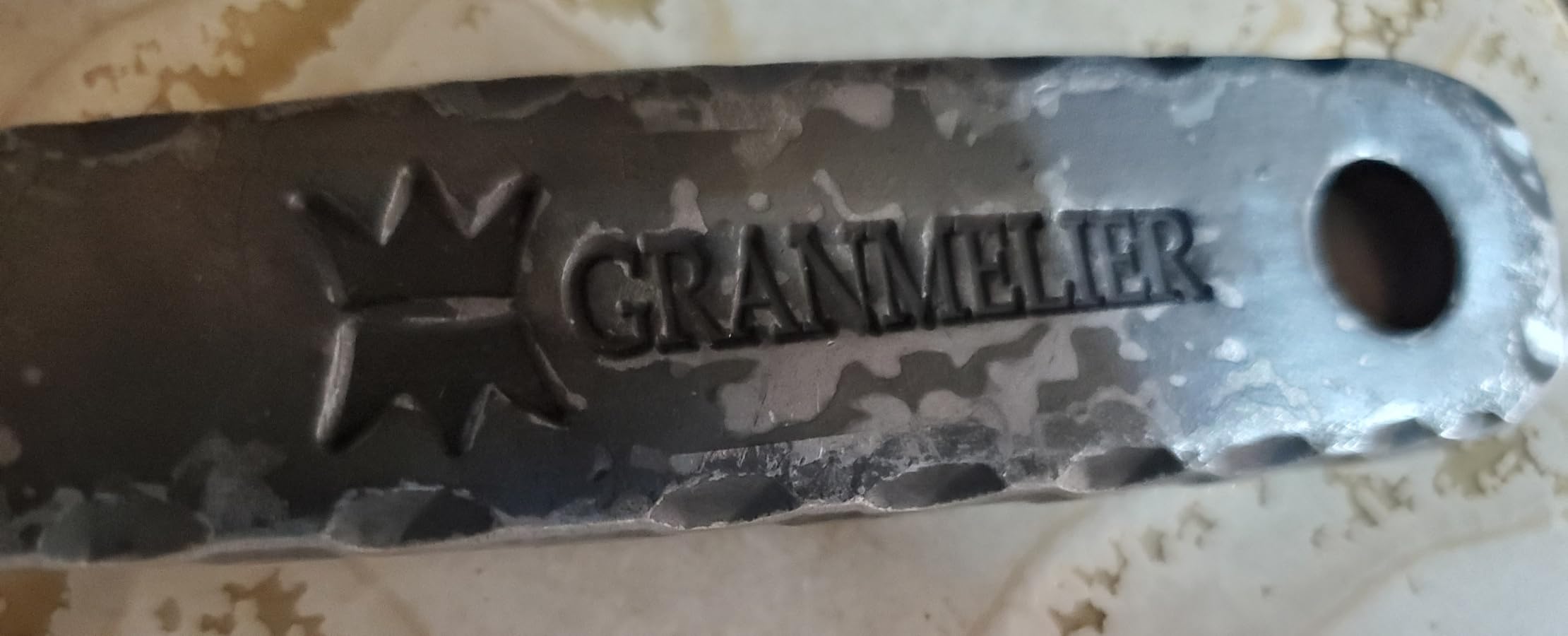
One inconsistency is worth naming directly. Marketing positions the pan as combining cast iron durability with faster heating, and reviewers report that on induction, preheating still takes a solid 3 to 4 minutes. Heat gradually on induction, and the maker says the same thing about reducing warping risk.
At 4.8 across 30 reviews it has the highest average in the roundup and the smallest sample. Read it as a promising early result from a recent product rather than a settled consensus, and note that the handle runs hot enough during an extended sear that a towel or mitt is standard practice.
What 3 mm steel actually gives you
Thickness is thermal mass you carry around. More steel means more stored heat, which means a bigger temperature cushion when cold meat lands, which means the sear does not stall halfway through.
The smooth machined base matters as much as the thickness. Rough walls give the pan character and grip for sliding, but the flat floor is what contacts the food, and a smooth floor browns more evenly.
Where it falls short for searing
The weight, at 2.24 kg, is the dealbreaker for a lot of cooks, and the rough forged side walls are harder to clean than a fully machined pan. The handle transfers heat, which is annoying precisely when the pan is hottest.
It must be seasoned before first use or it will rust, and on 30 reviews there is not yet a long ownership history behind it.
Carbon Steel vs Cast Iron for Searing: The Honest Comparison
The loudest argument against carbon steel, and the one you will meet from cast iron loyalists, is thermal mass. Cast iron holds heat, and a pan that holds heat keeps searing after the food hits. That is true, and it is the single strongest case for the other material.
The counter is response. A carbon steel pan reaches searing temperature in a couple of minutes where cast iron can take 10 to 15. More importantly, carbon steel responds to the burner the moment you turn it, so you can build a sear, then pull back to a gentle simmer without waiting for a heavy pan to catch up.
There is a real cost to that lightness. When cold meat hits a thin pan, the temperature drops noticeably, and the sear stalls for a moment. Cast iron barely notices. The practical answer is not to pick a side blindly but to understand what the drop means for the food you are cooking.
For a single thick steak, a light carbon steel pan reheat fast enough that you can finish the cook off the burner. For a whole batch of protein going into a hot oven, or for a cook who sears two or three pieces at once, the extra mass of a heavy pan earns its weight back.
What each factor changes
Preheat time. Carbon steel reaches searing temperature in 2 to 3 minutes. Cast iron commonly takes 10 to 15.
Response to burner changes. Carbon steel responds immediately. Cast iron responds slowly.
Temperature drop with cold food. Carbon steel drops noticeably. Cast iron barely moves.
Weight. Carbon steel is roughly one third the weight of cast iron.
Cooking surface. Carbon steel is smooth or lightly pebbled. Cast iron is textured.
Care. Both are hand washed, dried immediately, and wiped with a thin layer of oil.
Both materials are PFAS-free and PTFE-free, both take metal utensils, and both build a natural nonstick layer over time. Neither has a synthetic coating to flake. The real difference is how you cook: cast iron rewards patience, carbon steel rewards responsiveness.
How to Choose a Carbon Steel Pan for Searing
Most buyers pick a carbon steel pan on appearance and regret it later. Six specifications actually predict how well a pan will sear.
1. Weight and thickness
Weight is thermal mass, and thermal mass is the temperature cushion that keeps a sear going after the meat lands. The pans here run from 2.1 pounds at the Lodge to 5.6 pounds at the Tramontina, and that spread is the difference between a pan that recovers and a pan that stalls.
The same number decides whether you can flip. Heavier than about 4 pounds and you are setting the pan down, not tossing it.
2. Usable cooking surface, not pan diameter
Nominal diameter flatters a pan with steeply sloped sides. Look for the flat cooking base instead, since that is the area that touches food and heat. The de Buyer lists 5.5 inches of cooking surface on an 8 inch pan, while the Mauviel lists 21.5 cm on an 11 inch pan, and that ratio is the honest comparison.
3. Pre-seasoned or raw
Pre-seasoned pans (Lodge, Merten and Storck, OXO) are forgiving in week one. Raw pans (Matfer, Mauviel, STRATA, Forge ELI) develop a faster, more durable patina over months. If you are impatient, buy pre-seasoned. If you cook daily and enjoy the process, buy raw.
4. Oven and broiler ceiling
Finishing a seared fish or melting cheese on top of a steak after the stovetop crust requires a high ceiling. The Matfer Bourgeat at 800F, YOSUKATA at 700F, and OXO at 660F handle oven and broiler work. The de Buyer Mineral B stops at 400F for 10 minutes, which is enough for reheating but not for broiling.
5. Handle design
Handles set the temperature ceiling as much as the pan body does. Steel or cast iron handles work in the oven and get hot. Wooden handles stay cool and detach but cap the pan lower. Silicone sleeves (Tramontina) make a steel handle bearable. Removable handles (OXO, YOSUKATA) buy oven and grill capability at the cost of a looser grip.
6. Induction and warping behavior
All pans here are broadly induction compatible, though the Tramontina listing is inconsistent and the Forge ELI is rated for gas in its device field. Induction delivers concentrated power fast, and thin pans respond by bowing. If you sear on induction, choose a thicker pan, heat it gradually, and avoid dropping cold liquid into a screaming hot pan.
7. Size, honestly
An 8 inch pan sears one steak. A 10 inch pan sears one thick cut with room to turn it. A 12 inch pan sears two. If you cook for a table, the 12 inch options in this roundup, the Merten and Storck, the Tramontina, the STRATA, and the Forge ELI, are the practical choices. For a single person or a single steak, 8 and 10 inches are more efficient.
For higher-heat stir-fry work on a round shape, our best carbon steel woks comparison covers the deeper geometry separately.
Why Does a New Carbon Steel Pan Stick?
Sticking is the number one reason people abandon carbon steel, and almost every case traces to one of four causes.
The seasoning is not built yet. This is the big one. A factory seasoning or a thin patina is not the same as a developed one, and early sticking is expected. Most pans here describe a range of a few cooks to 10 to 30 cooks before release becomes reliable.
The factory wax or beeswax is still on the pan. Wax does not burn off into a patina. It flakes, and the flakes make food stick. Strip it with hot soapy water or very hot water before the first seasoning.
Too much oil during seasoning. Heavy coats polymerize into sticky patches rather than a hard patina. The coating instruction on the de Buyer is a thin layer, heated until smoky.
The pan was not hot enough, or the oil was not hot enough. Searing needs a shimmering, faintly smoking pool of oil. Lukewarm oil and a lukewarm pan produce steaming, not browning, and steam means sticking.
On the forums, cooks consistently describe the first weeks as a fickle period, then report that a well-seasoned carbon steel pan gets close to Teflon but will still stick if the pan and oil are not properly preheated. Cooks in those threads also point out that carbon steel runs roughly one third the weight of cast iron, which is why it can be moved and flipped far more freely while it is hot.
Seasoning a Carbon Steel Pan for Searing
Seasoning is a polymerized oil layer built up in thin coats. Each coat of a high smoke point oil (flaxseed, grapeseed, or avocado) is heated past its smoke point, and the smoke carries oil into the steel where it hardens.
Strip the coating. Wash the pan with hot soapy water and scrub, or boil water in it, until no wax remains and bare metal shows.
Dry completely. Any moisture under the oil film causes rust. Heat the pan on the stovetop until it is dry to the touch.
Apply the thinnest possible coat. A wipe, not a pour. If the pan looks wet, you have used too much.
Heat to a medium-high smoke. Hold there for 10 minutes or until the pan smokes visibly.
Cool, wipe off the oil, and reheat for 2 minutes. This second short pass sets the layer harder.
Repeat, then cook on it. The first few real meals add more than another oven pass. Long-term users report the seasoning takes months to reach its best, and that it keeps improving for years.
Two rules keep the patina intact. Never put a carbon steel pan in the dishwasher, and keep acidic foods such as vinegar, lemon juice, and tomato sauce out of it, since acid strips the layer your sear depends on. Hand wash, dry on the stovetop, and wipe on a bare layer of oil before you put the pan away.
What Cooks Say About These Pans
Across forum threads on carbon steel, the consensus lines up closely with the review data on these ten pans, and it is worth reading before you buy.
Home cooks and professionals most often name de Buyer Mineral B and Matfer Bourgeat as the two to start with, and that matches the two largest review counts in this roundup at roughly 15,800 and 8,300 reviews. Merten and Storck and Lodge come up most often as the budget and lighter options, which is also exactly how the review data reads.
The most repeated searing advice in those threads is a two to three minute preheat to a light smoke with a high smoke point oil, followed by a short two to three minute sear per side. The most repeated complaint is early sticking during the fickle period, and the most repeated warping complaints come from owners who blasted thin pans from a cold start on induction or glass.
On the cast iron question, the forum view is consistent: carbon steel wins on heat response, cast iron wins on heat retention. Rather than treating that as an argument to settle, use it to pick your pan. If you already own a heavy cast iron skillet, a lighter carbon steel skillet adds something different to your kitchen, not a duplicate.
One more thread worth reading: owners report the pan and its handle getting dangerously hot mid-sear, and reaching for a towel is standard practice. That is normal, and it is worth planning your towel workflow before you start, not during.
Frequently Asked Questions
What brand makes the best carbon steel pans?
de Buyer and Matfer Bourgeat are the two most frequently recommended brands among home cooks and professionals, and they carry the two largest review bases in our testing group. de Buyer Mineral B offers the best balance of fast heat-up, a flat non-warping base, and induction compatibility, while Matfer Bourgeat adds more thermal mass for batch searing and a higher oven ceiling. Lodge and Merten and Storck are the common lighter and budget recommendations.
What are the disadvantages of carbon steel pans?
The main disadvantages are real. A new pan sticks until the seasoning builds, which can take weeks or up to 30 cooks. The pans must be hand washed and dried immediately, and the dishwasher will strip the patina. Acidic foods such as vinegar, lemon, and tomato sauce strip the seasoning. Factory wax or beeswax coatings must be removed before first use. Thin pans can warp if blasted from a cold start on glass or induction, and handles get hot enough during a long sear that a towel or mitt is standard practice.
How do you season a carbon steel pan for searing?
First strip any factory wax with hot soapy water. Dry the pan completely, wipe on the thinnest possible layer of a high smoke point oil such as flaxseed, grapeseed, or avocado, and heat it on medium-high until it smokes for about 10 minutes. Cool it, wipe off the excess oil, and reheat for 2 minutes to set the layer. Repeat, then cook on the pan daily, since regular meals build a better patina than oven cycles alone. Expect weeks or months before the seasoning reaches its best.
Can I cook eggs in carbon steel?
Yes, once the pan is seasoned. Eggs are the most common way cooks test whether their carbon steel has developed a proper patina, and a well-seasoned pan releases them without fat. If eggs stick, the pan is usually not ready, the pan was not preheated, or the oil was too cool to shimmer. Keep the heat lower for eggs than for a steak sear, since screaming heat scorches the protein before the pan has released it.
Is a carbon steel pan worth it?
It is worth it if you sear regularly and will hand wash, dry, and lightly oil the pan after each use. You get a surface that seasons into natural nonstick release with no PTFE or PFAS coating, metal utensil safety, oven and grill capability, and a pan that improves for years. It is less worth it if you want a dishwasher-safe pan with zero maintenance, or if you are switching from nonstick entirely rather than adding a second option alongside cast iron.
Which Carbon Steel Pan Should You Buy?
Here is the short list, decided by use case rather than by rank.
Buy the de Buyer Mineral B if you want one pan that does almost everything right for searing. It heats fast, the base resists warping, it works on induction, and it carries a lifetime warranty behind the largest review base in the group. This is our pick as the best carbon steel pan for searing in 2026, and it is the one we would hand to a friend.
Buy the Matfer Bourgeat Black Carbon if you sear for a table or work over an open fire. The 12 5/8 inch surface and 5.2 pounds hold temperature through a batch, the welded handle never traps burnt food, and the 800F ceiling covers oven and broiler finishing that the lighter pans cannot.
Buy the Lodge 8 inch if you want to start cooking tonight. It arrives seasoned, it is the lightest thing here, and it is the easiest to move. Buy the 10 or 12 inch version if you want the same responsiveness on a larger surface.
Buy the Merten and Storck 12 inch for a large flat base at a light weight, on gas. Buy the Mauviel M’Steel 11 inch for the most even conduction and an oven-capable handle. Buy the YOSUKATA 10 1/4 inch or the OXO 10 inch if searing happens away from the stove or you want a detachable handle for grilling.
Buy the STRATA Carbon Clad only if you cook daily and want a large pan with no hot spots and less weight. Buy the Forge ELI if you want maximum steel thickness and do not mind the weight. Buy the Tramontina 12 inch if you want a large, warranted pan at the entry point, and check your cooktop type first.
Whichever you choose, strip the factory coating, preheat for two to three minutes, use a high smoke point oil until it shimmers, and give the seasoning ten meals before you judge it. That habit matters more than the model.