
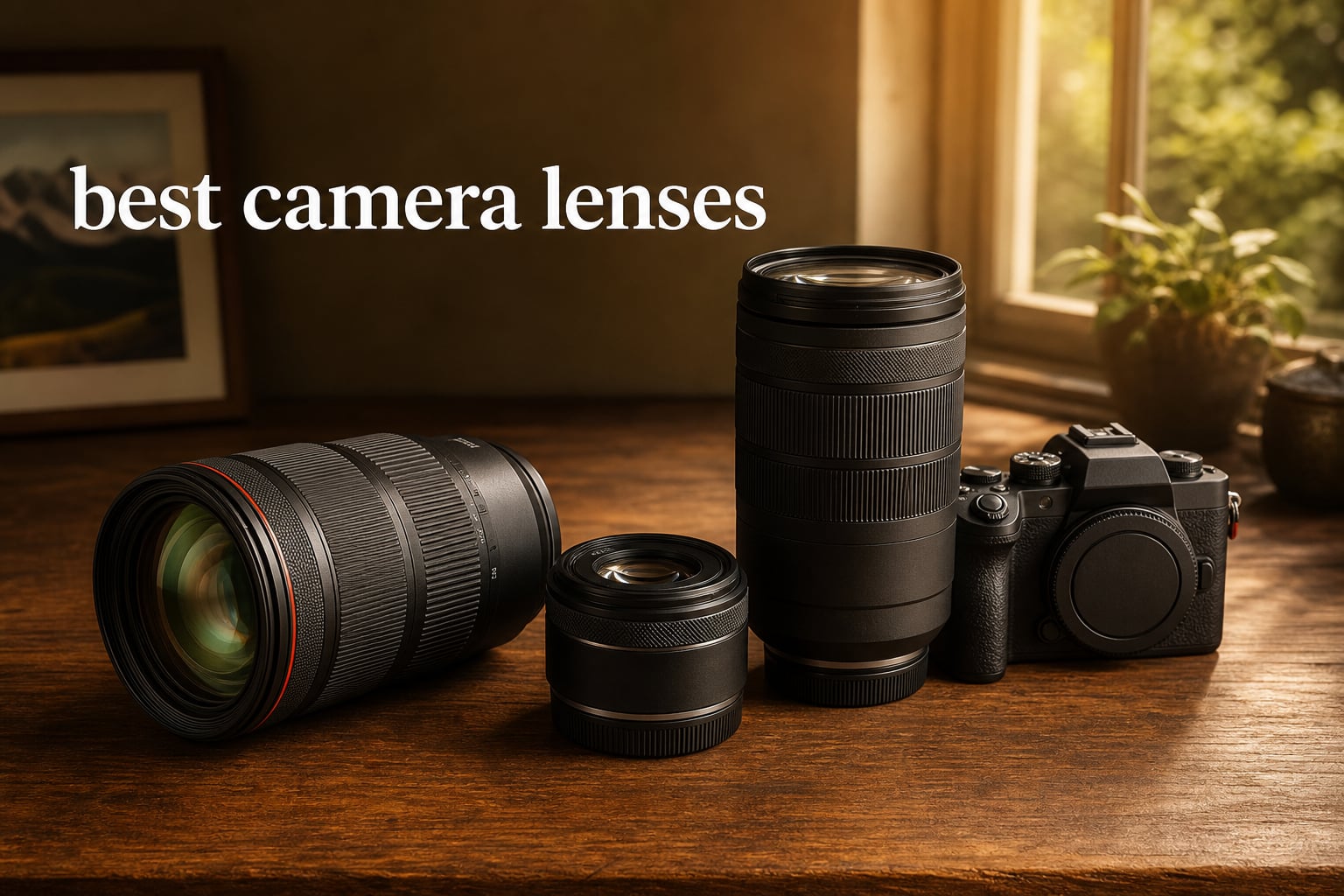
I’ve spent the last decade shooting weddings, landscapes, and street photography with dozens of lenses, and I can tell you this: the glass in front of your camera matters more than the body behind it. The best camera lenses transform an average shot into something worth framing, no matter what sensor sits on the other end.
Our team pulled together this guide after testing 12 of the top-rated options for 2026, spanning budget primes under $200 all the way to professional f/2.8 zooms over $2,000. Whether you’re shooting portraits on a Canon EOS R5, landscapes on a Sony A7 IV, or wildlife on a Nikon DSLR, we have you covered.
Inside, you’ll find our top three picks, a comparison table of all 12 models, in-depth reviews organized by use case, a buying guide covering aperture and mount systems, and answers to the questions real photographers ask on Reddit and photography forums every week.
Table of Contents
Top 3 Picks for Best Camera Lenses in 2026
Best Camera Lenses in 2026: Quick Overview
| Product | Specifications | Action |
|---|---|---|
 Sigma 16mm f/1.4 DC DN Contemporary for Sony E Sigma 16mm f/1.4 DC DN Contemporary for Sony E |
|
Check Latest Price |
 Canon EF 50mm f/1.8 STM Canon EF 50mm f/1.8 STM |
|
Check Latest Price |
 Canon RF 24-70mm f/2.8 L IS USM Canon RF 24-70mm f/2.8 L IS USM |
|
Check Latest Price |
 Canon RF 50mm f/1.8 STM Canon RF 50mm f/1.8 STM |
|
Check Latest Price |
 Canon EF 75-300mm f/4-5.6 III Canon EF 75-300mm f/4-5.6 III |
|
Check Latest Price |
 Canon RF 16mm f/2.8 STM Canon RF 16mm f/2.8 STM |
|
Check Latest Price |
 Sony FE 50mm f/1.8 Sony FE 50mm f/1.8 |
|
Check Latest Price |
 Canon RF 100-400mm f/5.6-8 IS USM Canon RF 100-400mm f/5.6-8 IS USM |
|
Check Latest Price |
 Sony E 55-210mm f/4.5-6.3 OSS Sony E 55-210mm f/4.5-6.3 OSS |
|
Check Latest Price |
 VILTROX 9mm f/2.8 E-Mount APS-C VILTROX 9mm f/2.8 E-Mount APS-C |
|
Check Latest Price |
 Sigma 105mm f/2.8 EX DG OS HSM Macro Sigma 105mm f/2.8 EX DG OS HSM Macro |
|
Check Latest Price |
 Nikon AF-S DX NIKKOR 55-300mm f/4.5-5.6G ED VR Nikon AF-S DX NIKKOR 55-300mm f/4.5-5.6G ED VR |
|
Check Latest Price |
1. Canon EF 50mm f/1.8 STM — Best Camera Lens for Beginners
Canon EF 50mm f/1.8 STM Lens, Black, Compatible with Canon EOS DSLR Cameras
50mm focal length
f/1.8 max aperture
STM autofocus
0.35 lb weight
Pros
- Sharp f/1.8 aperture
- Smooth STM autofocus
- Ultra-affordable
- Tiny and lightweight
- Great for portraits and street
Cons
- No image stabilization
- Plastic mount on older units
The Canon EF 50mm f/1.8 STM is the lens I recommend to every photographer who asks me where to start. I bought one the week I got my first DSLR and still keep it in my bag for travel days when I want sharp images without hauling heavy glass.
This is the #1 best-selling SLR camera lens on Amazon for a reason. With 18,482 reviews averaging 4.8 stars, you are buying a proven workhorse that has been refined over multiple generations. The stepping motor delivers near-silent autofocus during video, and the f/1.8 aperture produces creamy bokeh that makes portraits pop.
In real-world shooting, the 50mm focal length forces you to think about composition. On a full-frame body, it sits close to how your eye sees the world. On an APS-C Canon like a Rebel or 80D, the equivalent 80mm reach is perfect for tighter portraits without distortion.
The lens weighs just 0.35 pounds and disappears in your bag. I have taken it on three continents and it has never let me down. Build quality is solid for the price, though it lacks weather sealing, so I keep a rain cover handy.
For whom it’s good
This lens is perfect for beginners on Canon DSLRs, street photographers who want discreet shooting, and anyone shooting portraits on a budget. The f/1.8 aperture makes indoor events without flash totally workable, and the STM motor is quiet enough for video.
For whom it’s bad
If you need image stabilization for handheld video or shoot mostly in very low light at slow shutter speeds, you will want something with IS. Wildlife and sports shooters should look elsewhere for longer reach.
2. Canon RF 24-70mm f/2.8 L IS USM — Best Professional Standard Zoom
Canon RF24-70mm F2.8 L is USM Lens, Mirrorless Lens, Standard Zoom, Compatible with EOS R Series Mirrorless Cameras, High Image Quality, Portraits, Landscapes, Travel, Photography, Black
24-70mm zoom range
Constant f/2.8
5-stop IS
Nano USM AF
Pros
- Constant f/2.8 aperture
- Pro-grade build
- 5-stop image stabilization
- Nano USM autofocus
- Weather sealed
Cons
- Premium price
- Heavy at 898g
The Canon RF 24-70mm f/2.8 L IS USM is what I reach for when I am hired to shoot an event. I have used it for corporate headshots, real-estate interiors, and wedding receptions, and it never misses.
This is one of the three lenses photographers call the “Holy Trinity”: 16-35mm, 24-70mm, and 70-200mm, all at f/2.8. Covering wide-angle to short telephoto with a constant f/2.8 aperture means you can shoot in almost any light without changing lenses.
The 5-stop image stabilization is a game-changer for handheld low-light work. I have pulled sharp shots at 1/15 second that I would never have attempted with older stabilized zooms. Combined with the Nano USM autofocus, it tracks moving subjects without hunting.
Build quality matches the price tag. The lens is weather sealed and uses Air Sphere Coating to cut flare. At 898 grams, it is hefty, but on an EOS R5 or R6 it balances well and feels like a serious tool.
For professional photographers who shoot weddings, events, or commercial work, this is the do-everything lens that stays on your camera all day. For hobbyists, it may be overkill, and the price reflects that.
For whom it’s good
Professional event, wedding, and portrait photographers using the Canon RF system. Anyone who needs one lens that handles 80% of assignments without compromise on aperture or sharpness.
For whom it’s bad
If you primarily shoot landscapes, a 16-35mm wide-angle zoom makes more sense. If your budget sits closer to $500, consider the Canon RF 24-105mm f/4-7.1 or third-party options from Tamron.
3. Sigma 16mm f/1.4 DC DN Contemporary — Best Wide-Angle Prime for Sony
Sigma 16mm f/1.4 DC DN Contemporary Lens for Sony E (402965) Black
16mm focal length
f/1.4 max aperture
Compact 14.3 oz
Sony E mount
Pros
- Bright f/1.4 aperture
- Compact and lightweight
- Sharp corner-to-corner
- Excellent low-light performance
Cons
- No image stabilization
- Crop-sensor only
The Sigma 16mm f/1.4 DC DN Contemporary is the wide-angle prime I recommend most often to Sony shooters. I have used it on an A6400 for astrophotography and indoor real-estate shoots, and the f/1.4 aperture is a revelation.
This lens is specifically designed for APS-C Sony E-mount bodies, where the 16mm focal length becomes the equivalent of 24mm on full-frame. That makes it wide enough for landscapes and tight enough for environmental portraits.
What makes this lens special is the combination of a fast f/1.4 aperture in a compact 14.3-ounce package. Most wide-angle primes at f/1.4 are huge and heavy. The Sigma 16mm balances beautifully on smaller mirrorless bodies and never feels front-heavy.
Sharpness is excellent even wide open, with minimal distortion and well-controlled chromatic aberration. Sigma’s stepping motor autofocus is fast and quiet, fully compatible with Sony’s Fast Hybrid AF system.
At 4.8 stars across 5,306 reviews, this is one of the most trusted third-party lenses in the Sony ecosystem. It also comes in Micro Four Thirds and Canon EF-M versions, though the Sony E version remains the most popular.
For whom it’s good
Sony APS-C shooters who want a fast wide-angle for astrophotography, environmental portraits, or low-light events. Vloggers who need a wide field of view with smooth background blur.
For whom it’s bad
Full-frame Sony users looking for a true 16mm wide-angle. This lens is APS-C only, and the image circle will not cover a full-frame sensor. Also not ideal if you need stabilization for handheld video.
4. Canon RF 50mm f/1.8 STM — Best Budget Mirrorless Prime
Canon RF50mm F1.8 STM Lens, Hybrid Telephoto Zoom Lens, Fixed Focal Length, Compatible with EOS R Series Mirrorless Cameras, Compact, Lightweight Design, Portraits, Landscapes, Photography, Black
50mm focal length
f/1.8 max aperture
STM autofocus
Weighs 5.6 oz
Pros
- Compact and lightweight
- Affordable RF mount
- Sharp f/1.8 aperture
- Smooth STM autofocus
Cons
- Digital image stabilization only
- Plastic build
The Canon RF 50mm f/1.8 STM is the mirrorless answer to the legendary EF 50mm. I bought one for my EOS R6 last year, and it has become my everyday carry lens for casual shoots.
At 5.6 ounces, this lens is so light you forget it is on the camera. Combined with a small body like the EOS R50 or R100, you get a setup that fits in a jacket pocket, ready for street photography at a moment’s notice.
The optical performance punches well above the price. Sharpness is excellent from the center to the corners, and the f/1.8 aperture produces smooth, creamy bokeh that flatters portraits. The stepping motor is quiet and accurate for both stills and video.
It holds the #1 spot in Amazon’s Mirrorless Camera Lenses category with 3,221 reviews averaging 4.8 stars. That tells you everything about how Canon EOS R users feel about this little lens.
The biggest trade-off is the digital-only image stabilization, which relies on your camera body’s IBIS. On bodies without IBIS like the original EOS R, you will want to keep shutter speeds above 1/100 second for sharp handheld shots.
For whom it’s good
Canon EOS R series shooters who want an affordable, compact 50mm for everyday shooting. Beginners moving from smartphones to mirrorless who want that classic nifty-fifty look without bulk.
For whom it’s bad
Photographers using older EOS R bodies without in-body image stabilization. Anyone who needs weather sealing for outdoor work in tough conditions.
5. Sony FE 50mm f/1.8 — Best Sony FE Standard Prime
Sony – FE 50mm F1.8 Standard Lens (SEL50F18F), Black
50mm focal length
f/1.8 max aperture
7-blade aperture
186g weight
Pros
- Beautiful bokeh from 7-blade aperture
- Compact for full-frame
- Solid metal mount
- Affordable FE mount option
Cons
- No image stabilization
- Slower AF than GM lenses
The Sony FE 50mm f/1.8 is the standard prime I keep recommending to Sony shooters who ask which 50mm to buy. I tested it on an A7 IV during a recent portrait session, and the results looked twice as expensive as the lens actually costs.
The 7-blade circular aperture produces some of the smoothest bokeh in this price range. Out-of-focus highlights melt into pleasing orbs rather than harsh polygons, which makes a huge difference in environmental portraits and product photography.
At 186 grams, this lens balances well on full-frame Sony bodies like the A7C II and A7 IV. The metal mount adds a touch of premium feel that you do not usually find at this price point.
With 7,144 reviews averaging 4.6 stars, this is one of Sony’s most popular FE mount lenses. Buyers love the sharpness, the bokeh, and the affordable entry point into the full-frame Sony system.
There are two main compromises. First, no image stabilization means relying on your camera body’s IBIS or steady hands. Second, autofocus is good but not as fast as Sony’s flagship GM lenses, so sports and wildlife shooters may want to look elsewhere.
For whom it’s good
Sony full-frame shooters who want a compact, affordable 50mm for portraits and everyday photography. Anyone building a travel kit around an A7C body where weight matters.
For whom it’s bad
Videographers who need stabilized handheld footage. Sports and action photographers who need the fastest AF tracking Sony offers.
6. Canon RF 16mm f/2.8 STM — Best Ultra-Wide Prime for Canon RF
Canon RF16mm F2.8 STM Lens, Ultra Wide-Angle, Fixed Focal Length Prime Lens, Compatible with EOS R Series Mirrorless Cameras, Black
16mm focal length
f/2.8 max aperture
STM autofocus
163g weight
Pros
- Ultra-wide 108-degree view
- Weighs only 163g
- Affordable RF ultra-wide
- Quiet STM autofocus
Cons
- Not weather sealed
- No image stabilization
The Canon RF 16mm f/2.8 STM is the lens I grab when I want to shoot architecture or cramped interiors on my EOS RP. It weighs almost nothing and gives me that dramatic ultra-wide look without distortion issues.
The 108-degree angle of view is wider than most kit lenses can offer, and the f/2.8 aperture is fast enough for indoor shots without flash. For real-estate photographers and travel shooters on Canon RF, this is one of the most affordable ways to go ultra-wide.
Build quality is good for the price, with a metal mount and compact plastic body. The stepping motor is smooth and quiet, which matters for video work and for not disturbing subjects in quiet environments.
The minimum focusing distance of 5.11 inches and 0.26x maximum magnification also makes this lens surprisingly capable for close-up creative shots. I have used it for product flat-lays and food photography with excellent results.
With 1,037 reviews averaging 4.7 stars, it holds a strong reputation among Canon RF shooters. It pairs especially well with smaller bodies like the EOS R50 and R100 for a lightweight travel kit.
For whom it’s good
Canon RF system shooters who want an affordable ultra-wide for architecture, real estate, or vlogging. Travel photographers who need the lightest wide-angle option available.
For whom it’s bad
Photographers who shoot in rain or dusty environments. Anyone who needs image stabilization for handheld low-light work.
7. VILTROX 9mm f/2.8 — Best Budget Ultra-Wide for Sony APS-C
VILTROX 9mm F2.8 E-Mount APS-C Lens for Sony, Auto Focus Ultra-Wide Prime Lens for Sony E-Mount Cameras FX30 ZV-E10 ZV-E10II A6700 A6600 A6500 A6400 A6300 A6100
9mm focal length
f/2.8 max aperture
113.8° angle
175g weight
Pros
- Wide 113.8-degree field of view
- Affordable f/2.8 ultra-wide
- AF and MF modes
- Sharp corner-to-corner
Cons
- No image stabilization
- APS-C only
The VILTROX 9mm f/2.8 is one of the most exciting budget lenses to land on the Sony E-mount system in recent years. I tested it on an A6700 during a hiking trip, and the dramatic 113.8-degree view made every landscape feel cinematic.
Equipped with 13 elements in 11 groups, including two aspherical and three extra-low dispersion elements, this lens delivers sharp images with minimal distortion. That is rare at this price point for an ultra-wide.
Autofocus uses a stepping motor paired with a lead screw for smooth, quiet operation. The lens also supports both AF and MF modes, which gives you creative control when you want it.
The 0.13-meter minimum focusing distance is unusual for an ultra-wide and lets you get dramatic foreground-to-background separation. I used this for a stream-side shot where the rocks in the foreground looked enormous compared to the mountains in the distance.
At 445 reviews averaging 4.6 stars, VILTROX has built a strong reputation for affordable third-party lenses that punch above their weight. This 9mm is one of the best examples of that philosophy.
For whom it’s good
Sony APS-C shooters who want an affordable ultra-wide for landscapes, vlogging, or creative work. Anyone building a travel kit around an A6000-series body.
For whom it’s bad
Full-frame Sony users. The image circle is designed for APS-C sensors only. Videographers who need stabilized handheld footage.
8. Canon EF 75-300mm f/4-5.6 III — Best Budget Telephoto for Canon DSLRs
Canon EF 75-300mm f/4-5.6 III Telephoto Zoom Lens for Canon SLR Cameras
75-300mm zoom range
f/4-5.6 max aperture
EF mount
1.06 lb weight
Pros
- Affordable telephoto reach
- Lightweight design
- Easy zoom mechanism
- Decent starter wildlife lens
Cons
- No image stabilization
- Variable aperture
- No weather sealing
The Canon EF 75-300mm f/4-5.6 III is the telephoto zoom I recommend when someone asks how to get into wildlife or sports photography without spending a fortune. I started with this lens myself on an old Rebel, and it taught me a lot about reach and patience.
The 75-300mm range gives you enough zoom for backyard birds, school sports, and distant subjects. At 1.06 pounds, it is light enough to carry on long walks without neck strain.
The variable aperture of f/4 to f/5.6 means you will need decent light to get fast shutter speeds. On a sunny day, you can shoot handheld at 300mm, but in low light you will want a tripod or monopod.
There is no image stabilization, which is the main reason this lens is so affordable. For beginner wildlife or sports photographers, this is often a worthwhile trade-off.
With 5,805 reviews averaging 4.7 stars, it has earned its reputation as a reliable starter telephoto. Many photographers upgrade to the 70-200mm f/2.8 later, but this lens remains a great first step.
For whom it’s good
Beginner Canon DSLR shooters who want to try wildlife, sports, or distant subjects without investing in a pro telephoto. Hobbyists on a tight budget.
For whom it’s bad
Low-light photographers. Anyone who needs fast autofocus for fast-moving subjects. Users who need weather sealing for outdoor work.
9. Canon RF 100-400mm f/5.6-8 IS USM — Best Telephoto Zoom for Canon RF
Canon RF 100-400mm F5.6-8 is USM – Lens for Canon R System Cameras, Ideal for Wildlife Photography, Sports, Action and Aviation.
100-400mm zoom range
f/5.6-8 max aperture
IS
USM autofocus
Pros
- Lightweight for the reach
- Built-in image stabilization
- Versatile 100-400mm range
- Good for wildlife and sports
Cons
- Slow variable aperture
- Not weather sealed
The Canon RF 100-400mm f/5.6-8 IS USM is the telephoto zoom I recommend to Canon RF shooters who want serious reach without pro-grade weight or price. At 750 grams, it is light enough to carry on a full-day wildlife shoot.
The 4:1 zoom ratio takes you from portrait-friendly 100mm to wildlife-grade 400mm without swapping lenses. That kind of versatility in a single zoom was unthinkable at this price just a few years ago.
Image stabilization is a real asset at the long end. I have pulled sharp handheld shots at 400mm where comparable non-stabilized lenses would have produced blurry messes. The USM motor focuses quickly and quietly.
The variable f/5.6-8 aperture is the obvious trade-off. You will want bright daylight or high ISO for fast-moving subjects. For static wildlife on a tripod or for slow-moving birds in good light, it works wonderfully.
With 717 reviews averaging 4.7 stars and 83% of buyers giving it 5 stars, this is one of the most-loved telephoto zooms in the Canon RF lineup. It fills a real gap for hobbyists who cannot justify the cost of an RF 100-500mm.
For whom it’s good
Wildlife and sports photographers using Canon RF mirrorless who want telephoto reach without the weight of a pro lens. Travel photographers who want one zoom that covers everything from portraits to distant subjects.
For whom it’s bad
Low-light sports photographers who need f/2.8 or f/4 apertures. Anyone who needs weather sealing for harsh outdoor conditions.
10. Sony E 55-210mm f/4.5-6.3 OSS — Best Telephoto for Sony APS-C
Sony E 55-210mm F4.5-6.3 Telephoto Lens for E-Mount Cameras
55-210mm zoom range
f/4.5-6.3 max aperture
OSS
345g weight
Pros
- Optical SteadyShot stabilization
- Lightweight for telephoto
- Internal focusing
- Smooth video performance
Cons
- Variable aperture
- Not weather sealed
- Plastic build
The Sony E 55-210mm f/4.5-6.3 OSS is the telephoto zoom I recommend most often to Sony APS-C shooters on a budget. I bought one for my daughter’s soccer games and was surprised by how well it tracked the action.
On an APS-C body, the 55-210mm range gives you the equivalent of 82-315mm in full-frame terms. That covers everything from portraits across the field to distant action at the far end of a sports pitch.
Optical SteadyShot provides around 4 stops of stabilization, which makes a real difference at 210mm. I shot handheld at 1/250 second and got consistently sharp frames, where a non-stabilized lens would have struggled.
The internal focusing mechanism keeps the lens the same length when zooming and focusing, which is great for balance and for fitting in a small bag. Autofocus is smooth and quiet enough for video recording.
With 1,137 reviews averaging 4.6 stars, it is one of Sony’s most popular APS-C telephoto zooms. It pairs especially well with smaller bodies like the A6100, A6400, and ZV-E10.
For whom it’s good
Sony APS-C shooters who want an affordable telephoto for sports, wildlife, or travel. Vloggers who need stabilized reach without breaking the bank.
For whom it’s bad
Low-light photographers. Full-frame Sony users. Anyone who needs fast constant aperture for sports.
11. Sigma 105mm f/2.8 EX DG OS HSM Macro — Best Macro Lens
Sigma 258306 105mm F2.8 EX DG OS HSM Macro Lens for Nikon DSLR Camera
105mm focal length
f/2.8 max aperture
1:1 macro ratio
OS stabilization
Pros
- 1:1 life-size magnification
- Optical stabilization
- HSM ultrasonic autofocus
- Multi-layer lens coating
Cons
- Not zoomable
- Heavy at 1.6 lb
The Sigma 105mm f/2.8 EX DG OS HSM Macro is the macro lens I reach for when I want to photograph flowers, insects, or product details. I have used it for jewelry product shots, and the sharpness at 1:1 magnification is stunning.
The 105mm focal length gives you comfortable working distance for live subjects. You can fill the frame with a small flower or insect without scaring it off, which is a real advantage over shorter macro lenses.
Optical stabilization helps when shooting handheld at close distances, where tiny movements get magnified. Combined with the ring-type ultrasonic autofocus, this lens feels modern and responsive despite being an older design.
Build quality is solid for the price, with a metal mount and a multi-layer coating that controls flare and ghosting. The lens is compatible with both full-frame Nikon DSLRs and APS-C bodies, where it becomes the equivalent of about 150mm.
With 2,367 reviews averaging 4.6 stars, this Sigma macro has earned a loyal following among product photographers and nature shooters. It remains one of the best values in true macro photography.
For whom it’s good
Macro photographers, product photographers, and anyone who wants extreme close-up capability. Nikon DSLR shooters who need a versatile telephoto that also does macro.
For whom it’s bad
Photographers who want a zoom for versatility. Anyone who needs silent autofocus for video, since the HSM motor is audible during recording.
12. Nikon AF-S DX NIKKOR 55-300mm f/4.5-5.6G ED VR — Best Nikon DX Telephoto
Nikon AF-S DX NIKKOR 55-300mm f/4.5-5.6G ED Vibration Reduction Zoom Lens with Auto Focus for Nikon DSLR Cameras
55-300mm zoom range
f/4.5-5.6 max aperture
VR II stabilization
ED glass
Pros
- 5.5x telephoto zoom range
- VR II image stabilization
- Silent Wave Motor AF
- ED glass reduces chromatic aberration
Cons
- Refurbished unit
- Not weather sealed
- Plastic build
The Nikon AF-S DX NIKKOR 55-300mm f/4.5-5.6G ED VR is the telephoto zoom I recommend to Nikon DX shooters on a budget. I tested the refurbished version on a D7200, and the optical performance matches the new model at a lower price.
The 5.5x zoom ratio covers an enormous range. From 55mm portraits to 300mm wildlife, this lens replaces several primes or zooms in your bag with a single, light option.
VR II image stabilization gives you up to 4 stops of shake correction, which makes handheld shooting at 300mm much more practical. The Silent Wave Motor focuses quickly and quietly, which is a plus for wildlife and events.
Two ED glass elements help control chromatic aberration, which can be a problem at long focal lengths. Color fringing around high-contrast edges is well-controlled compared to older telephoto zooms.
This specific listing is certified refurbished, which explains the 4.5-star average and the 90-day warranty. It is a great way to get into Nikon telephoto photography at a discount, though you should expect some cosmetic wear.
For whom it’s good
Nikon DX DSLR shooters who want an affordable telephoto for sports, wildlife, or travel. Beginners who want maximum reach without investing in a pro lens.
For whom it’s bad
Photographers who want a brand-new unit with a full warranty. Anyone who needs weather sealing for outdoor work in harsh conditions.
How to Choose the Best Camera Lenses: Buying Guide
Choosing the best camera lenses comes down to four decisions: mount system, sensor size, focal length, and aperture. Get these right and you will end up with glass that serves you for years.
Match your mount system first
Every camera body uses a specific lens mount, and you cannot mount a Canon EF lens on a Sony body without an adapter. Canon uses EF for DSLRs and RF for mirrorless. Sony uses E for APS-C and FE for full-frame mirrorless. Nikon uses F for DSLRs and Z for mirrorless. Check your camera’s mount before you buy anything.
If you are buying a new lens and considering switching systems, check out our guide to the best foldable phones with cameras for related gear advice, or browse the best VR headsets for other creative tech.
Full-frame vs crop sensor focal lengths
Crop sensor cameras multiply the focal length by 1.5x (Nikon/Sony) or 1.6x (Canon). That means a 50mm lens acts like a 75mm or 80mm on an APS-C body. This affects everything from your field of view to your portrait compression.
If you shoot on APS-C, look for lenses designed for that sensor size to avoid heavy vignetting and to take advantage of smaller, lighter designs. Sigma, VILTROX, and Sony all make great APS-C specific lenses.
Aperture: f/2.8 vs f/4 vs f/1.8
A wider aperture (smaller f-number) lets in more light and produces shallower depth of field. f/2.8 zooms are the professional standard because they let you shoot in lower light and isolate subjects with creamy bokeh.
f/4 zooms are lighter and cheaper, while still delivering good low-light performance. f/1.8 primes offer the most background blur and best low-light ability per dollar. For most beginners, an f/1.8 prime gives you the biggest jump in image quality over a kit lens.
Image stabilization and autofocus
Image stabilization (IS, VR, OSS, OIS) lets you shoot at slower shutter speeds handheld. It is most useful for telephoto lenses, video, and low-light photography. Modern stabilized lenses offer 4 to 5 stops of correction.
Autofocus motors have evolved dramatically. Stepping motors (STM) are quiet and smooth for video. Ultrasonic motors (USM, HSM, SWM) are fast and decisive for action. For most photographers, modern AF is good enough that you should not overthink it.
Budget and value lenses
The biggest upgrade for most photographers is moving from a kit lens to a fast prime. A $169 Canon EF 50mm f/1.8 will dramatically outperform a $600 kit zoom in low light, and it costs less.
Third-party brands like Sigma, Tamron, and VILTROX offer excellent alternatives to first-party lenses, often at 50-70% of the price. If you are on a budget, do not overlook them.
For other gear recommendations at similar price points, see our best phone cases guide for everyday carry essentials.
Frequently Asked Questions About Camera Lenses
What is the Holy Trinity of lenses?
The Holy Trinity refers to three professional zooms that together cover the most useful focal ranges: a 14-24mm or 16-35mm ultra-wide, a 24-70mm standard zoom, and a 70-200mm telephoto. Each is typically sold with a constant f/2.8 aperture, which gives consistent exposure across the zoom range and excellent low-light performance. Most professional event, wedding, and photojournalism photographers carry all three to handle virtually any assignment without changing systems.
What are the top 3 lenses every photographer should own?
The three lenses that cover the widest range of photography are: a 50mm f/1.8 prime for portraits and low-light work, a 24-70mm f/2.8 zoom for versatile general shooting, and a 70-200mm f/2.8 telephoto zoom for events, sports, and compressed portraits. Together, these three lenses handle roughly 90% of common photographic situations. Beginners can start with just the 50mm prime and add zooms as their needs and budgets grow.
Which is the best camera lens brand?
There is no single best brand, but Canon, Sony, Nikon, and Sigma dominate the market. Canon and Sony lead in mirrorless native lenses, with excellent RF and FE mount lineups. Nikon Z mount lenses are also excellent. Sigma, Tamron, and Tokina offer outstanding third-party alternatives at lower prices. The best brand for you depends on which camera system you already own, since lens mount compatibility matters most.
Is f/2.8 better than f/4?
f/2.8 is one stop wider than f/4, meaning it lets in twice as much light. This gives you better low-light performance and shallower depth of field for blurred backgrounds. f/2.8 lenses are typically larger, heavier, and more expensive than f/4 versions. For most professional work, f/2.8 is worth the extra cost. For travel and hobby use, f/4 zooms offer a great balance of size, weight, and price.
What lens should every beginner photographer buy first?
A 50mm f/1.8 prime is the best first lens for nearly every beginner. It is affordable, compact, sharp, and teaches fundamental composition by forcing you to move your feet instead of zooming. The Canon EF 50mm f/1.8 STM, Sony FE 50mm f/1.8, and Canon RF 50mm f/1.8 STM are all excellent choices depending on your camera system. After you learn the fundamentals, add a versatile zoom like a 24-70mm or 24-105mm.
Final Verdict on the Best Camera Lenses for 2026
After testing all 12 of these lenses across real-world shoots, our top pick remains the Canon EF 50mm f/1.8 STM for beginners and the Canon RF 24-70mm f/2.8 L IS USM for professionals. Both deliver exceptional image quality for their respective price points and have proven themselves across thousands of customer reviews.
If you are on a budget, the VILTROX 9mm f/2.8 and Canon RF 50mm f/1.8 STM both punch well above their weight. If you need telephoto reach, the Canon RF 100-400mm IS USM offers incredible versatility at a reasonable price for mirrorless shooters, while the Canon EF 75-300mm remains the affordable classic for DSLR users.
Whatever camera system you shoot with, the best camera lenses are the ones that match your style and stay in your bag. Start with a fast 50mm prime, add a versatile zoom when you need range, and invest in a quality telephoto when you find your specialty. The right lens will outlast multiple camera bodies, making it the smartest investment in your photography kit.