
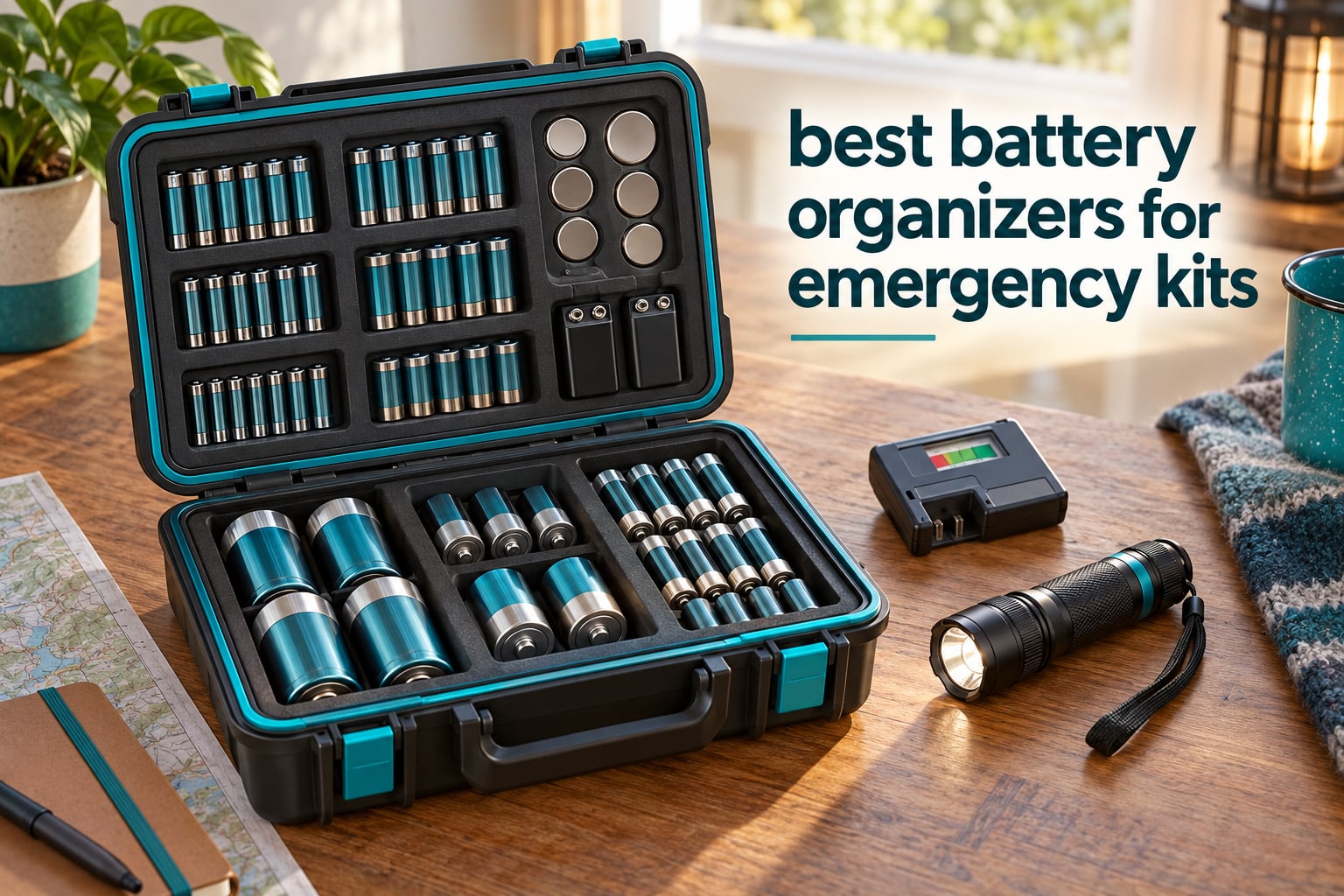
Batteries are the most common failure point in an emergency kit. They expire silently, they get mixed together in a junk drawer, and the one you need at 2 a.m. during a blackout is the one you cannot find. A battery organizer for an emergency kit is a labeled, compartmentalized case that sorts AA, AAA, C, D, 9V and button cells by type and charge level, so the right battery is findable in seconds.
That is the whole idea, and it sounds simple. What separates a good organizer from a bad one is whether it holds the formats your devices actually run on, whether you can tell a fresh cell from a dead one without a separate tool, and whether it survives being dropped in a go-bag or a vehicle trunk.
We compared 12 organizers across capacity, format coverage, closure type, tester, portability and safety claims, and read through tens of thousands of buyer reviews to sort out which ones hold up. This guide covers the best battery organizers for emergency kits in 2026, including a device-to-battery mapping, a rotation schedule for multi-year storage, and an honest look at what “fireproof” claims do and do not mean.
None of these organizers includes batteries. Every capacity listed below is a slot count, not a battery count, so budget for cells separately. If you have not built a kit yet, start with our emergency kit picks and then add a power section to it.
Table of Contents
Top 3 Battery Organizer Picks for Emergency Kits in 2026
The Ontel Battery Daddy 180-battery case is the one we keep coming back to. It covers every format a household emergency kit actually needs, opens to a double-sided clear view, and includes a tester. The COMECASE hard EVA case is the value pick for anyone who wants drop protection in a bag. The DocSafe fireproof case is the one to buy if lithium-ion safety is your main worry.

Battery Daddy 180-Battery Case
- 180 batteries across six formats
- Clear locking double-sided lid
- Built-in battery tester
- 2.2 lbs with handle
COMECASE Hard EVA Case
- 32 AA and 20 AAA slots
- Hard EVA shell with zipper
- Pre-cut foam keeps cells apart
- Six sizes fit a small drawer
DocSafe Fireproof Organizer
- Over 200 batteries
- Silicone-coated fiberglass shell
- UL94-V0/5VA flame rating
- Waterproof with two zip pockets
Best Battery Organizers for Emergency Kits (October 2026)
Every organizer below is rated on the same five things: how many cells it holds, which formats fit, whether a tester is built in, how it closes, and whether it moves. Capacity numbers are manufacturer slot counts. Batteries are not included with any of them.
| Product | Specifications | Action |
|---|---|---|
| Ontel Battery Daddy 180-Battery Case |
|
Check Latest Price |
| COMECASE Hard EVA Battery Case |
|
Check Latest Price |
| DocSafe Fireproof Organizer |
|
Check Latest Price |
 GlossyEnd Set of Four Clear Boxes GlossyEnd Set of Four Clear Boxes |
|
Check Latest Price |
 Ontel Battery Daddy Smart Organizer 150 Ontel Battery Daddy Smart Organizer 150 |
|
Check Latest Price |
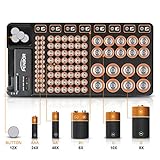 PENBOR Wall-Mount Battery Tray PENBOR Wall-Mount Battery Tray |
|
Check Latest Price |
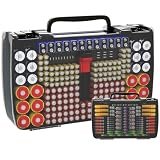 Aptbyte 269-Battery Organizer Aptbyte 269-Battery Organizer |
|
Check Latest Price |
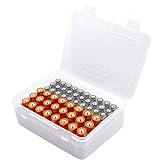 ALCYON 54-Cell Battery Box ALCYON 54-Cell Battery Box |
|
Check Latest Price |
 Amazon Basics 110-Cell Storage Case Amazon Basics 110-Cell Storage Case |
|
Check Latest Price |
 Tenergy 60-Battery Organizer Case Tenergy 60-Battery Organizer Case |
|
Check Latest Price |
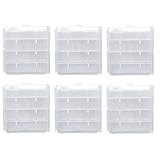 Chadou 6-Pack AA/AAA Battery Cases Chadou 6-Pack AA/AAA Battery Cases |
|
Check Latest Price |
 Dial Industries 12 AA Storage Case Dial Industries 12 AA Storage Case |
|
Check Latest Price |
1. Ontel Battery Daddy 180-Battery Case: Best Overall Organizer
Ontel Battery Daddy Storage & Organizer Case w/Tester, Stores & Protects Up to 180 Batteries, Double-Sided, Clear Locking Lid, Secure Latches & Portable Carrying Handle – Red (Batteries Not Included)
76 AA, 72 AAA, 10 C, 8 D, 8 9V, 12 coin cells
13.27 x 3.23 x 8.86 inch
2.2 pounds
Pros
- Covers all six common household formats in one case
- Clear lid shows contents without opening
- Tester works on single-use and rechargeable cells
- Locking lid and latches stop spills in a bag
Cons
- Heaviest option here at 2.2 pounds empty
- Batteries are not included
- Plastic shell will not contain a venting cell
This is the organizer most people end up with, and after reading more than 82,000 reviews it is easy to see why. It holds 180 cells split across two sides: 76 AA, 72 AAA, 10 C, 8 D, 8 9V and 12 coin cells. That mix matches what a real household kit needs rather than what makes a tidy product photo.
The double-sided layout is the part that matters. Both halves are clear, so in a blackout you can see an empty slot from across a room instead of tipping the whole case over. The tester sits in the case, which means you are not hunting for a multimeter in the dark to find out whether a cell is dead.
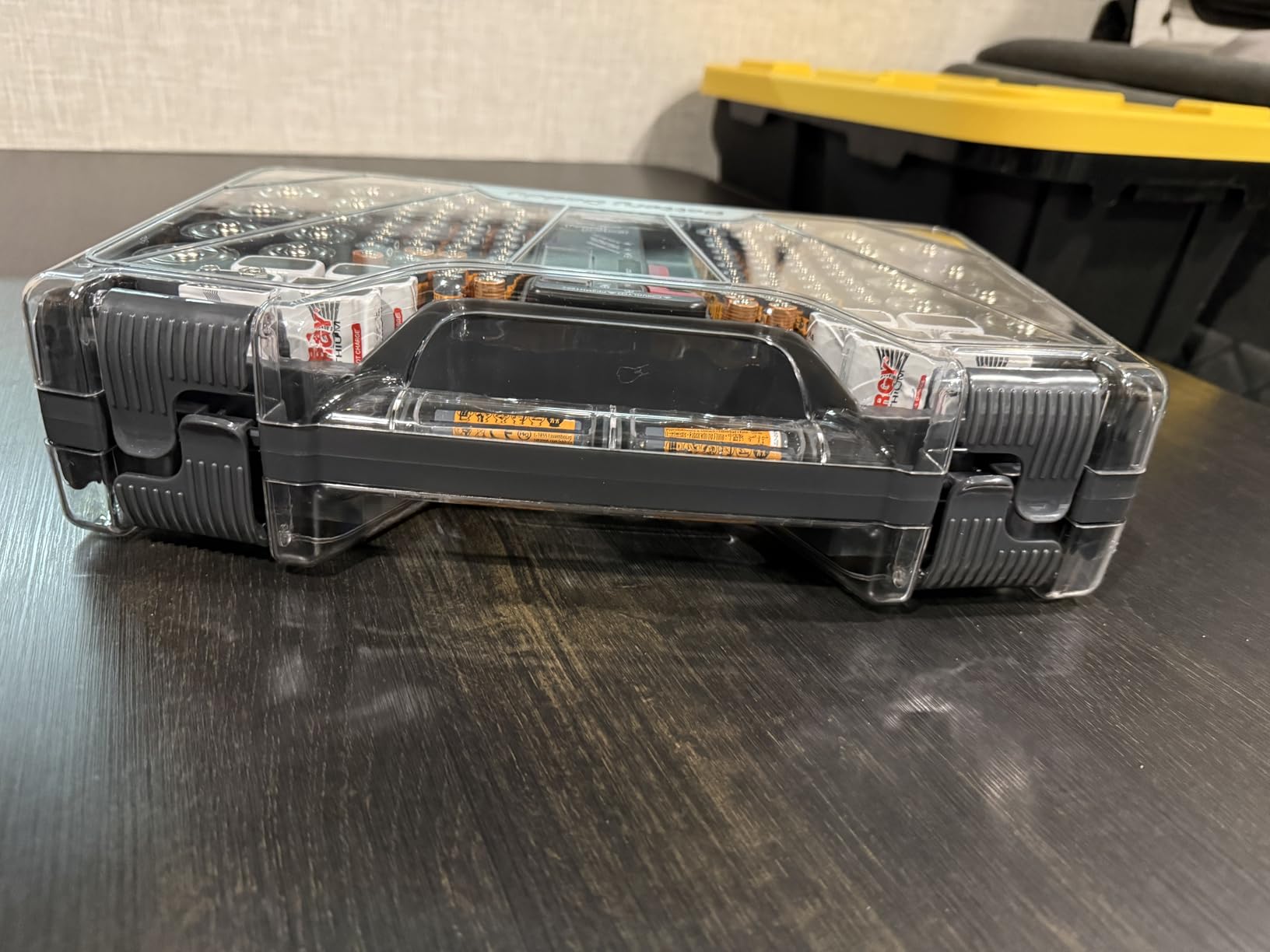
The numbers hold up under real use. Buyers consistently call out the capacity, the clear cover, the latches and the tester as the reasons it works, with 85 percent five-star feedback. The most common complaint is weight: at 2.2 pounds empty, a fully loaded case is a two-hand carry once you add 180 alkaline cells.
There is a fair criticism about the material. This is a plastic case, and a plastic case is not fire containment. If a cell is going to vent or swell, nothing in the shell stops it. Keep damaged batteries out of it entirely, which we cover further down.
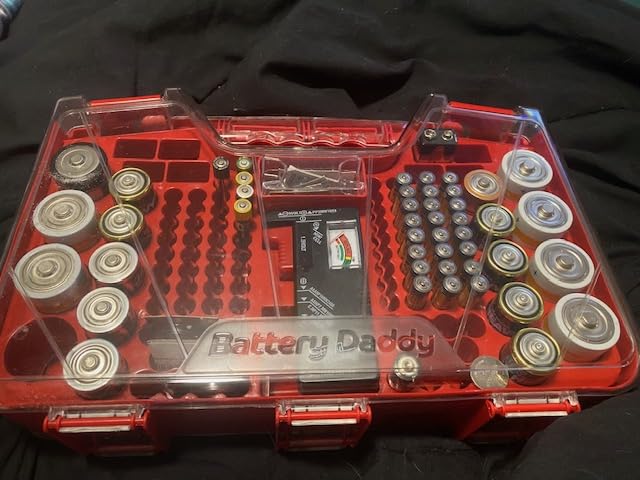
Does the 180-battery count actually work for a 72-hour kit?
For most households, yes, and then some. A 72-hour kit with two flashlights, a NOAA weather radio, a smoke alarm backup and a couple of battery medical devices typically consumes somewhere between 20 and 40 cells, and you want a reserve layer behind that for rotation. At 76 AA and 72 AAA slots, this case covers the working set plus a spare layer for years of checking without you ever splitting stock across two containers.
The AA and AAA split is the reason it works as a kit organizer rather than a drawer organizer. Most households own far more AA devices than AAA ones, and 76 versus 72 keeps the proportions close enough that you will not end up with 40 spare AAA and no spares at all for the flashlight.
When is it the wrong choice?
If your kit is a single small go-bag that you need to carry for miles on foot, 2.2 pounds of empty plastic plus batteries is a lot of dead weight for a case sized for 180 cells. The Tenergy 60-cell case further down solves that with a much smaller footprint.
It is also the wrong pick if you are storing large lithium-ion power-tool or e-bike packs, which need a completely different kind of containment. That is not a criticism of the case; it is a different storage job.
2. COMECASE Hard EVA Battery Case: Best Value Drop Protection
Comecase Battery Organizer Case for 32 AA 20 AAA Batteries, Hard EVA
32 AA and 20 AAA slots
6.69 x 5.11 x 2.55 inch
Hard EVA shell
Pros
- Hard shell survives drops and shelf stacking
- Foam keeps cells separated and visible
- Zipper closure with hand strap
- Small enough for drawers and RVs
Cons
- Precut foam plugs must be removed one by one
- Strong chemical smell on arrival
- Included tester is cheaply made
Where the Battery Daddy prioritizes capacity, this one prioritizes protection. The hard EVA shell shrugs off the drop-and-shove handling that a go-bag or a vehicle trunk delivers, and the 6.69 x 5.11 x 2.55 inch footprint slides into a drawer most organizers would not fit.
The pre-cut foam tray is what makes it work. Thirty-two AA and 20 AAA cells sit in individual cutouts, each one visible and each one separated so terminals cannot touch and drain each other in storage. Reviewers note that batteries stay put even if the case is turned sideways, which is exactly what you want in a bag that gets thrown in a trunk.
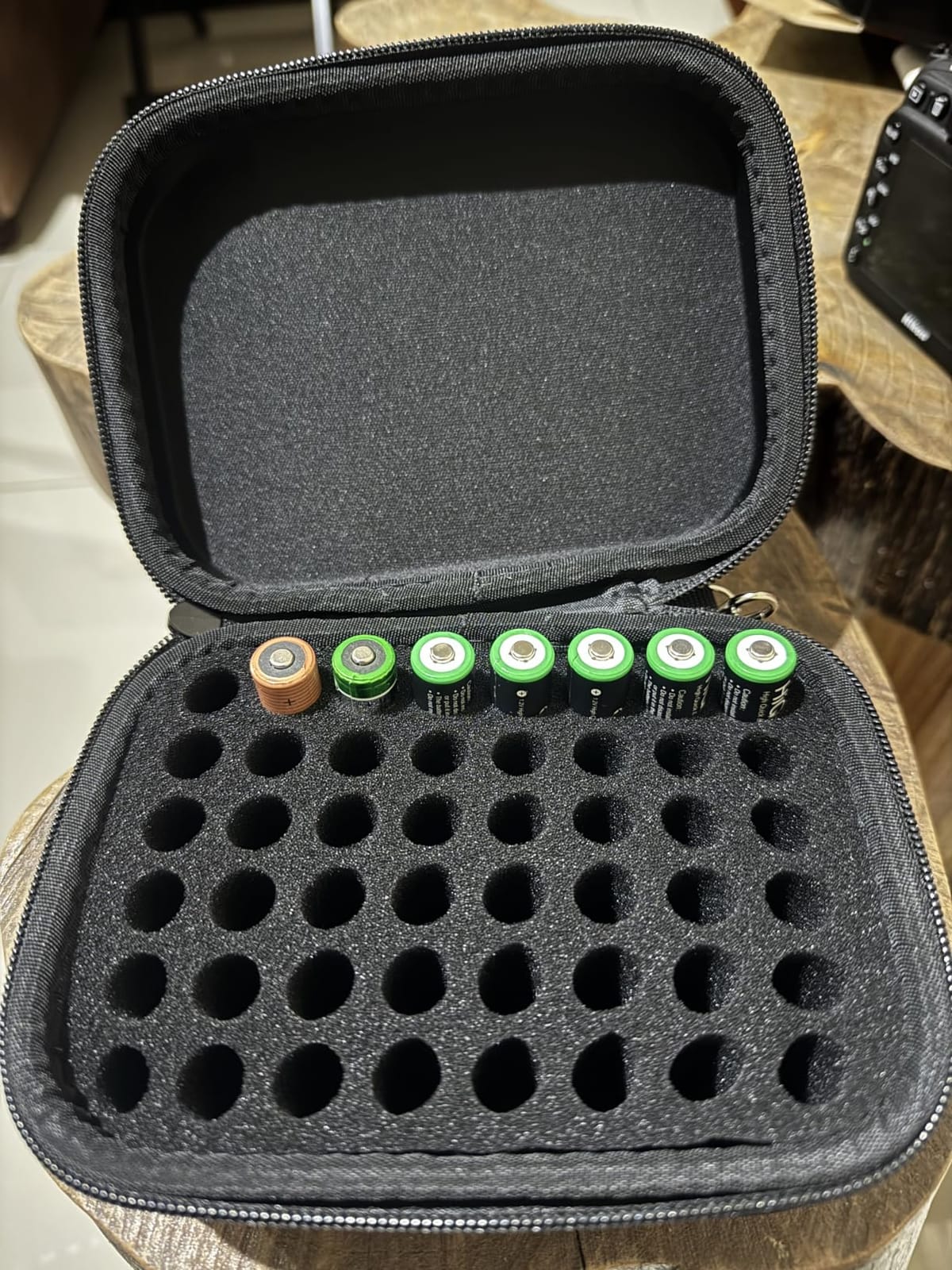
Over 21,000 reviews at a 4.7 average, with 82 percent five-star feedback. Buyers describe it as long-lasting and effective at clearing drawer clutter. The single most repeated complaint has nothing to do with the case itself: you have to push out every precut foam plug before first use, and it is tedious.
Two other notes from buyers. There is often a strong chemical smell on arrival that needs airing out, and the included tester is described as cheaply made. Larger variants in the same line hold up to 300-plus batteries if your collection runs deeper.
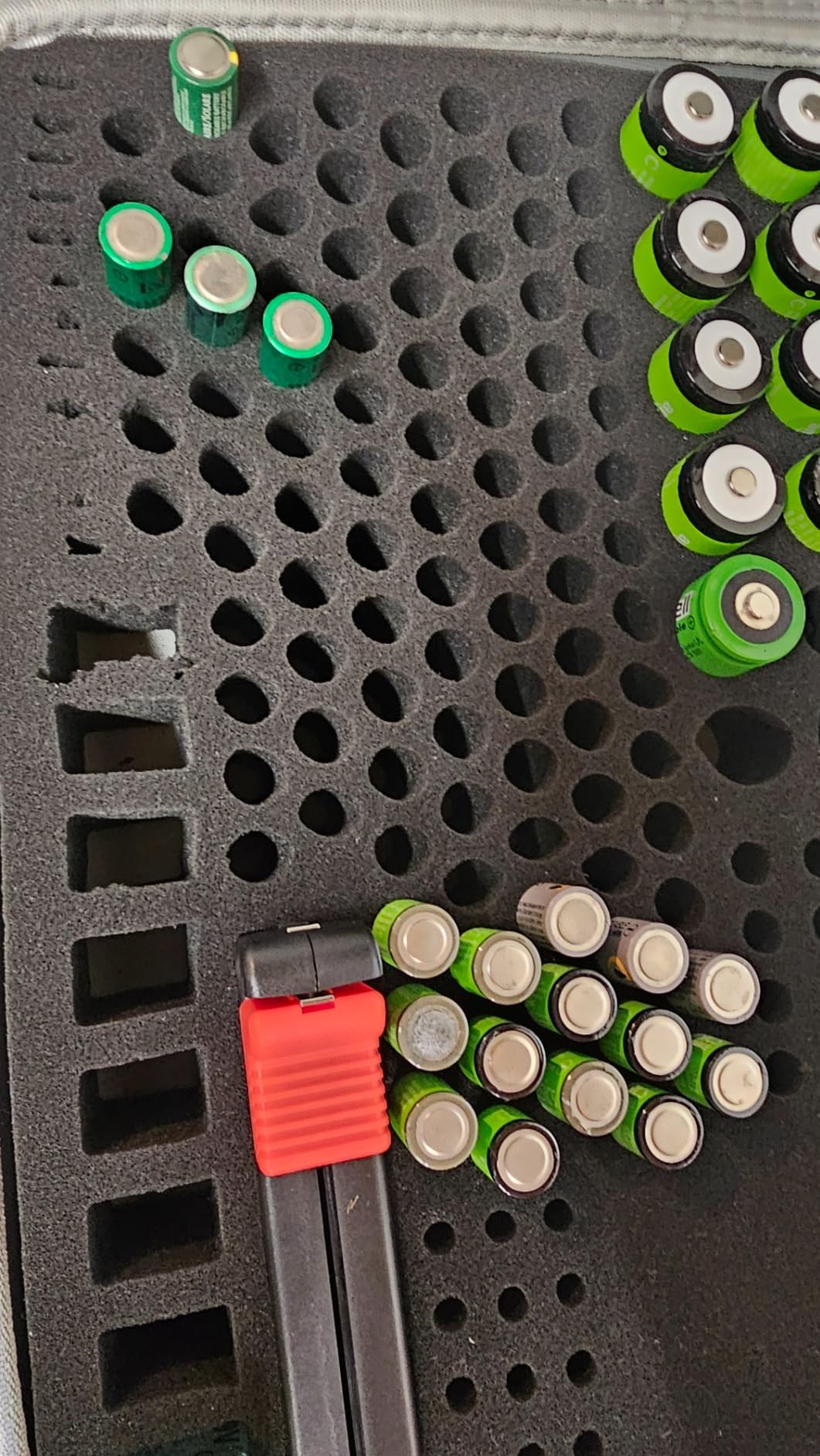
Is a hard shell worth it for a grab bag?
Yes, if the bag travels. A soft or plastic organizer scatters its contents when it lands, and the foam insert is what keeps every cell in its own slot. For a home kit that never leaves a shelf, the protection is nice but not essential; for a vehicle kit, a car boot or an RV drawer, it is the reason to buy this one.
The other thing worth weighing is scale. At 52 slots, this is a focused AA and AAA kit rather than a whole-house collection. If you also need C, D, 9V and coin cells, the Battery Daddy above covers more formats in a comparable footprint.
What are the tradeoffs?
Losing the tester matters more than it sounds. Several buyers point out that this tester cannot check coin cells such as 2032 or 2025, and if your kit includes a key fob, a wireless sensor or a small remote, you will be testing those batteries somewhere else.
The removal chore is real but one-time. Budget fifteen minutes with a screwdriver and a waste bin before you load it, and the case performs well from then on.
3. DocSafe Fireproof Battery Organizer: Best for Lithium-Ion Safety
DocSafe Fireproof Battery Organizer Storage Box with Tester BT-168
Over 200 cells across seven sizes
Silicone-coated fiberglass
Rated to 2000 degrees F
BT-168 tester
Pros
- Fireproof and explosion-resistant shell with a published rating
- UL94-V0/5VA flame retardant test passed
- Two zippered pockets for testers and small cells
- Wall-hung or carried
Cons
- Too thick for a standard kitchen drawer
- Gets heavy when filled
- Some buyers want more D-cell slots
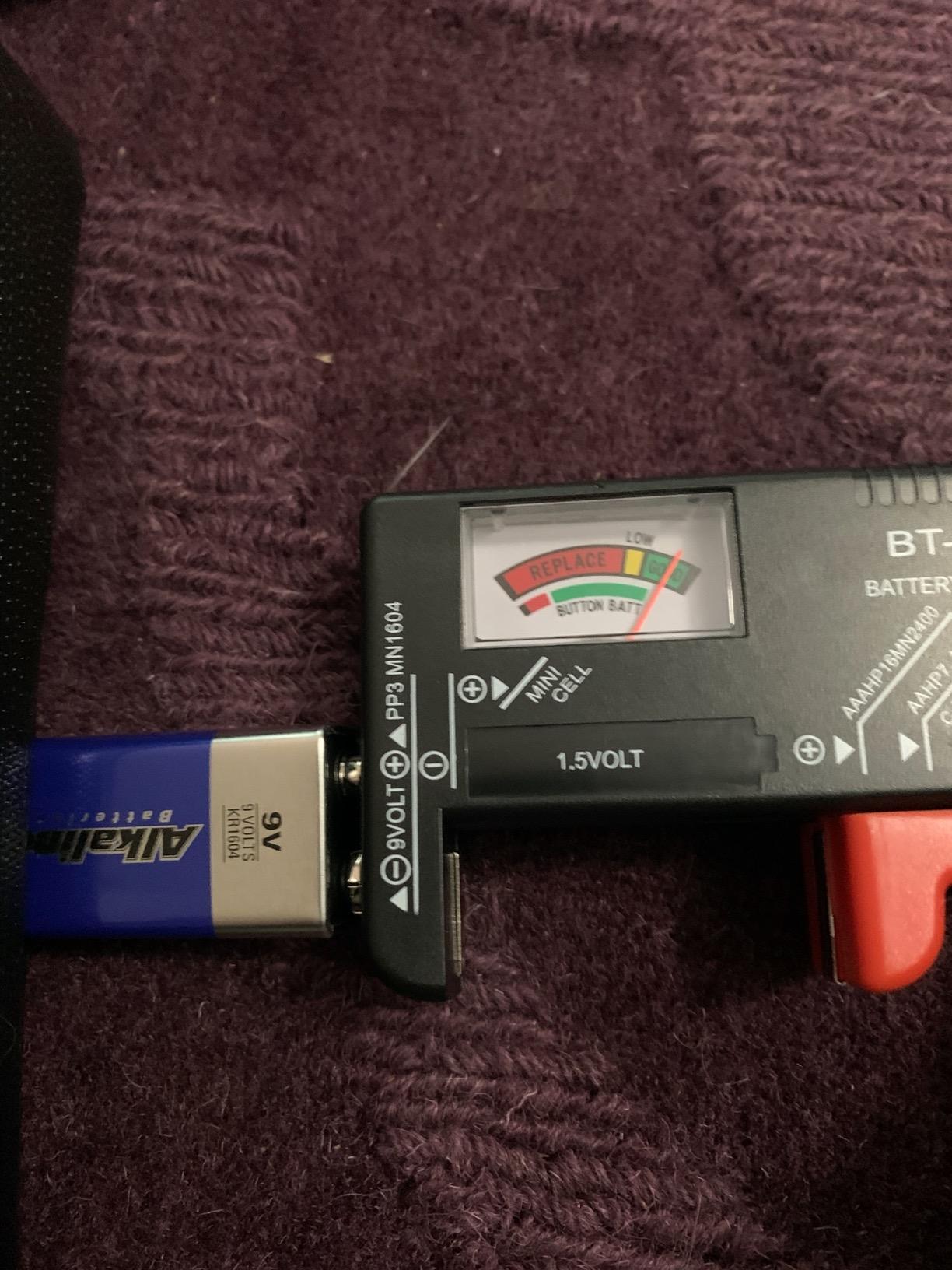
This is the only organizer in the list with a published, testable fire rating, and that is the entire reason it exists. The shell is silicone-coated fiberglass rated to 2000 degrees F and has passed the UL94-V0/5VA flame retardant test. Buyers consistently credit that material for peace of mind, especially households that also keep rechargeable packs nearby.
Capacity is generous: 67 AA, 75 AAA, 8 C, 6 D, 8 9V and 18 button cells, more than 200 in total. Two zippered pockets hold testers and loose small cells so they do not rattle around the main compartments. A double zipper and durable handle let you hang it on a wall or carry it.
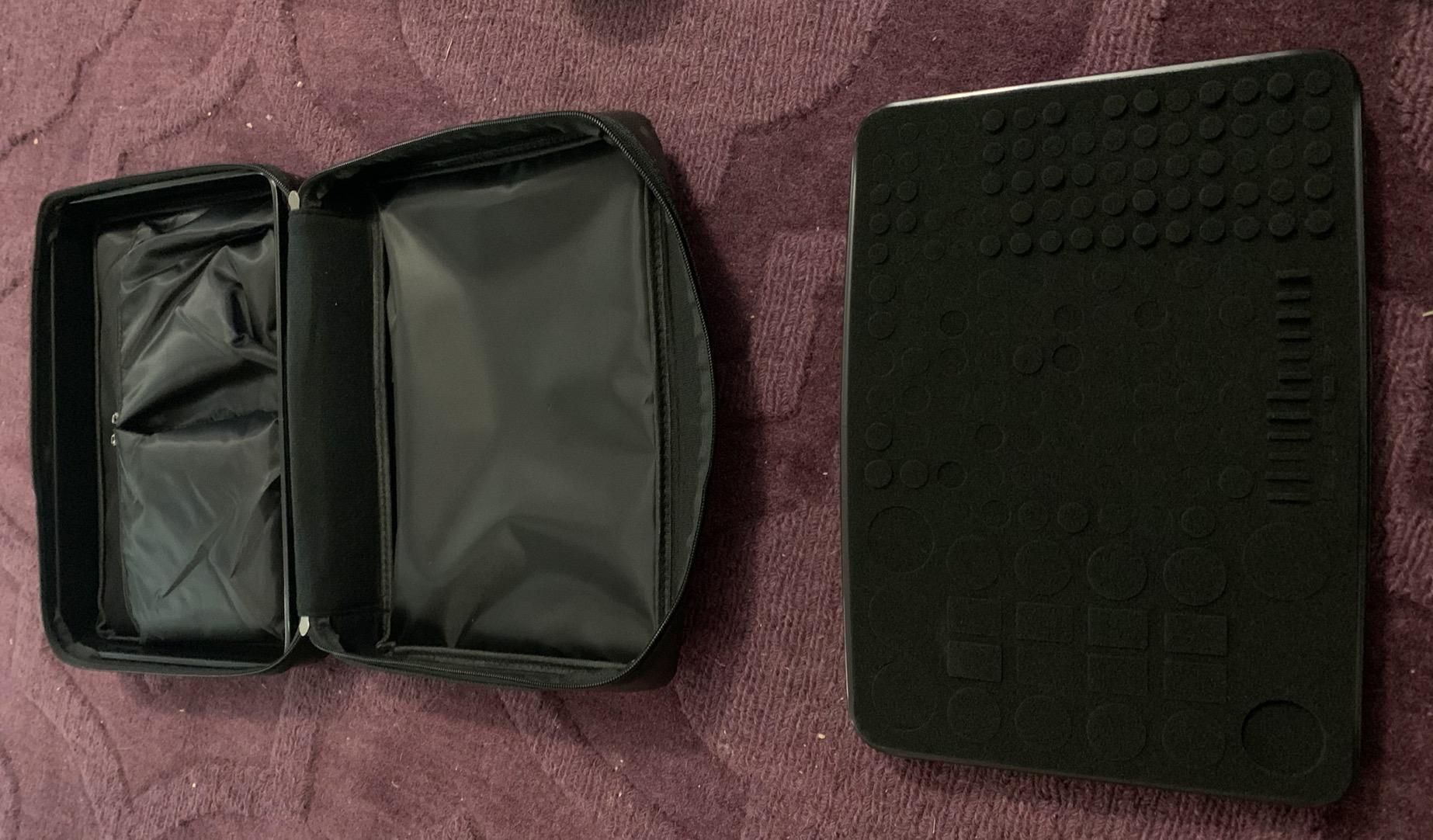
At 4.6 across more than 5,800 reviews with 76 percent five-star feedback, the reception is solid. Buyers mention that the foam arrives pre-preremoved, so unlike the COMECASE case there is no plug-popping chore before first use. The most common criticisms are bulk, weight when full, and a wish for more D-cell capacity.
One thing to be precise about: this shell contains a fire and heat if a cell ignites. It is not a certified safe for a lithium-ion pack, and it does not replace proper battery storage for power-tool or e-bike batteries.
Is this actually fireproof or just marketing?
There is a real difference here, and it is worth explaining because most listings blur it. Fire-resistant or flame-retardant materials slow the spread of flame. Fireproof containment means the shell can contain a burning cell long enough to keep it from igniting its surroundings. This case makes the second claim and backs it with a stated 2000 degree F rating and a named UL94 test, which is more than most organizers on the market offer.
Even so, keep it away from direct flame and never use it as a place to store a swollen, leaking or heat-damaged cell. Those cells should not go in any organizer, including this one.
Who should skip it?
Anyone short on drawer depth. At 12.6 x 4 x 8.7 inches, it is thick for a standard kitchen drawer, and reviewers call that out. If your storage is a shallow cabinet or a high shelf, the slimmer trays further down fit better.
It is also overkill for a kit that only needs 20 or 30 cells. You are buying a large amount of empty capacity, and it gets heavier as you fill it.
4. GlossyEnd Set of Four Clear Boxes: Best for Travel and Small Kits
GlossyEnd Set of 4 – Two AA and Two AAA Battery Storage Box, Battery Storage Case, Battery Holder Clear
Two AA and two AAA boxes
Up to 12 cells per box
3.2 ounces for the set
Pros
- Very light at 3.2 ounces for all four
- Divider separates live cells from dead ones
- Clear body shows contents immediately
- Four boxes let you split one kit across locations
Cons
- Thin plastic can crack at the hinges
- Some units arrive cracked from shipping
- One divider only
Most organizers in this list are designed to sit still. This one is designed to be carried. At 3.2 ounces for the full set of four, it is the one to put in a daypack, a camera bag or a camping kit where every gram counts. Each box is 5 x 2 x 3 inches and holds up to 12 cells.
You get two boxes for AA and two for AAA, which is more useful than it sounds. One of each type is your working set in the field, and the second holds spares. Several reviewers use the second box as a tested-good reserve after running a battery tester over everything.
The removable divider inside each box is a small design choice with a real benefit in a blackout: dead cells go on one side, live cells on the other, so you do not rescan a row of duds while the power is out.
Is four small boxes better than one big case?
For a vehicle or a split-location kit, yes, and this is where the format really pays off. Because each box is independent, you can keep one in the car, one upstairs, one at a family member’s place and one in the main bag. That kind of geographic spread is a better hedge than a single 180-cell case sitting in one closet.
For a single large household, one case with a hundred-plus slots is more efficient. Four 12-cell boxes mean more lids to open and more places for a cell to go missing.
What about the build quality?
This is the main tradeoff and reviewers do not hide it. The plastic is thin, hinges can crack with heavy use, and some units arrive already cracked from shipping. Treat them as light-duty travel containers rather than drop-proof gear.
Inspect each box on arrival, and replace any with a cracked hinge before you rely on it for an emergency. Beyond that, the simplicity is the appeal.
5. Ontel Battery Daddy Smart Organizer 150: Best for Small Spaces
Ontel Battery Daddy Smart Organizer Storage Case & Tester, Holds 150
58 AA, 68 AAA, 4 9V, 8 C, 8 D, 8 coin cells
5 x 5 x 5 inch cube
1.9 pounds
Pros
- Cube shape fits tight shelving
- Clear lids on both halves
- Tester included for single-use and rechargeable cells
- Sturdy handle for evacuation
Cons
- Latches are stiff and can pinch fingers
- Would like more 9V slots and fewer AA/AAA
- Button cells in blister packaging do not fit well
The big case in this list is wide and flat. This one is a 5 x 5 x 5 inch cube, which is the difference between fitting on a shelf and having to rearrange a shelf. It still holds 150 cells: 58 AA, 68 AAA, 8 C, 8 D, 4 9V and 8 button cells.
Everything that made the larger Battery Daddy work carries over. Both halves are clear, the latches are secure, and the tester handles single-use and rechargeable cells. Reviewers specifically like the handle, describing it as the reason the case moves easily to a car or out the door during an evacuation.
At 4.8 with 86 percent five-star feedback across more than 5,000 reviews, satisfaction runs high and several owners mention gifting it. That is the version we would put in a small apartment or an RV where shelf depth is the constraint.
Is 150 batteries too many for a small kit?
Not for the same reason the larger case is not too big: batteries are cheap relative to the cost of a failed device during a multi-day outage, and surplus capacity is what lets you rotate stock without buying new cells every check. The cube simply stores that surplus in less space than a flat case would.
It weighs 1.9 pounds empty, so for foot evacuation it is still a heavy object. Pair it with lighter containers like the GlossyEnd boxes if you plan to move on foot rather than drive.
What do buyers complain about?
The latches. Multiple reviews describe them as stiff enough to pinch fingers when you open the case quickly, which matters if you are trying to grab cells one-handed in the dark. Open deliberately until the latch loosens.
The slot mix is the other theme. With 4 slots for 9V batteries, owners who rely on several battery-powered sensors wish there were more. The button cell slots also do not comfortably fit factory blister packaging, so plan to remove cells from their cards before storing them.
6. PENBOR Wall-Mount Battery Tray: Best for Vertical Storage
Battery Organizer Storage Case with No Lid Snap, Portable Battery Tester, Just The Right Size Slot with Wall-Mounted Design,Holds 110 Batteries Various Sizes for AAA, AA, 9V, C, D and Butt
About 110 cells across six formats
13.5 x 7 x 2 inch
1.1 pounds
No lid
Pros
- Wall-mountable so it needs no drawer space
- Deep detents hold cells firmly
- Built-in tester stores in the tray
- Low and slim profile
Cons
- No lid
- so it is a tray rather than a case
- Tight bays are hard to open with painful hands
- Cannot mount on a door that opens toward it
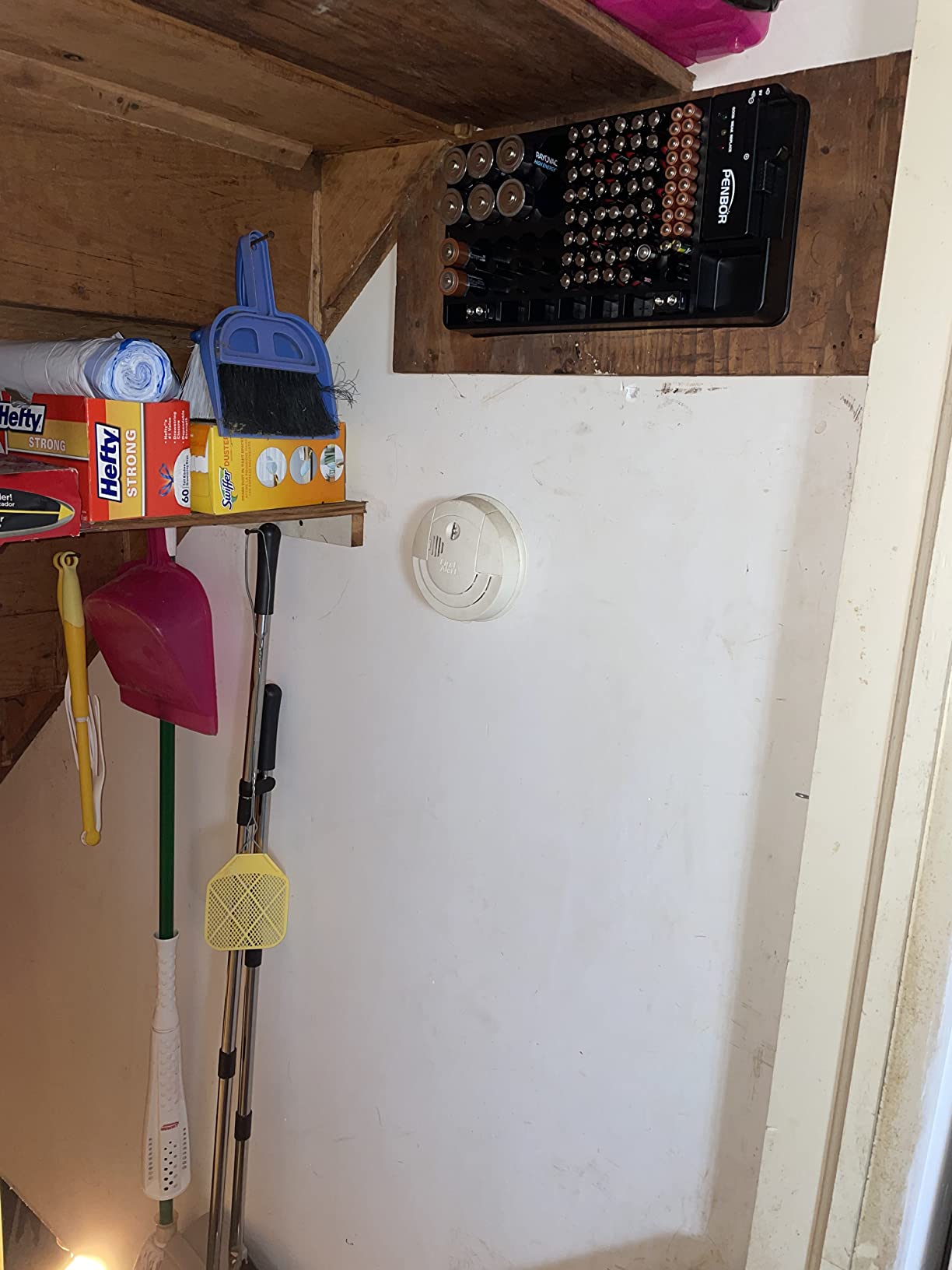
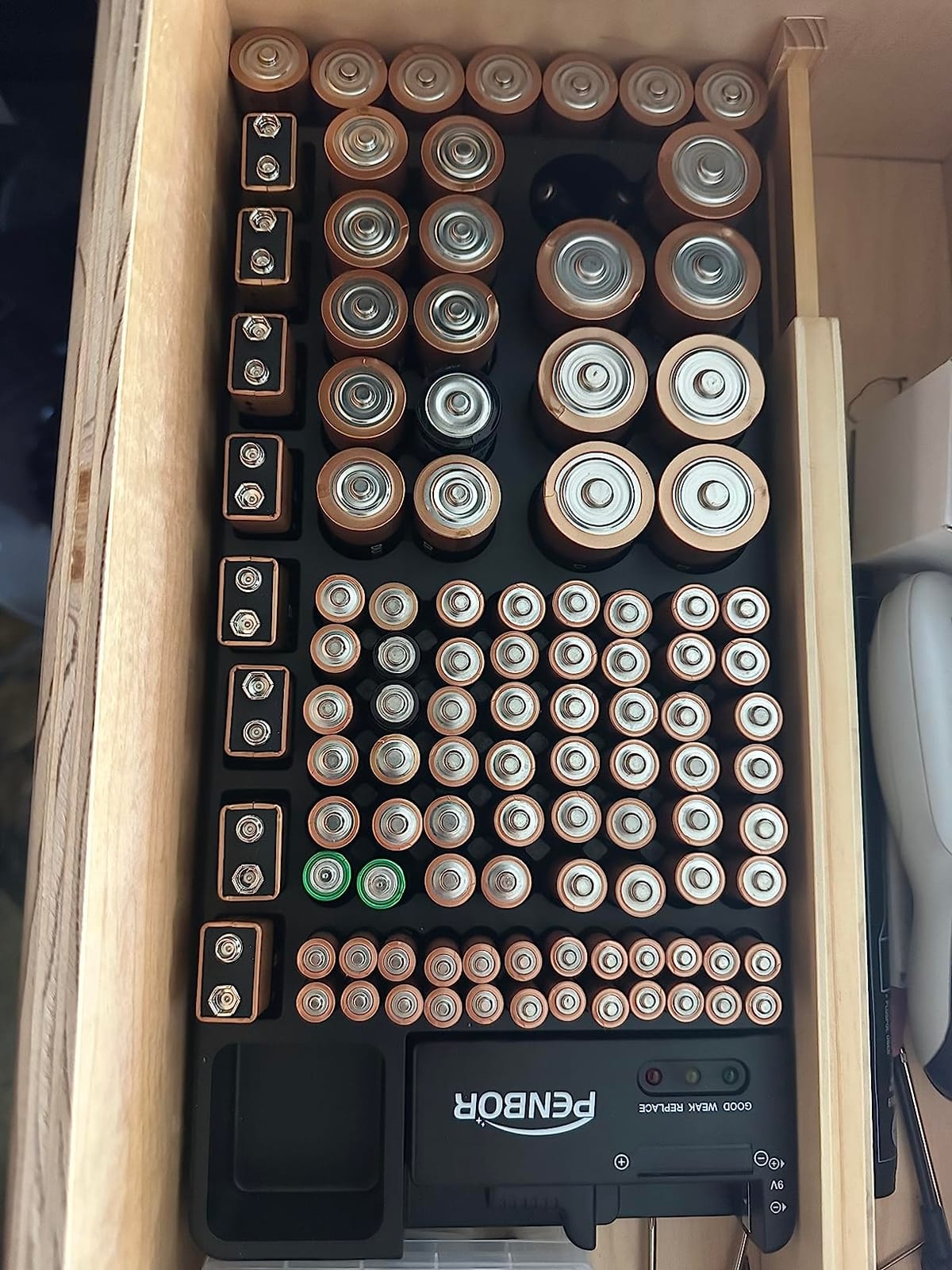
Every other case on this list stores batteries lying down in slots. This one stores them standing up, like a card catalog, on a tray you screw to a wall or slide onto a shelf. It holds roughly 110 cells across AAA, AA, 9V, C, D and button batteries in a 13.5 x 7 x 2 inch footprint.
The vertical format is genuinely useful in a garage, a utility closet or a mudroom where a case would eat a whole shelf. It is the same idea behind our pegboard organizer picks: give storage a dedicated home so it does not need drawer space. Batteries are also easier to count at a glance when they are standing in rows, which makes a six-month check take a minute rather than five.
The built-in tester slides out of the tray, and most cells can be tested in place, which is a nice touch when you are checking a wall of batteries. It sits at 4.4 across roughly 3,900 reviews, the lowest rated in this set, and the reason shows up in the reviews.
Is an open tray a problem for an emergency kit?
It depends on where the kit lives. On a wall in a dry garage, a shelf in a utility room or the interior wall of a closet, the open design is an advantage because batteries never get buried under a lid.
For a bag that gets thrown in a vehicle or carried, it is the wrong tool entirely. There is no lid, so cells scatter when the tray is tilted, and the batteries can roll out during transport. The listing title says case, but reviewers are clear that it is a tray.
Are the slots too tight?
Reviewers genuinely disagree. Some say batteries seat firmly and will not fall out once pressed into a bay. Others say the opposite, that cells wobble and drop out. The same people also note that tight bays are hard to pull cells from, especially with painful hands, which is a real accessibility concern if your kit is for an older family member.
If you have limited grip strength, skip this one. Press cells in with a flat tool and test the removal before you commit.
Also, do not mount it on a door that swings toward the tray. Batteries spill out every time it opens.
7. Aptbyte 269-Battery Organizer: Best for Maximum Capacity
Battery Organizer Storage Case with Tester for 269 Batteries, Double Sides
Up to 269 cells, foam-free molded slots
14.1 x 8.1 x 3.5 inch
1.33 kg empty
Pros
- Highest capacity in this roundup
- Custom-molded plastic slots instead of crumbling foam
- Integrated BT-168 tester
- Wall-mountable and slim enough for a standard drawer
Cons
- Heaviest option at 1.33 kg empty
- Batteries are not included
When one case has to hold everything, this is the one. Capacity is up to 269 cells across AA, AAA, 9V, C, D, 18650 and button cells, in a double-sided 14.1 x 8.1 x 3.5 inch body. It also carries a one-year warranty and a reinforced handle with four high-tension latches.
The decision that sets it apart is the slot material. Instead of precut foam, the bays are custom-molded rigid plastic. Foam is the weak point in this category: it crumbles, it collects debris, and the precut plugs are the most complained-about part of nearly every foam organizer on the market. There is nothing here to pop out.
At 4.7 across roughly 2,750 reviews with 82 percent five-star feedback, reviewers point to the large capacity, the foam-free slots and the integrated BT-168 tester as the reasons it stands out for busy households and technicians.
When does 269 slots make sense?
When you are consolidating a whole house into one location. Households with many rechargeable AA and AAA cells, camera batteries, remote controls, toys, sensors and smoke alarms can genuinely fill 150-plus slots, and consolidating means one place to check rather than four.
For a 72-hour kit, this is oversized. It is a household inventory manager that happens to double as an emergency resource, and it is the better buy if your kits are large or you want one box per household rather than one per location.
What is the real downside?
Weight. At 1.33 kg before a single cell goes in, this is the heaviest organizer here, and the handle is built for that reason. It is a two-handed object once loaded, and a wall-mounted placement makes more sense than carrying it.
Note also that 18650 slots are for cylindrical lithium-ion cells. Store those cells in a proper ventilated location rather than loose in a slot, especially if any are from a power tool or an older device.
8. ALCYON 54-Cell Battery Box: Best for Shallow Drawers
Battery Organizer Storage Box, Garage Case Holder for 24* AA, 30* AAA Batteries (Bag Not Include Batteries Pack) (white)
24 AA and 30 AAA slots
6.5 x 4.75 x 2.25 inch
4.64 ounces
Pros
- Fits shallow drawers while holding 54 cells
- Clear body shows contents without opening
- Foam holds cells evenly so rotation is easy
- Clip lid stores flat or upright
Cons
- Precut foam plugs must be pulled out one at a time
- Lightweight plastic feels flimsy for a vehicle
- No 9V slots
Drawer depth is the most common reason a good organizer fails at home, and this one is built around that constraint. At 6.5 x 4.75 x 2.25 inches and 4.64 ounces, it holds 24 AA and 30 AAA cells in a box that slides into a shallow kitchen drawer or a tight shelf without rearranging anything.
The pre-cut foam slots are removable, which is better than the fixed-insert cases that force you to keep the layout forever. Buyers like that the cells sit evenly spaced and easy to rotate by charge status, so the oldest-first habit is genuinely practical here.
Rated 4.7 across more than 2,400 reviews with 81 percent five-star feedback. The recurring praise is for the see-through body and tidy rows. The recurring complaint is the same foam-plug removal chore found in other foam organizers, plus a note that the plastic is light and feels flimsy.
Is 54 cells enough for an emergency kit?
It is enough for a focused kit. Twenty-four AA and 30 AAA covers a working set of flashlights, a radio, a couple of sensors and a spare layer, which is what most single-kit households need. It is not enough to also hold C, D, 9V and coin cells, and there are no 9V slots at all.
Pair it with a small case like the Dial Industries unit further down for 9V and C cells, or step up to one of the larger double-sided cases if you want everything in one container.
Can I use it in a vehicle?
Not our recommendation. Reviewers are blunt that the lightweight plastic feels flimsy for travel or vehicle use, where the case will be thrown, slid and dropped. It is a home drawer organizer, and a hard shell handles that environment far better.
The clip closure is a nice detail though. It lets the box sit flat or upright, and the wall-hanging clip is useful if you want it off the counter entirely.
9. Amazon Basics 110-Cell Storage Case: Best for First-Time Kit Builders
Amazon Basics Portable Battery Storage Case with Tester, Wall-Mounted Design, Carrying Handle, Holds 110 Batteries, 9.37 x 11.69 x 2.91 inches, Clear/Black
48 AA, 36 AAA, 4 C, 4 D, 4 9V, 14 coin cells
9.37 x 11.69 x 2.91 inch
1.74 pounds
Pros
- Holds the formats a new kit actually needs
- Integrated tester covers both 1.5V and 9V
- Wall-mountable design frees drawer space
- Transparent cover shows contents
Cons
- Batteries are not included
- Tester is limited to 1.5V and 9V chemistries
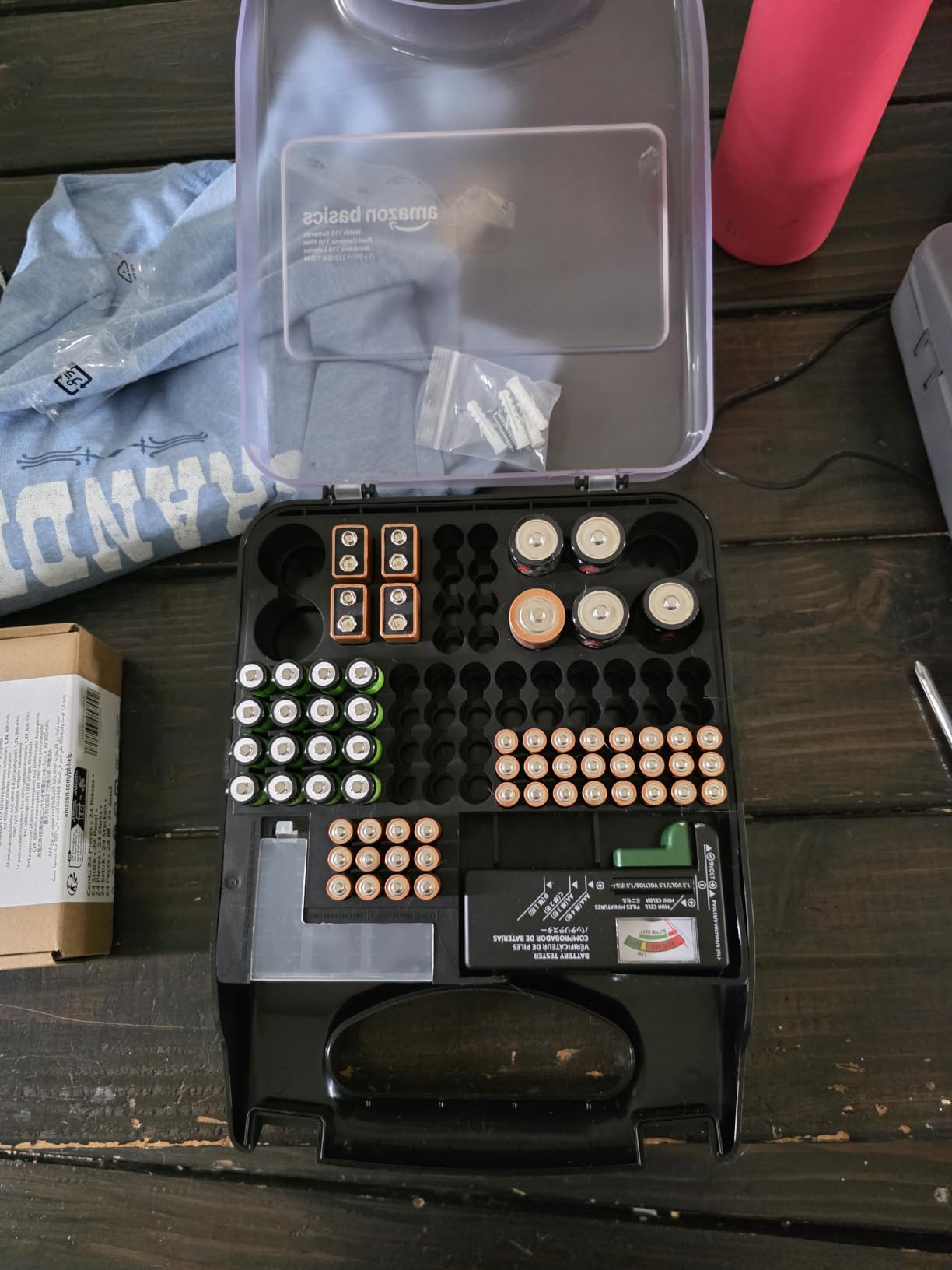
If you are assembling your first emergency kit and want one purchase that covers the obvious bases, this is the low-friction option. It holds 110 cells: 48 AA, 36 AAA, 4 C, 4 D, 4 9V and 14 coin cells, in a 9.37 x 11.69 x 2.91 inch case weighing 1.74 pounds.
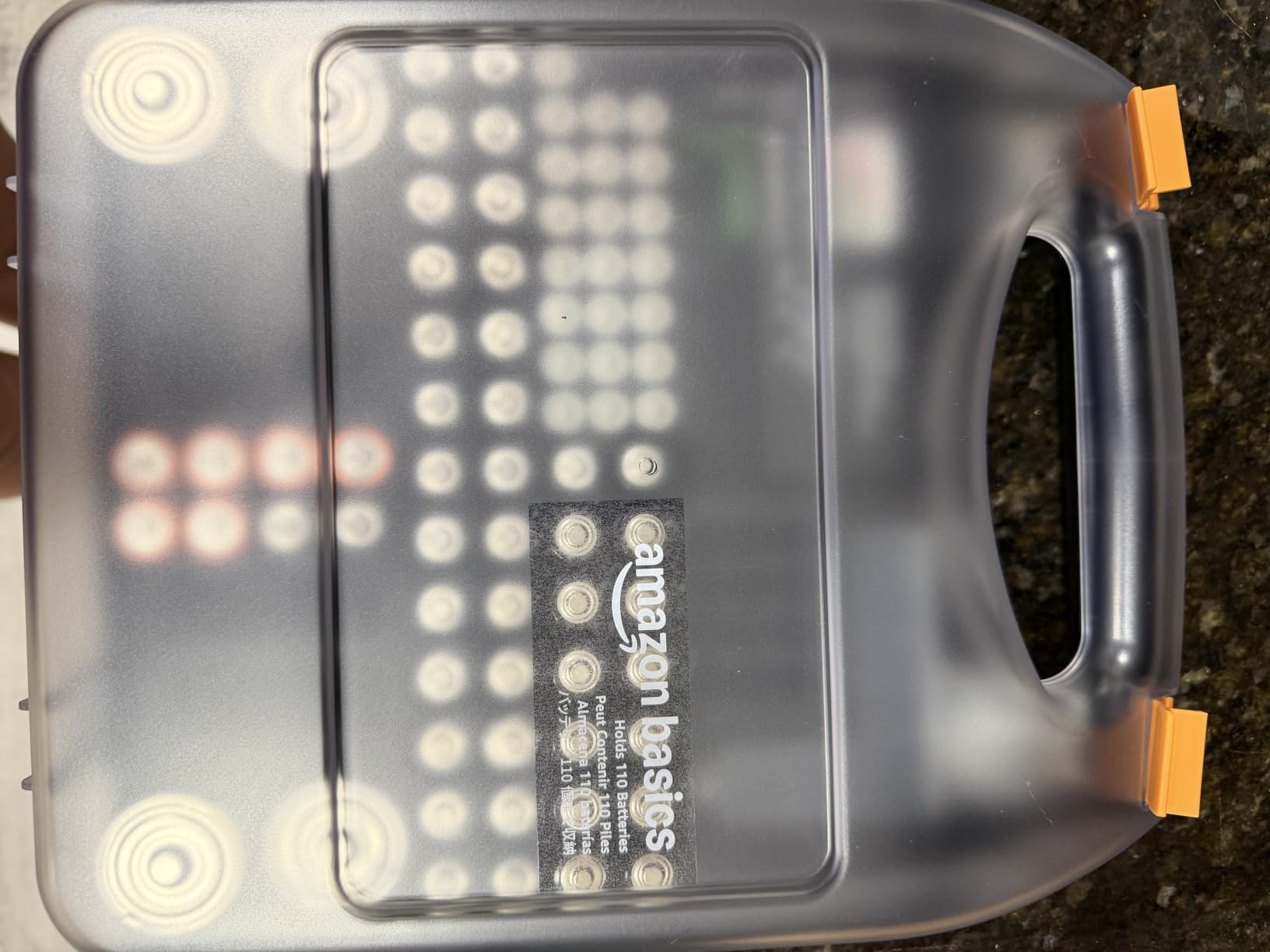
The two features that matter for a newcomer are the tester and the transparent cover. The integrated tester checks both 1.5V and 9V cells, which covers every size in the case except coin cells, so you can verify a whole inventory without a multimeter. The clear lid means you can read the inventory without opening anything.
It is also wall-mountable and has a carrying handle, so it works in a closet, a garage wall or a vehicle without needing drawer space. At 4.7 across roughly 2,100 reviews with 81 percent five-star feedback, buyers single out exactly that combination of wall mounting, handle and tester.
Is one case enough for a household?
For most households, yes. The 48 AA and 36 AAA allocation is well matched to real device counts, and the four slots each for C, D and 9V cover the devices that use them without ballooning the case. Coin cells get the most generous allocation at 14, which is useful if you have key fobs or small sensors.
If your household has more than three AA devices per room, you will outgrow the AA allocation first. The fix is a second case or a small box for overflow, not a bigger organizer.
What are the limitations?
Two, and both are stated plainly on the listing. Batteries are not included, which is true of every case in this roundup. More significantly, the tester is limited to 1.5V and 9V chemistries, so it will not check the 14 coin cell slots.
That is a real gap if your kit includes lithium coin cells in medical devices or key fobs. Track those with a separate coin cell tester and check them on a different cycle.
10. Tenergy 60-Battery Organizer Case: Best for Tool Bags and Repair Kits
Tenergy Battery Organizer Storage Case with Battery Tester, Holds 60 Batteries AA AAA C D 9V (Batteries not Included)
24 AA, 24 AAA, 4 C, 4 D, 4 9V
8.3 x 6.3 x 3.5 inch
16 ounces
Pros
- Sturdy zippered build that protects contents
- Tester reads voltage across alkaline
- NiMH and NiCd
- Four extra pockets for loose or packaged cells
- Compact footprint fits a tool bag or backpack
Cons
- Batteries are not included
- Many buyers wish they had bought the 120-cell version
- Not water resistant
This is the smallest case here that still covers the five main cylindrical formats plus 9V, and it is built for people who carry tools rather than fill a closet. At 8.3 x 6.3 x 3.5 inches and 16 ounces, it fits in a technician bag or a backpack without becoming the heaviest item inside.
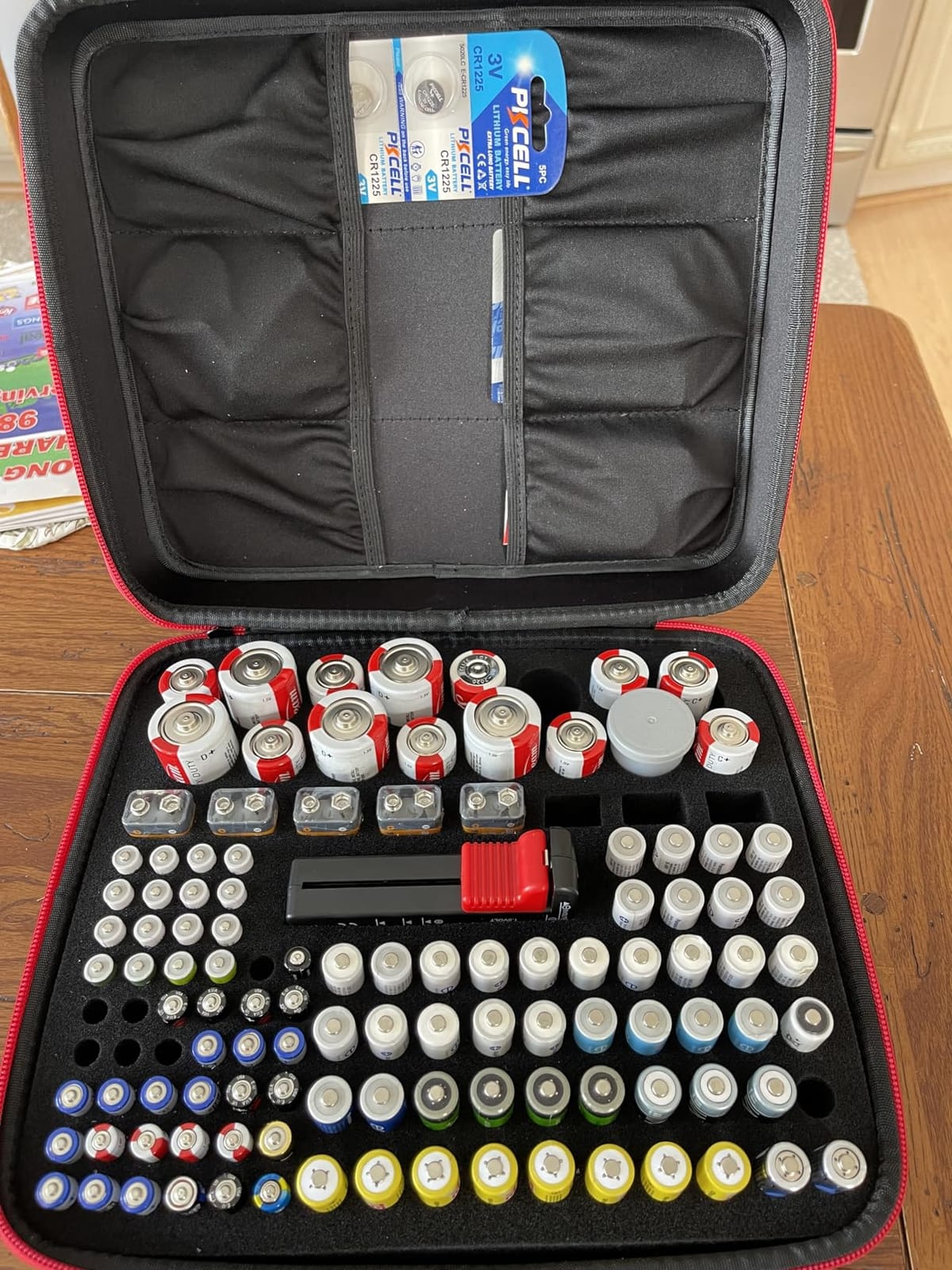
The foam slots hold 24 AA, 24 AAA, 4 C, 4 D and 4 9V batteries without contact. What separates it from the cheaper cases is the tester, which works across alkaline, NiMH and NiCd chemistries. For anyone mixing single-use and rechargeable cells, that matters, because a cheap tester often gives a misleading reading on a rechargeable cell.
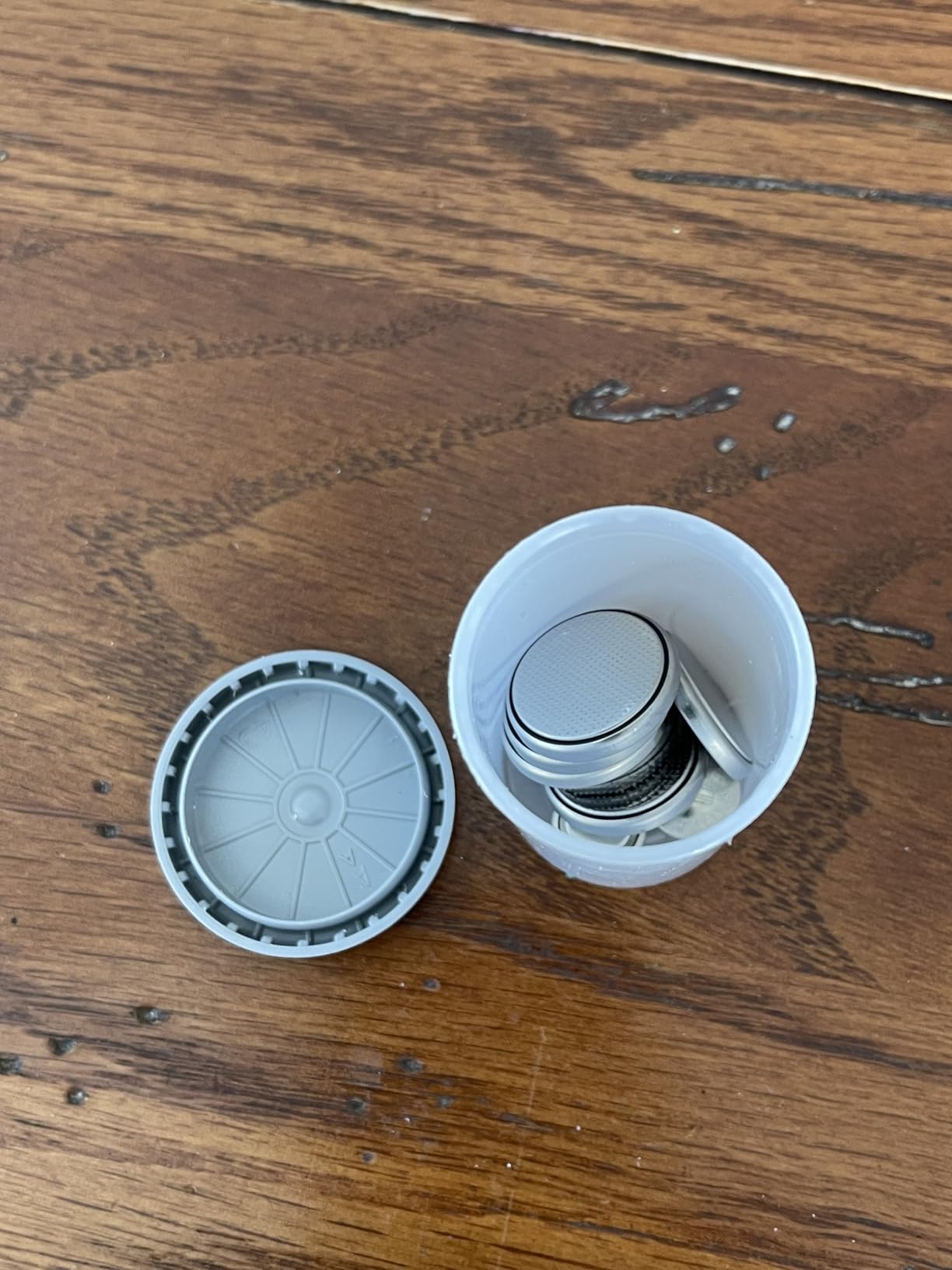
Four extra pockets in the lid hold loose batteries, shrink-wrapped cells and button cells still on their hanger cards. At 4.8 with 84 percent five-star feedback across more than 1,500 reviews, electronics repairers in particular like this one, and the extra pockets come up often in the reviews.
Is 60 cells enough for a go-bag?
For a 72-hour kit carried by one or two people, yes. Twenty-four AA and 24 AAA is a solid working set plus spares for flashlights, a radio and a couple of sensors, and the 4 C, 4 D and 4 9V slots cover the odd device that needs them.
Several buyers note that they later wish they had bought the 120-cell version in the same line. If you expect to add devices, look at that larger model before you settle, since the case format is identical.
What about water and drops?
It is not water resistant, so keep it out of a wet environment and off a garage floor where a leak or a flood could reach it. For a dry tool bag or an indoor kit, the zippered closure is enough.
The zip is the point of this case. It is a soft-sided zip case rather than a hard shell, so it protects against scuffs and jostling but not a hard drop onto concrete. For that, choose a hard EVA or fiberglass case instead.
11. Chadou 6-Pack AA and AAA Cases: Best for Camera and Travel Kits
Battery Storage Case for AA/AAA, Battery Holder Box (6Pack Clear)
Holds 4 AA or 5 AAA per case
Six cases included
55 g per set
Pros
- Clear body identifies contents at a glance
- Durable high-impact polypropylene
- Mixed AA and AAA capacity in one case
- Condition stickers help track charge status
Cons
- Limited to 4 AA or 5 AAA per case
- Mixed capacity is not a full complement of either size
- Snaps are not described as watertight
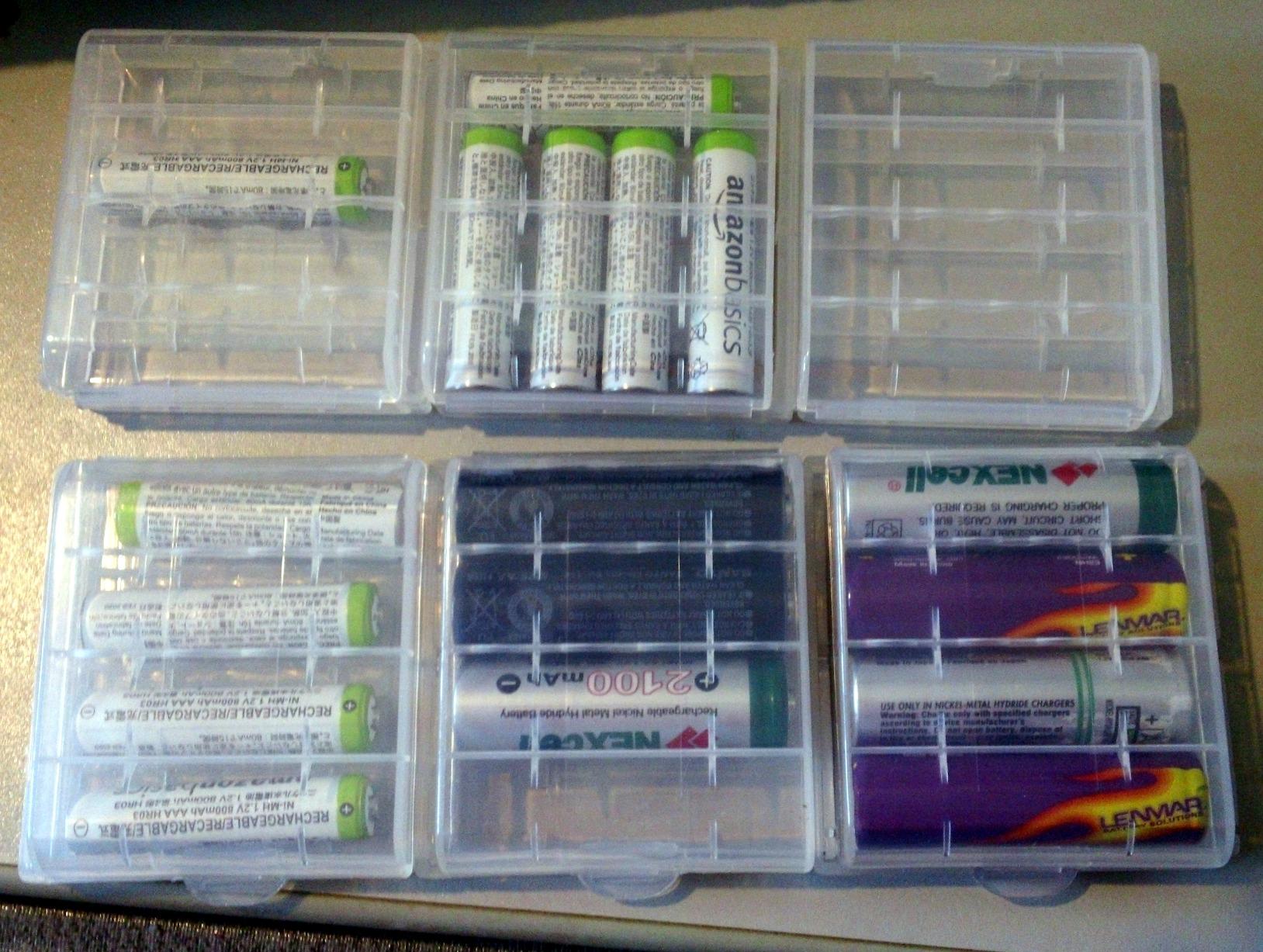
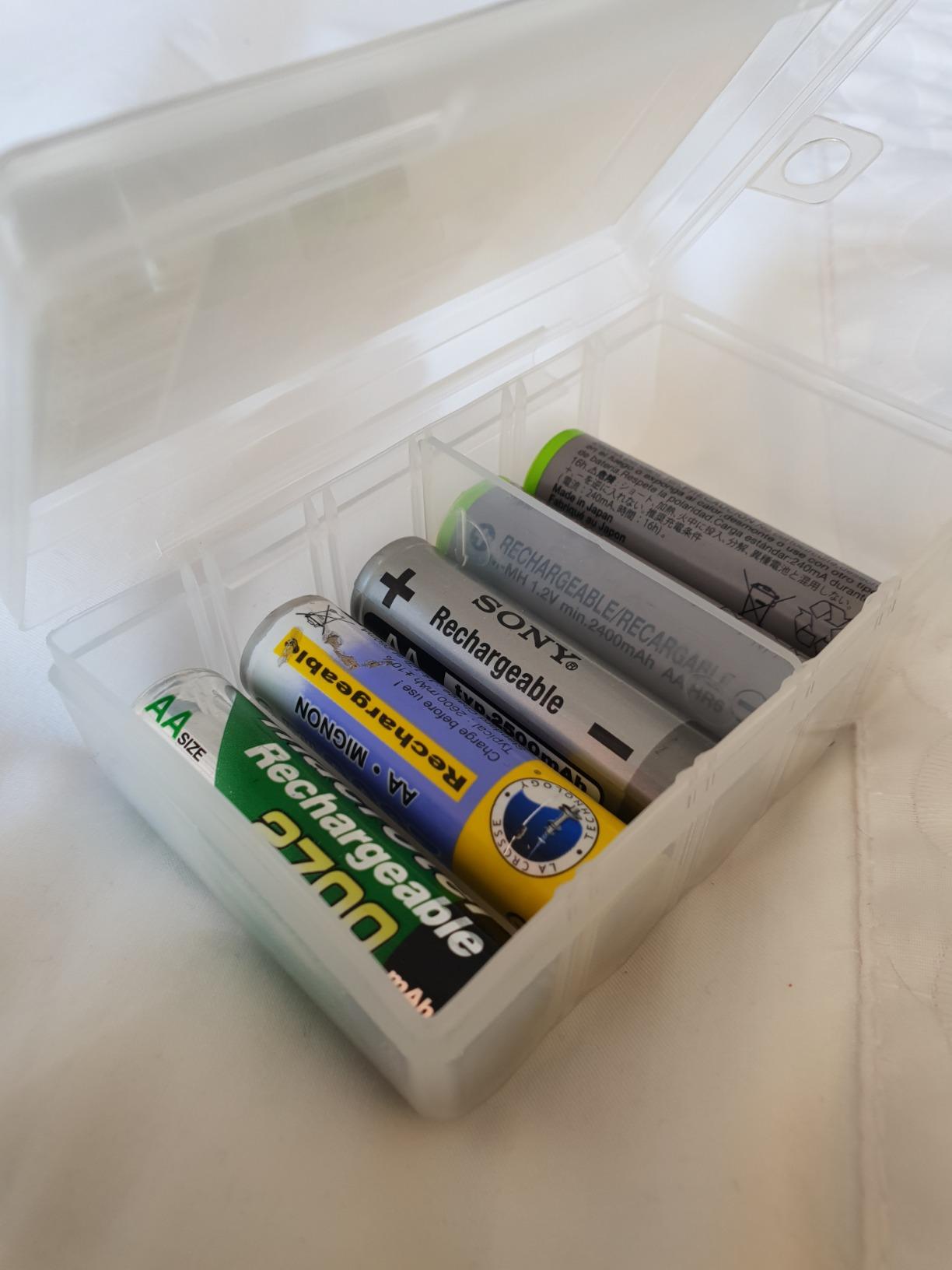
These are the smallest organizers in the roundup, and the logic is specific. Each clear case holds either 4 AA or 5 AAA batteries, or a mix of 4 AAA plus 1 AA. That makes them a natural fit for a camera bag, a hiking kit or a travel pouch where you carry a known, small number of cells rather than a household inventory.
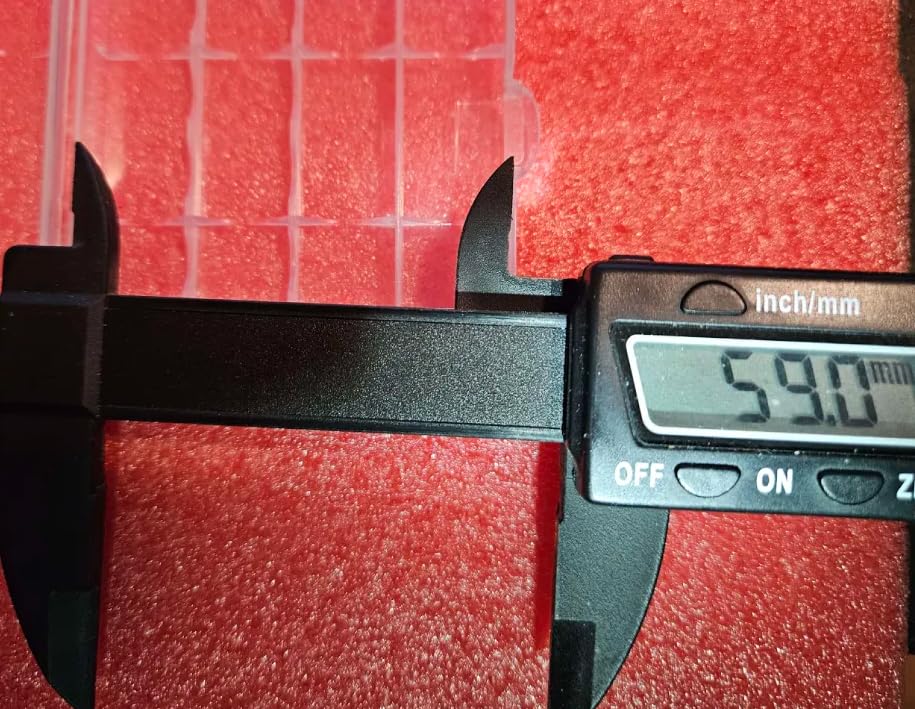
The construction is high-impact polypropylene, which holds up to repeated handling better than thin snap plastic at similar size. Buyers also like the condition-identification stickers: stick one on each case and mark whether the cells inside are tested good or spent, which is a simple version of the same rotation habit larger cases support with dividers.
Rated 4.6 across 1,500-plus reviews, with 73 percent five-star feedback, the praise centers on the clear, compact design and the durability. The clear body is what makes them useful, since you identify contents without picking up each case.
Is six small cases better than one 54-cell box?
It depends entirely on the question. If you want to distribute a few cells across six locations, such as one case per vehicle, per room or per family member, six small cases are the right answer. The ALCYON box further up is better if you want one place to check everything.
Capacity is the limitation to plan around. Six cases holding 4 AA each gives you 24 AA, but filling them all with 5 AAA gives you 30 AAA and no AA at all. Know your device mix before you commit.
Are they weather resistant?
No. The snaps and latches are not described as watertight or airtight, so treat these as dry-use containers. Keep them in a camera bag or a pack rather than loose in a vehicle where rain or wash water could get in.
For storage in a damp garage, a snap case without a gasket is a poor choice. A zippered case with a foam insert handles a humid room far better.
12. Dial Industries 12 AA Storage Case: Best for Garage and Utility Storage
Dial Industries Battery Storage Organizer Case, Holds 12 AA
Holds 12 AA batteries
2.75 x 4.5 x 1.5 inch
BPA-free plastic
Pros
- Holds a full dozen AA in a compact footprint
- Durable high-impact plastic with snap lid
- Easy to carry for travel
- BPA-free build with a one-year defect warranty
Cons
- AA only
- so AAA needs a different case
- Snap lid is not child-resistant or locking
- Listing details list reusability as rechargeable although the case is passive
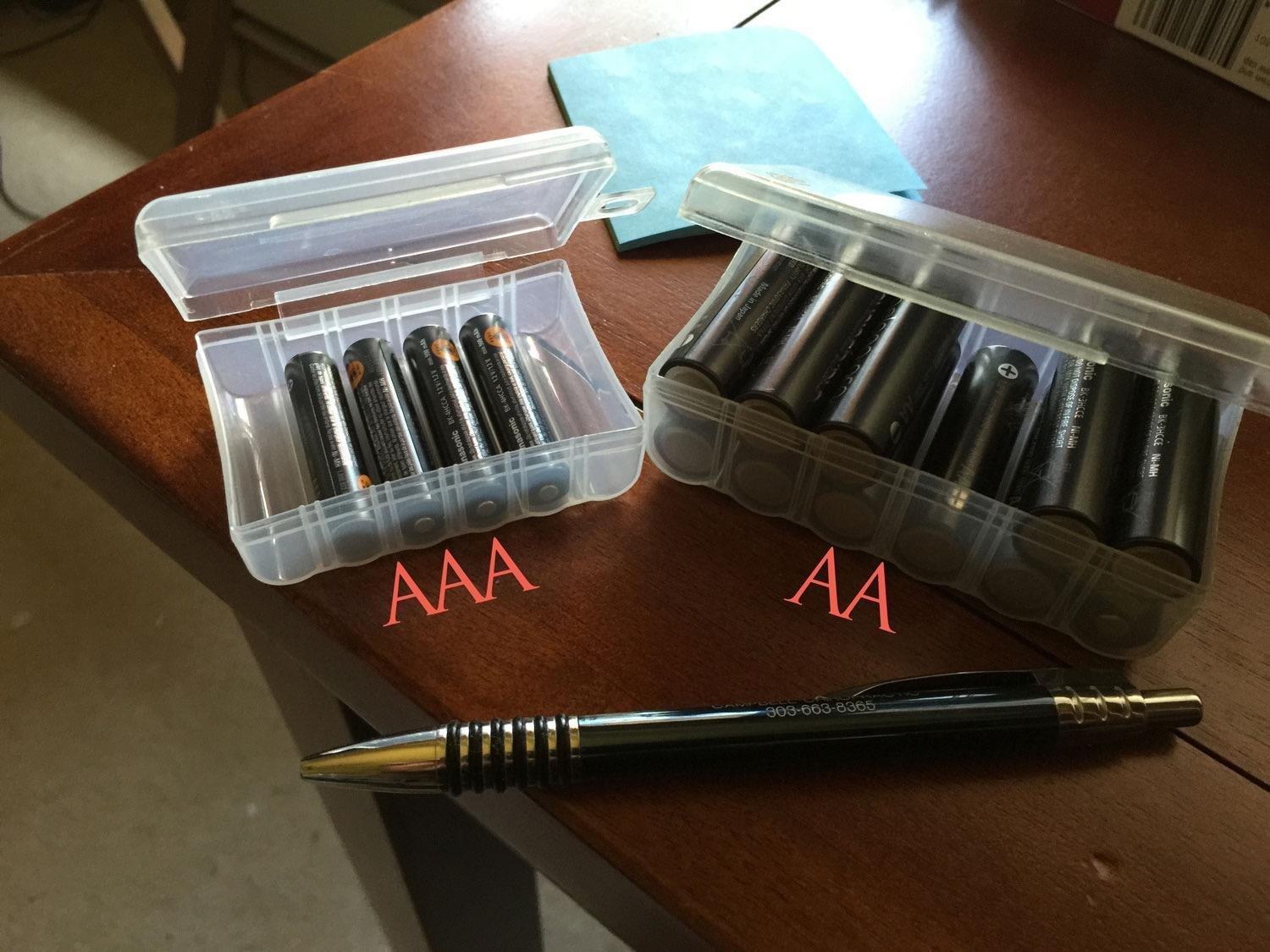
The simplest organizer here does one job: it holds 12 AA batteries. At 2.75 x 4.5 x 1.5 inches and just over an ounce, it is the case for a garage utility room, a kitchen drawer or a junk drawer, where the problem is a pile of loose cells rather than a large collection.
Build is high-impact plastic with a snap lid, and it is BPA-free with a one-year manufacturer defect warranty. Owners are generally satisfied, praising the sturdy construction, the secure snap and a 12-cell capacity that matches a standard package of batteries exactly.
At 4.5 across roughly 1,000 reviews, this sits a little below the top pick, and the complaints are about scope rather than quality: it is AA-only, and the lid is a simple snap rather than a lock.
When is 12 cells the right capacity?
When you are organizing a single room. A dozen AA covers a remote control cluster, a few flashlights, a couple of toys and a sensor or two, which is most of what a household loses track of in one drawer.
It also works well as a per-location case. Put one in the garage, one in the kitchen and one in each vehicle. At this size, a set of them costs less than a single large case, and the counting is trivial.
What should I know before buying?
It is AA only, so AAA cells need a different case entirely. If you are sorting a mixed pile, this does not solve the problem on its own.
The snap lid is not described as child-resistant or locking, so keep it out of reach of small children. One listing detail is also inaccurate: the reusability field says rechargeable while the case itself is passive plastic with no charging capability.
How to Choose a Battery Organizer for an Emergency Kit
Start with capacity, but count slots against the devices you actually own rather than the batteries you hope to buy. A 72-hour kit for two people typically needs 20 to 40 working cells plus a spare layer for rotation, so anything from 50 to 150 slots covers the majority of households. Go larger only if you are consolidating several kits or a whole property into one place.
Format coverage is the second filter. AA and AAA handle most flashlights, sensors and small remotes, but smoke and carbon monoxide alarms, larger radios and handheld weather devices frequently take 9V, C or D cells. A case with no 9V slot is a common blind spot, and coin cells are worth covering if you have key fobs or battery-powered medical accessories. The Amazon Basics 110-cell case and the DocSafe organizer both cover six or seven formats, which is why they suit a broad kit.
Portability decides where the case lives. A hard shell such as the COMECASE unit survives being thrown into a vehicle, a zip case such as the Tenergy unit is lighter and better for a backpack, and small boxes such as the GlossyEnd set are the only realistic option if you plan to move on foot. Anything over 2 pounds empty stops being a grab-and-go container.
The tester is a quality-of-life feature, not a safety feature. Most units in this roundup test 1.5V and 9V cells, and the better ones such as the Tenergy and Aptbyte models also handle rechargeable chemistries. Almost none test coin cells, so keep a separate coin cell tester if your kit has them. A tester is how you make the six-month rotation check take two minutes instead of twenty.
Finally, be honest about what safety ratings mean. Fire-resistant, flame-retardant and fireproof are different claims, and only the DocSafe case in this list states a published temperature rating and a named UL94 test. Even a rated shell is not the right home for a swollen, leaking or heat-exposed cell, and none of these organizers is a substitute for proper lithium-ion pack storage.
Whichever format you pick, buy the organizer and the batteries in the same week. People who own an organizer and never fill it end up with an empty case in a closet, which is the same as having no system at all. Our pantry organizer guide covers the same idea for food storage if you want the parallel.
What Batteries to Store in a 72-Hour Emergency Kit
Most kits are assembled by guessing. Mapping batteries to the devices that actually run on them is faster and produces a smaller, more usable kit. The list below covers the most common emergency devices and the formats they take.
LED flashlights and headlamps: AA or AAA. Stock 8 to 12 cells per light for a family of four, and rotate them into devices regularly so nothing sits unused for years.
NOAA weather radio: AA, AAA or D cells depending on the model. Check your specific radio and carry a spare set in a separate pocket so a radio failure does not take your main stash with it.
Smoke and carbon monoxide alarms: 9V, plus AA in some models. These are the batteries people forget most, because the alarm still beeps when the cell is low and the warning only comes at the worst moment.
Battery-powered medical devices: usually AA, AAA or button cells. Read the device manual, store a labelled spare set with the device rather than in the main case, and note the model number so you can source a match.
Handheld radios and two-way radios: AA, AAA or NiMH rechargeable cells. If you use rechargeable cells, keep a charger in the kit and do not store cells fully depleted.
Power banks: lithium-ion, built in. Charge them to full before every kit check, and do not store them in a bag for months at zero charge.
Headlamps with a battery pack: AAA. These draw power fast, so carry more cells per device than you would for a torch.
A battery-powered radio is one of the core items in any blackout kit, and choosing the right one matters as much as the cells. Our emergency radio picks break down battery types, NOAA reception and run times by model.
For a sump pump backup, the power picture is completely different because the load is far larger than anything a flashlight draws. Our sump pump battery backup guide covers that case separately.
Battery Freshness and Rotation for Multi-Year Storage
Alkaline cells do not fail loudly. They lose capacity slowly, often for several years, and then a device simply stops working. That is why a flashlight can sit in a drawer looking fine and die during a storm. The fix is a schedule, not a better battery.
Check every organizer twice a year, ideally when daylight saving time changes. In five minutes, run the built-in tester over every cell, pull anything that reads as spent, and move live cells to the front of their slot. Test coin cells with a separate coin cell tester, and check power banks by their own indicator rather than by cell test.
Store and use cells oldest-first. The FIFO habit that shows up repeatedly in preparedness forums is the simplest thing you can do: new batteries go behind existing ones, so the oldest are always the ones in the device. Without a system like this, good cells sit unused in storage and expire there.
Keep temperature steady rather than simply cool. A garage in summer and a car in winter both swing widely, and alkaline cells stored above roughly 100 degrees F lose shelf life quickly. A closet, drawer or interior shelf at normal room temperature is a better home than a cold garage or a vehicle, even if the vehicle is more convenient.
Split your supply into a working layer and a backup stash. The working layer lives in the organizer inside the kit and is the one you actually reach for. The backup stash stays sealed, in a second location, and replaces the working layer during each check. It also means a single lost bag does not take your entire supply with it.
Replace rather than mix age groups. If you have opened a fresh package and cells from three years ago, do not combine them in the same device. Rechargeable NiMH cells are the exception, since they are designed for repeated cycling and benefit from being used.
What Not to Store in a Battery Organizer
Do not put swollen, leaking, dented or heat-exposed cells in any organizer, fireproof or not. If a battery has been damaged, the safest storage is a non-combustible outdoor location away from anything that can burn, and the correct action for a swollen lithium-ion cell is to leave the area and call your local fire service rather than move it yourself. Users on preparedness forums consistently describe this as the one rule they will not bend.
Do not store large lithium-ion power-tool packs, e-bike batteries or large drone packs in a household organizer. These packs have enough stored energy to enter thermal runaway without an external ignition source, and no consumer organizer is a certified containment vessel for them. Store them in the manufacturer-recommended ventilated location with terminals covered, and keep them away from anything flammable.
Do not assume a fireproof label means fire containment for lithium-ion. Fire-resistant and flame-retardant describe material behavior under exposure. A fireproof bag slows burning paper; it is not rated for a lithium-ion pack that can reignite hours later. The DocSafe case’s 2000 degree F rating is meaningful for the cells it is sold for, and it does not change the rules for a power-tool pack.
Do not store loose cells in a bag or a zip bag without separation. A sealed bag keeps dust out but does nothing about terminal contact, and touching terminals are what drain a cell in storage. Foam slots, molded bays and dividers exist for exactly this reason, and the organizers in this roundup all use one or the other.
Do not store rechargeable NiMH cells fully discharged. If you keep rechargeable cells, top them off before the case goes into storage, and keep a charger in the kit. Rechargeable chemistry loses more of its capacity sitting at zero than sitting at full.
Frequently Asked Questions
Does Battery Daddy come with batteries?
No. The Battery Daddy case is supplied as an empty organizer. The 180-battery figure is a slot count covering 76 AA, 72 AAA, 10 C, 8 D, 8 9V and 12 coin cell positions, and you supply the cells. The tester is the only accessory included.
Do AA batteries go bad from sitting?
Yes, slowly and silently. Alkaline cells lose capacity over years even when unused, and heat accelerates the loss significantly. This is the reason batteries fail during an outage even though the flashlight looked fine on the shelf. A twice-yearly tester check and oldest-first rotation keeps the problem from reaching your devices.
Do I need a battery tester in my emergency kit?
It is not essential, but it changes a 20-minute inventory check into a 2-minute one. Most organizers in this roundup include a tester that checks 1.5V and 9V cells. Almost none test coin cells, so add a separate coin cell tester if your kit includes key fobs or small sensors.
Is it safe to store lithium batteries in a battery organizer?
Small cells like 18650 or button cells are fine when they are undamaged and stored in a slot that separates terminals. Large lithium-ion power-tool, e-bike and drone packs are a different matter. No consumer organizer is a certified containment vessel for a pack that can enter thermal runaway without an external ignition source, so store those separately in the manufacturer-recommended ventilated location.
How big of a battery bank do I need to power a house?
A battery organizer cannot power a house, and this is the most important expectation to set. These cases store cells for flashlights, radios, alarms and small devices, not for running appliances. If you need to power loads during an outage, you need a portable power station, and sizing that depends on which appliances and for how long.
Final Verdict on the Best Battery Organizers for 2026
The Ontel Battery Daddy 180-battery case is the best battery organizer for emergency kits in 2026, and the margin over the alternatives comes down to one thing: it covers every format a real kit needs, both sides are clear, and the tester lives in the case so you can check inventory in the dark. It is heavy at 2.2 pounds empty, so pair it with a lighter case if you need to move on foot.
Buy the COMECASE hard EVA case for drop protection in a vehicle or go-bag, the DocSafe fireproof organizer if lithium-ion safety is your main concern, and the Tenergy or ALCYON cases if drawer or bag space is the binding constraint. Fill whichever one you choose within the same week, then set a twice-yearly rotation check and keep damaged cells out of it entirely.