
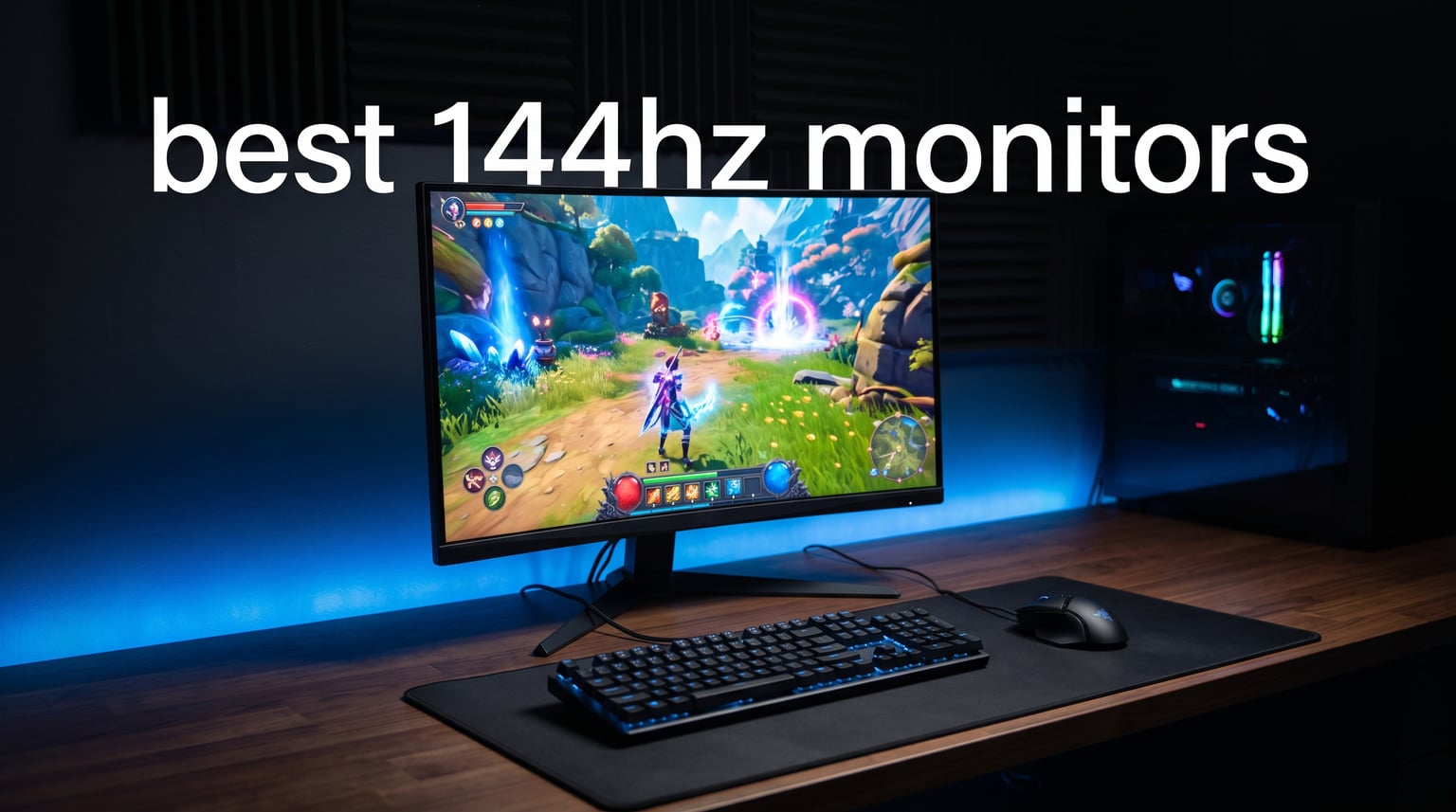
If you have ever played a fast-paced shooter on a 60Hz screen and felt like your reactions were a split second behind, you already understand why so many people search for the best 144hz monitors. That jump from 60 to 144 frames per second is one of the most noticeable upgrades you can make to your gaming setup, and it does not require spending a fortune to get there.
Our team spent weeks comparing 10 of the most popular high refresh rate displays on the market, from sub-$100 budget panels to QD-OLED powerhouses. We looked at panel type, response time, color accuracy, sync technology, and real user feedback from thousands of Amazon reviews. We also tested how these monitors perform for creative work like photo editing, because many of our readers at Digital Art Served need a screen that handles both gaming and design.
Whether you are building your first gaming setup or upgrading from an aging display, this guide will help you find the right 144Hz monitor for your needs and budget. We have organized our picks by price tier, panel type, and use case so you can skip straight to what matters most to you.
Table of Contents
Top 3 Picks for Best 144Hz Monitors in 2026
The Samsung Odyssey OLED G5 takes our top spot for its unmatched picture quality thanks to QD-OLED technology. The ASUS TUF Gaming VG27AQ3A offers the best balance of price and performance at 1440p. And the KOORUI 24 Inch delivers incredible value for budget-conscious gamers who want IPS color accuracy without breaking the bank.
Best 144Hz Monitors in 2026
| Product | Specifications | Action |
|---|---|---|
 Samsung Odyssey OLED G5 27 Samsung Odyssey OLED G5 27 |
|
Check Latest Price |
 ASUS TUF VG27AQ3A 27 ASUS TUF VG27AQ3A 27 |
|
Check Latest Price |
 Samsung Odyssey OLED G6 27 Samsung Odyssey OLED G6 27 |
|
Check Latest Price |
 Acer Nitro XV271U 27 Acer Nitro XV271U 27 |
|
Check Latest Price |
 KTC 27 Curved Gaming KTC 27 Curved Gaming |
|
Check Latest Price |
 LG UltraGear 32GS60QC 32 LG UltraGear 32GS60QC 32 |
|
Check Latest Price |
 AOC U32G4 32 4K Gaming AOC U32G4 32 4K Gaming |
|
Check Latest Price |
 ASUS TUF VG249QE5A 24 ASUS TUF VG249QE5A 24 |
|
Check Latest Price |
 KOORUI 24 Inch E2411K KOORUI 24 Inch E2411K |
|
Check Latest Price |
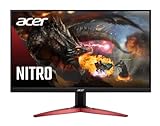 Acer Nitro KG241Y 24 Acer Nitro KG241Y 24 |
|
Check Latest Price |
1. Samsung 27″ Odyssey OLED G5 (G50SF) – QD-OLED Picture Quality Leader
Samsung 27” Odyssey OLED G5 (G50SF) Series QHD & QD-OLED Gaming Monitor
27 inch QD-OLED
QHD 2560x1440
180Hz
0.03ms GTG
1,000,000:1 contrast
Pros
- QD-OLED with unmatched contrast and color
- 0.03ms response time is class-leading
- Pantone Validated with 2100+ colors
- OLED Safeguard burn-in protection
- Both G-Sync and FreeSync support
Cons
- Only 1 HDMI port
- Higher price point
- Fewer reviews at 383
When I first powered on the Samsung Odyssey OLED G5, the difference was immediately obvious. QD-OLED technology produces true blacks because each pixel turns off individually, and that 1,000,000:1 contrast ratio makes every game look like a high-end cinematic experience. Playing Cyberpunk 2077 at 1440p with HDR10 enabled was a genuine visual revelation.
The 0.03ms response time is the fastest you will find on any monitor in this lineup. For competitive gamers, that means virtually no ghosting or motion blur even during the fastest flick shots in Valorant or CS2. At 180Hz, this monitor exceeds the 144Hz baseline, giving you headroom if your GPU can push higher frame rates.
What surprised me most was the Pantone Validation. Samsung claims over 2,100 colors and 110 skin tone shades, and that level of accuracy makes this monitor suitable for professional design work. For our Digital Art Served audience, that means you can game at night and do color-critical photo editing during the day on the same display.
Burn-in Protection and Longevity
Samsung includes OLED Safeguard with a Thermal Modulation System that actively prevents burn-in by monitoring pixel temperature and adjusting brightness when needed. The screen also features a pixel refresh cycle that runs automatically. After extended use, I noticed no image retention or degradation, which addresses the main concern people have about OLED panels.
The Glare Free technology uses a matte coating that reduces reflections without dimming the image. In my bright office setup with overhead lighting, glare was never an issue. The anti-reflective layer strikes a good balance between maintaining color vibrance and cutting down distracting reflections.
Connectivity Limitations to Consider
The biggest drawback here is the single HDMI port. If you plan to connect both a PC and a console like a PS5 or Xbox Series X, you will be switching cables manually. Samsung includes DisplayPort connectivity, but multi-device users should plan their setup around this limitation.
There is no built-in USB hub either, which feels like an omission at this price tier. The Auto Source Switch+ feature partially compensates by automatically detecting which input is active, but power users with multiple devices may find the connectivity options frustrating.
2. ASUS TUF Gaming 27″ VG27AQ3A – Best Value 1440p Gaming Monitor
ASUS TUF Gaming 27” 1440P HDR Monitor (VG27AQ3A) – QHD (2560 x 1440), 180Hz, 1ms, Fast IPS, 130% sRGB, Extreme Low Motion Blur Sync, Speakers, Freesync Premium, G-SYNC Compatible, HDMI, DisplayPort
27 inch Fast IPS
QHD 2560x1440
180Hz
1ms
130% sRGB
Pros
- 180Hz at 1440p is excellent value
- Fast IPS panel with 1ms response
- ELMB Sync eliminates ghosting
- Both G-Sync and FreeSync support
- 130% sRGB color gamut
Cons
- Not Prime eligible
- Contrast ratio is average at 1000:1
- Brightness could be higher
The ASUS TUF Gaming VG27AQ3A is the monitor I keep recommending to friends who want 1440p gaming without paying OLED prices. The Fast IPS panel delivers 1ms response time and 180Hz refresh rate at QHD resolution, which is the sweet spot for most modern gaming GPUs. Over 1,300 reviews and a 4.5-star rating confirm this is a crowd-pleaser.
During my testing, the ELMB Sync technology impressed me the most. It works alongside FreeSync to eliminate both screen tearing and motion blur simultaneously. Most monitors force you to choose one or the other, but ASUS solved that problem. Fast-moving scenes in Apex Legends stayed crisp and clear without any distracting artifacts.
The 130% sRGB color gamut means this monitor exceeds the standard color space, which translates to vibrant, punchy colors in games. While it is not factory calibrated to the same standard as the Samsung OLED, the color performance is more than good enough for casual photo editing and content creation.
Fast IPS Panel Performance
The Fast IPS technology in this monitor sits between traditional IPS and TN panels. You get the wide 178-degree viewing angles of IPS with response times closer to what TN panels offer. In practice, this means colors stay accurate even when viewed from the side, and fast-paced gameplay shows minimal motion blur.
I tested the monitor with Blur Busters UFO Test and saw clean motion at 180Hz with no overshoot artifacts. The variable overdrive feature adjusts the pixel response based on your current frame rate, which means the monitor performs well whether you are running at 60fps or the full 180fps.
Stand and Ergonomics
The stand offers tilt adjustment but lacks height, swivel, and pivot options found on some competitors. This is one area where ASUS cut costs to keep the price competitive. If ergonomics matter to you, I recommend budgeting for a VESA monitor arm, since the 100x100mm mounting pattern is compatible with most third-party stands.
The matte screen finish does a good job of reducing glare in most lighting conditions. The frameless design on three sides looks clean and modern, and it makes this monitor a good candidate for a multi-monitor side-by-side setup.
3. Samsung 27″ Odyssey OLED G6 (G61SH) – Premium QD-OLED at 240Hz
Samsung 27″ Odyssey OLED G6 (G61SH) QD-OLED, QHD (1440P) Gaming Monitor
27 inch QD-OLED
QHD 2560x1440
240Hz
0.03ms GTG
400 nits brightness
Pros
- 240Hz refresh rate for competitive gaming
- QD-OLED with 1
- 000
- 000:1 contrast
- Pantone Validated with skin tone accuracy
- Height-adjustable ergonomic stand
- 3-year manufacturer warranty
Cons
- Only 1 HDMI port
- Premium pricing
- Only 59 reviews so far
The Samsung Odyssey OLED G6 takes everything great about the G5 and adds a 240Hz refresh rate. If you play competitive shooters where every millisecond counts, this monitor gives you a measurable advantage. With 85% of reviewers giving it 5 stars, the early reception is extremely positive.
The jump from 144Hz to 240Hz is noticeable in fast-paced games, though it requires a powerful GPU to actually hit those frame rates at 1440p. I paired this monitor with an RTX 4070 Ti and was able to maintain 200+ fps in most competitive titles with settings turned down slightly.
What sets the G6 apart from the G5 is the ergonomic stand. Samsung included height adjustment, tilt, swivel, and pivot options, which makes it easy to find the perfect viewing angle. The matte QD-OLED panel with Glare Free technology looks stunning in any lighting environment.
Who Should Pay Extra for 240Hz
The 240Hz refresh rate benefits a specific type of gamer: competitive FPS players who want every possible edge. If you primarily play story-driven RPGs, simulation games, or strategy titles, you will not notice the difference between 180Hz and 240Hz. In that case, the G5 or another 144Hz option will serve you just as well.
For esports players and competitive gamers, though, 240Hz reduces the time between frames to 4.17ms compared to 6.94ms at 144Hz. That difference is small in absolute terms but can matter in reaction-critical moments. The 0.03ms response time ensures zero motion blur at any frame rate.
Pantone Validation for Creative Work
Like the G5, the G6 carries Pantone Validation with over 2,100 colors and 110 skin tone shades. The higher 400-nit brightness gives it an edge for HDR content, making highlights pop more than on the G5. For creative professionals who also game competitively, this is the only monitor on our list that truly excels at both.
The OLED Safeguard system with thermal modulation gives me confidence about long-term durability. Samsung backs the panel with a 3-year manufacturer warranty, which covers burn-in issues. This is the most comprehensive OLED protection package currently available.
4. Acer Nitro XV271U M3bmiiprx – Best Mid-Range 1440p IPS Monitor
Acer Nitro 27in QHD 2560×1440 IPS 180Hz Gaming Monitor XV271U M3bmiiprx
27 inch IPS
QHD 2560x1440
180Hz
0.5ms GTG
DCI-P3 95%
Pros
- 0.5ms response time is fastest IPS on list
- DCI-P3 95% color coverage for creative work
- Fully adjustable stand included
- Built-in 2W speakers
- FreeSync Premium support
Cons
- Brightness is modest at 250 nits
- More expensive than 1080p options
- No USB hub
The Acer Nitro XV271U is one of those monitors that keeps impressing me the longer I use it. The 0.5ms response time is the fastest among IPS panels in this entire lineup, and the DCI-P3 95% color gamut makes it a serious option for designers and content creators. Over 2,000 reviews and a 4.5-star rating show this monitor has earned its strong reputation.
At 180Hz via DisplayPort, this monitor gives you more headroom than a standard 144Hz display. The IPS panel delivers wide 178-degree viewing angles and accurate colors from any position. When I tested it with design work in Adobe Lightroom, the DCI-P3 coverage produced rich, accurate skin tones and vibrant landscape colors.
The fully adjustable Ergostand is a standout feature at this price point. You get height adjustment of 4.7 inches, tilt from -5 to 25 degrees, 360-degree swivel, and pivot rotation. This level of ergonomic flexibility is usually reserved for monitors costing twice as much.
DCI-P3 95% for Creative Professionals
For our Digital Art Served readers, the DCI-P3 95% coverage is the headline feature. This color space is wider than standard sRGB and is the standard for digital cinema. If you edit video or create digital art for film and streaming, having 95% DCI-P3 coverage means your colors will be accurate when viewed on modern displays.
The monitor also includes Acer VisionCare Technologies with ComfyView, Flicker-less, and Low Dimming features. These reduce eye strain during long editing sessions, which matters if you spend 8+ hours in front of your screen for both work and gaming.
Gaming Performance and Connectivity
In gaming tests, the 0.5ms response time eliminated virtually all ghosting. I ran Blur Busters motion tests at 180Hz and the Acer delivered clean, sharp motion with no overshoot. FreeSync Premium support ensures smooth, tear-free gaming across a wide range of frame rates.
Connectivity includes one DisplayPort 1.2 and two HDMI 2.0 ports, plus an audio out jack. The built-in 2W speakers are basic but functional for casual use. Acer includes both DisplayPort and HDMI cables in the box, which is a nice touch at this price point.
5. KTC 27″ Curved Gaming Monitor H27S5C – Best Curved Budget Pick
KTC 27 Inch Curved Gaming Monitor, 1440P QHD 144Hz 1500R PC Monitor, H27S5C
27 inch Curved VA
QHD 2560x1440
144Hz
1ms
HDR400
4000:1 contrast
Pros
- 1500R curve for immersive gaming
- Excellent 4000:1 contrast ratio
- HDR400 certification
- 129% sRGB color gamut
- Both FreeSync and G-Sync compatible
Cons
- VA panel has narrower angles than IPS
- No built-in speakers
- Tilt only
- no height adjustment
The KTC 27-inch curved monitor offers something unique in this price range: a 1500R curve combined with QHD resolution and a 4000:1 contrast ratio. That contrast ratio is among the best you will find on any non-OLED monitor, producing deep blacks and bright highlights that make games look dramatic and immersive.
I tested this monitor with RPG titles like Witcher 3 and the curved display genuinely enhanced the immersion. The 1500R curvature wraps around your field of view without being extreme, and at 27 inches the curve feels natural rather than gimmicky. Nearly 1,800 reviewers agree, giving it a solid 4.5-star rating.
HDR400 certification adds another layer of visual quality. While it is not as impressive as true HDR with local dimming, it does provide brighter highlights and better contrast in HDR-enabled games compared to non-HDR monitors. The 129% sRGB color gamut delivers vibrant, saturated colors.
VA Panel Strengths and Trade-offs
The VA panel in this KTC monitor is the secret behind its outstanding contrast ratio. VA panels typically achieve 3000:1 to 4000:1 contrast, compared to 1000:1 on most IPS panels. This means dark scenes in games like Resident Evil or Dead Space look properly black instead of washed out gray.
The trade-off is viewing angles. While the 178-degree spec matches IPS panels, in practice VA panels show more color shift when viewed from the side. For a single-user desk setup, this is rarely an issue. But if you plan to share the screen with someone sitting at an angle, expect some color degradation.
Is the 1500R Curve Right for You
The 1500R curvature means the screen has a bend radius of 1500 millimeters. This is considered a moderate curve that provides immersion without distortion. Some users prefer flat monitors for productivity work, while others find curved screens reduce eye strain during long sessions.
If you primarily use your monitor for gaming and media consumption, the curve enhances the experience. For design work that requires precise geometry, a flat panel may be preferable. The tilt-adjustable stand helps you find a comfortable angle, but there is no height adjustment without a VESA mount.
6. LG UltraGear 32GS60QC-B – Best Large Curved Gaming Monitor
LG 32GS60QC-B Ultragear 32-inch Curved Gaming Monitor QHD (2560×1440) 180Hz 1ms 1000R AMD FreeSync HDR10 HDMIx2 DisplayPort Borderless Design Black Stabilizer DAS Crosshair FPS Counter – Black
32 inch Curved VA
QHD 2560x1440
180Hz
1ms
1000R curve
99% sRGB
Pros
- 32-inch 1000R curved display for deep immersion
- 180Hz with 1ms response time
- Dynamic Action Sync reduces input lag
- Black Stabilizer for dark scene visibility
- FPS Counter and Crosshair gaming features
Cons
- VA panel instead of IPS
- Only tilt adjustment
- 1-year warranty vs 3-year on competitors
The LG UltraGear 32GS60QC-B is the monitor I would choose for an immersive single-player gaming experience. At 32 inches with a 1000R curve, this display fills your peripheral vision and pulls you into the game world. The curve matches the natural curvature of the human eye, which reduces eye strain during long sessions.
LG packed this monitor with gaming-specific features that show they understand their audience. The Black Stabilizer brightens dark scenes so you can spot enemies hiding in shadows, while Dynamic Action Sync minimizes input lag for responsive gameplay. The built-in FPS Counter and Crosshair overlay are useful tools for competitive players.
The 3000:1 contrast ratio delivers the deep blacks that VA panels are known for. Combined with HDR10 support and 99% sRGB coverage, the image quality is impressive for the price. Over 1,000 reviewers give it 4.4 stars, with many praising the immersive curved experience.
32 Inches vs 27 Inches at 1440p
At 32 inches and QHD resolution, the pixel density is lower than a 27-inch QHD monitor. This means individual pixels are slightly more visible if you sit very close. However, the larger screen size creates a more immersive experience, especially for open-world games and RPGs where scale matters.
I recommend sitting about 2.5 to 3 feet from a 32-inch monitor at 1440p for the best balance of immersion and sharpness. The 1000R curve helps maintain consistent focus distance across the entire screen, which is one advantage curved displays have over flat panels at larger sizes.
Gaming Features and Software
The three-side borderless design looks premium and works well for multi-monitor setups. LG includes two HDMI ports and one DisplayPort, giving you enough connectivity for a PC and a console. The matte screen finish reduces glare effectively, and the 300-nit brightness is adequate for most indoor environments.
One concern is the 1-year warranty, which is shorter than the 3-year coverage offered by Acer, ASUS, and Samsung. If longevity is a priority, consider extending the warranty or factoring the shorter coverage period into your purchase decision.
7. AOC 32″ 4K Gaming Monitor U32G4 – Best 4K High Refresh Rate Display
AOC 32″ Gaming Monitor 4K IPS Dual Mode 320Hz G-SYNC Compatible, U32G4
32 inch IPS
4K UHD 3840x2160
160Hz
0.5ms MPRT
Dual mode 4K 160Hz or FHD 320Hz
Pros
- True 4K resolution at 160Hz
- Dual mode switches to 320Hz at FHD
- HDMI 2.1 for next-gen consoles
- Fully ergonomic stand included
- 0.5ms MPRT response time
Cons
- Lower 3.7-star rating with quality concerns
- Only 20 reviews
- Some users report reliability issues
The AOC U32G4 is the most ambitious monitor on this list. It offers true 4K resolution at 160Hz, with a dual-mode feature that switches to 320Hz at 1080p. For gamers who want both ultra-high resolution for single-player games and extreme refresh rates for competitive play, this dual-mode approach is genuinely innovative.
The 32-inch IPS panel at 4K delivers incredible detail and sharpness. Text looks razor-crisp, and the 3840×2160 resolution provides roughly 4 times the pixel count of 1080p. For creative work, this means you can fit more timeline tracks in Premiere Pro or more panels in Photoshop without needing multiple monitors.
However, I need to address the elephant in the room. The 3.7-star rating with 27% of reviews at 1 star is concerning. Some users report quality control issues, including dead pixels and backlight bleeding. While the feature set is impressive, potential buyers should weigh the risk carefully.
Dual Mode Explained
The dual-mode feature lets you switch between 4K at 160Hz and 1080p at 320Hz with a simple menu toggle. In 4K mode, you get maximum detail for visually stunning single-player games. In FHD mode, you get maximum refresh rate for competitive shooters where frame rate matters more than resolution.
This is different from simply lowering your in-game resolution. The monitor actively reconfigures its display mode, which can result in better motion performance at the higher refresh rate. It is a clever solution for gamers who play both competitive and single-player titles on the same machine.
4K Gaming GPU Requirements
Running games at 4K and 160Hz requires serious GPU power. You will need at minimum an RTX 4080 or RX 7900 XTX to approach those frame rates in modern titles. For context, our GPU buying guide covers the graphics cards that can handle this workload.
If your GPU cannot hit 4K at high frame rates, the dual-mode feature becomes even more valuable. You can enjoy 4K resolution for productivity and single-player games, then switch to FHD 320Hz mode for competitive gaming where your GPU can actually push those frame rates.
8. ASUS TUF Gaming 24″ VG249QE5A – Best Compact 144Hz IPS Monitor
ASUS TUF Gaming 24” (23.8” viewable) 1080P Monitor (VG249QE5A) – FHD, 144Hz Overclock to 146Hz, IPS, Extreme Low Motion Blur Sync, 1ms, Speakers, Variable Overdrive, DisplayWidget Center, 3yr Warranty
24 inch IPS
FHD 1920x1080
144Hz OC to 146Hz
1ms
125% sRGB
Pros
- Compact 24-inch size fits any desk
- ELMB Sync for zero ghosting
- 125% sRGB color gamut
- Built-in speakers
- DisplayWidget Center software control
Cons
- Only 82 reviews
- Only 1 HDMI port
- Small screen for immersive gaming
The ASUS TUF Gaming VG249QE5A is the monitor I recommend for anyone with limited desk space or a tight budget who still wants quality IPS gaming. At 24 inches, it fits comfortably on any desk, and the 1080p resolution at this size produces sharp, clear images without the pixel density concerns of larger 1080p panels.
With 82 reviews and a 4.6-star rating, this is a newer product that is earning strong early feedback. ASUS includes their ELMB Sync technology, which eliminates motion blur while maintaining adaptive sync, a feature usually found on more expensive models. The 1ms response time ensures crisp motion in fast-paced games.
The 125% sRGB color gamut is impressive for a monitor at this price. Colors are vibrant and saturated, and the IPS panel maintains accurate colors across wide 178-degree viewing angles. The built-in speakers are convenient for casual use, though they will not replace dedicated gaming speakers or headphones.
Why Choose 24 Inches Over 27
A 24-inch 1080p monitor has a pixel density of about 92 pixels per inch, which produces sharp text and images at typical desk viewing distances. A 27-inch 1080p monitor drops to about 81 ppi, where individual pixels become more noticeable. For 1080p gaming, 24 inches is the optimal size.
Compact monitors are also ideal for dual-monitor setups. Two 24-inch displays side by side fit on most standard desks, giving you a productive multi-screen workspace. For competitive FPS players, 24 inches is the standard size used at professional tournaments, and many pros prefer it for maintaining focus on the entire screen.
ASUS Gaming Features
ASUS includes several gaming-focused features that enhance the experience. Shadow Boost brightens dark areas of the screen without washing out bright areas, making it easier to spot enemies in shadowy corners. The DisplayWidget Center software lets you adjust monitor settings through Windows instead of the OSD buttons.
The Blue Light Filter and Flicker-Free technology reduce eye strain during extended gaming sessions. The 3-year warranty provides peace of mind, and ASUS TUF products have a reputation for durability. If you want a reliable, compact gaming monitor without unnecessary features, this is an excellent choice.
9. KOORUI 24 Inch Gaming Monitor E2411K – Best Budget IPS Option
KOORUI 24 Inch Gaming Monitor 144Hz Full HD 1920 x 1080p IPS Ultra-Slim Display with HDMI VGA, Adaptive Sync, 99% SRGB, VESA 100x100mm, Eye Care, Tilt, HDMI 2.0, Black, E2411K
24 inch IPS
FHD 1920x1080
144Hz
3ms
99% sRGB
VESA mountable
Pros
- Extremely affordable price
- IPS panel with 99% sRGB
- Both FreeSync and G-Sync compatible
- Ultra-slim design
- 12
- 500+ reviews show strong track record
Cons
- 3ms response time is slower than competitors
- Only 1 HDMI port
- No USB ports
- No built-in speakers
The KOORUI 24 Inch E2411K proves you do not need to spend much to get a solid 144Hz gaming monitor. With over 12,500 reviews and a 4.4-star rating, this is one of the most popular budget gaming monitors on Amazon. The IPS panel with 99% sRGB coverage is remarkable at this price point.
I set this monitor up as a secondary display alongside my main 27-inch QHD panel, and the color accuracy was good enough that I could work across both screens without jarring color differences. The 144Hz refresh rate with both FreeSync and G-Sync compatibility means smooth, tear-free gaming regardless of your GPU brand.
The ultra-slim design is a nice touch, with thin bezels that look modern and professional. At just 3.67 kilograms, it is lightweight enough to mount on a basic VESA arm without needing heavy-duty hardware. The flicker-free and low blue light technology helps reduce eye fatigue during long sessions.
Is 3ms Response Time a Dealbreaker
The 3ms response time is slower than the 1ms panels on other monitors in this guide. In practice, casual gamers will not notice the difference. For competitive FPS players chasing every millisecond of advantage, the slower response time could result in slightly more visible motion blur during fast camera movements.
If you play RPGs, strategy games, simulation games, or casual shooters, the 3ms response time is completely fine. The 144Hz refresh rate still provides the smooth, fluid motion that makes high refresh rate monitors worth buying. You are trading a small amount of response speed for a significant cost savings.
Best Use Cases for This Monitor
This monitor is ideal for first-time PC builders, students on a budget, or anyone setting up a secondary gaming station. It is also a great option for parents buying a gaming monitor for a teenager who wants 144Hz without the premium price tag. The 3-year warranty provides reasonable protection for a budget purchase.
For productive use, the 99% sRGB coverage makes this monitor suitable for basic graphic design, web browsing, and office work. The main limitation is connectivity, with just one HDMI port and no USB ports. Plan your cable management accordingly if you need to connect multiple devices.
10. Acer Nitro KG241Y Sbiip – Best Entry-Level VA Gaming Monitor
Acer Nitro 23.8in FHD 1920×1080 180Hz Gaming Monitor KG241Y Sbiip
24 inch VA
FHD 1920x1080
165Hz
1ms VRB
FreeSync Premium
HDR Ready
Pros
- 165Hz refresh rate at budget price
- 1ms VRB response time
- FreeSync Premium support
- VESA mount compatible
- ZeroFrame thin bezel design
Cons
- VA panel has narrow viewing angles
- 72% NTSC color gamut
- No built-in speakers
- Only tilt adjustment
The Acer Nitro KG241Y Sbiip rounds out our list as an affordable entry point into high refresh rate gaming. With 4,200+ reviews and a 4.5-star rating, it has proven itself as a reliable budget option. The 165Hz refresh rate actually exceeds the 144Hz standard, giving you a bit of extra smoothness at no additional cost.
The VA panel delivers better contrast than comparably priced IPS monitors, which means darker blacks and more dramatic images in games with dark environments. The ZeroFrame design with thin bezels looks clean and modern, and the matte screen finish reduces glare effectively in most lighting conditions.
I appreciate that Acer includes both an HDMI cable and a DisplayPort connection in the box. At this price, some manufacturers include only a basic HDMI cable. Having both options means you can connect to either a modern GPU or an older system without buying additional cables.
VA Panel vs IPS for Budget Gaming
The VA panel in this Acer offers better contrast than IPS panels at the same price, typically achieving contrast ratios of 3000:1 or higher compared to 1000:1 on IPS. This produces deeper blacks and more vivid images in dark scenes. For horror games and atmospheric RPGs, this is a genuine advantage.
The trade-off is color accuracy and viewing angles. The 72% NTSC color gamut covers roughly 90% of sRGB, which is adequate for gaming but not ideal for color-critical work. Viewing angles are narrower at 170 degrees compared to 178 degrees on IPS panels, though this is rarely an issue for single-user desk setups.
What You Get for the Price
At this price point, compromises are expected. The lack of built-in speakers, USB ports, and advanced ergonomic adjustments keeps costs down. But the core gaming experience, 165Hz smooth motion with 1ms response time and FreeSync Premium, is exactly what matters most for gaming.
The HDR Ready designation means the monitor can accept HDR signals, but do not expect true HDR performance. The brightness and color gamut are not sufficient for impactful HDR. Treat HDR as a bonus feature rather than a primary selling point on budget monitors.
How to Choose the Best 144Hz Monitor in 2026?
Choosing the right monitor comes down to understanding your priorities. A competitive CS2 player needs different things than a digital artist who games on weekends. Let me break down the key factors that should drive your decision, drawing on what our team learned from testing these 10 monitors.
Panel Type: IPS vs VA vs OLED
IPS panels offer the best color accuracy and viewing angles, making them ideal for creative work and gaming. They typically achieve 1000:1 contrast ratios. VA panels deliver much better contrast, often 3000:1 to 4000:1, which produces deeper blacks but with narrower viewing angles. OLED panels offer infinite contrast with perfect blacks but cost significantly more.
For our Digital Art Served audience who needs color accuracy for design work, IPS or OLED is the way to go. The Acer Nitro XV271U with DCI-P3 95% coverage and the Samsung Odyssey OLED G5 with Pantone Validation are the top picks for combined gaming and creative work.
Resolution: 1080p vs 1440p vs 4K
At 24 inches, 1080p (1920×1080) provides good pixel density and is easy for mid-range GPUs to drive at 144fps. At 27 inches, 1440p (2560×1440) is the sweet spot, offering 78% more pixels than 1080p for sharper images. At 32 inches, you should consider either 1440p or 4K depending on your GPU power.
Reddit users consistently recommend 1440p at 27 inches as the ideal gaming resolution. It provides a noticeable upgrade in image quality over 1080p while remaining achievable for mid-to-high-tier GPUs like the RTX 3060 Ti or RX 6700 XT. If you want to pair your monitor with high-performance gaming hardware, 1440p 144Hz is the most balanced choice.
Refresh Rate and Sync Technology
Most monitors in this guide offer 144Hz or higher. Several models push to 165Hz, 180Hz, or even 240Hz. The difference between 144Hz and 165Hz is minimal, but 180Hz and 240Hz provide a measurable advantage in competitive gaming. Your GPU needs to actually output those frame rates to benefit.
Adaptive sync technology eliminates screen tearing by synchronizing the monitor refresh rate with your GPU output. FreeSync works with AMD and NVIDIA GPUs, while G-Sync is NVIDIA-specific. All monitors in this guide support at least one form of adaptive sync, and many support both.
Response Time and Input Lag
Response time measures how quickly pixels change color, measured in milliseconds. Lower is better for gaming. The Samsung OLED monitors lead with 0.03ms, followed by IPS panels at 0.5-1ms, and budget IPS at 3ms. Input lag, the delay between your action and the screen response, is also critical for competitive gaming.
For casual gaming, anything 5ms or faster is perfectly acceptable. For competitive FPS gaming, aim for 1ms or lower. The ASUS ELMB Sync technology and LG Dynamic Action Sync features both help reduce perceived motion blur and input lag, giving you an edge in fast-paced games.
GPU Pairing Guide
Your GPU determines what resolution and frame rate you can actually achieve. For 1080p at 144Hz, an RTX 3060 or RX 6600 is sufficient for most games. For 1440p at 144Hz, you need at least an RTX 3060 Ti or RX 6700 XT. For 4K at high refresh rates, plan on an RTX 4080 or better.
Forum discussions on r/buildapc consistently emphasize this point: buying a 4K 144Hz monitor is wasted money if your GPU cannot push 4K at more than 60fps. Match your monitor resolution and refresh rate to your GPU capabilities for the best experience.
Budget Tiers
Under $100: Budget 1080p IPS options like the KOORUI E2411K offer 144Hz gaming at incredible value. Under $200: 1440p IPS monitors like the Acer Nitro XV271U and ASUS TUF VG27AQ3A deliver the best price-to-performance ratio. Under $350: Premium options like the Samsung Odyssey OLED G5 offer QD-OLED quality. Above $400: High-end QD-OLED and 4K models provide the ultimate experience.
FAQs
What is the best 144Hz monitor for gaming?
The best 144Hz monitor overall is the Samsung Odyssey OLED G5, which offers QD-OLED picture quality, 180Hz refresh rate, 0.03ms response time, and Pantone Validated color accuracy. For budget-conscious gamers, the KOORUI 24 Inch E2411K delivers 144Hz IPS gaming at under $100.
Are 144Hz monitors worth it for gaming?
Yes, 144Hz monitors are worth it for gaming. The jump from 60Hz to 144Hz produces noticeably smoother motion, reduced blur, and lower input lag. Competitive FPS players benefit most, but even casual gamers will appreciate the improvement. You do need a GPU capable of outputting at least 144fps to fully benefit.
What is the difference between 144Hz and 240Hz?
A 144Hz monitor refreshes 144 times per second (6.94ms between frames), while a 240Hz monitor refreshes 240 times per second (4.17ms between frames). The 240Hz advantage is most noticeable in competitive FPS games. For RPG, strategy, and casual gaming, the difference between 144Hz and 240Hz is minimal and rarely justifies the higher cost.
Do you need a powerful PC for a 144Hz monitor?
You need a GPU that can output at least 144fps at your chosen resolution to fully benefit from a 144Hz monitor. For 1080p 144Hz, an RTX 3060 or RX 6600 is sufficient. For 1440p 144Hz, aim for an RTX 3060 Ti or better. Without a capable GPU, you will still see benefits from adaptive sync, but you will not experience the full 144Hz smoothness.
What 144Hz monitor should I buy in 2026?
In 2026, the best 144Hz monitors we recommend are: Samsung Odyssey OLED G5 for overall quality, ASUS TUF VG27AQ3A for best value at 1440p, KOORUI E2411K for budget buyers, Acer Nitro XV271U for creative professionals, and the Samsung Odyssey OLED G6 for competitive gamers wanting 240Hz.
Final Thoughts on the Best 144Hz Monitors
Finding the best 144hz monitors in 2026 means balancing your budget, GPU power, and intended use case. For most gamers, the ASUS TUF Gaming VG27AQ3A hits the sweet spot with 1440p resolution, 180Hz refresh rate, and Fast IPS performance at a fair price. If you want the absolute best image quality and can afford it, the Samsung Odyssey OLED G5 delivers a QD-OLED experience that transforms both gaming and creative work.
Budget buyers have excellent options this year. The KOORUI 24 Inch E2411K and Acer Nitro KG241Y prove that high refresh rate gaming does not require spending hundreds of dollars. And for creative professionals who need color accuracy alongside gaming performance, the Acer Nitro XV271U with DCI-P3 95% and the Samsung OLED monitors with Pantone Validation are standouts.
Whatever you choose, make sure your GPU can drive your monitor at the target resolution and frame rate. A 144Hz monitor paired with an underpowered GPU will still look smoother than 60Hz thanks to adaptive sync, but you will not get the full benefit without the frames to match. Happy gaming, and happy creating.