
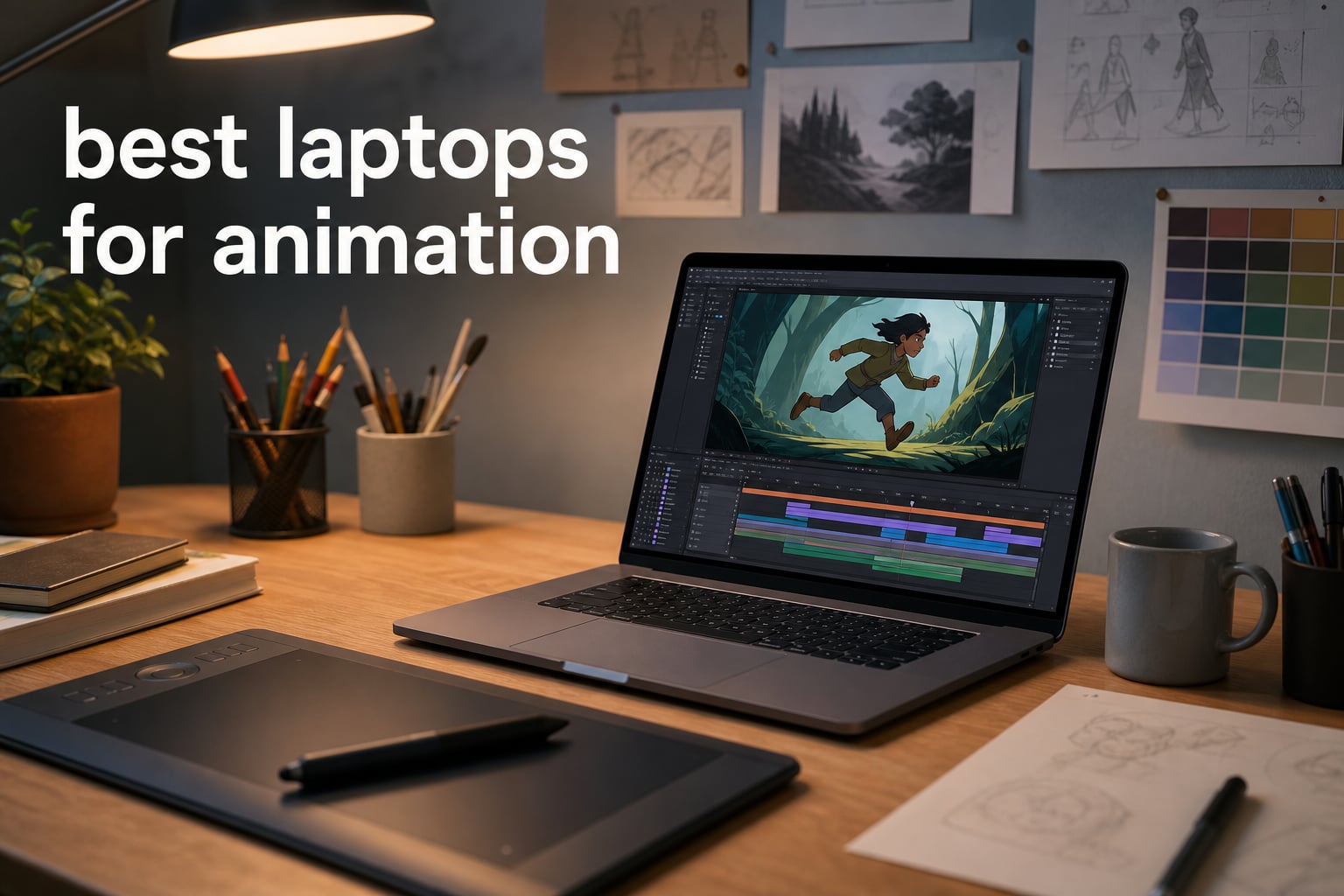
The best laptops for animation balance three things that are easy to separate on a spec sheet but hard to live with: fast previews, enough memory for big project files, and a display you can trust. A frame-by-frame 2D project, an After Effects composition, and a Blender scene all put pressure on a laptop in different ways.
For this guide, I compared all eight available configurations by their listed processor, graphics, RAM, SSD, display, ports, weight, and buyer feedback. The short answer is simple: choose dedicated Nvidia graphics for demanding 3D work, and prioritize memory, display quality, and battery life when your animation is mostly 2D, illustration, or motion design.
That distinction matters. Forum discussions repeatedly show that animators get stuck between a portable notebook and a powerful rendering machine, then discover that an older ultralight system cannot keep pace with their scene files. I would start with your software and the complexity of your projects, not a brand name.
Table of Contents
Top 3 picks answer most animation workflows in 2026
These three cover the widest range of creative needs. The Lenovo Yoga Pro 9i is the balanced choice because it pairs 32GB of memory and an RTX 5060 with a high-resolution OLED touch display; the Lenovo Legion Pro 7i is the clear pick for GPU-heavy 3D scenes; and the MacBook Air is the light, long-running option for mobile 2D work.
Every choice below has a different compromise. That is useful because the same laptop should not be recommended to someone drawing roughs in a café and someone rendering a complex character animation in Blender.
Best laptops for animation in 2026 at a glance
Use this overview as a quick filter, then read the full notes for the software and workflow fit. Listed specifications matter more than generic labels such as “creator” or “gaming” laptop.
| Product | Specifications | Action |
|---|---|---|
 Lenovo Yoga Pro 9i 16 Lenovo Yoga Pro 9i 16 |
|
Check Latest Price |
 Apple MacBook Air 15-inch M5 Apple MacBook Air 15-inch M5 |
|
Check Latest Price |
 NIMO N158 NIMO N158 |
|
Check Latest Price |
 ASUS ROG Strix G16 ASUS ROG Strix G16 |
|
Check Latest Price |
 Acer Aspire 14 AI Acer Aspire 14 AI |
|
Check Latest Price |
 Apple MacBook Pro 16 M1 Pro Apple MacBook Pro 16 M1 Pro |
|
Check Latest Price |
 Acer Predator Triton Neo 16 Acer Predator Triton Neo 16 |
|
Check Latest Price |
 Lenovo Legion Pro 7i Gen 10 Lenovo Legion Pro 7i Gen 10 |
|
Check Latest Price |
1. Lenovo Yoga Pro 9i 16 is the best overall color-focused choice
Lenovo Yoga Pro 9i, Ultra 9, RTX 5060, 32GB RAM, 1TB SSD, 3.2K Tandem OLED
Ultra 9
RTX 5060 8GB
32GB
3.2K OLED
Pros
- RTX 5060 with 8GB VRAM
- 32GB fast memory
- 100% Adobe RGB and DCI-P3 OLED
- 1TB Gen4 SSD
Cons
- Memory is soldered
- Small review sample
The Yoga Pro 9i makes the strongest all-round case because its component list addresses both viewport work and color-critical finishing. The Intel Ultra 9 285H, 32GB of LPDDR5X memory, and RTX 5060 Laptop GPU with 8GB GDDR7 give Blender, Maya, and GPU-accelerated motion-graphics workflows far more headroom than an integrated-graphics notebook.
I particularly like that the 16-inch 3200 by 2000 Tandem OLED is not just high resolution. Its listed 100% Adobe RGB, 100% DCI-P3, and 100% sRGB coverage, HDR 1000 True Black certification, 120Hz refresh rate, and touch layer speak directly to digital painters and animators who want to check color and draw without moving to a second screen.
The display makes this a strong color-review workstation
A color-rich screen does not replace color management, but it gives you a better starting point than a basic panel. This is a sensible fit for artists who switch among visual development, 2D animation, compositing, and 3D layout on one computer.
The fixed memory is the decision point to check first
The listed 32GB RAM is a healthy amount for serious animation work, yet it is soldered and capped at 32GB. Pick it when that capacity matches your typical scenes; do not expect to add memory later if your work grows into large simulations or many simultaneous applications.
2. Apple MacBook Air 15-inch with M5 is the light mobile 2D pick
Apple 2026 MacBook Air 15-inch Laptop with M5 chip: Built for AI, 15.3-inch Liquid Retina Display, 16GB Unified Memory, 512GB SSD, 12MP Center Stage Camera, Touch ID, Wi-Fi 7; Midnight
M5 chip
16GB memory
15.3-inch Retina
512GB SSD
Pros
- Light 3.32-pound build
- up to 18-hour listed battery
- large Liquid Retina display
- Thunderbolt 4 and MagSafe
Cons
- 16GB base memory
- 512GB SSD can fill quickly
For artists whose day involves drawing, storyboard revision, 2D frame-by-frame work, and lighter timeline editing, the 15-inch MacBook Air offers an unusually mobile working surface. It weighs 3.32 pounds and has a listed battery life of up to 18 hours, which directly answers the common need to work away from an outlet.
The M5 chip, 16GB unified memory, 512GB SSD, and 15.3-inch Liquid Retina display with support for one billion colors create a tidy package for macOS-based creative work. I would view it as a laptop for 2D animation and general creative production rather than a replacement for a dedicated-GPU 3D rendering system.
The large screen and low weight favor location-based work
Fifteen inches provides welcome room for a timeline and reference window without the bulk of a large workstation. Two Thunderbolt 4 ports, MagSafe, a headphone jack, Wi-Fi 7, and Bluetooth 6 round out a practical portable setup.
The memory and storage limit heavy scene ambitions
Sixteen gigabytes can be workable for focused projects, but it leaves less room for complex After Effects work, large raster files, and many apps at once. The 512GB SSD also merits a storage plan, especially if you retain image sequences, caches, exports, and source footage locally.
3. NIMO N158 is the flexible-memory option for lighter animation
NIMO 15.6 Gaming-Creator-Laptop, 8-Core AMD Ryzen 7 8745HS 32GB RAM 1TB SSD (Beat i7-1360P up to 4.9GHz) Radeon 780M, FHD 100W Fast PD for Video Editing, AI Tasks & Remote Streaming, 2-Yr Warranty
Ryzen 7
Radeon 780M
32GB RAM
1TB SSD
Pros
- 32GB RAM can reach 64GB
- dual-SSD support
- USB4 and HDMI 2.1
- 100W fast charging
Cons
- Integrated graphics
- limited review history
The NIMO N158 earns its place because it starts with 32GB DDR5 memory and 1TB of PCIe 4.0 storage, then offers room to expand memory to 64GB and support dual SSDs. That capacity focus is practical for 2D artists who keep large project folders, cache-heavy editing apps, and reference material open together.
Its Ryzen 7 8745HS has eight cores and reaches up to 4.9GHz, while Radeon 780M graphics handle display and lighter creative tasks. I would be careful not to treat integrated Radeon graphics as equivalent to the RTX machines above or below it for a laptop for Blender, GPU render engines, or large real-time 3D scenes.
The expansion path is the reason to consider this model
Animation projects often become larger after a semester, a new client, or a longer film. Being able to add memory and use two SSDs gives this laptop a more forgiving path than a fixed-memory design, based on the listed specifications.
The screen and graphics define the workload ceiling
The 15.6-inch FHD display and 180-degree hinge can suit a desk or shared studio, but no color-gamut figure is listed. Pair that with integrated graphics, and this is better for drawing, editing, 2D animation, and learning than intensive 3D rendering.
4. ASUS ROG Strix G16 is the dedicated-GPU Windows performance pick
ASUS ROG Strix G16 (2025) Gaming Laptop, 16” FHD+ 16:10 165Hz/3ms, NVIDIA® GeForce RTX™ 5060, Intel® Core™ i7 Processor 14650HX, 16GB DDR5, 1TB Gen 4 SSD, Wi-Fi 7, Windows 11 Home, G615JMR-AS74
Core i7
RTX 5060 8GB
16GB RAM
165Hz screen
Pros
- RTX 5060 dedicated graphics
- tri-fan cooling
- 1TB Gen4 SSD
- 165Hz display
Cons
- Only 16GB RAM
- listed battery life is 2 hours
The ROG Strix G16 brings a Core i7 14650HX and RTX 5060 Laptop GPU with DLSS 4 and Max-Q into a Windows notebook designed to keep its hardware cool. For animators using Blender or Maya, a dedicated Nvidia GPU is the headline feature because it offers 8GB of listed graphics memory and a more suitable starting point for GPU-assisted viewport work than integrated graphics.
Its 16-inch 1920 by 1200, 165Hz, 3ms display should feel responsive while scrubbing a timeline or checking fast action. The 1TB PCIe Gen 4 SSD is also a good baseline for active project files, and Wi-Fi 7 may help in studios that move work between network storage and laptops.
The cooling design favors plugged-in production sessions
ROG Intelligent Cooling uses tri-fan technology and liquid metal, which is meaningful when a CPU and GPU are both under load. I would use this as a desk-based animation laptop where sustained performance matters more than silence or minimal visual styling.
The 16GB memory ceiling needs honest consideration
The listed 16GB DDR5 memory is the main concern, and the specification says that is the maximum. It can suit focused modeling or animation exercises, but 32GB is the more comfortable target for demanding compositions, large scene files, or a broad multitasking workflow.
5. Acer Aspire 14 AI is the compact touch-screen companion
Acer Aspire FHD Touchscreen Laptop, Intel Ultra 7 258V, 32GB RAM, 1TB SSD
Core Ultra 7
Arc graphics
32GB RAM
14-inch touch
Pros
- 32GB RAM in compact body
- 1TB SSD
- touchscreen and hub
- 3.09-pound weight
Cons
- Integrated graphics
- 14-inch FHD display
The Acer Aspire 14 AI is built around mobility rather than raw 3D rendering power. It pairs an Intel Core Ultra 7 258V with an NPU rated at 47 TOPS, Intel Arc 140V integrated graphics, 32GB LPDDR5X memory, and 1TB PCIe storage in a 3.09-pound chassis.
That combination makes sense for planning shots, drawing roughs, reviewing dailies, script and layout work, and moderate 2D animation. The 14-inch 1920 by 1200 touchscreen can be useful for direct interaction, though a stylus is not listed in the available product details, so I would confirm your desired pen workflow separately.
The included hub makes small-studio setup easier
The supplied 8-in-1 USB hub includes HDMI, USB-A, USB-C, SD card, and Ethernet connections according to the listing. That is handy when a compact laptop needs to connect to an external display, card media, a wired network, or studio peripherals without filling your bag with adapters.
The integrated GPU suits 2D tasks rather than intense rendering
Do not let the “AI” label obscure the graphics choice: Intel Arc 140V is integrated graphics. I would choose this machine for portable creative administration and 2D production, then move GPU-rendering and demanding 3D work to a laptop with an RTX GPU.
6. Apple MacBook Pro 16-inch M1 Pro is the established macOS workhorse
Apple 2021 MacBook Pro with Apple M1 Pro Chip (16-inch, 32GB RAM, 1TB SSD Storage) Space Gray (Renewed)
M1 Pro
32GB memory
16.2-inch XDR
1TB SSD
Pros
- 32GB unified memory
- large Liquid Retina XDR display
- HDMI and SDXC ports
- up to 21-hour listed battery
Cons
- Renewed condition
- no touchscreen
- macOS adjustment for Windows users
This renewed MacBook Pro brings a configuration many creative professionals will recognize: M1 Pro, 32GB unified memory, 1TB storage, and a 16.2-inch Liquid Retina XDR display with 3456 by 2234 resolution. Those ingredients remain relevant for After Effects, 2D animation, editing, and broad macOS creative workflows where ample memory and a large screen are more important than a touch panel.
The listed port selection is unusually convenient for a Mac laptop: three Thunderbolt 4 ports, HDMI, SDXC, MagSafe 3, and a headphone connection. I also appreciate the stated six-speaker system and 1080p camera for remote reviews or a small edit suite.
The 32GB memory supports layered creative work
Memory is a major difference between this and entry ultralight laptops. Thirty-two gigabytes gives a more comfortable base for a laptop for After Effects, layered illustration files, browser research, audio, and the assets that tend to collect around an animation project.
The renewed status deserves a careful inspection
The product is explicitly renewed, and the listing says cosmetic wear may be present. Check the exact seller condition, battery information where available, return terms, and your required software compatibility before treating it as the long-term center of a production workflow.
7. Acer Predator Triton Neo 16 is the calibrated Windows creator display pick
Acer Predator Triton Neo 16 Gaming Creator Laptop | 16″ WQXGA+ 165Hz Calman Verified | AI-Powered | Intel Core Ultra 9 processor 185H | NVIDIA GeForce RTX 4070 | 32GB LPDDR5X | 1TB SSD | PTN16-51-932N
Core Ultra 9
RTX 4070 8GB
32GB RAM
Calman display
Pros
- RTX 4070 with 8GB VRAM
- Calman Verified 3200x2000 screen
- 32GB memory
- Thunderbolt 4
Cons
- 4.52-pound weight
- limited review count
The Predator Triton Neo 16 is a focused creator-gaming crossover that gets the fundamentals right for 3D production: an Intel Core Ultra 9 185H, RTX 4070 with 8GB GDDR6, 32GB LPDDR5X memory, and a 1TB PCIe Gen 4 SSD. Those specifications make it a credible option for animation artists who prefer Windows tools and want dedicated Nvidia graphics without dropping to 16GB system memory.
Its 16-inch 3200 by 2000 WQXGA+ panel is Calman Verified, runs at 165Hz, and has a 3ms overdrive response time. I would put more value on the calibration claim and resolution for animation than the gaming-oriented refresh figure, although smooth screen response is welcome during playback.
The calibrated panel supports color-aware review work
Calman verification is a useful sign for artists who care about how artwork appears on screen, though it does not replace a disciplined color-managed pipeline. The additional vertical pixels from the 16:10-style 3200 by 2000 workspace also help when a timeline, layers, and reference need to coexist.
The weight makes this portable power rather than an ultralight
At 4.52 pounds, this is transportable between home, class, and a studio, but it is not a featherweight bag companion. The AeroBlade fan design, liquid metal thermal grease, Thunderbolt 4, HDMI 2.1, and microSD reader make more sense for someone who carries a capable work machine deliberately.
8. Lenovo Legion Pro 7i Gen 10 is the heavy 3D rendering choice
Lenovo Legion Pro 7i Gen 10 16″ Gaming Laptop (2025 Model) Intel Core Ultra 9 275HX 24C, NVIDIA GeForce RTX 5080 16GB, 32GB RAM, 1TB Gen 5 NVMe SSD, 16.0″ WQXGA OLED 500 nits 240Hz, Windows 11 Home
Ultra 9 24-core
RTX 5080 16GB
32GB RAM
240Hz OLED
Pros
- RTX 5080 with 16GB VRAM
- 24-core Ultra 9
- 100% DCI-P3 OLED
- Gen5 SSD
Cons
- 6-pound weight
- non-touch display
- small review sample
If your work centers on complex 3D scenes, GPU rendering, visual effects, or simulations, the Legion Pro 7i is the clearest performance-first recommendation here. Its Core Ultra 9 275HX is listed with 24 cores, while the RTX 5080 has 16GB GDDR7 VRAM, a much larger graphics-memory allocation than the 8GB RTX configurations in this guide.
The rest of the configuration supports that direction: 32GB DDR5-6400 memory, a 1TB PCIe Gen 5 SSD, and a 16-inch 2560 by 1600 OLED panel with 100% DCI-P3, 500 nits, HDR 1000 True Black, and a 240Hz refresh rate. This is the laptop I would shortlist first when heavy 3D animation and rendering outweigh the need for a lightweight daily carry.
The 16GB VRAM is the standout specification for demanding scenes
VRAM holds graphics data used by the GPU, so scene complexity, textures, geometry, and render settings can make it a real constraint. A listed 16GB gives this machine more room for graphics-heavy work than the 8GB dedicated-GPU options, though project design still determines what will fit.
The size and power supply shape the travel trade-off
The 6-pound chassis and 400W power supply point to a mobile workstation-style role rather than casual travel. It can move with you, but I would plan for a desk, wall power, and a bag that accommodates a larger laptop if this is your primary animation system.
Choose animation laptop hardware by the work you actually make
The fastest way to narrow this list is to identify whether your day is primarily 2D, motion graphics, or 3D. Animation students and working artists often hear one blanket recommendation, but the right hardware changes with the renderer, scene scale, output format, and need to work away from a desk.
2D animation needs memory, screen space, and dependable mobility
For frame-by-frame animation, storyboarding, digital painting, and layout, a comfortable display, enough RAM, and a responsive SSD are usually more helpful than the biggest graphics card. The MacBook Air and Acer Aspire 14 AI fit a lightweight 2D-first role, while the Yoga Pro 9i offers a richer display and dedicated GPU if your tasks cross into compositing or 3D.
Sixteen gigabytes can support a simple, disciplined workflow, but 32GB leaves more breathing room for drawing software, a browser, reference boards, a video call, and a project file at the same time. If you work from a studio, a larger laptop screen or an external monitor also makes long timeline sessions much easier on the eyes.
3D animation needs dedicated graphics and enough VRAM
Blender, Maya, character rigs, 3D modeling, and GPU rendering gain the most from a dedicated Nvidia GPU. The ASUS ROG Strix G16 and Lenovo Yoga Pro 9i list RTX 5060 graphics with 8GB VRAM, the Acer Triton Neo has an RTX 4070 with 8GB, and the Legion Pro 7i lists an RTX 5080 with 16GB.
Think of VRAM as the GPU’s working area. More of it does not make every project faster by itself, but it can matter when high-resolution textures, dense geometry, lighting, effects, and rendering data need to remain available to the graphics processor.
CPU cores help with simulation, encoding, and responsive multitasking
GPU power is not the whole story. Animation software also uses the CPU for tasks such as simulation, asset processing, encoding, and parts of rendering, which is why the Core Ultra 9 and Ryzen 7 configurations deserve attention alongside the graphics card.
For heavy projects, I would favor a modern high-core-count CPU, 32GB of RAM, and a dedicated GPU over a thin chassis with impressive marketing language. The Legion’s listed 24-core Ultra 9 is the strongest raw CPU specification in this group, while the Yoga Pro 9i and Triton Neo 16 offer balanced high-performance processor-and-GPU pairings.
RAM should match the number of apps and assets you keep open
RAM affects how comfortably you can keep a scene, caches, brushes, reference, web resources, and editing tools active together. A 32GB configuration is the safer practical target for ambitious animation, and the NIMO is notable because the listing says its 32GB DDR5 can be upgraded to 64GB.
Fixed memory is not automatically a problem, but it makes upfront selection more important. The Yoga Pro 9i has soldered 32GB, the ROG Strix G16 is listed with a 16GB maximum, and the MacBook choices use unified memory, so buy according to the largest workflow you reasonably expect to run.
Display color and resolution affect every frame you judge
Color accuracy is not a decorative feature when you paint, grade, or deliver visuals for other screens. The Yoga Pro 9i lists full Adobe RGB, DCI-P3, and sRGB coverage; the Legion lists 100% DCI-P3; and the Triton Neo’s panel is Calman Verified.
Resolution also affects workspace. A 3200 by 2000 or 2560 by 1600 display lets you keep more panels visible, while a basic FHD panel remains workable but offers less room for a timeline and layer stack. Touch can help a direct drawing workflow, but only the presence of a touchscreen is confirmed for the Yoga Pro 9i and Acer Aspire; pen compatibility should be checked separately.
Storage and ports keep a laptop useful after the first project
Animation assets grow quickly through image sequences, audio, textures, render caches, and exports, making 1TB a sensible starting point across most of these configurations. The NIMO adds potential dual-SSD support, and the Legion lists two available M.2 slots, which may help people who prefer to separate active work from archives.
Ports are a quiet but important part of an animation setup. Thunderbolt 4, HDMI, SD card access, USB-C, and Ethernet can reduce adapter juggling when you connect external displays, fast drives, card media, or a wired studio network; the MacBook Pro and Legion have especially varied listed connections.
Portability matters only if it matches your real schedule
Community discussions make this trade-off clear: it is frustrating to carry a heavy machine every day if most tasks are simple, and equally frustrating to bring a thin machine to a render-heavy project. The 3.09-pound Acer Aspire and 3.32-pound MacBook Air are the easy-carry choices, while the 6-pound Legion puts performance first.
Battery figures should be treated as usage-dependent. The MacBook Air lists up to 18 hours and the MacBook Pro lists up to 21 hours, whereas the ROG Strix G16 listing says 2 hours; GPU-heavy animation and rendering will make wall power part of the plan for any high-performance laptop.
Frequently asked questions answer the final laptop choice
Which laptop is best for making animation?
The Lenovo Yoga Pro 9i 16 is the most balanced choice here for animation because it combines an Intel Ultra 9 processor, RTX 5060 graphics with 8GB VRAM, 32GB RAM, 1TB SSD, and a 3.2K OLED display with listed Adobe RGB, DCI-P3, and sRGB coverage. Choose the Lenovo Legion Pro 7i instead when heavy GPU rendering and 16GB VRAM are the priority.
What should I look for in a laptop for animation?
Look for 32GB RAM when projects are demanding, a fast 1TB SSD, a color-aware display, and a dedicated Nvidia GPU for 3D animation, Blender, Maya, or GPU rendering. For 2D work, screen quality, memory, storage, and battery life usually matter more than maximum graphics power. Check VRAM, ports, and laptop weight against your actual work routine.
What is the best computer for animation?
The best computer depends on the project. A dedicated-GPU laptop such as the Lenovo Legion Pro 7i or Lenovo Yoga Pro 9i fits heavy 3D animation, while the Apple MacBook Air and Acer Aspire 14 AI suit portable 2D work. A desktop can offer more expansion and sustained power, but a laptop is better when you need to work in several locations.
Is a PC or laptop better for animation?
A desktop PC is usually better for long rendering sessions, larger upgrades, and maximum cooling. A laptop is better for classes, travel, client reviews, and a small workspace. For 3D, choose a laptop with a dedicated GPU and at least 32GB RAM; for 2D, a lighter model with a good display can be the more sensible tool.
The right animation laptop is the one that fits your software
For the best laptops for animation in 2026, my balanced recommendation is the Lenovo Yoga Pro 9i 16 for its RTX 5060, 32GB memory, and exceptionally specified OLED display. Pick the Legion Pro 7i when 16GB VRAM and a 24-core processor serve your 3D work, or the MacBook Air when portable 2D production and long listed battery life matter more.
Before you choose, write down your software, largest project type, storage habits, and how often you work away from power. That small checklist will make the trade-offs in this list much clearer.