
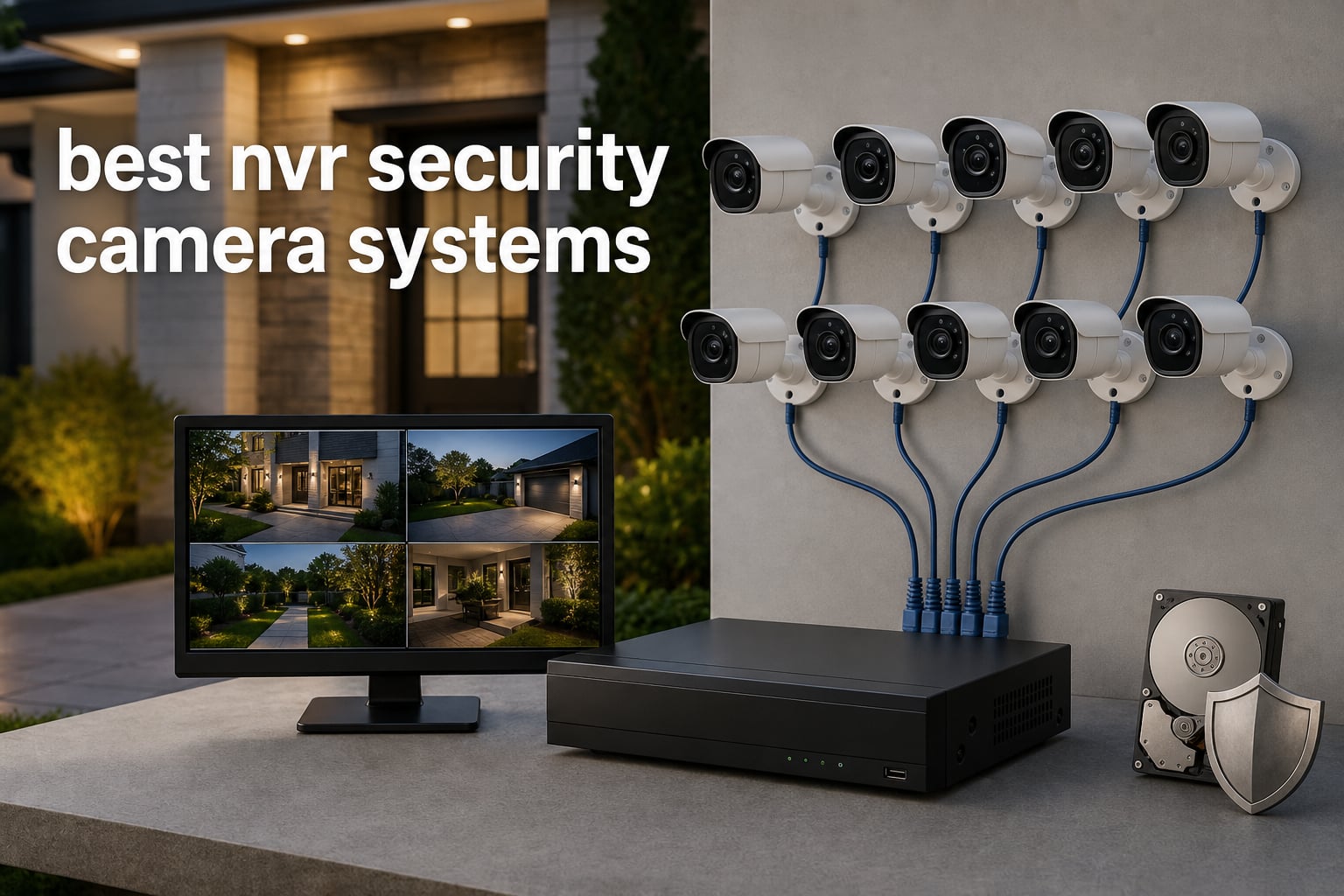
The best NVR security camera systems give you a central recorder, wired or network-connected cameras, and local video storage that stays under your control. That combination is a strong fit when you want continuous recording, a view of several areas at once, and no dependence on a cloud-only camera plan.
An NVR, or network video recorder, receives video from IP cameras and stores it on a hard drive. In a PoE security camera setup, one Ethernet cable carries both data and power to each camera, which is why PoE is often easier to manage over a long camera run than a separate power lead plus a WiFi connection.
I compared the eight available systems by the hardware that actually ships with each listing: camera count, stated resolution, channel capacity, drive capacity, night-vision specifications, audio, AI detection, and weather ratings. I also weighed ratings and review volume, while treating them as a useful signal rather than a substitute for matching a system to your property.
One point matters before any shortlist: local recording does not mean remote viewing works without setup. You will still need to connect the NVR to your router and follow the maker’s app instructions if you want live video away from home; the recorder can otherwise keep recording on the local drive.
Forum discussions repeatedly raise the same issues: subscriptions, confusing first-time configuration, storage that fills quickly with high-resolution footage, weak night vision, and cameras that do not work with a hoped-for third-party recorder. The picks below address those questions directly, including where the listing leaves an important limitation.
Table of Contents
The top 3 picks are the REOLINK 16CH 12MP, OOSSXX monitor kit, and eufy S4 Max (August 2026)
The REOLINK RLK16-1200D8-A leads for its 12MP cameras, 16 PoE ports, 4TB drive, and a stated path to 24 channels. The OOSSXX stands out for including a 10.2-inch IPS monitor, while eufy’s S4 Max is the specialist choice when PTZ movement, auto zoom, and cross-camera tracking matter more than a conventional fixed-camera kit.
These are not interchangeable picks. Choose the REOLINK when you need high-detail fixed-camera coverage and room to add cameras, the OOSSXX when an included screen simplifies the control station, and the eufy when active tracking is central to the job.
The best NVR security camera systems in 2026 cover different property layouts
Use this overview to narrow the field before reading the detail. Camera resolution and channel capacity are only part of the decision: a 16-channel recorder is useful only if its included cameras, cable routes, and storage plan suit the areas you need to cover.
| Product | Specifications | Action |
|---|---|---|
 REOLINK RLK16-1200D8-A REOLINK RLK16-1200D8-A |
|
Check Latest Price |
 OOSSXX 4K 8CH Monitor Kit OOSSXX 4K 8CH Monitor Kit |
|
Check Latest Price |
 eufy Security S4 Max eufy Security S4 Max |
|
Check Latest Price |
 Anpviz 16CH 6MP System Anpviz 16CH 6MP System |
|
Check Latest Price |
 ZOSI 4K 8-Camera System ZOSI 4K 8-Camera System |
|
Check Latest Price |
 REOLINK RLK8-1200V4 REOLINK RLK8-1200V4 |
|
Check Latest Price |
 Hiseeu 4K PoE PTZ System Hiseeu 4K PoE PTZ System |
|
Check Latest Price |
 ANNKE 16CH WiFi NVR Kit ANNKE 16CH WiFi NVR Kit |
|
Check Latest Price |
A fixed lens suits a gate, entrance, or driveway when you can frame the scene at installation. A pan-tilt-zoom camera can cover a changing scene, but it also changes channel planning; eufy says its PTZ camera uses two channels per camera.
1. The REOLINK RLK16-1200D8-A is the strongest pick for high-detail expansion
REOLINK 16CH 12MP PoE Security Camera System with 4TB HDD RLK16-1200D8-A
12MP cameras
16 PoE ports
4TB HDD
Pros
- 12MP detail
- 8 cameras included
- 24-channel expansion
- person vehicle pet alerts
- 100 foot night vision
Cons
- 93 degree view
- app and motion feedback varies
This REOLINK kit makes the clearest case for buyers who want a large wired system from day one. It includes eight 12MP PoE cameras, a 16-channel NVR with 16 PoE ports, and a 4TB drive; the listing also states that the recorder can expand to 24 channels.
Its 12MP capture specification is 4512 by 2512, which gives more detail than the 4K and 6MP systems here when a subject occupies a small part of the frame. I would still plan camera placement carefully because the stated 93-degree viewing angle is narrower than several alternatives, including the OOSSXX and the REOLINK dome kit.
Person, vehicle, and pet detection can make alerts more meaningful than generic motion alone. The system also lists spotlight color night vision, two-way talk, H.265 compression, and motion, schedule, or 24/7 recording modes, so it has the tools for an actively monitored entry as well as a continuous-recording perimeter.
The rating is 4.3 from 326 reviews, the largest review count in this group. The available review summary praises the resolution and camera count, but it also reports concerns about motion-detection accuracy and app performance, so I would use the return window to check notifications on the exact phones used in your household or business.
This system fits expanding properties that need fixed-camera detail
Pick this one when eight cameras are a sensible starting point and you expect to add coverage later. Its port count and stated expansion capacity make more sense for a large property, multiple entrances, or a small business than a four-camera kit.
The 4TB drive is a practical starting capacity, but high-detail 12MP video makes recording settings important. Set retention expectations after deciding which cameras need 24/7 recording and which can record on events, rather than assuming every camera should use the same mode.
This system needs thoughtful framing and app verification
A 93-degree lens may need more deliberate placement to cover a broad driveway or wide yard. It can be an advantage if you want a tighter view of an entrance, but it is not the widest option in this roundup.
The reviewer feedback on motion alerts and the app does not prove every installation will have that experience. It does make a real setup check sensible: confirm push alerts, playback, user permissions, and remote viewing before drilling the final camera locations.
2. The OOSSXX 4K monitor kit is the simplest PoE option for a dedicated viewing station
4K Wired PoE Security Camera System Outdoor, 8CH NVR with 10.2" IPS Monitor
4K cameras
10.2 inch IPS monitor
1TB HDD
Pros
- Monitor included
- 130 degree view
- AI human detection
- two-way audio
- plug and play PoE
Cons
- 15 fps
- 65 foot night vision
- limited review history
The OOSSXX listing combines an eight-channel NVR, four 4K cameras, a 1TB hard drive, and a 10.2-inch IPS monitor. That included display is its defining advantage: it gives a front desk, workshop, or home office a dedicated live-view screen without requiring a separate monitor or television.
The cameras are specified at 3840 by 2160 and a 130-degree viewing angle. That broad perspective can cover a wide front area with fewer cameras, although it will make subjects appear smaller at a distance than they would with a narrower lens pointed at the same scene.
AI human detection, two-way audio, IP66 weather resistance, and app access give this kit a useful set of practical features. It records at 15 frames per second and lists night vision to 65 feet, so I would not choose it for a situation where faster motion or a very long dark driveway is the first priority.
It has a 4.7 rating from 17 reviews. The review summary likes the supplied monitor and easy setup, while noting the night-vision range concern; that small review base is a reason to judge it mainly on the documented hardware fit for your installation.
This system suits buyers who want a screen at the recorder
The monitor makes a difference when someone needs to glance at live views without launching an app. It is especially sensible for a counter, garage work area, or office where the recorder will live close to the people using it.
Four cameras cover a compact home or a focused small-business layout well when the 130-degree view is used carefully. Draw the four intended sight lines first, including a face-height view at the main entrance rather than relying only on wide overhead angles.
This system calls for realistic expectations about motion and darkness
The stated 15 fps is less fluid than the 20 fps listed by both REOLINK systems in this guide, and the 65-foot night-vision figure is shorter than several 100-foot listings. Those limits may be inconsequential in a well-lit porch area, but they matter around faster activity or distant boundaries.
The listing says it is not smart-home compatible. If voice-assistant or platform integration is part of your plan, verify the exact integration before purchase rather than expecting app control to mean broad smart-home support.
3. The eufy Security S4 Max is the best active-tracking choice for a changing scene
eufy Security 4K NVR System S4 Max, 4-Cam, 2TB HDD, PoE Wired
4K triple lens
360 degree PTZ
2TB HDD
Pros
- Cross-cam tracking
- 8x auto zoom
- local AI agent
- smart video search
- two-way audio
Cons
- PTZ uses two channels
- 65 foot night vision
- app setup can be complex
The eufy S4 Max is less like a conventional all-fixed-camera NVR system. Its listed triple-lens bullet-PTZ camera pairs a 4K 122-degree fixed view with a 2K PTZ view, 360-degree pan, and 8x auto zoom, then adds live cross-camera tracking and smart video search.
That configuration has a clear purpose: preserve a broad overview while the PTZ view follows activity. The listing states that the PTZ camera consumes two channels per camera, a detail that has to be included when you calculate the up-to-16-channel expansion ceiling.
Its NVR includes a 2TB drive that eufy says can expand to 16TB. The local AI agent, two-way audio with AI noise reduction, IP65 weather protection, and 24/7, motion, or scheduled recording give it a substantial feature set without requiring cloud-based smart features.
The S4 Max has a 4.5 rating from 171 reviews. The available review notes favor the triple-lens approach, tracking, and video quality, while some buyers report app complexity and setup concerns; take time to map the fixed and PTZ views before mounting it high on an exterior wall.
This system is right for entrances and yards where activity moves
A fixed camera is excellent when the important area stays in one frame. This model is a better fit when a vehicle, visitor, or delivery path can move beyond that first frame and you want the system’s tracking features to follow it.
Its stated 122-degree wide view and 360-degree pan are most useful where there is open space to observe. A narrow side path or a single doorway may gain less from PTZ movement than a broader drive, front yard, or loading area.
This system requires channel planning before expansion
Do not treat “up to 16 channels” as 16 identical camera positions for this model. Because eufy states the PTZ camera uses two channels, its effective layout depends on how many of those cameras you intend to add.
The listed 65-foot night-vision range is also worth comparing with the distance from the intended mount to the farthest subject. For a remote gate farther away, a fixed camera with a stated 100-foot range may be a more direct fit.
4. The Anpviz 16CH system is built for large local-storage needs and eight-camera coverage
Anpviz 16 Channel NVR PoE Security Camera System, 12MP 4K 16CH NVR 4TB
16 channels
Eight 6MP cameras
4TB HDD
Pros
- Storage expands to 48TB
- 100 foot night vision
- H.265 plus compression
- built-in microphones
- AI detection
Cons
- Fixed lenses
- limited review count
- documentation feedback
Anpviz includes eight 6MP turret cameras, a 16-channel NVR, and a 4TB drive in this commercial-oriented kit. The NVR has two SATA interfaces and is listed as expandable to 48TB, a standout specification for anyone calculating retention across several continuous-recording cameras.
Each camera is specified at 3072 by 2048, with a 110-degree viewing angle, built-in microphone, IP66 weather resistance, and night vision to 100 feet. The recorder supports continuous, motion-detection, and schedule-based recording, with H.265+ compression to reduce the storage burden.
Human and vehicle detection can help cut down alerts caused by ordinary motion. Smart dual-light color night vision and remote access through the Guard Viewer app round out the kit, although a fixed lens always puts more weight on planning the final angle before installation.
The system has a 4.7 rating from 18 reviews. Review insights credit its video quality, setup, and AI detection, while documentation clarity is a recurring concern; I would label every cable run and complete basic recorder setup on a bench before the cameras go outdoors.
This system works for users who need long retention and many recorder channels
The stated 48TB maximum is meaningful for a site with several cameras and a requirement to keep footage longer. It does not automatically mean you need to fill every drive bay; it means the recorder has a growth route when your calculated retention calls for it.
Six-megapixel video may be sufficient for many gates, doors, and indoor spaces, especially when cameras are placed close enough to the identification point. The eight included cameras make it practical to cover several priority zones from the beginning.
This system needs a careful setup plan rather than a rushed install
The feedback about documentation means first-time NVR owners should allocate time for account setup, remote access, alert zones, and playback preferences. None of those tasks depend on ladder work, so completing them before final installation prevents frustrating adjustments outdoors.
Its fixed 110-degree lenses are broad but do not pan or zoom. Use a temporary mount or a helper holding the camera at the intended position to confirm that the frame captures the driveway approach, not just a vehicle after it has passed.
5. The ZOSI 4K eight-camera kit is a direct fit for full perimeter coverage with color night vision
ZOSI 4K POE CCTV Security Camera System,8pcs 4K POE Camera with AI Person Vehicle Detection, 8 Ports 16CH 8MP NVR with 2TB HDD for 24/7 Recording,Color Night Vision, Sound Light Alarm, Two-Way Audio
Eight 4K cameras
2TB HDD
16CH expansion
Pros
- Eight cameras included
- 100 foot color night vision
- AI person vehicle detection
- sound light alarm
- two-way audio
Cons
- Limited review count
- 16 ports are not included
- stock can vary
The ZOSI system starts with eight 4K PoE cameras and a 2TB hard drive, making it a sensible perimeter-focused option without adding cameras immediately. Its recorder is described as an eight-port, 16-channel 8MP NVR, so the included camera count and future channel capacity are different numbers by design.
Color night vision up to 100 feet is the central feature here, supported by a starlight sensor. It also combines AI person and vehicle detection with a sound-and-light alarm and two-way audio, which gives the owner options beyond recording an event after it happens.
Continuous recording is listed, which can be appealing for a driveway or business exterior where no activity should be missed. With eight 4K streams and a 2TB drive, though, retention will depend on the selected recording mode, bitrate, activity, and compression settings.
The system carries a 4.7 rating from 12 reviews. Review insights specifically favor color night vision and AI detection, but this is a small sample, so the published capability list should lead the decision rather than the rating alone.
This system makes sense for eight planned camera positions
Use it when you already know you need a camera at each major entrance, the driveway, a rear access point, and other perimeter lines. Getting eight cameras in the initial package helps keep image quality and control in one NVR environment.
The stated ability to expand to 16 channels leaves a path to add cameras later. Verify how additional cameras connect and which models are supported before relying on that path, particularly if you want to mix brands or use existing IP cameras.
This system benefits from a night-time lighting check
Color night vision can produce more usable color information than monochrome infrared when the scene and camera settings support it. Walk the property after dark to identify porch lights, vehicle lights, reflective signs, and any point where a spotlight or alarm could disturb neighbors.
The sound-and-light alarm is a feature to configure intentionally, not merely switch on everywhere. It may suit a closed business entrance well, while a frequently used family driveway could call for quieter detection notifications during active hours.
6. The REOLINK RLK8-1200V4 is the most durable dome-camera option for exposed areas
REOLINK 12MP Vandalproof Security Camera System with 2TB HDD RLK8-1200V4
12MP dome cameras
IK10 and IP67
2TB HDD
Pros
- Vandal-resistant domes
- 12MP detail
- AI detection
- color and IR night vision
- two-way talk
Cons
- Four cameras only
- PT control unavailable in app
The RLK8-1200V4 is a four-camera 12MP PoE system built around dome cameras with IK10 vandal resistance and IP67 weather protection. That is a meaningful combination for cameras mounted within reach at a front door, a storefront, a shared hallway, or another location where impact resistance matters.
It includes a 2TB drive and an eight-channel NVR, and it supports motion, schedule, and 24/7 recording. The listed cameras add person, vehicle, and animal detection, two-way talk, adjustable warm lights for color night vision, and infrared LEDs for black-and-white night recording.
There is one specification conflict worth calling out: the product details list a 121-degree viewing angle, while the technical detail line calls it 145-degree wide angle. I would confirm the current manufacturer documentation for the exact lens field of view before using that number to decide camera spacing.
Its rating is 4.4 from 148 reviews, which is a useful amount of feedback compared with several newer kits. The available review summary is generally positive, with 70 percent five-star reviews, and it identifies the lack of app or client PT control as the listed limitation.
This system protects camera positions that face tampering or severe weather
IK10 is the deciding feature for this kit because it addresses impact resistance, while IP67 addresses dust and water ingress. Those ratings make more difference at a reachable door or exterior wall than they do for a camera mounted far above a garage door.
Dome cameras can also look less conspicuous than bullet cameras. That is a layout preference rather than a performance promise, but it can matter for an entry where you want wide coverage without a long protruding camera body.
This system fits four high-priority zones rather than a full eight-camera perimeter
Four cameras are enough for a compact property when each has a clear job: main entrance, driveway, rear entrance, and a side route. They are less suitable for a property that needs several wide yard views and multiple doors monitored at once.
Do not buy this for PTZ control; the listing specifically says PT control is not supported through the app or client. Its strengths are high-detail fixed dome coverage, AI detection, and physical resilience rather than remote camera movement.
7. The Hiseeu PoE PTZ system is the practical pick for auto-tracking across six cameras
Hiseeu 4K PoE PTZ Security Camera System, 6Pcs 5MP Wired Security Cameras
Six cameras
300 degree pan
3TB HDD
Pros
- Auto human tracking
- 300 degree pan
- 90 degree tilt
- 3TB storage
- two-way audio
- works without internet
Cons
- Setup can be complex
- 1920p listed capture
- PTZ planning required
Hiseeu’s system includes six wired cameras and a PoE NVR that is described as eight-port and expandable to 16 channels. Its headline distinction is PTZ movement: 300-degree pan, 90-degree tilt, and auto human tracking, backed by a 3TB hard drive for 7/24/365 recording.
The product data lists a 4K 8MP NVR but records a 1920p video-capture resolution in the product details. I would treat that distinction seriously and confirm the resolution of the supplied camera model before purchase, since recorder capability and camera output are not automatically the same thing.
Real-time two-way audio, intruder alarm lights, push alerts through the free app, and operation with or without internet are useful on-paper features. Local recording without internet can keep operating, while remote app viewing still depends on a working network connection.
This is one of the most reviewed systems here, with a 4.2 rating from 658 reviews. The review summary is generally positive but specifically says that some users find setup complex, which matches the common forum warning that PTZ features add configuration steps beyond mounting a basic fixed camera.
This system covers active areas where automatic movement tracking matters
Auto tracking makes most sense in a yard, open drive, or other space where a person can move across a broad frame. It is less compelling at a doorway where a fixed camera can already keep the important face-height area in view.
The 3TB drive is helpful for continuous recording, but capacity needs should still be calculated from the actual camera streams and settings. Start by checking how much footage a normal day produces, then use that result to decide whether continuous or event recording is appropriate per camera.
This system rewards a methodical first-time configuration
Set up the recorder, create app access, name each camera, and test tracking indoors or at a low mounting height before running every cable. That sequence gives you time to learn the menus without making later adjustments from a ladder.
PTZ auto tracking should be tested against the actual scene, including trees, traffic, and people moving near the boundary of the view. A feature that follows intended activity well in one setting can create distracting movement in another if detection zones are not tuned.
8. The ANNKE 16CH WiFi NVR kit gives broad twelve-camera coverage without video Ethernet runs
ANNKE Wireless Security Camera System 2TB Hard Drive, 16CH 4K WiFi NVR Kit
12 cameras
Dual-band WiFi
2TB HDD
Pros
- Twelve cameras included
- 2.4 and 5.8GHz WiFi
- AI human alerts
- two-way audio
- 100 foot infrared vision
Cons
- Power cables still required
- manual 24/7 activation
- mixed reviewer feedback
The ANNKE kit is the outlier in this roundup because its camera connection is wireless rather than PoE. It pairs a 16-channel WiFi NVR with 12 indoor/outdoor cameras, dual-band 2.4 and 5.8GHz WiFi, and a 2TB hard drive that the listing says can expand to 8TB.
It is marketed as a 4K WiFi NVR kit with 2K cameras, while the product details state 3MP video capture. Rather than assume those labels describe the same effective output, confirm the exact camera resolution and NVR display or recording specification that applies to the set you receive.
Two-way audio, AI human detection, 100-foot infrared vision, 33-foot full-color night vision, metal housings, and IP66 weather protection make the feature set broad. The listing also notes that 24/7 recording needs manual activation, a small but important task to complete during setup.
The ANNKE has a 4.1 rating from 300 reviews. The review breakdown is mixed, with 66 percent five-star feedback and 16 percent one-star feedback, so I would give extra weight to network planning, camera placement, and an early full-system test rather than relying on the headline camera count.
This system helps when Ethernet video runs are not practical
WiFi cameras can reduce the need to route a data cable back to the recorder, which is useful in finished spaces where a long cable path is difficult. They still require power cables, so “wireless” does not mean the cameras can be placed anywhere without planning an outlet or power route.
Twelve cameras and 16 channels make this a wide-coverage starting package. Map the WiFi signal at each intended camera location before mounting, because distance, walls, and interference can affect a wireless camera even when your phone shows a good signal nearby.
This system needs a stronger network check than a PoE kit
PoE provides a physical camera connection that is usually more predictable for continuous video. With this WiFi system, test live video, playback, and alerts from all 12 camera positions at the same time, not just from one nearby camera.
Use the dual-band option intentionally: a band that reaches farther may not be the best choice in a crowded wireless environment, while the other band may offer a cleaner connection over a shorter path. Keep the NVR and router placement open and as central as the property allows.
The right NVR system depends on coverage, storage, wiring, and camera compatibility
The fastest way to choose is to begin with the property, not the product label. Mark every entrance, driveway approach, gate, vehicle area, and interior choke point; then decide what event you need each camera to show, such as a face at a door or a vehicle entering a drive.
The correct channel count is the number of cameras you need plus room for change
An eight-channel NVR supports up to eight camera channels, while a 16-channel NVR supports up to 16, subject to the manufacturer’s rules. Channel count is not the camera count in the package: the OOSSXX includes four cameras on an eight-channel recorder, and the ZOSI includes eight cameras while listing 16-channel expansion.
Start with fixed coverage needs rather than filling every port. Four well-framed cameras can identify activity better than eight cameras pointed too widely, while an extra channel is useful for a future shed, gate, or side entrance.
PoE is usually the steadier route for continuous security video
Power over Ethernet sends power and data over one Cat5e or Cat6 cable. Each camera has a direct wired path to the NVR or PoE network equipment, which avoids depending on wireless signal strength for video transport.
PoE takes more installation effort because you must plan and run cable, but that work often pays off where walls, distance, or several cameras challenge WiFi. The ANNKE kit is a reasonable exception when video Ethernet runs are impractical, provided you plan its network and power routes carefully.
Resolution should match the identification distance, not just the largest number
Higher resolution can preserve more detail, but the camera still needs to be aimed and placed at a useful distance. A 12MP REOLINK camera can capture a detailed frame, yet a person far away in a very wide shot may still be too small for confident identification.
Use a tighter field of view for a doorway, gate, or lane where identification matters. Use a wider lens, such as the OOSSXX’s stated 130-degree view, for broad situational awareness, then add another camera where detail is needed.
Night vision needs a real after-dark site check
Infrared night vision is useful in darkness, while color night vision relies on available light, warm lights, spotlights, or a camera’s low-light capability. The listed range is a comparison point, but it is not a guarantee that every object at that distance will be equally clear.
Check for backlighting, reflective surfaces, moving headlights, streetlights, and trees. The ZOSI and both REOLINK systems list color-night options, while the OOSSXX and eufy list a 65-foot night-vision range, so scene distance can decide between otherwise capable systems.
Storage planning prevents the common surprise of short video retention
Hard-drive capacity alone does not tell you how many days of footage you will retain. Retention changes with camera count, resolution, frame rate, compression, motion in the scene, and whether you record continuously or only on events.
For a sensible first calculation, select the cameras that need 24/7 recording, then use motion or schedule recording where continuous footage is unnecessary. H.265 and H.265+ compression, listed on the REOLINK 16CH and Anpviz systems, are designed to reduce storage and bandwidth use, but they do not remove the need to check actual retention.
The Anpviz’s stated 48TB maximum is the largest expansion figure here, while eufy lists expansion to 16TB and ANNKE to 8TB. Those ceilings matter only if you foresee a retention requirement that the supplied drive cannot meet.
An NVR is different from a DVR because its cameras are network devices
An NVR records data from IP cameras over a network connection, usually Ethernet or PoE in a wired system. A DVR is generally associated with analog cameras and coaxial cable, with the recorder doing more of the video processing.
For a new multi-camera installation, an NVR camera system gives you IP-camera options, centralized recording, and common PoE wiring. Its trade-offs are network setup, cable routing, and the need to check camera compatibility; an NVR is not a universal recorder for any camera you already own.
Compatibility must be checked before mixing cameras and recorders
Some IP cameras use open standards such as ONVIF, but support can vary by feature, firmware, recorder setting, and manufacturer. A camera might show basic video on another recorder yet lose smart detection, audio, or configuration controls.
Use the maker’s current compatibility list for the specific NVR and camera model. This is particularly important if you are adding a third-party camera to the ZOSI, Anpviz, REOLINK, or Hiseeu recorder rather than using the cameras that ship with the kit.
Remote viewing needs a private account and a local test before you leave
Most of these systems list smartphone and computer access, but remote viewing has several parts: the recorder must be networked, the app must be linked correctly, and each user needs appropriate permissions. Change default passwords and use unique credentials before enabling remote access.
Then test live viewing, playback, alerts, and two-way talk from a mobile connection rather than only from the same home network. If any feature fails, solve it while you are near the recorder and can see whether the camera, NVR, router, or app is causing the issue.
DIY installation works best when the recorder is configured before final mounting
Connect one camera to the NVR on a workbench, name the channel, verify recording, and check night view before drilling or routing cables. Repeat the test once all cameras are connected, because a system that works with one stream can behave differently with several streams recording.
Keep the NVR in a dry, ventilated, harder-to-reach location with access to power and your network. Label both ends of every Ethernet cable, leave a service loop where appropriate, and use weather-rated routing practices for outdoor cable paths.
Local NVR storage can avoid subscriptions, but it is not a backup by itself
Several listed systems emphasize no monthly fees or local recording. That can reduce dependence on a cloud plan and keeps routine footage on the recorder, a point often favored by people discussing NVR systems in security forums.
Local storage is still physically located at the property, so consider what happens if the NVR is damaged, stolen, or its drive fails. If off-site preservation matters, investigate the exact backup, export, or FTP options supported by the model you select instead of assuming every NVR includes them.
FAQs
What is the best camera for NVR?
The best camera for an NVR is a compatible IP camera that matches the recorder, covers the required identification distance, and has the night vision and weather rating needed for its location. For a new wired installation, PoE cameras are a practical choice because one Ethernet cable carries power and video data. Confirm compatibility for the exact recorder and camera model before mixing brands.
Which NVR is best?
The best NVR depends on the camera count and job. The REOLINK RLK16-1200D8-A is the strongest overall option here for eight 12MP cameras, 16 PoE ports, 4TB storage, and stated expansion to 24 channels. The OOSSXX is better when an included monitor is important, while eufy S4 Max is better for PTZ tracking and smart video search.
What are the disadvantages of NVR?
NVR systems take more planning than a single WiFi camera because cameras need compatible network connections, cable routing or stable WiFi, recorder setup, and storage management. High-resolution continuous recording can fill a drive quickly. Third-party IP cameras may not support every feature on another brand’s recorder, and remote viewing requires network and account configuration.
What is the highest rated security camera system?
Among the eight systems compared here, the Anpviz 16CH system, OOSSXX 4K monitor kit, and ZOSI 4K eight-camera kit each have a 4.7 rating in the supplied product data. Ratings should be read alongside review count: OOSSXX has 17 reviews, ZOSI has 12, and Anpviz has 18. Match the system’s camera count, storage, and wiring to your site first.
The best overall choice is the REOLINK 16CH 12MP system for scalable wired coverage
For most buyers comparing the best NVR security camera systems, the REOLINK RLK16-1200D8-A offers the strongest combination of eight 12MP cameras, 16 PoE ports, a 4TB drive, and stated expansion to 24 channels. It is the most complete starting point when future camera growth and high-detail fixed coverage are central requirements.
Choose OOSSXX for an included monitor, eufy S4 Max for active PTZ tracking, Anpviz for its stated storage ceiling, ZOSI for eight-camera color night vision, REOLINK’s dome kit for IK10 and IP67 protection, Hiseeu for PTZ auto tracking, or ANNKE when wireless video links are the practical route.
Before ordering in 2026, map the camera views, measure cable paths or WiFi reach, decide what needs continuous recording, and confirm compatibility for every added camera. Those steps will do more for day-to-day security footage than choosing a system solely by its biggest resolution number.