
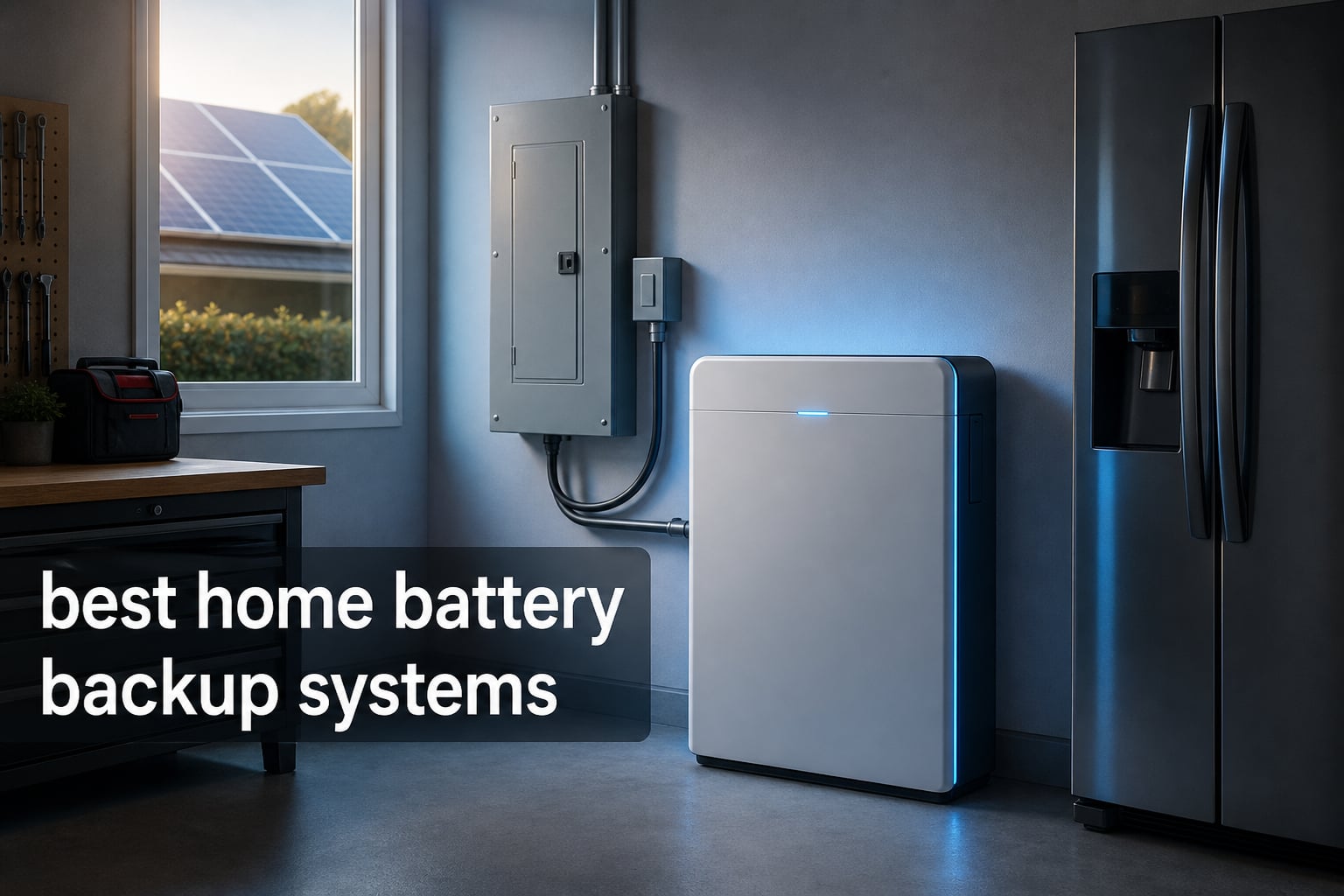
The best home battery backup systems give you stored electricity for an outage, but the right choice depends on two numbers: energy capacity in watt-hours and the power it can deliver at once. A small portable unit can protect a refrigerator, modem, lights, and a work setup; larger 120V/240V units move closer to supporting selected home circuits and heavy appliances.
I approached this list as a specification-led comparison, not a hands-on endurance test. The eight products below are portable power stations with lithium iron phosphate batteries, and their stated output, charging, expansion, and transfer features come from the analyzed product listings; an electrician should still review any plan to connect backup equipment to a home electrical system.
Our processor buying guides use the same practical approach: start with the job, then check the numbers that determine whether the hardware can do it. You can also browse our buying guides for different categories when you need a simpler starting point for a household purchase.
Table of Contents
The top three picks answer three different backup needs in 2026
My short list separates portable essentials power, a higher-capacity carryable station, and a large expandable system. Pick the first for fast charging and sensitive electronics, the second when stored energy matters more, and the third only when your plan calls for 120V/240V output and much larger expansion.

The EcoFlow DELTA 3 Classic is the compact pick for a modem, computer, lights, and other modest household loads. Its 1,800W AC output, less-than-10ms UPS claim, and 4.7 rating across 907 reviews make it the clearest portable essentials choice in this group.
The Jackery Explorer 2000 v2 is the middle-ground choice because it pairs 2,042Wh with 2,200W while remaining a 39.5-pound portable station. Its quiet charging mode is also a meaningful detail for someone keeping the unit near a living space.
The EcoFlow DELTA Pro Ultra is the large-system choice, with 6,144Wh, 7,200W AC output, 120V/240V support, and a stated path to 90kWh. It is not a grab-and-go answer at 186.4 pounds, but it is the strongest match here for a planned, scalable home power backup setup.
These eight home battery backup systems compare capacity, output, and expansion
Read Wh or kWh as the size of the stored-energy tank, and read W or kW as the strength of the outlet delivering that energy. A 3,600Wh unit stores more energy than a 1,024Wh unit, while a 6,000W output can run far larger simultaneous loads than a 1,500W output when the circuits and connection method support it.
| Product | Specifications | Action |
|---|---|---|
 EcoFlow DELTA 3 Classic EcoFlow DELTA 3 Classic |
|
View Details |
| Jackery Explorer 2000 v2 |
|
View Details |
 Anker SOLIX S2000 Anker SOLIX S2000 |
|
View Details |
 Anker SOLIX C1000 Gen 2 Anker SOLIX C1000 Gen 2 |
|
View Details |
 EcoFlow DELTA Pro EcoFlow DELTA Pro |
|
View Details |
 Jackery HomePower 3600 Plus Jackery HomePower 3600 Plus |
|
View Details |
 Anker SOLIX F3800 Anker SOLIX F3800 |
|
View Details |
 EcoFlow DELTA Pro Ultra EcoFlow DELTA Pro Ultra |
|
View Details |
Capacity alone does not make a unit whole-home capable. I would list every appliance you expect to run at the same time, including startup demand where relevant, then choose output headroom before comparing stored energy, recharge options, and expansion.
1. EcoFlow DELTA 3 Classic is the strongest portable pick for sensitive essentials
EF ECOFLOW Portable Power Station Delta 3 Classic, 1024Wh 1800W AC
1024Wh LFP
1800W AC
Less than 10ms UPS
Pros
- 4.7 rating from 907 reviews
- 1800W output
- Fast AC charging
- Smart app control
Cons
- Not Prime eligible
The DELTA 3 Classic begins with 1,024Wh of LFP storage and 1,800W AC output, with 3,600W surge stated through X-Boost. For an outage kit centered on communications and electronics, I find that pairing more useful than chasing a vague promise of powering an entire house.
Its listing says it can reach 80% from AC charging in 45 minutes and charge from a 500W solar panel in 2.5 hours. It also lists 15 outlets, including 100W USB-C output, so the station has more direct device connections than several higher-capacity choices here.
The less-than-10ms UPS claim matters for a desktop computer, server, or medical device that is appropriate for this type of backup. Treat that transfer figure as a manufacturer specification, and test your own equipment before treating it as a substitute for a dedicated critical-power plan.
The DELTA 3 Classic fits a portable essentials circuit with varied device ports
I would choose this model when the expected load is a refrigerator plus a modem, charging devices, lighting, and a computer rather than large heating or air-conditioning equipment. The app can monitor usage, set charging schedules, and activate backup modes, which is useful when the station remains plugged in as part of a home office setup.
The analyzed listing gives it a 4.7 rating from 907 reviews and describes LFP cells intended for more than a decade of daily use. That feedback volume is helpful context, though it does not replace checking the loads, outlets, and input limits that apply in your home.
The DELTA 3 Classic needs a realistic plan for its 1,024Wh energy reserve
A 1,024Wh battery is not the same as 1,024Wh delivered to appliances, because conversion and the operating load affect usable runtime. I would reserve it for a limited list of essential circuits and recharge it from AC, car power, or compatible solar when the outage lasts longer than the stored energy.
The product is listed as not smart-home compatible, so it is better viewed as a self-contained portable station than as a managed panel-based home battery. Its 15-pound listed weight makes that distinction practical: it can move where the essential load is rather than becoming a fixed installation.
2. Jackery Explorer 2000 v2 is the compact 2kWh option for longer essentials coverage
Jackery Explorer 2000 v2 Portable Power Station, 2042Wh, 2200W AC Output
2042Wh LFP
2200W output
20ms switching
Pros
- 2042Wh capacity
- 2200W output
- 39.5-pound weight
- Under 30dB charging
Cons
- Only three AC outlets
The Explorer 2000 v2 doubles the stored energy of the 1,024Wh class with a stated 2,042Wh capacity and delivers 2,200W across three AC ports. That combination is a sensible step up when a refrigerator and several lower-draw essentials are part of the same outage plan.
Jackery states that this 2kWh unit weighs 39.5 pounds and is smaller and lighter than typical comparable-capacity units. I would still plan a stable, nearby location rather than assume it will be convenient to move repeatedly during an outage.
Charging is another clear strength: the listing claims 0% to 80% in 66 minutes by AC fast charging. The LFP battery is described as lasting up to a decade, and its silent charging mode is listed at less than 30dB, an advantage where overnight noise would be distracting.
The Explorer 2000 v2 works when capacity and portable placement matter equally
This is the unit I would place between small desktop backup stations and much larger wheeled systems. Its 2,200W output supplies more headroom than the S2000’s 1,500W rating, while the 2,042Wh reserve is meaningful for a homeowner who wants to rotate limited essential loads over time.
The listing also specifies USB-C PD fast charging at 100W. That is a small specification with a real convenience benefit when a work laptop, phone, power bank, and communication equipment all need direct charging rather than an extra wall adapter.
The Explorer 2000 v2 requires outlet planning before a multi-device outage
The tradeoff is simple: only three AC outlets are listed. I would map which items need AC power before choosing it, since an outlet shortage can force unnecessary power strips or leave a planned device disconnected even when capacity and wattage are sufficient.
Jackery lists a 20ms uninterruptible power supply switching figure. That can help with ordinary continuity needs, but compatibility is device-specific, so do not assume every computer, medical device, or appliance will react identically without a real setup check.
3. Anker SOLIX S2000 is the refrigerator-focused portable option
Anker SOLIX S2000 Portable Power Station, 2,010Wh, 1,500W, Home Backup, UPS
2010Wh LFP
1500W output
Eight outlets
Pros
- 35-hour fridge backup claim
- 10000-cycle LFP
- Compact 2kWh size
- Six recharge methods
Cons
- No 12V DC port
- Not Prime eligible
The Anker SOLIX S2000 puts 2,010Wh of LFP capacity behind a 1,500W continuous output and eight outlets. Its headline claim is up to 35 hours of refrigerator backup, which makes the model immediately relevant to the most common food-preservation question during a power outage.
That 35-hour figure should be treated as the maker’s specific refrigerator claim, not a promise for every refrigerator or a general measure of whole-home runtime. Compressor cycles, refrigerator size, ambient temperature, and everything else plugged into the unit will change the result.
Anker says the S2000 is 30% smaller and 25% lighter than the industry average, and lists it at 35.7 pounds. I like the balance here for someone who wants 2kWh-class energy without committing to a wheeled 3.5kWh-class machine.
The S2000 suits an outage plan built around food, lights, and communications
The stated 1,500W continuous output is positioned by Anker as enough for 99% of home essentials. I would read that as a reason to define “essential” carefully: a refrigerator, modem, lamps, and charging gear are a far different simultaneous load from central air conditioning, a dryer, or electric heat.
It supports six recharge methods, including up to 400W solar input, and has eight outlets placed on the front and rear. Those details are useful if you intend to keep the station in one area while spreading a few short cords to appliances and electronics.
The S2000 is less suitable when a 12V DC connection or high wattage is required
The listing calls out no 12V DC port, so I would rule it out for a setup that depends on that connection. Its 1,500W output is also below the 1,800W, 2,200W, 3,600W, 6,000W, and 7,200W options elsewhere in this guide.
Anker lists a 10,000-cycle LFP battery and a 15-year lifespan claim. Cycle-life language is useful for judging intended durability, but actual battery condition still depends on storage temperature, charging practice, depth of discharge, and the way the station is used.
4. Anker SOLIX C1000 Gen 2 is the fast-recharging compact backup choice
Anker SOLIX C1000 Gen 2 Portable Power Station, 1,024Wh, 2,000W, Camping
1024Wh LFP
2000W output
49-minute recharge
Pros
- 49-minute recharge
- Ten ports
- 10ms UPS
- Solar recharge claim
Cons
- 1024Wh capacity
- Listing also notes 600W running wattage
The SOLIX C1000 Gen 2 is the smallest storage class in this roundup at 1,024Wh, but it has an unusually aggressive recharge claim: a full charge in 49 minutes at 1,600W with HyperFlash technology. I would prioritize that feature when grid power returns briefly between outages or when a backup source needs a quick reset.
The listing describes 2,000W output, 3,000W peak output, and ten ports, along with solar recharging in 1.8 hours at 600W input. It also claims a 10ms UPS switchover and app-based time-of-use controls, making it a compact choice with several modes rather than a bare-bones battery box.
One specification needs a careful buyer check: the analyzed product details separately list 600W running wattage despite the 2,000W output claim. I would verify the applicable output mode and documentation before assigning a high-watt appliance to this product.
The C1000 Gen 2 fits quick-recharge backup for electronics and modest loads
This unit makes sense when the most valuable feature is rapidly replenishing a portable energy reserve. Anker also states that its battery retains at least 80% capacity after 4,000 cycles, which points toward frequent-use intent rather than keeping it untouched for rare emergencies.
At a listed 11.3 kilograms and 15.1 by 8.2 by 9.6 inches, it is easier to position near a workstation or refrigerator than the large expandable systems. I would keep the actual load below the confirmed continuous-output limit and use the ten ports to avoid a cluttered adapter chain.
The C1000 Gen 2 cannot replace a high-capacity whole-home plan on its own
Its 1,024Wh capacity places it in the same energy category as the DELTA 3 Classic, well below the 2,010Wh, 2,042Wh, 3,584Wh, 3,600Wh, 3,840Wh, and 6,144Wh choices listed here. That is plenty for a focused kit, not an invitation to run every household appliance.
The analyzed listing did not report a customer rating for this exact item even though it recorded 1,300 reviews. I would read current owner feedback and the latest manual before making it the core of a medically sensitive or high-load backup plan.
5. EcoFlow DELTA Pro is the flexible 3.6kWh platform for expansion
EF ECOFLOW Portable Power Station 3600Wh DELTA Pro, 120V 3600W AC Output
3600Wh LFP
3600W AC
Up to 25kWh
Pros
- 3600Wh capacity
- Expandable to 25kWh
- Five charging methods
- Wi-Fi and Bluetooth app
Cons
- 99-pound weight
- Not Prime eligible
The EcoFlow DELTA Pro is where this roundup moves from carryable essentials stations to a serious home battery storage platform. It starts at 3,600Wh with 3,600W AC output, and the listing says its LFP capacity can expand to 25kWh.
That scale matters because a larger energy reserve is useful only if the output and connection method can serve the loads you chose. EcoFlow lists X-Boost output up to 4,500W and up to 7,200W with two units, so it offers a route for users who expect their backup plan to grow.
Five charging paths are listed: an EV station, solar, wall outlets, a smart outdoor generator, or a car outlet. The 240V recharge claim is 1.8 hours at 3,000W, but I would confirm the availability and electrical suitability of that outlet before treating it as an everyday charging plan.
The DELTA Pro suits homeowners building capacity in stages
I would consider this model for a household that starts with selected essential circuits and wants room to add energy storage later. The ability to scale to 25kWh separates it from the fixed-capacity portable units, while Wi-Fi and Bluetooth app control supports monitoring from inside the home.
The product has a 4.6 rating from 581 reviews in the analyzed listing. Its stated 15 outlets are another practical advantage for a temporary backup setup, though the number of plugs never changes the limits imposed by total output and stored energy.
The DELTA Pro requires a fixed-location mindset despite its portable category
At 99 pounds and 25 by 11.2 by 16.4 inches, this is not the product I would plan to lift alone between rooms. Choose the operating location, ventilation clearance, cable route, and charging access before an outage, rather than improvising after power fails.
Its listing also calls it suitable for residential and outdoor use, but the connection between a portable station and household circuits needs professional guidance. Forum contributors repeatedly point to proper sizing and professional installation as the safer route when backup power goes beyond plug-in appliances.
6. Jackery HomePower 3600 Plus is the wheeled essential-home expansion option
Pros
- 3600W output
- Expands to 21kWh
- 6000-cycle LFP
- Wheels and telescopic handle
Cons
- Only two outlets
- Not Prime eligible
The HomePower 3600 Plus pairs 3,584Wh with 3,600W AC output and can expand to 21kWh per unit according to Jackery. It is designed around essential home backup, with a plug-and-play description and a luggage-style case that has wheels and a telescopic handle.
For someone comparing the DELTA Pro and this model, the starting energy and output are very close: 3,584Wh and 3,600W here versus 3,600Wh and 3,600W on the EcoFlow. I would choose between them by extension goal, charging inputs, outlets, and the operating workflow you prefer.
Jackery lists four charging paths: hybrid AC plus DC in two hours, AC in 2.5 hours, solar in four hours, or a gas generator in 2.5 hours. A 6,000-cycle LFP battery and stated decade-long lifespan support the idea of regular backup readiness rather than one-off use.
The HomePower 3600 Plus fits a rolling backup station that stays near key loads
The wheels answer a real usability problem because the station is listed at 77.2 pounds. I would still think of them as a way to roll it across a suitable floor, not as permission to treat it like a small portable battery that can be carried anywhere.
Its 3,600W output gives it meaningful headroom for a carefully selected mix of appliances, while parallel operation is listed at 7,200W. The right question is not whether that sounds large; it is whether the electrical connection and appliance startup demands are part of a sound plan.
The HomePower 3600 Plus limits direct AC connections to two outlets
Only two outlets are listed, a sharp contrast with the 15 outlets shown for the DELTA Pro and DELTA 3 Classic. I would decide in advance whether those outlets will serve appliances directly or feed an appropriate, professionally planned distribution arrangement.
The listing says this model is not smart-home compatible. It can be a strong essential-home backup unit, but it is not presented as a smart panel or automatic whole-home load-management system, so its role should be planned around that boundary.
7. Anker SOLIX F3800 is the high-output option for 120V and 240V loads
Anker SOLIX F3800 Portable Power Station, 3,840Wh, 6,000W,Home Backup, RVs
3840Wh LFP
6000W 120V/240V
Up to 26.9kWh
Pros
- 6000W output
- Dual 120V and 240V
- Scales to 26.9kWh
- EV and RV connections
Cons
- 132.3-pound weight
- 4.3 rating from 154 reviews
The SOLIX F3800 raises output to 6,000W and adds dual-voltage 120V/240V capability with 3,840Wh of LFP capacity. In this group, that makes it a more credible starting point for homeowners who need to plan for equipment that exceeds ordinary portable-station loads.
Anker says capacity can expand to 26.9kWh with battery packs. It also lists a NEMA 14-50 port for direct EV charging at 6,000W and NEMA 14-50 or L14-30 ports for direct RV power, features that set this model apart from the 120V-only portable stations.
The product carries a 4.3 rating from 154 reviews in the analyzed data. That is useful evidence to examine rather than ignore: 72% are listed as five-star ratings, with 9% listed as one-star, so I would read current feedback carefully for concerns relevant to your intended connection method.
The F3800 suits planned high-demand backup with 240V requirements
I would shortlist the F3800 when 240V compatibility is a firm requirement and a large modular reserve is part of the plan. Its 6,000W continuous output is four times the S2000’s 1,500W rating, though output alone does not authorize a connection to a panel or appliance.
Wi-Fi and Bluetooth remote control are listed for monitoring and management. The combination of high output, expandability, and remote control gives it a different role from a compact UPS-style station: it is for a homeowner who is willing to plan the system, location, and loads in detail.
The F3800 demands a stable permanent operating location
The station weighs 132.3 pounds, so physical handling is a first-order constraint. I would determine where it can sit, how it will be protected, and who can safely move it before ordering rather than solving those questions when the weather is already bad.
Anker lists three outlets, which is another prompt to focus on a deliberate power-distribution plan instead of a collection of extension cords. Its stated five-year warranty and decade-long lifespan are useful ownership details, but the electrical design remains more important than the count of advertised features.
8. EcoFlow DELTA Pro Ultra is the largest expandable home-focused system here
EF ECOFLOW DELTA Pro Ultra 6144Wh Power Station, 120/240V 7200W AC Output, Lifepo4 Home Battery Backup Expandable to 90kWh, 2H to Full Charge, Solar Generator for Home Use, Emergency, Camping, RV
6144Wh LFP
7200W 120V/240V
Up to 90kWh
Pros
- 7200W dual voltage
- Scales to 90kWh
- 0ms online UPS
- App circuit prioritization
Cons
- 186.4-pound unit
- 4.3 rating from 141 reviews
The DELTA Pro Ultra starts at 6,144Wh, the largest base capacity in this comparison, and delivers 7,200W AC with 120V/240V support. Its claimed scalability from 6kWh to 90kWh puts it in a different planning category from the other stations: it is intended to become a large home energy storage system.
EcoFlow lists a two-hour full charge and an online UPS with 0ms transfer time. It also says the unit can handle a three-ton central air conditioner, but that should be treated as a product capability claim that requires professional load and connection assessment for a specific home.
The analyzed listing records a 4.3 rating from 141 reviews and notes 74% five-star ratings. I would treat those reviews as a starting point for questions about delivery, setup, expansion components, and support, especially because a system at this physical scale is not casually returned or relocated.
The DELTA Pro Ultra fits a formal whole-home backup conversation
If I needed the best whole-home backup direction among the products analyzed, this is where I would begin the conversation, not where I would end it. The 7,200W output, 120V/240V support, 0ms UPS claim, and 90kWh expansion ceiling are the relevant specifications for a system that may serve major loads.
Its smart app control includes stated circuit prioritization. That is valuable when the goal is load management, but a professional should determine which circuits, transfer equipment, and protections are appropriate before relying on a battery backup system for a home electrical panel.
The DELTA Pro Ultra is impractical for casual portability
The base unit is listed at 186.4 pounds and measures 27.2 by 18.9 by 8.4 inches. I would plan the site, access route, and service space first, because its form factor belongs in a permanent backup arrangement even though the listing calls it a power station.
This is also a reminder that more capacity is not automatically better. A small household focused on food, communications, and lights may get a more manageable outcome from one of the portable units, while a home with a defined 240V requirement has reason to investigate this scale.
The right home battery backup starts with an appliance list and power math
Forum discussions around home power backup return to the same mistake: buyers compare capacity without separating it from output. A battery can hold a lot of energy yet fail to run a high-demand appliance if its inverter cannot provide the required continuous power or startup surge.
The first step is to list what must remain powered
Write down only the loads you truly need during an outage: refrigeration, internet equipment, phone charging, lighting, a work computer, a sump pump, a medical device, or a specific climate-control load. Next to each one, note its running watts and, when relevant, its startup requirement from the appliance label or manual.
I would then group devices by what they must do at the same time. A refrigerator and modem may run together continuously, while a microwave or power tool may need temporary headroom; that distinction tells you whether continuous output or stored energy is the limiting number.
The second step is to match watts to output and watt-hours to duration
Continuous output is the total power a station can provide at one moment. The 1,500W S2000, 1,800W DELTA 3 Classic, 2,200W Explorer 2000 v2, 3,600W DELTA Pro and HomePower 3600 Plus, 6,000W F3800, and 7,200W DELTA Pro Ultra form a useful output ladder.
Capacity is the energy reservoir. Divide a battery’s stated Wh by the planned load in watts for a rough upper-bound estimate, then leave room for inverter losses, changing appliance cycles, and charging devices you forgot to include; do not treat a paper calculation as a guaranteed runtime.
For example, a 2,000Wh-class unit has roughly twice the stated stored energy of a 1,000Wh-class unit, while a 3,600Wh-class unit has more again. That comparison helps you choose a category, but it cannot predict a refrigerator’s exact behavior because compressors cycle and household conditions differ.
The third step is to choose between recharge speed, solar input, and expansion
Fast AC charging is a practical advantage when utility power returns in short windows. The C1000 Gen 2 claims a full charge in 49 minutes, the DELTA 3 Classic claims 80% in 45 minutes, the Explorer 2000 v2 claims 80% in 66 minutes, and the bigger systems publish their own charging paths.
Solar battery backup can extend an outage plan, but compatible panel wattage, weather, panel placement, and input limits decide what happens in practice. The C1000 Gen 2 lists up to 600W solar and a 1.8-hour claim, the DELTA 3 Classic lists a 500W-panel figure, and the S2000 lists up to 400W solar input.
Expansion is more useful for a growing plan than for an undefined one. The DELTA Pro reaches a stated 25kWh, the HomePower 3600 Plus 21kWh, the F3800 26.9kWh, and the DELTA Pro Ultra 90kWh; start with the circuits and duration you need before committing to any expansion path.
The fourth step is to treat switching and installation as separate decisions
A less-than-10ms, 10ms, 20ms, or 0ms switching claim describes how a product says it handles a loss of grid power. It does not mean every appliance is equally tolerant, nor does it explain how a portable station connects to permanent household wiring.
For plug-in loads, keep the plan simple and test it before an outage. For essential circuits, 120V/240V loads, a panel connection, or automatic transfer equipment, forum users consistently recommend professional installation; permits and local electrical rules may apply, and a qualified electrician can verify the safe design.
The fifth step is to plan for ownership after the first outage
LFP chemistry is common across these eight products and is generally chosen for long cycle life, but no battery remains new forever. Store the unit according to its manual, check its state of charge on a schedule, keep vents clear, and review the manufacturer’s maintenance and warranty terms before you rely on it.
Battery and generator plans can also work together during extended outages. The product listings for the DELTA Pro and HomePower 3600 Plus include generator charging among their input methods, and forum contributors often recommend a battery for quiet immediate power plus a generator as a longer-duration recharge source.
Before you make the final choice, compare your planned backup category with our latest deals and buying guides approach: identify the non-negotiable specification first, then dismiss options that cannot meet it. For home backup, that non-negotiable is usually output, capacity, 240V support, portability, or recharge access.
FAQs
What’s the best battery backup system for a home?
The best choice depends on the load and duration you need. For portable essentials, the EcoFlow DELTA 3 Classic pairs 1,024Wh with 1,800W output and a less-than-10ms UPS claim. For a large expandable 120V/240V plan, the EcoFlow DELTA Pro Ultra starts at 6,144Wh with 7,200W output and can scale to 90kWh.
How do I choose a home battery backup system?
List the appliances that must run, add their simultaneous running watts and relevant startup demand, then select enough continuous output. Next, use Wh or kWh capacity to estimate duration with room for losses, choose a recharge path, and decide whether you need portability, 240V support, or expansion. Use an electrician for any permanent circuit or panel connection.
How long can a home battery backup power a house?
Runtime depends on battery capacity, the active load, inverter losses, and appliance cycling. A focused set of essentials can run far longer than a whole house. As a manufacturer-specific example, Anker says its 2,010Wh SOLIX S2000 can provide up to 35 hours of refrigerator backup; that result will vary by refrigerator and other connected loads.
What is the best home battery backup without solar?
A portable battery can charge from AC without solar panels. The Anker SOLIX C1000 Gen 2 is a strong fast-recharge candidate because its listing claims a full AC charge in 49 minutes, while the EcoFlow DELTA 3 Classic claims 80% in 45 minutes. Choose capacity and output for your essential loads before prioritizing charge speed.
How much does a home battery backup system cost?
The full outlay varies by battery capacity, output, expansion hardware, solar equipment, transfer equipment, site work, and professional electrical installation. Request a written scope for any panel-connected system, and compare the capacity, output, charging method, and installation requirements rather than choosing on a single number.
The best choice is the one that matches your outage plan
For a compact portable home battery backup, I would start with the EcoFlow DELTA 3 Classic for device variety and its fast UPS claim, or the Jackery Explorer 2000 v2 for more stored energy. The Anker SOLIX S2000 is especially compelling if its stated refrigerator-backup use case mirrors your own.
For a planned 120V/240V setup with expansion, the F3800 and DELTA Pro Ultra have the output and scale worth discussing with a qualified installer. The best home battery backup systems in 2026 are not defined by the biggest capacity on a product page; they are defined by the appliances you must protect, the hours you need to cover, and a connection plan you can trust.