
The hum is almost always what kills a fan for bedroom use. A fan can move a genuinely impressive amount of air and still be unusable if the sound arrives at your pillow as a thin buzz rather than soft, steady air. We spent weeks with the best tower fans for quiet bedrooms, reading owner complaints closely and separating the noise claims worth trusting from the ones that only hold at the weakest setting.
Here is the short version. The best tower fans for quiet bedrooms are the ones with a brushless DC motor, enough speed steps that you can settle into a low setting that still moves air, a sleep mode, and a display that goes dark. Models built around an AC motor, or ones whose noise figure was measured at minimum speed from several feet away, tend to disappoint exactly where it matters.
One thing to clear up before we start: a fan does not lower room temperature. It moves air across your skin so sweat evaporates faster, which feels like cooling. If you want to cut the air conditioner back a few degrees on mild nights, a fan works well for that. If you expect a 40 inch tower to chill a stuffy room, it will not. More on what that means for sizing is in our bedroom tower fan guide.
We ranked ten fans on the things that decide whether you will still be running one at 2am: the published noise figure, motor type, how many speed steps exist between silence and useful airflow, whether the display and beeps can be silenced, and how owners describe the sound over months rather than weeks.
Table of Contents
Top 3 Quiet Tower Fans for Bedrooms in 2026
Our top three sit at three different points on the price and feature curve, because the right quiet fan depends more on your room and your ears than on any spec sheet.


Best Tower Fans for Quiet Bedrooms at a Glance
This table carries every fan in the roundup with its headline noise figure and the feature that decides its place. Use it to narrow to two or three, then read the full block.
| Product | Specifications | Action |
|---|---|---|
| DREO Tower Fan for Bedroom 28ft/s |
|
Check Latest Price |
 Levoit Tower Fan 28dB Levoit Tower Fan 28dB |
|
Check Latest Price |
| DREO Smart 42 Inch Tower Fan 20dB |
|
Check Latest Price |
 DREO Tower Fan 9 Speeds 28ft/s DREO Tower Fan 9 Speeds 28ft/s |
|
Check Latest Price |
 Honeywell QuietSet HYF260 Honeywell QuietSet HYF260 |
|
Check Latest Price |
 PELONIS 40 Inch Bladeless Tower Fan PELONIS 40 Inch Bladeless Tower Fan |
|
Check Latest Price |
 PELONIS 30 Inch Tower Fan 30dB PELONIS 30 Inch Tower Fan 30dB |
|
Check Latest Price |
 Lasko T38400 Oscillating Tower Fan Lasko T38400 Oscillating Tower Fan |
|
Check Latest Price |
 DR.PREPARE 16 Inch Bladeless Tower Fan DR.PREPARE 16 Inch Bladeless Tower Fan |
|
Check Latest Price |
 Timiyou Bladeless Tower Fan 22dB Timiyou Bladeless Tower Fan 22dB |
|
Check Latest Price |
1. DREO Tower Fan for Bedroom, 28ft/s – Best Overall for Quiet Bedrooms
DREO Tower Fan for Bedroom, 28ft/s Velocity, Ultra Quiet Fan, 8 Speeds
Brushless DC motor
25 dB claimed
8 speeds, 4 modes
90 degree oscillation
36 inch, 8.4 lbs
Pros
- Brushless DC motor stays soft on low and mid speeds
- 28 ft/s airflow felt across a room
- Eight speeds give genuinely fine control
- Silent oscillation and stable base
Cons
- Top speeds become clearly audible
- Larger rooms need higher settings
- Remote sometimes needs a second press
This is the fan we kept coming back to. The brushless DC motor is the reason, and it is not a small detail: on low and mid settings the sound sits low and soft in a way that reads as moving air rather than as a machine working. Owners on the r/bedrooms threads describe it consistently as steady rather than buzzy, which is the exact tonal quality that lets you sleep through it.
The airflow claim is 28 ft/s from a 36 inch body, and owners report feeling it from roughly 10 to 12 feet away. That matters in a bedroom because you want air circulating across the room rather than a jet pointed at the pillow. Ninety-degree oscillation spreads that across the space without any audible clicking at the head joint.
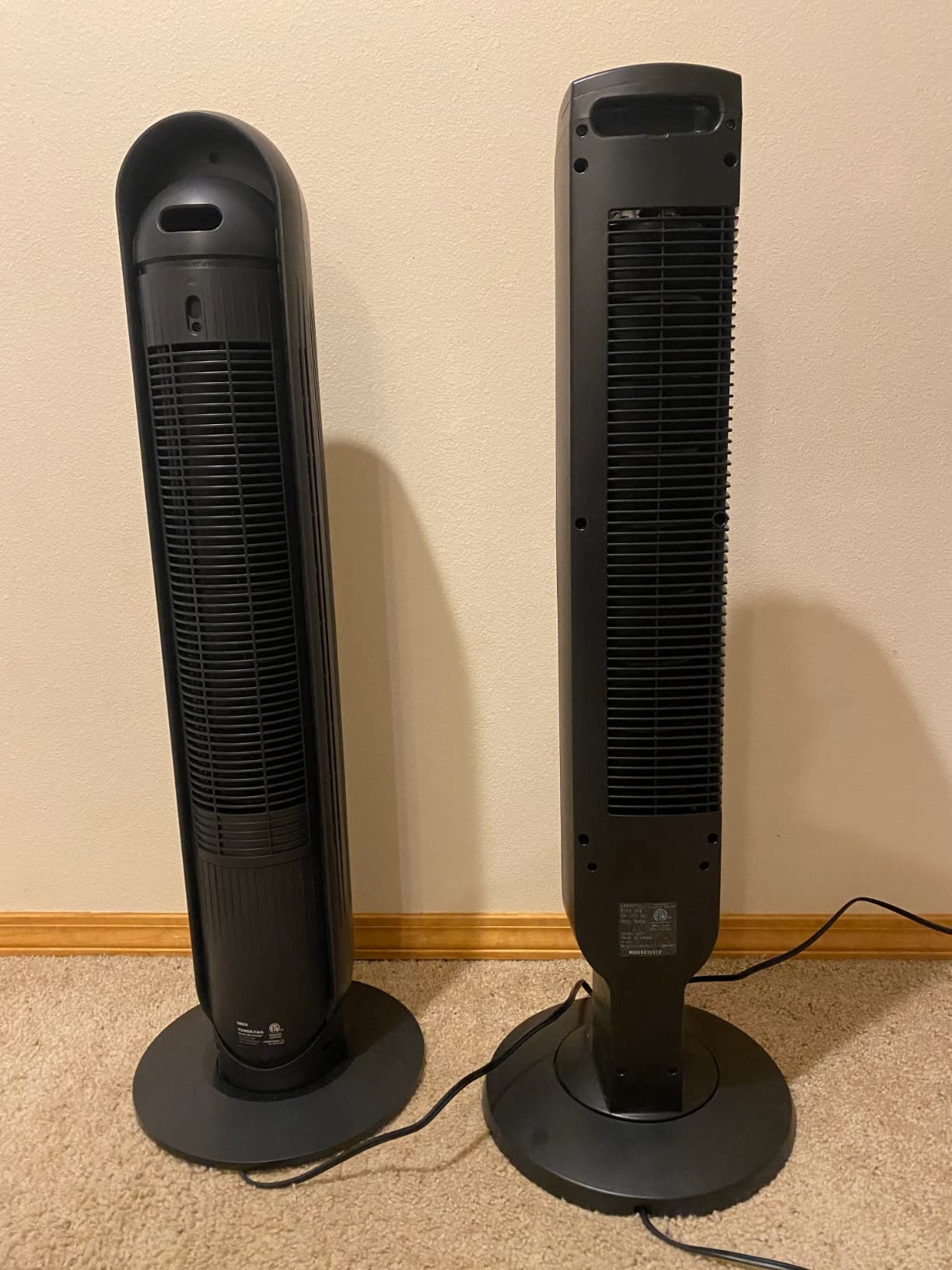
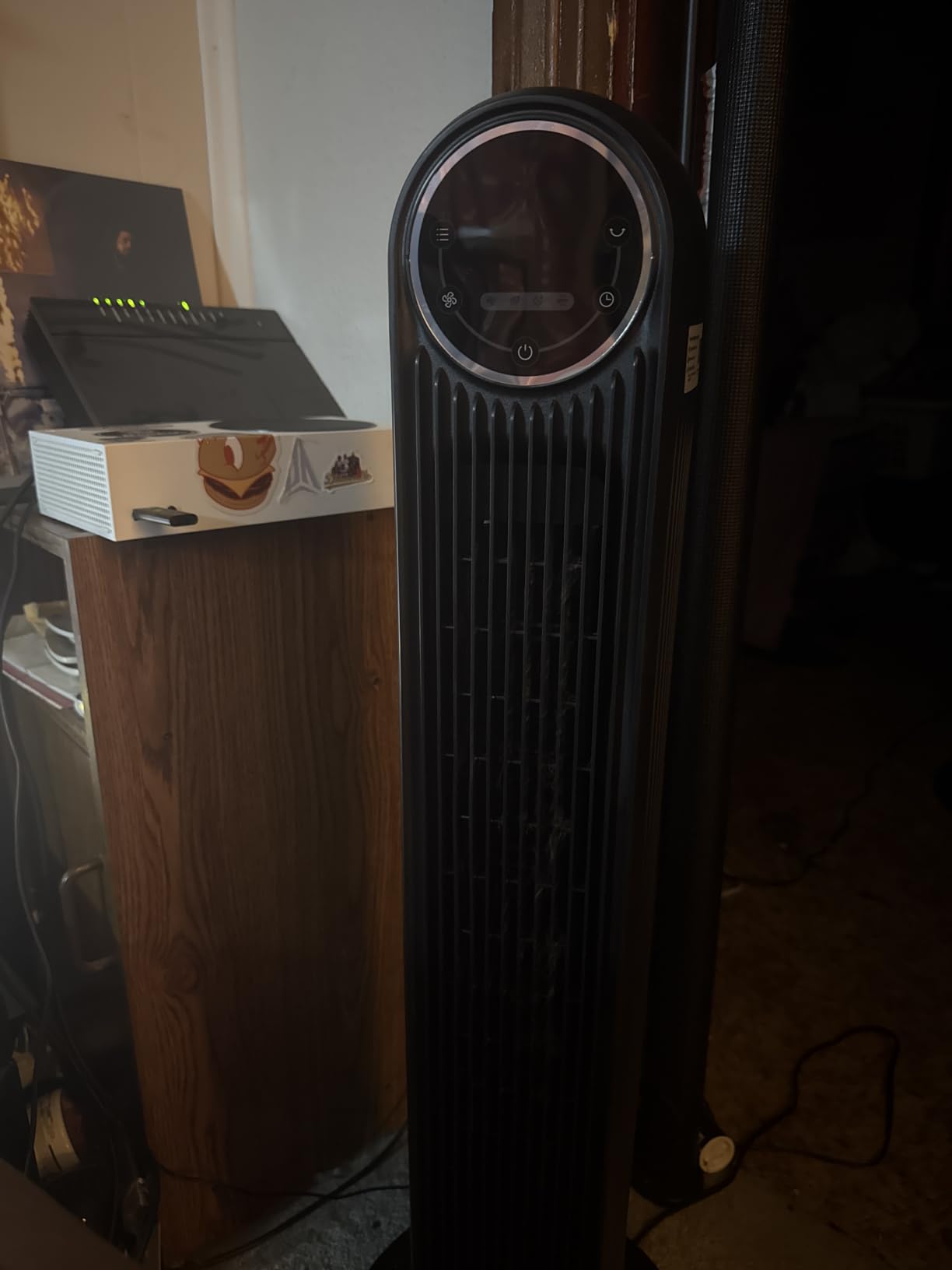
Eight speeds across four modes is more granularity than most rivals in this group, and it is what lets you find the specific setting where you stop noticing the sound. The 12-hour timer handles the overnight case, and the rear grille and impeller both remove for cleaning, which matters more than it sounds because a dusty impeller starts whispering.
Two caveats. Higher speeds are plainly audible, so treat the top third of the range as daytime or pre-sleep use. And the remote occasionally needs a second press, which is annoying at 3am but not a dealbreaker for most people.
Who should sleep next to this fan
Light sleepers and anyone sharing a bed with a partner who snores. The low tone is steady enough to mask intermittent noise without adding a pitch of its own, which is what you want when the goal is staying asleep rather than being lulled.
It also handles medium and large master bedrooms well at mid speeds, so it is not a small-room-only recommendation. If your bedroom is on the larger side, this is still the first one to try.
Who should look elsewhere
Anyone who needs the quietest possible reading on the spec sheet should note that the DREO Smart 42 Inch below claims 20 dB. That figure is also best-case, but it is a lower best case.
It is also not the cheapest option here, and if your room is a dorm or a 10 by 10 foot box, the height and throw are more than you need. Look at the compact options further down for that.
2. Levoit Tower Fan for Bedroom, 28dB – Best Value Quiet Tower Fan
Levoit Tower Fan for Bedroom, 28ft/s Fans that Blow Cold Air, 28dB Quiet
28 dB claimed
5 speeds, 4 modes
Auto mode with temperature sensor
12 hour timer with remote
36.2 inch, 8.5 lbs
Pros
- 28 dB claim suits low-speed overnight use
- 28 ft/s airflow with wide oscillation
- Auto mode uses a built-in temperature sensor
- Remote and 12 hour timer remove midnight trips to the unit
Cons
- AC motor is louder than brushless rivals at higher speeds
- Only 5 speed steps limits fine control
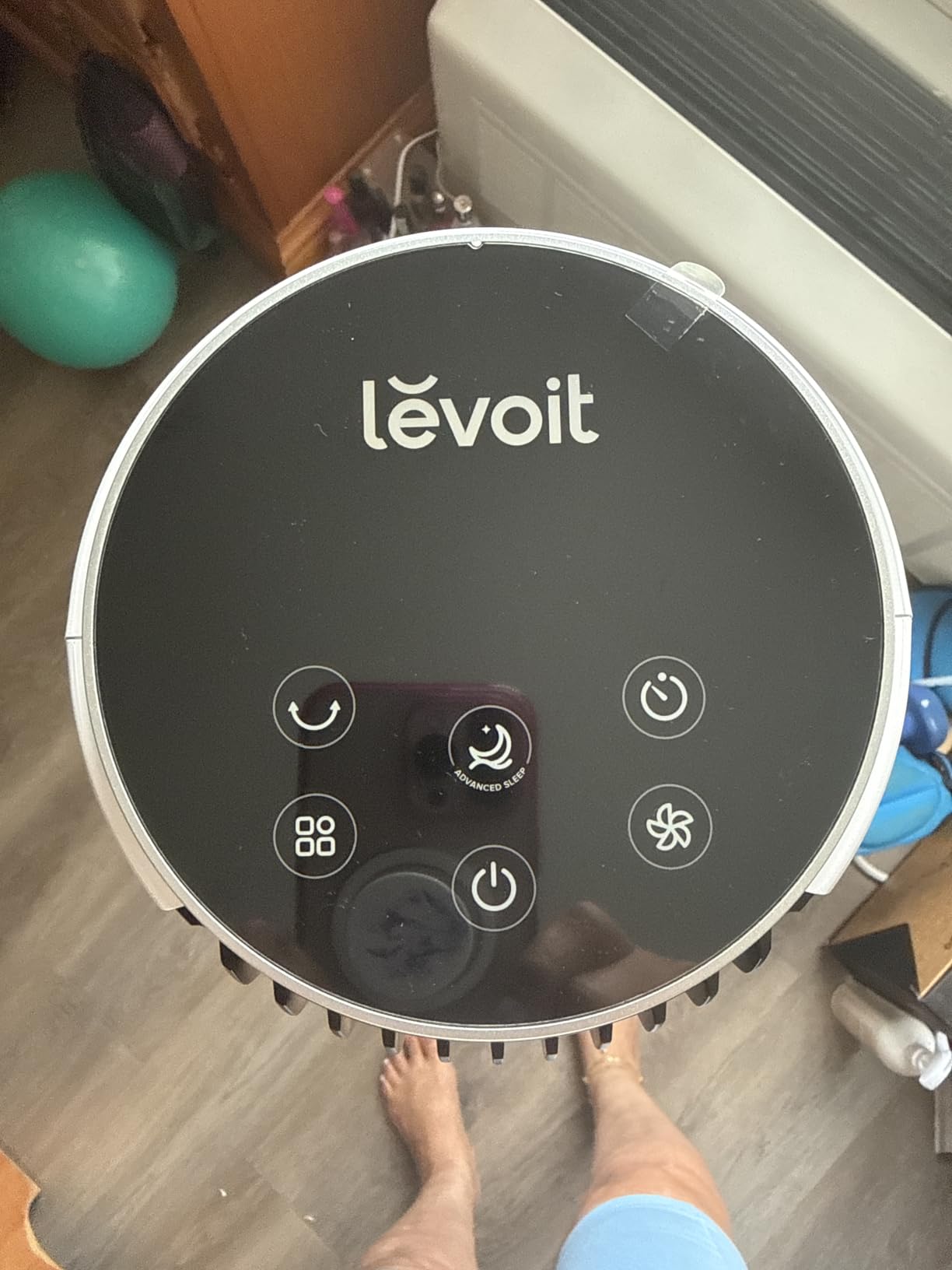
The Levoit is the pick when you want quiet low-speed running and a wide feature set without moving up a tier. Auto mode is genuinely useful overnight here: the built-in temperature sensor reads the room and adjusts the speed, so the fan ramps up if the room warms and eases off before you notice.
That leaves the AC motor as the thing to understand. It is fine on low, and the 28 dB claim reflects that, but buyers consistently note it gets louder than brushless DC competitors as the speed climbs. If you plan to run this on anything above the middle setting in a very quiet room, listen first.
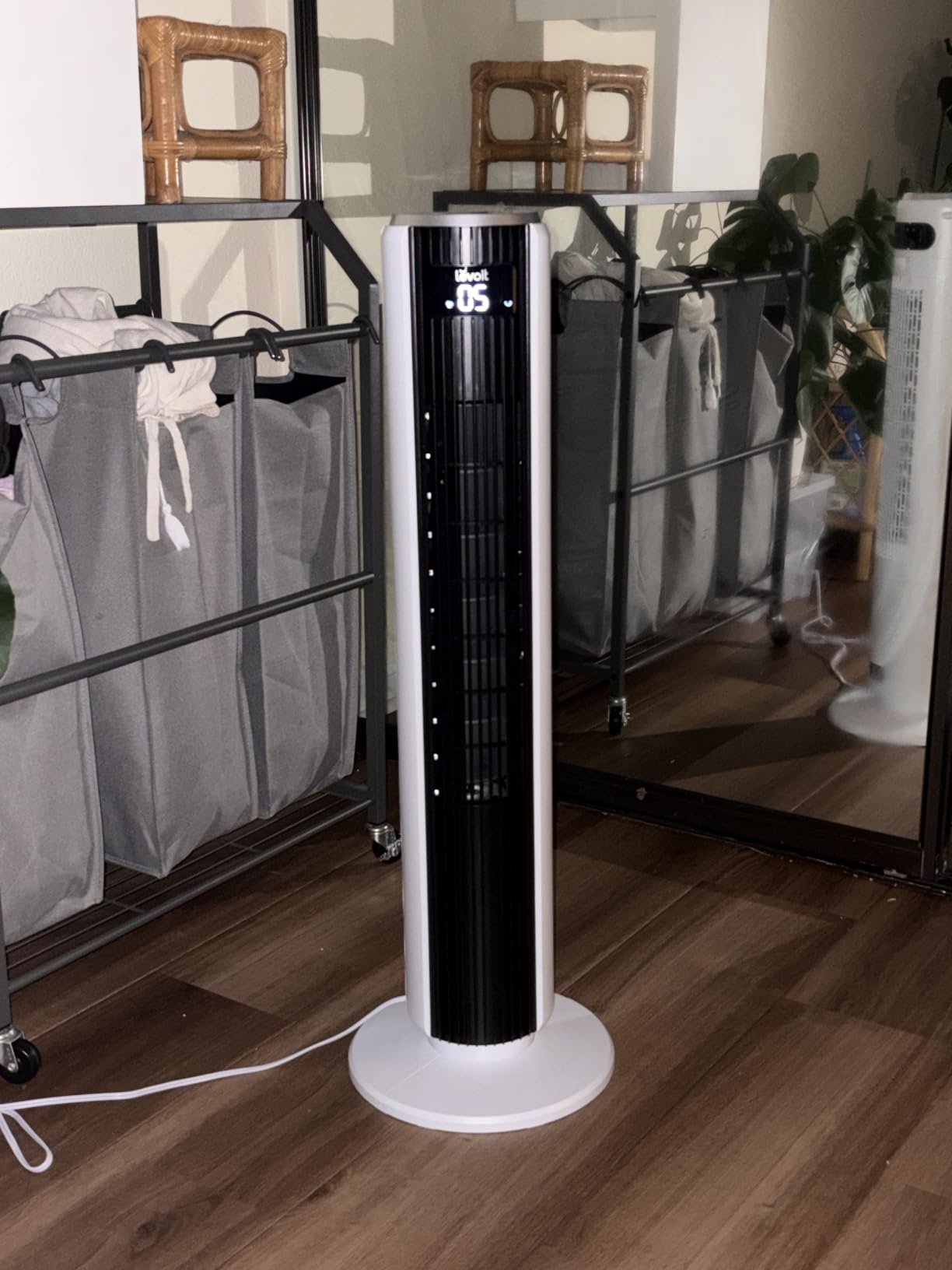
Five speeds is the weak spot. With eight or twelve steps you can creep the sound down incrementally; with five you are choosing between a setting that is quiet and a setting that is useful, and the jump between them is more noticeable. Sleep mode helps here, easing down gradually rather than stepping.
The removable back grille is a real convenience, and at nearly 14,500 ratings there is enough owner history to see patterns rather than anecdotes.
Who should sleep next to this fan
Medium sleepers who want automation more than they want absolute silence. Auto mode plus the 12-hour timer means you can set it once and stop thinking about it, which suits anyone who would otherwise wake up too warm and then be too cold.
It is also a solid pick for a bedroom where you want real airflow across the whole room on a hot night, since 28 ft/s is enough to move air well past the bed.
Who should look elsewhere
Very light sleepers and anyone sensitive to motor pitch. The AC motor is the deciding factor here, and it is the one spec that cannot be adjusted with firmware.
Anyone who wants white noise to fill a genuinely quiet room should also look past it, since the sound on low is soft but not dense enough to mask much.
3. DREO Smart 42 Inch Tower Fan, 20dB – Best for Light Sleepers
DREO Smart 42” Tower Fan for Bedroom, 12 Speeds, 20dB Quiet Standing Fan
20 dB claimed, lowest figure in the group
12 speeds, 4 modes
App, Alexa, Google Assistant, remote and touch
Auto-dimming display
42 inch, 24W
Pros
- Lowest published noise figure here
- near-silence below speed 5 per owners
- Twelve speeds give the finest granularity in the group
- Display auto-dims so the bedroom stays dark
- App and voice control plus remote
Cons
- Highest price in the group
- Small on-screen menu is hard to read in the dark
- Remote needs line of sight and can fail while the head oscillates
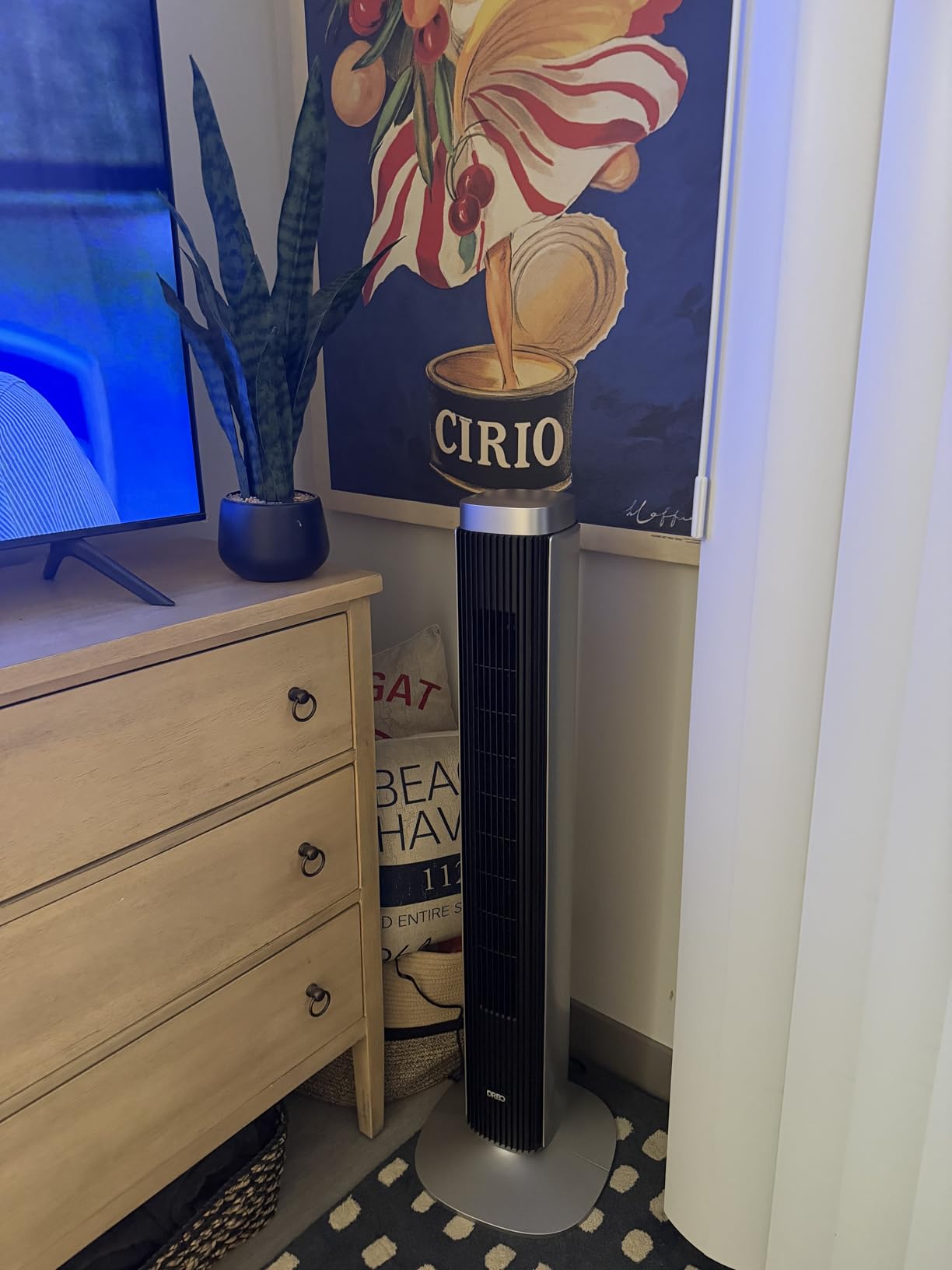
This is the pick for anyone who wakes to the smallest sound. At 20 dB claimed, it carries the lowest published figure of the ten, and owners report near-silence below speed 5. With twelve speed steps you can find a very low setting that still throws air across a large bedroom.
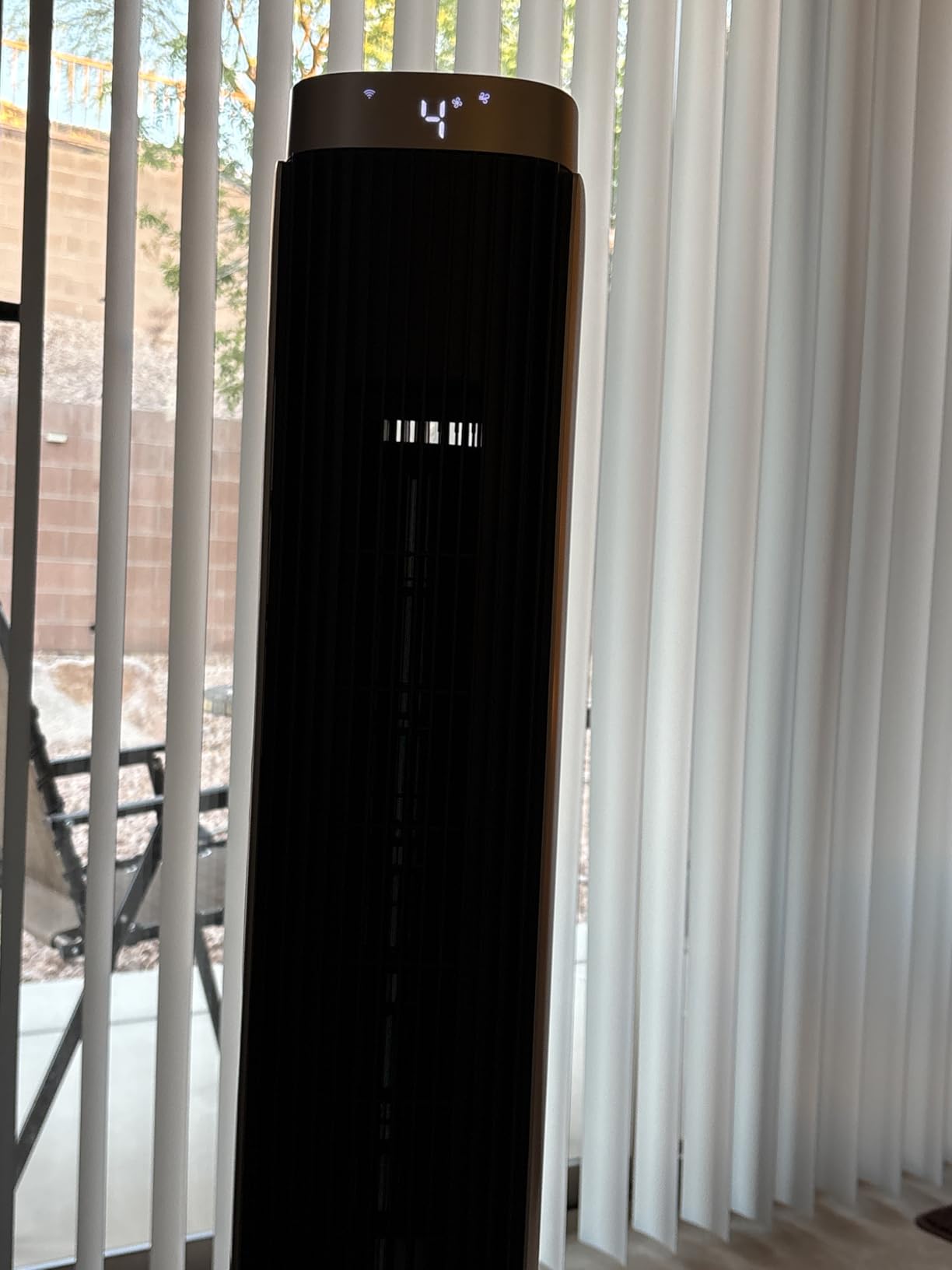
The 90-degree oscillation spreads a 28 ft/s stream across the room, and the display dims itself after about a minute, which removes one of the most common reasons people give up on an otherwise quiet fan. In a dark bedroom a glowing panel is often louder than the motor.
Smart control is the other differentiator. If your phone or a voice assistant is already part of your bedtime routine, you can change the speed without getting up at all, and scheduling from the app solves the 3am problem more cleanly than any timer.
The trade-offs are real. It is the most expensive fan here, and the on-screen menu is small and hard to read without light. The remote also needs line of sight, so it can miss the unit while the head is turned away. Owners who want a louder white noise option sometimes find this one too polite.
Who should sleep next to this fan
Light sleepers in larger master bedrooms, and anyone already running smart home gear. The combination of the lowest noise claim, twelve speeds and a self-dimming display is the most complete answer to the sound problem in this group.
It also suits a bedroom you share with a partner on a different schedule, since the remote and app let one person adjust without the other hearing a button press.
Who should look elsewhere
Anyone on a tight budget, and anyone who wants a rich noise floor to mask snoring or street noise. This fan is built to be inaudible, which is the opposite of what you want in that case.
If a 42 inch body will not fit your room, the compact picks below serve the same quietness brief in a smaller footprint.
4. DREO Tower Fan for Bedroom, 9 Speeds, 28ft/s – Highest Rated Pick
DREO Tower Fan for Bedroom, Upgraded DC 28ft/s Velocity, 9 Speeds
Highest average rating in the group at 4.6
Brushless motor, 28 dB
9 speeds across 4 modes
42 inch bladeless tower, 1397 CFM
9.7 lbs
Pros
- Quiet enough to sleep beside on low and mid speeds
- Nine speeds plus four modes for fine airflow control
- Oscillation turns with no audible click
- Display only lights when a setting changes
Cons
- Top speeds carry over television
- Taller and costlier than 36 inch rivals
- 42 inch height suits larger rooms only
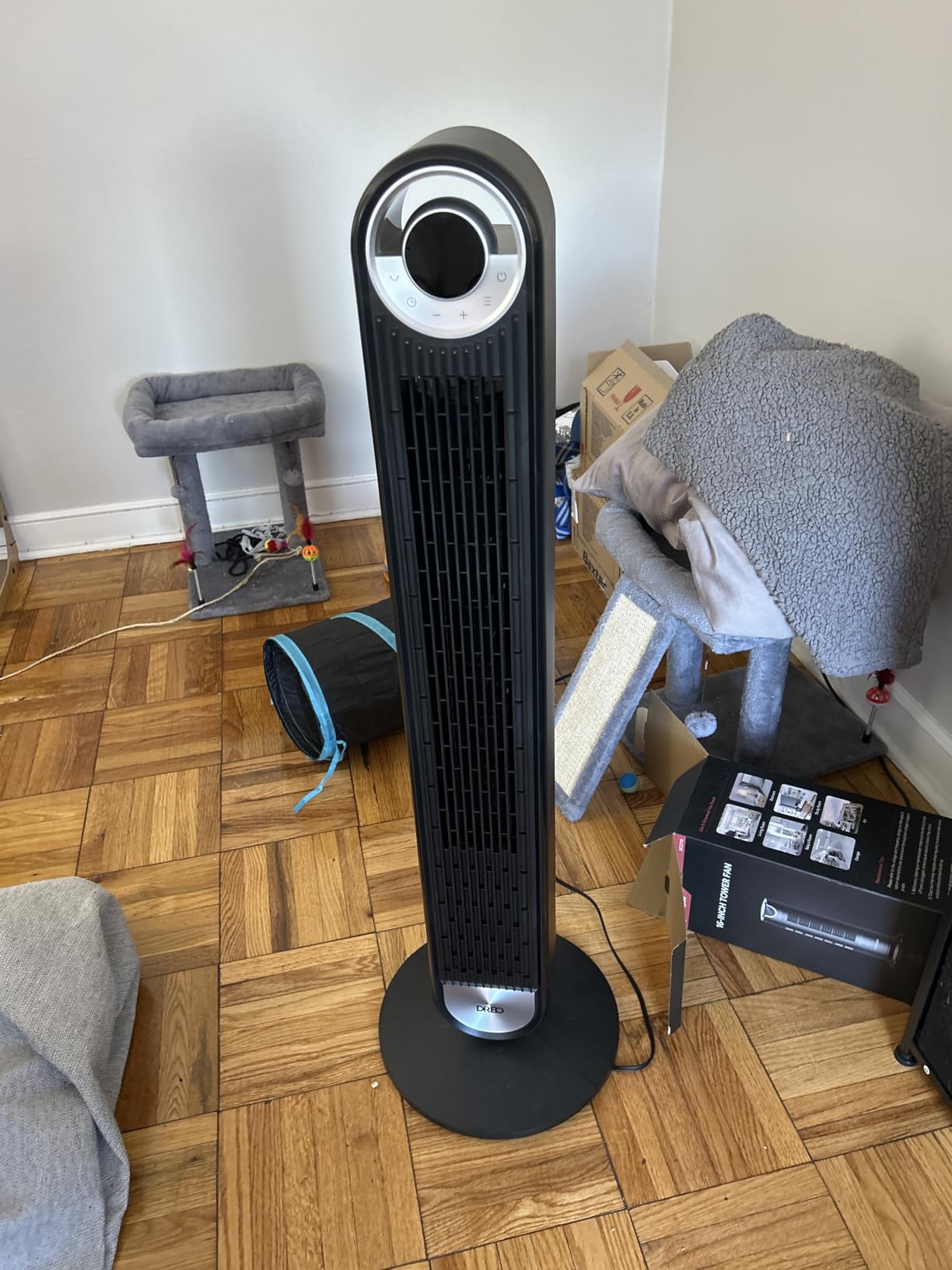
This model carries the highest average rating in the group at 4.6 across more than 22,000 ratings, and the reason is consistency. The brushless motor keeps the sound low enough to sleep beside on low and mid settings, while still moving 1397 CFM, which is real volume rather than a trickle.
Nine speeds across four modes give you a lot of room to tune. The oscillation is smooth and completely silent as the head turns, which removes a sound that most owners never think about until they hear it in a quiet room.
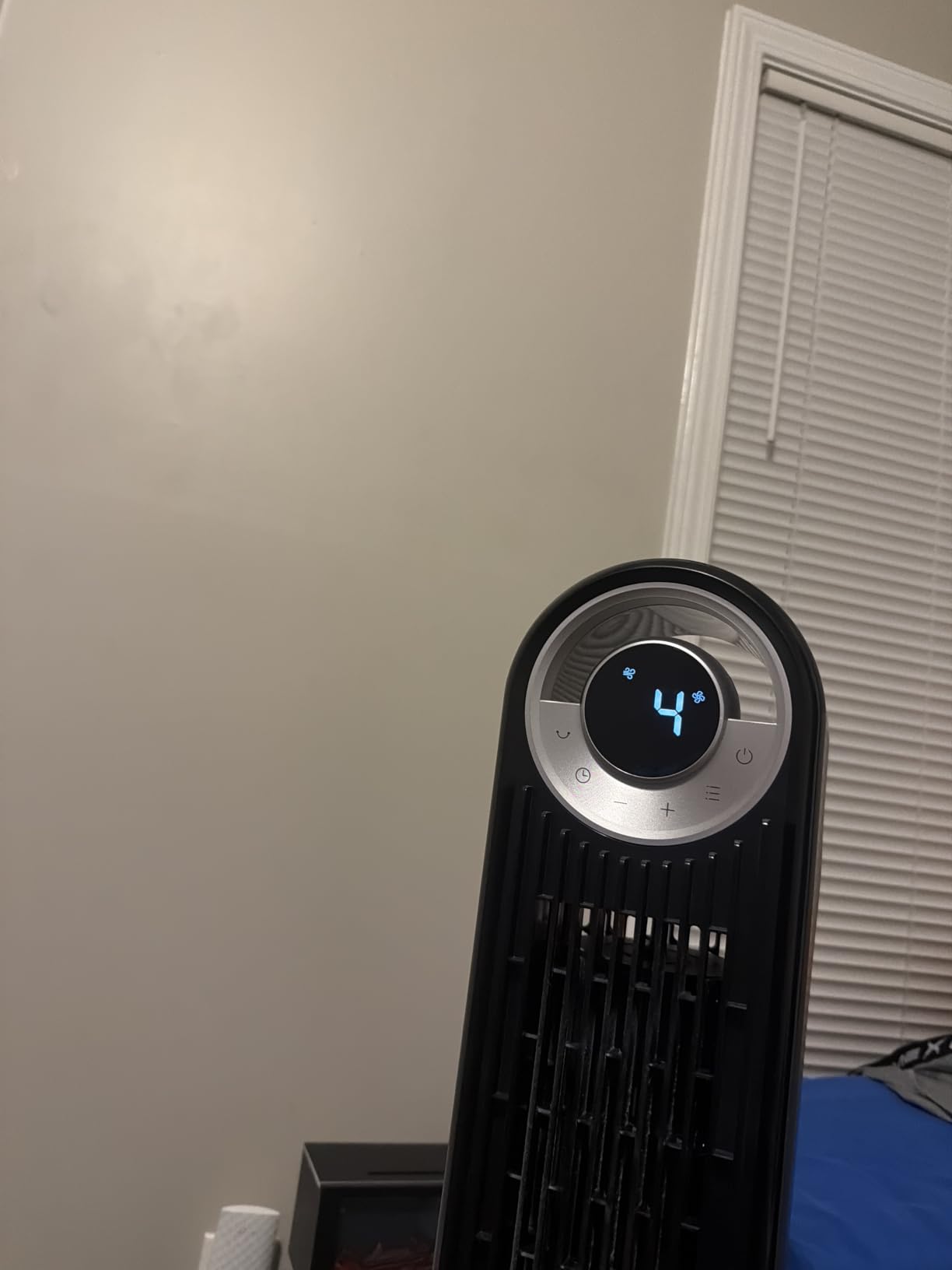
Display behaviour is handled well: lights illuminate only when you change a setting, then go out. Sleep mode dims the display and eases the fan down rather than dropping it a step at a time, which is the gentler way to fall asleep with air moving.
At 42 inches tall and 13 inches square, this is a large fan. It is priced above the 36 inch competitors too. Top speeds become loud enough to hear over television, so treat the upper range as a daytime setting.
Who should sleep next to this fan
Master bedrooms where you want strong airflow and near-silence from the same unit. The combination of high rated volume, nine quiet speeds and a display that goes dark is hard to argue with.
It suits people who want real cooling performance in a warm room but still refuse to accept fan noise as the trade-off.
Who should look elsewhere
Small bedrooms and dorms. A 42 inch body with a 13 inch footprint is a lot of real estate for a room that a 30 inch fan handles comfortably.
Anyone who needs the lowest possible sound at any cost should compare the Smart 42 Inch above, whose noise claim is lower.
5. Honeywell QuietSet HYF260 – Best for White Noise Sleepers
Honeywell QuietSet Whole Room Oscillating Tower Fan with Remote, White, HYF260
Sound most sleepers describe as ideal white noise
5 speeds plus auto-off timer
5 level panel dimming including off
Remote stores in the back of the unit
40 inch, 8 lbs
Pros
- Genuinely quiet airflow that many sleepers use as white noise
- Panel dims through five levels down to off
- Remote has onboard storage in the unit
- Oscillation plus 1 to 8 hour timer works well overnight
Cons
- Some units develop a motor vibration buzz after time
- Moderate airflow rather than powerful
- Not all units restart after a power outage
- Two piece plastic base feels insecure
This one earns its place for a different reason than the others. Where the DREO models aim to disappear, the Honeywell QuietSet is built to be present in a useful way: many owners describe the sound as white noise they run all night, and a steady broadband hum is far better at masking an intermittent problem, like a snoring partner or traffic, than a near-inaudible fan.
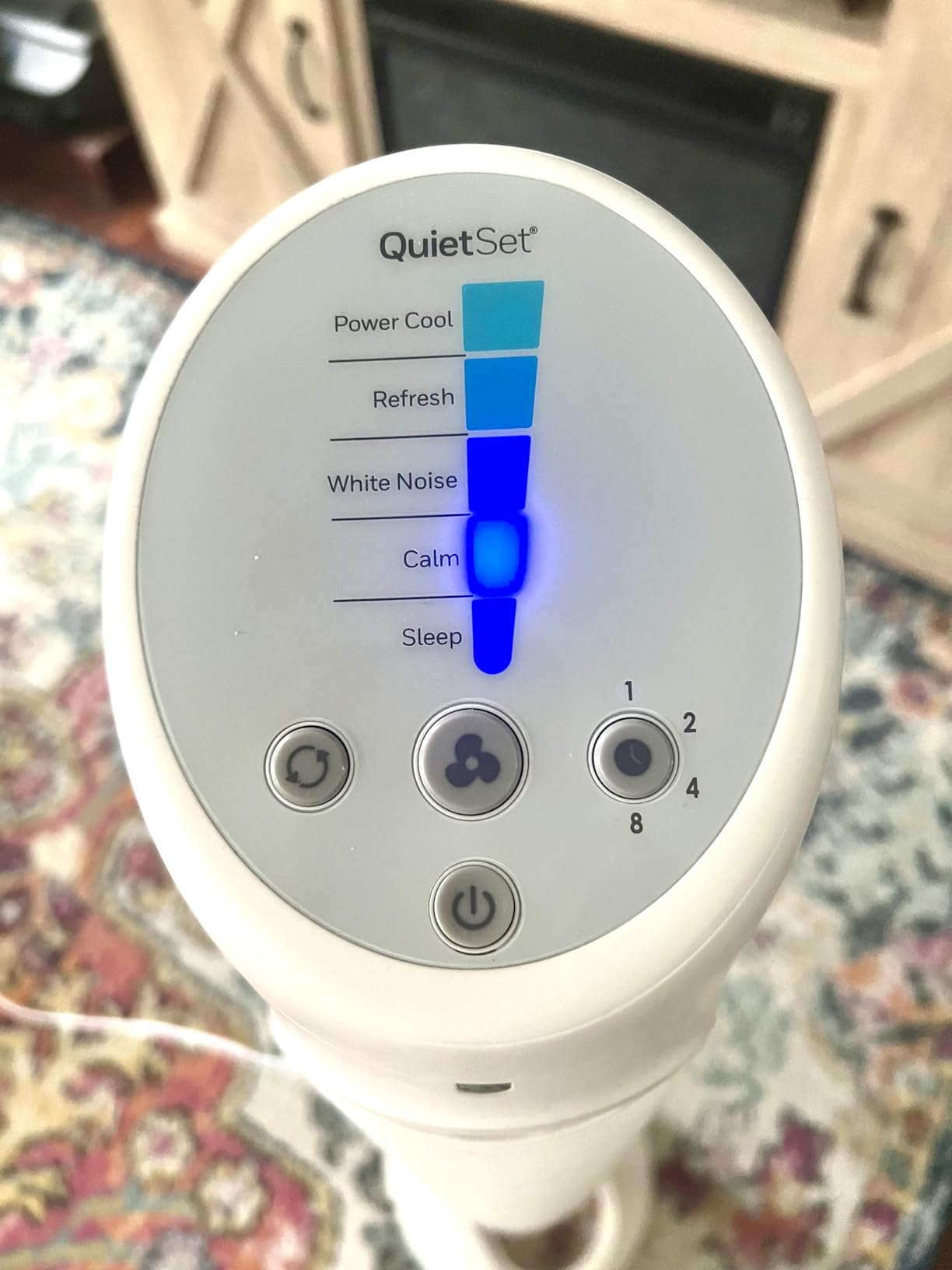
The panel dimming is genuinely the best in this group. Five levels from full down to off mean you can leave a little light on for a child or a dark bedroom stays properly dark, and that single feature removes one of the most common overnight irritants.
The remote storing in the back of the unit is a small design touch that matters in a bedroom, where a loose remote on the nightstand is one more thing to knock over. Oscillation plus a 1 to 8 hour timer handles the overnight window.
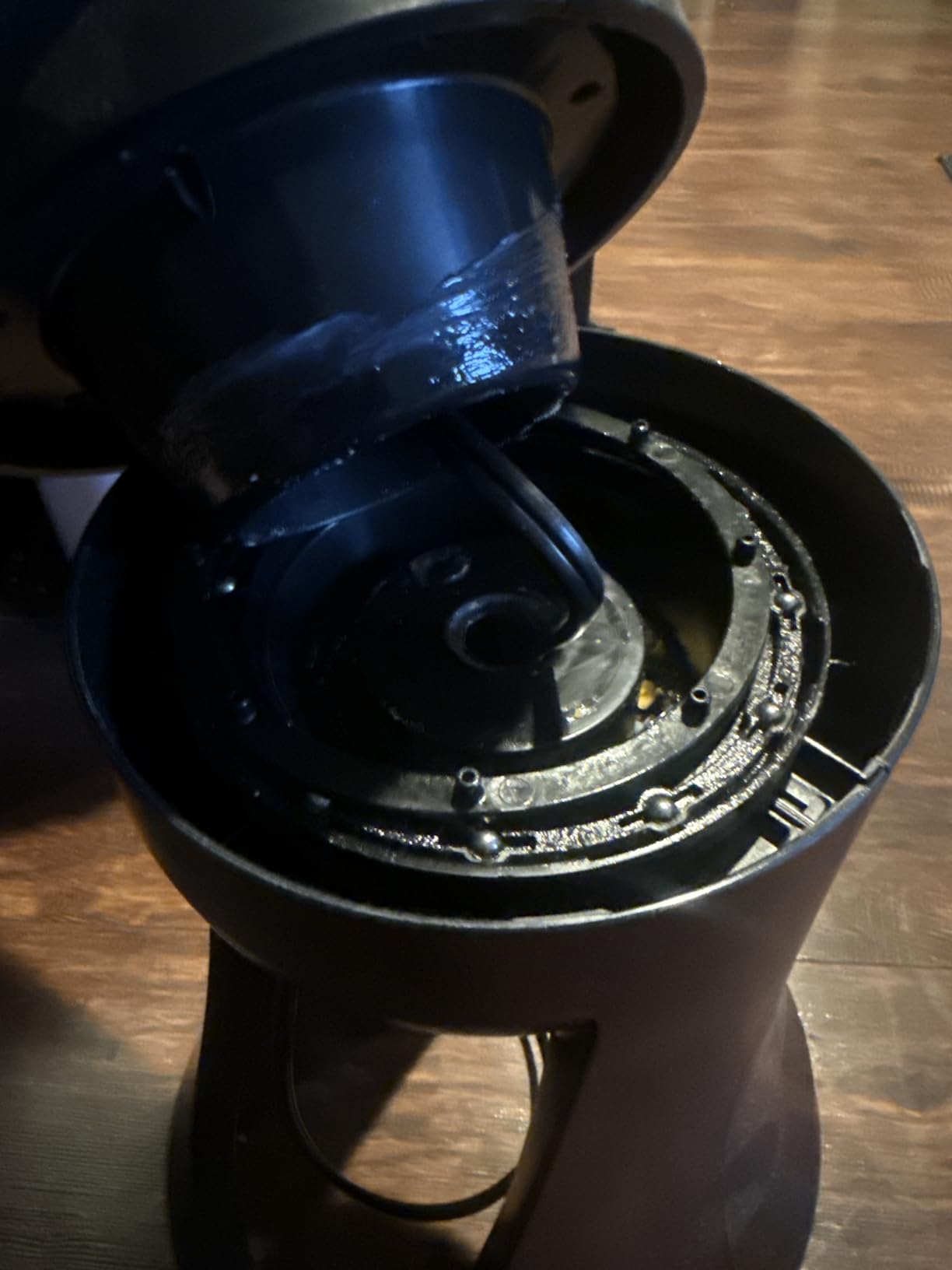
Now the honest part. A recurring complaint is motor vibration buzz on some units, which is exactly the failure that undoes a quiet fan. Airflow is also moderate rather than powerful, so this is a comfort fan for a bed rather than something that will noticeably cool a large room.
Who should sleep next to this fan
People whose problem is a noisy sleeping partner, a neighbour, or street noise. A steady low hum at a level you can sleep beside will mask more than a fan you cannot hear at all.
It is also a good fit for anyone who has been burned by a bright display, since the five-level dimming is the most thorough in the group.
Who should look elsewhere
Anyone in a large room who wants real cooling from the fan. Moderate airflow means it works best pointed at a bed, not a living space.
If you are buying for a long-term replacement of an old rattling fan and are sensitive to buzz, read the next section on noise durability first.
6. PELONIS 40 Inch Bladeless Tower Fan – Best Bladeless Design
PELONIS 40-inch Bladeless Tower Fan for Bedroom, Standing Fan with Remote Control, 26ft/s, 90° Oscillation, 3 Speed Settings, 27 dB, 3 Modes, 15-Hour Timer, LED Display, Fan that Blows Cold Air, Black
Bladeless column design
27 dB claimed
3 speeds, 26 ft/s
15 hour programmable timer
93 degree oscillation, 8.2 lbs
Pros
- Soft pitched sound that fades into background
- 26 ft/s airflow
- Assembly needs no tools
- Slim footprint fits tight rooms
- Remote works from 30 feet
Cons
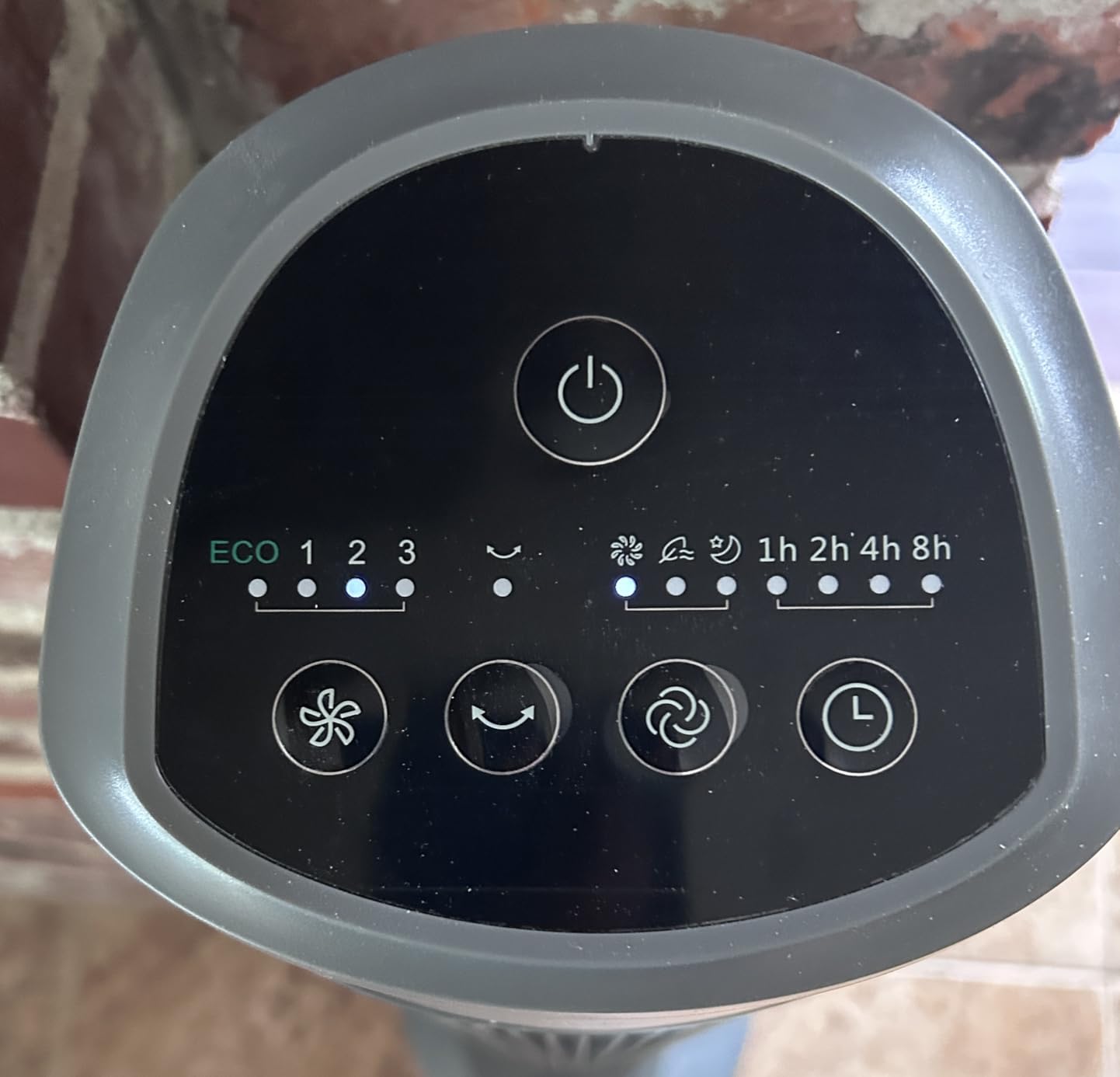
- Sleep mode behaves like the top speed
- Remote holder slot leaves the remote exposed
- Some units lose oscillation after about a month
- Only 3 speed settings
The bladeless column here is the reason to consider this model. There is no exposed blade to reach for, no blade guard to collect dust, and no narrow gap to clean with a brush, which matters in a child’s room or a house with a curious pet. The surface wipes down in seconds.
Sound is soft with a mid-high pitch undertone that owners say fades into the background rather than competing with it. Airflow of 26 ft/s is strong for a bladeless design, and the 93 degree sweep covers most of a room.
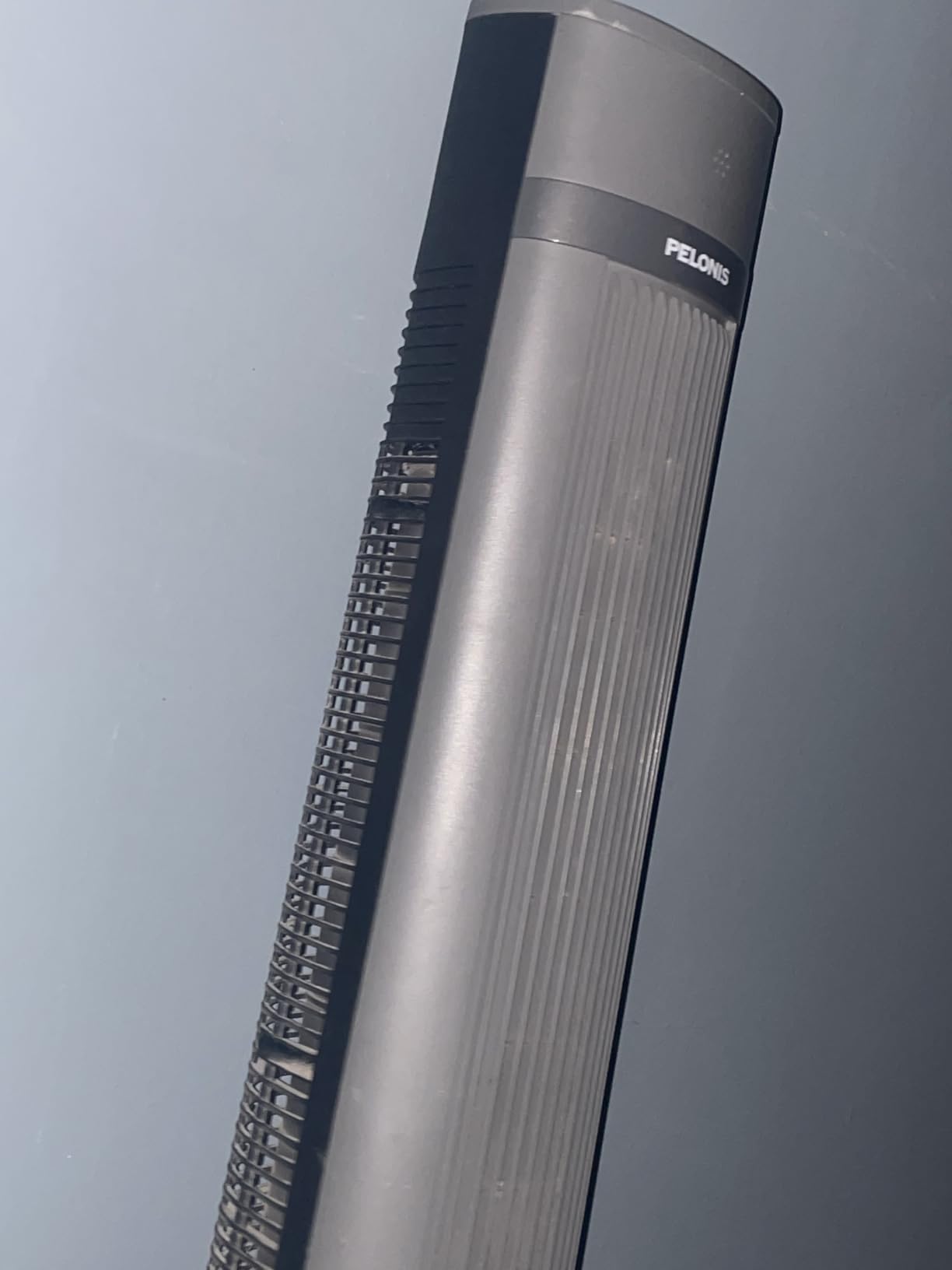
Three speeds is coarse, and one complaint is worth flagging before you buy: several owners report that sleep mode behaves no differently from the top setting. If you plan to lean on sleep mode, ask yourself whether a bladeless column matters more than a properly ramped-down night mode.
The 15 hour timer is the longest here, which suits late schedules. The remote holder is awkward and leaves the remote half exposed, and a minority of units lost oscillation after about a month, so keep the warranty details handy.
Who should sleep next to this fan
Nurseries, kids rooms, and any home where a child or pet shares the space. The safety and cleaning profile is the strongest argument, and several owners report years of reliable running.
It is also a reasonable pick for a narrow bedroom where the slim column matters more than maximum footprint coverage.
Who should look elsewhere
Large open-plan rooms. This is built for small and medium bedrooms, and pushing it beyond that means running the top speed, which is precisely the loudest mode.
Anyone who needs a true sleep ramp or very fine speed control should prefer one of the 8 to 12 speed models.
7. PELONIS 30 Inch Tower Fan, 30dB – Best for Dorm Rooms and Small Bedrooms
PELONIS 30-Inch 3-Speed Oscillating Tower Fan for Bedroom, Quiet 30dB
Compact body at 29.7 inches tall
30 dB claimed
3 speeds, 20 ft/s
90 degree oscillation, 120 minute timer
7 lbs with a carry handle
Pros
- Small footprint fits apartments
- dorms and small offices
- Light 7 lb body with a built-in handle moves easily
- Snap-together base assembles in under a minute
- Three speeds plus wide oscillation cover small rooms
Cons
- Weakest airflow in the group
- High setting is noisier than the 30 dB claim
- Loud clicking from the speed buttons
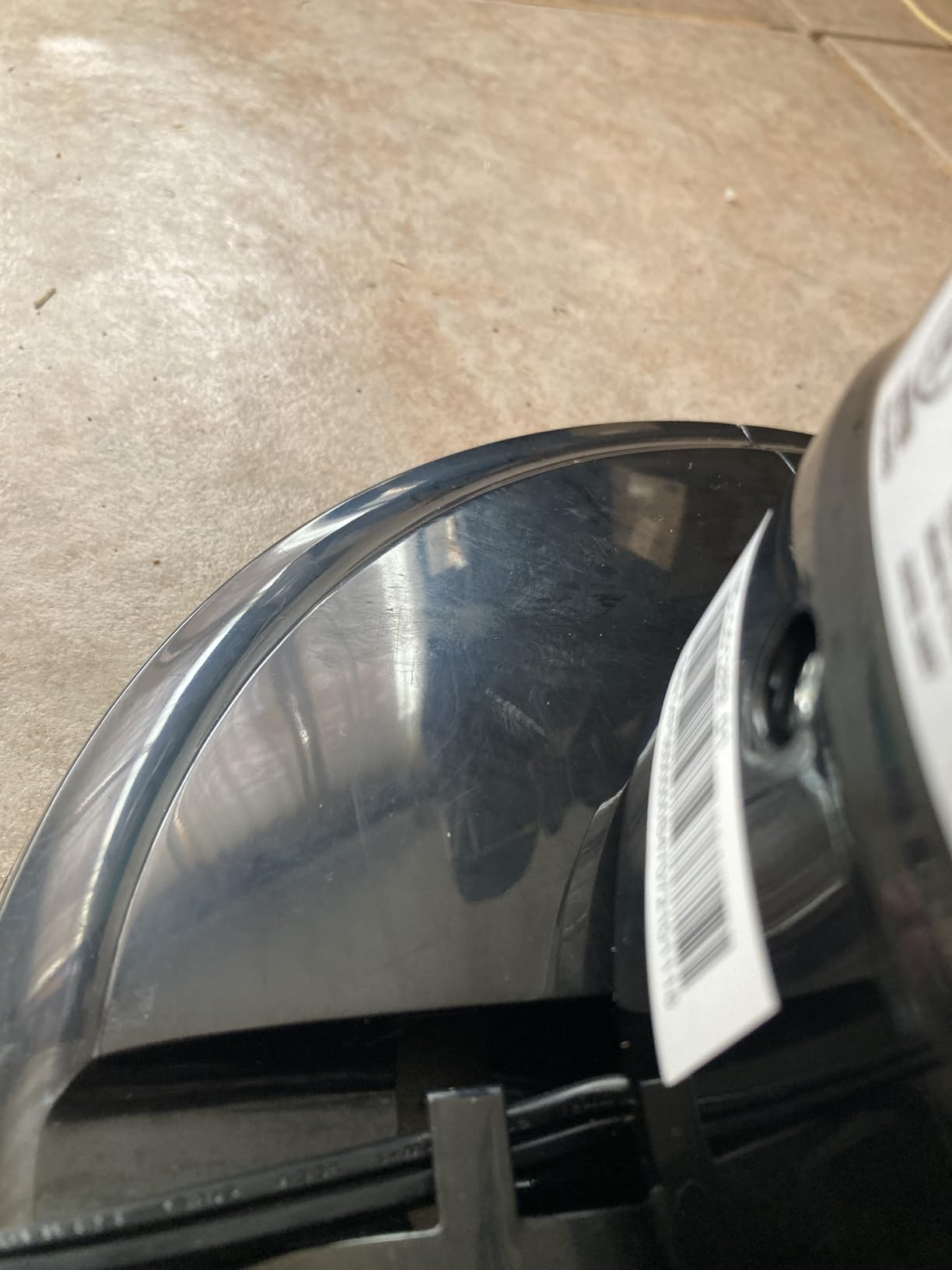
- Base described as flimsy
- No remote in the base configuration
This is the footprint answer. At 29.7 inches tall, 7 inches wide and 7 pounds with a carry handle, it is the only pick here that genuinely lives on a nightstand or a dorm desk, and small bedroom buyers on the forum threads single out compact models for exactly this reason.
Three speeds and 90 degree oscillation cover a small room adequately. The 120 minute timer in 20-minute increments is short for overnight use, so plan to set it before you settle in rather than relying on it for a full night.
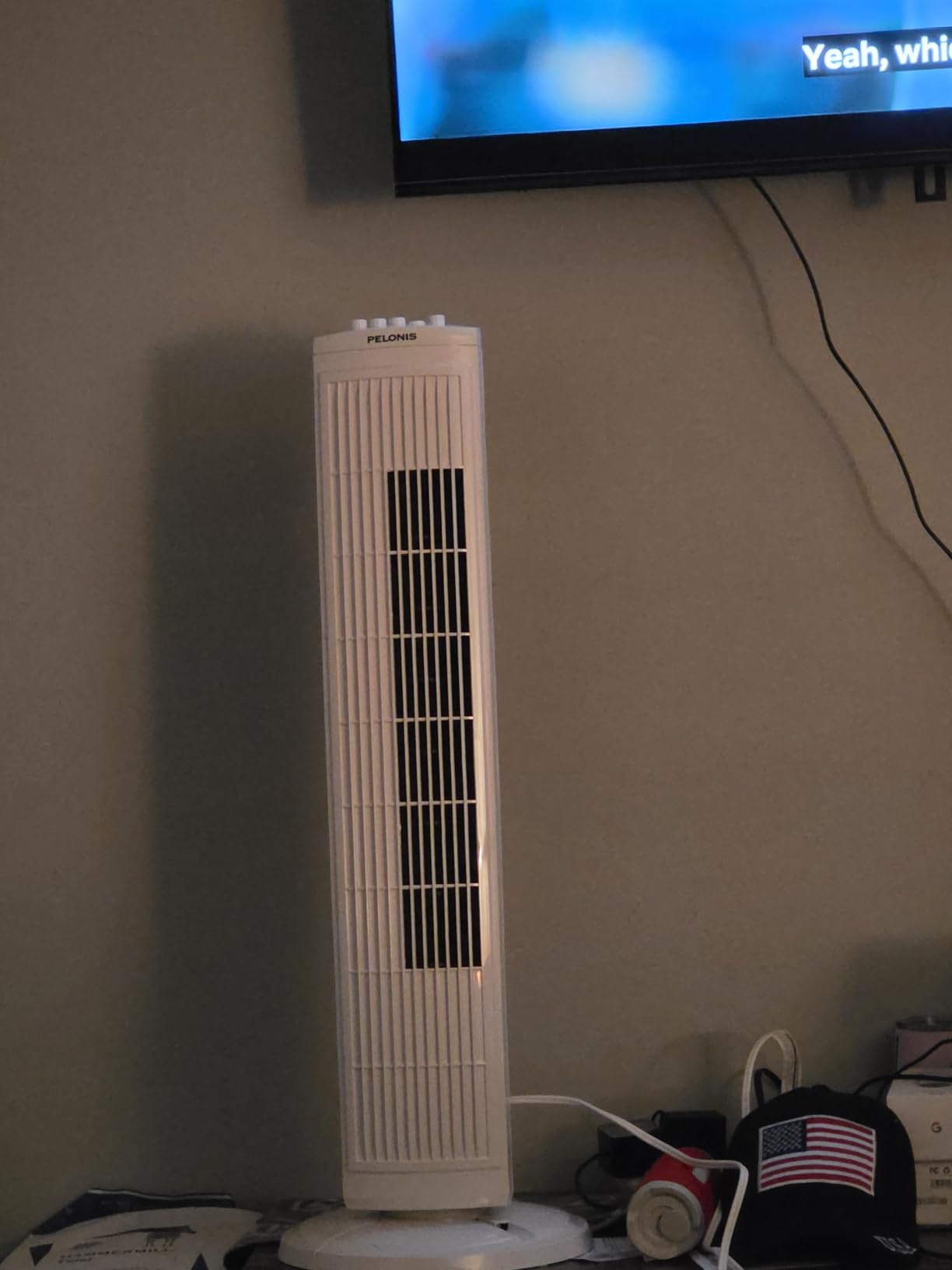
Be clear-eyed about the trade. Airflow of 20 ft/s is the weakest in the group and several owners find the high setting underwhelming, and the high setting is also noticeably noisier than the 30 dB figure. Loud clicking from the speed buttons is a recurring complaint, and for a light sleeper that alone can disqualify it.
Against that, several owners report it still runs well after three to four years, which is a genuine long-term signal in a category where many complaints are about early failure.
Who should sleep next to this fan
Dorm rooms, studio apartments, kids rooms, and anyone whose bedroom simply cannot fit a 36 to 42 inch tower. The low weight and small base also make it the easiest fan here to move between rooms.
Medium sleepers who will run it on low and not expect much will be fine with it.
Who should look elsewhere
Anyone who needs meaningful airflow or a silent button press. The airflow ceiling and the clicking are both real limits, not quirks of a particular unit.
Anyone wanting a timer that covers a full night should note the 120-minute maximum.
8. Lasko Oscillating Tower Fan T38400 – Best for Strongest Airflow
Lasko Oscillating Tower Fan with Remote Control – Tower Fan for Bedroom & Office, 4 Quiet Speeds, 38″ White, T38400
Hybrid blower design
57.3 dB listed, loudest in the group
4 quiet speeds
38 inch, 12 inch square footprint
85 watts
Pros
- Exceptionally strong airflow
- even on the lowest speed
- Hybrid blower draws cool floor air up through the room
- White noise output several owners sleep beside
- Compact 12 inch footprint with remote and timer
Cons
- Noticeably loud overall and unsuited to silence-sensitive sleepers
- Narrower oscillation than 90 degree models
- Some units develop an odd noise or rattle after a few months
- Costs more than comparable tower fans
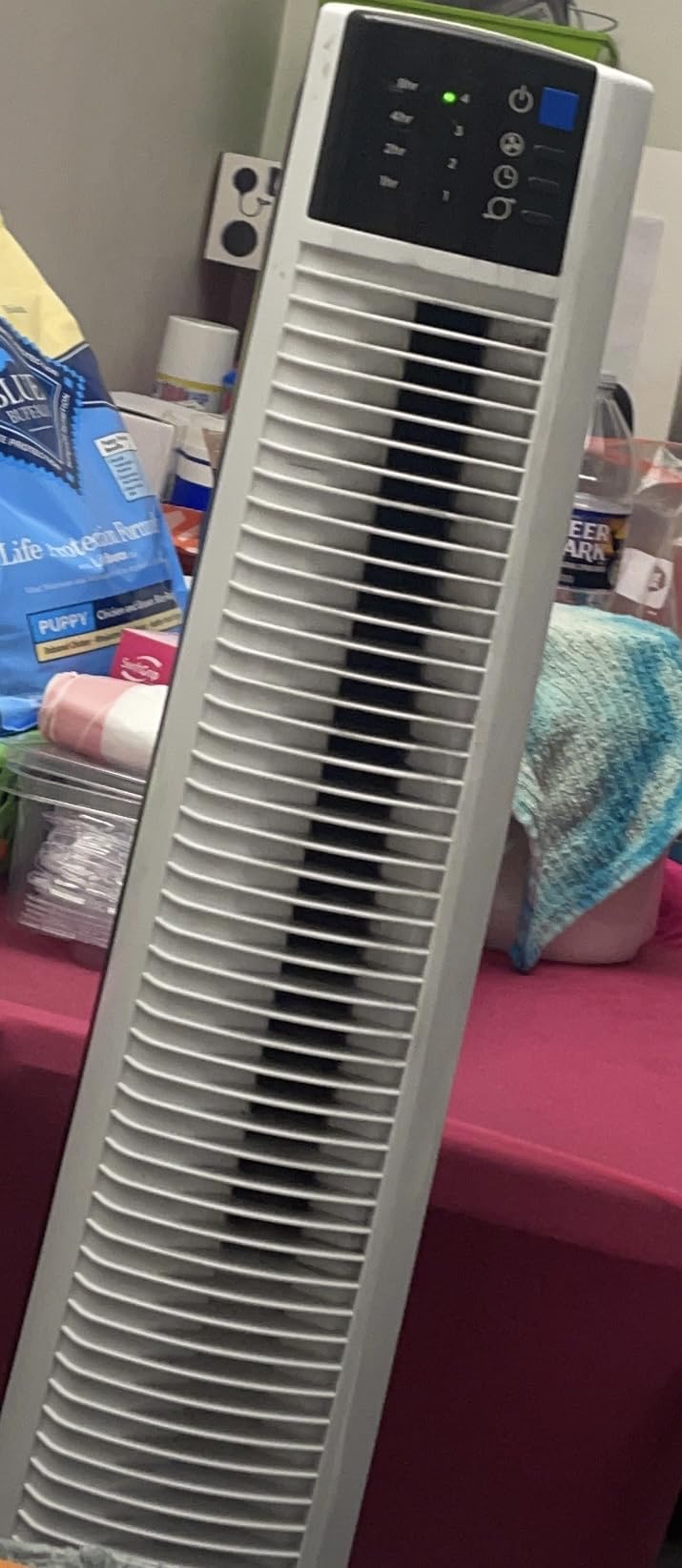
We include this one because it is the honest opposite of what most of this list is about. If you want a fan you can hear, that moves real volume across a room, and that several owners use as a white noise source, this does all three better than anything else here. The hybrid blower pulls cool floor air up and distributes it through the space.
The listed noise figure is 57.3 dB, the highest in the group, and multiple buyers explicitly warn it is too loud for a quiet bedroom or for use beside a television. Read that as a description of the machine, not a defect.
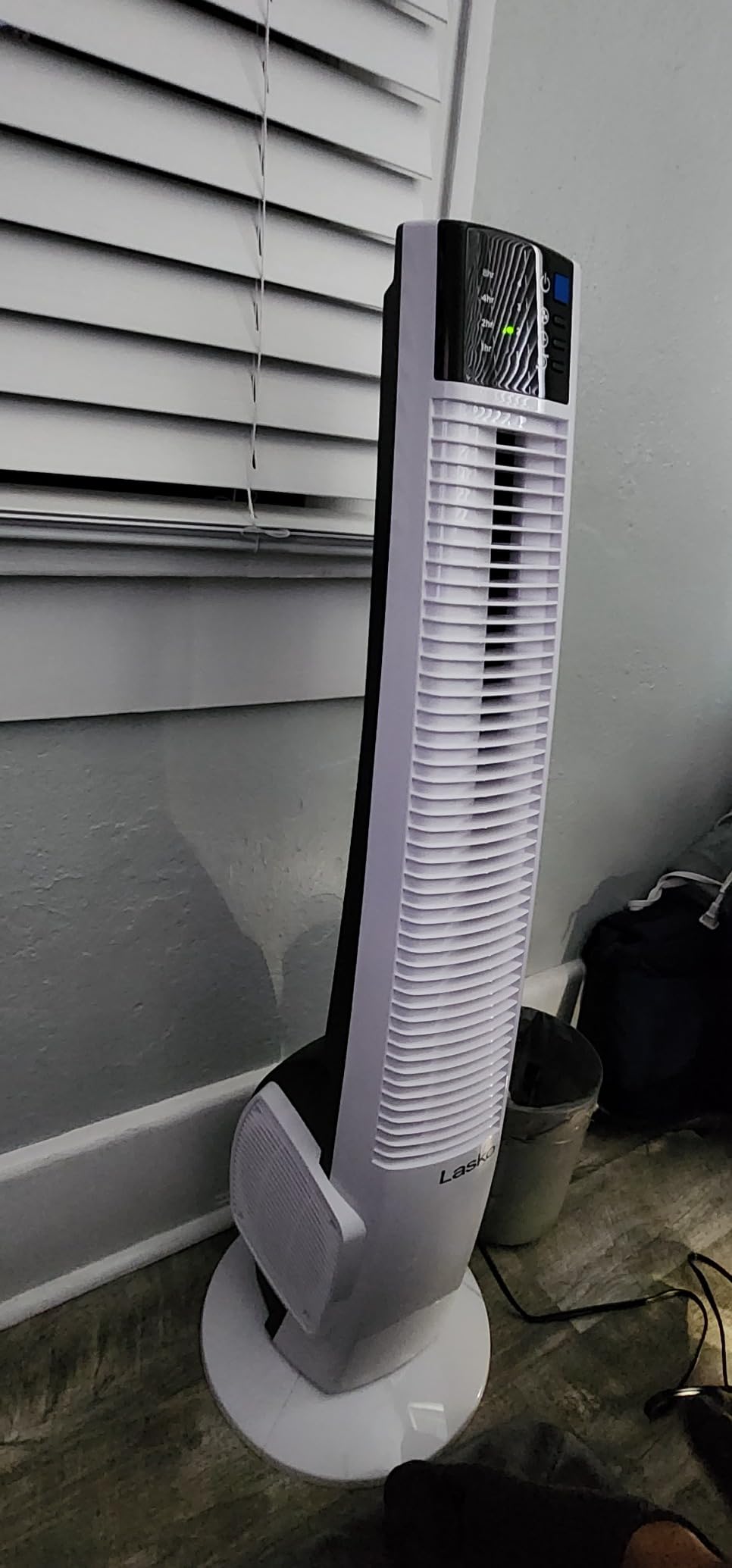
Oscillation is narrower than the 90 degree models, so coverage is concentrated. A few owners report an odd noise or rattle developing after a few months, and one reported performance dropping to roughly 60 percent within four months, so the warranty matters more here than elsewhere.
The 12 inch square footprint is compact for a 38 inch fan, which helps in tighter rooms even though the sound will limit where you put it.
Who should sleep next to this fan
Heavy sleepers, and anyone who wants a genuine white noise blanket rather than near-silence. If you can sleep through a steady hum, the airflow you get here is worth more than the quietness the other picks offer.
It is a reasonable fit for a larger bedroom where you want the fan to do actual cooling work at the bed.
Who should look elsewhere
Light sleepers, shift workers sleeping by day in a shared space, and anyone in a thin-walled apartment where the fan noise would carry. This is the pick to skip if sound matters more than volume.
It is also the wrong choice for a nursery or a room where a child sleeps.
9. DR.PREPARE 16 Inch Bladeless Tower Fan – Budget Pick for Nightstands
DR.PREPARE Tower Fan for Bedroom, 25 dB Quiet DC Bladeless Fan with Remote, 8 Speeds, 1-8H Timer, 80° Oscillating Fans for Indoors, 16 Inch Portable Desk Table Fans for Room, Home, Office
16 inch bladeless desk format
25 dB claimed, 12W DC motor
8 speeds with sleep mode
1 to 8 hour timer, 80 degree oscillation
3.3 lbs, detachable impeller
Pros
- Fits a nightstand
- desk or counter at 16 inches
- Genuinely quiet on low and mid settings per owners
- Display light and beeps can be turned off entirely
- Only 12W
- ideal for long un-air-conditioned nights
Cons
- 16 inch height makes it a personal fan
- not a room cooler
- Some buyers find it louder than the 25 dB claim
- A minority report weak airflow
- Some review text on the listing describes an unrelated product
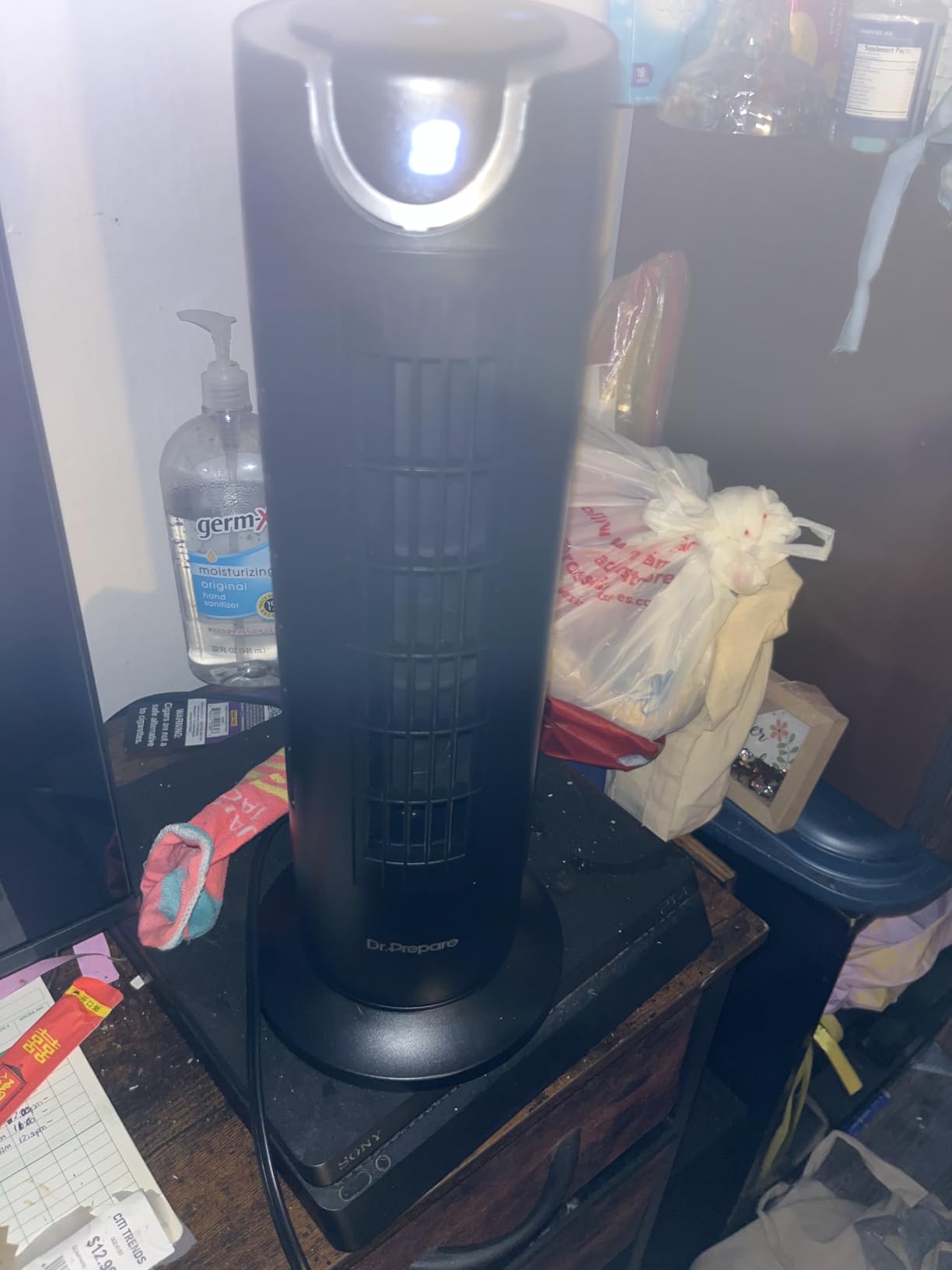
This is the small-room and small-budget answer. Sixteen inches tall at 3.3 pounds, it is the only pick here you can genuinely put on a nightstand, and it costs less to run than anything else on the list at 12 watts, which makes it a good choice for a room without air conditioning that you need running all night.
Eight speeds, a sleep and sound mode, an 80 degree oscillation and a 1 to 8 hour timer give it more control than its size suggests. Owners in small rooms and offices rate it as genuinely quiet on low and mid settings, and both the display light and beeps can be switched off for a fully dark sleeping setup.
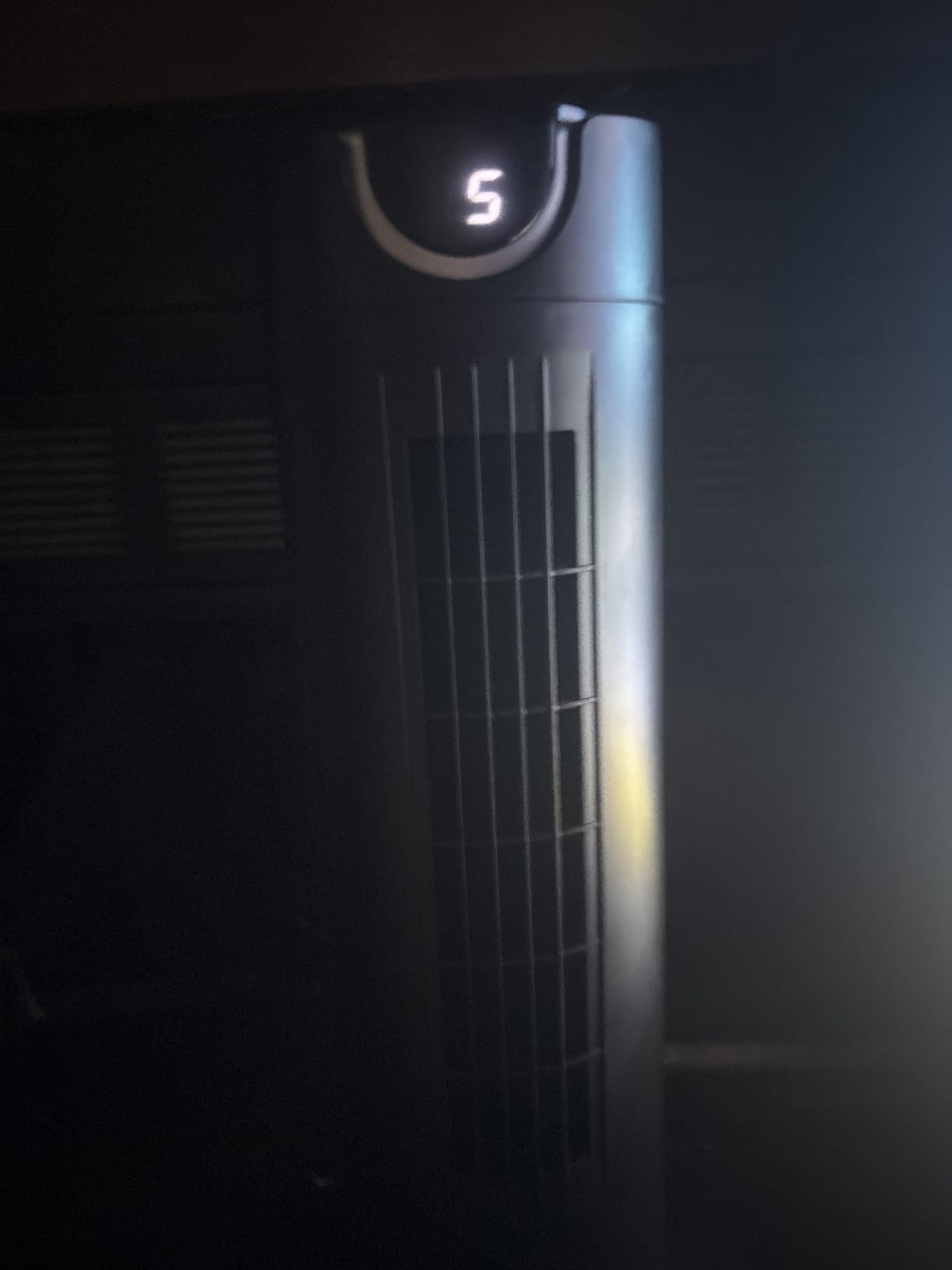
The detachable impeller and rear guard make cleaning simple, which keeps the sound low over time rather than letting a dusty wheel start whispering.
Set expectations clearly: at 16 inches this is a personal fan, not a whole-room cooler. Some buyers find it louder than the 25 dB claim, and a minority return it over weak airflow. A share of the review text on this listing also describes an unrelated neck-worn product, so read the detailed reviews rather than the headline rating.
Who should sleep next to this fan
Dorms, small bedrooms, nurseries, and home offices where you sit near it. The kill switch on the display and beeps is the detail that wins it over bigger fans for sleep.
Anyone trying to cool a room without air conditioning on a budget will appreciate the low wattage over a long night.
Who should look elsewhere
Anyone who needs to cool a room. Sixteen inches simply does not push air far enough, and trying to compensate by running it on high is exactly the setting where the noise complaint appears.
Master bedrooms are also a poor fit for the same reason.
10. Timiyou Bladeless Tower Fan, 22dB – Best for Kids and Pets
Bladeless Tower Fan with Powerful Airflow, Ultra-Quiet DC Motor (22 dB), 8 Speed Levels & 4 Modes, Remote Control, 12H Timer, 90° Oscillation, Safe Design for Bedroom, Home, Office – White/Silver
Bladeless 360 degree air intake
22 dB claimed, 8 speeds
4 modes with negative ion mode
90 degree oscillation, 12 hour timer
33.5 inch column
Pros
- Very quiet low hum that some owners use to mask background noise
- Bladeless design wipes clean with no dust traps
- Remote works from across the room
- Good airflow for the lower settings
Cons
- Weakest high-speed airflow in the group
- Reviewers are unclear about the rear filter and replacements
- Some review text describes an unrelated neck-worn fan
- Smallest review base here
- so limited long-term evidence
The child and pet safety profile is the reason this one is here. A bladeless 360 degree air intake has nothing to grab and no narrow blade gap to trap dust, and owners with pets and small children pick bladeless designs for exactly that reason. At 22 dB claimed it also sits near the quiet end of this list.
The low hum is described by owners as useful for masking background noise, and the remote reaches across a room so you are not adjusting it in the dark.
We want to be straight about the evidence here. This has the lowest rating and by far the smallest review base in the group, which means less long-term reliability information than anything else we recommend. Buyers report the weakest high-speed airflow of the ten, with at least one returning it after comparing it to a basic small fan. Reviewers are also unclear about the rear filter and what replacement to buy.
If you need proven airflow, treat this as a nursery or kids room option where the safety and cleaning profile outweighs how much air it moves.
Who should sleep next to this fan
Nurseries and children rooms, especially where the fan is left running through the night and cleaning needs to be fast. The negative ion mode and 12 hour timer cover the overnight case.
Pet owners who worry about reaching blades will find the bladeless intake settles that.
Who should look elsewhere
Anyone who needs real cooling. The high-speed shortfall is consistent enough that we would not build a recommendation for it on airflow.
Buyers who want confidence in long-term durability should look at the picks with tens of thousands of ratings, since we have far less owner history to draw on here.
What dB Actually Means When a Brand Says Quiet
The quietest fan noise levels fall around 20 to 25 dB, which is close to a whisper. Below that, you are in the territory of a very well-built DC motor on its lowest setting rather than a fan you can actually run all night at useful speed.
Here is the catch that frustrates almost every buyer. Published dB figures are measured at minimum speed, typically from several feet away, in a room treated as acoustically quiet. That is a best case, not a typical one. At the speed you would choose at 2am, the number is meaningfully higher on every fan in this list. Treat the figure as a ranking tool between models, not as a prediction for your bedroom.
Motor type explains more of the real-world gap than the number itself. A brushless DC motor has no brushes rubbing, so there is no friction rasp layered on top of the airflow, and it can hold a low speed without the tone climbing in pitch. An AC motor does the same job, but buyers consistently report it getting louder faster as the speed rises.
Sound character matters as much as volume. A broadband hiss that fades into a room is easy to sleep through. A tonal whine at a single pitch is not, because your ears lock onto it. This is the reason the DREO models get described as steady rather than buzzy, and the reason reviews complaining about motor or bearing whine are worth reading carefully.
One more measurement habit helps. Speed 1 and speed 4 are the numbers that matter, and no manufacturer publishes both. Ask instead how many speed steps exist, because a fan with twelve speeds lets you sit at a genuinely low point, while a three-speed fan forces a jump between quiet and useless.
Tower vs Bladeless vs Box Fan: Which Is Quietest for Sleep
Yes, tower fans are generally quieter than box fans at the speeds people actually use overnight. A box fan pushes a concentrated stream through a small blade, which creates turbulence and a sharper pitch, while a tower spreads the same air over a tall narrow outlet and sounds smoother.
Bladeless fans sit in between in a useful way. The column has no blade breaking the air, so there is no blade pass tone, and the sound is often a soft hum. What bladeless designs trade away is high-speed airflow, which is why most of them need a longer runtime at a lower setting to do the same job.
Practical takeaways: use a tower fan for a bedroom that needs real air movement, a bladeless model where safety and cleaning matter more than volume, and a box fan where you want maximum air per watt and can tolerate a sharper sound. If you are replacing an old fan and the reason is that it rattles, note that moving to a bladeless design removes the rattle source entirely, since there is no blade and no housing gap to resonate.
Consumers on the r/bedrooms threads consistently raise the same follow-up: whether the fan will still be quiet in a few weeks. That is the subject of the next section.
Why Some Quiet Fans Get Louder After a Few Weeks
The most common complaint in quiet fan discussions is not the first impression. It is that a fan which sounded excellent on day one develops a hum, a rattle or a thin whine over the first few weeks. Users on Reddit describe this repeatedly, and it is the single complaint no competitor roundup addresses properly.
Four things cause it, and you can screen for all four before you buy.
Impeller imbalance. Dust on the rear grille and impeller is the leading cause. A dirty wheel moves off balance and starts rubbing, producing a periodic thump or a rasp. Every fan here with a removable rear grille or detachable impeller is a fan you can keep quiet, so clean it every few months in high-use summers.
Housing resonance. Snap-together plastic bases can start clicking or buzzing when the panels work loose under vibration. Runners on the r/BuyItForLife threads treat multi-year ownership of a quiet fan as a genuine signal, and the opposite pattern, a rattle appearing early, as a strong reason to return it inside the warranty window.
Wobble on carpet. A base that rocks on soft flooring clicks audibly on every oscillation cycle. This one is visible before you buy it, so check the base in the store if you can, and prefer a heavier base.
Button beeps. Not a mechanical failure, but the most reliable way to lose a light sleeper. Several fans here let you silence or disable the beep, and that single setting matters more than a decibel figure of two or three.
Two patterns from owner reports are worth knowing. Some units of the Honeywell QuietSet develop a motor vibration buzz that cancels out the quiet, and a minority of the PELONIS 40 Inch lost oscillation after about a month. Both are minority outcomes within well-reviewed products, which is exactly why the warranty length is a fair tiebreaker between otherwise equal fans.
How to Choose a Quiet Tower Fan for a Bedroom
Start with the motor, because it is the one decision you cannot reverse. A brushless DC motor is quieter at low speeds and holds a low tone longer. Every fan in this group with one is a fan you can sleep next to.
Next, count the speed steps. Quietness is not a single setting, it is a range, and the range is what determines whether you can find a point that is inaudible but still moving air. Eight to twelve steps is the useful band. Three or five means you will be choosing between too quiet and too loud.
Then check sleep mode honestly. Some sleep modes simply hold the lowest speed, which is fine. On at least one model in this group, owners report sleep mode behaving like the top setting, which makes it worse than useless. If a sleep mode is a deciding factor for you, look for one that ramps gradually.
Display behaviour is a sleeper issue, not a gadget issue. A panel that cannot be dimmed to off will ruin a dark bedroom no matter how quiet the motor is. The Honeywell QuietSet offers five dimming levels including off, and the DREO models illuminate only when a setting changes.
Timers should cover a full night. A 12 or 15 hour timer handles a normal bedtime; the 120-minute timer on the compact PELONIS 30 Inch does not. If you use a smart home setup, app and voice scheduling beats any timer, but check whether the display is readable in daylight before you commit.
Oscillation range matters for coverage. Sixty degrees is narrow and leaves one side of the bed untouched. Ninety degrees or more spreads air across a whole room, which means you can run a lower speed and still cool the space, which is itself a quietness strategy.
Footprint and stability close it out. Measure the corner or dresser first, especially for the 42 inch models. Then check the base: a heavier base resists wobble on carpet, and wobble turns a silent oscillation into a click every few seconds.
Two quieter signals are worth trusting over the rest. Number of owner ratings tells you whether a pattern exists yet. And a warranty longer than the standard year tells you the brand expects a longer quiet life. Our tower fan value picks cover the cheaper end of this market if the numbers above run high for you.
Match the Fan to Your Room Size and Sleep Style
Room size sets the ceiling on which fan works. A small bedroom, a dorm or a 10 by 10 foot space is well served by anything from 16 to 30 inches tall, and buying larger mostly buys you more noise per unit of useful airflow. A master bedroom above 200 square feet needs real throw, which means 36 inches and up with an airflow figure you can feel from across the room.
Sleeper type decides the rest. Light sleepers want the lowest sound they can get and a display that goes dark, which points at the DREO Smart 42 Inch and the DREO 28ft/s. Medium sleepers get more from the Levoit 28 dB, where auto mode does the tuning for them. Heavy sleepers who want a noise floor rather than silence are better served by the Honeywell QuietSet or the Lasko.
Then consider what you are masking. If the problem is your own sensitivity to sound, aim for the lowest figure. If the problem is a snoring partner, street noise or a thin wall, you want steady broadband sound at a level you can sleep beside, which is a different target. Parents of light sleepers sharing a room should note that a bright display undoes a quiet motor instantly.
Placement matters as much as model. Set the fan 8 to 10 feet from the bed rather than beside it, aim it across the room rather than at a pillow, and use oscillation so nobody gets a fixed stream. If you want our broader read on coverage across rooms, our large room fan picks go deeper on throw distance.
If your issue is a persistent rattle rather than airflow, you may be better served by a different appliance category entirely. We covered the common causes in our tower fans that stay quiet writeup.
Frequently Asked Questions
Which bedroom tower fan is the quietest?
The DREO Smart 42 Inch Tower Fan carries the lowest published figure in our testing group at 20 dB, with owners reporting near-silence below speed 5 and a display that dims itself after about a minute. The DREO 28ft/s model is the quieter pick per dollar and the one most people end up buying.
Are tower fans quieter than box fans?
Yes, generally at the speeds people run overnight. A tower spreads air over a tall narrow outlet and sounds smoother, while a box fan forces a concentrated stream through a small blade, which produces turbulence and a sharper pitch. Bladeless fans are quieter still at low speed but move less air.
What is the quietest dB for a fan?
Around 20 to 25 dB is the quietest useful range, close to a whisper. Below that you are hearing a well-built brushless DC motor on its lowest setting rather than a fan that will move air all night. Published figures are measured at minimum speed from several feet away, so treat them as best case.
Will a quiet tower fan stay quiet after a few months?
Most do, provided you clean the impeller and rear grille every few months. The common early failures are an impeller going off balance with dust, plastic bases loosening and clicking, wobble on carpet, and loud button beeps. Fans with removable grilles and longer warranties carry noticeably less risk here.
Is a bladeless tower fan quieter than a bladed one?
Bladeless models avoid the blade pass tone, which many people find abrasive, and they sound like a soft hum. They also have nothing to rattle and are easy to wipe clean. The trade-off is weaker high-speed airflow, so they usually need more runtime at a lower setting to move the same volume of air.
Do tower fans lower room temperature?
No. A fan moves air across your skin so sweat evaporates faster, which feels like cooling, but it does not chill the room. If you want to reduce air conditioner use on mild nights, a fan lets most people raise the thermostat a few degrees without noticing the difference.
Is there a standing fan that blows cold air?
Standalone fans cannot blow genuinely cold air. What they do is move room air across your skin, and that feels cold because of evaporation. The DREO models throw air at 28 ft/s over roughly 40 feet, which is enough to feel a real effect across a bedroom if you run them a couple of hours before sleep.
Final Verdict: The Quietest Tower Fans for Bedrooms
The best tower fans for quiet bedrooms come down to one pick per sleeper type. Our Editor’s Choice is the DREO 28ft/s with its brushless DC motor, 25 dB claim and eight speeds, because it delivers a soft steady tone you can sleep beside while still throwing air across a room.
For the lowest possible sound, go with the DREO Smart 42 Inch at 20 dB and a self-dimming display. For white noise that masks a snoring partner, the Honeywell QuietSet is the better tool. For small rooms and nightstands, the DR.PREPARE 16 Inch and the PELONIS 30 Inch cover the footprint nobody else does.
Whichever you choose, check the quietness red flags before you commit: a motor type you cannot live with, a display that will not dim, a timer shorter than your night, and an oscillation that clicks. Those four catch most of the reasons a quiet fan ends up switched off by week three.
Last tested in 2026. Specifications and listings change as brands refresh models, so use the buttons above to confirm the current details before you buy.