
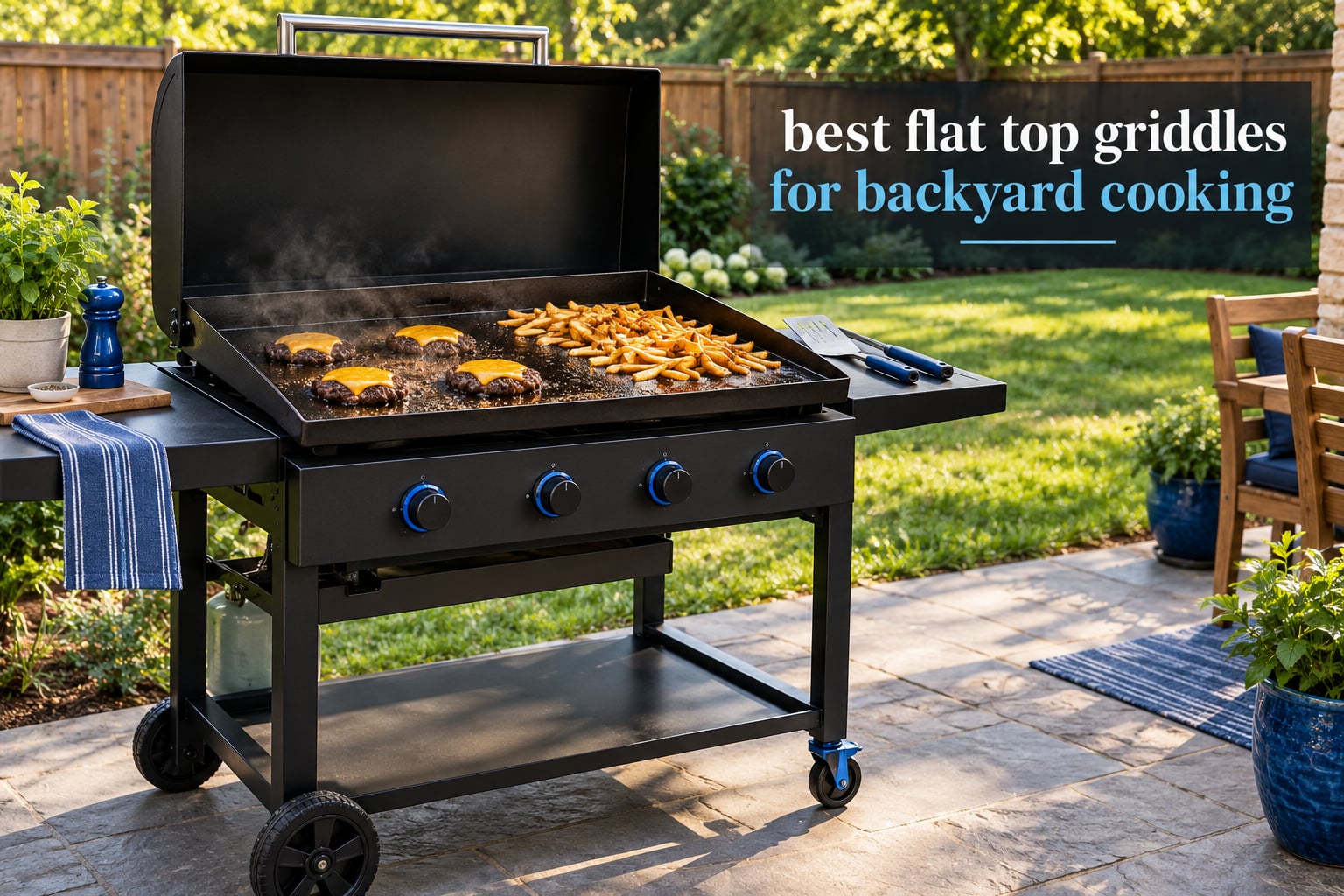
A flat top griddle is the single appliance that turns a bare patch of patio into an outdoor kitchen. Burners sit directly beneath a thick steel plate, so there is no open flame, no flare-up and no gap between the bars of a grill grate — just one continuous sheet of hot metal you can sear burgers on, fry eggs on and toast buns on at the same time.
That matters for backyard cooking more than it does anywhere else. A gas grill handles steaks and chicken well, but it cannot do a Saturday-morning pancake run for ten people or a round of smash burgers without the fat dripping through the bars onto the coals. When we lined up the best flat top griddles for backyard cooking in 2026, the deciding factors were not novelty features. They were how much usable surface you get per square foot of patio, whether the plate holds heat in one spot while you work in another, and how honestly the grease drains and how faithfully the seasoning holds up after a wet autumn.
We compared 12 griddles across the full range: tabletop models you can load into a hatchback, folding carts, four-burner free-standing rigs, cast iron plates that drop onto a grill you already own, and two electric options for patios without a propane line. Twelve is a lot of griddles, so we kept the verdict short for each one and put the reasoning underneath. If you want the single best starting point, it is the 22-inch Blackstone on this list. If you want to skip to the reasoning, the griddle roundup basics cover the shortlist in more detail, and our flat top grill guide goes deeper on the plate and burner side of things.
Table of Contents
Top 3 Best Flat Top Griddles for Backyard Cooking (October 2026)
Three units earned a badge after this round. The 22-inch Blackstone is the one we would put on a patio without hesitating, the 28-inch Blackstone Omnivore is the crowd feeder, and the Lodge cast iron plate is the buy that costs the least and outlives everything else on the list.

Blackstone 1666 22 Inch Tabletop
- 361 sq. in. rolled steel plate
- Two independently controlled H-shaped burners
- Rear grease management with collection cup

Blackstone 1883 28 Inch Omnivore
- 524 sq. in. cooking surface
- Built-in wind guards and integrated hood
- Counter-height dual side shelves

Lodge Pro-Grid Cast Iron Plate
- Reversible grill and griddle sides
- Seasoned with iron and oil only
- Lifetime limited warranty
All 12 Flat Top Griddles at a Glance in 2026
Every unit below is in the order we rank them. Cooktop area is the single most useful number on this list, because it is the one that dictates whether a group of six waits around or eats together.
| Product | Specifications | Action |
|---|---|---|
| Blackstone 1666 22 Inch Tabletop |
|
Check Latest Price |
| Blackstone 1883 28 Inch Omnivore |
|
Check Latest Price |
 Blackstone 2350 OTG 22 Inch Omnivore Blackstone 2350 OTG 22 Inch Omnivore |
|
Check Latest Price |
 Royal Gourmet PD4001 4-Burner Griddle Royal Gourmet PD4001 4-Burner Griddle |
|
Check Latest Price |
 Royal Gourmet PD3001 3-Burner Griddle Royal Gourmet PD3001 3-Burner Griddle |
|
Check Latest Price |
 SKOK 2-Burner Tabletop Griddle SKOK 2-Burner Tabletop Griddle |
|
Check Latest Price |
 ONLYFIRE GS318 Tabletop Griddle ONLYFIRE GS318 Tabletop Griddle |
|
Check Latest Price |
 Utheer 25 x 16 Inch Cast Iron Insert Utheer 25 x 16 Inch Cast Iron Insert |
|
Check Latest Price |
 Cuisinart 2-in-1 Electric Griddle Cuisinart 2-in-1 Electric Griddle |
|
Check Latest Price |
| Lodge Pro-Grid Reversible Plate |
|
Check Latest Price |
 VEVOR 22 Inch Commercial Electric VEVOR 22 Inch Commercial Electric |
|
Check Latest Price |
 VEVOR 22.4 Inch Manual Gas Griddle VEVOR 22.4 Inch Manual Gas Griddle |
|
Check Latest Price |
1. Blackstone 1666 22 Inch Tabletop Griddle — The Best All-Round Backyard Griddle
Blackstone 1666 22” Tabletop Griddle with Stainless Steel Faceplate, Powder Coated Steel, Black
361 sq. in. rolled steel plate
Two H-shaped burners
Rear grease cup
25.3 lb
Pros
- 361 sq. in. surface cooks up to 14 burgers or 60 hot dogs
- Two independently controlled H-shaped burners give real hot and cool zones
- Rear grease management channels drippings into a collection cup
- Seasons into an effective non-stick surface
- Light enough at 25.3 lb to load into a vehicle
Cons
- Rolling plate is heavy to carry and bulky to store
- Needs oiling after nearly every cook
- Some regions require a separate LP tank adapter
This is the griddle we kept coming back to. At 361 square inches of rolled steel it is not the biggest surface in the test, but it is the sweet spot: enough room for up to 14 burgers, 10 pancakes or 60 hot dogs, on a body small enough that one person can reposition it on a patio without planning a second person into the evening.
Two independently controlled H-shaped burners are the reason it cooks like a larger unit. You can hold one zone screaming hot for searing and drop the other to a lazy medium for eggs, which is the single most useful thing a backyard griddle can do. Blackstone’s rear grease management system channels drippings back into a cup rather than letting them run under the plate and drip onto your patio stones.
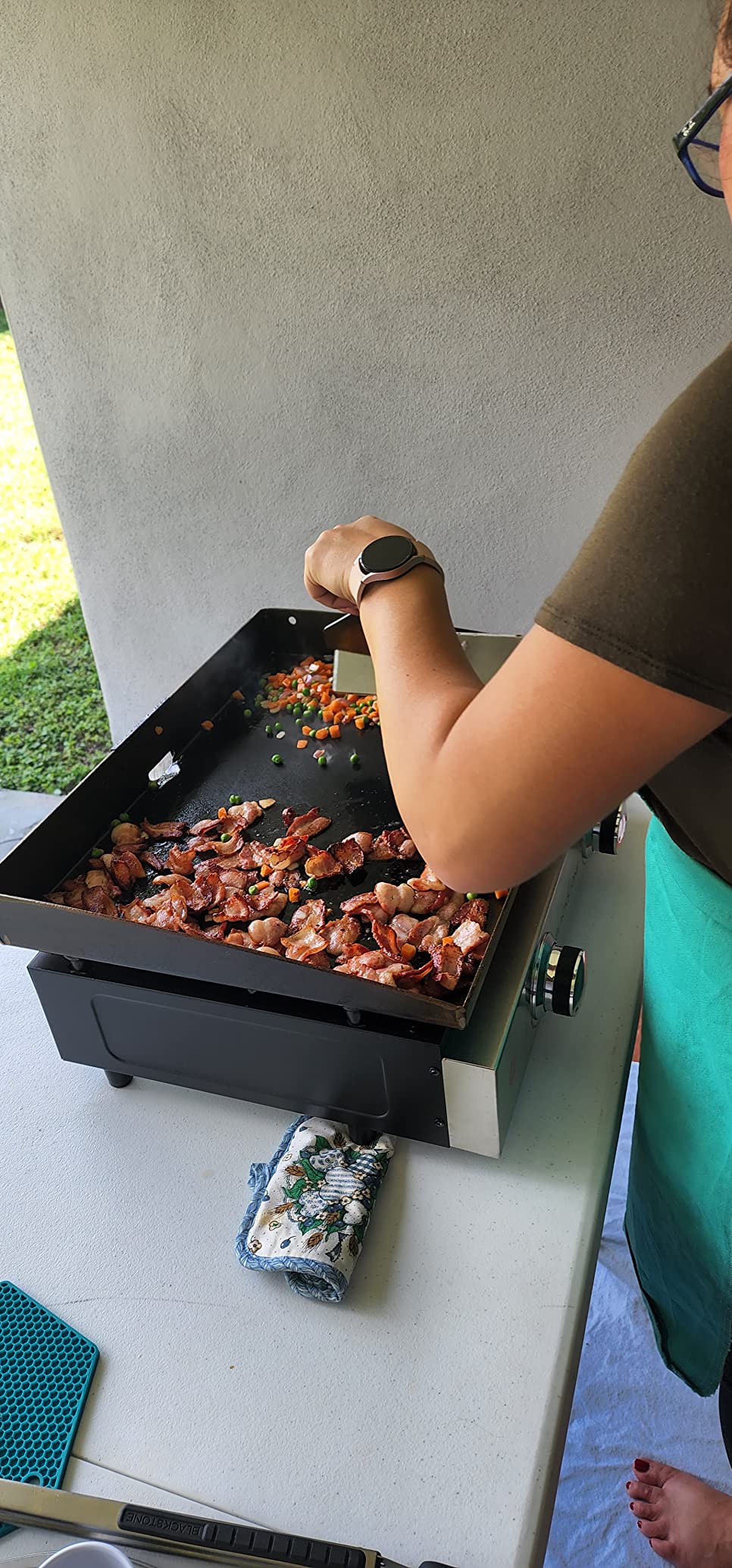
The plate is rolled steel on a carbon steel body, and the seasoning story is the standard one: it arrives ready to cook, it needs a wipe-down and a thin oil after each use, and after a few months of that attention it behaves like a non-stick surface. Reviewers describe exactly that pattern, with the cooking surface and heat control drawing near-universal praise in a review base of 6807 ratings at 4.7 stars.
That maintenance is not optional. The same review themes that praise the surface also flag that the plate demands regular oiling and re-seasoning and consumes a noticeable amount of oil and paper towel. Treat that as a five-minute end-of-cook ritual rather than a chore, and the surface will hold up for years.
Owners in griddling forums repeatedly name this general size class as the family compromise, with the 28-inch models reserved for feeding a genuine crowd. The most common regret reported in those threads is starting too small, not starting too large.
Weight is the one spec that catches people out. At 25.3 pounds, this is not a unit you carry in one hand across uneven grass, and the reported dimensions of roughly 22 inches deep by 23 inches wide mean it needs a real spot, not a balcony rail.
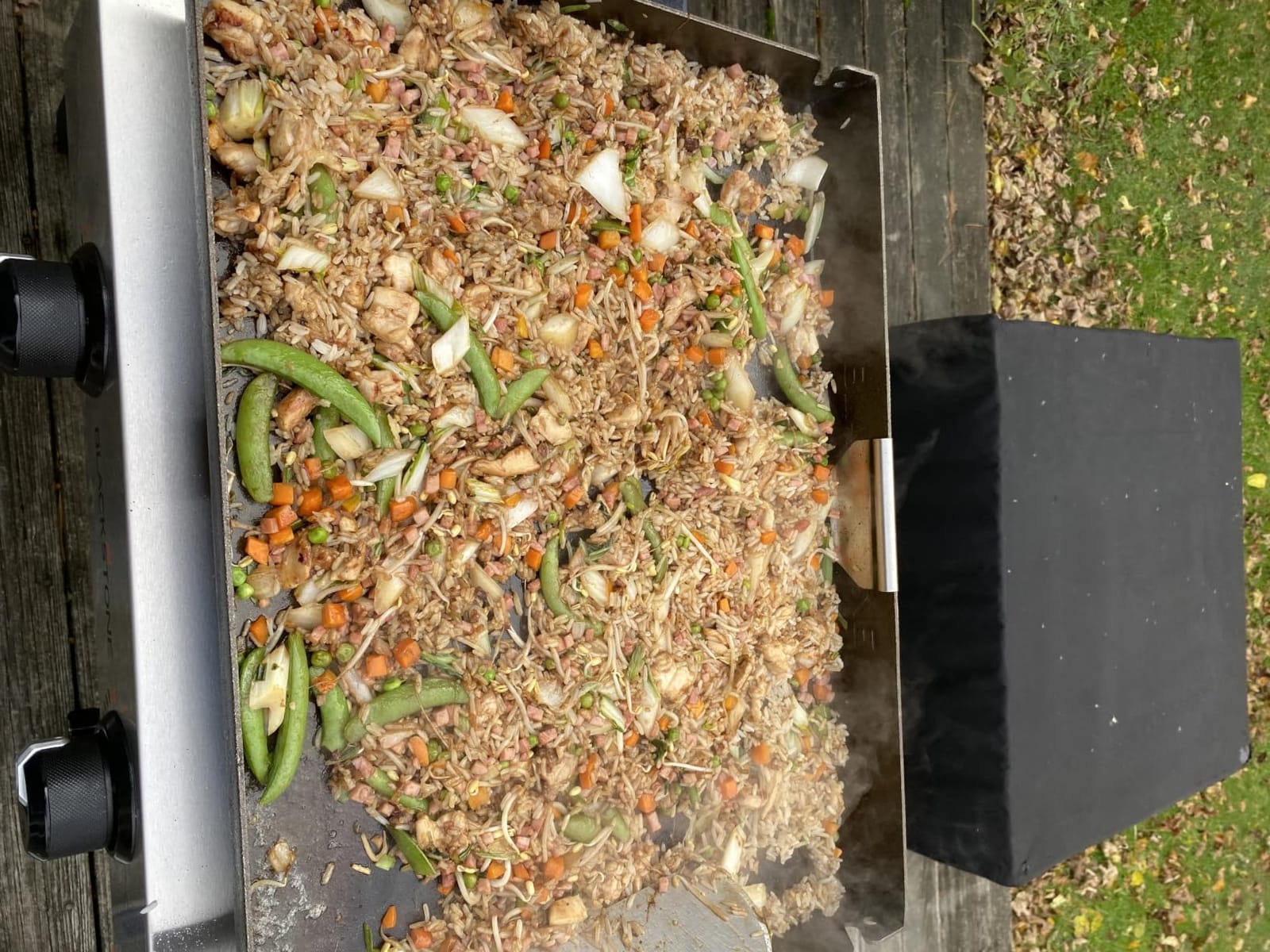
What 361 square inches actually gets you in a single batch
Manufacturer capacity for this plate is up to 14 burgers, 10 pancakes or 60 hot dogs in one pass. For a family of six cooking breakfast outside, that means one round of eggs and bacon rather than two rounds where the first batch goes cold.
The H-shaped burner layout is also the reason the usable area is close to the stated area. On a griddle with a single central burner, the outer thirds of the plate barely get warm. With two burners under a 22-inch plate, you lose far less edge space to a cold zone.
Where this one falls short for a backyard buyer
There is no hood. Rain gets to the plate rather than running off, and wind reaches the burners directly, so a gusty afternoon means longer preheat and more uneven recovery at the edges. Owners in the same forum threads treat wind guards as close to a standard accessory for unhooded units.
All-in-one carts for this style of griddle are also reported as occasionally unstable, and plenty of buyers end up buying the griddle-only version and pairing it with a cart or a sturdy outdoor table. If your patio is deck boards over a slope, plan on levelling the stand before first use.
2. Blackstone 1883 Original 28 Inch Omnivore Griddle — Best for Feeding a Crowd
Blackstone® 1883 Original 28″ Omnivore Griddle with Hood, Black
524 sq. in. Omnivore plate
Wind guards
Integrated hood
Two wheels
Pros
- 524 sq. in. surface holds up to 21 burgers or 15 pancakes
- Omnivore plate heats fast and recovers quickly with less fuel
- Built-in wind guards improve heat retention across the plate
- Counter-height dual side shelves add prep and serving space
- Integrated hood doubles as a wind deflector while cooking
Cons
- Bulky footprint and heavy build make it a two-person move
- Sheltered hood and wheel base add weight to an already large unit
- Steel plate still needs routine seasoning and oiling
If you are cooking for twelve or more on a regular basis, this is the unit the rest of this list is measured against. The 28-inch Omnivore plate gives 524 square inches of cooking surface, rated for up to 21 burgers or 15 pancakes in a single pass, which is roughly half again the area of the 22-inch models.
The Omnivore plate carries built-in wind guards along its edges, and that detail matters more outdoors than it does in a showroom. Guards trap rising heat along the perimeter, so recovery is faster after you drop a cold tray of raw smash patties onto the middle of the plate. Owners report even heat and quick recovery as the standout traits of this model.
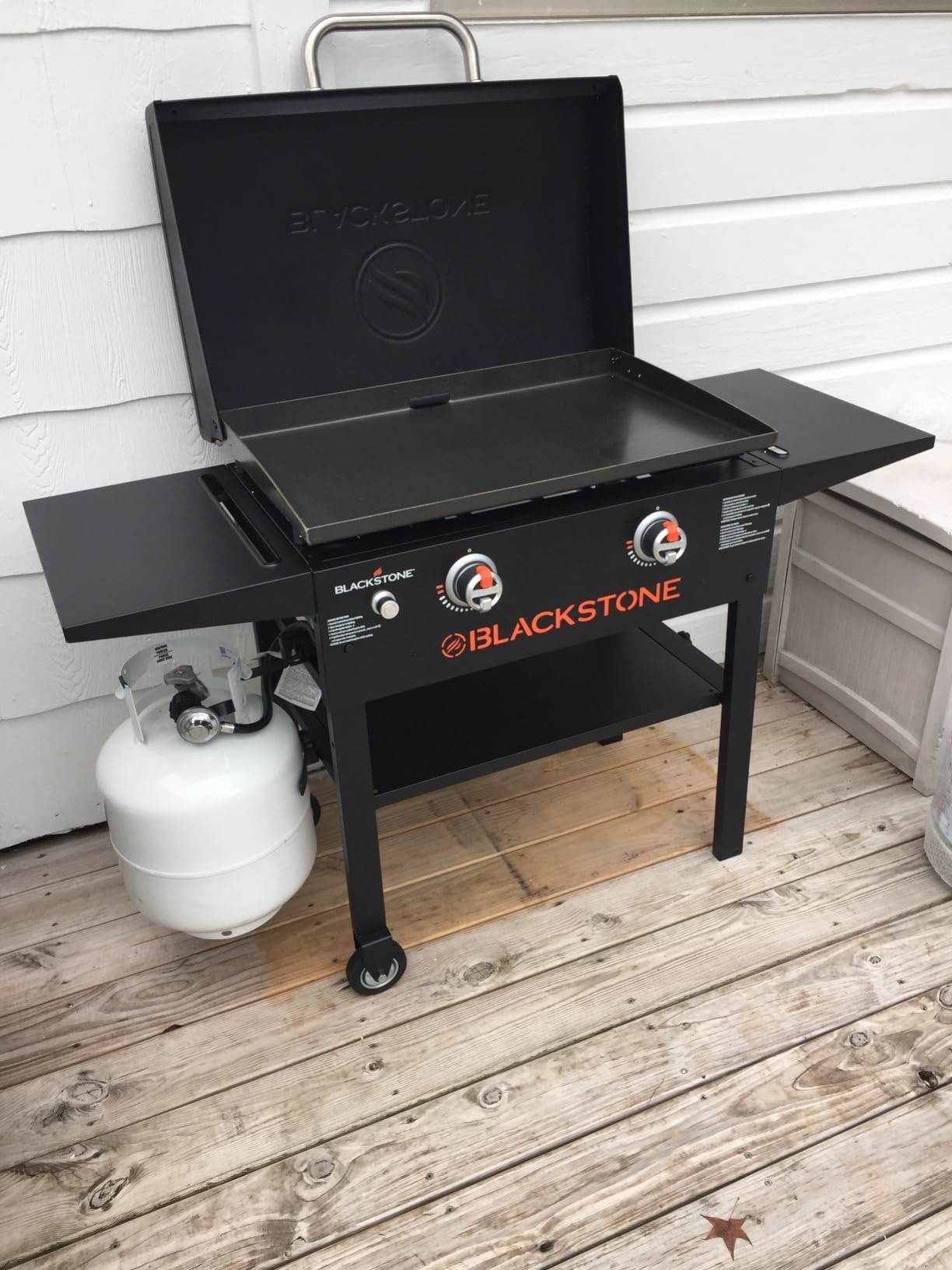
The integrated hood is the second reason to like this one outdoors. It sheds rain, deflects wind while you cook, and stops the season from landing directly on your seasoning when you are not looking at it. The trade-off is that a hood is a shelter you have to keep clear of the burners, and it adds weight to a unit that is already substantial.
Counter-height dual side shelves give you somewhere to put the tray of raw meat, the plate of cooked burgers and the condiments without leaning over the hot surface. Reviewers treat those shelves as one of the most-practical features of the design, and the wheels let you roll the whole thing back toward the house when dinner is done.
Two independently controlled H-style burners handle dual-zone work, and the rear grease management system feeds a cup at the back rather than under the frame. The 4.7-star average across 2026 reviews reflects a buyer who is happy about surface area and heat retention, and whose complaints are almost entirely about moving and storing the thing.
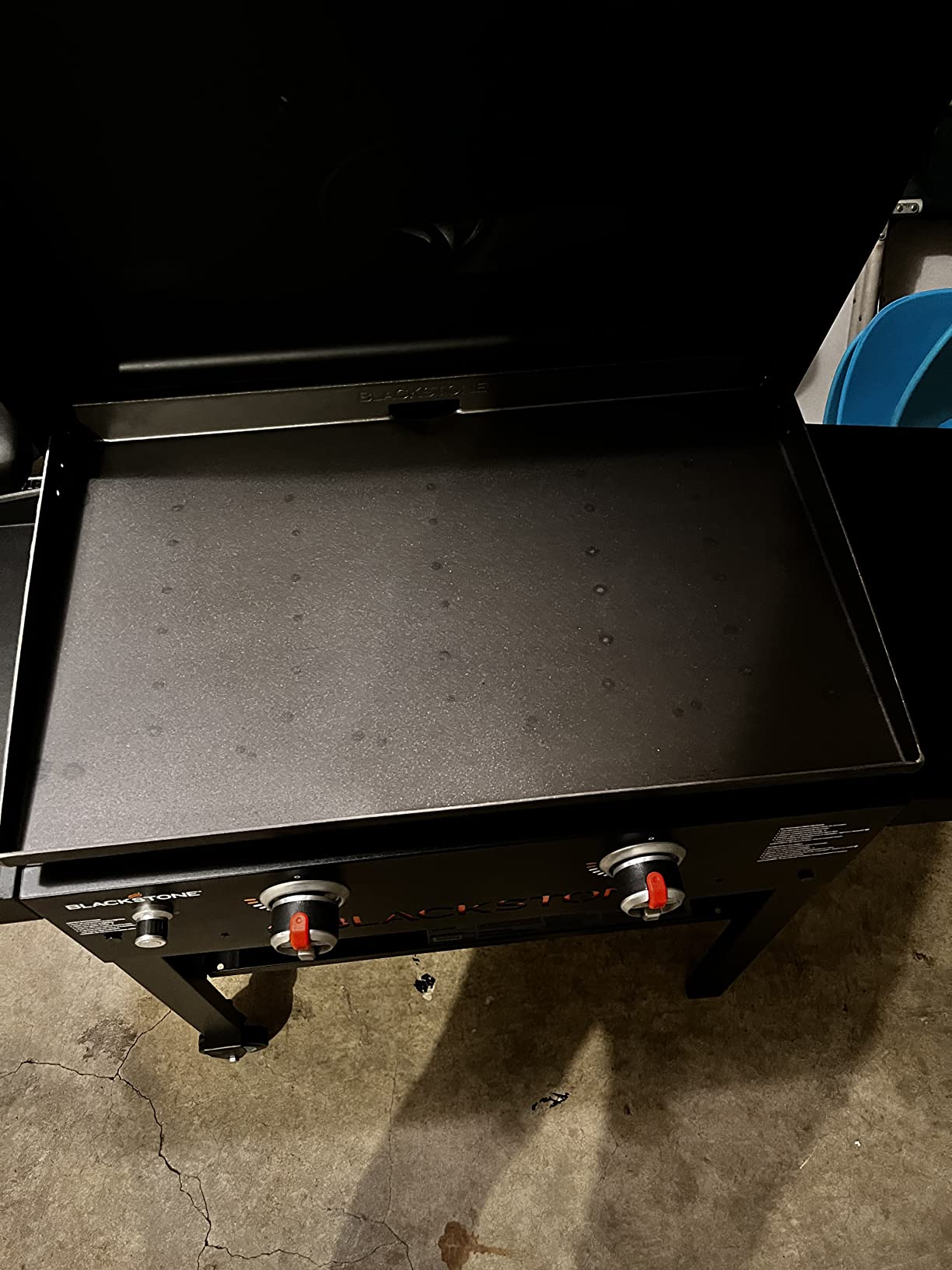
Is 524 square inches worth the extra footprint for a family?
If you routinely cook for eight or more, yes. The jump from a 361 square-inch plate to 524 is the difference between one batch of smash burgers and a full two-round service where the first batch sits on a warming shelf.
If you cook for two to five people a few times a season, the extra surface is dead weight and the extra weight is a real problem. Twenty-one burgers is impressive capacity that a household of four will never approach in a single sitting.
What to check before buying a hooded 28-inch
Measure your storage space. Reported dimensions run to roughly 33 inches deep and the shelf-and-hood build is heavy, so this is a two-person move and a dedicated corner of the yard, not a unit you tuck against a wall between seasons.
Check your cover situation before the first autumn. A hood handles rain during a cook, but it does not seal out standing water or dust, and this plate still needs the same oil-and-cover routine as any bare steel surface. Our griddles for camping guide covers the seasoning habits in more detail if you want the full routine.
3. Blackstone 2350 OTG 22 Inch Omnivore Griddle — Best Folding Griddle for Small Storage Spaces
Blackstone® 2350 OTG 22″ Omnivore Griddle with Hood, Black
361 sq. in. Omnivore plate
Locking hood
Flex-fold legs
78 lb
Pros
- Flex-fold legs and wheels let the whole stand collapse for transport
- Omnivore plate resists warping and heats efficiently
- 361 sq. in. surface suits groups of two to four
- Locking hood doubles as a wind deflector while cooking
- Side shelf adds prep and utensil space
Cons
- At 78 lb it is the heaviest portable unit in this roundup
- Collapsed 39.4 inch width still takes real cargo space
- Modest burner output for its size class
This is the same 361 square-inch Omnivore plate as the 22-inch tabletop model, mounted on a stand with folding legs, a locking hood and wheels. If your problem is not how much you can cook but where the griddle lives for the other ten months of the year, this is the answer.
Flex-fold legs collapse the whole frame so you can roll the unit to the car on its own wheels, load it, and set it up again on the other end of the yard. The side-shelf handle turns the folded package into something one person can tip and carry in a specific way rather than lift awkwardly.
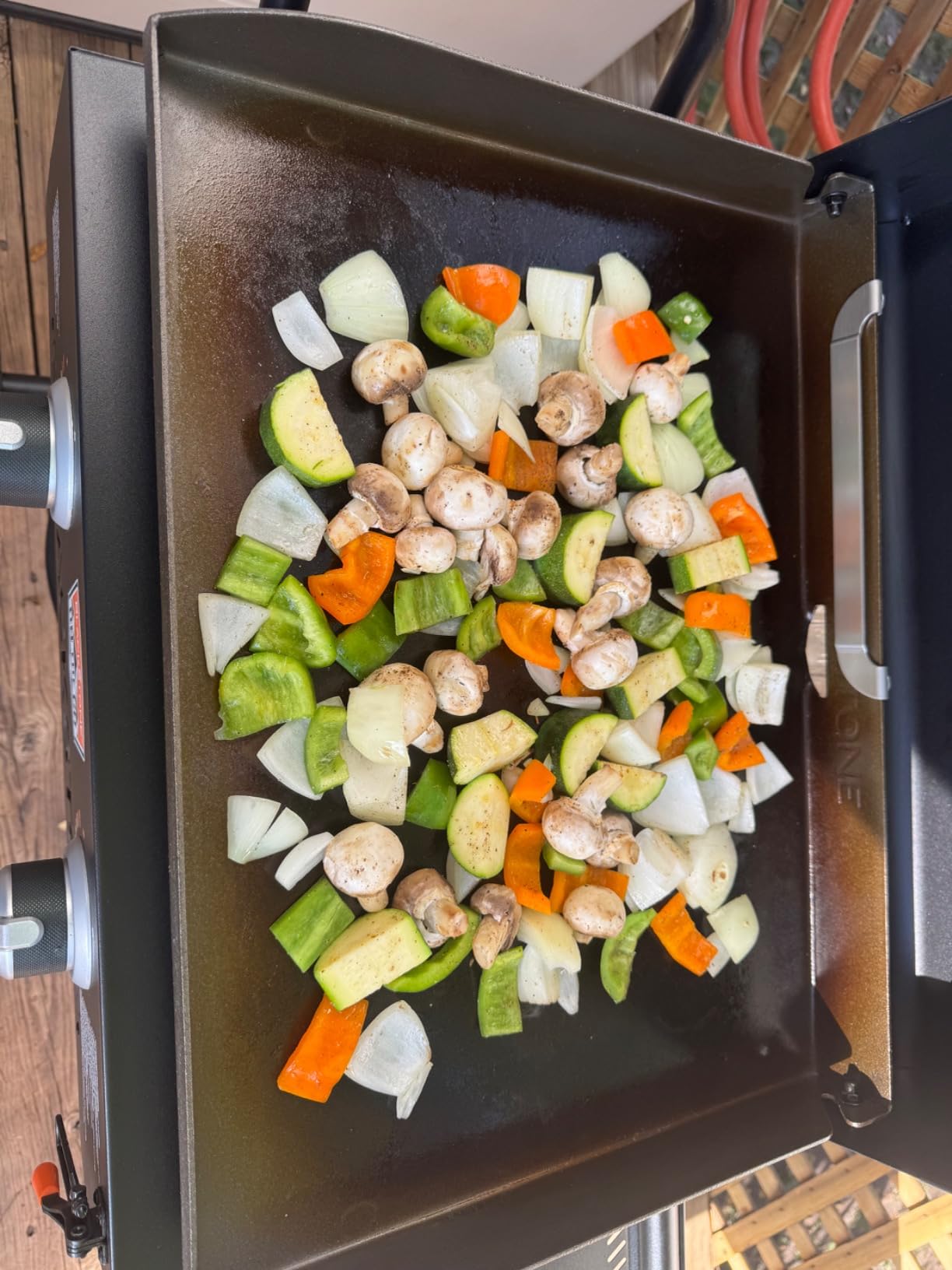
Buyers put the fold-and-roll design above cooking performance in their reviews, describing it as easy to load, store and deploy for tailgating and camping. That is the honest ranking of priorities here: this is a griddle that happens to cook very well, bought for what it lets you do with the space around it.
Heat performance is still good. The Omnivore plate resists warping, recovers faster than older rolled steel designs and uses less fuel per cook, and the built-in wind guards do the same perimeter-trapping job as the 28-inch model above.
Two independently controlled burners let you multitask at different temperatures, and the locking hood keeps the plate covered in transit and doubles as a wind deflector while you cook.
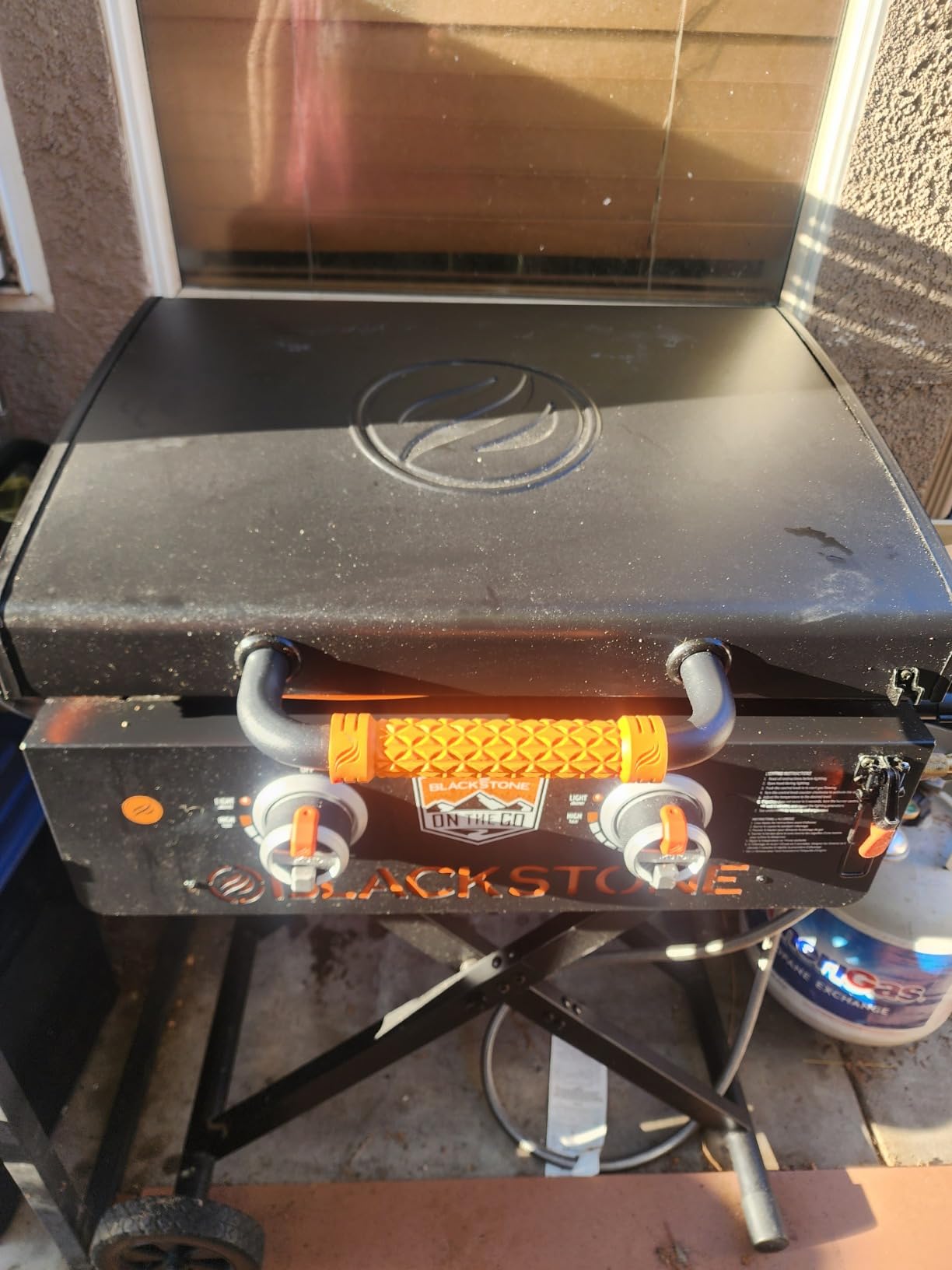
Is 78 pounds still a portable griddle?
It is portable in the design sense — self-contained, folding, wheeled — but it is the heaviest portable unit in this roundup and it is a two-person lift onto a counter or a truck bed. Think patio-to-shed rather than tailgate-to-parking-lot.
Collapsed, the reported width is still about 39 inches. Measure the cargo opening of your vehicle and the doorway of your shed before you commit, because that width is the part people underestimate.
Who should skip this and buy a smaller tabletop unit instead
Anyone cooking for five or fewer who wants to bring the griddle to a picnic, a campsite or a friend’s driveway. At 78 pounds with a stand attached, the tabletop griddles further down this list are the sensible choice.
Anyone cooking for eight or more. This plate handles groups of two to four comfortably, and beyond that you will be running batches while the first batch cools. For larger parties, our tailgating griddle picks cover the size question in more detail.
4. Royal Gourmet PD4001 4-Burner Griddle — Best Heat Output With a Removable Cart
Royal Gourmet PD4001 4 Burner Propane Gas Griddle, Removable Standing Cart
389 sq. in. sanding steel
Four burners, 34000 BTU
Removable cart
Two side shelves
Pros
- Four burners deliver 34000 BTU for strong fast heat recovery
- Removable cart lets you cook standing or set it on a table
- Dual side shelves with tool hooks add real prep space
- Hood protects the plate and deflects wind while cooking
- Two wheels and sturdy legs for stability
Cons
- Sanding steel plate is rougher than cast iron and needs proper seasoning
- 55.31 inch width is a wide footprint for a yard or garage
- Hood must stay open while cooking
Four burners at 34,000 BTU total is the highest output figure in this roundup, and it is the reason this griddle recovers heat so quickly after a cold tray hits the plate. When you are running a real backyard service rather than a weekend breakfast, burner power is worth as much as surface area.
The removable cart is the feature buyers mention most. Lift the griddle off the stand and set it on a sturdy table, a tailgate or a workbench, and you have converted a free-standing rig into a countertop unit without buying a second appliance. That versatility is unusual at this size.
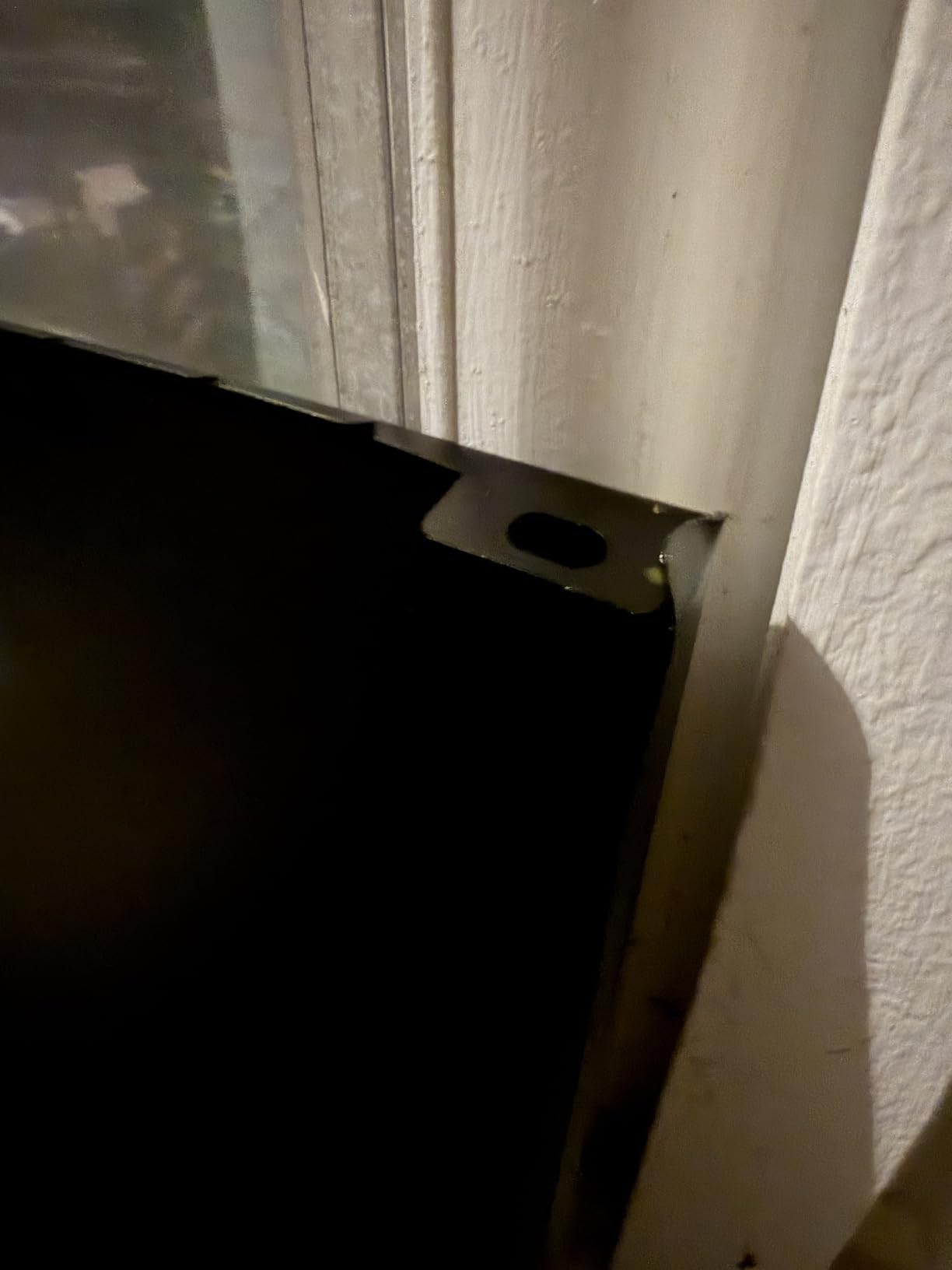
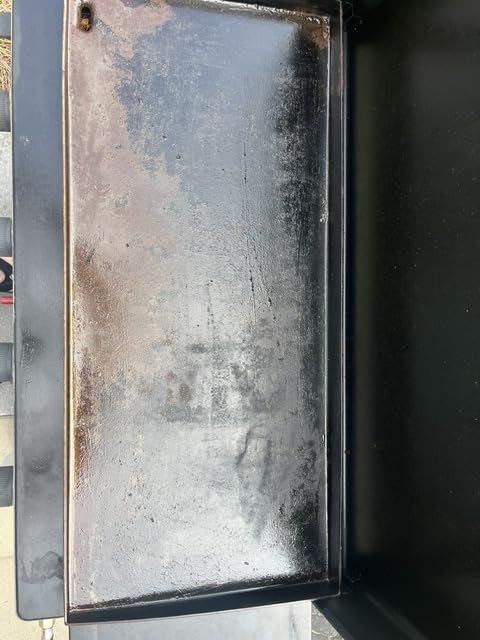
The 389 square-inch sanding steel surface is textured rather than smooth, which makes it forgiving of imperfect seasoning but slow to develop the glassy non-stick film a smooth plate reaches. Reviews split cleanly on this: buyers who seasoned it properly report excellent even cooking, while a meaningful group hit setup or coating issues out of the box.
That split shows up in the numbers too. The 4.2-star average is the second-lowest in this test, and 12 percent of ratings are one-star — the highest one-star share among the four-burner units here. The complaints cluster on assembly and finish rather than on cooking.
Dual side shelves on both sides, each with three tool hooks, give you a place for the raw tray, the finished plate and a hanging tong. The heat-resistant hood protects the surface and deflects wind, but it has to stay open during cooking, which catches out first-time owners.
Does four burners beat two on a backyard patio?
For heat recovery, yes. More burners under the same plate means the temperature comes back up faster after a cold load, which is the difference between a hot lunch service and a slow one. Two-burner plates are perfectly adequate for burgers and eggs; they ask more patience when you are searing a large batch.
For cooking quality, it is less decisive. Four burners under a 389 square-inch plate can feel busier than the surface needs, so you will spend more time turning knobs than a three-burner layout demands.
What to look at before you commit to a 55-inch-wide rig
Measure the space. At a reported width of 55.31 inches, this is the widest unit in the roundup, and it needs a flat, level run of yard or patio rather than a corner. It also weighs 63.9 pounds even after you remove the cart, so plan the lift.
Read the seasoning instructions before first use, and budget a proper burn-off. The sanding steel rewards patience. Skimping the seasoning is the most common route to the one-star reviews this product carries.
5. Royal Gourmet PD3001 3-Burner Griddle — Best Folding Cart Value
Royal Gourmet PD3001 3-Burner Propane Gas Griddle with Collapsible Stand
314 sq. in. ceramic-coated plate
Three burners, 25500 BTU
Folding stand
52 lb
Pros
- Collapsible stand folds flat and rolls away for storage
- Ceramic-coated top heats fast and wipes clean easily
- 314 sq. in. handles eggs pancakes and smash burgers with room
- Three burners cook more evenly than two
- Good value against premium name-brand griddles
Cons
- Assembly instructions are poor and screw holes reportedly misalign
- Cart hardware and brackets described as cheap
- Coating still requires seasoning before first use
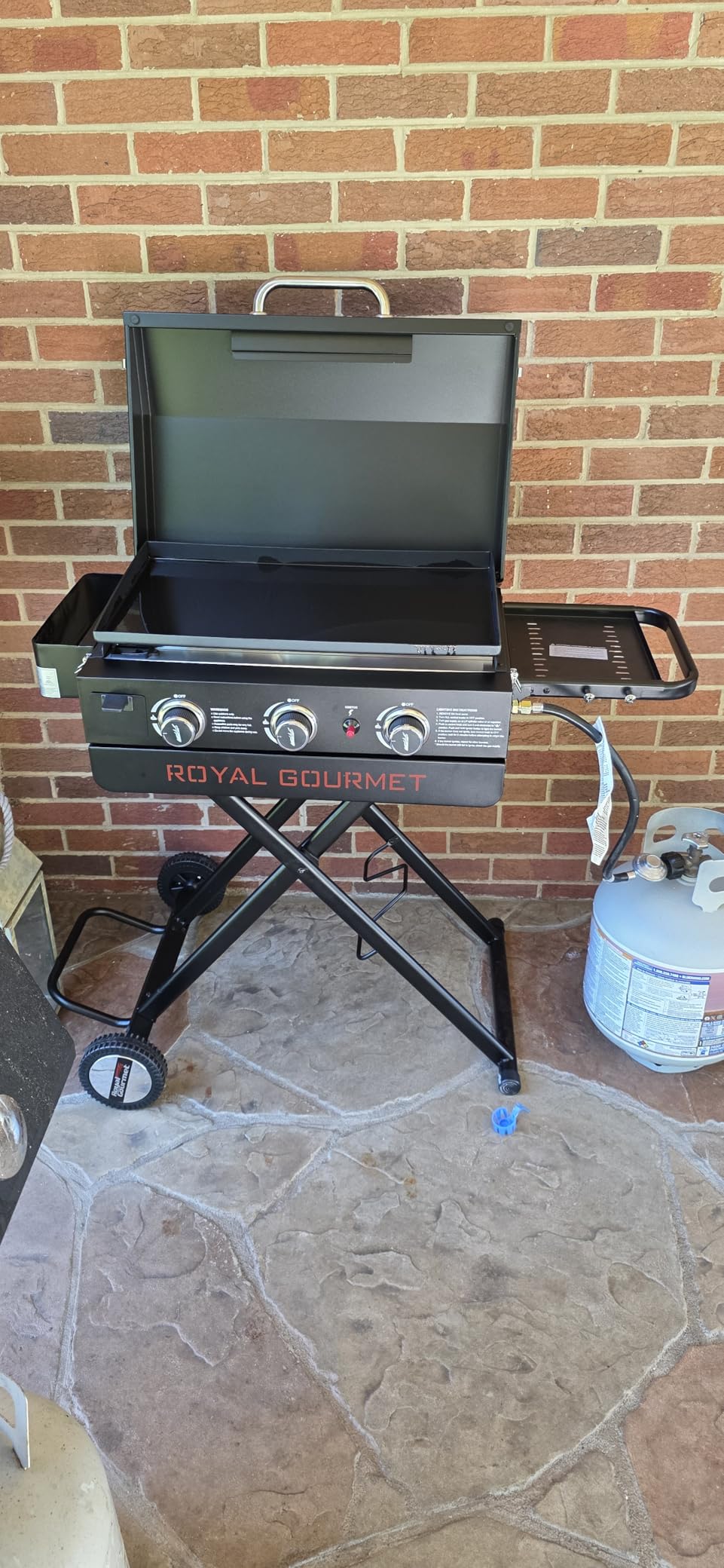
The PD3001 sits in the middle of this list in every measurable way: 314 square inches of surface, three burners at 25,500 BTU, 52 pounds, and a stand that folds flat. For most backyards, that is the correct size, and it costs materially less than the 28-inch models.
Three burners is the layout sweet spot for a plate this size. You get a wide hot zone, a middle zone and a cooler edge you can park eggs on, without the busy-knob problem of a four-burner rig. Reviewers consistently praise fast heat-up and even results across the plate.
The ceramic-coated top resists scratching, corrosion and high-temperature wear, and it wipes clean far more easily than bare steel. That is a genuine advantage in a family yard where the griddle gets used by people who are not going to scrape and re-oil it every time.
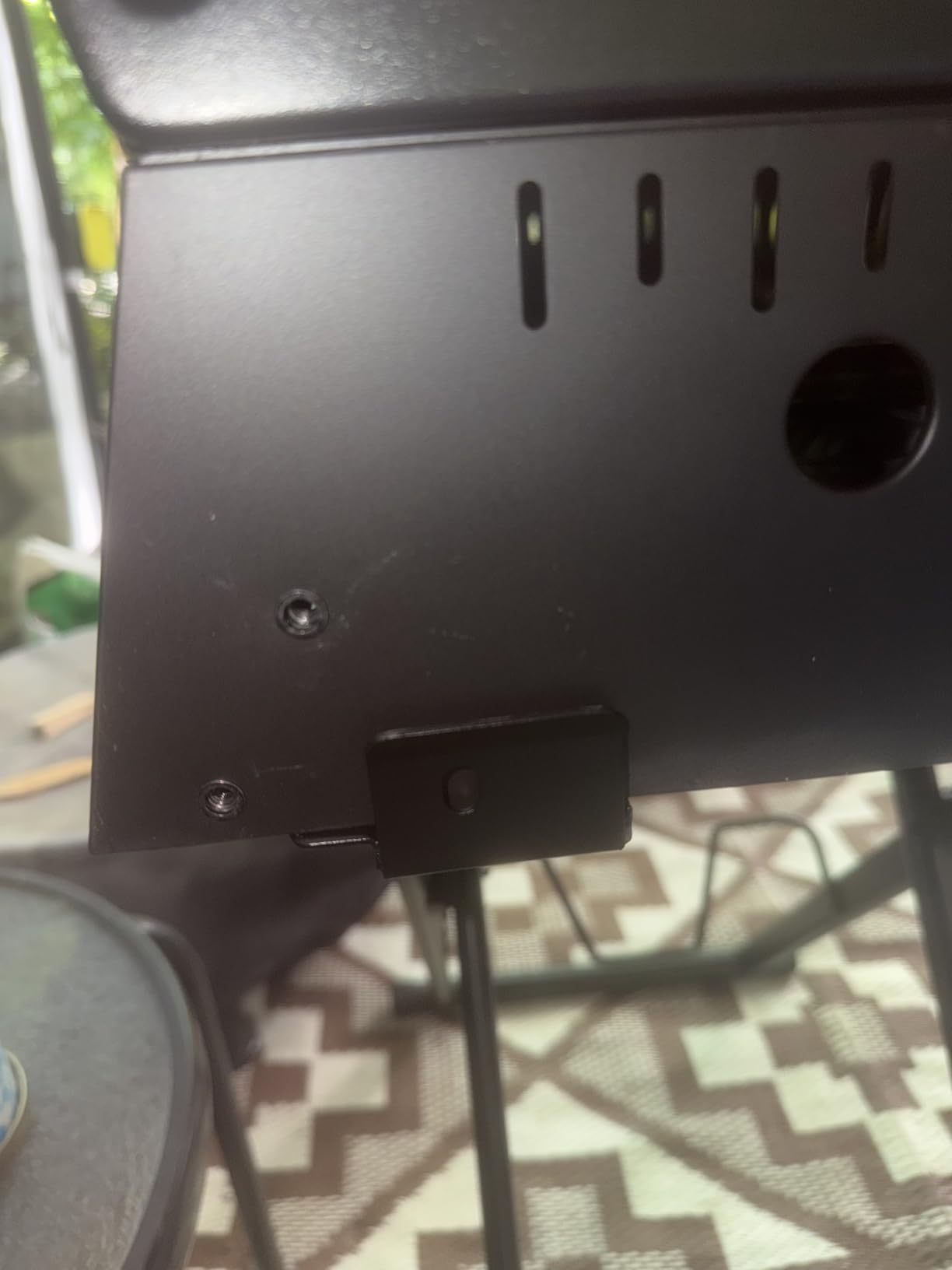
Assembly is the weak point, and it is the single most-cited complaint in the reviews. Several buyers report re-drilling misaligned screw holes, the diagrams do not clearly show how the stand folds, and the cart hardware and brackets are described as cheap. Budget an hour and a set of drill bits, and treat the build as a one-time task.
There is also a placement conflict worth knowing about: the propane outlet sits where the hanging tool accessories want to go, so something has to move. Two lid latch buckles keep the plate secure in transit, and the side shelf gives prep space.
Is a ceramic-coated griddle plate easier to live with than bare steel?
Day to day, yes. The coating resists scratching and corrosion and wipes clean without aggressive scraping, which means less oil consumption and less paper towel waste over a season of use. You also avoid the flakes of a factory finish that some bare-steel plates shed early in their life.
Long term, it is a different bet. A coating has a finite life and cannot be re-seasoned back to full performance the way bare steel can. If you intend to keep a griddle for a decade and resurface it as needed, bare steel is the better long game.
Should you expect to re-drill holes during assembly?
Some buyers do, and the packaging is not the cause. Misaligned holes in the cart and bracket hardware are a quality-control issue on this model, and the instructions do not make the process easy. Assemble it on a flat surface with a good set of bits, and check every fastener before you tighten the frame fully.
Also read the coating’s seasoning requirement before first use. A ceramic surface still needs a proper seasoning layer before it behaves the way the reviews describe, and skipping that step is how an easy-clean plate turns into a sticking plate.
6. SKOK 2-Burner Tabletop Griddle — Most BTU Per Dollar on a Small Patio
SKOK 2 Burner Outdoor Tabletop Gas Griddle with Hood, Flat Top Grill
246 sq. in. surface
30000 BTU across two burners
Disassemblable lid
Enamel-coated
Pros
- 30000 BTU across two burners is unusually strong output for the money
- Small enough for RV and tailgate use
- Assembles quickly and heats well
- Works with a full-size reusable propane container
- Enamel layer resists rust and oxide formation
Cons
- Hood is thin and reviewers question its durability
- 246 sq. in. is tight beyond a couple of diners
- Cleaning needs a separate griddle brush and surface cleaner
Thirty thousand BTU across two burners on a 246 square-inch plate is a ratio you do not see often. Most griddles this size put out half that, and it shows in practice: this one comes to temperature quickly and holds it when you set a cold cast-iron pan down in one corner.
The surface has an enamel layer over the metal, which is the one design decision here that matters for longevity. Enamel resists rust and oxide formation, so this is the least rust-prone plate in the roundup. It is not a seasoned carbon steel surface that needs oiling after every cook, and that changes the maintenance story completely.
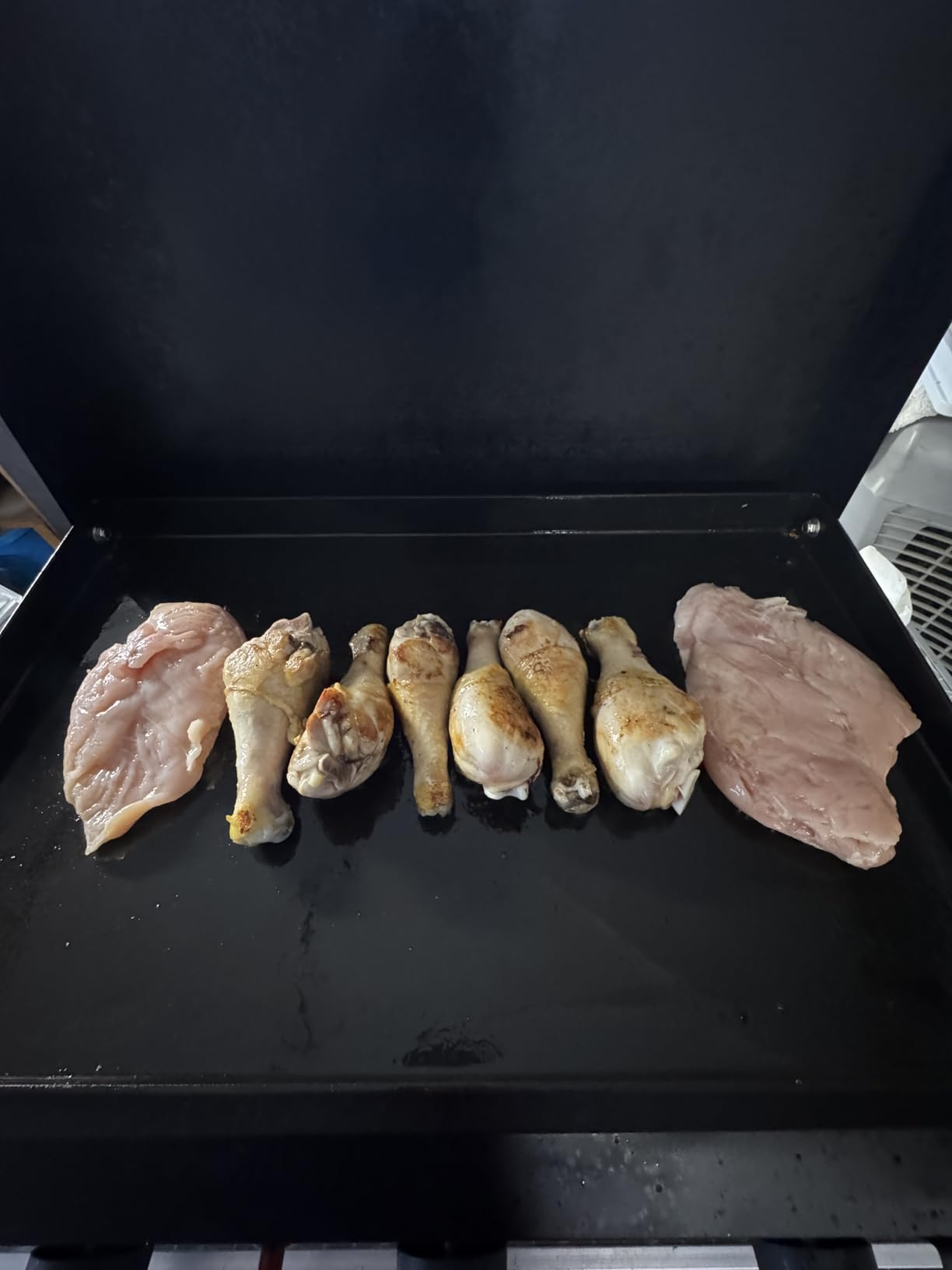
The high lid traps heat and speeds cooking, and it disassembles for storage, which matters on an RV or a small patio where the unit lives under a cover. A stainless-steel control panel with a built-in ignition system gives quick start-up without fussing with a match or a lighter.
Buyers consistently frame this as strong value — a lot of output and a hood at the bottom of this roundup’s price range, easy to assemble and carry. The reservations are concentrated in the thin hood and the small cooking footprint, with isolated reports of sticking during the first cooks.
Grease funnels to a removable drip tray, and the unit runs on a full-size reusable propane container rather than small throwaway cans, which is a real running-cost saving over a season of regular cooking.
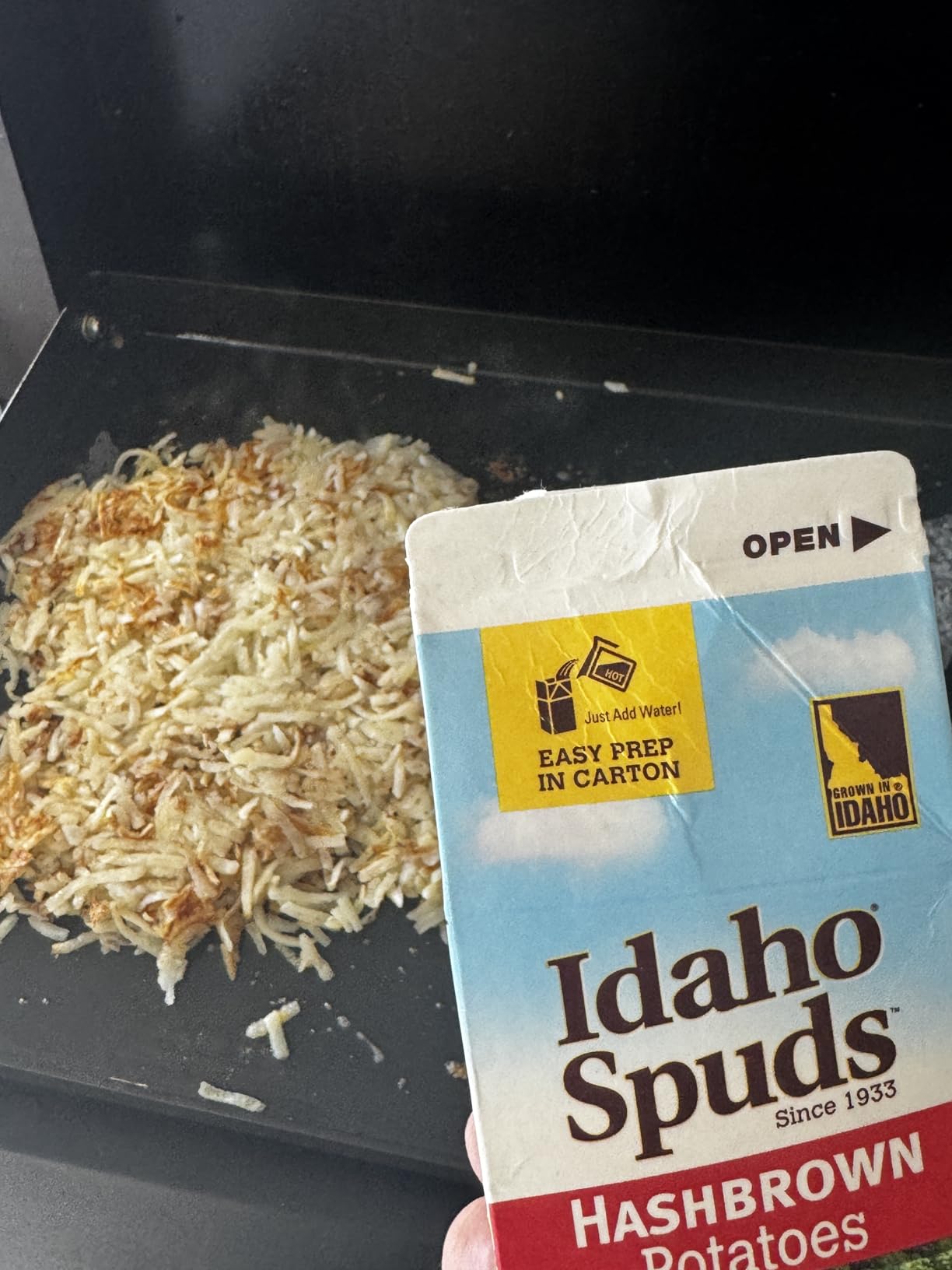
Is 246 square inches enough for a couple or a small family?
For two people it is comfortable. For a family of four doing eggs and bacon, you are doing two rounds rather than one. The plate is wide enough at 17.3 by 14.2 inches for a useful spread of food, but it is not a surface you crowd.
It is the right pick for a small patio, an RV hookup or a balcony with a table, and the wrong pick if you are hosting a group of six or more. Match the plate to the group, not to the price.
What does the enamel surface mean for how you cook and clean?
No seasoning cycle is required the way bare steel does, and oiling after every cook is optional rather than essential. That makes it a far more forgiving griddle for a household where not everyone is going to wipe and oil the plate.
You still need to clean it properly. The package includes a griddle brush and a surface cleaner, and a separate cleaning product is part of the routine rather than an optional extra. Reviewers also flag the thin hood as the part most likely to be the first thing to deform, so treat it as a wind shield rather than a lid you lean on.
7. ONLYFIRE GS318 Tabletop Griddle — Best Cast Iron Plate on a Small Stand
ONLYFIRE GRILLS Tabletop Gas Griddle 2 Burners, Propane Gas Stove, GS318
252 sq. in. cast iron plate
16000 BTU dual burners
Foldable legs
35 lb
Pros
- Cast iron plate at this price is uncommon and seasons into a solid non-stick
- Works with either a 1 lb cylinder or a 20 lb tank out of the box
- Two independently controlled burners cook small and large at once
- Foldable legs locking cover and handle make it genuinely portable
- Removable grease tray makes cleanup straightforward
Cons
- 252 sq. in. is small relative to its 16000 BTU output
- Small review base at 152 ratings with 10 percent one-star
- Griddle cover CV702 is sold separately
The GS318 pairs a cast iron plate with two independently controlled stainless burners, and a cast iron surface at this weight class is genuinely uncommon. Cast iron is slower to heat and far more forgiving of abuse than thin rolled steel, and it seasons into a surface that stays flat under hard use.
The fittings are the underrated part. The gas valve and hose work with either a 1 lb cylinder or a 20 lb tank out of the box, so you can start small and move to a full-size tank once you know how often you cook, without buying a separate adapter.
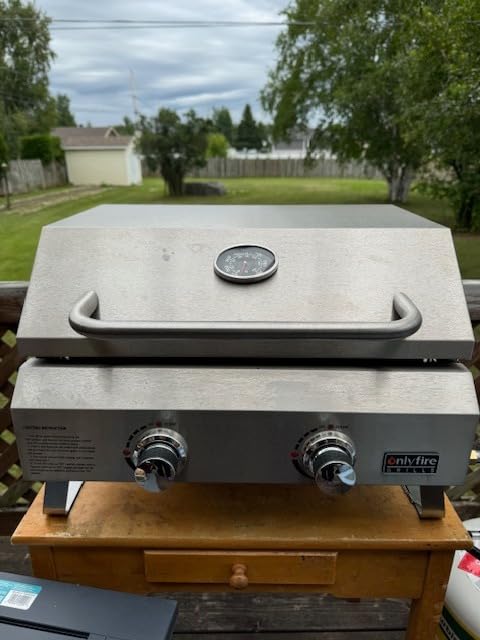
At 252 square inches the plate is 18 by 14 inches, which is a two-to-four person surface. Both burners are controlled independently, so you can sear on one side and warm tortillas or hold cooked food on the other.
It weighs 35 pounds, which is real but manageable, and the foldable legs, locking cover and carrying handle make it a unit you can genuinely move between a storage shed and a patio table rather than one you install once.
The honest caveat is the review base. 152 ratings at 4.4 stars is a thin sample, and 10 percent of them are one-star. Owners are happy about the cast iron plate, the included fittings and the folding design, with the seasoning requirement and the separately sold cover as the most commonly noted points.
Cast iron or rolled steel for a backyard griddle?
Cast iron heats more slowly and stores more heat, so it is steadier once hot and far more resistant to warping. You will see the difference most on low-temperature work — eggs, pancakes, anything where you need the temperature to hold rather than climb.
Rolled steel reaches temperature faster and is lighter, which matters if you are moving the unit around. It also needs more frequent oiling and will rust if you skip it. If your priority is a plate that stays true over years, cast iron wins.
What should you buy alongside this griddle?
The cover. It is sold separately as model CV702, and without it a cast iron plate sitting through autumn rain in a yard is exactly the scenario that produces surface rust. Budget for it from the start rather than after the first bad week.
Also plan the seasoning. The plate must be seasoned before use, and doing it properly takes a burn-off cycle and several thin oil layers. It is a weekend afternoon of work that buys you a surface that releases food cleanly for years afterwards.
8. Utheer 25 x 16 Inch Cast Iron Insert — Best Way to Add a Flat Top to a Grill You Own
Utheer 25″ x 16″ Pre-Seasoned Nonstick Cast Iron Griddle for Gas & Charcoal
25 x 16 inch pre-seasoned cast iron
Three support ridges
Grease trough
500 degree max
Pros
- Turns an existing grill into a flat top with no new appliance or fuel
- Reinforced ridges and thicker casting resist warping
- Grease trough cuts flare-ups and simplifies cleanup
- Detachable side handles help with loading onto a grill
- Handles breakfast through dinner on one surface
Cons
- Requires a compatible grill underneath as it is an insert
- 25 by 16 inches overhangs many smaller portable grills
- Heavy and awkward to lift on and off the grate
If you already own a decent gas or charcoal grill, this is the cheapest and lowest-risk way to get flat top capability. The plate drops onto the existing grate and turns a grill into a griddle without a second appliance, a second fuel line or a second thing to store in the shed.
The construction is where this one earns its place. Three reinforced support ridges on the base spread the heat and eliminate hot spots, and the upgraded thickness resists bending and warping under prolonged heat. Flat cast iron that stays flat is the whole game, and the review base of 2910 ratings supports that claim over repeated high-heat use.
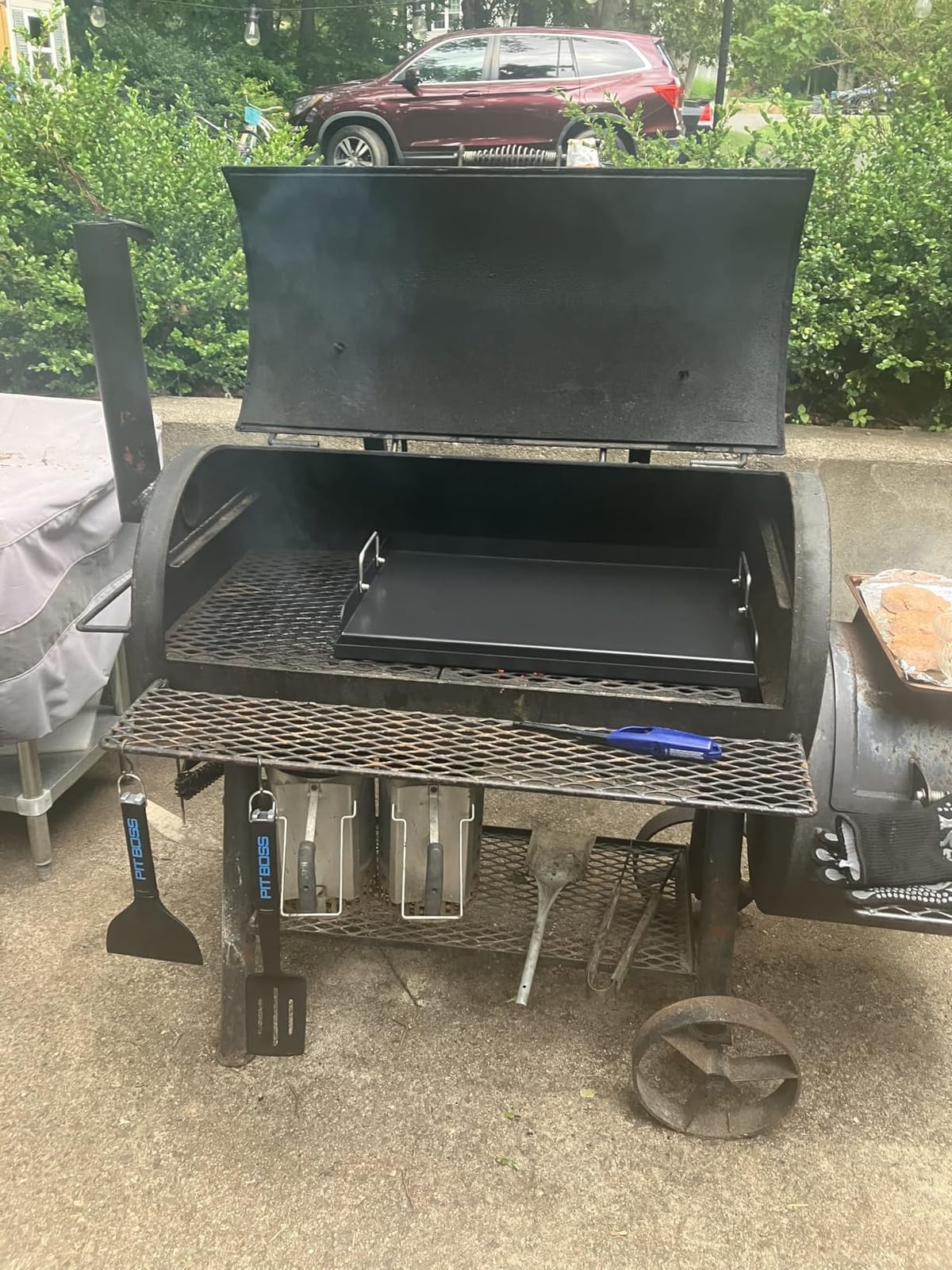
A built-in grease trough collects drippings along the edge of the plate and channels them away, which reduces flare-ups and makes cleanup far less of a scrub job. That is a meaningful difference from laying a bare plate on grill grates, where grease falls straight through onto the burners.
Detachable side handles make it possible to load the plate onto and off of a grill without grabbing the hot casting, and the polished edges eliminate the scratch risk you get with a rough-finished plate.
Rated up to 500 degrees and described as a universal fit for most gas and charcoal grills, it covers breakfast, burgers, steak, seafood and vegetables on a single surface. The one variable that decides whether it works is measurement.
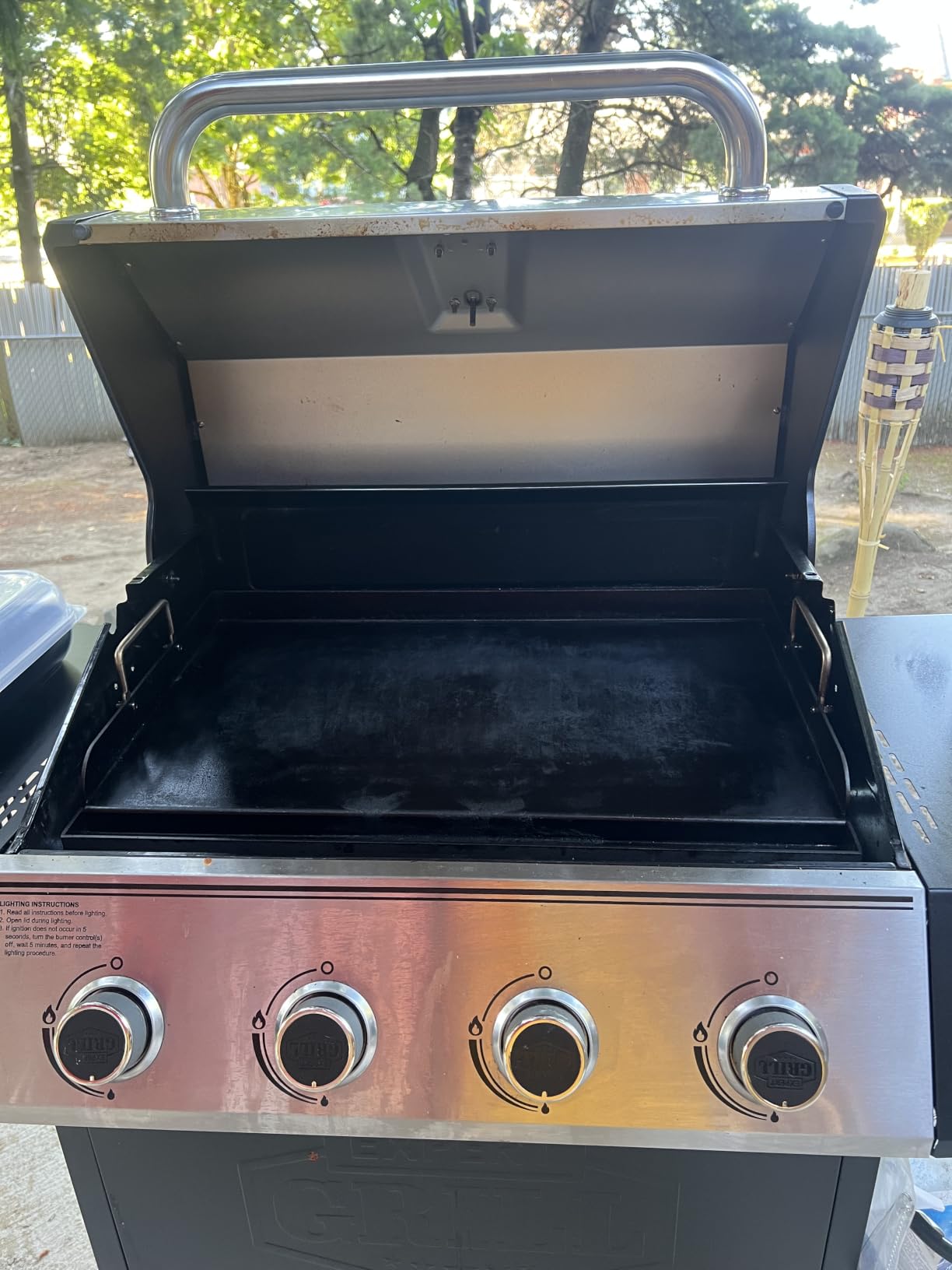
How do you know it will fit your grill?
Measure the grate area of your grill, not the outside dimensions. At 25 by 16 inches, this plate will overhang many smaller portable grills, and an overhanging plate is unstable and loses heat at the unsupported edge.
The manufacturer lists a range of other sizes as well, including smaller and much larger plates, so if 25 by 16 is not the right fit, the same construction exists in dimensions that will be.
Is a griddle insert a substitute for a real flat top griddle?
For burgers, hot dogs, eggs and pancakes, yes. The plate is broad, flat and pre-seasoned, and it does the job. What you give up is independent temperature control — you are managing heat through your grill’s burners, not dedicated ones under a rolling plate.
You also give up portability and convenience. A cast iron plate at this size is heavy and awkward to lift on and off the grate every time you want to grill instead of griddle, which is why many owners buy a second one.
9. Cuisinart 2-in-1 Electric Griddle — Best Fit for Patios Without a Propane Line
Cuisinart Indoor/Outdoor Electric Griddle, 2-in-1 Portable BBQ with Flat Top Nonstick Cooking Surface, Adjustable Heat, Stand/Tabletop Options for Cookouts, Barbecues & Small Spaces, No Tools Needed
240 sq. in. ceramic surface
1500 watts
Five heat settings
15 lb
Pros
- Only 15 lb and tool-free assembly make it the most portable unit here
- Runs on electricity so there is no propane to haul
- Detaches from the stand for indoor tabletop use
- Nonstick ceramic surface releases food easily and wipes clean
- Three-year limited warranty
Cons
- 1500 watts heats and recovers slower than any gas griddle
- Ceramic coating can degrade over time unlike bare steel
- Must be used with a weather-protected outlet outdoors
Some backyards have no practical place for a propane tank, and some people simply do not want to handle one. This electric griddle solves both problems. It weighs 15 pounds, assembles without tools in under ten minutes, and runs from a standard 120-volt outlet with a six-foot cord.
It also does double duty. Detach the griddle from its stand and the same appliance becomes an indoor tabletop unit, which makes it far easier to justify than a single-purpose outdoor cooker — and the 240 square-inch nonstick ceramic surface is genuinely easy to wipe clean between batches.
Temperature control runs through a probe with five settings from 350 to 550 degrees, which is a narrower band than a gas burner gives you but perfectly workable for eggs, pancakes, burgers and vegetables. A central grease channel directs drippings into a collection cup.
What do you give up by going electric?
Recovery speed, mostly. At 1500 watts, this plate takes noticeably longer to heat up and comes back to temperature more slowly than any gas griddle in this roundup. That does not matter for a relaxed Saturday breakfast; it does matter if you are running a queue of smash burgers.
You also give up the ability to use it anywhere. It needs a weather-protected outlet, which rules out a bare lawn or an exposed deck, and there is no smoke or propane to carry — the tradeoff works in its favour in a suburban patio but not on a camping trip.
Is a nonstick ceramic surface a good compromise outdoors?
For low-maintenance outdoor cooking, often yes. There is no seasoning cycle and nothing to rust, and a 71 percent five-star share in the reviews reflects how much owners like simply wiping it down.
The long-term trade-off is that a coating cannot be restored. Bare steel and cast iron can be resurfaced and re-seasoned indefinitely; a ceramic coating that degrades ends the product’s useful life. Weigh that against the fact that many households will never get that far.
10. Lodge Pro-Grid Reversible Cast Iron Plate — Budget Pick and Longest Track Record
Lodge Pro-Grid Reversible Grill/Griddle, PFAS-Free, 20 x 10.5 Inches
20 x 10.5 inch cast iron
Ribbed grill side and flat side
PFAS-free
Lifetime warranty
Pros
- Largest review base here at 16045 ratings spanning years of use
- Reversible plate gives a ribbed grill side and a flat griddle side in one piece
- Seasoned with iron and oil only with no PFOA PTFE or PFAS coatings
- Works on a grill stovetop in the oven or over a campfire
- Grid pattern channels grease away from food
Cons
- 20 by 10.5 inches is a compact surface best for two or three people
- No hood or wind protection so impractical as a stand-alone outdoor cooker
- Cast iron requires hand washing and cannot go in a dishwasher
Sixteen thousand ratings is not a product launch. This is a piece of cast iron with decades of ownership behind it, and the difference shows in how owners talk about it — as permanent cookware that improves with age, not as an appliance that needs replacing.
The reversible design is the core idea. One plate, two surfaces: a flat griddle side for eggs and pancakes, and a ribbed grill side where the grid pattern channels grease away from the food so it drops off instead of sitting in pooling fat. You flip it depending on what you are cooking.
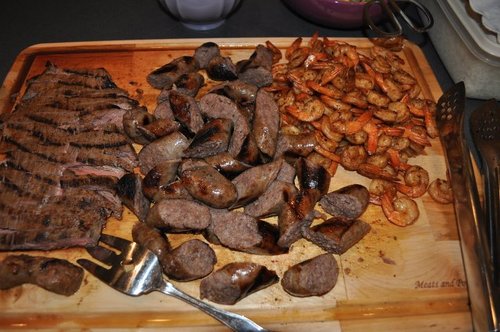
The seasoning is iron and oil and nothing else — no PFOA, no PTFE, no PFAS coating that can flake onto food. That is a common purchase reason among owners and it is also why the plate keeps working for decades: there is no coating to fail.
It works on a grill, a stovetop, inside an oven or over a campfire, which makes it the most flexible cooking surface in this roundup. The 4.6-star average across 16045 ratings, with 78 percent five-star, reflects a product with very little left to prove.
There is a lifetime limited manufacturer’s warranty behind it, which no gas griddle in this roundup can offer. That is a meaningful statement about how the manufacturer expects the product to age.
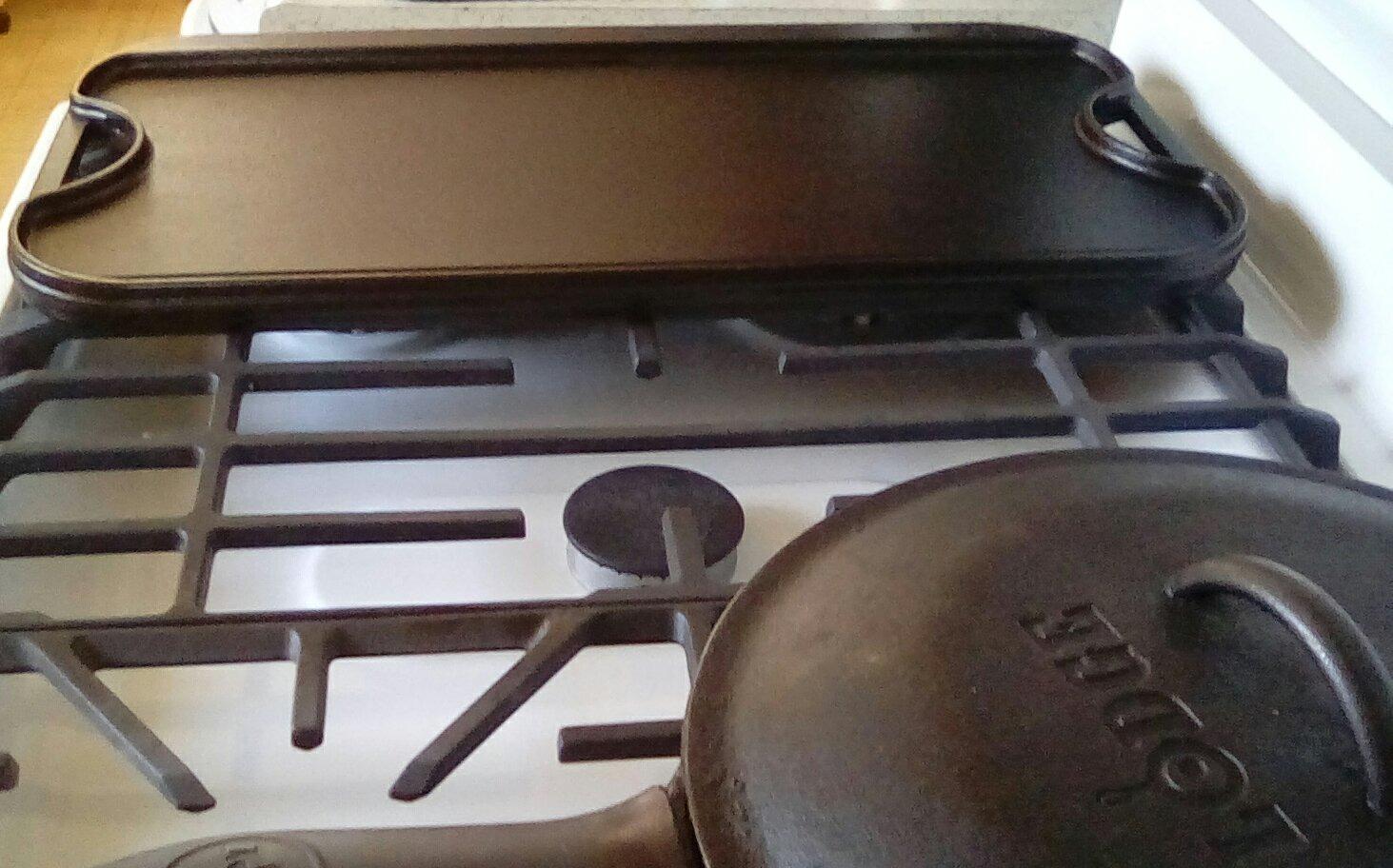
How small is 20 by 10.5 inches in real use?
Smaller than it sounds once you are plating for more than two. It handles a short-order cook service — two eggs, three burgers, a stack of bacon — but a family of six doing a full breakfast is two rounds.
Weight is the other constraint at 13.5 pounds. It is manageable one-handed, but lifting it on and off a grill grate repeatedly is still a two-handed job, and the lack of a hood or any wind protection rules it out as a stand-alone outdoor cooker.
Is a cast iron plate worth caring for long term?
Yes, and this is the product that proves it. Hand wash it, dry it thoroughly on the burner or on a towel, and apply a very thin film of oil. Owners describe a surface that gets better every season rather than one that degrades.
Never put it in the dishwasher, and avoid thermal shock by not blasting a cold plate with a torch or dropping a cold pan of water on a hot surface. Those two rules are the entire maintenance manual. Our commercial griddle guide covers larger surfaces if you need more room than 20 inches gives you.
11. VEVOR 22 Inch Commercial Electric Griddle — Best Electric Cooking Surface
VEVOR Commercial Electric Griddle, 22″, Countertop Flat Top Griddle
1600 watts
0.4 inch plate
122 to 572 degrees
Removable oil box
Pros
- True bare iron surface with nothing to flake off or replace
- Once preheated it holds temperature with few hot spots
- Unaffected by wind which makes it reliable on an exposed patio or campsite
- Comes with two shovels two brushes and a steel brush
- Widest temperature range in the roundup at 122 to 572 degrees
Cons
- 10 mm plate needs 15 to 30 minutes to preheat and does not hold heat between cooks
- Heavy and large which is difficult for some buyers to lift
- Plate arrives with factory oil that must be cleaned off and smokes on first heat-up
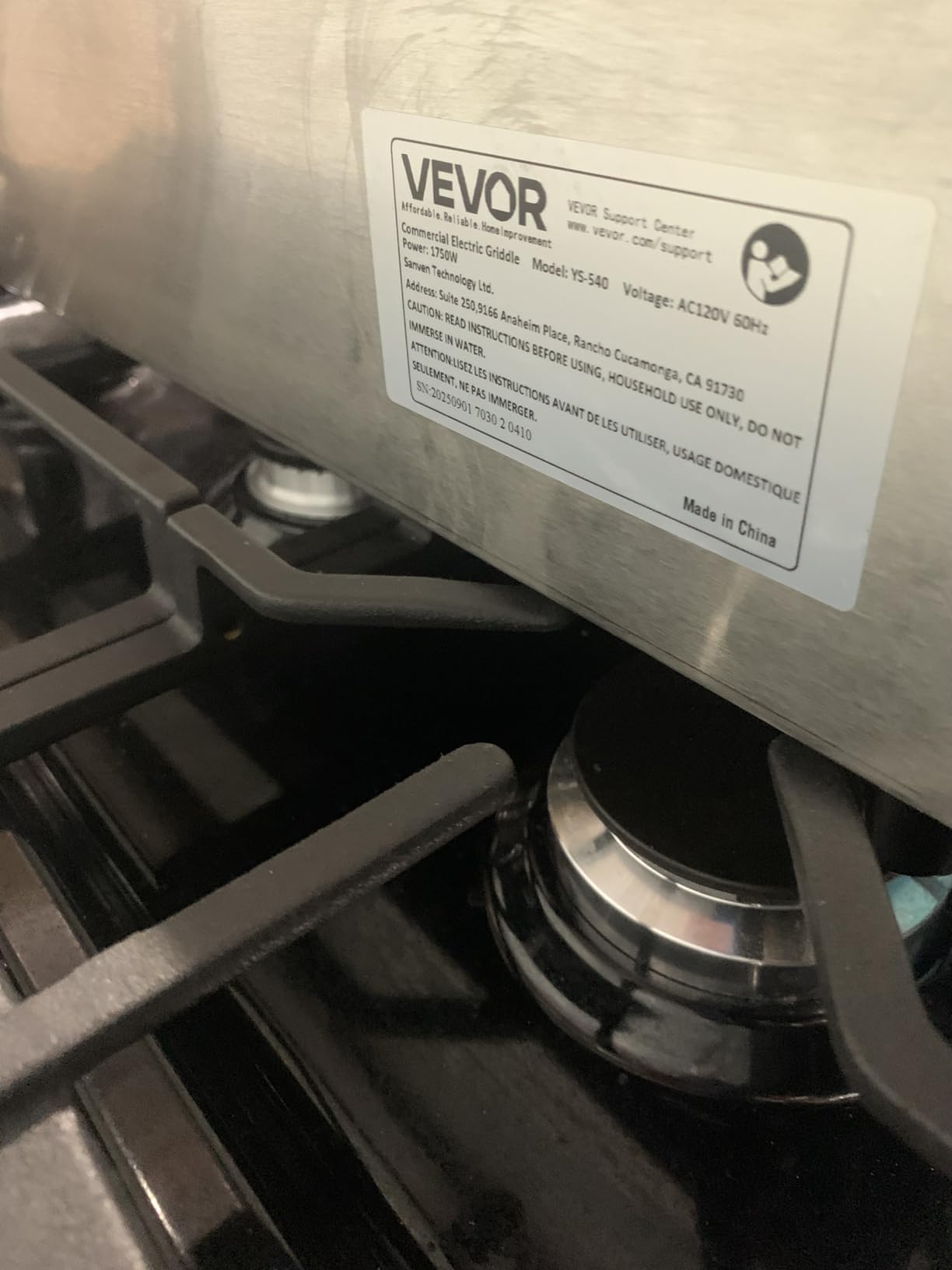
This is a restaurant plancha for a home patio, and the reason to like it is the plate. It is bare iron with no coating of any kind, stainless steel construction around it, and a 0.4 inch thickness that holds and distributes heat about as evenly as a domestic griddle can.
Temperature control is unusually granular for an electric unit, running from 122 to 572 degrees across six settings. A built-in heating tube under the plate spreads heat end to end, so once it is up to temperature it holds there with very few hot spots — a critical quality for a griddle, where a 30-degree difference between the middle and the edge ruins eggs and browns burgers unevenly.
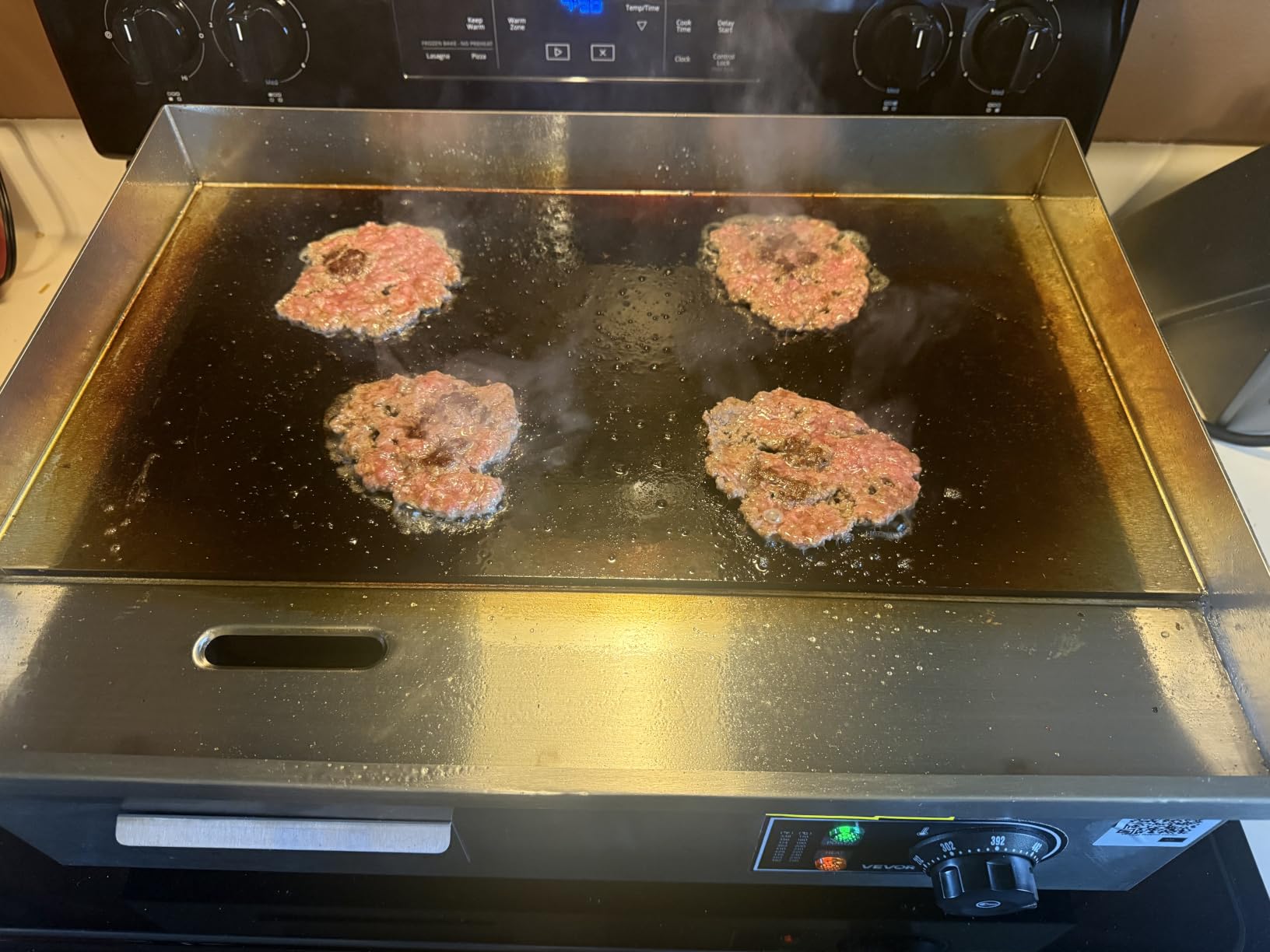
It is also the only unit here that ignores the weather. No wind, no gusts across the surface, no burner flame to blow out, which makes it dependable on an exposed patio or a campsite where gas griddles start struggling.
An enlarged drip hole and a removable oil storage box make cleanup fast, and the package includes two shovels, two brushes and a steel brush. That tool bundle alone would cost a meaningful amount to assemble on your own.
Buyers treat it as remarkable value against commercial restaurant equipment. The 4.3-star average across 855 ratings reflects a strong core of owners and a real minority who are bothered by warm-up time and weight, with a 10 percent one-star share tied for the highest here.
How long does it take to preheat?
Budget 15 to 30 minutes from cold. A 10 mm iron plate is a heat store, not a thin sheet of metal, and that same thickness is why it holds temperature so well once hot and why it does not retain heat well between cooking sessions.
Plan the preheat accordingly. Start it before you are ready to eat rather than when guests arrive, and the payoff is a surface that stays at temperature through a long service — something no gas griddle at this price can promise in cold weather.
What does the factory oil mean for first use?
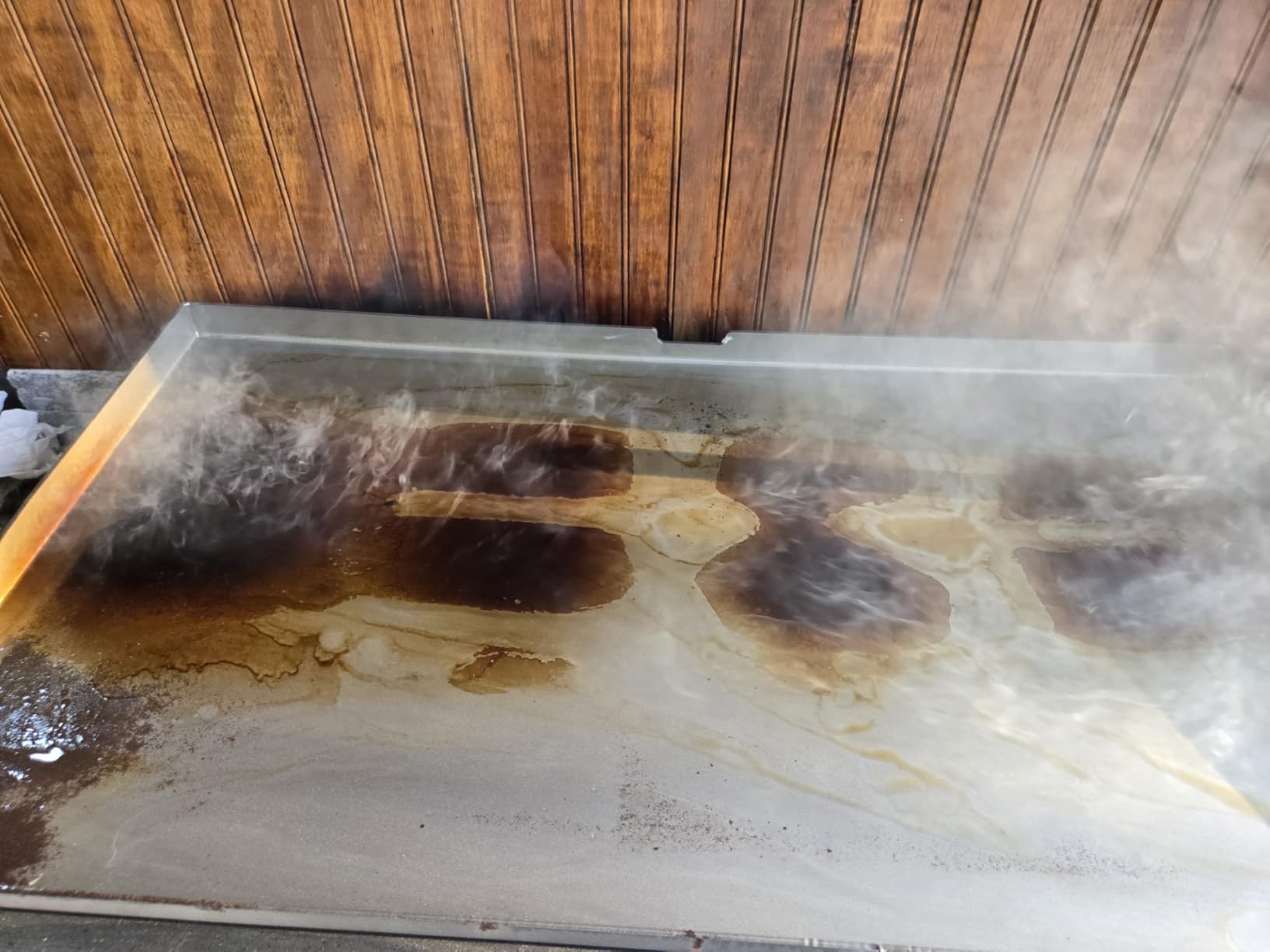
The plate arrives coated in factory oil, and it has to be thoroughly cleaned off before your first real seasoning. Expect visible smoke on the first heat-up while that protective coating burns away, and expect the surface to stain during that initial burn.
Once seasoned, the payoff is a bare iron surface with nothing to flake off and nothing to replace over the life of the plate. The included tools — particularly the steel brush — are noticeably lower quality than the griddle itself, so plan on replacing the brushes eventually.
12. VEVOR 22.4 Inch Manual Gas Griddle — Lightest Gas Griddle and Lowest Fuel Use
VEVOR Commercial Griddle, 22.4″ Heavy Duty Manual Flat Top Griddle, Countertop Gas Grill with Non-Stick Cooking Plate, Countertop Gas Griddles, H-Shaped Burner Restaurant Portable Grill, 13,000 BTU
13000 BTU H-shaped burner
Hot-rolled carbon steel
Removable grill plate
21.6 lb
Pros
- Thick heavy-gauge steel plate that reviewers judge better than the price suggests
- Stainless-steel burners heat evenly and consume very little propane
- Lightest full griddle in the roundup at 21.6 lb
- Removable grill plate and drip holes make cleanup manageable
- One owner cooked a week of meals on a single 1 lb cylinder
Cons
- No warranty is provided
- Surface arrives sand-blasted rough and stains during initial seasoning
- Thin riveted cabinet that flexes with weak hardware and instructions
At 21.6 pounds this is the lightest full gas griddle in the roundup, and that single number changes who can own one. If you want a gas griddle you can move between a shed and a patio by yourself, or hand to a single older family member, the weight is the deciding spec.
The fuel efficiency is the other story. The 13,000 BTU H-shaped burner design burns efficiently enough that one owner reported cooking a week of camping meals on a single 1 lb cylinder. Over a season of regular backyard cooking, that is a meaningful difference from higher-output units.
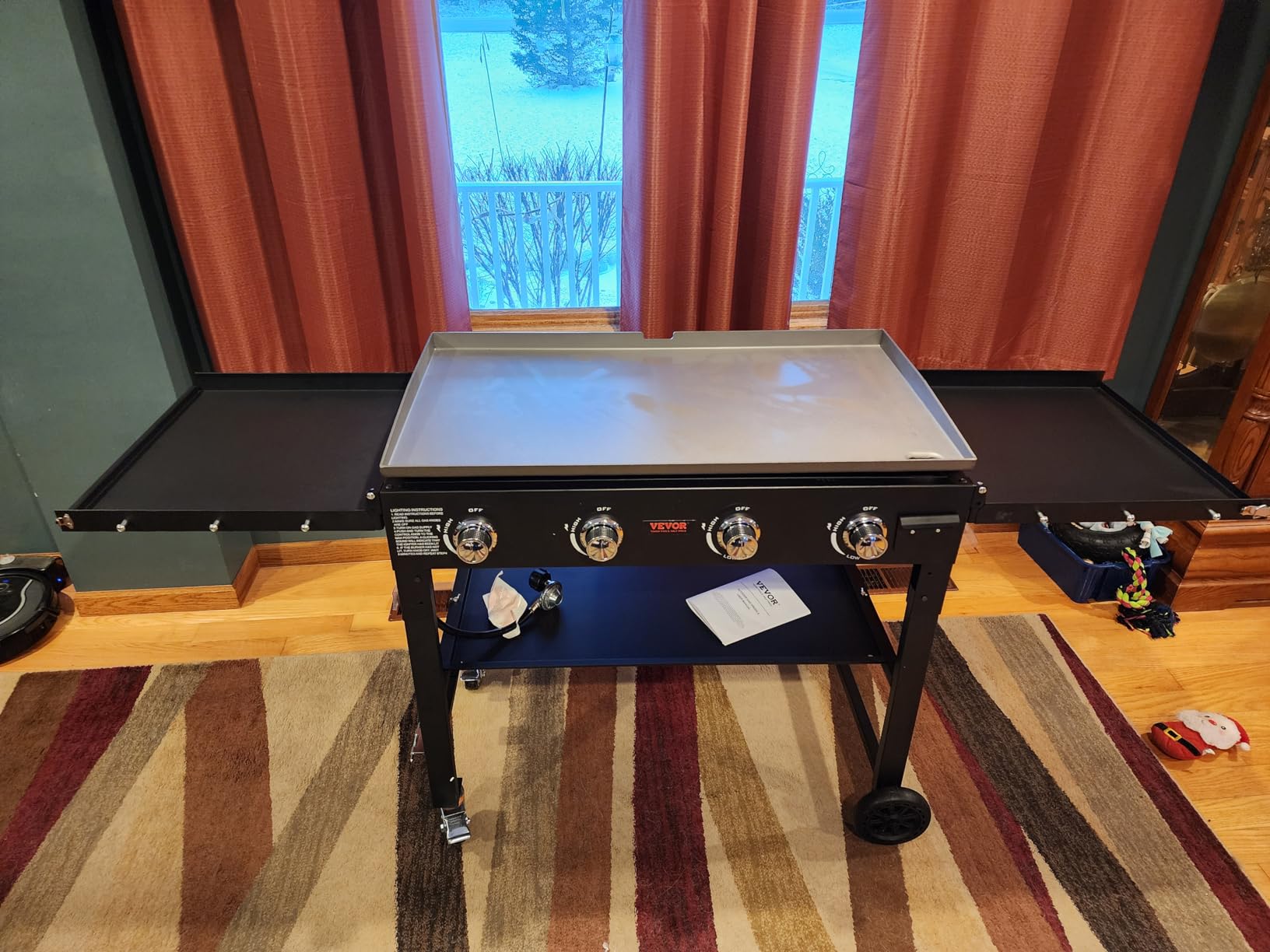
The plate is hot-rolled Q195 and Q235 carbon steel with a vegetable oil coating against rust, and reviewers consistently judge the plate thickness to be better than the price suggests. The H-shaped burner distributes heat evenly rather than concentrating it in the centre, and the stainless-steel burners are rated to withstand high heat without deforming.
Drip holes route oil and water to an oil cup, with a side oil storage compartment, and the grill plate itself lifts out for cleaning. That removable plate is the detail that keeps this maintainable — owners in forum threads repeatedly identify a removable cooktop or a large front grease trap as the mark of a griddle that stays clean.
There are real cautions. The surface arrives sand-blasted rough and stains during the initial seasoning. The cabinet is thin riveted steel that flexes, and the hardware and instructions are weak. One owner reports the plate warping severely after first use, and there is no warranty at all.
What does low fuel use mean over a season?
It means a 1 lb cylinder lasts longer, which is both a money saving and a logistics saving if you do not want to keep a full-size tank on the patio. Efficient burners also mean less ambient heat around the unit, which is pleasant in summer.
The trade-off is recovery time. Lower output means a cold tray of food hits the plate harder, so this griddle suits a relaxed cook at a table of three to five more than a high-volume service.
Should you buy a griddle with no warranty?
Only if you are comfortable owning the whole risk. Warping, hardware failure and burner problems are on you from day one, and there is no manufacturer to call. The plate is the strong part of this unit; the cabinet and the brackets around it are the weak part.
Also note what is included: a regulator and hose for a 1 lb canister. A 20 lb tank regulator is sold separately, and the propane fitting needs adapting outside North America. Budget for that before the first cook, not after.
How to Choose a Flat Top Griddle for Your Backyard
Cooktop area is the number that decides everything else, and it is the one buyers most often get wrong. Match the plate to the largest group you realistically cook for, not the group you hope to host. For most backyards, 361 square inches covers a family of six in one batch. Below about 250 square inches you are running multiple rounds, and above 500 you are carrying weight and price for capacity you will not use.
Burner count drives heat zones. Two independently controlled burners give you a hot side and a cooler side, which is what lets you sear burgers and fry eggs simultaneously. Three burners add a genuine middle zone. Four burners give the fastest recovery but need a larger plate to stay useful, which is why four-burner units tend to be the widest models in any roundup.
Surface material sets the maintenance schedule. Carbon steel and rolled steel cook fast and light but need oiling after every cook and will show rust within weeks if you skip it. Cast iron holds temperature better and resists warping, at the cost of weight. Ceramic-coated surfaces wipe clean without seasoning but cannot be restored once the coating degrades. Enamel-coated metal resists rust better than almost anything else in this roundup.
Grease management is the feature you will thank yourself for in month six. A rear or side grease trough feeding a removable cup is far better than a plate that drips directly onto your patio. Removable drip trays beat fixed troughs. A removable grill plate beats a fixed one. Check where the grease goes before you check anything else.
Then consider where it lives. A hood, or at minimum a good cover and wind guards, decides whether you cook through a wet spring or wait for clear weather. Wheels and a folding stand decide whether you can move it at all. And check the deck or patio weight and levelling — a heavy griddle on uneven ground is a rocking, unsafe, unevenly cooking combination.
Seasoning, Cleaning and Rust Prevention
Seasoning is what separates a griddle that releases food cleanly from one that sticks. The first one is a polymerised oil layer bonded to bare steel, and it takes a slow burn-off cycle and several thin coats to build.
Seasoning a new carbon steel griddle:
Wash the plate with warm water and dish soap to remove all factory oil, then dry it completely.
Apply a very thin film of a high-smoke-point oil such as canola or grapeseed, wiping the plate with a paper towel until it looks almost dry.
Heat the griddle on medium until the surface darkens and stops smoking, usually 45 to 60 minutes.
Let it cool, wipe off any black residue, and apply another thin coat of oil.
Repeat until the plate is an even dark brown or black with no bare grey steel showing.
Cleaning after a cook is much simpler than most guides make it sound. Scrape the surface with a metal spatula or a griddle scraper, push the debris into the grease trough, and wipe the plate down with a paper towel or a folded shop towel held by the leading edge. Do not pour water on a hot plate — the thermal shock will warp even good steel. Then apply a thin layer of oil and let it sit.
What actually prevents rust is frequency, not product. A very light coat of oil applied after every single cook, plus a cover, prevents almost all of it. Rust appearing within weeks is what happens when the plate is left bare overnight or sits uncovered through rain. Committed owners in griddling forum threads describe three-to-five-year lifespans on exactly this routine: oil after every use, covered when not cooking.
Surface rust is not the end of a griddle. Strip it back with coarse salt and a scouring pad, or a wire brush for heavier spots, scrub the plate down to clean metal, rinse and dry, then re-season with two or three thin oil layers. A griddle with cosmetic surface rust will still cook well once it is seasoned back. Rust that has pitted the steel, or that has eaten through thin plate, is a different problem and a reason to replace the unit.
Storage is the last piece. A griddle stored under a hard cover in a dry garage or shed will outlast one left on a covered patio all winter. If it has to live outside, put it on a stand that keeps it off wet ground, and use a cover that is fitted — a loose tarp traps condensation, which causes more rust than rain does.
Backyard Siting, Levelling and Wind
Where you put the griddle matters as much as which one you buy. Levelled ground prevents a rocking unit, which causes uneven heat and a genuine burn and spill hazard with a surface at searing temperature. Check with a spirit level before first use and shim the low corner rather than tightening everything down.
Think about wind. Unhooded burners can struggle to ignite in a gust, and crosswind cools one edge of the plate faster than the other, which is where hot and cold zone complaints usually come from. Wind guards and a fitted cover are close to universal accessories among owners, and they cost far less than cooking on an uneven surface all season.
Leave clearance for a propane tank. Never run a griddle in a garage, a shed with a door closed, or under a low overhang — carbon monoxide does not care how well the weather is. Outdoors, away from the house and away from dry timber, is the rule.
Plan the storage spot before the purchase, not after. Measure the doorway of the shed or the space in the garage, measure the folded footprint, and check that the griddle can sit level on that floor. A griddle that has to be wrestled through a doorway every autumn gets used less, and a griddle used less is a griddle that rusted.
Frequently Asked Questions
What can I put on my griddle to keep it from rusting?
A very thin film of high-smoke-point oil, such as canola or grapeseed, wiped on after every single cook. Frequency matters more than the oil you choose. Add a fitted cover and store the griddle off the ground, ideally indoors in a dry garage or shed. Loose tarps trap condensation, which causes more rust than rain does. Committed owners in griddling forums describe three-to-five-year lifespans on exactly this routine.
Can I still use my griddle if it has rust?
Yes, if it is surface rust. Scrub the plate back with coarse salt and a scouring pad or a wire brush, rinse and dry it fully, then apply two or three thin layers of oil and burn each one off. The griddle will cook normally once re-seasoned. Rust that has pitted the steel or eaten through thin plate is a different problem and a reason to replace the unit.
What is the best rust-resistant flat top griddle?
Among the griddles reviewed, the enamel-coated metal surface on the SKOK 2-burner tabletop griddle resists rust and oxide formation better than bare carbon steel, and cast iron plates such as the Utheer insert and the Lodge Pro-Grid need less daily attention than rolled steel. A ceramic nonstick surface needs no seasoning at all, but it cannot be re-seasoned once the coating degrades.
Why are people selling their Blackstone griddles?
Three reasons come up repeatedly in owner threads. First, rust fatigue from skipping the post-cook oil routine, which starts as surface rust and eventually pits the plate. Second, a change of mind about size, as buyers who started with a 17-inch tabletop unit regret not buying larger. Third, an upgrade to a built-in outdoor kitchen unit once the backyard project is finished.
Do I need to season a new flat top griddle before use?
Yes for any bare carbon steel, rolled steel or cast iron surface. Wash off factory oil, dry completely, apply a very thin layer of high-smoke-point oil, heat on medium for 45 to 60 minutes until it darkens, cool, wipe off the residue and repeat until the plate is an even dark brown or black. Ceramic-coated and enamel-coated surfaces do not need this cycle.
How big a griddle do I need for a family of six?
Around 361 square inches handles a family of six in one batch, such as the 22-inch Blackstone models on this list. Below about 250 square inches you will be running multiple rounds while the first batch cools. Above 500 square inches you are carrying weight and footprint for capacity a family of six will rarely reach in a single cook.
The Verdict: Which Flat Top Griddle Belongs in Your Backyard in 2026
The Blackstone 1666 22-inch tabletop griddle is the best flat top griddle for backyard cooking for most people. Its 361 square inches feed a family of six in one batch, two independently controlled burners give you real hot and cool zones, and 25.3 pounds is light enough for one person to reposition. It is also the model with the deepest owner base in the roundup, which means a decade of seasoning advice and replacement parts exist.
Cook for twelve regularly and the 28-inch Blackstone Omnivore takes over, with 524 square inches, built-in wind guards and a hood that keeps rain off the plate. Cook small and want the cheapest path to flat top food? The Lodge Pro-Grid cast iron plate costs almost nothing, lasts a lifetime, and turns the grill you already own into a griddle.
Whatever you pick, the accessories and habits matter more than the badge. Oil the plate after every cook, buy a fitted cover before the first wet week, and level the stand before you light it. A griddle maintained on a five-minute routine in 2026 will still be cooking in five years, and one that is left bare and uncovered will not.