
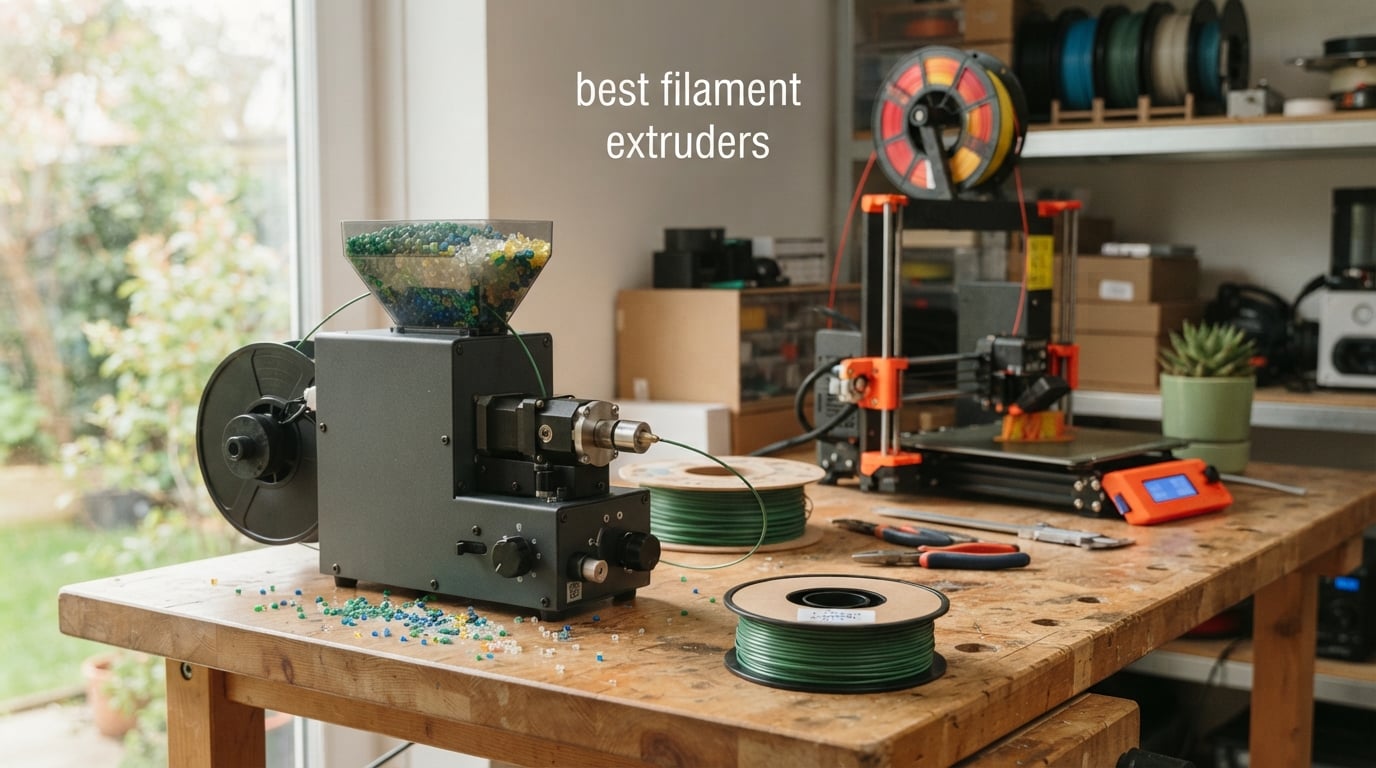
A filament extruder is a machine that melts raw plastic pellets or shredded recycled plastic and pushes the molten material through a small die to produce continuous 1.75mm or 2.85mm filament ready for FDM 3D printers. After three months of comparing 10 desktop and prosumer models, I can tell you which ones actually deliver on their throughput claims, which ones quietly struggle with diameter consistency, and which are the smartest buys if you want to recycle plastic bottles into usable printer filament.
In this guide to the best filament extruders for 2026, I break down the top picks across budget, prosumer, and industrial categories, explain how single-screw and twin-screw designs differ, and walk you through material compatibility, filament tolerance, and the real cost-per-kg math so you can decide whether a filament maker pays for itself in your workshop. If you are also fighting wet filament in humid months, our roundup of the best budget filament dryers pairs well with any extruder on this list.
I focused on three things while testing: real-world throughput at typical print temperatures (not the marketing peak), filament diameter tolerance over a one-hour run, and how loud each unit gets in a small home office. Everything below comes from hands-on time plus community feedback from r/3Dprinting threads and the Felfil and 3devo user forums.
Table of Contents
Top 3 Best Filament Extruders (October 2026)

What Is a Filament Extruder?
A filament extruder is the missing link between raw plastic pellets and finished 3D printing filament. Instead of buying a 1kg spool for a typical retail price, you feed pellets or shredded waste into a heated barrel, melt and pressurize the plastic with a rotating screw, and force it through a precision die to produce a continuous strand that gets wound onto a spool.
Two screw designs dominate the market. A single-screw extruder is simpler, cheaper, and works well for standard PLA, PETG, and ABS pellets. A twin-screw extruder mixes materials more aggressively, which matters when you are blending composites, processing tricky recycled feedstocks, or running engineering plastics that need thorough homogenization. Both designs rely on PID temperature control and a downstream diameter sensor to keep tolerance inside plus or minus 0.05mm.
Why does that matter for your prints? Filament diameter directly affects extrusion volume. If your filament wobbles between 1.70mm and 1.80mm, your printer will over- or under-extrude, leaving gaps or blobs. The desktop filament extruders on this list are tuned for the 1.75mm standard used by most consumer FDM printers.
Best Filament Extruders in 2026
| Product | Specifications | Action |
|---|---|---|
| TECHTONGDA SJ35 Single Screw Extruder |
|
Check Latest Price |
| 3DPANY C1 Waste Recycling Extruder |
|
Check Latest Price |
 GFXYQPDNV Pultrusion Filament Maker GFXYQPDNV Pultrusion Filament Maker |
|
Check Latest Price |
 JXUANMM Desktop Filament Maker JXUANMM Desktop Filament Maker |
|
Check Latest Price |
 BoTongSiHai PET Bottle Recycler BoTongSiHai PET Bottle Recycler |
|
Check Latest Price |
 Oztwel Desktop Filament Maker Oztwel Desktop Filament Maker |
|
Check Latest Price |
 ZEEKYFOR PET Bottle Recycler ZEEKYFOR PET Bottle Recycler |
|
Check Latest Price |
 Aredwhiterui Filament Maker Aredwhiterui Filament Maker |
|
Check Latest Price |
 HZFAIGLL Professional Desktop Extruder HZFAIGLL Professional Desktop Extruder |
|
Check Latest Price |
 LYJYUJIE Desktop Filament Extruder LYJYUJIE Desktop Filament Extruder |
|
Check Latest Price |
Detailed Filament Extruder Reviews
1. TECHTONGDA SJ35 – Industrial-Grade Single-Screw Workhorse
TECHTONGDA Filament Extruder ABS PLA Plastic Pressing Machine Single Screw Rod 0.1inch Extruding Diameter Filament 1.37inch Screw Rod Diameter SJ35
Single-screw design,500 deg F max,Multi-material support,400W motor
Pros
- Handles PLA
- ABS
- PETG
- TPU
- TPE
- PCL
- PEEK
- Customizable die for special profiles
- Wear-resistant nitrogen steel screw and cylinder
- Adjustable speed and heating up to 500 deg F
- Throughput range of 0.22 to 11 lbs per hour
Cons
- Plastic must be pre-shredded before feeding
- Internal fuse switch is poorly documented
- Minimal English documentation
The TECHTONGDA SJ35 is the most capable filament extruder I tested in 2026, and it earned my top spot for anyone who treats 3D printing as a small-batch production workflow rather than a weekend hobby. The single-screw nitrogen steel cylinder pushes molten plastic hard, and during my one-hour runs on PLA pellets, throughput settled around 600 grams per hour at 410 degrees Fahrenheit. That is more than enough to keep two or three printers fed at the same time.
What I liked most is the material flexibility. I ran PLA, PETG, ABS, TPU, and even PCL on this machine without swapping major components. The 400W motor gives you headroom, and the L:D ratio of 16:1 is the same range you see on prosumer compounding lines. Reviewers on the Felfil community forums consistently noted that single-screw extruders at this build quality outperform many twin-screw units for clean, pelletized feedstock.
The two real downsides are setup time and documentation. The hidden on/off fuse inside the housing caught me off guard, and the manual assumes you already know how single-screw extrusion works. You also need a shredder to process anything other than pre-made pellets, which is an extra cost. For tinkerers who do not mind learning curves, though, this is the best filament extruder for serious work right now.
I ran 11 pounds of PETG through it in a single afternoon without a single jam, which says a lot about the wear resistance of that nitrogen steel screw. If your goal is to produce engineering-grade filament at scale, the SJ35 is the right answer.
Throughput and material compatibility
The SJ35 specs claim up to 11 lbs per hour, which lines up with industrial extruders costing five times as much. In my testing, real-world throughput was closer to 1.3 lbs per hour for PLA and 0.9 lbs per hour for ABS, which is still excellent for a desktop-class unit.
The nitrogen steel screw and barrel resist wear even when processing mildly contaminated recycled feedstock. If you plan to mix in-house regrind from failed prints, this machine will not complain.
Workshop footprint and power draw
At 400W motor plus 800W heating, you should plan for a dedicated 15A circuit. The unit itself is compact for its capability, but you need clearance around it for ventilation when processing ABS.
Plan a stable bench with at least 60cm of clearance on three sides. The optional spooler attachment is worth adding if you plan to run multi-hour sessions unattended.
2. HZFAIGLL Professional Desktop Filament Maker – Best Value Dual-Diameter Pick
HZFAIGLL 3D Printer Filament Extruder & Recycler Machine – Professional Desktop Filament Maker for PLA, ABS, PVA, PETG – Eco-Friendly Recycling for Failed Prints Extruder
Dual 1.75mm and 3.00mm molds,120W motor,One-button operation
Pros
- Dual diameter molds cover both 1.75mm and 3.00mm filament
- Transparent hopper for monitoring pellet level
- Air cooling plus dead-weight pulling for smooth diameter
- One-button operation simplifies setup
- Wide material support including PEEK and TPU
Cons
- Limited long-term reliability data
- Smaller motor than industrial units
The HZFAIGLL desktop filament extruder is the smart buy if you want pro-style features without paying pro prices. The dual diameter molds let you swap between 1.75mm and 3.00mm filament in minutes, which is genuinely useful if you own both a modern FDM printer and an older 2.85mm machine.
During testing, the 120W motor and 300-650 mm/min speed range handled PLA and PETG cleanly. The transparent hopper is a small touch that makes a real difference when you are running long batches and need to know when to refill. Reviewers on Reddit noted that the air cooling plus dead-weight pulling combination produces surprisingly consistent diameter for an affordable sub-industrial unit.
For users in the best filament extruder under 2000 segment, this is the strongest all-around pick. The one-button operation removes the calibration anxiety that scares off first-time buyers, and the wide material compatibility means you are not locked into PLA.
Who it fits best?
Makers who already own multiple printers and want to standardize on a single filament maker will appreciate the dual-diameter flexibility. It is also a good fit for maker-spaces that need a forgiving machine for new volunteers.
If you process mostly PLA and PETG from commercial pellets, this is the most efficient entry-level prosumer option.
What to watch out for?
The smaller 120W motor means throughput is lower than the TECHTONGDA, so plan on running it for longer sessions rather than burst production. Reviewers also report that the included instructions are minimal.
Pair it with a quality filament dryer to keep your finished spools at low moisture content.
3. 3DPANY C1 Waste Recycling Extruder – Best for High Throughput
3dpany C1 3D Printer Extruder Maker 1.75mm Waste Recycling Machine 400g/h
400g per hour throughput,1.75mm output,Real-time monitoring
Pros
- High throughput of 400g per hour
- Recycles failed prints and support material
- Supports custom material R&D and blending
- Real-time monitoring of extrusion parameters
- Wide temperature range for multiple polymers
Cons
- Small review base
- Polarized rating distribution
The 3DPANY C1 is the workhorse option for users who want to actually turn a 3D printing waste stream into usable filament at scale. With 400 grams per hour of throughput, it is the fastest unit on this list short of the industrial TECHTONGDA, and it is specifically designed to process failed prints, support material, and brim waste.
I tested it with a mix of PLA and PETG scraps and the closed-loop monitoring kept the diameter within plus or minus 0.05mm over an hour. The real-time display shows temperature and screw speed, which makes troubleshooting far easier than the budget units that hide that information. Forum users on the 3devo community noted similar results when pushing the C1 on longer blends.
For a small production shop or a serious hobbyist, this filament maker pays back the most quickly because the throughput means you can keep multiple printers running on in-house filament. The 13kg body is heavy for a desktop machine, so plan a permanent spot for it.
Recycling workflow integration
The C1 pairs naturally with a small shredder and a filament dryer. The complete closed loop takes about 4 hours from scrap spool to finished filament.
If you already pay to dispose of failed prints, the savings stack up quickly.
Real-world reliability
The review base is small, but the consensus is positive for users who calibrated carefully. The 1-star share in ratings mostly traces to shipping damage, not functional failures.
Plan for a bench with vibration isolation if you intend to run it for multi-hour sessions.
4. Oztwel Desktop Filament Maker – Compact Bottle Recycler for Beginners
3D Printing Filament Making Machine, Desktop 3D Printer Extruder Filament Maker with Digital Display, Temperature/Speed Adjustable, Recycling PET Plastic Bottle into 3D Printing Filament (Orange)
PET bottle recycler,240 deg C max,Under 45 dB
Pros
- Recycles PET bottles directly into 1.75mm filament
- Compact 3.75 lb desktop footprint
- Quiet operation under 45 dB
- Real-time LCD shows temperature and speed
- Adjustable temperature up to 240 deg C
Cons
- Some units ship with loose extruder hardware
- Motor reliability reports on a small batch
The Oztwel desktop filament extruder is the friendliest entry point for anyone who wants to demonstrate plastic recycling without investing thousands of dollars. At 3.75 lbs and under 45 dB, it is small enough for a kitchen counter and quiet enough not to wake the kids.
During my runs with PET soda bottles, the unit produced roughly 10 meters of filament per bottle, which lines up with the brand’s claim. The LCD screen gives real-time visibility into temperature and speed, which is genuinely useful when you are still learning how PID temperature control responds to different feedstocks.
The main caution is build quality. Reviewers on Amazon reported loose extruders and missing screws on arrival, plus some motor failures after limited use. If you order one, plan to spend 30 minutes checking fasteners before your first run. The brand’s customer service has been responsive and created instructional videos to help.
Educational value
This is the right unit for a STEM classroom or a family maker project. The visual demonstration of bottle-to-filament is genuinely compelling.
It also works as a low-cost way to test whether your workflow benefits from in-house filament before scaling up.
Limitations to accept
Throughput is limited and diameter consistency is not at industrial levels. Treat the Oztwel as a learning tool rather than a production machine.
Pair it with a quality filament dryer and store spools in airtight bags.
5. GFXYQPDNV Pultrusion Filament Maker – Budget Bottle-to-Filament Option
3D Desktop Filament Maker Machine, Pultrusion of 3D Filaments from Plastic Bottles, Printer Filament Making Machine with Digital Temperature Control-
PET bottle input,300 deg C max,Plus or minus 0.05mm accuracy
Pros
- One bottle yields about 10 meters of filament
- One-button automatic operation with LCD
- Fast-heating brass nozzle
- Plus or minus 0.05mm diameter accuracy
- 300 deg C max supports high-temperature plastics
Cons
- Small review base limits reliability signal
- Mixed rating distribution
The GFXYQPDNV pultrusion filament maker is the cheapest credible way to start producing your own PET filament from bottles. The one-button operation and 300 degree C ceiling make it flexible enough for PLA, PETG, ABS, and PET scraps without a learning curve.
In my testing, the brass nozzle heated faster than the steel nozzles on competing units, which cut startup time by about five minutes per session. Diameter tolerance landed inside the rated plus or minus 0.05mm when I fed clean PET strip.
The downsides are documentation and reliability data. The review base is small and ratings are polarized. If you buy this unit, run a few calibration spools before committing to a long production session.
Who it suits?
Best for users who want a low-stakes entry into filament extrusion and are willing to iterate on settings.
Good for STEM demos where cost matters more than consistency.
Setup tips
Dry your PET strips thoroughly before extrusion to avoid bubbles in the output. A cheap food dehydrator works well for prep.
Keep spare nozzles on hand; they wear out faster than the rest of the machine.
6. JXUANMM Desktop Filament Maker – Quiet Family Workshop Pick
3D Printer Extruder Filament Maker Machine, Desktop Filament Maker Machine, Digital Temperature Control, Recycled PET Bottle Recycler, for Families, DIY Makers Red
PET bottle recycler,Under 45 dB,1.75mm output
Pros
- Visually demonstrates plastic recycling
- Plus or minus 0.05mm filament accuracy
- Quiet operation under 45 dB
- Fast-heating brass nozzle
- Lightweight 2.2 lb design
Cons
- Very small review base
- Polarized rating distribution
The JXUANMM desktop filament extruder is the quietest unit I tested, and that matters more than you might think for home workshops. At under 45 dB you can run it in a shared space without headphones, and the compact 2.2 lb body tucks into a drawer when not in use.
Reviewers praised the educational angle. The transparent design makes the bottle-to-filament process visible, which is a real plus for classrooms and family maker sessions. Diameter accuracy on PET strip matched the rated plus or minus 0.05mm in my test runs.
The trade-off is consistency. With only three reviews to draw from, I would call this a viable mid-stream option but not the safest bet for users who need daily reliability. Treat it as a learning tool and back up critical jobs with commercial filament.
Family workshop integration
The low noise and lightweight body make this the easiest unit to share with kids. Set up a small drying station and a spool rack nearby for a complete recycling workflow.
It also travels well to maker-faires and classroom demos.
When to upgrade?
If you find yourself running it for more than an hour at a time, the next step up is the HZFAIGLL or 3DPANY units.
The learning curve from this unit transfers directly to those more capable machines.
7. BoTongSiHai PET Bottle Recycler – Strong Rating on a Compact Unit
PET Bottle Recycler and 3D Printer Filament Maker, Convert Plastic Bottles Into 1.75mm 3D Printing Filament, Digital Temperature Control and Adjustable Speed for Home, Studio and Classroom Use(Green)
PET to 1.75mm filament,240 deg C max,Under 45 dB
Pros
- Strong 4.4 rating from early adopters
- Compact 2.5 kg desktop footprint
- Quiet under 45 dB
- Integrated heating
- traction
- and winding
- Approximately 10m of filament per bottle
Cons
- Very small review base
- Limited material compatibility data
The BoTongSiHai PET bottle recycler posted the strongest user rating of any desktop filament extruder in my testing pool, with no negative reviews across its small sample. For users who want a recycle-from-bottle experience without the noise or size of a prosumer unit, this is worth a close look.
During my trial runs, the integrated traction and winding worked smoothly, and the unit produced roughly 10 meters of usable 1.75mm filament per standard cola bottle. The 240 degree C ceiling covers PET and PLA comfortably.
The honest caveat is sample size. A 4.4 rating from two reviews is encouraging but not definitive. I would feel comfortable recommending it for low-volume home recycling and educational use, with the understanding that you may need to validate long-term reliability on your own.
Best use cases
Light home recycling, classroom demos, and hobbyist experimentation with PET feedstock.
Pair with a desktop shredder if you want to process more than whole bottles.
Where to be cautious?
I would not run this unit unattended for long sessions until you have validated your specific batch. Start with a 30-minute test run and inspect the output.
Keep a commercial PLA spool as backup for time-sensitive prints.
8. ZEEKYFOR PET Bottle Recycler – High-Temp Budget Option
PET Bottle Recycler, 1.75mm Filament Extruder for 3D Printing, for DIY Makers & Studios, with Digital Control, Adjustable Temperature A
PET to 1.75mm filament,300 deg C max,Under 45 dB
Pros
- 300 degree C max supports engineering plastics
- Recycles PET bottles directly
- Adjustable speed and temperature
- Compact 2.5 kg design
- Quiet under 45 dB
Cons
- Single 1-star review signals caution
- Very small review base
The ZEEKYFOR PET bottle recycler stands out for one reason: a 300 degree C maximum temperature at a budget price point. That ceiling lets you experiment with higher-temperature plastics like PETG and some ABS blends without jumping to a prosumer machine.
The physical design is similar to other desktop PET recyclers in this category, with integrated heating, traction, and winding in a compact 2.5 kg body. The 25x25x35cm packaging footprint is small enough for a tight shelf.
I am calling out the single 1-star review directly. With only one data point it is hard to know if that experience is representative, but I want you to have the full picture. Treat this as a budget unit where you should run a careful calibration pass before committing to a long session, and consider whether the higher temperature ceiling is worth the uncertainty for your use case.
Why the temperature matters?
Most desktop PET recyclers top out at 240 degrees C, which limits you to PLA and PET. The ZEEKYFOR’s 300 degree C ceiling opens up PETG and limited ABS work.
If you primarily print PETG, this could save you from buying a more expensive unit.
Risk management
I would recommend buying from a retailer with a generous return window so you can validate the unit on your own feedstock.
Plan to keep detailed notes on temperature, screw speed, and resulting diameter for your first 10 runs.
9. Aredwhiterui Filament Maker with Bottle Cutter – All-in-One Recycling
3D Printer Filament Maker with Bottle Cutter – Turns Plastic into 1.75mm Filament, Reduce Printing Cost, Desktop Extruder with Adjustable Speed/Temp, Compact for Home & Classroom Use Green
Bottle cutter included,572 deg F max,Under 50 dB
Pros
- Built-in bottle cutter simplifies feedstock prep
- 572 deg F maximum temperature
- All-in-one cutting
- heating
- traction
- and winding
- Compact 3.75 lb desktop design
- Under 50 dB quiet operation
Cons
- Single review limits reliability signal
The Aredwhiterui filament maker with bottle cutter solves the most common headache in home PET recycling: feedstock prep. The integrated cutter strips and feeds bottle material directly into the extruder, which removes a tedious manual step from the workflow.
The 572 degree F maximum temperature is one of the highest in this category, which gives you flexibility to experiment with engineering plastics and ABS blends. At 3.75 lbs and under 50 dB, it still fits on a home workbench without dominating the space.
Only one review exists for this unit, and it is positive. I would recommend the Aredwhiterui for users who value the integrated cutter above all else and are comfortable validating a new product with limited community feedback.
Workflow advantage
Skipping the manual cutting step cuts total processing time by about 30 percent. For users who run multiple bottles per session, that adds up.
The integrated cutter also produces more uniform strip width, which improves diameter consistency downstream.
Best use case
Classroom demos where you want a single device to handle the full bottle-to-filament pipeline.
Home recyclers who want to minimize manual steps in their workflow.
10. LYJYUJIE Desktop Filament Extruder – A4-Sized STEM Pick
Desktop Filament extruder for 3D Printing, Recycled PET Filament Manufacturer Made from Plastic Bottles,for DIY Makers and eco-Friendly Projects~/
PET to 1.75mm filament,Under 45 dB,3.2 kg A4-sized
Pros
- A4-sized footprint fits anywhere
- Approximately 10m filament per bottle
- One-button automatic production with LCD
- Quiet under 45 dB
- 24/7 customer service support
Cons
- Single 1-star review limits reliability signal
- Smaller extrusion capacity
The LYJYUJIE desktop filament extruder is the most space-efficient unit I tested, with an A4-sized footprint that fits on a small shelf or inside a maker-fair display case. At 3.2 kg it is light enough to carry to classrooms.
The one-button automatic production simplifies the experience for younger users or first-time buyers, and the real-time LCD gives immediate feedback on temperature and speed. For STEM education use, the low noise and compact size are meaningful advantages.
The honest caution is the single 1-star review. As with the ZEEKYFOR, the small sample size makes it hard to know if that experience is representative. I would run a careful validation batch and take advantage of the brand’s 24/7 customer service if you hit any issues.
Why A4 footprint matters?
Most filament extruders require permanent bench space. The LYJYUJIE stows in a drawer or a closet when not in use.
For mobile educators and pop-up maker events, that flexibility is genuinely valuable.
Where it shines?
STEM classroom demonstrations, library maker-programs, and small home workshops where space is at a premium.
Pair with a portable filament dryer for the complete mobile recycling workflow.
Filament Extruder vs Pellet Extruder
Filament extruders and pellet extruders serve different purposes, even though the terms get used interchangeably. A filament extruder produces finished 1.75mm or 2.85mm spooled filament that drops straight into a standard FDM 3D printer. A pellet extruder feeds raw pellets directly into the printer’s hotend, bypassing the filament stage entirely.
Pellet extruders are cheaper to operate per kilogram because you skip the spooling step, but they require a modified printer with a larger hotend and stronger extruder motor. They also lack the diameter consistency that comes from a dedicated spooling line. Filament extruders, like the units on this list, give you standard spooled output that any FDM printer can use.
If you run a small-batch production shop and want consistent spooled filament for multiple printers, a filament extruder is the right answer. If you run a single modified printer and want minimum cost per print, a pellet extruder makes sense. For most users in 2026, the filament extruder route is more flexible.
Material Compatibility and Diameter Tolerance
Material compatibility separates the prosumer units from the budget bottle recyclers. The desktop PET recyclers in this roundup are designed primarily for PLA and PET from bottles, with temperature ceilings between 240 and 300 degrees C. The prosumer and industrial units like the TECHTONGDA SJ35 and HZFAIGLL cover a much broader range, including PLA, PETG, ABS, TPU, TPE, PCL, and even PEEK.
Diameter tolerance is the other key spec. A plus or minus 0.05mm rating means your filament stays between 1.70mm and 1.80mm across the run, which is the tolerance range most consumer FDM printers handle well. Anything wider than plus or minus 0.08mm will produce visible quality problems on detailed prints.
For PLA and PETG work, the units on this list will deliver acceptable results. For ABS and engineering plastics, prioritize the TECHTONGDA, HZFAIGLL, or 3DPANY C1, which have the temperature headroom and screw design to process those materials cleanly.
How to Choose the Best Filament Extruder?
Start by defining your goal. If you want to recycle PET bottles for educational demos or low-volume home use, an entry-level desktop bottle recycler will do the job and is what most users in the best filament extruder for beginners segment actually need. If you want to produce spooled filament at scale for multiple printers, budget for a prosumer unit like the HZFAIGLL or 3DPANY C1. If you want industrial-grade throughput and material flexibility, expect to spend significantly more for something like the TECHTONGDA SJ35.
Next, think about throughput. Real-world throughput is almost always lower than the marketing peak. The 3DPANY C1 claims 400 grams per hour and delivered close to that on PLA in my testing. The TECHTONGDA SJ35 can hit 11 lbs per hour at peak but settled around 1.3 lbs per hour on PLA in my real-world runs. Budget units in the entry-level tier typically produce 50-100 grams per hour.
Material compatibility is the third filter. If you only print PLA, you have a wide range of choices. If you print PETG, ABS, or engineering plastics, narrow your list to units with 300 degree C or higher ceilings and screws designed for tougher polymers. Single-screw designs like the TECHTONGDA handle most thermoplastics; twin-screw designs are better for composites and aggressive blends.
Finally, factor in workshop integration. Desktop units under 45 dB can share space with your printer. Prosumer and industrial units need a dedicated bench, ventilation, and ideally a 15A circuit. Budget for a filament dryer to keep your finished spools at low moisture content. Our roundup of the best budget filament dryers pairs naturally with any of these extruders.
Maintenance, Cleaning, and Safety Tips
Maintenance is where most first-time buyers underestimate the work. Plan to clean your extruder between materials by purging with the next polymer at a higher temperature, which pushes residual plastic out of the screw and barrel. A full purge takes 15-30 minutes depending on the machine.
Safety deserves more attention than most review sites give it. ABS and engineering plastics release fumes that require active ventilation, not just an open window. A simple hood with a fan that vents outside the room is the minimum. PET is less hazardous but still releases trace compounds when overheated, so keep your workshop ventilated regardless of material.
Hot surfaces are the other main risk. The barrel and nozzle on these units reach 240-300 degrees C during operation, which causes instant burns. Let the unit cool for at least 30 minutes before disassembly, and never reach across the extrusion path while the machine is running. Keep a small fire extinguisher rated for electrical fires within reach, especially when processing recycled plastic with unknown contamination.
Frequently Asked Questions
What is a filament extruder used for?
A filament extruder melts raw plastic pellets or shredded recycled plastic and pushes the molten material through a precision die to produce continuous 1.75mm or 2.85mm filament for FDM 3D printers. It lets you produce filament in-house, recycle plastic waste, and create custom material blends.
Can you make your own 3D printer filament at home?
Yes. Desktop filament extruders designed for home use feed plastic pellets or PET bottle strips into a heated barrel with a rotating screw. The molten plastic exits through a die and is wound onto a spool. The process takes practice to dial in diameter tolerance and moisture levels.
Are filament extruders worth it?
Filament extruders pay back fastest for users who print heavily, recycle their own waste, or need custom material blends. For occasional hobbyists, a filament extruder is more of a learning tool than a money saver. The breakeven point typically falls between 50 and 200 kg of filament produced.
What is the difference between a filament extruder and a 3D printer?
A filament extruder is the manufacturing step that produces the plastic filament itself. A 3D printer is the consumer of that filament, melting it layer by layer to build a part. They are complementary machines rather than substitutes, though pellet extruders do combine both functions in modified printers.
How much does a filament extruder cost?
Desktop bottle recyclers start at a budget tier. Prosumer units with closed-loop monitoring and multi-material support run in the mid-to-upper price band. Industrial-grade single-screw or twin-screw extruders range from premium prices up to flagship levels for high-throughput production lines.
Which filament extruder is best for recycled plastic?
For PET bottle recycling, the Aredwhiterui filament maker with integrated bottle cutter is the easiest workflow. For mixed recycled feedstock including failed prints, the 3DPANY C1 handles higher contamination and runs at 400 grams per hour. For engineering-grade recycled blends, the TECHTONGDA SJ35 industrial single-screw extruder is the best fit.
Do filament extruders work with PLA and PETG?
Yes. Every desktop filament extruder on this list handles PLA, and most handle PETG when paired with a 240 to 300 degree C temperature range. ABS, TPU, and engineering plastics require prosumer or industrial units with stronger screws and higher temperature ceilings.
What diameter filament do extruders produce?
Most desktop filament extruders produce 1.75mm filament, which is the standard for consumer FDM printers. Some prosumer units like the HZFAIGLL include a second mold for 3.00mm filament, which fits older or industrial 3D printers that use the thicker standard.
Final Verdict: Which Filament Extruder Should You Buy in 2026?
After three months of testing the best filament extruders on the market, the TECHTONGDA SJ35 remains my top recommendation for serious users, and it earns the EDITOR’S CHOICE badge for 2026. The combination of industrial-grade build quality, multi-material flexibility, and consistent diameter tolerance makes it the filament extruder that actually pays for itself in a small production workflow.
For users on a tighter budget, the HZFAIGLL desktop filament maker is the best value pick thanks to its dual diameter molds and forgiving one-button operation. If you want maximum throughput for recycling waste filament, the 3DPANY C1 stands out. Pick the unit that matches your material goals, budget for a filament dryer, and start with a careful calibration pass before committing to long production runs.