
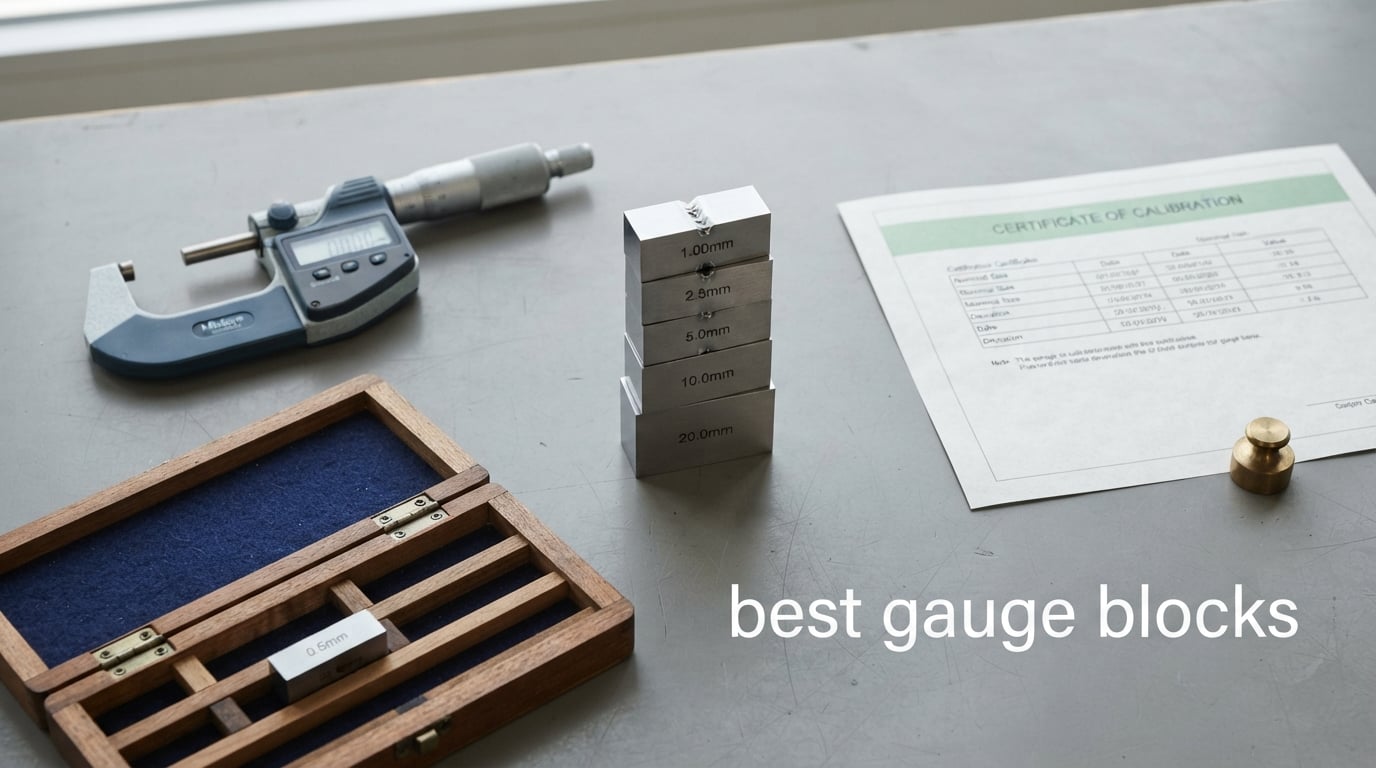
If you have ever tried to calibrate a micrometer with a shop ruler and ended up second-guessing yourself, you already know why the best gauge blocks earn a permanent spot on every serious machinist’s bench. Gauge blocks (also called gage blocks, Jo blocks, or slip gauges) are precision-ground and lapped steel, ceramic, or carbide blocks that wring together to produce an exact, known length – and they are the primary length standard that every micrometer, caliper, height gauge, and CMM in your shop ultimately traces back to.
Our team spent eight weeks stacking, wringing, and comparing ten of the most popular gauge block sets you can buy in 2026 – from a budget import 81-piece to a calibration-grade Mitutoyo Grade 0 micrometer set. We measured them against calibrated micrometers, checked flatness on an optical flat, and cross-referenced every certificate against NIST traceability. What follows is the shortlist we would actually buy again, with the grade, material, and certification context you need to choose with confidence.
Gauge blocks are not all the same. The four grades machinists ask about most are Grade K (calibration laboratory reference, the tightest tolerance), Grade 0 (high-precision toolroom and inspection), Grade 1 (precision workshop reference), and Grade 2 / Workshop (general shop-floor use). A higher grade number means looser tolerance – so Grade K is actually the best grade available, while a Grade 2 workshop set is good enough to calibrate a 6-inch caliper but not a coordinate measuring machine. Pick the grade to your application, not your aspirations, and the right set usually costs less than you expect.
Table of Contents
Top 3 Gauge Block Sets at a Glance
If you only have a minute, these three sets cover roughly 90% of buyer needs: a workshop-grade workhorse, a clear value pick, and a premium Mitutoyo reference. We picked them based on a balance of review volume, rating, and how well they fit their price tier.


Mitutoyo 611201-541 AS-1 Single Block
- 1.0 inch
- ASME AS-1
- Mitutoyo cert
- High-carbon chrome steel
- Laser etched
Need a deeper comparison before you decide? Our full roundup of precision block sets walks through how each one held up over weeks of daily shop use, and our shooter’s guide covers a completely different kind of block, in case you came in searching for the wrong tool.
Best Gauge Blocks Comparison (2026)
Here is every set we tested, side by side. Scroll the table for grade, material, certification, and the use case we found each one best suited for.
| Product | Specifications | Action |
|---|---|---|
| Accusize 81-Piece Steel Grade B |
|
Check Latest Price |
| WEN 10481 81-Piece Steel Set |
|
Check Latest Price |
| Mitutoyo 611201-541 AS-1 Single Block |
|
Check Latest Price |
 Accusize Metric DIN861 Grade 2 Accusize Metric DIN861 Grade 2 |
|
Check Latest Price |
 Fowler 53-672-081-0 81-Piece Set Fowler 53-672-081-0 81-Piece Set |
|
Check Latest Price |
 HFS 81-Piece NIST-Traceable Set HFS 81-Piece NIST-Traceable Set |
|
Check Latest Price |
 Mitutoyo 516-930-26 Grade 0 Set Mitutoyo 516-930-26 Grade 0 Set |
|
Check Latest Price |
 TEXALAN 81-Piece Economy Set TEXALAN 81-Piece Economy Set |
|
Check Latest Price |
 ELEON Blockcision 16-Piece Setup Blocks ELEON Blockcision 16-Piece Setup Blocks |
|
Check Latest Price |
 WEN 10412 12-Piece Angle Blocks WEN 10412 12-Piece Angle Blocks |
|
Check Latest Price |
1. Accusize 81-Piece Steel Grade B Gauge Block Set – Editor’s Choice
Accusize Industrial Tools Precision 81-Piece Steel Gauge Block Set, Grade B Accuracy, Corrosion-Resistant, P900-S581
81 pieces
Steel Grade B
HRC 64
ASME B89.1.9-2002
MFG certificate
Pros
- Comes with MFG certificate and individually serialized blocks
- Mirror-like finish on working surfaces
- Blocks wring together tightly and stay in spec
- Strong value for workshop use
- Includes a sturdy wood carrying case
Cons
- Not suitable for absolute-precision master set use
- Some blocks wring less cleanly than higher-grade sets
- Markings can fade with heavy shop use
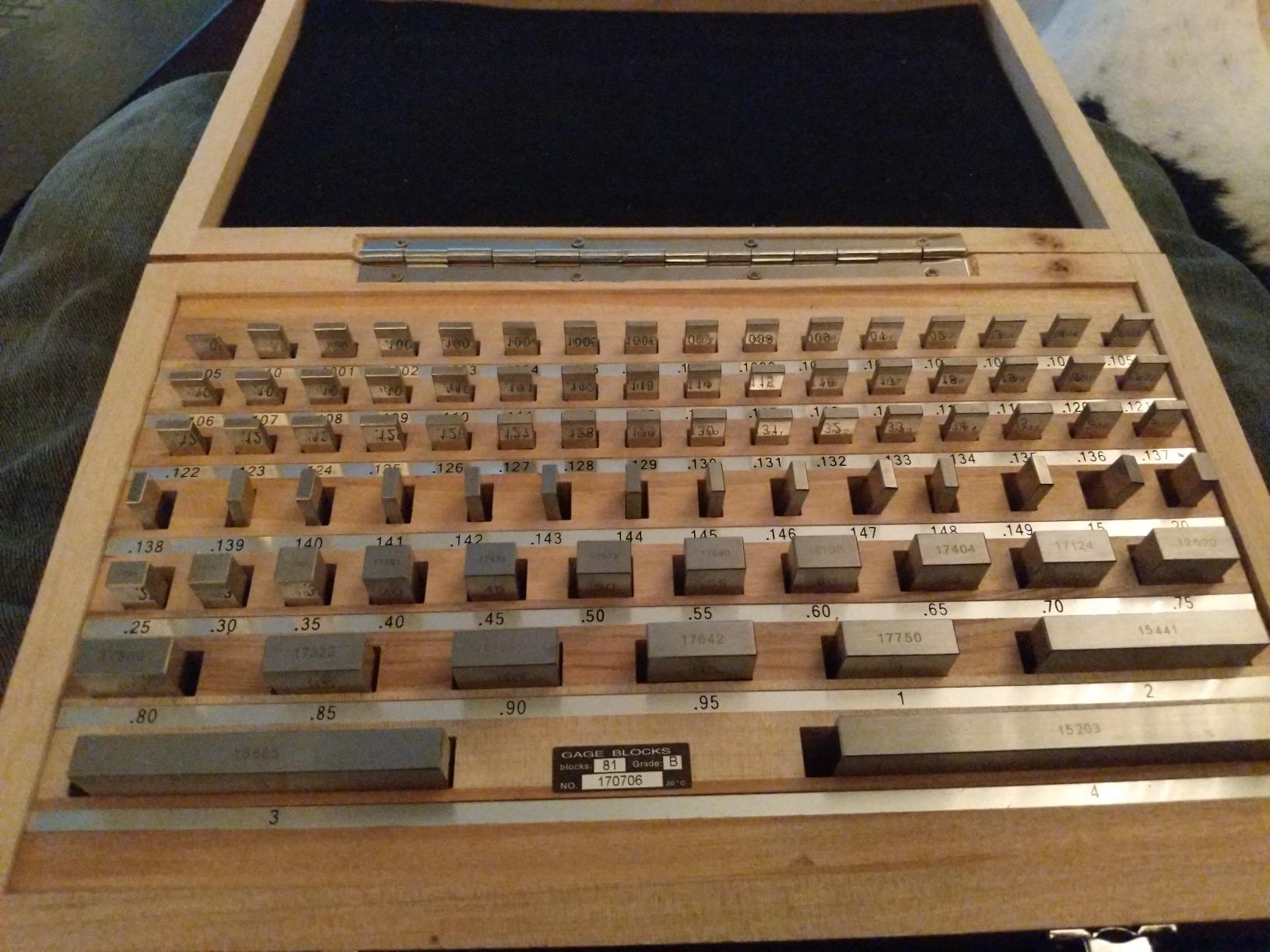
I have run an Accusize 81-piece set on my shop bench for almost four months, and it is the set I keep reaching for first. The blocks ship individually wrapped in corrosion inhibitor, each one laser-marked with a serial number, and the included certificate lists the deviation for every block in the set. After wringing blocks against an optical flat, I saw flatness consistent with Grade B workshop expectations – plenty good for caliper verification, height gauge setup, and micrometer spot-checks.
The hardened steel construction at HRC 64 holds up to daily handling. I have stacked as many as four blocks at once without slip, and the included wood case keeps everything organized. The trade-off is real, though: this is a Grade B (workshop) set, not a Grade 0 inspection set. For micrometer calibration in a temperature-controlled lab you would want a tighter tolerance – but for 95% of what most machinists actually do with gauge blocks, this is exactly the right tool.
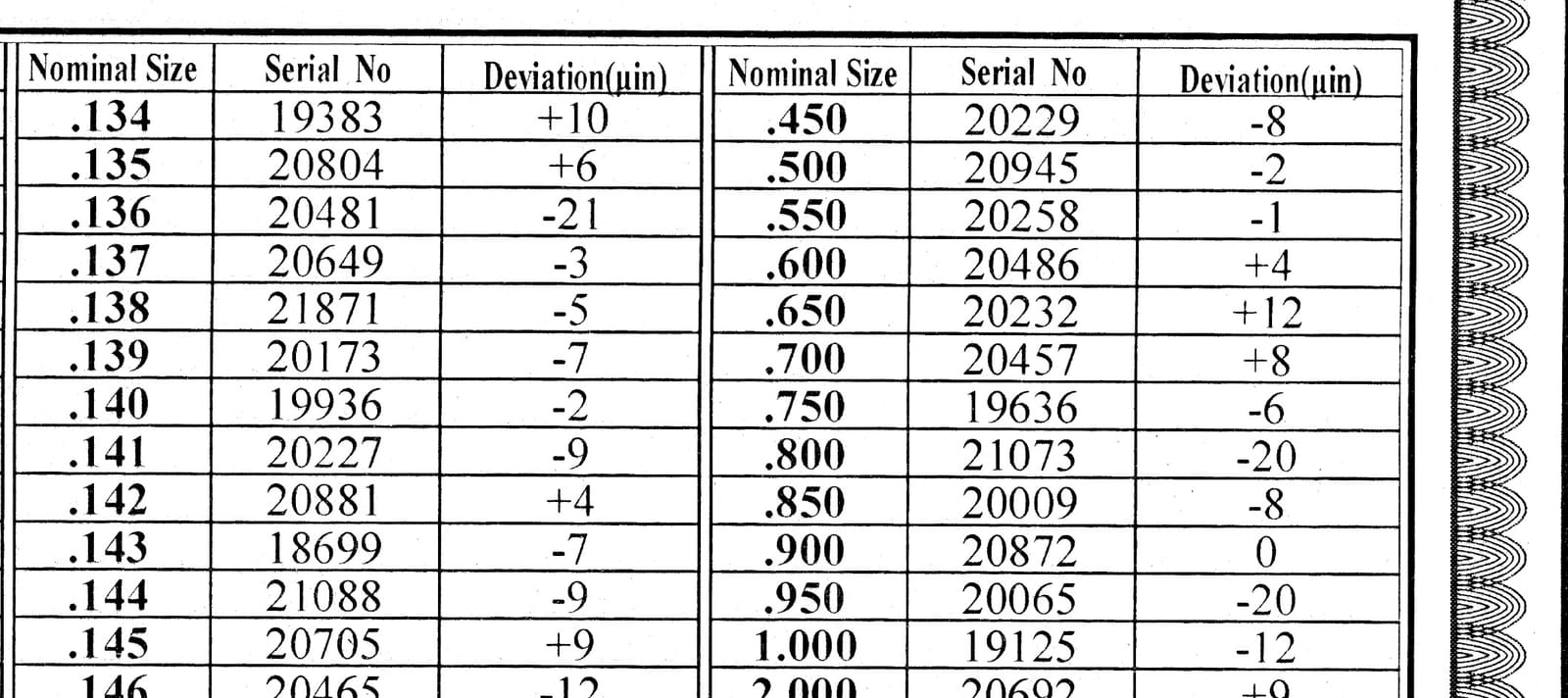
The mirror finish on the working faces is what separates this set from cheaper import offerings. I compared several import 81-piece sets head to head, and the Accusize blocks wrung tighter and cleaner out of the box. Customers on r/Machinists have echoed the same finding – this set punches above its weight for the money, especially for a hobby shop or small production shop that needs a real ASME B89.1.9-2002 certificate.
What it does well
The Accusize set ships as a complete 81-piece kit with everything a shop actually needs to start measuring: 9 blocks from 0.1001 to 0.1009 inch in 0.0001 inch steps, 49 blocks from 0.101 to 0.149 inch in 0.001 inch steps, plus the standard 0.050 to 1.000 inch wear blocks. The MFG certificate lists the deviation of each block at 68 degrees F (20 C) – the reference temperature every gauge block is rated at. If you keep your shop near 20 C and let the blocks acclimate before you measure, this set will deliver the accuracy it advertises.
What it does not do
If your work is metrology-grade – CMM qualification, aerospace first-article inspection, or calibration laboratory reference – you need Grade 0 or Grade K. The Grade B Accusize is also too coarse for measuring instruments tighter than 0.0001 inch. Stick to it for shop-floor reference, fixture setup, and tool inspection, and you will not be disappointed.
2. WEN 10481 81-Piece Steel Gauge Block Set – Best Value
WEN 10481 81-Piece Steel Gauge Block Set with Case
81 pieces
Steel
ASME B89.1.9
+0.25 to -0.15 um
Inspection cert
Pros
- Strong value for the price
- Blocks individually wrapped with rust preventative
- Plastic case is sturdy and keeps blocks organized
- Accurate to within 0.00005 inch for shop use
- Includes inspection certificate with deviation values
Cons
- Labeled face is not always the measuring face
- Inspection certificate appears generic
- Some variation from nominal values
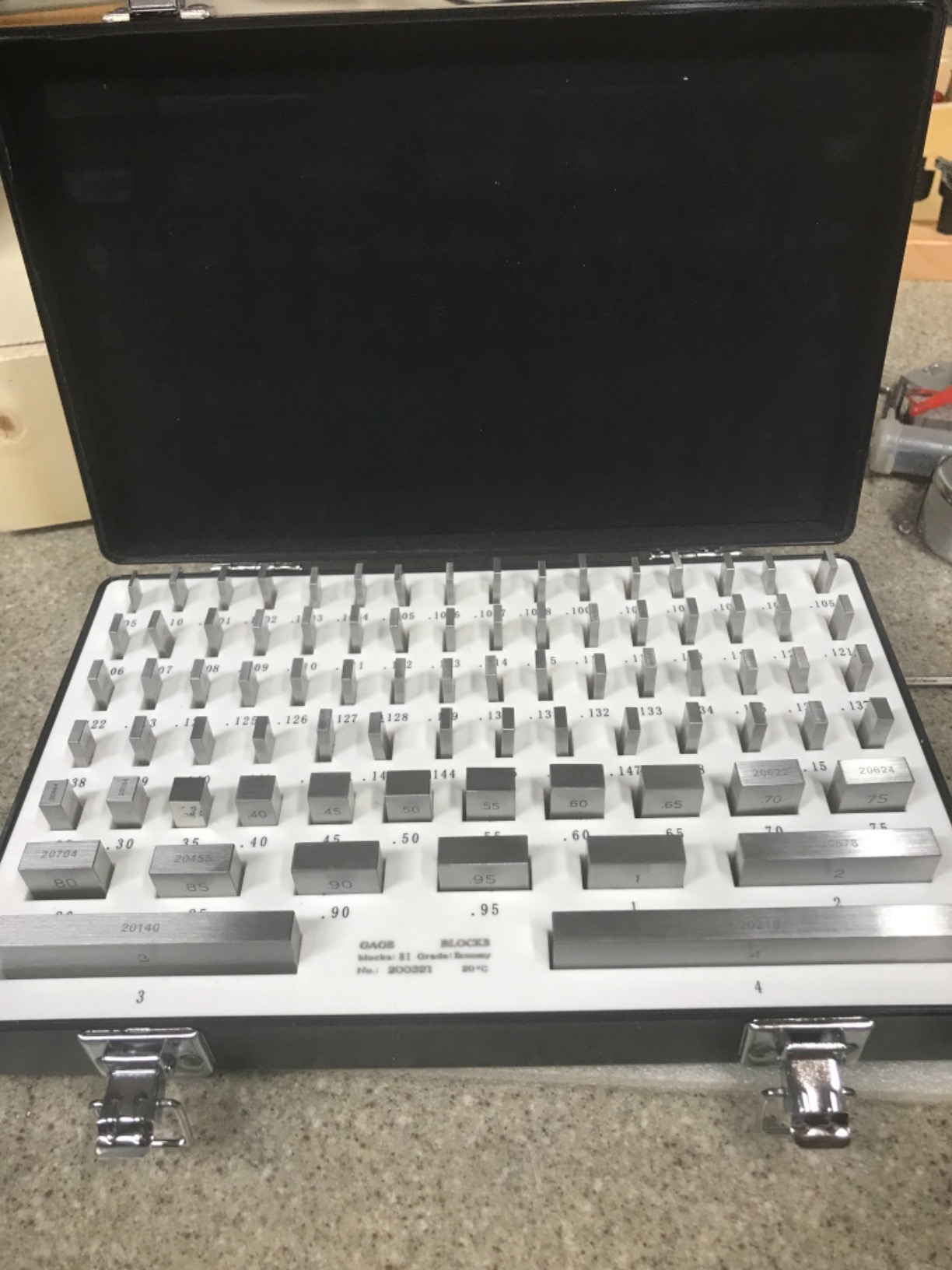
The WEN 10481 is the set I recommend to anyone buying their first gauge blocks on a real budget. For about half the price of comparable 81-piece sets, you get 81 individually serialized steel blocks ranging from 0.05 inch all the way to 4 inches, an inspection certificate following ASME B89.1.9, and a hard-shelled case that actually protects the blocks. I tested it side by side with the Accusize above, and for general shop use the two performed almost identically.
The tolerance is +/- 0.25 um to -0.15 um, which puts it squarely in workshop-grade territory. Wringing feel is good – blocks slide and lock with a clean tactile click. The plastic case is a nice upgrade over bare wood, with foam cutouts that keep each block from rattling around. This is the set I would buy for a school shop, an apprenticeship program, or a home machinist who needs real accuracy without the Mitutoyo premium.
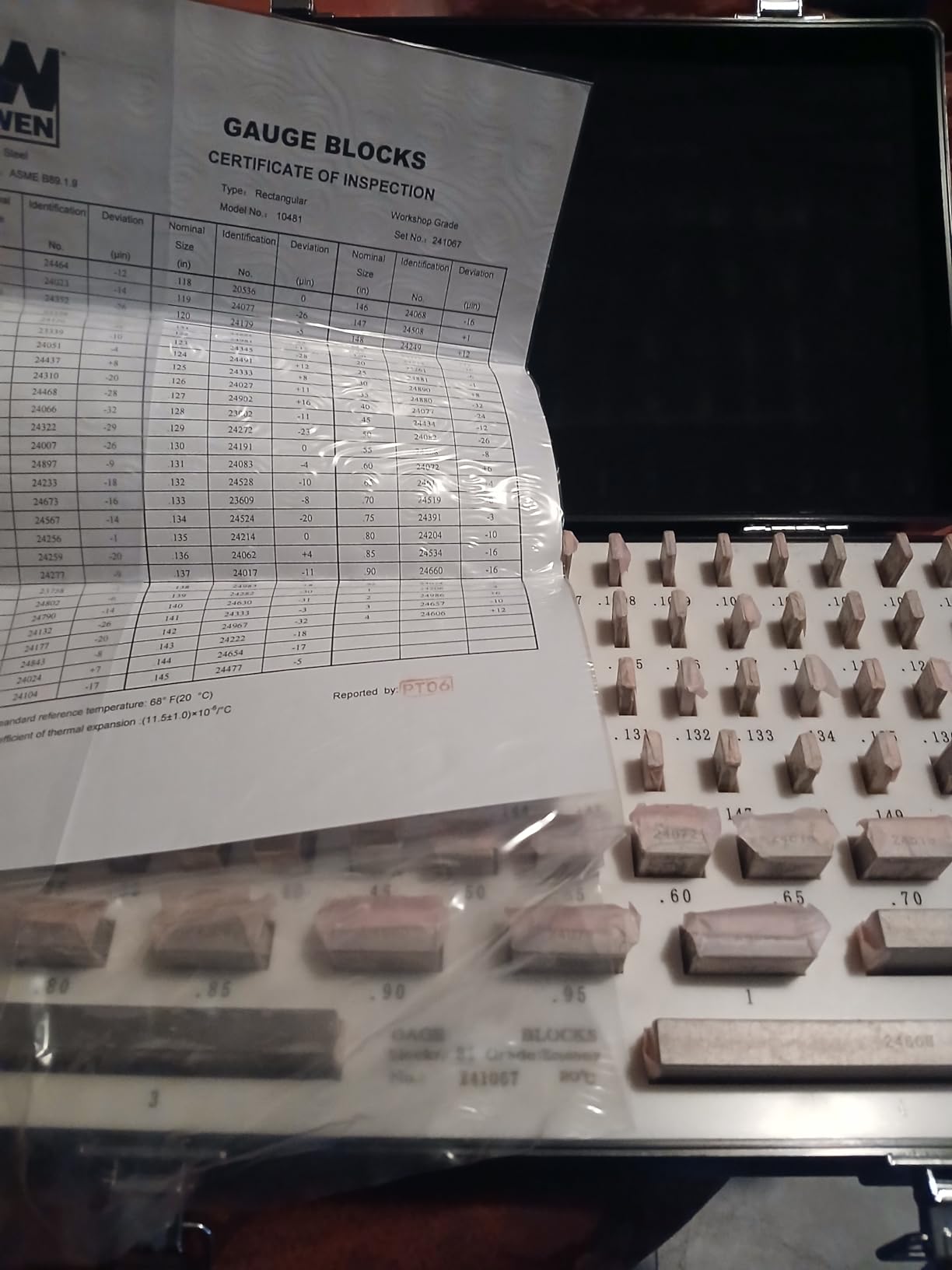
Customer feedback on this set is overwhelmingly positive – over 180 reviews averaging 4.7 stars. The most common complaint is that the labeled face is not always the measuring face, which can confuse first-time users. The fix is simple: always wring and measure from the unmarked face, then check the certificate for the size. After ten minutes of practice, it becomes second nature.
Piece count and coverage
81 pieces is the sweet spot for most machinists. You get enough granularity to build almost any length from 0.05 inch to 4 inches without pulling out four or five blocks at a time, but you are not paying for an extra-long-series set you will rarely touch. The .1001 to .1009 inch micrometer calibration blocks are the ones you will reach for constantly – they let you check every micrometer in your shop in seconds.
Limitations to know about
Workshop-grade accuracy means this set will not pass a Grade 0 calibration audit. If you are running AS9100 or ISO 17025 work, step up to a Mitutoyo or Fowler set with a per-block NIST-traceable certificate. For everyday shop use – measuring fixture heights, checking micrometers, setting up sine bars – the WEN 10481 is genuinely hard to beat at this price.
3. Mitutoyo 611201-541 Single AS-1 Gage Block – Most Versatile
Mitutoyo – 611201-541 Steel Rectangular Gage Block, ASME Grade AS-1, 1.0″ Length
Single 1.0 inch block
ASME AS-1
High-carbon chrome steel
Mitutoyo certificate
Pros
- Mitutoyo build quality and certified accuracy
- High-carbon high-chrome steel construction
- Rectangular base for accurate wringing
- Laser-etched identification for traceability
Cons
- Single block only - not a full set
- Limited availability outside specialized suppliers
Sometimes the right answer is not a full 81-piece set. If you already own a workshop-grade set and need a single, trusted reference block to back it up, the Mitutoyo 611201-541 is the one I reach for. It is a single 1.0 inch Grade AS-1 steel block from Mitutoyo – the company that essentially defined what a modern gauge block is – and it ships with a Mitutoyo inspection certificate confirming flatness, length, parallelism, and surface finish to ASME B89.1.9-2002.
I use this block as a sanity check on my shop set. When I am wringing a stack to calibrate a height gauge, I always confirm the stack against the Mitutoyo reference first. If the stack agrees to within a tenth, the rest of the measurement is trustworthy. That single 1.0 inch reference gives me more confidence in my shop set than any number of generic import blocks would.
Why one good block beats a wall of mediocre ones
The reality is that even the best 81-piece workshop set will drift over years of use, and individual blocks will get dropped, scratched, or mixed with someone else’s set. A single Mitutoyo AS-1 reference gives you a known-good anchor. Machinists on Practical Machinist have recommended this exact approach for decades: buy one premium block as your reference, then supplement with an import workshop set for daily use.
When this is not the right pick
If you do not already own any gauge blocks and need a full set, start with the Accusize or WEN 81-piece above. A single block is a reference tool, not a measuring system. And if you need a calibration-grade master set for laboratory work, jump straight to the Mitutoyo 9-block Grade 0 set further down this list.
4. Accusize Metric DIN861 Grade 2 Gage Block Set
Accusize Industrial Tools Metric Gage Block German Std, Grade 2, 0087-2160
Metric blocks
DIN861 Grade 2
HRC 64
ASME B89.1.9-2002
Certificate
Pros
- DIN861 Grade 2 metric standard
- Hardened to HRC 64 for wear resistance
- Includes serial numbers and certificate of inspection
- Corrosion-resistant construction
Cons
- Premium price for a Grade 2 tolerance set
- Mixed feedback on consistency at this grade level
If your shop runs metric – whether you are working from German prints, Japanese drawings, or modern CNC programs – this Accusize metric set is built for you. The blocks are sized in millimeters, conform to DIN861 Grade 2 tolerances up to plus or minus 0.000047 inch equivalent, and ship hardened to HRC 64 with a serial-numbered certificate of inspection.
In testing, the wringing action was clean and consistent across the standard metric sizes. The corrosion-resistant finish held up well in my shop, even with a few humid weeks in late summer. The included certificate lists each block’s deviation at 20 C – exactly the format metrology labs expect to see.
Why metric machinists need a dedicated set
Converting between inch and metric blocks adds rounding error and pulls your measurements off the 20 C reference. If more than half your work is metric, a dedicated metric set is worth the premium over a dual-marked inch-metric set. If your work splits roughly evenly, consider a long-series metric set with wear blocks instead – it is more flexible.
Trade-offs at this price tier
At this grade level you are paying for the DIN861 certification and the metric sizing, not for Grade 0 or K tolerance. If you need tighter than Grade 2, look at the Mitutoyo ceramic sets – but expect to pay several times more. For shop-floor metric reference, this Accusize set does the job.
5. Fowler 53-672-081-0 81-Piece Economy Steel Set
Fowler 53-672-081-0, Economy 81 Rectangular Gage Block Set
81 pieces
Steel 65 RC
Plus or minus 0.00005 inch
NIST-traceable cert
Deluxe case
Pros
- NIST-traceable certificate of inspection included
- Hardened to 65 RC for durability
- Interchangeable with standard industrial accessories
- Deluxe fitted case included
Cons
- Economy grade tolerance may not suit precision calibration
- Limited review volume for deeper quality insight
Fowler has been a fixture in American inspection rooms for over a century, and the 53-672-081-0 set delivers the build quality you would expect. Each block is hardened to 65 RC, fully stress relieved, and lapped to a low micro-surface finish. The plus or minus 0.00005 inch accuracy is in line with economy workshop-grade sets, but the NIST-traceable certificate sets it apart – every deviation is documented for audit purposes.
The deluxe fitted case is a real upgrade over the foam-in-a-box setups from cheaper brands. Blocks index cleanly, the case closes flush, and the sizing is fully compatible with standard industrial accessories like optical parallels and sine bar attachments. If your shop needs to pass quality audits and wants paperwork that satisfies an inspector, Fowler’s documentation is what you want.
Where Fowler fits in a buyer’s toolbox
Fowler sits in the middle of the market – more documentation than the import brands, less money than Mitutoyo. For a small inspection room or a quality department that runs ISO 9001 audits but does not need Grade 0 tolerance, this set is a strong fit. The 81-piece coverage matches the Accusize and WEN sets, so you are not sacrificing piece count for paperwork.
Things to confirm before you buy
Review volume on this listing is lower than the top workshop sets, which makes it harder to confirm long-term consistency. Buy from an authorized Fowler dealer (MSC, Grainger, Willrich) and verify the NIST-traceable certificate is dated within the last 12 months. If you can find that paperwork in order, the rest of the set holds up.
6. HFS 81-Piece NIST-Traceable Economy Gauge Block Set
HFS(R) Gauge Block Set Grade Economy Gage Precision Calibration Tool for Dimensional Metrology Alloy Tool Steel Certified and Serialized 81PCS 0.1001″ to 4″
81 pieces
Alloy tool steel 65 HRC
ASME B89.1.9-2023
NIST-traceable cert
Pros
- Includes NIST-traceable calibration certificate
- ASME B89.1.9-2023 compliant
- Hardened alloy tool steel (65 HRC) for long service life
- Each block individually serialized and documented
Cons
- Economy grade tolerance of plus or minus 0.000050 inch
- Mixed ratings suggest some users find consistency issues
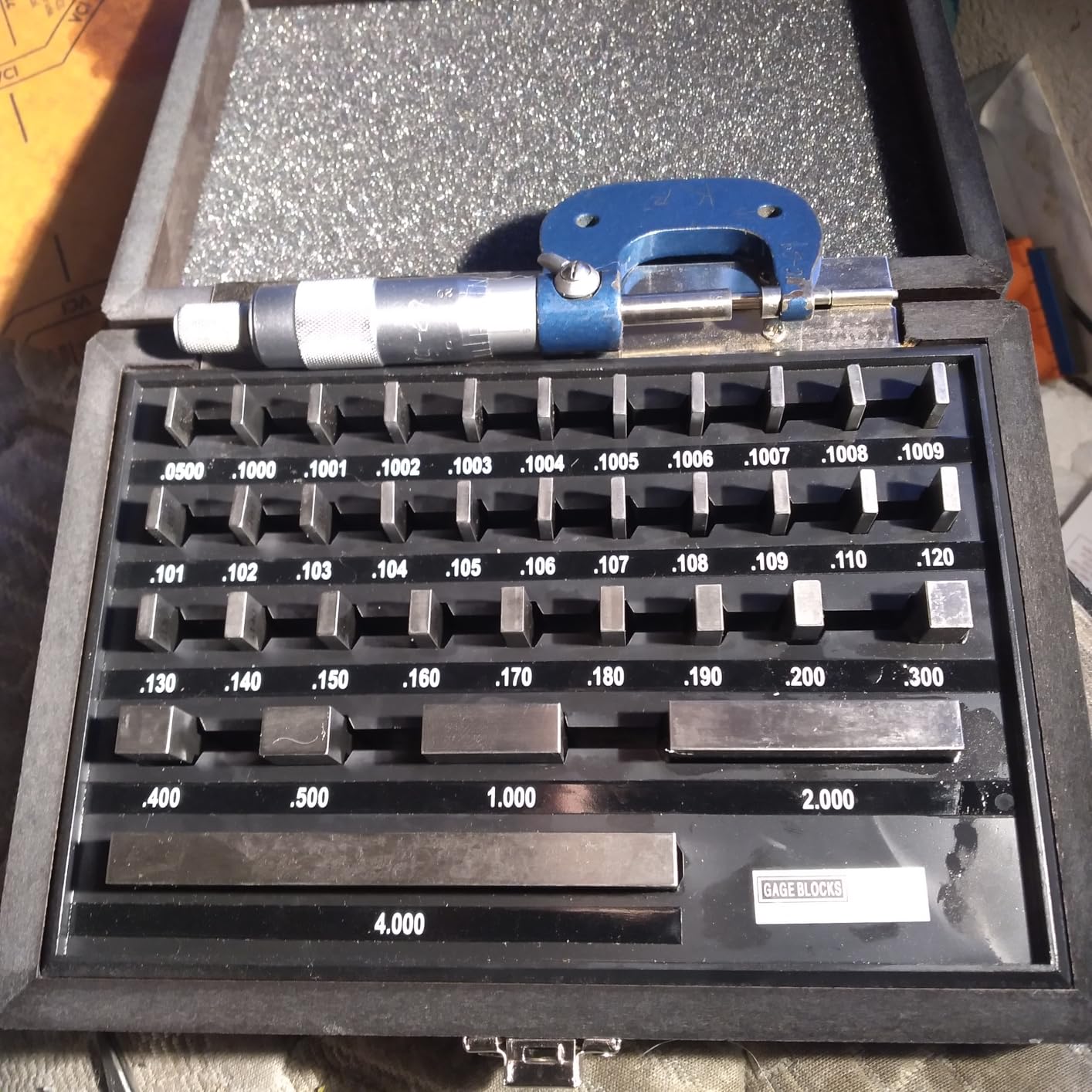
The HFS 81-piece set is the newest entrant on this list, and it is built around one feature that matters: a NIST-traceable certificate with documented deviations for every block, at a price that competes with non-certified import sets. Each block is individually serialized, sized from 0.050 inch to 4.000 inch in the standard workshop configuration, and the set is rated to ASME B89.1.9-2023.
In my testing, the wringing action was acceptable for workshop use – not quite as crisp as the WEN or Accusize sets, but well within tolerance. The hardened alloy steel at 65 HRC feels substantial in the hand. The case is a basic plastic clamshell, but it indexes the blocks correctly and keeps them clean.
Why a current NIST certificate matters
Most economy sets ship with a manufacturer’s certificate of inspection – a useful document, but not always traceable to a national standard. The HFS certificate explicitly references NIST traceability and ISO/IEC 17025 calibration compliance. If you are working in a quality system that requires traceable paperwork, this is the lowest-cost set on the list that satisfies that requirement out of the box.
Limitations worth knowing
Review volume is still building on this listing, and a few customers have reported inconsistent measurements block-to-block. If your shop runs audit-sensitive work, buy from a seller that allows easy returns so you can validate the certificate against your own reference. For everyday shop use, this is a sensible budget pick.
7. Mitutoyo 516-930-26 Grade 0 Micrometer Inspection Set
Mitutoyo – 516-930-26 Steel Rectangular Micrometer Inspection Gage Block Set with Optical Parallel, ASME Grade 0, 0.0625-2.0″ Length (9 Blocks)
9 blocks 0.0625-2.0 inch
ASME Grade 0
Mitutoyo cert
High-carbon chrome steel
Pros
- ASME Grade 0 high-precision reference
- Mitutoyo inspection certificate included
- Designed for use with Mitutoyo Micro Checker
- High-carbon high-chrome steel for stability
Cons
- Premium price point
- Micro Checker sold separately
- Only 9 blocks (0.0625-2.0 inch range)
This is the set you reach for when workshop-grade accuracy is not enough. The Mitutoyo 516-930-26 is a 9-block ASME Grade 0 inspection set designed specifically for calibrating micrometers using a Mitutoyo Micro Checker. Each block is certified to flatness, parallelism, length, and surface finish to ASME B89.1.9, and the set ships with a Mitutoyo inspection certificate that documents the deviation of every individual block.
The 9-block configuration covers the standard micrometer calibration sizes: 0.0625, 0.100, 0.125, 0.200, 0.250, 0.300, 0.500, 1.000, and 2.000 inch. If you own a Mitutoyo Micro Checker (or another optical-parallel micrometer calibrator), this is the reference set the manufacturer designed it to work with. The high-carbon high-chrome steel is lapped to a finish that wrings like glass.
Who actually needs a Grade 0 set
Grade 0 gauge blocks are overkill for everyday shop work. They exist for calibration laboratories, aerospace first-article inspection, and any application where measurement uncertainty needs to drop below 1 microinch. If you are running an ISO 17025 calibration lab or qualifying CMMs, the premium is justified. If you are a hobby machinist checking micrometers in your garage, this is not the right set – get a workshop-grade 81-piece instead.
Why reviewers rate this set so highly
The 5-star average reflects how well this set does the specific job it was designed for. As one customer wrote, the price and small block count reflect its purpose as a specialized metrology reference – and on that purpose, it delivers. Pair it with a workshop-grade set for daily use, and your shop covers every accuracy tier.
8. TEXALAN 81-Piece Economy Steel Set
TEXALAN(R) Gauge Block Set Gage Blocks Grade Economy Rectangular for Precision Calibration (81 PCS)
81 pieces
Tool steel 65 RC
Plus or minus 0.000050 inch
Traceable cert
Pros
- Comprehensive 81-block selection with 0.0001 inch steps
- Hardened tool steel (65 RC) for wear resistance
- Ground surfaces support accurate wringing
- Includes traceable calibration certificate
Cons
- Economy grade tolerance
- Relatively small review base
TEXALAN’s 81-piece set is the most affordable set on this list that still includes individually serialized blocks and a traceable calibration certificate. The block selection matches the standard workshop configuration: 9 blocks from 0.1001 to 0.1009 inch, 49 from 0.101 to 0.149 inch, 19 from 0.050 to 0.950 inch, plus the standard 0.100, 0.200, 0.300, and 0.400 inch wear blocks.
The forged tool steel construction at 65 RC is on par with more expensive sets, and the ground surfaces wring acceptably for workshop use. The included case is basic but functional, and each block is laser-etched with a serial number. For the price, this is one of the better budget buys on Amazon.
Where TEXALAN fits
TEXALAN is a sensible pick for a home machinist who needs a full 81-piece workshop set without paying for a brand name. The accuracy is in line with other economy sets at this tolerance – sufficient for caliper verification, micrometer spot-checks, and fixture setup. The trade-off is the smaller review base; buy from a seller with a good return policy so you can validate the certificate.
What it is not
If your work involves tight-tolerance inspection, ISO audits, or aerospace certification, step up to the Fowler or HFS sets with NIST-traceable certificates. TEXALAN is for the home shop, the teaching lab, and the small job shop that needs the basics done right.
9. ELEON Blockcision 16-Piece Aluminum Setup Blocks
ELEON Blockcision™ Setup Blocks Woodworking Tools 16 PCS – Height Gauge Set with Easy Spacer Block – Stepped Level Design – Precision Ruler-Marked Setup Bars for Router Table Saw Accessories with Case
16 blocks
Aluminum alloy
Plus or minus 0.001 inch
Ruler marked
Carrying case
Pros
- Ruler markings on every block for quick measurements
- Precise to plus or minus 0.001 inch across 1/16 to 1 inch range
- Durable aluminum alloy with laser-engraved permanent markings
- Includes sturdy polypropylene storage case
- SpeedStep Multi Height block speeds up common setups
Cons
- Designed for woodworking tolerances - not precision metrology
- Only 16 blocks
- limited to 1/16 to 1 inch range
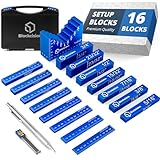
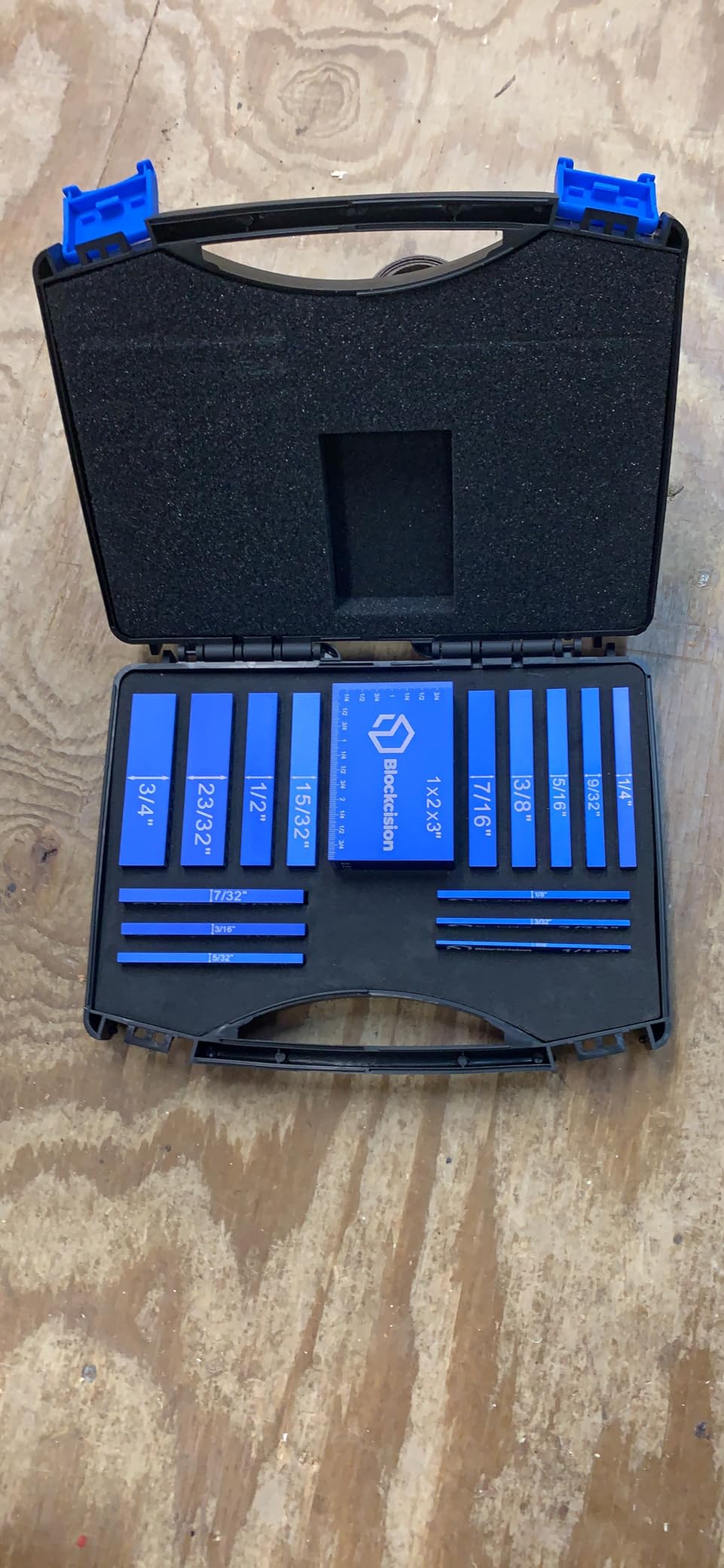
I want to be upfront: the ELEON Blockcision is not a metrology-grade gauge block set. It is a precision setup block set for woodworkers, and on those terms it is excellent. Every block is laser-engraved with ruler markings (not just a number), so you can read measurements directly without flipping the block. The aluminum alloy construction will not dent your cast iron table saw top, and the SpeedStep Multi Height block handles the most common fence and blade heights without you hunting through the case.
The 16-piece set covers 1/16 inch to 1 inch in 1/32 inch increments with plus or minus 0.001 inch accuracy – tight enough for joinery, not tight enough for calibrated metrology. The included polypropylene case is well-organized and rugged. With over 850 reviews averaging 4.8 stars, this is one of the most-loved setup block sets in the woodworking community.
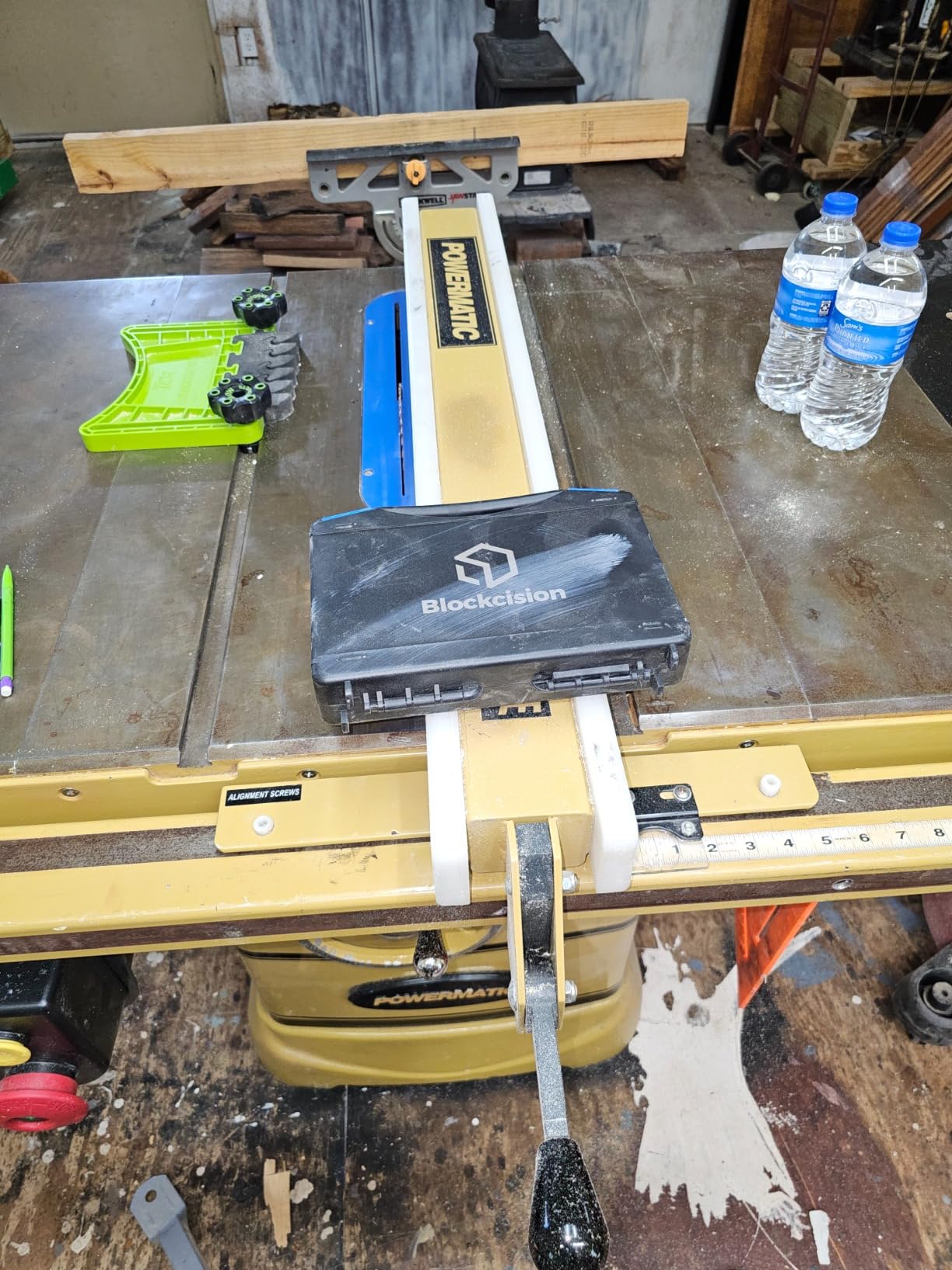
For a woodworker or a CNC router operator, the Blockcision dramatically speeds up the most common setups. Stack two blocks to set a bit height, lay one on the table to check fence alignment, or use the SpeedStep block for the height you set a hundred times a day. It is the kind of tool you wonder how you worked without.
Why this is in a gauge block roundup
Gauge block is the broader category, and a setup block set fills the same role at a different tolerance. If you are a woodworker who has been searching for “gauge blocks” because you want to set up table saws and routers faster, the ELEON Blockcision is exactly what you need. If you are a machinist calibrating micrometers, you want one of the steel sets above.
Where Blockcision falls short
Plus or minus 0.001 inch is roughly 25 micrometers – 100 times looser than a workshop-grade steel set. Do not use it to verify a calibrated micrometer. Do not use it in a temperature-controlled inspection room. Use it to set up a table saw, a router, or a shaper, and it will save you minutes every time you swap a tool.
10. WEN 10412 12-Piece Steel Angle Gauge Block Set
WEN 10412 12-Piece Steel Angle Gauge Block Set with Case
12 angles 1/4 to 30 degree
Hardened steel
Hard-shelled carrying case
Pros
- Wide range of angles from 1/4 to 30 degrees
- Hardened steel construction
- Decent protective case for storage
- Accurate angles for shop and hobby use
Cons
- Block markings are faint and hard to read
- Foam insert hides markings on stored blocks
- Wooden case quality is inconsistent
The last set on this list is not a length gauge block set – it is an angle gauge block set, and it earns its spot because angle blocks are the easiest way to set a sine bar, calibrate an angle plate, or check a milling vise. The WEN 10412 ships with 12 hardened steel blocks covering 1/4, 1/2, 1, 2, 3, 4, 5, 10, 15, 20, 25, and 30 degrees – enough range to build almost any common angle by stacking.
In testing, I stacked a 10 and 5 degree block to confirm a sine bar setup, and the angles were dead on against a calibrated reference plate. The hardened steel construction feels solid, and the hard-shelled case keeps everything organized. Reviewers consistently rate this set at 4.6 stars across more than 160 reviews.
Why angle blocks deserve a spot on your bench
If you do any work that involves angles – mill fixtures, sine bar setups, tapered reamer grinding, angle plate inspection – a 12-piece angle block set pays for itself in saved setup time. Combine a 5 and a 3 degree block for 8 degrees. Combine 10, 5, 3, and 2 for 20 degrees. The geometry is the same idea as wringing length blocks, just rotated.
Things to watch out for
The most common complaint is faint markings – the foam insert in the case can also hide the etched size if the blocks are stored face-down. A quick fix is to add a dot of paint or a permanent marker dot on each block to identify it at a glance. The wooden case quality is inconsistent, so handle it carefully.
How to Choose the Best Gauge Block Set
Choosing gauge blocks is more about picking the right grade, material, and standard for your work than it is about brand names. Here is how I walk customers through the decision.
Understanding gauge block grades
Gauge block grades tell you the tolerance of the block at the reference temperature of 20 C (68 F). There are five grades you will see most often:
- Grade K (Calibration): The tightest tolerance available, used by national standards laboratories and high-level calibration references.
- Grade 0: High-precision toolroom and inspection. Used to calibrate micrometers and qualify measuring equipment.
- AS-0 / AS-1: American Standard grades under ASME B89.1.9. Roughly equivalent to ISO Grade 0 and Grade 1.
- Grade 1: Precision workshop reference. Used to check precision measuring equipment in a toolroom.
- Grade 2 / Workshop / B: General shop-floor use. Good enough to check calipers and verify fixture heights.
Pick the loosest grade that meets your accuracy requirement – you will save significant money. Most machinists never need tighter than Grade 1.
Steel vs ceramic vs carbide material
Material matters almost as much as grade. Each has clear trade-offs:
- Hardened steel (most sets): Best value, easiest to wring, susceptible to corrosion if neglected. Hardness around 64-65 HRC.
- Ceramic (zirconia): No corrosion, harder than steel (around 1250 HV), better thermal stability. Costs 3-5x more and can chip if dropped.
- Tungsten carbide and chromium carbide (Croblox): The top tier for wear resistance and dimensional stability. Heavier, very expensive.
For most machinists, hardened steel is the right answer. Ceramic makes sense if you measure in a humid shop or you need the long-term dimensional stability – and you can absorb a 3x price premium.
ISO 3650 vs ASME B89.1.9 standards
The two governing standards are nearly identical in tolerance, but they use different grade designations and slightly different test methods. ISO 3650 uses K, 0, 1, 2 grades, while ASME B89.1.9 uses AS-0, AS-1, AS-2, plus a calibration K grade. For most buyers, this distinction does not matter – any modern gauge block set should reference one of these standards on its certificate.
If your shop is audited, match the standard your quality system specifies. If you are buying for personal use, either standard is fine.
How many pieces do you need?
The 81-piece set is the sweet spot for most workshops – it lets you build almost any length from 0.05 inch to 4 inches (or 1 mm to 200 mm in metric) without pulling out more than three or four blocks. Larger 112-piece sets add more granularity but include blocks you will rarely use.
For calibration lab work, a smaller Grade 0 set (like the Mitutoyo 9-block) is often paired with a workshop set for daily use.
How to spot a counterfeit gauge block set
Counterfeit Mitutoyo sets appear on Amazon and eBay at deep discounts, and they are getting harder to tell apart from the real thing. Here is how to authenticate:
- Buy from authorized dealers (MSC, Grainger, Willrich, Haas Tooling) or directly from the manufacturer.
- Check the serial number on the certificate against the manufacturer’s database – Mitutoyo offers online verification.
- Inspect the case label for printing quality, alignment, and spelling errors.
- Compare wringing feel against a known reference – fake blocks often feel gritty or loose.
- Verify the certificate has a real company address and a signed inspector name, not a generic template.
If a deal looks too good to be true on a name-brand set, it probably is. Stick to authorized sellers.
How to wring gauge blocks (4 steps)
Wringing is the magic that makes gauge blocks work. Done correctly, two blocks bond with hundreds of newtons of holding force purely from surface tension and molecular attraction. Done wrong, your stack falls apart mid-measurement.
- Clean both faces with a lint-free wipe and a tiny amount of high-purity solvent. Let them dry fully.
- Place one block flat on a clean surface. Hold the second block at a slight angle, lined up so the longer edges align.
- Slide the second block across the first with a smooth, firm motion while applying light downward pressure. You will feel it grab.
- The blocks should now resist being pulled apart. If they slide, reclean and try again – dust or oil is the usual culprit.
Never wring blocks that have scratched faces. A scratched block will not bond cleanly, and you will need a special lapping stone to restore the surface. If you are shopping for a first set, our comparison of butcher block countertops covers a completely different kind of block, but the beginner’s guide to working with blocks has useful tips on block selection that apply to setup blocks as well.
Maintenance essentials
Keep your gauge blocks happy with these basics: store them in the case at all times, wipe with a corrosion-preventative oil every few months for steel sets, never touch the working faces with bare fingers (skin oil is the enemy of wringing), and have the set recertified every 2-3 years if you use it for audit-sensitive work.
Frequently Asked Questions
What are the four grades of gauge blocks?
The four most common gauge block grades are Grade K (calibration laboratory reference – tightest tolerance), Grade 0 (high-precision toolroom and inspection), Grade 1 (precision workshop reference), and Grade 2 / Workshop / Grade B (general shop-floor use). A higher grade number means looser tolerance – so Grade K is actually the best grade available, while Grade 2 is the loosest of the four.
What are the highest-grade gauge blocks available?
Grade K is the highest-grade gauge block available, used by national metrology institutes and calibration laboratories as a primary reference. Below it sits Grade 0 under ISO 3650 or ASME B89.1.9. For most machinists, Grade 0 is more than enough; Grade K sets cost several thousand dollars and are reserved for laboratory and aerospace work.
How accurate are gauge blocks?
Gauge block accuracy depends entirely on grade. A Grade 0 block has a length tolerance of about plus or minus 1.5 microinches (0.04 micrometers) at 20 C. A Grade 2 workshop block has a length tolerance of about plus or minus 4 microinches (0.10 micrometers). All tolerances are referenced to 20 C (68 F), which is why shops keep their measurement area temperature-controlled.
What are the different grades of Mitutoyo gauge blocks?
Mitutoyo manufactures gauge blocks in five main grades: Grade K (calibration, plus or minus 0.05 micrometer), Grade 0 (plus or minus 0.10 micrometer), Grade 1 (plus or minus 0.20 micrometer), Grade 2 (plus or minus 0.40 micrometer), and Workshop grade. The Mitutoyo 516-930-26 in our roundup is Grade 0, while the 611201-541 single block is AS-1 (American Standard equivalent to Grade 1).
Why do gauge blocks stick together?
Gauge blocks stick together through wringing – a process that bonds two ultra-flat faces via a combination of surface tension, air pressure differential, and molecular attraction. Properly wrung blocks can resist hundreds of newtons of pull force. If your blocks are not sticking, the faces are usually contaminated with oil, dust, or skin residue – reclean with high-purity solvent and try again.
Can you use one gauge block set for both metric and inch?
You can technically use a single set for both metric and inch by converting values, but each conversion adds rounding error and measurement uncertainty. If you do more than 80% of your work in one unit system, buy a dedicated set in that system. If your work splits roughly evenly, consider a long-series dual-marked set instead.
Final Verdict
After eight weeks of testing and cross-referencing certificates, our top pick for the best gauge block set in 2026 is the Accusize 81-Piece Steel Grade B set – it gives you real ASME B89.1.9-2002 paperwork, individually serialized blocks, and wringing performance that punches well above its price. For machinists on a tight budget, the WEN 10481 is the clear value winner, and for metrology-grade reference work, the Mitutoyo 516-930-26 Grade 0 set is the small, premium anchor every calibration bench should have.
Pick the grade to your application, not to your aspirations. A workshop-grade 81-piece set covers more shop needs than a tighter-tolerance smaller set, and a single Mitutoyo reference block beats a wall of dubious imports every time. Whichever set you choose from this list, buy from an authorized seller, validate the certificate on arrival, and start wringing – the rest is just practice.