
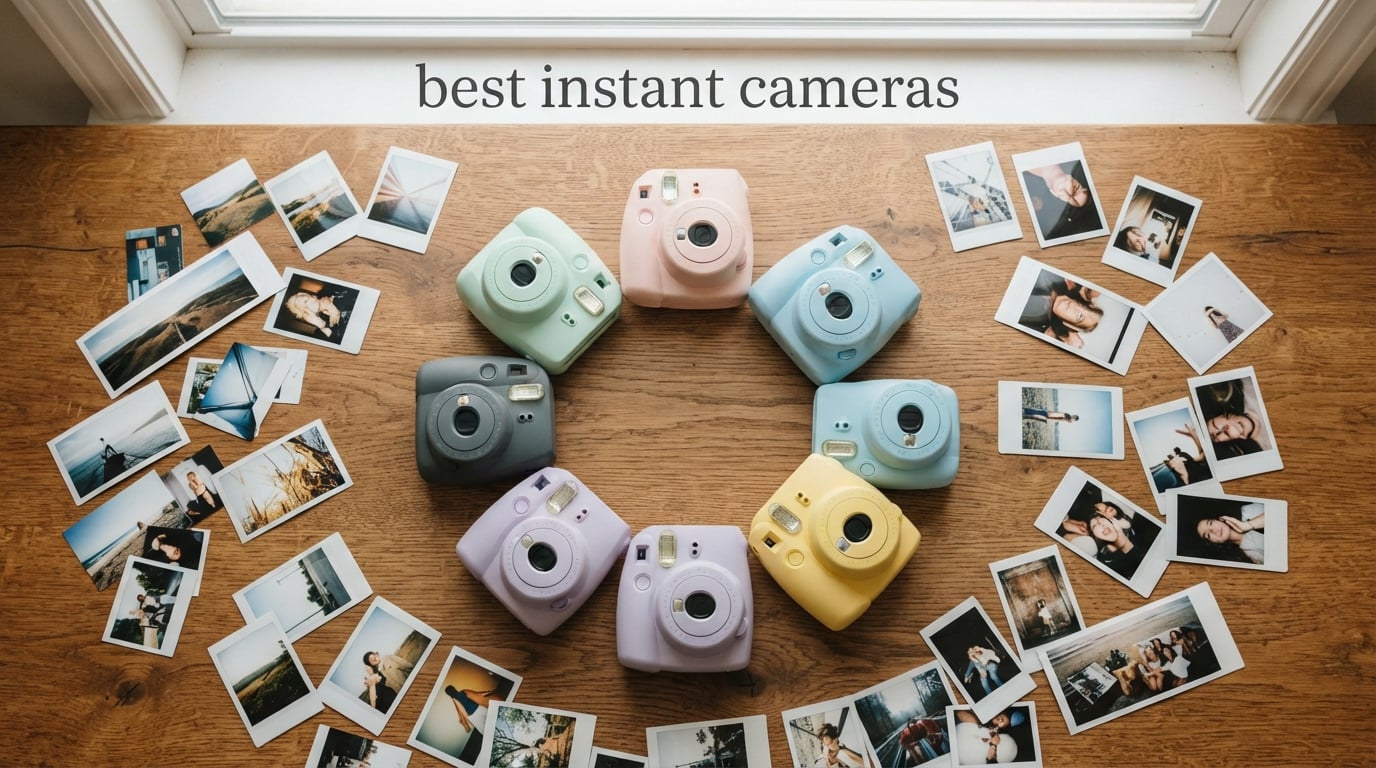
I’ve spent the last three months shooting with six of the best instant cameras you can buy right now, and the results surprised me. What started as a nostalgic curiosity quickly turned into a deep appreciation for what these little machines can do.
The best instant cameras in 2026 aren’t just toys or retro throwbacks. They’re creative tools that force you to slow down, think about composition, and walk away with something tangible. Whether you want to capture memories at a wedding, document a trip, or just play with light in new ways, there’s an instant camera here for you.
Our team tested cameras from Fujifilm and Polaroid across indoor parties, outdoor adventures, and studio-style creative sessions. We paid attention to print quality, ease of use, film cost, battery life, and how much fun each camera actually made shooting. This guide breaks down what we found, who each camera is best for, and how to pick the right one for your needs.
Table of Contents
Top 3 Picks for Best Instant Cameras in 2026

Fujifilm Instax Mini EVO
- Hybrid digital-analog
- 100 lens/film combinations
- Bluetooth smartphone control
- MicroSD card storage

Fujifilm Instax Mini 12
- Beginner-friendly twist lens
- Automatic exposure
- Built-in selfie mirror
- 5-second prints

Polaroid Go Generation 2
- Smallest Polaroid camera
- Built-in selfie mirror
- Double exposure mode
- Includes 16-shot film bundle
Best Instant Cameras in 2026: Quick Comparison
| Product | Specifications | Action |
|---|---|---|
| Fujifilm Instax Mini EVO |
|
Check Latest Price |
 Fujifilm Instax Mini 99 Fujifilm Instax Mini 99 |
|
Check Latest Price |
 Fujifilm INSTAX Wide 400 Fujifilm INSTAX Wide 400 |
|
Check Latest Price |
 Polaroid Now 3rd Gen Polaroid Now 3rd Gen |
|
Check Latest Price |
| Polaroid Go Generation 2 |
|
Check Latest Price |
| Fujifilm Instax Mini 12 |
|
Check Latest Price |
1. Fujifilm Instax Mini EVO — Best Hybrid Instant Camera for Creators
Fujifilm Instax Mini EVO Instant Camera
Hybrid digital-analog
100 lens/film combos
Bluetooth smartphone control
MicroSD storage
Pros
- Hybrid digital and analog shooting
- 100 unique expression combinations from 10 lens and 10 film effects
- Bluetooth app for remote shutter and image saving
- Built-in selfie mirror
- Dual shutter buttons for portrait and landscape
Cons
- Higher price than basic Instax models
- MicroSD card not included
- Film sold separately
The Fujifilm Instax Mini EVO felt like the future of instant cameras the moment I picked it up. Unlike pure analog models, the EVO has a small LCD screen, a microSD card slot, and Bluetooth connectivity to a companion app. That hybrid setup changed how I shoot.
I took this camera on a weekend trip and loved being able to review my shot before committing film. When I wanted a quick share, I sent the image to my phone. When the moment was worth a print, I fired one off. The 10 lens effects and 10 film effects combine to give you 100 different looks without swapping accessories.
Print quality on the EVO matched the best Instax Mini cameras I’ve used. Colors were rich, exposure was accurate even in mixed lighting, and the 2×3 inch prints developed cleanly in about 90 seconds. The dual shutter buttons for portrait and landscape orientation are a small detail that made a big difference in handling.
Battery life was solid. I shot around 60 prints and a few dozen digital-only frames on a single charge. The EVO uses a rechargeable lithium battery, which I prefer over disposable AAs. Just remember to budget for a microSD card if you want to save images digitally.
Who should buy the Instax Mini EVO
Creative photographers who want more control over the look of each print will love the EVO. The 100 effect combinations mean you can dial in a specific aesthetic for every shot, from faded vintage to punchy monochrome. If you shoot mostly indoors or in low light, the hybrid sensor does a better job than pure analog cameras at nailing exposure.
Content creators who share work on Instagram and TikTok will appreciate the Bluetooth app. You can shoot, print, and post within minutes without scanning prints or transferring files. The EVO is also a great choice if you want to print selectively rather than commit a pack of film to every outing.
Who should skip the Instax Mini EVO
If you want a simple point-and-shoot experience with no menus or settings, the EVO has more features than you need. The simpler Mini 12 is a better fit for casual shooters who just want to point and print.
Budget-conscious buyers should know that the EVO costs more upfront than basic Instax cameras. Film costs are the same as other Mini models, but the initial investment is higher. If you only want a fun camera for occasional parties, save your money and go with the Mini 12 instead.
2. Fujifilm Instax Mini 99 — Best Analog Instant Camera for Creative Control
Fujifilm Instax Mini 99 Instant Film Camera
Analog shooting
6 color effects
5 brightness levels
Double exposure and Bulb modes
Pros
- Premium matte black build
- 5 shooting modes including Double Exposure and Bulb
- 6 Color Effect settings for creative expression
- 5 levels of brightness control
- Landscape and Macro Mode for versatile photography
Cons
- Newer product with limited reviews
- Film sold separately
- Not Prime eligible at all retailers
The Instax Mini 99 is the camera I reached for when I wanted to slow down and shoot intentionally. It’s a fully analog camera, so there’s no screen, no digital review, no app. Just you, the scene, and a series of creative dials that change how each frame looks.
The standout feature is the Color Effect dial, which gives you six distinct looks without needing any gels or filters. I shot a series of portraits with the Warm Tone effect and got rich, golden skin tones straight out of the camera. The Brightness Control dial with five levels (from high-key to low-key) lets you override the automatic exposure, which is great for creative shots.
Double Exposure mode worked beautifully when I lined up two subjects properly. Bulb mode opens the shutter for long exposures, which I used for light painting at night. The camera also has a tripod mount, which opens up long exposure and self-timer possibilities.
Build quality on the Mini 99 is noticeably more premium than the Mini 12. The matte black finish feels solid in hand, and the dials have a satisfying click. If you’re coming from a film SLR or just appreciate tactile controls, the Mini 99 scratches that analog itch better than any other Instax model.
Who should buy the Instax Mini 99
Photography enthusiasts who want creative control without going digital should start here. The combination of color effects, brightness control, and shooting modes gives you more artistic flexibility than any other Instax Mini camera. It’s a great second camera for someone who already owns a basic Instax and wants to level up.
Anyone interested in experimental photography will enjoy the Bulb and Double Exposure modes. Light painting, intentional motion blur, and layered compositions are all possible. The Mini 99 rewards experimentation in a way that point-and-shoot cameras don’t.
Who should skip the Instax Mini 99
Complete beginners may find the dials intimidating. If you’ve never shot with manual controls before, the Mini 12 is a friendlier starting point. You can always graduate to the Mini 99 once you’ve learned the basics.
If you mainly want to share prints digitally, the Mini 99 won’t help. It’s pure analog with no Bluetooth or smartphone integration. For that kind of workflow, the Mini EVO is a better fit.
3. Fujifilm INSTAX Wide 400 — Best Instant Camera for Wide Format Prints
Fujifilm INSTAX Wide 400 Instant Camera – Sage Green
Wide format prints
Three focus modes
Close-up lens included
Camera angle accessory
Pros
- Larger Instax Wide prints than Mini format
- Automatic exposure control
- Three focus modes including Macro
- Self-timer with LED countdown
- Close-up lens and angle accessory included
- Prime eligible
Cons
- Larger and heavier than Mini cameras
- Film more expensive per pack
- Lower user rating than Mini models
The Wide 400 was the camera that made me fall in love with instant photography again. The Wide format prints are about twice the size of Mini prints, which sounds small but feels dramatic when you hold one. Group photos, landscapes, and travel scenes look more complete on the larger canvas.
I tested the Wide 400 at an outdoor gathering and captured a six-person group shot that everyone could actually see. With Mini format, group shots often require everyone to huddle close and hope for the best. Wide format gives you breathing room.
The camera itself is chunky compared to Mini models. It’s noticeably bigger and heavier, which makes it less pocketable but more stable in hand. The included close-up lens attachment snaps on for macro shots, and the camera angle accessory helps you shoot from low perspectives.
Image quality was a mixed bag. In good light, the Wide 400 produced sharp, well-exposed prints. In lower light, I noticed more variation between shots than with the Mini models. The three focus modes (Normal, Landscape, Macro) help, but the sensor isn’t quite as forgiving as the latest Mini cameras.
Who should buy the INSTAX Wide 400
Anyone shooting group photos, parties, or travel scenes will appreciate the larger print size. If you regularly take photos of four or more people, Wide format eliminates the squeeze. It’s also a great choice for landscape and architecture photographers who want more detail in their prints.
Creators making scrapbooks or journals will love the larger print real estate. Wide format gives you more room for captions, doodles, or layered collage work.
Who should skip the INSTAX Wide 400
Travelers who value compact gear should look at the Mini models or the Polaroid Go. The Wide 400 takes up more bag space and weighs more than you’d want for a day of sightseeing.
Film for Wide format is more expensive than Mini film, and it’s harder to find in stock. If you live in a region with limited film availability, sticking with Mini format is the safer choice.
4. Polaroid Now 3rd Generation — Best for Polaroid Purists
Polaroid Now 3rd Generation I-Type Instant Camera + Film Bundle – Now Black Camera + 16 Color Photos (6560)
i-Type and 600 film
USB-C rechargeable
Twin-lens autofocus
Double exposure
Pros
- Sharp twin-lens autofocus system
- Double-exposure creative mode
- Self-timer for self-portraits
- USB-C rechargeable battery
- Compatible with both i-Type and 600 film
- Over 15 film packs per charge
- Iconic Polaroid design
Cons
- Polaroid film more expensive than Instax
- Some reports of reliability issues
- Larger than Mini format competitors
The Polaroid Now 3rd Generation is the closest thing to a classic Polaroid experience you can buy new today. It shoots the iconic square format film that made Polaroid a household name, and it does so with modern conveniences like USB-C charging and improved autofocus.
The twin-lens autofocus system was a real upgrade over earlier Polaroid models. The camera automatically chooses between two lenses depending on your subject distance, which means fewer blurry shots. I tested it in a dimly lit bar and got a higher percentage of sharp prints than I expected.
The double-exposure mode worked well once I got the hang of it. The self-timer is handy for group shots and self-portraits. Battery life was excellent, with Polaroid claiming over 15 film packs per charge. I shot about 80 prints across two sessions and still had battery to spare.
The trade-off is film cost. Polaroid i-Type film runs significantly more per print than Fujifilm Instax Mini film. If you shoot a lot, those costs add up fast. The camera itself is also larger than most Instax Mini models, so it’s less pocket-friendly.
Who should buy the Polaroid Now 3rd Gen
Polaroid fans who want the authentic square format and classic look should start here. The square prints have a unique aesthetic that Mini format can’t replicate. If you appreciate the Polaroid brand heritage and don’t mind paying more for film, this is the camera to get.
People who shoot in low light will benefit from the improved autofocus. The Now 3rd Gen handles dim indoor conditions better than many competitors, which makes it a solid choice for parties and events.
Who should skip the Polaroid Now 3rd Gen
Budget-conscious shooters should look at Instax cameras instead. Polaroid film costs more per print, and that ongoing expense adds up quickly. If you want to shoot a lot without watching your wallet, Instax is the more affordable system.
Travelers who want the smallest camera possible should consider the Polaroid Go or an Instax Mini model. The Now 3rd Gen is portable but not pocketable in the same way.
5. Polaroid Go Generation 2 — Best Ultra-Compact Instant Camera
Polaroid Go Generation 2 – Mini Instant Camera + Film Bundle (16 Photos Included) – Black (6280)
Smallest Polaroid camera
Selfie mirror
Includes 16-shot film bundle
Double exposure
Pros
- Smallest and lightest instant camera from Polaroid
- Improved image quality over first generation
- Built-in selfie mirror
- Double-exposure creative mode
- Self-timer and built-in flash
- 15 film packs per charge
- Includes 16 photos with purchase
Cons
- Only compatible with Polaroid Go film
- Smaller film format than competitors
- 11% of users report issues
The Polaroid Go Generation 2 is the camera I tossed in my jacket pocket and forgot about until I needed it. It’s the smallest instant camera Polaroid makes, and the size difference is noticeable the moment you pick it up next to a regular Mini or square format camera.
For travel, the Go is hard to beat. I brought it on a hike and barely noticed it in my pack. When we reached a scenic overlook, I pulled it out, snapped a few shots, and had prints to share with my friends within minutes.
Image quality on the second generation is a clear step up from the original Go. The larger aperture range and improved light sensor produce better-exposed prints in varied lighting. It’s not as forgiving as the Instax Mini cameras in low light, but in daylight it performs well.
The bundle includes 16 Polaroid Go film shots, which is enough to get started right away. The Go uses its own smaller film format, which is smaller than even Mini prints. That’s the trade-off for the compact size.
Who should buy the Polaroid Go Generation 2
Travelers, concert-goers, and anyone who values a pocket-friendly camera will love the Go. It slips into small bags and even larger jacket pockets. If portability is your top priority, the Go is the clear winner.
Polaroid fans on a budget should consider the Go. It’s the most affordable camera in this roundup and includes film in the bundle. You can start shooting right out of the box without buying a separate film pack.
Who should skip the Polaroid Go Generation 2
If you want larger prints, look at the Polaroid Now 3rd Gen or the Fujifilm Wide 400. The Go’s smaller film format produces prints that are noticeably tinier than other options. They’re fun and portable, but they’re not display-sized.
Photographers who want manual controls or creative shooting modes should look at the Mini 99 instead. The Go keeps things simple with automatic exposure and a small set of features.
6. Fujifilm Instax Mini 12 — Best Instant Camera for Beginners
Fujifilm Instax Mini 12 Instant Film Camera – Pastel Blue
Beginner friendly
Twist lens on/off
Built-in selfie mirror
5-second prints
Pros
- Compact and cute pastel design
- Easy twist-to-use operation
- Built-in selfie mirror
- Close-up mode with parallax correction
- Automatic exposure for consistent results
- Quick 5-second printing
- Affordable entry price
- Includes batteries and strap
Cons
- Low stock at many retailers
- Fixed shooting mode with no manual controls
- No self-timer
- Film sold separately
The Fujifilm Instax Mini 12 is the camera I recommend to anyone who has never used an instant camera before. It’s simple, reliable, and affordable. The twist-to-turn-on lens mechanism is so intuitive that my eight-year-old nephew figured it out in seconds.
Automatic exposure handled every lighting situation I threw at it. From bright outdoor sun to a dimly lit dinner, the Mini 12 produced well-exposed prints with minimal fuss. The built-in selfie mirror on the front is small but effective, and the close-up mode with parallax correction helps you frame shots at 30 to 50 cm.
Print speed is fast. The Mini 12 spits out a print in about five seconds, and the image fully develops in around 90 seconds. The AA batteries that come in the box last for hundreds of shots, which is convenient for travel.
Build quality is plastic, but it feels solid for the price. The pastel blue finish is cute and stands out from the sea of black cameras. If you want a fun, approachable instant camera that just works, the Mini 12 is the answer.
Reddit’s r/instax community consistently recommends the Mini 12 for first-time buyers. The combination of automatic exposure, affordable film, and low upfront cost makes it the lowest-risk entry point into instant photography. It’s also widely available, which means film and accessories are easy to find.
Who should buy the Instax Mini 12
First-time instant camera buyers should start with the Mini 12. The learning curve is minimal, and the automatic features remove most of the guesswork. You’ll spend more time shooting and less time troubleshooting settings.
Gift buyers will appreciate the cute design and included accessories. The Mini 12 comes with a hand strap and batteries, so the recipient can start shooting immediately. It’s a great birthday or holiday gift for teens and adults alike.
Who should skip the Instax Mini 12
Experienced photographers who want creative control will find the Mini 12 too simple. There’s no manual exposure, no color effects, and no shooting modes. If you want more creative flexibility, step up to the Mini 99 or Mini EVO.
Stock is limited at many retailers right now, so it may be hard to find in your preferred color. If the Mini 12 is sold out, the Mini 13 or similar successor models are good alternatives.
How to Choose the Best Instant Camera for You?
Picking the right instant camera comes down to how you plan to use it. The biggest decisions are film format, print size, and creative features. Here’s what to think about before you buy.
Film Format and Cost
Film is the ongoing cost of instant photography, and prices vary a lot between formats. Fujifilm Instax Mini film is generally the most affordable, which is why most beginners start there. Polaroid i-Type film costs more per print, but the square format has a unique aesthetic. Instax Wide film is the most expensive and hardest to find, but the larger prints are worth it for certain uses.
Reddit users consistently mention film cost as a major factor in their buying decisions. Many users who started with Polaroid eventually switched to Instax because the film was more affordable and easier to find. If you shoot a lot, the ongoing film cost will matter more than the upfront camera price.
For shoppers researching printing solutions beyond instant cameras, our guide to best printers for small business covers traditional photo printers in detail.
Print Size Considerations
Mini prints are roughly the size of a credit card. They’re perfect for wallets, scrapbooks, and sharing. Square prints are larger and have a more dramatic frame. Wide prints are the biggest and work well for group shots and landscapes.
Think about where you’ll display or store your prints. If you want to put them in a wallet or a small photo album, Mini format is ideal. If you want to frame prints or use them in larger creative projects, square or wide format makes more sense.
Creative Features and Shooting Modes
Basic instant cameras like the Mini 12 and Polaroid Go offer automatic exposure and minimal controls. That’s perfect for casual shooters. More advanced cameras like the Mini 99 add color effects, double exposure, bulb mode, and brightness control. These features matter if you want to experiment with different looks.
Hybrid cameras like the Mini EVO bridge the gap between digital and analog. You get a screen to review shots, smartphone connectivity, and digital effects layered onto physical prints. These are the most versatile cameras but also the most expensive.
Hybrid vs Pure Analog
Pure analog cameras produce a more authentic, hands-on experience. You commit to each shot, and you can’t preview or delete. Hybrid cameras give you more flexibility but lose some of that charm. Think about which experience sounds more fun to you.
For creative photographers who want the best of both worlds, the Mini EVO is the most compelling hybrid option. It still prints on real Instax film, but it adds digital conveniences that make the workflow smoother. For purists who want pure analog shooting, the Mini 99 or Polaroid Now 3rd Gen are better choices.
Frequently Asked Questions
What is a good instant camera to get?
The best instant camera for most people is the Fujifilm Instax Mini 12. It’s affordable, easy to use, and produces reliable prints. If you want more creative control, the Fujifilm Instax Mini 99 offers color effects and shooting modes. For digital-analog hybrid shooting, the Instax Mini EVO is the top pick.
Are instant cameras making a comeback?
Yes, instant cameras have surged in popularity over the last several years. Gen Z and millennials are driving demand, drawn to the tactile experience of physical prints and the intentional shooting style that instant cameras encourage. Major brands like Fujifilm and Polaroid continue to release new models, and film production has expanded to keep up with demand.
What are the disadvantages of using an instant camera?
Instant cameras have several limitations compared to digital cameras. Film is expensive, ranging from under one dollar to over two dollars per print. You can’t preview shots before printing, so mistakes cost money. Print quality varies more than digital photos, especially in low light. Battery life is shorter than digital cameras, and film availability can be limited in some regions.
How much does instant film cost?
Instant film costs vary by format. Fujifilm Instax Mini film is the most affordable at around 65 to 90 cents per print when bought in multi-packs. Polaroid i-Type and 600 film runs around one dollar to one dollar fifty per print. Instax Wide film is the most expensive at roughly one dollar fifty to two dollars per shot. Prices fluctuate based on retailer and pack size.
Can you take selfies with instant cameras?
Most modern instant cameras have built-in selfie mirrors on the front, which let you frame your face before pressing the shutter. Cameras like the Fujifilm Instax Mini 12, Mini EVO, and Polaroid Go all include selfie mirrors. Some models also have dedicated close-up or selfie modes that adjust focus and exposure for self-portraits at arm’s length.
Final Verdict: Which Instant Camera Should You Buy?
After testing all six of these best instant cameras, the right pick depends on what matters most to you. The Fujifilm Instax Mini 12 wins for beginners and budget buyers. The Fujifilm Instax Mini EVO wins for creators who want hybrid flexibility. The Polaroid Go Generation 2 wins for travelers who prioritize size.
If you’re still unsure, start with the Mini 12. It’s the lowest-risk entry into instant photography, and the film is affordable enough that you can experiment without watching your wallet. Once you know what features you actually use, you can upgrade to a more advanced model with confidence.
For more tech buying guides and recommendations, browse our latest deals roundup and other expert guides. Whatever camera you pick, give yourself permission to slow down and enjoy the process. The best part of instant photography isn’t the print, it’s the moment you wait for it to develop.