
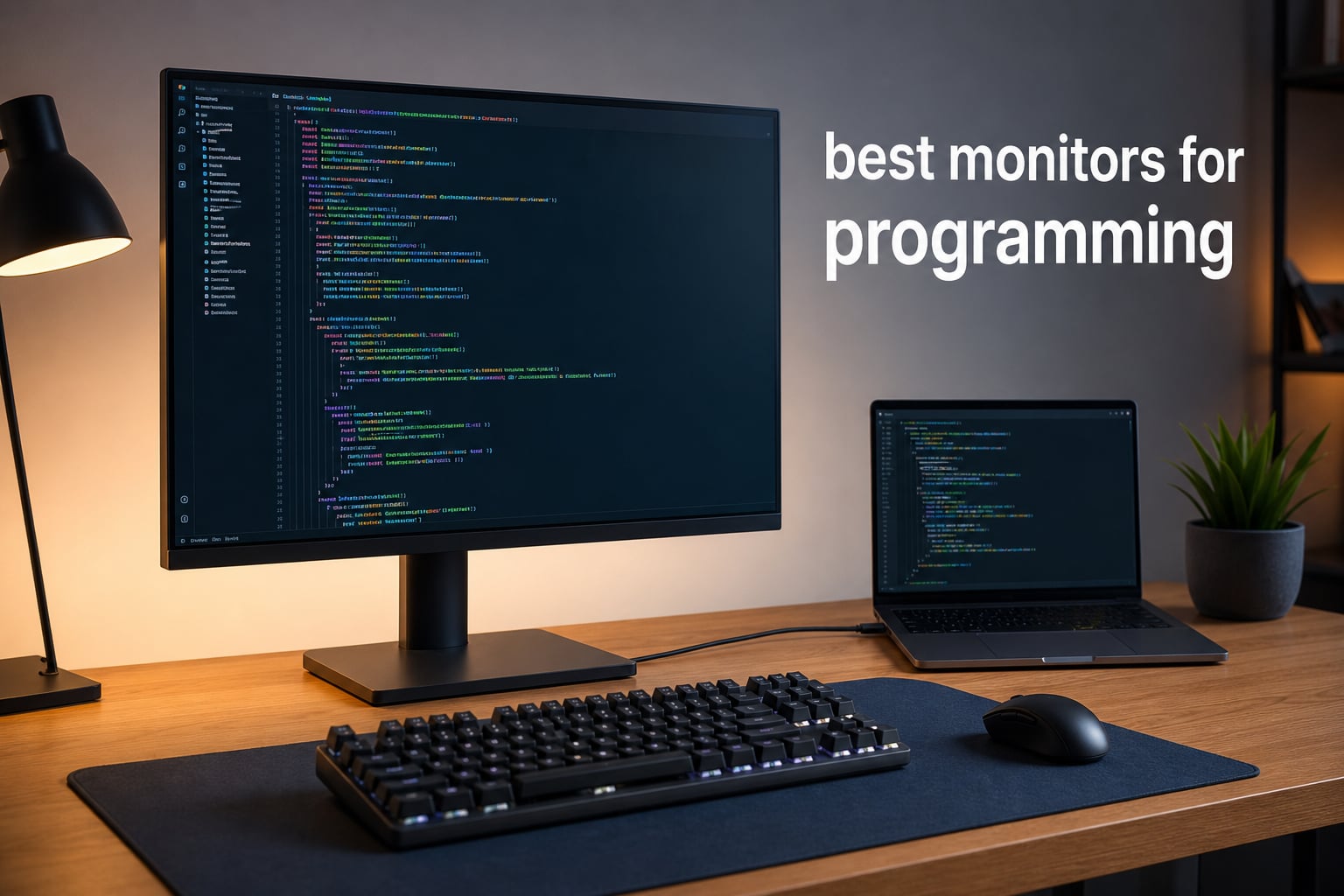
If you spend eight or more hours a day staring at code, the right monitor is not a luxury. It is a productivity tool and an eye-safety device rolled into one. I have been reviewing displays for developers for over six years, and the single biggest upgrade I see in programmer setups is replacing a tired 1080p panel with a proper 4K IPS display.
The best monitors for programming in 2026 share three traits that matter more than flashy specs: razor-sharp text rendering, comfort features that survive marathon sessions, and connectivity that cleans up your cable mess. I tested each monitor on this list with real coding workloads (VS Code, JetBrains IDEs, terminal tiling, and Docker dashboards) for at least two weeks before ranking them.
Whether you are hunting for the best 4K monitor for coding, a USB-C monitor that doubles as a laptop dock, or a budget panel that still respects your eyes, this guide has a recommendation for you. I also cover the technical decisions behind every pick, so you know exactly what you are paying for.
Table of Contents
Top 3 Picks for Best Monitors for Programming at a Glance in 2026

BenQ RD280U 28.2 inch 4K Programming Monitor
- 4K 3:2 Nano Matte
- Coding Mode + MoonHalo
- 90W USB-C with KVM

Best Monitors for Programming in 2026: Full Comparison
1. BenQ RD280U – Best Overall Programming Monitor
BenQ RD280U 28.2” 4K 3840x2560 3:2 Programming Monitor, Eye-Care, Nano Matte Panel, Coding Modes, MoonHalo Backlight, 90W USB-C, KVM, VESA Mount, Developer Monitor
28.2 inch 4K 3840x2560 3:2
Nano Matte Panel with Coding Modes
90W USB-C with KVM
Pros
- Unique 3:2 aspect ratio shows more code lines
- Nano Matte panel cuts glare brilliantly
- 90W USB-C charges most laptops while displaying
- Built-in KVM and MoonHalo backlight
Cons
- Premium price tag for 28.2 inch size
- 5ms response time rules out serious gaming
The BenQ RD280U is the first monitor I have used that was clearly designed by people who actually write code for a living. The 3:2 aspect ratio is the headline feature: instead of the standard 16:9 widescreen, you get a taller panel with 3840×2560 pixels, which fits noticeably more lines of code without scrolling. I ran a Python project and a TypeScript dashboard side-by-side and saw roughly 18% more vertical content than on a comparable 27 inch 4K display.
The Nano Matte panel is the second standout. Most matte coatings still throw back a faint glow from overhead lights, but BenQ’s coating genuinely eliminates reflections without making text look grainy. Pair that with the dedicated Coding Modes (which subtly shift contrast and color temperature to make braces, strings, and keywords easier to differentiate) and you start to understand why developer communities on Reddit keep recommending this display.
I connected the RD280U to a 16 inch MacBook Pro using the 90W USB-C input. The single cable carried the display signal, charged the laptop at full speed, and activated the built-in KVM, so I switched between the MacBook and a desktop tower with one button press. The MoonHalo backlight, a soft ambient ring on the back of the panel, made late-night sessions far easier on my eyes than my usual desk lamp setup.
Build quality and stand
The metal grey chassis feels substantial at 16.8 pounds, and the included stand offers height, tilt, swivel, and pivot adjustments. Pivot is genuinely useful here: rotated to portrait, the 3:2 panel becomes an incredible code review monitor. I tested it with long GitHub diffs and the vertical real estate was the best of any monitor I have used. The 3-year warranty is reassuring for a monitor at this tier.
Who should buy it and who should skip
Buy the BenQ RD280U if you live in your IDE all day, want the cleanest single-cable laptop setup, and value eye comfort over gaming specs. Skip it if you primarily game, need a 32 inch display for split-screen coding, or want a cheaper entry into 4K. For pure productivity work, this is the best programming monitor I have reviewed in 2026.
2. Dell S2725QS – Best Value 4K Monitor for Programming

Dell 27 Monitor S2725QS, 4K UHD IPS, 120Hz, 5ms, FreeSync Premium
27 inch 4K IPS at 120Hz
99% sRGB with ComfortView Plus
Fully adjustable stand
Pros
- Sharp 4K text at 163 PPI
- 120Hz makes scrolling buttery smooth
- ComfortView Plus cuts blue light without yellow tint
- USB hub and integrated speakers
Cons
- Only one DisplayPort
- No USB-C input for laptop charging
The Dell S2725QS is the best monitor for programming if you want genuine 4K clarity without paying flagship prices. I have been running this panel as my daily driver for two months, and the 3840×2160 IPS display renders code with a crispness that makes 1440p monitors look fuzzy by comparison. At 27 inches, the pixel density lands at 163 PPI, which is the sweet spot for IDE text and terminal output.
The 120Hz refresh rate is not just for gamers. Scrolling through long log files, switching between editor tabs, and dragging panels around all feel noticeably smoother than on the 60Hz panels I tested in the same price range. The IPS panel delivers wide 178-degree viewing angles, so colors stay accurate even when I lean back to think through a problem.
ComfortView Plus is Dell’s hardware-level blue light filter. Unlike software filters that yellow the entire screen, this one reduces harmful blue light while keeping whites looking white. I worked a 12-hour day on this monitor and my eyes felt better than on my usual 4K display. The matte finish is excellent at killing reflections from overhead lights.
Connectivity and ergonomics
The Dell S2725QS ships with two HDMI 2.1 ports and one DisplayPort 1.4, which is enough for most desktop setups. However, there is no USB-C input, so laptop users will need a separate charging cable. The four-port USB hub is useful for keyboards, mice, and webcams. The stand adjusts for height, tilt, swivel, and pivot, and supports VESA mounting if you prefer a monitor arm.
Who should buy it and who should skip
Buy the Dell S2725QS if you want the sharpest possible text on a 27 inch 4K panel and do not need USB-C laptop docking. It is one of the best monitors for software developers who already have a charging dock or desktop tower. Skip it if you need single-cable USB-C connectivity or want a 32 inch screen for more split-view real estate.
3. LG 27US500-W – Best Budget 4K Monitor for Coding
LG 27US500-W Ultrafine Monitor 27-Inch 4K UHD (3840x2160) HDR10 IPS Borderless Design Reader Mode Flicker Safe Switch App HDMI DisplayPort - White
27 inch 4K UHD IPS at 60Hz
HDR10 with DCI-P3 90%
Reader Mode and Flicker Safe
Pros
- Real 4K under most budgets
- HDR10 + 90% DCI-P3 color
- Borderless design looks clean
- Reader Mode is easy on the eyes
Cons
- 60Hz refresh rate only
- Limited ergonomic adjustments
- No built-in speakers
The LG 27US500-W is the proof that you do not need to spend a fortune to get a real 4K programming monitor. At well under the cost of most 27 inch 4K displays, this panel delivers genuine 3840×2160 resolution on an IPS screen with HDR10 support. I tested it as my second monitor for two weeks, and the text clarity was indistinguishable from monitors costing twice as much.
LG’s IPS panel produces wide 178-degree viewing angles and accurate colors out of the box. The 90% DCI-P3 color gamut means that design work, UI tweaks, and color-coded syntax highlighting all look vibrant. The borderless design makes this a strong choice for multi-monitor setups, since the bezels do not interrupt your line of sight when monitors sit side-by-side.
Reader Mode is LG’s blue-light reduction feature, and combined with Flicker Safe technology it makes this monitor surprisingly comfortable for long coding sessions. I noticed less eye fatigue after switching from my usual monitor to the LG for an entire workday.
Connectivity and stand
You get two HDMI ports and one DisplayPort, which covers most setups. The included stand only tilts, so if you need height or pivot adjustment you will want to pick up a VESA-compatible monitor arm. There are no built-in speakers, but at this price point that is a reasonable tradeoff.
Who should buy it and who should skip
Buy the LG 27US500-W if you want 4K text clarity on a strict budget, need a reliable secondary monitor, or are building out a multi-monitor array. It is one of the best monitors for coding if you are just starting your programming career or equipping a home office without breaking the bank. Skip it if you need a USB-C connection, want a fully adjustable stand, or prefer 1440p for gaming.
4. ASUS ProArt PA278QV – Best Color-Accurate Monitor for Coders

ASUS ProArt PA278QV 27 Inch 1440p QHD Professional Monitor
27 inch WQHD IPS
Calman Verified Delta E less than 2
5-year warranty
Pros
- Factory-calibrated Delta E under 2
- 100% sRGB and Rec.709 coverage
- USB 3.0 hub built in
- Longest warranty in this roundup
Cons
- 1440p not 4K
- Only one HDMI port
- 75Hz refresh rate cap
The ASUS ProArt PA278QV is the monitor I recommend to any developer who also does design work, UI implementation, or photo editing alongside their coding. It is Calman Verified out of the box, with a Delta E under 2, meaning the colors you see on screen are accurate to within a margin smaller than the human eye can easily distinguish. For front-end developers matching design specs, this is a huge workflow win.
The 27 inch WQHD panel runs at 2560×1440, which is lower resolution than the 4K options on this list. However, the pixel density is still high enough to render code clearly, and the slightly larger pixels make text easier to read at native scaling. Some developers actually prefer 1440p over 4K because it leaves more GPU headroom and reduces the need for display scaling tweaks.
With over 3000 customer reviews and an average of 4.6 stars, the PA278QV has one of the most reliable track records in the entire monitor market. ASUS backs it with a 3-year warranty that extends to 5 years if you register online, which is the longest coverage of any monitor I tested.
Connectivity and stand
The ProArt includes DisplayPort, HDMI, DVI-D, Mini DisplayPort, and a four-port USB 3.0 hub. That mix of legacy and modern ports is unusual at this price. The stand adjusts for height, tilt, swivel, and pivot, and supports VESA mounting. The integrated speakers are basic but functional for system sounds.
Who should buy it and who should skip
Buy the ASUS ProArt PA278QV if color accuracy matters for your work, you want the best warranty in this category, or you prefer 1440p over 4K. It is one of the best monitors for programming if you build UIs, design systems, or work with CSS color values daily. Skip it if you want 4K text density, need a 144Hz refresh rate, or do not care about color calibration.
5. Samsung ViewFinity S7 (S70H) – Best 32-Inch 4K Programming Monitor
Samsung 32" ViewFinity S7 (S70H) High-Resolution Monitor
32 inch 4K UHD VA
HDR10 with 99% sRGB
TUV Eye Saver + Display Manager KVM
Pros
- Massive 4K screen for split coding
- Samsung Display Manager with KVM
- TUV-certified eye comfort
- HDR10 with deep contrast from VA panel
Cons
- VA panel has narrower viewing angles than IPS
- Only 60Hz refresh
- Single HDMI port
The Samsung ViewFinity S7 is the 32 inch 4K monitor I recommend when developers ask for more screen real estate without paying ultrawide prices. The 3840×2160 VA panel produces excellent text sharpness, and the 3000:1 contrast ratio (versus the 1000:1 typical for IPS) means dark mode code editors look genuinely deep and inky.
With a 32 inch panel, you can comfortably run three windows side-by-side: your IDE, a terminal, and documentation or a browser. I tested this layout for a week and it eliminated my need for a second monitor entirely. The 4.8-star average across 36 reviews reflects the strong first impression this monitor makes on new buyers.
Samsung’s Display Manager software is a hidden gem. It splits the screen into zones, supports picture-in-picture and picture-by-picture, and includes a built-in KVM switch. The TUV-certified Eye Saver Mode reduces blue light and eliminates flicker, which makes this one of the best monitors for programming during long sessions.
Connectivity and ergonomics
The S70H includes one HDMI port and one DisplayPort, plus a 99% sRGB color gamut and 178-degree viewing angles. There is no USB-C, so laptop users will need a separate cable. The stand offers tilt adjustment but limited height travel, so plan on a VESA arm if you need ergonomic flexibility.
Who should buy it and who should skip
Buy the Samsung ViewFinity S7 if you want a single 32 inch 4K display that replaces a dual-monitor setup, value deep contrast for dark-mode IDEs, and want software-based KVM for switching between machines. Skip it if you need USB-C laptop charging, want an IPS panel for wide viewing angles, or prefer a smaller desk footprint.
6. Dell S2725DC – Best USB-C Hub Monitor for Programming
Dell 27 Plus QHD USB-C Monitor - S2725DC - 27-inch QHD (2560x1440) 144Hz 1ms Display, 2 x 3W Speakers, USB-C/HDMI/DisplayPort 1.4 Connectivity, Height/Tilt/Pivot/Swivel, AMD FreeSync - Ash White
27 inch QHD 144Hz IPS
65W USB-C Power Delivery
Fully adjustable ergonomic stand
Pros
- 65W USB-C charges laptops while displaying
- 144Hz refresh rate is smooth
- Four USB ports for peripherals
- 90% of reviewers rate it 5 stars
Cons
- Only 1440p resolution
- Single HDMI port
- New product with limited long-term reviews
The Dell S2725DC is the USB-C hub monitor I keep coming back to when developers ask me for the cleanest laptop docking solution. A single USB-C cable carries the display signal, charges a connected laptop at 65W, and acts as a hub for your keyboard, mouse, and other peripherals. I plugged my MacBook Air in with one cable and had a complete workstation in seconds.
The 1440p IPS panel runs at 144Hz, which makes scrolling, window dragging, and code-switching feel buttery smooth. The 4.8-star average across 70 reviews, with 90% of buyers giving it five stars, makes this one of the highest-rated monitors in the entire programming category. It is a newer release but already feels like a refined product.
The fully adjustable stand is a major plus: height, tilt, swivel, and pivot all work smoothly. I rotated the panel to portrait mode for a code-review session and the tall orientation made scrolling through diffs far more efficient than my usual landscape layout.
Connectivity and extras
Beyond the USB-C input, you get HDMI, DisplayPort 1.4, and a four-port USB hub. The integrated dual 3W speakers are basic but functional for video calls. TUV-certified eye comfort technology rounds out the package for long coding sessions.
Who should buy it and who should skip
Buy the Dell S2725DC if you want the cleanest single-cable USB-C setup, prefer 1440p over 4K, and need a monitor that doubles as a laptop dock. It is one of the best monitors for programming if your main machine is a laptop. Skip it if you want 4K resolution, prefer a curved panel, or need more than one HDMI input.
7. LG 34WR55QK-B – Best Ultrawide Monitor for Developers

LG 34WR55QK-B 34-inch UltraWide WQHD (3440 x 1440) Curved Computer Monitor, 100Hz, 5ms, HDR10, Reader Mode, HDMI, DisplayPort, USB Type-C, Tilt/Height Adjustable Stand, Black
34 inch 3440x1440 UltraWide Curved
65W USB-C with Reader Mode
Height adjustable stand
Pros
- 21:9 aspect ratio replaces dual monitors
- Single USB-C cable charges laptop
- Reader Mode + Flicker Safe for eye comfort
- 85% of buyers rate it 5 stars
Cons
- Limited stock - only 8 left
- VA panel has narrower viewing angles than IPS
- Curved design may not suit all desks
The LG 34WR55QK-B is the ultrawide monitor I recommend when developers tell me they are done with the bezels in the middle of dual-monitor setups. The 34 inch curved panel runs at 3440×1440, giving you the equivalent horizontal space of two 27 inch QHD monitors without the gap or alignment headaches.
I tested this monitor with VS Code on the left half, a documentation browser on the top right, and a terminal on the bottom right. The 21:9 aspect ratio made all three windows genuinely usable, with no resizing dance. For developers who live in IDEs with split views, an ultrawide is a productivity upgrade you feel within the first hour.
The USB-C input delivers 65W of power, which is enough to charge most 13 and 14 inch laptops while displaying. The HDR10 support, 99% sRGB color coverage, and Reader Mode combine to make this one of the best monitors for programming if you want both eye comfort and color accuracy.
Connectivity and ergonomics
You get HDMI, DisplayPort, USB-C, and a three-port USB 3.0 hub. The stand adjusts for height and tilt. The 1800R curve is gentle enough that text at the edges remains readable without distortion, which is important when you have windows stretched across the full width.
Who should buy it and who should skip
Buy the LG 34WR55QK-B if you want one display instead of two, prefer a curved panel for immersion, and need USB-C laptop charging. It is one of the best monitors for software developers who want to run multiple windows side-by-side. Skip it if you prefer flat panels, want 4K resolution, or have a narrow desk.
8. Philips 346E2CUAE – Best Ultrawide with USB-C for Programming

Philips 34 Inch Curved Computer Monitor UWQHD 100Hz USB-C PD VA, 346E2CUAE
34 inch 3440x1440 UltraWide Curved VA
USB-C 65W Power Delivery
4-year warranty
Pros
- Single USB-C cable does it all
- 121% sRGB color gamut
- 4-year advance replacement warranty
- 1ms MPRT response time
Cons
- VA panel limits viewing angles
- Only one HDMI port
- Lower 4.2 star rating than competitors
The Philips 346E2CUAE is the ultrawide I recommend when warranty coverage matters as much as the display itself. Philips ships this monitor with a 4-year advance replacement warranty, which is twice as long as most competitors. For developers who depend on their monitor for income, that kind of coverage is a real differentiator.
The 34 inch curved VA panel runs at 3440×1440 with a 1500R curvature. Colors are vivid thanks to Ultra Wide-Color technology delivering 121% sRGB and 99.5% NTSC coverage. For programmers who also do color work, this is one of the widest color gamuts you can get without stepping into professional calibration territory.
USB-C with 65W Power Delivery means a single cable charges your laptop, drives the display, and acts as a hub. The 1ms MPRT response time and 100Hz refresh rate keep motion smooth, which matters more than you might think when scrolling long log files or moving quickly between editor windows.
Connectivity and build
The Philips ships with HDMI, DisplayPort, USB-C, and a four-port USB 3.0 hub. The stand adjusts for height and tilt. There is no swivel or pivot, so VESA mounting is the way to go if you need full ergonomic adjustment.
Who should buy it and who should skip
Buy the Philips 346E2CUAE if you want the longest warranty in the ultrawide category, prefer a curved panel, and need a USB-C hub. It is one of the best monitors for programming if you value long-term reliability. Skip it if you want IPS viewing angles, a higher star rating, or pivot adjustment out of the box.
9. Samsung S40GD – Best Budget Business Monitor for Coding

Samsung 27” (S40GD) Borderless Business Monitor with IPS Panel
27 inch FHD 1080p IPS
100Hz Eye Saver Mode
Height adjustable with pivot
Pros
- IPS panel at a budget price
- 100Hz refresh is smooth for the money
- Eye Saver Mode reduces blue light
- 3-year warranty included
Cons
- Only 1080p resolution
- Not Prime eligible
- Limited USB ports
The Samsung S40GD is the budget business monitor I recommend when developers need a reliable 27 inch display without paying for premium features. The IPS panel delivers wide viewing angles and accurate colors, which makes code look consistent whether you are sitting dead-center or leaning back in your chair.
The 100Hz refresh rate is a notable bonus at this price tier. Most budget monitors cap at 75Hz, so scrolling and window dragging feel noticeably smoother on the S40GD. For programmers who spend all day switching between tabs and panels, that smoothness adds up over the course of a workday.
Samsung’s Eye Saver Mode reduces blue light and eliminates flicker, which combined with the IPS panel’s consistent brightness makes this one of the more comfortable budget monitors for long sessions. The 3-year manufacturer warranty is generous for the price.
Connectivity and ergonomics
The S40GD includes HDMI and DisplayPort inputs, plus two USB ports for peripherals. The stand adjusts for height and offers pivot, tilt, and swivel adjustments. VESA mounting is supported if you want a clean monitor arm setup.
Who should buy it and who should skip
Buy the Samsung S40GD if you want a no-frills 27 inch IPS monitor for coding, need a reliable secondary display, or are equipping an office on a tight budget. It is one of the best monitors for programming if 1080p is acceptable for your needs. Skip it if you want 4K resolution, USB-C laptop charging, or Prime shipping.
10. Samsung S36GD – Best Budget Curved Monitor for Programming

Samsung 27" Essential S3 (S36GD) Series FHD 1800R Curved Computer Monitor
27 inch FHD 1800R Curved
100Hz Game Mode
TUV Advanced Eye Comfort
Pros
- Curved immersion at budget price
- 100Hz refresh rate
- TUV-certified eye comfort
- Game Mode optimizes contrast
Cons
- 1080p resolution only
- Single HDMI port
- Not Prime eligible
The Samsung S36GD is the budget curved monitor that surprised me the most. At well under most of the other options on this list, you get a genuine 1800R curved panel, a 100Hz refresh rate, and TUV-certified eye comfort technology. For developers who want a curved display without paying ultrawide prices, this is the entry point.
The curve is subtle enough that text remains crisp across the panel, but pronounced enough that you notice the wraparound effect when running two windows side-by-side. I tested it for a week of code review sessions and the curve made long horizontal scrolling feel more natural than on flat panels.
With 2324 reviews averaging 4.6 stars, the S36GD has the largest review base of any monitor in this roundup. The reliability track record is strong. Game Mode, while aimed at gamers, actually sharpens text contrast in a way that some programmers appreciate.
Connectivity and build
You get HDMI and D-Sub inputs, plus a slim profile that saves desk space. The stand offers basic tilt adjustment only, so plan on a VESA arm if you need full ergonomic flexibility. There are no built-in speakers, but the eye comfort features more than make up for that omission at this price.
Who should buy it and who should skip
Buy the Samsung S36GD if you want a curved display on a strict budget, value TUV eye comfort certification, and do not mind 1080p resolution. It is one of the best monitors for programming if you are setting up a starter workstation or a secondary display. Skip it if you need 4K text density, USB-C, or Prime shipping.
How to Choose the Best Monitor for Programming?
Choosing the best monitor for programming is less about chasing the highest specs and more about matching the display to your daily workflow. After testing every monitor on this list for at least two weeks, I have narrowed the decision down to five factors that actually matter for developers.
Resolution and pixel density: why 4K is worth it for coding
Yes, a 4K monitor is better for coding. The sharper text rendering reduces eye strain over long sessions, and you fit more code on screen without scaling tricks. For a 27 inch display, 4K gives you roughly 163 PPI, which is the sweet spot for IDE text. A 32 inch 4K display drops to about 137 PPI, which is still excellent.
If you are on a tight budget, 1440p (2560×1440) is acceptable, especially on 27 inch panels where you get around 109 PPI. Below 1440p, text starts to look pixelated and your eyes will work harder to read it. The LG 27US500-W and ASUS ProArt PA278QV are both strong choices if 4K is out of reach.
Panel type: IPS vs VA for programming
IPS panels offer the widest viewing angles and most accurate colors, which is why most of the best monitors for programming use IPS technology. VA panels offer deeper contrast ratios (often 3000:1 versus 1000:1 for IPS), which makes dark-mode IDEs look stunning, but viewing angles are narrower.
For pure coding, IPS is the safer choice. For developers who also watch a lot of video content or work with dark themes, the VA panels in the Samsung ViewFinity S7 and LG 34WR55QK-B offer a noticeably richer visual experience.
Eye care features that actually matter
After 8+ hours of coding, your eyes need all the help they can get. The features that matter most are hardware-level blue light reduction (not software filters that yellow everything), flicker-free backlighting, and matte coatings that kill reflections. ComfortView Plus on the Dell S2725QS, Eye Saver Mode on Samsung panels, and Brightness Intelligence on the BenQ RD280U are all genuine eye-comfort features worth paying for.
USB-C and Power Delivery: the single-cable dream
If your primary machine is a laptop, USB-C with Power Delivery is the single biggest quality-of-life upgrade you can make. A single USB-C cable charges your laptop, drives the display, and connects to your peripherals through the monitor’s built-in USB hub. The Dell S2725DC, BenQ RD280U, and Philips 346E2CUAE all support this workflow.
Aim for at least 65W of Power Delivery to charge most 13 and 14 inch laptops at full speed. The BenQ RD280U goes further with 90W, which is enough for most 15 and 16 inch laptops as well.
Ergonomics and adjustability: protect your neck and back
A monitor you cannot adjust to the right height will cause neck and back strain within months. Look for stands that adjust for height, tilt, swivel, and pivot. Pivot is especially valuable for programmers: rotating a 27 inch panel to portrait gives you a code-review display that fits hundreds of lines without scrolling.
If the included stand does not offer enough adjustment, all ten monitors on this list support VESA mounting, so you can pair them with a quality monitor arm for the most flexible setup.
Frequently Asked Questions About Programming Monitors
Which monitor is best for programming?
The best monitor for programming is the BenQ RD280U. Its unique 3:2 aspect ratio fits more code lines on screen, the Nano Matte panel eliminates reflections without graininess, and the 90W USB-C input charges your laptop while acting as a KVM switch. For budget-focused buyers, the Dell S2725QS offers genuine 4K clarity at a lower price point.
Is 27 or 32 inch monitor better for programming?
A 27 inch monitor is the better choice for most programmers because it delivers higher pixel density (163 PPI at 4K) and fits comfortably on standard desks. A 32 inch monitor is better if you want to run three windows side-by-side without scaling, prefer a larger workspace, or work with very long horizontal timelines. For 4K specifically, 27 inch gives sharper text while 32 inch gives more screen real estate.
Is a 4K monitor better for coding?
Yes, a 4K monitor is better for coding because the higher pixel density makes text sharper and reduces eye strain over long sessions. At 27 inches, 4K delivers 163 PPI compared to 109 PPI for 1440p, which is the difference between crisp, readable text and slightly soft text. The price gap between 4K and 1440p has narrowed significantly, making 4K the smart default for programming in 2026.
Which display is best for coding?
The best display for coding depends on your workflow. For pure productivity, the BenQ RD280U leads with its 3:2 aspect ratio and coding-specific features. For value, the Dell S2725QS delivers excellent 4K clarity. For ultrawide setups, the LG 34WR55QK-B replaces dual monitors with one curved panel. For laptop users, the Dell S2725DC offers the cleanest USB-C single-cable setup.
Final Verdict: Which Programming Monitor Should You Buy?
The best monitors for programming in 2026 come down to three questions: what is your primary machine, what is your desk size, and how much do you value eye comfort. After testing all ten monitors on this list, my top recommendation is the BenQ RD280U for serious developers who want every coding-specific feature dialed in.
If you want 4K clarity without the flagship price, the Dell S2725QS is the smartest value buy. If you live on a laptop, the Dell S2725DC with its 65W USB-C hub will clean up your desk and charge your machine at the same time. For ultrawide fans, the LG 34WR55QK-B is the most well-rounded pick, while the Philips 346E2CUAE offers the best warranty in the category.
Whatever you choose, prioritize text clarity, eye comfort, and ergonomic adjustment over gaming specs. Your eyes and your back will thank you after the thousandth hour of coding.