
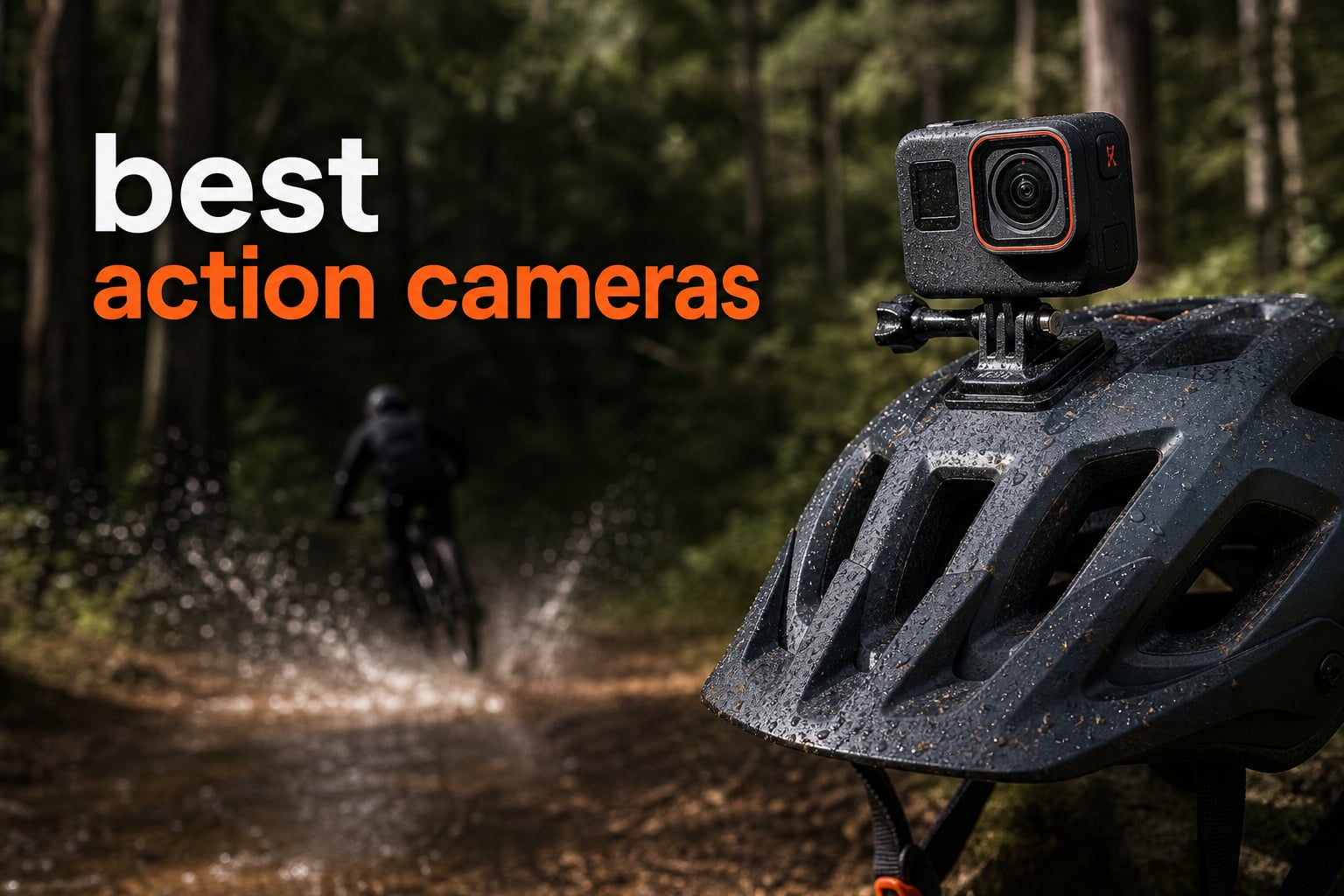
The best action cameras make fast movement watchable, but the right one depends on what you want to make after the ride, run, swim, or trip is over. A compact camera on a helmet can capture a point-of-view clip, while a 360-degree model can record every direction and let you choose the angle later.
For most people, the DJI Osmo Action 6 is the strongest all-around choice in this group because its listing combines 8K capture, a 1/1.1-inch square sensor, variable f/2.0–f/4.0 aperture, 50GB of built-in storage, and a claimed four-hour battery. That does not make it automatic for every project: a creator who needs a front-facing screen may prefer the Insta360 Ace Pro 2, while someone who wants to reframe the whole scene needs the Insta360 X5.
An action camera is a small, rugged camera built for active shooting, typically with a very wide field of view, waterproof construction, and electronic stabilization that smooths footage from a moving mount. It is useful when holding a traditional camera is impractical, including mountain biking, skiing, surfing, hiking, a motovlog, and travel vlogging.
I have kept this guide grounded in the published specifications and the included bundles for the five models selected here. That matters because battery claims, waterproof depth, resolution, and a camera’s editing workflow tell a more useful story than a headline feature alone.
Before choosing, decide whether you want conventional forward-facing footage or footage you can crop and reframe later. Then check the stated waterproof depth, the recording format your memory card supports, whether you need a wireless microphone, and how much time you want to spend editing clips for social platforms.
Table of Contents
The top three picks give most buyers a clear starting point in 2026
These three cover the main paths: the DJI Osmo Action 6 for a high-spec conventional action camera, the DJI Osmo Action 5 Pro for battery-focused shooting, and the GoPro HERO13 Black for its established filming modes and included mounting kit. The card ratings below are the product ratings reported in the available product data, not a separate editorial test score.


Choose the Action 6 if you want high-resolution capture, flexible exposure control, and long stated runtime in a compact camera. Choose the Action 5 Pro if the 20m underwater rating, dual OLED touchscreens, 47GB internal storage, and 4K/120fps slow motion matter more than an 8K option.
Choose the HERO13 Black bundle if you want a camera that arrives with a Handler Grip, head strap, adhesive mounts, a 64GB card, and two Enduro batteries. That bundle is especially practical for a first action-sports setup because it starts with several ways to mount and carry the camera.
The best action cameras in 2026 cover five distinct shooting styles
There is no single best camera for every kind of action. The conventional cameras below are simpler when you know where the camera should point; the X5 is the specialist choice when you want to capture the scene first and choose the view afterward.
| Product | Specifications | Action |
|---|---|---|
| DJI Osmo Action 6 |
|
Check Latest Price |
 DJI Osmo Action 5 Pro DJI Osmo Action 5 Pro |
|
Check Latest Price |
| GoPro HERO13 Black |
|
Check Latest Price |
 Insta360 X5 Insta360 X5 |
|
Check Latest Price |
 Insta360 Ace Pro 2 Insta360 Ace Pro 2 |
|
Check Latest Price |
Use this overview as a way to narrow your choice, not as a substitute for checking the recording modes you will actually use. A long battery specification may be less important than a flip screen for solo narration, and 8K may not matter if your finished clips are mainly short 4K exports.
1. The best overall is DJI Osmo Action 6 for flexible 8K capture
DJI Osmo Action 6 Essential Combo, 8K Waterproof Action Camera
8K
1/1.1 inch sensor
f/2.0-f/4.0 aperture
4-hour battery
Pros
- 8K capture
- Variable aperture
- 50GB built-in storage
- Four-hour stated battery
Cons
- Larger body
- 8K needs a fast card
The DJI Osmo Action 6 is the best action camera here for a buyer who wants a forward-facing camera with room to adapt to different conditions. Its listed 1/1.1-inch square CMOS sensor is larger than the 1/1.3-inch sensors listed for the Action 5 Pro and Ace Pro 2, and its variable aperture runs from f/2.0 to f/4.0.
That aperture range is the standout specification. A wider f/2.0 setting can help in dimmer scenes, while stopping down toward f/4.0 gives you another exposure control when the scene is bright; it is a useful tool for riders moving between open sun, trees, and shade.
The product listing states 8K video, 38MP stills, a 2.5-inch display, and multiple aspect ratios for social platforms. If you make both horizontal travel videos and vertical clips, the ability to select the framing at capture time can reduce the need to crop a wide master file later.
The sensor and aperture make this the strongest choice for changing light
The Action 6 is the one I would narrow down first for sunrise rides, shaded forest trails, and bright snow or water. Its square sensor and variable aperture are verified differentiators in this five-camera set, rather than marketing labels shared by every model.
It also lists D-Log M, which is useful for editors who plan to grade footage. That profile is not a shortcut to better color on its own: it asks for a deliberate edit, so casual shooters may prefer a normal color mode and a faster export.
The storage and control setup make this a practical all-day sports camera
DJI lists 50GB of internal storage alongside microSD support, Bluetooth, Wi-Fi, voice control, gesture control, RockSteady modes, and 360-degree HorizonSteady. Internal storage can save a shoot when a card is forgotten or fills before you can swap it, although it does not remove the need for a fast compatible card for demanding recording modes.
The claimed four-hour, cold-resistant battery and 20m waterproof rating give it a broad outdoor brief. For extended 8K recording, treat any runtime claim as a starting point: resolution, stabilization, temperature, screen use, and wireless connections all affect actual time, and creators in action-camera forums consistently flag heat and battery drain as their biggest long-recording concerns.
The Action 6 weighs 149g, so it is not the lightest choice, but it remains compact enough for a helmet camera or chest mount. Its limits are equally clear: 8K files need more card capacity and computing power, while the larger body may matter on very small mounts.
2. The best battery-focused pick is DJI Osmo Action 5 Pro
DJI Osmo Action 5 Pro Essential Combo, Waterproof Action Camera
4K120
1/1.3 inch sensor
20m waterproof
47GB built-in storage
Pros
- Four-hour stated battery
- 20m underwater rating
- Dual OLED screens
- Wireless mic connection
Cons
- No 8K option
- Accessories may be needed
The DJI Osmo Action 5 Pro is the sensible answer for people who care more about dependable 4K/120fps slow motion, battery capacity, and low-light-oriented sensor specifications than maximum resolution. DJI lists a 1/1.3-inch CMOS sensor with 2.4 µm pixels and 13.5 stops of dynamic range, plus a claimed four-hour battery from its 1950mAh cell.
Its 4K/120fps mode is a direct fit for slowing down a jump, a spray of water, or a fast bike turn. You should not choose it expecting 8K, because the published maximum is 4K; instead, choose it when a more manageable 4K workflow and high frame rate fit your final edit.
In practical packing terms, 47GB of built-in storage is a strong safety net. It is paired with microSD support, and DJI lists V90 UHS-II media for the camera, so check card compatibility before relying on a card you already own.
The dual OLED screens make self-framing and settings checks easier
The Action 5 Pro has front and rear 2.5-inch OLED touchscreens. A front display is useful when the camera faces you for a vlog, and a rear touchscreen is more convenient than button-only control when you need to change a mode while stopped.
DJI also lists subject tracking, a color temperature sensor, and D-Log M. Subject tracking can be helpful when a person needs to remain centered, but it is not a replacement for a thoughtfully aimed mount when a subject changes direction quickly.
The waterproof depth and mic support suit water and talking-head clips
This model carries an IP68 rating and a stated 20m underwater capability. That makes it a stronger match than the 10m-listed GoPro HERO13 Black for users who need more depth without adding a housing, though any underwater work still calls for careful checks of seals, card space, and battery level before entering the water.
The listing also supports direct wireless connection to DJI Mic 2 or Mic Mini without a receiver. For a vlogging camera, that can simplify a spoken segment, while the camera’s wireless functions and screens make it easier to review framing before you start.
Community discussions repeatedly favor this model family for long stated battery life, low-light use, and resistance to overheating during longer recordings. Those are user impressions, not a controlled comparison, so I would still test your preferred mode before relying on a single battery for an important all-day event.
3. The best established mount kit is GoPro HERO13 Black
GoPro HERO13 Black Action Camera with 5.3K60 Video, 27MP Photos, HyperSmooth 6.0 Stabilization, The Handler Grip, 2 Enduro Batteries, 64GB SD Card, Head Strap, Adhesive Mounts, 1-Year Warranty
5.3K60
27MP photos
HyperSmooth 6.0
10m waterproof
Pros
- 5.3K60 video
- 8x slow motion
- GP-Log
- Mounting bundle included
Cons
- Two-hour stated battery
- No 8K option
The GoPro HERO13 Black bundle makes a direct case for buyers who want familiar action-camera framing with useful accessories already included. The listed package includes a Handler Grip, two Enduro batteries, a 64GB SD card, a head strap, and adhesive mounts, which covers several common POV camera positions without a separate shopping list.
Its stated video ceiling is 5.3K at 60fps, and it can shoot 27MP photos. That is below the listed 8K output of the Action 6 and Ace Pro 2, but 5.3K still leaves meaningful room to crop for a 4K timeline while retaining a standard forward-facing action-camera workflow.
GoPro lists several aspect ratios—16:9, 9:16, and 8:7—plus video, photo, time lapse, night lapse, burst, TimeWarp, loop, slow motion, and Live Burst modes. The 8:7 full-sensor option is particularly relevant if you want to create both horizontal and vertical versions from the same action sequence.
The aspect ratios and slow motion fit creators who make several versions of one clip
HyperSmooth 6.0 is the listed stabilization system, and the camera supports 8x slow motion. Those specifications make the HERO13 Black a credible pick for daytime skateboarding, snowboarding, mountain biking, or an action camera for sports where you want a clear, conventional edit path.
It also lists GP-Log for people who color grade. Like D-Log M, log footage offers editing latitude but adds work; a beginner who wants a quick upload should favor a ready-to-share color setting rather than assuming a log profile will improve an unedited clip.
The included gear makes this the easiest option to mount on day one
The 156-degree field of view, 2.27-inch screen, and 5.4-ounce weight suit a compact helmet camera setup. The camera is listed as waterproof to 33 feet, or 10m, without housing, which is enough for surface water activities and shallow use but less depth than the two DJI options in this guide.
The published two-hour battery figure is shorter than the four-hour claims for the DJI cameras, although this bundle includes two Enduro batteries. That makes a battery swap part of the plan rather than an afterthought, especially when stabilization, high resolution, and cold weather are in play.
Forum users often call out GoPro for strong daytime image quality and flexible 8:7 capture. The tradeoff is clear in the specification list: it does not offer an 8K recording mode, and the available product data has a smaller review count than the other models shown here.
4. The best 360-degree choice is Insta360 X5 for reframing later
Insta360 X5 - Waterproof 8K 360° Action Camera, Leading Low Light, Invisible Selfie Stick Effect, Rugged and Replaceable Lens, 3-Hour Battery, Built-in Wind Guard, Stabilization, Triple AI Chip Design
8K 360 video
Dual 1/1.28 inch sensors
72MP
208-minute battery
Pros
- 360-degree capture
- Replaceable lenses
- FlowState stabilization
- Wind Guard
Cons
- Editing takes longer
- More complex for beginners
The Insta360 X5 is fundamentally different from the forward-facing cameras above. It records an 8K30fps 360-degree image through dual 1/1.28-inch sensors, so you capture the full environment and choose the conventional camera angle during editing rather than committing to one direction on the mount.
That approach is powerful for cycling, skiing, travel walks, and any activity where a subject might move out of a standard wide-angle frame. It is also the only model here with the listed invisible selfie stick effect, which can produce a third-person view without the stick appearing in the final reframed clip.
Insta360 lists 72MP stills, a 2.5-inch screen, HDMI, Bluetooth, Wi-Fi, and MP4 or INSV file formats. The X5 weighs 0.5kg, so it is notably heavier than the compact conventional cameras and may be a less comfortable choice for very small helmet mounts.
The 360-degree workflow is best when framing cannot be predicted
The X5 lists FlowState stabilization and 360-degree Horizon Lock, both of which suit footage where the camera rotates or the mount moves through uneven terrain. Its InstaFrame mode is intended to create ready-to-share flat video, which can help when you do not want to build every output manually from a 360 file.
Still, 360-degree capture asks more of your editing process. You need to select a view, set keyframes or tracking where appropriate, and export a standard frame for most platforms; a conventional 4K action camera can be the faster choice when you already know the framing you need.
The replaceable lenses and wind guard address two real adventure-camera concerns
The listed replaceable lenses are a practical durability feature for a camera with exposed optics. A scratch on a 360 lens affects much more of the recorded scene than a small mark on a standard lens, so the ability to replace lenses is meaningful for rocky trails, snow sports, and frequent travel.
The product data also lists a new Wind Guard and four-microphone array for clearer audio, plus a 208-minute battery claim. Audio can still be overwhelmed by wind at speed, so a rider who narrates while moving should plan the sound strategy before assuming any built-in microphone will capture clean speech.
The published description calls out a triple AI chip for low-light performance and autofocus from 10mm to 30mm. It is a premium, more involved route to an action shot, but it is the logical pick if reframing freedom matters more than the quickest possible editing path.
5. The best creator-facing pick is Insta360 Ace Pro 2 for front-screen work
Insta360 Ace Pro 2 Dual Battery Bundle - 8K Waterproof Action Camera Co-Engineered with Leica, 1/1.3" Sensor, Dual AI Chip, Leading Low Light, Superior Audio
8K30
1/1.3 inch sensor
Flip touchscreen
Dual batteries
Pros
- Flip touchscreen
- Leica color profiles
- PureVideo mode
- Wind Guard
Cons
- Digital zoom is 3x
- Limited UHS-II support listed
The Insta360 Ace Pro 2 is the best fit in this lineup for a person who moves between action footage and face-to-camera clips. Its 2.5-inch flip touchscreen lets you see yourself from the front, while its listed 8K30 capture, 1/1.3-inch sensor, and 157-degree MegaView field of view give it a serious outdoor-video specification set.
Insta360 says the camera is co-engineered with Leica and uses a Leica Summarit lens with an f/2.6 aperture. It also lists Leica color profiles, 13.5 stops of dynamic range, and a dual AI chip made up of a Pro Imaging Chip and a 5nm AI chip.
For people who shoot near dusk, the specific feature to notice is PureVideo mode, which the listing says works up to 4K60fps for low-light footage. It also lists 4K60 Active HDR, which is designed to retain highlight and shadow information when a scene contains both bright sky and a darker foreground.
The flip screen and GPS overlay tools make this the clearest vlogging option
The flip screen changes how easily a solo shooter can frame a spoken intro, a trail update, or a travel segment. It is a direct usability advantage over a fixed rear screen, especially when you want to check framing before recording rather than discovering a poor crop in the edit.
Insta360 also lists GPS overlay support through a phone, Apple Watch, or Garmin. That can add route, speed, or activity data to a finished sports clip, but it depends on one of those other devices; the camera’s listing does not claim that the data is captured independently.
The audio and mounting details suit fast creator workflows
The dual-battery bundle and included Wind Guard make this package appealing for a creator who works for longer stretches and records spoken pieces outdoors. It has Bluetooth, USB, and Wi-Fi, plus magnetic mounting for quicker accessory changes than a mount that has to be threaded or screwed in each time.
FlowState Stabilization, a 12m waterproof rating, 4K Clarity Zoom, and 3x digital zoom round out the feature set. The camera is not the top option for deep-water work in this group, and the product data only lists V90 microSD support rather than UHS-II support, so memory-card planning is especially important for high-resolution video.
Its reported rating is 4.4 from 121 reviews, lower and based on fewer reviews than the other products listed here. That does not settle whether it is right for your project, but it is a reasonable reason to focus on its distinct benefits—the flip display, PureVideo mode, color profiles, and dual batteries—rather than choosing it only for its 8K label.
The right action camera depends on how you will capture, edit, and share footage
Start with the activity, then work backward to the camera. A mountain biker who wants a stable, pre-framed helmet view needs different tools from a travel creator who wants a flip screen, and both need something different from a skier who wants to choose the camera angle after the fact.
A conventional camera is best when you know the shot direction
Choose a conventional action camera when the lens will point toward the trail, road, wave, or person from a predictable mount. The Action 6, Action 5 Pro, HERO13 Black, and Ace Pro 2 all fit this approach, and their files move into an ordinary forward-facing editing timeline with less reframing work.
Choose the Insta360 X5 when you cannot reliably predict where the action will happen or when you want a floating third-person appearance from the invisible selfie stick effect. The extra freedom is real, but so is the time spent turning 360 footage into a final standard video.
Sensor size and frame rate should match the final video, not a spec-sheet contest
A larger listed sensor can be helpful in lower light, but sensor size is only one part of the result. The Action 6 lists a 1/1.1-inch sensor, while the Action 5 Pro and Ace Pro 2 list 1/1.3-inch sensors; each also pairs that hardware with its own image processing and shooting modes.
Frame rate controls motion portrayal and slow motion. The Action 5 Pro’s stated 4K/120fps is useful for slowing action four times on a 30fps timeline, while the HERO13 Black lists 8x slow motion; check each mode before a trip because resolution, stabilization, and slow-motion settings can change the available options.
Waterproof depth and mounting position should be chosen before leaving home
For a waterproof camera, distinguish between a general waterproof claim and a stated depth. The Action 5 Pro and Action 6 each list 20m capability, the Ace Pro 2 lists 12m, and the HERO13 Black lists 10m; the X5 product data says waterproof but does not provide a depth figure.
Pick the mount based on what the viewer needs to feel. A head strap gives an immediate POV, a chest mount shows hands and handlebars, and a handler grip is better for walking or water-level clips; the GoPro bundle includes several of these accessories, while another model may need additional mounting equipment.
Battery claims need a real shooting plan, especially in cold weather
The selected DJI models each list a four-hour battery, the X5 lists 208 minutes, and the HERO13 Black lists two hours. Those numbers are useful comparisons, but they are not a promise of one outcome across every resolution, temperature, screen setting, or stabilization mode.
Bring a compatible spare battery when a clip cannot be repeated, and make room for cards that support the modes you will use. The GoPro bundle includes two Enduro batteries and a 64GB card, the Ace Pro 2 bundle includes dual batteries, and the DJI cameras add built-in storage as a backup layer.
DJI is better than GoPro when battery, storage, and deeper water ratings lead your list
DJI is not automatically better than GoPro, but it is the better fit when you prioritize the published four-hour battery claims, 47GB or 50GB built-in storage, 20m underwater rating, or direct wireless connection to compatible DJI microphones. The Action 6 adds 8K and variable aperture, while the Action 5 Pro focuses on 4K/120fps and dual OLED touchscreens.
GoPro is the better fit when the bundled grip, head strap, adhesive mounts, multiple aspect ratios, 8:7 capture, and its specific filming modes match your workflow. Its listed waterproof depth and battery estimate are lower than the DJI choices, so treat those as deciding details rather than assuming brand preference answers the question.
GoPro is better than Insta360 when simple forward footage matters more than reframing
The HERO13 Black is better for a direct, conventional action-camera process with 5.3K60 video, 8x slow motion, HyperSmooth 6.0, and a ready-to-use accessory bundle. That is the uncomplicated route if you want to aim, record, trim, and publish without working with 360 video.
Insta360 is better for a different set of needs: the X5 offers 8K 360-degree capture and replaceable lenses, while the Ace Pro 2 adds a flip touchscreen, PureVideo low-light mode, Leica color profiles, and a dual-battery bundle. Pick based on the shot you cannot make with the other system, not brand loyalty.
Audio and editing time can matter more than another resolution step
Wind is a recurring problem for motorcycle, cycling, and ski footage. The X5 and Ace Pro 2 list Wind Guards, the Action 5 Pro lists direct wireless support for DJI Mic 2 and Mic Mini, and any camera will benefit from a planned audio setup when spoken narration is part of the video.
Finally, match the camera to the edit you can realistically finish. A 360 workflow and 8K capture create more choices and larger files, while 4K footage is often simpler to store, edit, and upload; the best action camera for you is the one whose footage you will actually review, cut, and share.
FAQs
What is the absolute best action camera?
The DJI Osmo Action 6 is the strongest overall choice in this five-camera group because it lists 8K capture, a 1/1.1-inch square sensor, a variable f/2.0-f/4.0 aperture, 50GB of built-in storage, 20m waterproof capability, and a four-hour battery claim. Choose the Insta360 X5 instead if reframing 360-degree video is your priority, or the Ace Pro 2 if a flip screen is central to your solo-vlogging workflow.
Is anything better than GoPro?
Yes, depending on the job. DJI Osmo Action 6 and Action 5 Pro list longer four-hour battery claims, 20m waterproof capability, and built-in storage, while Insta360 X5 records 8K 360-degree footage that can be reframed later. GoPro HERO13 Black remains the better match when its bundled mounts, 8:7 capture, 5.3K60 format, and established forward-facing workflow suit the way you shoot.
What is the best camera for action?
For conventional action footage, DJI Osmo Action 6 is the best all-around pick here because it combines listed 8K video, variable aperture, 360-degree HorizonSteady, 50GB storage, and a four-hour battery claim. For action where you cannot predict the framing, Insta360 X5 is the better specialist choice because its dual-lens 360-degree capture lets you choose the view during editing.
Is GoPro better or Insta360?
GoPro is better for a straightforward forward-facing action-camera workflow, especially if you want the HERO13 Black bundle, 5.3K60 video, 8:7 capture, and 8x slow motion. Insta360 is better when you want a flip screen and PureVideo low-light mode in the Ace Pro 2, or fully reframable 8K 360-degree footage and replaceable lenses in the X5. Neither is better for every activity.
The best action camera is the one that matches your next real shoot
For the widest conventional feature set, choose the DJI Osmo Action 6. Choose DJI Osmo Action 5 Pro for its stated battery, 20m depth rating, and 4K/120fps, the GoPro HERO13 Black for the included mount kit and aspect ratios, Insta360 X5 for 360-degree reframing, or Ace Pro 2 for front-screen creator work.
The best action cameras in 2026 are not defined by resolution alone. Pick the model whose mount, depth rating, battery plan, audio options, and editing process fit the activity you will actually record, then check the current product details before you buy.